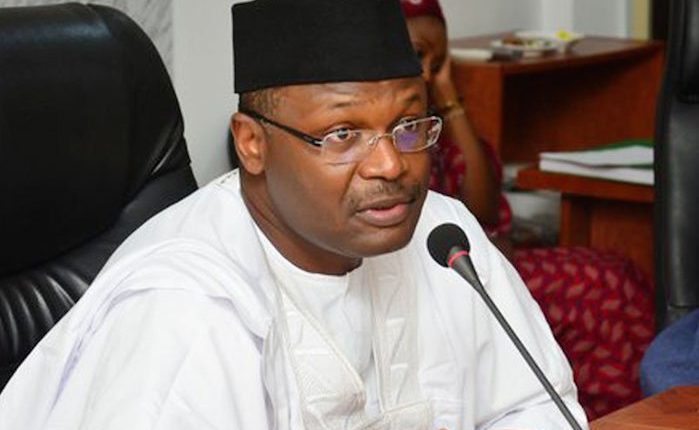
THE Independent National Electoral Commission (INEC) has reacted to The ICIR’s report on the allegation by some ad-hoc staff engaged by the Commission in the conduct of 2019 General Elections.
Press Secretary to the INEC chairman, Rotimi Oyekanmi has requested the details of all those affected with a promise to track their records with the INEC.
Earlier, the Ad-hoc staff, most of whom served in Enugu State, had alleged that the Commission had refused to pay them the half payment of their allowances a year after the conduct of the election.
Jonathan, who served as an Assistant Polling Officer (APO II), Udi Local Government, told The ICIR that it took a protest by some of his colleagues at the INEC office for the commission to pay them half-payments for the services rendered more than a year ago.
“At some point, some of us were not paid at all. We went to INEC Enugu Zonal Office to complain and they gave us forms to fill promising they would pay us in two weeks’ time. Months have gone and yet no payment. They kept giving us form to fill each time we went there to complain.
“At a point, some people tried to stage a protest. Some were paid after that. Security officials stopped allowing us each time we went there. They would tell us to go since we have filled the form to complain, that we would be paid. At one point they claimed they had paid some of us including me which was not true. They asked us to submit our bank account statement. I had to submit my bank account statement.”
He further said efforts by some of them to make sure the Commission pay them the balances have fallen on deaf ears as there have been alleged cases of embezzlement and misappropriation of funds for the election in Enugu State.
An initial attempt by The ICIR to reach the Commission to make comments on the allegation on Saturday was unsuccessful as a call put across to the Press Secretary to the INEC chairman, Rotimi Oyekanmi could not be answered. He also did not respond to SMS sent to him at 6:50 pm the same day.
But in a later call and WhatsApp message on Sunday evening, he asked The ICIR to furnish him with the details of affected persons for a follow-up with the Commission office in Enugu.
“Please supply the full details of all those making the allegations. By this, I mean their full names, the local government areas/polling units where they served, and evidence of engagement given by INEC. These details will enable me to track their records in our State office(s) where they served,” he said.
ANDRY Rajoelina, Madagascar’s President has placed the country’s capital Antananarivo under fresh lockdown following a new surge in coronavirus infections, two months after the restrictions were eased.
Rajoelina said in a statement on Sunday, that “the Analamanga region (under which the capital is situated) is returning to full lockdown.”
According to him, no traffic will be allowed in or out of the region starting Monday until July 20.
A strict curfew will be imposed on street movement by people, the president said.
“Only one person per household is allowed to go out into the street between 6:00 am (0400 GMT) and 12:00 pm (1000 GMT),” he added.
He explained that the measures have been taken “because of the spread of the epidemic and the increase of COVID-19 cases.”
Used to registering dozens of coronavirus cases a day, Madagascar has in recent days seen an exponential rise in daily numbers, jumping to a record 216 cases on Saturday.
The latest tally came after 675 people were tested.
Nearly 24,000 tests have so far been conducted on the impoverished island.
By Sunday, the country had a cumulative 2,728 cases, including 29 deaths since the virus was first detected on the Indian ocean island on March 20.
“All government meetings will now be held via video conferencing, while court hearings have been suspended,” Rajoelina said in the statement.
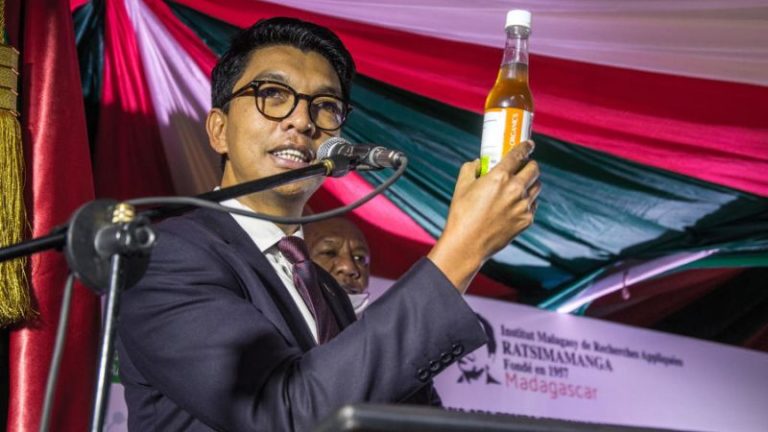
It will be recalled that in April, Andry Rajoelina launched a local herbal concoction he claimed prevents and cures the novel coronavirus.
Rajoelina on his Twitter handle asked people to believe in the country’s ability, and informing them that all profits accrued through the sale of the concoction will be diverted to the Malagasy Institute of Applied Research (MIAR).
The president has been promoting the brew for export, saying it is the country’s “green gold” which will “change history”.
The potential benefits of Covid-Organics, a tonic derived from artemisia — a plant with proven efficacy in malaria treatment — and other indigenous herbs, have not been validated by any scientific study.
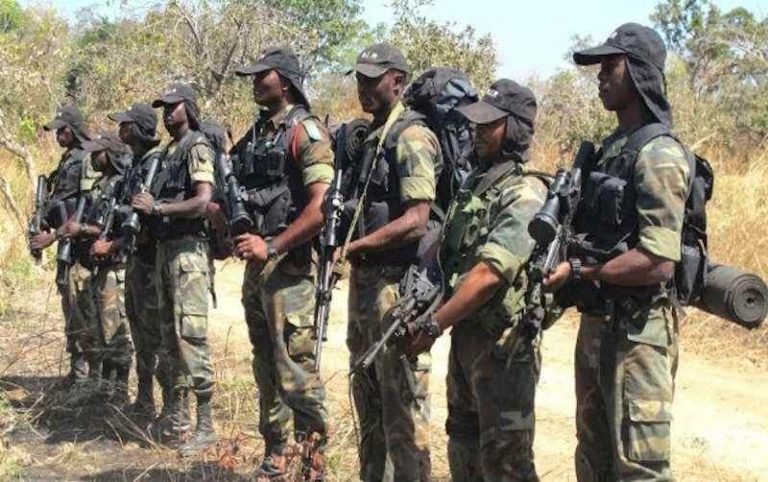
THE Nigerian Defence Headquarters has said that troops of Operation Lafiya Dole killed 75 Boko Haram terrorists and Islamic State in West African Province (ISWAP) fighters in the North east and rescued 35 people held captives, between June 1 and 30, 2020.
John Enenche, Coordinator of Defence Media Operations, who disclosed this on Sunday stated that the troops had 17 encounters with the terrorists during that period.
According to him, 18 women, 16 children and one adult male were all rescued.
“Between 1-30 June 2020, the gallant troops of Operation Lafiya Dole had a total of 17 encounters with the marauding criminals, neutralizing them in the process,” Enenche said.
He further disclosed that the troops were able to recover several weapons from the terrorists including, Anti-Aircraft Gun, 13 Ak 47 Rifles, one Sniper Rifle, 21 locally made guns, two Dane guns and one Rocker Propelled Gun.
Enenche added that other weapons recovered included three Hand Grenades, five Rocket Propelled Gun bombs, 205 rounds of Anti-Aircraft ammunition and 1018 rounds of 7.62mm Special ammunition.
Though largely successful, Enenche disclosed that the troops lost one officer who died during the operation and another wounded in action, noting that the injured officer is currently receiving treatment at the military medical facility.
“Regrettably, one officer paid the supreme price, while one soldier was wounded in action. The wounded personnel have since been evacuated to a military medical facility where he is recuperating,” Enenche said.
According to him, the troops also captured some Boko Haram fighters.
“The period under review also witnessed four surrenders by Boko Haram criminals. The trio of Mohammed Babagana, Modu Jugudun and Alhaji Usman surrendered to the troops of Delta Company at Strong response Area Pulka in Gwoza LGA of Borno State.
While one Mustapha Kori surrendered to torops of Army Super Camp 11 Gamboru in Ngala LGA of Borno State,” he said.
THE Governing Council of the Nigerian Content Development and Monitoring Board (NCDMB) has approved the expansion of the Nigerian Content Intervention Fund (NCIF) from $200 million to $350 million.
The enlargement of the fund by $150 million was part of the decisions taken at the recent NCDMB Governing Council virtual meeting chaired by Timipre Sylva, Minister of State for Petroleum Resources of Nigeria on June 16.
The Council approved that $100 million from the additional funds would be deployed to boost the five existing loan products of the NCI Fund, which include manufacturing, asset acquisition, contract financing, loan refinancing and community contractor financing.
Similarly, the Council also approved $20 million and $30 million respectively for the two newly developed loan product types, the Intervention Fund for Women in Oil and Gas and PETAN Products which include Working Capital loans and Capacity Building loans for PETAN member companies.
It would be recall that the NCI Fund was instituted in 2017 as a $200 million fund managed by the Bank of Industry, BOI, engaged to facilitate on-lending to qualified stakeholders in the Nigerian Oil and Gas industry on five loan product types.
The NCI Fund is a portion of the Nigerian Content Development Fund (NCDF), aggregated from the one percent deduction from the value of contracts executed in the upstream sector of the oil and gas industry.
About 94 percent of the NCI Fund has been disbursed to 27 beneficiaries as at May 2020. The NCDMB has received new applications from 100 companies for nearly triple the size of the original fund.
THE United States of America, India and Ghana have requested for the extradition of 11 Nigerians over money laundering, fraud as well as drug-related offences.
But India’s request was denied, according to a report.
A report titled ‘Ministerial Performance Report May 2019 – May 2020’ presented to the Federal Executive Council, (FEC) by Abubakar Malami, Attorney-General of the Federation (AGF) and Minister of Justice, showed that the Nigerians declared wanted in the foreign countries were linked to fraudulent practices.
However, the identities of the Nigerians involved in the acts of fraud were not disclosed in the report.
The Department of International Cooperation under the Ministry of Justice hinted that between May 2019 to May 2020, it had received a total of 12 extradition requests with eight from the US, three from Ghana and one from India.
It stated that the letters were sent to the INTERPOL to locate the persons named in some of the extradition requests, the Department added that it rejected the only extradition request from India involving a case of alleged money laundering concerning four Indians.
“The request was denied by the HAGF (Honourable Attorney General of the Federation) because the offences allegedly committed by the suspects appeared to be political in nature while a letter denying the request was sent to India,” a section of the report said.
It also stated that the department received 62 requests for assistance in investigations under the Mutual Assistance in Criminal Matters Act 2019.
Nigeria had signed agreements with the named countries to strengthen its ongoing war against corruption within and outside the country.
The report noted that 42 Memorandum of Understanding and agreements between Nigeria and other countries were vetted during the period, while the ministry’s Department of Public Prosecutions received 1,120 terrorism-related cases in one year.
It noted that 500 of the 1,120 cases had been filed at the Federal High Court “while others have been recommended for de-radicalisation.”
The ministry is projecting that by December 2020, about 250 cases would have been concluded while all the cases would have been concluded by 2023.
It added that over 3,392 general and financial matters-related cases were received from the Nigeria Police for the prosecution at the magistrate courts due to the enactment of the Administration of Criminal Justice Act, 2015.
“We are happy to report that over 1,000 of these cases have been completed in the magistrate courts, with the defendants sentenced to various years in the correctional services,” the ministry stated.
The ministry added that it was currently prosecuting 1,359 cases of conspiracy/armed robbery and 10 cases of Securities and Exchange Commission-related offences.
With 10 cases in court over hostage-taking and kidnapping, the report indicated that the ministry was also handling seven cases of pipeline vandalism and 10 cases of electricity equipment vandalism.
The report urged the nation’s anti-corruption agencies (ACAs), to refrain from what it called media trials.
“ACAs also need to desist from ‘media trials’ especially where investigations have yet to reveal tangible evidence that will sustain charges when filed in court,” it read.
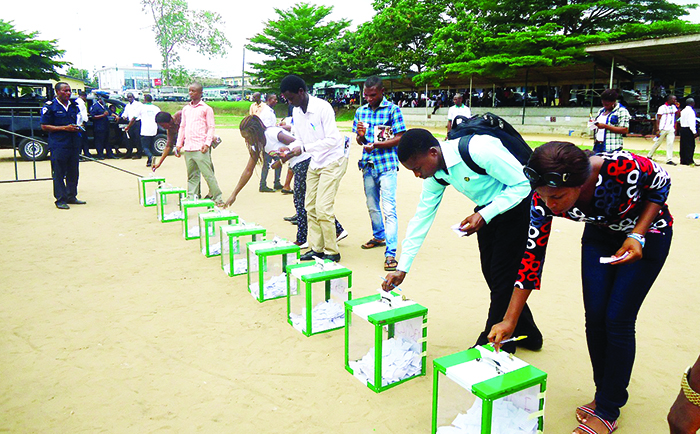
SOME of the ad-hoc staff who served during the 2019 General Elections in Enugu State have accused the Independent National Electoral Commission (INEC) of refusing to pay balances of their allowances since the election exercise ended a year ago.
Adinde Jonathan, who served as Assistant Polling Officer (APO II), Udi Local Government, told The ICIR that it took a protest by some of his colleagues at INEC office for the commission to pay them half payments.
“Some of us that worked as ad-hoc staff in Enugu during the last general elections have not received our complete payment. I worked as APO II at ST. Theresa Uwani I (Polling Unit 006, Voting point A), Amokwe Udi Ward, Udi L.G.A., Enugu State.
“At some point, some of us were not paid at all. We went to INEC Enugu Zonal Office to complain and they gave us forms to fill promising they would pay us in two weeks time. Months have gone and yet no payment. They kept giving us form to fill each time we went there to complain.
“At a point some people tried to stage a protest. Some were paid after that. Security officials stopped us eachtime we go there. They would tell us to go since we have filled the form to complain, that we would be paid. At a point they claimed they have paid some of us including me which was not true. They asked us submit our bank account statement. I had to submit my bank account statement.
“Eventually, I was paid for the presidential election in August, 2019, three months after I submitted the account statement. No other payment after that. I couldn’t go to their office anymore because I had a road traffic accident and broke my knee. During that time, I was calling my SPO and EO and they kept promising me. I was able to go there again with crutches in December, 2019. I went to the account section and they told me to meet my EO. Luckily, I saw my EO there and she told me to send her my details through sms for her to check on her records if my name was among those that she submitted to the commissioner for payment.
“She later confirmed that my name was there. Since then nothing has happened. No payment has been made. What they are owing me is a total of N17,500.”
He said when he visited the commission in February this year to complain, he was told the Economic Financial Crime Commission (EFCC), has taken over the case as there have been alleged cases of embezzlement of money for the election.
“In February this year, I went to INEC Enugu Zonal office again and I was told that the case has been taken over by EFCC. That after compiling names of the affected ad-hoc staff for payment, the authority in charge refused to sign it with a reason that INEC Enugu Zonal office have exhausted the money meant for the payment of the adhoc staff in Enugu state.
“It was alleged that they replaced the names of those that actually worked with some names and account numbers of people that did not work and paid them. It was also alleged that some adhoc staff were mistakenly over paid. According to the source, the case was reported to EFCC who demanded for the records and took over everything.”
“It is painful that after suffering, sleeping in an open field on cold nights including the first day the election was postponed, going to the field to face political thugs and agents, delivering our duties bravely, this ugly story will emanate under the watch of a government that claims it is fighting corruption.
“In February, INEC Nigeria responded to me on messenger after I have sent many messages which they did not respond to. They said they would verify what I complained about. I have written to them to know the outcome but as usual, they have not responded,” he said.
Corroborating Jonathan’s narrative, Chibuzor Vitalif, told The ICIR that he was only paid for the presidential election and allowances for the governorship election have not been paid. He said when they complained, they were asked to submit the statement of their accounts which they did but the commission has not gotten back to them since then.
When contacted, the Electoral Officer (EO) in-charge of Udi Local Government, Mrs. Ejimofor, told The ICIR that she is not in position to make comments on the matter.
Press Secretary to the INEC chairman, Rotimi Oyekanmi said he could not answer call when The ICIR called yesterday. But he also didn’t respond to SMS sent to him at 6:50 pm.
CHRIS Ngige, Nigeria’s Minister of Labour and Employment said the suspended management staff of the Nigeria Social Insurance Trust Fund (NSITF) were involved in embezzlement of public fund to the tune of N3.4 billion.
Ngige said this in a statement signed by Charles Akpan, the Deputy Director, Press and Publicity at the Ministry of Labour and Employment on Saturday.
Akpan in the statement said that preliminary investigations had shown that the suspended members of management of NSTIF were involved in various financial infractions.
He disclosed that the ministry uncovered a scam of about N3.4 billion spent on non-existent staff training split into about 196 different consultancy contracts in order to evade the Ministerial Tenders Board and Federal Executive Council (FEC) approval.
“Non-existent staff training totalling N2.3 billion was documented and paid while N1.1 billion is awaiting payment without any job done, all totalling N3.4 billion,”the statement read.
“Same goes for projects of construction of 14 Zonal/Regional Offices in 14 states running into billions of naira – a policy issue being done without Board or Ministerial knowledge not to talk of approval.”
“This was done in 2019 by the MD and his three-man Executive. Some of the projects are duplication and hence waste of funds, yet you are in the Board supposedly supervising.”
Responding to claims by the Nigeria Employers’ Consultative Association (NECA) on the illegality of the sack of the management team, Akpan said ‘due process was followed’ by the Federal Government in arriving at the suspension order.
He insisted that the minister acted in line with the Constitution, Public Service Rules and NSITF Act.
It would be recalled that NECA made the claim in a letter signed by Timothy Olawale, it’s Director-General, and addressed to the Minister of Labour and Employment.
In the said letter, Olawale referred to the presidential procedure released by the Secretary to Government of the Federation, put in place to stem the arbitrary removal of Chief Executives of government and to ensure stability in the system.
But the Ministry’s spokesperson insisted that NECA did not have the full facts of the matter and was not aware that the Secretary to Government of the Federation conveyed the Presidential approval to the Minister of Labour and Employment for full implementation.
Akpan also noted that the breaches in question started since 2016 to 2019 and were not limited to 2018/2019 as NECA claimed.
He said: “If a minister observes there are financial breaches earlier reported and gross misconduct he does not need to go back to a Board that has been complaining to the same Minister.
“We hope that NECA does not expect the minister to fold his hands like his predecessor who watched helplessly when the last Board Chair in cahoot with the two NECA representatives, MD and officials looted N48 billion from the Fund and are being tried as of date by the EFCC.
“NECA leadership should have been more restrained and responsive to the mantra of this administration like their Nigeria Labour Congress (NLC) counterparts as the NSITF is a Federal Government Parastatal operating within the realm of the Constitution, Public Service rules.”
It added that the NSITF Act has empowered the minister to recommend qualified persons to the President on appointments of chairman and some other management positions.
He noted that, however, ‘the President on the recommendation of the minister also has powers to discipline, suspend or even remove totally, depending on the circumstances of each situation’.
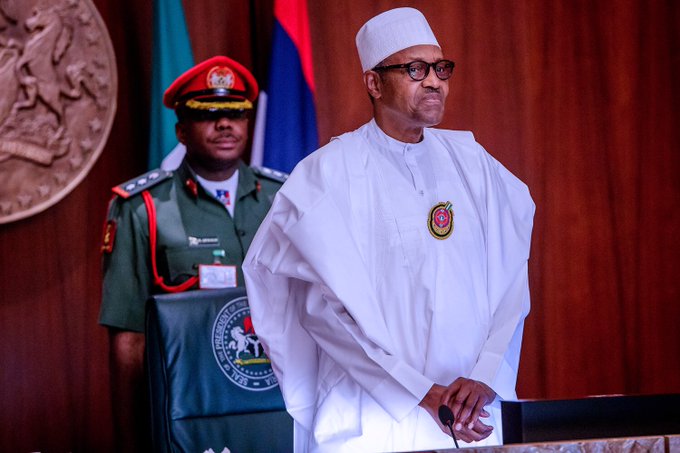
The ICIR reports that President Muhammadu Buhari had on Thursday, July 2 ordered the immediate and indefinite suspension of Adebayo Somefun, Chief Executive of the Nigeria Social Insurance Trust Fund (NSITF), and 11 others in the agency.
The president’s order was a result of established prima facie infractions on the extant Financial Regulations and Procurement Act, and other acts of gross misconduct against Somefun and 11 others, a statement by Charles Akpan, Deputy Director of Press and Public Relations at the Federal Ministry of Labour and Employment said.
Sexual and Gender-based Violence, SGBV, is on the increase in Abuja, the Federal Capital Territory, despite the domestication of Violence Against Persons Prohibition, VAPP Act signed in 2019 by President Muhammadu Buhari. Seun DUROJAIYE reports the travail of victims of SGBV during the lockdown in Abuja.
Photographs and video by Uthman SAMAD.
ON May 10, in Nyanya, a satellite town in the Federal Capital Territory, FCT Abuja, during the COVID-19 lockdown period, 14-year-old Angela Hosana picked the phone of her guardian, who was observing siesta and dialled a number. After a brief exchange, she hung up, stepped out of the house and stood by the gate. She remained there for several minutes, agitated.
It was a Sunday.
As she waited, one of the other girls in the house noticed her anticipation and asked why she was outside.
“Nothing,” she responded, adjusting her red dress as she looked away while still waiting.
Hours passed. Then, a car pulled up. Hosana recognised who it was and she climbed into the front seat. Once the door was shut, Hosanna’s friend, 31-year-old Emmanuel Kamalu, drove off.
The car came to a stop as they approached a lonely road. Kamalu advised that they move to the back seat and Hosana obliged. As they sat together at the back of the car, Kamalu raped her.
“He pulled my dress. Then he removed my pants. He pulled his trouser also and he held me tight and put me on his legs,” Hosana told The ICIR.
According to the Child Rights Act 2003, Section 31, no person shall have sexual intercourse with a child. Subsection 3 states that it is immaterial if the sexual intercourse was with the consent of the child.
It took several hours before she returned home to her guardian, Joy Ogbonna, who had been worried about her whereabouts. After long persuasion, Hosana revealed that Emmanuel Kamalu, a neighbour of theirs, had slept with her.
Ogbonna needed confirmation and Kamalu, who is married, with a son never denied he raped the minor. At her insistence, he agreed to visit a hospital with Hossana for tests.
On the way to the hospital, they were intercepted by military officers who were enforcing the lockdown curfew. Upon hearing the case, the officers, driven by moral rage, descended on Kamalu, only releasing him after he had sustained several bruises and cuts.
“The officers made him strip and they started beating him up. They asked him to submerge himself in a pool of dirty water and didn’t want to release him. They asked if I could drive and when I said yes, they asked me to go without him.
“But I refused because he also had to get tested so we could gather evidence. We spent over three hours at the checkpoint before they released us,” Ogbonna recalled.
When they arrived Nyanya General Hospital hours later, they were greeted by another obstacle. The doctor on duty refused to attend to them, demanding that they first get a police report. It was around 10:00 pm.
As regular practice, following an implicit rule of the Nigerian police, hospitals often demand a police report before treating victims of assaults or accidents, even in cases of emergency, a practice which Anjuguri Manzah, FCT Police Public Relations Officer (PPRO), describes as outdated.
Hospitals are now mandated to treat all patients including those with gunshot wounds without a police report, he said.
In fact, the Compulsory Treatment and Care of Victims of Gunshots Act, 2017, states that every hospital whether (private or public) is expected to treat a victim of gunshot wounds irrespective of whether the person has a police clearance or not.
Manzah told The ICIR that hospitals are only required to report cases after commencing treatments and not before.
But Ogbonna was not privy to this information, else she would have tried harder to convince the doctor. She however managed to reach a friend who intervened and got a doctor to help them out.
“It took several pleadings and the intervention of a doctor friend of mine whom I called before they agreed to test Hosana. The doctor was pissed and asked why I had to go through back channels to compel him to do his work. He said under normal circumstances, they are required to get a police report before doing anything.
“Even at that, they couldn’t do most of the required tests because they didn’t have the equipment. The examination room was dark because there was no light and the doctor had to use a flashlight,” Ogbonna said.
According to Ogechukwu Dike, a medical doctor at Chivar Specialist Hospital and Urology Center, tests such as Hepatitis B and C, HIV, syphilis, a swab (vaginal if possible) for microscopy and culture are routinely carried out on rape victims to establish the absence of preexisting infections before the incident, and thereafter, post-exposure prophylaxis is commenced to prevent certain diseases.
But only a physical examination and urine tests were carried out on Hosana that day.
After the examination, the doctor told Ogbonna that Hosana’s hymen was broken but further tests would need to be taken to determine if the secretion from her private area was semen. He directed them to the laboratory for more tests but the nurse on duty at first, declined to attend to them.
“She said most of the tests couldn’t be carried out because they didn’t have a rape kit for testing.”
The nurse also said the time (around 12.00 AM) when they came was only for emergencies and that Hosana’s case wasn’t an emergency. However, she agreed to do a urine test, advising them to return at another time for the other tests to be carried out.
By daytime, Kamalu was taken to Karu police station, where the case was reported. The police confirmed that he was a repeat offender and had previously been arrested for molesting two young girls but got bailed after spending a few days in detention.
Again, he was detained and asked to write a statement.
In his statement, Kamalu described Hosana as his girlfriend, saying that he was friendly with everyone including underaged girls in the neighbourhood.
“Hosana and I are very close. I’m a free man in the neighbourhood, I’m always free,” Kamalu said.
Kamalu also said he has no bad intention towards Hosana. However, when asked if he would accept if another person rapes his own child, he said no.
“I won’t take it if another man does it to my child but I can forgive him if I know he is sorry for his actions,” Kamalu said, pleading for forgiveness.
It is eight weeks since Kamalu had carnal knowledge of the teenager, yet police said the case is still under investigation, as at the time of filing this report.
The ICIR in an earlier report found that only 65 suspects have been convicted of rape in the whole country, in the last 46 years.
Of all these convictions, 32 took place in 2015 and the years before, while 33 took place after 2015, the report highlighted.
The low convictions directly reflect how the police have handled the administration of criminal justice concerning SGBV victims in Nigeria. But the Nigerian police is not the only law enforcement agency that records low conviction of sexual crimes. The National Agency for Prohibition of Trafficking in Persons, NAPTIP, which has the mandate to protect women and children also appears to have performed below expectations.
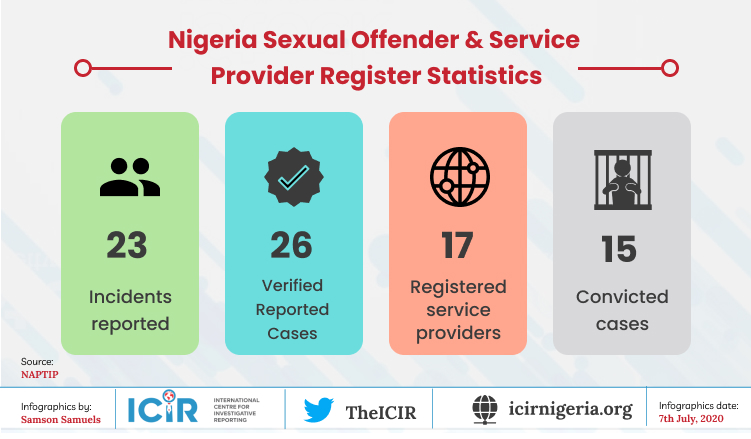
For the year 2020 alone, NAPTIP has only convicted 15 out of 26 sex offenders, representing 58 percent of all verified reported cases, as at the time of filing this report. Though local media report cases of rape and domestic violation almost daily, only a few of these cases are successfully prosecuted.
The abuse of Destiny Ejike, a 17-year-old student is one of those that may not go to trial because of the way it is being handled by NAPTIP.
Ejike and her older jealous lover
In October 2019, Ejike met Job Ikan, a mid-thirties businessman, while she was closing from work in Lugbe area of the Federal Capital Territory (FCT). Ejike recalls that he approached her with confidence and convinced her to share her phone number.
He never stopped calling and Ejike, feeling wanted, agreed to be his girlfriend. Within a short period of knowing her, he started promising marriage and a lifetime of happiness. And at the time, Ejike was seeking admission into the university and thought he could make her dreams come through. He showered her with attention and promised to sponsor her education.
True to his word, he gave her money to enroll in a state university in the north. However, once she resumed school, he became possessive.
Ejike narrating how Ikan subjected her to several forms of violence. CREDIT: ICIR
According to Ejike, he would call every time, demanding her exact location in the school premises and when he felt uncomfortable with her response, he would show up at the school unannounced and demand to see her. The first time it happened, he made her spend the night with him at a hotel.
“He didn’t care if I missed lectures, he made me spend the weekend at the hotel he booked. We had sex and he disvirgined me,” Ejike recalled.
All the while, Ejike kept her love affair a secret from her parents, only opening up when it became too rough to handle. Once they started sleeping together, Ikan became even more obsessed with Ejike. He had the contact details of security men at her school and would grease their palms for information about her movement around campus.
His care metamorphosed into abuse. He would show up at the school, take her to a hotel and beat her up, accusing her of cheating on him. When she tried to end the relationship, he got suicidal.
“I told him I was no longer interested in the relationship and wanted to break up and he started threatening to commit suicide and, on several occasions, he attempted suicide.
“He always said that he would kill himself and make sure that it was only both of us in the room so that if he died, people would think I killed him and I would be jailed for the rest of my life,” Ejike recounted.
The semester ended and Ejike planned to surprise her parents. When she shared her plans with Ikan, he offered to pick her from the bus stop and drop her home.
On the day, he showed up with a car and convinced her to follow him to his apartment. At his house, he locked the door and forced her to spend the night with him.
“He said I wanted to come to Abuja without visiting him. That he would kill himself if I don’t spend the night at his house. He didn’t let me go home that day,” Ejike said.
He eventually released her but the abuse went on for seven months.
Ejike started seeking a way out and told her parents about her affair with Ikan. Her parents reported the case to NAPTIP and as the case was being investigated, Ikan became a human camouflage. He sought the goodness of Ejike’s parents, promising that he was going to marry their daughter and ease them of their financial burden.
He started showing up at their home. When Ejike’s parents voiced their uneasiness with him coming over, it angered him and he recruited them as new victims.
“He would shout and abuse my parents and siblings. He said they were standing in between our love,” Ejike said.
Ejike’s parents again reached out to NAPTIP for help. This time they were assured that he would be stopped.
Emeh Magnus, head of NAPTIP’s Rapid Response Squad (N-RRS) in Abuja, told Ejike and her parents to reach out to him anytime they sensed danger. He told them the case was being investigated and, sooner than later, the suspect would be apprehended.
Weeks after the case was reported, Ikan was still a free man.
In fact, during an interview with the family in their home on May 10, Ikan showed up with a friend, pleading to be forgiven and demanding that the case be withdrawn from NAPTIP.
Ikan described Ejike as his betrothed to The ICIR. When questioned about the abuse and violence, he suspected he was being recorded and refused to answer questions.
“The case is with NAPTIP and I can’t discuss it because it is under investigation,” the accused told The ICIR before he left the house in anger a few moments later.
Afterward, a call was placed to his cell and when he realised who was on the line, he ended the call abruptly.
As at the time of filing this report, Magnus told The ICIR that the case is still under investigation and things were moving slowly because of the COVID-19 pandemic. Meanwhile, the accused has continued to have unfettered access to Ejike and her family.
Aside from the challenges that COVID-19 pandemic presents, NAPTIP commonly struggles to secure justice for victims of SGBV.
According to Godwin Morka, Director of Research and Programme Development in NAPTIP, it takes about three to six months for cases to be addressed in court due to the ‘sensitivity’ of the issues.
However, most cases never get to court for a myriad of reasons. For Priscilla Ubani, a domestic violence victim, justice was a luxurious option.
She found the man of her dreams but he wouldn’t stop hitting her
Priscilla had a tough childhood. From a tender age, she fended for herself and had to engage in menial jobs to pay for her university education.
Right after secondary school she secured admission into a University in her hometown but struggled due to meager funds. To get money she worked as a hairstylist and did neighbourhood promotions for local brands.
She then decided to reach out to her dad.
“He advised me to find a man and get married. He said once I find someone to marry, the person would support me with my education and that was the end of that discussion,” Ubani recalled.
In 2008, Ubani met Joseph and after dating for a few months, she took in and they decided to keep the child. They got married in a small ceremony just before she put to bed.
While pregnant, Ubani secured a job as a teacher and almost very quickly was made to start footing bills for the family.
“The little money I was earning was used for feeding both of us. My husband at the time was taking professional exams and so all his earnings were diverted to his professional development,” Ubani recalled.
When she finally put to bed, it was another mouth to feed. Ubani suggested they start a business that would fetch more money and Joseph agreed with her. They settle on beginning a transportation business.
“We opened a joint account and began saving towards buying a car. We were able to save over N400,000 and we used it to buy a small Mazda car,” Ubani told The ICIR.
But it was never used for transportation business.
“The car became another burden. He would collect money to fuel the car and return home with nothing. All I kept hearing was ‘I fuelled my car, I took my car for maintenance’,” Ubani recalled.
In the same period, Joseph asked Ubani to quit her job. He had complained of her closing hours and demanded that she stopped working in order to take care of their child at home and she agreed.
Not long after, he got fired from work because he got into a fight with a colleague and was reported to the police. It was his ninth year on the job as a Mathematics teacher.
“The owner of the school locked him (Joseph) up for beating up a staff member and said he had enough because it wasn’t the first time he was fighting in the school. So he was fired,” Ubani said.
Joseph, however, told The ICIR that he didn’t get fired. He said he resigned because he was planning to get another job which his wife had promised him. At the time, Ubani was a jobless, stay-at-home mum.
Their living condition worsened.
“He asked me what I had done to him. He said people get married and progress but things are even tougher for him as a married man and I must be the cause of his struggle,” Ubani said with teary eyes.
Most times, he would blame her for their struggles and quiz her about it. When she couldn’t respond, he would beat her up. The violence never stopped and Ubani, wanting to save her marriage, kept it a secret.
“I would tell people I brushed my arm on a hard surface by mistake. I was also wearing long sleeves and extra clothing to cover up the marks,” Ubani said.
One night, he approached her as usual and asked her to think deeply about her family origin and what they must have done in the past to worsen his luck.
“The beating that day was severe. He wouldn’t stop and I tried to reach my phone to call my neighbour for help but as I tried, he smashed the phone on the floor. It was one of the worst days,” Ubani recounted.
She survived the night.
Through the help of her neighbour, she got a job as a secretary and started earning N50,000 monthly. The job was lucrative. Aside from her monthly earnings, she got tips from visitors who came for meetings at the office.
As she worked to keep her family afloat, the beatings continued.
Some days it was a slap on the face and other days, it was several punches in different parts of her body.
In January 2019, Ubani approached the International Federation of Women Lawyers (FIDA) Nigeria, a non-governmental organisation whose core mission is to protect, promote and preserve the rights of women and children in Nigeria, to seek help.
“I went to FIDA to get help but on getting there, I met with Barrister Chinwe Okenwa and she asked me to bring N150,000. I told them that I didn’t have any money and if I did, I would use it to help myself. Money has always been my problem,” Ubani said.
The ICIR reached out to Okenwa through her mobile phone and though she said she couldn’t recall Ubani or her case, she disclosed that many cases come to their office and each peculiar case (or victim) is expected to pay a litigation fee, based on its subject and the court it will be tried.
However, on its official website, the group states that it “actualizes its objectives through free legal representation for indigent women and children,” a far cry from what Ubani says she experienced.
The ICIR reached out to FIDA’s National president, Rhoda Prevail Tyoden, and she promised to get to the bottom of it, iterating that FIDA offers pro bono services for victims of SGBV.
“What you saw on our website is what and who we are. Since I have a name, I will transfer to the Fida Abuja Branch for verifications. Thanks for bringing up. Will get back to you with my findings,” Tyoden said in a WhatsApp message.
As at the time of press, she was yet to share any findings.
For Ubani, the police appeared to be a cheaper option.
When she visited Efab Estate, Lokogoma Police Station for the first time in February, she filed a report against Joseph and sought custody of the kids.
Officer Juliana, the female officer who heard the case and Assistant Superintendent of Police (ASP) Yunisa Mutari, the head of the unit, both intervened and made Joseph sign an undertaking, promising to seek permission before visiting his kids.
They let him go after he dropped his signature.
“We took down her statement. So we intervened and called the husband (Joseph) to sign undertaking that he will not go to the house to see the kids until he gets permission.” Officer Juliana told The ICIR in a phone interview.
She further explained that though Ubani reported a case of domestic violence, it wasn’t a recent incident and they couldn’t do much except settle amicably.
As at the time of filing this report, Joseph still walks around as a free member of society and he believes he has been dealt a blow. According to him, he has only ever hit his wife, Ubani, once in 2018.
“I have only hit my wife once and that was in 2018. I don’t know why she is punishing me for that singular action which I regret every day of my life.
He admitted that he did so under the influence of alcohol and pressure, and he couldn’t fathom why she hadn’t forgiven him.
“Since that time, she sent me out of the house and I have waited for her to come back to her senses but she never did, even as I’m talking to you right now,” Joseph said during an interview with The ICIR.
For Joseph, alcohol was the trigger. The same is for David, who abused his wife for a decade and finally pulled the camel’s back during the COVID-19 lockdown period.
10 years of domestic violence
Ebere Owens in an interview with The ICIR described the pattern of abuse she suffered in the hands of her husband. CREDIT: ICIR
“The abuse started from the moment I got pregnant with our first child,” Ebere Owens, a young mother of two, told The ICIR couched on the bed in her single room apartment.
Owens migrated to Nigeria from Cameroon in 2009 and when she met her husband, David, she believed he was her knight in shining armour. They began dating and during the course of their relationship, she got pregnant and had their first child.
“Most times, he comes back home drunk and after drinking and smoking, the next thing is to start beating me,” Owens narrated.
By the time she had her second child, he had started laying his hands on her kids too.
“You can ask them if it’s beating, he beats them (the children) very well,” She said.
The final straw happened during the COVID-19 pandemic.
They took a trip to her hometown and when she was asked about her husband, she blurted that they were no longer together.
“I rejected him because the abuse was too much. There are many times he has beaten me and I will be unconscious,” Owens recalled.
For rejecting him, Owens got the beating of her life. For two months he didn’t show up in the house. On the day he finally showed up, it was during the lockdown period, his presence startled the kids.
“As he came back, he was drunk and he pounced on me. He was angry that I denied our relationship and when he was done, he started throwing my things out of the house,” Owens narrated.
At that point, she went to the police. The police intervened and arrested David. Days later, he was released on bail, according to Owens.
“I haven’t seen him in four months and I don’t know where he is. I’m afraid that he might come back,” Owens told The ICIR.
The police closed the case.
Sexual and gender-based violence prevalence in Nigeria
According to the Nigeria Demographic Health Survey (NDHS) 2018 report,31 percent of women and girls in Nigeria experience some form of physical abuse and sexual violence, while 9 percent experience sexual abuse, and 20 percent of women suffer female genital mutilation.
The NDHS survey also showed that 55 percent of the women who had experienced violence never sought help or told anyone about the incident. It was found that among women aged 15–49 who have survived physical or sexual violence, only 32 percent sought help from any source, and 12 percent told someone about their experience but did not seek help.
In a 2019 World Bank report on Gender-based violence in Nigeria, it was highlighted that one in “three surveyed women agree that a man is justified in beating his wife in some cases, including if she burns the food, argues with him, goes out without telling him, neglects the children, or refuses to have sexual intercourse with him.”
Due to cultural beliefs and traditions, most cases of SGBV in the country are tolerable. According to a Lancet Global Health 2015 report, tolerant attitudes represent the highest correlated risk factor contributing to the incidence of intimate partner violence in Nigeria.
In some other cases, justice-sector institutions, such as the police and the judiciary, lack the knowledge, understanding, or capacity to address cases of GBV with a survivor-centered approach. It was found that the police often refuse to intervene in cases of intimate partner violence and often describe it as a ‘domestic issue’ or a ‘family matter.’
In defense of the police, a senior officer who does not want to be named because he is not the force spokesperson said that Nigerians cannot blame the Police Force for failing in the fight against SGBV, as it is not equipped to do so.
“It is easy to blame the Nigerian Police but is it equipped to fight gender-based violence? Does the police budget have special subheads to enable it do forensic investigations? Yes, there is now a gender unit, but are its officers given any special training in the psychology of handling such cases? ” he queried.
The officer stated that for the police to be able to properly handle SGBV cases, it has to have special funds to conduct forensic investigations, “to examine evidence such as body fluids, semen, blood and so on to determine the culpability of an accused person”, noting that one of the biggest challenges of prosecuting rape cases is the lack of forensic evidence.”
Besides, he said that officers of the force, not just those of the gender unit, have to be trained and retrained “in the special area of handling such cases (SGBV), even in the psychology of dealing with victims.”
The Violence Against Persons Prohibition (VAPP) Act
The VAPP Act, signed into law by President Muhammadu Buhari in 2019, is a legal framework that transcends the criminal and penal code in guaranteeing justice and protection of rights and properties of victims of sexual and gender-based violence in the country.
However, of the 37 states in Nigeria, including the FCT, only 14 have domesticated the law, while 23 states are yet to adopt the Act. The majority of the states are in the north.
Inactions that Lemmy Ughegbe, a children’s advocate and Director of Make a Difference Initiative, concludes is “incalculable damage to the efforts to rid the society of sexual abuse, child sexual abuse and Gender-based violence.”
“We must point out that whereas the constitution recognises that no one under 18 years can lawfully and validly consent to sex, the Penal Code as operated by Northern Nigeria says a girl of 14 years or who has attained puberty can be engaged in a sexual relationship,” Ughegbe said in an interview with The ICIR.
Civil Society Organisations (CSOs) bridging the gap
Against all odds, CSOs such as Dorothy Njemanze Foundation (DNF) exists to bridge the gap. With a mission to end sexual and gender-based violence through direct support for survivors, DNF uses a community-based approach to provide responses to cases of SGBV.
According to Dorothy Njemanze, founder of the organisation, real-time responses aren’t provided to SGBV victims and that’s where DNF comes in.
“We liaise with law enforcement agencies and as much as challenges arise ever so often, things are picking up. For instance, the police hospitals are more inclined to help victims and doctors in these hospitals offer to testify in a situation where the case gets to court.
“However, we have funding challenges. Most times we fundraise for victims through social media and rely on the donations received from well-meaning Nigerians,” Njemanze said.
Nevertheless, The ICIR found that the VAPP Act is a good law on paper, but poorly enforced by the police.
And this is the reason why the likes of Hosana, Priscilla, Ebere, and other victims of sexual violence may not obtain justice before they are again violated.
* This investigation is supported by the Institute of War and Peace Reporting and the International Centre for Investigative Reporting, ICIR.
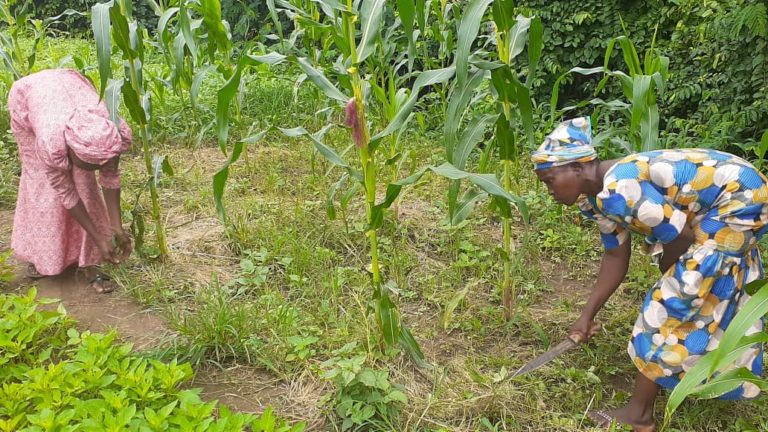
NIGERIA currently lacks data on the actual population of agriculture extension workers and total number of farmers, an official of Federal Ministry of Agriculture has said.
Frank Satumari, Director, Department of Agriculture and Extension Service in the Federal Ministry of Agriculture and Rural Development disclosed this at the weekend during a meeting organised by ActionAid Nigeria to support women farmers under the aegis of Small Scale Women Farmers Association of Nigeria (SWOFON).
According to him, unlike the Food and Agriculture Organisation (FAO) standard where one farm extension worker is assigned to 800 farmers, one extension agent in Nigeria is meant to work with 5,000 farmers. This, he described as an abnormal situation.
The meeting was organised to examine SWOFON’s access to extension services, inputs during and after the Coronavirus disease (COVID-19) pandemic.
Satumari, however, disclosed that the government would give priority to graduates of Agricultural Extension Services in its proposed training for 76, 000 farm extension officers across the nation.
He said a committee set up by the ministry has already recommended to Mohammad Nanono, the Minister of Agriculture on the necessity to increase the population of extension service officers as part of efforts to build farmers capacity to yield better productivity.
“I can assure that during the discussion on how to implement this training, we have made it a priority for a graduate of extension service of agriculture to be given priority before considering any other profession,” he said.
Santumari said 14 million farmers were enumerated through the Growth Enhancement Support scheme (GES) when Akinwumi Adesina was the Minister of Agriculture about five years ago.
This figure, he said, has not been updated since then.
He, however, revealed that the 75, 000 proposed extension service officers including about 100, 000 N-Power Agro beneficiaries would help bridge the deficit.
The Director also hinted that there are 8,000 private extension service workers complementing those from the public service.
Speaking during the meeting, Mohammed Othman, Executive Director, National Agriculture Extension Services (NAES), in his remark, shared similar opinion with Satumari on the low population of extension agents compared to the number of farmers in the country.
Othman said there are only 14, 000 farm extension workers in the country with a ratio of one extension agent to 10, 000 farmers, according to a study on Agricultural Performance Report (APR), 2017/2018 conducted by NAES.
Earlier, Mary Afan, SWOFON President urged the ministry to increase its commitment to supporting women farmers, especially in the area of extension services, interventions in form of grants, tools and other farm inputs.
She said some members of the association in Abuja, Kaduna, Gombe, Oyo and Kogi states have benefited from the ministry’s support, noting that other states are also waiting to benefit.
“In Plateau, the commissioner just announced plans to commence distribution of agric inputs but they are yet to start,” she added.
Ene Obi, Country Director of ActionAid advocated need for the government to release more funding to the ministry stating that the amount approved is not what is eventually released for project executions.
Obi, who emphasised that 75 per cent of farmers in the country live in rural areas, called for regular capacity building for the extension workers.
“Federal Government should recruit more qualified extension workers urgently,” she said stressing that it was difficult to determine actual allocation for agriculture extensions from the ministry’s budget.
“The service conditions of extension workers require a review. Make the service attractive, especially now that youths are asked to embrace agriculture like the N-Agro.”
She urged the ministry to partner with the state governments to develop the sector and ensure the extension service officers are Information Communication Technology complaint.
Farm extension officer is an agriculturist who shares latest information on better farm practice with rural farmers in order to help improve efficiency, reduce the cost of production, pest infestation, guide the farmers on the right use of farm inputs such as machinery, pesticides, herbicides in overall attempt to boost farm yields.
THE United Nations (UN) has condemned the Boko Haram attack in Damasak, Mobbar Local Government Area of Borno State on Thursday where two people including a five-year-old child were killed.
Edward Kallon, UN Humanitarian Coordinator in Nigeria, in a statement made available to The ICIR on Saturday decried the July 2 attack, where a humanitarian helicopter also suffered damages.
“I am gravely concerned by reports of another violent attack by non-state armed groups in Damasak,
Borno State, on 2 July, in which at least two innocent civilians lost their lives, including a five-year
old child. Several others were injured, and a humanitarian helicopter was hit, sustaining serious
damage,” Kallon said in the statement.
“I strongly condemn any attack against civilians, humanitarian assets or aid workers and call on all armed parties to respect international humanitarian law and international human rights law, and ensure the protection of civilians, humanitarian property and personnel.
“I furthermore call on all parties to allow and facilitate safe and unimpeded access for humanitarians to deliver life-saving assistance to the most vulnerable people in the north-east.”
He also extended his condolences to families of the civilians who lost their lives in the attack and wish a prompt recovery to those injured.
The UN official confirmed that while a UN Humanitarian Air Service helicopter was hit by bullets during the attack, no aid workers were on board at the time, just as he commended the crew for piloting the chopper to safety during the attack
“I deplore that a UN Humanitarian Air Service helicopter was hit by bullets during the attack. No aid workers were on board at the time and crew members are all safe.
“My thoughts are also with the crew and I commend them for piloting the chopper back to safety during this critical situation,” he stated
Kallon lamented that the attack and damage to the helicopter severely affected the ability of aid actors to provide urgently needed assistance to vulnerable people in remote areas across Borno State.
“The UN Humanitarian Air Service is essential to evacuate wounded civilians and remains the backbone to facilitating humanitarian access, thereby enabling UN agencies and non-governmental organizations to safely and securely reach the most vulnerable populations,” he said.
“In 2019, UNHAS transported 66,271 passengers and 147 megatons of humanitarian assistance, as well as conducted 30 medical and 70 security evacuations.”
He further stated that insecurity and violent attacks have continuee to hamper the ability of people to access basic services or livelihoods and recover from the protracted crisis in North-east Nigeria.
“The United Nations and NGO partners are working to bring life-saving assistance to 7.8 million people in the crisis-affected states of Borno, Adamawa and Yobe states, many of them in remote areas.”
According to him, Nigeria’s Government commitment to investigate the attack and swiftly bring to justice the perpetrators is a welcome development.
He, however, called on the Nigerian authorities to reinforce the safety and security of all humanitarian workers in the North east.