Home Blog Page 2088

Covid-19: How a major industrial unrest was averted at NAUTH, Nnewi

By Chukwuma NNAMDI


THE management of Nnamdi Azikiwe University Teaching Hospital (NAUTH) Nnewi, Anambra State, recently averted industrial unrest after reaching an agreement with members of the National Association of Nigeria Nurses and Midwives, (NANNM), that had threatened to begin strike action after a one-week ultimatum.

A letter titled “NANNM NAUTH DEMANDS: Re: Covid-19 Pandemic in NAUTH addressed to the Chief Medical Director of the Hospital expresses the concerns of the nurses and midwives of the teaching hospital.

The health workers wanted an adequate supply of personal protective equipment, and information on the number of suspected cases of COVID-19 managed by NAUTH.


READ ALSO:

The information should include the number of confirmed COVID-19 cases in NAUTH, number of nurses exposed to COVID 19, number of nurses tested and their results.

They also want to know why CMAC is not signing unit heads’ requests in view of the provision of adequate PPE, among other requests.

The letter noted that as front liners in the battle against COVID 19, the nurses have the legal right to a healthy and safe workplace hence they are not under obligation to provide high-risk services without appropriate safety protection.

Signed by Chairman, Com H.U Nwobodo, and Secretary, B.N Emerson, the letter warned that the nurses would withdraw their services if the demands were not met within one week.

In an interview, Nwobodo decried the delay by the management of NAUTH to address their concerns as well as cater for the welfare and well-being of members.

He accused the hospital management of exposing staff (including nurses) to danger, noting that recently when a patient, who finally tested positive for COVID 19, came into the hospital through the Accident and Emergency Unit and was later transferred to the medical ward, it caused palpable fear in all members of staff.

“The person came in through the Accident and Emergency Unit and was later transferred to the medical ward. This person was being treated in the ward and nobody knew about his status until a test was conducted on him and the result came out positive. The patient was then taken to the General Hospital, Onitsha, where they have an isolation centre.”

He is worried that many people were already exposed to the patient. “The question is – how are you treating those already exposed?” he wondered.

…a voice from isolation

One of the nurses in isolation who spoke with The ICIR under anonymity complained bitterly about the condition in the hospital.

“I am not surprised but I am disappointed in the management asking us to go into self-isolation in our respective homes. In fact, my own worry is that the patient should not have been treated in the ward. Once they suspected a case, they should have isolated such cases from other ones. But they left him for forty-eight hours after the sample had been collected and we were managing him. All the nurses in that place were just coming in contact with the patient. That was the disappointment”.

The nurse also was bitter that as at Wednesday, June 3, there had been no call from the management to find out how she was doing.

“They have not called. Tomorrow (Thursday) makes it a week since we were asked to go and isolate ourselves. I am on my own now, that’s what it means but I believe that nothing will happen to me. It’s just that whenever a case is suspected, they should remove such cases from every other patient. We have an isolation centre, which was meant for Lassa fever then. Currently, I don’t know it’s present state whether they are using it or not. I don’t know, I am not sure. I don’t work there”.

The nurse, who had gone spiritual hoping that nothing goes wrong with her, gave the management some advice.

My advice is that whenever a case is suspected, they should not take it to where every other person is being treated. That person was there for one day I worked and I left him there. Nurses, portals and every other one stays longer in the hospital than doctors who will come only when on call. Nurses stay with patients and sometimes they will call you. When such calls come, you must attend to them twenty-four hours. That is why we are more endangered than doctors.

“However, we are expected to work with our conscience. While the treatment lasted, the only PPE we wore was N-95 masks. No other thing. But my own point is that that person should not have been where he was treated. He should have been separated from others. That place is not suitable for him. It’s not ventilated. He shouldn’t have been left there. This is not the first case. Sometimes, they allow suspected cases in the ward for forty-eight hours, seventy-two hours, even more than that, our lives had been endangered there. I appeal to the management to value the lives of their staff more than they do at the moment.

“The management is aware of our grievances. Our union leaders have met several times with them. We have also given them a week ultimatum to meet our demands or we withdraw our services. The fact is that we cannot continue to work under this condition. Our work is to save lives. It should not be heard that we are being exposed by our management to avoidable situations that can even lead to death” the nurse concluded.

…Most grievances out of ignorance

The Chief Medical Director of the Hospital, Professor Anthony Igwegbe, said in a telephone interview on Friday, June 5 that most of the issues raised by the members of the National Association of Nigeria Nurses and Midwives, NANNM, were out of ignorance of the realities surrounding the management of the facility.

“Well, most of these issues are raised out of ignorance. We have tried to do our best within the limited resources at our disposal. Yes, I know there are challenges but we are moving on, trying to ensure that what is necessary is always provided. If I tell you that even today, I have used my personal money to buy some items for use this weekend. That is to ensure that work does not stop until Monday when management will procure those materials. Nobody knows about this, if not that I am telling you about it now”.

Professor Igwegbe also reacted to the allegation that staff members are being made to treat suspected COVID 19 patients without adequate precautionary measures.

He said: “What we do is to ensure rational use of the protective wears. They are not meant only for treating COVID 19. They are used in treating other health challenges. As I am talking to you now, surgery is going on and surgeons are wearing PPE. So, we don’t encourage irrational use of these materials. It costs a lot to procure them and they are also not readily available.

“So, if they say they are being exposed to COVID-19, it is not true. We value the lives of our staff and we will not want to see any of them exposed to dangers on the line of duty. And I am happy to tell you that all issues with the association you mentioned had been resolved. We met with them and agreed to move on. So, the threatened industrial action had been aborted. That tells you how committed the management is to the welfare and well-being of all staff”.

Igwegbe had earlier described the COVID-19 patient as a case of auto hemolytic anaemia, being managed by the Haematology Unit.

“He was admitted into A/E on the 24th of May. He subsequently developed symptoms suggestive of COVID-19 infection. Samples were taken and sent to ISTH Irrua for testing. The result released today showed he tested positive to COVID-19. The management has met with all the units involved in the management of the case and instituted the appropriate measures in terms of self-isolation for our staff, and contact tracing has commenced. The patient has been moved to the treatment centre in Onitsha. The management will continue to take appropriate measures in protecting our members of staff especially the front line staff during this pandemic. Please, do adopt the universal standard precautions in carrying out your duties”.

Nwobodo, however, confirmed that the issues of concern to them had been resolved in the meeting, expressing hope that the management would not renege on all the agreements.

The complaints about non – availability of PPE for the treatment of COVID 19 is not new as several medical and health workers in various parts of the country, had at one time or the other cried out.

A retired Anglican Bishop, Right Reverend Raphael Okafor, recently appealed to the government at all levels to take the provision of PPE for medical personnel seriously to ensure they carry out their duties unhindered and with a sense of security.

Speaking when he led a team of clerics under the Igbo Christian Restoration Assembly, (ICRA) to the Government House, Awka, Bishop Okafor described as suicidal treating COVID-19 patients without PPE.

“The government must do more. No-one sees death and voluntarily wants to go and die. It’s a commitment for the doctors to attend to the patients. But when you know that the disease is infectious, then, it’s mandatory they have the PPE. When they are not provided, you don’t expect them to commit suicide because many doctors have died in the process”.

Similarly, Governor Willie Obiano in a recent COVID-19 broadcast advised all hospital to establish what he called mini holding-wards, where patients, whose samples had been taken for COVID-19 test, can be kept until the results are known.

The number of confirmed cases recently increased to twenty-nine with seventeen new cases confirmed on June 6. This is an indication that a greater challenge may lie ahead for the health workers.

 

Online News Association 2020 worldwide journalism contest

0

THE Online News Association (ONA) is accepting applications for the 2020 Online Journalism Awards recognizing excellence in digital reporting.

According to the association, online journalists, digital news organizations and students worldwide can apply for an award.

The Award categories include data journalism, visual digital storytelling, investigative journalism, public service, technical innovation, general excellence and more.

This year features two new categories: climate change reporting and excellence in newsletters.


READ ALSO:

The contest offers five awards totaling US$31,000, courtesy of the Knight Foundation, the Gannett Foundation, Agora Journalism Center and the University of Florida.

Awards will be given at the Online News Association Conference & Awards Banquet September 30 to October 3 in Atlanta. The OJAs, launched in 2000, are a comprehensive set of journalism prizes honoring excellence in digital journalism. You can view a list of the 2019 winners here.

Entries must have published between June 1, 2019 and May 31, 2020. Although English translations are strongly recommended, works may be submitted in any language.

The entries deadline has been extended to June 11.

To apply, click here

UN Chief speaks against racism, says it’s abhorrent and nasty

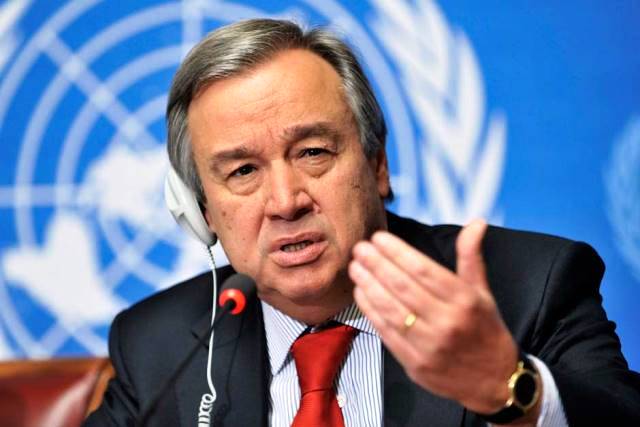
ANTONIO Guterres, UN Secretary General has spoken against racism describing it as  abhorrent and nasty which must be rejected everywhere at any moment, and condemned in a clear way.

Guterres spoke as anti-racism protests spread across the globe after police killing of George Floyd, an African-American.

A number of monuments with links to colonialism and slavery have either been defaced or pulled down in Europe and the US as protests continue for racial justice, Aljazeera reported.

“The societies that are diverse can only succeed if there is a massive investment in social cohesion, by governments, local authorities, civil society, churches, against discrimination and inequality,” Guterres wrote on Twitter Wednesday.

He said  that racism is the rejection of people’s common humanity, which is a central aspect against the charter of the United Nations.

The UN scribe said his position on racism is crystal clear, noting that racism violates the UN charter and debases its core values.

“My position on racism is crystal clear: this scourge violates the UN Charter and debases our core values. Every day, in our work across the world, we strive to do our part to promote inclusion, justice, dignity and combat racism in all its manifestations,” he said.

According to him, the The United Nations has a proud record of fighting racism and all forms of discrimination.

“I am proud of @UN staff who are condemning racism and expressing their solidarity with the victims of hate,” he said.

On May 25, 2020, George Floyd, a 46-year-old black man, was killed in Minneapolis, Minnesota, during an arrest for allegedly using a counterfeit bill.

Derek Chauvin, a white police officer, knelt on Floyd’s neck for almost nine minutes while Floyd was handcuffed and lying face down in the street, begging for his life and repeatedly saying “I can’t breathe”.

A second and third officer further restrained Floyd while a fourth prevented bystanders from intervening. During the final three minutes Floyd was motionless and had no pulse while Chauvin ignored onlookers’ pleas to remove his knee, which he did not do until medics told him to.


Group protests against rape, sexual violence in Abuja

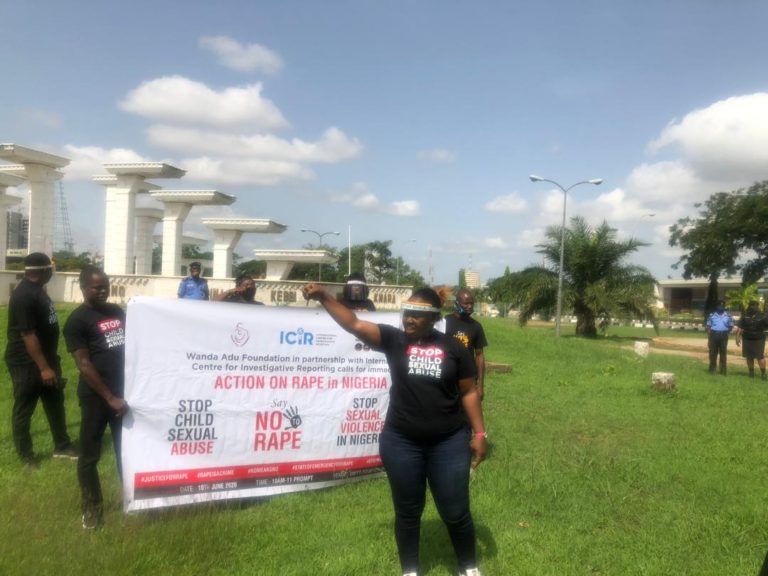
A civil society organisation, Wanda Adu Foundation (WAF) which focuses on helping vulnerable women and children, has called on the Federal Government to end the scourge of rape and sexual violence against women and girls across the country. 

Leading a protest at the Unity Fountain, Abuja on Wednesday to demand end to rape and sexual violence, Wanda Adu, Executive Director of WAF lamented that perpetrators of such crimes against women and girls are often left off the hook while their victims live with the scars and stigmatisation for ever.

“We are tired. In a year, there are over 1,000 cases of sexual abuse and violence in Nigeria and when you check, you see that only two or three have been prosecuted,” she said.

https://www.facebook.com/TheICIR/videos/679190505976004/

“Is our government trying to tell us that rape is okay? What message are they sending when abusers are not punished for raping minors and women?”

Adu disclosed that her Foundation has received several reports of abuse often perpetrated by family members against minors, citing a case of a 5-year-old girl that was raped by a man in his 40s and left her with damaged organs.

Also speaking during the protest, Lemmy Ughegbe, Director of Make a Difference Initiative noted that rape used to be a virus in Nigeria  but now has now become a pandemic  capable of swallowing future generation.

Ughegbe who called on the government to act, cited a 2015 report by UNICEF, which reported that one in every four girl child in Nigeria is raped before her 18th birthday and one in every 10 boy child gets raped before his 18th birthday.

According to him, the figures are much worse in 2020.

“Today, you can’t open the newspaper and not see at least two or three cases of rape. It’s happening all over the place,” he said.

Advising the government to take action, Ughegbe reiterated that there must be an intentional strategy and approach to dealing with cases of sexual and gender-based violence in the country.

He advised that all states should adopt the Violence Against Persons Prohibition (VAPP) Act, which at the moment has been adopted by 11 out of 36 states in Nigeria.

During the protest that kicked-off at about 10am at the Unity Fountain, the protesters took to Unity displayed banners with various inscriptions condemning rape and sexual violence, asking for justice for victims and calling for punishment for perpetrators.

They clenched their fists as they demanded that the government put laws in place to hold perpetrators of sexual and gender-based violence accountable for their actions.

The protest was supported by the International Centre for Investigative Reporting (ICIR) and Institute for War and Peace Reporting (IWPR).

On June 5, a group of Civil Society Organisations staged a protest at the Police headquarters in the FCT with calling for justice for victims of rape and punishment for offenders.

Among the CSOs that attended the protest were TechHerNG, Girl Child Africa, Connected Development, Enough is Enough Nigeria, Stand To End Rape, SilverChipFox, Yiaga Africa, Dorothy Njemanze Foundation, and Education as a Vaccine.

Part of their demands was that the leadership of the Nigeria Police should ensure prompt investigation and conclusion of rape and all sexual and gender-based violence cases across the country.

After calling for reduction of civil servants’ salaries, Ndume canvasses part-time National Assembly

ALI Ndume, Chairman, Senate Committee on Army, says the Federal Government should consider a conversion of the National Assembly to a part-time legislature during amidst the Coronavirus disease (COVID-19) pandemic to save cost.

“As far as I’m concerned, we can make the National Assembly a part time arrangement for now since we conduct our sitting once or twice in a week these days,” Ndume said on Wednesday.

“If we make it part time, that means our salaries must be reduced.”

This is coming less than 24 hours after Ndume was reported to have called for reduction of civil servants’ salaries.

While speaking to reporters in Abuja in an interview according to The Nation, the lawmaker denied calling on the Federal Government to cut the salaries of civil servants in the country.

Ndume said he was quoted out context in the report.

According to him, public servants across the three arms of government “not working full-time” during the present pandemic should no longer be paid 100 per cent of their salaries.

“The statement credited to me was not a complete statement and I was quoted out of context,” Ndume said.

“When they asked me questions about the revised budget, I said we should fasten our belts during this pandemic due to the fall in the prices of crude oil which is the mainstay of our economy,” he added.

Ndume said he had advised the Federal Government to look critically into cutting down the cost of governance.

“I said the Federal Government should critically look into cutting down of the cost of governance,” he said.

“I called for the reduction of overhead cost, salaries of senior public servants and the recurrent expenditure. That is what I said and I still stand by it.”

The senator representing Borno South Senatorial District was reported by many media outfits (The ICIR not inclusive) that Government should critically look at the personnel and recurrent expenditure which consumes about 70 per cent of the budget.

“People should make sacrifices. This is the time to look at issues critically. But as I said, When I talk like this – and make my opinion – people look at it and call me all sorts of names. But I try to express myself,” he was quoted as said.

In his interview on Wednesday, Ndume said he couldn’t have called for the reduction of salaries of lower civil servants, because the ‘salaries are too small.’

He argued that Nigerian civil servants deserve palliatives from all tiers of government.

“As a matter of fact, Nigerian Civil Servants deserve palliatives from all tiers of government, even with their salaries,” he said.

“I maintain that since most of us who are public servants across the three arms of government are not working full time for now, our salaries should no longer be paid 100 per cent.

“Overhead should also not be 100 per cent again. All those travel allowances should stop because we are no longer traveling.

“We are operating from online now, the provision for stationery should be stopped. By that so many expenditure would have been removed.”

Explaining why he called for a part-time National Assembly, he said: “The reality is that we can’t continue in a situation like this where 70 per cent of the country’s budget is going to personnel and recurrent expenditure as if everything is okay.

“This is a time when we are borrowing to fund the budget. I didn’t say salaries of civil servants who are struggling to survive, should be slashed.”

He insisted that the government should identify public officers that can work part time and reduce their salaries.

“For example, even we in the National Assembly, for the period of this pandemic, I strongly advocate that the work of the legislature and other people should be made par time and therefore, pay them on part time basis to reduce the cost,” Ndume said.

He stressed that there are jobs that are not critical, that could be converted to part-time basis to reduce cost, noting that the jobs of medical personnel cannot be made part-time.

Racism: Merriam-Webster set to change definition

THE American dictionary Merriam-Webster is set to change its definition of the word racism after receiving an email from a young black woman.

Kennedy Mitchum, a graduate of Drake University in Iowa, suggested that the definition should include a reference to systematic oppression.

“I kept having to tell them that definition is not representative of what is actually happening in the world,” she told CNN.

“The way that racism occurs in real life is not just prejudice – it’s the systemic racism that is happening for a lot of black Americans.”

Merriam Webster’s definition

Merriam-Webster’s editorial manager Peter Sokolowski in response to Mitchum’s request told the AFP news agency that the second definition will be updated to reflect the request.

“We will make that even more clear in our next release,” Peter Sokolowski said.

“This is the kind of continuous revision that is part of the work of keeping the dictionary up to date, based on rigorous criteria and research we employ in order to describe the language as it is actually used,” he added.

The decision comes amid international anti-racism protests after the death of George Floyd in Minneapolis.

Floyd died after a white police officer held a knee on his neck for nearly nine minutes.

Estimated billing: Nigerians relive experiences as electricity regulator, NERC, “slowly” intervenes

UMAR Labbo, 36, was in good spirits when he moved with his family of three into a rented apartment in Nyanya, a suburb of Abuja in 2017, and when he received the first electricity bill for his one-bedroom flat he knew something was off.

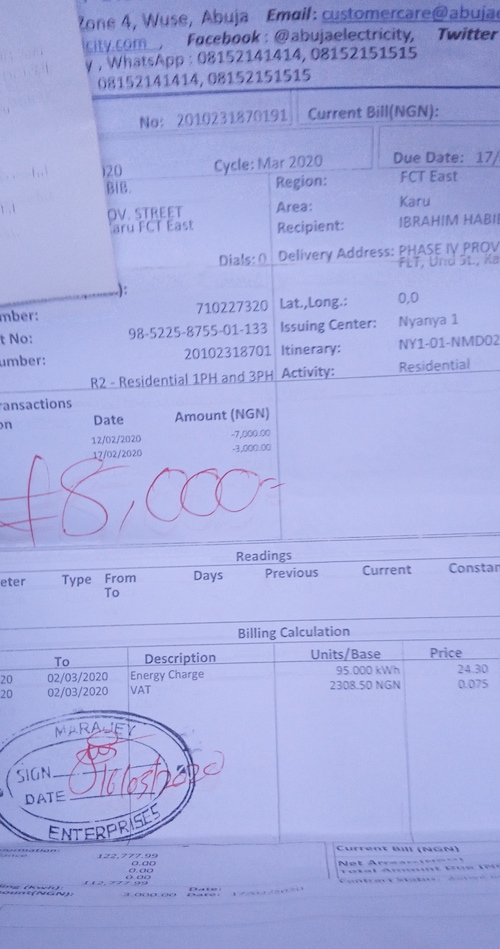
The bill received from  Abuja Electricity Distribution Company, AEDC, stated that he was owing N112,777 as his outstanding arrears barely a month he moved into the house.

The debt owed by the former occupant of the house was added to his own monthly charge of N10,000,  but despite his explanations, officials of the AEDC did nothing.

Rather they insisted he would have to offset the previous debt by paying in parts or risk being disconnected.

“It is ridiculous how they charge me monthly without regard to the appliances being used in the house or the supply of power which is erratic. I have applied for a prepaid meter to be able to monitor how much electricity I have consumed but since last year they are yet to deliver it,” he said.

Umar’s electricity bill for May, after paying N8,000. Credit: The ICIR

Distribution companies in the country had charged between N25 to N30 for 1 Kilowatt Hour, Kwh, of electricity, consumed on the national grid for the use of each domestic appliance per hour though the charges depend on the type of tariff plan which could be residential or commercial.

“The officials just put down figures they feel like and expect us to pay without taking note of the gadgets in our homes or the number of times they supply power so what is the essence of the estimated bills for houses without meters,” he told The ICIR.

For Labbo, this pattern of “estimated billing” by the AEDC has become very familiar and unfair but without a prepaid metre, the practice has continued, especially during the nationwide lockdown.

In February, the Nigerian Electricity Regulatory Commission, NERC, the nation’s power regulator announced limits on estimated bills to be issued by electricity distribution companies also known as DisCos to unmetered customers placing the maximum monthly tariff charged a residential customer at N1,872 per month.

However, the limits placed by the regulatory agency has been flagrantly disregarded by the electricity distribution companies as tales of outrageous charges by electricity consumers have continued to emerge.

Labbo’s frustration reflects the plight of 4.09 million Nigerians who do not have access to prepaid meters according to a Price Waterhouse Coopers, PWC, 2019 report as they recount tales of outrageous bills that do not reflect the electricity they consumed in their homes.

Tales of unfair treatment, extortion

In a report, Funke Osibodu, Chief Executive Officer, CEO, of Benin Electricity Distribution Company, BEDC, said during the lockdown, the DisCos experienced supply disruption, rising cost due to exchange rate volatility and loss of revenue.

“Our costs have gone up but revenue has gone down, as our industrial and commercial customers have been hard hit leading to drop in demand,” she said.

During the shutdown which affected several religious and industrial clusters, electricity consumers across the country who have no meters have borne the financial burden of estimated electricity bills.

Benjamin Uzordimma resides in a two-bedroom rented flat in Omilani off Ijesha in Surulere, a suburb of Lagos State under the Eko Electricity Distribution Company, EkoDisco, an apartment he moved into 16 months ago.

He started to worry when his electricity bills rocketed from N9,000 in December 2019 to N21,000 in April without a change in the appliances he used in the house.

“It is a serious problem for me because there is no change in what I have been using in my house and the bills keep rising without reason and the worst of all is that they don’t factor in the number of times they supply power which on some bad days for three days on a stretch they won’t supply power,” he told The ICIR.

Social media has also been flooded with complaints about the crazy estimated bills charged electricity customers as they vent their displeasure with the DisCos on Twitter.

A Twitter user identified as Ikechukwu Bobo, who lives in Ijeshatedo in Surulere, Lagos state in a compound with six single rooms with six occupants said their bill rose from N13,000 to N28,000 despite the incessant power cuts.

Another Twitter user known as Chukwuka Steven said EkoDisco kept increasing his estimated electricity bill though he was on a residential electricity tariff plan.

“I stay in Satellite town in Lagos State precisely in a three-bedroom apartment and my bill for just this month was 37k. I was wondering if I had a mini-factory in my house,” he said.

BEDC was not left out. Their customers are complaining of being ripped off. Iyinta Ijesha, recounting his ordeal said he was shocked after being presented with an outrageous bill even though they lacked power supply for two weeks.

“I have been paying heavily for no energy from BEDC under the guise of estimated billing from Olorunshogo area of Ekiti state. Between April 8 and 29th, there was no energy supply, but at the end of the month, they brought N11,800 bill. I was dumbfounded,” he said.

In 2019, according to data obtained from the Nigeria Bureau of Statistics, NBS, about 7.48 million residential households are connected by the distribution companies, but only  3.39 million households are metered which means 54.7 per cent of electricity consumers in the country have no meters.

The dilemma of electricity consumers who are placed on estimated billing as they relive their experiences is an indication that NERC did not ensure electricity distribution companies complied with the capping of estimated billing as the extortion cycle continued.

The failed order

NERC had issued Order No/NERC/197/2020 on capping of estimated billings in Nigerian Electricity Supply Industry, NESI, on February 20 to prevent electricity consumers from being charged arbitrarily by DisCos.

The Order revoked the NERC (Methodology for Estimated Billing) Regulations 2012 and placed a restriction on the estimated bill to protect unmetered R2 (Residential-single and 3-phase meters, who consume more than 50kWh per month) and C1(Commercial-single and 3-phase meters, small businesses) customers from arbitrary billing and facilitate their metering process.

It was expected that DisCos would recognise tariff class A1 customers which include customers using grid-connected premises for schools, religious houses amongst others that need single or 3 phase meters by identifying and getting them metered by April 30.

The capped rates are N1,872.00 for R2, where consumption is capped at 78-kilowatt hour per month at a tariff of N24 per kilowatt.

Also, all residential customers who consume no more than 50-kilowatt hour (R1 Customers) per month shall be billed N4 per kilowatt-hour at a total maximum of N200 per month.

The order directed that any customer whose current estimated bill was below the capped price should be without upward review until the installation of a meter by the DisCos.

While a customer who rejects the installation of a prepaid meter should be disconnected by the DisCo.

NERC’S Response

On June 9, NERC issued a notice of intention to commence enforcement action against seven distribution companies namely Benin, Enugu, Eko, Ikeja, Kano, Kaduna and Port Harcourt.

They are expected to respond to the notice within 14 days over their failure to comply with NERC’s order on capping of unmetered residential and commercial electricity customers.

Speaking to The ICIR, Mike Faloseyi, NERC spokesperson in a phone interview when asked why it took four months for NERC to call the distribution companies to order for violating its law,  said they were following “due process”.

“Its because we are following the due process we have to consider all the parties involved in the case that is why we took time before we served them notice,” he said.

However, the order issued by NERC in February had stated that customers on higher tariffs should be metered by April 30 or they were to remain connected to supply, but without further payment to the DisCos until a meter is installed for them.

Customers are still waiting to see if  NERC would rise to its responsibilities.

FCT women farmers worry about insecurity, resources

With the havoc caused by the COVID-19 pandemic and subsequent shutdown that left the world at a standstill, GRACE OBIKE, with support from the International Budget Partnership (IBP), had a chat with smallholder women farmers in the Federal Capital Territory (FCT) on how the situation affected them.


IMAGINE a farmer braving the lockdown that commenced in March, trekking back and forth to her farm for lack of transportation, labouring for weeks to cultivate her farmland, which is her only means of livelihood and finally planting maize.

She tends it like a baby since she cannot purchase the much-needed fertiliser that this type of crop thrives on, then watches it grow to waist length as the weeks go by only to return on a fateful day to discover that all she had planted had been eaten up by herds of cattle.

The above scenario is the plight of many small-scale farmers in different parts of the Federal Capital Territory (FCT).

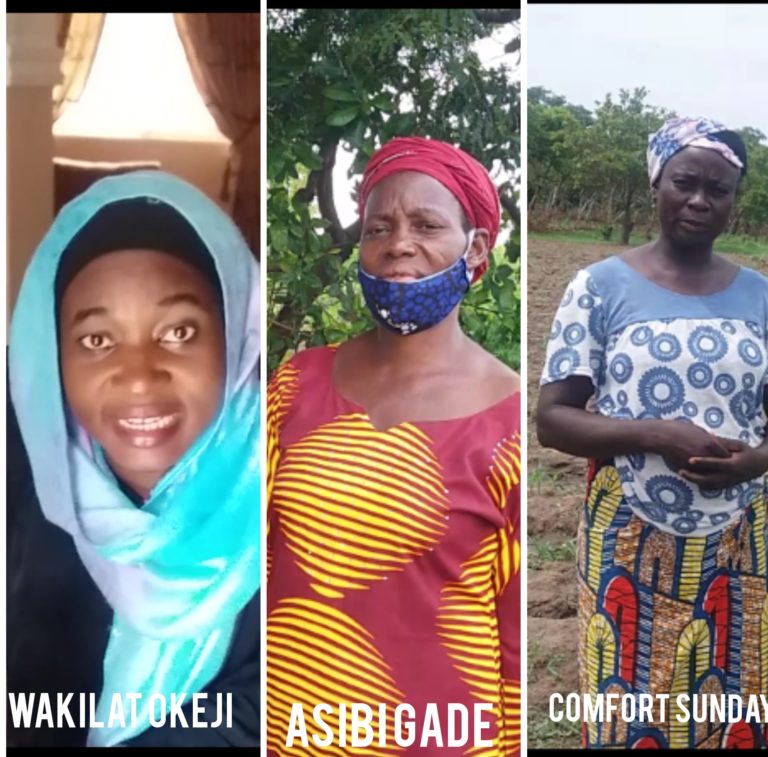
Recalling her sad story, Asibi Gade, a small-scale woman farmer who resides in Small Shada, opposite the Mathematical Centre in Kwali Area Council, rents farmlands for N10, 000 per season on which to grow cassava which she will process into fufu in large quantity for sale, corn and rice.

The widow and mother of two who resides in a tiny two-bedroom bungalow with her unemployed graduate son explained to The Nation how last year, she and a group of women contributed resources and rented hectares of land for N10, 000 per hectare, cultivated corn and soybeans with the aim of sharing the profit. But when some of them went to harvest the produce, they found cattle on the farm having a field day.

“The herdsmen surrounded our women, uprooted the produce and fed them to their cattle. We lost everything. We arrested the herdsmen and took them to the police, but they advised us to accept the N20, 000 compensation they offered us if we don’t want to lose everything,” she said.

In Jiwa community of the Abuja Municipal Area Council (AMAC), the experience of the farmers is similar.

Comfort Sunday just began a fish farm about two weeks ago to supplement her income from crops. She is just one of the hundreds of women in the community that farm in a large expanse of land divided into small plots without any form of demarcation among over 500 women who cultivate various vegetables such as waterleaf, garden-eggs and other crops. She plants rice, beans, corn and groundnut.

Last year, her group, the Smallholder Women Farmers’ of Nigeria (SWOFON) applied to the Federal Capital Development Authority (FCDA) for fertiliser, which they eventually got at a subsidised rate. She used the fertiliser on her beans crop and applied sufficient herbicides to ensure a good yield. Her bean crops were almost ready for harvest when herdsmen came to her farm and she lost everything as they cattle destroyed everything.

Laraba Shuaibu, FCT Smallholder Woman farmer

When she spoke with our reporter at her farm, she said during the lockdown, a couple in the community was returning from the farm when they came across herdsmen feeding their cattle with a neighbour’s crop. They confronted the herdsmen who attacked them with sticks and cutlasses and were eventually rescued by youths who got wind of the incident.

Why smallholder women farmers

According to a research conducted by Bashir Babura and published in the Scholarly Journal of Agricultural Science, Vol. 7 (1) in 2017, more than 80 per cent of farmers in Nigeria are smallholder farmers who produce an estimated 98 per cent of the food consumed in Nigeria apart from wheat. Many of the farmers are women. In the Federal Capital Territory (FCT) alone, the Programme Coordinator SWOFON, Ogechi Okebugwu said at least 13,000 small-scale farmers are women.

Their farming is, however, constantly disrupted by incidents of clashes with herders in search of food for their cattle. To stem these incidents, the Federal Government attempted to introduce the Rural Grazing Area (RUGA) policy, which was developed by the National Livestock Transformation Plan under the Nigerian Economic Council, but the move was faulted and has been adopted only by some states.

In pursuit of its diversification toward agriculture, the Federal Government’s budgetary allocations have continued to increase from 1.25 per cent in 2016 to 1.82 per cent in 2017 and 2.23 per cent in 2018.

Apart from launch of the programmes such as the N150 billion credit relief package by the Central Bank of Nigeria (CBN) for agriculture food chain businesses, FarmerMoni loans which have a three-month repayment period and the presidential fertiliser initiative for the 2020 farming season, the Federal Government recently announced that it intends to secure 995million Euro-worth of agricultural equipment for Nigerian farmers.

The FCT Authority also has the Agriculture Development Project (ADP), which delivers to women extension services towards ensuring that they are coordinated to key into agriculture development programmes.

The Deputy Director of Information and Communication of the Agriculture and Rural Development Secretariat of the FCT, Zakaria Aliyu said at the inception of every season, farmers are invited and offered subsidised agro-inputs such as fertilisers, insecticides, seedlings, poultry feeds, day-old chicks; fish processing inputs, water pumps and sprayers at 50 per cent subsidy.

In 2018 about 6,000 farmers were said to have benefited from the subsidy and 9,000 last year, but the support is yet to commence this farming season due to the lockdown, which has just been relaxed.

Who benefits from the programmes?

Despite the government’s investments in the agriculture sector, the COVID-19 pandemic and subsequent lockdown has severely affected farming activities and, according to Gade, a food crisis may be inevitable in the country.

A resident of Kuchibuyi, a sleepy village in Bwari Area Council Laraba Shuiabu, is the second of two wives of a local farmer who has nine children and had spent most of the lockdown period caring for a daughter who had just undergone surgery.

Unlike the other women farmers, Shuiabu, who owns a large farm about 40 minutes’ walk from her home, cultivates corn, rice and groundnut, explained that while she had a bountiful harvest last year, sold high volume of her corn fresh during the season from which she paid her children’s school fees and other bills. She added that she still had up to 50 bags of dry corn which she sold, even as she said she has barely planted enough to feed her family this year.

She further explained that her bounty was possible last year because she hired a tractor to plough her farm, had access to pesticides, fertiliser and sufficient seedlings, but cannot afford to do same this year. She had to cultivate just a small portion of her farm on her own while the rest lay fallow because she is too exhausted to do more. This indicates that she won’t have enough to sell this year.

Investigations by The Nation revealed that many of the women usually engage in menial jobs or sell their crops to earn enough money to buy all they needed for the new season.

“I am used to packing sand from the river and sell to trucks who in turn sell to builders,” Shuiabu explained.

She continued: “The money that I realise from this is what I use to hire a tractor, buy seedlings, fertiliser and pesticides for my farm at a subsidised rate from the FCT, but they asked us not to leave home so I could not make the money I need. Last year, I used 10 bags of fertiliser on my farm but even if they offer me this year, I don’t have the money.

“With the way things are right now, this and the coming year, things will be hard in this country because we don’t have money to invest in our farms. We are unable to go out and sell the little produce we have because they asked us not to leave the house.”

Gade explained that she had lost over N50,000 during the lockdown because she was unable to supply her fufu to her consumers in the town like she always did and buyers that eventually made it to their community insisted on buying it half the price.

She said the development has affected the income she and other members of the community who survive off supplying fufu to the Abuja metropolis need to invest in her farm this season, adding that access to fertiliser will be a huge factor that determines yield this season because farmers like herself are unable to go and apply for fertiliser at the FCDA due to the lockdown.

What about the loans?

The Smallholder women farmers in the FCT who spoke with The Nation explained that, apart from lack of access to herbicides/pesticides, fertilisers, knapsacks and improved seedlings at subsidised rates, small-scale farmers are afraid of applying for the numerous farmers’ loans the government claims it is providing for them due to inability to meet the repayment terms.

“I am scared of loans because some of my neighbours who collected loans from micro-finance banks and other places now sleep inside the bush because of the aggressive way they chase them for the repayment of even N10, 000.

“They don’t have rest of mind. It scares me and I know that as a widow, no one will rescue me when the time comes. If I collect, how will I pay back? The fufu that I sell is no longer profitable because of the COVID-19; people no longer come to buy like before,” she said.

Sunday believes that the process of acquiring the loan is too stressful with the need for collateral and other requirements.

“The stress that one goes through to get the money is too much. It’s better one manages what one has,” she said.

A poultry farmer from Peyi village in Ushafa, under the Bwari Area Council, Wakilat Okeji said the government is yet to make any provision for small-scale poultry farmers that will help them make a profit.

“For me, Tradersmoni is just N50, 000. It’s not enough. My Marketmoni is just N10, 000. If one wants to set up a farm of 1,000 capacity birds, one will need not less than N1.8 million to N2 million. A standard poultry farm will help reduce the risk of mortality, but as a start-up poultry farmer, I cannot access N2 million from the regular commercial banks or some of the interventions offered by the government. They will still fund only small-scale where they give things such as N100, 000, N200, 000, which will not be enough to produce the capacity of making profit.”

She said she recently tried applying for the COVID-19 support but when she saw the conditions for N1.5 million, which include movable assets, a guarantor that is a professional or civil servant on level 12 and above, she was discouraged.

Way out

The Programme Coordinator of SWOFON said the group is currently working on getting a good bargain for their members to access opportunities provided by the government through the Nigerian Agricultural Insurance Corporation (NAIC), including subsidised crops, subsidised livestock, commercial crops, machinery, equipment and agro-processing equipment.

Until that happens, farmers such as Shuiabu believe that women such as herself will not be comfortable applying for loans. She suggested that government officials should follow them to their communities and mobilise them rather than giving money to people who claim to represent them.

The Deputy Director of Information and Communication of the Agriculture and Rural Development Secretariat of the FCT, however, said support for the farmers is based on recommendations of agriculture officers who reside in the farm communities.

But Gade said the present interest rates on the loans offered by the government is too high, even as she called for the provision of power tillers, hand planters and improved seedlings.

“To encourage small-scale poultry farmers, the government should adopt the clustering method where they provide cluster facilities which will be like a hub where farmers can go and rent space. The space should have the capacity of 1, 000 birds per batch and all the needed facilities such as light, water, a veterinary doctor and security are provided to secure the pens,” Okeji stated.

More than providing facilities and affordable loans, Sunday said the problem of the herdsmen must also be addressed.

“If the government provides all that is needed and does not handle the menace of the herdsmen in our communities, then it will be as good as returning to square one because we will plant, weed but not harvest,” she said.

El-Rufai lifts partial lockdown in Kaduna after 75 days

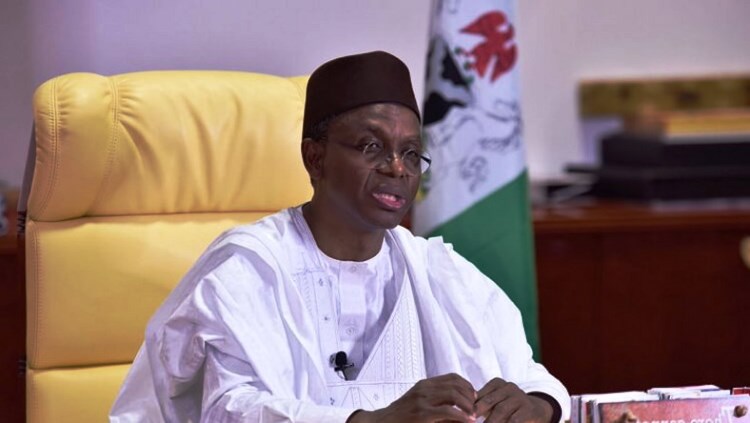
NASIR El-Rufai, Governor of Kaduna State has suspended the partial lockdown imposed in the state to stop the spread of Coronavirus disease (COVID-19).

The governor during a state broadcast on Tuesday explained that the lifting of the partial lockdown after 75 days followed  consultations and compliance by residents of the state with the guidelines of the lockdown.

He said it became necessary to move to the next step which, according to him is staying safe while pursuing socio-economic activities.

El-Rufai advised residents of the state to practice personal responsibility at places of work and worship.

He stated that civil servants are to resume work in phases which would be announced by the Head of Civil Service in the state.

On religious gatherings, the governor noted that a ban has been lifted only on Sunday service for churches and Friday service for mosques.

He added that commercial vehicles must reduce capacity to not more than two passengers per row and not more than 50 percent of capacity.

The governor also lifted ban on supermarkets, hair salons and hotels with orders that restaurants and bars are to offer only room service.

However, he said some certain persons were determined to jeopardise the effort of health workers in the state by making threats of an ‘untimely strike action’.

“Regrettably, certain persons seem determined to sully all the goodwill the hard work of our health workers has attracted by the untimely threat of strike action amidst a pandemic,”El-Rufai noted.

According to him, the threat was an action that contravened the Hippocratic Oath and Public Service Rules.

“This reckless action is a clear violation of the Hippocratic Oath, the Trade Union (Essential Services) Act and Public Service Rules,” he further stated.

The ICIR had reported how health workers in the state under the umbrella body of Kaduna State Health Care Workers Union and Associations earlier criticised the state government and threatened to go on strike for alleged deduction of 25 per cent from their salaries.

Over 262 million children forced out of school by COVID-19 pandemic in Africa – Report


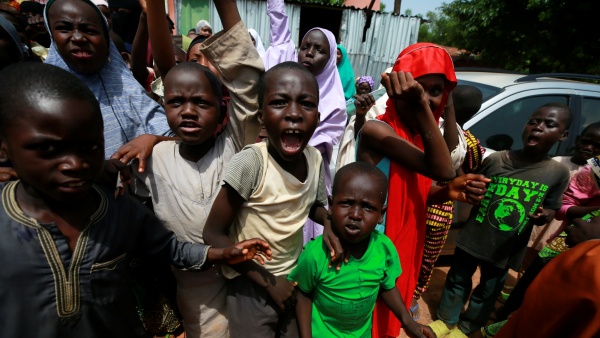
THE Save the Children International has said that the COVID-19 pandemic has disrupted the education of 262.5 million children in Africa, the continent’s most vulnerable population.

In it’s latest report titled “COVID-19 Impacts on African Children,” released on Monday, the charity highlighted how the pandemic had jeopardised African children’s access to formal learning, exposing them to the risk of being sexually abused or recruited by force into an armed group.

The report indicates that “more than 368 million school children globally are now missing out on school meals on which they depend, noting that 3.5 million of these children reside in Southern and Central Africa.

Eric Hazard, Panafrican Campaign and Policy Director at Save the Children, said the existing vulnerabilities coupled with the challenges posed by the pandemic could put development progress in Africa on the reverse.

“With the rapid spread of COVID-19, this pandemic is overburdening the under-resourced African health systems and disrupting routine health services, jeopardising Africa children’s access to formal learning, health and safety and protection,”Hazard.

“Especially girls and this is unfolding in Africa against a backdrop of worrying hunger levels driven by climate shocks, conflict and economic challenges.”

Between June and August 2020, the international aid organisation projects that 19 million people in West and Central Africa would be food and nutritionally insecure due to agricultural logistical constraints and labour shortages caused by COVID-19.

The report hinted that the food insecure population in Africa could double in the coming months, which has a serious nutritional impact on children.

It also highlighted that malaria deaths could hit the 769,000 mark in Africa which is the highest in 20 years due to disruption of insecticide-treated net campaigns and access to antimalarial medicines as the lockdown enforced across the continent brought activities to a halt.

Hazard urged African member states to ensure high-level political commitment and leadership across all sectors involved in COVID-19 response and provide a synergy that will provide viable solutions.

“As a child rights organisation, we have adapted our strategies and approaches to protect the most vulnerable children and ensure that their rights are protected but this requires a coordinated effort, led by African governments,” he said.

“The main threats, the COVID-19 pandemic poses to children in Africa suggests some of the political and programmatic responses protect children’s rights.”