Home Blog Page 2131

Swine flu, Hong Kong Flu, three other pandemics that shook the world

FOR the first time in world history, a disease called COVID – 19 which has proved difficult to contain, confining millions of people to their homes and grounding the global economy emerged from Wuhan, China in December 2019.

For centuries, several diseases have defined human history and changed the world’s perception about invisible pathogen capable of bringing human beings down to earth.

The ICIR chronicles the notable global pandemics that have hit the world from the swine flu outbreak to the current COVID – 19 which has claimed the lives of millions of people and also provided opportunities for understanding how to keep the future pandemics at bay.

The Spanish Flu (1918 – 1919)

One of the world’s most deadly pandemic described by doctors as the”greatest medical holocaust in history”.

The flu is believed to have started in crowded army training camps during World War I, but there is no universal agreement where the virus originated. It spread worldwide during 1918-1919.

The disease was caused by an H1N1 virus with genes of avian origin, the Spanish flu pandemic resulted in a high mortality rate for young adults, while children and people with weaker immune systems had low mortality rates.

Without a vaccine to protect against influenza infection at the time and treat secondary bacterial infections associated with the Spanish flu, control efforts worldwide were limited to non-pharmaceutical interventions such as isolation, quarantine, good personal hygiene, use of disinfectants, and limitations of public gatherings, which were applied unevenly.

It was estimated that about 500 million people which is one-third of the world’s population then were infected with this virus. The number of deaths was estimated to be at least 50 million worldwide with about 675,000 occurring in the United States.

The contagious flu which was caused by A/H3N2 influenza virus which is a subtype of viruses that can infect birds and humans by mutating into several strains. It is associated with mild or severe symptoms such as high fever, runny nose, sore throat, muscle and joint pain, headache, coughing, and fatigue.

The first outbreak was recorded in Hong Kong in 1968, infecting and 500,000 Hong Kong residents before spreading to different parts of the world. The virus was highly contagious, a factor that facilitated its rapid global dissemination.

The outbreak was the third influenza pandemic to occur in the 20th century, however, the H3N2 virus continues to circulate worldwide as a seasonal influenza A virus.

Over 1 million lives across the world were lost to influenza while 100,000 deaths recorded in the United States. The Hong Kong flu registered a high death rate for adults who were above 65 years, according to the Pandemic Severity Index the disease had a low case fatality ratio because of its low death rate.

It was first reported in Guangdong, China in 2002, when doctors noticed that patients admitted had a highly contagious germ, unaware that they were also at risk of a lethal infection.

SARS is a viral respiratory disease caused by a coronavirus called SARS-associated coronavirus, SARS-CoV – 1, but since 2004 there have not been any known cases of SARS reported anywhere in the world until COVID – 12.

Coronaviruses are viruses that circulate among animals with some of them also known to infect humans, SARS-CoV-1 is transmitted to humans from civet cats.

The disease had spread to several parts of Asia, Europe and North America, despite being contagious killed 774 people worldwide.

Its symptoms include common cold to more severe fever, chills, muscle aches, headache, dry cough and shortness of breath.

The SARS pandemic was eventually brought under control in July 2003, following a policy of isolating people suspected of having the condition and screening all passengers travelling by air from affected countries for signs of the infection.

There’s currently no cure for SARS, but research to find a vaccine is still ongoing.

In 2009, the World Health Organisation, WHO, officially declared the “swine flu” a pandemic after it was first identified in Mexico in April 2009. The flu became known as swine flu because of it’s similarity to flu viruses that affect pigs.

The scientific name for swine flu is A/H1N1 and shortened to “H1N1”. Statistics by the WHO reveals that the virus had killed more than 18,000 people after it appeared in April 2009 hinting that the total mortality including unconfirmed deaths from the H1N1 strain was higher.

Studies carried out at the U.S. Centers for Disease Control and Prevention published in May 2009 showed that children had no immunity to the new strain but adults, older than 60, had some degree of immunity.

In June 2010, Fiona Godlee, editor-in-chief of the British Medical Journal, BMJ, published an editorial criticising WHO for calling the swine flu a “pandemic” too soon and also alleged that some of the experts advising WHO on the pandemic had financial ties with drug companies which were producing antivirals and vaccines for the flu after an investigative report.

On 12, April 2010, Keiji Fukuda, the WHO’s top influenza expert, said that the system leading to the declaration of a pandemic led to confusion about H1N1 circulating around the world and he expressed concern that there was a failure to communicate in regard to uncertainties about the new virus, which turned out to be not as deadly as feared.

WHO Director-General Margaret Chan at the time said she appointed 29 flu experts from outside the organisation to conduct a review of WHO’s handling of the H1N1 flu pandemic for balance and fairness.

COVID – 19 (2019-)

SARS-CoV-2 is a new strain of coronavirus that has not been previously identified in humans until the first case was recorded in Wuhan, China in December 2019. Coronavirus are viruses that circulate among animals with some of them also known to infect humans

The strain of coronavirus SARS-CoV-2 was given to the novel 2019 coronavirus, while the name for the resulting disease associated with the virus is COVID – 19.

As of 30 March 2020, the COVID-19 outbreak had caused over 700, 000 cases globally since the first case, more than 30, 000 people are known to have died.

Infected persons might have the virus between 1 to 14 days before developing symptoms. The most common symptom of COVID-19 includes fever, fatigue, and dry cough.

Supply shortages affected trade globally due to panic buying, increased usage of goods to fight the pandemic, disruption to factories and logistics due to complete shut down of activities in different countries in a bid to contain the virus.

As of February 28, stock markets worldwide saw their largest single-week declines since the 2008 financial crisis as global stock markets crashed in March 2020, with a freefall of several of the world’s major indices.

As the pandemic spreads, global conferences and events across technology, fashion, and sports are being cancelled or postponed. While the monetary impact on the travel and trade industry is yet to be estimated, it is likely to be in the billions.

You can also read: The History of Influenza Pandemics By The Numbers.

After alleged assault on driver, Nigerian judge risks prosecution

A CROSS River Judge, Agnes Onyebueke  of the Akamkpa High Court Division, is currently under fire for allegedly assaulting and abusing her driver, Otu Okon Edem, The ICIR has learnt. 

According to documents and information obtained by our reporter, a four-man Committee has been set up by the Cross River State Judiciary to look into and resolve the case of the alleged assault.

This is coming weeks after a video  posted by one Deborah Edem, Okon Edem’s sister, surfaced online.

In the video, Deborah called on the Cross River State authority and other relevant agencies to investigate the case of alleged abuse and assault meted out to her elder brother by the Judge.

In the 17 minutes video posted, Deborah alleged that the Judge had on several occasions abused her brother who is a senior driver posted to her office.

She explained that her brother was posted to Justice Agnes office in November 2019 and within the short time, her brother has experienced “abuse, oppression and molestation.”

In his own account, Edem narrated that the assault happened on March 4.

According to him, he was waiting for Justice Onyebueke’s orderly, Jerry, a police Sergeant after washing and positioning her car when he heard the call of his boss, Agnes.

“What I saw was the other guy, Obinna, was with iron rod, and she asked me to go down from the security post. I was so surprised. She first insulted my mother and I asked her what was wrong? Before I could say anything more, a blow was landed upon me which was at the right side of my face. The guy hit me up and beat on the ground,” he narrated.

Edem further disclosed that he was hit with an iron rod, noting that the old man who is the gate man could not help the situation. He revealed that he has instituted a case with the police and investigation is ongoing.

Available pictures retrieved by The ICIR from the local press showed that he sustained injuries on different parts of his body, including a fractured bone around his hand.

The husband of the embattled judge, Fidelis Onyebueke, also a barrister at law while giving his own account alleged that Edem was being sponsored to destroy the name of his family. He accused him of being a drug addict who had made open threat to kill his wife.

According to Onyebueke, the fight ensued after his son who had just undergone abdominal surgery weeks before the incident, asked Edem to re-position the car in order for him to drive out and get fruits.

What the law says

According to chapter 25 of the Nigerian Criminal Law, a person who strikes, touches, or moves, or otherwise applies force of any kind to, the person of another, either directly or indirectly, without his consent, or with his consent, if the consent is obtained by fraud, or who by any bodily act or gesture attempts or threatens to apply force of any kind to the person of another without his consent, in such circumstances that the person making the attempt or threat has actually or apparently a present ability to effect his purpose, is said to assault that other person, and the act is called an assault.

The four man panel set up by the  Cross River State Judiciary  is expected to sit between Tuesday April 7 and Friday April, 10 2020. Edem Okokon, Chief Registrar is the Secretary of the Committee.

Cross River: Court dismisses suit seeking confirmation of former acting chief judge

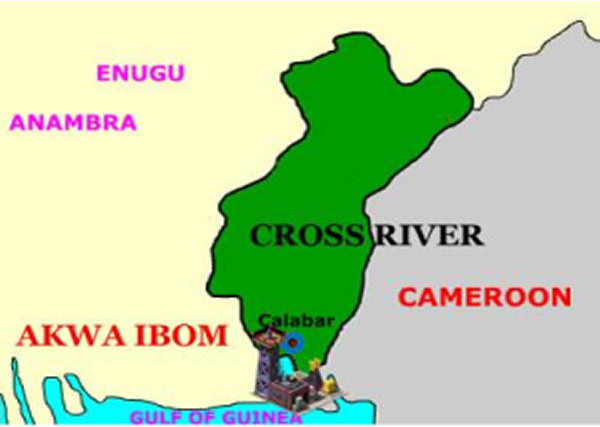
A Federal High Court sitting in Calabar has dismissed a suit seeking the declaration of the former Cross River acting Chief Judge, Justice Akon Ikpeme  as substantive Chief Judge over unsatisfactory evidence, The ICIR can report.

The Speaker of the Cross River State House of Assembly,  John Gaul Lebo, the ninth assembly of the state and the Government of Cross River state were listed as first, second and third respondents in the suit.

The case presided over by Justice Simon Amobeda, is coming after the Cross River House of Assembly refused to confirm her as the state’s chief judge after years of serving as the acting in the same position over her state of origin.

The embattled justice had in a fundamental human rights suit filed before the Court sought the enforcement of the right of freedom from discrimination after the Cross River House of Assembly rejected her nomination as substantive Chief Judge of the State.

After a careful examination, Justice Amobeda said of the exhibits presented by the applicants, there was no where it was explicitly stated without ambiguity that the assembly did not confirm Justice Ikpeme due to her state of origin.

The ICIR learnt that the State House of Assembly had reportedly voted against the confirmation of Justice Ikpeme on grounds that she was hailed from Akwa Ibom state despite being married to an indigene of the state.

The court also dismissed the preliminary objections filed by the three respondents challenging the jurisdiction of the court to entertain the matter as well as the locus standi of the applicants.

In his Judgment, Justice Amobeda while ruling on the preliminary objections, held that “so long as the enforcement of human right is the principal claim then the High Court of a state or the FCT and the Federal High Court have concurrent jurisdictions.”

According to him, the five claims sought were in line with Chapter 4 and section 42 of the 1999 constitution as amended. He therefore held that the first ground of the preliminary objection was “misconceived” and dismissed.

On the second objection based on locus standi, Justice Amobeda who relied on paragraph 3E of the preamble of the Fundamental Human Rights Enforcement Procedure rules of the court said the want of locus standi cannot be an impediment on a matter which the principal claim was on fundamental human rights.


15 Chinese medical doctors arrive Nigeria to help fight coronavirus

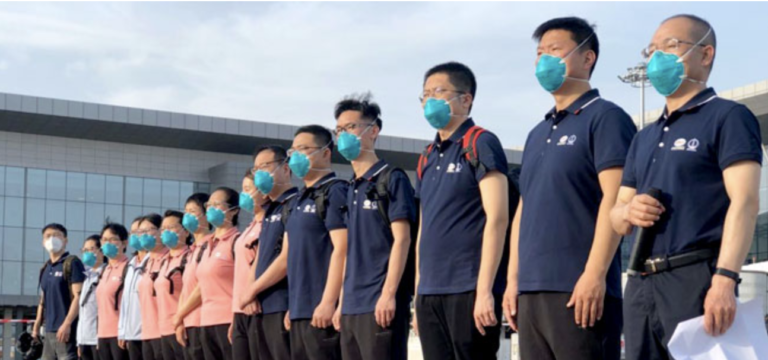
A 15-PERSON Chinese medical team has arrived Abuja to help the country combat coronavirus. 

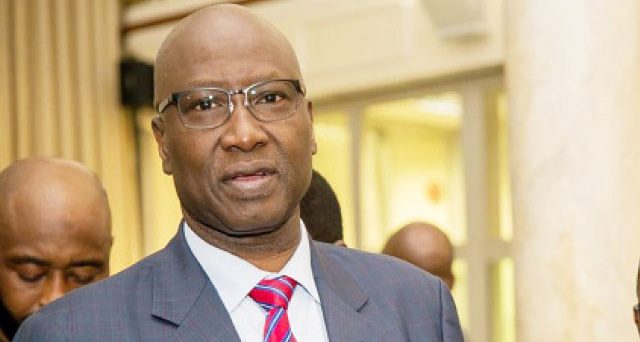
It was gathered that the medical personnel arrived at the Nnamdi Azikiwe International Airport, Abuja, on Wednesday, where they were received by a Federal Government delegation led by the health minister, Osagie Ehanire.

Reports reveal that the medical team arrived with 16-ton test kits, ventilators, disinfection machine, disposable medical masks, drugs, infrared thermometer and other items ordered by the Federal Government.

This is despite verbal protest against the Federal Government welcoming medical assistance and personnel from China.

The Nigerian Medical Association (NMA) had earlier kicked against the idea, stating that Nigeria has a large pool of medical practitioners and urging the government to scale up and empower Nigerian medical personnels instead of importing foreign doctors.

However, the Presidential Task Force on COVID-19, chaired by Secretary to the Government of the Federation, Boss Mustapha, on Friday, appealed that medical experts in the country should welcome and accept the effort of the Chinese.

Mustapha explained that the contribution of the Chinese medical personnels in tackling COVID_19 in the country would help to effectively combat the pandemic.

“I wish to clarify that all the countries of the world are seeking assistance and are receiving help in the fight against COVID-19 – even the United States is looking for help elsewhere,” Mustapha said.

Meanwhile, for doctors at the forefront of containing the COVID -19 pandemic in Nigeria, the federal government pays doctors in public hospitals a monthly hazard fee of N5,000, which is equivalent to $13.64, for any risk they might encounter while carrying out their duties, The ICIR earlier reported.

I wonder how Minister came up with her list on money disbursment – Shina Peller

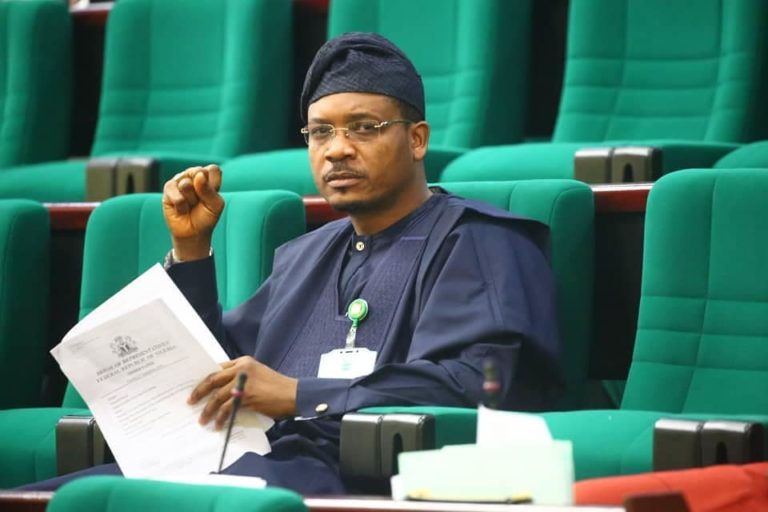
HOUSE of Representatives member, Shina Peller has expressed disappointment about how the Minister for Humanitarian Affairs, Disaster Management and Social Development, Sadiyat Farouq came up with her list and how palliatives were disbursed across the geopolitical spread.

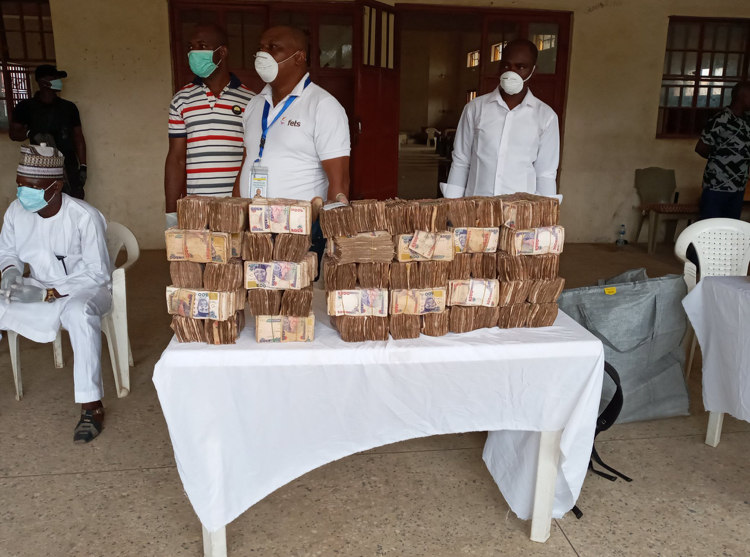
Peller in a Twitter message said he was still trying to make sense off the palliative of N20,000 each the Federal Government claimed it shared among 2.6 million households, which implies that the government has shared N52 billion to Nigerians as palliatives.

“The federal government needs a better strategy because if after this huge amount has been disbursed to households, I am still getting loads of calls and pressure from many of my people asking for my help with palliatives, then the government strategy isn’t right,” he said.

The lawmaker however suggested what the Federal Government should have done rather than waste huge amount of money, noting that many Nigerians were still left out of the safety net.

He said if the government had given N10 million to each 774 local government in the country, it would have cost the government N7.7 billion and the government would have saved a huge N44 billion.

Expressing his disappointments further, Peller gave an example of him representing four local governments in his federal constituency namely; Iseyin, Itesiwaju, Kajola and Iwajowa local government areas of Oyo State.

He explained that supervising the distribution of N10 million to 500 people at N20,000 per head in a local government would be more beneficial while the impact would be felt more.

According to him, the list of account numbers and beneficiaries would have been pasted on a notice board at the ward level.

While stressing that every local government is divided into wards, Peller added that it takes nothing to paste the list of 50 beneficiaries in every ward in the country.

“If this process is replicated by all members of the House of Representatives, the money would go down to the grassroot, and those who should benefit would have benefited, he said.

“The impact would be felt better than “Federal Government distributing N52 billion to 2.6 million households that can’t be verified.”

COVID-19:  It’s not true! SGF, Lai Mohammed debunk claims of N500,000 presidential committee sitting allowance

SECRETARY to the Government of the Federation (SGF), Boss Mustapha on Wednesday denied claims that each member of the Presidential Task Force on COVID-19 receives N500,000 as a sitting allowance once the committee meets.

Mustapha, who is also chairman of the committee, declared the news as false while speaking at the COVID-19 briefing in Abuja.

He said since they resumed operation, no one was paid for logistics or what it described as operational cost, much more a sitting allowance.

But he was quick to state that the committee might later be rewarded based on the laws guiding such service, as detailed by the public service rule.

His words: “Seating (sic) allowances in the government of either states or federation are guided by certain extant rules and regulations…you know there are extant rules that guide the payment of seating allowances if you sat in committees or commissions or task force.

“But let me say off-front when somebody was alleging that the Federal Government has withdrawn $150 million out of which they are paying the committee members of the task force N500, 000 daily as seating allowance.

“Let me say as the chairman of this committee, since we started functioning as a committee, we have not received a dime either by way of even operational cost talk less of seating allowances.”

“As I said, seating allowances are matters of regulations. They are there in the public service rules and regulations. It will be applied when the need arises, when funds are available,” he added.

In his remarks, Lai Mohammed, the Minister of Information and Culture, also dismissed the claim about the committee receiving seating allowances.

“The truth is no member of the presidential committee has received a penny, either for seating or sleeping allowance….everybody has spent his time, energy and sometimes his resources.”

Conditional Cash Transfer to poor Households as palliatives for COVID-19 lockdown

No more cash payment to poor households

Regarding palliatives, he advised Nigerians not to make available their Biometric Verification Number (BVN) to the public.

Doing the contrary, he noted could cause more harm to the people affirming that criminal-minded individuals might want to take advantage of the situation. These, he said, remains vital to maintain the social distancing recommendation to check further spread of the virus.

“The past experience of the ministry of humanitarian service shows it became difficult to control the people. In the process of giving palliatives, you do not endanger the health of the people that should be beneficiaries…the process will be a combination of payment through the bank and credit payment…”

“Asking for BVN is 419. Even in the midst of the pandemic, some people will want to play and exploit the ignorance of people to defraud them. Please advise the Nigerian populace not to disclose or release any information on their BVN, credentials or private information.”

While justifying need to make use of the airspace despite the travel ban, Mustapha also announced that a medical consignment from Turkey arrived the country but it was dropped in Lagos, instead of Abuja.

The Nigerian Airforce, according to him was, however, directed to convey the package to Abuja which is being kept at the medical storage facility at the Federal Ministry of Health.


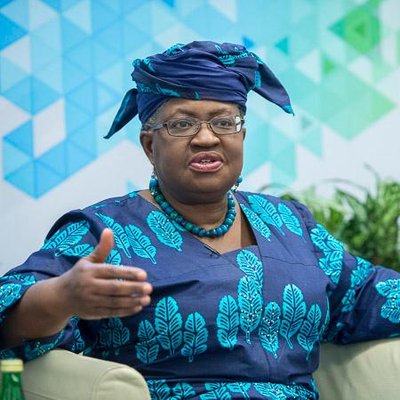
After ICIR’s factcheck, Okonjo-Iweala admits to tweeting wrong photograph

AFTER a factcheck by The ICIR on Wednesday, former Nigerian Minister of Finance, Ngozi Okonjo – Iweala has admitted to have tweeted a wrong photograph to illustrate the distribution of food items by Rwandan government under President Paul Kagame among low-income households in the country amid the coronavirus pandemic.

Okojo – Iweala, an influential personality in global economic and financial circles, via her verified Twitter handle and Facebook page shared the photo with the caption: “Responsible food distribution with social distancing to assist lower-income households in the #COVID19 era! A great example from #Rwanda where community workers also distribute food and other necessities door-to-door.”

The former minister’s post was seen as a subtle criticism of the distribution of food and money by governments in Nigeria, which many believe negates the social distancing advice recommended by medical experts to help stop the spread of the coronavirus.

However, a factcheck by The ICIR revealed that the picture was indeed from 2019 and was taken in The Gambia when a Gambian Islamic leader shared food items to Islamic faithful in his area.

After the publication, the former Nigerian Coordinating Minister of Economy tweeted to thank those who called her attention to the wrong picture.

She claimed that a friend sent her the picture that it was from Rwanda.

Thanks to those who have drawn my attention to the food distribution picture I tweeted earlier today. A friend sent it to me that it’s from Rwanda. Whether Gambia or Rwanda, the point I want us to focus on is that it is a safe way of handling food distribution,” she tweeted.

Okonjo-Iweala is a member of Board of Directors of Twitter. She was appointed in 2018.

Okonjo Iweala posts 2019 photo to justify sharing of COVID 19 relief materials in Rwanda

A PHOTOGRAPH shared on Wednesday afternoon by former Nigerian Minister of Finance Ngozi Okonjo – Iweala to portray how the Rwandan government under President Paul Kagame shares food items to low-income households in the country amidst the coronavirus disease has been found to be an old one from 2019.

Okojo – Iweala, an influential personality in global economic and finance circles, took to her verified Twitter handle and Facebook page to share the photo with the caption: “Responsible food distribution with social distancing to assist lower-income households in the #COVID19 era! A great example from #Rwanda where community workers also distribute food and other necessities door-to-door”

The former minister’s post was seen as a subtle criticism of the distribution of food and money by governments in Nigeria, which many believe negates the social distancing advice recommended by medical experts to help halt the spread of the coronavirus.

In fact, legit.ng, an online newspaper in Nigeria, picked up her post in a news story titled “Coronavirus: Emulate Rwanda’s example in food distribution – Okonjo – Iweala advises FG.”

“Nigeria’s former minister of finance and coordinating minister of economy, Ngozi Okonjo – Iweala, has urged the governments at all levels to emulate Rwanda’s example in the food distribution with social distancing to assist lower-income households as the effect of coronavirus lockdown bites harder,” the story reads.

The online newspaper said Okonjo – Iweala made the plea “in a Facebook post on Wednesday, April 8, adding that community workers distribute food and other necessities door-to-door in Rwanda during the COVID-19 era.”

However, a lead from a comment on her post and through a Rwandan showed that the photo is that of a Gambian Islamic leader who shared food items to the faithful Muslims in his area in 2019.

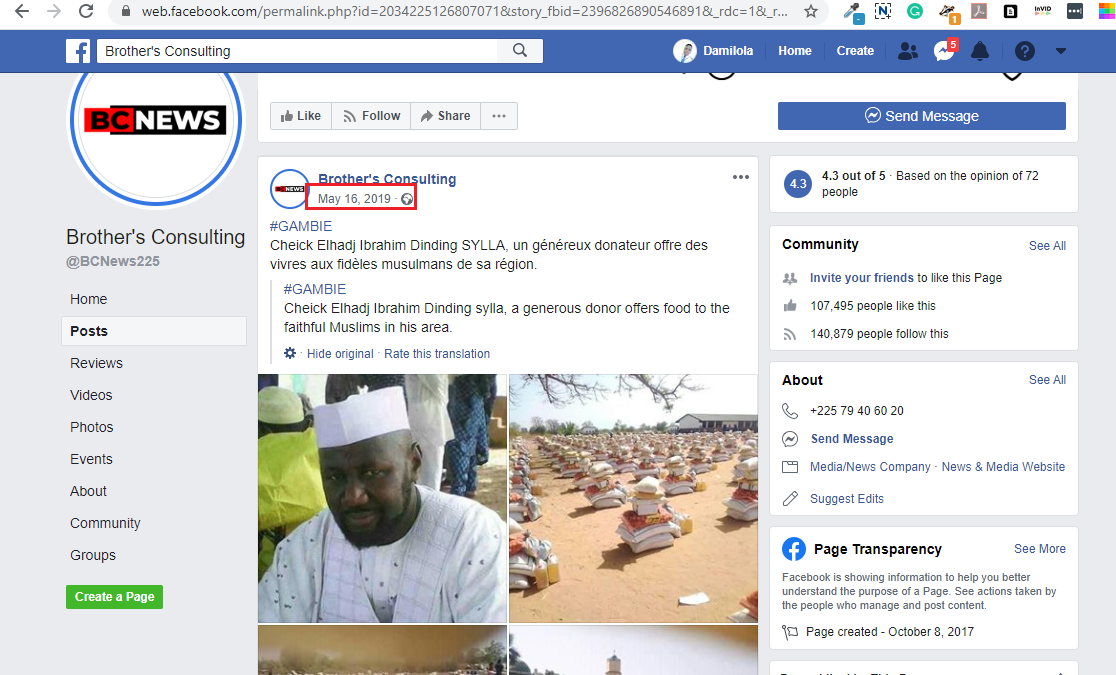
The photograph was shared by a Facebook page named Brother’s Consulting on May 16, 2019. The post was captioned in French but translated by Facebook to English as “Cheick Elhadj Ibrahim Dinding sylla, a generous donor offers food to the faithful Muslims in his area”.

Same photo shared by Facebook page Brother’s Consulting on May 16, 2019.

Brother’s Consulting posted the same pictures that the former Nigerian minister shared on Wednesday along with the photograph of the Gambian Islamic leader.

From the 2019 post alone, it is safe to say that Okonjo – Iweala was sharing a photograph that is nearly a year old to justify what she purports to be the distribution of food items in Rwanda, a process she says is worthy of emulation.

Okonjo – Iweala was Nigeria’s finance minister (later Foreign Affairs Minister) between 2003 – 2006 under President Olusegun Obasanjo and between 2011 – 2015 under President Goodluck Jonathan.

A respected economist, before she joined the government, she had worked with the World Bank, where she rose to the position of Managing Director.

Following her first term as minister, she returned to her job at the World Bank in December 2007 before returning in 2011 as Coordinating Minister for the Economy.

She was recently appointed by the President of South Africa, Cyril Ramaphosa, as a member of the country’s Presidential Economic Advisory Council (PEAC).

Okonjo – Iweala, who has 1.1 million followers on Twitter shared the photograph on Wednesday afternoon and within four hours, the post had garnered 3,251 likes, 1,538 retweets, and 357 comments.

The former Co-ordinating Minister for the Economy in Nigeria also shared the same post and photograph on his Facebook page, where she has over 360,000 followers. It had gotten 965 shares and 1,800 likes as at the time of filing this report

The ICIR could not reach the former minister as the newspaper could not get her contact phone numbers.

However, in a phone chat with her spokesperson, Paul Nwabuikwu,  he said the post must have been an honest mistake on the part of former Minister.

“…Oh! from Gambia, it must be an honest mistake on her part,” Nwabuikwu said. He then asked our reporter to send the post to him so he could share with Okonjo – Iweala.

Married in January, murdered in March: Family of late Rita accuses Police of cover-up, seeks justice over daughter’s death

LATE Rita Onyemauchechukwu Onyebuchi was married to Ikechukwu Atansi early this year.

Precisely on 10 January, 2020, she had her traditional marriage with the usual bridal rites that accompany such pleasing occasions. The event was blissful, with so much family expectation, but little did she know of the doom ahead.

She never had a premonition neither did she believed her death will come so untimely. Sadly, the marriage did not scale through the first quarter of the year she had her union.

Rita was allegedly murdered by her husband in the middle of the global COVID-19 pandemic.

While Onyemauchechukwu hails from Achalla village, Enugu-Agidi town in Njikoka Local Government Area (LGA), Anambra State, her husband, Atansi is popularly known as ‘Agbada’ hails  from Umudum village in Isu-Aniocha, also in the state.

After the union, they both decided to live at Chima’s compound in Ezimezi village, Amawbia town, Awka South LGA, until the incident happened.


How it began

In January, 2018, the deceased commenced work as an entry guard at Philip Smith Security Limited in Awka. She worked in the same organisation with her younger sibling, Johnpaul Onyebuchi for more than two years.

But on Tuesday, March 24, Onyebuchi suddenly noticed his sister failed to resume work, an occurrence he found strange.

It remained unclear if the deceased had a prior misunderstanding with her spouse. But the brother noted she was always punctual. “It has never happened before because she is always at work and dedicated to the company.”

As a result, Onyebuchi decided to put a call through to her phone. It rang, all through but no one answered, not even her husband who she lived with.

“She never responded to those calls and never returned the calls which were unusual,” says Onyebuchi. “After work hours, I made way to her house where she lived with her husband.”

“On reaching there, I saw that the house was locked and the husband’s car was not in the compound, after several knocks and banging at the door no responds too. I decided to head home and requested that the husband’s number should be sent to me by my mother.”

On Wednesday, March 25, Onyebuchi eventually got Atansi’s mobile number. He called repeatedly but it was switched off. The deceased’s mother also called, it was the same message from the telecom operator- the line was ‘switched off’.

Onyebuchi then proceeded to his office as usual, believing everything would be fine while trying his sister’s line.

But still, it rang, no one answered. Yet, she was away from work.

Late Rita Onyemauchechukwu Onyebuchi. Photo Credit: Family

By Thursday, 26 March, the deceased’s body was already decomposing. The police had visited to forcefully open the door and saw the late Rita covered with blood with a fractured head.

“When the special crime unit of the police arrived I was taken to the room to find the dead body of my sister lying in a pool of blood. And the body has started to decompose.”

“The whole place was smelly and blood all over the bedroom. I was shocked I couldn’t tell my mum at that point….”

Unfortunately, the deceased mother is battling with high blood pressure, which makes informing her about the daughter’s death more challenging.

“I couldn’t tell her,” Onyebuchi said.

That same Thursday, the suspect, Atansi was arrested by the police operatives from the Central Police Station, Awka Division.

Findings by The ICIR also revealed that the accused had a cut behind his head.  A police source attributed this to why the suspect was immediately taken to the police clinic for treatment before obtaining his statement.


Women abuse – a sad but reoccurring incident

Though, Onyebuchi told The ICIR the matter was already being handled by the police authority and the National Human Rights Commission (NHRC), he wanted justice. He is also seeking actions from the Civil Society Organisations (CSOs) on human rights to ensure the matter is sustained until justice his served.

Aside, the deceased’s case, there is a number of few reported cases of women abuse and several undocumented similar incidents happening across the country. The Federal Government strives to create enabling laws as part of measures to check the reoccurring menace of women right abuses, but again, very few numbers of states have domesticated the enabling law on women and child protection.

Beyond Nigeria, women are being beaten, trafficked, raped even killed in other countries, including developed countries.

As a result, in 2008, the United Nations through the UNiTE project launched a multi-year global effort to end violence against women.

It particularly worked to ensure by 2015, every nation has developed a national legal framework that would punish all forms of violence against women in line with global human rights standards.

“But significant gaps in legal frameworks remain,” Asha-Rose Migiro, ex-Deputy Secretary-General of the UN stated in a document on violence against women.

“States throughout the world are still failing to live up to their expectations….Too many perpetrators are not held accountable. Impunity persists.”

Unfortunately, both state and non-state actors are guilty of these offences against women which caused Non-Governmental Organsations (NGOs) in Nigeria, for instance, to demand a review of the Violence Against Persons Prohibition (VAPP) Act signed into law in 2015 by former President Goodluck Jonathan.

Sadly, among the 36 states, only 10 have domesticated the law, according to an online tracker created by Partners West Africa Nigeria a Non-Governmental Organisation (NGO). Anambra, for instance, signed the law in March 2018.

The remaining nine states which have ratified the law are Oyo, Benue, Federal Capital Territory, Kaduna, Ebonyi, Edo, Ekiti, Enugu and Osun States.

Despite the United States government recognising Nigeria’s lukewarmness on women protection, violence against the female gender has been on the increase.


Deceased was two month pregnant

The police are yet to make public outcome of their investigation. As of Tuesday,  March 7, Inspector Ogechi Onwa told The ICIR  that post-mortem test was yet to be conducted but the deceased’s family claimed their daughter was two months pregnant before her death.

“My sister was two months pregnant,” Onyebuchi stated. “She told us when I started noticing her behaviour because we work in the same place….”


Late Rita Onyemauchechukwu Onyebuchi Photo Credit: Family

The immediate sibling noted he had to plead that her corpse should hurriedly be taken away to avoid much public attention, especially keeping their mother from seeing the gory sight.

“Please I want the human right activists and lawyers to come into this matter and make sure that the suspect is brought to book to face the law,” he shared in his tweet. “Please I am begging for this message to be retweeted and shared so that justice will be served for Mrs. Rita Onyemauchechkwu Onyebuchi. Justice for Rita.” he tweeted.

“My sister needs justice.”


Suspected betrayal of justice

While The ICIR was able to get video footage of Atansi’s statements during interrogation, there are claims of attempted moves to upturn the investigation.

At the State Criminal Investigation Department, Amawbia where Atansi is held custody, the officer in charge, on Monday, March 30, told the deceased’s relatives of the need for the homicide department to visit the crime scene and possibly get more evidence. But unknown to the family, the room was already mopped clean.

Prior to the visit, it was gathered that Inspector Ogechi Onwa, who was earlier assigned to the case and also in custody of the key to the deceased’s apartment, allegedly connived with the suspect’s relative and caretaker to the building – a barrister to clean the room following alleged complaints from other neighbours over unpleasant smells.

Eventually, Onwa presented the key to the suspect, who then gave it to the sister for cleanup. The clean-up action, however, altered the crime scene and compromised the evidence.

“Reaching the crime scene with the CID homicide department and a counsel, it was found out that the crime scene has been totally cleaned up,” Onyebuchi said.

“Further investigation shows that the IPO Mr. Onwa who is the DSO III at the central police station, Awka who was handling the case before it was transferred to the state CID handed the keys of the house to Ikechukwu Atansi the husband who in turn now gave the keys to his sister who now went and clean up the crime scene and removed every implicative exhibit in the house and she also took away the mobile phone of Mrs. Rita Onyemauchechkwu Atansi.”

But when the suspect was arrested, the crime scene was locked up by the police and the key was handed over to Onwa of the central police station.

Meanwhile, Onwa was also accused to have demanded N5,000 bribe from the victim’s family before the case could be transferred to the CID. He had reportedly and unnecessarily delayed the case insisting on his demand until Onyebuchi resolved to push the matter to public space and petition the NHRC.

“After writing my statement, i asked Onwa when the suspect will be transferred to the state CID but he was telling me that I need to pay N5, 000 for registration of statement, and if possible, I might need to pay extra money before the statement will be signed. So, I left with annoyance…”

“I later called to find out if he was being transferred but he told me if I’m not ready to come with my people and do the needful, he has nothing to say.”


That’s not true, I didn’t demand bribe  – indicted Police officer says      

It is common knowledge that the Nigerian police often demand bribes from those they should protect and help secure justice. Several reports have also attested to the illegalities and criminal activities committed by the police to deliberately frustrate prosecution processes.

But The ICIR reached out to inspector Onwa, who is at the centre of the allegation yet he denied ever demanding for bribes. He felt Onyebuchi and his family had a personal grudge against him, as he claimed to be performing his duty.

“I didn’t do it, as a senior officer i can’t do that. That boy created this problem,” Onwa said. “It appears that boy has something in mind against the Police because we both carry the corpse to the mortuary but God is my witness,” he stated in a phone interview on Tuesday evening.

However, the accused officer admitted being queried and detained at the state CID for his ‘mistake’. He also agreed the key to the deceased’s apartment was released by the Divisional Police Officer (DPO) to the suspect while the case is yet to be concluded.

“The caretaker was demanding for the key because the corpse was about four days, so other residents were complaining. So the man in charge of the station gave the keys to the victim who happens to be the suspect in the hospital…”

Onwa further told The ICIR, he has been freed after he presented his case.

Repeated calls to Haruna Mohammed, Anambra State Police Spokesperson on the issue were unanswered.

Mohammed did not also return the calls. But, after sending a text message, he tersely responded, ‘case is under investigation please.’

Meanwhile, Nkechi Ngwanyi, Anambra State Coordinator, (NHRC) and Mr. Barnabas Obinigwe, Deputy Director from the commission have intervened in the matter and awaiting the outcome of Police investigation.

An expert, Titilola Vivour-Adeniyi, Co-ordinator, Domestic and Sexual Violence Response Team advised females who feel threatened or abused to seek temporary residence with relatives. Speaking on Law Weekly, a television programme on Channels, she observed an increase in reported cases of sexual and violence against women.

According to her, the organisation had been receiving eight new cases daily via its hotline and on average seven cases on social media.

“We have seen people reaching out through social media handles, some are panicking, some don’t know what to do and wants someone to talk to, while others are experiencing abuse during this period,” Vivour-Adeniyi stated while reacting on the increase in domestic violence during the pandemic.

“It is a sad reality, but we are experiencing that now because survivals of domestic violence are now basically stuck with their abusers.”

However, she advised that though it was becoming worrisome, it is important to keep safe.

“If you have a relative you can stay with, trusted family member or a friend during this lockdown, we encourage survivors to take that option. If they feel their lives is in danger. But those who don’t have that option, we encourage them to develop a safety plan – a small bag containing your essentials, important documentations, little money for transport, telephone numbers of relatives among other resources you can take advantage of.”

Covid-19: FG’s conditional transfer not reaching the targets—RULAAC

A CIVIL Society Organisation, Rule of Law and Accountability Advocacy Centre (RULAAC) has raised the alarm that the Federal Government’s Social Intervention Policy known as the Conditional Cash Transfer was yet to address mass poverty, deprivation and hunger across the country in the face of two-week lock down imposed to contain the spread of Covid-19 pandemic.

“The billions which government announced that it has released and made available for conditional cash transfer to the poor and vulnerable in communities are not reaching the targets. There are still cries of woe and anguish in most communities,” said Okechukwu Nwanguma, Executive Director of RULAAC in a statement issued on Wednesday.

“We have seen videos of caricature of the ‘social intervention’, of food items shared to some communities. In one video, we saw a street in Lagos of over 30 families who said they were given two loaves of bread and few cups of rice and garri and few condiments (tomato paste sachets) to share.

“And we see members of the community lamenting and asking how a whole street of over 30 families could be given such quantity of food items not enough to serve one family for two days to share,” he added.

Nwanguma called for transparent and community based approaches to the management and disbursement of the social intervention funds.

“Considering complaints by many local communities about not benefiting from the released billions of naira announced and meant to alleviate poverty and hardship, especially during this difficult and uncertain period, we call for a transparent and effective investigation of the management of the funds so far allocated. Efforts must be put in place to ensure that the funds are not diverted, as usual,” he said.

He noted that independent community committees must receive these funds and be charged with identifying those in their midst who qualify to benefit.

In the statement titled, “Assuaging the plight of the poor in this perilous time”, Nwanguma stressed that the management of the funds should be monitored by a multi stakeholder committee including government and community representatives as well as credible media and civil society representatives.

He added that government must put effective measures in place to check corrupt public officials who want to steal or divert funds meant to relieve the sufferings of the poor and vulnerable people in this perilous times.

“This is the only way to help the people comply with the law and stay at home for now,” Nwanguma said.

“Finally, since government has been announcing huge numbers of beneficiaries of cash transfer program running into millions and claiming to have paid billions, can the government make the system transparent by publishing the names and addresses of the beneficiaries on an electronic portal so that Nigerians can do the verification?”

It would be recalled that the Federal Government on April 1 commenced the disbursement of N20,000 Conditional Cash Transfer to indigent households (poor) at the Kwali Area Council of the Federal Capital Territory, Abuja.

Sadia Umar-Farouk, Minister of Humanitarian Affairs, Disaster Management and Social Development,  while kick-starting the disbursement noted that the Federal Government was giving out N20,000 per person for the next four months starting from March 2020.

She explained that President Muhammadu Buhari during his nationwide broadcast directed that the Conditional Cash Transfer should be given in advance of two months.