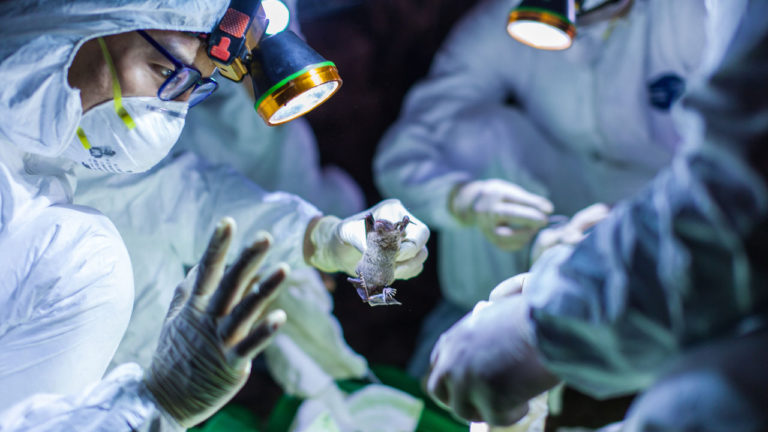
TEDROS Adhanom Ghebryesus, director-general of the World Health Organization (WHO) on Monday during the daily briefings since the outbreak of novel coronavirus said that public health officials are operating in “uncharted territory” as the number of affected persons increases to over 90,000 across 73 countries and territories.
Since the outbreak which originated in Wuhan China late December 2019, the virus has spread to every continent except Antarctica after the first cases in Africa–Nigeria, Algeria, and Egypt over the past weeks.
Ghebryesus in a Tweet on Monday said that to defeat the virus, an understanding of the epidemic would be instrumental.
“We have never before seen a respiratory pathogen that is capable of community transmission, but which can also be contained with the right measures,” he said.
After six deaths in the United States as a result of the virus, the number of deaths outside of mainland China, according to the WHO, totalled 172 while the global death toll was said to be 3, 115.
Knowing & understanding an epidemic is the first step to defeating it. We are in unchartered territory with #COVID19. We have never before seen a respiratory pathogen that is capable of community transmission, but which can also be contained with the right measures.
— Tedros Adhanom Ghebreyesus (@DrTedros) March 2, 2020
Nonetheless, Maurice Iwu a Nigerian professor of Pharmacognosy, and former chairman of the Independent National Electoral Commission (INEC) claim that Nigeria has a possible cure for the virus.
Iwu, made this disclosure on Monday in Abuja while briefing Dr Ogbonnaya Onu, Minister of Science and Technology, Senator Olorunnimbe Mamora, Minister of State for Health, and Barrister Mohammed Abdullahi the Minister of State for Science and Technology.
The professor who heads a bio-science institute said the US Government has reached out to him to take the discovered compound and test it against the COVID-19 virus.
“On Thursday last week, the US Government contacted me and we signed a non-clinical evaluation agreement for us to take this product forward and we are trying to see how we can test this compound immediately against this new virus.
“They are trying set up so we can see if this particular one is inferior to SARS so that the programme will be able to go on,” he said.
EITHY-THREE -year-old Pope Francis has undergone a Coronavirus test after speculations that the head of the catholic church had caught the virus after taking slightly ill.
Reports state that the Pope started suffering from a cough, a slight temperature, a sore throat and chills since leading a procession in Rome, last week.
It was gathered that the illness led the Pope to cancel several public engagements. However, newspaper Il Messaggero reported that the Pope tested negative to Coronavirus.
While this might come as a relief for many Christians and Catholic devotees, the outbreak of Coronavirus in Italy remains worrying for global health experts.
Less than 24 hours ago, CNN reported that there has been a 50 percent increase in recorded cases of Coronavirus in the European country.
According to Italy’s Civil Protection Authority, it was reported that Italy now has 1,694 confirmed coronavirus cases, up from 1,128 confirmed cases on Saturday.
And not fewer than 34 people have died from the virus in the country and Italy has the highest number of cases than any other country outside Asia.
Meanwhile, in Nigeria, the House of Representatives on Tuesday suspended its plenary for two weeks in a bid to contain a possible outbreak of the virus within the national assembly.
It was part of the resolution of the House, after a motion of urgent public importance by representative Uyime Idem, and seconded by Ndudi Elumelu, on the need for immediate action to prevent any new cases of the virus.
LAWMAKERS on Tuesday suspended plenary for two weeks in a bid to contain a possible outbreak of the coronavirus within the National Assembly.
It was part of the resolution of the house, after a motion of urgent public importance by representative Uyime Idem, and seconded by Ndudi Elumelu, on the need for immediate action to prevent any new cases of the virus
At the opening of the legislative session which was presided by Deputy Speaker of the house, Ahmed Idris, the deliberations were kicked in motion by Nkeiruka Onyejeocha of Isuikwato/Umunneochi constituency of Abia State raised concerns at the level of national preparedness against the outbreak.
She also called on border and airport personnel to ensure those coming into the country are effectively monitored which was adopted by the members of the house.
Nasir Ahmed, representing Nassarawa Federal Constituency in Kano State, decried the few isolation centres in Nigeria which would grossly be inadequate to cater if there is a possible outbreak.
However, Minority Leader, Ndudi Elumelu, of the Peoples Democratic Party, PDP, made another prayer to the motion that the lawmakers adjourn for two weeks to allow adequate preparation for the disease at the National Assembly Complex.
There was no assigned date for the lawmakers to take the two – weeks leave, off legislative duties to prepare for protective mechanisms within the National Assembly.
Rep. Taiwo in her contribution calls for grassroots sensitization at the primary health centers in every state.
Rep. Ndudi Elumelu calls on @nassnigeria management to put mechanisms in place to ensure the virus doesn't find a place into the National Assembly.
Josiah Uyime, representing Ukanafun/Orukanam Federal Constituency of Akwa Ibom State, called on the Federal Government to release more funds to the Ministry of Health and the Nigeria Centre for Disease Control, NCDC, in order to quarantine, treat, and contain the COVID-19 virus.
The lawmaker added that the situation was dire and globally about 3,000 people have died and over 90,000 are infected with the virus.
He called on the leadership of NASS to set up an ad-hoc committee to liaise with relevant health agencies to ensure the virus is contained.
A young man leapt out of the Anti-Cultism Unit of the Nigeria Police Force in Gbagada, Lagos, as his mother hurtled towards him. Emaciated, and having his face twisted by glaring discomfort, he had just broken loose from what was the “worst experience” of his life, having spent the previous weeks locked up in the torrid cell of the Gbagada police station.
Few steps to the infamous blue gate of the detention centre, he stopped, took a handful of red sand in the premises, swerved it over his head three times; then, just as he finally stepped outside, he released into the open air the sand, letting it go back into the compound and dusted his hands clean. It was a symbolic gesture: “Never again!”.
His experience offers a window into the encounters of several Nigerians, old and young, with the police institution in Nigeria that brazenly violates the fundamental human rights of citizens and the country’s law through arbitrary arrests, illegal detention, torture, and commoditising justice and bail.
Raided victims
A long-time investigation, including weeks of undercover reporting, revealed one of the police establishments notorious for its human rights violation. The Anti-Cultism Unit at Gbagada, a suburb of Lagos State, is dreadful, but only to the innocent and those unable to pay for a wiped slate. The single bungalow building is notorious for torture, extortion and criminal detention of hapless Nigerians.
Every day, family members of the detainees assemble in different clusters, opposite the building, agonising about the ‘ransom’ they have to pay the Investigating Police Officers (IPOs) of their detained relatives. Not paying this illegal fee only portends one thing — protracted legal battle or continued detention within a system skewed to crush the poor, ordinary Nigerian citizens.
The IPOs are gods, the generalissimos of the detention camp. They are feared because of the power they wield. They determine how long– weeks, many times, months– suspects spend in the holding cell. Ex-detainees and families also say they are arrogant and disrespectful. In the presence of an IPO, relatives of detainees genuflect, with their hands in between their thighs, as they plead –and pay– for the freedom of their detained child or spouse.
So, when the young man dusted his hands, gesturing never to return to the ‘Anti-Cultism’, as the station is often called among the locals, other parents anticipating the release of their own children sighed, partly congratulated the newly released, but mostly hopeful that their children would come out alive.
“I thank God for his mother,” said a woman, anticipating the release of his child in a hushed voice. “Only God knows how much his mother paid to get him out.”
“Better don’t think about the money,” another woman replied as the conversation continued. “Getting our own people out is what we should be praying about. She should be thankful that she has money. Someone can rot inside here if their families don’t have money to pay their bail.”
Indeed, detainees, who could not cough out the huge bail sums are held perpetually, and if they are unlucky, they get charged to court on trumped-up charges, investigations revealed.
After weeks of undercover reporting outside the station, yielding shocking details of how families scrape together money to bribe the police, this reporter gained access into the station to capture first-hand how the police not only detain citizens in brazen violence to the law but forms a money-making enterprise from the misery of these poor citizens.
Crying raid victims
Indeed, securing the release of detainees from police stations in Nigeria is usually draining financially and emotionally but the Anti-Cultism Unit pushes limits. At every turn, there is a policeman demanding a bribe for any interaction with those in their custody. N500 to drop a phone, N1000 to see the detainee, and another N500 to give food to a detainee. The officers take a 10% cut on every money given to the detainees. The avenues for extortion are endless.
At the main entrance, four policemen sit at a table, every day, to ensure visitors do not go into the main building with phones. Of course, the restriction of phones is to shield the world from the illegalities that go on in the station. The officers at this gate not only extort relatives of detainees but also harass them. With AK47 strapped to their sides, or left menacingly on the table, they intimidate visitors, screaming and threatening to “fire” at the slightest provocation.
However, their braggadocio ebbs when their palms are greased with Naira notes. A hitherto minacious face would soften. It costs N500 to retire a phone with them, and each time the phone is retrieved for use, they demand another N500 before one is allowed to return it.
The reception in the main building is not any different. Another police officer bills visitors before they are allowed to contact the detainees. Usually, the charges are not negotiable.
“You will all have to pay N1, 000 each,” an officer told some women waiting to see their detained relative.
These petty extortions hinder people from seeing their relatives. They are forced to rely on others to either get food or money across while they wait under an almond tree, opposite the station, where they lament and console one another.
Rabiu had been in detention for 60 days, his mother said. The station would not release her son and would not charge him to court either. When she visited her son, sometimes, she was able to pay her way through to see him; other times, however, she sat opposite the station, lost in thought and helpless.
Thursday, July 11, 2019, was one of such days she could not see her son. She pleaded with a roadside food vendor who supplied food to the detainees to give her son some food and tell him she was outside.
“Maybe tomorrow, I will enter to see him,” she told a woman who asked if she would be going into the station. “I don’t have money to pay today. I have given the money I have with me to the food seller to give him some food for me.”
While Rabiu’s mother was having a conversation with the other woman on one side, another mother was soliloquizing. She was completely unaware of her environment.
“When I warn this child, it appeared as though I am a wicked mother,” she said in Yoruba, monologuing. “Where do I carry this to? Who do I cry to? Where do I see N300,000?” This reporter looked on, held by the woman’s lamentation. She was one of several mothers whose children remain in the detention of the Anti-Cultism Unit because they were unable to cough out the bail sum.
The Nigerian constitution and the Administration of the Criminal Justice Acts (ACJA) provide that all suspects must be released or charged to court within 48 hours of arrest.
Section 8 (3) of ACJA holds that “a suspect shall be brought before the court as prescribed by this Act or any other written law or otherwise released conditionally or unconditionally”.
This, as investigation showed, is clearly not adhered to, in many instances, by the Anti-Cultism Unit. There are suspects held in detention for weeks without court orders. They remain incarcerated while their family members are pressured to raise huge amounts for bail.
Bail is free… Actually no!!! Bail is very expensive
The Nigeria Police Force consistently campaigns that bail is free. Police Stations across the country have ‘Bail is Free” in bold letters on their walls. It is what the police want Nigerians to believe: Bail is Free!!! But that much-vaunted claim is a ruse.
In 2017, the force relaunched the ‘Bail is Free’ campaign across the 36 states and the Federal Capital Territory. The Inspector-General of Police detailed all senior officers to ensure compliance in their stations and divisions. The campaign, also saw stickers pasted on commercial buses, announcing that bail is free. But, the farther these buses travel with the advertorial and the more prevalent the short sentence becomes, the more blatant an average policeman becomes in demanding a fee for bail. The reality for many Nigerians is that bail is freakily expensive, and not paying it comes with gruesome consequences.
Joshua Daniel, a 17-year-old boy, ended up in Kirikiri Prison because his parents could not afford the exorbitant bribe his IPO at the Anti-Cultism Unit demanded.
Daniel and 8 others were arrested from a room, where they were watching football, by the Ikorodu community vigilante men called ‘On ya bo’. They were later handed over to the operatives of the police Anti-Cultism squad.
The boys are tailoring apprentices with Kareem Awal. On the day they were arrested by the local vigilante, they had worked a night shift with their boss, Awal told this reporter. It was a day in May 2018.
“Truly, we had finished work for the night and I asked them to stay in the shop but they went into the room of one of the neighbours to watch television. It was from that room that they were arrested,” Awal explained.
“We were all watching football in a room when [Tobi] my deaf brother ran into the house,” Kunle said. “He had seen the ‘On ya bo’ boys and got scared because he was always harassed by the vigilante and police due to his condition. They followed him into the room and arrested all of us. Then, they handed us over to the police who took us to Gbagada police station.”
Deji Oladapo was also arrested from the same room but he never made it to the court. Four days after they had been held in detention, their IPO demanded N100,000 from each person.
“My father later paid N70,000 for my brother and I. Two others paid N40,000 each and we were released from Gbagada after one week,” he said.
Oladapo said the police did not immediately ask for the money. They were kept incommunicado for about 4 days before they were allowed access to any family members.
Keeping the suspects for days before initiating contact with their family members is one of the tactics used to wear out and pressure the families, such that when the bail (ransom) is finally requested, the relatives feel relieved that their misery is about to end and source for money by all means.
How Successive Lagos CPs preserve culture of illegal Parade
Fomer CP Muazu.
Every week across the country, hundreds of people are paraded at the police commands, mostly for PR gains. This investigation spanned three successive Commissioner of Police—Imohimi Edgal, Zubairu Muazu, and Hakeem Odumosu— in Lagos State and they all gave the same reason for parading suspects as convicted criminals.
Imohimi Edgal said media parade is necessary for the police to show its efforts in maintaining law and order.
“It is a way for police to always inform members of the public of what they are doing so as to win the trust and confidence of the people,” Edgal said during one such parade at the Lagos State Police Command in 2018.
Unfortunately, those who pay the price of this media stunts are, sometimes, innocent Nigerians with the misfortune of being poor. The Nigerian justice system is rigged against the poor who are unable to match up with different pockets of extortions at every layer.
When Daniel was paraded, alongside 100 others at the Lagos State Police Command, Edgal, who was then the state’s commissioner of police told pressmen who cover the event and would later splash the suspects’ names and faces across all media platforms, that they were arrested at Ogolonto area of Lagos State.
This was false, investigation revealed, but the truth does not matter to the police at that point. It was all for PR.
“They can go to court to defend their innocence,” Edgal said during a question and answer session after the parade.
“We were shocked when they read their charges in court,” Awal, Daniel’s boss told this reporter. “They said they are cultists and that they arrested them from Ogolonto. This is not true but we cannot say anything. The boys worked overnight in my shop and were watching football in one of the rooms opposite the shop when they were arrested. They were arrested at Adamo.”
On Google Maps, there is about 8 miles distance between Adamo and Ogolonto.
A similar event replayed itself during the parade of suspects led by the current Commissioner of Police, Hakeem Odumosu. An Islamic clergyman, Abdullahi, was paraded at the Command Headquarters in Ikeja as a cultist.
Abdullahi, who was still in his neat native attire, said he was boot kicked out of the room with his friend whom he was visiting at Ijora, on January 7, 2020. Odumosu paraded Abdullahi the next day along with other alleged “114 armed robbers, 46 cultists, and 82 murders”.
At the time of the parade—January 8, 2020—the clergyman said he had not written a statement and had not been informed why he was arrested. The Administration of Criminal Justice Law of Lagos State provides that the reason for arrest must be expressly stated before an arrest can be effected. The law also mandates all security agencies to charge suspects to court within 24 hours or release them on bail.
An advocate for police reform and a lawyer, Segun Awosanya, condemned street raids and illegal arrests. During raids, people cannot be held under arrests, Awosanya said. For an arrest to be made there must be a warrant, he explained.
However, he said when a crime had just been committed in a vicinity, the police could invite—not arrest–people around the area of crime for questioning. Person invited in such instances cannot be put behind bars or be made to write extrajudicial statements.
“My challenge with that approach is this,” Awosanya continued, “When crimes are being perpetuated by cultists or armed robbers, you will not see the police officers. They will not be anywhere near the environment. Hours after the crime has been committed, the criminals have gone… innocent souls going to buy bread and ewa agonyi [beans] will be arrested with the pots in their hands as suspects for the crime.”
Sadly, this is the reality of many young Nigerians who have fallen victims of street raids. They are raided and paraded as criminal suspects before the media.
Illegal Street happens every day
Street-raiding is one of the ways Nigerian security agencies illegally fleece people. From the Nigeria Police Force to the paramilitary task forces like the Lagos State Environmental Sanitation Corps (LAGSEC), street-raiding provides a daily meal ticket.
The Anti-Cultism Unit is not an exception. Different teams of operatives set out daily, with an empty eighteen-seater bus and return hours later with the buses fully loaded with young boys picked from different streets of Lagos.
This reporter, while being undercover at the Anti-Cultism unit in Gbagada, observed for a week, as policemen from the station illegally raided streets and extorted their victims.
“Don’t be surprised. It happens every day. It is what our eyes see here every time,” said one of the traders opposite the station. “When they come back later, the bus will be filled with young boys.”
A police inspector, who gave his name simply as Saudi, disclosed that people arrested in this manner and by operatives from the unit are treated less harshly once they pay the bounty of N5,000 or N10,000.
Saudi– Corrupt policeman
“If we arrest people directly, it is easier,” Saudi said.
However, the fee skyrockets when the suspects are brought in by other stations as it was in the case with Daniel.
“Transfer cases are more difficult,” the inspector, Saudi, revealed. “The DPO from the other stations can report us that we are releasing suspects without charging them to court. That is why the transfer is higher because of the risk involved.”
Saudi, or Nur Adeboye as a caller identification app, Truecaller, suggested, did not volunteer the information out of goodwill. He is part of the extortion racket at the police station. Adeboye extorted N500 as an entrance fee from the reporter while undercover as niece to one of the detainees. He would later make sexual advances in exchange for his help in securing the release of her supposed uncle.
Saudi, in the company of another policeman, Abdul, was subsequently seen receiving the balance of a N70,000 illegal bail fee charged for the release of a detainee.
Madam Atinuke [not real name] said her son was arrested for refusing to hold a suspect being chased by the police who was raiding streets at Ikorodu.
“A police officer asked my son to help him restrain a running suspect but he refused. That was his only offense. The policeman arrested my son and swore he would ensure he goes to jail,” she said. “I have spent more than N70, 000 at this police station. I had given them N60,000 earlier, it is the balance of N10,000 I bought today.”
Atinuke handed the N10, 000 to Saudi, who in turn handed same to Abdul. “Find something for me too,” Saudi asked the women as he handed the N10, 000 to his colleague
Anti-Cultism Unit or kidnappers’ den?
Sometime in July 2019, during the welcoming ceremony of the then Lagos State Commissioner for Police, Zubairu Muazu, was emphatic while addressing his officers, during an event at the State’s Criminal Investigation Department.
“When we say bail is free, we mean bail is free,” he said, as though trying to convince himself that his boys strictly comply with the ethos.
Muazu took his charade seriously, describing policemen who demand bail as kidnappers emboldened by state powers.
“Any officer collecting bail money is not better than a kidnapper. Yes, he is not better than a kidnapper,” he emphasized. “As for me, the difference is that a kidnapper keeps his victims where nobody knows but you [the extortionist officers] are keeping your victims in your cell, where everybody knows. That is the difference between an officer who takes any money and a kidnapper.”
The commissioner’s analogy, although a mockery of conduct of many police officers in the country, was apt.
At the time of reporting for this investigation, there were more than 10 detainees held in Anti-Cultism custody. Some have been there for months and weeks. Their family members struggled to gather the outrageous bail fee being demanded by the IPOs.
Bose Akinbade [not real name], a middle-aged woman, rallied around relatives and acquaintances to raise N300,000 requested for the release of her two children.
21-year-old Onyebuchi had been in custody for two weeks. There was a bounty of N150, 000 on him to regain his freedom. His sister brought food for him every day while his IPO negotiated with his uncle for the money.
“When I saw my brother, he had emaciated,” she lamented. Two weeks in that place is not a good thing.”
55-year-old Nurudeen Usman, was one of those also held at the detention of the Anti-Cultism Unit at the time. He was held captive for nine days while his family members run around to raise the N200,000 for his bail.
Usman’s ordeal started on a Sunday afternoon in July. He was coming from the workshop of an engineer fixing his wife’s refrigerator when he walked into a joint operation between Lagos State Neighborhood Safety Corps and policemen from Ejigbo station. They were raiding the street for suspected cultists.
“I was on a phone call. Unknown to me that they were raiding in the field,” Usman explained. “One of the neighbourhood officers hit me from behind and knocked the phone off my hand. While I was defending myself, other policemen joined him, handcuffed me with another man who was arrested from the field and took us away.”
The other man handcuffed with Usman was old Baba Aro, a homeless man. Baba Aro was known in the neighborhood. He lived in one of the cabins on the field. He was accused for allegedly dealing in marijuana.
But Usman has nothing to do with him, he said. He knew Baba Aro but not more than anyone else in the neighbourhood who got familiar seeing him on the field and sometimes gave him food. Usman was not allowed to explain himself. He was bundled into the cell and labeled a cultist. His phone was also confiscated, unable to contact relatives.
Three days later, he was paraded at the state’s CID office before Muazu as a cultist. The elderly man could not believe he was indeed being accused of an offense punishable by one-year imprisonment or in extreme cases a death sentence according to the Criminal Code Act. He wept in the manner of beaten kid as pressmen interrogated him and flashed camera lights in his face.
“I am not a cultist. I went to check my wife’s refrigerator,” Usman said in Yoruba as journalists bombarded him with multiple questions.
The next day, Usman’s name and picture were splashed across different newspapers. He was branded a notorious cultist who had been terrorising his neighbourhood in one of the publications.
But this was the least of Usman’s worries. He had spent four days in detention and had no clue if he would be released or tried alongside people he met, for the first time, at the police station.
N70,000 As bail ‘ransom’
In the meantime, Usman was locked up at the Anti-Cultism detention centre, unsure of his fate. On Thursday, July 11, the family members met Supro Jimoh, famously referred to as Babalawo, for the first time. Babalawo was the IPO in charge of the transferred cases from Ejigbo Police Station. This means he was Usman’s IPO.
Babalawo did not attend to the family members on first visit. He gave no reason for this. He sat as the throne head in the premises of the police detention centre surrounded by other junior officers, and detainees who sat on the bare floor. Baba Aro and few other detainees were chained together in violation of Section 5 of the ACJA.
The ACJA prohibits the inhumane treatment of any suspects held in detention.
Section 8 (1) holds that “suspect shall: be accorded humane treatment, having regard to his right to the dignity of his person; and not be subjected to any form of torture, cruel, inhuman or degrading treatment”.
“Come back tomorrow,” Babalawo said casually.
Ganiya, the wife of Usman; Ademola, his brother, and this reporter who was undercover as his niece begged Babalawo but he would not bulge.
“Please, sir. My husband has been in detention since last week,” the wife pleaded.
Babalawo became impatient and went into a tirade about how detainees’ family members are always adamant, and would not listen to simple instructions.
“I have told you to come back on Friday,” Babalawo insisted. We cannot do anything today. When you come on Friday, we will know what we can do. He has only spent days here. There are people who have been here for a month.”
Friday, Usman’s relatives met with a more receptive Babalawo at about 10 am. He assured them Usman would be released before the close of work.
“The man is innocent, we know. He was only unfortunate to be at the wrong place. Once I get instruction from my boss. We will release him to you today. Don’t worry, he would go home today,” Babalawo assured.
He did not mention what this promised release would cost but having been at the station long enough, the relatives knew freedom comes with a huge financial cost. Still, Ganiya hoped that her husband would be vindicated by his innocence. Ganiya’s hope was dashed when Babalawo later demanded N200,000.
“The bail is N200,000,” he said when he later met with the family. “The case is even more serious than I had thought. His face has been published in the newspaper. They said he is a cultist, that he knows that old man who sells weed on the field.”
Babalawo then referred the relatives to a junior officer, a tall, fair man, who would collect the money and interface with the family henceforth.
After numerous calls to distant relatives and acquaintances, Ganiya could only raise N45,000, less than a quarter of the chunk demanded by Babalawo. Ganiya, accompanied by Ademola, begged Babalawo to accept all they could raise.
“Please, sir, I have emptied all my account,” she begged.
Babalawo, seated behind a desk in the small office he shared with other IPOs, was unpersuasive. He became hostile even. It was N200,000 or nothing. The man who was cheerful only hours ago suddenly became aggressive.
“Why are you begging me,” he quipped. “Go and talk to the inspector. Am I the one who asked your husband to commit a crime? Did the police arrest him from the room? He committed an offense that was why he was arrested.”
The change in Babalawo’s countenance was not surprising. The plea was threatening his harvest of corruption. The same man who had assured the release of Usman on the account of his innocence had suddenly turned against him. He brandished the newspaper report as though it was a court sentence.
“Is this not your husband in the paper?” he asked, waving the paper in Ganiya’s face.
Ganiya left the station, feeling dejected. How would she raise N200,000? Usman remained in the cell throughout the weekend as his relatives were unable to meet demands for his release.
Nine days later, he was released at about 8 pm after N70,000 was paid.
“Are you sure the money is complete?” Babalawo asked as he received the N70,000 bribe.
Babalawo is not the only rogue officer, he works with other junior officers who sometimes negotiate the deal on his behalf. In the case of Usman, Babalawo referred the family to a tall, fair-skinned man who wore a chain necklace like a musician wannabe. The negotiation broke down with the fair-skinned officer because he insisted his superior would not accept less than a hundred thousand Naira.
While this reporter was in the IPOs’ office, negotiating the release of Usman, others were doing the same with the IPOs of their relatives.
The torturous ‘Kalakuta Republic’
The Kalakuta Republic, created by the Afrobeat legend, Fela Anikulapo Kuti, is one where men live freely and without inhibitions. It was to mirror the exact opposite of “Calcutta” prison detention where Fela was held during one of his incarcerations by the Nigerian military junta.
Beyond what Fela could have conceived, the police now have a place named ‘Kalakuta Republic’ but for an inverted purpose different from the late radical singer’s club.
A torturous republic exists within the premises of the Anti-Cultism Unit
The ‘Kalakuta Republic’ is a secluded space within the premises at the Anti-Cultism Unit. Suspects are tortured and inflicted with bodily harm to either extract extra-judicial statements or pressure them into parting with huge sums.
Many times, the paraded suspects are covered with bruises and wounds inflicted on them while in custody. Desmond Akpan [not real name], a student of the University of Lagos, was released to his father with a deep wound to his leg. He said he was hit with the nozzle of an AK47 rifle while in detention.
“They hit me with their guns on my leg, scratched my stomach. I did not do anything. I saw people running, I did not know why, so I ran too. I did not commit any offense,” Akpan explained when he was paraded at the police Criminal Investigation Department in Yaba.
Akpan still had his joggers on at the time he was paraded as a cultist. He was not arrested with any incriminating object but somehow, he was profiled and labelled a cultist. Ten days later, when he was released to his father by Babalawo, he could not fully balance his left leg.
Apart from the ACJA, other international laws prohibit torture of any kind on suspects. Nigeria is a signatory to the United Nations treaty against Torture and Other Cruel, Inhuman or Degrading Treatment or Punishment, adopted by the General Assembly on December 9, 1975.
The agreement prohibits torture of suspect in the bid to extract information or to subdue them.
Zeid Ra’ad Al Hussein, a former UN High Commissioner for Human Rights, summarised the responsibility placed on law enforcement agents while dealing with suspects.
He said police, “officials required to enforce the law should not undermine the rule of law. If the police break the law in pursuit of law enforcement, the message is one of capricious and abusive power. The institution which should protect the people becomes unmoored from principle; unresponsive to the law, it is a loose cannon.”
Note: This is the final part of the three-part series. Read Part II here, and Part III here.
THE International credit rating agency, Standard & Poor’s (S&P), announced on Monday that Nigeria’s credit rating has lowered to negative.
Nigeria’s current declining foreign exchange reserves have brought the country to the negative category on the rating.
In finance, credit rating is a quantified assessment of the creditworthiness of a borrower in general terms or with respect to a particular debt or financial obligation
The sovereign credit rating indicates the risk level of the investing environment of a country and is used by investors when looking to invest in particular jurisdictions, and also takes into account political risk.
According to the credit rating agency, there are two categories a country can belong to after an assessment which is stable or negative.
Foreign-exchange reserve levels have fallen from $45 billion at mid-year 2019 to $38 billion at end-2019 and fell to $36.5 billion in February 2020.
With S&P’s outlook change, all three international rating agencies now have a “negative” outlook on Nigeria’s sovereign credit rating.
With the recent low rating recorded by S&P, foreign and domestic investors are likely to have sentiments on whether to invest in the Nigerian market or not.
THE National Examinations Council (NECO) said it had handed over four students of the University of Abuja to the Nigeria Police force in Minna, Niger state capital over forgery of result.
According to NECO, the four students were initially handed over to the council by the management of Uniabuja following a verification of their NECO results.
The four students, Effiong Theresa Etim; Solomon Victor; Abdulkabir Mohammad and Yakubu Joy Adama are set to be arraigned before the court for allegedly forging their National Examinations Council (NECO) results to gain admission into the institution.
An official of the council said the students are likely to be arraigned before the end of the week following a failed attempt to arrange them on Monday before a magistrate court in Wuse zone 2 in the Federal Capital Territory (FCT), Abuja.
Chijioke Chigozie, a police prosecutor told newsmen on Monday that 9 students have been arrested for the same offence but investigations are still ongoing.
The charge against the four students read that: “On the 18, October 2019, the registrar of the University of Abuja laid a complaint to the AIG zone 7 headquarters Abuja for investigation.
“It revealed that you Effiong Theresa Etim with June 2017 NECO SSC no 501569013, Solomon Victor June 2017 NECO SSC no: 10506512111, Abdulkabir Mohammad with June 2012 NECO SSC no: 105016543 and Yakubu Joy Adama with June 2016 NECO SSC no: 597472720.
“That these certificates upon which you gained admission or sought admission into the University of Abuja are forged certificates. You are thereby suspected to have committed the above offense”
CLAIM: 822 people killed by malaria daily in Nigeria
GARBA Shehu, Senior Special Assistant on Media and Publicity to President Muhammadu Buhari on Sunday expressed dissatisfaction with the media blitz on Coronavirus.
The presidential aide wondered why the media would focus attention on the disease outbreak rather than other illnesses killing Nigerians.
“This morning’s newspapers, all of them have Coronavirus as the lead, cover story,” Shehu tweeted, then the said, “When will they bring the spotlight to bear on 822 who are killed by malaria every day in Nigeria?”
It could be recalled that Nigeria’s first COVID-19 case was officially announced by the Federal Ministry of Health and the Lagos State Government on Friday.
However, since he made the post, the claim has made headlines in major Nigerian newspapers.
The tweet in less than 24 hours has gathered over 2,400 likes and 716 retweets as many Nigerians now asking President Muhammadu Buhari-led administration to prioritise the country’s health sector.
This morning’s newspapers, all of them have Coronavirus as the lead,
cover story.
When will they bring the spotlight to bear on 822 who are killed by malaria everyday in Nigeria?
The ICIR, however, put a call through to Shehu to validate his claim that 822 Nigerians were killed by malaria every day, but he did not respond to his call. Text messages were sent but he is yet to reply as at the time of filing this report. This reporter further sent a tweet to him but he is also yet to respond.
Our Findings
Though, Nigeria has truly recorded the highest cases of Malaria in the world and mostly followed by the Democratic Republic of Congo (DRC) in recent years, according to the World Health Organisation Global Malaria Programme (GHP) – WHO’s coordinating unit that controls and eliminates malaria.
Moreover, children under age five are most vulnerable to the disease, and often fall victim.
For instance, the World Health Organisation (WHO) in its 2018 report says 15 countries in sub-Saharan Africa and India accounted for almost 80 percent of the global malaria burden put at 219 million cases.
Out of five countries that reflected nearly half of these 219 million global cases, Nigeria had 25 percent, followed by DRC with 11 percent, Mozambique also had five percent share while India and Uganda accounted for four percent respectively.
But in terms of deaths recorded as a result of the disease, it is not true that “822 are killed by malaria every day in Nigeria,” as claimed by the Presidential aide.
Based on the 2018 World Malaria Report published by the WHO, and forwarded by Dr. Tedros Ghebreyesus, 435,000 people died due to Malaria disease globally in the year under study.
From this figure, Nigeria recorded an estimated figure of about 43,700 deaths which accounted for 19 percent among seven countries that had more than 50 percent of the global deaths in 2017.
“Nearly 80% of global malaria deaths in 2017 were concentrated in 17 countries in the WHO African Region and India; seven of these countries accounted for 53% of all global malaria deaths: Nigeria (19%), Democratic Republic of the Congo (11%), Burkina Faso (6%), United Republic of Tanzania (5%), Sierra Leone (4%), Niger (4%) and India (4%),” it stated as at the time the report was released in 2018.
A further breakdown of 43, 700 deaths recorded in 2017, therefore simply implies that 120 deaths were recorded daily in Nigeria.
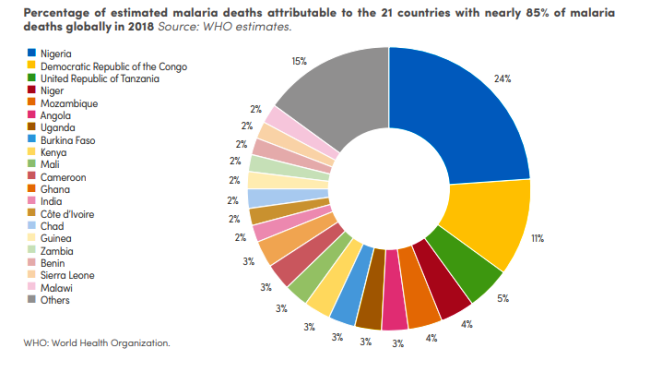
Percentage of estimated Malaria deaths attributed to 21 nations with nearly 25 per cent deaths globally Source: WHO
Moreover, the latest World Malaria Report, which was published on 4th December, 2019 also accounted for 228 million malaria cases in 2018.
19 countries in the Sub Saharan and India had almost 85 percent of the global burden.
Nigeria particularly recorded about 25 percent among six nations which accounted for more than 50 percent of global malaria cases.
But in terms of deaths, it accounted for an estimated figure of about 405, 000 casualties globally. From these deaths due to Malaria parasite, Nigeria reportedly accounted for almost 24 percent which is about 97,200 casualties.
“Nearly 85% of global malaria deaths in 2018 were concentrated in 20 countries in the WHO African Region and India; Nigeria accounted for almost 24% of all global malaria deaths, followed by the Democratic Republic of the Congo (11%), the United Republic of Tanzania (5%), and Angola, Mozambique and Niger (4% each).”
Again, from the same report subtitled, High Burden to High Impact Approach (HBHA), it stated that “Malaria deaths reduced from about 400 000 in 2010 to about 260 000 in 2018, the largest reduction being in Nigeria, from almost 153 000 deaths in 2010 to about 95 000 deaths in 2018.”
So, to be modest, if we are to adopt the quoted figure of 95,000 deaths in 2018, it means 260 deaths were recorded daily due to malaria.
Verdict
Based on these findings from the WHO, a United Nations health agency, the claim by the presidential spokesperson is false.
Contrary to the 822 daily deaths bandied by Shehu, the estimated figure of 95,000 when divided by 365 days equals 260 deaths – a figure, three times lower than his claim.
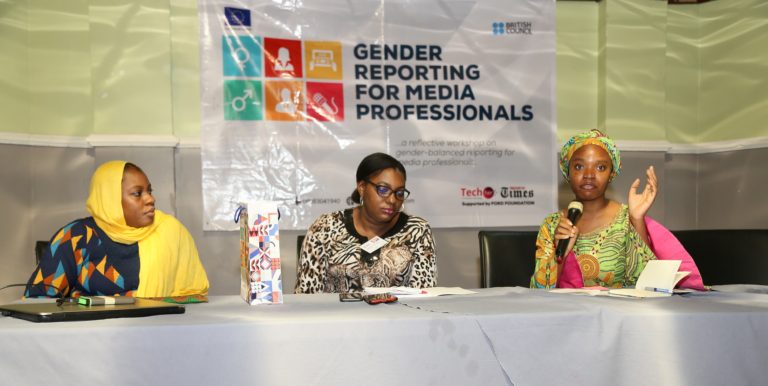
A GROUP of professional journalists and activists have identified social conditioning and power dynamics among other factors constraining journalists from telling objective gender stories.
The two- day intensive media training tagged “Gender Reporting for Media Professional” engaged professional media practitioners and activists from across Nigeria on the different ways of reporting gender-sensitive issues across the different social sectors including politics, business, and human development.
“It is the job of media professionals to curtail infringements, misrepresentation and biases in the reportage of gender-sensitive issues fueled by citizen bloggers who masquerade as professionals in the field of journalism,” said one of the facilitators, Lolade Nwanze.
Nwanze noted that it was time for the Nigerian media space to consciously make efforts geared towards changing the status quo.
Examining the reportage of rape and judicial trials of sexual assault by the media over the years, she noted lapses in the reporting processes.
“Let’s call a spade a spade if there has been a violation of rights, the media should be able to call it the way it is,” she said.
Dorothy Njamenze, the founder of Dorothy Njamenze Foundation, a Non-Government Organisation focusing on promoting women and girls’ rights, said for the media to break through restricting shackles of social conditioning and power dynamics, journalists have to report past conventional and personal biases.
“Let’s desist from stereotyping victims that would only portray them as more vulnerable and ask crucial questions,” said Dorothy. “Put on your gender googles and flip the charts we have come to the point where we need to report precise details and descriptions–especially in the reportage of sexual assaults if there must be the hope of getting justice for victims.”
Journalists at the Owerri Gender Reporting for Media Professionals Training.
Participants at the event told The ICIR that the media workshop on gender reporting was long overdue.
“This is an impactful and necessary media training that I must say has helped me identify my own biases in reporting. Unknowingly, journalists have helped give voice to perpetrators of acts that should be frowned upon in the society and unwittingly deny the victims justice,” said QueenEsther Iroanusi, PREMIUM TIMES journalist.
She noted that gender reporting is not restricted only to instances of sexual violations, but extends to negligence in any aspect that concerns both genders.
Chioma Ezenwafor, On-Air Personality with NigeriaInfo, Portharcourt said the use of certain conventional words in the process of reporting gender and assault cases affect the media efforts in its call for justice.
She said the takeaways from the workshop have shifted the dynamics of gender reporting in a positive direction for the participating journalists. She encouraged her colleagues to report gender-sensitive stories.
A CIVIL society organisation, Resource Centre for Human Rights & Civic Education (CHRICED) has slammed the State Security Service over harassment of PREMIUM TIMES editor-in-Chief, Muskilu Mojeed and reporter, Samuel Ogundipe.
A publication about the feud between the National Security Adviser, Babagana Munguno and Abba Kyari, the Chief of Staff to the Nigerian President, Muhammdu Buhari had prompted the alleged harassment, according to a statement by the group.
The Executive Director of the organisation, Ibrahim Zikirullahi, noted that the action is a misuse of security institutions.
“CHRICED flays the misuse of security institutions funded by taxpayers to intimidate citizens, especially journalists who are doing their legitimate duty by reporting the true state of governance to all citizens, ” he noted.
According to the group, the publication has exposed to the public how the fight against insurgency is being internally weakened by forces in the presidency.
Zikirullahi said the publication has shown that Buhari has been persistently passing on his responsibility to Kyari even in the face of terrorism.
“From the content of the leaked memo, it was also very clear that even in the face of the mindless slaughter of defenseless Nigerians by terrorists, bandits and other violent criminals, President Buhari continues to project weakness by abdicating his responsibility to his Chief of Staff who has been exercising power of the President by proxy rule,” he stated.
The statement further read that the SSS is again hunting journalists to force them to divulge the source of their information.
“With these facts so well established, it is condemnable that the DSS is again resorting to the discredited tactic of hounding journalists to force them to divulge the source of the leaked memo,” the statement read.
CHRICED urged the SSS to desist from such actions against the news agency and its staff because international organisations and foreign investors in Nigeria are watching.
“We, therefore, call on the DSS to immediately end the ongoing harassment and hounding of PREMIUM TIMES editors and reporters. CHRICED also admonishes the service to know that across the world, policymakers and investors are closely watching to see if the Nigerian State is serious about its commitment to the rule of law,” CHRICED noted.
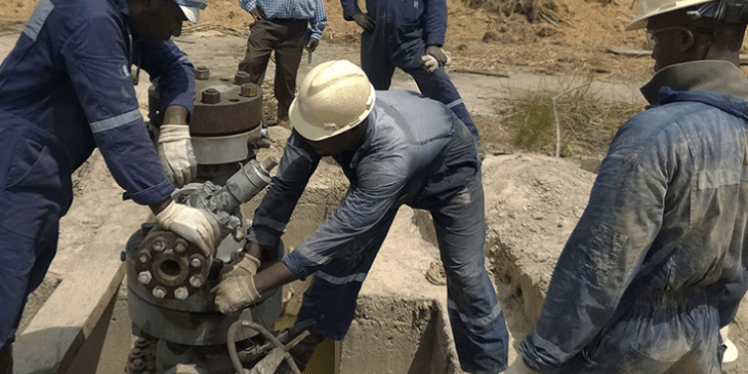
ON Monday, Nigeria’s oil firm Lekoil announced that its advisers failed to carry out due diligence in the scam loan deal that threw the company listed on the London stock exchange into a financial mess.
In January, the management of Lekoil penned a $184.0 million loan deal with Qatar Investment Authority, QIA, to finance its oil exploration operations on Oil Prospecting Licence, OPL, 310 oilfields.
It was later revealed in February that the party granting the loan was not a representative of QIA , and Lekoil confirmed it had been defrauded by phoney investors after paying $450,000 to Bahamas-based consultancy firm Seavave Investment Ltd, which acted as a broker for the deal.
Announcing the results of an investigation into the failed loan deal, Lekoil said the checks and due diligence carried out by the company, including a third party report, had proved to be “inadequate”.
“The fraud, whilst relatively elaborate and sophisticated, should have been capable of being detected by parties engaged to advise on the Facility Agreement, internally or externally, prior to its execution,” according to a statement released by Lekoil.
An internal investigation was led by Mark Simmonds, former Member of Parliament, MP, in the British parliament and Tony Hawkins, a senior lawyer, who are members of Lekoil’s board to curtail the falling stocks of the company in the London stock exchange as a result of the scandal.
After the conclusion of the investigation, it was found that there was “no evidence of any complicity of any Lekoil director of employee”, and it had started legal action to reclaim the monies paid to Seawave, though, the communication with the fake investors was facilitated by Chief Executive Officer, Olalekan Akinyanmi.
Lekoil claimed that Seawave had introduced the company to individuals who “constructed a complex facade in order to masquerade as representatives” of the Qatar Investment Authority which has made the firm launch a review of its corporate governance practices and procedures for the review and approval of major transactions.
“The Board only approved the execution of the Facility Agreement after a third-party global risk consultant engaged to undertake the due diligence investigation on Seawave, provided a report, based on public record search, that did not identify any ‘red flags’ on Seawave or its principals,” Samuel Adegboyega, a non – executive member of the board has said.