AUGUSTINE Obiora Akubueze, president of the Catholic Bishops Conference of Nigeria (CBCN) said the Nigerian President, Muhammadu Buhari rarely visits or speaks to Nigerians when attacked compared to his response to attacks in western countries.
“Nigerian Federal Government will not even send a condolence message to families who have suffered fatalities in the hands of Boko haram. We see our President rarely visit or even speak to Nigerians when there are terrorist attacks in Nigeria,” he said.
Akubueze said this during his remarks at a peaceful protest on Sunday organised by the CBCN in Abuja against the high level of insecurity in Nigeria.
According to him, the government sends condolence messages to foreign countries when there are attacks that led to the death of a few persons but fails to replicate the gesture internally.
“We sometimes read of our Government sending condolence messages to western countries when there is a terrorist attack that may have led to the death of one or two persons, we commend the Federal Government for doing this but we are utterly surprised to discover that the same Nigerian Federal Government will not even send a condolence message to families who have suffered fatalities in the hands of Boko haram,” the Archbishop noted.
He said the protest was carried out on behalf of over 22 million Catholic and over 100 million Christians living in Nigeria who stand against Boko Haram, kidnapping, herdsmen attacks.
It noteworthy though that these figures have not been validated by any census.
Akubueze noted that Christians are tired of claims by the Federal government that Boko Haram members have been “technically defeated”, despite incessant attacks.
He charged Buhari to take affirmative actions to prevent attacks in Nigeria, most especially in the northern part of the country.
The Archbishop urged the Nigerian president to listen to the legislative arm when they unanimously call for the sack of security chiefs of the nation and dissociate himself from members of his government that politicize the killings of Nigerians.
THE GOVERNOR of Imo State, Hope Uzodinma said a relative of the former governor of the state, Emeka Ihedioha visited him but insists he did not install him as an Emir in the state.
Uzodinma, addressing journalists in Abuja at the First Plenary Meeting of the Catholic Bishops Conference of 2020 on Sunday, said the visit by the Muslim community in Imo was a courtesy visit as he is a governor to both Christians and Muslims in the state.
Contrary to the information that he installed an Emir, he said the new Imam who visited him is a native of Mbaise in Imo State and a relation of ex-governor Emeka Ihedioha.
“Contrary to that, the courtesy visit by the Muslim community in Imo State to me, was a welcomed one. The new Imam is a native of Mbaise, not a Northerner. He is a relation of Emeka Ihedioha. I am a governor of both Christians and Muslims,” he said.
He urged residents of Imo to abstain from divisive information because there are Muslim indigenes in the state as there are Christians too.
“ We should shun everything that will bring division in the society, there are more people from the East that are also Muslims and some Muslims were born in the East and do not know any other place apart from the East, so, it is left for government to device a means that will accommodate everybody,” Uzodinma said.
Speaking on the review of the judgment that brought him in as the governor of Imo state, Uzodinma said ‘tomorrow will take care of itself’.
“I am not a member of the appeal panel, but we pray to God and tomorrow will take care of itself,” he told journalists.
He added that his vision for Imo state would speak for itself after one year as the governor of the state.
“Well, I just settled down, I came prepared and I have a vision that I am going to drive the state to be a model state, in the next 12 months, you will do the assessment yourself,” Uzodinma stated.
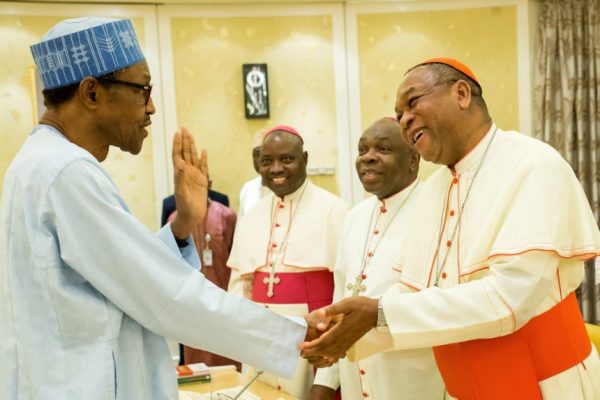
THE Archbishop of Abuja, Ignatius Kaigama on Sunday called on President Muhammadu Buhari and other political leaders to hearken to the cries of the ordinary Nigerian, noting that the masses are suffering.
“Nigerians are suffering and they come to us because we are the grassroots men, they don’t have access to the president,” Kaigama said in his homily during a mass organized to mark the First 2020 Plenary meeting of Catholic Bishops’Conference of Nigeria (CBCN).
Let’s listen to the people. We have to cultivate the spirit of patriotism, spirit of one Nigeria. Something must be done to repair the damage that has been done whereas so many things divide us as a nation; religion, ethnic, and many other factors.”
Vice President Yemi Osinbajo, Minister of Transport, Rotimi Amaechi, Governor of Imo State, Hope Uzodinma and other political leaders attended the mass held at the Catholic Secretariat, Abuja.
While emphasizing the need by the government to create access for the masses to be able to channel their thoughts, Kaigama said government should look towards working with faith based organisations that Nigerians are already baring their minds with.
“Since they are reaching out to us, we can touch the lives of the marginalized if the government reaches out to us.
“I’m glad that the Vice President is here. We need to have access to our leaders; president, vice president. We need to work together to eradicate poverty, killings, bad governance and all sorts of challenges facing us as a nation.”
Speaking on the insecurity in the country, the Archbishop called on Nigerians to turn to God to salvage the country from the firm grips of insurgents, bandits and kidnappers who he said are making life miserable for Nigerians.
“This is the time to turn to God to save us and our dear country, Nigeria. We are told that once there is life there is hope,” he said.
“We refuse to give in to pessimism. We are resilient, that’s why we are Nigerians.”
He, however, queried the government’s approach to fighting insurgency, banditry and kidnapping in the country lamenting that there have been no enough sincerity and political will to overcome the challenges.
“But why should we be suffering for so long? Where is the technology, where are the equipment, where is the sincerity and political will to conquer this menace? Kaigama asked.
Archibishop Kaigama also cautioned the government against taking offence when men of God point out its mistakes saying “let the president listen to us instead of waiting for what we are going to say to abuse the government.”
“Let’s listen to the people. There is a need to collaborate with faith-based organisations to reach out to the people.”
He, however, warned that churches and mosques are not places to rain abuses on government, noting that preachers can pontificate and denounce bad governance, poverty, hardship and insecurity but not to abuse government.
“To abuse leaders while preaching is not the message of the apostle. Why the church or mosque antagonises our leaders?, he said.
The Catholic Bishops’ Conference of Nigeria also organised a prayer rally on Sunday afternoon in Abuja to pray for those who are in the captivity of terrorists, bandits and kidnappers.
THE Department of State Security Services (SSS) has denied the alleged targeting of PREMIUM TIMES Editor-in-Chief, Muskilu Mojeed and reporter Samuel Ogundipe over a publication.
SSS through a statement signed by its spokesperson, Peter Afunnaya said the reports that the secret service is targeting the news agency and any of its staff are not true.
“The report that the DSS is laying siege on premium times and has hacked the phones of one of its staff is false in its entirety,” the statement read.
Samuel Ogundipe, a reporter with the news agency has gone into hiding after he said his phone had been hacked by the state security service over an exclusive piece that revealed a fracas between the Abba Kyari, the chief of staff to Nigerian President, Muhammadu Buhari and the National Security Adviser (NSA), Babagana Monguno.
Earlier on Sunday, two men suspected to be officers of the SSS had also attempted to invade the home Mojeed under the guise of delivering a letter meant for him.
However, the SSS said such reports are mere ‘sensationalism’ and there is no such activity going on in the agency.
“It is unfounded and just a needless sensationalism, there is no such operation at the moment by the Service targeted at the Premium Times, its editor or staff.
The security service added that if the need arises for such action, it would be carried out with decency.
“If there is any need for the DSS to discharge its duty, it surely has to do that with every sense of decency and in accordance with laid down procedures. Now the Service is not anywhere near the news agency,” the statement noted.
Notwithstanding, Ogundipe has said he would remain “underground” until he is certain of his safety.
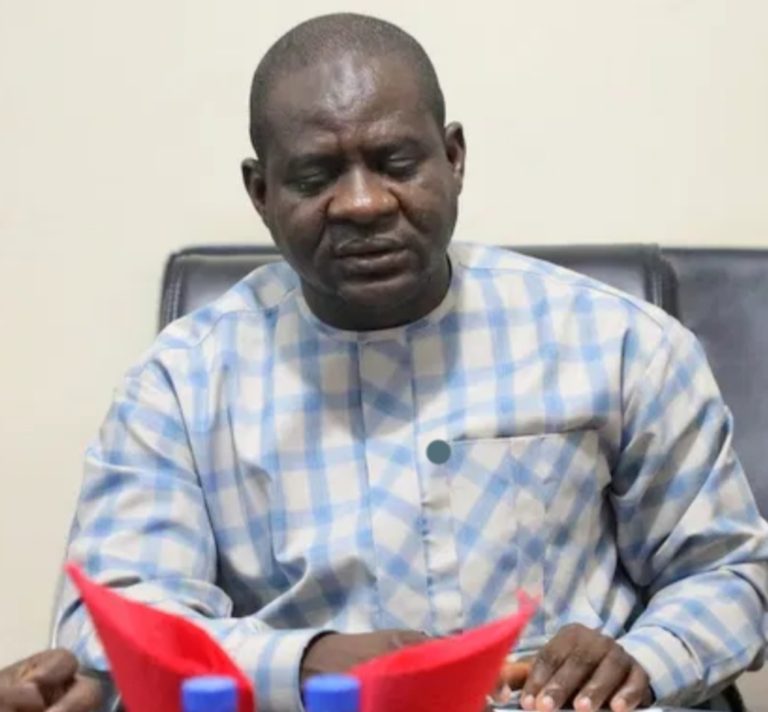
MEN suspected to be officers of the State Security Service (SSS) on Sunday morning breached the security of the Abuja residence of Muskilu Mojeed, the Editor-in-Chief of the PREMIUM TIMES, The ICIR has learnt
Two plain-clothes men who drove in a 2008 Toyota Camry car (Muzzle brand) arrived the house on Sunday morning and told Haulat, the wife who answered the knock on the gate, that they had a message for her journalist husband, requesting that she opened the gate to receive the message, a source close to the family told The ICIR.
The strangers had told Haulat that they knew that the husband was not at home but insisted that they had a “very important message” to deliver to him and persuaded her to open the gate to receive it, but she instead asked them to pass the message through the opening in the gate.
Three vehicles parked by security operatives parked near the PREMIUM TIMES office in Wuse, Abuja
The two men, one wearing a black T-shirt and the other in a corporate suit, pressed further, insisting that she had to open the gate and sign for the message they came to deliver but Haulat maintained she could receive and sign for the message without opening the gate.
Noticing that the men were adamant, the journalist’s wife told the men that she would have to go inside the house to phone her husband and ask for permission before she could open the gate. It was at this time, the source said, that the men turned and left, driving off in a heavily tinted black Camry car.
The ICIR reported yesterday that SSS has launched a manhunt for a reporter of the PREMIUM TIMES, Samuel Ogundipe over an exclusive report which exposed the rift between the National Security Adviser, Babagana Monguno and Abba Kyari, the Chief of Staff to President Muhammadu Buhari.
Inside sources at the presidency confirmed that the members of the kitchen cabinet of the president were very angry over the matter and had sworn to make Ogundipe reveal the identity of his sources.
PREMIUM TIMES editor, Idris Akinbajo, confirmed yesterday that the reporter is concerned about his safety and has since then gone into hiding.
Mr. Mojeed told The ICIR that the harassment of his wife by the Nigerian secret police is a confirmation of the government’s war against PREMIUM TIMES.
“The encounter has left my wife traumatized,” he said.
THE ORGANISERS of the International journalism festival have announced the cancellation of the 2020 edition amidst fears of the deadly virus, COVID-19.
Announcing the cancellation, founders of the festival, Arianna Ciccone and Christopher Potter through a statement said the festival earlier scheduled to hold on 1st to 5th April 2020 has been canceled owing to the risk of public health safety.
The 2020 edition was set to hold in Perugia, Italy where more than 1,000 coronavirus cases and 29 deaths have been confirmed.
The statement read that the cancellation is coming a month to the scheduled date because the safety of festival speakers, attendees, volunteers, staff, suppliers as well as that of the citizens of Perugia is a priority.
“We make this announcement today, one month before the start of the festival because we are convinced that the entire festival community will benefit from an end to the uncertainty. Please note that the festival is being canceled, not postponed,” the founders noted.
Ciccione and Potter apologized to all intending speakers, volunteers, and attendees for the inconvenience noting that another edition of the festival will hold in 2021.
“The next festival will take place in Perugia from 14 to 18 April 2021, we hope all those who were intending to participate in the 2020 festival will be able to come to Perugia for the 2021 festival,” said the organisers.
As cases of Coronavirus escalates, the World Health Organisation (WHO) said on Friday that the spread of the lethal disease is ‘getting bigger’ as there has been more than 85,000 confirmed cases across the globe.
CASALINDA Hotel and Gallery resort, located in Wuse area of Abuja, has come under scrutiny over alleged discrimination against one Mitchelle Iannone, a Nigerian lady married to an Italian man, identified as Fabio.
It was gathered that she was denied to access to stay in the hotel after her husband who is in Italy paid for a four-day lodge on her behalf.
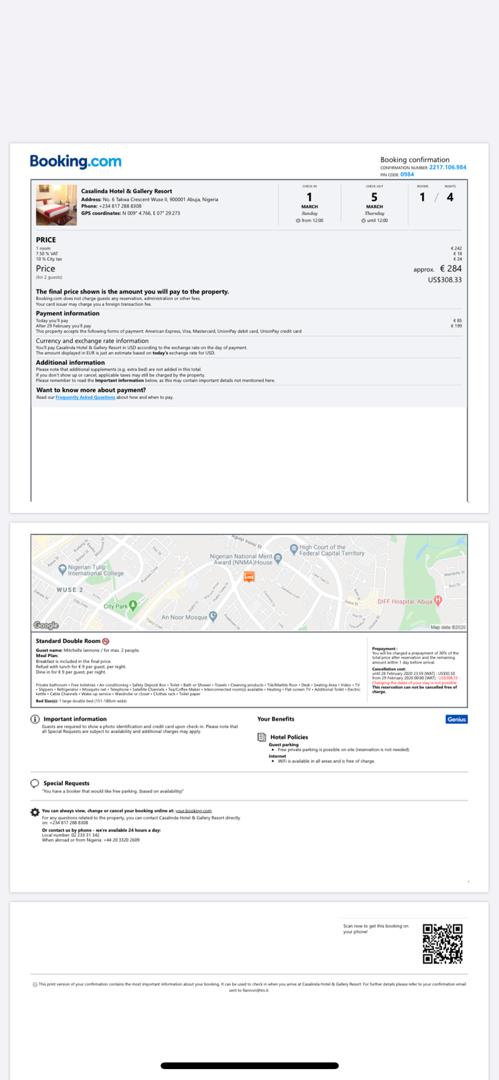
On February 26, Fabio who left the shores of Nigeria for Italy two days before, made a booking for his wife, Mitchelle through Booking dot com, reserving a room for four nights, from March 1, using his foreign credit card.
Booking dot com platform Photo: Dorothy Njemanze
According to the hotel manager, identified simply as Mr James, who was contacted by The ICIR, the policy of the booking platform requires a 10 percent of the total chargeable amount is paid initially and the balance is charged once the reservation is confirmed by the hotel and retained by the customer.
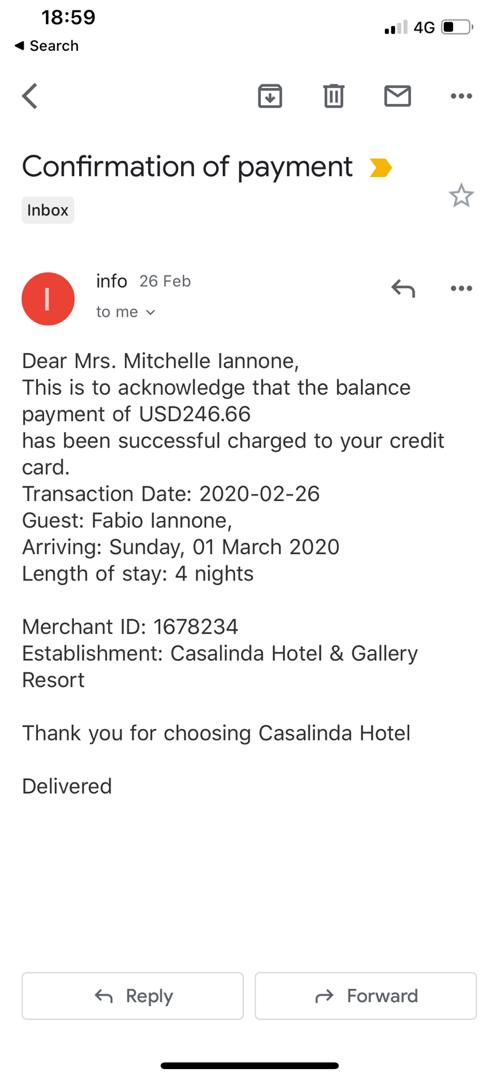
Thus, following procedure, the reservation and payment was confirmed by the hotel in a message sent to Fabio, which shows that a total of 308.33 dollars, about N112,694, was paid with the merchant identification registered as 1678234.
Message sent to Iannone Photo: Dorothy Njemanze
Mitchelle, told The ICIR that she decided to check-in a day earlier than previously booked and offered to pay cash at the point of lodge. In addition, she informed the management of the hotel that she would be arriving with five boxes as she was moving out of her apartment and plans on relocating from the country.
The manager of the hotel affirmed to Michelle that there was room for her luggages and she could arrive anytime.
However, Mitchelle’s plans were altered when the hotel sent a message to her husband saying: “Good day sir, due to the global threat of coronavirus, your hotel reservation with Casalinda Hotel has been cancelled.”
Message sent to Iannone Photo: Dorothy Njemanze
Mitchelle told The ICIR that the hotel further informed her that her payment would be refunded but, she would only be getting 70 percent of her full deposit, according to the hotel policy.
The ICIR visited the hotel in Abuja where the receptionist, Florence John confirmed that the incident happened on Saturday.
According to John, the attention of the hotel management was drawn to the fact that the payment of the reservation was done from Italy – a country that has recorded over 800 cases of coronavirus and 21 deaths since an outbreak occurred in the European country.
Also on Thursday, it was announced that an Italian citizen, who arrived Nigeria earlier, tested positive to the virus after developing a fever and visiting a hospital in Ogun state.
Despite informing the hotel management that she (Mitchelle) hasn’t been to Italy in the last six months and her husband only travelled recently, John confirmed to The ICIR that the Director of the hotel, Mr James, instructed that a full refund should be made to the customer and the booking cancelled.
A sum of N88,967 was registered in the book of the hotel as payment by Mitchelle as sighted by The ICIR, a 22 percent decrease from her total payment of N112, 694.
Acting based on instruction, the hotel manager went on to cancel the reservation, promising to refund the said amount to the customer.
Mitchelle refused the refund, asking that her total money be refunded as the hotel initiated the cancellation and not her.
As at the time of filing this report, Mr Richard, the hotel manager, claims that they plan to refund the complete money, N112,694 to the customer and have requested for the customer’s account details.
However, the customer, Mitchelle, says that the hotel manager told her she is only entitled to 70 percent of the payment made by her husband based on hotel policy and it is for that reason she has refused to accept the refund.
At the moment, the customer is yet to get her refund.
The hotel maintains that they are unable to accept her as a guest because of the ‘global threat of Coronavirus.’
Dorothy Njemanze, founder of Dorothy Njemanze foundation, an NGO focused on promoting women and girls rights, brought the incident to light in a live Facebook post.
According to Njemanze, the matter is that of discrimination, and care must be taken to ensure Nigerians are not discriminated againt on account of fighting Coronavirus.
“Is Casalinda hotel saying the woman has Coronavirus by marriage. The Nigerian govt is duty bound to prevent hotels and public service providers against discriminating people because of the virus especially when their only affiliation with the virus is by manner of where they come from and nothing else,” she said.
Since the record of Coronavirus case in Nigeria, several reports have shown a pattern of discrimination an manipulation by service providers as well as suppliers and retailers of certain products, such as hand sanitizer, latex gloves, and masks.
Just recently, the Federal Competition and Consumer Protection Commission (FCCPC) released a statement on Twitter, warning retailers and suppliers against price gouging of the above mentioned products describing it as unconscionable trade practices.
The Commission stated that the full extent of the law will be meted out to suppliers and retailers who attempts to benefit from the anxiety, apprehension and vulnerability of consumers.
OLUGBENGA Bodunrin, Uber Driver who reportedly picked an Italian at the Lagos airport has explained that the male foreigner that boarded his vehicle was actually taken to his house located in Oniru in Victoria Island, Lagos State, and not a hotel.
The story of Nigeria’s first COVID-19 case was officially made public yesterday by the Federal Ministry of Health and the Lagos State Government following the incident of an Italian man who entered the country on Tuesday and later tested positive for the virus.
But Bodunrin noted that the Italian he took has a family consisting of two boys and a Nigerian wife who lives with him at an undisclosed estate in Oniru.
He earlier posted on his twitter handle @boldjohnson07 affirming he picked an Italian, they dined and had a good conversation, in response to reports of government’s search of likely persons who might have been in contact with the announced case.
Bodunrin also dropped his mobile line in the tweet through which he was initially contacted but failed to respond. The Uber Service he works with was also contacted via two mobile lines – 0808 169 7334, 0808 169 7335 found on the website but they were switched off.
But on Saturday morning, he was again contacted by this reporter, where he shared his story.
He told The ICIR how he ought to convey the Italian all through his 20 days visit in Nigeria, until the man became unreachable after the first COVID-19 case was reported in the media.
“I picked him at about 5:30 pm on Wednesday from the airport. He told me himself he is an Italian that he just returned from Italy to meet his family here and he told me that he has a son and daughter in Italy that he is divorced, then remarried a Nigerian,” Bodunrin stated.
According to him, he had to take the Italian to the city mall from the airport before heading to Oniru where the man lives with his Nigerian family.
“From City Mall, Lagos Island, I took him home. So, I was in the car when he invited me upstairs to meet his family. That’s how I met his wife and we spoke in the Yoruba language.”
Narrating his story, Bodunrin said he spent time with the family until about 11 am when he left to return the next day.
However, his vehicle developed faults the next day and was unable to meet up with the appointment until about 3:00 pm in the evening. He claimed to have waited for an additional two hours hoping for their return by 6:00 pm but decided to leave after repeated calls to the Italian’s wife mobile line was unanswered.
“I called his wife’s line, it was showing line busy but I noticed she had blacklisted my number so I was unable to reach them.”
The ICIR asked why he could not call the man’s direct line since he picked him at the airport, but he responded that he was a linked pick him, not an Uber request.
Bodunrin said he had to visit Lagos State University Teaching Hospital (LUTH), Idi Araba, at about 3:00 pm yesterday to meet with the doctors for possible tests to verify his status.
He added that he was placed on 14 days of surveillance while the State Security Service (SSS) also reached out to him with the advice to respond to further instructions from appropriate government authorities.
“They said the story is not in line with the person with Coronavirus. But they said they will put me on surveillance for 14 days, and check on me day-to-day to know how I’m feeling.”
He further added that he has been under threats and being receiving calls from the public,
“it is not a joke, they even promised to use voodoo on me.”
After the doctor’s visit, Bodunrin claimed his passenger who joined on the visit took a photograph of him and the doctor. “I tried to do twitter live stream but the calls prevented it from loading. I tried but when I later realised it failed, it was so painful.”
He also could not provide the photograph as at the time of this report, while the mobile line of the Italian’s wife still remain unreachable.
The outbreak of Coronavirus has reportedly spread across the continents of the world except for the Artic.
Since the outbreak in Nigeria, the Federal Government through the Health Ministry, and other partners have increased awareness of the deadly virus.
The public has been advised to also maintain good hygiene, do proper handwashing, use hand sanitizer among other preventive measures.
The World Health Organisation (WHO) says over 20 vaccines are being developed globally, while it announced that 24 cases have been exported from Italy to 14 countries.
FOR publishing an exclusive report which exposed the rift between the National Security Adviser, Babagana Monguno and Abba Kyari, the Chief of Staff to President Muhammadu Buhari, the State Security Services (SSS) has commenced plan to arrest the PREMIUM TIMES journalist, Samuel Ogundipe, The ICIR has learnt.
Ogundipe’s report published last week by PREMIUM TIMES detailed how Monguno accused Kyari of undue and dangerous interference on matters bordering on national security and subsequently fired a warning memo to all service chiefs to desist from taking further directives from Kyari.
Multiple sources including PREMIUM TIMES have confirmed that the journalist is now concerned about his safety and has gone into hiding, following threats and information to extract from him the details of his source by the SSS.
According to theSignal report, Ogundipe was quoted as saying, “My email account was hacked yesterday. I have been told that they are looking for me to get the source who leaked the letter to me.”
Ogundipe is known for obtaining information on matters of national security, one of which led to his arrest and detention by the Nigerian Police in 2018, when he refused to reveal his source.
Former Chairman of Nigeria’s National Human Rights Commission (NHRC), Prof. Chidi Odinkalu also confirmed the development in a tweet.
The ICIR contacted the Managing Editor of PREMIUM TIMES, Idris Akinbajo for comment on the possible arrest of Ogundipe.
He confirmed that Ogundipe has not been arrested yet, but said the SSS is determined to identify his source for the scoop.
“We know that the DSS are desperate to identify our source for the story but we are reviewing the situation,” he said.
The ICIR’s effort to reach the SSS spokesperson, Peter Afunanya for comment was unsuccessful because his number has been switched off.
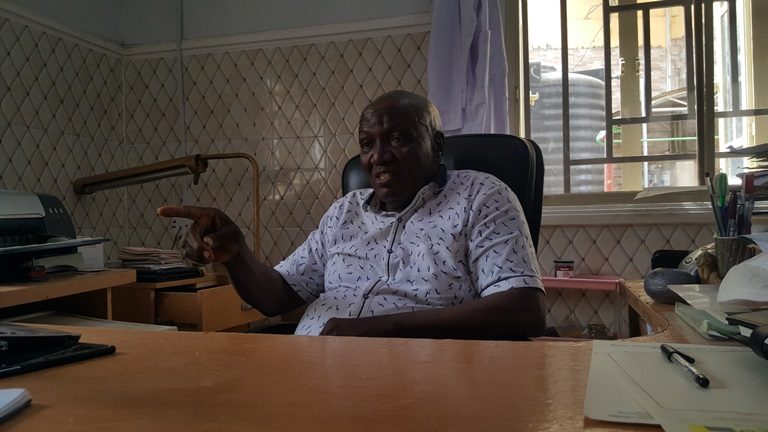
FATAI Adeshina is a quantity surveyor by training. He is the managing partner of A & Shine International Ltd, a honey packaging company based in Abuja. Adeshina who is also the President of the Nigeria Apiculture Platform (NAP) speaks with The ICIR’s OLUGBENGA ADANIKIN and AMOS ABBA about the challenges of the Nigerian apiculture industry, the safety standards being implemented for honey in the country among other sundry issues.
Can you give an overview of the Nigerian apiculture sector?
The Nigerian apicultural sector is one sector that the Federal Government is very keen to see how it can bring it up and revive it. In the past, the sector constituted mainly 75 per cent traditional beekeepers which means they were using the unorthodox methods of keeping bees and when you keep bees in that way you cannot avoid external contact with the honey and some bit of adulteration may go into it.
As a group, our motive was quite clear, right from the word go, we wanted to see how we can produce pure and unadulterated honey. When we started it you will all agree with me that adulterated honey is not something that we can completely eradicate and introduce a change. The change will be difficult but at least we were able to get somewhere.
For instance, we, I mean A & Shine Honey introduced every measure we could introduce from having our own laboratory for on the spot check whenever we have a supply of honey. And we didn’t just begin to request that traditional beekeepers supply honey to us, we tried to train and give them hives to see how they can begin to produce in a modern way. We gave them assurance of off-taking honey at a good price by buying it off from them.
Despite that, we can’t still trust producers 100 per cent and in order to ensure that we don’t run into packaging adulterated honey, we decided to have our lab where they bring their honey for testing and whichever one we reject they take it back.
Is your laboratory certified by any professional body in Nigeria?
In fact, we got the recommendation of what to use in the laboratory. It is just for our own internal use. Whenever we require testing to be done we send it to an independent laboratory recommended by the NAFDAC. Whenever we are sending our own lab test to the NAFDAC we use our laboratory test to compare with theirs. So NAFDAC certified our lab while the external lab was also certified by NAFDAC.
Tell us more about your own laboratory here?
Our own lab is not a full-fledged lab, it is a lab for on the spot check. We conduct on the spot check using a spectrometer to test water content of the honey. Phining test is something we can do on the spot before we can off-take honey from the supplier. So that is not a comprehensive test and that is why we have to use an external laboratory. Once we know the specification of what you want to achieve. For instance, if you have a spectrometer and you know water content of honey should not exceed 20 per cent, you use it to check the water content and another one to check for adulteration. Those are the two tests we carry out here to enable us off-take. Once we accept the honey we send it to our external lab for complete analysis.
Under your leadership is there any regulatory standard that you were able to develop to ensure that other stakeholders within Nigeria’s apiculture adhere to?
Let me say that the Nigeria Apiculture Platform (NAP) did not just appear from nowhere. There was a continental platform, African Apiculture Platform (AAP). This continental platform was launched by the African Union in Uganda in 2014. The launch brought together all the 52 member states in Africa to discuss policies of honey, the standards of honey and some other parameters.
It would interest you that when that platform was launched in 2014 in Uganda, A & Shine was chosen as the first chair of that platform. It was on that premise that we came to the Nigerian government to persuade government to launch a national chapter to oversee all the other associations and ensure that they will liaise with the continental platform to get information from them to develop our own national chapter.
We are the first country to launch the national chapter while 19 other countries also came together to launch theirs but Nigeria was the first. It was launched in 2018, at Chelsea Hotel by the former Minister of Agriculture, Audu Ogbeh.
The Government of Nigeria considered it wise to set up an inter-ministerial committee by the Federal Ministry of Agriculture on honey production. The idea was to increase the production of honey in the country, ensure that the stakeholders are sensitized on pollination policy and then to care for the bees and for food safety so that what they use on the farm does not affect the bees.
Those are the four principal objectives. The Nigeria Export Promotion Council waded in to see how they can get Nigerian honey certified by the EU. They engaged a consultant from Uganda. It was a very expensive exercise and the consultant came to Nigeria twice to train stakeholders on what is called residual monitoring process for honey. That is the condition for export of honey to EU countries.
That is the stage that we are now with the Nigerian Export Promotion Council. The AAP also put several things in place such as developing policy for the continent and that policy is what we are also using to develop a policy for Nigeria.
Last month, the Federal Ministry of Trade invited stakeholders on the development of national policy for apiculture in Nigeria. It will interest you to know that the consumption of honey in Nigeria is put at 38,000 metric tonnes annually and our production is a little above 2,000 metric tonnes. You can see that it is a sector that has hidden advantage.
We have several retirees who have registered today on the NAP to be trained in beekeeping so as to have something to do.
Does that imply that currently the regulatory framework is still being developed?
It has been developed in Kenya. All we need to do is to buy into what has been done as a country. So, I would say locally, it has been adopted.
In 2016, that was what actually prompted the decision to create awareness among the populace. One of the ways that was done was that the platform embarked on bidding to host the first-ever international fair of apiculture in 2018. At that time, stakeholders from all African member states gathered here at the International Conference Centre, Abuja to showcase the stage honey has reached to date.
We also had some people from outside Africa who came in. To bid for that hosting right, there was a $5,000 bidding fee which the Federal Ministry of Agriculture gladly paid. To host that event at the ICC which was a lot of money, the ministry paid it off. That is to show you how eager they want this sector to develop.
This was how Ethiopia started and they are the largest producer of honey in Africa and the largest producer of beeswax in the world. We know Nigeria can do better because we have the land and the vegetation if we can put our acts together. And A & Shine honey is trying to set the pace.
There are a lot of potentials in terms of apiculture and beekeeping but how many members do you have on the platform?
Before Nigeria Apiculture Platform came into existence, we had the Federation of Bee Keepers Association of Nigeria (FEBKAN). We had other association to overseeing the apicultural sector but we decided to leverage on NAP because of the AU connection that is why NAP is appearing to look like it is taking over from FEBKAN.
FEBKAN was put together by the Federal Ministry of Trade and Industry while NAP was registered by the Federal Ministry of Agriculture which provided an office for us at the Central Business Area close to NAIC office.
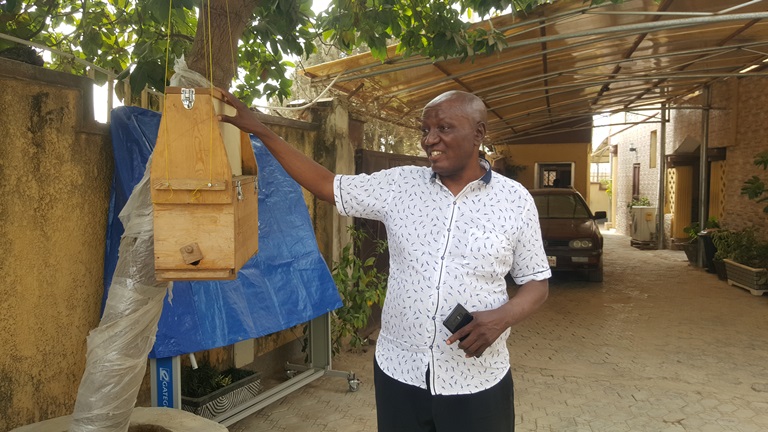
Adeshina explaining the concept of beehives given to beekeepers by NAP
Which is the recognized body?
As far as the stakeholders are concerned, NAP is a more recognized body for apiculture in Nigeria but we don’t want to dabble into the leadership tussle or who is overall. We have members of FEBKAN who are also members of NAP, it depends on the one you want to belong to.
This means that FEBKAN is majorly recognized by the Federal Ministry of Trade while NAP is recognized by the Federal Ministry of Agriculture, AU and stakeholders.
Considering this difference in terms of leadership and membership, how do you ensure that apiculture in Nigeria is carried out in accordance with international best practices?
I don’t see any grey areas of disagreement in whatsoever we have…. In terms of monitoring, the platform is put in place to provide an environment of training for stakeholders and ensuring that whoever belongs to the various associations or platforms conform to the best standard practice. The AU has put in place a standard for the African continent. That standard has been passed over to the Standard Organisation of Nigeria (SON). The SON has developed a standard which we call Nigerian standard from that.The membership of that committee includes members of FEBCAN, NAP and other stakeholders in the honey business.
We came together to put up this standard document which has been circulated to all associations as an approved standard for Nigeria. It was coined out from the African standard and the international standard. The SON has started implementing those standards right from the time we had a meeting. It was about six or seven weeks ago.
We would like to find out if the standard were implemented six or seven weeks ago, how were you able to manage the stakeholders…?
(Interjects) We have the codex standard that is in use, that’s the international standard and the standard you are talking about is not too different from the codex standard we are just taking into consideration the peculiarities as they affect Nigerian honey.
What’s the major position or recommendation of this codex standard you just mentioned?
The major recommendation is what is accepted internationally as far as honey is concerned. In terms of water content, in terms of other properties as far as honey is concerned.
Do you know of any of your members or anyone because of sharp practices who has been sanctioned recently because of this?
To the best of my knowledge, we have not received any sanction.I know there was a publication about one raw honey which was published as a result of crystallisation of honey. They picked the honey from the shelf and realized that the honey has crystalised. But when you check into the details of crystallisation, you will come to discover that crystallisation is normal in honey.
Crystallisation is just a state where the honey congeals but once you put it into warm water it dissolves again. It’s not a peculiar situation, perhaps, the reporter didn’t go into research of crystalised honey, so they felt that honey must be sugar.
The way to detect if it is sugar is if you put crystalised honey and sugar in the sun you will notice that the honey will dissolve while the sugar will not dissolve. To the best of my knowledge, I am not aware of a honey producer in Nigeria so far that has been sanctioned for any sharp practice.
Does that imply that some of these traditional beekeepers need to be sensitised to ensure their bee production is up to standard?
That’s exactly what we are doing right now; to train the traditional beekeepers on the use of boxes rather than thatch grasses to keep bees. There is a project we are into presently in Edo State where 1,500 traditional beekeepers were trained by UKAID. It’s a DFID program and we signed a major off-takers agreement to off-take the entire honey that would be produced from those hives. That off-taker agreement was based on certain conditions we put across, namely; the traceability of those hives must be known, each of those boxes must have a GSP marking.
What is GSP?
It is giving the latitude and longitude location of those boxes so that when you plug it on Google you can know where those boxes are. When you go to the shelves and you find any honey that doesn’t meet the requirements you can check the batch and go to the producers to tell you where this honey has been harvested from and that is what we call traceability.
Traceability is a major requirement by the EU to export honey to the EU market and that’s where we are going into. We now have a set of beekeepers in Edo State, about 1500 beekeepers and more are being trained. We cannot start overnight, it has to be by gradual process and within the next few years, more people will embrace these standards we are putting in place.
I remember in Tanzania there was a report of a certain defect in the honey found on the shelves but the government took it upon themselves to find the bottom of this defect. It was discovered that there was a particular plant that is harbouring certain bacteria that is proving too resistant to honey characters and they got rid of it. Tanzania today is one of the major honey producing nations in Africa.
Apart, from water what are other things you want your members to avoid while getting their honey ready?
Apart from water content, they should check for adulteration. It can be from people who may want to mix some other things with honey-like sugar cane and water and it is easily traceable. Anybody with conscience will be able to know that if you’re producing honey and it is being used in hospitals you must produce something that is pure. For example, our honey is acceptable in some hospitals especially in Maiduguri. We get regular orders from there because they found out that when they use it, it produces the required results.
There are about four or five tests that the external lab carries out on honey and once those tests are passed, it is not possible to have impurities there.
What are those tests?
Unless I have my lab technician around here, here we carry out the phining test, water content test but there are other specialized tests that are carried out by external labs on honey. We also have the HMF test to determine if the honey has undergone heating before it is being bottled. Once you heat the honey you destroy most of the nutrients.
Nigeria honey is certified to be one of the best honey in Africa, and even around the world. I remember we went to Dubai with the Nigeria Export Promotion Council because any time the Council is travelling for an international trade fair, our members are usually taken along to go and display their products.
We have represented the country in about seven to eight international trade fairs.
All our honey samples were impounded because they wanted to subject them to tests. Eventually they were released and certified fit for human consumption.
Nigeria’s honey has one major characteristic which we call poly flora honey because we are not restricting our bees from visiting specific flowers. We leave them to visit whatever flower that they want to visit so that makes our honey to look better than foreign honey.
Most of the foreign honey is over-processed that several of the ingredients that would really serve the interest of the body may have been destroyed. There was a situation sometimes our honey was purchased and they brought an international honey and the customer said no he wants A & Shine honey because if you look through A & Shine honey or honey produced in Nigeria you will discover that it is cold press. What I mean is that it not too clear like the foreign honey because it is not subjected to heat so all the ingredients that you need are still being preserved there in the honey and that makes Nigerian honey unique.
What is NAP’s specific role in the Nigerian apiculture industry?
NAP’s specific role is to ensure that no adulterated honey goes to the market and to ensure honey that is going out for consumption will meet the regulatory standard prescribed by the AAP which is being used by the NAP.
Correct me if I am wrong, NAP’s role in Nigeria’s apiculture industry is monitoring and regulatory and prior to seven weeks ago from the statement you made there was no adoption of a regulatory standard for beekeepers or honey producers to use in the country?
When you talk of standards, you are talking of standards acceptable in that particular locality. There are standards for honey but in Kenya, it was agreed that these standards should be moderated to suit your particular environment. Stakeholders must come together to say we will use bee veils, it must be like this because of the nature of our bees because of the aggressiveness of our bees if you look at the bees suits we have, there are very light ones, thick ones and the ones made of khaki.
When we came together we agreed that khaki will be best for Nigerian bee keepers to use. In processing, we agreed on the standards that will be used in processing honey, the standard equipment that can be used to process honey and then we agreed on several other parameters that are suitable for honey processing.
These agreements, are they in line with the AU adoption you spoke about that you said the SON domesticated and the other associations?
Yes, we are just making minor corrections or minor refining to suit our particular environment. The modification we are making is not to actually create a new type of specification for Nigerian honey. What is good for the white is also good for the black. When the white is saying that we don’t want moisture content to be above 20 per cent, it is because they realise that anything above 20 per cent the microbial level will be at risk. When it is below 20 per cent it is very impossible for microbes to survive in honey that is the main characteristics of honey.
The lower the water content the more impossible for microbial to survive in honey so we normally use the AU standard not tampering with key areas that would not make our honey to be accepted internationally.
Back to my earlier question, prior to seven weeks, there was no general consensus agreement between stakeholders in Nigeria?
The agreement that was in place has been that of the AU.
But seven weeks ago, what happened?
The stakeholders came together to look at this agreement we have been implementing to see what we should modify and send back to the AU that this is what is prevailing in Nigeria and this is what we want to adopt as Nigerian standard.
You must have people who have gone through a residual monitoring practice and that is what the Nigerian Export Promotion Council has been trying to put in place. Nigeria is currently undergoing the AU third country listing. It is an expensive exercise and it depends on the stake of the government concerning any sector.
As we all know, we have been focusing our attention on oil and nobody is looking any other way. Now, we want to focus our attention on apiculture. They have spent a lot to bring in people from Uganda. These are countries that have gotten their certification on EU standards and they brought them in to train members of NAP and FEBCAN on acceptable methods of producing good quality honey that will meet international standards.
Nigeria is now undergoing its EU third country accreditation and certification in order to certify its honey by the EU and the target date is 2020.
They are coming in for their third visit to see what we have been able to put in place. To meet all these certification standards, there are things to be put in place. If the government wants to do it and there are things that if they are not put in place you don’t get certification just like any other farm produce.
Can you cite instances of things to be put in place?
I just mentioned that residual monitoring standards must be put in place. Traceability of the honey must be put in place and that traceability is what I said is happening in Edo State.
Your organisation only builds the capacity of beekeepers and not monitoring. Who has been setting the microbial standards of honey when there is no national guideline?
That is where the NAFDAC and the SON come in. Where the SON sets the standard, NAFDAC ensures that those standards are met. The NAFDAC has all the equipment that you need for the testing of honey likewise SON. And every two months, SON pays a visit to our factory to pick samples and test our honey and ever since they’ve been coming they have never returned any of our honey to say it has failed their tests.
We just wrote to Director General of SON to tell him that we are aware that the organisation has all the equipment but it is not affordable for every honey processor. So we are asking, can you now put a system in place where we will send our products to you and you test and you put your stamp on the test result for onward forwarding to NAFDAC? With that, we don’t send products to lab even though they are certified and the results will be taken because they are certified lab.
If it is SON setting the standards for honey and NAFDAC regulating it, then if we get our results from SON we are sure that when we send it to NAFDAC it will have no issue because there will be seal of SON on the results.
That is where we are heading. We have requested to have an audience with the DG of SON to put this message across to allow all NAP and FEBCA members to send their honey products to SON for testing and we will send that result to NAFDAC.
In the past, processors would send their products to external labs and that result would be ready before it would be sent to NAFDAC before NAFDAC then sends it to their labs for testing. But we have realised that we are disadvantaged because of the charges since there are very few certified labs. So NAFDAC is saying don’t take your honey samples to external labs bring it to us.
That is what has been happening in the last few months. What we would have loved is a situation where we get our results from SON that is setting the standard and use that result to send to NAFDAC. All we are interested in is to ensure that we get the best quality honey produced and whatever is coming from our factory is the best.
It appears that Nigeria does not have a strict regulatory national policy to regulate apiculture in the country or what is lacking ?
The standards are not just being enforced. The NAFDAC has the standards for honey and that is the one it is using. We are not forcing anything on them, we are using the judgment of NAFDAC as the final arbiter, so we send our products to them and if it meets their requirements they give their approval.
Is this NAFDAC standard also drawn from the AU domesticated standard for honey?
The domesticated version of the AU standard once approved by SON would be forwarded to NAFDAC. So whatever stringent measure NAFDAC has been taking in testing is going to be adjusted either forward or backward.
Does it mean there is no agreed standard between SON and NAFDAC?
No, I am not saying there is no agreed standard. There has being a standard but the AU is now saying let every country come together and see what adjustments they can make and then take that as their standards for honey. In other words, it means if we have Nigerian standards for honey, it means if we meet those conditions then we can sell our honey within the country but if you want to export then you have no alternative but meet the international conditions.
Ghana, Cameroon have their own standards for honey, is there a standard in Nigeria for honey?
Ghana and Cameroon have undergone the residual monitoring process and training and they have met the vital conditions that the associations there are now passing to their members but we have not gone through the process…
And we have not met those conditions?
It’s not that we have not met them, we have not gone through the process. We use the international codex standard…
So we don’t have a standard?
Yes, we don’t for now because we are still in the process.
Research has shown that microbial contamination in honey can affect its quality and safety?
The prevalence of microbial contamination in honey is because the water content of the honey is above 20 per cent. When you harvest honey, it is sealed by the bees thereby reducing the water content of the honey so microbial action cannot take place which is why honey is used for embalming bodies.
If you had come earlier, one of our suppliers brought honey to us that has high water content. Initially, the water content was 16 per cent but after several hours the water content increased due to fermentation and we had to call him to carry his supplies.
Water content is a major determinant of the growth of microbial activity in honey and that is why we take it seriously. We didn’t have children until after 25 years in marriage and after a surgical procedure when the wounds did not heal a doctor recommended pure honey which was very effective.
What advice will you give to your members as 2020 is the year when the EU monitors will be coming to assess the apiculture sector in Nigeria?
Apart from the project we are handling in Edo State, we are also providing about 4,000 beehives to a certified organic bee farm in Kaduna State to begin to produce organic honey. We have about 18 hectares of land that we have earmarked for beekeeping and we are going to empower several of these traditional beekeepers. We have been going to farms advising farmers to keep bees not for the sake of honey alone but for pollination that can improve the yield of crops.
So I believe we would get to start exporting to the EU. And this year, we would scale through.