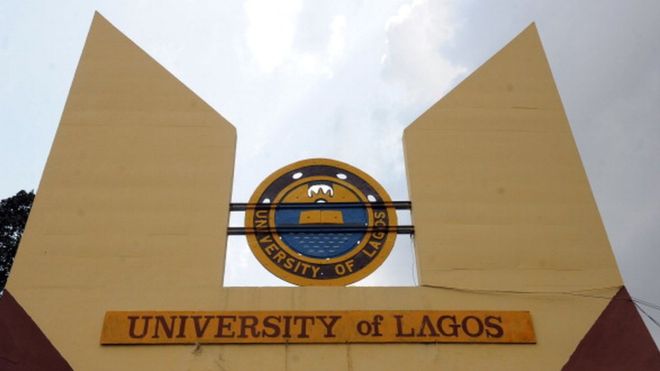
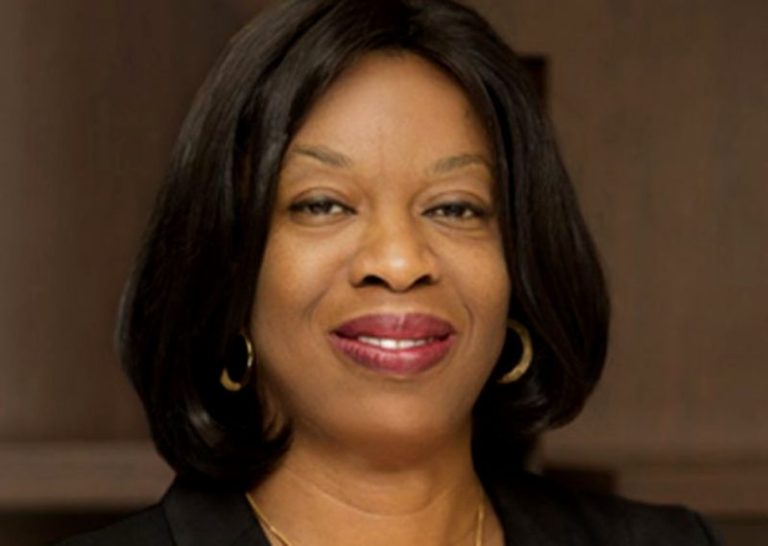
MANAGEMENT of the University of Lagos has suspended Boniface Igbegeghu, the accused senior lecturer and pastor of Foursquare Gospel Church exposed in the BBC sex-for-grade video.
Boniface in the video that has gone viral made sexual advances to Kiki Mordi, an investigative reporter who disguised as a 17-year-old student seeking admission.
The Principal Assistant Registrar (Communication Unit), Taiwo Oloyede confirmed to The ICIR that the former Sub dean of the faculty of art, University of Lagos has been suspended whilst investigation continues.
Oloyede also confirmed that the ‘Cold Room’ where lecturers get intimate with students of the school has also been shut down.
The suspension comes after the Foursquare Gospel Church sacked the pastor of his ministerial appointment and labelled his act ‘heinous’.
The sex-for-grades scandal has attracted the attention of many Nigerians on social media who applaud the reports, confirming that the act is popular in almost all of the Nigerian tertiary institutions.
The immediate past senate president of Nigeria, Bukola Saraki also commented on the incident saying that he was appalled to find the documentary.
He urged the 9th Assembly to revisit a bill passed in the last Assembly titled “Sexual Harassment in Tertiary Education Institution Prohibition Bill”. The bill prescribes a 5-year jail term for any lecturer, educationist or person in a position of authority in any tertiary institution in Nigeria found guilty of such conduct.
He said the university should conduct a robust investigation into the case and other similar reports, noting that the implementation of the bill is needed to reform the tertiary institutions of education in the country.
ON Monday, the Federal High Court sitting in Lagos ordered the temporary forfeiture of N280,555,010 allegedly belonging to embattled Nigerian entrepreneur Obinwanne George Okeke also known as Invictus Obi for alleged money laundering amongst other charges.
The Economic and Financial Crimes Commission, EFCC, had filed an ex – parte motion to seize the money in question affirming that investigation by the EFCC revealed that the sum of N280.6 million allegedly belonging to Obi was traced to the bank accounts of Invictus Oil and Gas Limited and Invictus Investment Limited.
Rotimi Oyedepo, EFCC counsel, stated that the funds were “reasonably suspected” to be proceeds of cyber-crime, and he requested the judge to order forfeiture.
In an affidavit filed in support of the application, Ariyo Muritala, EFCC investigator, said the funds could be expended by Okeke and his cronies if the order is not granted.
“I know as a fact and verily believe that our investigation has revealed the following ear-aching and mind-boggling findings: (a) That the Obinwanne George Okeke is a strong leader of a cybercrime syndicate specialized in business email compromise. (b) That the said syndicate has defrauded many innocent and unsuspecting victims (g) That the said Obiwanne George Okeke has been arrested by the Federal Bureau of Investigation in the United States of America for cybercrime-related offences (h) That if these funds are not forfeited to the Federal Government of Nigeria Obiwanne George Okeke and his cronies will dissipate same,” he said.
The presiding judge, Justice Rilwan Aikawa ordered a temporary forfeiture of the accounts requesting the EFCC to publish the court’s order in the national dailies to allow people interested in contesting the court’s decision to indicate interest before a final forfeiture is announced.
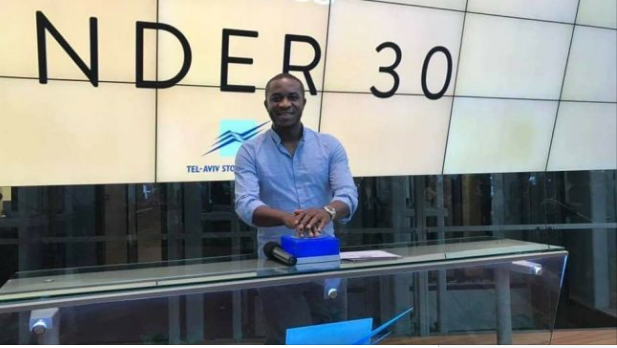
In 2016, 31-year-old Obi was celebrated by Forbes as one of Africa’s “most outstanding 30 entrepreneurs under the age of 30.
He was arrested in 2019 by the Federal Bureau of Investigation, FBI, where he is currently standing trial in the US for allegedly defrauding some US citizens to the tune of $11 million “through fraudulent wire transfer instructions in a massive, coordinated, business e-mail compromise scheme.
The court was adjourned to October 30 for further hearing on the case.
ANOTHER lecturer of the University of Lagos, Akoka, Boniface Ighenghu has been accused of sexually assaulting an investigative reporter who disguised as a 17 years old girl seeking admission into the University.
This comes few years after Afeez Baruwa, another lecturer of the university, was charged to court for allegedly raping a student of the institution.
Baruwa is still in court over the allegation as the student claimed to have pictorial evidence of the incident.
Also in 2018, a professor of English in University of Lagos, Olusegun Awonusi was also accused of sexual harassment by Joy Uwana, a student of the varsity who had the lecture’s nude images with her claimed the lecturer harrased her in the ,presence of other lecturers but they wont come out open because of their cult like nature.
Awonusi is a former vice chancellor of Tai Solarin University of Education, ijebu ode ogun state, also a former commisioner in ogun state denied the allegations levied upon him by the student.
However, the management of the institution are yet to conclude the investigations since it began over a year ago.
British Broadcasting Corporation (BBC) in a documentary released on Monday, titled ‘Sex for grades’: Undercover in West African Universities made this report.
In the documentary, Kiki Mordi, an investigative reporter revealed how students are sexually harassed in West African universities, showing UNILAG and the University of Ghana as examples.
The lecturer was taped making sexual propositions to the undercover journalist who claimed to seek admission into the university.
Boniface is currently a pastor with the Foursquare Gospel Church in Lagos State.
While making sexual propositions to the reporter, He said “Do you know that I am a pastor and I’m in my fifties? What will shock you is that even at my age now, if I want a girl of your age, all I need is to sweet tongue her and put some money in her hand and I’ll get her”.
In the video clip, he revealed that there is a place called ‘the cold room’ in the school premises where lecturers make love with students as he continued to assure her that the only way for her was for her to do his bidding.
In a press release signed by the national secretary of the Foursquare Gospel Church, Ikechukwu Ugbaja, the church distanced itself from Boniface and termed the act ‘heinous’.
“The general public is hereby informed that as a holiness and Bible-believing Church, we do not condone such heinous and unscriptural act among our ministers, we totally dissociate ourselves from the purported conduct of Igbenoghu and promise to take appropriate measure as soon as the ongoing investigation is concluded, Meanwhile, the pastor in question has been asked to step down from all ministerial assignments” the statement read.
Nigerian universities have in many cases been reported to sexually assault students including the sex for mark scandal which happened in Obafemi Awolowo University, Ile-Ife in 2018.
THERE is an Igbo saying about when you wake up is your morning. It simply means that it is never too late to start. This is, in my view, a good thing as it engenders an attitude that does not allow people to give up on their dreams regardless of age. However, sometimes when someone wakes up late, the reasons may be more cynical.
I want to begin this by telling a short story.
The town of Evwreni is located 150km away from the capital of Delta State, and unlike Asaba which is consistently derided as a non-Delta town (the people of Asaba are of the Igbo ethnic group), there is no doubt that Evwreni is an oil-producing Niger Delta town. In August 1999 the Evwreni Youths Association wrote a letter to the Shell Petroleum Development Company giving them an ultimatum to build a hospital, community centre, a borehole for the town, and tar the two roads in town – the Warri-Patani Road, and Palace Road. At the time, there were two major landmarks in Evwerni, the Girls Model Secondary School, which sat along the Warri-Patani Road, and the Ovie’s Palace, which was on Palace Road. In addition to these four demands, the EYA asked that Shell build a fence around the Ovie’s Palace, and install a telephone line for him. The Ovie at the time was Ovie Owin Kumani.
In response, Shell offered to pay homage and royalties to the Ovie in cash, and also offered some jobs and scholarships to the EYA. This last bit of information was kept from the majority of EYA members.
Eventually, the EYA found out and went on what was initially a peaceful protest to the Ovie’s Palace. Unfortunately, armed palace guards, paid for by the Delta State government, shot at the protesters and killed one of them. Nine others were alleged to have sustained bullet wounds.
Following this incident, Evwreni elders called for the dethronement of Ovie Kumani, and eventually the situation boiled over on 20 January 2000 when the youths stormed the palace and murdered Kumani, and another elder, Chief James Fashe. This story illustrates the danger of monetary compensation in the system such as we have in Nigeria where systems of accountability are weak, and where because of a culture of impunity, the incentive to just take cash and make for the hills is strong.
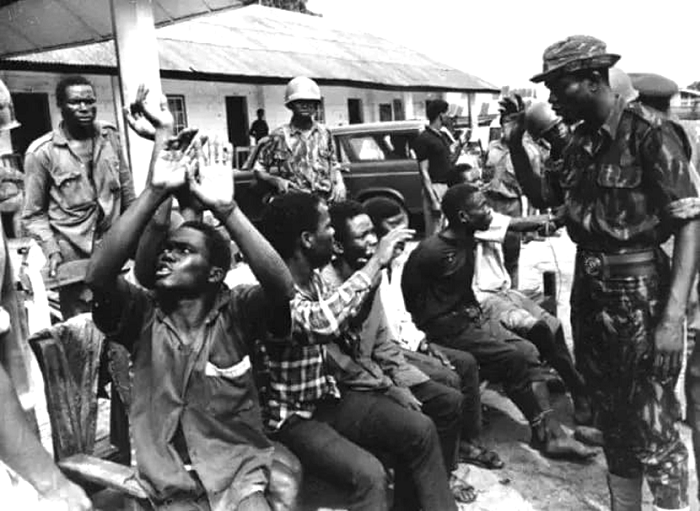
A few days ago, I read an article about the Asaba Development Union, which claimed to be speaking for the people of Asaba with respect to engagement with the government of Nigeria. The group is demanding an apology and compensation. This on the 52nd anniversary of the 7 October 1967 massacre in which at least 800 men and boys from Asaba were killed by the Nigerian Army on suspicion of being sympathetic to the secessionist cause during the Biafran War.
The reason this deserves some commentary is that two years ago during the organisation of the half-century of the event, various groups of Asaba indigenes were approached for their cooperation and contribution to the event, and they showed a distinct disinterest in the matter. In fact, it was during the six-week period of organisation before the event that I became involved and realised that there was no single group that had the capacity to organise a befitting remembrance.
But the show had to go on, and the Asaba Advisory Council set up a task force that ensured that the event went on despite the indifference of many Asaba groups, opposition from governmental figures, financial challenges and the time frame required to organise a successful event. At this point, I will go on the record to say that were it not for the extraordinary support shown by Prof Wole Soyinka, Bishop Matthew Kukah of the Sokoto Catholic Diocese, and Archbishop Emmanuel Chukwuma of the Enugu Anglican Diocese, the event may not have even gone ahead. So great was the opposition, and so real were the threats.
At the event itself all the speakers, including Soyinka, Kukah, the Governor of Delta State, Ifeanyi Okowa, and Alban Ofili-Okonkwo, were very clear that given the time that has passed, and the fact that the families of the victims of that brutal event half a century ago have for the most part done quite well, that monetary compensation was not among the lists of requests by the people of Asaba. What we want is simply an acknowledgment that the town was decimated in 1967 just because of their Igbo ethnicity and despite the “one Nigeria” stance of the indigenes at the time, and an apology for that action. The official communique after the event made it clear that if there is to be any talk of compensation, then it should be in form of a world-class maternity hospital to be located in Asaba and open to all Nigerians.
After the event, the committee met with the traditional rulership of Asaba and a foundation was incorporated to pursue these objectives. The Asagba of Asaba, by royal decree, said that the Foundation is the officially empowered body to have discussions regarding government interactions over the massacre.
Then we now have this group coming up to claim monetary compensation…
The objective of this piece is to sound an alarm because this being Nigeria, this is a movie script we have seen before, and sadly the writers only ever seem to change the dates, locations, and names of the actors, but never the script itself.
As a victim of that sad event, because I lost my maternal grandfather and many uncles, I think the stance of the task force that organised the half-century event is the best one. You do not throw money at a thing like this. It will only lead to a fight. Rather, build the hospital that they asked for.
Cheta Nwanze is a public commentator, he could be reached at cg.nwanze@gmail.com
SENIOR Nigerian public officers are notoriously parsimonious with their recall once out of office. From among their club memoirs are unusual, especially, from those with any sense of lingering shelf-life. It’s easy to speculate as to why this is so. In a country ruled by whim, risk aversion is prudent when you are out of power. By remaining quiet or feigning amnesia, yesterday’s men limit the likelihood that their successors may remember them for the wrong reasons. Moreover, with government as the principal guarantor of a good life, respect for its rule of Omerta is the only way to retain any hope of access to its revolving doors.
When it occurs, a departure from this trend is usually enforced. This is why the memoir recently published by Mohammed Bello Adoke is notable. Adoke, a Senior Advocate of Nigeria, (SAN), was Attorney-General and Minister of Justice under President Goodluck Jonathan for five years from 2010 until 2015. Since leaving office, his name has been linked with several controversies, the most high profile being in connection with the settlement of the now Infamous Oil Prospecting Lease (OPL) 245 granted in April 1998 by General Abacha to the shadowy Malabu Oil and Gas Limited.
In his memoir, Adoke feels called upon to clear his name by discharging a burden of narration in the controversies that have dogged him after office. Fittingly, his story is published under the titled Burden of Service. The sub-title Reminiscences of Nigeria’s Former Attorney-General underscores the point that Adoke is, remarkably, the first former Attorney-General of the Federation to publish any account of his time in office. In addition to the Malabu Oil controversy, Burden of Service also offers insights into many other highlights of the Jonathan years, including the hand-over of Bakassi Peninsula to Cameroon, recovery of Abacha Loot, the removal of Ayo Salami as President of the Court of Appeal, and the climactic denouement to Nigeria’s 2015 general elections.
Adoke’s telling of his version of the stories packs a punch. While his parochial account is interesting in and of itself, it is the vignettes he offers when he is not necessarily pleading his own case that make Adoke’s account deserving of attention. A general theme of his is the shiftiness of Nigerian politicians and he illustrates this with several issues in the book. Five deserve attention.
Cover page of Burden of Service by Mohammed Bello Adoke
The first is the currency of loyalty in Nigerian politics. Under General Abacha, politicians popularised “I am loyal” as cult greeting. It is not lost on those who are interested that anyone who has need to repeat affirmations of loyalty in this way probably knows nothing about loyalty in the first place. Illustrating this point, Adoke narrates how many people close to President Jonathan donated money to support the campaign of General Muhammadu Buhari in 2015. According to him, “many of my cabinet colleagues, including those known to be close to the President, had made donations to Buhari’s campaign. Those involved included heads of agencies. A Principal Officer of the National Assembly from the PDP was to later confess publicly that he donated N5 million to the APC during the elections.”
This shiftiness is not limited to politics; it also extends to high matters of constitutional legality. This is the second highlight from Burden of Service. Adoke tells a remarkable story about the fate of the Constitution (Fourth Amendment) Bill of 2015, which was said to have failed to receive presidential assent before President Jonathan vacated office. The amendment included clauses granting immunity to law-makers, life pension to former presiding officers of the National Assembly and inducting them into life membership of the National Council of State. It also contained a provision dispensing with presidential assent to constitutional amendments. As Adoke tells it, after the 2015 election, the National Assembly transmitted the Bill to the President for his assent. By the time Adoke learnt of this, President Jonathan had reportedly assented to the bill and authorized for this to be returned to the National Assembly. The President’s Senior Special Assistant on Administration, Matt Aikihionbare, confirmed this. So, Adoke raced to the presidency to explain to the President the dangers inherent in the provisions contained in the amendment he assented to. After his encounter with President Jonathan, “the President looked genuinely surprised and promptly withdrew his assent”, whereupon he directed the Attorney-General “to prepare a memorandum elucidating all the issues…. raised and why he would have to veto the bill.” The rest is history but an important constitutional question arises – can a president having assented to a law unilaterally withdraw his assent?
Thirdly, there is the issue of weaponisation of litigation against the public purse in judgment debts. It’s best to render this in Adoke’s own words: “Many of the claims were bogus but since it was an organized scam, they were getting away with it…. Again, there were too many people interested in judgment debts. We were getting calls from all manner of people, including members of the National Assembly. Actually, some National Assembly members were making appropriation for judgment debts based on an understanding with the debtors (sic). It was a conspiracy against the national treasury.” This does not require any translation but it would have been useful if Attorney-General Adoke could tell who “they” were.
At a time when they are being abused to intimidate and persecute critics of government, Adoke, fourthly, offers insights into the context and justifications for the Terrorism Prevention Act (TPA) and Cybercrimes Act, both adopted under his watch as Attorney-General. In addition to the clear and present threat of Boko Haram, the rationale for the former was the need to implement the treaty framework of international co-operation on terrorism to which Nigeria had subscribed. Concerning the latter, the goal was to “ensure the protection of critical national information infrastructure and to promote cybersecurity… intellectual property and privacy rights.” Today, sadly, these laws have been turned into instruments for pursuit of regime opponents, more imagined than real.
Fifth, there is the matter of plea bargains in white collar crimes involving politically exposed persons (PEPs) in Nigeria. About this, Adoke tells the story of the presidential pardon granted former Bayelsa State Governor, Diprieye Alamieyeseigha. According to him, Alamieyeseigha’s conviction was under a plea bargain and “as part of the plea bargain he was to be granted presidential pardon by (President Umaru) Yar’Adua after his release from jail. This, however, did not materialize as President Yar’Adua fell ill and died.” Plea bargains are subject to approval by courts and it’s doubtful whether this part of the deal was disclosed to any court. It certainly wasn’t disclosed to Nigerians.
As Attorney-General of the Federation, Adoke was also the official leader of the legal profession. His memoir offers an unusual insight into how he views hierarchies at the Bar. To make this point, he tells the story of how, before his time, “a substantial part of the budgetary allocation made for solicitors’ fees was being paid out only to two or three private solicitors. There was a case of a former Attorney-General that as paying a Senior Advocate N50 million for each case….” The result was there was insufficient money to go round, so many of the cases against government went un-defended, leading to more judgment debts. So, how did Adoke address this? He decided that “no SAN would be paid more than N5 million for a brief; any other lawyer, who was not a SAN, would receive a maximum of N2 million.” In the un-complicated calculus of Attorney-General Adoke, a SAN is worth 250% of the non-SAN!
Burden of Service is replete with claims of moral high ground and completeness of disclosure. As with all memoirs, however, it’s up to the reader to determine what weight to accord to the author’s account. In telling the story of the removal of Ayo Salami as the President of the Court of Appeal, for instance, Adoke prefaces his narration with the implicit disclaimer that “the Attorney-General is not a member of the National Judicial Council (NJC)”, who recommended the retirement of Salami. He then proceeds to a pro-forma narration that is half-hearted to the point of being clearly disingenuous. By Adoke’s own admission, Chief Justice Katsina-Alu, who was the other party in this terminal dog-fight with Salami, was his “mentor and adopted father” and benefactor, who personally recommended him to President Jonathan for the position of Attorney-General. Salami for his part “had personally encouraged” Adoke to apply for SAN. In the sub-text, Chief Justice Katsina-Alu was family to Adoke and it is difficult to escape the conclusion that in this part of the book, at least, he was less than economical with the truth.
Co-Convenor of Nigeria Mourns, Odinkalu works with the Open Society Foundations.
THE management of The Polytechnic Ibadan has sacked Bamishaye Olatunji Abiodun, a junior lecturer at the Department of Mass Communication for professional misconduct.
Bamishaye, who taught Newspaper Editing and Production and Public Relations Media and Methods, was caught on camera in the first part of an investigative report published by The ICIR in August where he was selling handouts to students for 20marks. The management said the act contravenes the institution’s rule.
The ICIR’s student reporter in an undercover investigation witnessed how the lecturer extorted students during one of his class sessions. He would write assignment questions on the first page of the handout and instruct students to get a copy. So, any student that fails to buy the handout would neither be able to get the assignment question nor be able to submit even if such student copied questions from classmates.
In a phone interview with the public relations officer of the institution, Soladoye Adewole, he disclosed to The ICIR that the management was able to fire Bamishaye because “he is a junior lecturer, still under probation.”
Bamishaye Olatunji Abiodun, a lecturer at the Department of Mass Communication teaches Newspaper Editing and Production and Public Relation Media and Methods
The ICIR can confirm that the management of the polytechnic has constituted a panel headed by a senior lecturer of the institution to “investigate acts of misconducts leveled against some staff of the institution” exposed in the first part of the report.
The term of reference given to the panel includes investigating sales of handouts and unauthorized textbooks by lecturers, and extortion of students. The panel was also directed to verify The ICIR report and recommend sanctions for the erring lecturers in line with the rules and regulations of the institution.
A source close to the management told The ICIR that the investigation was conducted between the 8th and 19th of July, but an extension was sought and granted, and the report of the panel has been submitted to the office of the rector.
The first part of The ICIR report showed how students of The Polytechnic Ibadan, Oyo state, are being extorted by their lecturers through the sales of handouts and grades and imposition of illegal charges that burden many parents of the student in the polytechnic.
The second part exposed how lecturers of the institution charge fees for supervising students’ final year projects.
Why is the panel report not implemented?
The spokesperson of the institution told The ICIR that the panel report has been submitted months ago to the rector but the institution currently does not have a governing council, hence its inability to sanction the other indicted lecturers.
But the lecturers involved already have been served queries, he said.
The governing council, according to the institution’s rule, is the only body that has the power to sanction any staff for any offence.
Adewole said the institution is waiting for the new governor of the state, Seyi Makinde to constitute the council.
What fact sheets say about Nigerian lecturers
A research conducted in all 36 states and the Federal Capital Territory (FCT) between April and May 2016 by United Nations Office on Drugs and Crime (UNODC) in collaboration with the National Bureau Statistics (NBS), published in July 2017, shows that teachers/lecturers are one of the corrupt officials in Nigeria.
Teachers/lecturers were ranked13th out of 18 corruption marked officials in the country with a prevalence rate of 11.7 per cent.
The 2019 Global Corruption Barometer Africa in her latest release also made it clear that in 2015, 25 per cent of total bribery cases were from public schools while in 2019, the prevalence shifted higher to 32 per cent.
NIGERIA is the world’s 13th largest oil producer and President Muhammadu Buhari re-affirmed in his latest Independence Day address that oil constitutes the bulk of Nigeria’s revenue and foreign exchange earnings. But, as the country quickly depletes her limited oil reserves and the world at large advances in technology, experts agree it’s time it focused on something else: data.
Communications Minister Isa Ali Pantami appears to share this view too. “Data is the oil of the 21st century,” he tweeted on Thursday, paraphrasing reputable research analyst, Peter Sondergaard Gartner. “But oil is just useless thick goop until you refine it into fuel. Artificial Intelligence (AI) is the refinery in a digital economy.”
The country, however, still has a long way to go in making this shift—no thanks to an entrenched poor record-keeping and data collection culture.
Journalists hit a wall
With investigative and data journalism increasingly gaining ground among Nigerian reporters, one challenge they often face is the unavailability of important data.
According to the 2019 National Freedom of Information Ranking by the Public and Private Development Centre (PPDC), out of a total of 191 public institutions, 87 (45.5 per cent) do not engage in proactive disclosure of information and the rest (54.5) only partially disclose proactively.
Data available to the PPDC also revealed that there’s a 33.5 per cent chance of getting all details requested through an FOI request, a 10.5 per cent chance of getting some of the details, and a 56 per cent chance of getting nothing at all. This is similar to The ICIR‘s experience in the past year, with over 60 per cent of requests either denied or ignored.
But an unwillingness to respond to requests for data is not the only problem, public institutions, in fact, do not have some of those data on record and in an easily retrievable form.
In April, Director of Press at the Federal Ministry of Justice, Modupe Ogundoro, told Bayo Akinloye, then a reporter with ThisDay Newspaper, she couldn’t confirm they have records on the number of name changes done in the last five years.
“How do you expect me to know the number of changes of name that has been done in the country? … I have gone around asking people which department handles records of change of name. I have spoken with my colleagues in the legal department and they told me that they don’t have such records,” she said.
“There must be a record somewhere. I am not saying we don’t have the records in the ministry and I am not saying that we have. I am working on finding out where, if it exists, the record is.”
Also, in July, a PremiumTimes reporter, Evelyn Okakwu, revealed how there seems to be no coordinated data with the Nigerian Prisons Service on the number of inmates detained and released in the last 15 years.
“After tracing the letter in vain for weeks, Mr Enobore [spokesperson of the Nigerian Prisons] requested a more concise application for the said data,” she wrote. “A further request for a similar data, to cover five or ten years, was not granted by the service. The subsequent letter was also lost between the statistics and operations units of the service.”
No show in global reports
Another indication of Nigeria’s inadequate data collection is how much information about it is available in various global comparative reports. There are either instances where the country has no statistics on certain objects or the statistics aren’t available for some periods.
In the 2018 Human Development Statistical Update, for example, Nigeria’s gender inequality index, international student mobility, percentage of female internet users, proportion of schools with internet access, female share of employment in senior and middle management, among other indices, are not available.
There are a lot more examples in the 2018 Global Innovation Index with missing statistics on graduates in science and engineering, tertiary inbound mobility, females employed with advanced degrees, research talent in business enterprise, intellectual property receipts, cultural and creative services exports, and so on.
The 2019 Global Talent Competitiveness Report does not have figures for the country on research and development expenditure, vocational enrolment, and population with secondary and tertiary education.
Likewise, the 2019 International Tourism Highlights does not have 2017 and 2018 figures for Nigeria on international tourist arrivals and the 2018 World International Property Indicators Report contains very little statistics on patent applications and grants in Nigeria.
Other examples, funding problem
The huge vacuum in Nigeria’s data hemisphere can be seen in various aspects, from population to elections, security, migration, and so on.
In 2018, responding to an FOI request filed by TheCable, the Independent National Electoral Commission admitted that it is not in custody of a state-by-state breakdown of the 2007 presidential results and instead directed the news agency to consult the various state offices.
Also, in July 2018, The ICIR asked the electoral commission for details of presidential and gubernatorial electoral results from 1999 till date as well as a state-by-state breakdown of the number of uncollected Permanent Voters Cards (PVCs), number of applications for transfer of PVC, and state of origin of applicants. However, in its reply, it only provided results for presidential elections from 2007 and a breakdown of collected and uncollected PVCs, ignoring other enquiries.
Despite a recommendation by the United Nations Population Fund that national censuses should be conducted every 10 years, Nigeria has gone 13 years without one. The National Population Commission has blamed this delay on poor funding.
The National Bureau of Statistics (NBS) is another crucial data-gathering agency that has been a victim of insufficient funding. In November, the head of the agency, Yemi Kale, admitted they could not gather and release updated unemployment statistics “due to budgetary releases”.
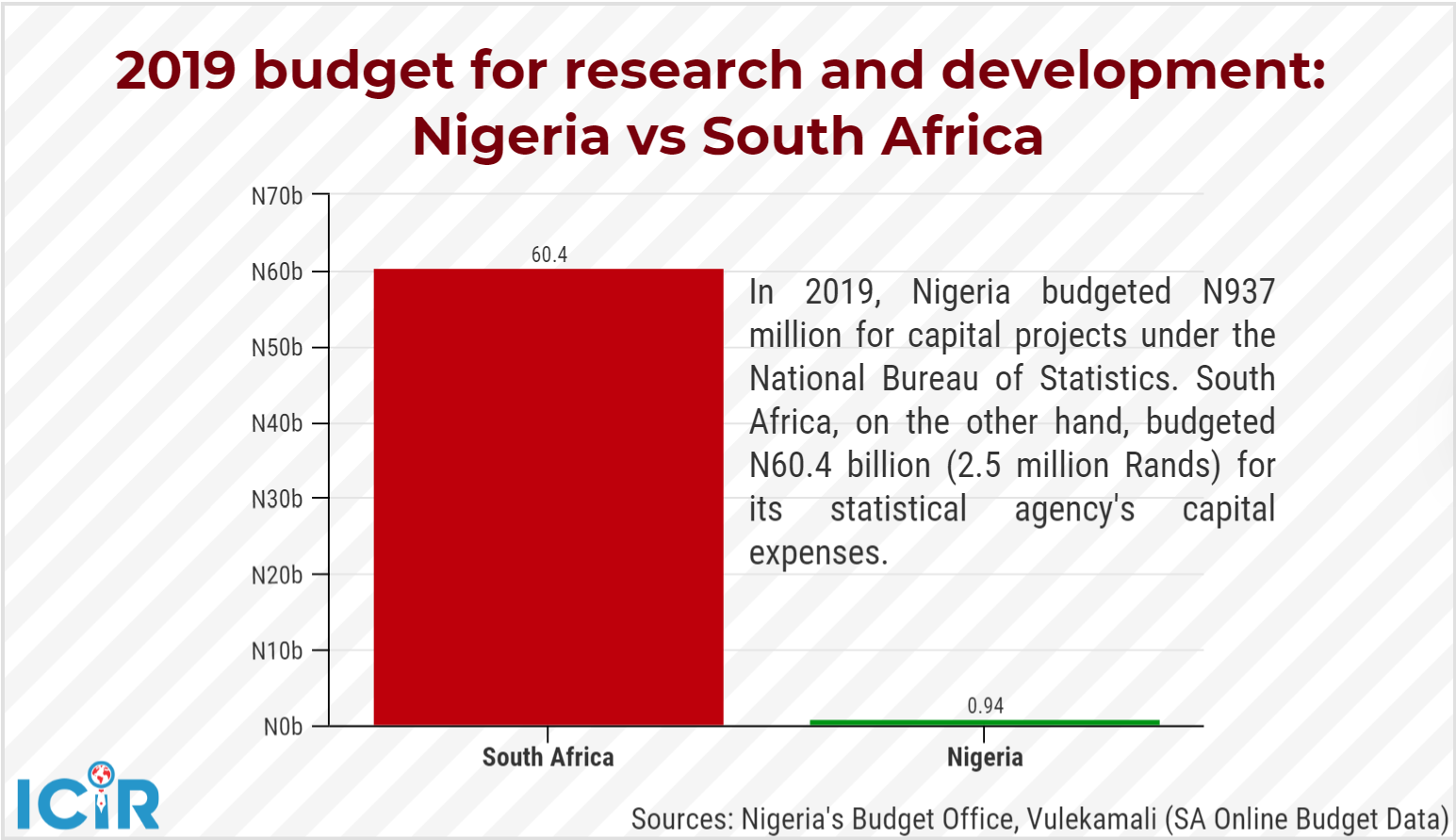
South Africa’s 2019 capital budget for research and development is 64 times bigger than Nigeria’s. Source: Nigeria’s Budget Office, Vulekamali: SA Online Budget Data
Money down the drain
Because a lot of official processes are not documented, Nigeria keeps losing money to corruption. This takes various forms such as unrecorded payments for public services or the use of ghost workers. Buhari said in February that the government had saved almost $550 million (N198 billion) from identifying phantom employees on the payroll.
Comptroller-General of the Nigerian Customs Service, Hameed Ali, told federal lawmakers on Wednesday that, contrary to expectations, the agency has been making an average of N5.3 billion daily, more money than usual, since the borders were closed.
“What we have discovered is that most of those cargoes that used to go to Benin [Republic] and are then smuggled into Nigeria [now come to us],” he explained. “Now that we have closed the border they are forced to bring their goods to either Apapa or Tin Can Island and we have to collect duty on them.”
Likewise, the absence of data on procurement has also encouraged misappropriation by government agencies and public officeholders. According to the Thematic Research Network on Data and Statistics, “The inaccessibility of budgetary information across the Nigerian Government aids financial corruption among public sector workers.”
Also stressing this point, Oluseun Onigbinde, founder of BudgIT said in a 2013 interview that improving access to information encourages debate in the society and shows traces of corruption.
“If no one knows what goes on in government and citizens are handed a fuzzy narrative, the incentive to steal funds is high. When we open up information about the flow of public funds, we strengthen the social contract, and deepen the trust between the electorate and the leader,” he said.
To grow, we need data
“No meaningful national development can take place without empowering the national statistical system.” This was the conclusion of a 2011 comparative study of Nigeria against Rwanda published by the Journal of Sustainable Development. It explained that is because of the need to map out strategic plans and also set up machinery for execution and monitoring.
Kale, Nigeria’s Statistician-General, agrees. While delivering a lecturer in August at the University of Lagos, he said meaningful progress cannot take place without “good, reliable, and timely data”.
Reliable and comprehensive statistics, experts have stated, are needed to formulate sound economic policies and development plans. It is what ensures budgets are focusing on the most important projects and priorities are not misplaced. Through Big Data, it also helps government and private companies to be more efficient by establishing patterns and predicting behaviours.
“Why do statistics matter?” the World Bank asked in its World Development Indicators of 2000.
“In simple terms, they are the evidence on which policies are built. They help identify needs, set goals, and monitor progress. Without good statistics, the development progress is blind: policymakers cannot learn from their mistakes, the public cannot hold them accountable.”
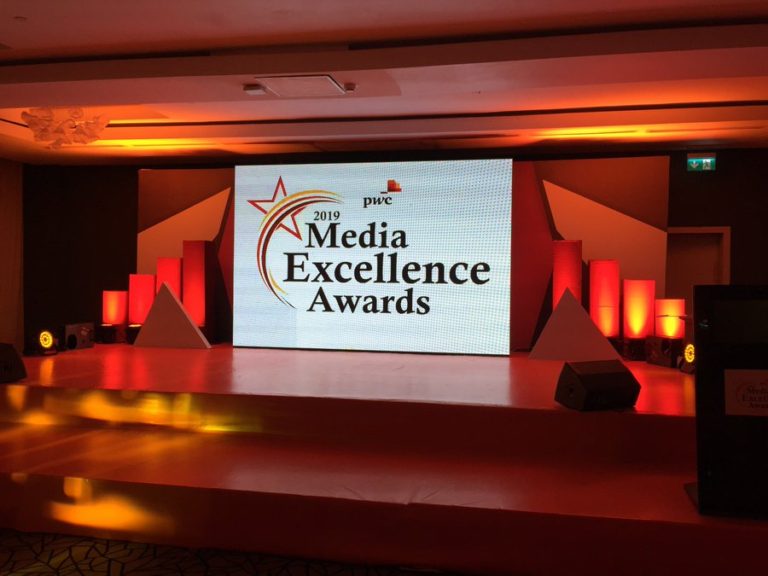
TWO investigative reports commissioned by the International Centre for Investigative Reporting, ICIR, have been announced winners in two among the four categories in the 2019 PwC Media Excellence Awards.
Kelechukwu Iruoma, a freelance journalist, and Bayo Akinloye, editor of Sahara Reporters, had the best entries in the Tax and SMEs reporting categories respectively, as declared at the award ceremony held in Lagos on Friday night.
Published in August, Iruoma’s report exposed how thugs forced traders in various markets across Rivers State to pay multiple illegal taxes and how this affected their businesses.
Titled “Still Loading”, Akinloye’s winning entry was published in December and had shed light on how “the curse of slow internet speed undermines investments and developments” in Nigeria.
Oladeinde Olawoyin, a reporter with Premium Times, won the Capital Markets Reporting category with his report: What Islamic finance products can do to Nigeria’s capital market, infrastructural growth.
And Businessday’s Isaac Anyaogu was declared winner of the Business and Economy Reporting category with his report: Dying in instalment: How lead battery recyclers are poisoning Nigerians.
All four winners each walk away with plaques and cash prizes of N500,000.
All four winners of the 2019 Pwc Media Excellence Awards. Credit: Twitter/@PwC_Nigeria
According to PwC, a network of firms that renders assurance, advisory and tax services, the annual awards celebrate “excellence in business reporting in Nigeria”.
The judges were on the lookout for well-organised research and insight, journalistic integrity, originality and resourcefulness, and relevance to the Nigerian situation.
Other shortlisted journalists were Femi Owolabi and Odogwu Emeka Odogwu in the Business and Economy Reporting category; Ayoade Olatokewa and Chijioke Nelson in the SMEs Reporting category; Gbenga Ogundare and Chinedu Asadu in the Tax Reporting category; and Teliat Sule and Oluseyi Awojulugbe in the Capital Market Reporting category.
THE National Industrial Court, Abuja, on Friday maintained its ground by again rejecting an application filed by the Nigeria Bulk Electricity Trade PLC (NBET) to stay proceedings in a case brought before it by one of the company’s embattled staff, Sambo Abdullahi.
Counsel to NBET had filed the application before the then trial Judge, Hon Justice Kiyersohot Damulak, asking the court to refrain from hearing the suit pending when the application filed at the appeal court is heard and determined.
Abdullahi, head of the Internal Audit at NBET, had queried fraudulent acts by Marilyn Amobi, NBET Managing-Director, alleging that transactions made by her on behalf of the organisation violated extant circulars, financial regulations and agreement duly executed by NBET.
He specifically queried the payment of N7.5 million to one Engr. Achinaya, a monthly over-invoicing of N2 billion to Olorunsogo and Omotosho Power plants and N30 million to Azinge & Azinge and Aelex law firms among others.
Not satisfied with the auditor’s queries, the NBET MD redeployed Abdullahi to another department and ensured his salaries are withheld since December 2017.
In a bid to challenge continuous intimidation by the MD, the embattled whistle-blower had approached the industrial court which ordered the maintenance of a status quo until the determination of the case.
Amobi then applied to the Appeal Court seeking an order to set it aside.
The appeal was on the grounds that the trial judge had erred by issuing an order suo motu, which is “directing parties to maintain the status quo without affording the parties any opportunity to address the court in respect of the said order”.
Presiding judge transferred, case reassigned
NBET made only an oral application before the National Industrial Court to stay proceedings and did not serve the claimant’s counsel at the appropriate time, after securing an adjournment to file the application. The NBET Counsel had also approached the appeal court seeking relief for the trial judge to recuse himself from the case.
However, a few days before the resumption of the case, Justice Kiyersohot Damulak was transferred out of the Abuja division of the NICN. The application had not been heard at the time and no reason was given for the transfer.
The new judge, Hon Justice Oyejoju Oyebiola Oyewunmi, who took over the case on Friday insisted that the suit could not lie fallow while the appeal court is busy with some other dealings.
The case was adjourned till October 31 and November 1 for hearing.
FOR four years, between 2015 and 2019, the 8th National Assembly introduced a total of 2,166 bills but only 515 of the bills were passed into law, a new report launched on Friday has revealed.
Scorecard of the 8th National Assembly — Report of a performance assessment of the 8th National Assembly in Nigeria’s Fourth Republic released by YIAGA Africa Centre for Legislative Engagement, revealed that there was a significant increase in the number of bills handled by the 8th National Assembly.
It noted that 21 of the 515 passed bills were Constitution Alteration bills while five of them received presidential assent.
“The Senate passed a total of 172 bills while the House of Representatives passed 343 bills within the same period. Some of these bills could be regarded as a landmark or significant for the widespread interest they generated, high media attention, pertinent issues they addressed and overall high perception of their potential impacts,” said the report.
The report was the product of a study to assess the legislature as a cardinal institution of democracy with regards to its responsibilities for legislation, oversight and representation.
It indicated that bills such as the North East Development Commission Bill and Not Too Young to Run Bill, among others were among those that were passed by the 8th Assembly.
It, however, noted that 53 bills were declined Presidential assent and only about 80 (15.5%) received assent adding that several Bills were still awaiting assent at the time of study.
However, the report said data on the number of bills transmitted to the president for assent were not available.
Over the same period, 15 bills were withdrawn while 33 were ‘negatived’- killed.
In total, the efficiency percentage of the Assembly was 23.8 per cent, representing the proportion of all bills introduced that were successfully passed by the 8th National Assembly.
According to the report, the 8th Assembly fared better compared to the 7th National Assembly, which passed a total of 205 Bills out of a total of 1367 introduced.
The report also revealed a high level of increase in the number of private members bill, which accounted for 95.8 per cent of all Bills introduced during the 8th National Assembly.
The House of Representatives, it said, accounted for 65 per cent of this category of Bills, which it said was due to its numerical strength over the Senate.
YIAGA’s report stressed that two decades of unbroken democratic governance and attendant accumulation of institutional memory may have tremendously enhanced the law-making capacity of legislators in terms of expertise.
It, however, disclosed that some of these bills generally classified as Private Member bills, though sponsored by legislators, were actually initiated by professional associations and civil society organisations, including the Not Too Young To Run bill.
“This not only shows that civil society organisations have a significant impact on law-making efficiency in the 8th National Assembly but also underscores its positive disposition to participatory law making.”
In terms of the gestation period, the report revealed that some of these bills took long to be passed.
“Ideally, a bill should, averagely, take less than six months to pass. But out of the 515 bills passed in the 8th National Assembly, only 47 (9.1 per cent) were passed within fifty days, while a whopping 271 (52.6 per cent) took over 351 days.
“Furthermore, 14 bills were passed within 100 days, 12 within 150 days, 80 within 200 days, 41 within 250 days, 23 within 300 days and 27 within 350 days. Notably, most of the bills passed within 50 days were either executive bills or, of emergency nature.”