THE management of The Polytechnic Ibadan has sacked Bamishaye Olatunji Abiodun, a junior lecturer at the Department of Mass Communication for professional misconduct.
Bamishaye, who taught Newspaper Editing and Production and Public Relations Media and Methods, was caught on camera in the first part of an investigative report published by The ICIR in August where he was selling handouts to students for 20marks. The management said the act contravenes the institution’s rule.
The ICIR’s student reporter in an undercover investigation witnessed how the lecturer extorted students during one of his class sessions. He would write assignment questions on the first page of the handout and instruct students to get a copy. So, any student that fails to buy the handout would neither be able to get the assignment question nor be able to submit even if such student copied questions from classmates.
In a phone interview with the public relations officer of the institution, Soladoye Adewole, he disclosed to The ICIR that the management was able to fire Bamishaye because “he is a junior lecturer, still under probation.”
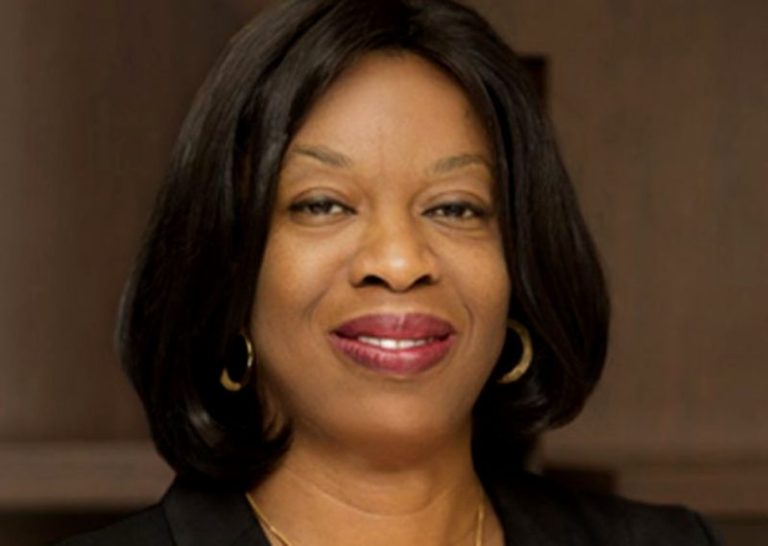
Bamishaye Olatunji Abiodun, a lecturer at the Department of Mass Communication teaches Newspaper Editing and Production and Public Relation Media and Methods
The ICIR can confirm that the management of the polytechnic has constituted a panel headed by a senior lecturer of the institution to “investigate acts of misconducts leveled against some staff of the institution” exposed in the first part of the report.
The term of reference given to the panel includes investigating sales of handouts and unauthorized textbooks by lecturers, and extortion of students. The panel was also directed to verify The ICIR report and recommend sanctions for the erring lecturers in line with the rules and regulations of the institution.
A source close to the management told The ICIR that the investigation was conducted between the 8th and 19th of July, but an extension was sought and granted, and the report of the panel has been submitted to the office of the rector.
The first part of The ICIR report showed how students of The Polytechnic Ibadan, Oyo state, are being extorted by their lecturers through the sales of handouts and grades and imposition of illegal charges that burden many parents of the student in the polytechnic.
The second part exposed how lecturers of the institution charge fees for supervising students’ final year projects.
Why is the panel report not implemented?
The spokesperson of the institution told The ICIR that the panel report has been submitted months ago to the rector but the institution currently does not have a governing council, hence its inability to sanction the other indicted lecturers.
But the lecturers involved already have been served queries, he said.
The governing council, according to the institution’s rule, is the only body that has the power to sanction any staff for any offence.
Adewole said the institution is waiting for the new governor of the state, Seyi Makinde to constitute the council.
What fact sheets say about Nigerian lecturers
A research conducted in all 36 states and the Federal Capital Territory (FCT) between April and May 2016 by United Nations Office on Drugs and Crime (UNODC) in collaboration with the National Bureau Statistics (NBS), published in July 2017, shows that teachers/lecturers are one of the corrupt officials in Nigeria.
Teachers/lecturers were ranked13th out of 18 corruption marked officials in the country with a prevalence rate of 11.7 per cent.
The 2019 Global Corruption Barometer Africa in her latest release also made it clear that in 2015, 25 per cent of total bribery cases were from public schools while in 2019, the prevalence shifted higher to 32 per cent.
NIGERIA is the world’s 13th largest oil producer and President Muhammadu Buhari re-affirmed in his latest Independence Day address that oil constitutes the bulk of Nigeria’s revenue and foreign exchange earnings. But, as the country quickly depletes her limited oil reserves and the world at large advances in technology, experts agree it’s time it focused on something else: data.
Communications Minister Isa Ali Pantami appears to share this view too. “Data is the oil of the 21st century,” he tweeted on Thursday, paraphrasing reputable research analyst, Peter Sondergaard Gartner. “But oil is just useless thick goop until you refine it into fuel. Artificial Intelligence (AI) is the refinery in a digital economy.”
The country, however, still has a long way to go in making this shift—no thanks to an entrenched poor record-keeping and data collection culture.
Journalists hit a wall
With investigative and data journalism increasingly gaining ground among Nigerian reporters, one challenge they often face is the unavailability of important data.
According to the 2019 National Freedom of Information Ranking by the Public and Private Development Centre (PPDC), out of a total of 191 public institutions, 87 (45.5 per cent) do not engage in proactive disclosure of information and the rest (54.5) only partially disclose proactively.
Data available to the PPDC also revealed that there’s a 33.5 per cent chance of getting all details requested through an FOI request, a 10.5 per cent chance of getting some of the details, and a 56 per cent chance of getting nothing at all. This is similar to The ICIR‘s experience in the past year, with over 60 per cent of requests either denied or ignored.
But an unwillingness to respond to requests for data is not the only problem, public institutions, in fact, do not have some of those data on record and in an easily retrievable form.
In April, Director of Press at the Federal Ministry of Justice, Modupe Ogundoro, told Bayo Akinloye, then a reporter with ThisDay Newspaper, she couldn’t confirm they have records on the number of name changes done in the last five years.
“How do you expect me to know the number of changes of name that has been done in the country? … I have gone around asking people which department handles records of change of name. I have spoken with my colleagues in the legal department and they told me that they don’t have such records,” she said.
“There must be a record somewhere. I am not saying we don’t have the records in the ministry and I am not saying that we have. I am working on finding out where, if it exists, the record is.”
Also, in July, a PremiumTimes reporter, Evelyn Okakwu, revealed how there seems to be no coordinated data with the Nigerian Prisons Service on the number of inmates detained and released in the last 15 years.
“After tracing the letter in vain for weeks, Mr Enobore [spokesperson of the Nigerian Prisons] requested a more concise application for the said data,” she wrote. “A further request for a similar data, to cover five or ten years, was not granted by the service. The subsequent letter was also lost between the statistics and operations units of the service.”
No show in global reports
Another indication of Nigeria’s inadequate data collection is how much information about it is available in various global comparative reports. There are either instances where the country has no statistics on certain objects or the statistics aren’t available for some periods.
In the 2018 Human Development Statistical Update, for example, Nigeria’s gender inequality index, international student mobility, percentage of female internet users, proportion of schools with internet access, female share of employment in senior and middle management, among other indices, are not available.
There are a lot more examples in the 2018 Global Innovation Index with missing statistics on graduates in science and engineering, tertiary inbound mobility, females employed with advanced degrees, research talent in business enterprise, intellectual property receipts, cultural and creative services exports, and so on.
The 2019 Global Talent Competitiveness Report does not have figures for the country on research and development expenditure, vocational enrolment, and population with secondary and tertiary education.
Likewise, the 2019 International Tourism Highlights does not have 2017 and 2018 figures for Nigeria on international tourist arrivals and the 2018 World International Property Indicators Report contains very little statistics on patent applications and grants in Nigeria.
Other examples, funding problem
The huge vacuum in Nigeria’s data hemisphere can be seen in various aspects, from population to elections, security, migration, and so on.
In 2018, responding to an FOI request filed by TheCable, the Independent National Electoral Commission admitted that it is not in custody of a state-by-state breakdown of the 2007 presidential results and instead directed the news agency to consult the various state offices.
Also, in July 2018, The ICIR asked the electoral commission for details of presidential and gubernatorial electoral results from 1999 till date as well as a state-by-state breakdown of the number of uncollected Permanent Voters Cards (PVCs), number of applications for transfer of PVC, and state of origin of applicants. However, in its reply, it only provided results for presidential elections from 2007 and a breakdown of collected and uncollected PVCs, ignoring other enquiries.
Despite a recommendation by the United Nations Population Fund that national censuses should be conducted every 10 years, Nigeria has gone 13 years without one. The National Population Commission has blamed this delay on poor funding.
The National Bureau of Statistics (NBS) is another crucial data-gathering agency that has been a victim of insufficient funding. In November, the head of the agency, Yemi Kale, admitted they could not gather and release updated unemployment statistics “due to budgetary releases”.
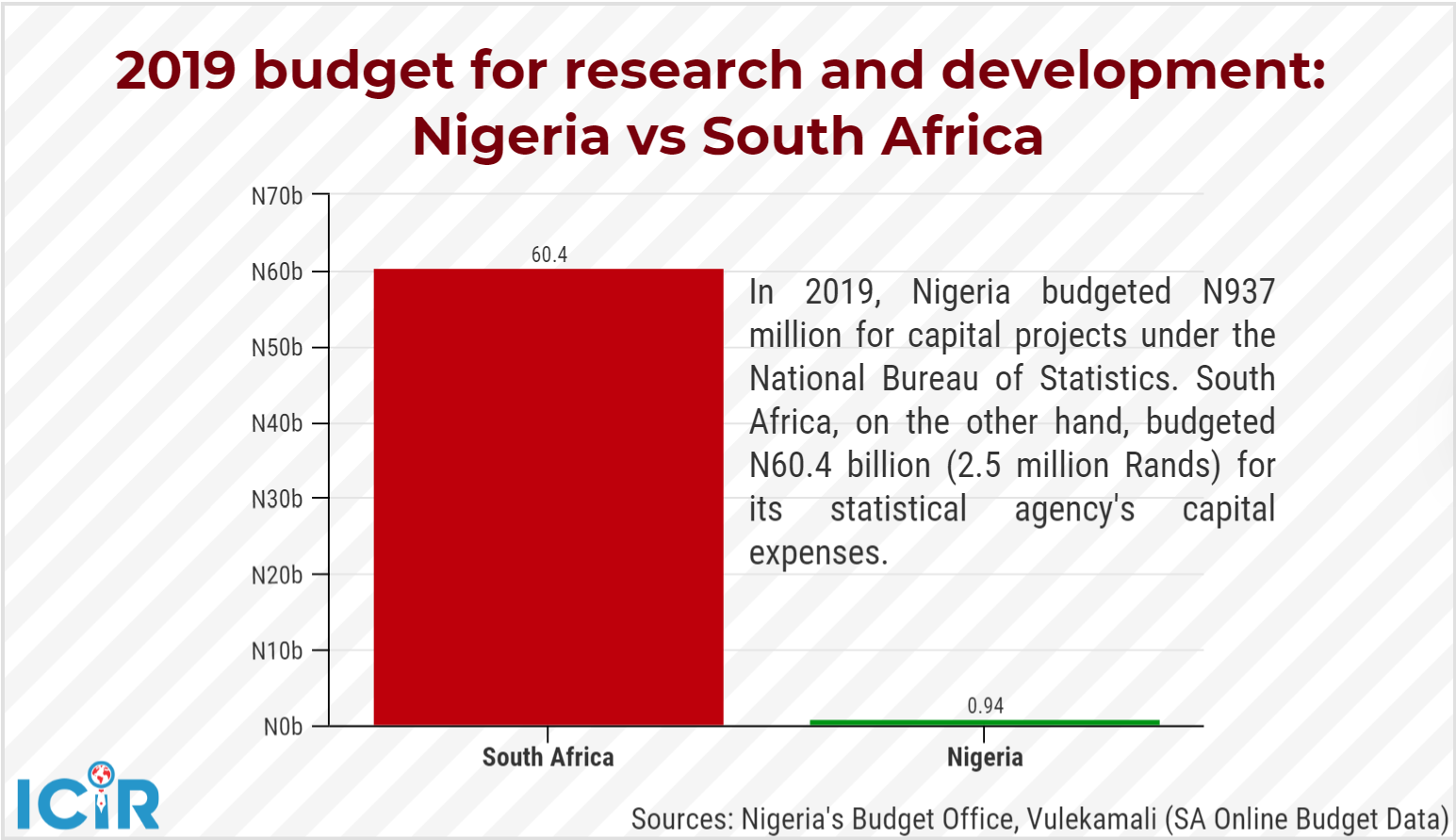
South Africa’s 2019 capital budget for research and development is 64 times bigger than Nigeria’s. Source: Nigeria’s Budget Office, Vulekamali: SA Online Budget Data
Money down the drain
Because a lot of official processes are not documented, Nigeria keeps losing money to corruption. This takes various forms such as unrecorded payments for public services or the use of ghost workers. Buhari said in February that the government had saved almost $550 million (N198 billion) from identifying phantom employees on the payroll.
Comptroller-General of the Nigerian Customs Service, Hameed Ali, told federal lawmakers on Wednesday that, contrary to expectations, the agency has been making an average of N5.3 billion daily, more money than usual, since the borders were closed.
“What we have discovered is that most of those cargoes that used to go to Benin [Republic] and are then smuggled into Nigeria [now come to us],” he explained. “Now that we have closed the border they are forced to bring their goods to either Apapa or Tin Can Island and we have to collect duty on them.”
Likewise, the absence of data on procurement has also encouraged misappropriation by government agencies and public officeholders. According to the Thematic Research Network on Data and Statistics, “The inaccessibility of budgetary information across the Nigerian Government aids financial corruption among public sector workers.”
Also stressing this point, Oluseun Onigbinde, founder of BudgIT said in a 2013 interview that improving access to information encourages debate in the society and shows traces of corruption.
“If no one knows what goes on in government and citizens are handed a fuzzy narrative, the incentive to steal funds is high. When we open up information about the flow of public funds, we strengthen the social contract, and deepen the trust between the electorate and the leader,” he said.
To grow, we need data
“No meaningful national development can take place without empowering the national statistical system.” This was the conclusion of a 2011 comparative study of Nigeria against Rwanda published by the Journal of Sustainable Development. It explained that is because of the need to map out strategic plans and also set up machinery for execution and monitoring.
Kale, Nigeria’s Statistician-General, agrees. While delivering a lecturer in August at the University of Lagos, he said meaningful progress cannot take place without “good, reliable, and timely data”.
Reliable and comprehensive statistics, experts have stated, are needed to formulate sound economic policies and development plans. It is what ensures budgets are focusing on the most important projects and priorities are not misplaced. Through Big Data, it also helps government and private companies to be more efficient by establishing patterns and predicting behaviours.
“Why do statistics matter?” the World Bank asked in its World Development Indicators of 2000.
“In simple terms, they are the evidence on which policies are built. They help identify needs, set goals, and monitor progress. Without good statistics, the development progress is blind: policymakers cannot learn from their mistakes, the public cannot hold them accountable.”
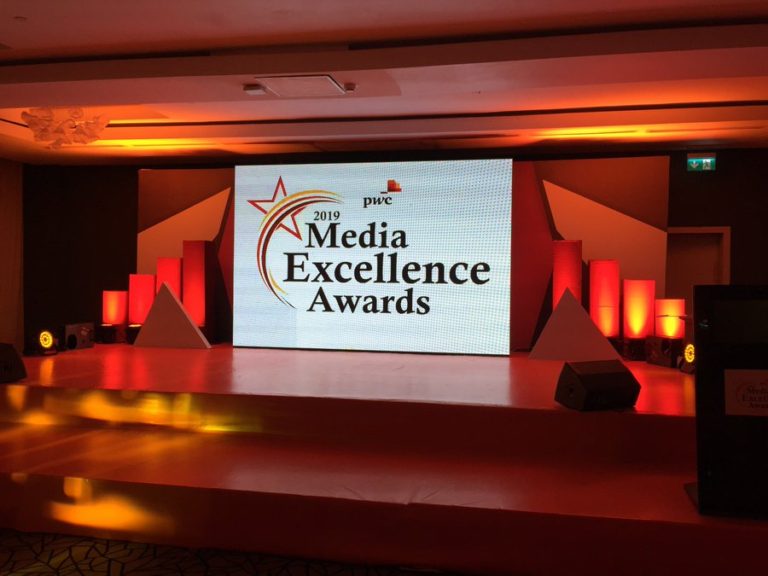
TWO investigative reports commissioned by the International Centre for Investigative Reporting, ICIR, have been announced winners in two among the four categories in the 2019 PwC Media Excellence Awards.
Kelechukwu Iruoma, a freelance journalist, and Bayo Akinloye, editor of Sahara Reporters, had the best entries in the Tax and SMEs reporting categories respectively, as declared at the award ceremony held in Lagos on Friday night.
Published in August, Iruoma’s report exposed how thugs forced traders in various markets across Rivers State to pay multiple illegal taxes and how this affected their businesses.
Titled “Still Loading”, Akinloye’s winning entry was published in December and had shed light on how “the curse of slow internet speed undermines investments and developments” in Nigeria.
Oladeinde Olawoyin, a reporter with Premium Times, won the Capital Markets Reporting category with his report: What Islamic finance products can do to Nigeria’s capital market, infrastructural growth.
And Businessday’s Isaac Anyaogu was declared winner of the Business and Economy Reporting category with his report: Dying in instalment: How lead battery recyclers are poisoning Nigerians.
All four winners each walk away with plaques and cash prizes of N500,000.
All four winners of the 2019 Pwc Media Excellence Awards. Credit: Twitter/@PwC_Nigeria
According to PwC, a network of firms that renders assurance, advisory and tax services, the annual awards celebrate “excellence in business reporting in Nigeria”.
The judges were on the lookout for well-organised research and insight, journalistic integrity, originality and resourcefulness, and relevance to the Nigerian situation.
Other shortlisted journalists were Femi Owolabi and Odogwu Emeka Odogwu in the Business and Economy Reporting category; Ayoade Olatokewa and Chijioke Nelson in the SMEs Reporting category; Gbenga Ogundare and Chinedu Asadu in the Tax Reporting category; and Teliat Sule and Oluseyi Awojulugbe in the Capital Market Reporting category.
THE National Industrial Court, Abuja, on Friday maintained its ground by again rejecting an application filed by the Nigeria Bulk Electricity Trade PLC (NBET) to stay proceedings in a case brought before it by one of the company’s embattled staff, Sambo Abdullahi.
Counsel to NBET had filed the application before the then trial Judge, Hon Justice Kiyersohot Damulak, asking the court to refrain from hearing the suit pending when the application filed at the appeal court is heard and determined.
Abdullahi, head of the Internal Audit at NBET, had queried fraudulent acts by Marilyn Amobi, NBET Managing-Director, alleging that transactions made by her on behalf of the organisation violated extant circulars, financial regulations and agreement duly executed by NBET.
He specifically queried the payment of N7.5 million to one Engr. Achinaya, a monthly over-invoicing of N2 billion to Olorunsogo and Omotosho Power plants and N30 million to Azinge & Azinge and Aelex law firms among others.
Not satisfied with the auditor’s queries, the NBET MD redeployed Abdullahi to another department and ensured his salaries are withheld since December 2017.
In a bid to challenge continuous intimidation by the MD, the embattled whistle-blower had approached the industrial court which ordered the maintenance of a status quo until the determination of the case.
Amobi then applied to the Appeal Court seeking an order to set it aside.
The appeal was on the grounds that the trial judge had erred by issuing an order suo motu, which is “directing parties to maintain the status quo without affording the parties any opportunity to address the court in respect of the said order”.
Presiding judge transferred, case reassigned
NBET made only an oral application before the National Industrial Court to stay proceedings and did not serve the claimant’s counsel at the appropriate time, after securing an adjournment to file the application. The NBET Counsel had also approached the appeal court seeking relief for the trial judge to recuse himself from the case.
However, a few days before the resumption of the case, Justice Kiyersohot Damulak was transferred out of the Abuja division of the NICN. The application had not been heard at the time and no reason was given for the transfer.
The new judge, Hon Justice Oyejoju Oyebiola Oyewunmi, who took over the case on Friday insisted that the suit could not lie fallow while the appeal court is busy with some other dealings.
The case was adjourned till October 31 and November 1 for hearing.
FOR four years, between 2015 and 2019, the 8th National Assembly introduced a total of 2,166 bills but only 515 of the bills were passed into law, a new report launched on Friday has revealed.
Scorecard of the 8th National Assembly — Report of a performance assessment of the 8th National Assembly in Nigeria’s Fourth Republic released by YIAGA Africa Centre for Legislative Engagement, revealed that there was a significant increase in the number of bills handled by the 8th National Assembly.
It noted that 21 of the 515 passed bills were Constitution Alteration bills while five of them received presidential assent.
“The Senate passed a total of 172 bills while the House of Representatives passed 343 bills within the same period. Some of these bills could be regarded as a landmark or significant for the widespread interest they generated, high media attention, pertinent issues they addressed and overall high perception of their potential impacts,” said the report.
The report was the product of a study to assess the legislature as a cardinal institution of democracy with regards to its responsibilities for legislation, oversight and representation.
It indicated that bills such as the North East Development Commission Bill and Not Too Young to Run Bill, among others were among those that were passed by the 8th Assembly.
It, however, noted that 53 bills were declined Presidential assent and only about 80 (15.5%) received assent adding that several Bills were still awaiting assent at the time of study.
However, the report said data on the number of bills transmitted to the president for assent were not available.
Over the same period, 15 bills were withdrawn while 33 were ‘negatived’- killed.
In total, the efficiency percentage of the Assembly was 23.8 per cent, representing the proportion of all bills introduced that were successfully passed by the 8th National Assembly.
According to the report, the 8th Assembly fared better compared to the 7th National Assembly, which passed a total of 205 Bills out of a total of 1367 introduced.
The report also revealed a high level of increase in the number of private members bill, which accounted for 95.8 per cent of all Bills introduced during the 8th National Assembly.
The House of Representatives, it said, accounted for 65 per cent of this category of Bills, which it said was due to its numerical strength over the Senate.
YIAGA’s report stressed that two decades of unbroken democratic governance and attendant accumulation of institutional memory may have tremendously enhanced the law-making capacity of legislators in terms of expertise.
It, however, disclosed that some of these bills generally classified as Private Member bills, though sponsored by legislators, were actually initiated by professional associations and civil society organisations, including the Not Too Young To Run bill.
“This not only shows that civil society organisations have a significant impact on law-making efficiency in the 8th National Assembly but also underscores its positive disposition to participatory law making.”
In terms of the gestation period, the report revealed that some of these bills took long to be passed.
“Ideally, a bill should, averagely, take less than six months to pass. But out of the 515 bills passed in the 8th National Assembly, only 47 (9.1 per cent) were passed within fifty days, while a whopping 271 (52.6 per cent) took over 351 days.
“Furthermore, 14 bills were passed within 100 days, 12 within 150 days, 80 within 200 days, 41 within 250 days, 23 within 300 days and 27 within 350 days. Notably, most of the bills passed within 50 days were either executive bills or, of emergency nature.”
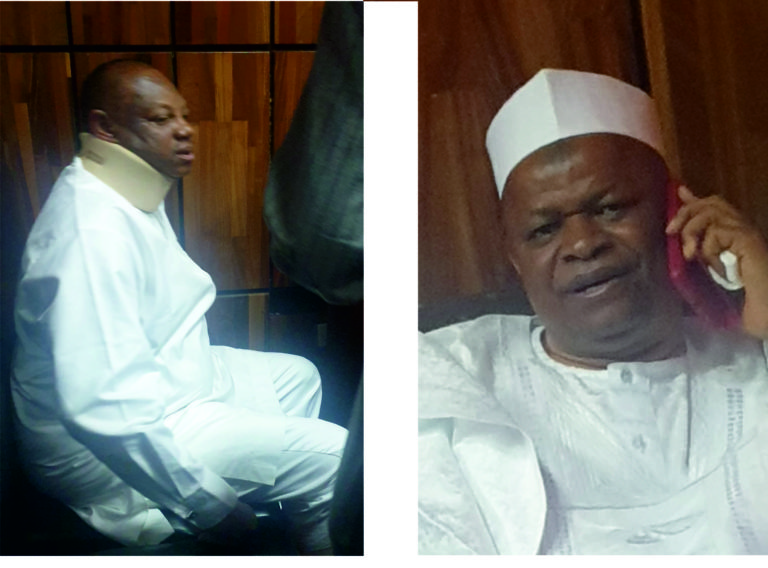
ECONOMIC Financial Crime Commission (EFCC) on Thursday arraigned before High Court in Abuja an ex-special adviser to Buhari on Presidential Amnesty, Brigadier General Tarelah Paul Boroh (rtd.) and Hanafi Musa Moroki for allegedly diverting public fund to personal use.
Boroh and Moroki were arraigned on nine-count charges including criminal breach of trust, and diversion of fund amounting to N974,768,466 and $1,914,000.
EFCC Head, Media and Publicity, Wilson Uwujaren, disclosed this in a press release obtained by The ICIR.
Earlier in 2018, the sum of $9 million (N2.75 billion) was allegedly found at the Abuja residence of the former special adviser to the president in discovery by the EFCC and Office of the National Security Adviser.
The duo were alleged to have on different occasions, dishonestly converted the sums of N8,601,571; N106,288,445; N12,078,450; N382,800,000; N456,000,000; N9,000,000 and more, while they were in office.
The third count of the charge read, “That you, Paul Boroh and Hanafi Moriki between the 1st of December 2016 and 30th July, 2017 at Abuja within the jurisdiction of this Honourable Court whilst being public servants entrusted with property to wit funds of the Office of the Special Adviser to the President on Niger Delta and Coordinator of the Presidential Amnesty Programme, dishonestly converted the sum of One Million, Seven Hundred and Fourteen Thousand United States Dollars to your own use and thereby committed an offense contrary to and punishable under section 315 of the Penal Code Law”.
Both defendants pleaded not guilty of all of the charges read to them by the court.
Counsels to Boroh and Moroki charged the court that the both be granted bail on liberal terms while counsel to Boroh stressed that his client be granted bail because he brought himself to the court despite his failing health.
EFCC counsel, Aisha A.T Habib opposed the bail application; she stated that a counter affidavit had been filed against the applications and prayed the court to grant the case accelerated hearing.
However, Justice O.Goodluck granted Boroh two million naira bail while Moroki was granted bail in the sum of twenty million Naira.
She also ordered the defendants to provide two sureties not below the rank of Assistant Director in the Federal Public Service, who must be resident in Abuja and that both defendants should deposit their international passports with the court registry.
Goodluck after granting bail to the defendants adjourned the case to 26, 27 November and 3, 4 December 2019 for the commencement of trial.
THE Federal High Court sitting in Calabar on Friday denied bail to the detained journalist, Agba Jalingo stating there was no substantial evidence to show that his health was failing to necessitate his bail.
Attah Ochinke, the lead counsel to the defendant, had pleaded with the court to grant his client bail on grounds that he was willing to see the trial through. He also pleaded that the journalist should be admitted to bail on health ground.
The prosecution counsel, Dennis Tarhemba, had countered the bail application.
Justice Simon Amobeda, the presiding judge ruled that the charges against Jalingo were serious which also carried capital punishment before dismissing the bail application for lack of merit.
Jalingo, the publisher of CrossRiverWatch, an online newspaper, with a focus on Cross River State, was arrested on August, 22, but was incarcerated for 34 days in police detention before he was arraigned on September 25.
The journalist, whose arrest and the trial have attracted outrage from human rights groups across Nigeria, arrived at the court premises in handcuffs.
He was charged with treason over his report about an alleged diversion of N500 million by the Cross River governor, Ben Ayade.
The incarcerated journalist recently released some prison notes, urging the people of Cross River state to remain steadfast in the struggle against “dictatorship”.
He said in the notes that he is ready to go through his travails faithfully, with the belief that victory and glory await him in the end.
“One final assurance that I give to my people of Cross River, in particular, is that ‘we will overcome that dictator in Peregrino House.
“Dictatorship has never defeated goodwill and a determined people. Even if I end up not standing with you in the summit, remain strong and be rest assured that the arc of life is on our side and we will win,” a section of the note reads.
However, Justice Simon adjourned the case to Wednesday, October 16 for the start of his trial for treason.
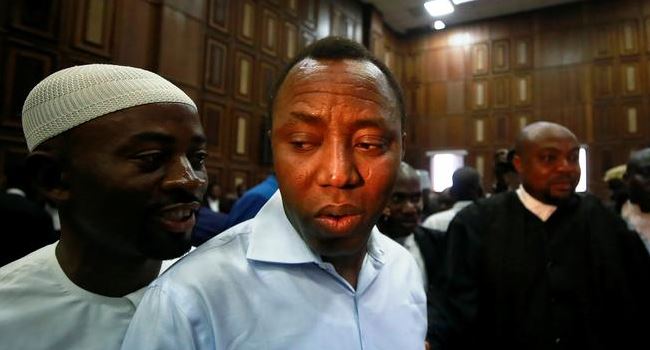
THE Federal High Court in Abuja has granted bail to Omoyele Sowore, convener of #RevolutionNow protest and publisher of the Sahara Reporters.
The judge, Ijeoma Ojukwu, ordered the release of Sowore and Olawale Bakare after listening to the submissions of both the prosecutor’s counsel Hasssab Liman and the defendants’ lawyer led by Femi Falana on Friday.
“Since the charge before the court does not carry any death penalty, I am inclined to grant bail,” she held.
The trial judge granted bail to the two defendants in a total sum of N150 million.
The court ordered Sowore not to partake in any rallies. It added that both defendants should remain within the Federal Capital Territory, Abuja.
This is the second time the court will be granting Sowore bail after being arrested and arraigned by the Department of State Security Service for masterminding the protest.
The government did not obey the rule of the court after Sowore was granted bail on September 24. Rather, Sowore and Bakare were arraigned on Monday on seven counts bordering on an alleged conspiracy to commit treason, cyberstalking and money laundering among other charges.
Sowore’s counsel, led by Femi Falana had applied again at the court hearing for bail application.
At the hearing of the bail application on Friday, the judgeordered that Sowore and his co-defendantbe released from the military detention.
She asked Sowore to drop his passport with the court within 48 hours as part of the bail conditions.
The court asked Sowore also provide N100 million as the bail bond with two sureties in like sum.
The second defendant, Olawale Bakare, was to be bailed with a bond of N50 million.
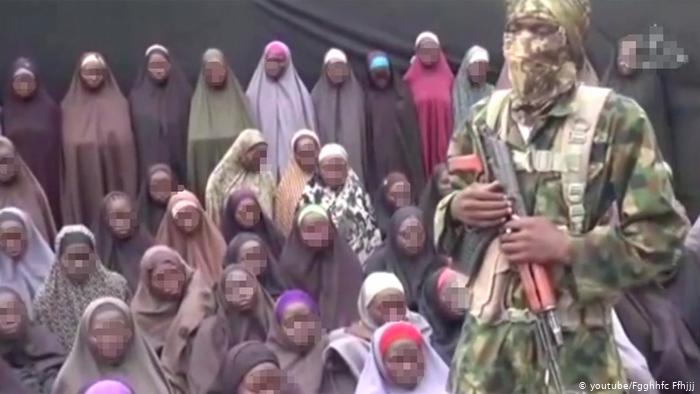
THE Bring back Our Girls campaign movement is set to commemorate the 2000 days of the disastrous kidnapping of 276 schoolgirls of Government Girls Secondary School on the 14th of April 2014 by Islamic Extremist Group, Boko Haram in Chibok town.
In a release by the spokesperson of the movement, Nifemi Onifade, he noted that some of the 276 school girls have been rescued, some escaped but towards the commemoration of the 2000 days of the kidnapping, 112 schoolgirls are still unaccounted for.
“The BringBackOurGirls movement will commemorate this ongoing tragedy by keeping hope for the return of our Chibokgirls alive,” he added.
Bring Back Our Girls movement is set to organise an activity on Saturday 5, October to commemorate 2000 days of unaccounted 112 schoolgirls of Chibok.
Nifemi said that the movement would continue to uphold her promise to the Chibokgirls by demanding their immediate and unconditional return from the Federal Government of Nigeria.
He also thanked people who have continued to stand by the movement and their unwavering support for the Chibokgirls during the Bringbackourgirls struggle.
Nigerians continue to witness several abduction cases in the Northeastern part of the country, it should also be noted that the Boko Haram group, alsokidnapped more than 100 schoolgirls in Dapchi, North-East Nigeria, although most of them have been recovered by the Nigerian government.
However, many Nigerians have criticized the government’s inability to recover the remaining 112 schoolgirls of Chibok, Leah Sharibu among others.
The former Minister of Education, Oby Ezekwesili also criticized the Federal Government in a tweet on her official page, she quoted Buhari of saying that the FG would not claim to have defeated Boko Haram without rescuing the Chibokgirls and all other innocent persons held hostage by insurgents and that the government went ahead to do so.
Renowned government critic and Special Assistant to Former President Goodluck Jonathan, Reno Omokri statement said, ”President Muhammadu Buhari, you should do everything in your power not to score political points, keep her and when it’s time for elections let her go”.
AFTER waiting for nearly 30 minutes on the queue at the banking hall Nnajiofor Cynthia, a student of the University of Nigeria, Nsukka anxious to make her deposit that morning, was notified that a sum of N300 bank charges would be required to finalise her school fees deposit of N45,600 into the Treasury Single Account, TSA.
In December, 2011 the Central Bank of Nigeria, CBN, signed a contract to hire Systemspecs- a local financial/tech company that designed Remita, an online platform. The firm is expected to facilitate e–payments on government financial services to a single account overseen by the apex bank in line with chapter five, Section 80 (1) of the Nigerian Constitution.
The decision to hire the company owned by John Obaro was borne out of fact that the Nigeria Inter-Bank Settlement System Plc (NIBSS) – a subsidiary of the CBN, at the time lacked the capacity to carry out the functions for which Systemspecs was being hired for.
By August 2015- September 2016, Remita reportedremittance of over three trillion Nairas into the TSA (N3, 651,360,698,359.03) for the Federal Government.
However, public outcryandcriticism in October 2015 of fraudulent extortion and exorbitant charges by the payment interface led to a pause on payment charges into government accounts.
Abayomi Oniku, Divisional Head, Public Sector Systemspecs who spoke to The ICIR said the gains made from the use of the interface as charges billed payers was shared amongst shareholders–Systemspecs Remita, CBN, Deposit Money Banks at 50 per cent, 10 per cent, and 40 per cent respectively.
Therefore, it wasn’t kept by the fintech company alone – An assertion to which John Obaro, Chief Executive Officer, and CEO, Systemspecs, had earlier attested.
As the controversy thickened, the CBN on November 1 2018, released a directive for the enforcement of a flat rate charged payers for every deposit—both cash and electronic transaction made into the TSA’s.
“All payers using other channels apart from Cards (Bank Transfers, Mobile Payments, Bank teller points, USSD and all other channels) shall pay the sum of N150.00 (One Hundred and Fifty Naira only), per transaction,” a section of the letter read.
It also stipulated that “All payers using cards are to be charged N150.00 (One Hundred and Fifty Naira only) plus 0.75 per cent of the amount being paid, subject to a maximum of N1,200.00 (One Thousand Two Hundred Naira Only).”
This meant that depositors would have to pay additional charges on every transaction for using the interface–birthing a ‘non-seamless’ deposit transactions into the TSA as the federal government reneged on its initial responsibility to bear the cost of service on behalf of the revenue payers.
However, the introduction of the directive by the CBN may have come a little too late.
Different folks, different strokes
Between 2016 to 2017, prior to the directive, The ICIR was able to establish that some DMB’s placed arbitrary charges on payments made through the Remita gateway into the TSA, as sources revealed that they paid between N300-N1000 –not captured on the final Remita receipt.
“When I gave my money to the cashier, I was asked to pay N300 charges which is to be paid using the bank deposit teller. So it was not evident in the final receipt issued at the end of the transaction that there was an extra charge for the service,” The ICIR was told.
Coming to terms that she would have to pay N5000 to acquire her original JAMB admission letter, rather than getting the document on her profile through the portal, Peace Agada had to pay additional bank charges of N175.50 bank charges– an amount she said would have preferred to use in purchasing a much-needed bottle of cold coke beverage to calm her parched throat in the sweltering Makurdi-Benue State- sun after her business at the bank.
“I asked at the bank why we are paying the extra fees apart from the original payment, and they said it is bank charges. I have been paying for bank charges and I don’t even know what it is for. I come to give someone else money, only to be charged for doing so,” she fumed
The undergraduate who visited the bank with her friends to make the same payment told The ICIR that although they all came for the same purpose—deposit- varying charges were demanded each transaction.
“In fact, some even paid N200 as the bank charges instead of the N175 that we were charged. On that particular day, we were more than 30 students,” she said.
The ICIR also got the same report from another student who was present at the banking hall that afternoon.
Similarly, Ebere Anioke an overstay student of UNN, who also spoke to the reporter said the sum of N300 extra charges was demanded of her in other to facilitate payment of N500 billed for course registration.
Worthy to note, the Remita Public sector officer, Oniku, told The ICIR a ratio for Value Added Tax (VAT) is also included in the charges.
“IT is clear in the CBN circular that you mentioned it is clear that the channels of payments are recognised. So if you are making payment through a bank branch for instance, then VAT payments are included,” He told The ICIR.
However, a cursory look at some final Remita payment receipt does not indicate any deduction of VAT charges.
Remita Payment Receipt: No VAT deduction indicated
Attempts by the reporter to ascertain the ratio remitted to the FIRS—if any– from the service proved abortive at the time of this report.
Unfortunately, due to the inconsistency of the sum charged payers, an estimation of the exact amount that could have been raked in for charges into the TSA could not be ascertained.
However, records obtained from the Joint Admission Matriculation Board (JAMB) showed that from 2017 to 2018, the total number of 1, 116,482 (one million one hundred and sixteen thousand, four hundred and eight two) candidates gained admission into Federal Higher institutions of learning in the country.
Going by the fixed CBN flat rate at N150 flat rate on every transaction to the TSA, the undergraduate students would have paid N167,472,300 (one hundred and sixty-seven million, four hundred and seventy-two thousand, three hundred) on charges alone for their school fees payment into the TSA.
While at N157, the sum of N175, 287,674 (one hundred and seventy-five million, two hundred and eighty-seven thousand, six hundred and seventy-four) would have been incurred on charges alone.
According to Onyeka Olisa, a banker that spoke to The ICIR, “The payer has no option but to pay through this platform. The depositor, in this case, pays for the services being offered not the government.
“It should not be, but unfortunately, this particular issue falls under the circle of concern and not circle of influence.
“The circle of influence we can change, but matters within the circle of concern we cannot change. It falls within the jurisdiction of the lawmakers who made this law. It is only the National Assembly that can change it.
Also bemoaning the incessant charges incurred by the use of the Remita interface, Mahmud Abdul, a lawyer in Abuja said it is shameful and wrong for Nigeria as a country approaching high modernity to seek the assistance of a third party in the managementof her resources.
“Expensive charges itself shut out people from open government. The country should be able to develop its own framework to make payment of fund into the government coffers easier without unnecessarily burdening her citizen.
“Hence it is not proper for these extra charges to be passed over to ordinary poor Nigerian citizen who is trying to access the government framework. Access to the government should be free!”
The ICIR was able to ascertain that in Ghana where the Treasury Single Account (TSA) was launched in 2016, Systemspecs-Remita interface has also been introduced and banks charge the Ghanaian government for maintaining the accounts while payers are not charged extra fees for transactions into the TSA accounts.
The CBN had claimed that at the inception of Remita, the government was charged with paying the fintech company for running the TSA gateway, however, through 2016 to the later part of 2018 the government claimed it could not shoulder the financial obligations of paying the systemspecs.
Investigations revealed that this development resulted in the arbitrary charges imposed on payers by the banks. Consequentially, the government had intently dumped the cost of operating the TSA gateway on Nigerians while the CBN still partook in the sharing pattern of 10 per cent ratio incurred from billing Nigerians, Remita 50 per cent and Deposit Money Banks 40 per cent.
Implementation of a flat rate was also obviously not in favour of the poor masses who were being charged varying amounts ranging from N157 to N500.
Although the CBN-recent propagators of cashless policy- has directed for a seamless transaction-no extra charge- for payers using e-transaction payment channels, this is yet to be implemented on payments into the TSA. The reason is that some payers remitting revenue to the government still have to pay for services rendered by e-payment gateways through the DMB’s when making cash transactions.
The situation in Nigeria is absolutely different from what is obtained in Ghana as depositors are still billed the sum of N150 and above on a daily basis, and this is shared among the four stakeholders—CBN, REMITA, FIRS and DMB’s.