Home Blog Page 2279

Inside The Ibadan Polytechnic where corruption thrives (Part 2)

 The first part of this undercover investigation exposed how students of The Polytechnic Ibadan are being extorted by the academic staff of the institution, how they systematically pay for grades and how students are made to pay for lecture notes by their lecturers.

In this second part, Uthman SAMAD reveals how lecturers at the foremost polytechnic in Southwestern Nigeria charge fees for supervising final year projects of students.


FINAL year project or thesis is a partial requirement for the award of university or polytechnic degree or higher diploma in Nigeria. It requires rigorous academic research by undergraduates under the supervision of a lecturer assigned as a supervisor.

Once a student is certified by his lecturer to have carried out satisfactory academic research on a given researchable topic, he is deemed to have fulfilled the partial requirement for graduation—the other requirements being his academic performance—and must be found worthy also in character.

But at the Polytechnic Ibadan, this student-lecturer relationship is being traded for money. Here, final year students literally pay money into accounts of their supervisors and are allowed to duplicate other people’s work as their final year projects.

Students, graduate narrate their ordeal with supervisors

When Taiwo (surname withheld) was assigned to be supervised by his Head of Department, Mr. Makinde for his final year project, the final year student had looked forward to a rigorous engagement with his supervisor.

Taiwo, then an undergraduate in the Marketing Department, submitted Chapters 1-3 to his supervisor, hoping that the experienced lecturer would look through his work, make corrections and put him through what to be done next.

He was wrong. Mr. Makinde instead asked him to part  N40,000 and get a full score for the project rather than writing and submitting in chapters.

“I can literarily tell you that I didn’t do anything like I didn’t submit a word like this, this lecturer pressurised me and I paid 40K(N40,000) soft,” he said, recalling his encounter with the supervisor back in school.

“I was placed under Mr. Makinde who was then the HOD. I could remember that I have started writing my project before Baba said he did not need my project. I have written like three chapters and I took it to him,” Taiwo reminisced.

“Aranse, there is nothing I will do with this, or are you telling me you are brilliant? I am not using all these? Your own payment is N40, 000.  I have marked enough of things like this,” the supervisor told him when he submitted the first three chapters.

With this reality staring him in the face—N40, 000 or no project and graduation—he went looking for the money.

“I went to Lagos to hustle for the 40k, I paid and that’s all,” he said.

Another student from the Department of Public Administration who spoke under anonymity narrated his ordeal with another lecturer at the institution, one Mr. Ganiyu Hakeem, who teaches Community Development and Public Finance. He also doubles as the staff adviser for the department.

“All is done and dusted now. Project is a means some lecturers use to fill their hungry stomachs,” he said.

“My case was an example,” he started. “Firstly, I was surprised when my supervisor asked me to pay a certain amount for the project because he believed I can’t do it alone.”

In this case, the supervisor was operating through a proxy—a cyber café operator was his agent.

“Although we didn’t pay to him directly but he directed us to a café man and we paid the money to him,” he recalled.

“I later heard that the café man will take half of my money and then give the commission to the supervisor which is half of the money I paid which was N20, 000.”

Another student of Public Administration who was supervised by the same Mr. Akeem recounted how hard it was to pass through a supervisor without paying.

“The first day we met him, he frankly told us to pay N30, 000 through a café man. It’s an individual project and not group, so everyone carried their burden. I heard later that he eventually pegged the amount to be paid at N20, 000 per student.”

I understood the meaning of the word ‘hard’, he said.

He would not attend to me daily for months, yet he gave priority and attention to those that made the payment.

“He asked those that were willing to pay to a café man beside the Music Department. So they just go there to collect the project and submit chapter-by-chapter.”

When contacted for comments through a telephone call,  Mr. Ganiyu Akeem denied the allegation.
“There’s never been such since I have been working and I will never do that,” he responded angrily.
“The first part of  your investigative report has caused a lot of trouble on this campus because I had this same information from somebody, I have been waiting for you till now.”
Livid with anger, he hurled abuses and curses on the reporter as a result of what he says were the bad consequences of the first part of this reporter’s expose.
“I have been issued queries because of this same issue. There’s no reason asking me about this again”
“If  you don’t want to die untimely, leave me alone, don’t ask me anything about this again. This is no more a news. I don’t know anything about what you are talking about, I have never collected a dime from anybody,” he said and ended the call.

Akintunde, a graduate of Computer Engineering Department of the institution also shared his own story.

He painted a sorry picture of how he and three other members of the group were directed by their Electronic Package lecturer who was their final year supervisor to meet one of the café shop owners on the south campus market of the institution.

“I graduated last year, just a session ago. Our Electronic Package lecturer, Mr. Adebisi was our supervisor then and we were just four in number. We didn’t waste any time. He directed us to meet a café man at the South campus market to get a project done,” Akintunde narrated.

“The project was about ‘gas leak detector’, so the man did the hardest part of it which is hardware building, and he collected N40, 000.

The student said the sum was shared by the four of them at  N10,000 each. We later wrote the write-up on the hardware ourselves.”

In another interview, Mr. Adebisi of the Department of Engineering also denied the allegation levelled against him.
He said :“ I don’t understand what you are talking about. We don’t give projects to students. I don’t know any café around Music Department, and I don’t collect money from any student, so I don’t understand what you are talking about.”
All efforts to reach Mr. Makinde of the Marketing Department proofed abortive as his number was not reachable throughout the period of filing this investigation.

Welcome to Kalkulus Concept where final projects are for sale

The signpost of Kalkulus Concept, a business centre where Final Year project is plagiarised for just N5000. Photo Credit: Uthman Samad

There are quite a number of business centres on the campus of The Polytechnic Ibadan, where final year projects are plagiarised and sold to students who could not do projects on their own. Investigations also revealed that the operators of the centres work with lecturers of the institutions who serve as project supervisors to the final year students.

Kalkulus Concept is one of such centres where anyone can walk in and get a copy of final year of any department purchased. It is located in small settlement opposite the Department of Survey and Geo-informatics. The settlement itself is populated with computer business centers and canteens.

A visitor is attracted to the businesses going on there by series of advertisements and marketing strategies—oral jingles like “brother, Photocopy dey o, Brother spiral binding wa o—were some of their marketing lines.

Kalkulus Concept also solicit students who want their research project to be done by a proxy.

“Are you a final year student or a researcher? Contact Kalkulus for researchable project topics, seminar topics/writing, project materials and Data analysis,” a part of the banner reads.

A fair complexioned man with an average height who would later identify himself as Qudus welcomed this reporter to the center.

“Good morning sir, we can give you whatever you want here sir” Qudus said with vivacity of a problem solver.

“I want to get a finished project from the Department of Public Administration,” the reporter said plainly.

“You know this is first semester, I should have finished by now but the fact is I am working and schooling, I don’t really have much time. I have been told by many students of my department that you be guru for this kind matter; just help me with this thing, any amount I will pay”

Convinced by the apologetic nature of this reporter’s request, Qudus smiled, assured him to worry less that he was at the right place. He even boasted of the centre’s popularity. Below is the conversation between Qudus and this reporter.

Quadri, altering the information on a Final Year project and replacing it with those of a new buyer of the project at Kalkulus Concept. Photo Credit: Uthman Samad

Qudus: What is the name of your supervisor?

Reporter: (without much ado) Mr. Ganiyu Akeem.

Mr. Ganiyu Akeem, a known lecturer in the department, has a track record of asking his students to pay him before being supervised for their final year project.

Kudus: Kosi wahala (no problem), Ganiyu is a person that has his own people that works for him here.

Reporter:  I know him

Qudus: So you know him? You know that’s it? (Qudus raising an eyebrow for confirmation)

Reporter: Yes now

Qudus: (relaxing) I can understand, Ganiyu, Ganiyu, ah ah ah, no problem.

So how do we go about it?

Reporter: Do you have anyone (finished project) that was once supervised by Ganiyu Akeem?

Qudus: Ha ha, any project that you want, we will just change the name and that is all. We will just have to collate the chapters, because it is on the laptop.

Reporter: Okay then

Qudus:  When do you want to submit it?

Reporter: If possible as we are talking right now

Qudus: You cannot have it today, or wait let me help you to ask

Reporter: Just make it ‘coded’ sir

Qudus: No problem, don’t worry.

Qudus went inside the shop without hesitation to open a file of portable device format (PDF) of a finished project done by them (Kalkulus concept) on his computer. He checked to realise that some chapters of the project to be sold to this reporter were missing.

Qudus called Quadri, a senior colleague at the center who is also a student of the institution for the missing part. In less than 15 minutes, this reporter was introduced to Quadri, who sounded to have full knowledge of the reporter’s ‘problem’.

“I have the files ready, let’s talk about the money” Quadri said with a face of a busy businessman.

Reporter: how much is it?

Quadri: It Is N15, 000

“Let me pay N5000k sir. You can see, it’s already late for this submission, just help me” this reporter said apologetically.


Quadri accepted the offer and asked for the transfer of the N5, 000 to his Guaranty Trust bank account with account number 0162168898 and Adeyemi Damola Quadri as the name which authenticates the account. The transfer was made immediately without hesitation.

 After acknowledging the receipt of the N5, 000 transfer, Quadri surfed through his laptop computer to look for an already done and submitted project in the acclaimed department of this reporter.

At the end, he came up with a project submitted by one Tajudeen, on the topic: “Civil Service As a Vehicle Towards A Nation Building In Nigeria (A Case Study Oyo State Civil Service Commission)”.

PLAGIARISED! A copy of Final Year project bought for N5000 by this reporter at the business centre. Photo Credit: Uthman Samad

Quadri began to work on the project. After 20minutes or so, the modification was complete and was the reporter was handed ‘his’ final year project which contained a review of literature, analysis of sourced data and others.

The name of the supervisor, matriculation number of the student and date of submission were cleared off and replaced with those presented by this reporter.

Part-time students also not spared

The practice of asking students to pay for their final year project by their lecturers who serve as supervisors also affects students in part-time programmes.

Muhammed, a student of Mass Communication graduate explained that he and his course mates did not even attempt to write any project. Rather, they paid a certain amount of money to their supervisor and they graduated.

“During our time, that was a session ago, we didn’t do any written project like full-time students,” Mohammed recalled.

“We were asked by our supervisor, Mr. Olawale Olagoke who teaches Graphics of Communication to contribute N5, 000 each. We were more than 114 students then. The money was used to make a SAV banner and we were just given a technical report at the end that we just submitted”.

Also, a current ND11 female Daily Part-time (DPP) student, Omolola (not real name though) of Mass Communication Department also revealed that part-time students in her department have been grouped and were asked before the end of their last examination (first semester) to pay a sum of N1, 000 each under the supervision of one Mr. Najimdeen Adunola who teaches Advert related courses.

“I am grouped under Mr. Najimdeen Adunola and we have been asked to pay N1, 000 each,” Omolola noted.

 What the law says about stealing of intellectual property

Davidson Oturu in “An Overview of Copyright Protection in Nigeria, explains that Copyright is a form of intellectual property.

It has been defined by Black’s Law Dictionary, 9th Edition as a right granted to the author or originator of certain literary or artistic productions, whereby the creator is invested, for a limited period, with the sole and exclusive privilege of multiplying copies of the literary or artistic works and publishing or selling them, Oturu further explained.

He said the Copyright Act Chapter C28 Laws of the Federation of Nigeria 2004 (Copyright Act) does not define the word “works”. But quoting Section 1 (1) of the Copyright Act, Oturu said the Act provides that the following shall be eligible for protection: Literary works, Musical works, Artistic works, Cinematographic films, Sound recordings and broadcasts.

Any work that is created which does not fall under the foregoing categorisation cannot vest copyright in its creator. Furthermore, it is not sufficient to have created a work; such work will only be eligible for legal protection if: “(a) Sufficient effort has been expended on making the work to give it an original character; (b) The work has been fixed in any definite medium of expression now known or later to be developed, from which it can be perceived, reproduced or otherwise communicated either directly or with the aid of any machine or device.”

He concluded that it can be gleaned from the above statutory provision that the moment a literary, musical or artistic work has been fixed in a definitive form and effort has been expended on the work to give it an original character, it qualifies as a work eligible for protection.

“Originality within this context does not connote inventiveness or novelty. It simply denotes that the work was not copied or plagiarised. It is therefore pertinent to note that copyright does not protect ideas and copyright is acquired by expending skills on a work and not by invention,” he added.

Also, a Lagos based lawyer, Abimbola Ojenike, posited that the case of intellectual property theft can be viewed from civil and criminal perspectives of which any of these perspectives can be referenced to indict defaulters.

“If I submit my project to Obafemi Awolowo University or the University of Ibadan, I am submitting it for the purpose of assessment not an assignment of role to anyone, Ojenike said.

“Whoever the lecturer is selling it to or through a proxy, it’s unlawful, it is even more unlawful because the students are dealing with a third party who basically gets access to university’s archive and reproducing it.

“It depends on how you are looking at it. You can view it from civil Law perspective and you can look at it within the criminal context.

“Criminal context will be that academic dishonesty, the bribery that goes on between one person and the other, a kind of fraudulent transaction between a lecturer and a computer center worker to sell final year project, there’s nothing like intellectual property here, it is a general criminal law that applies to that.

“The owner of the work has the civil right to sue for intellectual property infringement which will result in compensation.”

ASUP speaks

The Academic Staff Union of Polytechnic (ASUP), The Polytechnic Ibadan branch has been suspended by the management couple of sessions ago due to internal fracas, but a former deputy chairman of the union, Asiwaju Akinade expressed surprise at the development when this reporter spoke to him.

He insists such practice never existed on the campuses of the institution.

“What’s the meaning of that? Akinade queried in surprise, and added, “ I know quite a number of students that haven’t paid their school fee talk less of paying N20, 000 for the project.” “I know them; their parents can’t even afford it.”

As far as he is concerned, no lecturer is engaging in the sale of projects or collecting money from students to supervise them for their final year project. “As I have said, if you know of any frivolous activities, contact the right quarters and I am very sure that does not exist here,” he with an aura of certainty.

Students have the right to report wrongdoings by lecturers—Management

When contacted, Soladoye Adewole, Public Relations Officer of the polytechnic exonerated the management of the institution from the ‘final year project businesses, which he described as ‘satanic’. He, however, didn’t deny or confirm the existence of the practice.

“That is satanic conspiracy,” Adewole said. “It is academic fraud,” he added, because according to him, “the students too are willing too (to pay) as they are criminally minded.”

“If it happens as you said, that means the student is just a lazy bone.”

The polytechnic spokesperson maintains that students have the right to report to the management of the institution if they were coerced by any lecturer to do anything against the law or against their wish.

“You are once a student too, did our Vice-Chancellor know about your final year project? You have every right to report any moves by any lecturer to the management,” he said.

An ignorant students’ union government

Akadiri Bayonle, the polytechnic’s Students’ Union Government (SUG) president claimed he was not aware of such unwholesome practice in the institution. This, according to him has never been reported to the union nor has he ever heard of it in the institution.

“You know, I have not written any project before on this campus due to the fact that I didn’t have my National diploma here,” Bayonle said proving his ignorance of the project sale business. “I can tell you officially that we don’t pay as to the information I got.  I have even never heard of it.”

He said there are 32 departments in the institution with more 28 presidents of departmental associations.

“I can’t force information out of their mouth and I can tell you as the president of the union, I am personally working to stop all extortion,”Bayonle said.

“You know the funny thing is, we students are even the one extorting ourselves, the SUG sometimes made a move that no association should pay more than a thousand naira, the rule stands, we will proclaim this over extortion and I can tell if truly this is happening, it will be a thing of the past”

What fact sheets say on Nigerian lecturers

A research conducted in all 36 states and the Federal Capital Territory (FCT) between April and May 2016 by United Nations Office on Drugs and Crime (UNODC) in collaboration with the National Bureau Statistics (NBS), published in July 2017, shows that teachers/lecturers are one of the corrupt officials in the country.

Teachers/lecturers were ranked13th out of 18 corruption marked officials in the country with a prevalence rate of 11.7 per cent.

The 2019 Global Corruption Barometer Africa in her latest release also made it clear that in 2015, 25 per cent of total bribery cases was from public schools while in 2019, the prevalence shifted higher to 32 per cent.

Fight against corruption should start from tertiary institutions—Activists

Hamzat Lawal, activist and founder of Connected Development (CODE) while reacting to the level of corruption in Nigeria’s higher institution of learning, recommended that fight against graft should start from tertiary institutions.

“Corruption has eaten deep and particularly into our higher institution of learning,” Lawal said.

He said Nigeria has huge number of her citizens living in poverty who still struggle to send their wards to school, particularly public institutions.

“I can imagine what the parents are going through directly or indirectly to pay a corrupt lecturer before they get their project done,” he said.

“We can’t exonerate the board foreseeing these polytechnics. We can’t say the ministry of Education or NBTE is not aware of these corrupt practices in our higher institutions.

“It is quite unfortunate and we must resist this kind of extortion because this is sheer extortion, if we don’t resist it from the academic state, then Nigeria is not on the pathway of tackling corruption. Segun Awosanya, popularly known as “Segalink”, an activist and media strategy consultant also decried the worrisome spate of corruption in the higher institutions of learning.

“How can ethically informed decisions be made from our citadel of knowledge when the teachers are mired in the most putrid of corruption?” Awosanya wondered.

“How can intellectually and morally ignorant reprobates hide behind lecterns to reinforce the culture of bribery for the supervision of projects?

“We have seen the trajectory of the impunity stemming from the alteration of grades, coercion of students to purchase handouts, etc… now it is deemed a religion to bribe a lecturer before your project can be supervised in Polytechnic of Ibadan? Are the school authorities aware of this trend? What steps have they taken to curb this malfeasance,” he asked worriedly.

“The sociopolitical dereliction you see in the Nigeria of now is as a result of a culture of disconnection, division, disunity, selfishness, widening institutional gaps and lack of national integration.

“It gets worse with the dearth of political will when people don’t believe it matters especially if it doesn’t affect them directly. But we have seen where that leads and must begin to re-calculate our coordinates towards the #NewNigeria where the country is put to work, where human lives matter, where law order is prioritized, where the rule of law is sacrosanct.”

 

Facebook confirms removal of accounts peddling fake news in Nigeria, UAE and Egypt

0

FACEBOOK on Friday took down over 400 pages, groups and accounts on its platform that peddle fake news, stating they were engaged in a co – ordinated inauthentic activity and operated by marketing firms in Egypt, Nigeria and the United Arab Emirate, UAE.

The takedown operation removed 211 Facebook Accounts, 107 Facebook Pages, 43 Facebook Groups, and 87 Instagram accounts which revealing the extent malicious actors across different platforms to create disinformation platforms to promote their agenda.

In a statement by Facebook’s Head of Cybersecurity Policy, Nathaniel Gleicher he explained the reasons behind shutting down the pages. groups and accounts on Facebook saying their behaviour to manipulate people rather than contents posted was a major pointer.

“Taking down these Pages, Groups and accounts were based on their behaviour, not the content they posted. In each of these cases, the people behind this activity coordinated with one another and used fake accounts to misrepresent themselves, and that was the basis for our action.

“We’re constantly working to detect and stop this type of activity because we don’t want our services to be used to manipulate people,” he said.

Although the people behind this activity attempted to conceal their identities, our investigation found links to three marketing firms — Charles Communications in UAE, MintReach in Nigeria and Flexell in Egypt.

Facebook stated that it had tracked an operation associated with three marketing firms in the UAE, Egypt, and Nigeria specialising in the use of fake accounts to broadcast its content on topics ranging from elections and candidates, UAE’s activity in Yemen, Iran nuclear deal amongst others.

The firms involved include Charles Communications in UAE, MintReach in Nigeria and Flexell based in Egypt.

It also showed that the UAE–Nigeria network spent close to $150,000 promoting its content on Facebook, and attracted close to 1.4 million followers for the associated pages, according to the Facebook announcement. The Instagram profiles were followed by nearly 70,000 people.

“This was a network of pages designed to appear like local media organizations and advocacy organizations,” David Agranovich, Facebook’s Global Lead for Threat Disruption said in the report.

The countries affected in that Facebook accounts purge include Iraq, Ukraine, China, Russia, Saudi Arabia, Iran, Thailand, Honduras and Israel.

Six students, two teachers abducted in Kaduna

SIX female students and two teachers have been kidnapped by gunmen on Thursday at Engravers College in Kakau Daji, a village near Kaduna Refining and Petrochemicals Company (KRPC) in Chikun, Kaduna State.

Recently, Kaduna State has witnessed several kidnap cases reported along the Kaduna – Abuja expressway with almost 13 victims kidnapped, leading to the state being ranked first in the list of state with kidnapping cases earlier in September.

The school bursar, Elvis Allah-Yaro, said the attack by gunmen happened at around 12:30 am on Thursday

Police Public Relations Officer, Kaduna State Police Command, Yakubu Sabo also confirm ed that the gunmen invaded the school, scaling the fence very early on Thursday morning.

He said the gunmen went straight to the female hostel immediately they got in and abducted the students and their female teachers residing inside the school. Their whereabouts are still unknown as at the of filing this report.

Sabo said a joint team of Police Mobile Force and Anti-kidnapping Squad have begun the search for the victims, adding that the Intelligence Respond Team has also been contacted for technical support for the rescue of the abductees and apprehension of the perpetrators.

He advised private school authorities to give immediate reports of any suspicious persons around their premises to avoid future recurrence of such incidents.

Boko Haram: 25 children released from military detention

THE Nigerian military has released from detention 25 children who were once victims of the Boko Haram attack to the United Nations Children’s Fund (UNICEF) and the Borno State government.

The handing over was done in Maiduguri by Major General Olusegun Adeniyi, Theather Commander of Operations Lafiya Dole on behalf of the military on Thursday, according to an update on the UNICEF Nigeria Twitter account.

The children had been released to be reintegrated into the society after being cleared of ties with Boko Haram insurgents.

“Let me say here that I am handing over 25 children formerly associated with Boko Haram.

“These children have been cleared of any wrongdoing because they were arrested during our operations along with their fathers who are still under investigation,” said Adeniyi.

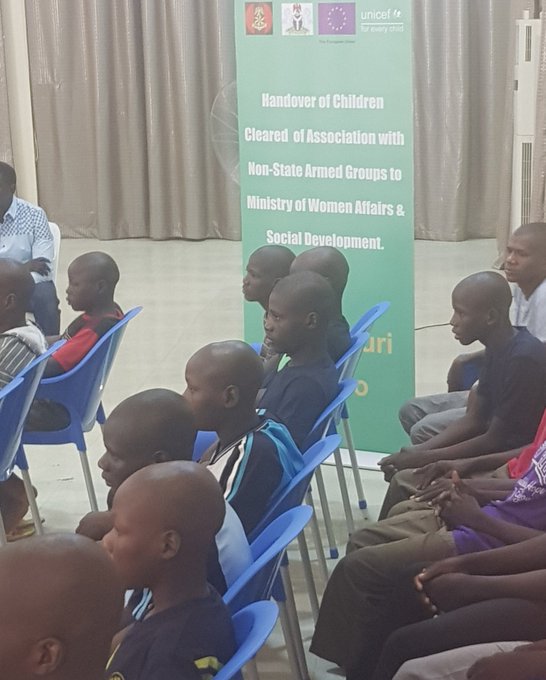
Cross-section of the children released from the military detention and handed over to UNICEF and Borno State government on Thursday. Photo credit: Twitter/UNICEF_Nigeria.

The military urged the Borno government, UNICEF and other partners to ensure an adequate education for the children.

“So, we are happy for these children but I know Boko Haram criminals are not happy because they could not use them as suicide bombers,” it added.

Receiving the children, UNICEF noted that the children would access reintegration support which includes psychosocial support, education and livelihood skills.

They would be kept at a UNICEF-supported transit centre whilst efforts to reunite them with their families and reintegrate them back to their communities are underway. 

The release of the 25 children on Thursday came less than a month the Human Rights Watch published a report stating thousands of children, some as young as five, were still in the military detention for suspected involvement with Boko haram insurgents.

The report released on September 10 recommended to the Nigerian government immediate release of children in military detention who were not charged with a criminal offence in order for rehabilitation, community reintegration and family reunification.

“Nigerian authorities should also immediately release children currently in military custody. If military or intelligence authorities have credible evidence of criminal offences by children, they should transfer them to civilian judicial authorities to be treated in accordance with international juvenile justice standards. The government should also accelerate efforts to ensure access to education for children affected by the insurgency,”  the report stated.

FUOYE protest: NANS releases findings, demands compensation for families of late, injured students

0

By Vincent UFUOMA


THREE weeks after a violent clash between students and security agents claimed the lives of two students and left others injured at Federal University Oye-Ekiti, FUOYE, the National Association of Nigerian Students (NANS) has released a report on the incident.

The national union of students led by Bamidele Danielson, on Thursday condemned the killings and attacks on students by security agents in Ekiti.

NANS said officers of the Counter-Terrorism Unit (CTU) were in the convoy of the state’s first lady, Bisi Adeleye-Fayemi, and not the operatives of the Special Protection Unit designated for the protection of dignitaries in the country.

The student body accused the Ekiti State government of wrongly blaming the students’ actions for the violence.

“The Ekiti State Government hurriedly, without verification and due diligence, through the Commissioner for Information, Orientation and Culture, Mr. Muyiwa Olumilua laboriously attempted to pull the wool off the eyes of the public by dishing out dishonest views with respect to what transpired; all were aimed at covering up the stark reality of their misdeed,” the union said.

“The subtle plans to negate the occurrence and paint a picture of political attacks were soon distorted by on-the-spot video recordings of the brutality.”

Contrary to insinuations that the crisis was caused by men of the Nigerian Police in Ekiti, NANS said it found that the CTU officers who were responsible are not under the control of the Police Command in Ekiti.

“While many believed that Police officers at the Ekiti State Command precipitated the crisis, NANS’ investigation revealed that the CTU officers attached to the wife of Ekiti State Governor are not under the control of the Police command,” it said.

NANS demanded that the Ekiti State Government compensate the families of the deceased and those injured, that the first lady apologise publicly, that the CTU officers be named and prosecuted, and transformers should be supplied to the campus surroundings to facilitate power supply—all before October 10, 2019.

Demands made by the association include:

  • That it is incumbent as a ‘moral duty’ on the wife of the Ekiti State Governor, Erelu Bisi Fayemi to make available the list of Counter Terrorism Unit officers attached to her person and office.
  • That Erelu Bisi Fayemi should tell the entire public why she moves in a convoy of CTU officers instead of Special Protection Unit officers designated for the protection of VIP such as her likes.
  • That an apology letter be written by Erelu Bisi Fayemi; published in at least 5 national dailies, 6 television stations with wide coverage and 12 radio stations spread across the six geopolitical zones of Nigeria and 20 online news medium.
  • That the Ekiti State Government should without delay retract statements credited to the Commissioner of Information, Orientation and culture claiming that the wife of the governor and her convoy were attacked by FUOYE students.
  • That beyond condolence visits paid to families of Kehinde Dada and Joseph Okonofua, practical effort should be made by the state government to deliberately assuage the grieving families through; 1. Employment into the state civil service at least 2 members of each of the families of the deceased students deemed employable. 2. Immortalization of the slain students. 3. Immediate release of CTU officers attached to the wife of the Ekiti State Governor for prosecution in accordance with the laws. 4. That a judicial commission of inquiry involving all stakeholders including the students, members of the host communities and the deceased families be set up immediately to unravel the cause of the incident with a view to forestalling future occurrence. 5.  The Ekiti State Government should immediately pay the gratuity and pension of the parents of Kehinde Dada which they have not paid for Seven Years after retirement. 6. That all the medical bills of the survivors be paid with Twenty million Naira (N20m) each as compensation.
  • That the Ekiti State Government should as a matter of urgency provide transformers to communities hosting the Federal University, Oye-Ekiti to facilitate regular supply of electricity.
  • That the Benin Electricity Distribution Company should show efficiency and ensure supply of electricity to the campuses of FUOYE both at Oye-Ekiti and Ikole-Ekiti and other communities where the students reside.
  • That no attempt should be made at pointing accusations at the Students Union Government of FUOYE, any of her executives and or any students in relation to the protest which is entirely not connected with the brute of the overzealous CTU officers attached to Erelu Bisi Fayemi.
  • That the IGP should as a matter of urgency reconstitute the Police Students Relations Committee who can interface and nip in the bud the incessant killing of innocent Nigerian students by trigger-happy Police officers and create a student’s friendly police.
  • That the Police authorities should bar police officers such as SARS, CTU e.t.c other than the regular police from meddling in student matters especially on campuses or communities hosting students.
  • That the NANS hereby places a ban on the wife of Ekiti State Governor, Erelu Bisi Fayemi and her spouse from entering, attending or participating in any activity(ies) on any campus of any Tertiary Institution in Nigeria pending the resolution of all issues in contention.
  • That NANS’ demands that all of these demands are met before 10th October 2019.

‘All passengers sweating like Christmas goat’… man laments Dana Air’s poor service

0

By Vincent UFUOMA [Student reporter]


A PASSENGER who flew using Dana Airline, on Wednesday, expressed his dissatisfaction with the management and staff’s customer relation service on Twitter.

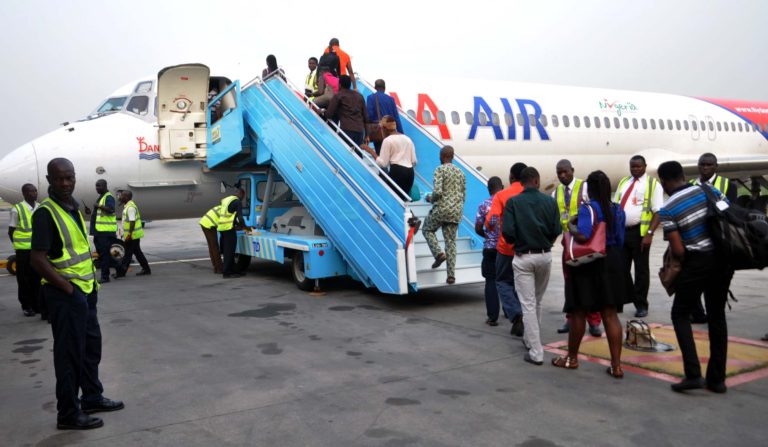
Ayo Bankole, the convener of Lagos SME Bootcamp, and other passengers had boarded the plane at the Murtala Muhammed Airport in Lagos. He complained that the air conditioners in the Abuja-bound aircraft, with flight number 9J353, were not functioning.

“I’m on this Dana flight. All the air conditioners are not working. All passengers are sweating like Christmas goat, everyone screaming and fanning. Yet, the flight is preparing for take-off. Anyhowness will not kill us in this country,” he wrote.

The pilot, according to him, was unruly and unprofessional in his approach when passengers told him he must put on the air conditioners before take-off. Instead of addressing their concerns, he taxied back to park the aircraft with them locked inside.

“So while the pilot was announcing take off, everyone screamed NO!!! and requested they fix the AC, as it was terribly hot. The pilot, instead of apologising and explaining, announced that there are some ‘unruly passengers’ and taxied irresponsibly around, then went back to park,” he narrated.

“It is totally unacceptable for Dana and its pilots to risk the lives of passengers in the hands of a pilot throwing temper tantrums with a plane. The engine has been on for a while, after taxing, still hot. Everyone is up, asking to get out. The pilot has locked us in. No go in, no get out.

“We are in an extremely hot plane. All passengers require is a reassurance that the plane is fine and we will get AC working. But no, the pilot and the crew are displaying some rude and arrogant verboseness. Again, failure of regulatory oversight, failure of standards. Failed country.”

“The Pilot is the nastiest, most arrogant and most unprofessional pilot I’ve ever flown with. If this represents Dana’s culture, then Dana has no business flying Nigerians. Even the hostesses are confused. Total madness,” Bankole added.

When passengers requested to change the pilot after they were told to disembark, the management addressed them very rudely and insisted that they must fly with the pilot, he said.

“Passengers have disembarked. @DanaAir is addressing us rudely, insisting we board with the same pilot who couldn’t manage his emotions and was mentally unstable with the way he taxied. We are insisting pilot be changed.”

He later informed other Twitter users that it appeared the pilot was later replaced and the air conditioners of the same aircraft were put on.

“We’re back on board. Plane is cool. I think pilot was changed. I wonder what has been done to cool the plane that couldn’t be done before,” he said.

He called on the Consumer Protection Commission (CPC) to help investigate the incident and to ensure Nigerians are well treated with dignity by airline operators in Nigeria.

“Finally landed safe and sound. Not the best of flying experience in my entire life. But at least, I’ve landed. @TundeIrukera and his team at CPC can help investigate and help restore some dignity to how Nigerians are treated by airlines,” he urged.

Isaac Dorcas, another passenger on the flight, corroborated his account.

Responding to Bankole’s complaint, also on Twitter, Dana Airlines apologised for the inconvenience due to the pilot’s response to the issue.

“This will be looked into immediately. Kindly see this as a one-off miscommunication,” it added. “Please rest assured we would take necessary and decisive action today. We value our guests and we would stop at nothing in ensuring that our guests get value for their money.”

It also wrote: “The time between the change of power and when the aircraft will eventually taxi and fly, there will be temporary discomfort (heat) which will eventually go off as soon as the aircraft is airborne.”

Here are some of the reactions to Bankole’s thread:

Meet Chukwuedo, corps member who transformed Ekiti library

0

By Daniel Whyte [Student reporter]


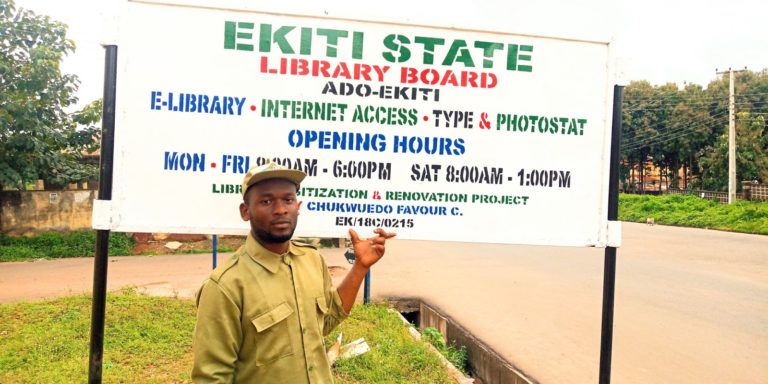
MEMBER of the National Youth Service Corps (NYSC), Favour Chukwuedo, 25, commemorated the completion of his Community Development Service with the digitisation and renovation of the Ekiti State public library. 

Chukwuedo from Delta State said the decision to take on the task of transforming the electronic section of the library at the Old Governor’s Office, Ado-Ekiti, was influenced by a desire to promote digital literacy in his host community. 

“I wanted to address the need of my host community,” he told The ICIR.

In March 2019, he started a digital literacy and STEM education engagement that targeted 2000 students in underrepresented communities with low income public and private schools in Ekiti with a preference for the girl child.

Some of the schools he and his team visited were Divine Touch International School, Treasured Heritage Schools, Bluecrest International School, Olaoluwa Grammar School, Holy Child Catholic School, and Shepherd International School.

It was during this engagement he administered training survey forms to the students and active users of the library, from which he discovered that they long for a conducive learning environment.

The process of renovating and digitising the library took 34 days, lasting from August 23 till September 26 when it was finally commissioned. Chukwuedo noted that this wouldn’t have been possible without the help of Director of the Library board Mrs. Adeyeye, the Deputy Director, the Secretary and community members.

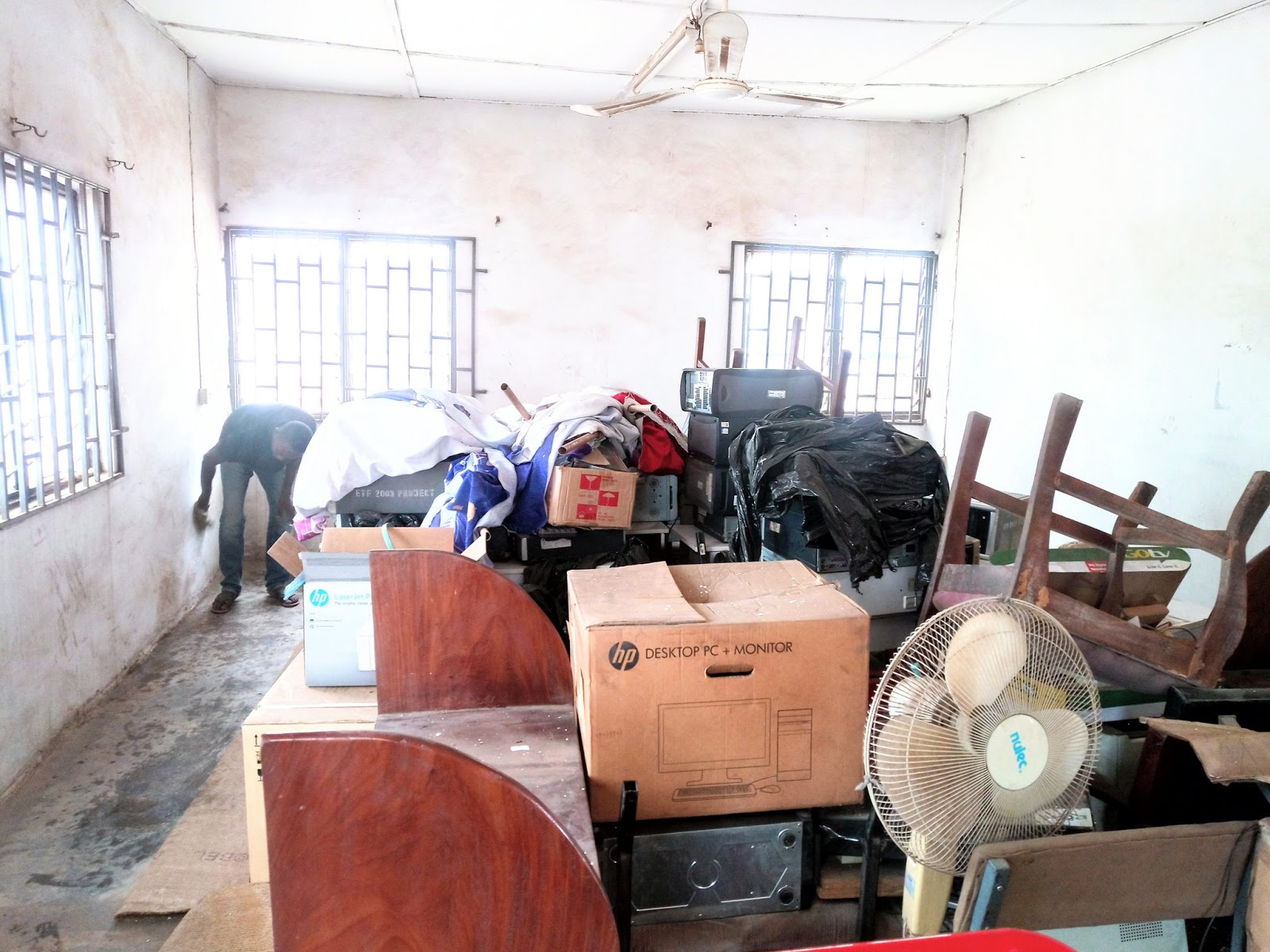
E-library section before the renovation

The project didn’t come without its challenges. 

“The challenge I faced, among others, was shuttling between my place of primary assignment (Ministry of Information) and the library, trekking distance sometimes when he could not afford to pay transport fare

Didn’t spend a dime

Chukwuedo didn’t have to spend out of his own pocket to execute the project. All the materials were provided by community members while staff members of the library provided the laptops with which the e-library was equipped.

Also, the artisans he engaged didn’t collect any fee for workmanship. Money was, therefore, not a challenge. He, however, noted that he was able to get the community members on board because of his track record of getting things done.

Chukwuedo receiving a special recognition award from the first lady of Ekiti State, Mrs.Erelu  Fayemi

“I believe that the STEM engagements paved the way for me. People saw the consistency in my previous projects even without asking them for support. So they were eager to get involved in my library renovation and digitisation project because they were sure of results from me,” he explained.

Speaking on how he felt after the completion of the project, he said, “The same feeling a doctor gets when an operation is successful was what I felt during the commissioning and reopening of the library.”

An advocate of STEM  education

Chukwuedo is a STEM educator, software engineer, and advocate for Sustainable Development Goal 4 on Quality Education.  In 2012, he graduated from Ekiti State University’s Computer Engineering department. He also obtained a Mathematics degree from Evangel University, Ebonyi State, finishing top of his class.

He established Tech Quest Club Ekiti to champion the quality education advocacy engagements through STEM Education. The team comprises corps members and youth of the community.

STEM is a combination of four subjects: science, technology, engineering and mathematics. It is a curriculum-based approach to learning that aims to teach these specific subjects together rather than as separate subjects. It is particularly aimed at young children and it shows how practical knowledge of science or scientific methods can be applied to real-life situations.

Speaking on his current plan, he said, “I’m drafting a strategic work plan to run a free STEM Hub for kids in low-income communities within the state. The goal of the project is to complement traditional academic learning with an in-depth introduction to STEM education in a fun and collaborative learning environment; through the empowerment of individuals (teachers and volunteers), schools and organisations with content, resources, and tools needed for STEM education.”

Upon completion of the project of renovation and digitisation of the library, he was offered a letter of commendation by the state’s library board which he said “means a lot” to him.

How Maina was arrested in Abuja, as son attempted to escape

DETAILS of the arrest of former Chairman of the Pension Reform Task Team (PRTT), Abdulraheed Maina, on Wednesday have emerged as his son, Faisal, crashed a bullet proof Range Rover SUV in an attempt to escape arrest.

Operatives of the Department of State Services (DSS)have confirmed they arrested Maina and his 20-year-old son at the Pennsylvania Avenue Hotel, Utako, Abuja following a request by the Economic and Financial Crimes Commission (EFCC) to the agency to assist in apprehending the suspect.

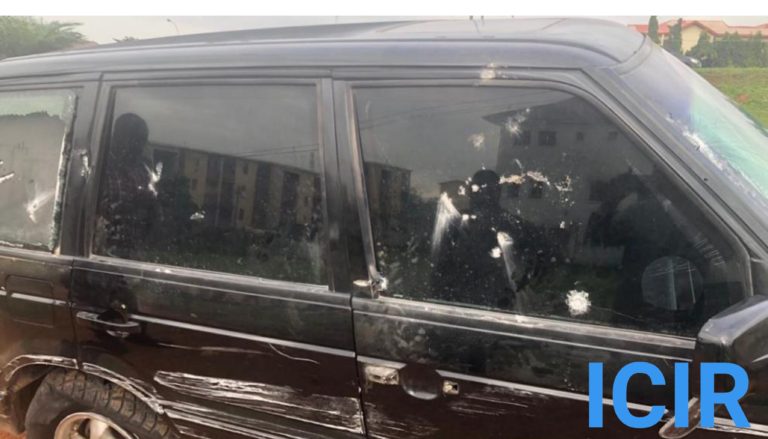
A security source told The ICIR that Maina’s son, Faisal, a final year student at the Canadian University of Dubai, attempted to escape with the SUV and rammed against the hotel gate, causing dents and burst tyres on the vehicle.

The source said that security operatives had been on Maina’s trail for a few days as he moved from one hotel to another in the nation’s capital. On Wednesday, when the DSS agents moved in to arrest maina, he was said to have given himself over without any resistance.

However, it was gathered that when his father was taken downstairs, Faisal was asked to stay back to witness a search of the room. According to the source, rather than wait in the room, the boy ran downstair to the Range Rover SUV and locked himself in. He then made to escape, smashing into the gate. TheDSS operatives on the hotel premises are said to have demobilised the car. In the process, the source said that Faisal pulled out a gun and shot at an operative before he was “demobilised.

Nobody was, however, injured in the incident but a picture of the Range Rover exclusively obtained by The ICIR showed that there might have been a gun duel between boy and the operatives.

A side of the vehicle shows gunshots that could not penetrate as it was a bullet proof car and a burst rear tyre, apparently hit by a bullet.

A statement from DSS spokesman, Peter Afunanya confirmed that Faisal Maina, unsuccessfully tried to resist the arrest.

He said “the lad even pulled a pistol against the security agents involved in the operation.”

“He was, however, disarmed and arrested. He is a final year student at the Canadian University of Dubai where he is studying Telecoms Engineering,” He said the items recovered from the suspects include a pistol with live ammunition, a bullet proof Range Rover SUV, a BMW Saloon car, foreign currencies, a phantom 7 drone and sensitive documents. He said the suspects and the recovered items will be handed over to the EFCC for further investigations and appropriate necessary actions.

Afunanya said it is instructive to note that the operation is as a result of a renewed inter-agency collaboration among security and law enforcement agencies.

He said the Service has always subscribed to such collaboration believed to be important in national security management and therefore, hopes to sustain the initiative in mitigating the current threats against public safety and national critical assets.

Both Maina and his son are currently in the EFCC custody. The ICIR source said he is to be prosecuted for illegal possession of firearm and corruption.

Maina was a Director at the Customs, Immigrations, and Prisons Pension Office (CIPPO) in the Ministry of Interior before he was appointed PRTT Chairman by Steve Oronsaye, then Head of Service of the Federation, in 2010.

But Maina and Oronsaye also got enmeshed in the pension fraud they ought to be fighting, mindlessly looting the pension coffers of billions of naira.

After he escaped from the country, news filtered in that Maina has re-entered Nigeria and was also reinstated.

In October 2017, President Muhammadu Buhari ordered his disengagement immediately after news broke that the fugitive had been secretly recalled into the federal civil service and promoted as a Director in the Ministry of Interior.

Buhari also queried the Head of Service of the Federation, demanding an explanation as to what led to Maina’s recall. The report was submitted to Abba Kyari, Buhari’s Chief of Staff, on Monday evening. But its contents remain unknown.

Since the news of Maina’s reinstatement broke, the Ministry of Interior has been trading blames with the office of the Head of Service and the Civil Service Commission over who authorised the move.

Maina has since been handed over to the EFCC and he and his son are believed to have spent the night in the anti corruption agency’s detention centre.

Apart from the corruption charges against him, a top EFCC source said that the police might also be brought in to investigate him and his son and possibly prosecute them for illegal gun possession.


Malabu Scandal: U.S. Department of Justice closes probe on Eni/Shell involvement due to lack of evidence

0

THE U.S. Department of Justice, DOJ, on Wednesday, clarified that shutting down the probe into the alleged OPL 245 bribery scandal perpetrated by Italian oil giant Eni due to lack of evidence did not mean the case has been closed according to a Reuters report.

The US legal body hinted that closing the probe was not absolute but the investigation could be re-opened if circumstances surrounding the case changed.

According to the report, a trial attorney for the DOJ said that in light of the “misleading implication” of a lack of evidence highlighted by the prosecutors, he was sending them a copy of the DOJ’s original communication with Eni’s counsel in the United States.

The acting chief of the DOJ’s Foreign Corrupt Practices Act unit in the letter said the inquiries had been closed because Italian authorities were prosecuting the case.

“If the circumstances noted above change, the Department may reopen its inquiries,” he said.

In 2011, the federal government had facilitated the controversial OPL 245 deal for Malabu Oil and Gas which was interested in the oil field.

Shell and Eni also wanted to buy the oil block from the Nigerian company instead of paying the required a signature bonus of $210 million to the federal government, they also paid  another $1.1 billion to buy 100 per cent stake in the oil block from Malabu

They transferred the $1.3 billion to the account of the federal government in London, UK, from where Malabu was paid off its $1.1 billion.

Eni, the biggest foreign oil and gas producer in Africa, is currently on trial in Milan on graft allegations surrounding the 2011 acquisition of OPL 245.

The firm is also involved in a corruption case involving its previously 43 per cent-owned unit Saipem over alleged bribes paid to win contracts in Algeria.

A Milan court acquitted Eni last year but the decision is still subject to appeal.

The DoJ had been conducting its own investigation into the Nigerian and Algerian allegations independently of the Italian court cases.

On Tuesday, Eni issued a statement saying the DoJ had informed its management that the investigation had been closed with no action taken.

Eni issued a second version of the first statement stating that it removed a passage saying the DoJ decision confirmed investigations by independent advisers and Eni’s own controlling bodies that found no illegal activity.

An Eni spokesman said the original statement had contained a translation error and had been replaced as soon as possible. He emphasised that the DoJ’s statement that it could re-open the investigation if circumstances changed was in line with normal procedure.

“If the DoJ would decide to reopen its investigation based on events new and unknown, then Eni will cooperate again with the Department to further demonstrate that Eni and its management are not involved in any illegal conduct,” the spokesman said in a statement.

After increase in VAT, Nigerians to pay for using federal roads

WEEKS after the Value Added Tax (VAT) has been increased to 7.5 per cent , the Federal Government is planning to return toll fees back to federal roads.

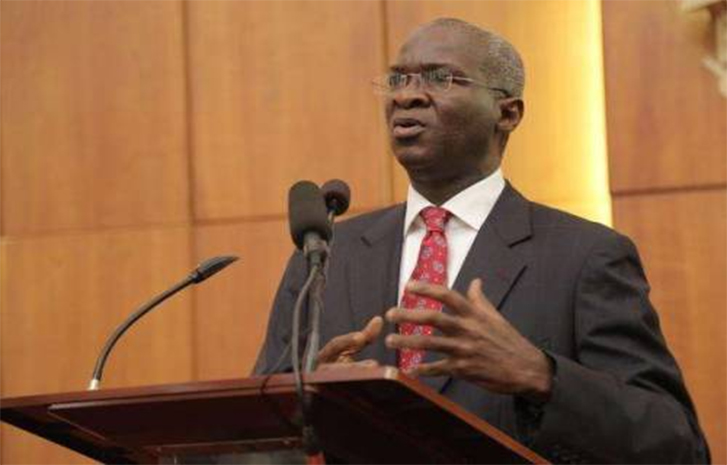
Minister of Housing and Works, Bababtunde Raji  Fashola alongside the Minister of Information, Lai Mohammed announced that the Federal Government are concluding plans to establish cashless payment in toll plazas during a State House briefing at the end of Federal Executive Council (FEC) meeting chaired by President Muhammadu Buhari at the Presidential Villa, Abuja before leaving for South Africa.

Fashola was quoted saying,  “There is no reason why we can’t toll, there was a policy of the government to abolish tolls or as it were, dismantle toll plaza but there is no law that prohibits tolling in Nigeria today. We expect to return toll plazas, we have concluded their designs of what they will look like, what materials they will be built with, what new considerations must go into them”.

He added that the government is working on acquiring more lands as the tolls are proposed to be about ten lanes.

Fashola noted that as other logistics are being worked on, the Federal Government are trying to conclude plans on how the back end runs and that the government is also considering to eliminate the payment of cash by introducing electronic  mode of payment.

This came barely a month after the Federal Government through the Minister of Finance, Budget and National Planning, Zainab Ahmed, in a news report announced that the Federal Government would increase Value Added Tax to meet the new minimum wage obligation.

“This is important because the Federal Government only retains 15 per cent of the VAT, 85 per cent is actually for the states and local governments to enable them to meet the obligations of the minimum wage,” the minister had said.

Fashola also stated during the FEC meeting on Wednesday that the government has approved additional N15.765 billion for  Suleja-Minna-Lambata road and Ibadan-Lagere-Ilesa bypass.

He said the two road contracts approved on Wednesday came after another review of the initially approved amount for the bill.

On the 101km Suleja-Minna-Lambata road, he said FEC on Wednesday approved additional N12.6 billion and N3.165 billion for the Ibadan-Lagere-Ilesa bypass.