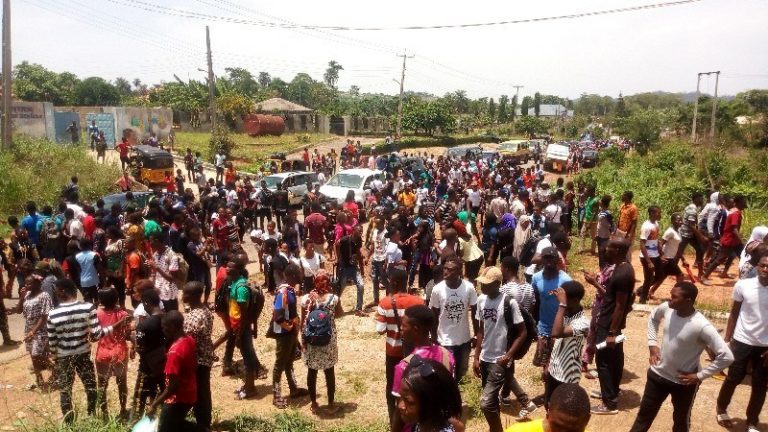
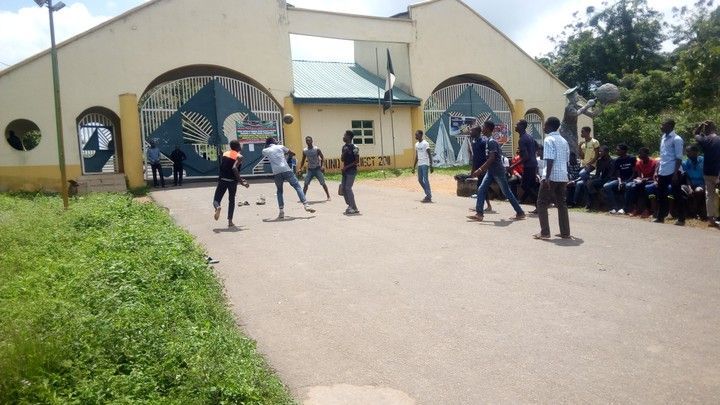
Speaker of the Ekiti State House of Assembly, Funminiyi Afuye has spoken over the protest of students of Federal University Oye-Ekiti (FUOYE) and the subsequent shooting by men of Nigeria Police on Tuesday, which led to the death of two students.
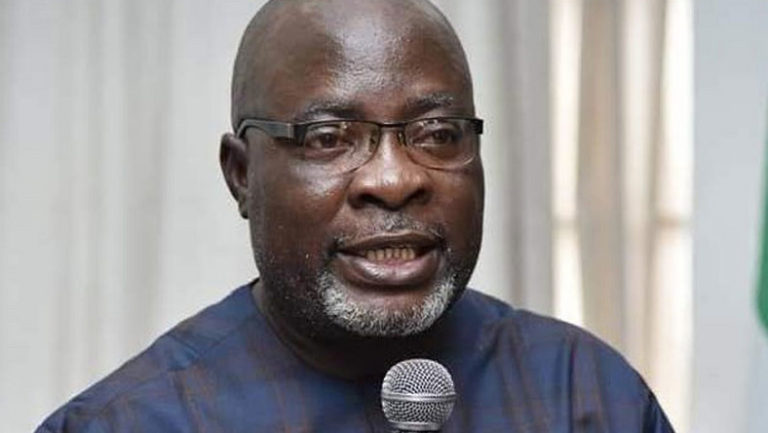
The Speaker expressed his concerns over the ugly incident and the death of the students via his Twitter handle @FunminyiAfuye.
In a Twitter thread he posted on Friday, Afuye said he recognised the right of students to protest and vowed to investigate the matter.
“I had issued a statement on the matter recognising the right of students to peaceful and civilised protests. I indicated that the unfortunate incident will be investigated by the Ekiti State House of Assembly,” he tweeted.
“I represent justice. The Governor represents justice. The Wife of the Governor is a social justice activist. Indeed the programme that was disrupted by unscrupulous elements is social justice and empowerment engagement by the Wife of the Governor.
“It’s indeed saddening that there were reported casualties when the events had ended and everybody had left.
“As a parent, I commiserate with the affected families,” he concluded by expressing his sympathy over the casualties recorded as a result of the incident.”
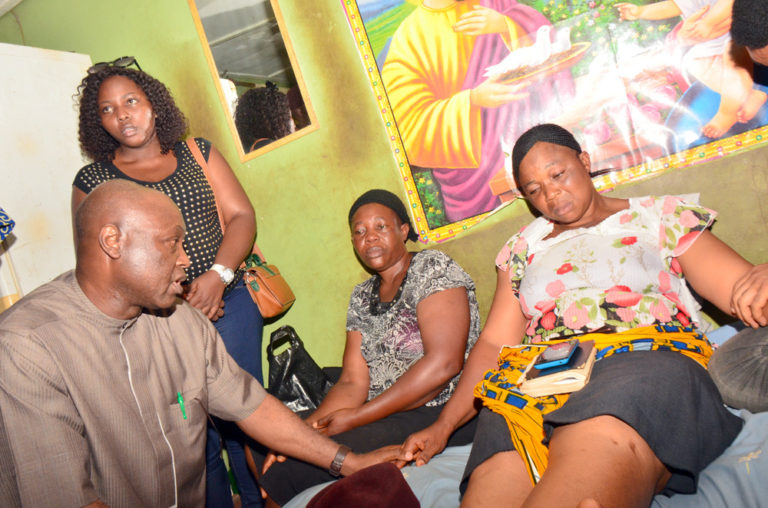
This was as the State Government on Saturday sent delegates to visit the families of the two deceased students who live at Ido-Ekiti and Usi Ekiti.
The ICIR reported how the violence that turned bloody claimed the lives of Oluwaseyi Kehinde who was shot in the eye and Joseph Okonofua who was hit in the stomachs and died hours afterwards.
Several Nigerians had condemned the shootings and demanded justice for the dead students.
The ICIR also reported that SERAP, a non-profit legal and advocacy organisation, condemned the unlawful and extrajudicial shooting of students on Tuesday.
Also, Kolapo Eleka, a former deputy governor of Ekiti State and 2019 governorship candidate reproved the action.
Secretary to the Government of Ekiti State, Biodun Oyebanji who led the delegates condoles with the families of one of the deceased FUOYE students.
Meanwhile, Ekiti State Government also has commiserated with the families of the two deceased students through its official Twitter handle @ekitistategov.
Biodun Oyebanji, Secretary to the Government of Ekiti State who spoke during the visit said it was to demonstrate that the government shared in the grief of the parents and to sympathise with them over their loss.
“Oyebanji said the visit was at the instance the State Governor, Dr Kayode Fayemi; who was saddened by the unfortunate incident, adding that the visit was to demonstrate that the state government share in their grief and to encourage them during the trying period,” the message on the twitter handle read.
The delegates to the deceased’ families were Biodun Oyebanji, Secretary to Ekiti State Government; Moji Fafure, Commissioner for Women Affairs and Social Development; Gbenga Ageyo,Commissioner for Environment; Abiodun Fawekun, Lawmaker representing Ido/Osi 1 at the State Assembly and Eunice Oladimeji, Permanent Secretary, Ministry of Women Affairs.
The Nigerian Prisons Service recently changed its name to the Nigerian Correctional Service; however, the name change has not taken away the reality of the overcrowded prisons, long list of awaiting trial inmates as well as child prisoners languishing in the country’s system. In this Blueprint Weekend exclusive report, AMEH EJEKWONYILO brings gory insider details of Nigerian children in chains.
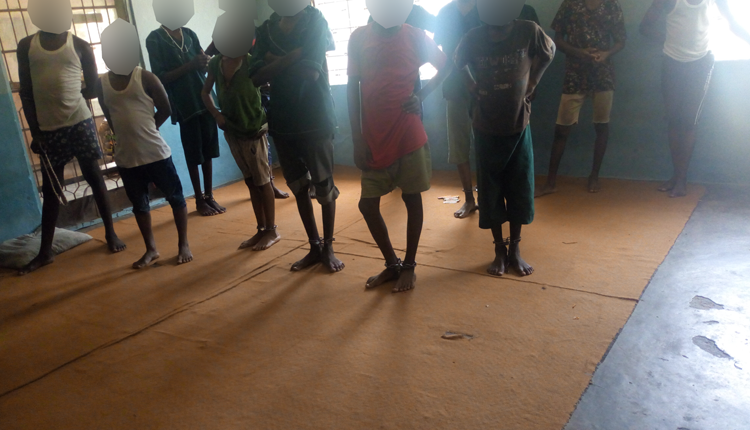
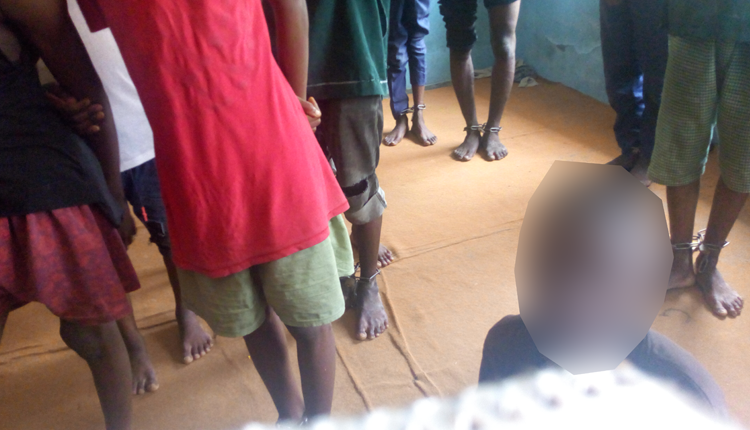
INSIDE the dormitory of the Minna Remand Home in Niger State, not up to the size of a normal room, without mattresses and fans to reduce the effect of the scorching heat in the month of March, about 30 children are held in chains for various offences.
An overpowering stench from the crowded dormitory welcomes any first time visitor.
With their emaciatedbodies in torn clothes, they hurried to their open bathroom taking turns for ablution for the 4.00 p.m. Muslim prayers.
At mealtime, they scooped cooked rice from the little bowl on the floor.
“ We are suffering here,” said Suleiman Adamu, a 12-year old boy and pupil of Alfitra Primary School, Tunta, Minna, who was brought to the home in March 2019 over loss of parental control.
“I was brought here by my father whom I was living with together with my step-mother. My step-mother accused me of stealing her wrapper. Immediately I got here, I was put in chains so that I do not runaway; you can see I’m still in chains and I don’t know who will rescue me from this problem,”Adamu explained almost in tears as he urged the reporter to reach out his parents who live inAbdulsalam’s Quarters in Minna metropolis.
Most of the under aged inmates standing criminal prosecution by the police have not been taken to court for trial.
Harande Buba, 13 who was remanded for alleged culpable homicide based on the orders of the Chief Magistrate Court 1 in Minna on April 12, 2017, said he had not been charged to court.
Narrating the incident that led to his incarceration, Harande said what started as a mere child’s play soon developed into a serious fight that led to his victim’s death.
“The boy I was fighting hit me with a stick and in retaliation, I used a machete on him which led to his death.
“Since I came to this home in April 2017, I have not been to court. Nobody cares to check on me. We do not feed well here, because we don’t have food. We wash our clothes without soap, and that is why our room smells. Life is so difficult here,” Harande said.
Located in the heart of Minna capital city, the remand home brims with children whose hopes and dreams have been dashedfor alleged violation of the law.
For Usama Haruna, a 12-year-old boy who aspires to be an engineer, the thought of being held in shackles at the home is the worst experience of his life.
“Though my parents are poor with mother doing menial jobs such as dish and clothe washing in private homes and restaurants, and my father a scavenger, it is my dream that someday I will work hard to become an engineer, then I will take care of my parents and siblings.
“ I regret the offence that has brought me into this remand home. My parents do not know my whereabouts. We were arrested by the police from Suleja and brought to Minna. Please go to Suleja and inform my mother that I’m being held here,” Usama appealed to the reporter as tears welled up his eyes.
On visiting Suleja a satellite town of about an hour 30 minutes’ drive from Minna, due largely to the deplorable state of the Minna-Suleja highway, our correspondent met Usama’s mother, Fatima Huruna, in Suleja at Saida Low Cost Housing Estate, where the family resides in one – room gatehouse.
“One evening in March 2019, we waited for Usama to come home because he used to accompany his father to his scavenging work. He was nowhere to be found, we began to ask after him. Someone told us that he might have been arrested by the police and taken to Minna.
“ But we have no money to travel to Minna to look for him. That is why we are praying to Allah that one day he would return home,” Usama’s mother told the reporter.
Usama is being tried at the Magistrates’ Revenue Court 3B of Angwan Daji in Minna for the alleged defilement of 6-year-girl. An offence he allegedly committed in Suleja in February 2019.
But Haranda, Suleiman and Usama are lucky as they are at a remand home, not locked up with adult inmates in a regular prison system. Not so for Happiness Kure, a 16-year-old girl, who is languishing at the Suleja Medium Prison, Niger State.
The Suleja Medium Prison, which is sandwiched by residential buildings, was built in 1914, according to prisons authorities.
Though our correspondent was not allowed into the female section of the Suleja prison, Happiness told our reporter that shares her prison cell in the awaiting trial inmates’ block with eleven other adult inmates.
The boys said their condition of living at the homes is nothing to write home about.
“Our condition of living here is miserable. When I first got to this prison in February last year, we were initially five in our room; I had my own separate mattress from other women. But later, one after the other, we are now eleven in the same room that is meant for five of us, including my mother who is breastfeeding my kid sister.
“ Our toilet and bathrooms are very dirty with broken pipes. Water is a big problem for us. We don’t feed well. Whenever my kid sister falls sick here in the prison, there is no clinic to take care of her. Some of the prison warders often help us to buy drugs from outside, and whenever lawyers visit, that is when they bring some drugs and food items for us. The situation we are facing at Suleja prison is terrible,” Happiness lamented.
Her tortuous journey to incarceration began in February, 2018 following the alleged murder of her father by her fleeing boyfriend, the embattled teenager told our correspondent.
Though standing trial alongside her nursing mother, Asabe Kure, at an Abuja High Court at Gwagwalada, the police is yet to call a single witness in the case.
“Since I came to this prison in February 2018, my education came to an end. You can see that my mother and little sibling who is just twelve months old are also being held here for the same alleged offences. Our condition here is unbearable. The most painful part of our situation at the Suleja prison is the fact that I cannot go to school. Does that mean our lives are over?” Happiness wondered in a cracking voice.
From Minna to Suleja, Markurdi to Port Harcourt, there is not much difference in the conditions of the children who are languishing in prisons/borstal institutions across the country; without education in most cases and locked up in adult prisons contrary to constitutional provisions.
According to a Prison Census report of 2016 by the Prisoners Rehabilitation and Welfare Action (a non-governmental organization) with over two decades of critical interventions in prisons reforms in Nigeria, child prisoners make up 43.2 per cent in Enugu, 25.9 per cent inKano and 30.9 per cent in Lagos prisons respectively.
The Child’s Rights Act of Nigeria enacted in 2003 makes ample provisions for children who are in conflict with the law. According to Part Two Section 11 of the Act, “Every child is entitled to respect for the dignity of his person and accordingly, no child shall be subjected to torture, inhuman or degrading treating or punishment, held in slavery or servitude, while in care of a parent, legal guardian or school authority or any other person or authority having the care of the child.”
Similarly, Section 15 dwells on the Right of a Child to Free, Compulsory and Universal Primary Education. It says, “Every child has the right to free, compulsory and universal basic education and it shall be the duty of the government in Nigeria to provide such education.” While Section 212 borders on Detention Pending Trial, Sub-section (2) provides that, “While in detention, a child shall be given care, protection and necessary assistance including social, educational, vocational, medical and physical assistance, that he may require having regard to his age, sex and personality.”
When asked why fetters are put on the inmates’ feet, the Officer-in-Charge of the Children Remand Home in Minna, Hajiya Hadiza Mohammed, explained that it is to prevent them from absconding.
“We do this to especially new children that are brought into the home, because we are not familiar with them. We also put the chains on stubborn and badly behaved inmates. But after a while, when we must have observed that the inmates have improved in their behavior, let them off the chains,” Hajiya Mohammed said.
While the child inmates in Niger State are chained, the situation is different at the Port-Harcourt Remand Home in Rivers State as they are allowed to move freely within the compound located at Nembe Street, Borokiri.
The home, according to the Officer-in-Charge, Mrs. Joy Ololube, is however overwhelmed by the daily challenge of inadequate feeding and others.
“We are overwhelmed by the challenges of difficulty of conveying the children to court during the hearing of their suits. Most of these inmates have not been to court for trial for the past two years. Also, the Approved School which is supposed to provide education and skills for the children has since closed down due to lack of resources to run the school,”
She also disclosed that when inmates fall sick, there are no healthcare facilities to deal with emergencies.
“We rush them to the nearby Naval Base hospital which is directly opposite our home. But at a point, the Naval authorities became tired of our problems and they began to reject our children. These are the challenges we battle with every day,” Mrs, Olulube said.
An 18-year-old inmate, Daniel Okon, said he was remanded at the home in 2015 for murder charges when he was 14 years old by the Juvenile Court 2, Port-Harcourt, and since then had not been to court due to non-availability of a vehicle that would convey him to court.
” I was a JSS 2 student of Community Secondary School, Udung-Uko in Akwa Ibom State. But since I came to the remand home, my education has stopped. Now, I do not know what to do. I want to appeal to both the governors of Akwa Ibom and Rivers States to come to my aid. I need to go back to school and complete my education,” Okon pleaded.
Another inmate, Tuanwii Joseph, a 17-year-old was only 14 years old when he found himself in the remand home in Port-Harcourt.
“I came into the Port-Harcourt Remand Home in 2016 as a result of murder case. The problems we are faced with here is the fact that our trials are stalled and we don’t have the opportunity to continue with our education. I got here when I was Junior Secondary School 3. But since I was remanded by the Juvenile Court 2, I have not been to court and there is no school for me to attend in the remand home. Life is so difficult for us here. You can see for yourself that this home is a place of suffering. We need help,” Joseph stated.
Asked why the Port-Harcourt remand home was left unattended to by the Rivers State government, Mrs. InimaAguma, Commissioner for Social Welfare, explained that arrangements were being made to reposition the facility for better service delivery.
“ Before I was appointed commissioner, there were issues of feeding and lack of vehicles to convey the inmates to court, I have ensured there is proper feeding. I have also ensured that a doctor comes in once in a while to examine the children. Also, the Rivers State government is working assiduously to get the Approved School back on stream for the inmates,” Mrs. Inima disclosed.
The plight of inmates at the Benue Remand Home in Gboko, is equally heartrending as the children also lack access to both formal and informal education.
With the roofs of the main building meant to house the inmates blown away, the sixteen children are crammed into a small room where they share one bathroom and toilet.
Mrs. Apaa Dorathy who is the Officer-in-Charge of the Home, noted that the facility lacks water, electricity supply as well as a vehicle to ferry the inmates to court for trial.
She explained that trial of inmates had been stalled due to lack of legal representation.
While there is a furnished classroom stocked with books for the inmates, there are no teachers to impart the desperately needed knowledge that the children yearn for. This situation, Mrs. Apaa said, was caused by the precarious security situation in state, which has prevented the posting of members of the National Youth Service Corps (NYSC) to the home.
“This is the only correctional centre in the state that caters for the 23 local governments. We are being confronted by a number of challenges that require urgent intervention given the fact that these children who have come in conflict with the law are the future of the society, and therefore should be properly rehabilitated and reintegrated into the society.
“However, that is not the case as our mandate is hampered by the lack of resources like mobility to convey the inmates to court for trial. We lack water and electricity here as you can see. Our school lacks teachers, and therefore, it’s not functioning. So, how do we cater for the needs of transforming these inmates into better citizens,” Mrs. Appa said.
An inmate the Gboko remand home, ThankgodUnogwu (14), a JSS 2 student of Jesus Comprehensive College, Eke-Olengbecho in Okpokwu LGA of Benue State, was remanded at the home last October over cultism related offences.
“Life is difficult for us here. We just stay here without going to court, let alone going to school. Even feeding and water is big problem here. Only God can deliver us from what we have found ourselves. I regret the crime I have committed, but I need a second chance at life to become a better person,” Unogwu said.
The problems were corroborated by the Benue State Chief Judge, Justice Aondaver Kakaan, who described the conditions of the children as “horrible”.
“What the children need is reformation, but that is not the case. The state government has not been forthcoming in that regard. It is so sad that these inmates have to live in subhuman conditions.
“We have been making efforts to establish the Family Court as required by law. However, we don’t have the funds to execute the mandate. The issue of juveniles can only be tackled through reformation,” Justice Kakaan said.
However at the Borstal Institute in Kaduna State,the school authorities said their inmates have facilities for both formal and informal education.
“Our inmates have most of the facilities for formal education and skill acquisition. Our inmates take the Senior School Certificate Examination (SSCE). However, we have some challenges that require government interventions such as expansion of facilities in the institute,” a staff who pleaded anonymity told our reporter.
The staff who also declined to comment on the number of inmates being held at the Borstal Institute, equally turned down the request by our correspondent to go into the inmates’ dormitories to speak with some of the inmates.
“You know we don’t allow outsiders into the dormitories or interact with the inmates,” the warden said.
Upon arriving at the heavily guarded facility, located at Barnawa in Kaduna, the huge buildings and spacious premises give an impression of a fully functional home for children. However, a couple whose child was being held at the institution, was seen with a sack of food items like garri and provisions, among others.
When asked why they were at the home, the mother of the inmate who pleaded anonymity, said: “My husband and I come regularly to donate food items to the institution as a way of supporting them for better service delivery, because the children are too many and, as a result, they do not feed well. We can only appeal to the government to help us take good care of the children in the home by providing a suitable environment for their education.”
Constitutional prohibition against denial of basic education
The Federal High Court sitting in Abuja, presided by Justice John Tsoho in February 2017 held that children have the right to free, compulsory basic education.
Although the right to free education in Section 18(3)(a) of the Constitution was ordinarily not enforceable like all other rights provided for in the Chapter 2 of the Constitution, the Compulsory, Free Universal Basic Education Act of 2004 enacted by the National Assembly has elevated the right to an enforceable status.
This provision was the basis for the judgement of Justice John Tsoho of the Federal High Court sitting in Abuja.
In his verdict, the judge held that both the federal and state governments were constitutionally required to provide adequate funding for the free education scheme.
The judgment followed a suit filed by a group, the Legal Defence and Assistance Project (LEDAP).
Justice Tsoho held that the failure of any government at the state and federal levels to fund the scheme would constitute a breach of the Constitution of the Federal Republic of Nigeria.
Expert views on the issue
The Executive Director of PRAWA, Dr. Uju Agomoh decried the conditions in which under-aged children are being held.
“The current conditions of these homes are deplorable as they are consistently deteriorating. An urgent and sustainable intervention must be made by both the government and private individuals to reposition these homes for better service delivery. Anything short of that the society will pay for it dearly. The children must be rehabilitated in all ramifications,” Agomoh said.
Existing Borstal homes in Nigeria include: Borstal Training Institution in Barnawa, Kaduna State, Borstal Training Institute Ganmo, Kwara State and the Borstal Training Institute Abeokuta, Ogun State.
The Borstal Institutions and Remand Centres Act 1962 mandates the remand of offenders between the ages of 16-21.
During a recent visit to the Nigeria Prisons Akwa in Anambra State, the National Human Rights Commission (NHRC), disclosed that about 523 children were being held at the facility.
During the commemoration of the 2019 African Pre-trial Day themed: “Decriminalisation of Petty and Minor Offences,” the Anambra State Coordinator of the National Human Rights Commission (NHRC), Mrs. NkechiUgwuanyi, decried the high number of underage inmates at the prison.
Illegal trial of the inmates
According to the trial magistrate at the Rivers State Juvenile Court, Mrs. Ibiere Foby, the current circumstance where underage inmates are tried using the Child’s Rights Act with a properly constituted family court as prescribed by the law, constitutes a gross violation of the rights of the defendants to fair hearing.
She explained that an ideal family court should have a magistrate and two assessors to hear and determine suits concerning children who come in conflict with the law. But that is not the case.
“ You can see I am the only magistrate sitting in the Juvenile Court here.”
When asked on the legal implications, Foby said, “If matters tried by the Juvenile Court go on appeal, they will be dismissed on the grounds that the trial court is not properly constituted as required by the Child Rights Act. Here in Rivers we have the Young Persons Law, which is an archaic piece of legislation.”
Similarly, an official of the Rivers State Ministry for Social Welfare, who did not want his name in print said: “The remand home is basically for children whose parents have lost parental control over them, and children who are convicted of minor offences to be held for not more than six months. While the borstal home is a juvenile prison.
“So, what we are doing in terms of children who are in conflict with the law, is unconstitutional. But due to the non-availability of resources to do the proper things, we have to make do with what we have.”
Composition of the Family Court
Section 153 (3) of the Child’s Rights Act provides that, “The court at the Magistrate Level shall be duly constituted if it consists of – a Magistrate, two assessors, one of whom shall be a woman and the other person who has attributes of dealing with children and matters relating to children, preferably the area of child psychology education.”
The Child’s Rights Act of Nigeria enacted in 2003 makes ample provisions for children who are in conflict with the law. According to Part Two Section 11 of the Act, “Every child is entitled to respect for the dignity of his person and accordingly, no child shall be subjected to torture, inhuman or degrading treating or punishment, held in slavery or servitude, while in care of a parent, legal guardian or school authority or any other person or authority having the care of the child.”
Similarly, Section 15 dwells on the Right of a Child to Free, Compulsory and Universal Primary Education. It says, “Every child has the right to free, compulsory and universal basic education and it shall be the duty of the government in Nigeria to provide such education.” While Section 212 borders on Detention Pending Trial. Sub-section (2) provides that, “While in detention, a child shall be given care, protection and necessary assistance including social, educational, vocational, medical and physical assistance, that he may require having regard to his age, sex and personality.”
FIDA Nigeria’s Reaction to the Issue
The International Federation of Women Lawyers (FIDA) Nigeria described the plight of underage inmate in the country “disturbing.”
FIDA Nigeria’s President, Rhoda Prevail Tyoden, while reacting to our findings, said the country’s Child’s Rights Act which is meant to help children who come in conflict with the law, is not being implemented.
“We have the Child’s Rights Act that is meant to tackle the issue, but it is not being implemented. If the Act is fully implemented you won’t have a situation whereby children are locked up in prisons with adult.
“The Child’s Right Act and the Young Persons Law spell out how this group of people should be treated. But we have a system where these laws are not well implemented. The Act says we need to have Family Courts; comprising of Magistrates and assessors. The Family Court should be functional to address these issues, but it is unfortunate the courts are not working.
“Secondly, we should have borstal homes across all the states of the federation, but only three or four states have such facilities; when we have children in conflict with the law in all the states of the country.”
“FIDA Abuja which I belong as a branch; we go to Suleja Prison and we see teenagers there, and we try to get them out if it is a bailable offence. Sadly, these children are locked up together with adult prisoners. We often say the youth are the fulcrum of every national development, but when children are locked up in prisons, then where is the future of the country,?” Tyoden queried.
“Children who are in conflict with the law should not be dealt with as criminals, because they are supposed to be in a place where they would realise their mistakes and you take them through the process of rehabilitation.
“We have enough laws that can cover every kind of offence in Nigeria but the issue we have is the implementation of the law, the government has simply refused to implement this law.And that is why we are now advocating for the adoption of the VAPP Act. We now have ten states that have adopted it.”
The association recommended the sensitisation of Nigerians on the prevalence of social ills in the society as a way of helping to guide children away from crime.
“It is not enough to have the laws; we should rather go round sensitizing people through awareness programmes on the societal ills that our laws have failed to effectively tackle, because we have the laws but the laws are not effective.
“The political will to get the child right act implemented is not there. The law covers everything; the dignity of the child, everything should be done in the best interest of the child,” the FIDA President said.
* This investigation was supported by the Institute for War and PeaceReporting, IWPR, and the International Centre for InvestigativeReporting, ICIR.
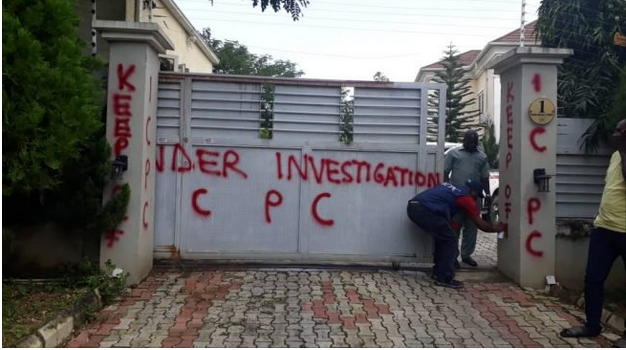
THE Independent Corrupt Practices and other Related Offences (ICPC) on Friday sealed the residence of the second vice president of the Nigeria Football Federation (NFF) Shehu Dikko in Abuja.
Dikko’s house on No. 1 River Benue, Maitama was sealed by operatives of the Commission after securing a forfeiture order from a Federal High Court, Abuja.
Spokesperson of ICPC, Rasheedat Okoduwa who confirmed that the NFF’s chief house was sealed, said the action was in line with an ongoing investigation on a fresh corruption allegation in the Federation.
According to Okoduwa, the ongoing investigation is targeted at revealing alleged financial irregularities in the football association, with Dikko and other executives inclusive.
“Yes it was sealed by the ICPC,” she told The ICIR.
“It’s because we have an investigation that is ongoing regarding some fresh allegation against him and some other persons. That’s why the house was sealed”
When asked to name other officials of NFF being investigated, Okoduwa replied, “I wouldn’t tell you that because the investigation is still ongoing, and those other persons are still be run-down, so I can’t say too much regarding them, you guys would be informed in due course of time”
She would also not disclose the amount of money involved arguing that disclosing such would jeopardise the investigation.
“I can’t give you such information. If I give you clue into the allegation, that would keep-off those other persons that I say are involved, and they would go into hiding,” Okoduwa said.
“I’m not going to tell you now, but as I said, as its unfolds, you will get to know. We would issue a statement about the development.”
The NFF has long been under the surveillance of the various Anti-graft agencies, such as the ICPC, the Economic and Financial Crimes Commission (EFCC) and the Special Presidential Investigation Panel on Recovery of Public Property (SPIP).
THE Peoples Democratic Party (PDP) on Friday told President Muhammadu Buhari led Federal Government to rescind its decision on the approved Value Added Tax (VAT) increase which it said would kill the already worsened nation’s economy.
Describing the decision as oppressive, Kola Ologbondiyan, PDP National Publicity Secretary in a statement said his party frowned at the new tax policy, even as he appealed to the National Assembly (NASS) to intervene in the development.
Zainab Ahmed, the Minister of Finance, Budget and National Planning had on Wednesday, after the Federal Executive Council (FEC) meeting held in Abuja, announced the increase of VAT increase from 5 to 7.2 per cent.
But the opposition party noted that “indeed, only an administration that does not have the mandate of the people can seek to adopt such oppressive stance against its citizens.
“President Buhari ought to be aware that an increase in VAT will worsen our decrepit economy and put more pressure on families and business as it will result in increase in costs of goods and services that have a direct bearing on the welfare of the people,” Ologbondiyan said.
“Our party charges the Buhari Presidency not to further punish Nigerians by imposing harsh tax regime to make up for its crass incompetence and lack of capacity to effectively harness and manage our resources to create wealth for the benefit of the people.”
He said the party rejected the tax increase stressing that the current administration should rather harness all available resources, as Nigerians would find it difficult to bear the economic burden of the increase.
“It is more painful that the Buhari Presidency cannot give an account of the huge resources at its disposal, including the taxes it has been collecting in the last four years, most of which are frittered to service the wasteful lifestyle of the cabal at the Presidency and APC chieftains,” the PDP spokesperson said.
“Instead of foisting more tax burden on Nigerians, the PDP charges President Buhari to account for and recover the over N14 trillion oil money established to have been stolen under his watch in the last four years”.
Nigerians should be enjoying economic development blueprint designed by Atiku Abubakar, former Vice President and presidential candidate in the 2019 election, the PDP said.
Meanwhile, a coalition of civil society organisations had earlier condemned the VAT increase, challenging the Federal Government to focus on illicit financial flows out of the country and how multinationals evade taxes.
PRESIDENT Mohammadu Buhari will depart Abuja on Saturday to attend a one-day Extraordinary Summit on Counter-Terrorism, for Economic Community of West African States (ECOWAS) Head of States in Ouagadougou, Burkina Faso.
Femi Adesina, Special Adviser on Media and Publicity to the president made this known through a statement in Abuja on Friday.
The decision to hold the summit according to the aide was reached during the 55th Ordinary Session of ECOWAS Authority Head of States and Government in June and would serve as an avenue to review previous initiatives explored already and update crucial intervention areas to counter terrorists attacks within the sub-regions.
“In Ouagadougou, ECOWAS leaders are expected to adopt a priority action plan on counter-terrorism and put in place a mechanism to monitor the implementation of the measures adopted towards ensuring lasting peace in the sub-region,’’ Adesina said.
Governors Abubakar Bello of Niger, Dapo Abiodun of Ogun and Okezie Ikpeazu of Abia states would accompany the president to Burkina Faso.
Some other members on the entourage would include the Geoffrey Onyeama, Minister of Foreign Affairs, Bashir Magashi, Minister of Defence, Babagana Monguno, the National Security Adviser, and Ahmed Abubakar, Director-General, National Intelligence Agency (NIA).
A Coalition of Civil Society Organisations (CSOs), Friday warned that the increase in the Value Added Tax (VAT) by the Federal Government from five to 7.2 per cent would further increase inequality and exacerbate poverty in the country.
The six-member coalition under the aegis of Tax Justice and Governance Platform (TJGP) said that rather than increasing the VAT, deliberate pro-poor policies should be developed to protect the masses, which according to the group are more significant in the national population.
Members of the Non-Governmental Organisations include Christian Aid, Action Aid Nigeria, Centre for Democracy and Development, Civil Society Legislative Advocacy Centre, OXFAMNigeria and Imo state Tax Justice and Governance Platform.
“As it has been demanded by many Nigerians and groups, we call on the federal government to pay serious attention to widening the tax net rather than increasing the rate which will only place more burden on the few that complies already and still exempt the majority that does not pay taxes,” it states in a statement.
“We want to state our position for advocacy and campaign which is that Government designs and implements policies and programmes that enhance the welfare of the poor and protects disadvantaged groups that constitute much of the Nigerian population and address issues of inequality.”
The Federal Government on Wednesday had announced at the Federal Executive Council (FEC) that it would increase tax as part of efforts to increase national revenue for developmental projects.
The Coalition further charged the Federal Government to consider some thematic issues such as; who bears the burden of the tax increment? What main drivers could justify the decision for a VAT increment? What are the real issues around VAT: Remittance (collection) or Rate? How well has the little been used and what are the assurances that an increase would alleviate economic conditions? What systematic measures have been taken to ensure tax compliance? Are there no other options available to the government to mobilize revenue?
Hence, it tasked the government to provide additional information and details on proposed measures for the purposes of public debate and multi‐stakeholder input.
It stated further the need for empirical projections and evidence-based expected outputs that could indicate that the tax yield from some of the measures would outweigh any disadvantage and potential negative impact and that the majority of Nigerians would be the ultimate beneficiaries of the proposed measures.
“These include reducing the tax incentives granted to multinationals which is not even much of a contributor to their existence in the Nigerian business environment. Consider full digitalization of the processes of tax administration to curb leakages in the system.
“Support the establishment of the beneficial ownership register in Nigeria as a measure to know people’s real worth and what they are liable to pay as tax.
“Fully implement the BVN policy as a measure of tracking peoples’ tax liabilities especially the high net worth individuals in the country who has been alleged of not paying taxes at all.”
The group, however, welcomed the VAIDS initiative as an opportunity to increase tax net, stressing that though, it is yet to yield the optimum result expected, “there are still myriads of companies and other taxable entities in Nigeria who are not in the tax net and still not convicted or punished in any way.”
It also advised the Federal Government to concentrate more on proper collection of appropriate tax from multinationals and large corporations accused of benefitting from ‘undeserved tax incentives and had for years engaged in tax avoidance practices”.
The TJGP Nigeria is a group of CSOs advocating for the promotion of a progressive, fair and transparent system in which domestic resources are effectively mobilized through an efficient tax system, utilized for people-oriented development and provision of essential services that benefit majority of citizens, including the poor and disadvantaged groups.
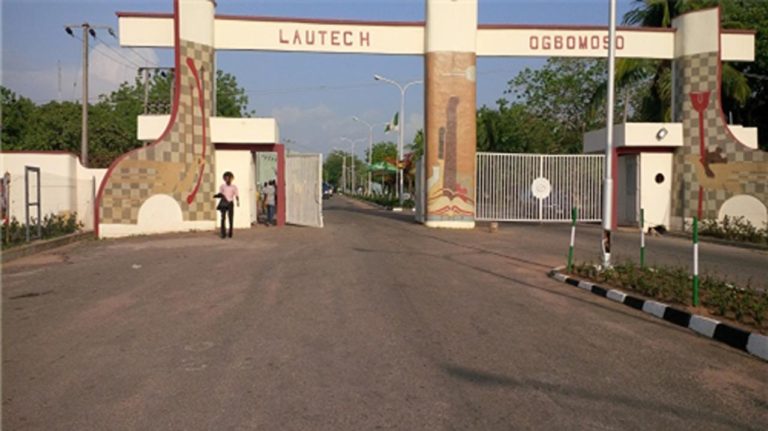
THE claim about the reduction in tuition fee of the Ladoke Akintola University of Technology (LAUTECH) has been made by two popular social media users, both on Facebook and Twitter.
A Facebook group called PDP Social Media Observer Group posted on September 10 that Seyi Makinde, Governor of Oyo State governor, reduced the tuition fee of LAUTECH to 65,000.
The group wrote: “Gov Seyi Makinde of Oyo State has reduced the tuition fee of LAUTECH from N250,000 to N65,000.
It described that as what “a governor should be”.
The group which itself has 62, 379 followers, at the time of writing, made the post more prominent as not less than 1,500 people shared it, while it received more than 1,200 likes.
Most of the comments on the group show that quite a number of people have believed in the information as some people commended the governor for the job done.
Earlier on September 6, a similar claim was made on Twitter.
Oladele Dada who posted the information was funded by United Nations Education Scientific and Cultural Organization (UNESCO) to study Media and Information Literacy and Intercultural Dialogue course at the Athabasca University, Canada which he completed in 2015.
He had a total follower of 6,369 people as at the time of writing this report.
But checks by The ICIR revealed that the tuition fee of the University was not reduced to N65, 000. In fact, the institution fee has not been reviewed in 2019.
It is not from us — Media Aide to Governor Makinde
Chief Press Secretary to Makinde, Taiwo Adisa, told The ICIR that the Oyo State Government has no capacity to unilaterally reduce the tuition fee of the institution.
“The school belongs to two states. How can one of them now announce that it has cut the school fees when there are two owners,” he said.
“It is not from us,” Adisa disassociated the state government from the post.
LAUTECH is jointly owned by Oyo and Osun states.
Makinde had only recently said on September 5 that Oyo State Government was ready to pay the Osun State’s share of the salary for the university staff.
“We’ve signed for workers’ payments but since it’s owned by both Osun and Oyo states, unfortunately, Osun State has not paid. This can not continue.
“Oyo State will have to pay the salary of LAUTECH(Osun’s share) because I don’t want the students to suffer,” Makinde had said.
No directive to review the tuition fees- LAUTECH spokesperson
Fadeyi Lekan, spokesperson of the institution, said the school has not received any directive to the effect of reviewing of the tuition fees in 2019. He added that the last time it was reviewed was 2018.
“We have not received such a directive,” said Lekan.
According to Agboola Sodeeq, a 200 level student in the Department of Electronic and Electrical Engineering in LAUTECH, the tuition fee of the school ranges from N90,000 to N170,000.
He said the school has not made any statement regarding any reduction of the tuition fees. Sodeeq said the last time the fee was reviewed was in 2018.
He noted that the tuition fee for the indigenes of both Osun and Oyo states is different from the one non-indigenes pay.
“The indigenes pay N140,000, N120,000 and N90,000 in their 100, 200 and 300-500 levels respectively.
“Non-indigenes pay N170,000, N150,000 and N100,000 in their 100, 200, and 300-500 levels in that order,” he said.
Verdict
Thus, the claim that the governor of Oyo State has reduced the tuition fee of Ladoke Akintola University of Technology (LAUTECH) is false.
NIGERIANS have taken to Twitter to condemn the arbitrary shooting and extrajudicial killing of students of the Federal University Oye-Ekiti (FUOYE), Ekiti State, by security operatives attached to the wife of Ekiti state governor, Bisi Adeleye-Fayemi.
The ICIR earlier reported how two students of the university diedfrom gunshot wounds sustained after policemen opened fire at them on Tuesday evening.
One of the victims, Oluwaseyi Kehinde, a first-year student of Crop Science and Horticulture, was buriedamid tears and wailings on Thursday.
Using the hashtag #JusticeForFUOYE, many have since condemned the incident and called for the investigation and prosecution of the culprits.
SERAP, a non-profit legal and advocacy organisation, condemned the excessive use of force by the police against the student protesters.
“We condemn the reported unlawful killing of at least 2 students of #FUOYE by @PoliceNG,” it tweeted on Thursday.
“The police reportedly used live ammunition and other forms of excessive force against protesting students and injured & arbitrarily detained some of them.”
SERAP noted that Nigerian students have the right to protest without losing their lives or getting arrested.
The NGO urged that “the Nigerian authorities MUST promptly and thoroughly investigate the unlawful killings and hold to account all those responsible.”
On the whereabouts of some other students believed to have been arrested by the police in connection with the Tuesday, protest, SERAP demanded for their immediate release.
“The authorities should reveal the students’ whereabouts and release them immediately and unconditionally. The familiar tactic of violence and abuses by @PoliceNG to silence dissent will not solve any of Nigeria’s problems,” it further said.
“The @UNHumanRights, the African Union, and others should also press the Nigerian authorities for an independent investigation into the killings, all abuses during the protests in Oye-Ekiti. Federal University of Oye-Ekiti students deserve justice, reparation, adequate compensation.”
SERAP conclusively noted that its “legal team is closely monitoring the situation in Oye and will take legal action as appropriate” while emphasising that “Nigerian authorities must unambiguously call a halt to the violence, ensure justice for the victims, and allow students and other Nigerians to exercise their right to protest.”
Among others who have strongly condemned the killings is Segun Awosanya, convener of the EndSARS movement.
“The victims of the murderous convoy have parents, who are currently grieving and the unelected & presumed mother who claimed to be on an empowerment program is justifying the murders by the slimy attempt to save her face by playing victim?!” he tweeted on Wednesday.
“The @PoliceNG officers must be named and the vicarious liability pursued to the letter. Anyone with details of the family of the deceased should reach out to us. Has Gov @kfayemi made a statement yet? Does citizens life matter to him?
“So four unarmed promising students were gunned down needlessly and these folks believe it can be swept under the carpet by brown envelope media spin?! You have another think coming. This will not go unpunished. You have no power to murder humans and get away with it. #EndImpunity.”
On Friday, he also stated: “The injustice meted out to students of #FUOYE is not just an assault to students in that university but to all the youth in Nigeria. This is beyond the deceased/victimized by the diabolical thirsty for blood. It’ll visit your campus soon if we don’t fight it now.”
Kolapo Eleka, former deputy governor of Ekiti State and 2019 governorship candidate, has also decried the fatal incident.
He offered condolences to the victims on Thursday and urged that value be placed on human lives.
“We must live in a society where human lives mean something to us, rather than being comfortable celebrating barbarism and lavishing public funds on fruitless purposes,” he said, adding that his prayers “are with the students and families of the victims, including the people of our entire State at this moment.”
Here are other reactions on Twitter:
I join my voice with those demanding for #JusticeForFUOYE. The policemen who shot live rounds at students in Oye Ekiti must be investigated and prosecuted if found to have committed extra judicial killings.
I still can't believe some of you are bold enough to try justify the killing of innocent students by the Police officers attached to the First Lady of Ekiti state. If the media can be bought, at least I expect individuals to have some conscience. #JusticeForFUOYE
This is the result when you vote for incompetence. The voice of the dead won't allow everyone that has a hand in it to sleep.. Until justice is served, you won't know peace.. @PoliceNG@kfayemi Retweet and let our voices be heard @SaharaReporters@segalinkpic.twitter.com/I5xeOIT1F9
#JusticeForFUOYE . this is the funeral of one of the boys killed by Ekiti state govt. the songs says that you av killed a boy in his prime,why didn't you allow him to grow into a man.such agony, pain 😭i weep…rest in peace Icon and kenny.kayode=pain 😢 https://t.co/4uQcjG6X3A
STUDENTS of the Federal University, Oye Ekiti, Ekiti State, who were traveling along the Ado-Ikere road on Thursday have accused operatives of the Nigeria Police in Ekiti State of harassment and extortion.
The students were returning home following the immediate closure of the institution by the management after Tuesday’s unrest, in which altercations between students and policemen led to the death of two students who were teargassed and sustained gunshot wounds.
One of the victims, Adesuyan Oluwaseyi Isaac, a student of the Department of English and Literary Studies told this reporter that he and others were delayed, tortured, and extorted by policemen in Ikere on their way from Oye to Akure. There were three male and three female passengers in the car, mostly students of FUOYE.
He said the police held him in detention for five hours, between 11 am and 4 pm, for “taking their pictures” and then demanded N100,000 as a condition for his release.
He narrated: “I was travelling from Oye to Ondo when the vehicle that conveyed us was stopped. The police ordered six of us in the vehicle to come down for a search.
I was told to bring out my phone, which I did. The policeman collected it and asked me to unlock it. I obeyed. I turned to look at other passengers that were being searched for about two minutes and the next thing I heard was a slap on my face.
“The policeman that was searching me accused me of taking pictures of them while they were searching my colleagues. Immediately, they handcuffed me and one other guy who was accused of being a Yahoo boy, forced us into their vehicle, and took us to Ikere Area Command Police Station.
“We were tortured; I was beaten severally for taking their pictures. They said it’s unlawful. I called home and explained things to them.
“They said we were to pay N100,000 each for our bail. I called my sibling who negotiated with them on the phone and we eventually paid N20,000. The other guy, accused to be a cyber-fraudster also paid N20,000 before we were allowed to leave around 4 pm.”
“This is unfair,” Isaac said twice in an exasperated tone.
…s sister transferred the N20,000 to his account; he then withdrew it to secure his release
Another student who was in the cab spoke to this reporter but asked not to be named. She recounted that the policemen tagged them criminals after they revealed they are students at FUOYE.
“We were stopped at a checkpoint by the police along Ado Ikere road. The police ordered us to come from the vehicle. They asked us if we are students from FUOYE, we said yes and we were immediately tagged criminals,” she said.
“The way they were acting was absurd. It even got to a point where a girl denied knowing her friend. It was awkward. Those men were ready to do anything. They were checking old pictures and harassing them. They were actually stopping every car.”
She said the policemen were armed and wielded their guns as though ready to shoot at any time.
“Later, I started hearing some slaps. I tried looking out the window to see what was going on. I wanted to record a video but the other lady advised me not to try it because it appeared they accused one of the male passengers being slapped of taking their pictures.”
She said the two male passengers were handcuffed and thrown into the patrol van despite pleas from the cab driver. Other cars passing the route were also stopped and the policemen kept checking young people’s phones and pockets, and “asking stupid questions like if they were Yahoo boys”.
When the spokesperson of the Ekiti State Police Command, ACP Caleeb Ikechukwu, was contacted for comments on the incident, he directed the reporter to send him his identification card and reports he had published to him on WhatsApp before he would be comfortable to speak.
“I am not sure you are a journalist. Several people have called to ask me almost the same questions today claiming they are journalists from somewhere,” he said.
“If you are truly a journalist, snap your ID card and the evidence of the stories you have published. Send them to me on WhatsApp before I can answer you.”
THE Economic and Financial Crimes Commission, (EFCC) on Thursday says 13 suspected internet fraudsters were arrested in the Federal Capital Territory, Abuja and Kwara State respectively in separate operations.
According to the anti-graft body, eight of the suspects were arrested after a raid at their apartment located at No. 16 Isaaya Shukari Crescent, Gwarinpa and C15 & A27 City of David Estate, Life Camp.
They included: Chiyiri Izuchi. Nurala Eze Kamchi, Amuka Shadrack, Nwegbediegwu Chekwubechukwu J, Chigbo Eze, Franklin Okafor, Ezeagwu Olisaemeka and Nnamani Chukwudera.
Those arrested by the commission’s Zonal Office in Ilorin, the Kwara State Capital were Stephen Odanye, Abolarin Kayode, Babatunde Muhammad, Adepoju Tomiwa and Akinbamidele Femi.
In a statement issued by the commission, they were arrested based on intelligence report indicating their involvement in internet fraud.
“Some of the items recovered from the Abuja suspects, include several mobile phones, laptop computers, several International Passports, a Toyota Corolla, a Toyota Avalon, Lexus 15 250, Mercedes 4matic C350, Mercedes C280, Mercedes GLA 280 and an Acura.
“It was discovered that the suspects use their phones and laptop computers to communicate with their victims who are majorly foreigners in order to defraud them of their monies.”
The statement reads further that, “the suspects received monies, in several foreign currencies, deposited into their accounts by their victims.
“Items recovered from them include, phones, cars and documents containing false information”.