Home Blog Page 2333

Obasanjo again writes Buhari, says Nigeria “on the precipice”

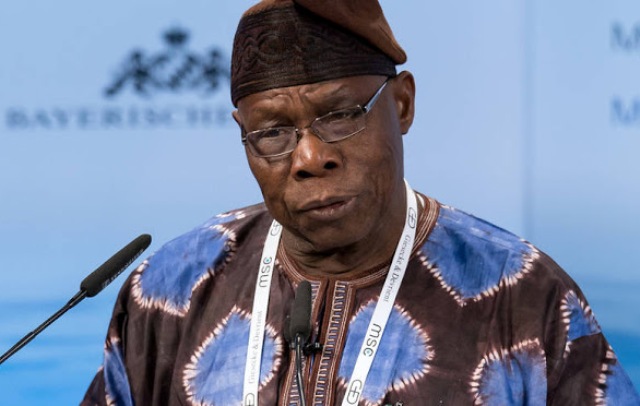
FORMER President Olusegun Obasanjo on Monday wrote to President Muhammadu Buhari to urgently devise measures to forestall likely division of the nation, as Nigeria is “on the precipice and dangerously reaching a tipping point where it may no longer be possible to hold danger at bay.”   

In the letter released by his media aide, Kehinde Akinyemi, Obasanjo said the president should consider the urgent action and avoid a similar situation that led to the disintegration of Yugoslavia, identifying issues of insecurity across the nation.

According to him, Nigerians are beginning to lose confidence in the federal government’s ability for protection, aside perceptions that the criminalities are being orchestrated by the Fulani ethnic group.

“….the issue I am addressing here is very serious; it is the issue of life and death for all of us and for our dear country, Nigeria. This issue can no longer be ignored, treated with nonchalance, swept under the carpet or treated with cuddling glove. The issue is hitting at the foundation of our existence as Nigerians and fast eroding the root of our Nigerian community.

“I am very much worried and afraid that we are on the precipice and dangerously reaching a tipping point where it may no longer be possible to hold danger at bay.

He stated further that, “For over ten years, for four of which you have been the captain of the ship, Boko Haram has menacingly ravaged the land and in spite of government’s claim of victory over Boko Haram, the potency and the activities of Boko Haram, where they are active, remain undiminished, putting lie to government’s claim.

“The recent explanation of the Chief of Army Staff for non-victory due to lack of commitment and lack of motivation on the part of troops bordering on sabotage speaks for itself.”

Prior to this period, notable Nigerians have decried the poor security situation in the country, including the president’s alleged preference for the preservation of Fulani ethnic group, such as when it got the license to operate a radio station.

Obasanjo went on to blame the government for poor handling of the herdsmen/farmers crises before it escalated to become a big threat which, he noted, has transited into banditry, kidnapping, armed robbery and killings nationwide.

“The unfortunate situation is that the criminality is being perceived as a ‘Fulani’ menace unleashed by Fulani elite in the different parts of the country for a number of reasons but even more, unfortunately, many Nigerians and non-Nigerians who are friends of Nigeria attach vicarious responsibility to you as a Fulani elite and the current captain of the Nigeria ship. Perception may be as potent as reality at times.”

Obasanjo further identified four calamities that may befall the country except the president moves into action, especially by calling for national discussions with traditional rulers, former state administrators, envoys among others present.

He listed the calamities to include: (i) abandoning Nigeria into the hands of criminals who are all being suspected, rightly or wrongly, as Fulanis and terrorists of Boko Haram type;

(ii) spontaneous or planned reprisal attacks against Fulanis which may inadvertently or advertently mushroom into pogrom or Rwanda-type genocide that we did not believe could happen and yet it happened.

(iii) similar attacks against any other tribe or ethnic group anywhere in the country initiated by rumours, fears, intimidation and revenge capable of leading to pogrom;

(iv) violent uprising beginning from one section of the country and spreading quickly to other areas and leading to dismemberment of the country.

Other recommendations provided in the letter called for “cohesion and concentration of effort and maximum force – political, economic, social, psychological and military – to deal successfully with the menace of criminality and terrorism separately and together.”

“We cannot dither anymore. It is time to confront this threat headlong and in a manner that is holistic, inclusive and purposeful. For the sake of Nigeria and Nigerians, I pray that God may grant you, as our president, the wisdom, the understanding, the political will and the courage to do what is right when it is right and without fear or favour.”

Obasanjo’s letter to Buhari

Dear President and General Buhari,

I AM constrained to write to you this open letter. I decided to make it an open letter because the issue is very weighty and must be greatly worrisome to all concerned Nigerians and that means all right-thinking Nigerians and those resident in Nigeria.

Since the issue is of momentous concern to all well-meaning and all right-thinking Nigerians, it must be of great concern to you, and collective thinking and dialoguing is the best way of finding an appropriate and adequate solution to the problem.

The contents of this letter, therefore, should be available to all those who can help in proffering effective solutions for the problem of insecurity in the land. One of the spinoffs and accelerants is the misinformation and disinformation through the use of fake news. A number of articles, in recent days, have been attributed to me by some people who I believe may be seeking added credence and an attentive audience for their opinions and view-points. As you know very well, I will always boldly own what I say and disown what is put into my mouth.

But the issue I am addressing here is very serious; it is the issue of life and death for all of us and for our dear country, Nigeria. This issue can no longer be ignored, treated with nonchalance, swept under the carpet or treated with cuddling glove. The issue is hitting at the foundation of our existence as Nigerians and fast eroding the root of our Nigerian community.

I am very much worried and afraid that we are on the precipice and dangerously reaching a tipping point where it may no longer be possible to hold danger at bay.

Without being immodest, as a Nigerian who still bears the scar of the Nigerian civil war on my body and with a son who bears the scar of fighting Boko Haram on his body, you can understand, I hope, why I am so concerned.

When people are desperate and feel that they cannot have confidence in the ability of government to provide security for their lives and properties, they will take recourse to anything and everything that can guarantee their security individually and collectively.

For over ten years, for four of which you have been the captain of the ship, Boko Haram has menacingly ravaged the land and in spite of government’s claim of victory over Boko Haram, the potency and the activities of Boko Haram, where they are active, remain undiminished, putting lie to government’s claim. The recent explanation of the Chief of Army Staff for non-victory due to lack of commitment and lack of motivation on the part of troops bordering on sabotage speaks for itself.

Say what you will, Boko Haram is still a daily issue of insecurity for those who are victimised, killed, maimed, kidnapped, raped, sold into slavery and forced into marriage and for children forcibly recruited into carrying bombs on them to detonate among crowds of people to cause maximum destructions and damage. And Boko Haram will not go away on the basis of sticks alone, carrots must overweigh sticks. How else do you deal with issues such as only about 50% literacy in North-East with over 70% unemployment?

Herdsmen/farmers crises and menace started with government treating the issue with cuddling glove instead of hammer. It has festered and spread. Today, it has developed into banditry, kidnapping, armed robbery and killings all over the country.

The unfortunate situation is that the criminality is being perceived as a ‘Fulani’ menace unleashed by Fulani elite in the different parts of the country for a number of reasons but even more, unfortunately, many Nigerians and non-Nigerians who are friends of Nigeria attach vicarious responsibility to you as a Fulani elite and the current captain of the Nigeria ship. Perception may be as potent as reality at times.

Whatever may be the grievances of Fulanis, if any, they need to be put out in the open and their grievances, if legitimate, be addressed; and if other ethnic groups have grievances, let them also be brought out in the open and addressed through debate and dialogue.

The main issue, if I may dare say, is poor management or mismanagement of diversity which, on the other hand, is one of our greatest and most important assets. As a result, very onerous cloud is gathering. And rain of destruction, violence, disaster and disunity can only be the outcome.

Nothing should be taken for granted, the clock is ticking with the cacophony of dissatisfaction and disaffection everywhere in and outside the country. The Presidency and the Congress in the US have signalled to us to put our house in order. The House of Lords in the UK had debated the Nigerian security situation. We must understand and appreciate the significance, implication and likely consequences of such concerns and deliberations.

No one can stop hate speech, violent agitation and smouldering violent agitation if he fans the embers of hatred, disaffection and violence. It will continue to snowball until it is out of control. A stitch in time saves nine, goes the old wise saying.

With the death of Funke, Chief Fasoranti’s daughter, some sympathetic Nigerian groups are saying “enough is enough”. Prof. Anya, a distinguished Nigerian merit Laureate, has this to say “We can no longer say with certainty that we have a nation”. Niger-Delta leaders, South-Eastern leaders, Middle-Belt leaders and Northern Elders Forum have not remained quiet. Different ordinary Nigerians at home and abroad are calling for different measures to address or ameliorate the situation.

All the calls and cries can only continue to be ignored at the expense of Nigerian unity, if not its continued existence. To be explicit and without equivocation, Mr. President and General, I am deeply worried about four avoidable calamities:

(i) abandoning Nigeria into the hands of criminals who are all being suspected, rightly or wrongly, as Fulanis and terrorists of Boko Haram type;

(ii) spontaneous or planned reprisal attacks against Fulanis which may inadvertently or advertently mushroom into pogrom or Rwanda-type genocide that we did not believe could happen and yet it happened.

(iii) similar attacks against any other tribe or ethnic group anywhere in the country initiated by rumours, fears, intimidation and revenge capable of leading to pogrom;

(iv) violent uprising beginning from one section of the country and spreading quickly to other areas and leading to dismemberment of the country.

It happened to Yugoslavia not too long ago. If we do not act now, one or all of these scenarios may happen. We must pray and take effective actions at the same time.

The initiative is in the hands of the President of the nation, but he cannot do it alone. In my part of the world, if you are sharpening your cutlass and a mad man comes from behind to take the cutlass from you, you need other people’s assistance to have your cutlass back without being harmed.

The madmen with serious criminal intent and terrorism as core value have taken cutlass of security. The need for assistance to regain control is obviously compelling and must be embraced now.

A couple of weeks ago at a public lecture, I had said, among other things, that:

“In all these issues of mobilisation for national unity, stability, security, cooperation, development, growth and progress, there is no consensus.

“Like in the issue of security, government should open up discussion, debate and dialogue as part of consultation at different levels and the outcome of such deliberations should be collated to form inputs into a national conference to come up with the solution that will effectively deal with the issues and lead to rapid development, growth and progress which will give us a wholesome society and enhanced living standard and livelihood in an inclusive and shared society.

“It will be a national programme. We need unity of purpose and nationally accepted strategic roadmap that will not change with whims and caprices of any government. It must be owned by the citizens, people’s policy and strategy implemented by the government no matter its colour and leaning.

“Some of the groups that I will suggest to be contacted are: traditional rulers, past heads of service (no matter how competent or incompetent they have been and how much they have contributed to the mess we are in), past heads of para-military organisations, private sector, civil society, community leaders particularly in the most affected areas, present and past governors, present and past local government leaders, religious leaders, past Heads of State, past intelligence chiefs, past Heads of Civil Service and relevant current and retired diplomats, members of opposition and any groups that may be deemed relevant.”

The President must be seen to be addressing this issue with utmost seriousness and with maximum dispatch and getting all hands on deck to help. If there is failure, the principal responsibility will be that of the President and no one else.

We need cohesion and concentration of effort and maximum force – political, economic, social, psychological and military – to deal successfully with the menace of criminality and terrorism separately and together. Blame game among own forces must be avoided. It is debilitating and only helpful to our adversary.

We cannot dither anymore. It is time to confront this threat headlong and in a manner that is holistic, inclusive and purposeful. For the sake of Nigeria and Nigerians, I pray that God may grant you, as our President, the wisdom, the understanding, the political will and the courage to do what is right when it is right and without fear or favour.

May God save, secure, protect and bless Nigeria. May He open to us a window of opportunity that we can still use to prevent the worst happening. As we say in my village, “May God forbid bad thing”.

Chief Olusegun Obasanjo is the former president of Nigeria between 1999 and2 2007

 

The Nduka Obaigbena phenomenon

By Simon Kolawole


I RECOLLECT vividly as if it happened yesterday — the day I first had a one-on-one with Mr Nduka Obaigbena, editor-in-chief and chairman of THISDAY Newspapers. I had heard so much about him, the good and the bad, and I had always been fascinated by the good. By instinct, I focus more on the positive side of people, partly because I get inspired and partly because of my own glaring imperfections. That meeting was in August 1997. I had been offered the position of assistant editor of The Sunday Newspaper by Mr Eziuche Ubani, who was then the Sunday editor. I was to pioneer a weekly all-colour sports pull-out, named SportsXtra, along with the man who would later become my brother, friend and confidant, Emeka Enechi, now of blessed memory.

Emeka and I had just produced the first edition of SportsXtra but I kept protesting to Ubani over the remuneration. Before I knew it, I found myself sitting in front of the big man himself one evening. Calmly, he asked me what the issue was. I said I was not happy with the pay. He replied: “If you do a good job, you will get whatever you want. Do you know Waziri Adio? He is now in New York as our bureau chief, earning dollars!” I stifled a chuckle. Waziri and I had discussed over the phone the previous day and the dollar part of the story was not terribly earthshaking, but having met the publisher who welcomed me with open arms, I was disarmed. He didn’t know me, probably hadn’t heard of me and had only seen the first edition of SportsXtra. Maybe he liked it.

I would go on to become features editor, Saturday editor and, finally, editor of the daily newspaper over two spells of working with THISDAY between 1997 and 2012. As a life student of journalism, I would say the kind of influence he has had on the Nigerian newspaper landscape is definitely in a class of its own. Since 1859, the Nigerian newspaper industry has been impacted by great entrepreneurs and managers such as Henry Townsend, Nnamdi Azikiwe, Obafemi Awolowo, Babatunde Jose, MKO Abiola, Alex Ibru, Sam Amuka-Pemu, Olu Aboderin, Segun Osoba, Stanley Macebuh and Kabir Yusuf, to name a few. In the annals of the Nigerian media, Obaigbena has by dint of creativity and foresight — as well as the force of resilience — written his name in bold.

For those who don’t know, he started publishing THISDAY in 1995 without owning a printing press. It was thought impossible to publish a daily newspaper without buying a press. That was the first time in our history. Many would soon start following in his footsteps. He brought about a switch to colour printing after many other newspapers had experimented and retreated. Those who said it was impossible soon joined the fray. He turned the back page of the newspaper to the prime location for columnists. It is now industry standard. He eliminated the practice of printing two different editions of the newspaper for the same day. Others followed. He introduced the publication of the full table of daily transactions at the Nigerian Stock Exchange (NSE). It is now, as it were, a law.

Whenever you see a colourful “style” section in any Nigerian newspaper today, the tribute has to go to Obaigbena, who started it all in 1997. THISDAY Style is arguably the most sought-after weekly supplement on style and fashion in any Nigerian newspaper today. He re-christened rejoinders as “Right of Reply” and that has become part of our media language, tending to suggest that it is somewhere in the Nigerian constitution. In 1998, he introduced “map painting” (as we jocularly call it) to provide at-a-glance previews of how political parties would perform in states and geo-political zones at election times. We have to give credit to whom credit is due. There must be a reason why no politician or business leader jokes with THISDAY.

In times past, Nigerian reporters submitted handwritten scripts. One day, I think in 1997 or 1998, Obaigbena announced that all reports must now be written and filed electronically. In other words, every reporter must learn how to use a computer. For me, it was not strange — I had started using the computer to write my stories as early as 1994 — but many reporters considered this to be a tall order. Obaigbena had a mantra then: “You either change or die!” Everybody at THISDAY eventually made a switch to electronic writing, even if slightly behind schedule, and this soon became the standard in Nigeria’s newsrooms. It is only fitting to describe Obaigbena as the most positively disruptive and innovative entrepreneur in the history of Nigerian media — on the basis of evidence.

For at least 13 years, I interacted very closely with Obaigbena and learnt tremendously at his feet. Obviously, several people impacted massively on my journalism career. Alhaji Mumini Alao was the one who plucked me fresh from the University of Lagos for Complete Football magazine; Mr Dapo Olorunyomi, publisher of Premium Times, took me under his wings when he was deputy editor-in-chief of TheNews/TEMPO; Mr Victor Ifijeh, MD of The Nation, tutored me on the fine art of news judgment when he was THISDAY editor; Mr Ayo Arowolo, as managing editor of Financial Standard, inspired me on visioning and inducted me into business journalism; and, of course, Waziri started celebrating my talent from our undergraduate days — long before anyone knew I existed.

However, Obaigbena taught me different things without opening his mouth. I will list just three as we celebrate his 60th birthday today. One, he taught me not to take no for an answer. In 1998, he had asked the then Abuja bureau chief, ‘Folabi Lawal, to send a document to him by the next available flight. It was evening time. In those days, there were fewer flights and none at night. When Lawal got to the airport, there was no flight again. Disappointed, he called and informed Obaigbena, who retorted: “You mean there was no flight? Not even a presidential jet?” I laughed when I heard the story. That is just the mindset of the man. Nothing is impossible. There is always a way. I have never seen him give up on anything without the last drop of his sweat. The resilience!

Two, Obaigbena believes you should never settle for second best or consolation prizes. In my early days as editor of THISDAY in 2007, there was a sensitive story we were writing that needed the obligatory balance from the other side. He asked if I had called them. I said we had spoken to the chief press secretary who said he had not been briefed. He asked: “Why call the press secretary when you can call the governor?” This altered my horizon altogether: why go through an intermediary when you can hear from the horse’s mouth? This came to shape my reportorial thinking. Always seek to get the “story behind the story” from first-line sources, even if they can’t be quoted. The Obaigbena philosophy is that you must always stand out. Don’t be part of the crowd.

Three, he has a large heart. He forgives easily. I have seen people walk out on THISDAY, abuse the hell out of him and badmouth him everywhere. Yet, they would come back years later looking for a job and he would warmly receive them back. I do not know how many employers of labour have that heart. I have heard people argue that he accepts ex-staff back because he knows the value they can add to THISDAY. Maybe that is true, but if it were that easy, how come it is not commonplace in the workplace? In some places, they would not even allow you go past reception. I have seen him recommend people for political appointments even after they had bitterly fallen out with him. One reason THISDAY was overstaffed at a point was his reluctance to render people jobless.

I need to say this. When I resigned from THISDAY in June 2012, some said I left in anger after a “cabinet” shake-up. Unknown to them, I was in Obaigbena’s house a few hours after my resignation, chatting and laughing with him. He said he did not want me to leave, but I told him I had planned my exit since 2007. As a parting gift, he gave me a new car. Two years later, he chaired the launch of TheCable, the online newspaper I founded. I insist that you don’t find many Nigerian entrepreneurs with such a spirit. It is also a fitting tribute that in a country where ethnic chauvinism is the rule, Obaigbena is one of the most open-minded Nigerians you would ever meet. He does not give a hoot about where you come from. His circle of friends is as diverse as they come.

For crying out loud, I am not trying to paint Obaigbena as perfect. He is as imperfect as the rest of the human race. I am still searching for a perfect human being and it has been difficult for me to spot one, maybe because I am not perfect enough to know a perfect person! In all, one fact will stick out eternally: Nduka Obaigbena has reshaped the Nigerian media landscape and impacted generations of journalists. Can I ever forget how he always showed me off to his powerful friends — billionaire entrepreneurs, governors and ministers — when I was editor of THISDAY? “Meet the most powerful man in THISDAY,” he would announce. That gave me confidence and prestige in doing my job. He used to tell us: “Be the star. I just want to be your coach.” Phenomenal.

AND FOUR OTHER THINGS…

KILLING FIELDS

Mrs Funke Olakunrin, daughter of Chief Reuben Fasoranti, the leader of Afenifere, was shot dead in Ore, Ondo state, on Friday — just a few hours after armed robbers invaded the female hostel of the University of Ibadan. The 58-year-old woman was heading to Ore junction from Akure, also in Ondo state, when she was attacked and killed. Initial reports attributed the dastardly act to herdsmen, although that remains a speculation. The level of insecurity across the length and breadth of Nigeria should worry all of us. The killing of Olakunrin is coming at a very fragile time when all kinds of conspiracy theories are flying around. What’s going on in our country? Disturbing.

MENTAL HEALTH

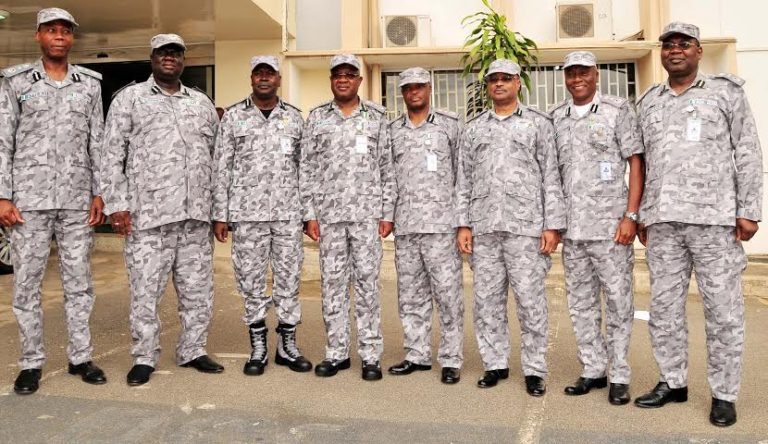
Mr. Nura Dahiru, an assistant superintendent of customs, on Monday promoted himself to the rank of deputy comptroller-general. He claimed he had been directed by President Muhammadu Buhari to assume the office of comptroller-general currently occupied by Col. Hameed Ali (rtd). He was well kitted, but the façade barely covered an apparent mental health issue for which he has now been taken to hospital for medical attention. This again brings to the fore the issue of mental health among uniformed men and women, particularly in the police. Some may be as a result of substance abuse while others could be work pressure. The authorities should not take this lightly. Attention!

MINT MESS

President Buhari has cancelled all e-passport printing contracts being executed abroad. Henceforth, it will be the sole responsibility of the Nigerian Security Printing and Minting Company (NSPMC), the state-owned company. This has been long-awaited. Everyone in the know says NSPMC has the capacity to print the passports, but there seems to be something pulling the decision-makers to travel all the way to Malaysia and other countries. Anywhere there is a contract to be awarded in foreign currencies, there seems to be much enthusiasm. I’ve even heard in whispers that NSPMC has the capacity to meet all our currency needs. We are finally coming to our senses. Overdue.

AND FINALLY…

For over two months now, a “ministerial list” has been circulating on social media. Titled “Breaking News” (as most fake news broadcasts are, in any case), the list contained 16 names, both familiar and unfamiliar, including Rotimi “Amechi” (Amaechi), Hadi Sirika, Barnabas Bala Bantas and Halima Babayo. To prove how fake, portfolios were added. The statement was attributed to Femi Adesina, “S. A to Mr President on media and publicity”. Last week, the same list resurfaced, this time “sign” by Garba Shehu, “SSA to media and publicity”. It contained an additional name. How anybody continues to believe and circulate these fake lists is something psychologists need to study. Gullible.


Simon Kolawole is the founder and CEO of TheCable. He tweets @simonkolawole.

Ezekwesili, others call for value-based democracy as Wole Soyinka turns 85

OBIAGELI Ezekwesili, Senior Economic Advisor, Africa Economic Development Policy Initiative (AEDPI) along with other speakers at the 11th Wole Soyinka Centre Media Lecture Series has called on Nigerians to insist on values in determining those who become their leaders and how the polity is administered.

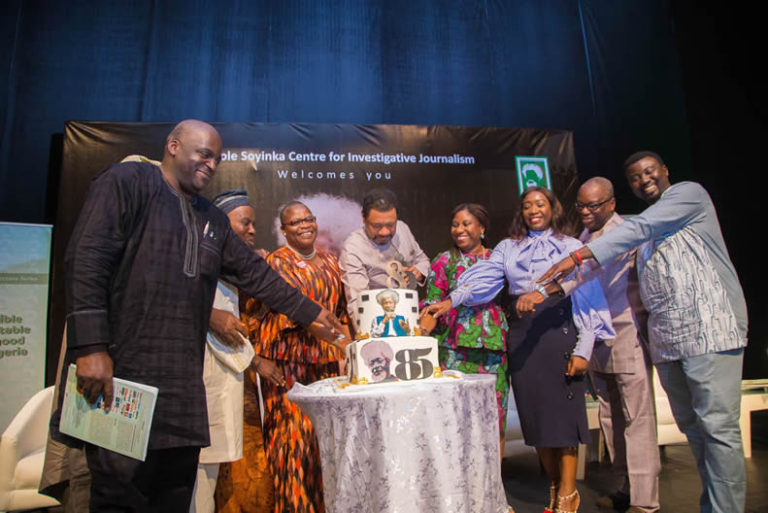
The former Nigerian Minister of Education and Minister of Solid Minerals made this call at the lecture held on Saturday, 13 July at MUSON Centre, Onikan, Lagos, in commemoration of the 85th birthday of Wole Soyinka, Africa’s first Nobel Laureate in Literature and Grand Patron of the Wole Soyinka Centre for Investigative Journalism.

According to Ezekwesili, who was a candidate in the 2019 elections, good governance is rested on good values.

She said: “If we are lacking in the building of those values and the shaping of those values, then we will have to wait endlessly. The people who should win our vote should be people with values and character. Age should not just be the determinant of the people who should lead us; it should be age plus values.

“Citizens have abandoned politics in the hands of politicians. So, our political parties have become a venture of political entrepreneurs. It cannot work that way. Political parties are supposed to be the government in waiting.”

Other speakers at the lecture themed, Rethinking Credible Elections, Accountable Democracy and Good Governance in Nigeria were Oluwole Osaze-Uzzi, Director, Voter Education and Publicity, Independent National Electoral Commission (INEC); Amina Salihu, Senior Programme Officer, MacArthur Foundation; Gbenga Sesan, Executive Director, Paradigm Initiative; and Rotimi Sankore, Editorial Board Chair, Nigeria Info Radio Group.

Osaze-Uzzi said the citizens should go beyond thinking and rethinking elections, to acting to see the change they seek.

He urged stakeholders to begin to focus on the electoral process in terms of voter registration, technology and infrastructure, the registration of political parties and other determinants of successful elections.

The crucial issue of gender balance was introduced to the discussion by Amina Salihu who called for gender-based affirmative action in governance.

She said women have been “minoritised” because although they are half the population their voices have been diminished. Amina Salihu used the opportunity of the lecture to push for naming and shaming of sex offenders through the launch of a national sex offenders register which she assured will happen shortly.

Speaking of appropriate technology for elections,  Sesan said technology hardly needs to be sophisticated and expensive.

According to him, INEC should have sent text messages to its over 80 million registered voters when the 2019 election was postponed just a few hours before the 2019 Presidential elections. He charged the Commission to take advantage of technology to educate the technology savvy new generation of voters including the additional 20 million plus youth who will be eligible to vote by 2020.

Nigeria Info Radio Group, Editorial Board Chair, Sankore said the role of the media is to report factually and seek to educate and solve problems rather than add to it. According to him, the media needs to engage with data and evidence. Rotimi Sankore cited examples relating to conflicts in the northern parts of the country, health, education and the Rural Grazing Area (RUGA), of how the lack of in-depth reporting, verification of facts and deployment of evidence by the media have denied the people the opportunity to engage issues appropriately.

In his opening remark, Ropo Sekoni, the Board Chair of the Wole Soyinka Centre for Investigative Journalism (WSCIJ), organisers of the programme, mentioned that the lecture’s theme was topical given the insecurity that permeates the system.

Kole Shettima, Director of the Africa Office of the MacArthur Foundation, whose organisation supported the lecture expressed the foundation’s excitement to be part of the occasion.

He appreciated the WSCIJ for improving the lives of the citizens by making government accountable through investigative reporting.

The son of the celebrant, Olaokun Soyinka, thanked the WSCIJ on behalf of the family for the consistency that has brought the lecture to its 11th edition and its focus on promoting the culture of investigative reporting. He observed that Soyinka’s struggle to hold power accountable and fight against impunity are still relevant today and admonished young people to draw the battle line between those who are prodemocracy and does who are not rather than between the young and the old.

Motunrayo Alaka, the organisation’s Coordinator appreciated the speakers and panellists, the WSCIJ board, WSCIJ staff, her family, the media, Wole Soyinka and his children. She mentioned that it has taken the support of all the relevant stakeholders to keep the lecture on the same date, Wole Soyinka’s birthday for ten years.

The lecture was opened by a viewing of a documentary which chronicled the life, writings and the crucial role Wole Soyinka played for the emergence of Nigeria.

The event attended by journalists, policy makers, representatives of pressure groups and non-governmental organisations, students and other members of the public, was moderated by Stephanie Busari, Supervising Producer, CNN Africa.

Gas Flaring: Investors scale evaluation phase, as petroleum ministry closes bid round

ON Thursday, the Permanent Secretary of the Federal Ministry of Petroleum Resources, Folasade Yemi-Esan announced the completion of bid round to secure flared gas for monetisation under the Nigerian Gas Flare Commercialisation Programme, NGFCP, as successful candidates are expected to be announced next week.

NGFCP was launched in December 2016 to eliminate gas flaring in the Niger Delta by monetising flared gas, which accounts for 22 million tonnes per annum of carbon emissions.

Yemi-Esan stated that the initial evaluation exercise was complete with successful bidders to be contacted next week.

“We received over 238 statements of qualification of which we’ll be selecting 205 applicants who will be contacted by email this week with invitations to attend a Qualified Applicants’ Workshop 19th August at the Petroleum Technology Development Fund, PTDF, in Abuja ahead of the Requests for Proposals, RFP, phase,” she said.

Justice Derefaka, general manager of NGFCP, also assured bidders who were unsuccessful at the initial evaluation exercise, that they could be considered if they formed a consortium.

“The 33 unsuccessful applicants will still have a chance to participate with a successful consortium, subject to acceptance by those consortia, but the burden of arranging such alliances will not be the responsibility of the NGFCP,” he said.

Nigeria aims at attracting investors to deploy innovative technologies that will utilise flared gas at over 198 flaring sites across the Niger Delta.

Eradicating gas flares in the Niger Delta has been the Nigerian government’s policy for decades but companies ignored small fines set to dissuade the violation.

The Department of Petroleum Resources, DPR, in particular, has been unable to enforce compliance, despite the threat to revoke titles from those in breach of the rules.

New regulations have raised the penalty from 0.03 cents per thousand cubic feet of associated gas flared for companies pumping more than 10,000 barrels per day of oil to $2. The fine for companies producing less than 10,000 barrels per day is 50 cents, offering respite for marginal field producers.

“The strategy of eliminating gas flaring within two or three years will have a huge multiplier effect on economic development, attracting investment topping $3.5 billion, and contributing to Nigeria’s Intended Nationally Determined Contributions under the COP-21 Agreement, signed after the 2015 Paris Climate Conference,” Justice affirmed.

Nigeria to produce military gears locally

GODWIN Emefiele, Governor of the Central Bank on Thursday under the directives of the presidency revealed that military uniforms among other clothing for government workers would henceforth be produced in Nigeria.

The meeting in Abuja discussed the enforcement of Executive Order 003 signed by President Muhammadu Buhari, mandating all Ministries, Departments and Agencies (MDAs) to source their textile needs locally in an effort to revive the country’s Cotton, Textiles and Garment (CTG) sector.

Emefiele said full compliance with the order would help in curbing the pressure on foreign reserves through demands for forex for the importation of textile and clothing materials.


READ ALSO:

“It has the capacity to transform Nigeria’s rural economy and revive the textile and garment industries by creating over two million jobs, improve internal revenue across three tiers of government, and reduce $4 billion import bill incurred annually on textile and apparel.

“Our model in achieving this presidential directive is to facilitate long term contracts five years or more with our textile and garment factories to produce uniforms for our armed forces and uniform services using local fabrics and textile materials.

“We have the mandate of Mr President to ensure that all uniformed services and theatre wears in hospitals and medical facilities be sourced locally from the Nigerian CTG sector,” said the CBN governor.

To ensure the enforcement of the Presidential Order, he said the Bureau of Public Procurement (BPP) has been notified to enforce compliance among MDAs as the CBN will work out payment terms that fit budget releases for uniforms for various organisations.

Another suit challenging Buhari’s academic credential meets dead-end at Appeal Court 

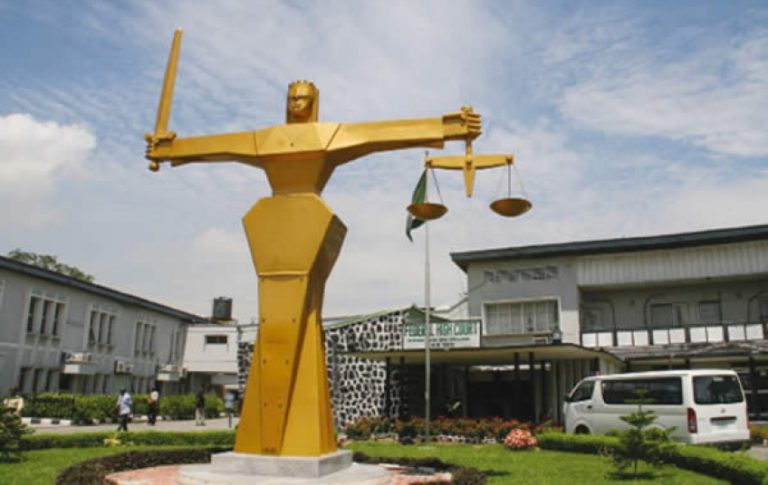
A SUIT to nullify the candidacy of President Muhammadu Buhari based on alleged shortcomings in his academic qualifications has been struck out by the Court of Appeal as the case was filed after the time allowed by law.

The court’s Abuja division upheld, on Friday, a similar ruling earlier delivered by the Federal High Court, which had noted that the matter was “brought outside the specified period of time”.

The appellants were Kalu Kalu, Labaran Ismail and Hassy Kyari el-Kuris.

“We have decided to settle on the preliminary objection. To determine the issue, we have to pay serious attention to when the cause of action arose,” Mohammed Idris, who read the judgment, observed.


READ ALSO:

“I have no doubt in my mind that the cause of action arose on October 18 when the documents said to be false that is the Curriculum Vitae and affidavit were submitted to INEC in form CF001.”

He held that the action was instituted after the stipulated period of 14 days legally permitted for pre-election matters, and therefore statute-barred.

The counsel for the appellants, Ukpai Ukairo, had however submitted that the cause of action commenced with the announcement and publication by the electoral commission of successful candidates for the general election on October 25, 2018.

And since the case was instituted on November 5, 2018, he argued, it was well within the time permitted by the constitution.

The three-member panel that presided over the matter was headed by Justice Atinuke Akomolafe-Wilson. It had, on Monday, reserved judgment for today after listening to the arguments from the counsel.

Allegations contesting Buhari’s qualifications and eligibility for a presidential election were also levelled in the build-up to the 2015 general election.

In April 2015, two cases filed to challenge the then-president-elect were withdrawn by the plaintiffs and then struck out by the Federal High Court. Representing one of the plaintiffs, Mike Ozekhome had told the court the reason for the withdrawal was to give the incoming administration time to focus on the “enormous task” of governance.

Another suit instituted by Nnamdi Nwokocha-Ahaiwe, an Abuja-based lawyer, which claimed that Buhari did not partake in the 1962 Cambridge West African School Certificate examination as claimed, was also suddenly withdrawn in June 2016.

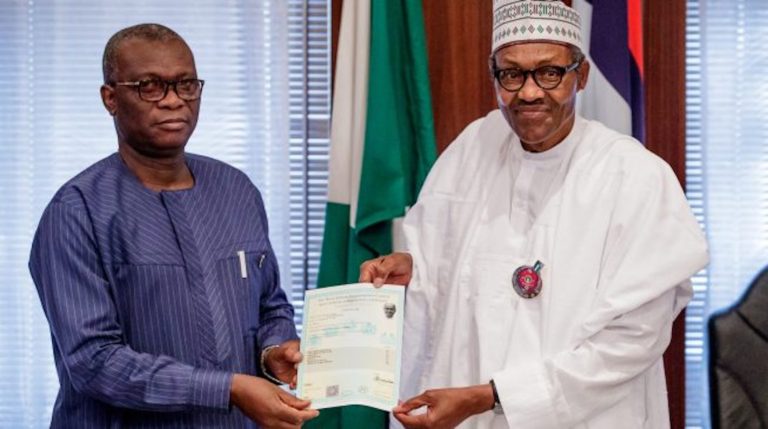
To bring the enduring controversy to end, the West African Examination Council had, in November at the Presidential Villa, presented Buhari with an “attestation certificate and confirmation of school cert result”.

Court Jails eight internet fraudsters

THE Economic and Financial Crimes Commission, EFCC, on Thursday, July 11, 2019, secured the conviction and sentencing of four internet fraudsters, Shotayo Ahmed, Ale Olugbenga Abraham, Preye Kinsley and Akintoye Toluwalope for possession of fraudulent documents before Justice Oluwatoyin Taiwo of the Special Offences Court sitting in Ikeja, Lagos.

One of the counts reads: “That you, Shotayo Ahmed, on or about the 8th day of December, 2018 at Lagos, within the Ikeja Judicial Division of this Honourable Court, had in your possession an email opened with the name madeleinepalm133@yahoo.com, wherein you chatted with a white man represented yourself to be a lady in order to create a relationship to entice him to give you money which document was printed out from your email account madeleinepalm133@yahoo.com in your presence, which you ought to know, having regards to the circumstances of the case, that the document contains the false pretence.”

Also on Thursday, July 11, Justice Mojisola Dada of the Special Offences Court sitting in Ikeja, Lagos, convicted and sentenced four internet fraudsters, Ibrahim Habeeb Olalekan, Ogunlami Adetokunbo Gabriel, Adeosun Adeyemi and  Sadiq Adeola, to one year imprisonment each for possession of fraudulent documents.

One of the counts reads: “That you, Ibrahim Habeeb Olalekan, on or about the 13th day of June, 2019, in Lagos, within the jurisdiction of this Honourable Court, with intent to defraud, had in your possession document titled “persona Info”, where you represented yourself as Nancy Crawhorn (a female), which representations you knew or ought to have known to be false.” They pleaded guilty to the charges preferred against them by the Commission when they were arraigned.

In view of their pleas of guilt, the prosecution counsels, Samuel Daji, E.S.Okon and Ukemruwem Anana, informed the court that the defendants had entered into a “plea bargain” with the EFCC.

Consequently, the facts of the case against the defendants were reviewed by the prosecution.

The prosecution counsels informed Justice Taiwo’s court of the defendants’ confessional statements to the EFCC and that several items were recovered from them.

Their statements, as well as documents recovered from them, were tendered and admitted in evidence by the court.

In view of this, the prosecution urged the court to “convict the defendants as charged in the plea bargain agreement”.

Justice Taiwo, after perusing the facts before the court, convicted and sentenced both Ahmed and Abraham to three months imprisonment each.

The Judge also convicted and sentenced Kinsley and Toluwalope to four months imprisonment each.

All items recovered from the defendants were ordered to be forfeited to the Federal Government.

Justice Taiwo further gave Ahmed, Toluwalope and Abraham an “option of fine” of N250, 000.00 (Two Hundred and Fifty Thousand Naira) each.

The Judge, however, refused Kinsley an option of fine.

The defendants before Justice Dada also pleaded guilty to the charges when they were read to them. In view of their pleas of guilt, the prosecution informed the court that the defendants had entered into a “plea bargain” with the EFCC.

The facts of the case against the defendants were reviewed by the prosecution. The prosecution also told the court that the defendants wrote confessional statements to the EFCC and that several items were recovered from them.

The defendants’ statements to the EFCC as well as the documents recovered from them were tendered and admitted in evidence by the court. The prosecution, therefore, urged the court to convict the defendants as charged in the plea bargain agreement”.

After going through the facts of the case before the court, Justice Dada convicted and sentenced the defendants to one year imprisonment each.

The Judge also ordered that all items recovered from the convicts be forfeited to the Federal Government. Justice Dada, however, gave the convicts an option of fine of N250, 000 (Two Hundred and Fifty Thousand Naira) each.

The Judge further ordered the convicts to write an “undertaking” with the EFCC, promising never to go back to the crime.

The convicts were further ordered to be remanded in prison custody pending the fulfilment of the option of fine.

Nigeria rakes in over USD $25bn dollars in export value, spends close to $10bn on imports within eight years in West- Africa

NIGERIA is considered the largest economy in Africa with a Gross Domestic Product change rate of 1.9 per cent in 2018 and projected to hit 2.1 percent by the International Monetary Fund in 2019, thereby making her a huge potential beneficiary of African Continental Free Trade Area (AfCFTA) agreement.

Globally, The Observation of Economic Complexity ranked Nigeria 49th in the world with an export value of about $47billion and 58th in the world with an import value of $34.2billion.

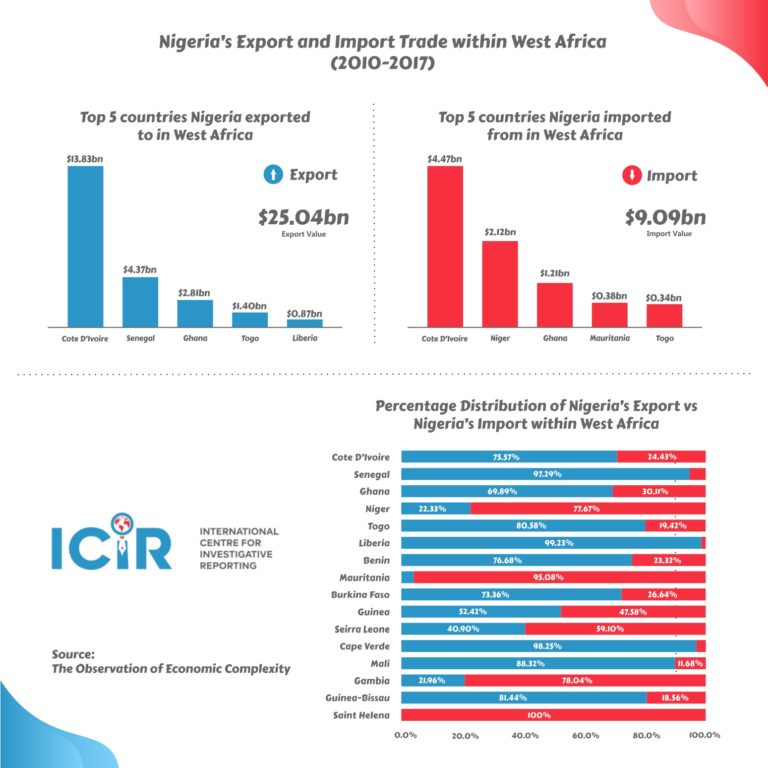
In West-African, from 2010 to 2017, Nigeria raked in over $25 billion from her export activities with other West –African nations. Cote D’Ivorie comes top amongst nations to which Nigeria sell, contributing a total sum of almost $14billion dollars, followed closely by Senegal at over $4billion dollars, Ghana at $2.8billion, Togo $1.4bn and Liberia, $870million.

The countries make the top five West-African states from which Nigeria benefit more doing business with.

However, with Nigeria as a signatory to AfCFTA,  the country’s level of importation is expected to rise even as her exports gain momentum as lesser tariff plans would make the movement of goods amongst the borders easier and predictably would lead to more imports into Nigeria for her teeming population.

Also, in eight years, Nigeria had spent almost $10billion dollars on importations within the region. Cote D’Ivoire tops the list of five countries from which Nigeria imports in West Africa, with export values amounting to $4.47billion, followed by Niger, $2.12billion; Ghana, $1.21 billion; Mauritania $383million; and Togo, $338million.

‘‘As African leaders, our attention should now focus on implementing the AfCFTA in a way that develops our economies and creates jobs for our young, dynamic and hardworking population

‘‘Our consultations and assessments reaffirmed that the AfCFTA can be a platform for African manufacturers of goods and providers of service to construct regional value chains for made in Africa goods and services,” the Nigerian president had said after signing the trade treaty in Niamey, Niger on 7, July 2019.

Nigeria also recorded 100 per cent of importation ratio from Saint Helena, Mauritania 95.08 per cent, Gambia 78.04 per cent and Niger 77.67 per cent from 20110 -2017.

With the import ratio rate recorded with the British overseas territory, Nigeria has however never reported exports to the territory.

GT Bank clinches Euromoney best bank award in Africa

GUARANTY Trust Bank Plc on Wednesday was named the Best Bank in Africa 2019 by Euromoney at its annual Awards for Excellence which held at the Hilton Hotel, Park Lane, London.

The Nigerian Bank was also named the Best Bank in Nigeria for a record ninth time, reflecting the Bank’s position as one of the best managed financial institutions in the country.

Segun Agbaje, the Chief Executive Officer of the bank, in his vote of thanks said that the award for the financial institution serves to indicate the progress been made to ensure the delivery of the best banking experience that captures what customers want.

“They are also a testament to our leading role in driving world-class corporate governance standards, excellent service quality and innovation in Africa’s banking industry.

“At GT Bank, we are passionate about building the bank of the future by leveraging the best of technology to add real value to our customers’ lives, and these awards illustrate the hard work and commitment of our staff, management, and board towards achieving this goal,” Agbaje added.

GT Bank brand is regarded by industry watchers as one of the best run financial institutions across the continent and serves as a role model within the African financial service industry.

The bank, reportedly recorded modest growth in key performance indicators for the full year 2018 with profit before tax for the 12 months rising to N215.59 million.

Key financial extract of the bank last audited report and account for the year ended December 31, 2018, showed that that gross earnings rose to N434.7 billion in 2018 as against N419.23billion recorded in 2017.

It boasts of an assets base of $6.8 billion, making it one of the biggest banks in Nigeria.

GT Bank’s assets are worth about $11.77 trillion.

DBS was named as the world’s best bank for 2019, while JP Morgan won world best investment bank of the year and Andreas Treichl, the chief executive of Austria’s Erste Group, was named Euromoney’s banker of the year. Erste’s Treichl recognised as the banker of the year.