Home Blog Page 2353

FLASHBACK: Six top INEC officials who confirmed planned use of ‘central server’

RESPONDING to an application by the People’s Democratic Party (PDP) to inspect its server used for the 2019 general election, the Independent National Electoral Commission (INEC) said on Thursday that it does not have such a thing.

“They are asking us to bring something we do not have,” Yunus Usman, INEC’s lawyer, said.

Lawyers representing President Muhammadu Buhari and the All Progressives Congress at the Presidential Electoral Tribunal also asked that the application be dismissed for failing to establish that a server exists.


Read Also:

This development has led to a fierce debate among supporters of Nigeria’s two major political parties, and moreso because available record has cast doubt on INEC’s claim.

In a fact-check, The ICIR already established that over N2 billion was approved for the electoral commission towards the procurement and upgrade of various servers. And the money was not only released, but fully utilised.

Asides this, there is also video evidence showing that the upgraded Smart Card Readers used during the election are capable of transmitting results to a central server monitored by INEC; and there are reports from ad-hoc officials indicating that they actually did transmit such information.

The operational procedure given to those officials states that there should be an “electronic movement of election results from the Polling Unit (PU) using the Smart Card Reader (SCR) to a centralised database system where the collation of such result is done”.

In this report, we take a look at the statements of some of INEC’s top officials pointing to the fact that the commission had always planned to make use of a central server in 2019 and has used such servers in past elections.

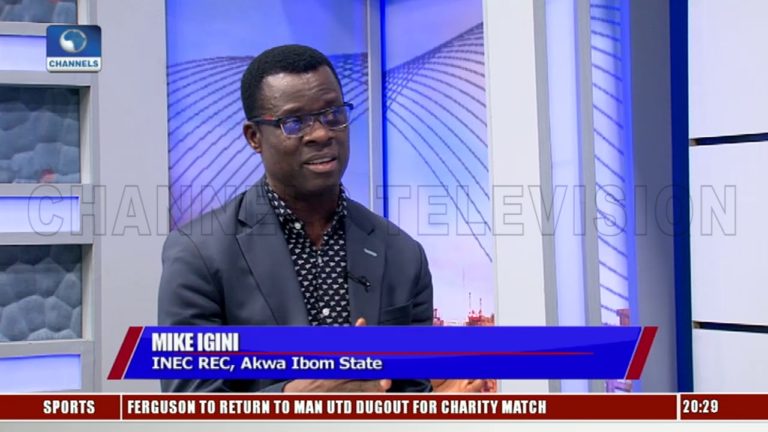
Mike Igini

Said to be “one of the most experienced electoral officers”, Igini was INEC’s Resident Electoral Commissioner in Bayelsa State during the election. On February 17, he was interviewed on Sunday Politics, days after the commission postponed the presidential and National Assembly elections by a week.

On the show, he confirmed that INEC planned to make use of electronic collation officers and a central server to ensure fairness in the collation process and “bring about transparency, openness to issues about the results declared at the polling unit being at variance at the world collation centre”.

“What we are going to do on Saturday in each of the polling units, and we have trained people for that, is that unlike before when you have only one collation officer we are now having two collation officers at the ward level,” he said.

Igini added: “And this is how they are going to go about it: First, the presiding officer will have to input the result into the card reader and will send it straight away to the central server… We have what they call the e-collation officer and the manual collation officer because we are still doing the manual collation process as required under section 73 of the Electoral Act that talks about step-by-step recording.

“What happens is that after I have sent that data as the presiding officer, the cameraman and yourself, you are the two collation officers, before I get to you, without any form of communication, we have granted you access to our central server. You will see what I have transmitted without talking to me.

“Therefore, it is not expected that on my way to the World Collation Centre I will do anything funny with the form EC8A because we now have evidence trail–the fact that I am aware that at the polling unit, the same result is there, the duplicate has been given to the party agent, I have transmitted to the central server, without talking to me, both of you have seen that result.

“By the time I get to the World Collation Centre … the e-collation officer will have to confirm whether what is on the result sheet is the same thing I have transmitted.”

Igini had given similar assurances in November during a press conference at the INEC headquarters in Akwa Ibom. According to him, the commission “developed a platform in which once the results at polling units are announced, the same results would be transmitted straight to our central server.”

Soyebi Adedeji Solomon

Two-time national commissioner, Soyebi, is described on INEC’s website as one who “is no stranger at all to elections and the electoral process”. “As a great team player with a wide knowledge of electoral matters, he was appointed Acting Chairman of the Independent National Electoral Commission (INEC) following the expiration of the tenure of the then Chairman, Professor Maurice Maduakolam Iwu,” it said.

Before this appointment, he served as the national commissioner in charge of electoral operations; and in 2019 he acted as the chairman of INEC’s Board of Electoral Insititute, the agency’s training arm, and supervised the Information and Voter Education Committee.

Speaking on Channels Television in February 2018, Adedeji also confirmed that INEC intended to make use of a central server to store electoral results.

“What we are trying to do is that come 2019 every result at a polling unit will be scanned at that particular polling unit—a full scan, just an exact replica of what is there; and it goes into a central server. And this is stored. We are going to rely on this for 2019,” he said.

“We’ve started piloting,” he added. “We did it in Sokoto. We did it in Anambra, although it was not the determinant of the result. We used that to compare. We have been testing some of these transmissions. But then we are going to make sure that come 2019, we are going to make sure that these scanned results are fully operational, or they are determinant of results.”

Asked if this plan is dependent on President Buhari’s signing of the bill to amend the Electoral Act, he replied in the negative.

“No, we have a right to do it,” he said. “We are not aware. As I told you, the amendment was signed in 2015, but it was not even made public until 2016.”

He gave assurance that it would be impossible to hack the server, explaining that the Smart Card Readers would be enhanced to function as a scanner.

Olusegun Agbaje

INEC’s Resident Electoral Commissioner in Osun State, Agbaje, confirmed on Politics Today, a show on Channels Television, that results will be sent to INEC’s headquarters in Abuja using the card readers.

“Right from the Polling Unit, when you finish the polling, and then they do the calculation, that is after the sorting and counting of the ballot, everything is going to be put inside the Smart Card Reader and this we will also transmit to the central server,” he said.

Asked if the card reader will be used for the transmission, he said yes at the Polling Unit, “but by the time we get to the collation centre we have technical officers who are also going to deploy their gadgets to be able to transmit it to Abuja headquarters.”

Chidi Nwafor

Nwafor, the electoral commission’s Director of Information and Communication Technology (ICT), said in March 2017, at an event chaired by INEC chairman Mahmud Yakubu, that the commission would make use of electronic collation and transmission as a way of preventing malpractices.

“Observations have shown that most election malpractices that take place do not take place at polling units,” he said. ‘The challenge has been after the poll – between the polling units and the collation centres and at the collation centre.

“INEC has therefore decided to securely transmit results from all polling units to a central database such that only viewing access is allowed at the wards and local government levels – which ultimately eliminates manual collation processes.”

“INEC is preparing for the 2019 elections and is further deploying technology to improve its service delivery and make its processes less prone to manipulations,” he had added.

He explained that the electronic collation system involves the entering of results from polling units into an e-collation application of the card reader, transmission to a central server, auto-collation of results and viewing at wards, and auditing of results and confirmation at local government, state and national levels.

Mahmud Yakubu

No less than the INEC chairman, Mahmud Yakubu, has also mentioned the plan to deploy electronic collation and transmission of results during the 2019 elections. He said this in June 2017 during a meeting with the Computer Professionals Registration Council.

“Something happened in 2015 in our elections with the increasing deployment of technology,” the chairman said.

“This commission is committed to further deepening the deployment of technology, and we very heartily welcome this discussion with the apex body for the regulation of computer professional practice in Nigeria, and whatever you require of the commission that we can do within the law, I want to assure you that we shall do so.”

He added: “We are pioneering and we hope to deploy in the 2019 general elections a new platform for electronic collation and transmission of results.”

Attahiru Jega

The immediate past INEC chairman, Attahiru Jega, has also confirmed the existence of a “central server”. In a statement signed by Kayode Robert Idowu, his chief press secretary, and released on March 10, 2015, he confirmed that card readers are used to transmit information to the agency’s server.

“The SCR sends the data of all accredited voters to INEC’s central server, equipping the Commission to be able to audit figures subsequently filed by polling officials at the PU and, thereby, be able to determine if fraudulent alterations were made,” the statement said. “The public demonstration also succeeded wholly in this regard.”

Army court-martials 14 officers, soldiers accused of murder, kidnapping

THE Nigerian Army said on Saturday it has begun proceedings to court-martial 14 officers and soldiers accused of murder, kidnapping and desertion, among other criminal offences.

Inaugurating the court proceedings in Port Harcourt, General Officer Commanding Army 6 Division, Port Harcourt, Maj.-Gen. Jamil Sarham, said the suspects were officers and soldiers of the division.

Sarham said the General Court Martial was convened in compliance to Section 131 of the Armed Forces Act guiding professional conduct of the nation’s military.

“The offences for which the accused persons are being tried range from murder, attempted murder, kidnapping, (and) desertion.

“Others are offences in relation to public and service property, disobedience to standing orders and conducts to the prejudice to service discipline.

“All the offences are punishable under the Armed Forces Act CAP A20 Law of the Federation of Nigeria 2004,” he said.

The GOC said the army has zero tolerance for indiscipline, adding that it would never shield any personnel, no matter how highly placed from the law.

He said the armed forces hold personnel in high esteem, and as such, would not put personnel on trial unless the matter was thoroughly investigated.

According to him, the trial was not only aimed at prosecuting the suspects but to discourage others from indulging in criminality.

“To this end, each accused person was thoroughly investigated to ensure that an innocent person is not wrongly tried and punished.

“The headquarters 6 division has painstakingly selected credible officers with in-depth knowledge and outstanding experience of military law and duties as members of the court-martial to ensure fair hearing and justice.”

The News Agency of Nigeria reports that the accused personnel include three officers and 11 soldiers, including a major, two captains, two staff sergeants and one sergeant, among other ranks.

(NAN)

FACT-CHECK: Did INEC receive money for servers to store electoral data?

WHETHER or not the Independent National Electoral Commission, INEC, made use of a central server in storing poll results for the 2019 general election has recently been a subject of heated controversy.

In a petition sent to the presidential election tribunal in March, the People’s Democratic Party (PDP) claimed its candidate, Atiku Abubakar, defeated Muhammadu Buhari, candidate of the ruling party, by 1.6 million votes. This information, the party said, was retrieved from the electoral commission’s server, which has the authentic results.

INEC, however, replied that the numbers peddled by the PDP were fabricated and said it did not adopt electronic transmission of collation of results.

Atiku, in April, gave the tribunal what he called the “unique MAC address and Microsoft product ID of the INEC server”.

“The figures and votes were transmitted to the first Respondent’s Presidential Result’s Server 1 and thereafter aggregated in INEC_PRES_RSLT_SRV2019, whose Physical Address or unique Mac Address is 94-57-A5-DC-64-B9 with Microsoft Product ID 00252-7000000000-AA535,” he said.

“The 1st Respondent specifically denies the existence of electronic transmission of results as it is unknown to the Electoral Act, 2010 (as amended) and Regulations and Guidelines for the conduct of the elections, 2019,” it said in its response.

Following an application to the tribunal by the PDP for an order compelling INEC to grant access to the server, the agency maintained that it does not have any server.

“They are asking us to bring something we do not have,” Yunus Usman, its lawyer, said, though this position contradicts statements made before the election by INEC’s commissioners.

Claims have been circulated suggesting that INEC spent “millions of naira” on a server. In this fact-check, The ICIR takes a look at documents drafted by the commission itself, which confirm that it intended to procure various servers for the 2019 election and that, in fact, it got funded for those procurements.

A little background

President Buhari had, in July and September, written to the National Assembly requesting for N242 billion as virement and supplementary budget to fund the 2019 general election. Out of this amount, N189 billion was allocated to INEC while the rest went to the Nigeria Police, Civil Defence, and other security agencies.

The Senate Committee on Appropriations on the Virement Request headed by Muhammed Danjuma Goje, in its interim report, recommended that N144.7 billion be transferred from the Special Intervention Programme recurrent budget and N44.2 billion from the programme’s capital budget.

Adding this to the N45 billion recurrent expenses already approved for INEC in the 2018 budget, it meant INEC’s total budget for 2018 was N234.5 billion.

In October, the National Assembly approved the N242 billion supplementary budget as sent by the president—only changing the source of the funding from the legislators’ special projects votes to the Special Intervention Programme.

Does the supplementary budget provide for servers?

Yes, it does. INEC’s supplementary budget was made public by the Policy and Legal Advocacy Centre (PLAC), a nonprofit committed to facilitating legislative advocacy and access to public policies.

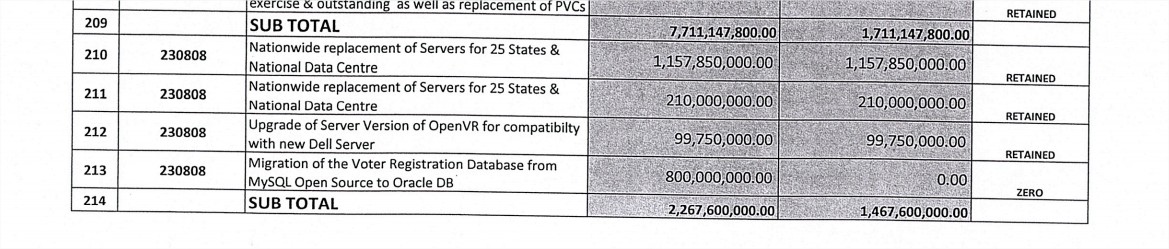
According to the document (archived here), INEC proposed to spend N143.5 billion on 209 items. Out of that amount, N2.27 billion was budgeted for server-related procurement items, with budget code 230808. The purpose of a computer server is simply to store, retrieve, and send information to other computers connected to a network.

N1.37 billion was budgeted for nationwide replacement of servers for 25 states and National Data Centre, N99.7 million for an upgrade of the server version of OpenVR for compatibility with new Dell server, and N800 million for the migration of voter registration database from MySQL Open Source to OracleDB (both database administration services).

INEC’s supplementary budget. Source: PLAC Nigeria

INEC also budgeted N157.5 million for the renewal and maintenance of cloud infrastructure, with budget code 230709.

Though the National Assembly sub-committees on INEC and electoral matters, headed by Suleiman Nazif and Aishatu Dukku, recommended the reduction of the some of the proposed amounts, the proposed budget was eventually passed in full.

Not only was the approval absolute, but the office of the Accountant-General reports in its “Capital Performance of the Budget” document that all of the amount (N188.9 billion) was released to INEC and spent by it.

The plan for servers predates 2018 budgeting process

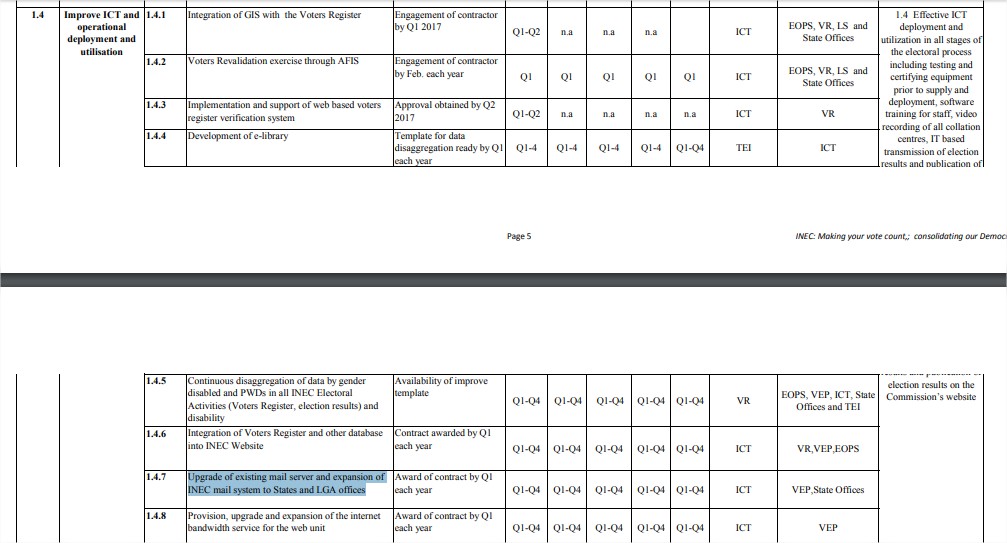
It is worth mentioning that the word server is likewise used four times in INEC’s “2017-2021 Strategic Programme of Action” (archived here).

According to the plan, the agency’s ICT department was expected to award contracts by the first quarter of each year for the upgrade of existing mail server and expansion of INEC mail system to states and local government offices.

The department was to get approval by the second quarter of 2017 and 2018 for the procurement of servers for all 36 states and the Federal Capital Territory. It was also to upgrade the server version of Open VR for compatibility with the new Dell Server.

INEC’s 2017-2021 Strategic Programme of Action

The renewal and maintenance of cloud infrastructure as well as the development of data management tools “for archiving election results and other electoral activities” were also provided for in the programme of action.

Conclusion

It is true that money (over N2 billion naira) for the procurement and upgrade of servers was approved for INEC by the National Assembly and it has had a longterm plan favouring the electronic storage of electoral results.

The amount was also released to INEC and the commission reported it as utilised. If the agency insists it does not have a server, then it has some explaining to do on how exactly it spent the relevant funds.

IEA projects drop in oil prices in 2020, cuts down estimates over global trade tensions

FOLLOWING attacks on two oil tankers carrying petroleum products at the Strait of Hormuz, a strategic waterway in the Persian Gulf, through which one – fifth of the world’s oil is transported, the International Energy Agency, IEA, on Friday in its monthly report predicts an increased global oil supply that would be more than the demand in 2020 which is likely to result in lower oil prices.

The global energy authority which directs the energy policies of industrial nations adjusted its 2019 global oil demand growth estimate by 100,000 barrels to 1.2 million barrels per day with a projected 1.4 million barrels per day increase next year.

“The main focus is on oil demand as economic sentiment weakens … The consequences for oil demand are becoming apparent,” the IEA said in its monthly oil report.

Though the report anticipates growth in world oil demand to accelerate to 1.4 million barrels per day in 2020, it also predicts a 2.3 million barrels per day increase in supply which might result to a slump in oil prices.

“A clear message from our first look at 2020 is that there is plenty of non-OPEC supply growth available to meet any likely level of demand, assuming no major geopolitical shock. This is welcome news for consumers and the wider health of the currently vulnerable global economy, as it will limit significant upward pressure on oil prices,” the report stated.

It is expected that demand will pick up markedly, averaging 1.2 per cent in 2019 and 1.4 per cent next year. The ongoing trade war between the US and China has helped the global oil market stage a recovery from the 2016 drop in oil prices as prices surged to about $75 per barrel in recent months according to the report, despite, the Organization of Petroleum Exporting Countries, OPEC, decision to cut down oil supply by 650,000 barrels per day in the first quarter of 2019, to increase prices in the global market.

The IEA report states that if OPEC continues with its stance to reduce oil output below the 650,000 barrels per day ceiling to improve oil prices. Production would be at its lowest since 2003 suggesting its strategy to support the oil market would have backfired, the report said.

What does this mean for the Nigerian economy?
The Central Bank of Nigeria, CBN, earlier in the year had predicted a forecast GDP growth of 3 per cent for 2019 partly due to projections driven by higher crude oil prices.

Richmond Osuji, an oil and gas consultant told The ICIR, that without the appropriate physical infrastructure put in place by the government to cushion the effects of lower crude oil prices the economy of the country will be hit badly.
“When the prices of crude oil dropped in 2016 we fell into recession so it is obvious that our economy will suffer from the effects of low prices since we depend majorly on revenue from the sector. However, when we came out of recession it was because crude prices rose, we didn’t have a strong strategy apart from depending on market forces to bail us out,” he said.


He affirmed that with the expansion of domestic gas utilisation in the country and an increase in the number of modular refineries in the country it would be easier for Nigeria to thrive in the face of dwindling global oil prices.

“If our government can’t make the refineries functional and effective then privatisation is another option. It will go a long way in bringing down the price of petroleum products and expanding the domestic usage of gas to drive production efforts to rake in profits,” he said.

Judiciary must be sanitised to win anti-corruption war – Ribadu

EXCEPT the Federal Government properly ‘sanitise’ the judicial system, its anti-corruption campaign would yield little or no result.

Former Chairman of the Economic Financial and Crimes Commission (EFCC), Nuhu Ribadu disclosed this on Friday during a convocation lecture at the Federal University Dutsin-Ma, Katsina State.

He said cleansing the judiciary should be the first move and fighting corruption is a matter of life or death which if not won, could deprive the nation of needed development.

According to him, it is a fight that should be relentless, ruthless and holistic.

“A major step towards attaining result in the fight against corruption is by first cleaning up our entire justice sector. There would only be limited or no success in the anti-corruption campaign if the justice system is not properly sanitised to shoulder that important responsibility,” Says Ribadu.

“Fighting corruption is an existential fight; it is one that we have to win or die trying. Corruption deprives the society of development and further impoverishes the poor. It is, therefore, one fight that should be relentless, ruthless & holistic.”

He added that,“For a long time, security, in concrete and abstract terms has been used to conceal expenditures that are largely fraudulent or dubious. If we learn any lessons from the arms probe, is that not everything written in the name of security actually gets spent for the listed purpose.”

The former EFCC chairman, however, insisted that Nigerians must insist that whatever money being spent especially in the guise of security must be budgeted for in annual budgets for the purpose of transparency and accountability.


He said he once advocated for the establishment of a national charter and strategy for the fight against corruption expected to converge all layers of governance such that it would outline specific requirements, responsibilities, commitments and performance indicators.

Speaking on need for a centralised data system, Ribadu said the appropriate authority should set up data registry that would enable authorities have easy access on details of basic information of all citizens as well as records of financial transactions, tax records, assets, crime history, physical addresses among others stressing that it remains vital in fighting corruption and financial crimes.

“Data centre, which will house a beneficial ownership register, is the most important modern tool of following money, tracking transactions and information sharing among law enforcement and other agencies of government.”

He advised the populace to act as citizens and question the authorities in power rather than being spectators.

FACT-CHECK: NYSC says it’s at ‘forefront’ of total compliance with FOI Act, but it’s not true

THE Director-General of National Youth Service Corps (NYSC), Brig. Gen. Shuaibu Ibrahim on Friday says the Corps has been at the forefront of  total compliance with the provisions of the Freedom of Information Act (FOIA), but the statement is false.

He disclosed this on Friday during the opening ceremony of the NYSC Freedom of Information Desk Officers’ workshop held in Abuja.

“You will recall that since the enactment of the Freedom of Information Act (FOIA) in 2011, NYSC has been at the forefront of ensuring total compliance with the provisions of the Act,” says Ibrahim.

“I, therefore, charge you to continue on this positive stead by ensuring effective record management, effective liaison as well as prompt response to enquiries in your respective secretariats.”

The event was put together for the 37 FOI desk officers of the public institutions nationwide, including the Federal Capital Territory (FCT).

The DG  described the recruitments, training and mentoring of the FOIA corps as laudable.

However, an annual survey of FOIA compliance conducted by an independent Non-Governmental Organisation (NGO), Public Private Development Centre (PPDC) has shown the DG’s claim to be false.

Since 2015 till 2018, the PPDC annual FOI ranking revealed that NYSC has not been complying with the FOIA requests, let alone lead the compliance ranking.

In 2015, the NYSC ranked 116th position while the Nigerian Export Promotion Council (NEPC) ranked first on the list. In 2016 it rose to 97th position while the Bureau of Public Service Reforms (BPSR) took the first position.

While the BPSR maintained its first position in 2017, the NYSC ranked 75 on the list. The most recent survey conducted by the PPDC for 2018 had the Corporate Affairs Commission (CAC) taken the first position while NYSC ranked 82nd.

There was no time since the enactment of the law that the NYSC led on the compliance table.

NYSC in fact is among other several government Ministries, Departments and Agencies (MDAs)  notorious for ignoring FOIA requests.

The FOIA was enacted in 2011 as part of measures to promote transparency and accountability in government institutions whereby the public is legally permitted to request and receive public information of interest.

The ICIR severally reported how agencies of government under President Muhammadu Buhari disregarded FOIA requests during his first term in office.


Nigeria, other African countries are slow in eliminating hepatitis -WHO

THE World Health Organisation has noted that Nigeria and 43 other African countries are lagging behind to eliminate viral hepatitis in the continent. 

Of the 47 countries in Africa only Rwanda, Uganda and Cabo Verde are on course to eliminate the disease that affects one in 15 persons in the region.

The information was contained in a press release of the WHO African region on Friday which gave some tips of a scorecard that examines hepatitis prevalence and response in Africa. The scorecard will be presented at the first African Hepatitis Summit to be held in Kampala, Uganda’s capital between June 18 and 20.

Dying of viral hepatitis in Africa is becoming a bigger threat than dying of AIDS, malaria or tuberculosis, said WHO. It said more than 200,000 people in Africa die from complications of hepatitis B and C annually. As it is a liver-related disease, complications include liver cancer, liver failure and scarring of the liver (cirrhosis).

The health agency estimated that 60 million people in the continent were living with chronic hepatitis B (HBV) infection in 2015, while about 4.8 million of them were children under five years old.  For hepatitis C, 10 million people are infected, “most likely due to unsafe injection practices within health facilities or by communities”.

Matshidiso Moeti, regional director, said the analysis was the first to track the countries and to access progress. “It was created as a guide for Member States on the implementation of the Global Health Sector Strategy on Viral Hepatitis, which calls for the elimination of the disease by 2030 (defined as a 90 percent reduction in new cases and 65 percent reduction in deaths),” she said

The analysis shows that only 7 of the 47 countries are leading prevention efforts with national coverage of both Hepatitis B birth dose and childhood pentavalent vaccination exceeding 90 per cent.

WHO said Rwanda is providing free treatment for both hepatitis B (HB) and C, Uganda only HB. “These two countries are championing the regional response and are on track to reach the 2020 Framework targets for testing and community awareness,” said WHO. 

“In Uganda, where more than 6 per cent of the population is infected, the commitment to end hepatitis infection was driven by civil society and strong political will with the result that it became one of the first African nations to fund domestic action against hepatitis B”.

Unlike HIV infection where there is no vaccine to prevent the disease, HB vaccination is available.

“Administration of the hepatitis B vaccination at birth and in early infancy is the most effective way to halt the transmission of the virus because 95 per cent of the burden of chronic disease is due to infections among children, acquired before their fifth birthday,” WHO reported.

But the health agency said only 11 countries could provide vaccination to children at a high rate. Only Cabo Verde was mentioned to have achieved 99 per cent vaccination coverage at birth.

High burden in Nigeria

According to WHO’s estimates, 11.2 per cent of the population is hepatitis B positive, while 2.0 per cent has the hepatitis C virus. The former figure indicates that 20 million Nigerians are living with viral infection.  And this represents that one in nine Nigerians has the disease.

Isaac Adewole, the former minister of health, had said during 2017 World Hepatitis Day that Nigeria is determined to eliminate hepatitis B infection by 2021.  Nigeria has also scheduled hepatitis B virus vaccination into the national immunisation for children since 2004.

However, WHO, in 2017, wrote that the screening and vaccination coverage among children and adults remains unsatisfactorily low in Nigeria due to a lack of awareness among the general populace.

A consultant gastroenterologist at the University of Abuja Teaching Hospital, Ojonugwa Ameh, told The ICIR in 2018 that the awareness of hepatitis B screening is not adequate in the country.

Most Nigerians do not know their status. Only when they come very sick, and most times at that stage, the damage has been done,” he said.

Nigeria’s profit from oil exports hits $236.2 bn in five years, as oil reserves slide

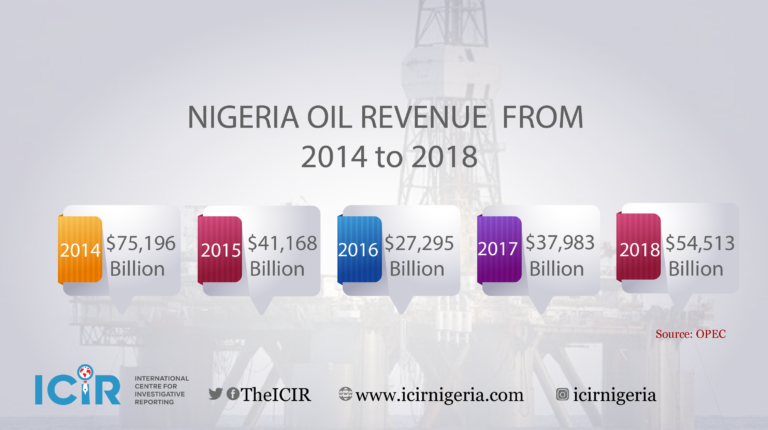
NIGERIA raked in $236.2 billion from the proceeds made from crude oil exports between 2014 to 2018,  according to the OPEC  latest report.

This was revealed in the 54th edition of the Annual Statistical Bulletin, ASB, released by OPEC, which ranks Nigeria in sixth place amongst  OPEC countries examined and the highest oil revenue earner in Africa in the five-year timeline.

Countries examined in the report include Nigeria, Saudi Arabia, Iraq, Kuwait, Congo, Ecuador, Equatorial Guinea, Gabon, the Islamic Republic of Iran, Iraq, Kuwait, Libya, Angola, Sudan, the United Arab Emirates and Venezuela.

Nigeria earned its highest revenue from oil exports for the period under review, receiving $75.196 billion in 2014, $54.513 billion in 2018 and $41.168bn in 2015 respectively.

Saudi Arabia sits on top of the table with the highest oil exports revenue with $194.4 billion followed by United Arab Emirates’ $74.9 billion, Iraq’s $68.2 billion, Iran’s $60.2 billion and Kuwait’s $58.4 billion.

The report assessed the OPEC member countries using economic indicators based on GDP growth and current account balance, which improved majorly in 2018.

However, the report also revealed that Nigeria’s proven oil reserves were on a steady decline due to exploratory activities leading to increased oil production and output expansions.

For the period under review, Nigeria’s oil reserves were pegged at 37,448 billion barrels in 2014 but dropped significantly to 36,972 billion barrels in 2018.

“With regard to countries with increasing oil production in 2018, output expansions were clearly driven by North America, notably by the United States. Oil supply in the US increased by around 2.3m barrels per day in the year 2018, representing almost 80 per cent of total non-OPEC supply growth,” the report states.

Also, the volume of crude oil exported, by OPEC member countries sold an average of 24.67 million barrels per day in 2018, a slight increase of about 14,000 barrels per day, which is about 0.1 per cent increase compared to 2017.

OPEC and Russia -led oil producing nations formed an alliance tagged OPEC+ which had agreed to cut down inventories and remove 1.2 million barrels per day of crude oil from global markets on January 1, in a bid to raise oil prices.

In April, OPEC members bound by the agreement achieved 132 per cent of pledged cuts, compared to 145 per cent in March, due to higher production in Nigeria which did not fulfill its OPEC benchmark and small increases in Saudi Arabia and Iraq.

The report states that 2018 witnessed a substantial global supply growth as total oil liquids production increased significantly by 2.60 million barrels per day, outpacing oil demand growth by more than one million barrels per day.

It also noted that member countries have successfully continued to improve the diversification of their economies and be less dependent on petroleum export revenues.

EFCC to clampdown on illegal use of POS machines


THE Economic and Financial Crimes Commission (EFCC) says it would start a clampdown on the fraudulent use of Point Of Sale (POS) machines in the country.

A statement issued in Abuja on Thursday by the acting Head of Media and Publicity at the EFCC, Tony Orilade said EFCC Chairman, Ibrahim Magu has asked banks across the country to to ensure proper monitoring and strict compliance by those to whom they issue POS machines.

Magu spoke through the Makurdi Zonal Head of  EFCC Johnson Babalola, in an interactive session with Regional Bank Managers in Makurdi, Benue State.

“We are having serious challenges with the banks giving POS machines to individuals with questionable characters and without proper documentation,” he said.

He pointed out that there was a need for some of the POS machines to be withdrawn from such individuals.

Magu also warned banks to adhere strictly to the Post-No-Debit (temporary freezing of account) order placed on banks found to be involved in suspicious transactions. “Default will not be tolerated,” he said.

He noted that it was unfortunate that some staff of banks were in the habit of giving prior notice to customers whose accounts were being placed on Post-No-Debit, thus “aiding and abetting crime and obstruction of justice, instead of assisting the Commission as stipulated by law”.

The EFCC chairman further urged the banks to “respond on time to the letters of investigations sent to them by the Commission”, stressing that prompt response will help speedy dispensation of cases.

“You need to always report any suspicious transactions as required by law,” he added.

FG earmarks fresh 12bn for Abuja airport second runway

Three years after the Federal Government approved an initial sum of N18billion for the construction of the Nnamdi Azikwe International Airport (NAIA) Abuja second runway, work is yet to commence on the site.

Though the Federal Government has set aside another N12 billion in the 2019 Appropriation Act for the project, the start period of the project remains uncertain.

When completed, the second runway is expected to complement the first one repaired in 2017.

Then, the former Minister of State for Aviation, Hadi Sirika said repair of the second runway would be completed before the end of the first administration of President Muhammadu Buhari but the project is far from completion.

According to sources at the Abuja airport, actual construction is yet to commence. “They have not started work on the second runway. What they have is just the sketch, and drawings but the actual construction is yet to start.”

Another source at the Federal Airport Authority of Nigeria (FAAN) told The ICIR that though the federal government appeared serious about the project it has not commenced.

“I saw some paper works, so I think they are serious about it but they have not started.”  

While addressing the House of Representative Joint Committee on Land, Transport, Maritime Safety and Administration, Aviation, Port Harbours and Waterways, in 2017,  the Minister told the lawmakers that N63 billion would be required for the project contrary to the approved N18billion.

In the same year, N10 billion was approved in the ministry’s budget for the project. In 2018 and 2019 N8.32 billion and N12 were approved respectively.

 Though the actual release for the project in 2018 is unknown, N5 billion was reportedly released.

Meanwhile, the Federal Ministry of Transport got N82.4 billion as its total releases for the year out of the N194 billion approved as capital budget. The ministry utilised N81, 9 billion.

Stakeholders in the aviation industry had earlier called on the federal government to ensure repair of the second runway. They noted that temporary shutdown of the first runway cost the federal government about N20 billion losses.

The minister further justified the need to fix the second runway due to the air traffic, stressing that some air operators are mostly on the ground for about 30 minutes waiting for take-off or to land.

“I saw the need and called for it but it fell on deaf ears. At the time of Yar’Adua, the government saw the need but the project was condemned on the excuse that the money was too much.”

“There is a second runway in Kano, Lagos, and Port Harcourt. I think the focus of the government within the limited resources is to do a second runway in Abuja and if we need an additional runway, during the concessioning, the man, who would win it will do it,” he stated.

FAAN General Manager in charge of Corporate Affairs, Mrs. Henrietta Yakubu confirmed the project is yet to commence when contacted.

“No. it has not. I think they are still at the level of getting consultants…but work has not commenced,” Yakubu said.