Home Blog Page 2358

Abacha Loot: UK withholds £211 million stashed in late Nigerian dictator’s account

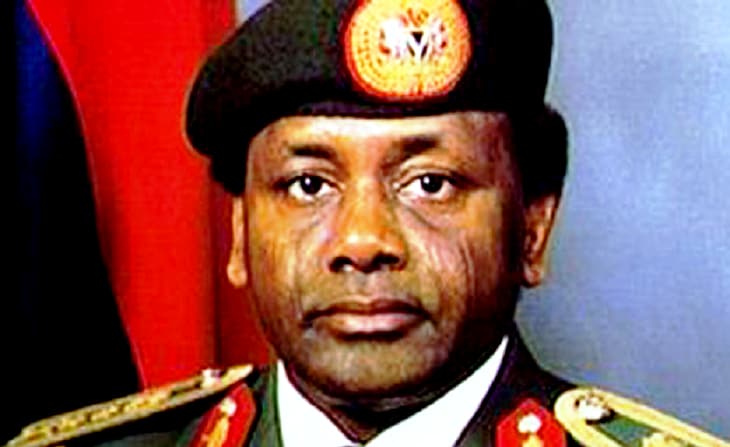
ON, Tuesday the United Kingdom, UK, Government announced the seizure of over £211 million from a Jersey bank account belonging to the late Nigerian Head of State, Sani Abacha.

In a UK Metro report, the money which was initially intended to be laundered into the United States, US, was recovered and put in accounts held in Jersey by Doraville Properties Corporation, a British Virgin Islands company.

Abacha had ruled the country for about five years as Nigerian military head of state before he died on June 8, 1998, from an alleged “sudden heart attack”.

The report also stated that the money is now being held by the government until authorities in Jersey, the US and Nigeria agree on how it should be distributed.

“Any money that Jersey does keep will be put into the Criminal Confiscation Fund, which is used to pay for a variety of projects. In the past, the fund has been used for the new police station and developments at La Moye Prison.

It also hinted that the “money held by Doraville is likely to be seized and paid into the Civil Asset Recovery Fund in the future”, the report stated.

The latest discovery is among a string of public funds allegedly stashed in international banks by the late military head of state who had ruled between 1993 and 1998.

In 2014, at the request of the US authorities, the Island’s Attorney General applied for, and the Royal Court granted, a restraining order over the Jersey bank account balance of Doraville.

“The purpose of the restraining order was to preserve the money until a final civil asset recovery order could be registered in the Royal Court.”

Doraville applied to the Royal Court for the restraint order to be discharged, but the Royal Court dismissed the application in 2016.

Then in 2017, Doraville challenged the Royal Court’s decision, taking the case to Jersey’s Court of Appeal.

“That challenge was again rejected. Finally, following the decision of Jersey’s Court of Appeal, Doraville made an application to appeal against the restraint order before the Privy Council – Jersey’s ultimate appellate court.”

However, Jersey’s Attorney General, Robert MacRae, confirmed Jersey’s judicial system was displaying transparency in its operations.

“In restraining the funds at the request of the United States of America, through whose banking system the funds were laundered prior to arriving here, and in achieving the payment of the bulk of the funds into the Civil Asset Recovery Fund.

“Jersey has once again demonstrated its commitment to tackling international financial crime and money laundering,” he said.

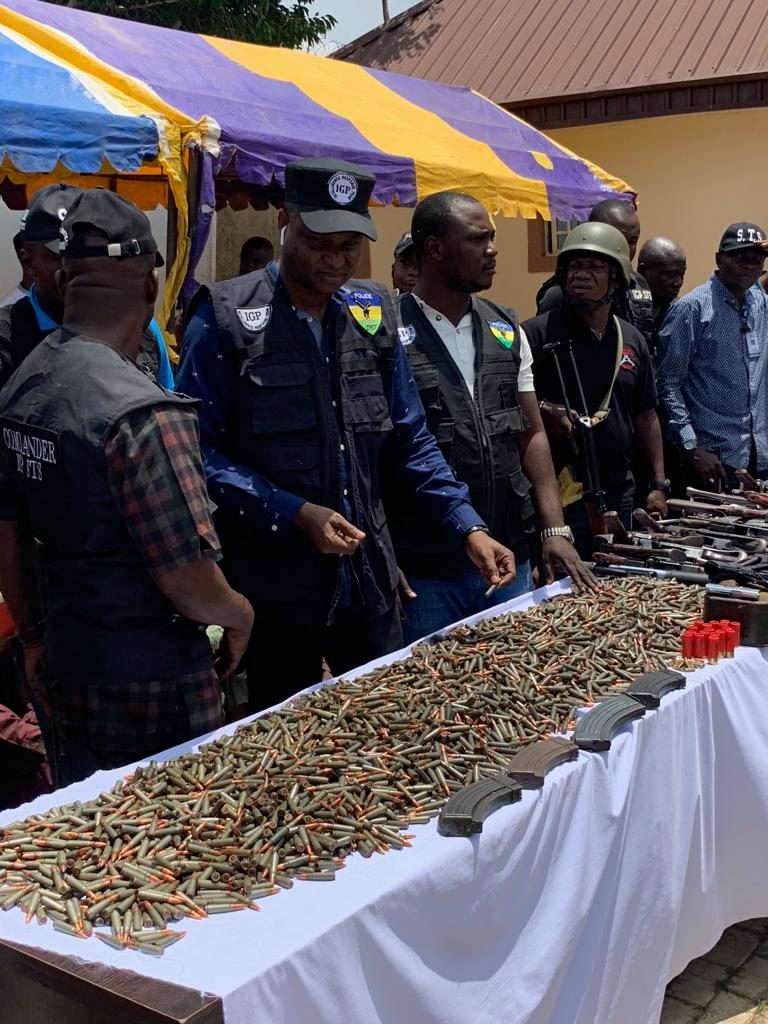
Operation Puff Adder: Police arrests suspected kidnappers with 6,000 live ammunition, 20 AK47 rifles

THE Nigerian Police on Monday says it has arrested arms syndicate who are notorious for smuggling weapons into the country from North Africa, Burkina Faso and Benin Republic. 
Police spokesperson, Deputy Commissioner of Police (DSP) Frank Mba, disclosed this in Abuja after parading 38 suspected persons accused of kidnapping, armed robbery and gun racketeering.
“They conceal the weapons inside hide and skin, second-hand clothing and yam flour,“ says Mba.
The Police launched Operation Puff Adder in April followings incessant attack along the Abuja-Kaduna express road
He told the newsmen that the suspects were arrested by police operatives attached to the Special Tactical Squad (STS) and Intelligence Response Team (IRT).
According to him, 20 AK47 rifles, 11 dane guns, four pump action rifles, 10 automatic pistols, 6, 000 live ammunition and two vehicles were recovered.
The Police noted that the arrest was in continuation of the Operation Puff Adder recently launched to tackle the security challenges on the Abuja-Kaduna highway.
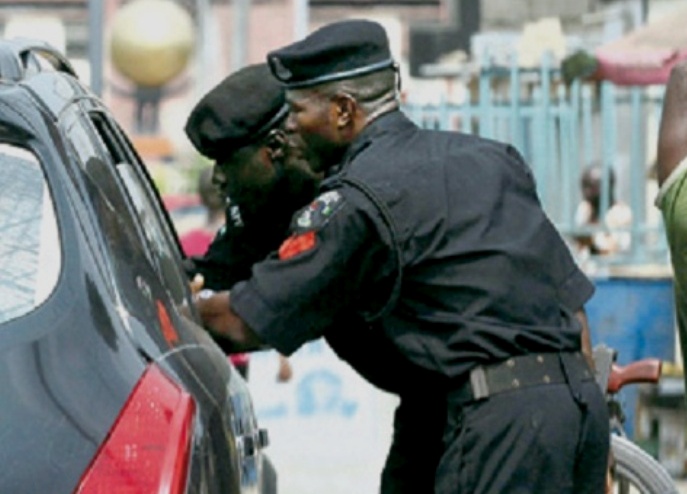
He further narrated how the criminals devised new means of concealing weapons inside toys, stressing the need for members of the public to bear with the police when carrying thorough checks on vehicles.
“When you see policemen checking items like that please don’t blame them,” says Mba.
However, one one of the suspects who spoke to newsmen during the briefing said he had killed several kidnap victims who failed to pay ransoms.
The Police eventually said that the suspects would be charged to court after investigation.

AFRICMIL urges ICPC to investigate alleged corruption in YABATECH

THE African Centre for Media and Information Literacy (AFRICMIL) has called on the Independent Corrupt Practices and other related Offences Commission (ICPC) to probe the allegations of financial crimes and other acts of corruption at Yaba College of Technology, Lagos State.
A statement signed by Chido Onumah, Coordinator of AFRICMIL, said the allegations of massive financial malpractices were contained in a petition dated May 5, 2019, sent to the anti-graft agency by one Joseph Akeju, a victimized whistleblower and former bursar at the institution.
Onumah said the sum of N1,682,085,539  was allegedly stolen by some staff of the College between 2008 and 2014.
“The petitioner,” Onumah said, “discovered that such a huge sum of money had disappeared when he served as the chairman of a seven-man committee on the review of audit report on students’ accounts set up in 2016 by the College management.”
Besides, there were numerous dubious transactions in which the College’s Zenith Bank account No: 1010243958 was used as the conduit, as well as the persistent sale of College certificates by a syndicate in the College registry, according to the petition.
Onumah noted that all efforts by the whistleblower to make the current governing council headed by Prince Lateef Fagbemi SAN address the issue of fraud and other malpractices in the institution were rebuffed.
“Instead of listening to Mr. Akeju and commending him for doing a good job, the governing council turned the heat on him.
He suffered all kinds of abuses which culminated in his illegal dismissal in March 2018, just a few days to his official retirement from the public service,” Onumah said.
He said the ICPC has a duty to not only begin an immediate investigation into the whistleblower’s petition, but also to ensure that those who report wrongdoings, as  Akeju has patriotically demonstrated, deserve safety and full protection from high-handed government officials whose only interest is to cover and perpetuate corruption.
“That is the only way government can encourage citizens to adopt whistleblowing as a viable tool for fighting corruption,” Onumah noted.
According to him, the whistleblower’s dismissal should be reversed, and he should be allowed to retire honourably, while all those found culpable in the large-scale fraud and financial violations at YabaTech should be identified and punished accordingly.

Police reform: Buhari Panel recommends creation of state police, dismissal of 37 officers

THE Panel on the reform of the Special Anti-Robbery Squad of the Nigerian Police has recommended the dismissal of 37 police officers, and also directed the Inspector General of Police, Adamu Mohammed to unravel the identity of twenty-two officers involved in the violation of the human rights of innocent citizens.

The panel has also recommended the establishment of the state and local government police, as well as strengthening information and communication technology of the force.

Anthony Ojukwu, executive secretary of National Human Rights Commission who headed the panel set up by President Muhammadu Buhari in August 2018 submitted its report on Monday in Abuja to the president. 

The panel, whose membership was constituted by the National Human Rights Commission, was empowered to make recommendations on how to hold police officers found wanting accountable, and also, on how SARS and the larger Nigeria Police Force could be properly reformed.

The report noted that it received  113 complaints across Nigeria. After the complaints were investigated, the panel arrived at the conclusions and recommendations.

“The panel called for and received 113 complaints on alleged human rights violations from across the country and 22 memoranda on suggestions on how to reform and restructure SARS and the Nigeria Police in general,” Ojukwu said.

“At the end of its public hearing and having listened to complaints as well as defendants and their counsel, the Panel recommended thirty-seven 37 Police officers for dismissal from the force.”

The panel also recommended 24 officials for prosecution.

It also directed the Inspector General of Police to unravel the identity of twenty-two officers involved in the violation of the human rights of innocent citizens.

The report added that the 22 officers were to pay compensation for various sums and tender public apologies, as well as to obey court orders due to their abused of the citizens’ right.

The panel also directed the police to immediately arrest and prosecute two retired senior police officers found to have violated the rights of citizens (one for extra-judicial killing and the other for the illegal takeover of the property of a suspect). The Panel also recovered two vehicles illegally auctioned by SARS officers and returned them to their owners.”

Responding to the panel’s report, Buhari directed the IGP and Solicitor General of the federation to implement the recommendations within three months.

He told the police at all times to act within the ambit of the law and not to violate the fundamental human rights of Nigerians whom they had sworn to protect.

“…Police while also ensuring that we keep them in check, protect the human rights of Nigerians, and ensure that offending officers are held fully accountable,” Buhari tweeted.

Nigerian police have usually been alleged of human rights violation. On March 31, a young man named Kolade Johnson was shot dead by some police officers when he had gone to watch a football match.

Also on April 12, a trending video displayed sars operatives beating a young man to a pulp for “refusing to unlock his mobile phone”.

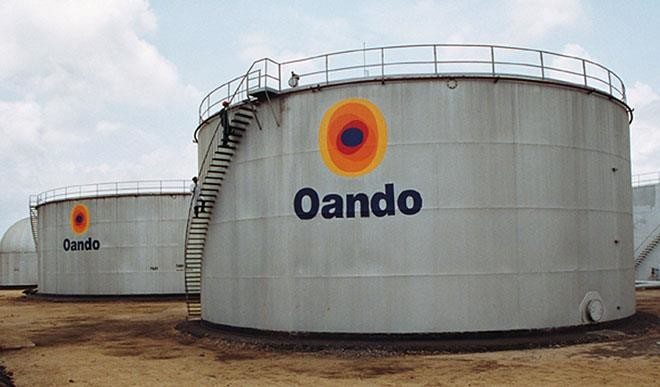
Oando,SEC disagree as police seals Oando’s headquaters

FOLLOWING the Securities and Exchange Commission’s conclusion of its investigation into the financial irregularities by Oando PLC, it announced an interim management team led by Mutiu  Sunmonu to take over the helm of affairs that would subsequently appoint a substantive management team. 

In its announcement via its Twitter handle on Monday, the commission implemented its earlier directive by appointing Mutiu  Sunmonu to take over the management of the oil firm after over – deducting withholding tax from dividends paid to shareholders amongst other tax infractions.

Withholding tax is an informal tax that is usually deducted from fees to be paid by a company that engages the service of another company.

SEC had announced the conclusion of the investigation on Oando PLC and ordered the Group Chief Executive Officer of the company, Wale Tinubu, and other affected board members to resign.

It also barred Tinubu and the Deputy Group Chief Executive Officer of the company, Omamofe Boyo, from being directors of public companies in the country for a period of five years.

In a statement issued by the commission, it stated that an extraordinary meeting to announce the appointment of new directors into the board of the company should take place on or before July 1, 2019.

In response to SEC’s decision, Ayotola Jagun, on Monday in a tweet on behalf of the company conveyed its stand on the issue urging the public to disregard the decisions of apex capital market regulator.

It affirmed that SEC was embarking on a smear campaign to damage the reputation of the company  saying “the alleged infractions and penalties are unsubstantiated, ultra lies, invalid and calculated to prejudice the business of the company.”

However, on Monday policemen had stormed Oando’s Wing Office Complex located at Ozumba Mbadiwe Avenue, Victoria Island, Lagos State denying the staff access to their offices at the directive of SEC.

The share price of Oando Plc also experienced a decline by 9.52 per cent in early trading on the Nigerian Stock Exchange, NSE, after the Securities and Exchange Commission, SEC, published its findings on Friday.

Labour, groups urge Lalong to discard bill seeking to privatise water sector

THE Amalgamated Union of Public Corporations Civil Service Technical and Recreational Services Employees (AUPCTRE) and the Environmental Rights Action/Friends of the Earth Nigeria (ERA/FoEN), on Monday urged Simon Lalong, the Plateau State Governor, to discard the Plateau State water sector law passed by the State Assembly.

The coalition argued that Plateau State residents had repeatedly rejected attempts to privatise the water sector in the state, stressing that such law would prohibit democratic control of water resources.

Members of the State Assembly, last week approved the bill after a report of the House Standing Committee on Parastatals was read by Hon. Godfrey Langdip, to the House. He claimed that the bill would foster adequate water provision to the people despite public agitations.

In a statement issued by Philip Jakpor, Head, Media and Campaign, ERA, in Abuja the groups frowned at how the lawmakers hurriedly passed the law in spite of popular aversion to its Public-Private Partnership (PPP) provisions.

According to the statement, Article three sub-section 1 (p) of the bill seeks to promote PPP principles in the development and management of water resources in Plateau.

But AUPCTRE and ERA/FoEN countered this in a joint statement, describing the passage as a betrayal of trust that Plateau citizens reposed on the lawmakers to defend them against ‘oppressive forces’. They urged Governor Lalong not to append his signature to the bill.

“We are not only dismayed with this news; we feel the Plateau State House of Assembly just gifted the citizens of the state a bad law that will mortgage their future and tie them to the loins of for-profit only entities. We reject the PPP in its entirety,” says Comrade Benjamin Anthony, AUPCTRE National President.

“The PPP privatization model in the water sector has failed in virtually all countries of the globe where it was introduced…..what we want the state government to do is to avoid worsening the already tensed security situation in the state through a denial of their fundamental right to a free gift of nature.”

Anthony insisted that the solution to the Plateau State water crisis, just like that of other states of the federation, requires the prioritizing of the rights of the people far above private interests.

Akinbode Oluwafemi, ERA/FoEN Deputy Executive Director, described the development as the height of insensitivity. He also tagged the enacted law as ‘anti-people’.

“The PPP experiment that the Plateau State government is planning to embark on will only lead to poor water quality, job losses, hike in water prices and poor service. It has happened elsewhere and will not be different here,” says Oluwafemi.

“The Governor must side with the people by not appending his signature.”

Meanwhile, on April 16, a public hearing was held on the bill where the proposed bill was reportedly rejected by the Civil Society Coalition for Good Governance and a host of the grassroots group. Rather, they canvassed support for public control and sustainable budgetary allocation to the water sector.

The groups appealed to the Plateau government to fully uphold human rights to water as an obligation of the government, representing the people and integrate broad public participation in developing plans to achieve universal access to clean water.

“The Plateau State government must build the political will to prioritize water for the people by investing in the water infrastructure necessary to provide universal water access. This will create jobs, improve public health, and invigorate the Plateau economy”.

Buhari offers more money to military in four years, but security grows worse

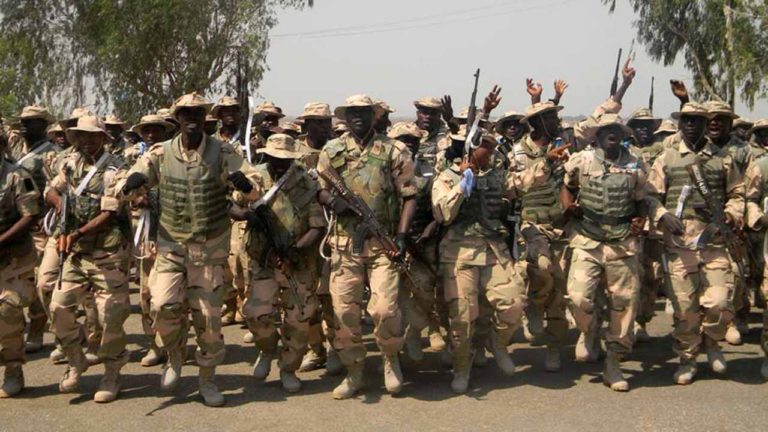
THE Nigerian military’s total spendings rose by 137 per cent between the four-year term of the former President Goodluck Jonathan and the first term of President Muhammadu Buhari.

According to the data obtained by The ICIR from the Office of the Accountant General of the Federation (OAGF). This implies that the military during the first four years of President Buhari received more allocation than the last four years of ex-President Jonathan with a difference of N109, 106,256,894. 

Also, the military capital releases during Buhari’s first tenure increased by 128.52 per cent compared with Jonathan government.

Spendings on capital expenditure between 2011 and 2014 amounted to N79.54 billion, whereas the total capital budget for the military between 2015 and 2018 is N188.65 billion.

But, despite this rise in military spending during Buhari’s first tenure, the increased allocation has an inverse relationship with the level of security in the country.

Curiously, the data shows that the more the government spends on arms and ammunition, the more widespread are the incidents of restiveness across the nation.

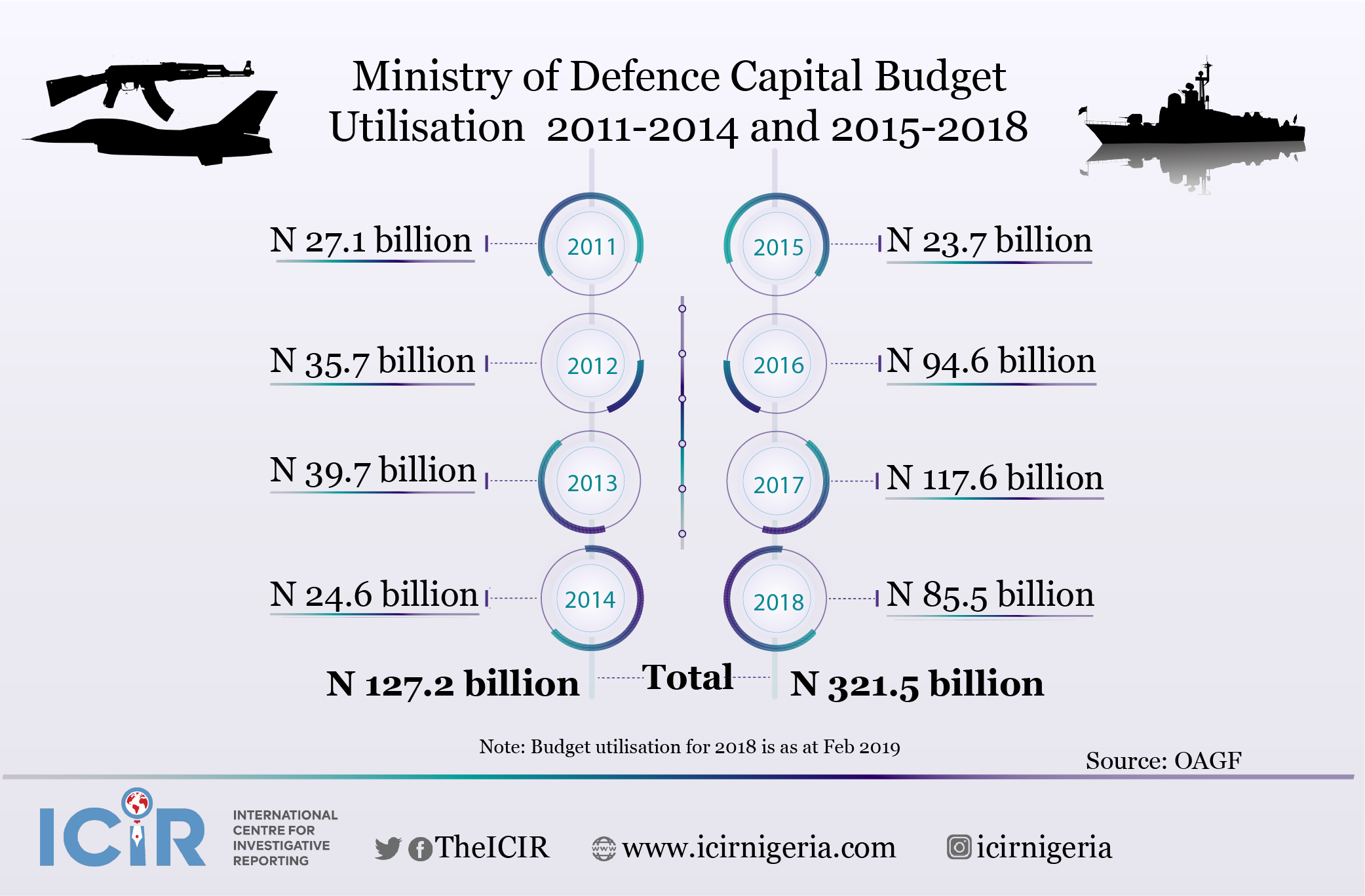
The budget of the Federal Ministry of Defence also rose significantly within the period. From 2011 to 2014, the defence ministry got N132.3 billion and spent N127.2 billion, whereas the ministry received an allocation of N334.75 billion and spent N321.5 billion between 2015 and 2018.

Years of increased budget releases, full utilisation

The breakdown of the budget showed that for the past four years of President Buhari, the military spent a total of N17.19 billion (2015), N61.67 billion (2016), N61.24 billion (2017) and N48.55 billion (2018) as at February 2019.

In 2015, the joint military – Nigerian Army, Navy and Air Force got an allocation of N21 billion as capital budget. Similarly, in 2016, the military got N69.71 billion. In 2017, it was N80.72 billion and in 2018 the entire military got a total approved capital budget of N91.73 billion.

Therefore, the total approved capital budget amounts to N263,601,055,203 during Buhari years while total releases for the period was N188,649,423,842.
Within this period, the Nigerian Army actually utilised N52,513,106,071; the Navy, N53,881,122,409 while the Nigerian Air Force spent N82,255,149,858.

However, from 2011 to 2014, the Nigerian Army utilised N21.92 billion, the Nigerian Navy spent N36.19 billion while the Nigerian Air-force utilised N21.43 billion.

Between 2015 and 2018, the Federal Ministry of Defence had a total release of N334.75 billion and utilised N321.58 billion.  Its approved capital budget for the period was N464.57 billion.

However, from 2011 to 2014, the Ministry received a total release of  N132.33 billion and utilised N127.27 billion.

This breakdown shows that President Buhari spent far more on the military than his predecessor.

Timeline of Killings

Despite the increased allocation to the Nigerian military, insecurity in the country steadily has been on the rise.

Nigerians are repeatedly worried on the visibly declining security situation, ranging from kidnappings to killings, aside from the contending Boko Haram insurgency.

More often than none, attacks occur in different parts of the country.  In Zamfara State, for instance, a BBC report, identified 262 civilian deaths in the first 100 days of the year.

Mid-last year, former Senator Sa’idu Dansadau made a claim that about 3,000 people were killed in Zamfara State, with 2, 076 farms destroyed within two years. The ICIR has not confirmed this.

On the night of 31st December 2018, Kashim Shettima, the former Borno State Governor held an extraordinary security meeting on what he perceived as worsening security situation in the state.

On 5th April, 50 people were reportedly killed as claimed by Sanusi Rikiji, Speaker of the Zamfara State House of Assembly, speaking during a condolence visit to Kaura Namoda Emirate.

BBC Hausa reported on 2nd May, how suspected gunmen also attacked Government Girls Secondary School, Moriki, Zuru Local Government Area of Zamfara, abducting teachers and girls.

The kidnapping came five years after Secondary School girls were abducted by the Boko Haram insurgents in North East Borno State.

Miss Faye Mooney, a British national was killed by bandits in Kaduna state, adding to several other gory incidents that have generated much public anxiety recently.

On 5th May, gunmen at the early hours of Sunday kidnapped Mrs Suzzy Nathan, Permanent Secretary of the Taraba State Ministry of Water Resources, from her home. The height of the situation was a declaration by the Daura Emirate of its resolve to suspend Sallah celebration in the President’s home town.

Lawmakers, Traditional ruler reacts 

Worried over the insecurity situation, Abdulmumini Kabir, the Emir of Katsina, reiterated the need to proffer a lasting solution to the continuous killings and kidnappings.

“What are you to gain by killing, kidnapping people? It’s very unfortunate. I have not seen this kind of country; how do we live like animals? Three days ago Magajin Gari (of Daura emirate council) was abducted, nobody is safe now, whether in your house or road, wherever you are,” says the emir “What we want you to do for us is to stop the fight. Many people have deserted, abandoned their farms in fear of kidnapping and killings and other atrocities, it’s very unfortunate.”

Recently, the lawmakers summoned the President who was apparently away in London, to meet before it to explain reasons for the reoccurring insecurity.

This is coming less than a month member of the National Assembly (NASS) invited the president over the insecurity situations.

Despite this intervention, killing is yet to abate in several parts of the country. And these tragic occurrences have made it difficult for Buhari administration to justify the rising military spending.

Gwarzo: Aggrieved SEC union protests reinstatement of DG, locks headquarters

THE Security and Exchange Commission has been shut down by its workers’ union to prevent the reinstatement of its suspended Director-General, Mounir Gwarzo who was accused by the Independent Corrupt Practices and Other Related Offences Commission (ICPC) of fraud and abuse of office.

The Association of Senior Civil Servants of Nigeria, on Monday reportedly locked-up the offices of the headquarter in Abuja to prevent the former DG’s reinstatement.

Gwarzo was suspended by the former Minister of Finance, Kemi Adeosun in November 2017.

Shortly after Adeosun suspended Gwarzo over multiple financial improprietiesa leaked memo emerged in the media detailing how both officials had sparred over a decision by SEC to go ahead with a probe into the activities of Oando Petroleum Plc but the former minister claimed Gwarzo’s suspension was not as a result of the probe, she alleged that the former DG had tried to blackmail her.

He was formerly indicted over alleged abuse of office and corruption in a probe carried out by a panel headed by Mahmoud Isa-Dutse of the Federal Ministry of Finance.

However, an industrial court in Abuja last Thursday acquitted Gwarzo and dismissed the three issues raised against the embattled DG and ordered his immediate reinstatement.

Obi, former NIMASA boss, jailed for seven years over N136 million fraud

FORMER Acting Director-General of the Nigerian Maritime Administration and Safety Agency (NIMASA), Calistus Obi, has been sentenced to imprisonment for seven years, the News Agency of Nigeria has reported.

The sentence was pronounced on Monday by the Federal High Court, sitting in Lagos, in connection with an eight-count charge of fraud to the tune of N136 million.

He was arraigned by the Economic and Financial Crimes Commission (EFCC), which had alleged that the offence was committed in August 2014.

The commission said Obi and a former NIMASA employee, Alu Dismas, conspired to unlawfully appropriate property belonging to the agency knowing full well that they are proceeds of stealing, in violation of the 2012 Money Laundering Prohibitions Act.

Rotimi Oyedepo in an earlier trial said the evidence shows that funds were transferred to Obi and were used for personal purposes.

The former acting DG was convicted on Thursday, May 23, but the court deferred sentencing to a later date.

Obi was appointed acting DG in July 2015 following the sack of Ziakede Patrick Akpobolokemi by the federal government.

Meanwhile, Haruna Jauro, another former NIMASA acting DG is also facing trial at the Federal High Court in Lagos. He was charged in 2016 alongside other defendants with 19 counts of converting N304 million belonging to the agency. He closed his defence in May and the court adjourned to June 20 for the adoption of final addresses.

Patrick Akpobolokemi, Obi’s predecessor has been arraigned before the court by the EFCC on 12 counts including conspiracy, forgery, and stealing N687 million.

Nearly 30,000 teachers to take TRCN’s professional qualifying examination

THE Teachers Registration Council of Nigeria (TRCN) says about 30,000 Nigerian teachers are going to write its  Professional Qualifying Examination (PQE) slated to hold between June 7 and 8 in 50 centres across the country.

Registrar of the Council, Josiah Ajiboye, disclosed this in Abuja while interacting with journalists on the planned professional qualification examination.
‎“About 30,000 would-be teachers across the states of the federation and the FCT have registered for the examination,” Ajiboye said.
“The examination would hold between June 7 and 8 in all the states of the federation and the FCT. In states like Bauchi, Kaduna and Kano the examination will begin  on Friday, June 7 because of the large number of candidates.”
The registrar said the Professional Qualifying Examination had become one of the benchmark processes for registering professional teachers in Nigeria.
According to him, the PQE was introduced in October 2017 noting that the forthcoming one would be the fourth in the series.
“One of the aims of the examination was to get the teachers prepared technologically in the 21st century.
“It has provided a big experience for us because when we started, many people who took the exam were not computer literate, and that accounted for the large number of failure in the first exam in 2017,” he said.
He said TRCN has achieved the target of getting teachers inclined to computer appreciation, adding that 83.2 per cent passed the exams across to the country.
Ajiboye reiterated that the deadline for flushing out unqualified teachers from the classroom remains December 31, 2019, noting that the deadline has made the council to record an increase in the number of people going to take the May diet of the PQE.
“In the first PQE, we had like 16,000 candidates. In October 2018, we had 22,000; this year we have recorded the highest number.”
“Presently, we have registered about 30,000 candidates.”
“By January 2020, we are going to begin our enforcement and we may likely start from the private schools because our mandate covers both the public and private schools.
“We have more than 80 per cent compliance from public schools, but the major problem we have is private schools.”