Home Blog Page 2361

Court remands six over JAMB’s N35million allegedly swallowed by snake

Philomena Chieshe and five other officials of Joint Admission and Matriculation Board on Friday were incarcerated by a High Court in Maitama, Abuja, over their involvement in the missing N35m from the sale of JAMB e-cards in Makurdi, Benue State.

The Economic and Financial Crimes Commission had previously arraigned her and others on eight counts bordering on refusal to account for the Board’s money between 2014 and 2016.

Justice Peter Afen, who presided over the case ordered that the defendants be remanded in the custody of EFCC pending the outcome of their bail application.

The case has been adjourned until Monday, June 3, for the hearing of their bail application.

EFCC alleged that Chieshe, a sales clerk with JAMB, told JAMB investigative panel that she could not give account for the money she made in previous years before the Board stopped the sale of scratch cards.


READ ALSO:

However, she had claimed that the money was swallowed by a snake. She said her housemaid had conspired with another JAMB employee, Joan Asen, to steal the money from the vault in the accounts office through voodoo.

According to the EFCC, the actions contravened Section 139 (a) of the Penal Code Law.

Chieshe was arraigned alongside Samuel Umoru, Yakubu Jekada, Daniel Agbo, Priscilla Ogunsola, and Aliyu Yakubu.

The accused persons pleaded not guilty to the allegations.


Alanamu, former ICPC board nominee dropped after ICIR’s report, convicted of bribery


A FORMER chairman of the Governing Council, Kwara State Polytechnic, Sa’ad Alanamu, has been convicted of bribery and sentenced to 12 years imprisonment.

Rasheedat Okoduwa, spokesperson of the Independent Corrupt Practices and other related Offences Commission (ICPC), disclosed this in a statement made public on Friday.

Also sentenced alongside Alanamu was Salman Sulaiman, director of Namylas Nigeria Limited, who was found guilty of giving a bribe.

The Attorney-General of the Federal filed an eight-count charge against Alanamu in September 2017 at the Kwara State High Court. He had been nominated the previous month, among 13 others, by Vice President Yemi Osinbajo into the board of the ICPC.

But an exclusive report by The ICIR showed that Alanamu and Maimuna Aliyu, another nominee, were being investigated by the same agency for alleged acts of corruption and were soon to be prosecuted. Alanamu was facing probe for abuse of office while he was head of several institutions in Kwara State.

It was likewise exclusively reported that the federal government failed to run security checks on the nominees before their names were announced. A source had told the Centre that the appointees were simply picked “from a long list of names that had piled up in the two years that the Muhammadu Buhari government came into office”. Such appointments were often used to reward party faithful.

After the publications, the vice president stepped down the nomination of the two individuals “who have ongoing investigation issues with the commission as this presents a conflict”. A month later, Alanamu was formally charged for receiving bribes.

He was accused of collecting N5 million from Sulaiman, a contractor-friend, as bribe for a contract awarded. The ICPC discovered that the company, Namylas Nigeria, had submitted doctored documents while bidding.

Alanamu was also accused of awarding  N182 million contract for the construction and furnishing of an auditorium in Kwara State Polytechnic to a friend’s company though it lacked the capacity to execute it.

The trial judge, Mahmud Abdulgafar, found Alanamu guilty of the charges and sentenced him to seven years imprisonment on the second and third counts, as well as five years with hard labour on counts one, four, and five, with no option of paying fine. The sentences are to run concurrently, he noted.

The Honourable Justice also ordered he pays N25 million, in complying with the ICPC Act that mandates a public officer found guilty of receiving gratification to forfeit the bribe and “pay a fine of not less than five times the sum of the value of the gratification”.

Update: Nine witnesses to testify against Naira Marley, EFCC says

THE Economic and Financial Crimes Commission (EFCC) says nine witnesses would be presented in its case against the up-and-coming musician, Naira Marley.

THE PUNCH reports that the witnesses would give an evidential account to the law court; “three of the witnesses were said to have taken the defendant’s and witnesses’ statements

“The remaining are representatives of Mastercard, Visa Inc and Guaranty Trust Bank, who are expected to tender relevant card and account details of the defendant to the court.”

Naira Marley was arrested with three others on alleged cybercrime and identity theft.

He was later arraigned before Justice Nicholas Oweibo of the Federal High Court, Ikoyi, Lagos.

He was yesterday May 30  granted bail worth N2million with two sureties in the same like.

The charges with suit number FHC/L/178C/19 were filed before a Lagos State High Court.


Francis Johnson, PENGASSAN President dies

Current President of the Petroleum and Natural Gas Senior Staff Association of Nigeria, PENGASSAN, Francis Johnson, is dead.

Johnson, who was the current president of PENGASSAN, died early Friday morning after failing to recover from a protracted undisclosed illness.

After his election as President of the petroleum union in 2014, he had advocated for reforms in the petroleum industry calling for the passage of the Petroleum Industry Bill, PIB, and the need to separate the Ministry of Petroleum Resources from the Presidency for the effective operation of the ministry.

An employee of the Nigerian National Petroleum Corporation, NNPC, Johnson was re-elected for a second term of 3 years that would have terminated in 2020.

He was first elected as the President of Petroleum and Natural Gas Senior Staff Association of Nigeria (PENGASSAN) on June 2014, and was re-elected in 2017 at the association’s fifth Triennial Delegates Conference, TDC, held in Abuja after defeating two other contestants: Mohammed Saleh and Emmanuel Eze.

Amnesty International launches 8-point human rights agenda for Nigeria

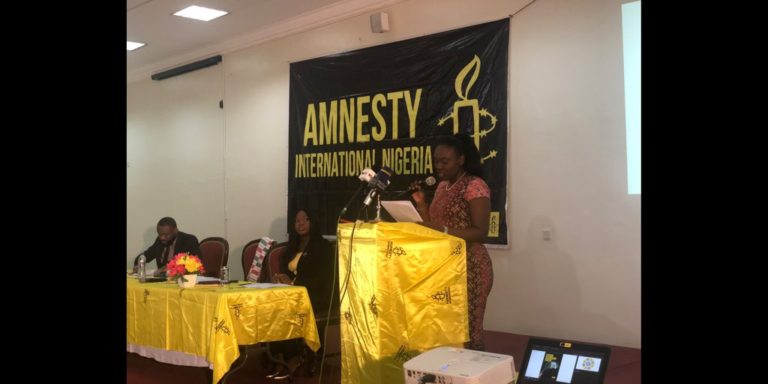
FORTY-EIGHT  hours after the inauguration of President Muhammadu Buhari for his second-term of four years in office, the Amnesty International has set an eight-point human rights agenda for his administration.

In the document, Nigeria: Human Rights Agenda, launched in Abuja on Friday, Amnesty International said the inauguration of president  Buhari on 29 May, presents an opportunity for the incoming administration to demonstrate its oft-stated commitment to human rights and undertake urgent and concrete actions to strengthen their promotion and protection in Nigeria.

It explained that the document appraises the human rights situation in Nigeria and provides information regarding cases of human rights violations and abuses across the country.

While noting that the Nigerian Constitution of 1999 (as amended) in Chapter IV contains provisions on human rights and Nigeria has ratified several international and regional human rights treaties, the organisation lamented that the country is plagued with decades of human rights violations and abuses perpetrated by state and non-state actors respectively.

Amnesty International said it has documented many and various forms of human rights violations and the victims continue to lack redress.

“As the new administration takes office for a 4-year term, Amnesty International is recommending some concrete measures to ensure that human rights are better respected, protected, promoted and fulfilled in Nigeria,” it said.

“In this regard, Amnesty International calls on the new administration to: 1. End all forms of violence against women and girls, 2. Protect the rights of children, 3. Ensure accountability for the Niger Delta clean-up, 4. Guarantee freedom of expression, 5. End torture, enforced disappearances and extrajudicial executions, 6. Secure Economic, Social and Cultural Rights, 7. Protect the civic space and improve the operating environment for human rights defenders and activists, 8. Abolish the death penalty and commute all death sentences.”

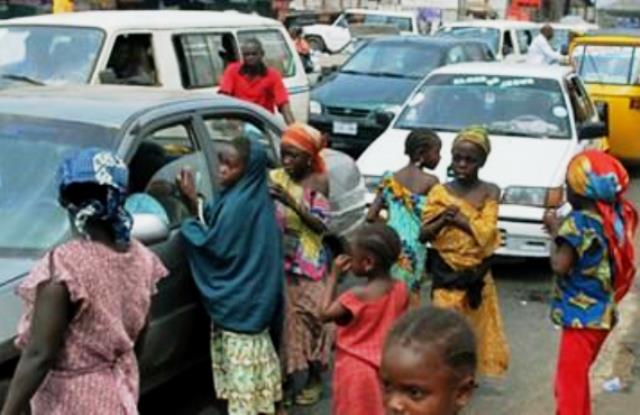
It further noted that the human rights situation in Nigeria is marked by serious human rights violations such as extrajudicial executions, arbitrary arrests and detentions, torture and other ill-treatment, enforced disappearances, violence against women and girls, restrictions on the rights to freedom of expression, association and peaceful assembly, mass forced evictions, environmental pollution and lack of accountability for human rights violations and abuses.

Despite Nigeria’s overwhelming ratification of human rights treaties and commitments at the international and regional level, Nigerians continue to face worsening human rights crisis across the country, Amnesty International said.

It reiterated that the incoming administration of president Buhari can address the perennial human rights violations and abuses in Nigeria, adding that the Nigerian government has clear national and international obligations to promote, protect, respect and fulfil human rights.

“Amnesty International is calling on the Nigerian government to seize this opportunity to end decades of human rights violations and pervasive impunity including by making human rights central to its agenda and ensuring that human rights are not suppressed.”

It emphasised that the government must demonstrate its commitment to human rights by taking concrete actions on the proposed recommendations made as a matter of priority.

“Amnesty International will continue to assess the human rights situation in Nigeria and to call for greater protection of everyone’s human rights,” it concluded.


Nigerian economy is “stuck like stranded truck” under Buhari ─ Economist

THE Economist magazine has described the Nigerian economy under the administration of President Muhammadu Buhari as being “stuck like a stranded truck” where Nigerians became poorer during his first term. 

The magazine, in a report on Thursday, analysed how more Nigerians slipped into poverty under the Buhari’s watch while projecting more misery ahead in his second term that started on May 29.

It stated that the average incomes fell during the four-year period covering 2015 to 2019, Buhari’s first term. The Economist said based on the thinking of the International Monetary Fund (IMF), the average income of Nigerians “will not rise for at least another six years.”

“Average incomes have been falling for four years; the IMF thinks they will not rise for at least another six,” the report read partly.

The magazine said there is “little sign of the kind of export-led industrial revolution that has lifted incomes in Asia.”

“This is not only because the naira is overvalued. It is also because the state has spent decades neglecting basic public goods, like roads, schools and electricity,” it read in part.

Referring to the poverty rate in the country, it said about 94 million people live on less than $1.90 a day (N685), adding that “the number is swelling”.

“By 2030, a quarter of very poor people will be Nigerians, predicts the World Data Lab, which counts such things.”

It said “where urgency is needed, Mr Buhari offers only caution. Few are holding their breath for any more drive in his second term, which began on May 29th.”

The economist frowned at the federal government’s social investment programmes (SIP) which, saying they have not been yielding the needed result.

“Although the government has expanded school-feeding programmes and is working on a safety-net for the poor, most citizens get few benefits from the state,” the report read.

It added that public finances would be healthier if the government raised the price of fuel which is imported by the Nigeria National Petroleum Corporation and sold on at a loss.

In 2018, it said subsidy was worth at least 0.5 per cent of the GDP, relating the amount to equal almost what the government spent on health care.

For Nigeria to prosper, the magazine asked the government to harness the “vim of its 200m citizens.” It said currently the government ignores the population, except when their votes were needed. 

It said Buhari needs to solve the revenue crisis in his second term to reduce poverty ratio in the country.

“Oxfam, a charity, ranks 157 countries on their commitment to reducing inequality, based on social spending, taxes and labour laws: Nigeria comes last,” the report stated, quoting Oxfam report.

Many reports have put Nigeria among countries filled with millions of people that are poor. Theresa May, Prime Minister of the United Kingdom (UK), during her visit to the country in August 2018, recognised Nigeria as the country with the largest number of people living in extreme poverty.

She had said many Nigerians were thriving with some individuals enjoying the fruits of a resurgent economy, “yet 87 million Nigerians live below $1 and 90 cents a day, making it home to more very poor people than any other nation in the world.

Dyslexia:The plight of right brained people in a left thinking world

FROM a distance, it’s hard to notice that nineteen-year Olusile Joy needs any special help. Her inability to comprehend written words has always been a constant source of worry.

She has always thought school is not meant for her because no matter how hard she tried she is unable to fluently read or spell.

Often, she loses her composure whenever she is asked to read a passage from a book in public because previous experiences had exposed her to humiliating taunts from her teachers and classmates.

“I have problems understanding alphabets because I switch letters in my head, for example where you see the letter “B”, I see letter “D” so when I’m reading I pronounce “but” as “dut”. Though I might try to memorise words to pass a test I can’t when you give me the same test two hours later I won’t be able to write it,” she told The ICIR.

The nineteen-year-old lady from Ogun State currently, studying educational planning and administration at Babcock University, Illishan Remo, Ogun State

Joy is dyslexic, a condition that makes it difficult linking letters to form words and recognizing letters.

Several years ago, her parents made drastic efforts to help her correct this disturbing condition since her siblings didn’t have such challenges.

They assigned her to read the daily devotional during the family’s morning prayers while her father encouraged her to read every newspaper he bought, hoping her exposure to words would enable her to read fluently.

“My parents were supportive considering they didn’t put me under pressure to get good grades but provided reading materials for me in text form but it didn’t help me because that was not what I needed. I was interested in books with lots of pictures rather than text and that was what I could relate with,” she explained.

Therefore, their efforts did not yield the desired result. Her teachers in primary and secondary schools would rather use canes to “beat” knowledge into her, a measure that only inspired fear in her rather than encouraged her to learn.

Their excuse was that Joy was lazy and unable to grasp what was taught in class at a speedy rate as she barely escaped coming bottom of her class on a few occasions. However, her grades took a turn for the better after gaining admission into the university.

On how she scaled the academic hurdles in the university, she told The ICIR that she devised methods peculiar to herself to enable her to pass her exams.

“It was difficult for me to cope initially but I had to adopt personal methods on how to study to pass my exams. First, I made YouTube my companion, any topic taught in the class I made sure I got an available video version online to get insight into the topic. If a video of that topic was not available online, I would fall back on a group reading with my friends as they discussed I pay attention. I’m also very attentive in class and brief in writing because I couldn’t spell a lot of words but I try not to use shorthand in writing,” she said.

In her first year in the university, she overheard a lecturer talking about learning disorders and specifically mentioned traits associated with dyslexia.

After listening to the lecturer, she self – diagnosed herself as being dyslexic having lived with all the conditions of dyslexia all her life.

In April, at the prodding of a friend she took three online dyslexia tests and the test results confirmed her initial suspicion. Joy was severely dyslexic.

She then began to come to terms with her new reality after informing the head of her department about her condition.

“My HOD didn’t believe me when I told her because being one of her students with the best Cumulative Grade Point Average, CGPA, in the department she didn’t think I could struggle with reading. Until I recalled instances when she had given me reading tasks to read before the entire class in my first year but I was unable to effectively read without errors,” she told The ICIR.

“My lecturers and some friends don’t believe I can’t spell lots of words, but I’ve decided to speak up because dyslexia is not something to be ashamed of, it’s just a disability,” she said.

Joy is one of the thousands of faceless people suffering dyslexia but not captured by statistics in the Nigerian educational system. Many are students who cannot spell or write with proficiency and has to navigate schools without any support system or drop out.

A silent disability

Dyslexia is a learning disorder that involves difficulty reading due to problems identifying speech sounds and learning how they relate to letters and words.

This condition which medically has no known cure occurs when there is low activity in the left part (hemisphere) of the brain which is responsible for the logical aspect of human thinking which is responsible for reading and word identification. To compensate for this low activity in the left part of the brain they depend on the right (hemisphere) part of the brain to read or write which explains the struggle for dyslexic people.

Dennis Shatima, a neurological paediatrician at the National Hospital, Abuja describes the condition as a silent disability.

“It is a silent developmental challenge, in some children it is majorly detected when it comes to writing and reading, the human brain is interesting such that if you think of something, you can arrange it in a particular way so that it can be understood by another person when it is presented but dyslexic people can’t arrange words, alphabets and figures in their brain,” he said.

He stated that lack of early diagnosis could hinder the progress dyslexic people would have made in managing the disorder.

“When the brain of a dyslexic person is scanned it looks normal but it is the function performed by their brain that differs from others. When it is discovered early it can be managed where they can provide other means of writing for them without doing it in a conventional way. It all depends on the stage at which it is diagnosed,” he said.

A 2017 report on disability gaps in educational attainment and literacy by the World Bank and the Global Partnership for Education showed that literacy among children with learning disabilities was increasing globally. The study showed that children with disabilities were severely excluded from educational policies and therefore lag behind their peers.

The study, conducted in 19 countries, concluded that 3 in 10 children with disabilities have never enrolled in school and just about half of those who do enrol complete primary school.

No relief in public schools

Ben Arikpo vividly remembers the day he acknowledged his son, Femi, (not real name) had a problem with reading.

It was seven years ago, his wife had embarked on a short trip while he was helping his son, Femi, to complete his homework. He noticed that Femi could barely read the work he brought home from school.

“My wife was always telling me before that day that our son couldn’t meet his milestones at school but I was assuring her that he would catch up and he should not be compared to his siblings until I witnessed his lack of progress in reading,” he recalls.

He went to the school the next day and vented his anger on his teachers for their incompetence but they rebuffed his accusations claiming Femi was very hyperactive and playful.

The school could not offer any solution to the problem. After searching for solutions within the country for two years, he had travelled to Germany for a vacation when he stumbled on a brain training programme.

“I took my son’s assessment to them and was told from the results that he had dyslexia, attention deficit disorder with hyperactivity and weak cognitive skills. Though, he was nine years old at the time his cognitive skills were that of a five-year-old,” he said.

He could not afford the costs at the time because the training would take nine months. Since he was on vacation he decided to purchase the franchise for the training after two years of negotiation with the person holding the franchise.

This gave birth to the Dyslexia Foundation of Nigeria which was set up in 2015.

After getting training, he enrolled Femi for the programme and saw significant improvements after the fifth month of the programme.

“At the end of the second term that year I noticed a remarkable turnaround in his grades at school. I came home one day and saw him watching a Yoruba movie and was curious because he doesn’t speak the language and he told me he was reading the subtitles. During the training I withdrew him from every activity in school after closing hour at 2 pm to allow him to concentrate on the training,” he said.

Though official data on the number of children with learning disabilities in Nigeria is non – existent, according to a United Kingdom Department for International Development, DFID, funded survey, Ben decried the non-recognition of people with learning disorders by the government through policies.

“At the moment government’s focus is on people with a physical disability but there is no policy by government to support people with dyslexia or learning disorders even the newly disability act did not make mention of people with learning disorders,” he said.

In a research study carried out by John Ugwu and Ijeoma Adubasim in 2017, published by the Journal for Education and Entrepreneurship using six public primary schools that involved 1,350 pupils,  revealed that one out of every three children in public primary schools in Port Harcourt Local Government Area, Rivers State has a reading problem which is a major pointer to dyslexia.

How to help school children with disability

The high costs of fees charged by these privately -owned special schools and costs of training staff appear to have dimmed the prospects of children of the poor with varying degrees of learning disorders.

The website of Patrick Speech and Language Centre, reveals that a full term costs ₦610,000 while a two hourly session from Mondays to Fridays costs ₦260,000 per term.

Olusola Oluwanuga, a psychiatrist believes a total overhaul of the public health system would enable the government to be able to reach children with learning disorders.

“We need to work harder on our public health system by changing what is obtainable today to revisit the school health policy which was in place many years ago. Then we usually had health workers pay visits to schools to assess the students. They are health personnel designated to a certain number of public schools to monitor and identify the health challenges of students in those schools.

“It is only when this kind of public health system is put in place that the government can properly evaluate mental, psychological and physical conditions of children, especially those from less privileged homes,” she said.

Senate approves N129 billion to offset subsidy debts owed petroleum marketers

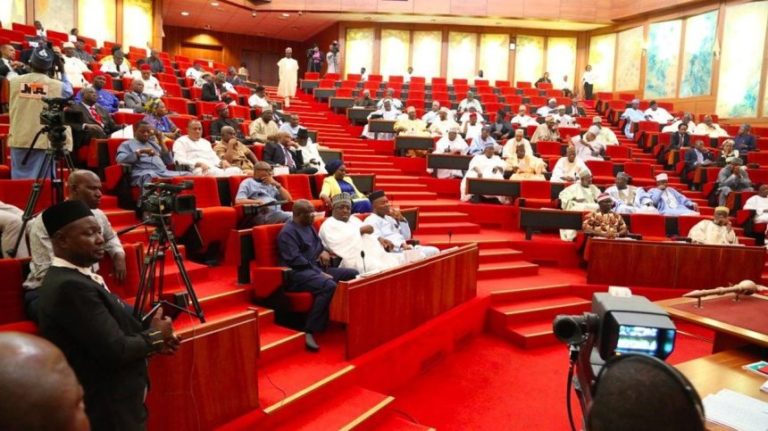
THE Senate on Thursday approved the payments of outstanding subsidy debt of N129 billion owed petroleum marketers in six years for importing refined crude into the country.

The Chairman, Senate Committee on Downstream Sector, Kabir Marafa, had presented to the upper legislative house its report titled “The Promissory Note Programme and a Bond Issuance to settle Inherited Local Debts and Contractual obligations to Petroleum Marketers”.

Moving a motion for the report to be considered, Marafa noted that the said sum of N129 billion was the last payment to 67 petroleum marketers.

“It was first considered on the 31st of May 2018. After submissions made by the ministry of finance we observed as follows that the oil subsidy arrears claims were based on three elements namely; subsidy, forex differentials and bank interests,” he said.

He explained that the committee had spotted areas that should address the debts owed the marketers.

“The recent claim is based on one of the identified elements that are the forex differentials. It is pertinent to note that this is that last tranche of payment.

“The committee after due consideration [recommends] that the Senate approve the sum of N129 billion as final subsidy arrears claim,” he said.

Victor Umeh, senator representing Anambra central, wondered the next line of action after the sum has been paid which is what should happen to proceeds from crude oil after paying off the subsidy debts.

The Deputy Senate President, Ike Ekwerenmadu, who presided over the proceedings praised the committee and thanked them for their hard work.

The fund was approved after it was put to a voice vote by Ike Ekweremadu, deputy senate president.

Meanwhile, the Senate adjourned till June 6 for its valedictory session.

Ethiopian Airline confirms turbulence, says ‘go-around’ in agreement with safety standard

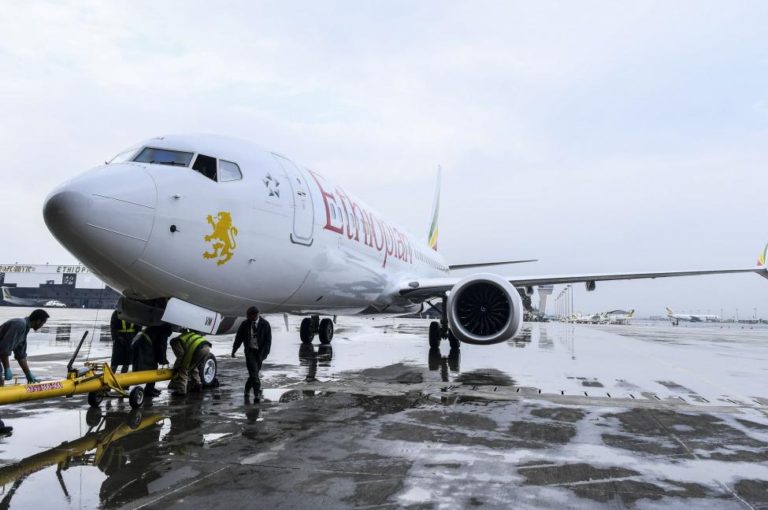
Following a widespread panic on a nearly-escaped  Boeing 737-300 crash, the Ethiopian Airline has confirmed the turbulent landing as a go-around executed for a better and smooth landing.

Firihiewot Mekonnen, the General Manager, Ethiopian Airlines, Nigeria confirmed on Thursday that its aircraft had departed from Addis Ababa on its way to Lagos, when it encountered bad weather during landing at the Murtala Muhammed International Airport (MMIA), Lagos on Wednesday.

The flight had on board the former head of state, Olusegun Obansanjo and 393 other Nigeria.


READ ALSO:

She said such decisions by the pilot was in consonance with the safety standards of the industry, as pilots are encouraged to make similar go-around in such cases.

Mekonnen said the plane made a safe and normal landing at the second attempt.

In an exclusive interview with PREMIUM TIMES, Obasanjo narrated his ordeal,

“I was on Ethiopian Airline. Rain just came down heavily.

“The pilot thought he could land. And he landed. He touched down. But I think he took a swift decision that he had to take off again.

“So he took off. If he did not, I think he probably would have overrun the runway. He then apologized and said he would try to land again. He tried again, and we landed safely. And we all clapped.” Obasanjo said.

The former Nigeria president was returning from a stakeholders dialogue on continental trade and implementation of the African Continental Free Trade Agreement (AFCFTA) which ended on Tuesday in Addis Ababa.

Obasanjo, and 393 other Nigerians, reportedly escaped death on May 29 on an Ethiopian Airline at the Murtala Mohammed International Airport. The News Agency of Nigeria, (NAN) said.

Report states that passengers on board included prominent Nigerians such as Ambassador Ayoola Olukanni, Director General of Nigerian Association of Chambers of Commerce, Industry, Mines and Agriculture (NACCIMA).

Also, Prof Samson Tunde Adebayo, the Director of Ports Inspection, National Agency For Food And Drug Administration And Control (NAFDAC) and other nationals were included.

The passenger aircraft, ET-901, had departed the Bole International Airport, Addis Ababa, at about 9:10 a.m., Ethiopian time; 7 a.m Nigerian time.

There was no casualty reported in the incident.


Sanwo-Olu signs executive order on refuse dumping, traffic management

LAGOS State Governor, Babajide Sanwo-Olu, has signed an executive order on indiscriminate refuse dumping and traffic management and public works in the state.

Sanwo-Olu also declared a state of emergency on the matters while signing his first executive order on Thursday at the Lagos House, Alausa, Ikeja.

He said the process would restore stability and a culture of accountability in which all the citizens become active stakeholders in bringing about the necessary changes.

The governor announced that  Lagos State Transport Management Authority (Lastma) officials would immediately begin work on a shift basis in which road and traffic management operations would be on till 11 pm every day.

Many people have lamented on how several places are characterised by dirt in Lagos. A report noted how almost every street and bus stop in Lagos is filled with refuse.

According to Sanwo-Olu on Thursday, Lagos State residents have been warned against indiscriminate dumping of refuse. “As from the date of this order, there shall be zero tolerance for environmental abuse, including illegal and indiscriminate dumping of refuse, construction on drainage points and setbacks,” he said.

The governor asked Lastma officials to effectively carry out their functions by ensuring strict enforcement and compliance with all extant traffic rules and regulations.

To reduce gridlocks on Lagos road, Sanwo-Olu said that the State Public Works Corporation would immediately commence the identification and repairs of all potholes and bad roads within the state.

The governor also said provisions of the order would extend to all enforcement agencies in the state, in maintaining law and order for the collective good of the citizens.

“I expect the fullest level of compliance with this order and will look to the various heads of ministries, departments and agencies to give full force and effect to the orders therein contained and to take responsibility for any failure,” he said.