The Nigerian Air Force says it has launched another round of “devastating airstrikes against Boko Haram and inflicted heavy casualties on the dreaded terrorist group
This was contained in a statement issued on Saturday by the NAF spokesperson, Ibikunle Daramola, an Air Commodore, who said the insurgents were fleeing from air bombardments by the Niger and Chadian Air Force when they “met their Waterloo with the Nigerian Air Force”.
“The Air Task Force (ATF) of Operation LAFIYA DOLE has inflicted heavy casualties on Islamic State of West Africa (ISWAP) elements in devastating air strikes conducted at Tumbun Hamma on the fringes of Lake Chad yesterday, 24 May 2019,” the statement read.
“The attack was conducted following credible intelligence reports indicating that the terrorists, who had fled the series of air strikes conducted by Nigerian, Nigerien and Chadian Air Forces, around the Malkanori-Tumbun Rego general axis of northern Borno State, had converged in Tumbun Hamma.
“The attack was preceded by series of Intelligence, Surveillance and Reconnaissance (ISR) missions which confirmed heavy presence of terrorists in several structures, along with their logistics items, spread across the small settlement.
“Accordingly, the ATF scrambled an Alpha Jet aircraft to attack the location, recording a successful direct hit in the centre of the target area leading to the neutralization of several terrorists as well as the destruction of their structures and logistics.
“The NAF, operating in concert with surface forces, will sustain its operations to completely degrade the terrorists in the Northeast.”
The Nigerian military has maintained that Boko Haram has been technically defeated, however, reports show that while the insurgents no longer control territories like they did in the past, they are still very active and carry out regular attacks against military and civilian objectives in the North East region of the country which has remained their stronghold.
One soldier was reportedlykilled while three others were injured when a Boko Haram attacked a military base in Gubio, Borno State on Sunday, May 19.
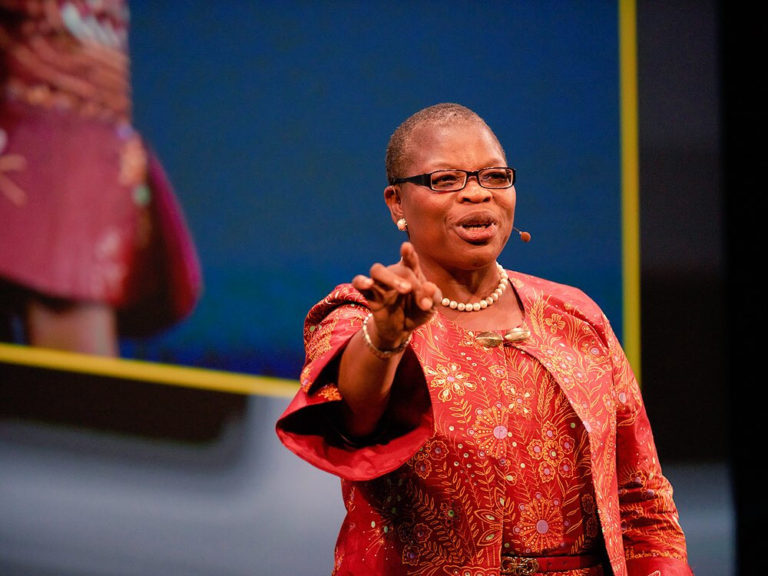
OBY Ezekwesili has said the problem faced with Nigeria educational sector isn’t funding, but the collapse in the price of tertiary education which has compromised its value.
The former minister of education said this at the launch of Edfin, Nigeria’s first educational micro finance bank on Thursday.
She said the low cost of education in Nigeria has deteriorated its quality, calling on the government to increase the cost of tertiary education to sustain its value.
“You must have a solution that the pricing of education does not get taken down to the level where it cannot sustain quality that is what’s going on now”, Ezewesili said.
She said the problem with the sector isn’t funding, “If you fund a dysfunction well, you will get a well-funded dysfunction.”. She says failure to address it, has put the country into trouble.
“Our country is in trouble because education is in crisis. A decade plus ago, I told the mission that if we did not address the crisis in education that in a matter of years. In fact, my prognosis at that time was that by 2020 that we will produce the most hardened criminals,” Ezekwesili said.
She underscored the challenge of the sector, as one where, parents are comfortable paying N500, 000 in top secondary school for their children but protest about learning cost at the tertiary level, which compromises educational relevance and quality
Ezekwesili, therefore, says “those who have the capacity to pay should pay the right price for tertiary education and for those without the capacity to pay, edufinance and a subsidy from the federal government that is well designed will come to ensure that they are not left out of education”.
Edufinance as described by Bunmi Lawson, managing director of the microfinance bank, is that which ensures access to finance for educational needs.
“We are here today to mark the start of a journey one wherein the future everyone who wants to has access to quality education; where those who need finance; or you are a parent, you may be a student wanting to further your education or a teacher who need loans to improve their standard of living or their teaching skills. All stakeholders in the education ecosystem having easy access to the finance they need are the future we envisage.”
However, Reports show that funding is the biggest problem confronting Nigeria’s education system. The percentage of the budget allocated to education annually is abysmally low. In 2018, only 7.04 per cent was allocated to education. This is far below UNESCO’s recommended 15-26 per cent.
Nigeria’s educational system also is in crises of infrastructural decay, neglect, waste of resources and sordid conditions of service.
The increase in privatization of government-owned universities has led to tertiary education becoming the exclusive preserve of the rich upper class; in a country where more than 90 per cent of the population is currently living in abject poverty.
Those in the public institutions also are continuously faced with a plethora of industrial actions, hindering the liquidity of the education system, while many can’t gain admission into them either.
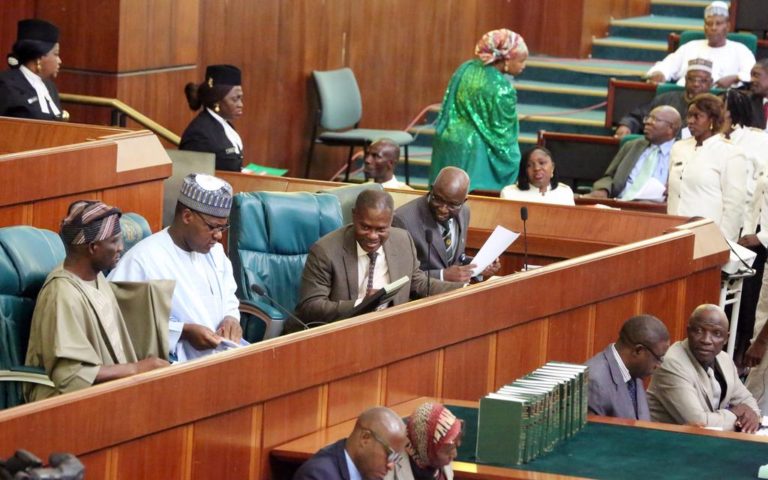
THE House of Representatives has been criticised for not passing the police reform bill by Citizen’s Gavel, a civil society group and civic tech organisation, which likened the decision to throwing the baby out with the bathwater.
A little over a month after the same bill was passed by the Senate, the House of Representatives, on Wednesday, rejected the Police Act (Repeal and Re-enactment) Bill, 2018, popularly called the Police Reform bill.
This decision, the lawmakers had said, was reached because “most of the provisions of this bill are against the constitution”.
“Unless we amend the constitution, we can not implement the bill. The bill also proposed the reduction of the number of DIGs, are we moving forward or backward? The bill is also referring to the Police as police force which is against the constitution,” explained Abubakar Lawal, chairman of the house committee on police affairs.
In its press statement released on Friday and signed by the group’s team lead Nelson Olaonipekun, Gavel said the lower legislative chamber would have done a better job if it simply removed the sections in conflict with the constitution and passed others.
Or it could have passed “the bill and let those provisions be removed when tested in court rather than throwing the baby out with the bathwater,” it added. “The present set has sent the country back to the dark age.
“In recent times, citizens have complained about the increase in police brutality, police extortion, poor welfare of police and extrajudicial killings across Nigeria. After the unfortunate death of Kolade Johnson in Lagos, several other persons have died in a similar manner, and this has left citizens to wonder who will be the next victim,” the statement said.
“Citizens on several occasions have admonished the National Assembly to strengthen laws on police accountability and in extreme cases called on the National Assembly to investigate above-mentioned instances.
“The Police Reform Bill has been before the House of Representatives and Senate. While the Senate has taken the bold step to pass the bill, the House of Representatives has taken Nigerian back to the old colonial days by refusing to pass the 21st-century law.”
Gavel pointed out that the Police Act currently in force is old-fashioned as it was enacted in 1943. It further called for a massive overhaul of the system, especially through passing the proposed amendment which “promotes human rights, efficiency and effectiveness of the police”.
The CSO also urged the coming ninth National Assembly to prioritise the lives of Nigerians and police officers by ensuring the swift passage of the bill.
Among other things, the bill makes provisions for the establishment of a police fund and community police forum. It also makes illegal the taking of liquor or intoxicating substances while on duty, stipulating a fine of N20,000 or three months imprisonment as a penalty.
CELEBRATION broke out in Gusau, the capital of Zamfara State, following the victory of the People’s Democratic Party (PDP) governorship candidate, Bello Mutawalle at the Supreme Court on Friday.
Reports say residents of the city came out into the streets to celebrate the court judgement and commercial motorcycle operators rode around jubilantly holding Mutawalle’s posters.
“I hope the new administration would make life better for the people. I was not surprised at the verdict owing to what has been happening right from the party primaries to date,” the News Agency of Nigeria (NAN) quoted a resident, Aliyu Hussain, as saying.
Also expressing his satisfaction at the verdict, the APC factional state chairman, Sirajo Mai-Katako, who belongs to the Kabiru Marafa APC faction, described the judgment as a good development in the nation’s democracy.
Mai-Katako said the Supreme Court judgement has underscored the need for people’s freedom of choice towards those who occupy political offices, noting that the party was more concerned about justice and fairness than it was about producing the governor.
He further urged the people of Zamfara to show total support to the new incoming governor.
Earlier on Friday, the Supreme Court had affirmedthe Court of Appeal’s nullification of the All Progressives Congress (APC) from the 2019 gubernatorial election in Zamfara State and awarded the sum of N10 million against the party.
Prior to the election, the Independent National Electoral Commission (INEC) had barred the APC from fielding any candidate because the party had failed to hold its primary election within the window provided by the electoral commission.
However, following an order of a state high court, INEC readmitted the APC for the election, which was won by the party’s governorship candidate, Mukhtar Shehu.
But in a ruling later in March, the Court of Appeal nullified the order of the lower court which reinstated the APC to be part of the election, and held that INEC was right in the first instance to have barred the party from participating in the exercise.
Shehu and the Zamfara APC further appealed the ruling at the Supreme Court and the judgement was given on Friday against them.
OF all things, rain is not something residents of Owutu, an area in Ikorodu, Lagos state, currently pray for because each time it falls, it comes with horrific experiences.
Heavy rainfall is usually followed by flood on roads, blockage of streets and drainages, hike in transport and freight fare, as well as difficulty in pedestrian ambulation, the residents have said.
Owutu community and others such as Asolo, Isawo, Ojokoro, Agbede, Ori-Okuta, Igbo-Olomu are some of the communities that constitute Ikorodu West local council development area.
Visits to the area by the reporter this week revealed the difficulty residents in the area face each time there is a heavy downpour
“Can you see? This is just rain that lasted for one hour. How about when the rain begins to fall continuously — for three consecutive days, for instance?” a woman, whose road to her residence on Olu Adebayo street has been blocked by flood, said with disgust.
Roads to other adjoining streets such as Gunwa-Ola, Omodisu have also been blocked.
Last Sunday when heavy rain fell, 55-year-old Olanrewaju Jaji said her son was almost trapped in the flood that covered the Asolo-Isawo road.
“When rain falls here, it comes with droppings from hell.
The flood has nowhere to go because there is no drainage
“My son had just completed his university education at the University of Ibadan. He was returning home last Monday with his heavy luggage when he fell inside the flood from the okada (motorcycle taxi )that was carrying him.
“I thank God that he was not injured or that something worse happened. But this situation is serious. This road ought to have been done to a stage where it would not cause danger to the people in the community.”
As for Lekan Toheeb, a tricycle rider (commonly called maruwa or keke napep), plying the road during the rainy season has not been a good experience.
“This rainy season is giving us headache. Workers can’t go to work. Since morning my keke has broken down. Please help us beg the government to do something. I’ve been here for the past two hours, repairing my keke,” he lamented.
Tricycle riders repairing their tricycles in Alasalatu
area of Asolo
Passerby are not left out — they have to cut corners
to reach their destination
Portholes everywhere covered by flood
A section of Asolo-Isawo road has become unmotorable
The reporter observed as a number of people turned back home because of the difficulty in transporting themselves to their place of work.
Mrs Adebayo, a trader in Asolo area, also echoed her frustration about the heavy downpours and the attendant hike in transport fare.
Transport fare to Agric bus stop which normally ranges between N50 and N100 now costs N500.
“We have to pay more for transport because of the flood.
“See the front of my shop: flood. I had to use this stick to divert the dirt elsewhere. It’s just too hard for us.”
Another tricycle rider named Qosim who spoke to the reporter recalled the state of the road before the state government began expansion on it. He blamed the hardship they face on the negligence of the government.
“This problem began since when the bitumen on the road was scrapped off,” Qosim recounted. “Had it been they didn’t scrap it off then, it wouldn’t have been this difficult.
“Each time rain falls, the potholes become deeper. If the roads are smooth, one can still navigate the flood.
The entrance to Olu Adebayo street, Asolo, blocked by flood
“But if you unknowingly ride your keke into those holes and the engine sucks water, it will break down immediately. It is water that caused the breakdown of those you see there,” Qosim said, pointing at a number of broken tricycles metres away.
He suggested levelling of the road as a temporary solution but was sceptical if the government quick intervention.
“Since they abandoned work on the road in December [last year], the road has gone from bad to worse.”
Although governor Akinwunmi Ambode had earlier said the project would be completed between March and April of this year, but he has not fulfilled the promise yet.
The project which started in 2017, according to the signpost of the project, is expected to last for 20 months.
When contacted, the Lagos state Commissioner for Information, Kehinde Bamigbetan, said he was indisposed and could not “speak for now”.
He, however, said the Commissioner for Works should be reached instead for information.
The reporter called Mr. Ade Akinsanya, Lagos state Commissioner for Works and Infrastructure, but he did not answer any of the calls. He also did not reply to the text message sent to him.
FREQUENT acts of violent crime have grown to form a major threat to Nigeria’s national security. These include instances of militancy, insurgency and banditry. Banditry includes cattle rustling, armed robbery and kidnapping for ransom.
Kidnapping has remained the most virulent form of banditry in Nigeria. It has become the most pervasive and intractable violent crime in the country.
Kidnapping can be targeted at individuals or at groups. School children have been kidnapped in groups in various parts of Nigeria. Usually, the prime targets of kidnapping for ransom are those considered to be wealthy enough to pay a fee in exchange for being freed.
Kidnapping is the unlawful detention of a person through the use of force, threats, fraud or enticement. The purpose is an illicit gain, economic or material, in exchange for liberation. It may also be used to pressure someone into doing something – or not doing something.
Nigeria has one of the world’s highest rates of kidnap-for-ransom cases. Other countries high up on the list included Venezuela, Mexico, Yemen, Syria, the Philippines, Iraq, Afghanistan and Somalia.
Thousands of Nigerians have been kidnapped for ransom and other purposes over the years. Kidnapping has prevailed in spite of measures put in place by the government. The Nigerian police’s anti-kidnapping squad, introduced in the 2000s, has endeavoured to stem the menace. But this been to no avail, mainly due to a lack of manpower and poor logistics.
In my view these efforts have also failed because of weak sanctioning and deterrence mechanisms. Kidnapping thrives in an environment that condones crime; where criminal opportunism and impunity prevail over and above deterrence.
This obviously calls for an urgent review of Nigeria’s current anti-kidnapping approach to make it more effective.
Opportunistic and organised bandits
Even prior to the advent of colonialism there were recorded cases of kidnap for rape, ritual or for other purposes in various parts of Nigeria. But kidnapping today is done primarily for ransom – either money or its material equivalent to be paid for someone’s release. The underlying logic of the kidnapping enterprise is that the victim is worth a ransom value and they or their proxy have the capacity to pay.
Each victim has a so-called “kidnap ransom value” which makes them an attractive target. This value is determined by a number of factors. These include the victim’s socio-economic or political status, family or corporate premium on the victim, the type of kidnappers involved, as well as the dynamics of ransom negotiation.
The kidnapping business in Nigeria has been mostly perpetrated by criminal gangs and violent groups pursuing political agendas. Bandits have often taken to kidnapping for ransom to make money. The escapades of the famous kidnap kingpin, Evans, speak volumes of this pattern of kidnapping. Evans was a multimillionaire kidnapper who was arrested in Lagos a few years ago. He is currently is detention awaiting trial.
Organised violent groups such as militants and insurgents have also been involved in kidnap for ransom in Nigeria. Current trends have been linked back to the example set by Niger Delta militants who resorted to solo and group abductions as a means of generating funds both for private use and for the cause of a particular group.
Similarly, Boko Haram insurgents have used the proceeds of kidnapping to keep their insurgency afloat. The insurgents engage in single or group kidnapping as a means of generating money to fund their activities. Huge sums are often paid as ransom by the victims’ families and associates to secure their release.
In addition to militants and insurgents, organised local and transnational criminal syndicates have been involved. This is happening to apocalyptic proportions in North West Nigeria where rural bandits engage regularly in kidnapping in the states of Zamfara, Kaduna, Katsina, Kebbi and Sokoto.
The cost
Kidnapping has led to the loss of tens of thousands of lives and huge sums of money in Nigeria. Many of the victims of the crime have been killed in the course of their abduction, custody or release. Many more have been injured. This is in addition to huge amounts of money lost to ransom takers.
For the victims and their families and friends, the consequences are even more frightful.
Nigeria should never have got here. Kidnappers persist because the benefits of their crimes exceed the costs. So the obvious solution is to raise the costs by imposing harsher, surer penalties. The present penalty for kidnapping ranges from one to 20 years in prison, with the possibility of life imprisonment for extreme cases involving, for instance, murder.
Stricter measures, such as life imprisonment or the death penalty, may not be completely out of place in dealing with the kidnapping menace. After all, the crime of kidnapping is a maximum threat that requires an equally maximum deterrence.
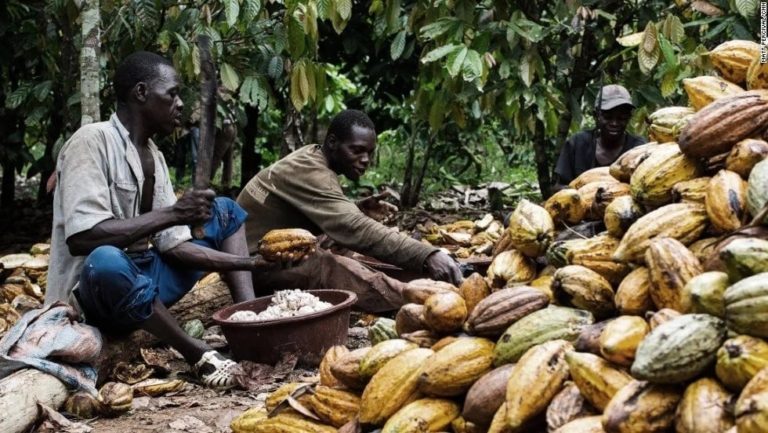
BASED on the volume of cocoa output from the Niger Delta region and the number of cocoa farmers there, a new report says the future of Nigerian cocoa production lies in the region.
The output of Nigerian cocoa beans for three years, between 2014/15 and 2016/17 was 620,000 metric tons and Niger Delta Delta states accounted for 546, 822 metric tons of the total output, revealed Cocoa Value Chain Assessment Report.
In the report unveiled by the Foundation for Partnership Initiative in the Niger Delta (PIND), 88 per cent of the total cocoa output for those years was produced by the Niger Delta states.
“There are 120, 000 active cocoa farmers in the Niger Delta and 66 per cent of them have plantations with size ranging from one to five hectare of land,” says Executive Director of PIND, Dara Akala, while presenting the report at a Cocoa Stakeholders’ round-table held in Akure, Ondo State capital.
According to him, the report was the result of a study carried out by the Foundation to provide a detailed scoping and value chain analyses of the cocoa sector in the Niger Delta.
He explained that PIND is already implementing interventions in aquaculture, cassava, poultry and palm oil sectors adding that with some of the interventions attaining full maturity and reaching scale, the Foundation is now expanding into the cocoa sector.
“The cocoa sector has growth potential and ability to increase income and employment,” he said.
He said the Foundation’s vision, within five years, is that the cocoa industry in the Niger Delta will be characterised by improved linkages and communications between smallholder farmers and the processors and exporters, with mutual incentives.
Akala who was represented by PIND’s Market Systems Development Manager, James Elekwachi added that cocoa accounted for more than 30 percent of Nigeria’s agricultural export and generated a total of $774.6million in 2016 out of which $83.6million came from exportation of cocoa derivatives including cocoa butter and cocoa paste.
In 2016, the report said agriculture accounted for 24.2 per cent of Nigeria’s Gross Domestic Product (GDP), noting that the sector is highly concentrated on crop production which accounts for 90 per cent output.
“Fishery, forestry and livestock, account for remaining 10 per cent,” the report said, insisting that the country’s agricultural potential is still high because Nigeria 82million hectares of arable land, out of which only 34million hectares have been cultivated.
It remarked that Nigeria cocoa production in the past 17 years has witnessed some volatility, noting that production has been fairly flat, “with peaks and valleys due to the cyclicality of cocoa tree production and weather conditions.”
“It was discovered from the study that for one hectare of a cocoa farm in Ondo State, the 7th year is the break-even point.”
On the cocoa processing industry, the report disclosed that the industry is divided between the processing industry (intermediate processors and finished good processors) and exporters.
While noting that local immediate processing companies produce cocoa liquor, cocoa butter and cocoa cake, it said a number of them are already grappling for survival and some have closed down the operation.
“Of the 17 intermediate processing companies, only five are functional with combined capacity utilisation of 50, 000 metric ton and four of them are in Ondo State,” the report said.
However, it stressed, that an estimated 90 per cent of these cocoa derivatives are exported, not including cocoa powder.
It further stated that there were 123 firms in cocoa business in Nigeria including processors and exporters, and that there are 20 regular exporters operating in the sector out of which only three of them control 50 per cent of cocoa beans export.
Small scale farmers, the report said, have no direct contact with the processors and exporters, lamenting that the awareness of sustainable production or certification to motivate better producer price among farmers in is limited to about 10 per cent of farmers in the Niger Delta region.
“If Nigerian exporters can incentivise farmers to produce more cocoa, they can sell it, so the challenge is on increasing production through increased productivity and greater area under production,” the report suggested.
“An integrated markets approach, considering economic, social and environmental dimensions is needed to improve cocoa sector competitiveness.”
SIX hundred and thirty naira (N630). This was the amount Andrew Bello, a Lagos-based lawyer, received in one of the months he worked for a law firm in Ikoyi.
His total salary was supposed to be N20,000 per month, but his firm deducted N500 for each day he got to the office later than 8 a.m. Living in FESTAC town, ordinarily at least an hour away from the office, and coupled with constant traffic congestion, he had little choice. And so he often went home at the end of the month with an average of N4000, while the manager’s gardener, he’d learnt, was paid at least N35,000.
When he asked why he was receiving only N630 that month, he was told the monies deducted were for lateness, practising fee, as well as seal and stamp.
“The boss even told me they just gave me that money out of generosity, that I’m the one who was supposed to pay them that month,” the 28-year-old alumnus of Benue State University recalled.
He was also given between N100 and N200 anytime he had to go to the court. Though it was never enough, he was asked to produce proof of additional amounts spent if he wanted his money reimbursed. From November 2016 to December 2017, Bello endured not only exceedingly inadequate pay but also generally poor working conditions at the firm.
A few months into the job, he travelled to Akwa Ibom for a trial and by the time he returned, his house had been demolished, with no debris in sight. He lost all his possessions, and had only two shirts, one pair of trousers, and one suit. So he went to his boss and pleaded for a week-long leave to recover.
“Err… I’m sorry for your tragedy but, if you miss one day, don’t ever come here again,” she had replied.
For two months after that incident, he slept on plastic chairs at a bar in Obalende and went to the office every morning from there. He then moved in with a friend at the Nigerian Law School. There, he facilitated tutorials between 6 and 10 p.m. on weekdays and earned an extra N20,000. He lived on the campus for three to four months before moving to squat with another friend in Ajah.
“It was terrible,” he said. “I would leave Ajah by 5 a.m., get to the office by 8 a.m. so I don’t get N500 deducted, finish from Law School by 10 or 11 p.m., go back to Ajah, get there by 1 a.m., and then I’m up again by 4 a.m. And after all that, at the end of the month, I was always in debt.”
Today, Bello works in-house for the Seven-Up Bottling Company and earns well over N200,000. “Most people like to say I paid my dues, but man! I didn’t have to pay that much,” he chuckled.
Asked if he would study law a second time if he had an opportunity to travel back in time, he said yes—but only “because of the course itself”. He added jokingly, “If it was by the people in the profession, I would pick Police Studies so that I can deal with them under the guise of anti-robbery or anti-cultism.”
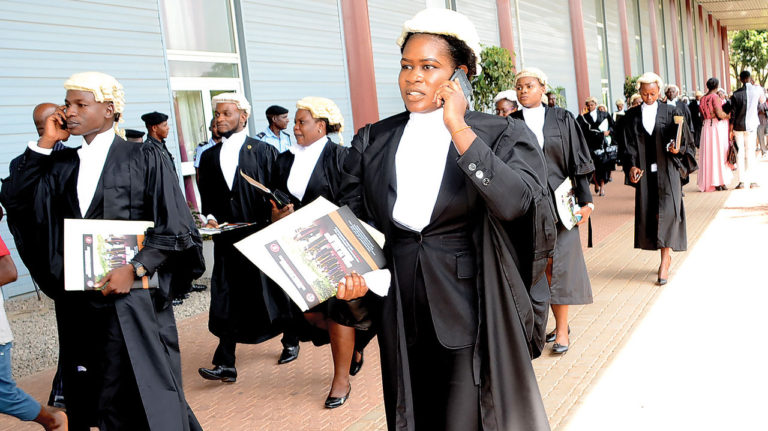
Bello’s ordeal may be behind him but thousands of legal practitioners across the country continue to face a lot of difficulty in trying to eke out a living. Many law firms are reported to treat their employees shabbily, particularly when it comes to remuneration.
There are firms on the Lagos Mainland for example, sources say, that pay as low as N10,000, nearly half of the previous national minimum wage of N18,000. Then there are those who just offer to pay “something” at the end of the month, often defaulting for long periods.
It is also common for lawyers to be employed without written contracts or terms of employment, though this violates section 6 of the Labour Act that states that such contracts must be given not later than three months after employment.
A young female lawyer in Ibadan, Oyo State, who preferred not to be named, spoke of how she was paid N25,000 by her boss. Worse still, he only paid after the first month, and she had to spend out of her pocket to work for several months till she finally quit. “That is the trend of how he does his own things,” she said, implying he used that approach for his other employees too.
Again, last year a video that went viral showed two policemen hitting, dragging and threatening to shoot a lawyer, Olakunle Kareem, who had gone to his former employer, Oluyomi Olawore LLP, a law firm in Onikan, Lagos, to request for his unpaid salary.
It is suggested that the only reason lawyers are not massively seeking job opportunities in other countries, like their counterparts in the medical field, is because they are limited by country jurisdictions.
The narrative is the same irrespective of state. Believing legal practice is not enough to meet his needs, Stephen, an Abuja-based lawyer in his fifth year of practice, has also delved into the information technology (IT) space.
“I had to go learn IT,” he said. “I am a web designer. I run a tech. company with a couple of friends, and that is where I augment from.”
Young lawyer goes to his former employer to ask for his outstanding salary and this happened! Law firm: OLUYOMI OLAWORE LLP. RT till it gets to the right people pic.twitter.com/E9lw7wFbi8
— Start Up Legal Consulting (@bjspesh) July 4, 2018
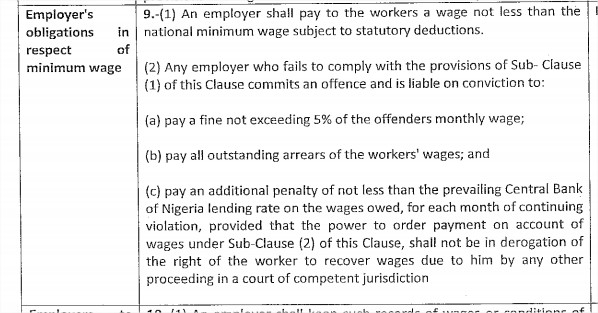
According to the newly passed amendment to the national minimum wage law, employers who pay less than the minimum wage, which is now N30,000, may be sued at the National Industrial Court. On conviction, section 9 states, the employer shall pay a fine, all outstanding arrears of the worker’s wages, as well as additional penalties for each month of continued violation.
From law to tailoring
When Bisola Ogunsola, 27, participated in the compulsory one-year National Youth Service Corps scheme in 2016, like many of her colleagues she was offered neither stipends nor accommodation. They were treated like burdens in their places of primary assignment.
“We thought NYSC would soon pass and things would get better,” she said, “not knowing that many of us will so much miss the N19,800.”
Studying law was a trying experience for the graduate of University of Ibadan. Due to no fault of hers, she spent eight years, instead of the usual six, in getting a law degree. She was in her first year when her dad got diagnosed with lung cancer. His expensive treatment and subsequent death in 2011 left the family of eight in financial hardship.
Ogunsola took on three part-time jobs just to get through school. She was a tutor at a JAMB tutorial centre and worked for a home tutor business. She also sold jewellery and trained others interested in the trade.
Her mother had to secure a loan to pay her tuition at the Nigerian Law School. Life was simply a transition from one struggle to another. But, after her service year, her hopes of reaping the fruits of her hard work still did not materialise, in spite of how celebrated and highly competitive her profession is.
The firm she joined in Akure, Ondo State, told her they don’t pay salaries but only allow their staff to have appearance fees in order to promote hard work. But she soon discovered, to her dismay, that most clients wouldn’t pay the fee after proceedings, and requesting yourself could get you a scolding.
Those who paid only gave between a thousand and two thousand naira to cover transport expenses. As a result, she earned an average of N2000 every week and, with fares and call cards expenses deducted, only ended up with about N3000 each month.
“The principal will personally go for briefs where the appearance fee is attractive and push juniors to stingy clients,” she narrated.
Her search for jobs at other law firms did not bring a better offer. Many promised salaries but would not pay for months, and then you would have to let go. Some assure you of attractive appearance fees, but prevent you from going to trials. At times, they also lie that they’re handling a matter pro bono (free of charge) just to mislead their employees into thinking they are not making huge profits, she said.
So how did Ogunsola cope with other expenses? Her answer: “Business and donations from family.”
“Most young lawyers live on business. Most female lawyers are selling one thing or the other. At least, some people will patronise out of pity,” she explained. “I’ve never been a fan of sole income since my childhood. I just had to pick up from where I stopped.”
She is into the fashion business now, she added, and is training to become a seamstress. With her free time, she builds her private practice by holding briefs for clients and other lawyers outside the jurisdiction.
Another young female lawyer who narrated her experience of psychological abuse and being overworked told The ICIR she has left practice for the position of company secretary at a micro-finance bank in Lagos. From there, she hopes to delve into human resources after successfully getting inducted by the Chartered Institute of Personnel Management in Nigeria (CIPMN).
The National Minimum Wage Act provides for remedies in case of non-compliance by employers
Not a global problem
Compared to other countries, including some in Africa, lawyers in Nigeria are not doing very fine. Based on a 2016 surveyreported by Delta Quest Media, an American lawyer who is just one to four years at the bar can up to a £166,510 (N75.8 million) in a year. Lawyers in Switzerland earn an average of N69.7 million, and those in South Africa with only one to three years of work experience earn up to N63.8 million.
Tsholofelo Tsholofelo, a lawyer in Botswana, confirmed that lawyers in the country do not get paid below the national minimum wage of about $85 per month (and there are talks of raising this to $350). Lawyers who are maltreated report to the Botswana Law Society, which holds lawyers and firms accountable.
“It is very active,” he added. “You can get disbarred for unacceptable behaviour.”
Ayomide Shittu, a US-based lawyer and graduate of the University of Texas School of Law, also told The ICIR lawyers in the United States are not an exception to the national minimum wage of $1,160 (N419,000) per month and there is no prejudice against so-called junior lawyers.
“US lawyers are paid better because the US is a more successful country and the laws about wages are enforced,” she explained.
“If someone pays you less than minimum wage, you can report to the US Department of Labor and they will sue them. Also, no one is going to even take that job so the employer won’t offer it. Law firms are serious companies. No one is going to pay you less because they feel like they are doing you a favour.”
Section 13 of Nigeria’s amended National Minimum Wage Act empowers trade unions to demand compliance with the law on behalf of their members through the court. Complaints may also be filed with the minister of labour and employment.
Benson Upah, the NLC’s head of information, said the law is not fully operational yet and processes are still ongoing to ensure its implementation. He also said the Congress has not had records of companies in the past not paying, but it plans to exploit remedies available to it in seeking compliance including going to court where necessary.
Likewise, the labour ministry’s deputy press director, Rhoda Iliya, told The ICIR that aggrieved persons who visit the ministry’s headquarters at the federal secretariat or send an email will be appropriately directed.
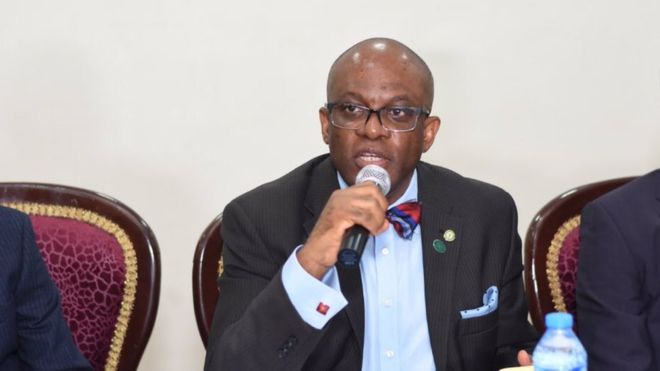
NBA President, Paul Usoro
What is the NBA doing?
The Nigerian Bar Association (NBA) is the professional association of all Nigerians admitted to the bar. Aspirants for key positions at the NBA have often included better welfare for junior lawyers as part of their campaign promises, but do close to nothing after elections.
“Every candidate comes with the mantra and says he will bring back the minimum wage for lawyers, but they don’t really mean it. They just say those things like typical Nigerian politicians,” Stephen remarked.
NBA president, Paul Usoro, in his acceptance speech last year stressed the need to motivate, take care of, and improve the compensation packages of young lawyers. His predecessor, Abubakar Mahmoud, in his 2016 inaugural speech was also particular about developing “a minimum standard and practices for the employment of younger lawyers in law firms across the country”.
Towards fulfilling this, the NBA under Mahmoud’s leadership set up a 13-man committee to formulate a framework on the issue of welfare for all lawyers. Headed by the then NBA vice president, the committee proposed a minimum salary of N50,000 for young lawyers and N25,000 of corps members.
It recommended the establishment of a Welfare Monitoring Committee to act as a task force and watchdog in ensuring that the new policies are adhered to. It suggested also that there should be awards to recognise firms with a friendly disposition to welfare.
Isiaka Olagunju, former NBA general secretary, however, confirmed that the National Executive Council has yet to approve the committee’s blueprint submitted to it in February 2018.
Improve the economy, enforce wage laws
It is the view of Shittu that the fortune of lawyers in Nigeria is a direct reflection of how well the larger economy is performing, and it is not only lawyers who are victims of the system.
“Lawyers are underpaid because everyone is underpaid,” she suggested, adding that “this is so because there is no enforcement of minimum wage laws.”
Laditan Adekunle, a senior state counsel for the Lagos State government, has a similar assessment. He advised that one way to improve lawyers’ financial welfare is for the NBA to ensure that perfection of titles at the land registry can only be done by legal practitioners.
Another crucial step towards improving the financial conditions of lawyers, according to Kemi Sulyman-Akanbi, is to diversify legal practice, which is presently limited compared to what is obtained in other countries. Exploring untapped areas of law will open the doors to new career opportunities, she said.
“The rate at which lawyers are being churned out year in year out is huge, and the opportunities for work as far as Nigeria is concerned are not commensurate. There’s too much manpower, and fewer opportunities to absorb it; and that will affect the pay because if a lawyer says he is not going to take a job, there are thousands more who are willing to,” said Akanbi, an expert in labour law and lecturer at the University of Ilorin.
“Globally, there is what we call super specialisation in law. In some law firms in other countries, they focus only on energy law, artificial intelligence, humanitarian law etc. Here, we just have essentially criminal law, civil law, and a few other areas. There is, therefore, need for reorientation to open up new areas.”
She agreed there should be a minimum wage for lawyers but expressed doubt about it—as well as proposals to make law a second-degree course—bringing a lasting solution. Particularly, a minimum wage might lead to a reduction in firms’ workforce so as to cut costs and a greater number of unemployed lawyers, “if my earlier recommendations are not in place”, she said.
Akanbi also emphasised that the bulk of the burden of putting an end to poor remuneration lies with the NBA. She wonders why, lawyers who are interpreters and ultimately drafters of the law allow themselves to be cheated, despite the clear provisions of the Labour Act.
“It is the lawyers themselves that need to act; there is little the government can do. We need lawyers to take their fortune into their own hands.”
THE Supreme Court has affirmed the Court of Appeal’s nullification of the All Progressives Congress (APC) from the 2019 gubernatorial election in Zamfara State and awarded the sum of N10 million against the party.
The APC, whose governorship candidate was Mukhtar Shehu, had been declared the winner of the Zamfara state governorship and state assembly elections held in March this year.
Prior to the election, the Independent National Electoral Commission (INEC) had barred the APC from fielding any candidate because the party had failed to hold its primary election within the window provided by the electoral commission.
An intra-party conflict had caused a division within the Zamfara APC, causing the two factions to hold parallel primaries, none of which was recognised by INEC.
However, the APC faction that is loyal to the state Governor, Abdulaziz Yari,obtained a judgement from a state high court which directed INEC to recognise the candidates that emerged from the primary election held by the faction. INEC complied with the court order and reinstated the APC into the ballot, but the other APC faction, led by Kabiru Marafa, a serving member of the Senate, filed an appeal with the Court of Appeal.
After the election, the APC won the governorship position as well as majority of the state assembly seats.
On March 25, however, the Court of Appeal deliveredits judgement and agreed with the appellant that the APC ought not to have any candidate for the Zamfara state elections.
Dissatisfied, the other faction took their appeal to the Supreme Court seeking to set aside the judgement of the Court of Appeal.
Delivering the judgement on Friday, the panel of five Supreme Court Justices, led by the Acting Chief Justice of Nigeria, Tanko Muhammad, dismissed the appeal and upheld the judgement of the Court of Appeal and voided all the votes cast for APC in the Zamfara election.
Bello Matawalle, candidate of the PDP in the Zamfara guber election, is likely to become the state’s next governor.
The court further ruled that the “candidate other than the first appellant with the highest vote stand elected”.
“A cost of N10 million is awarded against the appellant,” the court ruled.
Recall that because of the pending court cases, INEC had decided to withhold the certificates of return for the governor and legislators-elect in Zamfara until the cases were determined.
As it stands now, it is likely that the candidate of the Peoples Democratic Party (PDP) in the elections, Bello Matawalle, who came second with a total vote of 189,452 will be declared the winner of the election and returned elected.
When this happens, it would bring the total number of States won by the PDP in the 2019 general elections to 15, namely: Abia, Adamawa, Akwa Ibom, Bauchi, Benue, Cross River, Delta, Ebonyi, Enugu, Imo, Oyo, Rivers, Sokoto, Taraba, and now Zamfara.
This would also mean that the states won by the APC has been reduced to 14 namely: Borno, Gombe, Jigawa, Kaduna, Kano, Katsina, Kebbi, Kwara, Lagos, Nasarawa, Niger, Ogun, Plateau, and Yobe.
Elections did not hold in seven states, namely Anambra, Bayelsa, Edo, Ekiti, Kogi, Ondo and Osun. INEC has fixed the Bayelsa and Kogi elections for November 16, 2019. Both States are currently governed by the PDP and APC respectively.
Meanwhile, the Supreme Court has affirmed the electoral victory of Kayode Fayemi in the Ekiti State governorship election held in July 2018.
The court held that the appeal was lacking in merit because the judgements of both the election petitions tribunal and that of the Court of Appeal in the case were the same. It is only where there has been an established breach of the law in the two judgements, that the Supreme Court could decide otherwise.
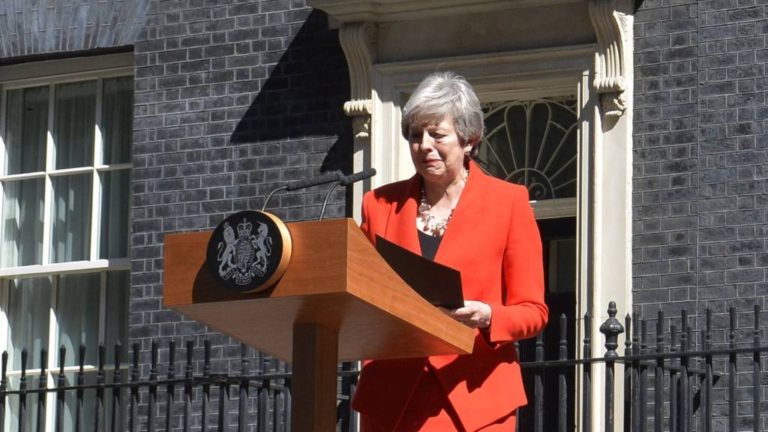
Theresa May on Friday announced that she was resigning from her position as the United Kingdom Prime minister and quitting as the conservative party leader on June 7.
The embattled Prime Minister has faced massive criticism for failing to deliver her flagship policy of leaving the European Union, missing two Brexit deadlines.
In her emotional statement at the doorstep of 10 Downing Street, May said although she had failed in her efforts she has also tried her best to implement the decision of the people.
“I negotiated the terms of our exit and a new relationship with our closest neighbours that protects jobs, our security and our Union. I have done everything I can to convince MPs to back that deal. Sadly, I have not been able to do so.
“I tried three times.
“I believe it was right to persevere, even when the odds against success seemed high. But it is now clear to me that it is in the best interests of the country for a new Prime Minister to lead that effort.
“It is, and will always remain, a matter of deep regret to me that I have not been able to deliver Brexit. It will be for my successor to seek a way forward that honours the result of the referendum.
“To succeed, he or she will have to find consensus in Parliament where I have not. Such a consensus can only be reached if those on all sides of the debate are willing to compromise.
“So I am today announcing that I will resign as leader of the Conservative and Unionist Party on Friday 7 June so that a successor can be chosen.”
The processes of electing a new leader she said would commence next week.
“I have kept Her Majesty the Queen fully informed of my intentions, and I will continue to serve as her Prime Minister until the process has concluded,” she said.
With May’s exit, it is expected that Britain will experience a leadership contest, with several Conservative MPs tipped to run. The winner will be Britain’s next PM.