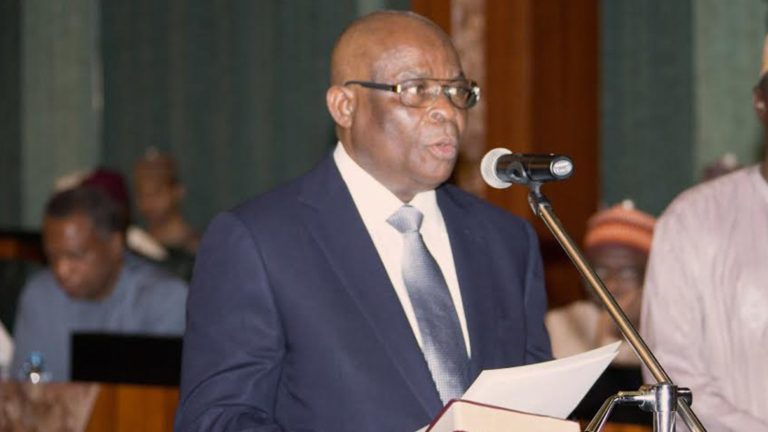
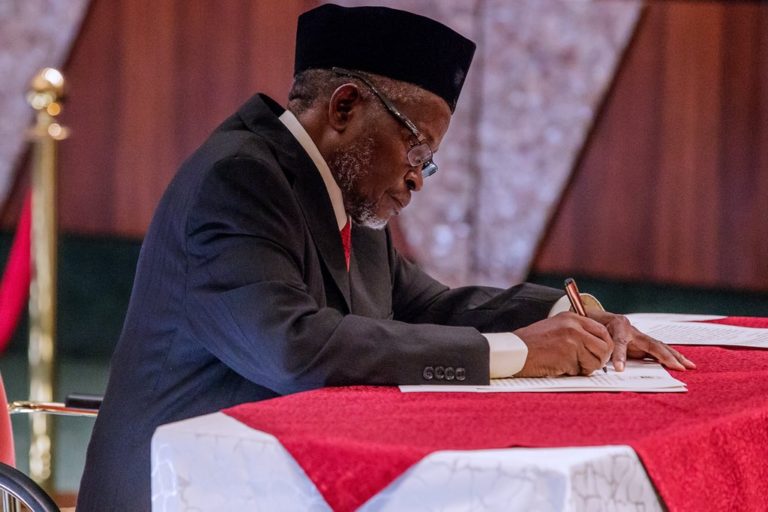
THE suspended Chief Justice of Nigeria has been issued a seven-day ultimatum by the National Judicial Council, NJC, to respond to a petition filed against him.
Onnoghen was suspended for non-declaration of assets by President Muhammadu Buhari who claimed he acted on the order of the Code of Conduct Tribunal (CCT).
The acting Chief Justice of Nigeria, Ibrahim Muhammad, was also asked to respond to a separate petition within seven days for allegedly contravening NJC rules.
He was accused of making himself available to be sworn in as acting CJN without the approval of the NJC.
The NJC stated in a communique released at the end of its emergency meeting on Tuesday that it received two petitions against Muhammad and one against Onnoghen. And a fourth petition was written against the chairman of the Code of Conduct Tribunal, Danladi Umar.
The governing body of the judiciary referred the petition written against Danladi Umar, the Code of Conduct Tribunal (CCT) chairman, to the Federal Judicial Service Commission (FJSC).
The FJSC, under whom Umar is employed, will address the petition and refer it to NJC to take appropriate action.
NJC is due to reconvene on February 11, 2019, to discuss further actions against the country’s top legal luminaries.
The emergency meeting was presided over by Umaru Abdullahi, former president of the court of appeal, following the absence of both Onnoghen and Muhammad.
The NJC director of information, Soyi Oye, released the statement below after the meeting.
THE NJC’S RESOLUTION
“The National Judicial Council held an Emergency Meeting today and considered four (4) petitions filed at its Secretariat. The petitions are Petition against Hon. Mr. Justice W.S.N. Onnoghen, GCON by Zikhrillahi Ibrahim of Resource Centre for Human Rights & Civil Education; Petition against Hon. Mr. Justice Ibrahim Tanko Muhammad, CFR by Centre for Justice and Peace Initiative; Petition against Hon. Mr. Justice Ibrahim Tanko Muhammad, CFR by Olisa Agbakoba, SAN, OON; and Petition against Hon. Danladi Yakubu Umar, Chairman, Code of Conduct Tribunal by Centre for Justice and Peace Initiative.
“Council referred the petition against Hon. Danladi Yakubu Umar to the Federal Judicial Service Commission (FJSC) which is the appropriate constitutional body empowered to deal with it.
“In line with its procedure, Council also forwarded the petitions against Hon. Justices W.S.N. Onnoghen, GCON and I. T. Muhammad, CFR to them for their responses.
“In view of the gravity of the matters involved, Council abridged the usual response period from fourteen (14) to seven (7) working days for the Hon. Justices to respond.
“Hon. Mr. Justice W. S. N. Onnoghen, GCON, and Hon. Mr. Justice I.T. Muhammad, CFR recused themselves from the meeting. Consequently, Council elected Hon. Mr. Justice Umaru Abdullahi, CON, former President of the Court of Appeal as Interim Chairman to preside over the meeting.
“Council will reconvene on the 11th February 2019.”
NIGERIAN youths have resorted to a social media campaign over the strike action by the Academic Staff Union of Universities (ASUU) which has disrupted academic activities in major federal and state universities in the country.
The campaign tagged #endasuustrike trended all day on Twitter on Monday.
Since November 5, 2018, Nigerian lecturers have beenon strike over several issues, including better funding for universities, non–implementation of previous agreements, non-payment of earned academic allowances, salary shortfalls and pension matters.
In November, the National President of ASUU, Biodun Ogunyemi said the struggle was for the students’ good. He called on all Nigerians to join ASUU in putting pressure on the federal and state governments to pay adequate attention to all the academic institutions to avoid “a total collapse of the educational sector.”
But as the strike continues to linger, the students have continued to cry out to the federal government and ASUU to show more commitment to ending the indefinite strike. In its 84th day on Monday (or 12 weeks), the students say only remains a week to make up a normal semester.
Joe Solomon, a Twitter user tweeted that the future of Nigeria has been home wasting their time and lives. “We can’t be the future by staying at home and doing just nothing,” he said.
Another user Favour Onyeoziri expressed how millions of youths’ lives have been on hold. He tweeted: “Already 3 months’ strike, that is the life of millions of Nigerian youths put on indefinite hold.”
Also, a tweet by Nwanne Erica lamented on how she has been delayed. “I should have been preparing for the first-semester examination but ASUU is on strike. Please, I don’t want a delayed future,” she lamented.
Similarly, several have cried out that they were tired of staying at home, doing nothing. A user tweeted how the on-going strike could disenfranchise a lot of students in the forthcoming general elections. She said that students who got their permanent voters card in school are now at home.
LET me quickly get a few things out of the way before I proceed with my reflections.
If you are one of those abusing, insulting, rubbishing, ridiculing, and mocking Oby Ezekwesili, take a piece of paper, jot down these five points, and frame them for future reference: 1) there will never be a history of Nigeria written in which Oby Ezekwesili will not feature as a heroine; 2) there will never be a posterity of Nigeria evaluated in which Oby Ezekwesili will not feature as a patriot; 3) the harshest that history will be to her is to classify her as a great Nigerian; 4) the kindest that history will be to her is to classify her as one of the greatest Nigerians of our generation and one of Africa’s best contributions to the world stage in our generation; 5) should fate ever settle on a female president for Nigeria in our lifetime, you’d rule out Oby Ezekwesili only if your mind was puny.
Two factors necessitate this intervention, and both are products of the tragic collapse of Nigeria’s education ecosystem and its repercussions evident in the remaking of the social character of our body politic. That remaking is, sadly, completely negative. The first factor in the remaking of the social character of our body politic is hostility to excellence and all matters cerebral. This manifests mostly in the fetishization of mediocrity and illiteracy. Excellence is refashioned and re-imagined as that which is alien to us and our culture, a foreign imposition. A language of derision and sarcastic put-down is even fashioned for it – “saner clime”. The apostles of this new culture fan out across social media, asking – who saner clime epp?
What they are really doing is creating a culture in which MC Oluomo is “more grounded”, “more relatable”, “closer to the people’s heartbeat”. MC Oluomo thus becomes a role model in a culture ready to dismiss and excoriate Wole Soyinka or Chimamanda Adichie as alienated intellects disconnected from the people. Yet, what they are hostile to is excellence. What they are normalizing as “our culture” is mediocrity. What they are fetishizing are ignorance and mediocrity. Sometimes, the dumbing down of national culture can be a deliberate political move to normalize absurdity. I have seen self-abnegating PhD holders snigger at the value of a PhD just to create a room to normalize and rationalize President Buhari’s absurdities.
The second factor in the remaking of the social character of our body politic is the language in which this circumambient hostility to excellence is delivered. For more than a decade now, my research and scholarship have focused on new Nigerian/African socialities and cultures produced in such novel spaces of meaning and phatic communion as social media. I have researched and lectured widely on the cultures, attitudes, and innovative spirit of the millennial generation and youths who inhabit and animate these new spaces. So, I know that the dominant idiom and mode of expression in these new spaces are rooted in irreverence.
Irreverence is a major culture shift and I have always argued that whoever puts himself or herself out there must be prepared to be at the receiving end of it. However, as is the case with everything Nigerian, we have extended the meaning of irreverence beyond every conceivable boundary. Our public space is littered with some of the most potty-mouthed, execrable worshippers of mediocrity whose hostility to excellence can only be delivered with scatological registers.
Because of the national culture of celebrating mediocrity and attacking excellence that we have created, whoever comes to represent excellence and cerebral brio in the collective imagination of these children of anger (apologies to Reuben Abati) becomes a target, subject to their boundless scatological vocabulary. This is the interweaving loop of factors and contexts informing the bazaar of insults and ad hominems that have been poured on Oby Ezekwesili since she quit the presidential race last week. Undeserved insults have always trailed her post-service public career through the various movements she has led in the service of motherland, from BBOG to the Red Card movement and many more. However, it reached a crescendo last week.
Oby Ezekwesili bears the burden of excellence in an environment that is very unforgiving of excellence. It is a testament to the character of our brave new Nigerian world that somebody could hail and tuale pictures of MC Oluomo being ferried overseas in business class for medical treatment and at public expense in one tweet and, in the very next tweet, descend on a two-time Federal Minister, former World Bank Vice President, board member of major global intellectual foundations and think tanks, abuse her in the crudest possible manner, and accuse her of running for office because she is scheming for a ministerial appointment!
I do not know any measure of assessment in which Oby Ezekwesili does not tower above a Muhammadu Buhari or an Atiku Abubakar. The CVs are just not comparable. It is day and night. I almost feel that I owe her an apology for mentioning her CV in the same breath as those of these two men. Yet, it is a testament to the character of our brave new world that somebody will get off from tweets praising these two morally and ethically-challenged men and begin to rain invectives on someone who outshines them in every way imaginable. Who among these men can hold a candle to Oby Ezekwesili? From where did you get the idea that, as a supporter of the corrupt status quo, you have an Archimedean standpoint from which to insult a compatriot who has so much more to offer Nigeria than the decrepit men you are hoisting on a pedestal?
Rotimi Amaechi it is who says in a leaked tape that he has encountered only one true Nigerian – Olusegun Obasanjo. And he anchors his definition on what he says is his subject’s selfless pan-Nigerian soul. If that is how to define a true Nigerian, it means that Rotimi Amaechi has never met or listened to Oby Ezekwesili. I laugh or chuckle when I encounter ignorant attributions of uncatholic motifs and intentions to Oby’s service and actions by the children of anger.
She is just simply not cut from the same cloth as the despoilers of Nigeria that so many of you worship. There is an unquenchable pan-Nigerian fire burning in Oby Ezekwesili’s soul. I have listened to it in candid conversations, have felt it. It is love, selfless love for all of Nigeria and every Nigerian for which she has paid a huge price without complaining. What then is the basis of these insults?
I have deliberately borrowed Buchi Emecheta’s ironic titling of her most famous novel, The Joys of Motherhood. We know that motherhood brings Nnu Ego pains and tears. Yet, it does not dampen her enthusiasm for the fundamental essence of motherhood. Offering to serve Nigeria has attracted her so much scorn, insults, and derision but I know that nothing will ever dampen Citizen Ezekwesili’s love and zeal for her country.
As for the insults. They will continue to come her way. I will get my own measure of insults for this op-ed but it is ok. Social media insults are water off the back of a duck for me – completely inconsequential. Continue to insult Citizen Oby. The Yoruba have a proverb which perfectly captures her situation: egan o pe k’oyin ma dun. Insults and ill-will are powerless against the sweet taste of honey.
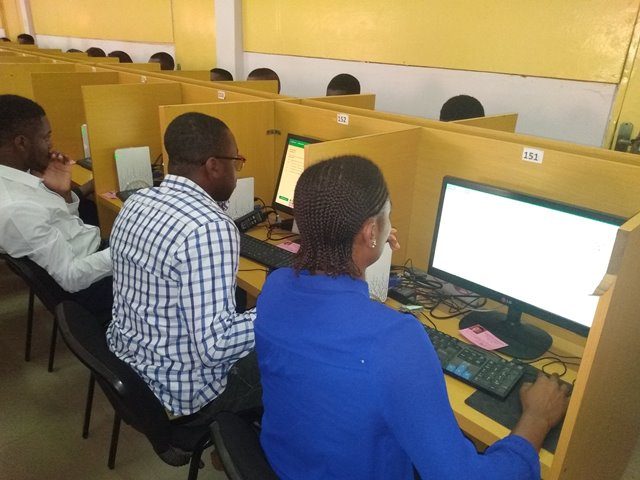
FOR charging more than the authorized amount, the Joint Admissions and Matriculation Board (JAMB) says it has suspended nine Computer-Based Test (CBT) centres that breached the code governing the 2019 Unified Tertiary Matriculation Examination (UTME) registration exercise.
The Board in its weekly bulletin released on Monday explained that the affected centres demanded higher fees than the amounts stipulated by the Federal Government.
It revealed that some of the centres among other offences were charging more than N7,000 for registration as against N3,500 authorized by the Federal Government while it also discovered payment of N50,000 by an unauthorised person to centre owner to have access to the portal.
According to the publication, the nine suspended centres are the University of Benin International ICT Centre, Iyayi, Benin, Edo State; Mardakem Limited by Methodist Boys High School, Oron, Akwa-Ibom State; Bintels Global Services, Aguleri, Anambra State; Noble and Shuaib ICT limited, Alor, Anambra State; Global ICT Connect, Makurdi, Benue State; DA Civic Centre, Benin City, Edo State; Medes ICT Centre, Okitipupa, Ondo State; Divine Success All CBT Centre, Iseyin, Oyo State; Riyom ICT Centre, Riyom Secretariat, Plateau State.
“Before commencing the 2019 UTME and Direct Entry registration exercise, a meeting with all CBT operators was convened in Lagos State, where the guidelines on the exercise were deliberated upon and laid out strictly for all to adhere to. The meeting had resolved that the cost of registration should not exceed N700,” JAMB said in the bulletin.
“Unfortunately, findings from the board’s monitoring exercise revealed that some centres were charging higher than the stipulated figure directed by the Federal Government and equally agreed at during the Lagos meeting.”
It further stated that 10 centres in Lagos and Plateau states were under investigation for the same offences, adding that it would convene a management meeting this week to take appropriate action on those centres.
On the number of candidates registered so far for the UTME, JAMB disclosed that a total of 869,709 candidates have been registered for the examination scheduled to hold in March.
According to the breakdown of the figure, Lagos State recorded the highest number of registered candidates, with 111,102 candidates, Kaduna State was second with 59,261 candidates and the Federal Capital Territory, Abuja, had 43,390 registered candidates.
Others are Oyo with 41,128 candidates; Benue, 36,080; Nasarawa, 35,940; Rivers, 35,749, and Ogun with 32,702 candidates.
The three states with the lowest registration are Jigawa, with 6,784 candidates; Sokoto, 4,881 and Zamfara, 2,427.
JAMB reiterated that the electronic pin issued to candidates are not transferable, adding that an optional mock examination for the candidates would take place on Saturday, February 23, at accredited CBT centres nationwide.
A Facebook page posted a video on its platform claiming that President Muhammadu Buhari was booed after the presidential rally in Sokoto state.
CrossCheck Nigeria, a collaboration of newsrooms in Nigeria which includes The ICIR, confirms that the claim is misleading, as the video is from an event that happened in Sokoto in July 2018, six months before the APC presidential rally.
The post has so far garnered an engagement of 1,537 shares and 19,000 views as of 02:20 pm, January 25.
Using an online video verification software InVID, CrossCheck Nigeria found keyframes from the video. A Yandex reverse image search on each of the keyframes led CrossCheck Nigeria to a report from ionnigeria’s website with the headline: “(Video/Pictures) Watch As Excited Tambuwal Supporters Set Broom Ablaze”. The report was published on August 1, 2018.
The pictures in the report show the reactions from supporters of Governor Aminu Tambuwal of Sokoto state, when he announced his defection from the All Progressives Congress (APC) to the Peoples Democratic Party (PDP).
Supporters of the Governor took to the streets to set APC flags and brooms ablaze in solidarity with the Governor’s move and rejection of the APC. These pictures match exactly the scenes from the currently circulating video.
A further search of the headline revealed that the video was originally shared by the Sokoto state government house through its official Twitter handle at about 05:59 am on Wednesday, August 1, 2018.
A report from the Vanguard Newspaper confirms that the video is from last August, when the Governor defected.
THE African Centre for Media and Information Literacy (AFRICMIL), a non-governmental organization focused on good governance and the promotion of accountability, has applied to the Code of conduct Bureau (CCB) for the asset declaration form of the new Acting Chief Justice of Nigeria (CJN), Ibrahim Tanko Mohammed.
In a letter to the Chairman of the CCB the coordinator of AFRICMIL, Chido Onumah, based his application on Paragraph 11, Part 1 of the Fifth Schedule to the 1999 Constitution as amended, which states that “every public officer shall within three months of the coming into force of this Code of Conduct and immediately after taking office and thereafter – (a) at the end of the every four years; and (b) at the end of his term of office, submit to the Code of Conduct Bureau a written declaration of all his properties, assets, and liabilities and those of his unmarried children under the age of eighteen years.”
It further states: “Pursuant to the aforementioned provision of the 1999 constitution, as amended, and Section 1(1) of the Freedom of Information Act 2011 which states that, “Notwithstanding anything contained in any other Act, law or regulation, the right of any person to access and request information, whether or not contained in any written form, which is in the custody or possession of any public official, agency or institution howsoever described, is hereby established.”
Relying on the stated constitutional provisions, AFRICMIL requested that the CCB should grant it access to inspect and obtain copies Justice Mohammed’s asset declaration forms as at the time he was appointed a justice of the Supreme Court of Nigeria and now that he is the Acting CJN.
In a statement on Monday, Onumah recalled how, in 2011, AFRICMIL had made a freedom of information request to the CCB seeking to be allowed to obtain copies of the asset declaration form of former President Goodluck Jonathan. Another request was also sent in January 2017, requesting for the asset declaration forms of some elected and appointed political office holders, including the current president and vice president, their immediate predecessors, past and current principal officers of the National Assembly, past and current governors of the 36 states of the country as well as past and current ministers since May 2011.
“Although both organizations made these requests under the Freedom of Information Act, 2011, the CCB failed to respond to any of these requests within the time stipulated in the Act, thereby leading to the filing of cases before the Federal High Court requesting judicial action aimed at getting the Code of Conduct to do the needful, in relation to the aforementioned FoI requests of both institutions,” Onumah stated.
“It is the sole responsibility of the Code of Conduct Bureau to ensure that all public officers declare their assets at the beginning and the end of their tenure in office. It is also their responsibility to ensure that the assets declared are verified to ensure compliance with the provisions of the law and also to establish possible cases of misconduct or corrupt enrichment, with a view to ensuring such culprits face the full wrath of the law.
“The CCB has the constitutional responsibility to retain custody of such asset declaration forms and make them available and accessible for inspection by any citizen of Nigeria on such terms and conditions as the National Assembly may prescribe.
“By enacting The Freedom of Information Act, 2011, the 7th National Assembly gave effect to the constitutionally guaranteed right of the public to access public documents held by public institutions and relevant private entities in Nigeria and this includes asset declaration forms of public officials, which are public documents within the meaning of the FoI Act, 2011.”
In 2017, Justice Abdu Kafarati of the Federal High Court, Abuja granted the two civil society organizations – AFRICMIL and the Public and Private Development Centre (PPDC) – leave to bring substantive suits against the Code of Conduct Bureau (CCB).
Justice Kafarati eventually gave judgement declining the reliefs sought by the applicants in the respective cases. AFRICMIL and PPDC appealed the judgement and the cases have been slated for hearing at the Court of Appeal on February 20 and 21, 2019.
THE Nigerian Bar Association, NBA, has directed its members to embark on a two-day boycott of the courts to protest the suspension of Nigeria’s Chief Justice, Walter Onnoghen.
The NBA adopted the resolution at its emergency National Executive Council meeting held on Monday.
“The Nigerian Bar Association rising from her NEC meeting has decided to embark on a two-day warning boycott of courts all over Nigeria over the suspension of the Chief Justice of Nigeria by President Buhari,” according to a press statement.
The two-day boycott will commence on Tuesday and continues through Wednesday which according to association should serve as a warning to the federal government.
Onnoghen is facing trial on an alleged non-declaration of assets at the Code of Conduct Tribunal, CCT.
He was suspended from office by President Muhammadu Buhari on Friday based on a controversial ex – parte order by the CCT.
The president implemented the CCT order despite the Court of Appeal ordering the tribunal to halt the trial of the chief justice.
Onnoghen’s suspension has generated mixed feelings from Nigerians, with the majority describing the move as an illegal action and a coup against the judiciary by the executive.
SINCE January 25, 2019, no Nigerian public office holder has gained more media prominence than the suspended Chief Justice of Nigeria (CJN), Walter Onnoghen.
The suspension of Onnoghen by President Muhammadu Buhari on the advice of the Code of Conduct Tribunal (CCT) has continued to attract diverse comments, criticisms and condemnation to the administration.
According to Jiti Ogunye, a legal practitioner, the portrayal of what Onnoghen is facing inevitably will be that the Nigerian Judiciary is so corrupt that its head is put on trial.
“This depiction is not fair to many judicial officers whose integrity is solid and who are free of corrupt practices,” he said.
The suspension was also carried against the stay of proceedings order of an appeal court— a court of higher jurisdiction— to the CCT. The occupant of the office of Chief Justice of Nigeria (CJN) is the head of the judiciary —the third arm of government.
The removal of Onnoghen on the order of CCT whose judge, Danladi Umar is also being investigated for corruption allegations has again made a mockery of the Buhari administration’s war against corruption.
To some Nigerians, the suspension was an outright violation of the 1999 Constitution—that the president has no such power—but the National Judicial Council (NJC), while some other people opine that the president acted in the right interest of the state.
Other school of thoughts believes that the Chairman of CCT, Danladi Umar on whose advice Onnoghen’s suspension rests lacks moral ground to continue to occupy that position because his hands were soiled already.
The president claimed it was an attempt to fight corruption in the judiciary, critics argued that on the basis of that, CCT’s Chairman who got administrative bail from the Economic and Financial Crimes Commission (EFCC) about five years ago over an alleged N10million bribe should also be removed and prosecuted.
Case against Onnoghen
Following a petition by a Non-Governmental Organisation, Anti-corruption and Research based Data Initiative against the then Chief Justice of Nigeria (CJN), Walter Onnoghen, the Code of Conduct Bureau (CCB) slammed corruption charges against the Onnoghen at the Code of Conduct Tribunal.
Walter Onnoghen became the Chief Justice in March 2017, less than six months after the homes of several federal judges, including those of the Supreme Court, were searched in an anti-corruption raid.
On January 10, the Federal Government filed charges against him, accusing him of asset declaration offences.
The government said it was only in 2016 after the controversial crackdown on judges that Onnoghen partially declared his asset, but still failed to declare a series of bank accounts, denominated in local and foreign currencies, linked to him at a Standard Chartered Bank branch in Abuja.
The government consequently filed six charges of non and fraudulent declaration of assets by Onnoghen. His trial commenced on January 14 and culminated in his eventual suspension on January 25 despite public outcry.
The complaints were sent to the Code of Conduct Bureau and the Economic and Financial Crimes Commission
PETITION ON SUSPECTED FINANCIAL CRIMES AND BREACHES OF THE CODE OF CONDUCT BUREAU REQUIREMENTS AGAINST HONOURABLE MR. JUSTICE W. S. NKANU ONNOGHEN, GCON, THE CHIEF JUSTICE OF NIGERIA
We write to bring to your attention serious concerns bothering on flagrant violations of the law and the Constitution of Nigeria by the Honourable Mr. Justice Walter Samuel Nkanu Onnoghen, the Chief Justice of Nigeria.
Specifically, we are distressed that facts on the ground indicate the leader of our country’s judicial branch is embroiled in suspected financial crimes and breaches of the Code of Conduct Bureau and Tribunal Act.
The particulars of our findings indicate that:
His Lordship Justice Walter Onnoghen is the owner of sundry accounts primarily funded through cash deposits made by himself, up to as recently as 10th August 2016 which appear to have been run in a manner inconsistent with financial transparency and the code of conduct for public officials.
To give specific examples, here are some instances of cash deposits by Justice Onnoghen:
Justice Onnoghen made five different cash deposits of $10,000 each on 8th March 2011 into Standard Chartered Bank Account 1062650;
On 7th June 2011, two separate cash deposits of $5000 each were made by Justice Walter Onnoghen, followed by four cash deposits of $10,000 each;
On 27th June 2011, Justice Onnoghen made another set of five separate cash deposits of $10,000 each and made four more cash deposits of $10,000 each on the following day, 28th June 2011;
Hon. Justice Walter Onnoghen did not declare his assets immediately after taking office, contrary to Section 15 (1) of Code of Conduct Bureau and Tribunal Act;
Hon. Justice Walter Onnoghen did not comply with the constitutional requirement for public servants to declare their assets every four years during their career;
The Code of Conduct Bureau Forms (Form CCB 1) of Hon. Justice Walter Onnoghen for 2014 and 2016 were dated and filed on the same day. The acknowledgement slip for Declarant SCN: 000014 was issued on 14th December 2016. The acknowledgement slip for Declarant SCN: 000015 was also issued on 14th December 2016, at which point Justice Onnoghen had become the Chief Justice of Nigeria.
The affidavit for SCN: 000014 was sworn to on 14th December 2016;
The affidavit for SCN: 000015 was sworn to on 14th December 2016;
Both forms were received on 14th December 2016 by one Awwal Usman Yakasai.
The discrepancy between Justice Walter Onnoghen’s two CCB forms that were filed on the same day is significant.
In filling the section on Details of Assets, particularly Cash, in Nigerian Banks, His Lordship as Declarant SCN: 000014 mentioned only two bank accounts:
Union Bank account number 0021464934 in Abuja, with balance of N9,536,407, as at 14th November 2014.
Union Bank account number 0012783291 in Calabar, with balance of N11, 456,311 as at 14th November 2014.
The sources of the funds in these accounts are stated as salaries, estacodes and allowances.
As Declarant SCN: 000015 His Lordship however lists seven bank accounts:
Standard Chartered account 00001062667, with balance of N3,221,807.05 as at 14th November 2016.
Standard Chartered account 00001062650, with balance of $164,804.82, as at 14th November 2016.
Standard Chartered account 5001062686, with balance of EUROS 55,154.56, as at 14th November 2016.
Standard Chartered Bank account 5001062679 with balance of GBP108,352.2, as at 14th November 2016.
Standard Chartered Bank account 5001062693 with balance of N8,131,195.27, as at 14th November 2016.
Union Bank account 00021464934 with balance of N23,261,568.89, as at 14th November 2016.
Union Bank account 0012783291 with balance of N14,695,029.12, as at 14th November 2016.
The foreign currency Standard Chartered Bank accounts that were declared by Declarant SCN: 000015 have been in existence since at least 2011.
Prior to 2016, His Lordship appears to have suppressed or otherwise concealed the existence of these multiple domiciliary accounts owned by him, as well as the substantial cash balances in them.
The Standard Chartered Bank dollar account 1062650 had a balance of $391,401.28 on 31st January 2011;
The Standard Chartered Bank Euro account 5001062686 had a balance of EURO 49,971.71 on 31st January 2011;
The Standard Chartered Bank pound sterling account 5001062679 had a balance of GBP23,409.66 on 28th February 2011.
It is curious that these domiciliary accounts were not declared in one of the two CCB Forms filed by Justice Onnoghen on the same day, 14th December 2016.
The Naira bank accounts in b (i) and b (v) above are also omitted in the CCB form of Declarant SCN: 000014.
It is our humble view that, with the foregoing, we have laid before you facts which support the assertion that Justice Walter Onnoghen may have committed a breach of the provisions of the Code of Conduct Bureau Act as follows:
Non-declaration of assets immediately after taking office in several capacities prior to becoming the Chief Justice of Nigeria contrary to section 15 of the Code of Conduct Bureau Act;
Non-declaration of assets immediately after taking office as the Chief Justice of Nigeria contrary to section 15 of the Code of Conduct Bureau Act;
55Non-declaration of assets at the statutory intervals after taking office throughout his career as a federal judicial officer contrary to section 15 of the Code of Conduct Bureau Act;
False declaration of asset, and in particular, concealment of significant and declarable assets in the form of sundry bank accounts and the balances therein, contrary to section 15 of the Code of Conduct Bureau Act;
Consequent to this information, it is our expectation and request that you will discharge the constitutional duty of your office and take the necessary lawful actions to uphold and enforce the law in this matter by involving sister agencies such as:
The Nigerian Financial Intelligence Unit (NFIU) to conduct comprehensive statistical analysis of cash transactions on all the accounts for cases of suspicious transactions.
The Nigerian Financial Intelligence Unit (NFIU) to determine whether Standard Chartered Bank has not breached statutory duties to the Nigerian State in favour of, or in connivance with, His Lordship on Suspicious Transactions Reporting (STR).
The Revenue Mobilization Allocation and Fiscal Commission (RMAFC), the Supreme Court of Nigeria and the National Judicial Council (NJC) to determine whether the disclosed financial transactions are justified by His Lordship’s lawful remuneration.
As ordinary citizens, motivated by a clear belief that there must be high standards in public life, we have acted to expose a possible criminal breach of our laws. We believe it is now your duty to act, and to do so promptly.
Umar’s N10million bribery allegation
CCT Chairman, Danladi Umar
The Chairman of Code of Conduct Tribunal (CCT), Danladi Umar made history on July 11, 2011, when he was appointed by former President Goodluck Jonathan to the position he currently occupies at the age of 40. He was and still the first Nigerian to occupy that seat at the age of 40.
And for his role in the trial and suspension of Onnoghen, Umar to many Nigerians appear to be a sacred cow that cannot be touched. His case at Economic and Financial Crimes Commission (EFCC) has been swept under carpet.
Umar gained unprecedented media prominence in 2015 when the Federal Government arraigned the Senate President, Bukola Saraki on 13 counts of false assets declaration.
Saraki was accused of making false assets declaration in his forms submitted to the Code of Conduct Bureau as a two-term governor of Kwara State between 2003 and 2011. The CCT Chairman would later order the arrest of the Senate president following his refusal to appear in court to face the 13-count criminal charge that was preferred against him.
Saraki had through his lawyer begged the tribunal to consider his position as the Senate president and stay the execution of the arrest warrant, saying he would be available for trial the following Monday. His plea was refused by Umar who maintained that the accused person, having sworn to protect the constitution, ought to have shown respect to the tribunal by appearing before it on the day he was meant to appear.
But unknown to many Nigerians, Umar had indeed been investigated by the EFCC in 2014 over an alleged N10million bribery scandal, he and his personal assistant Ali Gambo Abdullahi were involved. He was alleged to have demanded N10million bribe from one Rasheed Omotosho Owolabi, a Comptroller of Customs who was retired in 2009 by the Nigerian Customs Service.
Taiwo sued the Service for wrongful dismissal. In response, the then Comptroller General of Customs reported him to EFCC for presenting a fake certificate which was found to be false.
On July 6, 2012, he was arraigned before CCT for false assets declaration. During the trial, it was alleged that Umar met with Taiwo in his Chamber, the meeting was between the two of them alone and act described as ‘unethical’, by other legal practitioners.
At the meeting, Taiwo alleged that Umar advised him that the case against him was not strong and that if he could bring N10million the case would be quashed. In the process, he transferred the sum of N1.8million to Abdullahi’s account on December 12, 2012. But Taiwo would later petition Umar at EFCC when he continued to pester him for the balance.
Despite evidences filed by the Commission against the CCT Chairman, the EFCC said it could not establish any wrong doing against him and withdrew the case in March 2015. The Commission said he could not be prosecuted because it has no evidence to do so. In fact, the letter of clearance was written by former SGF, Pius Anyim.
However, in the height of the prosecution of the Senate President in the false asset declaration case, Saraki filed for the withdrawal of the Chairman of CCT from handling his matter because he was on administrative bail granted him by the EFCC in an alleged N10million bribery scandal.
That was in April 2016. He went further to provide evidence against the Chairman including letter by the then Secretary to the Government of the Federation (SGF), Anyim Pius Anyim to the EFCC, letter by two other members of the CCT, Robert Odu and Agwaza Atede to former President Goodluck Jonathan asking for investigation into the allegation as well as confessional statements made by both Umar and Abdullahi.
Two years after, precisely in February 2018, EFCC filed fresh charges against Umar. The charges, prepared by Festus Keyamo, an EFCC prosecutor revealed that Umar collected N10 million from Rasheed Taiwo, a former Customs official who was facing false assets declaration charges before the Code of Conduct Tribunal sometimes in 2012.
The prosecution also accused him of receiving N1.8 million of the N10 million bribe sum through one of his personal assistants, Gambo Abdullahi.
The two counts of fraud contradicted Section 12(1) (a) and (b) of the Corrupt Practices and Other Related Offences Act, 2003, Keyamo stated in charge affidavit prepared on January 25 and stamped on February 2 at the Federal High Court, Abuja. The CCT chair could face up to seven years’ imprisonment if convicted of the charges.
These charges are however the same for which the Commission in 2015 cleared him of any wrongdoing. The EFCC was compelled to clear Umar after he came under intense scrutiny since the commencement of the trial of Saraki, over alleged false assets declaration, with many accusing him of being equally tainted and calling on him to excuse himself from Saraki’s case.
It is not clear why the Commission suddenly brought up the case against Umar.
ON several occasions during the campaigns for the 2015 presidential election, President Muhammadu, then the candidate of the newly formed All Progressives Congress (APC), assured Nigerians that he had turned a new leaf and is now a “converted democrat”.
Buhari gave the assurances to allay the fears of Nigerians, many of whom were scared that his presidency could be a repeat of what happened in 1983 when he became Nigeria’s military head of state after a coup d’etat that removed then President Shehu Shagari from office.
Both the local and international media at the time wrote about Buhari’s military regime, describing it as one that is “remembered with trepidation by many Nigerians”.
In his own defence, Buhari saidduring an event, “Before you is a former military ruler and a converted democrat who is ready to operate under democratic norms and is subjecting himself to the rigours of democratic elections for the fourth time.”
He was also quoted as saying in another interview, “I operated as a military head of state. Now I want to operate as a partisan politician in a multiparty setup. It’s a fundamental difference. Whatever law is on the ground, I will make sure it is respected.”
And in another interview with the CNN, when reminded that his regime banned political meetings, restricted press freedom and executed people for crimes that were not capital crimes, Buhari was reported as pointing out: “The only thing you haven’t said is that I did all those things you allege under military administration and, since then, I am a converted democrat and I attempted to attain this office three times and three times I ended in the highest court, in the Supreme Court.”
How repented is Buhari?
Four years after winning a historic presidential election and returning to the helm of affairs, it does appear that the president still retained some aspects of his military inclinations.
Freedom of speech, transparency, and respect to the rule of law are all important characteristics of a democracy, but Buhari’s presidency so far has fallen short in all three.
Under the Buhari administration, law enforcement agencies have carried out several acts aimed at stifling press freedom and freedom of expression. Journalists have been arrested, detained and intimidated, and even private individuals who criticise the government have been arrested and illegally detained. The cases of Premium Times, Daily Trust, and Deji Adeyanju readily comes to mind.
Also, the anti-corruption campaign of the Buhari administration, especially when it affects persons within the administration, has largely been shrouded in secrecy.
For instance, nobody seems to know what has become of the corruption case involving the former Secretary to the Government of the Federation, Babachur Lawal, who was ousted from office for alleged contract scam and abuse of office. Similarly, no one has been able to explain to Nigerians how Abdulrasheed Maina, a former chairman of the pension reforms taskforce who had been declared wanted as a result of corruption, resurfaced all of a sudden and was reinstated into the federal civil service. It took a media and public outcry before Buhari directed that Maina be ‘re-sacked’. Even after Maina’s removal, no attempt has been made by the government to arrest him and bring him to justice.
Yet, Buhari has continued to detain former National Security Adviser, Sambo Dasuki, who was alleged to have overseen the frittering away of the sum of $2.1 billion that was meant for the purchase of arms. Dasuki was taken into custody shortly after Buhari was sworn into office, and ever since, several courts have granted him bail, but the powers that be have continued to defy the courts.
Many liken Dasuki’s continued incarceration, against court rulings, to Buhari’s military regime when top government officials were just hounded into prison on allegations of corruption.
Also being kept in custody since 2015 is Ibrahim El-Zakzaky, the leader of the Islamic Movement in Nigeria (IMN) also known as the Shiite Islamic sect. Several courts have ruled that Zakzaky’s continued detention, without charge, by the federal government is non-constitutional, and therefore illegal, but President Buhari appears not to be bothered.
Perhaps what could be described as the highpoint of the present administration’s disregard for the law is Friday’s suspension of the Chief Justice of Nigeria, Walter Onnoghen, by President Buhari.
This many say is a direct violation of the constitution which, if not well handled, can plunge the country into avoidable chaos.
Nevertheless, Buhari remains the candidate to beat in the forthcoming election which is barely three weeks away, just that this time, he is not promising to be a converted democrat.
FOLLOWING the controversial suspension of the former Chief Justice of Nigeria, Walter Onnoghen, by President Muhammadu Buhari, former Vice President Abubakar Atiku says the present administration “has set a new precedent…that has no equivalence in our history, not even in the darkest days of military dictatorship”.
Atiku, who is also running for the presidency in this year’s general election, on the platform of the Peoples Democratic Party (PDP), said this during what he described as a “state of the nation” address on Monday.
He said he was not against the fight against corruption, however, “no mission or goal, no matter how noble or well intended, should be used as a pretext for the subversion of our democracy and our democratic institutions”.
“To create a condition that allows the constitution and the rule of law to become secondary to any other agenda is to pave the way for tyranny. History is replete with odious dictators whose path to dictatorship started with statements of good intentions. We must, therefore, remain vigilant in defence of our democracy,” Atiku said.
Atiku insisted that as the final hope of the common man, the judicial arm of government must not only operate without hindrance from any other arm of government but must be perceived by the people as doing so.
“Our judiciary must not only be above suspicion but must also be seen to be manifestly above board,” he said. “The issue at stake is not whether the Chief Justice is guilty or not, but whether his removal from office has been done in accordance with the process specified in our constitution.
“We are all witnesses to how this government has serially assaulted the National Assembly, a separate arm of government that represents the bastion of our democracy. However, with this attack on the judiciary, General Buhari has set a new precedent in our democracy that has no equivalence in our history, not even in the darkest days of military dictatorship. This cannot be allowed to stand.”
Atiku reminded President Buhari that having been a beneficiary of a free and fair election in 2015, he must, as a matter of honour, “allow a political environment and process that gives confidence to everyone”.
“I believe this present challenge has imposed on us yet again, the duty to rise in peaceful defence of democracy, for which so many have laid down their lives. I also know that the surest weapon against tyranny is the democratic will of the people,” Atiku said.
Buhari’s removal of the head of Nigeria’s judiciary has been condemned by all except supporters and sympathisers of the president and his party, the APC.
The international community, including the United States of America, the United Kingdom, and the European Union, have all spoken against the move, expressing concern that it could affect the integrity of the forthcoming general elections.
In response, the presidency has warned that it would not tolerate any external interference in Nigeria’s internal affairs, as that would mean an affront to the country’s sovereignty.