KENNEDY Agyapong, a member of parliament in Assin Central Accra, Ghana, identified as a suspect in the murder of an investigative journalist, Ahmed Hussein-Suale, has left the country.
Ahmed was killed in Madina, Accra on his way home by two gunmen on a motorbike. His death is said to be connected to an undercover report, corruption in Ghana football, published recently.
In a video released by Anas Aremeyaw Anas , the lawmaker was seen telling the public to slap and beat the reporter and report back to him if anything happens.
The journalist before his death was Anas’s partner and head of the Tiger Eye Private Investigation in Ghana.
Agyapong who owns NTE2 and other media outfits in Ghana said he only called for Hussein-Suale to be beaten after employees at NET2 reported sighting him in the station’s premises. As a way of exonerating himself, the MP also claimed that he helped pay the murdered journalist school fees in 2012 .
On Thursday, however, Agyapong was seen preparing to fly out of the country after being questioned by the police, a trip the MP defends as being pre-planned before the journalist was murdered.
The departure of Agyapong from Ghana has incited Ghanaians on the social media, calling for their government to carry out a proper inquiry to bring the perpetrators of the crime to book.
The MP has also accused Anas and his lawyer of hanging the murder of the journalist on him. He also said Anas was a suspect, saying there was no love lost between Hussein-Suale and Anas before the death of the journalist. He said the acclaimed journalist might have ordered the hit to keep certain things shrouded in secrecy.
But Anas has rejected Agyapong’s allegations calling it “the words of a liar”. He told the Premium Times that he never had any issue with the deceased reporter.
“The politician is known to be a liar, I do not think that anybody should take anything he says seriously.
“On the day my reporter died I was sitting with him, and he left me for an assignment,” he said.
Ahmed Hussein-Suale is expected to be buried Friday in accordance with Islamic rites.
THE All Progressives Congress (APC) has criticised the United States of America for allowing former Vice President, Abubakar Atiku into the country despite allegations of money laundering against him.
Atiku’s visit to America on Thursday was his first visit to the country since he left office as Nigeria’s vice president in 2007.
In a statement on Friday, signed by the Chairman of the APC, US chapter, Adeshegun Labinjo, the party said that “Atiku’s entry and presence in the USA is a mockery of President Bush’s Presidential Proclamation 7750 which affirms the denial of US visa to foreign officials involved with corruption and other supporting legislation by the Congress”.
“APC-USA believes that Alhaji Abubakar Atiku should be held accountable for his involvement m money laundering,” the statement read.
Labinjo further stated that Atiku remains a thief “no matter where he … visits”.
“Congressional records point to the fact that Atiku engaged in money laundering through his wife who was then resident in the USA,” he wrote.
“We see Atiku, who is the 2019 presidential candidate of the Peoples Democratic Party (PDP) of Nigeria, as a self-centered corrupt Vice President under President Obasanjo’s regime.”
This statement is coming regardless of the fact that Atiku was one of the major financiers of the APC’s successful presidential campaign in 2015 which brought in President Muhammadu Buhari and Vice President Yemi Osinbajo.
In fact, it was Atiku’s defection to the APC at the time, alongside many other members of the PDP, that tipped the scale heavily to APC’s favour.
Some of the big names that joined the APC at the time were Rabiu Kwankwanso, Bukola Saraki, Aminu Tambuwal, and Rotimi Amaechi. All of these, but Amaechi, have since returned to the PDP.
In November 2018, when reports circulated that Atiku was processing a US visa, the Minister of Information and Culture, Lai Mohammed, adviced the US embassy in Nigeria not to oblige him.
“We are not unaware that Atiku has engaged the services of some lobbyists to persuade the US to issue visa to him. Our position is that if the former Vice President is seeking the US visa we have no problem about it. However, we want the US government not to create the impression that it is endorsing one candidate over the other,” Mohammed cautioned.
“Impression must not be created that the US government is endorsing one particular candidate over the other. I am sure you will all recall the Jefferson case and the cold $90,000 in a fridge.”
Atiku is scheduled to hold separate meetings with the US Chamber of Commerce and a delegation of Nigerians living in the country.
THE All Progressives Congress, APC, has for a while placed the allegedly plagiarised Next Level logo in several places on its official website, although it had denied any knowledge of or connection with it.
Hours after the unveiling of the party’s campaign mantra and symbols in readiness for the 2019 general elections, many an eyebrow was raised regarding the logo and its originality.
Prior to APC’s announcement in November, the brand ‘NExT LEVEL’ and an identical logo have been associated with a professional development programme of the Winthrop University-School Partnership Network, executed in collaboration with Fort Mill School District, Lancaster County School District, and Rock Hill School District.
As soon as the scandal broke out, Winthrop University’s Rex Institute, in a letter addressed to APC’s National Legal Adviser, threatened to institute legal action if it does not stop using its intellectual property.
“As you can see from the attached visuals, the logo your Party has just unveiled and which is being promoted by the Leader of the Party and the President of Nigeria on his Twitter feed is a direct copy of that of our client, with just a small colour change in the arrow,” the letter read.
“However, every other element from the name, font and design is identical. In fact, in my entire legal career, I have never seen such a blatant piece of plagiarism. We, therefore, demand that you immediately cease and desist in any use of the logo and make every effort to recall and destroy all materials which have already been disseminated.”
Screen capture of the page dedicated to the NEXT LEVEL project of The Rex Institute
Party denies connection to logo, blames opposition
While on air in November, Festus Keyamo, spokesperson of the Buhari’s Campaign Organisation, accused supporters of the People’s Democratic Party (PDP) of being the brains behind the creation and circulation of the plagiarised logo.
“Look at the Next Level [logo], it is totally different from what they are showing, Look at our official logo released,” he said. “They went to steal a logo crafted it as if it is our own and put it up on the social media. Fraud!”
Two months later, logo remains on website
A look at the APC’s most active website shows that the controversial logo is still largely in use, in spite of the fact that it was disowned. Sitting at the top of the home page is a screen-size graphics that contains pictures of President Muhammadu Buhari, Vice President Yemi Osinbajo, the APC logo, as well as the Next Level logo.
The version of the logo on the website shares even greater semblance to the original one belonging to The Rex Institute, as the letters in “LEVEL” with the exception of “V” are written using a black font colour. But unlike the Institute’s logo, “NEXT” is written using white fonts. On the other hand, in the first version of the campaign logo circulated on the internet, both words are written in green colour.
In the website’s photo gallery, there are presently five graphics, and all except one have the Next Level logo boldly embedded. These images are placed strategically on the website too. We have two of them, for instance, on the Manifesto page. All other pages also have one or another of the five images used as the header.
Screen capture of the photo gallery on APC’s website
That is not all. The recently added sub-domain for press releases, news, and interviews, also has five sets of the logo accompanying cartoons of Buhari and Osinbajo on both side margins of the website. It is not clear if the party has sought permission from the copyright owners to make use of it, or this is just a brazen disregard for the facts as they appear.
The ICIR attempted reaching out to Keyamo for clarification, but calls placed to two of his phone numbers were not answered. Texts sent to him have also not been responded to.
Not the first plagiarism scandal
The Next Level logo is not at the centre of the only plagiarism scandal that has dogged the All Progressives Party or the Buhari-led administration. In September 2016, the speech delivered by Buhari in launching the ‘Change Begins with Me’ campaign was discovered to have lifted significant portions from a 2008 victory speech of former US President Barack Obama.
Recently also, the introductory paragraph to the power supply section of APC’s Next Level Agenda as published on its website was also found to contain stark similarities with contents on other online platforms — with the heading stating that the party’s “first priority is keeping America safe and secure”.
Lanre Issa-Onilu, the party’s National Publicity Secretary, however claimed in a press release on Saturday that the site was hacked and its contents tampered with.
THE 2019 General Elections are already at hand with the Presidential and National assembly elections slated for the 16th of February 2019; while the Governorship and State Assembly elections are scheduled for the 2nd of March.
In Nigeria there is a popular saying that goes “politics is a dirty game” but this can become a self-fulfilling prophesy. In the dailies we encounter news stories of distasteful tactics through which political aspirants try to win votes for themselves, but we rarely spare a thought as to how we encourage this behaviour, albeit unknowingly. We need to recognize that government is an inclusive concept and every citizen has a role to play.
So, as we march on toward Election Day I have outlined the key issues that require personal reflection and which need to be addressed if we truly want to reap the benefits of the democratic process. Accountability Lab Nigeria stands for integrity in all aspects of public service, and is wholly committed to a free and fair electoral process through which everyone’s voices are heard.
Meritocracy
Merit is the most important aspect of the electoral process, both in terms of the choice of candidates and individuals overseeing the elections themselves. As a scientist, I would like to cite the human body as an example of just how important this is. Every systemic process in the human body depends on the effective functioning of a set of organs. If a single organ fails to perform its duties efficiently, there is a cascade that affects the entire body negatively.
This explains many of the administrative problems the nation faces today. In the private sector, employers always try to acquire the best and brightest individuals for their companies to ensure the highest quality service and maximize profit. This is a quality that should be emulated in the elections; as citizens we should take steps to ensure the most worthy candidates are considered for public service, to improve the quality of said service.
Meritocracy plays a huge role at Accountability Lab as well. In our Integrity Idol program for example, a variety of processes are conducted to ensure that the selected Idols are worthy and will worth with integrity over the long-term. There is an extensive national nomination process, background checks are carried out on all of the candidates and independent judges make final selections before the public vote. Meanwhile, personal interviews are conducted, all to ensure the efficiency of the system.
Voter Apathy
There is currently a disturbing trend of citizens boldly declaring their refusal to take part in the electoral process. Many of them lament that their votes will not count, the results will be manipulated and the process is a waste of time. Some individuals have already taken to predicting election winners based on their ability to steal the elections rather than on the desires of the citizens. They actively encourage others not to vote as well. Ironically, some of these individuals prove to be the most passionate about the electoral process and results.
Voter Apathy is a big hindrance to the success of any electoral exercise. Not only will the will of the citizenry be improperly represented, it deprives the process of proper scrutiny. With the advent of the card reader, social media and other technologies, it has become easier to understand how fair the elections are in real time. Election results can and are contested in the courts and are closely monitored by independent local and international organizations.
It is important as a citizen to ensure that you do your best to ensure a proper election process in Nigeria. You are also in the best position to report any strange happenings or malpractice occurring at your polling unit. The Independent National Electoral Commission (INEC) has also made it public that voters cards are ready for collection and registered citizens can easily check their voter status and Permanent Voters Card (PVC) collection centers on the INEC website. The more people declare their interest in the exercise, the less room there will be for manipulation.
Vote Buying
For every vote buyer there is a seller. Unfortunately, the high level of poverty and lack of awareness in our country has coerced many into voluntarily selling their votes for negligible fees. Many of such individuals express a lack of trust in the electoral system and would rather sell their votes for profit rather than hope for any improvement in their standard of living.
By selling your vote, not only will you be encouraging negligence in government, but you will also be exposing questionable characters to public funds. The culture of gifting votes to the highest bidder is ultimately detrimental to the welfare of citizens in the long run. It therefore behooves on you as a citizen to actively push back against vote trading.
Disorderly Conduct and Spreading Misinformation
There is usually tension surrounding general elections as voting centers feature party faithfuls and loyalists who are constantly on the alert to avoid being cheated by their political opponents. Sometimes such situations escalate into violence or the theft of ballot boxes. Also, some individuals use fearmongering as a tactic to win votes or discourage voters from exercising their rights.
As a citizen, it is important that you do your part to ensure a peaceful and transparent exercise. Show patience and tolerance to each other especially at the polling units. Refrain from escalating tense situations and let issues be sorted out logically and fairly. To those that will be giving out reports on the state of the elections in their area, it is important that you give an accurate representation of the situation, so as not to escalate issues in other areas.
Unity
Unity is the highest determinant of peaceful co-existence among any group of people. As a nation we should be united across ethnic and religious lines but these divisions often halt the progress of national activities, including elections. We need to foster a spirit of brotherhood among one another, devoid of sentiment. There are many countries with populations of people of diverse cultures and yet they manage to make it work.
Ejiogu Obinna is a Program Officer with Accountability Lab Nigeria. Follow the Lab on Twitter @accountlab; and the Lab’s Voice2Rep campaign using music to engage people in the elections is on Twitter @voice2rep
WITH less than 30 days to the general elections, President Muhammadu Buhari is pleading with Nigerians to re-elect him so that he can consolidate on his achievements in the fight against corruption, insecurity and to ensure economic development.
The president was speaking on Wednesday night in Abuja at a two-hour Town Hall meeting tagged “The Candidates“, and said the All Progressives Congress (APC) nominated him as its presidential candidate because he had delivered on the campaign promises of the party.
“We want Nigerians to remember where we were in 2015, where we are now and where we are going,” he said.
These were the fundamental issues on which his ‘Change’ mantra was based before he was elected in 2015.
Prior to the Wednesday’s programme, he had campaigned in Uyo, the capital city of Akwa Ibom State late last year and also emphasised that his administration had delivered on its campaign promises to fight corruption, reduce insecurity and grow the nation’s economy in spite of doubts by the opposition.
“We are arresting corrupt people and prosecuting them and we will not stop. I assure you that we have collected property and collected cash,” he said
He said that APC’s campaign was based fundamentally on three fundamental issues of enhancing the economy, ensuring security and fighting corruption.
Buhari noted that Boko Haram had no stronghold in any local government area in Nigeria at the moment. He assured Nigerians that Boko Haram would be “a thing of the past’’ if Nigerians re-elected him in 2019.
Despite this assurance by the president, many Nigerians have expressed reservations that he might not have achieved all these in the face of recent happenings. In the opinion of others, using the same catch-phrase to the campaign may not really swing Nigerians to his side this time around.
He has said that the military was faced by limitations of resources to battle the terrorists, not many Nigerians again believe this is actually the reason insurgency seems intractable.
Is Nigerian Military constrained by limitations of resources against Boko Haram?
Speaking on the insurgency during the programme, president Buhari said the challenges facing the counter-insurgency operations was the fact that warfare was not a conventional one and that the “military needs a lot more money for equipment, a lot more money for spare parts, for communication, and so on.”
The country is confronted by limited resources to wage the war against terrorism adequately, he said.
But was the president right that there were resources limitations to fight the war? Could this be a lame excuse to support the recent wave of terrorist attacks? Service Chiefs insist that the Boko Haram terrorists have been defeated— although technically−attacks by the group on Nigerian Army formations on July 20, October 8 and November 22, 2018 in which a total of 116 soldiers and officers were reportedly killed were pointers to the fact that the Federal Government still has a lot of ground to cover in its anti-terrorism war.
The attacks took place when insurgents swarmed 81 Division Task Force Brigade in Jilli, near Geidam, Yobe State. Three officers and 28 soldiers were confirmed killed. Other reports say the casualty figurewas as much as 62 for the Nigerian Army.
Another deadly attack on the Nigerian Army formation near Niger Border and around the Lake Chad on October 8, 2018 left 15 soldiers dead. While the most recent and much talked about — Metele attack in Guzamala Local government in Borno State had 70 soldiers dead.
The soldiers were part of the 438 people killed by the terrorists between January 1 and November 22, 2018 in as many as 37 attacks across the Northeast according to Wikipedia.
The recent upsurge of attacks against the military by the terrorists has been blamed on three factors by critics of the government —failure of the president to change the service chiefs that he appointed three months after he took over power on May 29, 2015, poor motivation of the soldiers at the forefront and near obsolete weapons they are fighting with.
There have been several reports from the Northeast about the sorry state of welfare of the soldiers combating the terrorists and also allegations of corruption against military top brass.
Frustrated soldiers in the wake of the attacks by the terrorists have released videos of those attacks while lamenting the quality of weapons they fight with.
These are indications that the early gains of the war against terrorism were eroded by the continuous presence of the service chiefs, the poor welfare of the combatants and allegations of corruptions against the officers.
In August 2015 when he inaugurated them, president Buhari charged the new heads of the Nigerian military to defeat the Boko Haram insurgents within three months.
More than three years after, the service chiefs are still grappling with the insurgents they claimed have been decimated and the military has recorded huge casualties in the wake of renewed attacks by the terrorists.
While over 20 attacks were carried out by the terrorists in January 2015 in Borno State, 19 attacks were recorded in February of the same year.
By May 2015, there was no attack recorded or carried out by the terrorists while only seven and four each were recorded in April, June and July respectively in Borno, Yobe and Plateau states as well as in Chad.
In all, a total of 67 attacks by Boko Haram were recorded in 2015 with just eight of them taken place post May 29. Whereas in 2014, Boko Haram attacked only 39 times.
As a result of these feats, the president announced to the world that the terrorists were technically defeated − there were no attacks in May, June, September and December 2015. On the eve of Christmas in 2015, president Buhari declared that Nigeria has technically won the war against Boko Haram.
In December 2018 when the Global Terrorism Index released its report, Nigeria for the fourth consecutive year, occupied the third position among the countries worst hit by terrorism, globally, because of the activities of Boko Haram and herdsmen.
The International Crisis Group, (ICG), a non-governmental organization working to prevent war, in a new report, revealed that the violence between herders and farmers in Nigeria had claimed six times more lives than the Boko Haram insurgency in 2018.
Buhari has spent N1475.143trillion on defence in three years
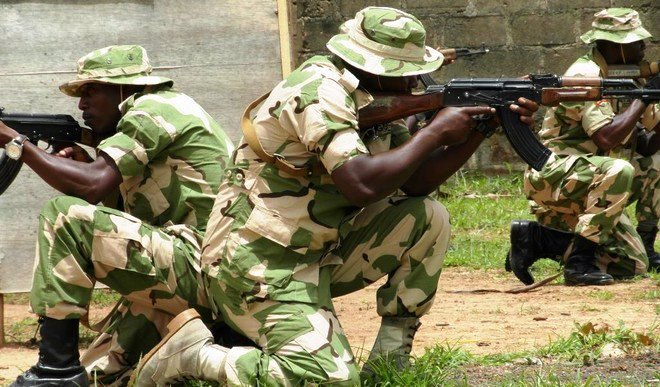
Men of Nigerian Army on a training. Photo Credit: File Photo
Though the president claimed that the war against insurgency is partly constrained by limitation of resources, available records show that a total of N1475.143trillion has been the budgetary allocations to defence since 2016 to 2018 . Compare to his predecessor, budgetary allocations to defence under Buhari did not improve significantly.
In 2016, the defence budget was N429.128 billion 7.08% of N6.061 trillion budget; and 2017, N465.87 billion or 6.26% of the final N7.444 trillion budget. And in 2018, the budget was N9.12 trillion of which Defence got N580.145 billion or 6.26%.
The sum of N2.945 trillion was spent in 2012, 2013, and 2014. Allocations to defence in each year were N921.91billion, N1.055trillion and N968.127billion respectively.
In April 2018, president Buhari, approved a release of $1bn for the procurement of security equipment to fight insurgency and revolt in the country.
While it appears that the government had committed much resources to prosecuting the war, the president, on the other hand, has not demonstrated enough will power to make the service chiefs accountable for the deaths of soldiers fighting Boko Haram. He has not shown a keen interest in their welfare and the weapons with which they engage the terrorists.
One-sided war against corruption
Former SGF, Babachir Lawal, was indicted of corruption and sunsequently removed from office, but he is yet to be prosecuted.
President Buhari is touted as a man of integrity and this largely accounted for why he won the hearts of many Nigerians on his way to electoral success in 2015.
Three years down the lane, his much talked about the war against corruption has been criticised as one-sided which looks away from atrocities committed by those believed to be his allies and members of his party.
Nigeria’s ranking in the Corruption Perception Index rating by Transparency International slipped 12 steps in 2018’s rankings, moving from 136 under President Goodluck Jonathan to 148 today.
Former President Olusegun Obasanjo had also lamented that the president was condoning corruption and that he had failed woefully and as such should not seek a re-election.
His opponent and presidential candidate of Peoples Democratic Party (PDP), Atiku Abubakar also mocked him that “corruption”has become official under his watch.
Atiku was speaking against the warm reception given to the former Secretary to the Government of the Federation, Babachir Lawal by the Federal Government, even after it was established that the former SGF was involved in corruption.
President Buhari was forced by public opinion to drop Lawal from his cabinet after he was alleged to misappropriated funds meant for rehabilitation of Internally Displaced Persons (IDPs).
When he was confronted by the Anchor of the “The Candidates”, Kadaria Ahmed, Buhari challenged Nigerians to bring their evidence against Lawal.
Under his administration, former governors under the platform of PDP who were being investigated for corruption have also defected to his APC and already currently servingin his Presidential Campaign Council.
But the president defended himself during the programme, he said he was being careful with the war against corruption.
“When I came in uniform in 1984, we arrested the President, the Vice President, and governors and ministers, and said that they were guilty until they can prove themselves innocent,” Buhari said
“I told you why I have to be careful. If there are strong allegations, people should come out with strong evidence like names of companies looted, contracts awarded, then, we take them before the court and ICPC and we have to trust the system and allow them to complete their investigation.
“If we just arrest them and look the other way as we did in the military system…democracy is a multi-party system that does not approve that. So, if there is sa trong allegation, the government may ask people to go like the former secretary general.”
PRESIDENT Muhammadu Buhari’s appearance on ‘The Candidates’, a town hall event that is intended to bring the top candidates in the 2019 presidential election closer to the voters, was the major subject of discussion all day on Thursday.
The programme, organised by Daria Media and the Nigeria Television Authority (NTA), with support from the MacArthur Foundation, saw Buhari and his vice, Yemi Osinbajo give an account of their stewardship so far, and why they should be re-elected come February 16, 2019.
However, during the interview, Buhari failed to provide straightforward answers to some of the questions directed at him, perhaps because he genuinely forgot or he just chose to ignore.
Here are a number of them:
WHY HASN’T BABACHIR LAWAL BEEN PROSECUTED?
One of the first questions Buhari was asked was why the former Secretary to the Government of the Federation (SGF), who was removed from office after he was found guilty of abuse of office and contract scam, was yet to be prosecuted by the EFCC.
Rather than give a direct answer, Buhari tried to deflect the question, saying that the method of fighting corruption in the present dispensation is different from what obtained when he was a military Head of State.
He ended by saying that the public should help the administration by volunteering vital information that could lead to uncovering corrupt practices by public officers.
“If there is a strong allegation, the government may decide to ask the person (involved) to go, like the former Secretary to the Government of the Federation, we asked him to go,” Buhari said.
When the interviewer insisted on why Lawal has not been prosecuted despite having been sacked, Osinbajo interjected, saying that the matter was still before the EFCC.
WOULD YOU SUPPORT EDUCATION RESTRUCTURING?
Before this question, Buhari had blamed the local governments for their failure to effectively carry out their responsibility of providing basic education, the consequence of which is the Almajiri system of education in Northern Nigeria.
He was then asked whether he was willing to support restructuring such that certain items could be moved from the exclusive list to the concurrent and residual lists as the case may be, in order to improve education funding.
Again, there was no answer to this question, rather Buhari insisted that it was the duty of the local governments to “scream loud enough for Nigerians to hear them” if their respective state governors refused to make funds available to them to fund basic education.
“It is very difficult for the federal government, under this dispensation, to enforce education at all levels…” he said.
DO YOU BELIEVE THAT THERE’S CORRUPTION IN THE MILITARY?
Following the recent resurgence of the Boko Haram group and the alleged corruption among the Military hierarchy, Buhari was asked whether he was convinced that the there was something untoward going on. His response was not convincing.
“I believe the system is still working otherwise there will be a complete breakdown. The system is working but it is lots more difficult,” Buhari said.
Osinbajo, again, came to Buhari’s rescue, though he neither affirmed nor denied the issue of corruption among the military leadership. He rather said that “assuming there is any misappropriation of government funds, there is a clear process for ensuring that that is not the case, and if people are found to be guilty of those things, they will be prosecuted.
DO YOU FEEL YOU’RE HEALTHY ENOUGH TO CONTEST?
This was the second to the last question posed at Buhari, but the president did not attempt the question. This could be because Kadaria Ahmed, the interviewer, asked her two final questions together so that while answering one, Buhari forgot the other. It could also be because the time for the programme was up.
IF YOU LOSE, WILL YOU ACCEPT DEFEAT?
Buhari, again, did not provide a straightforward answer to this question. First, he said it was not possible. He asked the presenter to find time to watch his visits to Bauchi, to Kogi, and also watch his subsequent visits to other states, as well as the reaction of the voters.
When the presenter insisted on whether Buhari would accept defeat, he said, “that won’t be the first time I’m losing an election”.
AND THE QUESTIONS THAT WERE NOT ASKED…
One would expect that the issue of Nigeria’s almost comatose education and health sectors would feature prominently in an event such as Wednesday’s town hall.
Not a few Nigerians were disappointed that Buhari and Osinbajo were not asked what their administration has done to improve education in Nigeria, especially given that university lecturers have been on strike since the past three months.
Also, Nigerian young medical practitioners continue to leave the country in droves in search of better working conditions in the UK, US, and Canada. Medical facilities in the country are poorly equipped and staffed. Not even the State House Clinic fared any better. Yet, Buhari has spent more than 150 days in his first term in office on medical vacation in London.
The issue of a new minimum wage was also one that many expected would have been thrown to the President to provide a clearer position. But that too did not come up.
The Criminal Investigation Department (CID) of Ghana Police Service has officially invited Kennedy Agyapong, Member of Parliament for Assin Central over the murder of Ahmed Hussein- Suale, an investigative reporter and the partner of Anas Aremeyaw Anas.
Ahmed was allegedly shot dead in Madina on Wednesday night by two gunmen on a motorbike who shot into the car he was driving.
The murder coincidentally occurred months after Assin Central MP exposed him in the aftermath of the #Number12 exposé on corruption in Ghana football, and called the deceased wicked and said he be beaten if he visits the premises of his company.
“Slap him, in fact, beat him, anything that happens I will pay,” Agyapong said in the viral video.
Meanwhile, before his official invitation to the CID, Kennedy Agyapong has said that he knows, and have nothing to do with the killing.
It was reported that during a morning show on NEAT FM ‘Ghana Montie,’ he said that the journalist never offended him while he was still alive pointing out that the opinion being circulated on the social media about his connection with the killing is quite unfortunate.
“A friend called to tell me that there is something trending on the social media that I engineered the killing of one Ahmed, first of all, the guy has never offended me in any way,” he said.
He said that he could not fathom why he would engineer the killing of a person who is irrelevant in his life as he is well placed and sees no reason why he would want to murder Hussien- Suale.
“This boy is irrelevant to my life. Why would I be stupid and order people to kill him looking at how far God has brought me? He has not offended me in any way. They should look for those who may be behind this heinous act. This is just cheap propaganda.”
“I don’t live a low life. I am focused on everything that I do, that is why I am very loud when I am arguing. I don’t compromise on anything. Ahmed has not done anything to me because I am not part of the people he set up,” he added.
Although no links have been drawn between the Agyapong’s call to violence and the Wednesday evening murder, the police has promised to leave no stone unturned in getting to the bottom of the murder as all persons suspected to be linked to the killing will be invited to assist in the investigation.
Agyapong is only invited as a person of interest, the police authorities have said.
THE Peoples Democratic Party (PDP) presidential candidate Atiku Abubakar has arrived in Washington D.C on Thursday, putting an end to a visa restriction placed on him by the United States for the first time in 13 years.
The former vice president is billed to speak at the US Chamber of Commerce and US – Africa Business private roundtable and meet with US government officials.
He is also expected to hold a consultative forum with Nigerians in Diaspora and the business community.
He was accompanied by Senate President Bukola Saraki who is the director-general of his campaign, Uche Secondus, national chairman of the Peoples Democratic Party, PDP, and some key members of the opposition party.
Abubakar’s arrival in the U.S is set to boost his presidential election hopes, after the ruling All Progressives Party (APC) had taunted him for his inability to enter the U.S. for over a decade.
Abubakar has not visited the U.S. since 2007 when he left office as Nigeria’s vice-president. He served under former President Olusegun Obasanjo who had serially accused Abubakar of fraud while in office and claims that he was linked to corruption charges filed in the U.S.
However, he has always denied all allegations of wrongdoing.
For the over 12 years, Abubakar was unable to visit the U.S, as American authorities had declined to issue him entry visa and there was speculation that a secret indictment had been entered against him by the country’s authorities.
Abubakar’s visa appears to have come through the intervention of Obasanjo, with whom he recently settled a decade-old dispute ahead of the 2019 elections, according to sources yet unconfirmed.
In a tweet, Atiku confirmed he will be meeting with US government officials during his stay in America.
“Just arrived Washington D.C for meeting with US government officials, Nigerians living in D.C metropolis and the business community,” he tweeted.
Former president Olusegun Obasanjo is believed to have been very instrumental in the process which made the US grant Atiku the visa.
Obasanjo wants President Muhammadu Buhari out of office, after accusing him of displaying incompetence on issues confronting the country.
Atiku was accused of demanding a bribe of $500,000 to facilitate the award of contracts to two American telecommunication firms in Nigeria.
Investigators had videotaped William Jefferson, a former congressman representing Louisiana, who was jailed for 13 years for receiving a bribe of $100,000 worth of $100 bills which he claimed was meant for Atiku from an investor, Lori Mody, who was wearing a wire.
The FBI had searched Atiku’s residence in Potomac, Maryland, but no money was found.
If after watching d #NgTheCandidates yday & seeing PMB’S campaign mishaps you still think we’ve a president, you should sue your brain for non-support! We’ve a national emergency on our hands. Buhari is clearly infirm both in mind and in body. Other pple are ruling on his behalf.
Nigerians is this your President? ???????????? This is not a joking matter. The President of the Federal Republic of Nigeria clearly has Conductive deafness, looks frail and weak and thereby unfit to run for any office of government.#NgTheCandidates#buhari#osibanjo#president#UNFITpic.twitter.com/74l2L55CR4
Buhari is not fit to govern Nigeria
Buhari is not fit to govern Nigeria
Buhari is not fit to govern Nigeria
Buhari is not fit to govern Nigeria
Buhari is not fit to govern Nigeria
Buhari is not fit to govern Nigeria
Buhari is not fit to govern Nigeria#NgTheCandidates
Why is the president embracing and doing business with former PDP members whom he consistently blamed for destroying Nigeria for 16 years?#NgTheCandidates
Clearly Buhari doesn’t understand the problem and so he can’t fix it.. He is still talking about grazing routes and cattle routes. He is saying Governors should reestablish grazing routes? This man is stuck in the past. #NGTheCandidates
Osinbajo is like a defensive midfielder. The man is an asset to Buhari and to APC.
He is the only reason why this interview is remotely watchable. Otherwise it would be pointless.
I wonder what will happen at the Presidential debate when he’s not there though #NgTheCandidates
— OurFavOnlineDoctor ???????? (@DrOlufunmilayo) January 16, 2019
This thread gives the full account of what transpired yesterday on the #NgTheCandidates the entire horrific moments were captured with links to the video just in case your brain decides to shield you from the shock. It happened. #NeverAgain
Buhari asked about Herdsmen/Farmers clashes and how to solve it and he is still making a case for grazing routes, he didn’t even say “Pim” about MODERN RANCHING.
Buhari should never head anywhere let alone being president. Amaechi knows, so does Tinubu, Osinbajo, Fashola, Rochas.. but they are all wicked and does not give a rat ass about Nigeria #NGTheCandidates
One of the most stupid arguments tonight is a professor of law defending sharing $27 to market woman and calling it loan to aid economy. What business can you develop with 10k? #NgTheCandidates
From what I saw, I’ll give @MBuhari 7 out of 10 for his #NGTheCandidates performance in terms of meeting and exceeding expectations . He would have scored 9 but the audio was bad so he couldn’t hear some of the questions, no one is Perfect, so 10 was impossible.
If after watching Buhari on Channels #NGTheCandidates you still have your PVC for Buhari, your loyalty to this country should be questioned.
He couldn’t speak for himself ????????♂️
The way he looks at Osinbajo when he talks about his admin, like he is hearing it for the first time too!
An attack by Boko Haram, nearly two years to the January 17, 2017, bombing of Rann by the Nigerian Air Force, has again sent thousands of residents fleeing. To date, no one has been held accountable for the Airforce bombing.
EXACTLY two years after the Nigerian Air Force bombed Rann, Borno State, killing over 160 people and injuring scores, thousands of residents are again fleeing the beleaguered town.
By Wednesday, more than 8,000 of the residents, according to Doctors Without Borders/Médecins Sans Frontières, MSF, had fled across the border to Bodo, in Cameroon – without food, water or shelter.
Unlike two years ago, the residents now flee from ceaseless attacks by the Boko Haram insurgency group, that has attacked Rann three times since March 2018.
Fourteen people, among them three soldiers, were killed in the Monday attack, according to MSF team that went to access situation in the town.
By the accounts of fleeing residents, Boko Haram fighters launched the attack on the town on Monday at about 4:00 pm shooting indiscriminately and burning down houses and other properties. They also carted away not fewer than 800 head of cattle.
Sadiq Bwala, an MSF nurse who went to Rann on Tuesday said the attackers did not only burn many houses to the ground but also looted the town market and offices of humanitarian organisations in the town, including MSF and the International Organisation for Migration, IOM.
Tuesday 17 January: At least 120 people were wounded and 52 killed following today’s bombing by the Nigerian Army in an internally displaced persons’ camp in Rann, Nigeria, according to Médecins Sans Frontières (MSF).
“What struck me when we arrived was the silence. Usually Rann bustles with life, but yesterday it was eerie and quiet, like a graveyard. Usually, kids run around and play, but yesterday the only ones I saw were standing around quietly, looking anxious. The town has been devastated and I was devastated to see it. Many parts of the town have been burnt. There was still smoke drifting in the sky and the fires were still burning in places.
“I saw a long line of people leaving for Cameroon—women, children, and men, of all ages. Some had donkeys but many were just carrying their belongings. The ones I spoke to said they were leaving because they were too afraid to stay. There is not much left for them to stay for anyway: their homes are gone, and I don’t know what they would live on. The market was burnt and looted—food stores also. There is nowhere to get food from. People who don’t have any food at home will not be able to get any more,” Bwala said.
As at Wednesday, it was estimated that some 8,000 residents of Rann had fled across the border into Bodo in Cameroon, about 6 kilometres away, many of them in a state of shock, apparently distressed by what they had witnessed during the attack.
Humanitarian workers say that thousands more are expected to flee to Bodo and surrounding communities in the coming days. Those who had arrived as at Tuesday, many of them children and women, including breastfeeding mothers, were said to have spent the night in the open as there were no shelters to accommodate them, raising concerns about their health.
Emergency workers in Rann community, shortly after a bomb attack by a fighter jet belonging to the Nigerian Military. Photo credit: MSF
For these residents of Rann, the saying that lightning does not strike in the same place twice is a misnormer; for, for many of them, lightning has struck multiple times, each time bringing suffering and death.
Before the Monday attack by the insurgents, Rann had suffered three previous deadly attacks by Boko Haram in the last 9 months, the last being in December 2018.
The main target of these attacks has been the military unit, situated right beside the Internally Displaced Persons, IDP, camp in the town.
However, by far the most devastating attack on the town so far has been the bombing of the town by Air Force planes on January 17, 2017, an incident that the military authorities said was an accident, arising from wrong or misleading intelligence.
The ICIR was planning a commemorative report on two years of the airforce debacle and had spoken to some residents of Rann, many of them IDPs who had been displaced from their original homes, before the latest attack on the town on Monday. Many of those who spoke to us for the report have been unreachable since the attack.
Smoke billows from Rann following an attack on the community. Photo credit: MSF.
Those who spoke to The ICIR expressed disappointment with the federal government and military authorities for abandoning them and also for failing to compensate families of victims of the attack for their loss. They also worry that nobody has been held accountable for the blunder that led to the death of 167 persons.
Two years after the Nigerian air force bombed an IDP camp in Rann, Borno State, housing at least 45,000 people, little are known about the cause, the victims and the steps taken by the government to prevent such a tragedy occur again.
On that fateful day, the military was very quick to admit that the bombing happened and that there were many casualties.
While the army acknowledged that 112 people died in Rann and 97 were wounded, local officials claimed that the number of deaths could be as high as 236. The International Committee of the Red Cross, ICRC, which lost six of its own staff in the attack, said it performed surgeries on 78 persons, treated 98 persons and evacuated about 100 seriously injured persons to Maiduguri for urgent treatment
National and international condemnation and disbelief followed.
“Nigerian authorities should conduct a prompt, thorough, and impartial investigation into the January 17, 2017 airstrikes that hit a settlement for displaced people who had fled Boko Haram, killing at least 70 people, including nine aid workers, and wounding at least 120”, Human Rights Watch, HRW, said, two days after the bombing.
The international human rights advocacy group also demanded that “government, which has stated that the Nigerian Air Force accidentally carried out the strikes, should compensate those who were injured and the families of those killed as a result of any violation of international humanitarian law or the right to life.”
Likewise, Nigeria’s main military partners involved in the training urged the country to investigate. The USAeven offered its expertise in assisting with the investigation.
Three days after the bombing, the air force announced its own internal investigation. Defence Headquarters (DHQ) also announced its own investigation.
The cemetery with the bodies of the first victims buried. Photo credit: MSF
However, in July 2017 the defence headquarters in a statement blamed the bombing on “lack of appropriate marking”, meaning Rann IDP camp was not known to exist. The statement highlighted the cause of the incident being the “lack of appropriate marking of the area” and recommended appropriate marking of IDP camps.
The findings of the DHQ effectively passed the blame for the bombing on the IDP camp on the rationale that “people were not expected to amass at that location” and that “it appeared as a place that could equally be used for enemy activities”.
That position, to many international organisations, was an unacceptable defence by the Nigerian military aimed at covering up the truth.
Many human rights and humanitarian organisations operating in the region rejected both claims by Airforce and military authorities that it was an accident and that the military did not know of the existence of a camp there.
Human Rights Watch, for example, observed that tents in the IDP camp “are easily visible from the air”, adding it is “difficult to understand how an accident of this nature could have occurred.”
“The presence of what appears to be a large Nigerian military compound on the edge of town, 100 meters from one of the impact sites, raises further questions, as the military would have been expected to know that the area was filled with civilians and to take adequate precautions not to harm them during any operation targeting Boko Haram fighters who might have been in the area,” HRW stated further.
There are, indeed, clear indication that the military did know about the camp and was actually in charge of it. Many residents of the IDP camps who spoke to The ICIR said that the military had asked them to move to Rann for security after their communities by Boko Haram insurgents.
Graveyard where bodies of victims of the Rann attack were buried. Photo Credit: MSF
Besides, in December 2016, international humanitarian organisations carried out an assessmentof the IDP camp in Rann, and observed that the military set up the camp in April 2016 that the Nigerian army provided security and that humanitarian agencies liaised with the military about access to Rann.
Also, on the day of the bombing, staff of international humanitarian organisations were in the camp for food distribution, vaccinations and to ensure water supply. They could not have arranged that without the approval and cooperation of the military.
Another sore point for victims is that no compensation has so far been paid to any of the or their families. In fact, one resident, Pate Maite (not real names) complained that no government official has visited to condole with them, insisting that the government does not care for them.
“There was no response. There was one army officer who came by helicopter, but nobody else. No one came to see us. Nobody interviewed us. Not face to face, nothing. Even his excellency (Borno State Governor) or House of Assembly didn’t come to us for condolence. We didn’t see anyone on behalf of our nation to offer condolences,” he lamented.
Continuing, Marte queried, “Did Government not know about us? Did they not see us as a citizen? Or did they forget us? What have we done to deserve this? People have died, they became disabled, but nobody came to say they are sorry. Maybe they forgot us? Or we are no citizens?”
Contrary to Marte’s claim, however, The ICIR confirmed that the Senate and House of Rep members paid a condolence visit to the victims. The Senate, in fact, donated N7000 to each family that had lost loved ones.
Mausi Segun HRW country manager in Nigeria expressed worry that victims of the 2017 attack were abandoned and left without compensation.
“We are concerned that despite the military’s admission of responsibility for that unfortunate raid, most of the injured victims have been abandoned to bear the cost of treatment unassisted,” she said.
She states further: “The late-night attack on Rann by Boko Haram fighters just yesterday, almost 2 years to the date of the 2017 raid reinforces the vulnerability of civilians caught in the crossfire between government forces and the insurgents.”
Rann IDP camp after the bombing. Photo Credit: MSF
The 2017 air force bombing put Rann on the map; it received international attention. But things have not improved at all since then.
In January 2017, victims described life-threatening circumstances in Rann as people died daily due to lack of adequate food. Today, life continues to be very difficult in Rann.
The town is still cut off from the world as there are no roads. During raining season, with no roads, humanitarian workers find it difficult to offer assistance.
People continue to die of malnutrition, especially during the rainy season, on some days there were 15 to 20 deaths.
Aba Lamido (not real names) who spoke to The ICIR on January 14, shortly before the latest attack on Rann, said at the worst times, up to 20 people die in the town daily.
“There is no improvement. During rain season, 10 to 16 were dying on daily basis because of hunger and malnourishment, mostly small children. Now, the situation has improved. On daily basis, 2 or 3 or 1 are dying.”
He said there are few medical staff in Rann as many who left after the 2017 attack did not return.
“Many people working in the hospital have left because of fear of the BH. It is unfair. After the second attack, some staff of NGOs / UNICEF didn’t come again. The medical facilities are down.”
The condition is unfair, because anyone who gets something from WFP, maybe 6 kg guinea-corn per person for a month, and that is not enough. Cooking oil is not up to 1litre. Maybe 1.5kg beans with salt. There are no condiments. There is an NGO, called Care, they do the distributions.
Before the latest attack, Rann is believed to have hosted about 18,000 IDP households and some 60,000 displaced persons, mostly children and women, especially widows who lost their husbands to the insurgency.
The whereabouts of most of these residents are uncertain as MSF staff who went to Rann after Monday’s attack say that the town is now desolate.
Air Commodore Ibikunle Daramola, spokesperson of the Nigerian Air Force, who spoke to The ICIR on Wednesday night said that the Air Force was still expecting the report of the special investigation panel set up by the federal government before it can do anything.
Daramola said that the DHQ and Nigerian Air Force had handed over the results of their own investigations to the federal government panel.
Noting that the panel had submitted its report to the presidency and the Attorney General of the federation, Adesanya said that “the ball is not with the Air Force any more” adding that “office of the Attorney general is the right organ of government to comment on the findings of the investigation into the attack.”
“In terms of compensation, that responsibility is with the federal government. We are not empowered to do that even if we had wanted to. The issue of compensation is supposed to be part of the recommendations of that panel’s work,” he said.