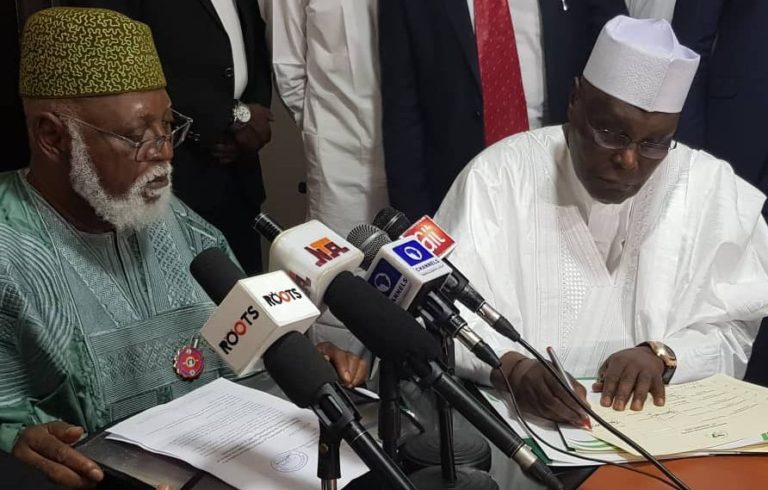
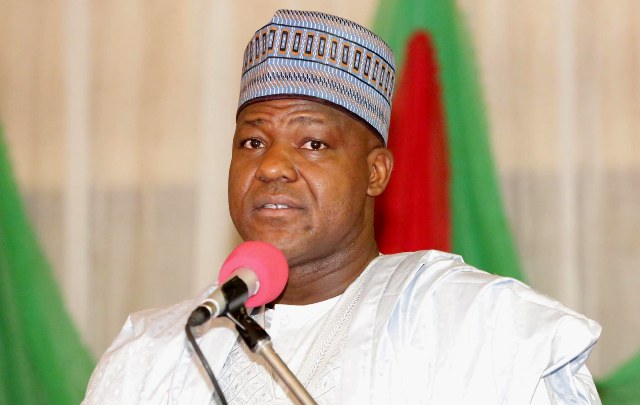
THE presidential candidates of the Peoples Democratic Party and former Vice President, Abubakar Atiku, has signed the 2019 general election peace accord while asking President Muhammadu Buhari to reconsider his decision on the Electoral Amendment Bill which he has refused to sign into law.
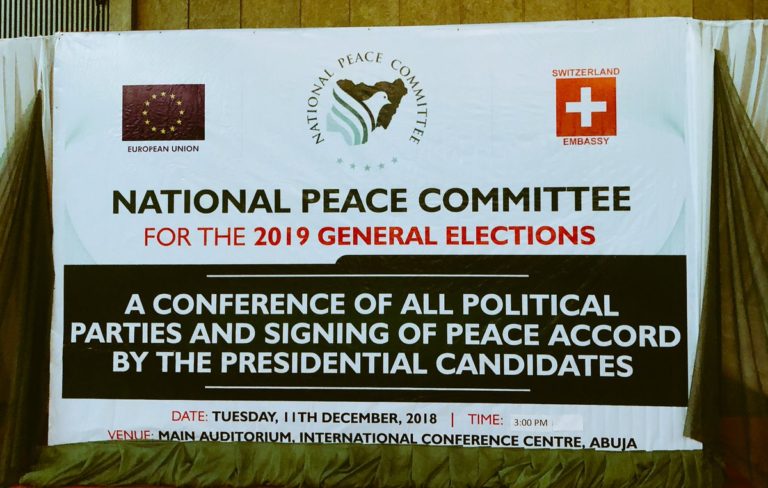
The official ceremony where presidential candidates of the various political signed the peace accord, held on Tuesday, but Atiku did not attend the event, saying later that he was not invited.
On Wednesday, however, Atiku signed the accord at the Kukah Leadership Centre in Abuja, and the brief ceremony was witnessed by the chairman of the National Peace Committee, Abdulsalami Abubakar, and the Catholic Bishop of Sokoto Diocese, Mathew Hassa-Kukah.
“I commend the President for accepting to sign the peace agreement. But let me also advise him to sign the Electoral Act Amendment Bill”, Atiku said after signing the pact.
Some of the persons that were present at the brief ceremony on Wednesday also expressed their displeasure with the National Peace Committee, for allowing only President Buhari and the National Chairman of the All Progressives Congress (APC) to deliver speeches during the ceremony held on Tuesday.
Usman Ikeleji, the Chairman of Change Nigeria Party (CNP), said the committee demonstrated “partiality by not given the other party chairmen the chance to speak. According to him, not even the chairman of the Inter-party Advisory Council 9ipac), Peter Ameh, was allowed to speak.
“Why was only the presidential candidate of the APC allowed to speak at this occasion? Is Buhari the only presidential candidate here? Nigeria belongs to all of us.
“Why should Oshiomhole be singled out at the event when we have equal status as chairmen of political parties? We came here and can’t be allowed to speak? Who owns Nigeria?
“It is our country. You can’t just bring us here and ask us to sign a document we don’t even know the content. These men are deceiving us.
“Nobody was allowed to talk not even the Chairman of Inter-party Advisory Council. We are talking about peace here and they won’t allow us to speak? Are we children?”
At this, Abubakar said he takes responsibility for the error, and pleaded with the political parties to forgive him.
Some of the people that accompanied Atiku to the Kukah centre on Wednesday were the PDP national chairman, Prince Uche Secondus, and the former governor of Ogun State, Otunba Gbenga Daniel, who is also the Director General of the Atiku campaign organization.
Earlier on Wednesday, Obiageli Ezekwesili, former Minister of Education and presidential candidate of the Allied Congress Party of Nigeria (ACPN), was also at the Kukah Centre to sign the peace accord. She, too, was not present at the official ceremony on Tuesday.
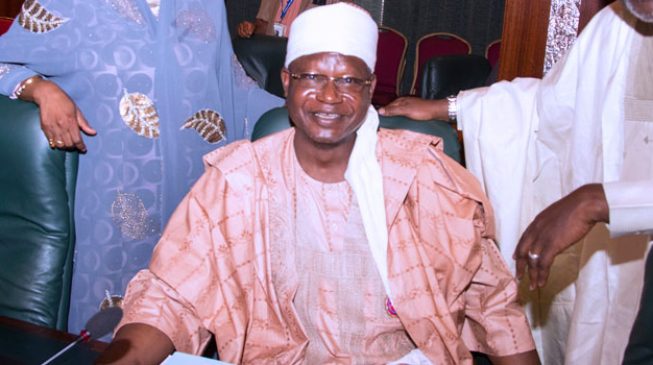
The Minister of State for Environment, Ibrahim Jibrin, has stepped down from his office after he was chosen as the Emir of Nasarawa by the Nasarawa Emirate council.
His resignation was announced on Wednesday by the Secretary to the Government of the Federation (SGF), Boss Mustapha.
In a valedictory session held in his honour, Mr Jibrin recalled his time as minister saying he travelled the entire length of Nigeria and has “seen the devastation caused by climate change” and effect of conflict in the North-east.
He said in the South-south, he saw “fish being fried with crude oil” which made him make up his mind to work with the administration to stop oil pollution in the region and ensure the clean up of Ogoni part of Rivers State.
“Tomorrow the 13 of December, there will be a project meeting in Port Harcourt in which project site will be handed over to contractors”.
Before now, he said, oil companies were reluctant to release anything, but a commitment by the government forced them to change their mind and $180 million has now been paid.
The President, in a statement, hailed the people of Nasarawa Emirate and the State Government on the hitch-free exercise which led to the emergence of Alhaji Jibrin as the 13th Emir.
Describing the new First Class traditional ruler as a “wise choice and worthy successor,” President Buhari stated that Alhaji Jibrin’s impeccable credentials as a distinguished public servant and a land expert will be deployed to impact positively on the development of his emirate.
Jibrin was appointed as the Minister of State for Environment in December 2015 when the council was constituted after the Senate screening and confirmation.
REGARDLESS of age, no resident of Oke-Irhue community has ever enjoyed a supply of electricity from the government of Nigeria. The agrarian community located in the heart of Uhunmwode Local Government, Edo State, has not been connected to the country’s energy grid ever since inception.
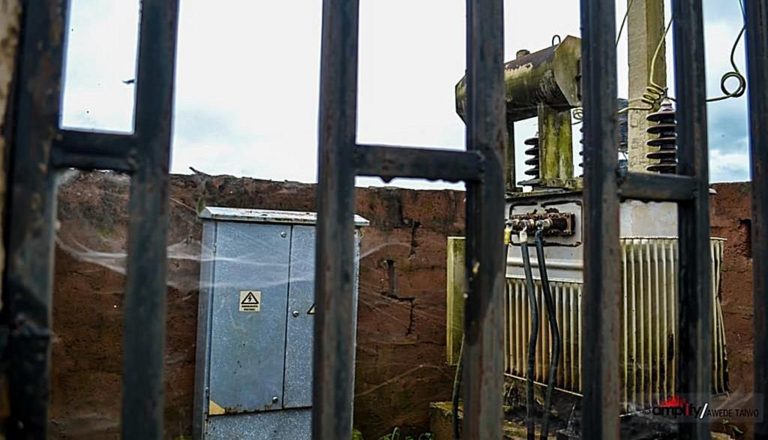
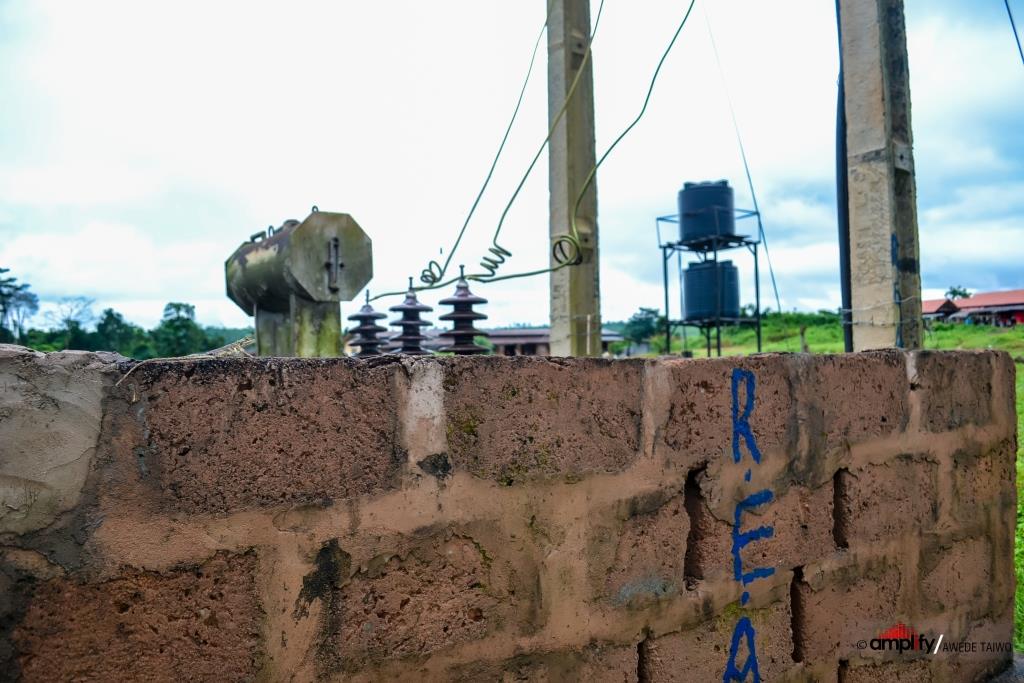
In 2004, the community got lucky. The Rural Electrification Agency (REA) started a power supply project. Poles were erected in some parts of the town by the contractor, wires were placed, and one transformer was supplied. But that was the end of it.
Fourteen years later, people of Oke-Irhue still sleep in darkness and generators remain the only source of electricity for the few who can afford them. Not only that, the town is disconnected from the rest of the world because they also do not have access to news. Yet, these are possibly the least of their worries.
With close to 5000 residents, the community is one of the largest in the Irhue Ward 4. Moreover, this figure is likely to double in the near future taking into account the activities of Okomu Oil Palm Company, which has just extended its operations to the town.
At least four times, the last in June, Sam and Sam Electrification Company, the contractor handling the project, has asked residents of the community to clear the site in order to resume the project. The residents have carried out the instruction, and are waiting for the contractor to get to work, but nothing has been done till date.
Of politics and failed promises
Speaking with The ICIR in October, Tony Jimoh, a member of the community’s working committee, revealed that the electrification project has constantly featured in the campaign promises of politicians in the region, but none has yet fulfilled the promise.
“Every four years, they tell us they will give us light and they will come and commission it,” Jimoh said. “But after winning, we do not see them again.”
In 2015, the same cycle was repeated and, as the 2019 general elections approach, the issue of electrification has again taken centre stage in political discussions, though people remain incredulous.
According to Jimoh, the senator representing the Edo South district, Aisagbonriodion Matthew Urhoghide, is one of those who promised to see to the completion of the electrification project. Aisowerien Patrick, representing Orhionmwon Uhunmwode federal constituency at the House of Representatives, has also refused to respond to entreaties after his election.
“Even one of our leaders in the community says he has been calling his number and he is not even responding,” he added. “He sent him text messages concerning this project and he’s never replied.”
Elizabeth Atvie, representing the state constituency at the Edo State House of Assembly, has also forsaken the community despite earlier promises of completing the energy project and rehabilitating the road. Jimoh recalled that she supplied a damaged transformer “over eight years ago”, with some wires hanging loose.
“She won, it’s getting to seven years now, and we are not getting what she promised. And she’s even campaigning for the House of Representatives as we speak,” he said.
Members of the community did not find out that the donated transformer is not working until both transformers were examined in August by an expatriate from the Benin Electricity Distribution Company (BEDC) Plc. It is only the transformer placed between the market and the Catholic church, the expatriate observed, that is functional; but he also assured that, with that one alone, the entire community could be powered.
BEDC, during the visit, pledged that power would be supplied “before December”, but nothing has been heard from them since then.
Photo credit: Amplify/Awede Taiwo
Of politics and sabotaged publicity
Having had enough of the hollow promises and fruitless pleas, members of Oke-Irhue community resolved in 2014, to employ other means of drawing attention to their plight. The Nigerian Television Authority (NTA) was invited and residents were taxed to raise N70,000 as payment for publicity.
A short heart-rending documentary was produced and the villagers were given a date on which it would be aired. When the agreed Thursday arrived, various residents gathered and waited anxiously to watch the report; but it was not aired as promised.
“We called them to ask what is happening,” Jimoh narrated. “They told me that that woman representing us, Hon. Elizabeth Atvie, is the one behind it, that they called their madame that they should not air it on Thursday.”
Officials of the NTA assured the community leaders that the video would be aired on Saturday, knowing full well that it would not get as much viewership. It was observed that parts of the documentary had been removed when it was finally broadcast. When the officials were challenged about this, they responded that the uncensored version would be broadcast at a subsequent date. There is no evidence this was done.
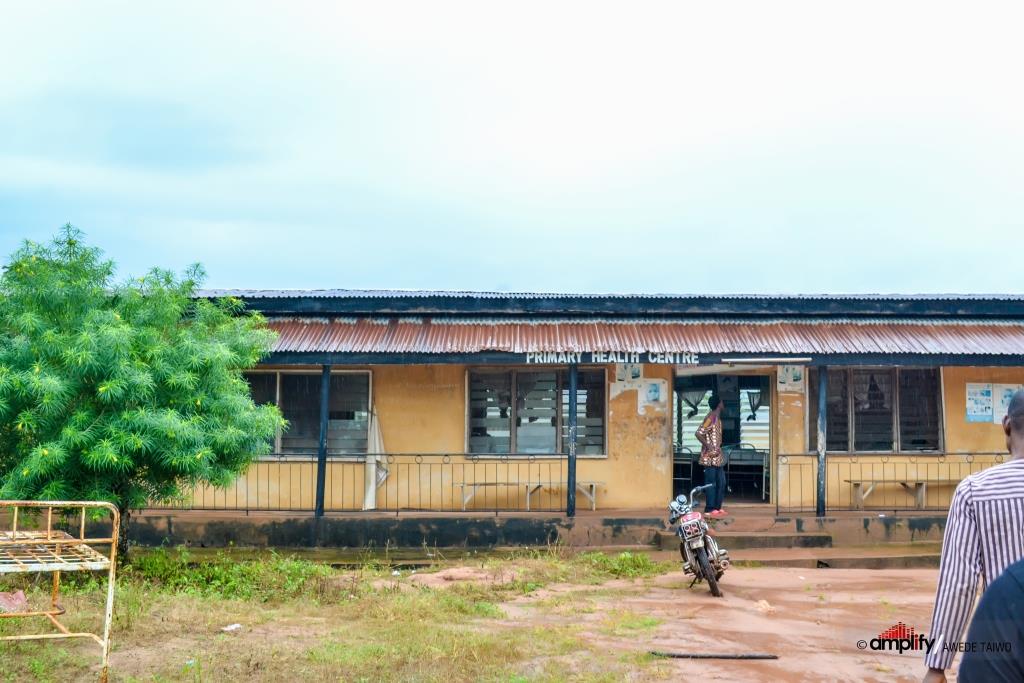
Primary Health Centre, Oke-Irhue. Photo credit: Amplify/Awede Taiwo
Health hazard, wasted farm produce … effects of blackout
Oke-Irhue is a largely agrarian community where nearly 80 per cent of the population are farmers. As a result of unpleasant road conditions and the difficulty involved in travelling to the area, farmers hardly get the money’s worth of their produce.
Buyers do not visit frequently enough; and when they do, they offer ridiculously low prices for the goods — knowing the farmers have little or no choice but to accept. A farm produce that is worth N1000 could be sold for N200, Jimoh said.
“If we say we will not sell, they will say carry it,” Jimoh said, sorrowfully. “But how can we carry over 1000 heads of plantain and tubers… You cannot eat all of them, so you’ll be forced to sell.”
He also said the bulk of their produce such as plantain, pineapple and yam are left to waste in the bush, especially as there is no power supply with which they may be preserved. He told The ICIR that residents of the community would have ventured into tomato farming, but the lack of electrical supply has made it too risky.
Daniel Asemota, the community secretary, said the abandoned electrification project has also created a life-threatening atmosphere because the community’s health centre could not function appropriately.
In the hot season, patients at the clinic suffer suffocation and they usually resort to the use of hand fans to keep themselves cool.
“The health centre runs on a generator,” Asemota revealed. They put it on sometimes from the hours of seven in the evening to ten, if there is fund. “It is not regular.”
He added that, asides the deplorable condition of the health centre, the primary and secondary schools are also in bad shape and the people are not enjoying any amenities as dividends of democracy.
Secondary School Building, Oke-Irhue. Photo credit: Amplify/Awede Taiwo
Contractor: Project is completed; it is left for REA to energise
When he was contacted, Sam, the owner of Sam and Sam Electrification Company — which could not be traced as one of the companies incorporated by the Corporate Affairs Commission — said the project is completed, but the REA has refused to energise the community through the infrastructure on the ground. He also revealed that his company has not been fully paid by the agency.
“We are being owed, we have not been paid,” he said, impatiently. “The project has been completed. If you want information about Oke, go to NEPA [BEDC]. Go to REA. Information is everywhere. The certifications are there for them to energise; they refuse to energise them.”
He also said he is aware members of the community are scheduled to meet with BEDC the following day to discuss the project. When he was asked to confirm the project’s completion rate, he started a conversation with another person, ignoring the reporter’s calls for attention for nearly two minutes.
However, speaking on behalf of REA’s South-South Zonal Office, Thomas Inegbedion said Sam and Sam is not the actual contractor, and requested The ICIR to pay a visit to the office for details.
“You’re getting the wrong information,” he said. “Sam and Sam is the one doing the job, he is not the contractor. That is not the name of the contractor. When you come to the office, you will get your correct information, please. You can’t just get information on the phone like that. We have a department which handles such issues.”
Meanwhile, Section 16(6) of the 2007 Public Procurement Act provides that all bidders for a contract must “possess the necessary professional and technical qualifications to carry out particular procurements”, as well as necessary equipment, adequate personnel and other relevant infrastructure.
Oke-Irhue is one of the numerous rural communities that benefit nothing from the over 7,000 megawatts generated in the country. The World Bank, in a 2018 report, pointed out that, with about 80 million people lacking access to grid electricity, Nigeria has the largest access deficit in Sub-Saharan Africa and the second largest in the world, after India. It also established that while up to 83.6 per cent of the urban population has access, only 39.1 per cent of the rural population does.
In December, Nigeria secured approval for a $200 million loan from the African Development Bank (AfDB) and China’s Africa Growing Together Fund (AGTF) to fund the Nigeria Electrification Project (NEP), implemented by the Rural Electrification Agency (REA).
According to REA’s website, the South-South geopolitical zone has the highest number of ongoing projects (52) and the second highest number of new capital projects (81) funded by the agency. The exact locations of these projects, as well as others that have been completed, are however not available on the platform.
This report received the support of TrustAfrica and Amplify, a civic tech organisation projecting the voices of rural underserved people and advocating for sustainable development in Nigeria’s forgotten communities.
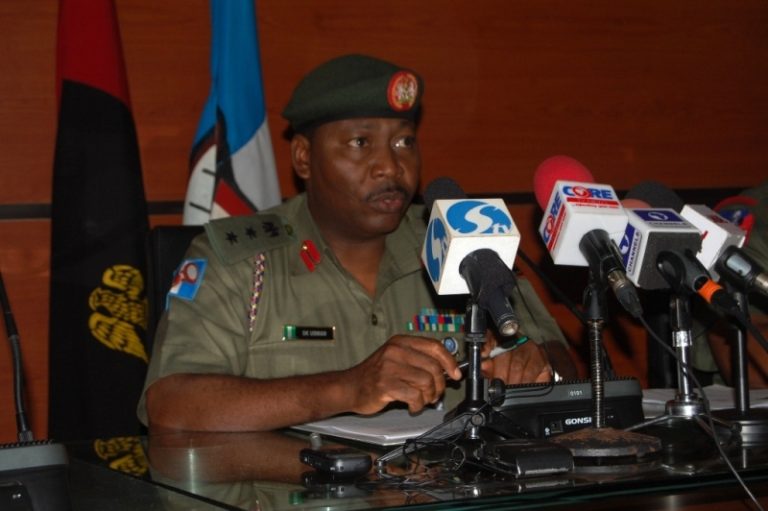
ARMY spokesperson, Sani Usman, says the reports that the International Criminal Court (ICC), The Hague, indicted the Nigerian Army of war crimes were false.
The 2018 Report on the Preliminary Examination Activities of the ICC stated that the institution identified eight potential cases involving the commission of crimes against humanity and war crimes in Nigeria. Six of the cases were against Boko Haram while two were against the Nigerian security forces.
The report read in part: “Specifically, the Office found a reasonable basis to believe that the NSF (Nigerian Security Forces) committed the war crimes of murder pursuant to article 8(2)(c)(i); torture, cruel treatment pursuant to article 8(2)(c)(i); outrages upon personal dignity pursuant to article 8(2)(c)(ii); and intentionally directing attacks against the civilian population.”
The Army spokesman, Usman, clarified the statement, saying the army was not indicted by the ICC, rather the global court had pointed out some issues of interest in the country.
“I just sent a WhatsApp message to one of the Nigerians at The Hague, and honestly, I wish my phone was here, you would have seen his reply,” Usman said during a live television programme on Tuesday.
“I think there is an element of some campaign of calumny and mischief. The International Criminal Court (ICC) in its preliminary report did not say so.
“In fact, what they said is that there were issues of interest in Nigeria, but for them to have come out to indict the Nigerian army, it is not true.”
On Monday, Amnesty International, a global human rights group, had also accusedthe Nigerian army of committing crimes against humanity in the North East region of the country and called on the Office of the Prosecutor (OTP) of the ICC to open an investigation against the army.
“Eight years since the opening of the preliminary examination and faced with the continuing commission of crimes under international law and the possibility of a never-ending preliminary analysis, it is time for the OTP to open a formal investigation in Nigeria,” Amnesty International stated.
The leadership of the Nigeria Army has consistently denied AI’s repeated allegations of gross human rights abuse, saying that the international Non-Governmental Organisation is an enemy of Nigeria and its people.
THE Anti-Corruption Academy of Nigeria (ACAN), a training arm of the Independent Corrupt Practices and Other Related Offences Commission (ICPC), will be the best anti-corruption training school in Africa.
According to Rasheedat Okoduwa, ICPC’s spokesperson, President Muhammadu Buhari made this pledge at the opening ceremony of the training workshop on Corruption Risk Assessment (CRA) for heads of anti-corruption agencies in Africa, in Abuja on Tuesday.
Buhari noted that the support for ACAN would ensure that Nigeria and other African countries are well equipped to deal with the menace of corruption on the continent.
“ACAN has earned our support as it moves to becoming a focal centre for anti-corruption studies in Africa,” Buhari said while commending the ICPC for coming up with the CRA as a tool for ensuring the success of the battle.
The President called on the participants from over 30 Africa Union (AU) member countries to domesticate the CRA template in their various countries, stressing that the training can only be meaningful if the assessors are put to work back in their countries.
In his remarks, the Acting Chairman of ICPC, Musa Abubakar, noted that the introduction of CRA by ICPC had helped the government to block avenues for corruption in its financial systems.
He listed some of the areas where the Commission had conducted CRA to include the ports sector, Nigerian international airports and selected Ministries, Department and Agencies (MDA) which had led to a significant reduction of opportunities for corruption in Nigeria.
“When loopholes and leakages in the systems are plugged, people will be denied access to public funds and as such will not have the opportunity to misappropriate it,” Abubakar said.
“This is against pursuing individuals after the deed is done, an action that drains a lot of resources amidst challenges that create uncertainty of outcomes.
“To this end, ICPC stands on the principle that an ounce of prevention is worth more than a tonne of remedy.”
Forty-two participants are taking part in the CRA workshop, drawn from AU countries like Mauritius, Mali, Kenya, Lesotho, Guinea Bissau, South Africa, Morocco, Togo, South Sudan, Sierra Leone, Liberia, and Rwanda.
Others are Ghana, Senegal, Benin Republic, Zambia, Niger, Burkina Faso, Algeria, Burundi, Democratic Republic of Congo, Cote d’Ivoire and Tanzania.
JUST 12 days after the Police Service Commission (PSC) opened its recruitment portal for police applicants; the Commission says it has received 104,289 applications for 10,000 police jobs.
“The applications hit this figure as at 11.30am today, Tuesday, December 11th, 2018. The portal will officially close on the 11th of January, 2019 in compliance with the six weeks requirement by Federal Character Commission,” said Ikechukwu Ani, the Spokesperson of the Commission in a statement on Tuesday.
The recruitment portal was opened on November 30, 2018 for Nigerians who want employment into the Nigeria Police Force as Constables.
“Niger State has the highest number of applicants at 7,985 while Bayelsa State has the least applications of 347. Kano State is second with 7,513, Katsina came third with 6,820; Bauchi fourth with 6,204 and Kaduna State fifth with 5,729 applicants.
“Following Bayelsa from the rear, is Lagos State with only 516 applicants, Ebonyi State is next with 600, Anambra State, 605, Abia State, 733 and Imo State with 870 applicants.
“Out of the 104,289 applications received so far by the Commission, 93,871 were males while 10,418 were females.
“The Commission restates its commitment to ensuring a merit-driven and transparent recruitment exercise that will follow due process and abide by the relevant rules and regulations in the Public Service.
“Applicants are warned not to give money to anybody for assistance as the giver and receiver if caught, will face the full weight of the law.
“Applicants are required to apply online to the Commission’s portal www.nigeriapolicecareers.net and applications are free. This is for the benefit of other interested applicants. They are only required to fill the form online and also submit it online,” the PSC statement said.
On December 5, a total of 21,878 applications were received just five days after the opening of the portal.
“The Police Service Commission has so far received twenty one thousand, eight hundred and seventy-eight thousand applications, five days after it opened its portal for the recruitment of 10 thousand Constables on Friday, November 30th, 2018.”
“The online applications hit this figure as at 12.30 pm today, Tuesday 5th December 2018.”
In June this year, over 37,000 applicants applied for the police job, but only 5,253 candidates were shortlisted after all the applicants were subjected to an aptitude test conducted by the Joint Admission and Matriculation Board (JAMB).
The Inspector-General of Police (IGP)Ibrahim Idris, had in February announced that the Police force will recruit at least 10,000 personnel every year to boost its operations.
ABUBAKAR Atiku, the presidential candidate of the Peoples Democratic Party (PDP) was conspicuously absent at the signing of the peace accord for the 2019 general election.
The event was put together by the National Peace Committee, headed by the former Military Head of State, Abdulsalami Abubakar.
Also absent at the event were Kingsley Moghalu, Obiageli Ezekwesili, Donald Duke, and Omoyele Sowore, presidential candidates of the Young Progressives Party (YPP),Allied Congress Party of Nigeria (ACPN), Social Democratic Party (SDP), and African Action Congress (AAC) respectively.
President Muhammdu Buhari was present at the event.
JUST IN: President @MBuhari signs the Peace Accord, an undertaking by all the presidential candidates to ensure peaceful and rancor free campaigns before, during and after the 2019 general elections. #NigeriaDecidespic.twitter.com/ITwx1tojcR
Abubakar thanked President Buhari for his commitment to a peaceful general election, adding, however, that the security situation of the country remains a source of worry. He also urged leaders to desist from making statements that could further heat up the polity.
Also speaking at the event, on the topic, “Trust and Democracy”, Yakubu Gowon, a former Military Head of State, said democracy remains the system of government that is guaranteed to bring about all-round inclusion.
“The beauty of democracy is that it avails citizens the right to have a say in how they are governed; this right is abridged by the most brutal dictators in the word,” Gowon said.
“Military incursion into our politics has led to misery and underdevelopment of our richly endowed nation and contributed to defective democracy.
“All hope is not lost for the enthronement of true democracy in the country, which is why we must commend the NPC in sensitising everyone that elections are not do-or-die contests.
“We should encourage them to consolidate on the successes of 2015, so that we can have even better polls in 2019. There are better issues of development than pursuing agenda of violence and hate speech. Promotion of ethnic and religious or mutual suspicion will not make us see the best in us, and will defeat the essence of democracy.”
Witnesses at the event include the National Chairman of the Independent National Electoral Commission (INEC), Mahmood Yakubu, Catholic Bishop of Sokoto Diocese, Mathew Hassan-Kuka, the traditional ruler of Ile-Ife, Adeyeye Ogunwusi, among many other political, religious, and traditional rulers.
In the run-up to the 2015 general election, both former President Goodluck Jonathan and Buhari signed the peace pact, committing to a violence-free process.
Atiku says he wasn’t invited
Meanwhile, Atiku explained later on Tuesday, through his spokesman, Paul Ibe, that he did not attend the peace accord signing ceremony because he was not invited.
“His Excellency did not get any invitation for the programme. I have spoken with him and I can confirm he wasn’t invited,” Ibe said.
AN investigation by The Next Edition, an online newspaper, has reported that Nigerian security operatives are significantly sabotaging the government’s efforts to eliminate Boko Haram as they aid the funnelling of huge volumes of petrol and other fuel products to the deadly group.
The newspaper, in its week-long investigation, reportsthat soldiers, police, customs, immigration and civil defense operatives frequently receive bribes and turn a blind eye as fuel marketers and smugglers divert truckloads of petrol and foodstuff to Boko Haram enclaves in Nigeria and neighbouring countries.
During interviews with security operatives, marketers and undercover exploration of the dark market, the newspaper obtained details of the well-coordinated transactions and is able to provide a glimpse into a largely unreported and unregulated operation that has clearly fed the insurgency in the Northeast and helped prolonged the nine-year war.
The reporting has also shown the impact of the large-scale murky operation on the nation’s petro-economy.
Highly classified sources said not fewer than 60 trucks loaded with petrol and an equal number carrying foodstuff illegally leave the country through Adamawa State daily.
This newspaper learnt that Boko Haram insurgents get their food and fuel supplies from the diverted products.
Each day, operatives of the Nigerian Army, Nigeria Police, Nigeria Immigration Service, Nigerian Customs Service and the Nigeria Security and Civil Defence Corps, NSCDC, manning the many checkpoints across Adamawa State extort bribes ranging from N500 to N300, 000 from motorists in order to allow them to pass regardless of the vehicle convey .
The smuggled fuel is sold at lucrative rates either to the Boko Haram insurgents, a group that has waged war against the Nigerian state since 2009, or is ferried across the border.
Today, Nigeria’s subsidised petrol and foodstuff are being illegally sold in countries such as Cameroon, Niger, Chad and in the Central African Republic.
The military sources said Boko Haram has relied on such smuggling fuel to power their vehicles and motorcycles when going for attacks.
Repeatedly, security services in Borno, Gombe and Yobe have either arrested suspected Boko Haram fuel suppliers or seized huge consignments of petroleum products believed to have been procured for the militants.
In July 2016, the Army in Borno State arrested a man it said was a supplier of fuel to Boko Haram.
According to the News Agency of Nigeria, NAN, the suspect was arrested with a truck loaded with 25 jerry cans of petrol and other goods cleverly covered in cartons.
In January 2018, the NSCDC in Borno State said it seized 1,000 litres of petrol from suspected Boko Haram fuel suppliers. The NSCDC Commandant, Ibrahim Abdullahi, told the NAN that the products were filled into jerry cans and concealed in sacks. In June, the Army said it arrested two other men in Gombe for allegedly selling large quantities of fuel to Boko Haram. Concealing fuel-filled containers under sacks would turn out a common method for hiding smuggled or diverted products in neighbouring Adamawa as this investigation has shown.
Government’s Move to Beat Sharp Petrol Deals
One of the tankers used in discharging petrol at the illegal depot.
As part of measures to monitor daily fuel consumption across the country, the Federal Government in August adopted an automated fuel system management and sensor network. According to the Minister of State for Petroleum, Ibe Kachikwu, the platform would reveal national consumption by tracking fuel supply from the ports to its final delivery in the petrol station.
An initiative of the Petroleum Equalisation Funds (PEF), the project enabled the licensing of every truck conveying fuel with a driver and a transport company so they could be apprehended if the products go missing. Mr. Kachikwu had at the time boasted the exact daily fuel consumption in the country would be known for the first time.
“The essence of what PEF is doing is that this will enable us track refined petroleum product movement from the point of LC (letter of credit) opening from the vessels that come into Nigeria, up until the point where they are discharged into tanks in Nigeria, and from the tanks into trucks in Nigeria, monitor the trucks till they deliver the products into the storage tanks for the filling stations and they are discharged and sold,” the minister had said.
But like most government policies, the tracking project has failed to stop the diversion of petrol not only across the country’s borders but also to the Boko Haram fighters enclave.
How marketers beat NNPC’s tracking system
AH Gurin Investment Nigeria Ltd, where fuel was loaded in jerry cans and staked behind the building.
Investigations by this newspaper revealed how Shylock marketers beat the NNPC’s monitoring devices and take products out illegally. They divert products after they have been delivered to filling stations in many parts of the North-east. Each truck lifting product from the NNPC depot in Yola goes straight to a designated filling station and discharges into the underground tank. While the monitoring system shows the product has been discharged, the marketers wait till nightfall before rallying young men to fill the product into hundreds of jerry cans and or drums brought from a storage bay.
The jerry cans and drums are then loaded into trucks and a tarpaulin is rolled over the illegal cargo to protect it from direct exposure to sunlight and heat before setting out to where the products are sold at exorbitant prices.
On the surface of it, no one would believe petrol diversion could be a big business right inside Yola Metropolis. But The Next Edition found out some filling stations in Jambutu area of Yola are neck deep in the illegal business. Some of the stations involved in the illegal deal are located close the Jambutu Bypass Roundabout.
Our correspondent learnt that the police, military and customs authorities are aware of their activities.
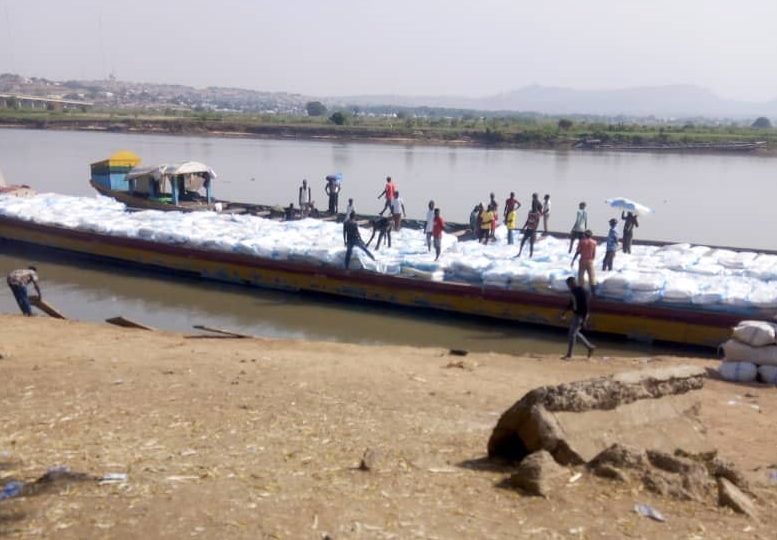
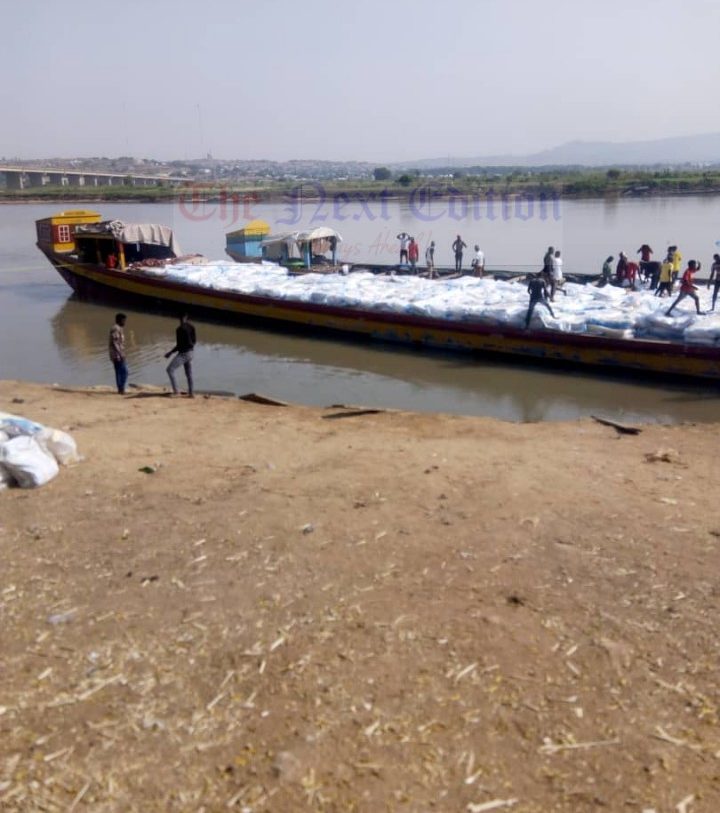
Barkin Kogi Waterside in Jimeta is another area where petroleum products and foodstuff are smuggled out to Boko Haram and neighbouring countries.
A fully-loaded boat carrying smuggled petrol and grains ready to leave Barkin Kogi Waterside, Yola.
During a visit to the riverside, our correspondent saw dozens of young men loading bags of grains into a boat but the grains were merely used to cover drums of petrol already stacked inside the boat. We also found that the consignments that were already loaded in the boat came from a nearby NNPC filling station in the area.
“What happens is that the marketers fill drums and jerry cans with petrol and bring them here in the night using hand trucks,” an insider told our correspondent.
“The drums or jerry cans are first loaded into the boat before some bags of foodstuffs are used to cover the drums or jerry cans.
“All the security agencies represented here collect money before any boat is loaded. Even the military representative here collects money from each passenger boarding a boat in this waterside.”
Before any boat carrying grains and or petrol is allowed to set sail, cargo owners are made to pay N22, 000 to the customs, N80, 0000 to immigration, N70, 000 to marine police.
The military which has the only Intelligence Unit at the waterside is said to receive N5, 000 per passenger boarding a boat in and out of the area.
A fully-loaded boat carrying smuggled petrol and grains ready to leave Barkin Kogi Waterside, Yola.
One of the biggest petrol smuggling rings uncovered in the course of this investigation is in Jabilamba, a community located about 20 kilometres from Yola metropolis.
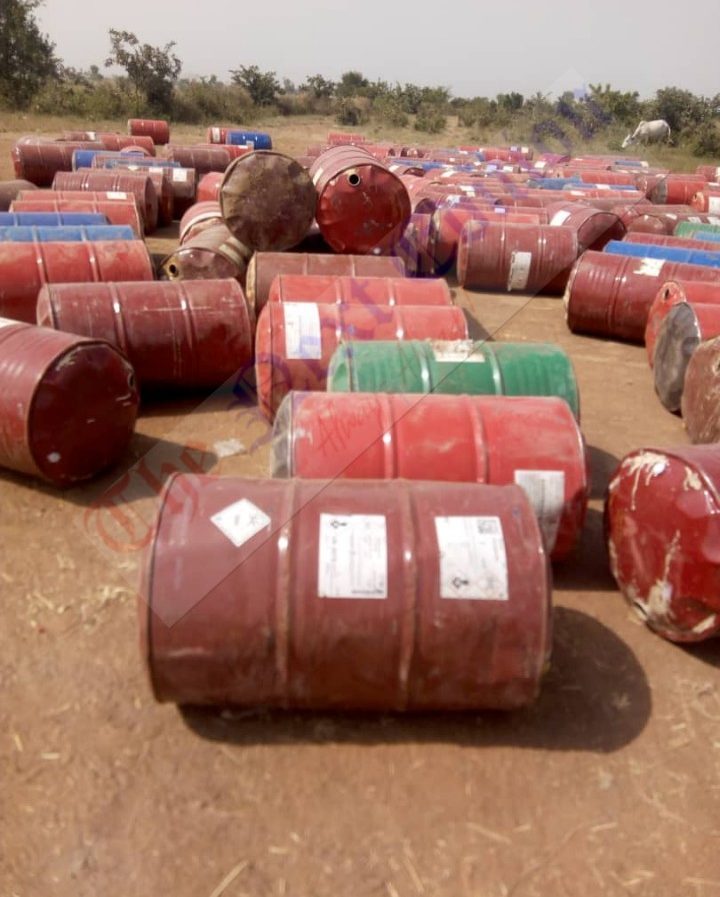
The illegal petrol depot is housed in an expansive fence nestled in the bush with hundreds of empty drums littering the place. It was learnt that the site is jointly operated by powerful marketers who divert tankers from their filling stations and load the products for sale outside the country in jerry cans and drums.
At the time our correspondent sneaked into the depot, there was no activity going on but the strong smell of petrol and the drums that littered the compound gave an indication of what happens there.
“This place comes alive as soon as petrol tankers start rolling in and discharging products. So many young people earn living filling drums and jerry cans with petrol and loading them into trucks,” a local told our correspondent.
The NEXT EDITION learnt that no fewer than 10 petrol tankers discharge petrol at the illegal depot on a daily basis and the products are being taken out of the country.
More drums waiting to be loaded with petrol at the Jabilamba illegal depot.
Another Adamawa hothouse of petrol diversion is Guri, a Nigerian border town in Fofure Local Government Area.
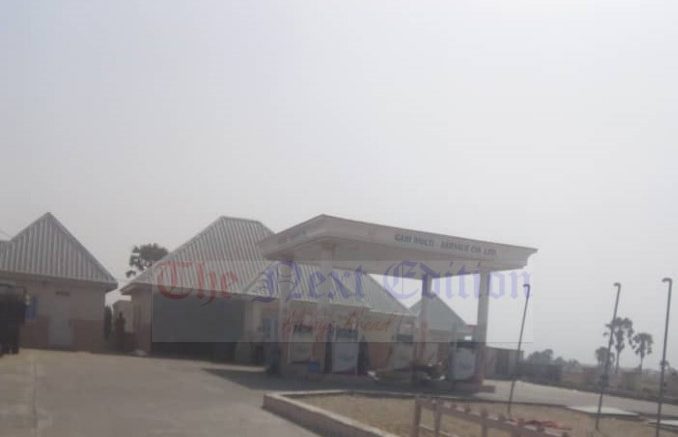
What separates the town from the Republic of Cameroon is a river that has long dried up, thereby providing easy access for people, including smugglers to move freely in and out of the two countries. There are two filling stations in the area, Gari Multi-Services Ltd and H.S Gurin Investment Nigeria Ltd. The third is still under construction.
Residents of the community confirmed the two service stations which are located less than a kilometre from the border, are involved in smuggling. The properties are constructed with the filling station in front and a large fenced empty space behind.
Our correspondent, who stopped over to buy water spotted the sales boy filling several jerry cans with petrol and while four young men took them to the back of the station. While pretending to use the restroom, our correspondent saw other young men putting the fuel-laden jerry cans into large bags and stacking them.
This was the same method those arrested by the NSCDC officials allegedly used. Many commercial motorcyclists suspected to be Cameroonians were also seen crossing the dried river bed with six jerry cans tucked into bags and securely tied to the back of the motorbike.
We also learnt that several trucks loaded with petrol, foodstuffs and building materials go across the border to Cameroon daily.
“It is an open business here and a lot of people earn their living taking one thing or another across the border,” a local fixer told our correspondent.
At Gari Multi-Services Limited, our correspondent asked the sales boy whether it was possible to buy some quantity of petrol to be sent to his relation in Cameroon.
“Can I buy some petrol here and send to my brother in Cameroon,” our correspondent asked?
“Yes it is possible but you don’t have a jerry can. How are you going to do it,” the sales boy replied.
“I thought you have some jerry cans for sale here. I could have bought some. But do you know any Okada man who can help me take the product across the border?,” our correspondent continued
“I don’t have jerry cans and I don’t know any Okada who crosses the border with petrol,” the sales boy responded appearing suspicious of the reporter. He walked away and refused to answer any more questions from our correspondent.
Many petrol stations in Mubi, Song, Hong, Michika and Madagali are said to be involved in the business of fuel diversion and smuggling and security agencies including the Department of State Services (DSS) are aware, highly classified sources said.
Gari Multi-Service Station where our correspondent asked to buy fuel and send to Cameroon.
How security operatives encourage the criminal diversion of petrol and foodstuffs
With several checkpoints created in many parts of Adamawa State, investigation shows security operatives deployed to man them shamelessly aid and abet diversion of foodstuff and petrol.
In the course of the investigation, the newspaper found three checkpoints where marketers and foodstuff merchants bribe security operatives to allow them to divert badly needed petrol and grains.
At the Sangere by Moddibo Adama University of Technology (MAUTEC) gate, our correspondent saw drivers park their trucks by the roadside and go straight to settle operatives of the NSCDC under a tree.
Instead of arresting drivers with truckloads of petrol-filed jerry cans and drums, the NSCDC officials rather collect N2, 000 bribe and let them divert the subsidised product and badly needed grains.
Less than 20 kilometers from the NSCDC checkpoint, is a military checkpoint in a town called Jabilamba. At this checkpoint located in one of the most notorious “fuel depot,” truck drivers carrying petroleum products loaded into drums and jerry cans pay N500 while those carrying grains part with N2,000.
At a major checkpoint located in Mubi, popularly called “tollgate,” by motorists, our correspondent said soldiers extort drivers but do not check the contents of the vehicles.
It was learnt that a top officer at the local military formation in Mubi earns millions in bribes from drivers and traders plying the routes.
“Every truck driver passing the checkpoint is compelled to pay N2, 000 which is remitted to the commander,” a highly classified source said.
“He (commander) has a boy who keeps a register of all the trucks passing through the checkpoint. The boy ticks as each truck driver arrive and pays the money.
“At the end of the shift, the money is gathered and paid to the commander.”
The source said over 30 trucks loaded with 1330 x 30-litre jerry cans of petrol are smuggled out from filling stations across Mubi on a daily basis.
Our correspondent was taken to one of such filling stations where the criminal business is perpetrated and secretly recorded what was going on.
The leadership of Customs and Immigration in the state are also said to receive returns from their operatives extorting motorists and traders.
While the “big” man in customs is said to collect between N200, 000 –N250, 000 from every truck carrying petrol towards the border, his Immigration counterpart is said to charge every illegal immigrant coming in or out of the country.”
“The customs man issues a kind of clearance letter to the truck drivers so when they get to the last checkpoint jointly manned by his officers, the Police and Immigration, the document is shown and the officers on the ground would merely collect N6,000 as their share and allow the vehicle to pass without being checked.
“The Immigration officers extort every foreigner coming in or leaving the country and many of them come to Adamawa to buy petrol and foodstuffs,” the source told our correspondent,” a security source confided in our correspondent.
The police are not left out of the extortion bazar as officers and men deployed to checkpoints along the border areas get their own share and allow drivers to pass without routine search.
How the accused security agencies responded to inquiries
The NEXT EDITION reached out to the spokespersons of the security agencies indicted in the investigation for clarification.
The Defence spokesperson, John Agim and his counterpart in the Nigerian Army, Yusuf Sani, were contacted on the telephone. While Mr. Yusuf would not pick calls to his phone, he, however, requested for a text message, which he replied about 12 hours after it was sent.
“Thank you so much for your enquiry. The matter is being investigated and whatever is the outcome, we will let you know,'” he said.
“However, we would like to state that the Nigerian Army does not tolerate any act of indiscipline or unprofessional behaviour from its personnel.”
Mr. Agim would neither pick calls nor respond to our text messages.
The Police Public Relations Officer (PPRO) in the Adamawa State command, Othman Abubakar, thanked our editors for the enquiry and promised to report the matter to the Commissioner of Police (CP) during a strategic meeting of the command.
“Thank you, my brother. I have heard what you said and I will report it to the CP at our meeting during the week.
“I know the CP will take appropriate action on the matter,” Mr. Abubakar said.
On his part, the spokesperson of the Nigerian Customs, Joseph Attah, after consulting the Adamawa State comptroller said the service has no power under the law to impound trucks carrying goods within the country’s borders.
“You know we have licensed filing stations dotting many of the border villages. The first challenge the SC raised was when tankers come to pass, Customs would ask where they are going. If they have a licensed filling station at the next village, customs have no right to stop such trucks.
He said it got to a point that dealers from these licensed stations came to meet the command and said Customs was stopping their properly licensed business.
“They said if our comptroller wouldn’t believe them, they would produce their signed complimentary cards showing the products came from the NNPC deport and meant to their respective filling stations located in the area.
“Secondly, when the supplies are delivered to the filling stations, some people come to buy the product in jerry cans and drums to take to some of the interior villages.
“You know because of the insurgency, many filling stations have been closed down and others, blown up. So nearby villages need products.
“But the real issue is because of the security situation on the ground, Customs have limited patrols. I am told our men do not go to Madagali area.
“Sometimes, the military would ask our men not to go to certain areas because of the grave security situation. So our men are not completely in charge of the border areas in that part of the country.
“Besides, Customs cannot stop the movement of goods within the country. It is only when it is being taken out that we can deal with it,” Mr. Attah said.
He did not, however, comment on the alleged bribes paid to his colleagues or deny the allegation.
Responding on behalf of the NSCDC, its spokesperson, Emmanuel Okeh said the agency would carry out a full investigation into the allegations and anyone found culpable, dealt with in line with the principles of the law.
“I assure you that the Corps will carry out a full investigation into the allegation and anyone found culpable will be dealt with in line with the principles of the law,” he stated.
“Just last week, the commandant general ensured the payment of their allowances and the arrears as approved by the Federal Government.
“Therefore, they have no reason for getting themselves involved in any illicit activity. The Commandant General, Abdulahi Gana Muhammadu takes the welfare of personnel as a top priority so as to discourage them from carrying out or getting involved in illegal activities,” Mr. Okeh stated.
The spokesperson of the Nigerian Immigration Service, Sunday James, said the leadership of the agency has resolved to carry out a full-scale investigation into the matter.
“The Comptroller General said I should thank your organisation so much for being patriotic in embarking on the report,” Mr. James said.
“He has assured that a full investigation will be carried out on the matter and we will get back to you on our findings.
“He has also asked that if you have pieces of evidence, you can forward them to us as soon as possible to aid our investigation,” he said.
The ICIR obtained the approval of The NEXT EDITION to re-publish this investigation.
SPEAKER of the House of Representatives, Yakubu Dogara, has criticised the ‘Trader Moni’ initiative of the federal government, saying it is a form of voter inducement and violates the Electoral Act.
Dogara said this at a public hearing organised by the National Assembly Joint Committee on INEC and Political Parties Matters on Vote-buying and Improving the Electoral Processes in Nigeria, on Monday, in Abuja.
The ‘Trader Moni’ initiative is one of the social intervention programmes of the Buhari administration whereby 30,000 petty traders from each state of the federation are given small, interest-free loans of N10,000 each, repayable within six months. The aim, according to the government, is to provide the small traders with funds to sustain and boost their businesses.
Vice President Yemi Osinbajo has been going around many states across the country to kick-off the programmes.
But many have complained that the programme is a disguise by the government in power to induce voters ahead of the 2019 general election.
For instance, the ‘Trader Moni’ programme was launched in Osun State on September 4, just a few weeks to the state’s governorship election on September 22 this year.
Dogara, in his speech on Monday, maintained that the programme is a form of vote buying, regardless of how noble the intention may seem.
Speaker Yakubu Dogara
“It is instructive to note that the Electoral Act anticipated and captured most forms of electoral fraud including inducement and vote buying,” Dogara said.
“I am afraid that such endeavours, no matter how noble the intentions behind them, may fall within the all-encompassing provisions of S. 124 (1)(a);(b);(c); and S.(124)(2)(4)(5) and S. 130 of the Electoral Act.
“Although penalties are not stringent, there is also lack of political will to implement the laws as it is, even if it were to offer feeble deterrence to violators. Arrests are hardly made and even where arrests are made, prosecutions are unheard of.
“Let me seize this opportunity to call on all people of goodwill in our country to rise in condemnation and denunciation of vote-buying and all forms of electoral malpractices. Indeed, electoral fraud is one of the worst forms of corruption, and should be treated as such.”
Section 124 of the Electoral Act talks about “Bribery and Conspiracy” in election matters. Among other things, the section stipulates that anyone who “directly or indirectly, by himself or by any other person on his behalf, gives, lends or agrees to give or lend, or offers any money or valuable consideration” commits an offence.
Subsection 124 (b) states more clearly that “any person who… directly or indirectly, by himself or by any other person on his behalf, corruptly makes any gift, loan, offer, promise, procurement or agreement to or for any person, in order to induce such person to procure or to endeavour to procure the return of any person as a member of a legislative house or to an elective office or the vote of any voter at any election,” commits an offence is liable on conviction to a maximum fine of N500,000 or imprisonment for 12 months or both.
The law also forbids any voter from receiving any such “money, gift, loan…for himself, or for any other person, for voting or agreeing to vote… at any such election”.
The presidency has consistently stated that the ‘Trader Moni’ initiative has nothing to do with the forthcoming election.
However, the programme is also being used as a form of informal campaign for the re-election bid of President Buhari.
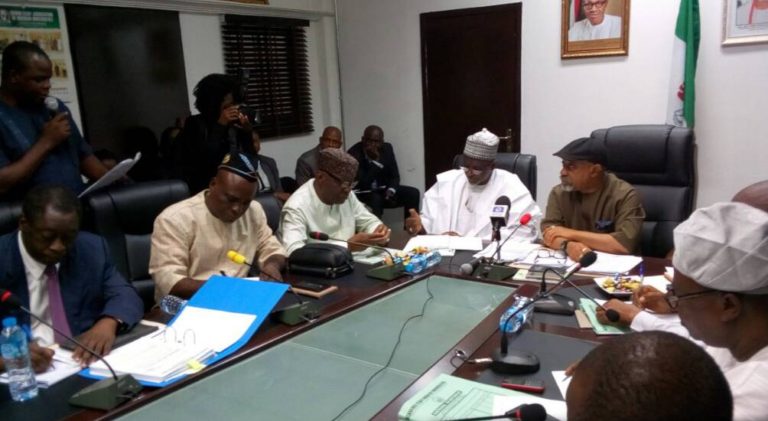
MINISTER of Labour and Employment, Chris Ngige, says the federal government has reached a partial agreement with the Academic Staff Union of Universities (ASUU) over the union’s ongoing strike.
But the leadership of ASUU said the industrial action remains ongoing as the government in the past has made mere promises without any concrete action.
Ngige had pointed out that some of the agreements in the Memorandum of Action signed between ASUU and the FG in 2017 will soon be implemented.
“I am happy to report that we touched some areas of understanding in implementation from the memorandum of action which we agreed to in 2017,”
“Some of these areas we have substantial compliance and some other areas have not been fully dealt with.
“Like the issue of shortfall in salaries of some federal universities’ workers and lecturers, ASUU has given a list to the accountant general’s office and we have agreed that by Wednesday that list should be cross-checked by the presidential initiative on continuous auditing. So, the accountant general’s office is to get back to us by Wednesday.
“We also have the issue of earned allowances, revitalisation, these are issues of 2009 agreement and partial implementation and we have agreed on the modus operandi to look into the fund situation, this is due to low revenue on the part of the government.
“We have agreed on what we are going to do to make sure that the outstanding amount is handled in a way that all parties will be properly accommodated.”
Ngige also said that the ministry of education will set up a committee to engage the Nigeria Governors’ Forum on ways to better fund state-owned universities.
But speaking with journalists after the meeting, Biodun Ogunyemi, National President of ASUU, said there was no concrete development yet to warrant the suspension of the strike.
“All we have heard today are just promises. There’s nothing to take back to our members,” Ogunyemi said.