Home Blog Page 2472

INEC chairman clarifies that IDPs, not refugees will be able to vote in 2019

CHAIRMAN of the Independent National Electoral Commission (INEC), Mahmood Yakubu, has clarified that it is only Internally Displaced Persons (IDPs) who are taking shelter in camps within the country that would be able to vote in the 2019 general election.

Yakubu gave the clarification at the ongoing Election Security Management Workshop holding in Abuja, on Thursday, following misinterpretations to his earlier comments on Wednesday about IDP voting.

He had said that persons who had been displaced as a result of the Boko Haram insurgency, farmer/herdsmen clashes, or natural disaster would not be denied their rights to vote.

Many media reports suggested Mahmood was saying that even the Nigerian citizens who are in IDP camps located in neighbouring countries, would be allowed to vote.

But speaking on Thursday, Yakubu explained that the IDPs in camps outside Nigeria are technically referred to as refugees, and since the Electoral Act does not recognise diaspora voting, they will not be eligible to vote.

“This category of Nigerians is not eligible to take part in the 2019 general elections because our laws do not make provisions for diaspora voting. The decision of INEC for IDPs to vote in the 2019 election is only limited to IDPs in Nigeria. There is no diaspora voting,” he said.

Yakubu had explained that there would be slight changes to the pattern used in 2015 where a day was set aside for IDP voting.

“This time around, it appears that displacement resulting in a number of citizens, not residing in places where they were ordinarily registered to vote, has led to much wider displacement,” he explained.

“We interacted with Resident Electoral Commissioners (RECs), at the moment, we are looking at about 15 states, for a variety of reasons citizens are not living in their natural and normal places of domicile.

“Intra-state IDPs shall participate in all election categories when and where applicable, while inter-state IDPs shall only participate in presidential elections in order to limit the challenges associated with political perception and suspicion over transmission of results across state borders and constituency boundaries.”

The Nigeria Army says thousands of IDPs have been relocated to their homes as a result of the successes being recorded in the counter-insurgency operations in the North East. However, there are still fears of attacks by Boko Haram on some of the communities that have been recovered.
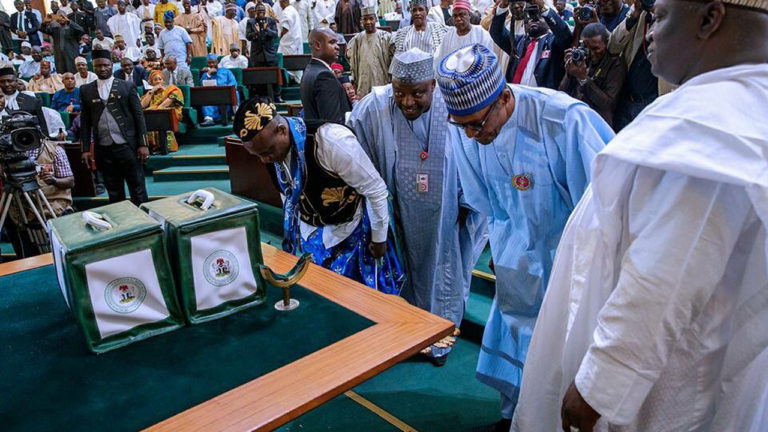

Buhari to present 2019 budget to National Assembly December 19

PRESIDENT Muhammadu Buhari says he will present the 2019 budget proposal before a joint session of the National Assembly on Wednesday, December 19.

This was contained in a letter read on the floor of the House of Representatives on Thursday, by the Speaker, Yakubu Dogara.

“May I crave the kind indulgence of the House of Representatives to grant me the slot of 11 hours on Wednesday, 19th December 2018 to formally present the 2019 appropriation bill in a joint session,” the letter read.

The Federal Executive Council (FEC) during its meeting on Wednesday had approved the 2019 budget, but the Minister of Budget and National Planning, Udoma Udoma, declined to reveal the details of the budget, saying that they were liaising with the National Assembly to fix a date when the document would be presented.

However, the lawmakers, during Thursday’s plenary, expressed displeasure at Udoma’s comments which, according to them, implied that lawmakers were the ones delaying the presentation of the budget.

Udoma had said after Wednesday’s FEC meeting, “As you already know, the budget is ready. We are liaising with the National Assembly because they are to give us a date. If they say today, we will go. The budget is ready.”

But Chika Adamu, a legislator from Niger state, said Udoma told a lie against members of the National Assembly on national television and called on his colleagues to demand an apology from the minister.

Some other lawmakers supported the motion, pointing out that the executive arm of government was fond of making the parliament appear bad before the people, hence the need for a public apology, else, they will boycott the budget presentation.

However, Femi Gbajabiamila, the majority leader of the house, said Udoma was misquoted by the media and that he was writing a rejoinder to his earlier statement in order to clear the air.

At this, Dogara called on his colleagues to give the minister sometime “to see if he will truly issue a rejoinder. But if we don’t see that (a rejoinder), then we have an issue because we will not allow this institution to be blackmailed. If nothing is done, we will take a concrete action on it.”

The 2018 budget proposal was presented to the National Assembly in November 2017, and President Buhari said he had hoped that the budget would have been passed before the end of the year in order to launch the country into a January to December budget system. However, the budget was not passed until May 2018, and was signed into law in June.

Nearly 30 million sick and premature newborns in dire need of treatment every year

NEARLY 30 million babies are born too soon, too small or become sick every year and need specialized care to survive, according to a new report by a global coalition that includes UNICEF and WHO.

“When it comes to babies and their mothers, the right care at the right time in the right place can make all the difference.

“Yet millions of small and sick babies and women are dying every year because they simply do not receive the quality care that is their right and our collective responsibility,” said Omar Abdi, UNICEF Deputy Executive Director.

The report, Survive and Thrive: Transforming care for every small and sick newborn, finds that among the newborn babies most at risk of death and disability are those with complications from prematurity, brain injury during childbirth, severe bacterial infection or jaundice, and those with congenital conditions.

Additionally, the financial and psychological toll on their families can have detrimental effects on their cognitive, linguistic and emotional development.

“For every mother and baby, a healthy start from pregnancy through childbirth and the first months after birth is essential.

“Universal health coverage can ensure that everyone – including newborns – has access to the health services they need, without facing financial hardship. Progress on newborn health care is a win-win situation – it saves lives and is critical for early child development thus impacting on families, society, and future generations,” said Dr. Soumya Swaminathan, Deputy Director General for Programmes at WHO.

Without specialized treatment, many at-risk newborns won’t survive their first month of life, according to the report. In 2017, some 2.5 million newborns died, mostly from preventable causes. Almost two-thirds of babies who died were born prematurely. And even if they survive, these babies face chronic diseases or developmental delays.

Also, an estimated 1 million small and sick newborns survive with a long-term disability.

With nurturing care, these babies can live without major complications. The report shows that by 2030, in 81 countries, the lives of 2.9 million women, stillborns and newborns can be saved with smarter strategies. For example, if the same health team cares for both mother and baby through labour, birth and beyond, they can identify problems early on.  

In addition, almost 68 per cent of newborn deaths could be averted by 2030 with simple fixes such as exclusive breastfeeding; skin-to-skin contact between the mother or father and the baby; medicines and essential equipment; and access to clean, well-equipped health facilities staffed by skilled health workers.

Other measures like resuscitating a baby who cannot breathe properly, giving the mother an injection to prevent bleeding, or delaying the cutting of the umbilical cord could also save millions. 

According to the report, the world will not achieve the global target to achieve health for all unless it transforms care for every newborn. Without rapid progress, some countries will not meet this target for another 11 decades. To save newborns, the report recommends:

  • Providing round-the-clock inpatient care for newborns seven days a week.
  • Training nurses to provide hands-on care working in partnership with families.
  • Harnessing the power of parents and families by teaching them how to become expert caregivers and care for their babies, which can reduce stress, help babies gain weight and allow their brains to develop properly.
  • Providing good quality of care should be a part of country policies and a lifelong investment for those who are born small or sick.
  • Counting and tracking every small and sick newborn allows managers to monitor progress and improve results.
  • Allocating the necessary resources, as an additional investment of US$ 0.20 cents per person can save 2 of every 3 newborns in low- and middle-income countries by 2030.

Almost three decades ago, the Convention on the Rights of the Child guaranteed every newborn the right to the highest standard of health care, and it is time for countries around the world to make sure the legislative, medical, human and financial resources are in place to turn that right into a reality for every child, the report says.


EXTRA: Dancing ‘robot’ at exhibition turns out to be a man in a robot costume

A robot on show at a Russian state-sponsored tech exhibition has turned out to be a man dressed in a costume, the BBC reports.

The robot, named Boris, was featured on Russian TV and was apparently able to walk, talk and dance, but soon after its appearance journalists began to question its authenticity.

In a picture published afterwards on social media, the neck of a person was clearly visible, and it turned out that so-called robot was, in fact, a £2,975 costume called Alyosha the Robot, made by a company called Show Robots.

Though the organisers of the tech event – which was aimed at youngsters – did not claim the robot was real, the TV coverage on Russia-24 suggested it was.

There have been several breakthroughs in the robotics industry among developed countries of the world and there seems to be a competition of sorts over whose technology is the most advanced.

Watch a video of the fake robot below:

ASUP begins indefinite strike, sets up committees to monitor compliance

THE Academic Staff Union of Polytechnics (ASUP) has begun an indefinite strike to protest the federal government’s failure to implement various agreements reached with the union in the past.

This is coming just over a month after the Academic Staff Union of Universities (ASUU) commenced its own strike on November 4.

National President of ASUP, Usman Dutse, made this known on Wednesday, adding that the government has invited representatives of the union to a meeting on December 17. He said the union has set up committees in their various chapters across the federation to monitor compliance to the industrial action.

Dutse pointed out that a 21-day ultimatum issued by ASUP to the federal government on October 2, elapsed since November but the Union did not embark on the strike immediately.

“We have zonal coordinators and a monitoring team, zone by zone, all over the country. Already from the report we are getting, we are satisfied with the level of compliance from all our zones but we are reviewing the day’s activity in a meeting now”, Dutse said.

The ASUP National Chairman had on December 5, informed journalists that the union will be kicking-off the strike on Wednesday, December 12, as “government has failed to implement and fulfil agreements it reached with the union as contained in the memorandum of understanding signed”.

Among other things, Dutse complained that “the institutions are not funded. The states are even worse because state governments just establish schools without actually funding those schools. So, no infrastructure is in place.”

“We have states that are owing about 14-month salaries. Some owe eight months. Benue, Ogun, Osun, Edo, Kogi are owing up to as long as 14 months,” he said.

The last industrial action by ASUP was in November 2017, but following prompt action by the federal government and the agreement to implement the recommendations of the 2014 NEEDS assessment, the strike was suspended 15 days after.

Abia Police arrests 51 suspected IPOB members in Umuahia

0

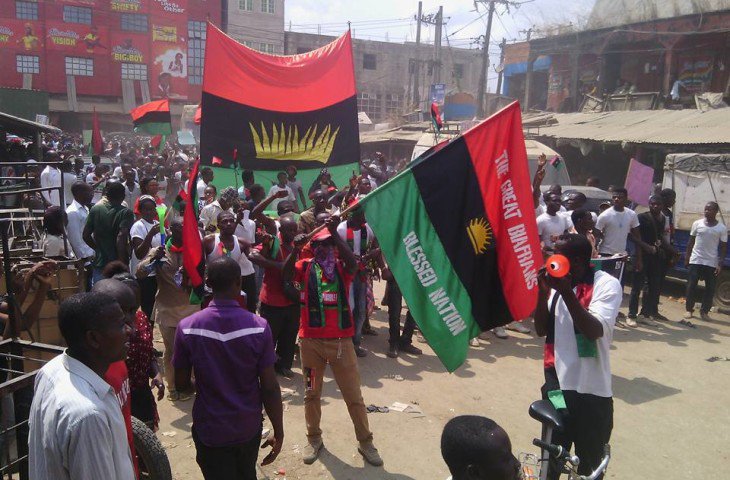
 Abia State Police Command on Wednesday arrested 51 persons allegedly suspected to be members of the outlawed Indigenous People of Biafra, (IPOB) operating as members of a “Judaism” sect, in Umuahia.

The Command’s Public Relations Officer in the state, Geoffrey Ogbonna in a phone interview with The ICIR confirmed that the command arrested 41 men and 10 women of the proscribed Indigenous People of Biafra (IPOB) in Umuahia, who were in possession of Israeli and Biafra insignia as they embarked on a ten million march protest.

“I can confirm to you that 51 suspects were arrested in Umuahia today for their association to a proscribed group,” he said.

“Their activities halted commercial activities and been a group that is outlawed the security agencies had to step in to restore law and order,” he stated

The suspects held a procession on major streets in Umuahia, carrying placards with different inscriptions written in Jewish Language.

Security peratives were said to have started firing teargas canisters to disperse the protesters and this resulted in chaos in the area as traders and passersby ran for safety.

The development caused a stampede at Isigate Market as traders, shop owners, passers-by and motorists ran in different directions for safety.

The suspects, who were dressed in religious white attires with small caps, similar to those of the Jews, began the procession from Afaraukwu community, where the IPOB leader, Nnamdi Kanu, hails from but were dispersed at Isigate.

Some items recovered from the suspects included two motorcycles, Biafran identity cards, one Biafran magazine, one Biafran National Anthem booklet and a Biafran flag.

In November, the ICIR reported a similar arrest was conducted in Anambra state where 43 persons suspected to be affiliated with IPOB were arrested but only 33 of the arrested persons were paraded by the police.

The Police spokesperson advised residents to shun actions that could be perceived by security agencies as “constituting a breach of the public peace during this period’’.

Buhari promises free healthcare for citizens above 60

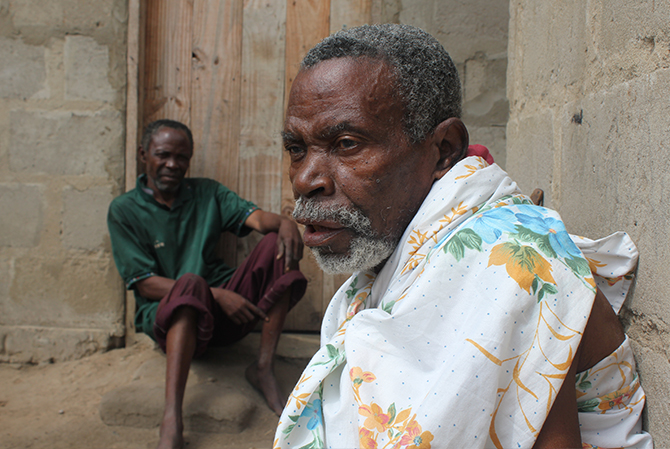
PRESIDENT Muhammadu Buhari has announced plans to establish geriatric centres at tertiary health institutions across the six geo-political zones of the country to provide specialized and free healthcare for Nigerians over the age of 60 years.

Buhari said this at the maiden edition of the National Summit on Healthy Ageing, in Abuja, on Wednesday, adding that the policy is aimed at improving health care services for the aged in the country.

This fresh promise of free healthcare for older citizens, coming so close to the 2019 general election, follows many unfulfilled promises by the Buhari administration to revamp the Nigerian Health Sector.

During his campaign prior to the 2015 election, Buhari promised, among other things, to pay attention to the health sector, but he ended up spending several months outside the country on medical leave as no hospital in the country was equipped enough to treat his ailment. Even the Aso Rock Clinic has remained in a state of disrepair and

Young Nigerian medical doctors keep travelling out in droves to the UK, USA, and Canda, in search of better opportunities, doctors and health workers still go on strike periodically in protest of poor working conditions and poor remuneration, and primary healthcare centres across the country remain ill-equipped and ill-staffed, despite the promise by the health ministry to revitalise at least 10,000 PHCs across the country.

Minister of Health, Isaac Adewole, who represented Buhari at the summit, said the federal government will provide resources and support to ensure that the programme is sustained across the country.

“We would ensure that resources and support are provided to enable us achieve the desired results, Adewole was quoted as saying on behalf of the president.

“We are aware that some states give free healthcare services to under fives and women, we hope to extend these services to people over the age of 60 years.

“We must make healthcare services available to our senior citizens as part of the government appreciation and social responsibility and a way of recognising their immense contributions to national development.”

Adewole said the ministry would carry out a research on some of the diseases that older people are more prone to, as well as train special health workers for the special geriatric healthcare programme.

Aged people are more prone to non-communicable diseases like hypertension, diabetes, and cancer.

According to him, there would be a training of healthcare workforce through effective collaboration and technical support of international organisations. There would also be research on chronic diseases of the aged and community-based health-social support.

Adewole also promised that the policy would be integrated into the Universal Health Coverage strategy.

Also speaking at the event on Wednesday, the Director of Hospital Services at the Ministry of Health, Joseph Amedu, said that the National Policy on Healthy Ageing was the first of its kind in Sub-Saharan African and it would serve as a model for the provision of healthcare to the aged in Africa.

Similarly, Chairman of the Governing Board of University of Abuja Teaching Hospital, Sam Jaja, said the aim of the summit was to discuss the truth and beauty of healthy ageing, with emphasis on geriatric medicine.

He said that Nigeria is currently ranked 86th out of 96 countries in the global age index 2015, which ranked countries by how well their older populations were faring.

The theme of the maiden summit was “Promoting the healthcare agenda of the present administration on vulnerable populations with focus on the aged”.

CDD trains journalists, INEC officials on combating fake news


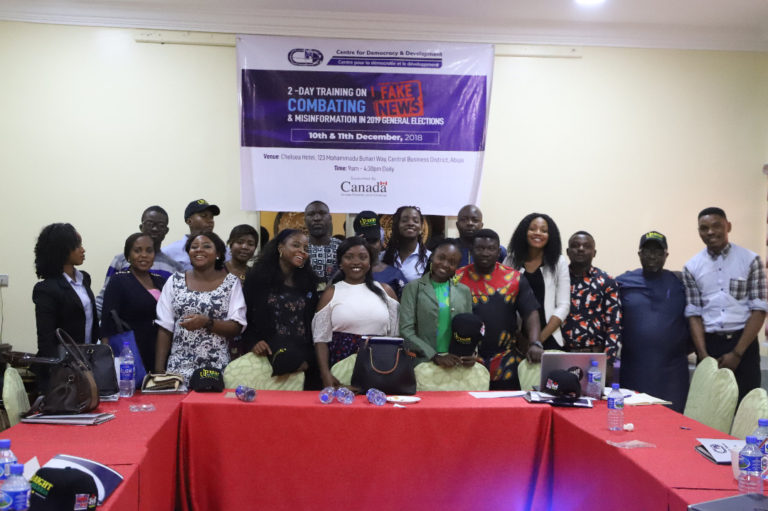
Journalists and officials of the Independent National Electoral Commission, INEC,  have been trained in Abuja to Combat Fake news and misinformation in the 2019 general elections.

The two-day fact-checking training, organised by Centre for Democracy and Development, held between Monday, December 10 and Tuesday, December 11.

The International Centre for Investigative Reporting, ICIR, Ray Power, The Cable and others  attended the training.

Armsfree Ajanaku, senior communication officer of the centre said that fake news would definitely have a negative influence on the voting habit of the citizens.

“We need to know that fake news if left to thrive will gain lots of traction for people that want to peddle this false news for their own good, as gatekeepers, we have the duty of stopping this information from causing social and democratic harm”


READ ALSO:

“It is appropriate that participants be equipped with the required techniques to put a quick stop to fake news and expose the peddlers of such stories.

“So it is only necessary that proactive approaches be discussed,” Ajanaku said.

Fadare Titilope,  one of the journalists in attendance told The ICIR that  the training has added value to his experience and promised to use the new skill acquired  to effectively counter fake news.

“I believe the fact-checking skill will go a long way in providing effective journalism at the same time dispelling concocted disinformation and misinformation.

“I would start employing this skill in my piece and hope there would be future training of this kind,” she said.

Other participants  also commended CDD for organising a training that prepared stakeholders ahead of the 2019 election.


 Ministries of Education, Aviation, NIGCOMSAT, NACA flout FOI Act

Ministry of Education; Ministry of Aviation, Nigeria Communications Satellite (NIGCOMSAT) and National Agency for the Control Aids (NACA) have continued to deny Nigerians access to public information by not responding to Freedom of Information (FOI) requests sent to them.

On Thursday, October 18, The ICIR submitted an FOI request to NIGCOMSAT. The purpose of the request was to obtain contact details for LOT 1 to 15 NIGCOMSAT procurement. Two months after, prospects of getting the needed information are still very slim.

On November 13, The ICIR filed another FOI requests, which included the request on the contract status of HIV counselling, testing and demand creation awarded to three companies from the NACA and a reminder to NIGCOMSAT on the request sent to the agency. The ICIR is yet to receive responses for the two requests sent to the concerned public institutions.

The ICIR on 22 November, filed two FOI requests to the Ministries of Education and state for Aviation, to request for information on the implementation status and contact details of 2017 zonal intervention projects under each ministry, three weeks after acknowledging the receipt of the letter, both ministries are yet to respond to the request, hence, violating section four of the FOI act, which, compels public institution to make information available to the applicant within seven working days.

Experiences gathered by The ICIR reveals that the ministry of education is known for violating the FOI Act by not responding to requests sent to them.

In October, The ICIR reported how public institutions frustrate Nigerians’ access to public information despite FOI law. The ministry of Education is part of the public institutions who are serial violators of the act.

What the FOI Act says

The FOI Act was signed to law in 2011 by former President Goodluck Jonathan and since then, all requests for information received by a public institution have to be dealt with in accordance with the FOI Act.

Sections 1 and 2 of the FOI act establish the right of any person to apply for information or records in the possession of a public institution. Generally, these rights are:

  • The right to access or request any information or record that is in the custody or possession of any public institution or private bodies providing public services, performing public functions or utilising public funds.
  • The right to be told whether the information or record exists.
  • The right to have the requested information or record released if the information or record is in the custody or possession of a public institution.
  • The right not to demonstrate any specific interest or purpose in the requested information or record.
  • The right to receive information that public institutions are obliged to proactively disclose under the Act.
  • The right to take legal action in Court to compel any public institution to comply with the provisions of the Act, including discharging their proactive disclosure obligations under the Act.

Also, according to section 29 of the FOI Act, every public institution must submit its annual report on or before February 1 of each year to the AGF on all applications of FOI request they received.

For 2017, only 73 out 900 public institutions in Nigeria complied to that provision of the FOI act. This amounts to about only 8.1 per cent compliance to section 29 of the FOI act by public institutions.

The ICIR had earlier in the year reported how budget provisions meant for the implementation of FOI request have not been utilised fully to ensure compliance with the FOI Act.

Atiku signs peace accord, asks Buhari to sign Electoral Act

THE presidential candidates of the Peoples Democratic Party and former Vice President,  Abubakar  Atiku, has signed the 2019 general election peace accord while asking President Muhammadu Buhari to reconsider his decision on the Electoral Amendment Bill which he has refused to sign into law.

The official ceremony where presidential candidates of the various political signed the peace accord, held on Tuesday, but Atiku did not attend the event, saying later that he was not invited.

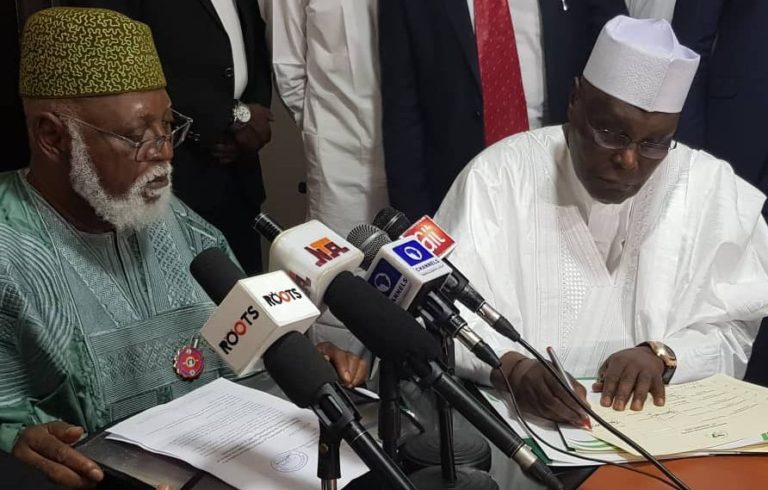
On Wednesday, however, Atiku signed the accord at the Kukah Leadership Centre in Abuja, and the brief ceremony was witnessed by the chairman of the National Peace Committee, Abdulsalami Abubakar, and the Catholic Bishop of Sokoto Diocese, Mathew Hassa-Kukah.

“I commend the President for accepting to sign the peace agreement. But let me also advise him to sign the Electoral Act Amendment Bill”, Atiku said after signing the pact.

Some of the persons that were present at the brief ceremony on Wednesday also expressed their displeasure with the National Peace Committee, for allowing only President Buhari and the National Chairman of the All Progressives Congress (APC) to deliver speeches during the ceremony held on Tuesday.

Usman Ikeleji, the Chairman of Change Nigeria Party (CNP), said the committee demonstrated “partiality by not given the other party chairmen the chance to speak. According to him, not even the chairman of the Inter-party Advisory Council 9ipac), Peter Ameh, was allowed to speak.

“Why was only the presidential candidate of the APC allowed to speak at this occasion? Is Buhari the only presidential candidate here? Nigeria belongs to all of us.

“Why should Oshiomhole be singled out at the event when we have equal status as chairmen of political parties? We came here and can’t be allowed to speak? Who owns Nigeria?

“It is our country. You can’t just bring us here and ask us to sign a document we don’t even know the content. These men are deceiving us.

“Nobody was allowed to talk not even the Chairman of Inter-party Advisory Council. We are talking about peace here and they won’t allow us to speak? Are we children?”

At this, Abubakar said he takes responsibility for the error, and pleaded with the political parties to forgive him.

Some of the people that accompanied Atiku to the Kukah centre on Wednesday were the PDP national chairman, Prince Uche Secondus, and the former governor of Ogun State, Otunba Gbenga Daniel, who is also the Director General of the Atiku campaign organization.

Earlier on Wednesday, Obiageli Ezekwesili, former Minister of Education and presidential candidate of the Allied Congress Party of Nigeria (ACPN), was also at the Kukah Centre to sign the peace accord. She, too, was not present at the official ceremony on Tuesday.