ANAMBRA traders brought economic activities to a standstill in Nnewi and its environ as they shut down markets in protest of the arrest of some of their members by the police on Saturday.
According to media reports, not fewer than eight major markets were closed in the protest involving nearly 10,000 traders.
The Chairman of the Motor Spare Parts Dealers Association, Gabriel Chibueze, insisted that the arrested members were not members of the Indigenous People of Biafra as claimed by the police but genuine traders in the market. He demanded the immediate release of the arrested members.
Chibueze said the arrested traders could not be part of the clash between the police and the IPOB members, considering the proximity between the clash location and the market.
“The place the protest took place is far from the market. In order to ensure the fracas doesn’t escalate to the market, we the executive closed down all entrances leading to the market while our members continued their business.
“Suddenly, we saw a combined team of police and the army who broke the gate of the bank in the market and started beating our members. They arrested both masters and their apprentices.
“We quickly rushed to the Area command where we made a complaint but the Area Command turned down our complaint, saying we will put him in trouble,” Chibueze said.
He also said that at the time of detention that 43 members were arrested, only 33 of the arrested persons were paraded by the police.
The chairman said that the market will stay under locks in solidarity of their members that were arrested until they are released from custody
“We appeal to Nnewi Police Area Commander, the Anambra State Commissioner of Police, the Inspector General of Police and Governor Obiano to order the immediate release of the Nnewi traders.
“If they are not released, shutting down of the market would be extended to the state and the entire South East,” Chibueze said.
Christina Madubuko, the state commissioner for Trade and commerce, said that the incident was rather an unfortunate one and equally assured fast return to normalcy in the market.
“It is very unfortunate at what is happening here. We don’t encourage violence of any sort.
“I was here on Monday for hours and met with the market leaders, dialoguing and seeking a solution to the problem.
“I went from shop to shop and from the way they spoke, the traders are embittered, especially the women whose husbands were arrested,” he said.
Madubuko, admitting that it was not in his place to pass judgement on which party might have first ignited the clash, he equally made a plea for the arrested members, absorbing them from the incident.
“I can speak authoritatively that the people arrested here are genuine traders. While we seek a solution, I appeal to traders to calm down,” Madubuko said.
THE Federal High Court Osogbo, on Tuesday, turned down the bail application of ex-lecturer with Obafemi Awolowo University, Professor Richard Iyiola Akindele.
Akindele who was remanded in prison last week pending the filing of his formal bail application was denied bail after the court hearing today.
Francis Omotoso, counsel to the defendant, filed an application for his bail, but the application was opposed by Kehinde Ayantoye, a senior legal officer with the Independent Corrupt Practices and Other Related Offences Commission (ICPC), who filed a counter affidavit deposed to by a detective, Afolabi Oluwatoyin.
Justice Maureen Onyetenu said allegations contained in the counter affidavit were weighty and directed the prosecution to produce evidence to back his claim.
ICPC lawyer told the court that the defendant unlawfully demanded sexual benefits for marks from Miss Monica Osagie on September 16th, 2017.
According to the prosecutor, the defendant is facing a four-count charge for corruptly asking for sexual benefits from Ms Osagie on account of favour to be shown to her afterwards in the discharge of his official duties as a lecturer, and also altering her academic grades from failing to pass in the course.
The offences contravene Sections 8 and 18 of the corrupt practices and other related offences act 2000 and are punishable under same sections.
The professor has however pleaded not guilty to the charges preferred against him.
She ordered that the defendant be remanded in prison custody till 17 December.
A video recording of Professor Akindele allegedly demanding for sex from Miss Osagie, a postgraduate student, went viral in September 2017. This led to his dismissal from the institution after he was found guilty by the committee set up to investigate the case.
THE Akwa Ibom State House of Assembly is embroiled in fresh crises this morning, as Governor Udom Emmanuel intervened in the legitimacy battle between APC and PDP legislators on who takes leadership of the house.
Governor Udom Emmanuel arrived at the complex of the Akwa Ibom State House of Assembly to disrupt the sitting of five members of the All Progressives Congress, APC who were holding a plenary session.
The Governor, who came along with some members of his cabinet and security details successfully dislodged the legislators from holding their plenary session.
This development is reportedly connected with a court order declaring the seat of Idongesit Ituen, a member representing Itu State constituency vacant who defected from the People’s Democratic Party (PDP) to the All Progressives Party (APC).
The lawmaker was sacked by a November 14 ruling of the Uyo Division of the Federal High Court.
But the court, acting on an application by Mr Ituen, later halted its earlier decision and then asked the assembly not to declare the lawmaker’s seat vacant.
The presiding judge, Fadun Riman, stated the verdict of the court, “I am satisfied that there is merit in this application (and) that an order staying the execution of the judgment of this Honourable Court delivered by Hon. Justice F. O. Riman, sitting at Federal High Court No 2, Uyo Judicial Division on the 14 November 2018, pending the hearing and determination of the Applicant’s Appeal at the Court of Appeal is hereby granted as prayed.”
Apart from Mr Ituen, the speaker, Mr Luke Onofiok, had declared vacant the seats of four other lawmakers who also defected from the PDP to the APC, even though the court was yet to rule on their cases.
The other four lawmakers are Nse Ntuen, Essien Udim State Constituency; Gabriel Toby, Etim Ekpo/Ika, Otobong Ndem, Mkpat Enin; and Victor Udofia, Ikono.
The sacked lawmakers, five of them, held their own “sitting” on Monday and, in turn, ‘removed’ Mr Luke from office as speaker, and then “elected” Mr Nse Ntuen as the new speaker.
The APC leadership in the state, while throwing its weight behind the five lawmakers, said on Wednesday it no longer recognises Mr Luke as the speaker of the assembly.
The constitution stipulates that a speaker or deputy speaker can only be removed from office by a resolution of House of Assembly by the votes of not less than two-third majority of the members of the House.
It would require the votes of 17 lawmakers, at least, of the 26 members to remove Mr Luke as the speaker of the House.
However, the factional speaker Nse Ntuen of the APC suspended Mr Luke Onofiok amongst others and also suspended all standing committees constituted illegally by the former speaker and adjourned till next week Tuesday, December 4.
Other members suspended by Ntuen are Udo Kerian Akpan, Felicia Bassey, Nse Essien, Lawrence Udofia, Usoro Akpanusoh, Ime Okon, Friday Iwok, Asuquo Archibong, Mark Esset, Emmanuel Ekpenyong, Aniekan Uko till further notice.
FORMER Governor of Oyo State, Rashidi Ladoja, on Tuesday, testified before the Federal High Court, Lagos, in his ongoing N4.7 billion corruption trial by the Economic and Financial Crimes Commission (EFCC).
Ladoja was re-arraigned by the EFCC on November 5, on an 11-count charge of money laundering and illegal conversion of public funds for personal benefits.
Also arraigned alongside the former Governor was his former Commissioner for Finance, Waheed Akanbi. Both accused persons pleaded not guilty to the charges.
In one of the charges, Ladoja and Akanbi were accused of diverting the sum of N1,932,940,032.48 belonging to Oyo State to the bank account of a private company named Heritage Apartments Limited.
Similarly, Ladoja was accused of moving about £600,000 from the Oyo State treasury and sending same to one Bimpe Ladoja, who was at the time in London. He was also accused of using the sum of N42 million state funds to purchase an armoured Land Cruiser jeep for his personal use.
Also, Ladoja allegedly converted the sum of N728,600,000 and another N77,850,000, monies belong to the Oyo State government, to his personal use. The latter sum, according to the EFCC, was transferred by Ladoja to the account of one Bistrum Investments, a real estate company, to purchase a property for him at Quarter 361, Ibadan, Oyo State.
All these crimes were allegedly committed while Ladoja was Governor of Oyo State, and they run contrary to sections 17(a) and18 (1) of the Money Laundering (Prohibition) Act, 2004 and punishable under sections 14(1), 16(a) (b) and 18(2) of the same Act.
The EFCC had closed its case against the duo of Ladoja and Akanbi, but instead of opening their defence, the accused persons filed for a no-case submission, arguing that the prosecution has not established a prima facie case against them.
However, the trial judge, Mohammed Idris, on November 12, ruled that the defendants have a case to answer and asked them to open their defence.
So far in 2018, two former state governors have been convicted and sentenced to prison having been found guilty of diverting state funds for personal use during their times in office.
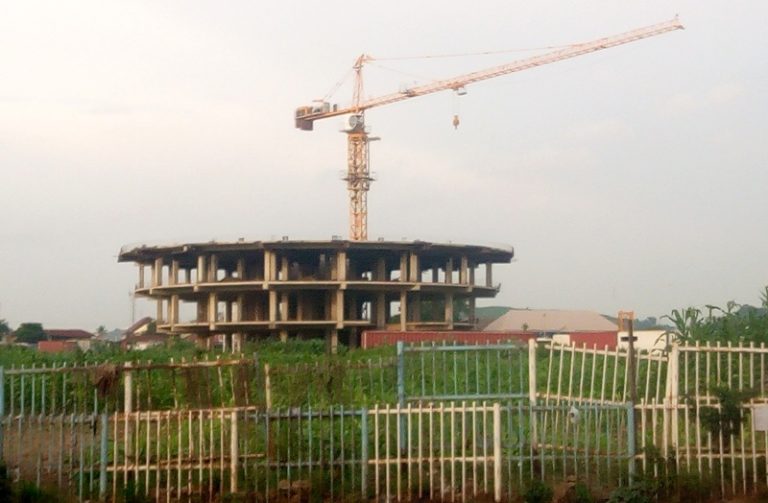
RUSTY iron works, overgrown bushes and massive presence of an idle crane are the discomforting features of the supposed ultra-modern edifice called the Minna City Centre project.
Located in the centre of Minna, the landmark project, expected to beautify the capital city of Niger State, is now not only a huge source of embarrassment to the state but also an eyesore to visitors since its strategic location makes it impossible for a visitor not to see it.
The centre was a project initiated by the Governor Aliyu Babangida’s administration to serve as the state capital’s hub for shopping and tourism, as it would have had among its features a shopping mall with 5,000 shops, including a branch of the famous Shoprite, a 25-storey tower which would have served as offices, a cultural centre and an amusement park.
Estimated to cost N5 billion at inception, the project was said to have gulped about N800 million before it was stalled – N600 million was said to have been expended on the tower, while about N200 million was spent on the shopping mall.
Investigations revealed that between 2013 and 2015, about N3.935 billion was budgeted for the project. In 2013, the sum of N900 million was budgeted for the project under the title of Minna City Centre, Project Number 064/017, with the construction of tower and dump as some of its features. In 2014, N2 billion was earmarked for the project, while in 2015, N1.035 billion was budgeted for the provision of the city center tower, convention, and information centres.
Former Governor of Niger State, Babangida Aliyu, during a tour of one of the buildings at the Minna City Centre project in June 2014. Aliyu promised that the project would be completed by April 2015.
Before the Minna City Centre project was conceived, the spot had hosted a market and a residential area, popularly known as Abdul Street. But the project remains a pipe dream six years after the market and houses were demolished for its sake and thousands of people and traders lost their homes and shops.
Former residents lament
Erstwhile residents of Abdul Street, which is the current location for the Minna City Centre project, are not happy with the abandoned project. They believe that the state government forced them to give up their homes for no just cause, considering that they were grossly under-compensated for their buildings that were destroyed. Many of the former landlords have since been turned into tenants, while many others were forced to leave the town because of their inability to cope with rent.
While Jide Babatunde and Sons Limited, the estate valuers hired by the state government for the construction of the city centre were valuing the properties, many of the affected residents were said to have complained that their properties were under-valued. The government, however, paid them compensations without addressing their complaints that they were being short-changed. Our correspondent gathered that the government paid 47 of the affected landlords a total sum of N233 million, a sum the landlords described as “unfair and insensitive.”
Mr. Olajide Olasinde, a former chairman of the Abdul Street Landlords Association, said memories are still fresh on his mind and that of the other former landlords.
“I feel bad each time I pass there. After driving people from their homes, nothing has been done to justify their action against us,” he said.
“The so-called shopping mall was not completed. The aim was not achieved, so what was the rationale of driving people out of their ancestral homes?
Former Governor of Niger State, Babangida Aliyu, during a tour of one of the buildings at the Minna City Centre project in June 2014.
“We were all surprised when we were called to collect our cheques for the houses. We were surprised because no one came physically to value our houses.
“They told us that if the cheques were not okay, we should take whatever step we needed to take. They gave us papers of allocation to other lands, but up until now, we are yet to receive the certificate of occupancy for the lands.”
Describing the experience as a bitter one, Olajide said that most of the houses were more than 60 years old at the time they were demolished.
He said: “It was a bitter experience. It is like you are living inside a house and you are sent out to live outside. This is because we were living in the heart of the town and suddenly, that was taken from us. The amount paid to everyone could not give anyone a sound structure because we were grossly underpaid.
“My building has been there since the 1960s. The government’s action affected many of the landlords as most of them do not own houses again. And because most of them relied on the rents from their houses, they could not meet up with a lot of things, and at the last count, about 20 of the landlords had left Minna for their villages because of this.”
Erstwhile landlords tell tales of woe
Olajide Olasinde, former chairman of the Abdul Street Landlords Association.
Another landlord, Abdul Ibrahim, who valued his demolished family house at N45 million, said the family was paid a paltry N6.23 million. He said, however, that the government did not drive them out of their houses because a certain time frame was given to them to vacate.
“But when the hoodlums heard that we had been paid, they came to ransack our houses. A lot of us were humiliated as these hoodlums started pulling down the houses bit by bit and looting our houses. We were forced out of our homes before the eviction day and before we could not even get alternative homes for our families. Whether the hoodlums worked in connivance with the government, we don’t know,” he said.
Ibrahim’s house is the oldest and biggest in the area, and the compensation he received has caused serious chaos in the family as there have been conflicts in the sharing formula. The family is still in court till date, he said, as he showed the reporter pictures and documents on the demolished family house.
He said: “I was 65 years old when the house was demolished, and I was born in that house. So, you can imagine how long that house had been in the family. Our house had four buildings, including two duplexes and two buildings with eight rooms and four rooms separately along with some shops.
“The valuers valued the houses wrongly and even the compensation has caused problems in the family as my younger brother took me to court over the sharing formula. Minna. Due to the determination of the government to set up the City Centre project, an alternative market (Kure Ultra-Modern Market) was established for the traders. But unwilling traders who did not have the means to move into the new market were forced out when the structures in the whole area were demolished.
Looking sadly at her ware displayed on a table in front of her house, Madam Shade, who was initially unwilling to speak to the reporter, later agreed to an interview, albeit reluctantly.
She said: “I do not want to talk about it. That incident is not something one should think about. It was a very sad day when we arrived at the market and found that all our shops were gone.
“I had just arrived from market, the Onitsha Market, some days before and all my goods were gone. I could not even locate the area my shop was in the rubble, so my wares were gone.
“Nothing is as devastating as that. From a cloth seller, look at what I am selling now—petty goods. And where are the customers?”
While Madam Shade who sells iced fish seemed to have given up hope, others like Mama Kemi are relentless as she is one of the traders who relocated to the back of the demolished market. She explained that even the government is tired of driving them away from the place and has left them alone.
Petty traders have taken over the site of the proposed city centre project.
“How will they drive us when we only come out after the government officials have gone home? They have tried so many times, but unlike other markets, we do not leave our goods here for them to take. So how will they drive us?” she asked.
She said she had not been able to secure a shop in the Kure Ultra-Modern Market because the shops are too expensive.
“Where else will I go? A shop in Kure Market is too expensive and they will not allow you to put your table somewhere to sell what you want to sell. Even if I want a shop now, it will be far inside the market. Who will locate me there?
“I have been selling fish for long. I use it to support my family. Seeing that all the front shops in Kure Market have been taken, will people leave the fish sellers at the front and come inside to buy fish where I am? That is why I did not follow them to the new market when the old market was destroyed.”
Contractors, government agencies play hide-and-seek
Parts of the city centre project taken over by overgrown bushes.
Checks our correspondent made at the Corporate Affairs Commission (CAC) revealed that Grand Tower Limited, builders of the city centre, is registered. Why the company did not continue with the project, however, remains a mystery.
Checks made in respect of the estate valuer, Babatunde and Company, however, could not establish if the company was registered with the CAC. Efforts made to reach the consultant, Flopat Global Services Limited, were also not successful as the phone number on the signpost was said not to be valid.
The project has no specific ministry handling it. Checks made by the reporter, including Freedom of Information requests sent out, indicated that no ministry in the state was willing to admit that it oversaw the project. The Ministry of Works, which received the Freedom of Information request for information about the project, said it did not handle or supervise the project.
The ministry, which ordinarily should be the main supervisors of the project, could not give the total sum the project would consume as the Permanent Secretary and Director of Works directed the reporter to the Ministry of Finance to get the details about the project.
Similarly, the Ministry of Finance claimed not to have any knowledge of the project. In its response to the FOI request, the ministry redirected the reporter back to the Ministry of Works, Lands and Housing and the Ministry of Investment. A second FOI request written to the Ministry of Works in August had received no response at the time of filing this report.
On his part, the Commissioner of Commerce and Investment promised to provide the details as soon as he presented a memo to the state governor regarding the project.
He said: “I cannot speak on the project now. I am preparing a memo regarding the whole subject of the Minna City Centre project and need to present it to the governor. After I have made the presentation, I will brief the press.”
The reporter also tried to reach the Niger State Development Company (NSDC), another agency that could have handled the project but was told the Managing Director would not speak to any journalist on the issue, especially with the current sale of one of the malls in the project. The Personal Assistant to the Managing Director who spoke with the reporter said: “We just received a letter from the Ministry of Investment that one of the malls, NSDC Mall, has been sold. We were not informed or have any knowledge of it. If you were in our shoes, will you be happy?
“I don’t think he wants to speak to you now. I told him you were here and he said he will not speak to you.”
Government sells out mall at give-away prices
Governor of Niger State, Abubakar Sani-Bello
When the state governor, Abubakar Sani-Bello, resumed office in 2015, he said he had no money to complete the structure, adding that he would rather use such money for other pressing needs faced by the state. He then asked the Commissioner for Commerce and Investment and the management of NSDC to find investors who would be ready to take up the project.
Recently, however, the Niger State Government disclosed that it had sold the NSDC Mall, one of the malls in the Minna City Centre project for N110 million, an amount that is said to be less than half the current market price of the structure.
The structure is the only construction in the project that has reached about 89 per cent completion and has been listed by the present administration as a non-priority project and therefore abandoned. The structure is erected on a land area covering 4,300 square metres, and at the time that work stopped on the project in 2015, the Niger State Government was reported to have sunk well over N247 million into it.
The state government, through the Commissioner for Commerce, Cooperatives and Investment, Mudi Mohammed, who briefed newsmen in August, revealed that the mall had been sold to Jaiz Bank Plc for N110 million, a sum considered as giveaway even by the most conservative in estimates and cost evaluations.
The commissioner said the state government had earlier advertised the uncompleted shopping mall for rentals for which more than 106 persons purchased application forms at N5,000 each before the state government opted to sell the shopping centre outright.
Although no reason was given for the state government’s decision to sell the complex and at such rock bottom price, the commissioner attributed the state government’s action to lack of interest from the public and the current economic situation in the country. He said the government decided to sell it to Jaiz Bank Plc, but he did not say whether there were other bidders for the complex. He also did not say if there was any public offer through bids process for the magnificent shopping centre.
The commissioner said the state government had given the new owner of the shopping centre guidelines which include the immediate takeover of the structure, employment of indigenes of Niger State and beautification of the centre.
Efforts made to get details of government’s plans for the other projects in the City Centre did not succeed as the commissioner was repeatedly said not to be in the office each time the reporter visited, and no other official of the ministry was ready to speak on the project.
This investigation is supported by the John D. and Catherine T. MacArthur Foundation and the International Centre for Investigative Reporting (ICIR).
… [how can] a soldier come up and say ‘I’m not well equipped’ yet you have a rifle; what do you want? You want APC, you want tanks? The basic weapon of an infantry man is rifle, so why should there be mutiny? Why? The basic weapon of an infantry man is rifle, so why should there be mutiny? — Alex Badeh, Chief of Army Staff (January 2014 – July 2015).
It initially started out as 44. Then 100, then ‘more than 100’. And now 118. There is even a chance it could, when all is said and done, end up more than 200. In the end, the truth is somewhere in between. In an attack that ranks among the deadliest this year, Boko Haram downed scores of soldiers in Metele, Borno State, on November 18.
With the benefit of hindsight, we now know the insurgents lurked around for the Army to dispatch a team to retrieve its killed or injured men. When that rescue, treatment and evacuation team arrived in Metele, the insurgents struck again. Among the victims of that first raid are five officers, including a Lieutenant-Colonel; and from the second raid, the fallen include the Major who led the rescue team.
The latest attack is a continuation of Boko Haram’s newfound confidence to take the battle to military zones in recent months, often yielding high casualty tolls. The past few days have been truly difficult for the political neutrals. The social media has been awash with mourning and gnashing of teeth, not only by the opposition, as the government and the Army are wont to always believe, but by those genuinely concerned about the failure of two governments running to pocket Boko Haram. This grand-scale attack has happened despite repeated government assurances of “decimating” and “technically defeating” the insurgents. So, the question goes: why, and three years after electing a Major-General as President, can Boko Haram so easily overrun hundreds of soldiers in one fell swoop?
As I have previously written, the Army is indeed waging a war against Boko Haram — not with weapons but with propaganda. In its trademark downplaying of its own casualties and exaggerating the insurgents’, the Army attempted to sweep the Metele attack under the carpet. And despite its protestations over the so-called “well-doctored” reports by the media, the Army has, after eight days, refrained from making definitive remarks about the attack, particularly the casualty on its side. A war that thrives on misleading the public, ostensibly including the President and Commander-in-Chief, is doomed to fail.
So is a war steeped in hypocrisy. Two soldiers who survived the Metele attack, and are set to desert the Army, released a now-viral video of the post-attack ruins. Laden with anger, frustration and despair, it is a video that should humble every true Nigerian patriot. It is a video that President Muhammadu Buhari — if his advisers have any idea what they’re doing — should have seen and self-analysed by now. But the shocking response of the Army has been to brand members of the public as “detractors or tacit supporters of the enemies of our beloved country” and to threaten them with court suits. This type of sickening hypocrisy should not be judged just on its face value but on its implications for decision-taking in the highest recesses of the Army. It is the same type of hypocrisy that caused Alex Badeh, as Chief of Army Staff in January 2015, to say soldiers cannot say they’re not well-equipped when they have a rifle, only for him to claim, at his pull-out ceremony six months later, that he was “head of a military that lacked the relevant equipment and motivation to fight an enemy that was invisible and embedded with the local populace”. Badeh had already rendered himself an accomplice to the damage that had been done. Unfortunately, this same strategy of misleading the government and the people has been adopted by the current Army hierarchy. Boko Haram can only be the beneficiary.
Everyone knows the most important move that must be made to whittle down Boko Haram’s powers. The foot soldiers know; the senior officers do. Even the insurgents themselves know. I found out in June 2016. During an undercover trip to the North-East in June of that year, I was in a hospital where a soldier receiving treatment for a gunshot injury was recalling events on the battlefield to his colleagues. He was one of 15 soldiers who ran into 18 insurgents in Kala Balge, the easternmost local government area of Borno, very close to Cameroon, on April 30, 2016. While the insurgents came in six motorcycles and carried a mortar Rocket-Propelled Grenade (RPG) and a General-Purpose Machine Gun (GPMG), the soldiers had only their trucks and their 1949-made Kalashnikov (AK-47) rifles. Still, it was the insurgents who took to their heels while the soldiers chased on with their trucks. One by one, the soldiers killed the insurgents until only two were left. Then they ran out of ammo. Tables suddenly turned, and the hunter became the hunted.
“When our ammo finished, we were looking at them and they were looking at us,” the soldier recalled. “We were about boarding the truck when three of us were fired at the same time with a GPMG.” In all, six of the soldiers were shot. I remember that soldier was filled with optimism about how Buhari’s coming would strengthen the weaponry of the Army. If that soldier is still alive — he promised to return to the field once his leg healed up — he must feel let down the coming of Buhari hasn’t altered the balance of weapons between soldiers and insurgents.
Much as it hurts to say, Boko Haram will continue killing soldiers. I have met quite a number of Nigerian soldiers involved in the counter-insurgency operations, and my conviction is that they are some of the bravest soldiers available anywhere in the world. However, if we’re stuck with fighting Boko Haram with weapons that are older than Nigeria itself (the AK-47 was made 11 years before Nigeria’s Independence), then our soldiers have no chance. No serious military should still be parading the T-12 in this age. This was a tank made between 1925 and 1931, and they are prone to mechanical failures; the soldiers in that video weren’t lying. As they said, Buhari must “interfere” in this matter. This is beyond intervening, the President, as the C-in-C should ‘interfere’ with the operations of the Military same way he does with the petroleum industry. At the very least, it’s time to establish the correlation between the Army’s armoury and the funds recently invested in this war. Until such a time when that gap is closed, expect high casualties on the Army’s side, from time to time.
Soyombo, former Editor of the TheCable and the International Centre for Investigative Reporting (ICIR), tweets @fisayosoyombo
INTERNATIONAL and local activists are asking the Federal Government to cancel the 2011 resolution agreement that yielded ownership of the controversial oil block OPL 245 to Shell and Eni after evidence emerged that the oil giants undercut Nigeria to a record of $6 billion in projected revenue over the lucrative oil block.
Earlier report by The ICIR detailed how Shell and Eni cut out a deal that removed terms requiring them to pay royalty and profit oil on OPL 245.
Shell and Eni paid $1.1 billion in 2011 to secure ownership of the oil block after a protracted dispute over the rightful ownership among the Federal Government, Shell and Malabu Oil and Gas limited.
Activists say that the international oil companies made the payment not just to secure rights to the oil block but also to cut an unfair deal that will result in Nigeria losing $5.86 billion in revenue projected on an oil price of $70 per barrel.
A new report on the analysis of OPL 245 presented in Lagos on Monday indicates that Shell and Eni connived with government officials to alter terms of the agreement which drastically reduce the potential government revenue from the oil block.
“Some people actually signed off on the deal knowing full well that Nigeria was being scammed,” said Olarewaju Suraj, chair of Human and Environmental Development Agenda (HEDA).
Suraj said the officials of the oil companies knew that the payment of $1.1 billion for the oil block would be misappropriated but they did so with the aim of securing favourable terms that would rake in billions in profits for the oil companies.
“We can’t allow Nigeria to be treated like a banana republic where multinationals will conspire with locals to deprive the country of its entitlements,” Suraj said.
Barnaby Pace from the Global Witness said “Shell and Eni executives set the deal up so that Nigeria would earn an estimated $6 billion less than it could have. This scandalous deal must be cancelled.”
Antonio Tricarico of Re: Common also called for the cancellation of the oil deal. He said, “The Italian government is discouraging migrants trying to reach Italy by claiming that it will help them at home, but Italy’s biggest multinational, partly owned by the state, is accused of depriving the Nigerian people of billions. The OPL 245 scandal appears to show that Italian officials are not helping the poorest, but profiting from them.”
Nick Hildyard of The Corner House added that “Shell and Eni represented their OPL 245 contract as a production sharing agreement yet it includes no sharing of production for Nigeria. This shocking poor deal must be cancelled.
The new analysis of the controversial oil block was carried out by Resources for Development Consulting for Global Witness and NGOs HEDA, RE: Common and The Corner House.
While the campaigners are calling for the outright cancellation of the OPL 245 deal with Shell and Eni, the Minister of State for Petroleum Resources, Ibe Kachikwu, had advised President Muhammadu Buhari to accept the terms of the agreement which have been established to be disadvantageous to Nigeria.
Shell and Eni are currently facing bribery charges over the OPL 245 in a landmark trial that began in September in Italy.
PRESIDENT Muhammadu Buhari has disagreed with a directive by the All Progressives Congress (APC) National Working Committee (NWC), headed by Adams Oshiomhole, that members that had filed lawsuits against the party must withdraw the suits or be prepared to face sanctions.
Buhari, on Monday, said the directive was not acceptable to him, adding that anybody who feels he has been treated unjustly by the party has the right to seek redress in court.
The directive from the APC NWC had read in part:
“The Party intends to activate constitutional provisions to penalise such members as their action is capable of undermining the Party and hurt the Party’s interest.
“We hereby strongly advise such members to withdraw all court cases, while approaching the appropriate party organs with a view to resolving any outstanding disputes. In addition to this, aggrieved members are urged to take full advantage of the reconciliation committees the Party has put in place.
“APC members should understand that as a progressive party that operates on the principle of change, it is not a matter of choice to keep to the rules.”
But, Buhari thinks otherwise. For him, “we can’t deliberately deny people of their rights”.
“We agreed that party primaries should be conducted either through direct, indirect or consensus methods, and if anyone feels unjustly treated in the process, such a person can go to court.
“The court should always be the last resort for the dissatisfied. For the party to outlaw the court process is not acceptable to me.”
The President, however, advised aggrieved APC members to work with the reconciliation committees and not a purported presidential committee on reconciliation, as only the party authorities have the authority to constitute such committees.
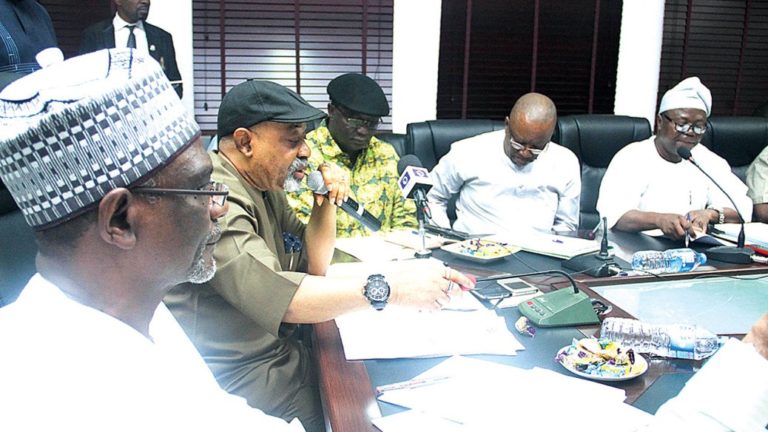
THE Academic Staff Union of Universities (ASUU) is expected to resume talks with the Federal Government at a closed-door meeting Monday over the ongoing strike action in public universities, the Union has said.
After last week’s meeting by ASUU and the federal government in which no conclusive decisions were reached, the two parties will meet on Monday (today) at the Federal Ministry of Education in Abuja.
In a phone interview with the ICIR, Abiodun Ogunyemi the president of the union reiterated ASUU’s position which he explained has remained constant.
“Our position has remained unchanged. We are calling on the federal government to honour the agreement they signed with us in 2017. There is no shifting of grounds today. When they fulfil their own part of the bargain then we will go back to work,” he said.
“It’s high time we hold the government accountable for their actions and also be conscious of doing our duty for the growth of the country. I think this step we are taking is in the right direction for the benefit of our universities. It’s not uncommon to hear people say we are tired of this ASUU strike actions, but we see it as our community service, we are the barometer of the society to bring the corrupt in public offices to respect their agreements,” he said.
The Union embarked on strike three weeks ago over issues and demands by the lecturers which include better funding of Nigerian universities, non – implementation of previous agreements, non-payment of earned academic allowances, salary shortfalls and pension matters
Abiodun stated that the Federal Government’s insincerity in honouring agreements with lecturers is responsible for the backward state of Nigerian public universities.
” When public office holders fail to respect a gentleman’s agreement with lecturers about their welfare, will you expect them to give their best in class? Nigerian universities cannot globally compete with their peers when it comes to infrastructure and the quality of education received in our institutions but our politicians are able to send their wards to schools abroad neglecting the state of education in the home front. So how do you expect our universities to be able to compete globally?” he queried.
The Nigerian Labour Congress (NLC) and the National Association of Nigerian Students (NANS), on November 19 embarked on a solidarity protest to demand increased funding for education.
A total of N605 billion was allocated to the education sector this year which is higher in naira terms than the N550 billion allocated in 2017, but it represents only 7 per cent of the total budget.
This allocation falls short of the Global Partnership for Education (GPE) framework to which Nigeria is a signatory. GPE has prescribed education budget benchmark of 15 to 20 per cent of thenational spending. The government’s failure to increase spending on education and other welfare issues have led to an industrial action by the Union, that has forced Nigerian universities to shut down since November 5.
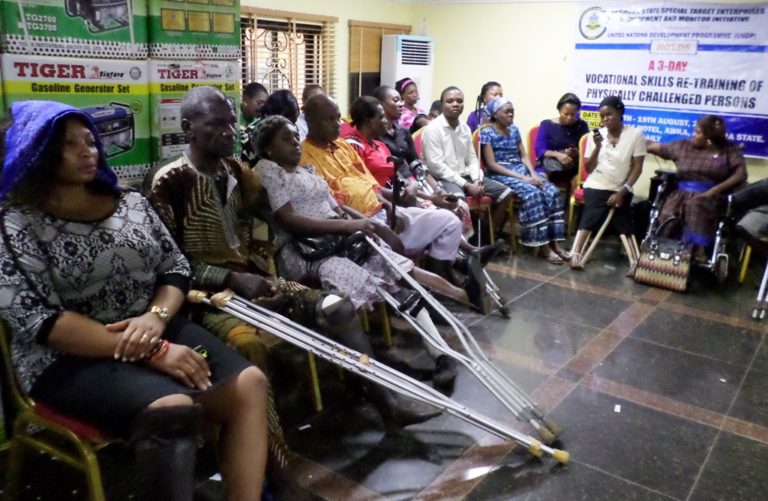
The Independent National Electoral Commission (INEC) has pledged to enhance greater participation of persons living with disabilities in the 2019 general elections.
Adekunle Ogunmola, the INEC’s national commissioner in charge of outreach and partnership committee made the pledge on Monday in Lokoja at the opening of a two-day strategic meeting on access and participation of persons with disabilities in 2019 general elections.
He said that the commission was desirous of deepening the democratic process in Nigeria.
He said part of the strategies was to ensure the participation of the marginalised and the disadvantaged groups across the country.
Mr Ogunmola, who was represented by the Resident Electoral Commissioner in Kogi, James Akpam said that the INEC had introduced some innovations to reduce all forms of barriers experienced by people living with disabilities in all aspects of electoral process.
“It has also provided ‘assistive’ and materials such as magnifying glasses at the polling units during elections, transcriptions of voter education materials to Braille and others to ensure their full and effective participation in the electoral process,” he said.
Mr Ogunmola explained that more interventions were needed as the 2019 general elections drew near, hence the strategic meeting on improving electoral access for persons with disabilities.
According to him, the strategic meeting is to facilitate discussions and sharing of information on existing and new plans towards better outcomes for people living with disabilities.“It is expected that the strategies developed at this meeting will enrich and complement efforts of the commission in improving the Electoral process,” he said.
In her remarks, the INEC Deputy Director in charge of civil Organisation, Mrs Dorothy Bello said that the meeting was organised to examine the role people living with disabilities in the forthcoming elections.
Simon Fanto, the Project Manager of the International Foundation for Electoral System ( IFES) , said that the organisation decided to partner with the INEC to organise the meeting as part of its global objective of enduring inclusiveness in electoral process.
Ekaete Umoh, the National President of the Joint National Association of Persons Living with Disabilities ( JONAPWD) commended the INEC for the measures taken so far to ensure full participation of her members in electoral process but stressed the need for more action.
Participants at the meeting include members of the Joint National Association of Persons Living with Disabilities, organisations of persons living with disabilities and persons with disabilities desk officers of the commission.