Home Blog Page 2490

INVESTIGATION: Plastic recycling plants— Project where Nigeria can generate N504b a year in ruins

In June 2018, Nigeria celebrated World Environment Day alongside other countries of the world. The celebration was focused on fighting plastic waste that threatens the lives of humans and animals. The ICIR Reporter, YEKEEN AKINWALE visited Lagos, Osun, Ekiti and Kaduna states where, five years ago, the Federal Government had installed plastic waste recycling plants.  His findings reveal the culture of waste sustained by the federal and state governments that has caused ruin to the multi-million naira projects.


TWENTY- six plastic waste recycling plants located in 26 cities across Nigeria, whose contracts the federal government awarded in 2009 to eradicate the problem of plastic waste, are at different stages of deterioration, but the government is oblivious of this fact despite the huge investment on the project, investigations by the ICIR have revealed.

Nigeria is not catching up with the movement to eliminate plastic waste, but the government would like the world to believe otherwise.

At the event marking the 2018 World Environment Day,which focused on eradication of plastic waste, the Minister of State for Environment, Ibrahim Jibril, announced with pride that Nigeria was moving towards eradicating plastic waste with the establishment of recycling plants – perhaps in keeping with Rwanda and South Africa examples: the two countries have banned the use of plastic for packaging and as bags.

“At present, a total of eight plants have already been completed and handed over to the states while 18 others are at various stages of completion,” the minister disclosed at a press conference. 

But this statement is grossly inaccurate and the minister seems oblivious of the fact.

Minister of State for Environment, Ibrahim Jibril: He is unaware of the state of the plastic recycling plants, yet he told the world they were completed.

Jibril indeed was unaware that the plastic waste recycling plants he said were completed or ongoing, at different locations were wasting away despite the government’s huge investment in the project.

In 2009, the administration of former President Goodluck Jonathan awarded the contract for the procurement and installation of 26 multipurpose plastic recycling plants in 26 cities including the Federal Capital Territory, Abuja.

Before the end of that administration− the projects, in 2013 were recorded completed and waiting for commissioning in a document prepared by the Ecological Fund Office (EFO) and submitted to the Presidency.

The contract was funded through the EFO whose mandate among others is to reduce ecological problems nationwide to the barest minimum and ensure judicious and equitable utilization of the Fund.

The government awarded the contract at the sum of N15million each to one contractor, Abdul Essentials Services Limited, under the supervision of the Federal Ministry of Environment.

The 26 plants which were envisioned to take care of plastic waste in those cities, cost  N392 million in total.

When The ICIR reporter visited states like Osun, Ekiti, Lagos and Kaduna, which were among those the government claimed were completed and handed over to state governments, findings reveal typical examples of a culture of waste by both the federal and state government as well as lack of synergy between the tiers of government in project execution and management.

How N15m Osogbo plastic waste recycling plant rots away

With a collapsed roof that has sunk into the building, covering about five different recycling machines floating inside a pool of water that has flooded it due to years of rainfall and negligence, the current state of Osogbo plastic waste recycling plant reveals how government’s investments go to waste in various parts of the country.

Sitting in the midst of a heap of refuse at Osogbo landfill along Iwo road, in Osun State capital, the N15million recycling plant installed in 2013 already has been overtaken by weeds.

To a visitor, there is nothing to suggest that a N15 million worth of a project lie fallow in the bush.

Facilities in the plant included a toilet and bathroom, a changing room for operators and three ceiling fans.

The state government was expected to provide access road, water and electricity to the plant. They were not provided.

Some components of the plants were also vandalized by some unknown persons due to the porous nature of the dumpsite, The ICIR learned from workers at the site.

Like the Minister of Environment, Ganiyu Oyeladun, General Manager of Osun State Waste Management Agency, whose office is in charge of waste management in Osun State, told The ICIR that he was unaware of the plant, and did not know of its sorry state.

All he knew about the only recycling plant in the state was that it “was a project by the Federal Ministry of Environment that was badly executed.”

He told The ICIR how officials of the Federal Ministry of Environment came looking for a suitable place to site the project back in 2009.

“The agency gave out the dumpsite where the machine was installed. That was the level of involvement of Osun State Waste Management Agency,” he said.

For him, the project was poorly executed by the contractor because key components such as cooling system, dryer and water for washing plastic waste were not part of what was installed.

And the state government never operated the plant− to the detriment of the people of the state.

But Yaqub Abdul, a representative of the contractor refuted the claim that the contract was badly done. He told the ICIR that both the Federal Government and Osun State Government abandoned the project.

He insisted that the plant was installed and test run before it was handed over to the state government.

“It is unfortunate the kind of government we have in Nigeria, after handing over they just abandoned the plant. The state did not take over; they did not make use of the machine,” Abdul said.

When asked about the key components that were alleged not to be included in what was installed, he said those “parts were not part of the bill of quantity the Federal Government gave to the contractor.”

Another staff of the contracted company who did not want his name to be mentioned said the government was told of those components by the contractor but was ignored.

“You know that project was done during the time of Jonathan, the kind of project they gave us, they did not complete, they were supposed to include all those things you mentioned; even there was supposed to be dryer,” he says.

“They didn’t put all that in our bill of quantity. We told them all that that time, I think they just use that project to siphon money. We did what we could do, we did our best and we test run the machine. We handed over the project. We completed that of Osun State.”

Some officials of the agency revealed to The ICIR that the plant was indeed test run by the contractor after the installation.

“Yes, the contractor rented a generating set and we supplied him with some plastic bottles and polythene to test the plant,” an official of the agency who did not want his name mentioned said.

It was never used after that day. Nobody bothered to operate it or ask after it, because as the official said, “Since our ogas don’t have interest in it, it has been like that.”

 In Ekiti, recycling plant is moribund
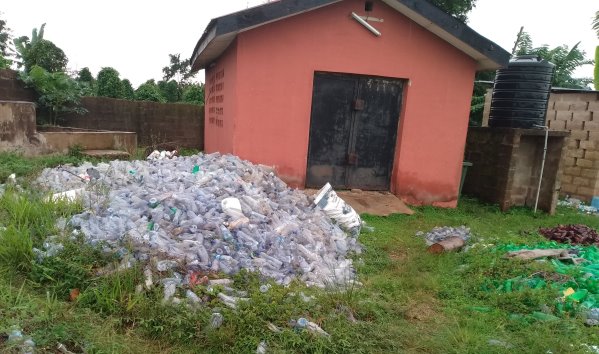
The moribund Ekiti State recycling plant. Photo Credit: YEKEEN AKINWALE

Like its Osun State counterpart, the Ekiti State government does not attach much importance to the plastic waste recycling plant located inside the state’s main dumpsite at Ilokun village.

It is under the supervision of Ekiti State Waste Management Agency, but the plant is not on the priority list of the state government.

Since September 2012 that the plant was handed over to the state government for operation, there has been no budgetary allocation to run it efficiently.

Rather, the plant survives on a pittance from the annual budget.

The Director of Operations at the agency, Osalusi Ayoola who oversees the operation of the plant told The ICIR that the state government has no special budget for the plant. Hence, the plant runs only whenever there is a little fund to buy diesel to power the generator set.

The machine has the capacity to produce three tons (3000kg) of plastic pellets per week which translates to about 12000kg in a month.

The National grid was recently extended to Ilokun area, but the plant is not connected. Presently, only the crusher, a machine that crushes plastic waste, works at the plant because the main recycling machine has broken down over a year ago, The ICIR gathered. The pumping machine that supplies water for washing of plastic waste broke down even earlier.

“There are months that we don’t work,” said Olu Ajayi, the operator of the plant.
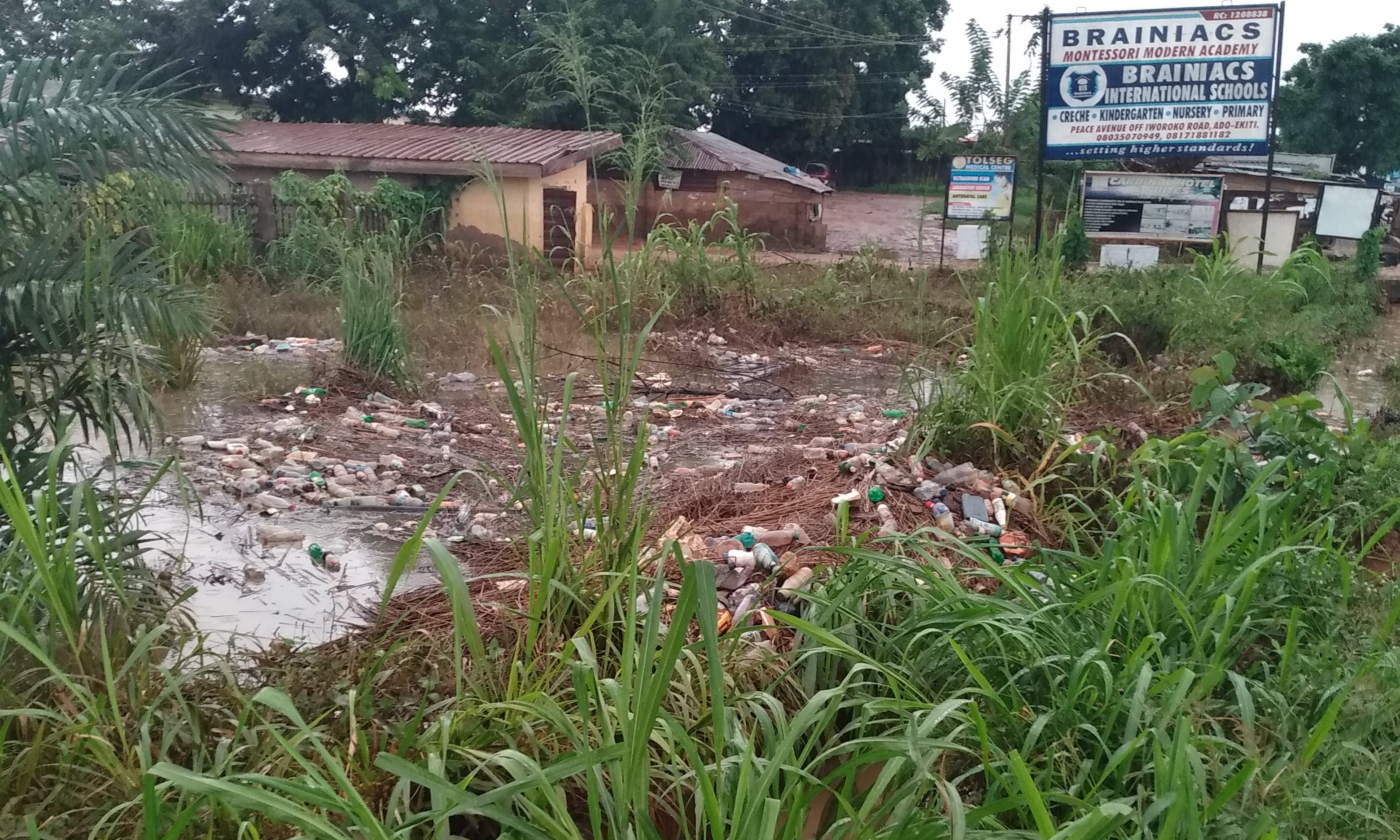
Pet bottles take over everywhere in Ado-Ekiti. Photo Credit: YEKEEN AKINWALE

At the current price per kilogram of pellets which is N150 − the recycling plant can generate as much as N1.8million in a month and N21.6million in a year if well managed according to the operator. Ajayi confirmed that 50 per cent of solid waste generated in the state is plastic waste; he, however, revealed that the plant works only when there is diesel to power the generator.

Scavengers who pick plastic waste from the dumpsite were paid N15,000 by the state government in the beginning. Suberu Umar who had worked there as an operator since 2012 confirmed this. The pay, he lamented,  has since been slashed to N10,000.

Ekiti State government under the former governor Ayodele Fayose was already considering selling the plant to a private investor for better utilisation, according to  Ayoola.

Where is the Lagos N15m plastic waste recycling plant?
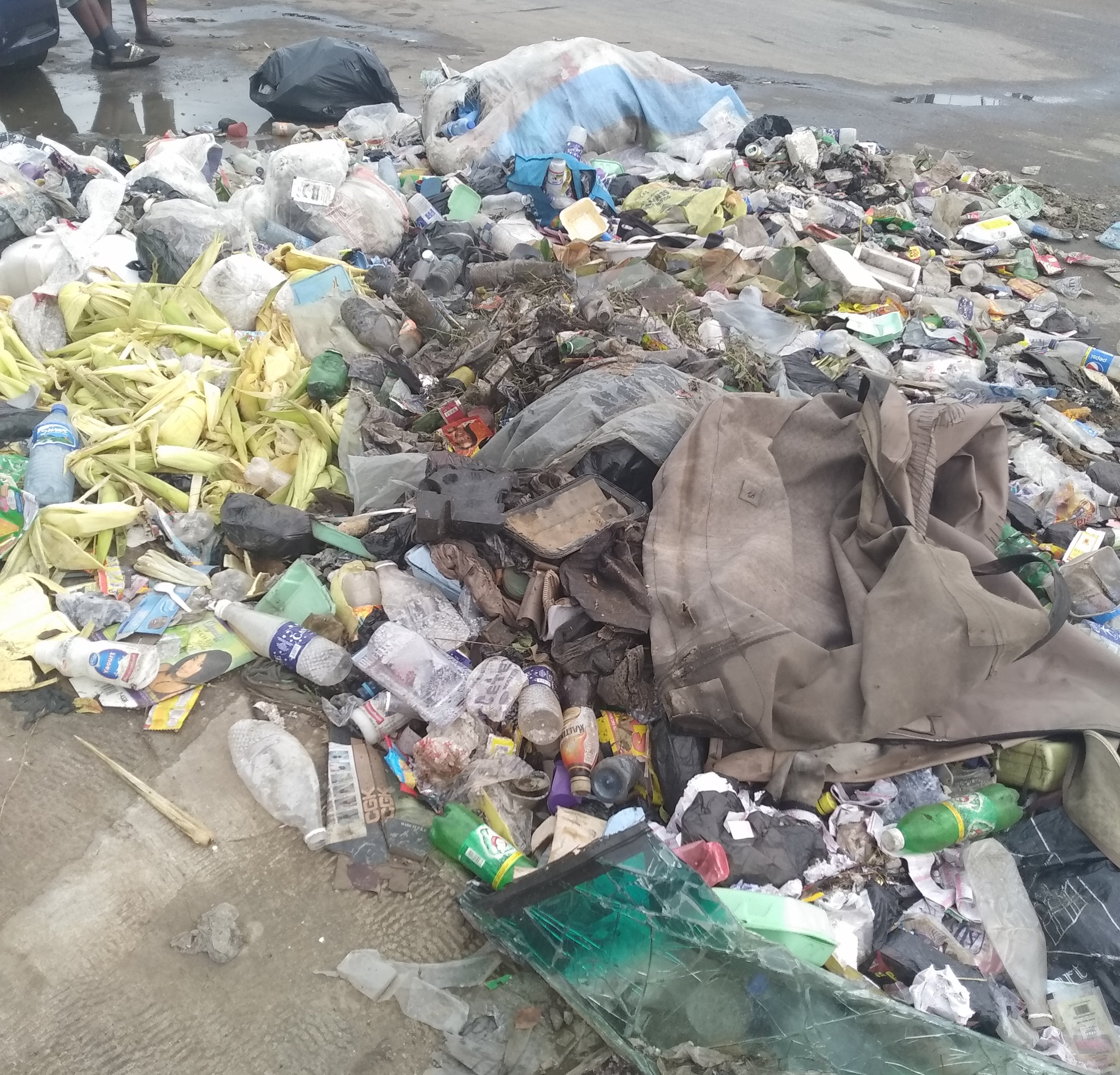
Indiscriminate disposal of plastic waste is a comm practice in Lagos. Photo Credit: YEKEEN AKINWALE

For hours, men of Mushin Local Government sweated in the sun to evacuate the blocked drainage in front of Chief Bode’s house on Coker road at Ilupeju Estate. For each load of waste they evacuated, there were more plastics than any other waste.

By the time, they finished packing the waste,  the roadside was lined with dirty empty plastic waste.

Blocked waterways and canals, and flooding are permanent features of Lagos, Nigeria’s commercial nerve centre. This is a reflection of the waste disposal and collection system in the state.

The Director-General of UNESCO, Audrey Azoulay, says nearly one-third of the plastic packaging “we use bypasses collection systems and ends up polluting our environment.”

At Ilupeju estate, Lagos, a mixture of the residential and industrial estate, residents contend with blocked drainage and flood. “It’s a major source of worry for us here,” Bolu, an Earth Scientist and a resident in the area lamented.

Despite the half-hearted job done by the municipal men, some residents expressed relief that the drainage was free and water could flow freely because each day it rains, the whole road is flooded.
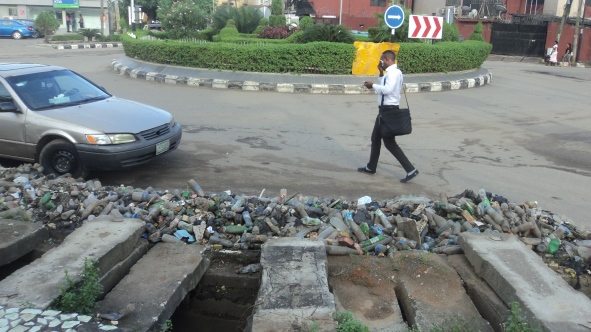
At Coker roundabout, Ikeja, plastic waste are not only environmental threats, they are also health risks. Photo Credit: YEKEEN AKINWALE

But a resident was indifferent or not so relieved.

“I’m not bothered by those plastics blocking the drainage,” says Chief Bode, “those plastics have always been there and once it rains, yes the road is flooded but the water will go after some time and the plastic will be there.”

He had lived on the street for well over 20 years, and the drainage around there have always been sources of worry. They are always taken over by waste, particularly plastics, thereby causing floods whenever rain falls.

But that’s not Chief Bode’s real grievance. His angst was the failure of the municipal officials to remove the waste from the street after the evacuation.

“Soon, those plastics would still find their way back into the drainage,” he said, “and that’s my anger.” “The plastics have been there and they came to remove them and left them out there. I won’t pack it, let them pack it.”

He admitted that Coker roundabout which is just opposite his house and the drainage is river-like whenever there is a deluge of water from the sky, but “if they had left the waste in the drainage, the water would have been flowing and the plastics would have been there.”

“Municipal do the evacuation and one of the greatest disservices they do is not to pack what they brought out,” Bolu also voiced his discontent about the act.

From Ojodu, Ogba, Surulere, Ikorodu, Egbeda to the eyebrow areas such as Lekki, Ajah, Victory Island and Parkview, Lagos city is plagued by blocked waterways, drainages, canals and other areas that are clogged by plastic waste.

As Nigeria’s commercial nerve centre, Lagos State hosts over 2000 bottled and sachet water manufacturing and distribution companies.

According to the Head of Lagos State Department of Public Affairs, Mukaila Sanusi, Lagos state houses about 2,000 Industrial complexes, 15,000 commercial ventures, and a burgeoning middle class with high purchasing power.

He discloses that waste generated in Lagos is more than 13,000 tons per day; and 12 per cent of the waste consists of plastic materials in the form of soft drink plastic, water and other consumer goods packaging.

“According to the World Bank, the generation of solid waste is tied to population, income and urbanization. If the report by this body which puts per capita waste generation rate at 1.2 kg per person per day is anything to go by, waste generated in Lagos far outweighs the official figure of 13,000 tons per day,” he says.

Plastic waste management should ordinarily not be a source of worry for Lagosian like Chief Bode and other residents.

A plastic waste recycling plant that was installed in the state some five years ago should have taken care of that worry.

The plant was among those awarded in 2009 which were ready for commissioning in 2013 according to EFO. But it was strange that it could not be traced in Lagos State.

Authorities at the state’s Ministry of Environment and Waste Management agency were not aware of such project in Lagos metropolis or any other places around it.                           

The General Manager, Lagos State Waste Management Agency (LAWMA), Segun Adeniji, says he was not informed of any plastic waste recycling plant executed by the Federal Government in the state.

“Ha, I’m not aware o, honestly, I’m not aware,” he says. “What I’m aware of is a brisket machine installed by the Federal Government and that one has to do with the wood waste.

“That’s what I’m aware of and I’m not aware of that one, except I will ask from my colleagues. I was not in LAWMA in 2013, I got here in late 2015. If there is anything like that I would have known, having spent more than two years here.”

Asked if the state government has a plastic recycling plant, Adeniji replied, “the recycling plant is a private facility. It is a Public Private Partnership (PPP), West Africa Energy came on board, partners with the state government.

“They bring machinery to do recycling; they sort plastics, bottles and resell to those that require them. The plant is at Igando. They call it materials recovery facility.”

The Contractor confirms to The ICIR that the plant was indeed installed in Lagos state, but he could not state the specific location.

“We installed the plant in Lagos State. But I can tell you that the machine has been removed,” he says.
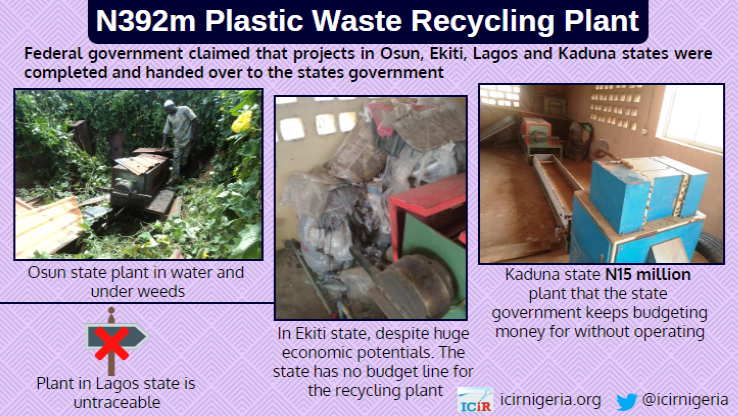
INFOGRAPHIC: N392 million plastic waste recycling plant

Already, there is a Food and Beverage Recycling Alliance (FBRA) in Lagos that is committed to cleaning up of post-consumer plastic waste in the state. The Alliance consists of Nigerian Bottling Company Limited, the Coca-Cola Company Nigeria, Nigerian Breweries Plc, Seven-Up Bottling Company Limited and Nestle Nigeria Plc.

In July 2018, FBRA signed a Memorandum of Understanding (MoU) with the Lagos State Government, through the Ministry of Transportation, to rid the state’s waterways of plastic and packaging waste.

The MoU is a three-year partnership between Lagos State and the FBRA to clean-up and prevents waste pollution from plastics and other food and beverage packaging, on Lagos State’s inland waterways.

The programme focuses on evacuation for recycling of packaging waste collected from the four inland waterways: Five-cowrie Creek to Lekki; Marina through Elegbata and Osborne to Oworonshoki, waterways from Apapa through Kirikiri, Mile 2, Festac to Oke-Afa, and the Ikorodu Axis, which covers Ipakodo, Ibeshe, Baiyeku, Ijede and Badore.


Kaduna plant never worked since installation
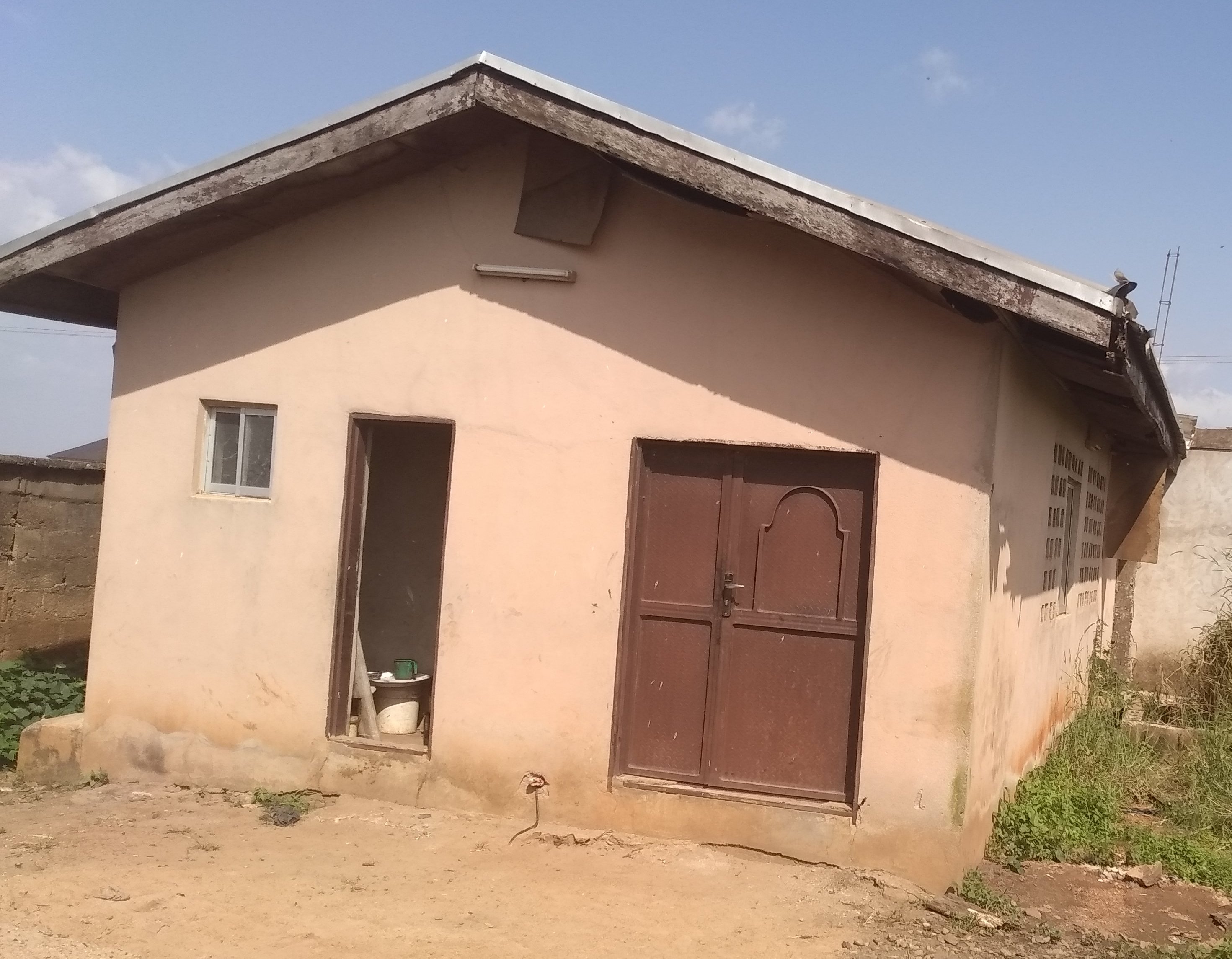
Abandoned: Kaduna plant has never been operated since it was first test run by the contractor. Photo Credit: YEKEEN AKINWALE

Like Osun State, Kaduna State plant located inside the Gonigora Kaduna’s main dump site has never worked since 2012 when it was test-ran.

“The plant is dead,” says an official of Kaduna Environmental Protection Authority (KEPA) who is in charge of the dumpsite situated along Abuja Kaduna express road.

“Nothing is there, it has never worked since the day it was tested, adds the official who did not want his name to be mentioned because he did not have the authority to speak to the press.

With some samples of plastic crushed during the test-running still lying at the mouth of one of the machines, probably− the crusher, other machines were covered in dust.
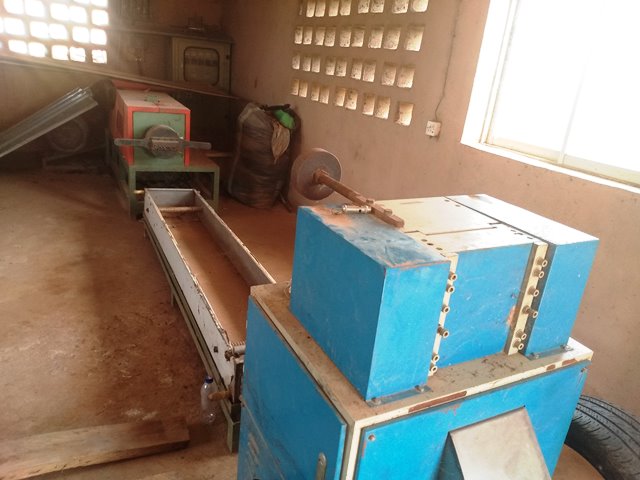
Wasting away: The N15million plant that the state government keeps budgeting money for without operating it. Photo Credit: YEKEEN AKINWALE

The General Manager of KEPA, Yusuf Rigasa who was appointed on February 9, 2106, by Governor Nasir El-Rufai said the state government has earmarked N19million in its 2017 and 2018 budget to resuscitate the plant.

“The project was handed over to the then Commissioner of Environment,” Rigasa says. He told The ICIR that the Federal Government started the project but did not complete it.

 FG, State governments not interested in the project – Contractor
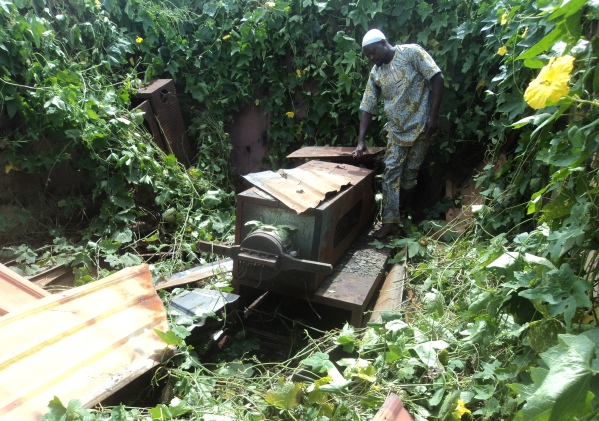
Failure: Osun State government failed to provide complementary facilities to operate the plant. Photo Credit: YEKEEN AKINWALE

After installing nine recycling plants in nine states, Abdul Ishaq, the Chairman of Abdul Essential Services Limited, told The ICIR that his firm was frustrated by both the agents of Federal and State governments that he could not continue with the project.

He maintained that the failure of the Federal Government to pay according to work done and penchant for demanding kickbacks by officials of Ecological Fund Office, Federal Ministry of Environment, and state governments’ officials were responsible for why the rest of the project was abandoned.

The frustration on the job was from government officials; they never paid us according to the value of the job done, before they pay us, you have to balance the equation.

“You understand what I’m saying. When you finish balancing the equation and the scatter level they scattered the job to, you are left with nothing.”

They paid over N320million and that is the money for us and money for the consultant, money for the Ecological Fund agency and money for the Ministry of Environment, he told The ICIR.
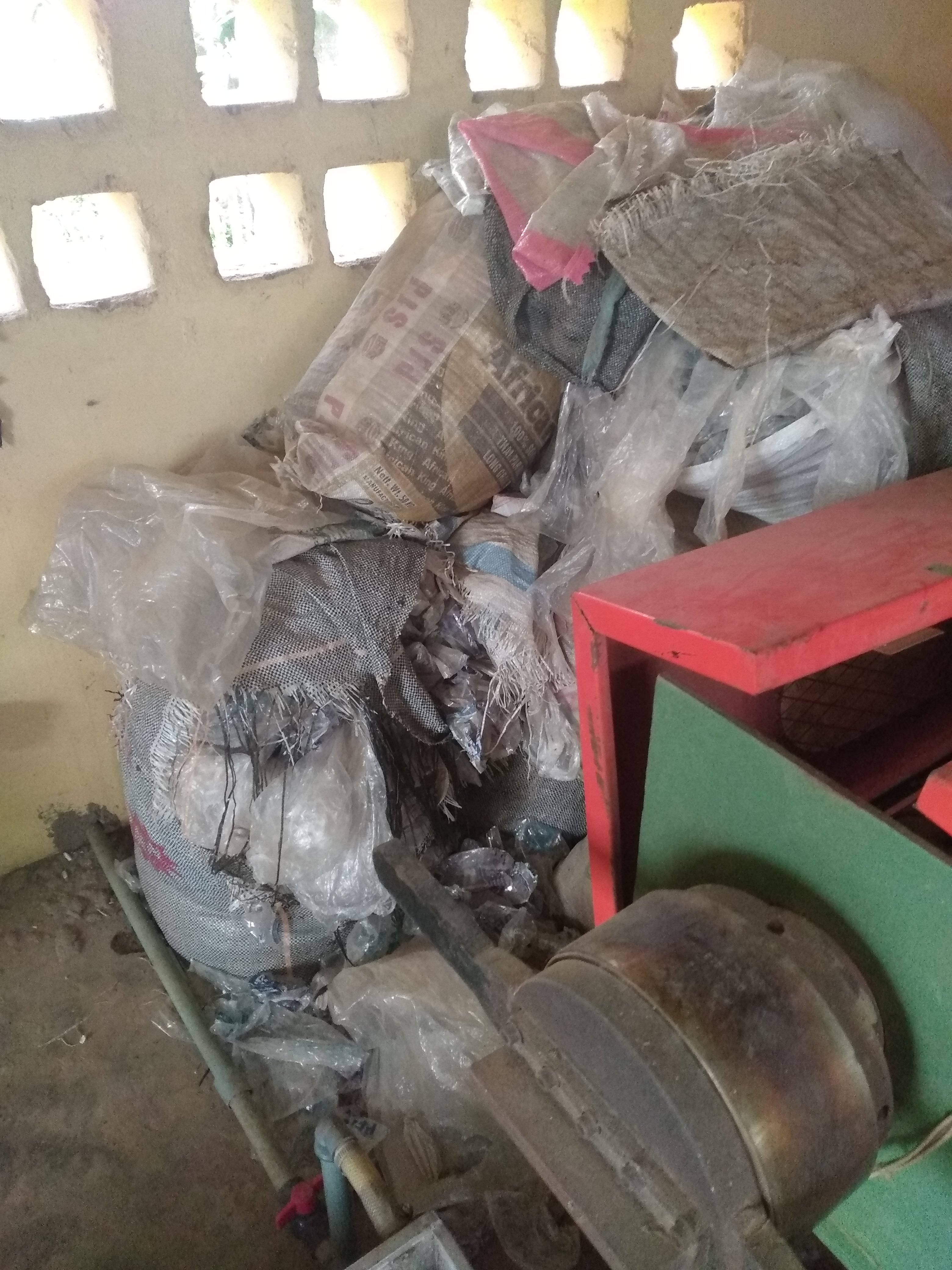
Untapped revenue: Despite its huge economic potentials, Ekiti State has no budget line for the recycling plant. Photo Credit: YEKEEN AKINWALE

“I have what is called the Financial Outlay that shows how much they pay us every time. But you know what?  These guys are wicked, in the bill of quantities, what they paid me was not even up to the cost of the machine. The machine alone was over 80 per cent of the job,” Abdul alleges.

He specifically mentioned Rivers, Cross River, Delta and Oyo states where, according to him, state officials were demanding for money before they could allocate land where the plant would be sited.

Abdul revealed that many of the states have the machines installed already. “We have in Borno, Katsina, Oyo, Delta, Rivers and other states.”

But the Federal Ministry of Environment that supervised the project has not responded to all the allegations.

A Freedom of Information (FOI) request dated August 29, 2018, and addressed to the Minister of Environment requesting for the contract details of the project was not responded to even at the expiration of the seven working days allowed by law.

However, after a period of two months and a week, the Ministry responded to the FOI request in a four-page document and two Video CDs documenting when Lagos and Katsina states recycling plants were test-run. The document was dated November 5, 2018.

The Federal Ministry of Environment is reputed for its notoriety for not responding to FOI requests.  The Ministry came last in 2016 in the ranking of government ministries, agencies and commissions’ response to FOI request conducted by the Public-Private Development Centre (PPDC). It was second to the last in 2017 and 2018 respectively.

When The ICIR reporter contacted the Ministry’s Director of Public Communications, Mohammed Sagir, for a response on the state of the plants and allegations by the contractor, he simply directed him to write a formal letter.

But when he was told an FOI request was pending in the Ministry, he claimed that such has not been brought to his desk as he is also new in the Ministry.

The following day that this reporter went back to the Ministry with the acknowledged copy of the FOI request, he was told to go and follow it up at the office of the Minister.

“We will treat it whenever it is brought here, but you can go and follow it up at the Minister’s office a female staff at the Public Communications office told this reporter.

Findings by The ICIR revealed that almost all the plants installed by the contractor in states like Lagos, Borno, Ekiti, Katsina, Osogbo, Niger, Kwara, Kaduna, Oyo have either been vandalized, stolen or abandoned to rot away.

In the response to the FOI request which further confirmed that the Ministry was unaware of the state of the project contrary to claims by the Minister, the document stated that all the 26 machines have been delivered to the beneficiary states, noting that 21 equipment buildings were completed.
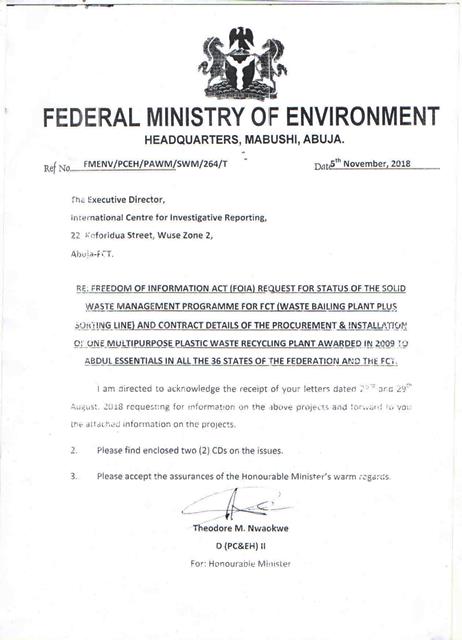
The copy of the response of the Federal Ministry of Environment to the Freedom of Information Request

It added that the project was completed in nine states − Katsina, Kaduna, Ilorin, FCT, Bauchi, Osogbo, Ado-Ekiti, Ibadan and Lagos, while the training of personnel was also carried out.

Despite claiming that all the 26 machines have been delivered, the Ministry in its response said, three states, Cross River, Delta and Ebonyi were yet to provide land as promised at the beginning of the project.

Twelve states where the equipment buildings have been completed are yet to provide water, electricity for the installation and test running of the machines, the Ministry said in the document but failed to name those states. And it is not clear if the nine states where the government claimed the project was completed were among them.

It confirmed that there is an outstanding of N69.77million debt to be paid to the contractor as it was paid N322.53million, which the document said represents 82.21 per cent of the contract sum.

The N504b revenue potentials that Nigerian government failed to harness
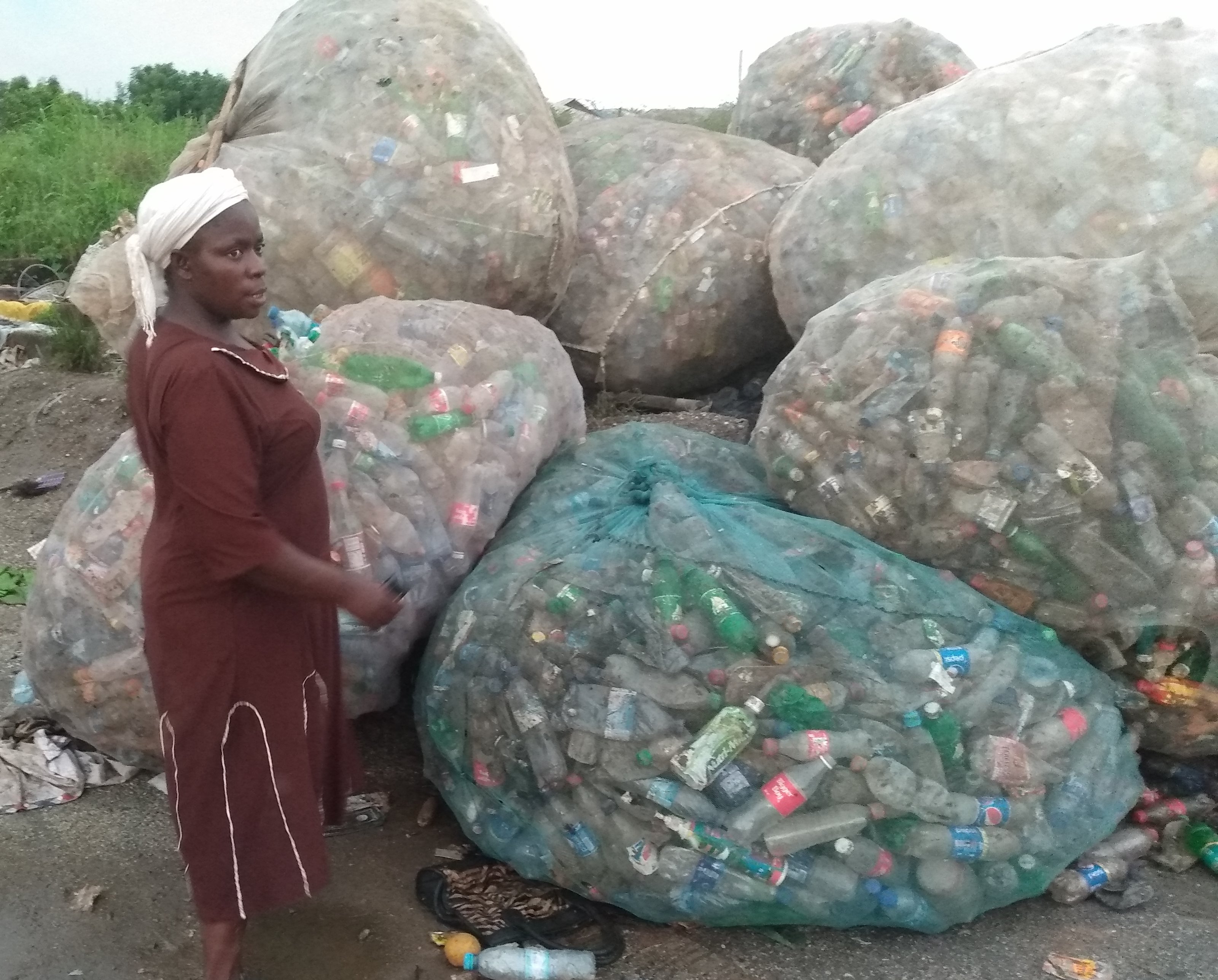
Waste to wealth: Oluwalana used to sort plastic bottles at the dumpsite, now she supplies plastic bottles to recycling plants and makes money. Photo Credit: YEKEEN AKINWALE

Rachael Oluwalana was once a worker at Saje dumpsite in Abeokuta, Ogun State. She was always sorting out plastic waste for merchants who take it to recycling plants in Lagos.

“I used to work here for like two years, but from my daily contributions I started my own business about three months ago,” she said.

Now a plastic waste supplier, Oluwalana sends 5000 kilograms of plastic waste collected at Saje dumpsite to a Chinese owned recycling plant at Mowe, Lagos, Ibadan expressway.

Selling at N50 per kilogram, she told The ICIR that her income in a month revolves around N200,000 and N250,000.

“We used to sell a kilogram at N34 but it has been increased to N50. The buyer used to deduct like 9 per cent or 5 per cent for the dirtiness of the plastic and we pay commission to the owner of the plant, West Africa Energy. We pay N3000 on 2500kg.

In the plastic waste value chain, Oluwalana is just one player aside from the scavengers who pick the plastic− the loaders, transporters and recycling plants operators and pellets buyers —plastic waste recycling forms part of the solution to the unemployment problem in Nigeria which stands at 18.8 per cent as at third quarter of 2017.

Plastic waste recycling is definitely a huge revenue generation potential that government is not harnessing.
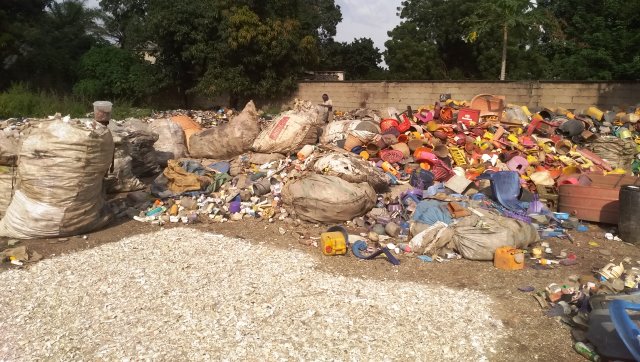
In Kaduna, plastic recycling is a booming business. Photo Credit: YEKEEN AKINWALE

According to Ishaq, the type of recycling plant that his firm installed has the capacity to produce the 10,000 kg of pellets per day and an average of 70,000kilogram in a week noting that the energy requirement of the machine is 200kilowatts and can run on 100kva generator.

At N150 per kilogram of pellets, Nigeria can generate as much as N42million from the sales of pellets in a month and as much as N504billion in a year from just a recycling plant if well managed.

The government is not taking this advantage, whereas other countries of the world are already making revenue out of plastic waste recycling.

In Haiti, the Philippines, and Brazil for example; the Plastic Bank pays people to collect plastic garbage.

They can trade it for groceries, fuel, and even school fees, or receive payment in the blockchain. The goal is to help people out of poverty and combat plastic pollution in the ocean, Forbes reported.
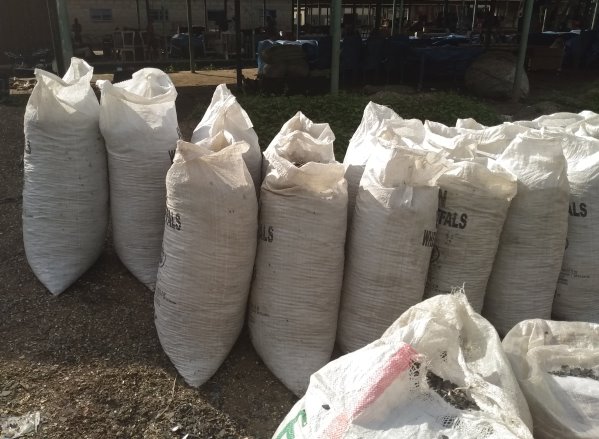
At a private recycling plant in Kaduna, bagged plastic pellets waiting to be transported to final destinations. Photo Credit: YEKEEN AKINWALE

The bank pays them more than other recycling schemes because it sells the plastic on to corporations at a premium as an ethically sound raw material called social plastic. Since 2014, it has processed 3.2 million kilograms (32,000 tons) of plastic.

Some schools in Haiti, Forbes reports, also accept plastic to be used toward tuition.

“If a family making $1,000 a year gets $60 from plastic, it’s a profound change in their lives,” says David Katz, founder of the Vancouver, BC-based company. (The company’s term for the currency is Social Plastic).

According to Daily Mail, 8 million tons of plastic enter the world’s oceans every year. Eighty per cent of it comes from developing countries like Nigeria.

The Plastic Bank wants to address the root cause of plastic pollution, rather than clean up once it’s already in the ocean.

“We should realize the value of plastic while it’s still on land then transfer that value to the world’s most disadvantaged,” Chikere says.

“Nigerian government needs to be in the mainstream of nations seeking to build a globally functioning recycling economy so that fewer new plastics are created and less are disposed of in an uncontrolled manner,” he concluded

Banning the use of plastic in Rwanda has worked well. And the country is a now used as UNEP case study for other countries to emulate

In 2004,  the  Rwandan Ministry of Environment,  concerned by the improper disposal of plastic bags, as they were often burned or clogged drainage systems, commissioned a baseline study which revealed that plastic bag litter was threatening agricultural production, contaminating water sources, killing fish and creating visual pollution.

In 2008 the Rwandan government banned the manufacturing, use, sale and importation of all plastic bags. Paper bags replaced plastic ones, and citizens also started using reusable bags made of cotton.

Along with the new ban, tax incentives were provided to companies willing to invest in plastic recycling equipment or in the manufacturing of environmentally friendly bags.

Not only can eliminating plastic trash save lives, but it also boosts economies, reports the Global Citizen which chronicles the success recorded by Rwanda after banning plastic.

Rwanda, according to the report, has seen an increase in tourism and compared to Uganda, a much cleaner environment.

Rwanda relies heavily on tourism and by eliminating plastics bags can promote eco-tourism and a cleaner greener environment than neighbouring countries. 1.2 million tourists visited Rwanda in 2014–an increase of 4 per cent in the last year.

“Eight per cent (177,000 jobs) in Rwanda are in the tourism sector. And tourism brought in 305 million (USD) last year.

“In addition, Rwanda’s efforts to eliminate plastic bags and overall plastic waste by banning it saved funds that would have been needed to pay government employees to clean up plastic waste.

“So the ban was a pretty smart move economically.”

If Nigeria must get it right the management of plastic waste, Isiaka Amoo, a professor of Analytical and Environmental Chemistry at the Federal University of Technology, Akure, says the Federal and State governments must work together.
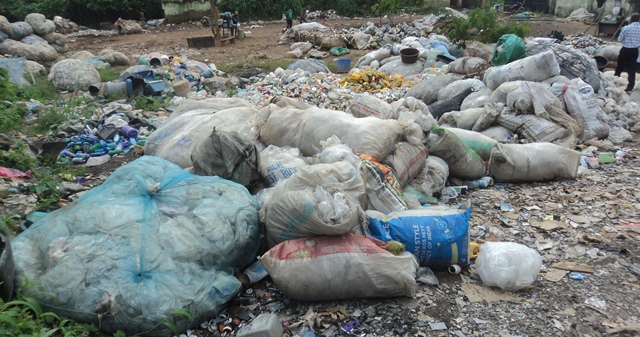
Huge business: Already, private individuals are making a living out of plastic waste business in Osogbo, Osun State. Photo Credit: YEKEEN AKINWALE

“There is no national policy on plastic waste management in Nigeria as of now. I don’t think there is one,” he says.

“At the Federal level, we have the Senate and the House of Representatives, at our local level, we have House of Assembly here. We can have the law at the top and bye-law at the state level so they can work hand-in-hand in order to have effective ways of managing these plastic wastes.”

He says that plastic waste, besides recycling can also be used to generate energy as used in China.

“We can recycle plastic and it can be used again. Apart from this, you can produce energy from it. When you burn plastic, you see the heat that comes out of it. It shows the amount of heat energy in it. I think in China or India, they are using plastic to generate power. And the by-product that comes from it, they use it to tar their road.”

Another problem is that we don’t have a continuous government; if there is continuity, the new government ought to take over abandoned projects and continue with them.

As it is done in Rwanda, Amoo says the Federal Government can also introduce Public Private Partnership (PPP) to the management of plastic waste in the country.

“We need Public Private Partnership (PPP) at all level, it is a menace, Federal Government and state governments cannot do it alone. If the attitude of government workers is nothing to write home about, it is better to have PPP,” he says.

“The policy can be made by the Federal Government and the private people should continue with the policy.”

On his part, Chikere avers that political engagement is a powerful lever for setting the right incentives to change. “Developing a circular economy is just a matter of political will,” he quips.

The plastic waste menace Nigeria is not dealing with
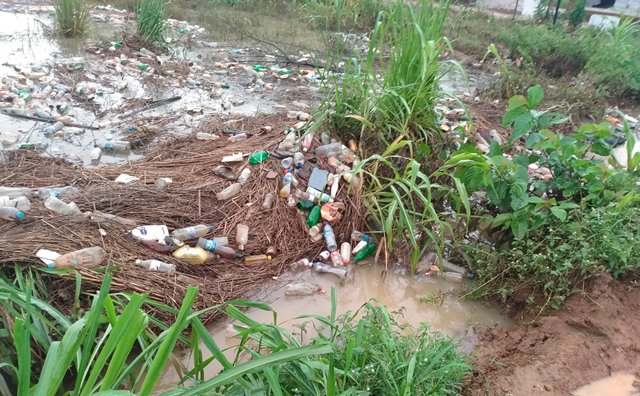
Plastic waste everywhere: Once it rains, plastic waste takes over everywhere and the government is not dealing with it. Photo Credit: YEKEEN AKINWALE

“It was as if all the plastic in Ife were directed here,” says Adewale Mathew, who, with the help of his friends and clients, spent two hours picking plastic waste that took over his fitness centre situated along Ede road very close to Obafemi Awolowo University, Osun State.

That day, Monday, July 30, 2018, residents counted their losses but one thing littered everywhere – it was a plastic waste. Pet bottles, take-away foils, pure water sachets and polythene covered the walkways, road and all available space.

It was after a heavy rainfall. Water flooded everywhere – from Ile-Ife down to Ede road. Roads and houses were all taken over by water.

“We have to wait for the flood to come down,” he narrated. “Immediately the flood subsided, we have to pick the plastics.”

“I have clients and friends who joined me in picking the plastic, it took us like two hours, we just have to pick and pick, gather them and burn them all,” Mathew told The ICIR, pointing to flooded parts of his fitness centre.

The amount of plastic that came with the flood was unimaginable for him. “I can’t even count, more than 500 plastics covering everywhere because they could not flow under the bridge, so they were washed here and at the edge of the bridge.”

His prayer every time it’s about to rain is ‘for there not to be flood’ because as he said, “Any time there is a flood, we must see plastics.”

Mathew’s experience after the flood underscores the menace of plastic waste which he admits constitutes a serious environmental challenge.

Nigeria has no national policy on plastic waste management− the Minister of Environment of State disclosed that the Federal Government was working on a national policy on plastic waste management to regulate use and disposal of plastic waste in the country.

This is unlike fellow African countries − Kenya, Rwanda, Mauritania and Morocco, that now have a total ban of plastic bags and packaging.

In February 2017, ten countries signed up with the United Nations Environment Assembly (UNEA) to ban the use of plastic bags or containers.

Each year, more than 8 million tonnes of plastic end up in the oceans, wreaking havoc on marine wildlife, fisheries and tourism, and costing at least $8 billion in damage to marine ecosystems. Up to 80 per cent of all litter in our oceans is made of plastic, the UN agency said.
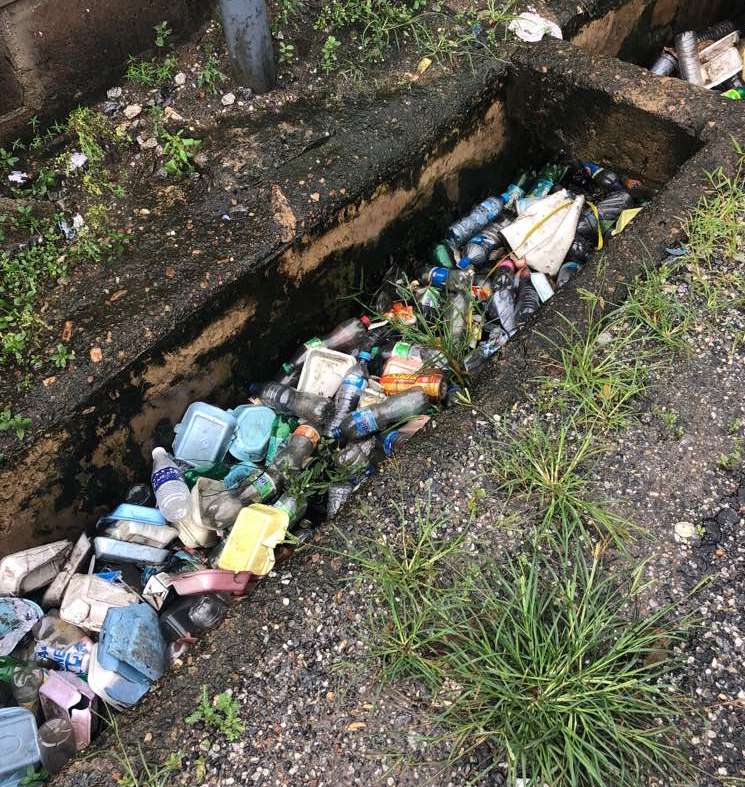
Clogged drainage: In Lagos, like many cities across Nigeria, plastic waste clog gutters and waterways, thereby causing floods. Photo Credit: YEKEEN AKINWALE

“According to some estimates, at the rate we are dumping items such as plastic bottles, bags and cups after a single use, by 2050 oceans will carry more plastic than fish and an estimated 99 per cent of seabirds will have ingested plastic,” says UN Environment Program in an article titled “UN declares war on ocean plastic.

The threat by plastic waste, environmentalists say is very real.

“If individual countries fail to clean up their plastic waste, our seas will be choked and this will almost certainly affect the world’s ability to generate oxygen, sustain the food chain and indeed all life on the planet,” they said at the UNEA’s #CleanSeas campaign in 2017.

The environmental impacts of plastic waste alongside the looming threat to human survival are many, says Chigozie Chikere, a Training Facilitator at the Institute of Maritime Studies, University of Lagos.

Scientists across the globe are increasingly finding wildlife that has been killed after ingesting or becoming entangled with plastic. Ninety per cent of seabirds, for example, have been found to have plastic in their bellies, The New Republic reports.

It says the estimated 19 billion pounds of plastic that end up in the ocean every year is expected to double by 2025.

“These plastics will not only kill more animals; they’ll decimate coral reefs, and damage human health as microplastics enter the food chain.

“They’ll create more and bigger dead zones where nothing can live, harm biodiversity, and change ecosystems. There will likely be additional, unknown impacts; researchers have only been studying ocean plastics for less than two decades.”

Chikere explained that only one per cent of ocean plastic is actually found floating on the surface.

“In fact, the plastic concentration on the ocean floor is 1,000 times greater than on the surface.”


This investigation was supported by  John D. and Catherine T. MacArthur Foundation and the International Centre for Investigative Reporting, ICIR.
 

ASUU STRIKE: My salary is N500,000, some professors earn more than that, says Fayemi

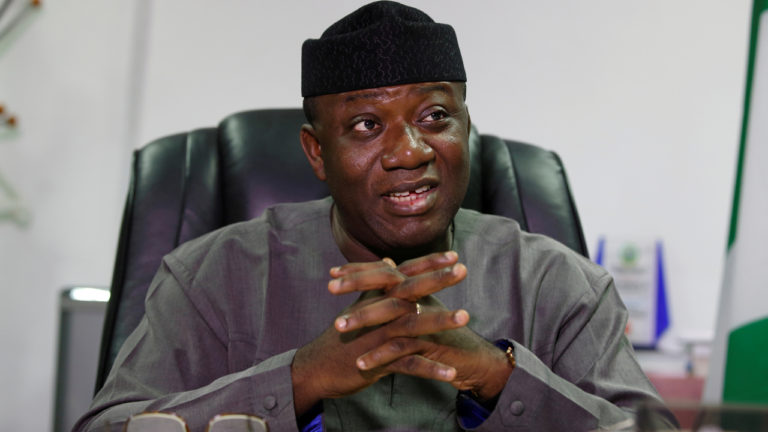
GOVERNOR Kayode Fayemi of Ekiti State says no administration has done as much for Nigeria’s education sector as the Muhammadu Buhari administration, which is why the industrial action embarked upon by the Academic Staff Union of Universities (ASUU) is unnecessary and ill-advised.

Fayemi, who accompanied Buhari to Paris, France, said this during the President’s interaction with Nigerians resident in the country. He pointed out that ASUU cannot have all that it is demanding for, especially given that there are many challenges facing the federal government.

For instance, Fayemi said the average salary of lecturers in Nigeria has increased significantly and is almost at par with what he is being paid as a governor, all thanks to the Buhari-administration.

“Ask yourself what was the average wage in the university system before. A university professor earns more than me as a governor. My salary as a governor is N500,000. Most university professors earn about the same amount if not more,” Fayemi said.

“Yes, you may argue that there are other opportunities available, there are also other opportunities that are available that are not being taken advantage of by our academics. I can say a little bit about this because this is my terrain.

“I do not think that ASUU on its own strength can argue that the government has not done well. There is hardly any institution in Nigeria today, including states universities, that have not had the benefit of the intervention.

“It is either the government is building an auditorium or rehabilitating a laboratory or improving on students hostels in virtually all the universities as I speak to you. That’s what TETFUND does via their intervention funds. That again is not the complete solution.

“Can we add more resources to the education budget? Absolutely we can. But when you have competing needs, you cannot have everything that you want. And this is something ASUU needs to know.”

The current ASUU strike began on November 5 as the lecturers complained that FG was yet to fulfil an agreement it reached with the union in 2017. They also bemoaned the poor funding of the education sector, as well as the plan by the government to increase tuition fees across universities.

Speaking with journalists on Monday, November 12, one week after the commencement of the strike, ASUU National President, Biodun Ogunyemi, said even though the union had submitted a memorandum to the relevant government agencies on how to better fund universities, “nobody is talking about the items there except to say that they cannot meet the union’s demand because of the oil prices”.

“We have submitted the report of a joint committee to the minister; on how to generate funds to address the outstanding balance of N1.3 trillion. It is like the minister is not addressing issues raised and the recommendation in the report,” he said.

President Buhari is in France to take part in the Paris Peace Forum.

Southern Cameroonian refugees blame international community, media over their plights

0

THE Southern Cameroonian refugees in Nigeria have accused the international community and the African Union (AU) of not doing enough to proffer political solution to the crisis going on between Anglophone Cameroon and the Francophone side led by President Paul Biya.

The aggrieved refugees also carpeted international media for under-reporting their plights since October 1, 2017, when a crisis erupted between the Anglophone and Francophone Cameroon after the former declared independence.

Ako Albor, Vice Chairman of Southern Cameroonian Refugees in Adagan Refugees Resettlement, Ogoja, Cross River State, lamented that the international community has been ‘dormant’ on their matter.

Albor, French- English Translator from Manyu Division of Southern Cameroon wondered why “nobody in the international community is talking about their plights.”

“I think Paul Biya has a very strong Mafia among the AU and they are doing everything in his favour.”

He said that AU, Nigeria, Ghana, South Africa and other countries were supposed to be the first stakeholders in their matter but have done little or nothing to resolve the crisis.

Nigeria government should do more in resolving the crisis, Albor said, “Nigeria and Southern Cameroon people have a long history together. Nigeria cannot be indifferent in this case.”

He said Nigeria should be the first to stand openly with the Southern Cameroon, adding that Nigeria should not shy away from speaking the truth.

According to him, the recent victory of Paul Biya in the general election dashed their hope of any quick resolution of the crisis.

“We thought the opposition would win the election because that would have offered some hope of dialogue and perhaps a settlement.”

The return of Biya has led to more clamp down in the country− his immediate actions show that he is not working towards any immediate resolution, Albor said.

“Last night, a journalist was arrested and those that are in detention, we don’t know what he plans to do with them.”

Ignatius Mezam, a teacher in Southern Cameroon lamented that international media such as the Cable Network News (CNN) and Aljazeera have not given their crisis the required attention.

“When you look at other revolutions going on across the world, they are prominent in the news, but you don’t hear about Southern Cameroon issue,” Mezam said.

“The CNN, Aljazeera have not given it prominence in their reportage, is it because we are black. The battle is only fought on the Facebook by Facebook warriors.”

War broke out between Biya-led government and Southern Cameroonians after the latter on October 1, 2017, though a minority, declared independence under the name Ambazonia Republic.

Tens of thousands of Southern Cameroonians have fled the country in the wake of the clampdown by the Francophone Cameroonian government.

Over 30,000 of them are currently under asylum in Nigeria− Cross River, Benue and Taraba states, according to National Commission for Refugees, Migrants and Internally Displaced Persons and UNHCR.

Nigeria lawmaker Faruk refutes claim ‘to deal with’ Tracka official

1

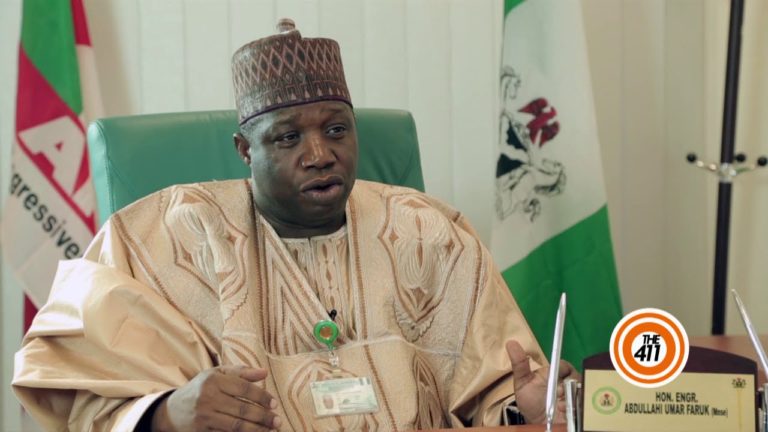
ABDULLAHI Faruk, a legislator from Kebbi State has refuted the claim to “deal with” Emmanual Yaro, one of the officials working for Tracka.ng in the state.

He told The ICIR that the alarm raised by Tracka.ng on its Twitter handle @TrackaNG over the safety of its staff was unfounded.

Tracka NG, a transparency platform that helps citizens monitor constituency projects in their communities, disclosed on Twitter today that the lawmaker representing Kebbi/Kalgo/Bunza federal constituency has threatened to deal with Yaro for “sensitising the people of Maidahini community.”

Faruk’s side of the story 

Faruk denied this claim in a telephone interview with The ICIR.

The lawmaker said his people had called him, saying the Tracka official had alleged him of collecting a sum of N10 million for a perimeter fencing which had been abandoned.

“They gave me his number, and I called him and told him that I am giving him one week to go and correct what he said or else I will take legal actions against him.

“Nobody gave me money. This government will not give any member money. It doesn’t concern me, you should go and ask the River Basin Development Authority, they are the ones that the money is released to quarterly. I already have 48 projects executed, in fact, you can get the document verifying this,” he told The ICIR.

Tracka’s allegation

In a previous interview with Uadamen Ilevbaoje, Head Tracka, he said Yaro received a call from the legislator threatening to deal with him, and promising to take legal actions against him for visiting his constituency.

Ilevbaoje said that after the Tracka’s official received the call, out of fear for his life, he decided to make the threat public.

The ICIR called Yaro to describe the event leading to the “threat”. He corroborated the account of his boss.

He said after sensitising the villagers about the need to monitor project in their constituency, the village head reached out to the legislator notifying him of their knowledge about the monetary provision of  N10 million assigned for a perimeter fencing of a Muslim cemetery at Madhini and Tunga both in Birnin Kebbi.

Subsequently, the legislator called him and told him that he had just 30 minutes to go back to Birnin Kebbi and tell them he was not given the sum that he (Yaro) said he received or else he would have his lawyer on his tails.

Tracka had since then alerted the Nigerian Police Force and the Kebbi State Government describing Faruk’s statement as a threat on its official Twitter handle.

“This is to inform the people of Kebbi state, that our project tracking officer’s life is in danger. His offence is sensitising the people of Maidahini community. Hon Abdullahi Umar has alleged to deal with him. @PoliceNG_PCRRU@PoliceNG Please take note of this threat. @KBStGovt,” Tracka tweeted on its official account.

“As it seems, the Tracka project which is geared towards ensuring transparency, grass root participation, and reduction of corruption in government capital projects had obviously annoyed the legislator,” Ilevbaoje told The ICIR.

The Tracka head said that this was not the first time his men had come under attack or harassment from members of the House of Representatives in the course of doing their duties and holding legislators accountable on constituency projects.

Other legislators who have openly threatened Tracka officials include Hon. Nnanna Igbokwe, representing Ezinhite Mbaise Federal constituency Imo State;  Senator Sani Mohammed, representing Niger South senatorial district; Hon. Alhassan Dogowa, representing Tudunwada/Dogowa federal constituency and Hon. Shehu Usman Aliyu, representing Karaye/Rogo federal constituency Kano.

Tracka periodically embarks on sensitising Nigerians in communities, councils and local government areas, enlightening indigenes on federal government constituency projects in their community. It also takes civic education to the grassroots, insisting that public funds must work for the people.

The World Economic Forum recently commended Tracka’s impact in Nigeria.

The organisation “is turning citizens into real-life anti-corruption tsars with a tool called Tracka, an e-platform on which citizens share updates on budgetary and development projects in their communities,” says WEF.

With increasing number of infants living with HIV, Nigeria is failing to meet global target

1

LAST year, 1, 359 infants in Nigeria tested positive to HIV, a spike in mother-to child-transmission when compared to previous years.

“1,359 is a challenge to us because we used to have less than 100 some years ago,” says Gbenga Ijaodola, assistant director in the Federal Ministry of Health in charge of prevention of mother-to-child transmission of HIV.

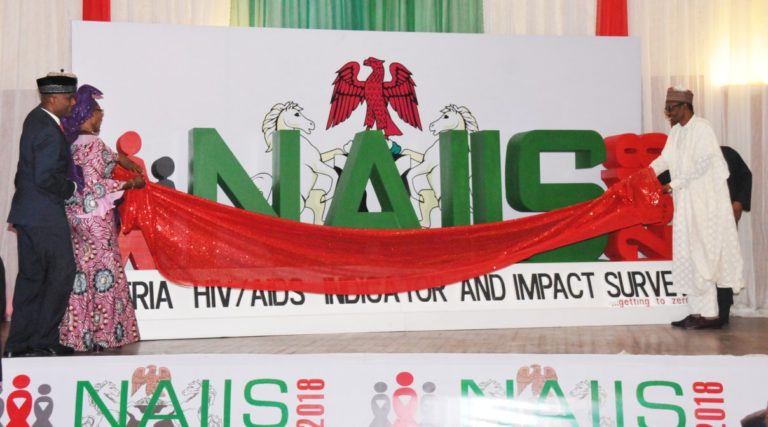
“What’s going on? That’s already giving us concern,” Ijaodola says. He says the causes of the new infections are multifaceted but a reliable answer to his own question will be available in early 2019 when the results of Nigeria HIV/AIDS Indicator and Impact Survey are expected to be released.

Regardless of the causes of new infections, Nigeria is moving against the global target of achieving zero new HIV infections among infants by 2020, as set out by the World Health Organisation (WHO).

These new HIV infections in Nigeria are abnormal considering that Cuba eliminated mother-to-child transmission of HIV in 2015. Belarus and Thailand followed suit in 2016.

To achieve the 2020 target, mother-to-child transmission rates of HIV have to be less than 5 per cent in breastfeeding populations or less than 2 per cent in non-breastfeeding populations for at least one year. Africa countries like South Africa, Uganda, eSwatini and Namibia have met the target of 5 per cent.

An infant is at the risk of contracting HIV if the mother is living with the virus. HIV can be transmitted from an HIV-positive woman to her child during pregnancy, childbirth and breastfeeding. But this transmission from mother-to-child is preventable if HIV-positive pregnant women are on antiretroviral treatment (ART).

Without treatment, the likelihood of HIV passing from mother-to-child is 15 per cent to 45 per cent. However, antiretroviral treatment and other effective prevention of mother-to-child transmission interventions can reduce this risk to below 5 per cent.

An estimated 165, 474 pregnant women in Nigeria needed prevention of mother-to-child transmission of HIV services in 2017 but only 50,890 of these women were accessing antiretroviral treatment, according to data from the National AIDS and STI Control Programme (NASCP). Eventually, 24,026 of these HIV positive women delivered of their babies in health facilities.

Source: National AIDS and STI Control Programme (NASCP)

Prevention of mother-to-child transmission started in Nigeria as far back as 2001 in six tertiary health facilities but Nigeria currently has the highest number of new HIV infections among children. UNAIDS estimated that between 22, 000 to 56, 000 children were newly infected with HIV in 2016 due to mother-to-child transmission.

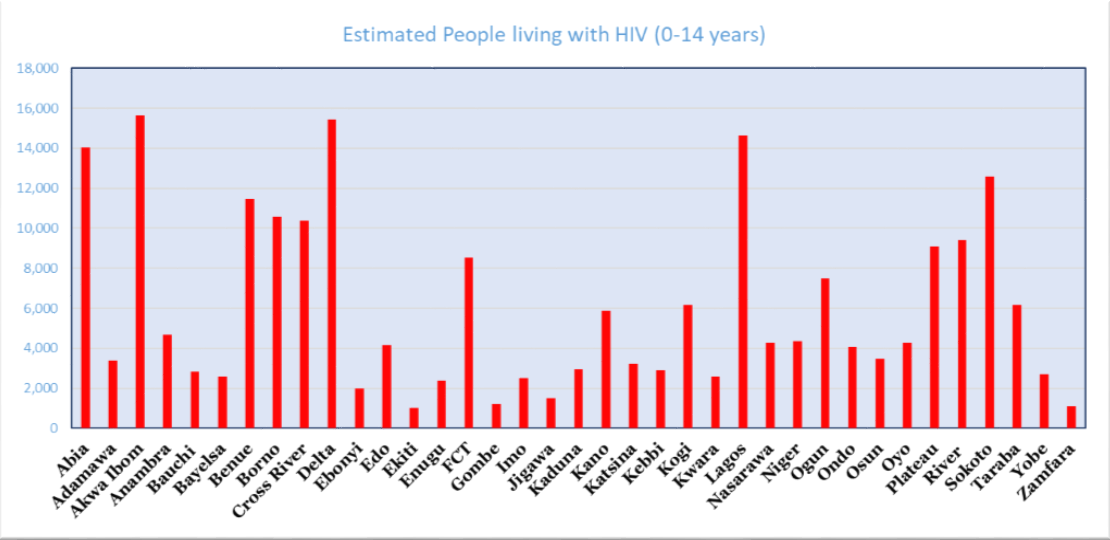
Federal Ministry of Health estimates that 221,729 children are living with HIV in Nigeria and only 54,167 the children are on treatment.

It is widely believed that if Nigeria is taking prevention of mother-to-child transmission seriously, the country would not have this high number of children with HIV.

UNAIDS points out there has been little progress in reducing new HIV infections in recent years in Nigeria, adding that only one in three people living with HIV is on treatment.

According to the National Agency for the Control of HIV/AIDS 1, 090,233 persons (747, 853 females and 342, 380 males) are currently on HIV treatment in the country as at June 2018.


Alleged N7.7billion fraud: Court revokes Uzor-Kalu’s bail for travelling without permission

FOR travelling to Germany for medical treatment without obtaining permission from the court, Justice Mohammed Idris of the Federal High Court, Lagos, has withdrawn the bail he granted to the former Governor of Abia State, Orji Uzor-Kalu.

Uzor-Kalu is being tried by the Economic and Financial Crimes Commission (EFCC) on charges of corruption, abuse of office and mismanagement of Abia State funds during his days as governor of the state.

He pleaded not guilty to the charges and was subsequently granted bail. Among other conditions, Uzor-Kalu was ordered to submit his travelling documents with the court’s Registrar.

However, on the last adjourned date, Uzor-Kalu’s counsel, Gordy Uche, informed the court that his client travelled to Germany to undergo a surgery. He explained that the situation was urgent and begged the court for an adjournment to enable him to recover.

But the counsel to the EFCC, Rotimi Jacobs, objected to the application and urged the trial judge to treat Uzor-Kalu as one who had jumped bail.

“I am not aware when the 1st defendant wanted to travel. We only got to know that the 1st defendant travelled abroad for medical treatment through his media aide, one Kunle Oyewunmi,” Jacobs said.

“Things must be done in accordance with the law. In my own view, what happened is that the 1st defendant has jumped bail. This is an attempt to further frustrate this trial because no application was made to the court to travel.”

Justice Idris agreed with the prosecution counsel and ordered that Uzor-Kalu must appear before the court in the next seven days. That deadline expired on Monday, but Uzor-Kalu was not in court, prompting the trial judge to revoke his bail.

He ruled that Uzor-Kalu is permitted to continue his medical treatment abroad without harassment by security agencies, but that upon his return to the country, “he shall, at the point of entry, surrender his passport and other relevant travel documents to the EFCC”.

“He shall also surrender himself to the EFCC within 24 hours of his return, failing which he shall be arrested and detained by the EFCC,” Justice Idris ruled.

Uzor-Kalu has since joined the ruling All Progressives Congress (APC), but his trial has continued regardless.

He is currently campaigning to be elected as a senator representing Abia North.

How abandoned Calabar dredging contract landed senator in trouble

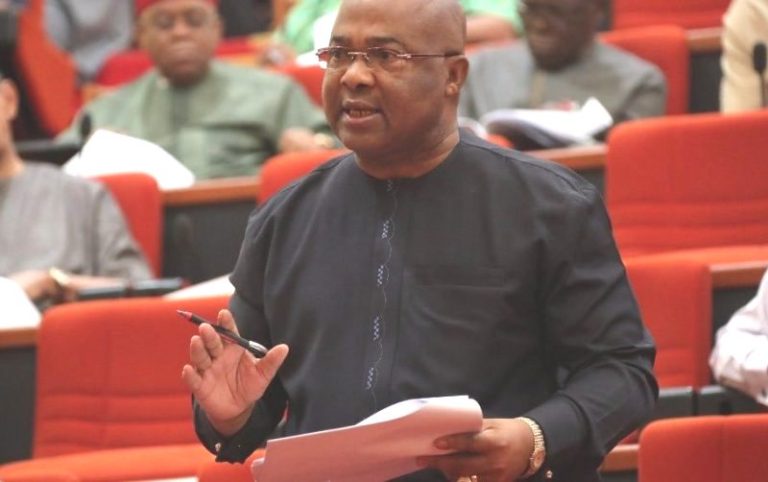
HOPE Uzodinma, the sitting Senator representing Orlu Senatorial District of Imo State, was “arrested” on Sunday by the Special Presidential Investigation Panel for the Recovery of Public Property headed by Okoi Obono-Obla.

As at noon on Monday, Uzodinma was still in custody, with Obono-Obla confirming to the media that he (Uzodinma) has been evading arrest since last year.

While some Nigerians were quick to claim that Uzodinma’s arrest may be connected to his face-off with Governor Rochas Okorocha of Imo State.

Uzodinma is currently aspiring to contest for the Imo State Governorship position on the platform of the All Progressives Congress (APC), but Okorocha has ‘endorsed’ his son-in-law, Uche Nwosu, to succeed him as Governor, while he (Okorocha) is aiming to unseat Uzodinma in the Senate.

But the presidential committee on asset recovery explained that Uzodinma was picked up in connection to a contract his company was awarded for the dredging of Calabar channel during the presidency of Goodluck Jonathan.

Though the company, Niger Global Engineering and Technical Company Limited, has received the total sum of $12.5 million (about N26 billion) for the contract, investigations revealed that it did not carry out any work on the Calabar Channel.


READ ALSO:

This issue was brought to the public domain via a publication by Premium Times in June 2017, following a memo written by the current Director General of the Nigerian Ports Authority, Hadiza Usman, to the Minister of Transportation, Rotimi Amaechi, informing him of the development.

It was based on the publication that Uzodinma was arrested at the Nnamdi Azikiwe Airport, Abuja, on Sunday.

“We have been looking for him since we saw the wonderful investigation that Premium Times carried out on the matter, and then we were also helped by a petition which a citizen took time to forward to our panel,” Obono-Obla said on Monday.

“The petition went to the presidency, and then it was forwarded to us for action.

“We have made all efforts to get him, including writing to him and the Senate on several occasions, but he ignored our invitation and evaded our attempts to get him to come and explain what he did.

“He got a contract to dredge Calabar Ports, which we all know can help this country’s economy significantly, but refused to do it.”

Obono-Obla, who himself is facing a certificate forgery scandal, said that his committee does not have the powers to detain a suspect for a long time, adding that Uzodinma would be released after he had written a statement, and subsequently, he would be charged to court.

However, Obono-Obla’s comments appear to have gone against the ruling of the Abuja division of the Court of Appeal on November 5, 2018, saying that  Special Presidential Investigation Panel (SPIP) for the Recovery of Public Property does not have powers to arrest or prosecute a suspect nor confiscate anybody’s asset.

“The Recovery of Public Property (Special Provisions) Act does not confer any prosecutorial powers on the SPIP,” stated the Appeal Court judgment which was read out by Justice Hussein Muhktar.

“The powers conferred on the SPIP under the Act is limited to investigation and cannot prosecute under the Act or under the EFCC Act or any other Act.

“The SPIP, upon conclusion of investigation can only submit its report to the President. The SPIP cannot obtain forfeiture orders from any Court whatsoever. The SPIP cannot exercise the powers of the Attorney General of the Federation or the Chairman of the EFCC.”

Should Lai Mohammed’s N3.5m revelation have been left off the record?

0

By ‘Fisayo Soyombo

“JOURNALISM entails a high degree of public trust. To earn and maintain this trust, it is morally imperative for every journalist and every news medium to observe the highest professional and ethical standards” — Preamble, Code of Ethics for Nigerian Journalists (1998).

For three days in March 1998, some of the country’s finest journalists, plus newspaper owners and other stakeholders, gathered in Ilorin, the capital of Kwara State, to forge what till date remains the most recent version of the ethical code guiding journalism practice in Nigeria. The Nigerian Guild of Editors (NGE), the Nigerian Press Council (NPC), the Nigerian Union of Journalists NUJ), the Newspaper Proprietors Association of Nigerian (NPAN) were all represented. The ensuing document was an upgrade on the one in existence since 1979.

Exactly 20 years on, Kwara State returns to the summit of a delicate yet thrilling debate about ethical journalism, not because another gathering of journalists has been convoked but because a son of the soil has fallen victim to the relative obscurity to which the 1998 document has fallen.

On Thursday, Lai Mohammed, the Kwara-born Information Minister, was seen telling reporters in a viral video that the government was spending N3.5 million monthly to feed Ibrahim El-Zakzaky, the Shi’ia sect leader who has been in detention since December 2015. In the six-minute-fifteen-second video, Lai can be heard four different times saying the information should be kept “off the record”. In an instance, he specifically says: “This should be off the record… I am only giving you all this background information so you know how to write your story.”

Lai’s off-the-record revelations were passed on to the public by internet platform, Oak TV. Following Lai’s cry of betrayal, Oak TV delivered a letter of apology to the Minister, and claimed to have sanctioned “all the team members involved”. The only problem is Nigerians won’t stop discussing the incredulity of feeding a detainee with such humongous sum. Of more journalistic and scholarly importance, however, the debate rages: should Oak TV — and the legion of media outfits that jumped on it — have published the video?

Before delving into the debate about the propriety of publishing the video, it has to be said that something is fundamentally wrong with this so-called regime of change if it truly spends N3.5million monthly on an accused for whom it has disobeyed a court order for his release, and at a time the government can’t just muster a measly N30,000 as minimum wage for workers. Maybe some will also argue, perhaps rightly so, that Lai got his comeuppance in the end — for being such a notorious inventor of propaganda for the selfish interests of the then opposition party and a cynical manipulator of information to the benefit of the now ruling government.

Still, should that video have been published? The answer — and it is not hard to explain — is no. Section 4 of the Ethical Code, tagged ‘Privilege/Non-disclosure’, states clearly: “(i) a journalist should observe the universally accepted principle of confidentiality and should not disclose the source of information obtained in confidence; (ii) a journalist should not breach an agreement with a source of information obtained as ‘off the record’ or as ‘background information.’” Not only did Lai say “off the record”, he particularly clarified he was only offering the journalists background information for their stories.

Although they haven’t expressly said so, most of those arguing for the spilling of the video can fall back on other sections of the Ethical Code. In the second, titled ‘Accuracy and fairness’, the code says “the public has a right to know”. A part of the document’s preamble also states: “In the exercise of these duties, a journalist should always have a healthy regard for the public interest.”

Is there, therefore, a clash of interests between the public’s right to know and the journalist’s respect for off-the-record information? No. Combining these two provisos would mean something like: ‘the public has a right to know, but through any means other than the publication of off-the-record information’. And this is possible. In this specific case, the answers are not set in stone, but there are a number of possibilities.

One — probably the least desirable and surely not in a video — would be to state Lai’s claim but attribute it to a Federal Government source rather than him. In any case, according-to-a-source stories are a permanent fixture in Nigerian journalism. Another would be to take Lai’s claim to the Interior Minister or the Director-General of the Department of State Service (DSS), both of who should know; whether they say yes or no, it’s a story. Yet another is to attempt to force the information out of the government with an FoI request, with failure to respond gifting the journalist the liberty to announce Lai’s claim even without revealing the source. The possibilities are limitless. Lai’s revelation, in fact, can be the springboard for investigative reporting to ascertain the cost of feeding or generally caring for a DSS detainee or an EFCC detainee or a prisoner. Or for El-Zakzaky himself!

The wide publication of the Lai video also raises a string of worrying questions about the practice of journalism in the new-media age. One that personally bothers me is the growing transformation of the media to an entity that sees itself as useful solely for news dissemination — what’s happening to educating the readers? What’s happening to analyzing, interpreting and processing the raw news so that readers are better placed to make informed decisions with them? This shrinking of robust journalism is one reason Lai’s revelation was not considered valuable beyond its news mileage.

It is also wondrous how the media is comfortable with setting a certain standard for the rest of the society yet lowering it for itself. For example, over the past two weeks, the media has been vociferous in its criticism of the Army for gunning down dozens of Shi’ites in Abuja. That criticism is valid because the Army’s Rules of Engagement (RoE) state clearly when and how a soldier can apply fire. There must be “grave danger” to the life of the soldier; and even then, “fire must be aimed and controlled”. The RoE forbid “indiscriminate firing”. All these the Army flouted, and for this it was roundly criticized by the media. How then can the media fall short of the rules of its own rules of engagement?

I have been taken aback by arguments reprimanding Lai for saying on camera something he didn’t want published. Baffling thought pattern, actually. As long as he wasn’t on live TV, and knowing the taped videos would still be edited pre-publication, he acted within reasoning. A few months ago, I taught an investigative journalism class during which a participant questioned the morality of undercover reporting; he just couldn’t understand why a journalist would obtain information in an environment where he isn’t known to be one. In one of my answers, I shared a finding from Borno State during an undercover adventure in June 2016. But first, I asked that my disclosure should be off the record. And the cameras were on, too. During that trip, I found myself in a certain room where there was access to the official — not the press-release manipulations — number of the total number of soldiers who had been killed by Boko Haram in just the first six months of that year. And boy, were the numbers staggering! I gave the figure to the class but I again impressed it on them that this information couldn’t be made public. All I wanted to prove to the class was this: there are certain information you will never have unless you go undercover.

That this debate has existed at all is one more reminder of how the disruption of journalism practice by technology is not all gains. In more intellectually-conscious climes, last week’s off-the-record drama would spark scholarly incursions into the changing values of 21st-century journalism. It would trigger intense concerns about the gaping hole of self-regulation that must be filled if the media must bountifully harness the pluses of Internet-driven media explosion. Personally, I remain worried that while the audience for journalism is larger today than it was, say, a decade or two ago, the mindset is remarkably smaller.

Soyombo, former Editor of the TheCable and the International Centre for Investigative Reporting (ICIR), tweets @fisayosoyombo

How claims of Atiku’s employees don’t add up – Did he employ more than Dangote, Shell?

ON Thursday, Mohammed El-Yakub, who is the Managing Director of Gotel Communications, Atiku Abubakar’s Adamawa-based media organisation, said his boss had approved minimum wage for all staff of his companies. He also put the total of these beneficiaries at “over 100,000”.

“The N33,000 new salary scale, which takes effect from November 2018, includes domestic servants and all categories of workers on the former VP’s payroll,” El-Yakub told Sahara Reporters.

This claim is coming shortly after the committee on the review of the national minimum wage recommended N30,000 as the new national minimum wage to the federal government.

Among Atiku’s known companies and organisations are Adama Beverages (producers of Faro water), American University of Nigeria (AUN), Gotel Communications, Rica Gardo & Standard Microfinance, Prodeco, ABTI International Secondary School, and Intels Nigeria Ltd. He is also said to have once ventured into maize and cotton farming.

In Atiku’s defence, Reno Omokri, former aide to ex-President Goodluck Jonathan, said in October that only three of Atiku’s companies, including the AUN, have created up to 50,000 jobs. The All Progressive Congress “is silly to say Atiku must list jobs he created,” he tweeted.  “Their focus should be jobs created.”

“Let me humor them. From just American University of Nigeria, Faro, Rica Gardo & Standard Microfinance. Atiku created 50k jobs, to mention a few. APC, list Buhari’s jobs!”

While The ICIR could not verify how many persons work under the beverage and finance companies, it can report that the staff strength of AUN is just slightly above 1000.

Responding to a recent enquiry e-mailed to the school on the subject, Daniel Okereke, the university’s Executive Director of Communications and Publications said the staff strength of the school constitutes of 1,082 Nigerians, over 80 foreigners and an additional temporary staff of four.

Bigger employer than Dangote, Shell?

A good number of companies, reputably larger than those established by the People’s Democratic Party (PDP) presidential candidate, are known to have employee populations which are lesser than 100,000. One of them is the Dangote Group of Companies, a multinational conglomerate owned by Aliko Dangote, Africa’s richest man.

The conglomerate, the largest in West Africa and one of the largest on the continent, comprises Dangote Cement, Dangote Sugar and Dangote Refinery, and is reported to employ only over 30,000 people, as at 2017, generating revenue in excess of  $4.1 billion. Dangote Cement alone has operations in up to 10 African countries.

Another great example is Royal Dutch Shell PLC, a British-Dutch oil and gas company with headquarters in the Netherlands, and the sixth-largest company in the world according to revenues in 2016. The company also has operations in over 70 countries. Nevertheless, as at 2016, Shell employed an average of 92,000 workers, as stated in its 2016 sustainability report.

ExxonMobil, a United States-based multinational oil and gas corporation and the world’s ninth largest company by revenue, also employs far less people than Atiku Abubakar, if the claims of his associates are to be accepted.

As at 2017, the company had only 69,600 employees globally, according to Statista, an online statistics, market research and business intelligence portal. The company’s staff strength declined compared 2001 when it employed 97,900 people.

Reckitt Benckiser Group PLC (RB), a British multinational consumer goods company which produces Dettol, Strepsils, Air Wick, Durex among several other products and has operations in 60 countries across the globe, had as at 2017 only 37,000 employees.

Further checks revealed that Shoprite, Africa’s largest food retailer with over 500 outlets has “a current estimate of 130 000 employees”. Nestle Nigeria has a staff strength of just over 2,300 direct employees.

Also, according to the Nigerian Banks Financial Transparency Report of 2010, 14 top banks in Nigeria including First Bank, Zenith Bank and United Bank for Africa (UBA), had a total staff strength of  59,807 as at 2009, leading to a wage bill of N265 billion.

The 2013 annual reports and accounts of Nigerian Breweries PLC, which has several large-scale breweries across the country, put its staff strength at 3,195 — a reduction from the 2012 figure of 3,214.

Interestingly as well, the total number of Nigerians employed by the Lagos State Government only surpassed 100,000 in 2017, when it grew to 100,433 after an additional recruitment of 5,000 persons that year. This was according to Olabowale Ademola, the State Head of Service, who spoke at a ministerial press conference in Ikeja.

Based on the staff strength of leading multinational companies, it is obvious that the claims of Atiku having over 100,000 employees are open to questions. And it is most unlikely that he has such number of staff.


‘My suspension was nothing but preemptive strike and a coup,’ embattled NHIS boss speaks

USMAN Yusuf, the suspended Executive Secretary of the National Health Insurance Scheme (NHIS), says his suspension was the handiwork of some fraudulent Health Maintenance Organisations (HMOs) partnering with the agency.

Yusuf made this allegation in a video he shared via his Twitter handle @ProfUsmanYusuf on Thursday to tell his side of the story on the corruption allegations leveled against him.

He said that the day he was suspended was the exact day he was to present a report on the HMOs that had qualified to be licensed by the NHIS.

Yusuf said Nigerians should ask why he suspended on that Thursday, October 18th and not on the 20th.

“Thursday was the day I was supposed to present to the council the number of HMOs that have qualified for licenses. My suspension was nothing but preemptive strike and a coup,” he said.

Yusuf explained that the HMOs in Nigeria usually get paid by the NHIS but would not pay the hospitals they serve. He said that was the problem he met when he was made the Executive Secretary in July 2016.

He said there are 57 HMOs in Nigeria which are in three classifications, the defense, police and civilian HMOs. The defense and police have one each, while the other 55 HMOs are for the civilians. Yusuf said he had solved the first two HMOs crises, but the civilian HMOs have lots of impunity.

“We pay HMOs in Nigeria three months in advance to pay hospitals but they will not pay the hospitals,” he said. “And Nigerians  are not treated well because HMOs have not paid hospitals.” Rather, Yusuf said the HMOs fix the NHIS money in banks to generate interests or be used as a collateral for bank loans.

According to him, HMOs are non-licensed entities, and the only contract that is in existence between the them and the NHIS was the one of 13 years ago, when it was created. “This is what I met: non-license entities that are paid three months advance but not paying hospitals,” he said.

Yusuf said he found it offensive that billions of naira are going to non-licensed HMOs, hence, he established a forensic audit that looked into the affairs of the HMOs. Subsequently, he directed that all HMOs be licensed. And to be licensed, he said, non-indebtedness forms signed by the Chief Medical Directors of all the hospitals the HMOs serve must be presented to the NHIS.

“On the day I want to present the report that would give out the numbers of HMOs that are qualified to work with NHIS was the day I was suspended,” he said.

Yusuf said another thing he wanted to achieve was that the HMOs return all the N1.025 billion that was given to them illegally between 2013-2015, as revealed by an investigation conducted by the Department of Security Services (DSS).

He said his administration had recovered 75 percent of the money, and that he had threatened that by December this year, if the monies were not fully paid, he would delist the affected HMOs and hand them over to Economic and Financial Crimes Commission (EFCC).

The HMOs, Yusuf said, are looking for means to maintain the existing state of affairs. “They are the ones that are inciting the rancor in the NHIS boardroom,” he said. “If I was stealing money, Nigerians would not hear anything about it. It would be done quietly as it is being done.”

While the suspended Executive Secretary maintains his innocence, the NHIS governing council, as well as the Minister of Health, Isaac Adewole, think otherwise.

Enyantu Ifenne, Chairman of the NHIS Council, said the Executive Secretary refused to carry out the board’s decisions on critical issues and noted that there was institutionalized corruption at the agency. She said Yusuf was “fraudulently inflating the cost of biometric capturing machines,” and had “attempted to illegally execute N30 billion in federal government bonds”.

A report of the investigative panel set up by the Ministry of Health to probe Yusuf indicted him of high-handedness, budget distortion, fraudulent cost manipulation, illegal investments and unprofessional manipulation of the human resources of the agency.

According to the panel, Yusuf oversaw the siphoning of up to N919 million from the coffers of the agency in the name of payment to consultants for staff training.

The report stated that in some instances, the number of purported trainees was far more than the entire number of employees at the NHIS, while in some other instances, some employees were registered for the same training in two different states at the same time, with the facilitators charging as high as N250,000 per participant.

Yusuf, a professor of Haematology-Oncology and Bone Marrow Transplantation in the United States prior to his appointment in July 2016, had earlier been suspended in July 2017 by Isaac Adewole, the Minister of Health, over similar allegations and petitions against him. But he was reinstated in February this year by President Muhammadu Buhari.

In the video he shared on Thursday, Yusuf said the allegations against him had been investigated by the EFCC and ICPC and he was cleared before he was reinstated. He, however, said that if there are fresh allegations, he is willing to present himself to the appropriate authorities for further investigation.

Yusuf said he was not guilty because “the allegations against him are unproven.”