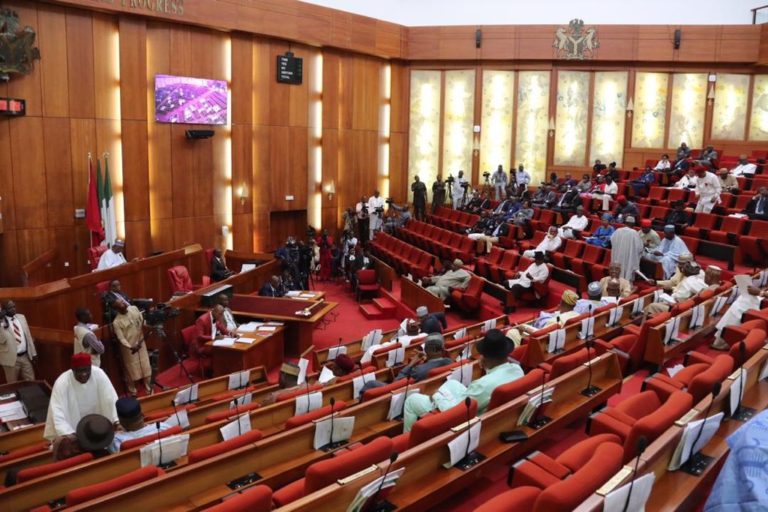
SENATE has passed the Independent National Electoral Commission (INEC) amendment bill after the third reading.
This was done after the third reading of the bill at the Senate Plenary Sessions on Tuesday.
Senate President Bukola Saraki said the new electoral act would improve the electoral process in Nigeria.
“This will further strengthen our governance,” Saraki said. He added that he was sure the President Muhammad Buhari would give his assent. “I am sure Mr president will, of course, give his assent and we can now finally have an electoral process we all will be proud of.”
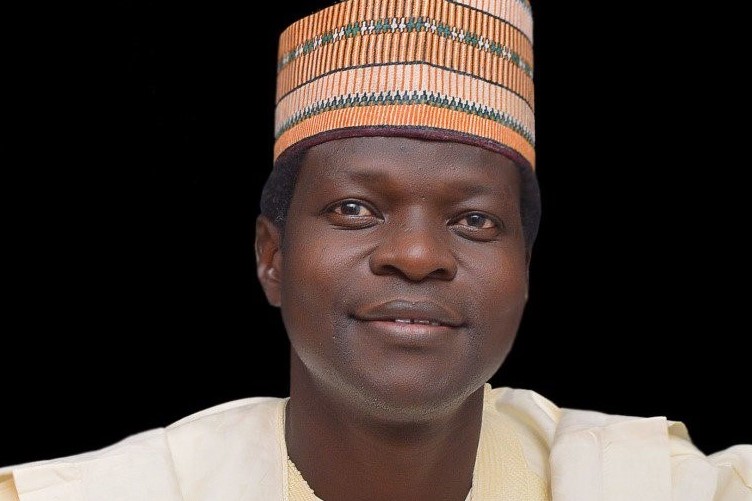
The third reading was done after the committee on the Independent National Electoral Commission (INEC) Act 2010 (Amendment) Bill, 2018 (SB. 699) submitted their report by Suleiman Nazif, Senator representing Bauchi North of Peoples Democratic Party.
While presenting the bill, Nazif explained the main objectives of the bill to include the recognition of the use of Smart Card readers and other technological devices in elections. He added that it would provide a sequence of elections and political party primaries as well as providing a timeline for the submission of the list of candidates, criteria for substitution of candidates.
He said it would address the omission of names of candidates or logo of political parties. This is contained in the bill by inserting, after subsection (4) of Section 140 of the Principal Act, a new subsection( 5).
It stated: “If, at the point of display or distribution of ballot papers by the Commission, a candidate or his agent discovers that his name or the name or logo of his party is omitted, a candidate or his agent shall notify the Commission and the Commission shall postpone the election to rectify the omission and appoint another date to conduct the election, not later than 90 days.”
The chairman explained that some observations of the president were considered.
Mr. President, after he rejected to give assent to the bill the last, had called on the Senate and House of Representatives to address “some drafting issues” quickly as possible so that he may grant assent to the Electoral Amendment Bill.
The sections of the electoral act of 2010 that were amended included the sections 31, 33, 34, 38, 44, 67,76, 78, 82, 85, 87,91, 99, 112, 120,138,140, 143, and 151.
The Independent National Electoral Commission (INEC) Act 2010 (Amendment) Bill, 2018 (SB. 699) was thereby read the third time and passed.
The Senate on Tuesday also resolved to set campaign spending limits for senatorial elections at N250 million and N100 million for House of Representatives.
THE Federal Road Safety Corps (FRSC) says the Nigerian would have been N9.8 billion richer in 2018, but for truck accidents in the country.
The Corps Marshal of the FRSC, Boboye Oyeyemi, made this known during this year’s edition of the National Safety Training Programme for Petroleum Tanker Driver in Lagos.
The training was organised by the Lagos State branch of the National Union of Petroleum and National Gas Workers (NUPENG).
Speaking at the event, Oyeyemi said there was a slight improvement in the truck accidents recorded in 2018 when compared to 2017 and 2016 figures. While the number of truck crashes in 2016 was 282, that of 2017 was 240 and the figure recorded so far in 2018 was 196.
The FRSC boss explained that the total loss was arrived at by calculating the cost of the vehicles involved in the crashes, as well as the damage to the environment and roads, adding that the lives that were lost in the accidents cannot be measured in monetary terms.
“We have an agreement with NUPENG PTD to organise periodic training programme for their drivers. This is very critical even though we have seen a reduction in the traffic crashes involving tanker drivers,’ Oyeyemi said.
“We have recorded 196 this year and the economic value is about N9.8 billion loss, involving cost of other vehicles, lives, damage to the environment and to the roads.
“NUPENG PTD is putting its best to set up a capacity workshop for the tanker drivers. Once they finish in Lagos, the other programme will take place in Kaduna and Warri and this is very impressive.
“We are going to give our maximum support to NUPENG towards ensuring that the 4,000 tanker drivers are fully trained.”
Oyeyemi also advised NUPENG to carry out regular visual tests for tanker drivers, as a study by the FRSC found that about 30 per cent of commercial vehicle drivers had visual acuity challenges.
He advised that wearing a pair of glasses if need be, will improve drivers’ vision.
Also, Oyeyemi observed that many drivers were hypertensive and had high sugar levels, urging NUPENG to ensure that drivers undergo periodic medical examination to ensure road safety culture in the country.
Also speaking at the event, the National Chairman of the Petrol Tankers Drivers (PTD), Salmon Oniditi, said that the training which started three years ago has led to a reduction in accidents.
He commended FRSC for its involvement and support in the training since the inception of the programme and urged fellow members to always be professional in their activities.
Oniditi pledged that NUPENG will continue partnering with the FRSC to ensure that petroleum tanker drivers did not become a nuisance to the society. (NAN)
THE Executive Secretary of the National Health Insurance Scheme (NHIS), Usman Yusuf, has insisted that the allegations of corruption against him are false, otherwise, the Economic and Financial Crimes Commission (EFCC) would have found him culpable.
Yusuf has twice been suspended from Office but he insists that neither the Minister of Health, Isaac Adewole, nor the NHIS governing council has the powers to remove him from office.
On Monday, police officers used tear gas to disperse the protesting NHIS workers who had tried to prevent Yusuf from gaining access into his office despite having been placed on an indefinite suspension by the governing council.
Speaking with the BBC Hausa service on Tuesday, Yusuf said some powerful but corrupt individuals who had been making illegal profits from the scheme, were cooking up false corruption allegations in order to remove him from office.
“The governing board has no right to suspend me as the Executive Secretary,” Yusuf said. “I notified them in a written document that they lack constitutional rights to suspend or even block me from entering my office.
“From the country I came from, if you say someone is a thief, you have to prove that. But since I came on board, I have been going through unnecessary accusations of fraud.
“They’re doing that just to intimidate and stop me from doing my good work. They have failed, I will never succumb to their ploy, I think they have to change plan.
“I told everyone when I came on board that the public funds in the commission belong to Nigerians, no one should tamper with that money, including myself.
“If I’m corrupt, EFCC and ICPC are currently recovering billions of naira from my whistleblowing in the commission and I have never been indicted by the anti-corruption agencies.
“My ordeal as the Executive Secretary of NHIS may be connected with NHIS agents who think that I stepped on their toes and you know these people are powerful and they are well established in the previous administration.
“Those NHIS agents, I told them to pay back their debts which has already run to billions of naira. After initial investigations, I learnt that so many abnormalities need to be corrected.”
Earlier on Tuesday, speaking during Channels Television’s Sunrise Daily, the presidential spokesman, Garba Shehu, also defended Yusuf, saying that the NHIS had been “ethnicised and politicised by some interest groups within and outside the agency”.
“I can say that I have never seen this kind of disaster in my life,” Katsina state governor, Aminu Masari, told the News Agency of Nigeria (NAN) as he spoke about the devastating effect of ecological flooding incident which killed 44 people this past month. “I have seen a young groom of three days who lost his bride and still searching for her,” he said.
So far, more than 100 people have been killed this year by multiple flooding across Nigeria, more than 37 years since the Nigerian government set up an ecological fund meant to curb and prevent flooding, among other purposes.
In the last five months since the rains started to fall in some parts of the country, hundreds of people have been reported killed in several states such as Kano, Katsina, Ondo, Jigawa, Niger, Delta and even the Federal Capital Territory, while several people have been left homeless and their properties destroyed. Before the year ends, an additional 380 Local Government Areas in 35 states are expected to experience flooding, Nigeria Hydrological Agency (NHSA) said in its 2018 Annual Flood Outlook.
Food shortages concerns
This raises several concerns, the second biggest being food shortages, following fears of potential loss of life and property across the county. This fear doesn’t seem far-fetched, food outlook from the country’s ministry of agriculture and rural development indicates.
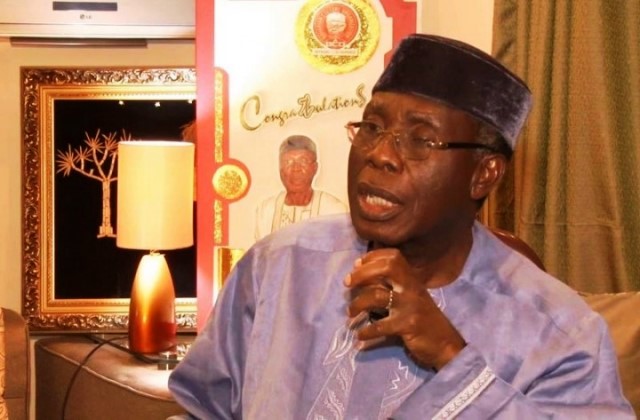
Minister of Agriculture, Audu Ogbeh
According to Minister of Agriculture and Rural Development, Audu Ogbeh’s estimation, Nigeria could potentially be “in serious trouble for rice, millet, sorghum and maize next year,” as floods in Nigeria are wiping out farms and forcing farmers to harvest prematurely this year.
“This year has not been a very good year for us farmers. We have suffered damages from the violent attacks on our farms by herders and now flood is washing away our farms. This is not just Katsina’s problem. It affects states like Zamfara, Sokoto, Kano and all over Nigeria,” Tukur Alimi, a farmer in Katsina said.
“In a country where conflicts and insurgency have displaced tens of thousands of people, with properties, crops and livestock worth billions of naira destroyed, one would think fixing the ecological problems that are in part responsible for these conflicts would be a priority by the Nigerian government,” a highly placed member of the Centre for Social Justice Limited by Guarantee (CSJ) a Nigerian not for profit focusing on rights-based approach to public finance management and political finance reforms, said.
In context of Nigeria’s ecological problems are climate-related conflicts that continue to threaten the environmental sustainability in northern Nigeria, peace and conflicts specialists said and are worried that they don’t see an end in sight in the oil-dependent economy as they predict that the conflict will continue to expand to other parts of Nigeria, as Wale Adeboye, Country Coordinator, Terrorism Research Initiative (TRI) Nigeria said.
By security analysts’ projection, Nigeria’s annual loss of up to 350,000 hectares of land to desert encroachment as the Sahara desert advances southwards at the rate of 0.6 km every year, and this by UNEP’s estimates will continue to drive increased competition over grazing land; and will escalate armed conflict between herdsmen and agrarian host communities. According to the United Nations Environmental Programme (UNEP), more than 20 million hectares are reduced annually, putting 35% of the world’s land surface at risk, at the moment.
This, therefore, once again raises the fear of food security in Nigeria. Data from the US Department of Agriculture sees Nigeria’s 2018-19 combined grain imports as expanding more than 50 per cent as Nigeria’s food production shrinks due to herders attacks in traditional grain producing belt of Nigeria as well as rising cost of local production affecting rice, wheat and corn.
Adeboye says violence the oil-dependent economy is not seen as going away “in the foreseeable future” and will “unfortunately” lead to increased dependency on food imports, “as violence likely spreads to other parts of Nigeria.”
Despite interventions, communities are left worse off
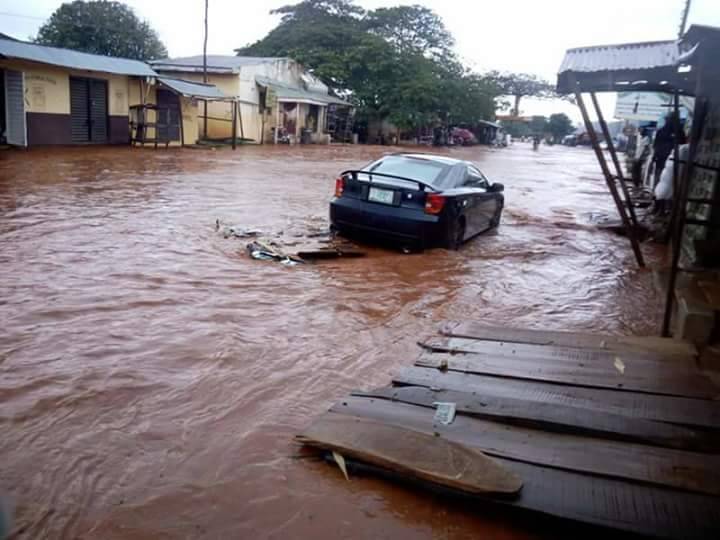
Flooded streets in Kano. Photo credit: Premium Times
The ecological fund office said it had disbursed billions of naira in funding for intervention projects meant to curb flooding across several states in Nigeria. Yet, people like Taminu Zubairu in Kano state and Tola Adekanmbi in Ondo state say they are yet to get feel positive impacts from the projects.
Marred by a history of mismanagement and corruption, the managers of the fund have left the people severely disappointment, according to Tanimu Zabairu, who lives in Kano state, where two major projects funded by the ecological fund are sited.
According to Zabairu, several interventions projects in the state did provide an immediate relief at the inception of the project but as the projects are left uncompleted or abandoned, the communities often time left worse off than they already were.
Contractor for Erosion and Flood Control at Dumbulun, Tsanyawa LGA, Kano State.
One of the two projects funded by the ecological fund office is the Gudu Tukuntawa and Zoo road erosion and flood control project contracted to an Abuja-based African Development Company Ltd, an export and import company. Although the project, commissioned in 2015, according to a government record, was classified as 30 per cent completed in 2018, a visit to the project site shows the construction only started “five months ago and that majority of the project was left abandoned,” according to the site supervisor, Joseph Adejoh.
And his team are only working on a two-kilometre channel that would lead to a bridge that may or may not be demolished because it may or may not have met appropriate specifications, adding no one is sure when the project will be completed.
A resident who lives beside the site that seemed abandoned said work had been suspended on the site since 2016. “We just noticed they stopped coming. The worst part is that the water that is being channelled from another place will flood our houses as soon as it begins to rain heavily in the coming months,” Aisha Aliyu, the resident said.
A story is told about how some houses were flooded by the rain, sweeping away children and women. One of the survivors of the incident, a husband who lost his wife and children were said to have left town altogether. “We cannot say what has become of the man. It is a really terrible day as the flood washed a lot of people including children away that day,” Zabairu said.
The second of the two projects, “Erosion and Flood Control” at Dumbulun, Tsanyawa LGA contracted to UYK Nigeria Limited, a construction company with offices in Kano and Abuja in June, 2017 and classified “100 per cent” completed by the Nigerian government is causing problems for the people of the area mainly because, according to them, the drainage system is too narrow and fails to prevent flooding in the area.
Residents of Kunchi/Tsanyawa Federal Constituency told this reporter that the purpose of the Senate’s constituency project to prevent flooding has not been met as flooding has resurfaced due to narrow drainages constructed.
Abubakar Tsanyawa, a resident of the area who was at the site of the project when this reporter got there, said “this project is nowhere near completed” contrary to the government records which showed that the project was per cent completed. According to him, despite the fact that the project has reached about 90 per cent completion, the narrow drainage being constructed on the waterway after breaking a lake in the affected area is leading flood into their village.
“We are overwhelmed flooding despite the project in our village. When this project started, we thought we were being saved by the government but the narrow drainage constructed is making the situation worse. Erosion water flows across the nook and cranny of the village during the rainy season and we are now calling the federal government to come to our rescue,” Kabiru Isah said.
Galadiman Dumbulum, who spoke on behalf of the village head confirmed the residents’ views.
Kano state is the commercial nerve centre of Northern Nigeria and is the second largest city in Nigeria; it is also known as one of the states worst hit by land degradation and environmental insecurity in the country. “There are thousands of erosion gullies scattered across the 44 local governments of this ancient city,” Nura Haruna Nudi, this reporter’s tour guide said.
Flooding is one of the issues that affect livelihoods of the people in rural Kano, Hassan Ahmed, a farmer/taxi driver said. Although he doesn’t farm in a commercial capacity, he said his friends who do complain bitterly when it begins to rain.
“The only problem we have with rain in Kano is flooding. Flooding makes going out to farm dangerous because the gullies are filled with water and you may lose your balance and fall into the ditches. Once that happens, chances of surviving is very slim. Going on about with our lives and commercial activities become a problem,” a man who simply gave his name as Usman said.
In Ondo, similar stories are told by the people in the state.
‘Our children can’t go to school’
Worst hit states like Kano, Anambra and Ondo still reel from effects of the damages from last year’s during the rainy season; as they face challenges this year’s rain brings with it in spite of several billions of naira in funding towards projects that could give the townspeople some respite from recurrent flooding.
Projects like the Soil Erosion Control Works at Usho/Ise Road, commissioned in November 2015, and the Erosion and Flood Control Project at Aiyeotoro Community, commissioned in June 2017, were recorded as 100 per cent completed by the Ecological Fund Office, but visits to the areas show that the projects do not provide any respite for the people of these communities. An ongoing project, Ondo Township Erosion Control Works, which commenced in November 2017, is said to be 30 per cent completed.
Flooding at the Aiyetoro area of Ondo State.
In Aiyetoro, where the multi-billion naira project was cited, parents say their children have difficulties getting to school whenever it rains in their area.
Tola Adekanmbi, a mother of two said she becomes fearful whenever it rains in her community as the resultant flood has been known to wash people away. “I usually don’t allow my children to go to school when it rains heavily because of the flooding. More so, many of the schools are usually affected so what’s the point of exposing my children to danger? Let me just say this, our children cannot go to school when it rains in this place,” she said.
At the time of the visit to the Ayetoro, it had been raining for days leading to severe flooding in those communities and therefore made visiting the to the project site “very dangerous,” according to a journalist, Hakeem Gbadamosi, who collaborated with this reporter on this story in Ondo State.
Recent flood in Ikare Akoko, Ondo State.
At Igbokoda in Ilaje Local Government Area of the state for instance, where the sum of N2 billion was intervention project was meant to have begun, residents said the project has “failed to see the light of the day.” Alhaji Kareem Anifowose, a resident of Davog stretch along Ijoka in Akure said: “many houses have been eroded by the flow of water that was not properly channelled due to the lack of constructed drainages. This destroyed houses, fences during heavy rains while some houses have been pulled down.”
Failure of the office
As issues arise with the projects funded by the EFO, many stakeholders are tracing the failure of the fund to the discretionary of the fund manager, that is any sitting president to disburse the fund he or she sees fit and thus, contravening purpose it was created and it’s leading the debate that the National Assembly might be complicit in the mismanagement of the special intervention fund.
“We shouldn’t be having these problems today. These problems were meant to have been taken care of by the ecological fund established in 1981,” Olumide Idowu, Country Manager, Climate Scorecard said, adding that he is not entirely surprised that nearly 40 years after, the problems the fund was meant to solve still notoriously persists.
“Again, the 2012 flood or any other flood since the establishment of an ecological fund should not have happened in this country if the fund had been used for the purpose it was created. But what we have seen is that the disaster the fund was meant to prevent keeps on happening year in year out. I grew up hearing about the ecological fund and what it was meant to do, and now, sadly, it has not done much to mitigate these preventable and unfortunate disasters,” Idowu said.
According to him, the problem with the fund is that it was left at the discretion of an incumbent head of state to be managed as he or she deems fit.
“Who is going to track the president? The fact that the Ecological Fund is placed under the presidency means that there the president has the power to do as he wishes with the fund and there is no one to query him. This is where the National Assembly should have stepped in and performed an oversight function on the fund. The best way would have been to set up independent managers for the fund but we are yet to see that happen,” Idowu said.
Is the senate culpable in alleged mismanagement of the fund?
Senator Bukar Ibrahim, Chairman of the Senate Committee on Ecology and Climate Change.
Despite lack of oversight in managing the fund, the Nigerian Senate appears to want to increase the special intervention fund. Yet there are numerous allegations of misappropriation, theft and failures of the ecological fund, going by the bill that has passed the second reading in the Senate; prompting several stakeholders to view the accusation of mismanagement of the fund by the Nigerian Senate disingenuous given that in one hand, it alleges that the sum of N500 billion of the fund was misappropriated and in the other, it is asking for an upward review of the fund from the Federation Account.
In 1981 when the fund was first established, it originally received one per cent of the Federation Account but was reviewed upwards to two in 1992. Documents obtained from the Senate show that currently, Senator Mohammed Hassan has sponsored a bill to review the ecological fund upward from two to three per cent.
Members of several civil society organisation wonder what might be the justification or rationale behind the quest to increase deductions from the Federation Account to three per cent from the initial two per cent, given that nine years ago, a similar bill asking for the exact same thing was thrown out by the Senate. They are also asking why, unlike previous instances, the Senate is trying to keep them out of deliberations on the proposed bill.
Other watchdog agencies including Center For Climate Change and Environmental Studies have asked why the National Assembly has not up until now found ways to regulate the fund, especially as several studies such as Management of Ecological Fund and Natural-resource Conflict in Northern Nigeria have indicated. The studies have shown that the fund was “utilized to serve private interests” and has “led to the escalation of natural-resource conflicts in northern Nigeria.”
“We are perplexed by what is happening in the Senate regarding this bill. Why is the Senate keen on increasing the ecological fund when right now they have not found any solution to the challenges facing the bill?
“The bill sponsored by Senator Hassan was the same bill thrown out by the Senate in 2008 when the then Senator Grace Folashade Bent proposed an upward review to 3 per cent. Why has the Senate allowed Senator Hassan’s bill to pass the second reading?” the source at CSJ asked.
Same bill, different sponsors
Senator Mohammed Hassan, sponsor of the bill seeking to increase the amount of money going into the ecological fund.
A comparison of the two bills, one by Senator Bent in 2008 and the other by Senator Hassan in 2017 showed that the later is a duplication of the earlier bill seeking to repeal the same non-existent Act as the first bill.
In the bill initially sponsored by Senator Bent, the senator proposed back in 2008 that the National Assembly enacts a fund that “shall be maintained and administered under the authority of the President, Commander-in-Chief of the Armed Forces or as designated by the President” and “there shall be paid into the Fund not less than three per cent of the total consolidated revenue of the Federal Government from the annual budget.” The bill did not seek to provide oversight for the fund at the time. Instead, it sought to repeal the “Ecological Fund Act 36 of 1988; and the Ecological Fund (Amendment) Act 106 of 1992.”
The bill “failed to pass as the Acts it sought to repeal did not exist” according to an official in the Senate who is familiar with the matter.
Nine years after, the bill resurfaces almost verbatim except for a few alterations and seeks to repeal the previous ones almost a decade ago. This time, with Senator Hassan as its sponsor, the bill has passed the second reading at the Senate. And like its predecessor, the bill did not seek provisions of oversight functions over the fund. Although Senator Mohammadu told reporters that the Senate has resolved to enact a legislation to establish and regulate the operations of the Fund and other similar funds given that the ecological fund was operated like a ‘slush,’ at the free will of the incumbent, there is no evidence in his bill or anywhere else that the Senate made such resolution.
Multiple calls placed to Senator Bukar Ibrahim, Chairman, Ecology & Climate Change Committee, seeking clarifications on the bill and other investigations, went unanswered. The first call was placed in Abuja at 13:02, July 18, 2018, while other calls were subsequently placed thereafter. The last call to the Senator was placed at 15:02, August 30, 2018, and that also were not answered.
The mismanagement of the fund meant to check ecological problems that affect millions of Nigerians put the country’s attainment of 2030 Sustainable Development Goals Agenda in jeopardy, said Dr Aminu Zakari, Executive Director, Centre For Climate Change and Environmental Studies, Abuja.
This investigation was supported by the Ford Foundation and International Centre for Investigative Reporting (ICIR).
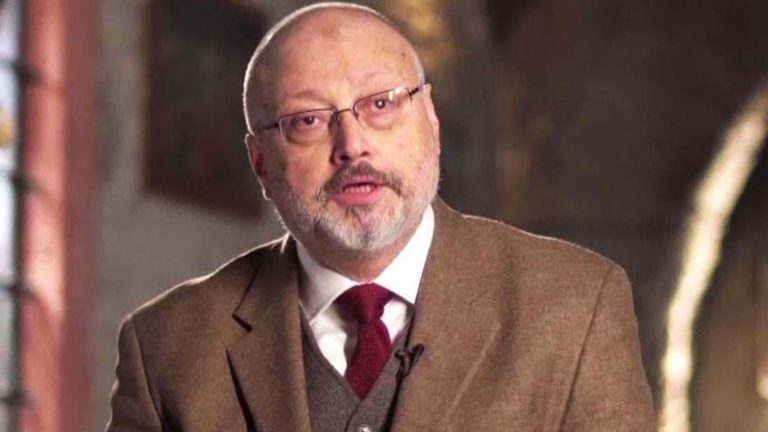
RECEP Tayyip Erdogan, the Turkish President, rejected Saudi Arabia’s explanation that the killing of Khashoggi was an accident resulting from a discussion that went awry, a narrative that had been pushed since September, saying it was a pre-planned and “ferocious” murder.
On Tuesday he began his speech in Turkey parliament by first condoling with the family of Khashoggi, his fiancee and the citizens of Saudi Arabia.
“Turkey is becoming the joint conscience of the international community,” he added.
“To try and hide such a ferocious murder is against the conscience of humanity,” Erdogan told the Turkish Parliament.
Erdogan said Saudi consulate cameras were removed before Khashoggi’s arrival. “We have very strong leads that this was not accidental, but that it was planned,” he said.
He further questioned the previous explanations that were given by the Saudi’s and their intentions.
“Why was the consulate not opened immediately?
“Why where the camera’s removed in Saudi consulate before the arrival of Khashoggi?
“Who was the local collaborator that has taken possession of the body?
“This matter will not be closed until all of these questions have been answered,” he said.
While Erdogan enumerated many of the details already reported in the case, he made no reference to the tape and held back from pointing the finger directly at Saudi Crown Prince Mohammed bin Salman.
“I am calling on the prince of Saudi Arabia and the highest level of administration. The incident has occurred in Istanbul so this team of 18 people should be tried in Istanbul,” Erdogan said.
Erdogan added that Saudi authorities gave Turkey a list of 18 suspects held in Saudi Arabia as part of the Kingdom’s probe into the killing of Khashoggi. The list included the 15 Saudi men identified by Turkish authorities, in addition to three more, he said.
Erdogan said he wants the 18 Saudi suspects held in Saudi in connection with the murder of Khashoggi to be tried in Istanbul.
“Turkey will pursue this matter to the end. Our own law and international law must be fulfilled, ” he said.
URBANISATION is spreading across Africa at great speed. Projections suggest that more than half of the total population will live in urban areas by 2050. Urbanisation in Nigeria is happening at a particularly astonishing rate. The population density of urban dwellers in Nigeria is growing at an annual rate of 50 per square kilometre and it’s expected to rise to 450.9 per square kilometre by 2050.
These urban dwellers include a large number of people over the age of 60. The number of old people on the continent is expected to rise to 67 million by 2025, up from an estimated 43 million in 2010. Nigeria will experience an exponential increase the number of older people.
These developments call for a new urbanisation agenda. A large number of old people in urban spaces in Nigeria suffer from homelessness, abuse, neglect and destitution. The situation is further compounded by the absence of social protection policies that can reduce vulnerability in old age.
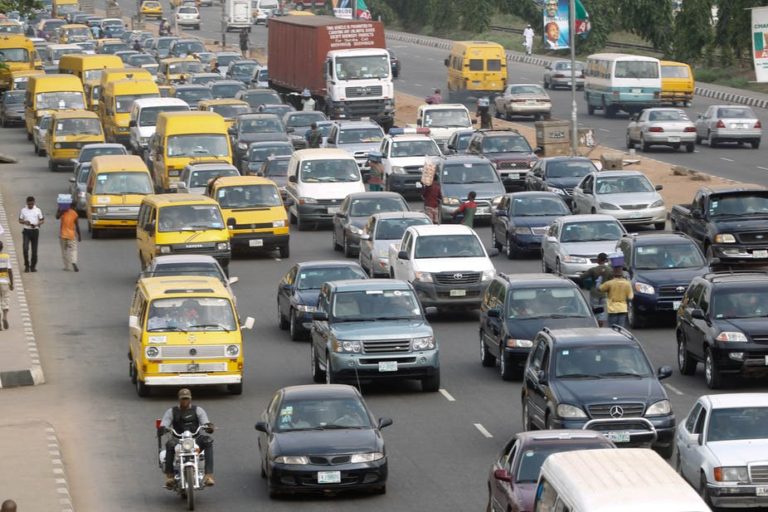
Old people in Nigeria’s cities can’t even rely on public transport. The urban renewal has led to the phasing out of the popular Molue buses while pedestrian bridges are built in a way that makes access challenging to physically challenged and older people with mobility problems. Access to safe public transportation system is one of the indicators of age-friendly cities and communities.
Among Nigeria’s 36 states, Lagos is leading in urban regeneration initiatives. Unfortunately, there are indications that older people and their needs are being marginalised. My research is motivated by the need to understand vulnerability and resilience in old age. The findings presented here focus on what it means to grow old in the city and how urban renewal initiatives might be shaping vulnerability in old age.
The study
Data was sought through individual interviews and media reports. All these sources have their focus on demolition of markets, shops and houses in Lagos State from 2012 to 2018. The City of Lagos has a history of demolitions of markets and neighbours that are predominantly inhabited by the less privileged. Older people are included among the victims of these demolitions. Those trading among them have lost their means of livelihood without the freedom to protest or any hope of compensation.
The report highlights the findings about mobility concerns, fears and experiences of using the public transportation system in Lagos.
Drawing from the experiences of 13 older people aged 60 to 78 years, the research found that the existing public transport system isn’t conducive to being used by older people.
The participants’ narratives and media reports portray the urban renewal efforts in the city as ageist and lopsided. While a great deal has been done to transform some crowded areas and commercial motor parks in the city, the changes made weren’t done in a way that helped old people. For example, pedestrian bridges had been built too high. There had also been a loss of means of livelihood and accommodation in the city.
All the interviewees had spent 29 years on average in the city. More men (8) than women had engaged in menial jobs to earn a living and have had to travel hours within traffic from one part of the city to another throughout their youthful life. The women were more into petty trading, and only one worked with one of the local government authorities before retirement.
All the interviewees had used public transport when they were younger until it became more difficult to move around the city. Even the Bus Rapid Transport (BRT) was described as mostly inaccessible. In the words of one of the interviewees:
I have been told that there are seats for older people in BRTs, but the drivers and commuters are often in a hurry that it becomes difficult for older people to catch up with them or even use the available seats.
Towards inclusive urban renewal
Urgent measures are required to avert or minimise the risks that come with using public mode of transportation in the city of Lagos. Existing public modes of transportation are in need of overhauling. Presently, the public mode of transport, pedestrian bridges and walkways are designed to reflect the needs of the young urban population. Walkways that will accommodate older people and their various mobility needs are urgently needed. Creating such pathways can enhance the safety of other social categories of commuters in the city.
More legislation and conscious efforts are required to protect the vulnerability of older people to abuse in public spaces. Buses can be provided for older people and those that are physically challenged.
The urban renewal initiatives must be inclusive and participatory. The demolition actions must be done in transparency and proper accountability. Inclusive urban regeneration framework is urgently required in addressing the existing gaps and the future mobility needs of the growing population of older people in the city. These efforts amongst others will place the City of Lagos on the march towards becoming one of the age-friendly cities in Nigeria and Africa.
THE Nigerian Medical Association (NMA), Abuja chapter, has expressed concern over Nigeria’s low rating in the global community and on the poor implementation of the Universal Health Coverage (UHC).
Ekpe Philip Uche, the Chairman of the chapter, said this on Monday at a press conference to mark NMA-Abuja’s physician week with the theme, “Universal Health Coverage: Leaving No One Behind”.
Uche said that the Sustainable Development Goals (SDGs) three and eight on UHC envisioned that by 2030, everybody could access health services they desire.
He added that the goal is to make quality health sufficient, effective and accessible with no financial constraints.
Uche said that the National Health Insurance Scheme (NHIS) still covers less than seven per cent of Nigerians till date.
“The NMA has thought it wise to bring to the attention of all, including the government of the day, partners and the public, the need for a multi-sectoral approach,” the chairman said.
This, he said, would be geared towards the institution of a political will for both investment and alternative funding to drive health reforms.
According to him, it is no news that government efforts to achieve universal health for Nigeria is below expectation, especially when compared with many other countries.
Phillip said that the major job for the NHIS was to provide basic health to Nigerians without impoverishing them irrespective of their socio-economic status.
He said while the formal sector had made significant progress, the informal sector which comprises over 80 per cent of the country’s population is not yet covered.
The UHC is included in the World Health Organisation constitution of 1948 which declares health as a fundamental human right.
According to the WHO, UHC means that all people and communities receive promotive, preventive, curative, rehabilitative and palliative health services they need without suffering financial hardship.
The United Nations member states, which include Nigeria have agreed to achieve the universal health coverage (UHC) by 2030 as part of the SDGs.
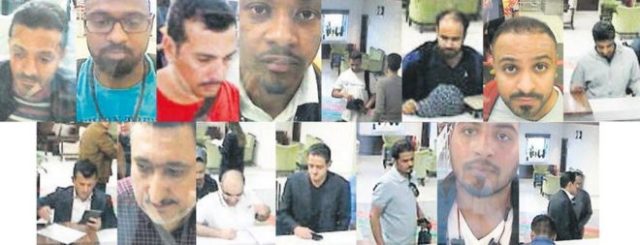
Turkish media have named 15 Saudi nationals whom Turkish officials suspect were involved in the disappearance of Jamal Khashoggi, a prominent Saudi journalist critical of the government who was last seen entering the Saudi consulate in the city of Istanbul on 2 October. The BBC reports.
Turkish officials believe the men are Saudi officials and intelligence officers, an allegation that appears to be supported by open source information that is freely available.
Saudi authorities deny any involvement in Khashoggi’s disappearance. They insist he left the consulate soon after getting the paperwork. Here are the men suspected to have murdered Khashoggi:
In 2014 the London-based Arabic newspaper Asharq al-Awsat said Dr Tubaigy was a lieutenant colonel working for the forensic science department of the interior ministry’s General Directorate of Public Security.
A man identified as the doctor can be heard recommending that other people join him in listening to music on headphones while he cuts up Mr Khashoggi’s body, according to the officials.
In an interview, accompanied by a photograph of him wearing a uniform, the doctor discussed a mobile laboratory that he had designed to allow pathologists to perform post-mortems in only seven minutes in order to quickly determine the cause of death of Muslims performing the Hajj pilgrimage.
Dr Tubaigy stayed at a Mövenpick Hotel Istanbul, 0.5km (0.3 miles) west of the Saudi consulate, and departed Istanbul airport on HZSK2 at 22:54 on 2 October. The jet returned to Riyadh via Dubai, landing late on 3 October.
A surveillance source confirmed to the BBC his identity as “an intelligence security operative”, having met him in 2011 and trained him in how to use offensive spyware technology on behalf of the Saudi state.
The spyware trainers nicknamed Mr Mutreb “dark face”, the source said, “because he looked always grumpy… he was very silent.
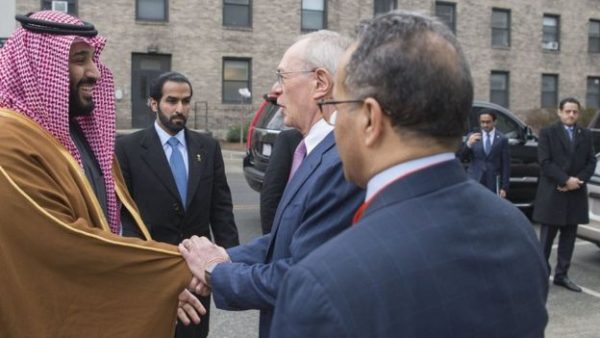
Photographs also show that he has travelled abroad with Saudi Crown Prince Mohammed bin Salman on at least three occasions since March 2018, suggesting he may have had a security role.
The Turkish pro-government newspaper Sabah also published pictures from CCTV footage that appeared to show Mr Mutreb entering the Saudi consulate in Istanbul at 09:55 on 2 October, just over three hours before the journalist arrived, and at the nearby consul-general’s residence at 16:53.
Turkish media said Mr Mutreb arrived in Istanbul on the private jet HZSK2 along with Dr Tubaigy, and also stayed at the Mövenpick hotel.
He flew out of Istanbul on another private jet owned by Sky Prime Aviation with the tail number HZSK1, at 18:40 on 2 October, according to Turkish media.
Abdulaziz Mohammed M Alhawsawi, 31
Photo credit: AFP
The New York Times cited a French “professional” who had worked with the Saudi royal family and identifying him as a member of the security team that travels with Crown Prince Mohammed bin Salman.
Someone with the same name is also listed on MenoM3ay as a member of the Saudi Royal Guard Regiment.
Mr Alhawsawi flew to Istanbul on a commercial flight, going through passport control at 01:43 on 2 October.
He stayed at the Wyndham Grand Istanbul Levant hotel, about 1km (0.6 miles) south of the Saudi consulate, and left Istanbul on HZSK2 with Dr Tubaigy.
A guard wearing a badge with that name also appears to have been photographed and filmed standing next to Crown Prince Mohammed bin Salman at an event in 2017, according to the activist Iyad el-Baghdadi.
Turkish media said Mr Alzahrani arrived in Istanbul on a commercial flight, and that he stayed at the Wyndham Grand and flew out on the private jet HZSK2.
He flew to Istanbul on a commercial flight and stayed at the Wyndham Grand. He went through passport control at Istanbul airport at 20:28 before departing.
Naif Hassan S Alarifi, 32
Photo credit: AFP
A Facebook account of a man with that name included photographs of someone in uniform bearing Saudi special forces insignia, according to Qutaibi Idlbi, a Saudi-born Syrian entrepreneur based in Washington who said he was an acquaintance of Mr Khashoggi
Mr Alarifi is also listed on MenoM3ay as an employee of the crown prince’s office.
He arrived in Istanbul on a commercial flight and went through passport control at 16:12. He stayed at the Wyndham Grand and departed on the private jet HZSK2.
Mr. Almadani arrived on HZSK2 and stayed at the Mövenpick. He went through passport control at Istanbul airport at 00:18 on 3 October before leaving on a commercial flight.
Mr. Albostani went through passport control at Istanbul airport at 01:45 on 2 October and stayed at the Wyndham Grand. He departed on the private jet HZSK2.
Mr Alotaibi flew into Istanbul on HZSK2 and stayed at the Mövenpick. He flew out on HZSK1.
Saif Saad Q Alqahtani, 45
Photo credit: AFP
A man with his name is identified on MenoM3ay as working in the service of Crown Prince Mohammed bin Salman, according to the Washington Post. Mr Alqahtani arrived in Istanbul on the private jet HZSK2 and stayed at the Mövenpick. He went through passport control at Istanbul airport at 00:20 on 3 October before leaving on a commercial flight.
Turki Muserref M Alsehri, 36
Photo credit: AFP
He arrived on HZSK2 and stayed at the Mövenpick. He left on HZSK1.
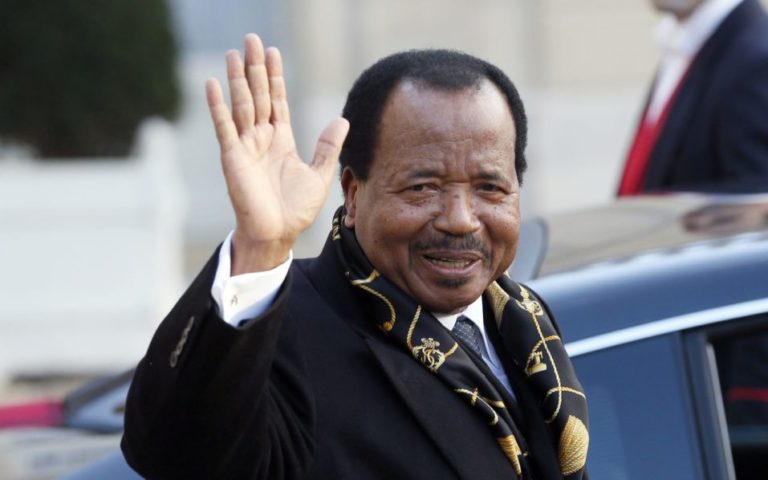
Cameroon’s President Paul Biya, Africa’s oldest leader, has won the election by a landslide to rule for another seven years, according to the official announcement made by Cameroon’s Constitutional Council.
At 85, Paul Biya is the oldest leader in sub-Saharan Africa. The win gives him another seven years in office and bolsters his place as one of Africa’s longest serving rulers after President Teodoro Obiang Nguema of Equatorial Guinea who is in his thirty-ninth year in office.
He won 71.3 per cent of the votes, but opposition candidates have said the election was marred by widespread fraud, a low turnout and violence.
Mr Biya’s closest rival, Maurice Kamto of the MRC/CRM, polled 14.2 per cent. Paul Biya took the majority of votes in all but one of Cameroon’s ten regions, losing out to Mr Kamto by a small margin in the Littoral region which is home to the economic capital, Douala.
Despite calls from opposition candidates for a re-run of the presidential election, the Constitutional Council dismissed 18 petitions claiming fraud last week.
Among those calling for a fresh vote were President Biya’s two main challengers – Mr Kamto and Joshua Osih of the main opposition SDF/FSD.
The announcement follows two weeks of tension in the coffee and oil-producing country where there has been a steady economic growth above 4 per cent since the last election, but most Cameroonians live in poverty.
Maurice Kamto proclaimed victory for himself on Oct. 8 based on his campaign’s figures without evidence to support his claims.
Kamto, who pronounced himself the winner of the vote before even the first results were announced – leading the government to brand him an outlaw – has alleged that six of the 11 members of the Constitutional Council were biased in Biya’s favour.
Threats of violence made against would-be voters by rebels in the Anglophone regions reportedly deterred many from voting. On Election Day, three separatists who were accused of opening fire on passers-by were shot dead by security forces. Some rebels also tried to disrupt the transporting of ballot boxes by calling for a total ban on all travel.
Cameroon’s electoral body Elecam also reduced the overall number of polling stations across the Anglophone North-West and South-West regions, and moved some others from turbulent zones to more secure areas.
Despite the unrest, and a desire among the youths for change, the opposition appeared unable to mount a credible challenge to Biya who, despite long absences abroad holidaying in Switzerland, has kept core support.
Election observers from the African Union (AU) reported that the election was peaceful but added that most parties were not represented when it came to who was allowed to oversee voting and ballot counts at polling stations
False claims were made on Cameroon’s state-owned television that Transparency International had deployed international observers but they issued a statement denying them.
Cameroon’s parliamentary and legislative elections were due to take place at the same time as the 7th October presidential elections, but have been postponed till 2019.
OMOYELE Sowore, the African Action Congress (ACC) presidential candidate has announced Rabiu Ahmed Rufai, a medical doctor as his running mate in the 2019 general election.
Malcom Fabiyi, the Sowore Campaign director-general, announced the appointment in a statement on Monday.
Rufai, who hails from Jigawa state and born on July 1976, is a fellow of the West African College of Physicians (FWACP) as well as a fellow of the Royal Society for Public Health (FRSPH).
Aside from practising medicine, he is an academic. The party vice-president candidate was the pioneer dean of the school of public health at the Federal University, Dutse from 2014 to 2015. He had served as an honorary consultant physician at the federal medical centre in Birnin Kudu between 2014 and 2015.
Sowore, while giving his remarks, said he could not think of anyone more qualified than Rufai as his running mate. The presidential candidate said Rufai would help reform the country’s health sector.
“Health is Wealth – and in our government, Dr Rufai will be responsible for ensuring that Nigerians have access to affordable and world-class healthcare and translating that to economic growth,” Sowore said.
He added that the health sector, which is part of their agenda, is a critical one which Rufai is most suitable to spearhead.
“In our bid to work on Nigeria’s multifaceted challenges and proffer solutions that will create a true giant out of our nation, we have always believed that health care, population health and health economics, ranks alongside national security and power, as critical areas that a serious government must address. I can think of no one more qualified than Dr Rufai to spearhead that aspect of our agenda.”
Rufai had a medical degree (MBBS) from Bayero University, Kano, and Masters in Public Health (MPH) from Leeds University United Kingdom.
His areas of expertise include Maternal and Child Health Services, Communicable Disease Prevention & Control, Health Systems Development for Primary Health Care, Health Management, Policy and Planning, Health Economics and Policy Research, Health System Development and Strengthening, Demography, Monitoring & Evaluation of Health Programs, Medical Statistics and Epidemiology.