Home Blog Page 2503

Drug abusers deserve a second chance from UNILAG

0

By Fisayo SOYOMBO

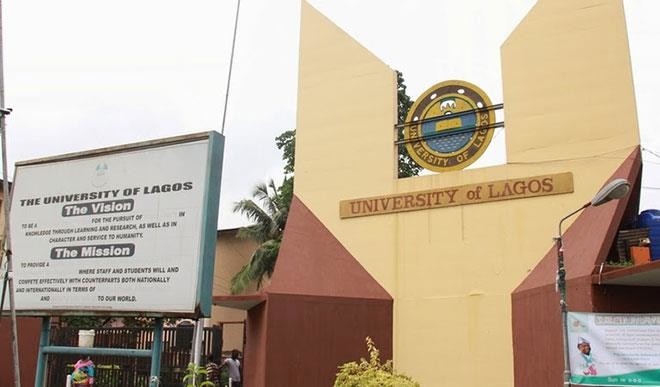
SUCCESS in the Unified Tertiary Matriculation Examination (UTME) and in the follow-up internal test of an institution are usually enough to qualify a candidate for admission into a Nigerian university. Not anymore, particularly if the University of Lagos (UNILAG) is the candidate’s first choice. As Mrs Taiwo Oloyede, Principal Assistant Registrar, Communication Unit, of the university announced days ago during an interaction with the News Agency of Nigeria, newly-admitted students will undergo a “compulsory” drug test from now on. If they pass, good luck. They fail, goodbye to admission.

“This test is compulsory and will be administered on new students before they are allowed to go ahead with registration,” Oloyede said. “Admission of any newly-admitted students who test positive for drug use shall be withdrawn. Our students must be seen to be good products not only of the institution, but also of the larger society.”

It is easy to see what UNILAG is trying to do. Fantastic conception but faulty execution. Tertiary institutions are easy breeding grounds for drug addiction; stamp drug abuse out of campuses and the society would have been done a huge favour. However, by Oloyede’s words, this drug screening will be a post-admission hurdle: it’s not like the identified drug addicts would be denied admission from scratch; instead, they would first have secured the admission, and then they would lose it. True, this method bars the guilty candidates from entering UNILAG, but what happens to them from then on? No one should expect that they end up in a rehab, or in the church or mosque; to lose their admission this way means they sink even deeper into drugs. It’s a scenario that sees UNILAG solve one problem for itself but simultaneously create two more for the society.

Withdrawing the admission of drug-positive fresh students won’t help UNILAG realise its ambition of ensuring that its students are “good products of the larger society”. To think it would, in the first place, gives UNILAG out as guilty of a defect common to the academia: the thinking that ‘citadels of learning’ are a society on their own, different in class, standard and expectations from the ‘larger society’. This societal superiority that the academia likes to claim is, in the moment, far from reach; it is difficult, but not impossible, to achieve. To happen, the institutions must truly be able to operate on their own, entirely devoid of human-capital support at least from the larger society. It means, for instance, that a university’s Faculty of Engineering can produce cars, and its graduates can repair them; it means lecturers can get their cars repaired on campus rather than embarking on a trip to the roadside mechanic several kilometres in ‘town’. It means its Faculty of Agriculture can cultivate crops, harvest them, process them and get them consumed — all on the farm. Until then, students whose admissions are withdrawn end up returning to the same “larger society” that UNILAG is an integral and continuous part of. Long and short, UNILAG hasn’t done anything to aid the cause of this ‘larger society’.

The threat of drug abuse to societal well-being is real, but it is important to understand that most drug abusers are not hardened criminals. They are more like prisoners — emotional/psychological prisoners of addiction. What they need is love, not force; rehabilitation, not rejection. In any case, any drug abuser who is brilliant enough to pass the UTME as well as UNILAG’s post-UTME test should not be discarded as entirely useless. If UNILAG truly desires to help itself and the society in one fell swoop, there are a number things it could do.

One is to take advantage of its internal intellectual capacity in availing the students of help. Its Department of Psychology exists for a purpose, and if that doesn’t include making psychological help available to needy students, such as those hooked on drugs, then the department is in dire need of some rejigging.

Another is to admit such students on condition, something similar to the ‘promoted on trial/condition’ we’re more accustomed to seeing in primary and secondary schools. Students found to be hooked on drugs can be admitted on, say, a two-year condition that they enroll at a rehab centre and produce periodic reports from the centre. Those whose reports prove progress with drug reliance retain their admission after two years, while those without remarkable progress forfeit it. A few students will still end up in the latter group, no doubt, but even they would recognize they were at least given a chance to fight for their educational survival. The real gain lies with those who would have won their battle against drug dependence in those two years.

But everyone deserves a chance to fight. To send drug abusers away from their dream university at the first time of asking is cruel and in consonance with the Nigerian mentality of judging a book by its cover. There are a few brilliant, morally-upright youth out there who missed their way at some point in their lives; if we can’t help them — or at least give them a chance to help themselves —  then we must not crush them. What is guaranteed is that the success rate for rehabilitation of these admission seekers will be high, given that all of them are young and therefore still impressionable.

If we’re looking for drug addicts to kick out of certain sections of our society, focus should be on politics. Too many Nigerian politicians are hooked on drugs. Some of them we don’t know because they’ve mastered the art of covering their tracks; others we already know because no sane human utters the kind of words that come out of their mouths. I won’t mention these names but I won’t stop readers who choose to do so in the comment section. These are the real people we should be kicking out; but the students, what they really need is an arm around their neck.

Soyombo, former Editor of the TheCable and the International Centre for Investigative Reporting (ICIR), tweets @fisayosoyombo.

Kwara govt. foot-dragging in prosecuting Offa robbery suspects, says Police

THE spokesman of the Nigeria Police Force, Jimoh Moshood, says investigations have been concluded into the robbery incident that took place in Offa, Kwara State, but the state government is reluctant to charge the suspects to court.

Moshood said this on Monday in reaction to allegations by a member of the Kwara State House of Assembly, Abdulrafiu Abdulrahman, that the police have been compromised in the Offa investigation.

The Kwara State police command had arrested suspected ritual killers who allegedly confessed to having sold about 31 human heads and body parts to several prominent politicians in the state and beyond. But Abdulrahman, who is Chairman of House Committee on Information, alleged that there was a plot by the police to force the suspected human parts dealers to implicate prominent political and religious leaders in the State.

But Moshood responded by saying that the police have long concluded the investigation into the Offa robbery and had handed the case file to the Kwara State Attorney-General since August.

“Investigation into the matter has been concluded by the police and the case file sent to Attorney General of the Federation who directed that the case file be sent to the Kwara State Attorney General for prosecution which the police has complied with since August 2018,” Moshood said.

“The Force has been waiting for the Kwara State Attorney General to take over the suspects from the police for prosecution.”

Moshood denied allegations that the arrested suspects were being forced to implicate come highly placed individuals in the state.

He said investigations into the alleged human parts buying and selling were still ongoing, “any individual or group found to be connected with this heinous crime will be arrested and prosecuted”.

“The Force has no plan to implicate any personality in the matter and there is no any cause for any innocent person(s) to be afraid of the law. The Force will not allow itself to be cowed, or obstructed from ensuring that the dictate of the law prevails in all matters,” Moshood said.

Recall that a similar scenario played out when the news broke that some suspected armed robbers that took part in the Offa robbery had been arrested.

Senate President, Bukola Saraki, told newsmen at the time that he had intelligent reports that the suspects were being forced by the police to implicate him by saying that they were his boys, and that was exactly what happened days later when the suspects were being paraded by the police.

The suspects said they were thugs that worked for Saraki and the Governor of Kwara State, Abdulfatah Ahmed. They further said that they were usually deployed during election periods to disrupt the process at polling units where their principals were losing.

EFCC arraigns Fayose in Lagos court

THE Economic and Financial Crimes Commission (EFCC) has arraigned the former Governor of Ekiti State, Ayodele Fayose, before the Federal High Court, Lagos, on charges of corruption and abuse of office.

Fayose, who had reported to the EFCC Headquarters in Abuja on October 16, a day after former Minister of Solid Minerals Development, Kayode Fayemi, was sworn in as the new Governor of Ekiti State.

He has remained in custody since then and was transferred to the Lagos office of the EFCC on Sunday ahead of his arraignment in court on Monday.

Fayose pleaded not guilty to the charges against him.

More details later…

Razak Atunwa, Kwara PDP governorship candidate in certificate forgery scandal

FORMER Speaker of the Kwara State House of Assembly and the current governorship candidate of the Peoples Democratic Party in the state, Razak Atunwa, did not take part in the one-year mandatory National Youth Service scheme.

Atunwa, however, submitted a forged NYSC certificate to the PDP screening committee as part of his qualification to be eligible to run for governorship post in Kwara State, according to Premium Times.

This is coming after two top ministers were exposed as having not taken part in the NYSC, without which anyone who graduated before the age of 30 can be employed by either the public or private sector in Nigeria.

Atunwa is the preferred candidate of the Senate Bukola Saraki, who is seen as his political godfather.

Kemi Adeosun, former Minister of Finance, resigned her position and fled the country after she was found to have falsified her NYSC certificate, while Adebayo Shittu, the Minister of Communications, insisted that he did not need to take part in the one-year service because he had been elected into the Oyo state legislative House immediately after graduation.

According to the Premium Times report, the certificate which Atunwa submitted to the PDP indicates that he served between 1995 and 1996, and the certificate was purportedly signed by Walter Oki, the supposed Brigadier General in charge of the NYSC at the time.

However, Oki only became the Director-General of NYSC in 2002, a whopping six years difference from the time that Atunwa claimed he signed his certificate. The NYSC DG in 1996 was Soyemi Sofoluwe, also a Brigadier General. He was succeeded by S.M. Dule who served as head of the NYSC between 1996 and 2000.


READ ALSO:

Also according to the report, there were noticeable discrepancies between the certificate allegedly submitted by Atunwa and the certificates awarded by the NYSC to Nigerians who had studied abroad but returned home to observe the mandatory national service.

A copy of a page of the PDP nomination form that was filled by Atunwa.

For instance, while the NYSC certificate for persons that studied abroad bore the acronym FORN or FRN (indicating that the bearer attended a ‘foreign’ university), Atunwa’s forged certificate had the acronym KWP – a code for graduates of the Kwara State Polytechnic – even though he claimed to have graduated from the University of East London, with a degree in Law, aged 23.

When he was contacted, Atunwa maintained that he did not forge any document neither did he present any forged document to anybody.

“I did not submit any unsupported NYSC certificate as suggested by you. I strongly advise that you verify each and every assertion you wish to make. You may wish to make formal enquiries/verifications of all institutions concerned,” Atunwa was reported as having said.

The spokesman of the PDP, Kola Ologbondiyan, said he would investigate the allegation and get back to the reporter, but he was yet to do so before publication.

If the allegations against Atunwa proves correct, it could disqualify him from contesting the election. A clause in the PDP governorship nomination form states that a candidate will be automatically disqualified if it is found that any or all of the information he provided was false.

Read the full story here.

Ruckus as suspended NHIS boss arrives office on Monday

USMAN Yusuf, the suspended National Health Insurance Scheme (NHIS) Executive Secretary has resumed to the office on Monday, causing a ruckus at the Scheme’s head office at Utako, Abuja.

NHIS Workers at the office were protesting at the entrance of the building, as Yusuf was escorted by fully armed Nigeria police officers who fired tear gas at workers.

The NHIS workers had locked the entrance gate as early as 7 am. When Yusuf arrived around 8:30 am, the workers tried to stop him, but they were overpowered by the security personnel who followed him.

The NHIS boss was suspended indefinitely by the Governing Council on October 18 over allegations of corruption and sundry offences.

However, Yusuf ignored the resolution and resumed office on Monday.

He had argued that his suspension was illegal and the council has no legislative power to suspend him.

A memo he sent to Enyenatu Ifenna, Chairperson of the Council, stated that only President Muhammadu Buhari has the power to suspend the executive secretary.

“As you are aware, by virtue of Section 8 of the NHIS Act, my appointment, like yours, is at the instance of the President, while the Council’s power of appointment is limited to directors and other employees of the scheme,” the memo read.

At a press conference last week, Ifenna had accused the secretary of allegedly inflating the 2018 budget, “fraudulently inflating the cost of biometric capturing machines,” and “attempt to illegally execute N30 billion in federal government bonds”.

The Council also alleged that Yusuf carried out unauthorised staff travel “in defiance to council directive” among other offences

Yusuf had earlier been suspended in July 2017  by Professor Isaac Adewole, the Minister of Health, but was reinstated in February following the intervention of the House of Representatives.

Kaduna government imposes 24-hour curfew as violence persists

GOVERNOR Nasir El-Rufai has imposed a 24-hour curfew on Kaduna town as violence in several parts of the capital city persists on Sunday.

“This is a notice of a 24-hour curfew imposed on Kaduna town and environs, with immediate effect. Residents are advised to comply by this directive. The decision has been taken in the best interest of the state,” El-Rufai stated.

Violence broke out in the Kasuwar Magani area of Kaduna state on Friday, and according to the police, 55 people were killed. A 24-hour curfew was imposed in the area on Saturday as security operatives tried to get the situation under control.

But on Sunday, rumours of reprisal attacks began spreading around the town, leading to another round of violence. Residents ran indoors and locked themselves in for fear of being hurt.

President Muhammadu Buhari condemned the development on Sunday, adding that a special squad of security operatives had been deployed to ensure that the situation was brought under control.

“The violence in Kaduna, which has resulted in the deaths of 55 innocent people, is condemnable. The Police have been authorized to do everything possible to restore calm. A Special Intervention Force has been deployed to the flash-points, and the IG will provide regular updates,” the President tweeted.

“The disregard for the sanctity of human life is unacceptable. Violence is an ill-wind that blows nobody any good. I appeal to community leaders and citizens to always choose dialogue, patience and tolerance, to prevent crises from escalating into violence.

“…The Federal Government and its law enforcement agencies will work with the State Government and community leaders to ensure the full restoration of peace and security.”

Minimum wage: Labour says another round of strike underway, if FG fails to act


THE Organised Labour that includes the Nigeria Labour Congress (NLC), Trade Union Congress (TUC) and United Labour Congress (ULC) says it would be left with no option than to call its members across the country to once again commence an indefinite strike if the Federal Government failed to act responsibly on its demand for new Minimum Wage for workers.

“If nothing is responsibly done by the federal government to meet our demands, on Monday, the 6th day of November, we shall embark on a nation-wide strike to compel this government to show more sensitivity to the plight of Nigerians and the suffering that is decimating our people on daily basis,” the labour bodies threatened on Sunday in joint press release signed by the NLC President, Ayuba Wabba,  TUC President, Bobboi Kaigama and ULC President, Joe Ajaero.

The Minister of Labour and Employment, Chris Ngige  had denied  reports that the Federal Government had agreed to pay N30,000 as the new minimum wage to workers, insisting the government can actually pay N24,000.

But the labour said there was no time during the tripartite negotiations that it proposed N30,000 to the government as the Minimum wage, rather, it noted that the N30,000 was accepted as a compromise to demonstrate its willingness to make sacrifices towards nation building.

“It is not true that we proposed N30,000 as the new national minimum wage. It is also not true that the committee did not agree on a figure during its last sitting,” the labour said

“We accepted N30,000 as a compromise to demonstrate the willingness of Nigerian workers to make sacrifices towards nation building. Anything to the contrary no matter the quantum and character of the din or how well couched it may appear cannot be true.”

Responding to statements by the Nigerian Governors’  Forum that the state governments were not comfortable with the negotiations for the new Minimum wage, the Organised Labour said: ” it would consider any Governor saying that he is unable to pay as unpatriotic and, an enemy of Nigerian workers and masses.”

“We shall vote them out in 2019,” it added

The three bodies noted that, they have not seen any sign that “this government is willing to demonstrate honour and integrity in relating with Nigerian workers and masses,”  have resolved to organise a day of National Outrage and mourning  that would be used to sensitize Nigerians on “our plight and on the issues at stake.”

This, they said would take place in all states of the federation including Abuja on Tuesday, the 30th day of October 2018, in addition to a meeting of various organs of the unions that would also hold as appropriate.

On Friday, November 2, 2018, the unions revealed that a Joint Central Working Committee (CWC) meeting of all the Labour Centres in Nigeria would hold to receive reports and make final preparations for their ultimate engagement with the federal government on the matter.

George Ayo Osho: An officer and a gentleman

0

By Simon KOLAWOLE

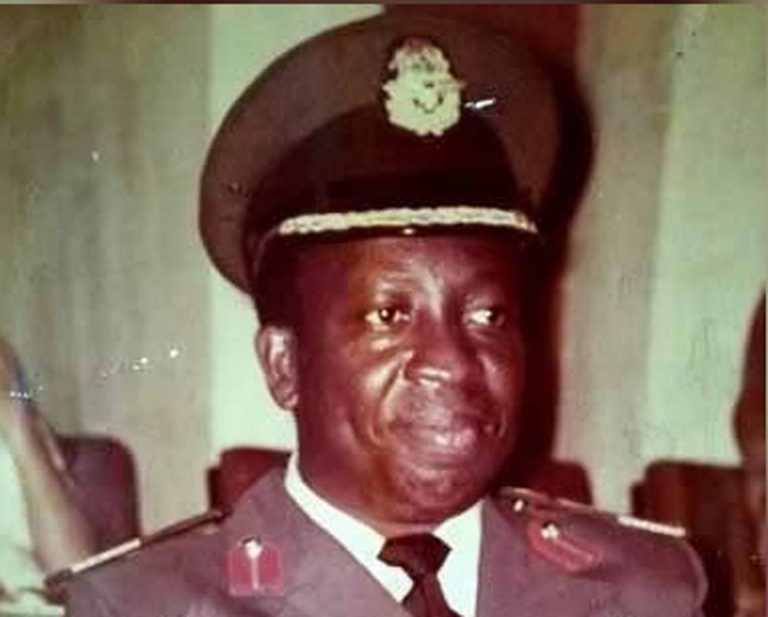
WITH gratitude to God for a life well spent — and I mean every word of it — I mourn the passing of Air Vice Marshall George Ayo Osho (rtd), one of Nigeria’s first two presidential pilots, the first Nigerian Air Force (NAF) pilot to clock 6,000 flying hours, former acting governor of Lagos state — and definitely one of the best human beings that ever lived. Since creation, God has made billions of souls, but AVM Osho must be in the league of the most caring, the most humble, the most contented and the most selfless of them all. If it was possible for any mortal to be perfect, he would be my top nominee.

On October 13, 2018, he drew his last breath, aged 78. I never heard anyone say one bad word about him when he was alive. I once mentioned him to Gen. Abdulsalami Abubakar, former head of state, and he said only two words: “Perfect gentleman!” Gen. Abubakar should know — in 1963, he started his career in the air force, where he first met Osho, before moving to the army in 1966. Again, I proudly mentioned him to President Muhammadu Buhari years ago, and he too said only two words: “Perfect gentleman!” Gen. Buhari should know too — Osho flew him at the onset of the Civil War when Buhari was based in Makurdi, today’s Benue state.

Osho served Nigeria with “heart and might”. He was operations officer and commander of NAF detachments in Makurdi, Enugu and Benin in the late 1960s. He was one of the key initiators of most of the post-Civil War policies of the air force with special reference to operations, training policies, force projection and NAF 2 establishments. He was the first NAF officer to attend the prestigious Defence Services Staff College in Wellington, India. He was “faithful, loyal and honest” — he was one officer known in military and civil service circles for returning his unspent estacode to the treasury whenever he came back from foreign trips.

He told me a lot of interesting stories about his service to fatherland and I must take the blame for not encouraging him to write a book. I was just sitting there, soaking in the compelling stories and never thinking I could have encouraged him to record history in his own words. By the time it crossed my mind, he had started battling old-age medical issues. Writing a book, or even sitting down for gruelling interviews for the purpose of writing a book, was no longer an option. He was such a self-effacing human being that it would even have been difficult to get him to talk on his service to the nation, much less his role in the development of the air force.

He once narrated to me his experience of the December 31, 1983 coup that ousted President Shehu Shagari. “I followed Gen. Buhari to NTA for his inaugural address to the nation after he was named head of state,” he said, joking that even though he was not involved in the planning of the coup (which was usually an army business), he could have been imprisoned or executed if it had failed. He said Justice George Sodeinde Sowemimo, then the chief justice of the federation, politely declined to swear in Buhari. Sowemimo said he was not authorised to swear in a military head of state and asked Buhari to simply raise his right hand, recite the oaths of office and that would be it!

My paternal grandfather was on his deathbed when the coup broadcast was made by a certain Brigadier Sani Abacha in the wee hours of December 31. When we told him of the coup, he said he had a feeling “Baba Tolu” (AVM Osho) would be given an appointment. My grandfather later died close to midnight same day, but Osho — who had been promoted to AVM that year — was not given an appointment. It was not until last year that he told me the full story. He was nominated to be chief of air staff by Brigadier Tunde Idiagbon, but Gen. Buhari said he had already promised the late AVM Ibrahim Alfa the position. He was instead appointed air officer operations (AOO).

He was AOO till 1989 when he retired. No other officer occupied the position for five years before or after him. He served as acting governor of Lagos in 1977 when Navy Captain Samsudeen Adekunle Lawal, the governor, fell ill. He handed over to Navy Commander Godwin Ndubisi Kanu (who retired as a Rear Admiral in 1993) when Kanu was made the substantive governor. For all his service to Nigeria, AVM Osho did not receive any national honour. He was nominated for the honour in 1999 by Gen. Abubakar’s government but all nominations were later nullified by President Olusegun Obasanjo, having not been officially conferred.

The most amazing aspect of AVM Osho’s life was his Christian service. He was love in motion. For as long as I can remember, he regularly went to Kirikiri prisons to minister to inmates, both spiritually and materially, on Wednesdays until his health could no longer handle it. When I visited him about five years ago, one young chap I had never met opened the gate for me. I later asked AVM Osho who the boy was, and he told him he was an ex-Kirikiri inmate. His parents had disowned him after he had served his prison term, and AVM Osho decided to adopt him. I marvelled. He practised the Christianity that he preached. ‘I was homeless and you took me in. I was naked and you clothed me…’

In him, I saw my inadequacies and failings as a human being and as a Christian. His mind was stubbornly fixed on eternity. It was all about what he could give than what he could get. I lived with him for seven years, between 1994 and 2001, and not once did I hear him make a personal prayer request during the nightly family altar. While the rest of us would be praying for new jobs and new businesses and other things “modern” Christians like me are primed to ask for, he had a different kind of prayer request. He would say: “Let us remember the widows in our prayers. Let us pray for those in prison and those who are in the hospital.”

He regularly led the Yoruba service at the Shepherdhill Baptist Church, Obanikoro, Lagos, until his health began to fail. But that is not the story. Anytime his one and only car began to throw tantrums at the crucial hour — such as refusing to start as tired cars are wont to do — he would simply walk to the road side, take a cab to Ojota and take a bus to Obanikoro to go and tell his congregation that Jesus loves them. This is old time religion. A “whole” AVM — the equivalent of a major general in the army — going by public transport to church, in a country where to be a general is a licence to be a billionaire! He never pitied himself. He was always at peace with himself. He never felt entitled.

He was contented. I was told Abacha offered him a ministerial appointment in 1995 but he turned it down. He had a land allocation in Abuja which papers he struggled for years to perfect. When he told me of his predicament in 2002, I wrote a passionate note to the then FCT minister, Engr. Mohammed Abba Gana, appealing that he should help issue the certificate of occupancy (C of O). I said, rather emotionally, that it was the only favour I would ever ask from him in my life. Engr Abba Gana, another compassionate Nigerian I was privileged to know, promptly obliged. I am normally very reluctant to ask for favours, but I would do anything for AVM Osho.

I was over the moon when he showed me the C of O. I was feeling like, “Finally, I did something for this great man!” I did not hear anything about the land again. A few years after, I asked him if he had started development or sold it, and he said, with a lot of pains on his face, that Mallam Nasir el-Rufai, who succeeded Abba Gana as FCT minister in 2003, had revoked the allocation. He sounded broken-hearted. I said I was going to raise the issue with el-Rufai, whom I barely knew at the time, but he said I should not worry, that the stress was too much for him. He was no longer interested in the allocation. He never owned a plot of land in FCT till he died.

AVM Osho took me on my first flying experience in 1983. I was a tiny secondary school boy holidaying in Lagos. Vice-President Alex Ekwueme had travelled to Enugu state on an official visit. AVM Osho flew Hercules C-130 to Enugu to bring Ekwueme’s official vehicles — two green-coloured Mercedes-Benz cars, as I recall — back to Lagos. I sat behind him in the cockpit having the experience of my life. As we were about to fly over River Niger, he beckoned on me. He “tilted” the aircraft a little to the side and said: “This is the River Niger.” My classmates in the village had to know I flew in an aeroplane! I was no longer their mate.

AVM Osho made such an impact on my life. I saw humility and compassion, godliness and contentment. If I could possess half of his virtues in this life, I would be a fulfilled man. He took me like a son. I started calling him “Daddy” from when I was five (I lost my father at 4). He acted as my father on my wedding day. Actually, he was married to my aunt. But he loved us so much and we so much loved him that you would think we were biologically related to him. An uncle of mine, writing under “appreciation” in his undergraduate dissertation, thanked AVM Osho profusely for his love and care. He wrote: “What else could a father have done?”

AND FOUR OTHER THINGS…

Sani vs Sani

I once said APC is the most disorganised ruling party in Nigeria’s history. I now wish to withdraw that statement. They are worse than that. Their conduct of the 2019 primaries made PDP look like a gathering of angles. The most dramatic must be the Kaduna central district, which Senator Shehu Sani currently represents. Mallam Uba Sani, his challenger, was mysteriously screened out by the party. Senator Sani was to be returned unopposed. The primary still went ahead and Uba Sani won. Shehu Sani appealed and it was upheld, but Uba Sani has finally won the tug-of-war. The senator has now quit the party in anger. Over all, APC is nothing but a house of commotion. Pathetic.

Kanu is back

After disappearing for over one year, Nnamdi Kanu, the supreme leader of Indigenous people of Biafra (IPOB), is back in the limelight. In the photos and videos shared online by Radio Biafra, the IPOB leader was seen observing some religious rites in Jerusalem. There are more questions than answers. Are the images recent? Would it not be a dangerous gambit for him to travel to Israel at a time he has been declared wanted in Nigeria? Are old videos being presented as fresh to create the impression that he has the support of Israel? The comforting thing for me, though, is that: going by new revelations, he has not been killed as alleged by IPOB. That settles the puzzle. Finally.

Adios, Ambode

So Mr. Akinwunmi Ambode will not be a candidate in the 2019 governorship election? Wow. This would be the first time a governor of Lagos state would not be seeking re-election. It was not as if he didn’t try, just that his political weight was lighter than he thought. One big lesson I am picking from this is that if you want to take on your godfather, you must have enough bullets in your pouch. If I were Ambode, I would spend the remaining seven months in office working like mad. I would make sure there is no single pothole on any Lagos road, improve access to quality healthcare and upgrade education infrastructure all over the state. It is not how long but how well. Legacy.

And finally…

You must have seen the videos in which Dr. Abdullahi Ganduje, the governor of Kano state, appeared to be collecting bundles of dollars from unseen persons. The allegation is that he collected millions of dollars in kickbacks from contractors. The governor has denied the allegation, and one of his aides has comically described the videos as a “clone” (what is “clone”, fellow Nigerians?) The governor himself said his blood pressure has been normal despite the scandal. To be honest, except you are genetically prone to hypertension, collecting that volume of greenbacks is very good for your blood pressure. My blood pressure would be normal too. LOL.

Simon Kolawole is the founder and CEO of TheCable. He tweets @simonkolawole.

FACT CHECK: Did Fayose leave N170b or N120b debt profile in Ekiti?

ACCUSATIONS of debts profile in Ekiti State have become a vicious cycle between the incumbent governor, Kayode Fayemi and his predecessor, Ayodele Fayose.

They both have released many figures−huge and contradicting debt profiles that have left the public confused in their determined efforts to run down and malign each other. This has been since 2014 when Kayode Fayemi lost to Ayodele Fayose in a hotly contested election.

When  Fayose took over from Fayemi in October 2014; he accused the later of plunging the state into debts that outlived his administration.

Then, Fayose alleged that his predecessor left a debt profile of N45 billion and later came up with another figure of N86 billion which he said the state would only be able to exit in 22 years− 2036.

Now, the tide has turned and new debt profile has been released by the new government− it is both outrageous and controversial.

Claims and counter-claims

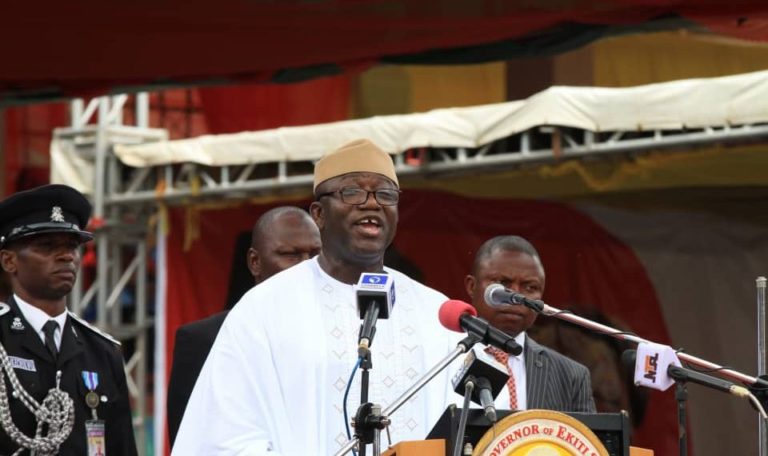
On Tuesday, October 16, 2018 when he was reading his inaugural speech at his swearing-in ceremony, Governor Kayode Fayemi said available evidences suggested that the state has been plunged into debts that amount to N170billion.

He vowed to probe his predecessor’s finances to ensure that the culture of prudence and financial propriety were brought to bear in the governance of the state.

“We will ensure that within 100 days from today, Ekiti Kete will know the true position of things,” Fayemi said, alleging that the loans that accrued to the N170billion debt was expended on white elephant projects.

He would later reverse himself that the debt profile was indeed N120billion and not N170billion as earlier claimed.

The newly appointed Chief Press Secretary to the governor, Olayinka Oyebode,  in a statement revealed that the state’s indebtedness is now N120 billion.

According to a copy of the debt profile Oyebode made available to The ICIR, which he said the government of Fayose prepared and sent to the DMO, the debt profile was N120billion as of June 2018.

He stressed that the figures could have also increased from June when it was prepared and submitted to the DMO.

“The document was sent prepared by the immediate past administration in June this year, so the indebtedness could have increased between June and now,” he said.

“The truth about the actual financial records of Ekiti State is now in the open going by the debt figures voluntarily submitted to statutory regulators, the Debt Management Office by the outgoing government of Governor Peter Ayodele Fayose in Ekiti State,” he said.

“Contrary to repeated claims by the Fayose Administration that Fayemi plunged the state into a debt burden that will not be paid off till 2036, it is now clear than the bond taken by the Fayemi administration is almost completely paid off with the first tranche of N20bn to be completed in October 2018 and the second tranche of N5bn bond due for payment in 2020.

 “The report revealed that the domestic debt of Ekiti State leapfrogged by N3bn within the last three months from N117bn to N120bn between March and June 2018 making Ekiti state debt to quadruple since Fayose assumed office as the Governor in Ekiti State from N31bn in 2014 to N120billion.

 “In a document forwarded to the DMO Office by the outgoing government, the components of the N120bn debt by the Fayose administration as at 31st June, 2018 include: Commercial Bank Loans of N2,087,788,065.28 received from Wema Bank in 2016, balance of N18,226,699,707.18 received from the FGN bond by his government in 2015, Budget Support Facility of N16,869,000,000.00 received in 2016 and 2017, Salary bail-out of N9,083,761,215.40 received in 2015, Commercial Bank Loan against funds due to Ekiti State in the FGN Excess Crude Account of N9,545,173,472.78 received by the current government in 2016, Contractors Arrears of N2,087,788,065.8, Pension and Gratuity Arrears of N22,162,602,017.49, Salaries arrears and other staff claims of N8,373651,226.50 and Judgment Debt of N95,048,963.35.

“The report also comprised the commercial agric loan of N163, 450,000.00 and N3, 484,469,345.51 outstanding balance of the Bond taken by the Fayemi administration.

But the immediate former governor refuted the N170billion debt profile claim by Fayemi arguing that the state’s debt profile left by him was not more than N60 billion. This rebuttal also negates the claim of the N120billion and the possibility of any veracity in the document sighted by the new government at the DMO.

Fayose who is currently in the custody of the Economic and Financial Crimes Commission (EFCC) for interrogation over allegation of fraud, responded through his media aide, Lere Olayinka, that the debt was either directly incurred during Fayemi’s first tenure or as a result of the loans restructuring done at the instance of the federal government and the Federal Economic Council.

He gave the breakdown as follows: Commercial Bank Loan, N2,087,788,065.28; CBN Grant for Water Project, N163,450,000; Excess Crude Account Backed Loan, N9,545,173,472.78; Bailout, N9,083,761,215.40; FGN Bonds, N18,226,699,707.18; State Bonds, N3,484,469,345.51 and Budget Support, N16,869,000,000.

On December 17, 2017, Daily Post, an online newspaper reported that the Debt Management Office (DMO) release a bulletin that showed that Fayose borrowed a total of N56billion since October 2014 when he came to power and December 2016.

The newspaper gave the breakdown, as follows, quoting the DMO bulletin which it claimed was available on the agency’s website.

“For 2015 Ekiti State borrowed loans include new loans of N24, 811, 574, 926.00; foreign loans stood at N2,709,786,898.98 while local bank loans was N22,101,788,065.28.

“In 2016, the summary of new loans was N31, 688, 638, 962.30 with foreign loans standing at N2, 705, 737, 050. 37 while local bank loans rose to N28, 982, 901, 911.93.

“The summary of total loans in two years, that is, between January 2015 and December 2016 is N56, 500, 213, 924.56.

“The summary of foreign loans is N5, 415, 523, 947.35 while summary of total bank loans incurred by the Fayose administration is N51, 084, 689, 977.21.”

It added that the figures excluded another N25billion applied for which was waiting approval.

The bulletin and the figures could not be traced by The ICIR on the DMO website.

The paper also claimed that Fayemi left a debt profile of N18billion in October 2014, but there was no record of the state’s debt profile as of that October 2014 on the website of DMO.

In a swift reaction, Fayose denied that the state under him in three years borrowed N56 billion.

“The only fresh loan taken by the government of Fayose was the N10 billion grant from the Excess Crude Account, which was released to all states for capital projects, N2.8 billion requested from Wema Bank to pay State Universal Basic Education Board (SUBEB) counterpart fund out of which N1 billion has been accessed and N600 million for MDGs counterpart fund, which has been repaid,” he said in a statement issued by Lere Olayinka.

Fayose accused Fayemi of orchestrating the report that was attributed to the DMO, but insisted that he inherited N86billion debt when he came to power in October 2014.  This claim was also not available on DMO’s website.

But DMO figures show that Ekiti was only indebted to the tune of N38billion −both domestic and foreign debts as of December 2014, two months after the exit of Fayemi as the state governor.

Actual figures from Debt Management Office

Despite all these discrepancies in figures being churned out by the two parties to the public domain, figures of Ekiti State Debt profile contained on the official website of the Debt Management Office (DMO) may have laid the controversy to rest.

Ekiti state debt profile between December 2014 and June 2018

As of December 2014, two months after Fayose took over from Fayemi as the Governor of the state, Ekiti State domestic debt profile stood at N30.5billion while its foreign debt was $46.5million. This amounted to N38billion when the foreign debt was converted to naira at the exchange rate of N168 per dollar.

Therefore, the debt profile of Ekiti State, both local and foreign when Fayose took over from his predecessor in 2014 was N38.26billion and neither N45 billion nor N86 billion that he said the state would exit in 2036. It was also not N18billion claimed by the Daily Post.

It must be noted that debt profile of each state on DMO website was calculated as of December of each year except for 2018 that has not ended and which the agency has released the figure up till June.

Therefore, in 2015, Ekiti State domestic debt profile was N52.6billion while the foreign debt was $55million. It was N85billion in 2016 while the foreign debt stood at $56.9million, while in 2017; the figure was N117.5billion and $78.1million respectively for both domestic and foreign debt. And as of June 2018, the figure released by the DMO as domestic debt of Ekiti was N117.7billion while the foreign debt was $98million.

The DMO, on its website, did not provide details of how these debts were incurred.

The state’s debt profile as of June 2018

Figures released by the DMO as of June 2018 as debt profile of Ekiti State revealed that its external debt rose from $46,452,932.15 to $97,994,770.66, with a difference of $51,541,838.51 from December 2014. That’s N15,771,802,584.06 at the current exchange rate.

Domestic debt under Fayose rose from N30,460,634,167.79 to N117,724,274,041.26. Thus, the state’s domestic debt leaped by N87,163,669,873.47 in four years.

Therefore, it is safe to conclude that at the exchange rate of N306 per dollar, the current debt profile of Ekiti State, both domestic and foreign as of June 2108, according to DMO statistics is N147,612,679,092.56.

And until there is another official release by the agency, this is what could be seen as official debt profile of the state and not N170billion or N120billion.


Fani-Kayode: Nnamdi Kanu will work with us to vote out Buhari

FORMER Minister of Aviation, Femi Fani-Kayode says the leader of the Indigenous People of Biafra (IPOB), Nnamdi Kanu has agreed to work with him to remove President Muhammadu Buhari in 2019.

Kanu who disappeared from the public scene in September 2017 after a raid on his country home in Abia state by the army appeared in a video on Friday where he was spotted worshipping in Jerusalem.

Fani-Kayode wrote on his Twitter handle on Saturday that he received a call from Kanu noting that they have agreed to work together to vote Buhari out.

“I just received a call from my brother Nnamdi Kanu. I am delighted that he is alive and well. I commend his strength and courage even as I marvel at the loyalty, resilience and commitment of his lawyer Ifeanyi Ejiofor and IPOB. We have agreed to work together to VOTE Buhari out,” Fani-Kayode wrote.

After the raid, Kanu’s house was raided in September, 2017, his lawyer, Ifeanyi Ejiofor said the IPOB leader was abducted by military operatives on September 14.

He said “Kanu has probably been killed”.

Ejiofor insisted he had not communicated with his client since September 14, since his home was “invaded” by soldiers while reacting to reports that Kanu had gone into hiding.

When contacted by The ICIR, Ejiofor who confirmed it was Nnamdi Kanu that was in the video said he heard from him Saturday morning.

“On the face of this cheerful news staring on my face, I immediately intensified effort to ascertain the veracity or otherwise of the video clip.
 “Only, this morning, I received a direct confirmation from my client, hearing once from him after 13 months in captivity.
I  am very delighted, therefore,  to use this singular opportunity to announce to the world that my client is the very person seen in the pictures /video. That I can confirm authoritatively,” Ejiofor said in a statement sent to The ICIR.