Home Blog Page 2507

Many election promises of Obiageli Ezekwesili  and Kingsley Moghalu

0

The 2019 presidential election has produced many candidates vying for the position of the number one citizen in Nigeria. And each of them is full of promises to change the lives of Nigerians within four years. Here are some of their many promises:

Ezekwesili Obiageli

Ezekwesili Obiageli, former Minister of Solid Minerals ,Federal Minister of Education, and one time Vice-President of the World Bank’s Africa division from May 2007 to May 2012 who holds a master’s degree in International Law and Diplomacy from the University of Lagos, as well as a Master of Public Administration degree from the Kennedy School of Government, Harvard University is also in the race for the presidential position.

The 55-year-old Ezekwesili christened her campaign mantra as “Project Rescue Nigeria” Ezekwesili said if voted as the country’s next president, she would ensure an all-inclusive government amongst others.

“I bring you a message of hope, that I and millions of supporters will march in solidarity to ensure that Nigeria gets a new focused leadership in 2019,” she said. In earlier interviews and campaigns, she had promised to create-

Equal opportunities for everyone

The Bring-back-our-girls activist on The Factor promises to offer equal opportunities to all Nigerians irrespective of age, religion, gender or region. “The policy we want to create is equality of opportunity” she promises to put before her equality of all “equality of opportunity is going to drive everything,” she said.

Women Empowerment

Stressing that societies that empower their women are at the top of the economic league table, “the more your women are part of the decision making processes, the more likely that your society will do better,” she said. The Federal Character which provides for equality of opportunity Ezekwesili claims that “in the process of trying to create inclusion, we took Federal Character and reduced it to mediocrity” referring to previous administrations, pledging that hers will change the status quo.

Make the required resources available for youths in Nigeria

She also pledges that the youths are going to be centre stage in her administration policy “the young are going to be very prominent, I love the minds of the young,I have seen young Nigerians excel in different field in the world, so we are going to make that thing available where they are running off to available here.” The aspirant promised that her administration will work with the young people to identify the barriers that limit them and integrate the youth in the political processes.

We will decentralise power

The aspirant also promises to decentralize power “as much as possible” while discussing the authority of the state police and the nations’ restructuring.

Economy

I will put NNPC in a place where it faces the market, maximum investment by both the public and private investors are going to be key. Our economic reform will ensure that we have macroeconomic stability, that will give confidence to investors, consumers and the market generally including government confidence.  While looking at inflation to ensure inflation is not affecting the poor.” she said.


Kingsley Moghalu

Kingsley Moghalu, Former Central Bank Governor has made many promises to the Nigerians during his campaign for the 2019 presidential race. Most of these promises are hinged on the aspirants’ visions for Nigeria set in his book ‘BIG’ (Build, Innovate, Grow) as his policy agenda-

All senior officials of the presidency will be announced within 48 hours

Compose a world-class, “first eleven” team based on merit and inclusive governance to drive government policy. We will be ready on Day One. The appointment of all senior officials of the Presidency will be announced within 48 hours. “My government will enthrone evidence-based public policy, strategy and risk management as tools of effective and modern governance” -Moghalu.

There will be a fundamental overhaul of the educational system of Nigeria to make the economy stronger.

Establish and propagate through the educational system a foundation philosophical worldview for the Nigerian state, around which all Nigerians will unite in a common purpose nation-building

“The economy system will be re-founded in such a way that a graduate from secondary school and universities will focus on skill, so the educational system will now be a skill-based educational system”. Moghalu laid more emphasis on this promise during a lecture organized by Center for Financial Journalism (CFJ) on 22 of March 2018.

Promises to restructure Nigeria

Lead a consultative political process, in cooperation with the National Assembly, to achieve a constitutional restructuring of Nigeria and return our country to true federalism for stability and prosperity by 2021.

Promises to give 50 per cent appointments to women if elected Nigeria’s president in 2019.

Implement a 50:50 gender parity policy in all political appointments — nearly double the ratio recommended by the National Gender Policy of 2008.

He noted that the marginalization of women in the country could only be addressed when women collaborate with men to discuss as partners in progress rather than engage in “battle of sexes.” Moghalu made the pledge at a town-hall meeting on Thursday in Lafia, Nasarawa State as part of his consultative tour of the 36 states.

 To recruit at least 1.5 million policemen and women

A fundamental overhaul of the Nigerian Police Force that will emphasize training, equipment, and boosting the strength of the Force by recruiting at least 1.5 million policemen and women, up from the grossly inadequate present force strength of 350,000. The presidential aspirant also promised to embark on Police reform and restructure the security architecture of the country in order to address the incessant herdsmen/farmers crisis and other security challenges.

Pledges to establish a venture capital fund with a vote N1tr for industrialisation

“We will pump capital into our capitalist economy. Under my presidency, we will float a massive venture capital fund of minimum N500 billion from the government and another N500 billion from the private sector. With this venture capital fund we can begin to invest in innovations and industrial growth,” this he pledged to 24 of May 2018 during his official declaration in Abuja under the Young Progressive Party (YPP).

Establish a Venture Capital Fund with a minimum of N500 billion as a public-private partnership to invest in the creation of new businesses by presently unemployed youth in Nigeria; the new businesses created with support from this fund will, in turn, create new jobs. The fund will be managed by private sector partners while the Federal Government of Nigeria will be a core investor”.

A total shift to renewable energy for households

Reform energy policy to create an enabling environment for Nigerian households to be powered by renewable energy while industrial zones are served by gas and hydro-powered energy.

 Stop Medical Tourism

Fundamental reform of Nigeria’s healthcare system to assure quality healthcare for Nigerian citizens and remove the need for medical tourism abroad. Healthcare will have 15 per cent of Nigeria’s budget in line with the Abuja Declaration of the African Union in 2001. A world-class hospital will be established in each of the six geopolitical zones at a federal university teaching hospital.  “We will bring back these professionals to transform the country’s education sector to world-class and stop medical tourism abroad.” This he said in a town hall meeting in Nasarawa State.

Twenty per cent allocation of the FG budget in education, 30 per cent increase over eight years.

Fundamental reform of Nigeria’s education system to create skills and human capital that will drive Nigeria’s industrialization and job creation. Education will be allocated 20 per cent of the federal government budget, with a progressive increase to 30 per cent over eight years.

Fight corruption

While speaking during a lecture organized by Center for Financial Journalism (CFJ) the aspirant stressed on the need for a generational shift towards a leadership that has the youth of the country within the helms of affairs, also assure that if elected he would curb corruption in the nation. “Nigeria needs a generational shift, a generational shift that is not based on age but based on the idea.”

He said that he would run a participatory and accountable government with transparency in finances. Secrecy he said aids corruption and the way out would be technology as a tool of financial management to aid transparency

Provide the Opportunities for Locally-Based Companies to Manufacture and Assemble Mobile Phones in Nigeria

“Technology is the biggest driver of the global economy in the 21st century, and this sector can play an important role in reviving our economy. For example, most of the wealth in the cell phone business is generated outside our country even though some of the raw materials are taken from Nigeria. Upon becoming president in 2019, we intend to provide the opportunities for locally-based companies to manufacture and assemble mobile phones in Nigeria to boost income,” he said. Speaking during a tour of Ikeja Computer Village in Lagos.

 

Amnesty International: Execution of Hauwa must not go unpunished


THE Amnesty International says Boko Haram’s brazen disregard for the sanctity of life which resulted into the execution of Hauwa Leman, a midwife and nurse working in the North East on Monday, October 15, 2018 must not go unpunished.

Hauwa was a humanitarian aid worker working with the International Committee of the Red Cross (ICRC) when she was abducted along with her colleagues, Saifura Ahmed and Alice Ngaddah. Saifura Ahmed was executed in a similar circumstance in September by the terrorists.


While condemning what it described as yet another horrific execution, the human rights body noted that “Under the international humanitarian law, aid workers must be protected from attack and must not under any circumstance be targeted.”

“Amnesty International is deeply concerned about yet another horrific execution of a health worker by Boko Haram one month after threatening to do so, ” Amnesty International wrote on Twitter Monday evening.

But Amnesty International did not specify who should take responsibility for punishing the terrorists for the execution.

Hauwa , a 24-year-old midwife at a government health care center supported by the ICRC, and Alice Loksha, a nurse working for UNICEF, were abducted along with another aid worker in March, when militants thought to belong to a Boko Haram faction stormed Rann, a Northeastern Nigerian town where there are tens of thousands of refugees.

The faction, the Islamic State West African Province, which is supported by ISIS, has been responsible for high-profile abductions and propaganda victories, further complicating the security crisis from an insurgency entering its 10th year.

There has been a widespread condemnation of the execution of Hauwa by the terrorists since the news broke Monday evening.

The Federal Government said it was shocked and saddened at the killing of another aid worker by Boko  Haram despite the actions taken by the government and the widespread appeal to save the young woman.
The  Minister of Information and Culture,  Lai Mohammed, in a statement issued in London, described the killing as dastardly, inhuman and ungodly, saying nothing can justify the shedding of the blood of innocent people.
He commiserated with the family of the aid worker and said the Federal Government did all within its powers to save her life.
”It is very unfortunate that it has come to this. Before and after the deadline issued by her abductors, the Federal Government did everything any responsible government should do to save the aid
worker.
”As we have been doing since these young women were abducted, we kept the line of negotiations open all through. In all the negotiations, we acted in the best interest of the women and the country as a whole.
”We are deeply pained by this killing, just like we were by the recent killing of the first aid worker. However, we will keep the negotiations open and continue to work to free the innocent women who
remain in the custody of their abductors,” the Minister said.
Also, the BringBackOurGirls (BBOG), the advocacy group for the release of abducted Chibok girls and others said it was saddened by the news of Hauwa’s execution.
“It is with a deep sadness that we receive the regrettable news of the death of Hauwa Leman today on the 15th of October, 2018,” said Nifemi Onifade, Spokesperson of BBOG in a statement.
“The news we have received suggests that she was killed, in a similar manner as Saifura was about a month ago, following a threat by the terrorists to do so.”
The BBOG said it was not too late for the Federal Government to ensure the release or rescue of Alice Ngaddah, Leah Sharibu, our 112 #ChibokGirls and others in captivity
“For Alice Ngaddah, Leah Sharibu, our 112 #ChibokGirls and others in captivity, it is not too late,” it said.
It is noted that it would go ahead with a planned protest to the Presidency today (Tuesday) to carry “our increased demand to the Federal Government led by President Muhammadu Buhari.
“We ask that members of the public join us tomorrow as we set off from Unity Fountain at 9 am. We also and ask for prayers for Hauwa’s family, her colleagues and others in captivity.”

Fayemi’s second bite: That Ekiti might breathe again

0

By Yinka ADEOSUN

THE Ekiti error has now been corrected. The lord of the manor would soon return to the farm and the king of the jungle would return to where he belongs – the jungle. With the inauguration of Dr Kayode Fayemi as the governor of Ekiti state, the state seems set for the restoration of values and intellectualism in Ekiti land.

Since her creation on October 1, 1996, there has not been a significant watershed in the development of Ekiti state. Successive governments have merely marked time in Oke Ayoba, scrabbling for perks and privileges rather than making sacrifices for the long-term prosperity of Ekiti. The dreams of the founding fathers of Ekiti state cannot be said to have been realised. The path to prosperity remains to be visible and development has become a fantasy.

It is interesting that the same John Kayode Fayemi who was rejected four years ago is back again as the beautiful bride. This was the same with Peter Ayodele Fayose who, when he was impeached in 2007 people rolled out the drums. In 2014, he was the favourite, defeating the then incumbent governor. With this renewed mandate, Dr Fayemi must understand that the stakes are high. He must come to terms with the needs of the people, and not what he thinks the people needs. His performance or otherwise would translate to his political relevance or oblivion in the annals of Ekiti politics.

As a minister and Ekiti representative in the federal cabinet of President Muhammadu Buhari, Fayemi’s tenure was not quite impressive. There was nothing particularly noteworthy about the ministry of mines and steel development while he stirred the boat. In fact, the House of Representatives had passed a vote of no confidence in him. Perhaps, his ambition to right his seeming misdeeds in Ekiti between 2010 and 2014 was uppermost on his mind. Now that he has the chance, he needs to make haste and set the ball rolling.

Those who do not understand history are bound to repeat it. In Nigeria, the second term for elected officials is often times characterised by ineptitude and indifference. Winning a second term ticket is often seen as a “reward” for a job well done in their first term. Hence, they forget that their re-election portends a time to stamp their feet on time and bequeath lasting legacies in the minds of the people. More often than not, these elected officials abandon their constitutional responsibilities to pursue politicking

For Fayemi, whose administration was cut short and then restored, it is not going to be an easy ride. That break in the saddle has cut short his plans and elongated the otherwise short journey. Sportsmanship is an element of maturity and JKF has proved that he is a mature sportsman. He called Fayose in 2014 to congratulate him when the latter was declared the winner even when he had reservations about the election. Although Fayose has refused to accord the same sportsmanship to Fayemi, who defeated Fayose’s deputy, the age of political vengeance may have been left to the judiciary. And now that he is set to be restored as the governor, his projects that were abandoned by his successor must be revisited and reviewed.

Indeed it will be stupid for the Fayemi administration to overlook the finances of the state under Fayose, giving that the outgoing governor ran the state like a personal fiefdom. The level of secrecy of the government’s finances was taken to the peak. The outgoing administration needs to be brought to book in order to make a statement and deter future occurrence.

Beyond the tea party, however, the governor-elect has got a lot to do; for these are not the best of times for Ekiti state. The state is currently among the least in terms of economic development as revealed by economic indices. With the Fiscal Responsibility Commission report showing that Ekiti is among states with worrisome debt to gross revenue ratio, the situation is precarious and potentially insecure for investors. If not well managed, Ekiti’s debt profile is capable of frustrating whatever his dreams and visions for the state.

There is no better time than now to cut down the cost of governance, overhaul the civil service and improve the welfare of civil servants as well as their productivity. Look inward to increase and make public the state’s internally generated revenue. For how long shall we continue to solely depend on the crumbs that emanate from Abuja?

The incoming governor may need to adopt his own style of inclusiveness and participatory democracy which his predecessor glamourised as stomach infrastructure. He has a lot of work to do in reorienting the Ekiti people; for Fayose has popularised stomach infrastructure at the expense of public amenities.

Ekiti is agrarian. Agriculture is no doubt the main occupation of the bulk of the people. We all know what is happening in “food basket of the nation”. The state was undeniably under siege although things seem to be getting better. With the peace in Ekiti, Fayemi has that golden opportunity to turn Ekiti into the food station of the southwest and by extension, that of the nation. If this is well done, with mechanised farming, the youths would be attracted and they can be brought on board.

Technology and tourism are potential cash-cows for the state. To achieve the inherent benefits, the need to catch them young cannot be over-emphasized. Public and private partnership to establish tech hubs in Ekiti becomes germane. The government would need to create an enabling environment to attract investors into the state. This in a way will also help to reduce the rate of unemployment just as it will open Ekiti for commercial activities.

Fayemi holds loyalty to the people of Ekiti state, and not to his godfather in Lagos or his financier in Ondo, or the cabal at Abuja. Four years is almost here and he would soon present his scorecard to the people. The time to start work in earnest is now.

Adeosun writes from Akure.

Abuja displaced persons lament over non-potable water

AS the world celebrates the importance of hand washing with soap and water, the Internally Displaced Persons (IDPs) residing at Gongola camp in Abuja, the Federal Capital Territory of Nigeria, have no potable water, as well as toilets.

According to NAN, this was revealed when a team of the National Task Group on Sanitation and non-governmental organisations like WaterAid and Action Against Hunger, visited the camp on Monday to mark the 2018 hand washing day.

Joseph Jauro, the camp chairman, said there was no accessible water in the camp. He recounted numerous cases of diarrhoea and cholera cases and deaths among under-five-year-old children, saying this has been linked to poor sources of drinking water.

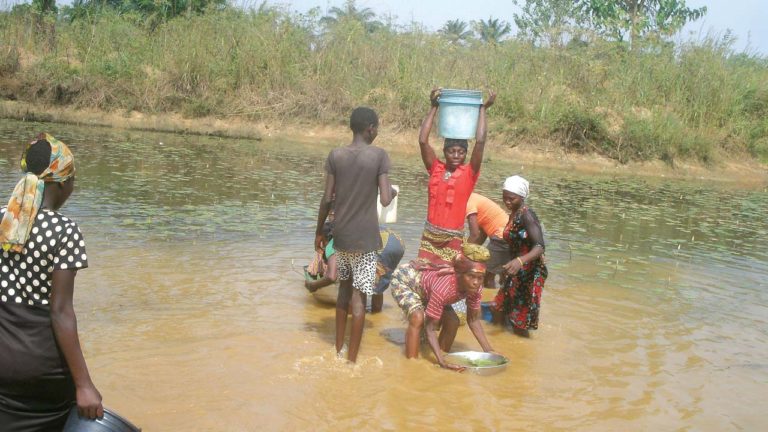
While narrating the difficulty in getting water in the camp, Jauro said the free source of water is a stream where many women have been bitten by snakes while sourcing for it.

He added some water vendors which are called “mai ruwa” sell water to displaced persons at N20 per a 20-litre of cans.

“There are times when you do not have the money to buy the water, you end up going to the stream to fetch the water the way it is,” the camp chairman said.

He called for immediate interventions from relevant stakeholders, saying this was necessary to forestall terrible incidents.

“The issue we have in this camp is malaria, cholera and snake bites, because of the bushes around, there are times when they come into your room, two women have been bitten so far.

“We want the government to help us, to alleviate our sufferings in this camp, how can we call ourselves Nigerians when we do not have the basic necessities of life’’, Jauro said.

The WaterAid, in a statement on its website, says 59 million Nigerians have no access to clean water, representing one in every three persons.

Court arraigns Senator Adeleke, others over examination malpractices

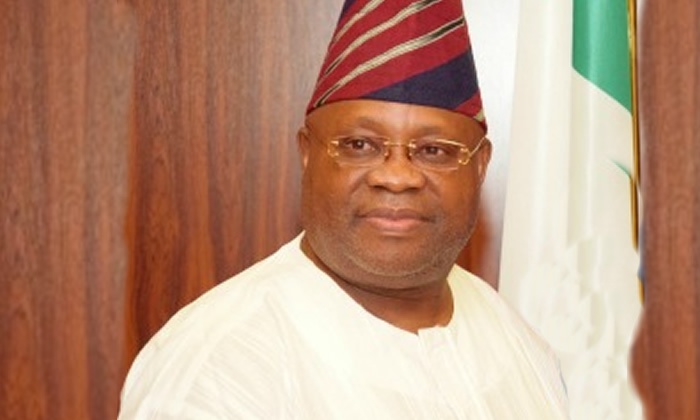
THE Federal High Court in Abuja has fixed  Monday FOR the arraignment of Ademola Adeleke, the Osun West Senatorial District at the National Assembly and the People’s Democratic Party’s governorship candidate in the September 22 election and four others over charges of examination malpractices.

The judge, Justice I.E Ekwo, during a brief hearing, which was stalled due to Adeleke’s absence on Monday, directed Ibrahim Idris, the Inspector-General of Police,  to ensure all the five defendants were brought to court for arraignment on October 31.

“The prosecution is ordered to ensure the defendants are in court at the next date, to take their plea,” the judge ruled.

The Nigeria Police Force filed the charges of examination malpractice against Adeleke on September 19, three days before the state governorship election and after a certificate forgery suit of him was dismissed in the Osun State High Court.

According to a statement released by the Force Public Relations Officer, Jimoh Moshood, Adeleke had connived with the principal of a secondary school in Osun State to allow him to sit for the 2017  SSCE organised by the National Examination Council (NECO).

President Muhammad Buhari had called on the Police Force to suspend the invitation of the senator until after the election ostensibly to prevent a possible backlash from a weary public that might think the opposition candidate was being harassed.

The prosecutor, Lough,  informed the judge on Monday that the matter marked,FHC/ABJ/CR/156/2018, was coming up for the first time on Monday.

The prosecution accused the five defendants of committing examination malpractices by fraudulently, through personation, registering Adeleke and another Sikiru Adeleke, as students of Ojo-Aro Community Grammar School, in Ojo-Aro in Osun State, for the National Examination Council’s June/July 2017 Senior School Certificate Examination in February 2017.

The other four accused of malpractices are Sikiru Adeleke, brother to Ademola Adeleke; Alhaji Aregbesola Muftau, the principal of Ojo-Aro Community Grammar School; Gbadamosi Ojo, the registrar of the school; Dare Samuel Olutope, a teacher in the school.

While the four other defendants were present in court on Monday, Adeleke was absent.

Alex Izinyon (SAN), his lawyer informed the judge that the governorship candidate was not in court because of ill health.

Izinyon said, “His Personal Assistant informed me yesterday (Sunday) that he was indisposed because he was stooling. “He sent a sent medical report to that effect.”

He said that Adeleke had served the medical report, showing his client was on medication, on the prosecution. He pleaded with the court to grant a short adjournment to enable the first defendant to recover.

The prosecuting counsel acknowledged that the medical report had been served on him. He also urged the court to grant a short adjournment.

In the Osun governorship election, Adeleke was defeated by Adegboyega Oyetola, the All Progressives Congress’ candidate. However, the PDP’s candidate had filed a petition before the election petition tribunal challenging the cumulative results of the September 22 election and the September 27 re-run declared by the Independent National Electoral Commission.

World Hand-washing Day: Nearly 60,000 under-five children die of diarrhoea in Nigeria yearly

0

Not fewer than 59,500 children under five in Nigeria die every year because of diarrhoea which is caused by dirty water, poor toilets and poor hygiene, according to WaterAid Nigeria.

Oluseyi Abdulmalik, Communications Officer of WaterAid Nigeria who released a statement yesterday to commemorate the global hand washing day emphasized the need to practice regular handwashing.

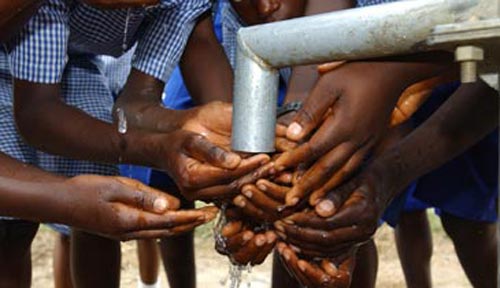
October 15 marks the World Handwashing day which is celebrated every year to promote proper hand hygiene.

WaterAid Nigeria has revealed that about 157 million Nigerians lack access to hand washing facilities and only 16 per cent of Nigerian hospitals have facilities within their premises to dispense clean water.

According to Abdulmalik,  handwashing is likely to reduce the chances of diarrheal infections from between 27 – 48 per cent, and drinking clean water puts the risk of diarrhoea infection to the barest minimum.

She enjoined citizens to extract a pledge from candidates in the next election to support WASH (Water Sanitation and Hygiene) access in order to achieve a healthy environment and country.

According to her, washing hands with soap and water puts everyone on the safe side but around the world, only 19 per cent of people wash hands with soap after defecation. She maintained that the government needs to promote handwashing and good hygiene in order to save lives.

The Country Director, WaterAid Nigeria Dr Chi Chi Aniagolu-Okoye advised on personal hygiene and regular consumption of a healthy diet.

This would ensure that the health of a child is not compromised, she said.

“Hand washing with soap and good food hygiene will benefit everyone health wise and economically. Essentially, hand washing with soap for health workers is compulsory to improve the quality of care and reduce the risk of cross infection to make our children healthier.”

“We are advocating alongside our partners, Action Against Hunger to demand that governments should develop cross-ministerial coordination mechanisms between WASH (Water Sanitation and Hygiene) and the nutrition sector to support sharing of information, joint planning and implementation of policies,” she concluded.

Experts have advised  that Nigerians should wash hands after:

  • Handling food
  • Changing a nappy or going to the toilet
  • Contact with body fluids (blood, saliva, vomit, etc.)
  • Handling animals and pets
  • Emptying the bin
  • Being in the garden


FACT CHECK: Keyamo’s claim that Nigeria’s debt cancellation came on a platter is false

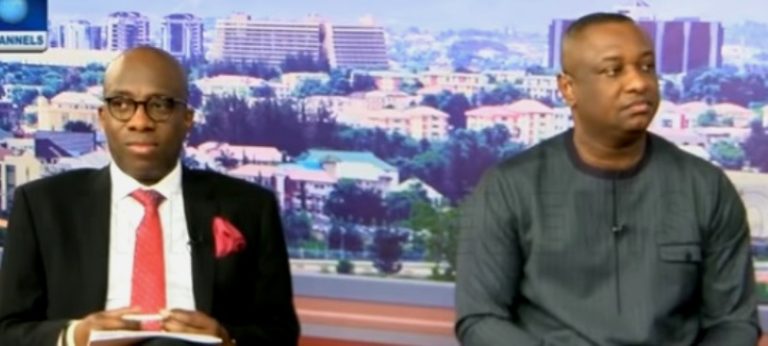
The spokesman of President Muhammadu Buhari’s re-election campaign, Festus Keyamo, and that of the Abubakar Atiku campaign, Segun Sowunmi, went head-to-head on Channels Television’s Sunrise Daily on Monday, to try explain to Nigerians why their respective principal is more qualified to lead the country come 2019.

Among the many claims made by Keyamo in trying to demarket Atiku, was that the Olusegun Obasanjo administration, in which Atiku served as the second in command, did not do anything special to merit Nigeria’s debt cancellation in 2006.

Keyamo implied that Nigeria could have had its debt cancelled anyway whether it took any stop or not.

“Let Nigerians not go away with the impression that there’s some kind of wizardry in negotiating debt forgiveness. It’s a lie. The G8 at that time took a policy to forgive debt in Africa. There was no wizardry on the part of Nigeria. 18 countries benefitted (from that policy),” Keyamo said.

And to buttress his ‘facts’, Keyamo invited Nigerians to google “G8 debt forgiveness 2004/2005” and see evidence that the debt forgiveness was an unmerited gift to Nigeria.

CLAIM 1: Countries that benefitted from the G8 debt cancellation

Contrary to Keyamo’s claims, Nigeria was NOT one of the countries that benefitted from the G8 debt cancellation initiative of June 2005 to which Keyamo alluded.

According to an International Monetary Fund factsheet, the idea, which was tagged the Initiative for Heavily Indebted Poor Countries (HIPC Initiative), was a collaboration between the IMF, the International Development Association (IDA) of the World Bank, and the African Development Fund (AfDF), to cancel 100 percent of the debt claims of “countries that had reached, or would eventually reach, the completion point—the stage at which a country becomes eligible for full and irrevocable debt relief”.

The countries that benefitted were 38 in all, and they were as follows: Afghanistan, Burkina Faso, Burundi, Central African Republic, Chad, Democratic Republic of Congo, Ethiopia, The Gambia, Ghana, Guinea-Bissau, Liberia, Madagascar, Malawi, Mali, Mozambique, Niger, Rwanda, São Tomé and Príncipe, Sierra Leone, Tanzania, Togo , Uganda, Benin, Bolivia, Cameroon, Comoros, Republic of Congo, Côte d’Ivoire, Guinea, Guyana, Haiti, Honduras, Mauritania, Nicaragua, Senegal, Zambia.

Also, Cambodia, Tajikistan, benefitted from the initiative even though they were non-HIPC countries, but they had a per capita income below $380 and outstanding debt to the IMF.

A screen-grab of a table showing the beneficiaries of the G8 debt forgiveness initiative of 2005. Source. imf.org

Keyamo was right that the G8 reached a decision to forgive indebted countries, but he was wrong that they were all African countries and that Nigeria was one of them. Only 14 of the countries are in Africa, and Nigeria was clearly not one of them.

CLAIM 2: Debt forgiveness came on a platter

The G8 debt cancellation did require some efforts or ‘wizardry’ as Keyamo put it on the part of benefitting countries. The IMF stated that there were requirements to be met before countries could have their debts forgiven them.

According to the IMF factsheet, “to qualify for debt relief, the IMF Executive Board also required that these countries be current on their obligations to the IMF and demonstrate satisfactory performance in macroeconomic policies, implementation of a poverty reduction strategy, and public expenditure management.

So Keyamo was also wrong on this claim. The countries that had their debts forgiven had to meet a set standard which only a handful of countries could meet.

There was some “wizardry” in Nigeria’s Paris Club debt release.

Negotiations continued after Nigeria missed out of the HIPC initiative. These negotiations culminated in the Paris Club writing off $18 billion or 60 per cent of the total $30 billion being owed it by Nigeria in October 2005. The group, at the time, also promised to raise the amount of the debt to be cancelled to $20 billion or 67 per cent.

Among other explanations that led to the partial debt cancellation, the Paris Club said the gesture was in recognition, as well as part of its contribution to Nigeria’s efforts at economic development, adding that “It would also help Nigeria in its fight against poverty”.

“Creditors welcomed Nigeria’s willingness to conclude a Policy Support Instrument (PSI) as soon as this new instrument is approved by the board of the IMF, to pay all its arrears towards Paris Club creditors and to treat them equitably,” a statement issued by the Paris Club read at the time.

Conclusion

Keyamo’s claim that the 2005 debt pardon to Nigeria by the Paris Club required “no wizardry” is at best misleading, and at worst, FALSE.

The Obasanjo administration, under which the former Finance Minister, Okonjo-Iweala worked, worked hard to qualify for the debt cancellation.

This much was also acknowledged by former Minister of Environment, Amina Mohammed, who resigned from Buhari’s cabinet to take up the role of the United Nations Deputy Secretary-General.

While having a televised chat with the current Managing Director of the IMF, Christine Lagarde, Mohammed said, “One of the reasons that we succeeded with the debt relief that Nigeria got from the Paris creditors was because we had the MDGs (Millenium Development Goals)”. But Lagarde cuts in, “I would add something, it [the debt relief] was also caused by one Nigerian woman (Ngozi Okonjo-Iweala).”

“I was on the other side of the table for that negotiation,” Lagarde continued, “and she [Okonjo-Iweala] carried the water for Nigeria.”

Mohammed agreed with Lagarde, but added, regrettably, that though “It took her (Okonjo-Iweala) a few years to convince people, we are now back again [in debt] in my country”.

I never endorsed Atiku, Kukah explains

THE Catholic Bishop of Sokoto Diocese, Mathew Kukah, says he did not endorse the presidential bid of Abubakar Atiku, but had only been instrumental to his reconciliation with his former Principal, Olusegun Obasanjo.

Kukah appeared in a photograph alongside Obasanjo, Atiku, and Abubakar Gumi, a prominent Islamic cleric, at the Abeokuta residence of the former President last week. It was at the event that Obasanjo endorsed Atiku for the 2019 presidential election, describing him as Nigeria’s President-to-be.

Also,  in one of the pictures taken at the event, was David Oyedepo, a popular pastor and founder of Living Faith Church, also known as Winners Chapel.

In a statement on Monday, Kukah said that he had been working on getting Obasnjo and Atiku to reconcile with each other for years now, but that the way the reconciliation happened was purely coincidental.

“Although trying to reconcile President Obasanjo and Alhaji Atiku Abubakar was something I had been working on intermittently in the last few years, nothing could have prepared me for the way things finally shaped up,” Kukah stated.

He went further to narrate how he met Obasanjo at a programme organised by the Four Square Gospel Church and reminded him of the need to reconcile with Atiku, and how Obasanjo had agreed to a meeting to be held on October 21.

However, Kukah said he was pleasantly surprised when Obasanjo called him the evening of that same day to say that he was willing to meet with Atiku the next day at 1 pm, in his house in Abeokuta.

“I arrived Abeokuta about 12.15pm ahead of both President Obasanjo and Alhaji Abubakar and his team. Alhaji Abubakar and his team arrived, and then I saw more and more people coming in. I saw familiar faces of different people who turned out to be the leaders of Afenifere,” Kukah wrote.

“All these years, whenever I brought up this matter of reconciliation, my idea has always been for the three of us to sit down together.

“I was happy that what I wanted to achieve had been achieved, namely, getting these two men to put the past behind them (but) my personal preoccupation was a pastoral one, and not a political one.”

Kukah explained that Atiku and Obasanjo went into a private room to “sort out their issues”, he and Gumi were called into the room, “and both of us spoke briefly on what they had done, encouraging them to ensure that this reconciliation holds… After that, we prayed and then took what has now become the famous photograph behind closed doors.

“At this point, I felt that my spiritual duties had been achieved and I was prepared to maintain my independence. Sheikh Gumi and I shook hands and although I was hungry and the food was being laid out, I skipped lunch. I quietly let myself out by the side door, got into the Four Square Gospel car and we drove off to Lagos.”

Kukah maintained that “I was not in Abeokuta to endorse Alhaji Atiku Abubakar, the candidate of the Peoples’ Democratic Party”.

“I have far too many friends across party lines for me to openly endorse one candidate or party against the other, (but) it will be against the principles of the Code of Canon Law of the Catholic Church which regulates our public life in the political space.”

Kukah said that he will never relent in the very urgent task of making peace and reconciliation across the spectrum of our country.

Also, Gumi and Oyedepo have denied endorsing any candidate for the 2019 election, explaining that they were invited as non-partisan parties to witness Obasanjo and Atiku’s reconciliation.

Obasanjo and Atiku fell part toward the end of their second term in office which ended  May 29 2007.

FLASHBACK: Did Peter Obi lie about owning one wristwatch?

0

LAST Friday, a former governor of Anambra State, Peter Obi, was announced as the running mate of Atiku Abubakar, in his race to the Presidential Villa, under the flag of the People’s Democratic Party (PDP).

This decision was celebrated by many as a wise choice not only because of Obi’s ethnic background, impressive academic profile, youthfulness and intelligence, but also because he is perceived as an upright, austere and no-nonsense leader.

However, about a year and a half ago, the former governor caused a huge stir on the internet over a suspicious — and, as it later turned out, controversial — claim he made while speaking at The Platform on Monday, May 1, 2017.

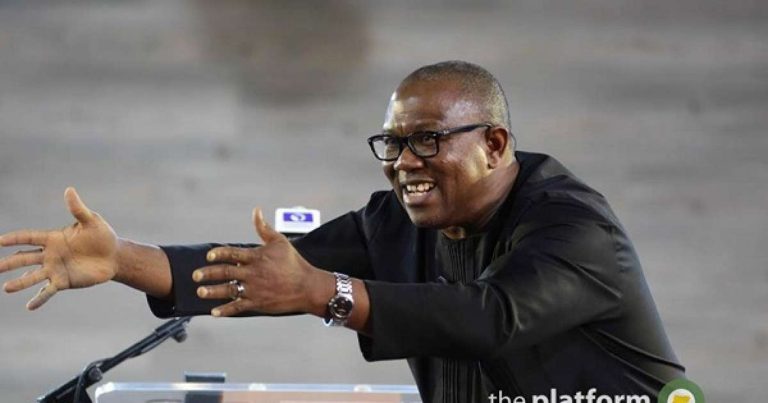
At the event, organised by the Covenant Christian Centre in Lagos, Obi said he did not have more than a single wristwatch which has served him for seventeen years. He also chipped in that he had only two pairs of black shoes that he always travelled with.

While narrating an experience with the Economic and Financials Crimes Commission (EFCC), which searched his apartment in Lagos while he was abroad, he said they could not find expensive clothing accessories there and accused him of not living in the house.

Explaining, he said to an applauding crowd: “I have said it to many Nigerians. Peter Obi wears only black shoes and I have two pairs of it anytime, and I travel with them.”

“The purpose of shoes is to protect the legs from being hurt,” he added. “Nothing else. Some people buy shoes of $200, $300. It’s a waste of time. I bought this from Marks and Spencer. $49.99. Finish.”

“They said, ‘Oh, we didn’t even see watches’,” he continued, referring to operatives of the EFCC.

“I have said it openly to everybody. This is the only watch I have,” he said, as he pulled his silver-coloured chain watch. “I have worn it for seventeen years… The purpose of watch is to keep time. Why would I keep a watch at home? Whose time is it keeping?”

A year before, at the 2016 edition of The Platform, Obi appeared to have used the same wristwatch for his presentation. But is that the only one that has graced his wrist for close to two decades?

Pictures emerged of other watches

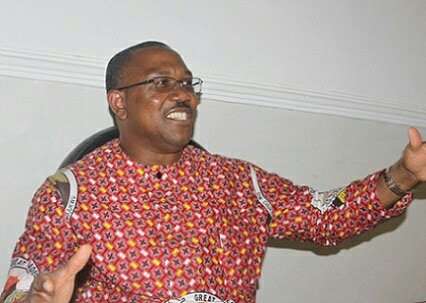
Soon after the video of his assertion went viral on the internet, pictures of Peter Obi within the 17-year time frame were dug up to suggest the former governor might have goofed or outright told a lie to look good before the audience.

It is clear from some of these images that he has used at least two types of watches in the past decade, one with a brown leather strap and another with a silver-coated chain and dark clock plate.

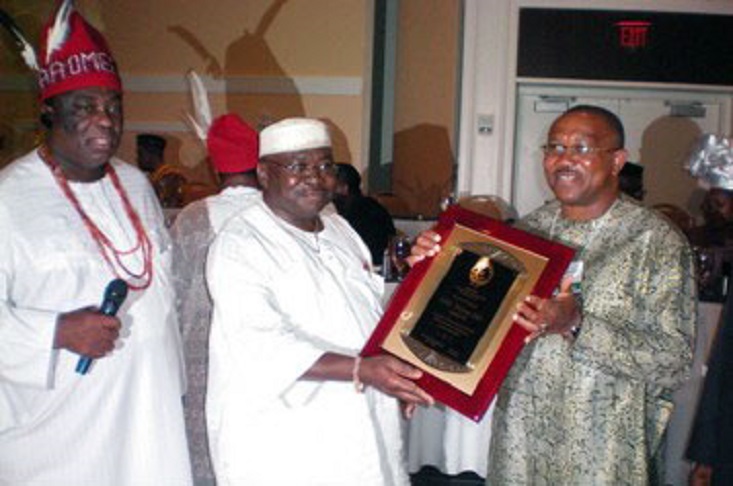
Peter Obi receiving an ‘award’ from then president and Baord Chairman of ASA-USA

Nigerians, especially loyalists to other parties, have started using Obi’s statement to suggest he is not fit for office, some suggesting his wristwatch must have been a chameleon.

“Peter Obi is a monumental pathological liar anyway,” tweeted Don Carleton (@PapazLagos) on Thursday. “Man used The Platform to hoodwink gullible youths into believing he’s one honest politician that only used two pairs of shoes and one wristwatch during his 8-year term as governor.”

Another Twitter user, Abdul Aziz Mu’azu (@mabziz), said: “No frivolous claim from Peter Obi can as much as amuse me again; after his ‘I have only one wristwatch’ stunt.”

Yet another Nigerian pleaded with the press to fact-check his claims, including that he has only one house located in Onitsha.

Jumping into conclusion?

While it is true the former governor could have meant to say as popularly interpreted: that the watch he wore to the event is the only one he had had for seventeen years, this is not the only semantic connotation.

His statement could as well be interpreted to mean he had had the watch for seventeen years, it was the only one he was using at the time, but he had used others too in the past.

This explanation was also suggested by Ikeogu Oke, award-winning poet and journalist, in a piece published by Vanguard newspaper.

“Even with such seemingly contradictory images, it would be wrong to draw the conclusion that Obi’s wristwatch claim was not true unless it could be proven that he owned any other wristwatch at the moment he made that claim or had not owned that particular one for seventeen years,” he wrote days after the incident.

“While not ruling other possible interpretations of the claim, as a student of semantics I can say that it can be rightly interpreted to mean that he might have owned other wristwatches together with that one in the past seventeen years, but that was the only one left,” he added.

“And so digging up images where he seemed to wear other wristwatches or actually did in the past seventeen years would not translate into his having lied.”

Obi himself, however, has yet to put up a defence or clarify the ambiguity in his statement. Perhaps with his new position as a vice presidential candidate, the matter will finally be laid to rest, in one direction or the other.

FACT CHECK: Did Okowa raise Delta State’s IGR from 30 to N51 billion?

IFEANYI Okowa, Governor of Delta State, said the Internally Generated Revenue (IGR) of his state was as low as N30 billion in 2016 but, thanks to his administration, this has been raised to N51 billion annually.

He passed this remark on Friday at the 14th All Nigeria Editors Conference in Asaba, the state capital, and added that the nearly doubling of IGR was made possible through expanding the scope of tax collection and making it more effective.

“We were able to collect taxes from the market women not just as tax but also as premium for the state health insurance scheme, which they benefit from by paying their taxes,” he said.

Another factor that led to the success recorded, he explained, was the privatisation and effective management of the Asaba Airport, which has been upgraded to enable it accommodate the landing of larger aircraft.

According to him: “We got technical advice to privatise or commercialise the airport and we have published for investors to bid for it.”

The ICIR has, however, discovered the governor’s claim to be exaggerated and misleading, when set against available data.

Belied by the NBS

Data from the National Bureau of Statistics (NBS), the government agency which produces official statistics on behalf of the federation, show that Okowa’s claims are not accurate.

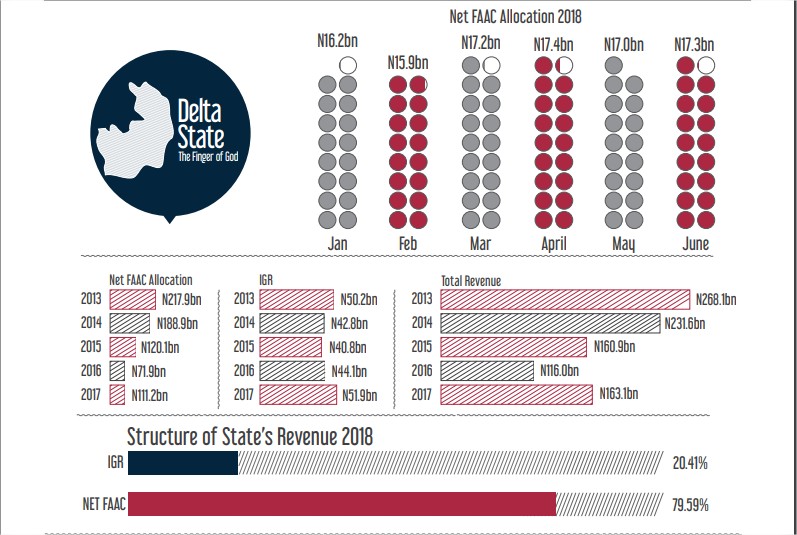
Source: BudgIT‘s State of States, 2018 edition

While the internally generated revenue for 2017 is stated to be N51.9 billion and that of 2018 is said to average N4.3 billion monthly (N51.6 billion when stretched for the entire year), it is not true that the IGR of 2016, a year after Okowa was sworn in, was as low as N30 billion.

According to the NBS, Delta State had internally generated a revenue of N44.1 billion in the 2016 calendar year. In other words, the year on year growth (that is percentage increase) is only 17.7% and not 73% — the result when the governor’s understated figured is used.

There is, therefore, a difference of 55.3% between the figures as claimed by the governor and the authentic figures. Also, data compiled by BudgIT, a civic organisation that simplifies the budget and matters of public spending, have shown that it is not the first time Delta State’s IGR will be shooting up beyond N50 billion.

Under Emmanuel Uduaghan, who was governor between 2007 and 2015, the IGR had risen to a record high of N50.3 billion, as a result of various reforms, before dropping in 2014 to N42.8 billion.

Chike Ogeah, the Commissioner for Information under Uduaghan, had said in 2013 that the state’s internally generated revenue was only N12.2 billion in 2007, but rose to N37.4 billion in 2011 and then N45.5 billion in 2012.