INDIA’S Supreme Court has decriminalised homosexual sex in a landmark judgment for gay rights, reports The Guardian UK.
A five-judge bench of the country’s highest court ruled on Thursday that a 160-year old law banning sex “against the order of nature” amounted to discrimination on the basis of sexual orientation and was unconstitutional.
“Criminalising carnal intercourse under section 377 Indian penal code is irrational, indefensible and manifestly arbitrary,” said the chief justice, Dipak Misra, in his ruling, part of a series of judgments that quoted from Oscar Wilde (“The love that dare not speak its name”), Leonard Cohen (“From the ashes of the gay / democracy is coming”), William Shakespeare (“What’s in a name? That which we call a rose by any other name would smell as sweet”), and the German philosopher Johann Wolfgang von Goethe (“I am what I am, so take me as I am”).
“Social exclusion, identity seclusion and isolation from the social mainstream are still the stark realities faced by individuals today,” Misra said, “and it is only when each and every individual is liberated from the shackles of such bondage … that we can call ourselves a truly free society.”
“History owes an apology to members of the community for the delay in ensuring their rights,” stated another judge on the bench, Indu Malhotra.
The announcement of the decision drew loud cheers from a crowd gathered on a lawn outside the Supreme Court. India has one of the world’s largest populations of gay people.
“Today is a historic day,” said Anand Grover, one of the lawyers who led the case, on the lawn outside the Supreme Court in central Delhi. “The future is for everybody to be included, to realise their fundamental rights of equality, privacy, dignity, etcetera. That is what the court has stated and given directions that this be made available and known to everybody.”
The decision appears to mark the end of a fraught path to legalising homosexuality in modern India. Early cases filed in 1994 and 2001 bounced back and forth for years between higher courts reluctant to rule on the issue.
In 2009, the Delhi high court quashed the cornerstone of section 377 of the Indian penal code, finding that applying its ban on “carnal intercourse against the order of nature” to consenting adults breached the rights to life, liberty and equality enshrined in the country’s constitution.
That decision was overturned four years later by the supreme court, which argued that the 1861 law that came to be associated with homosexual sex had been used so infrequently – fewer than 200 times, according to the judgment – and against such a “minuscule fraction” of the population that it could not be said to violate Indians’ constitutional rights.
FORMER Vice President Atiku Abubakar has taken another jibe at the Muhammadu Buhari presidency accusing it of lack of transparency as well as shielding corrupt individuals.
Atiku’s recent criticisms came in reaction to comments by Femi Adesina, Buhari’s Special Adviser on Media and Publicity, who, in a statement on Wednesday, described Buhari as uncompromising on issues of accountability, probity and transparency.
“President Buhari is uncompromising in the quest to restore probity and accountability to public office. He is uncompromising in cleaning the rot Nigeria was consigned into pre-2015, thus the war against corruption is being fought without fear or favour,” Adesina had stated.
But Atiku, writing through his media aide, Paul Ibe, listed a number of instances where, according to him, Buhari had demonstrated a lack of transparency and compromise. These include the payment of over N1 trillion naira in fuel subsidies, even when the presidency claimed it had stopped payment of subsidies; the suspicious reinstatement of Abdulrasheed Maina, a former pension boss who had fled the country after he was accused of corruption; Buhari’s refusal to act on the allegation of forgery against his Finance Minister, and so on.
“If President Buhari is “uncompromising in cleaning the rot Nigeria was consigned into pre-2015” then how come the latest Corruption Perception Index by Transparency International reveals that Nigeria is more corrupt today than she was in 2015, having moved 12 steps backwards in Transparency International’s Corruption Perception Index, moving from 136 in 2014 under the PDP to 148 today?” Atiku queried.
“Again, we ask how uncompromising a President can be when he allows a minister accused of forgery to remain at her job?
“The Buhari administration pays a whopping ₦1.4 trillion on subsidy per annum according to the minister of state for petroleum. This amount is almost twice what the Jonathan administration paid and yet President Buhari accused that administration of scamming the nation. Where is the transparency in that?
The payment of petroleum subsidies has been one of the most controversial actions of the federal government over the years; many Nigerians believe the government used the idea to carry out corrupt practices.
But the Buhari administration announced, in May 2016, that it was deregulating the petroleum downstream sector, which also meant the scrapping of subsidy payments. Consequently, the pump price of premium motor spirit (PMS), otherwise known as petrol, was raised N86 to N145 per litre.
Osinbajo, at the time, explained to Nigerians that it was the best decision for the country, going forward.
“Amongst others, the downstream sector has been deregulated with the elimination of petroleum subsidy. This policy has removed from government, a burden of not less than N15.4 billion monthly,” Osibanjo said at an event in December 2016.
However, in April this year, the Minister of State for Petroleum Resources, Ibe Kachikwu, who was a former Group Managing Director of the Nigeria National Petroleum Corporation (NNPC), said Nigeria pays about N1.4 trillion in what he called “under recovery” payments; this is just another term for subsidy.
“Nigeria presently incurs over N1.4 trillion till date as under-recovery or losses on the importation and sale of petrol. It is time for Nigeria to harness alternative fuel sources like (LPG) as under-recovery from the importation and sale of petrol at the government-regulated price of N145 per litre has hit N1.4 trillion,” Kachikwu wrote.
Also, the Buhari administration has continued to maintain silence over the allegation of forgery against Kemi Adeosun, Minister of Finance.
Adeosun is alleged to have fraudulently acquired a National Youth Service Corps (NYSC) exemption certificate, having failed to participate in the mandatoryone-year national service.
It has been 61 days since the allegation was made against Adeosun by Premium Times, but the president has refused to act.
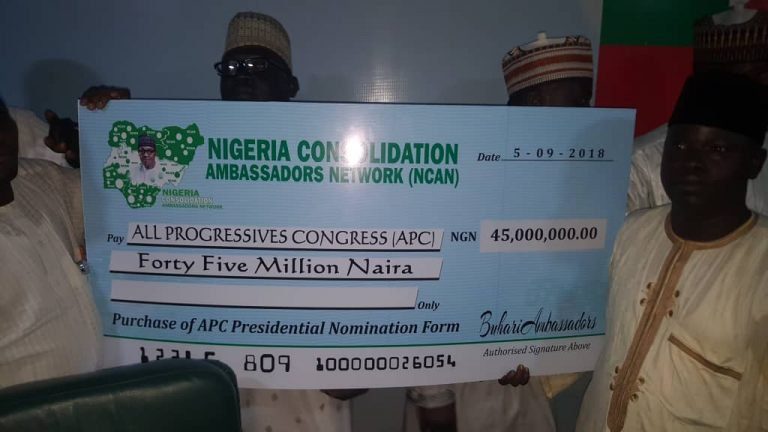
A group known as Nigeria Consolidation Ambassador Network (NCAN) has purchased the N45 million presidential nomination form of the All Progressives Congress (APC), for President Muhammadu Buhari.
Presenting the N45 million cheque to the APC National Chairman, Adams Oshiomhole, Coordinator of the group, Sanusi Musa, said members from several villages and local government areas had contributed in order to raise the sum.
Musa said the gesture was a demonstration of their belief in Buhari’s leadership and the foundation he is laying for a better Nigeria.
“We cannot afford to go back to Egypt. We cannot afford to destroy the future of our children. The foundation laid by President Muhammadu Buhari must be reinforced,” Sanusi said.
“We believe in the leadership of President Buhari, we count on him to consolidate the good work he has started for another four more years.
“It is for this reason, Mr Chairman, (that) we have decided to pull our meagre resources together and purchase the expression of interest and nomination forms for President Buhari as he presents himself to our party members to be chosen as its candidate for the 2019 general election.
APC’s presidential nomination and expression of interest forms.
“Our members from various villages, local governments and states have contributed to making this happen.
“We have no doubt that Mr President has, both in action and words, been working to lay a foundation for greater and prosperous nation that our generation and future generation will be proud of.”
Senior Special Assistant to the President on Media and Publicity, Garba Shehu, had told journalists in July, that “a number of groups have promised to purchase the forms for the president as their own way of appreciating the good leadership President Buhari is offering the country”.
Former Vice President Atiku Abubakar, who is running for the presidency on the platform of the Peoples Democratic Party (PDP), also said his supporters paid for his nomination form (N12 million).
“I felt heavily sorry for myself because I don’t want to go and ask somebody to pay for my nomination forms, because I always try to pay myself, at least for the nomination. N27 million is a big sum.”
Buhari, at the time, complained that he had tried to get the party’s leadership to reduce the amount but the National Chairman at the time, John Odigie-Oyegun, said to him, “you better pick your form and keep a straight face; that means there is no excuse”.
“Thankfully I have a personal relationship with the manager of my bank in Kaduna and I told him that very soon the forms are coming, so, whether I am on red, or green or even black please honour it otherwise I may lose the nomination,” Buhari said.
Explaining why the nomination form was that exorbitant, Odigie-Oyegun said it was intended “to separate the men from the boys”.
Fast-forward to 2018, four years later and a few months before another general election. The APC is no longer an opposition party, Buhari is no longer a presidential aspirant, and the presidential nomination form has skyrocketed to N45 million, a 63.6 percentage increase.
In 2014, governorship aspirants on the APC platform paid N5.5 million to purchase a nomination form, Senatorial aspirants paid N3.3 million, House of Representative’s aspirants paid N2.2 million, while State Assembly aspirants paid N550,000.
Today, the nomination form to contest for a governorship position, the Senate, House of Reps, or State Assembly has been pegged at N22.5 million, N7 million, N3.85 million and N850,000 respectively.
As at August 2014, Nigeria’s inflation rate was not up to 9 per cent, but according to the National Bureau of Statistics, the inflation rate currently stands at over 11 per cent. Perhaps, that is what also affected the price of APC’s nomination forms.
On the other hand, the opposition Peoples Democratic Party (PDP) sells its expression of interest and nomination form, for presidential aspirants, for N12 million, as against the N22 million price tag in 2015. Governorship aspirants will pay N6 million, senatorial and House of Reps aspirants are to pay N3.5 million and N1.5 million respectively, while state assembly aspirants will pay N600,000.
It is not immediately clear why the APC decided to increase the price of nomination forms, despite pleas by the not-too-young-to-run group for political parties to make their nomination forms affordable to youths who are interested in contesting.
On the social media, many complained that the nomination forms was way too expensive.
Ismaeel Ahmed tweeted: “Just so we are clear, I believe the amounts for nomination forms of my party, APC, as publicized is prohibitively expensive and obnoxious. We will officially write for it to be reviewed. Pecuniary bottlenecks must not be deliberately planted to limit participation.”
Another tweeter user, Sunday Chisomwrote: “After holistically looking at how the political parties are structured, and how expensive the nomination forms are, sincerely, no way for the youths in this country’s politics.”
When President Buhari signed the age reduction bill, also known as the not-too-young-to-run bill, into law in May this year, he pleaded with the young people, albeit jokingly, not to run against him come 2019. It is conceivable the exorbitant price for nomination forms is APC’s way of ensuring that the presidential plea was complied with.
Besides, a presidential aide on media and publicity, Garba Shehu, had toldnewsmen, in July, that “a number of groups have promised to purchase the forms for the president as their own way of appreciating the good leadership President Buhari is offering the country”.
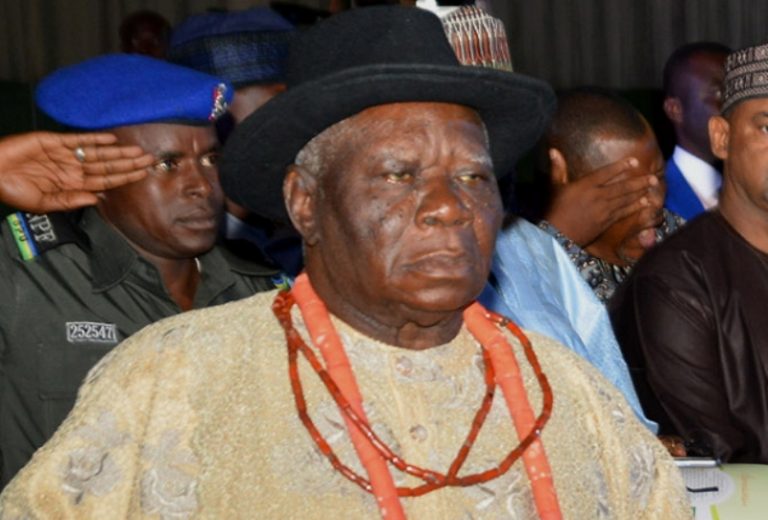
THE invasion of the home of former Minister of information, Edwin Clark, by men of the Nigeria Police Force, has drawn criticism by many Nigerians.
Clark, who was a senator during the second republic, said policemen invaded his home in the Asokoro area of Abuja on Tuesday, saying they were operatives of Special Tactical Squad, and that they had a warrant to search his house.
According to Clark, the policemen said they were looking for weapons, but at the end of the search, nothing incriminating was found. He described the incident as embarrassing and threatened to take legal action against the police.
Spokesman of the police, Jimoh Moshood, later said that the officers were not authorised to embark on the operation, adding that they had been detained.
Moshood said this while parading one Ismail Yakubu, the alleged informant who had purportedly misled the police into believing there were weapons in Clark’s house. Also, according to Moshood, the IGP, Ibrahim Idris, had sent a delegation of top-ranking officers to apologise to Clark for the embarrassment.
Nevertheless, many Nigerians took to the social media to condemn the actions of the police and criticise the IGP for what they say was an act of dictatorship.
Senate President Bukola Saraki, who himself has had several altercations with the police in recent times, described the actions of the police as a “threat to democracy” and “a gross abuse of state institutions”.
“If there was a genuine reason for the search on Chief Edwin Clark’s home, nobody would object to it. However, for the Police to conduct a raid on the pretence that they were looking for arms, and eventually, the claim turned out to be a hoax, means something is amiss,” Saraki tweeted on Wednesday.
This action by the Police does not reflect well on the country. It represents a gross abuse of state institutions.
Now that the Inspector General of Police has denied that the raid was ever authorized, the next move should be a thorough and transparent investigation.
Similarly, former Kano State Governor, Rabiu Kwankwanso tweeted: The unlawful invasion of the residence of elder statesman Chief Edwin Clark by men of the Nigerian police is another sad episode in the recent catalogue of embarrassments, witnessed under the current administration.
The unlawful invasion of the residence of elder statesman Chief Edwin Clark by men of the Nigerian police is another sad episode in the recent catalogue of embarrassments, witnessed under the current administration. pic.twitter.com/HHKnDZb6c0
Some also questioned the sincerity of the leadership of the Police in denying knowledge of the raid on Clark’s home.
Please there is something I wanna understand, Firstly, the IGP said he wasnt aware of any raid, he didnt authorize it, now the same NPF is parading someone that made them raid Edwin Clark’s residence, so now they are admitting they actually intentionally raided him…THIS IS NGR
Whatever @PoliceNG was looking for at Chief Edwin Clark’s house in Asokoro they apparently did not find.
Raiding his house was illadvised. We have enough challenges on our hands already. Adding Clark to it is a no, no. Don’t give elements reason to start acting up. STOP IT NOW! pic.twitter.com/3c7We2Wf2t
ALL things being equal, the distance between Apete and Akufo — roughly 12 kilometres — ought to be covered within fifteen minutes. Things have however not been equal for the people of these towns and those sandwiched between them. So, what is meant to be a fifteen-minute drive now takes a minimum of one hour as a result of poor road conditions.
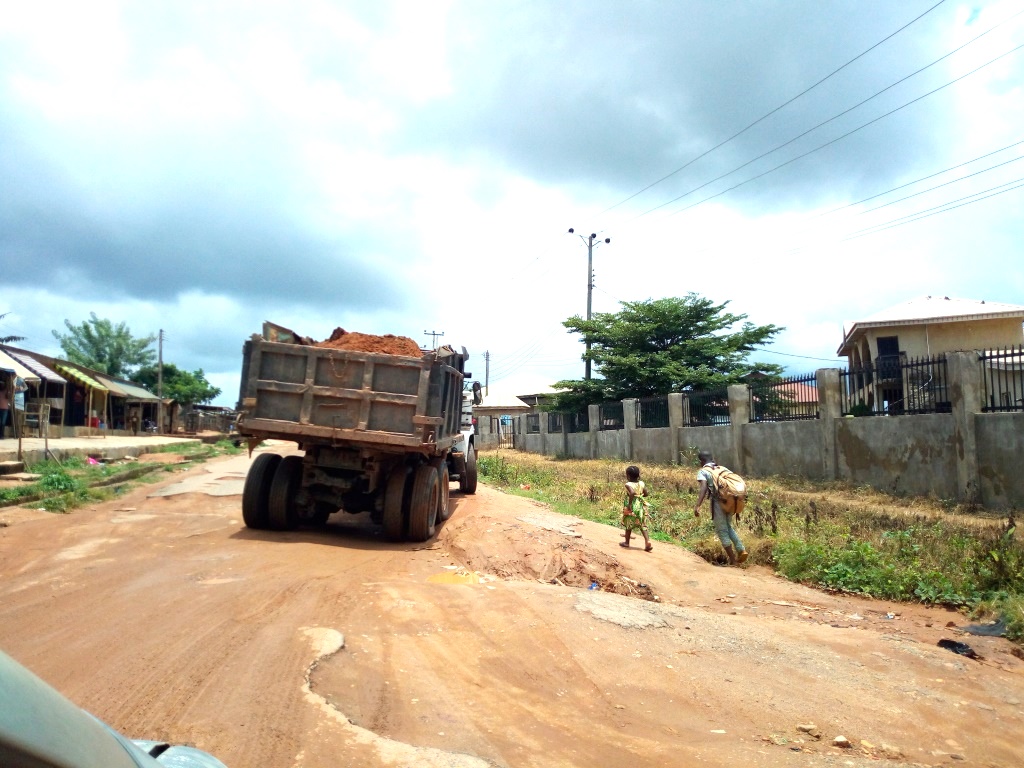
The last time the Oyo State government paid any attention to the road was during the administration of Christopher Adebayo Alao-Akala between 2007 and 2011, but the substandard tarring done at the time has failed to stand the test of time. While deep potholes are at various sections of the road, other areas are without asphalt — despite its closeness to the Polytechnic Ibadan and location in an urban environment.
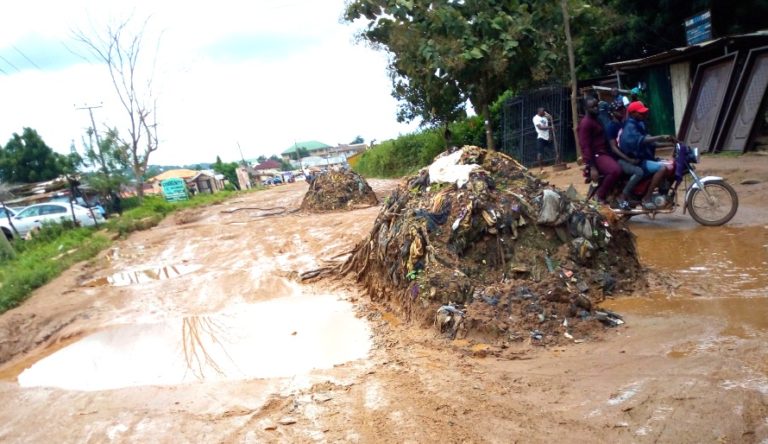
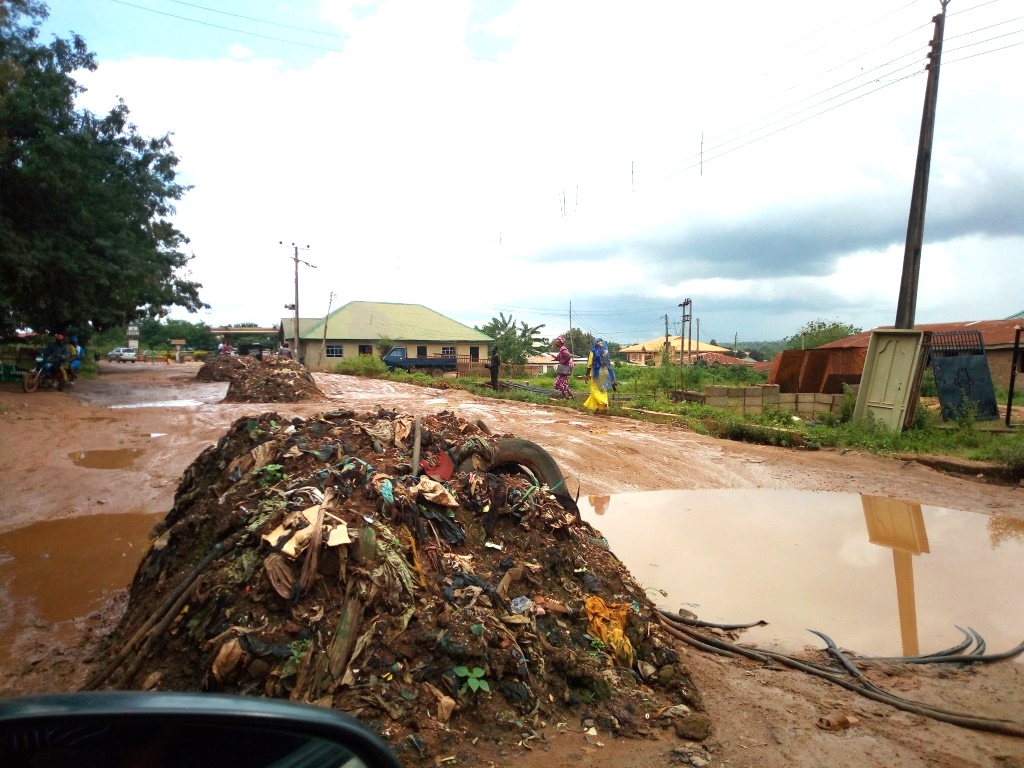
Many attribute the condition of the road to neglect from the state governor who, they say, is punishing them for voting other parties during past governorship elections. As a result, the people of Apete have stopped expecting intervention from the government. They contribute money to buy materials to fill the holes on the road, and other times they simply dump pyramids of refuse in the middle, hoping this will provide temporary relief.
The road is as big a problem for taxi drivers as it is for other road users. Commercial vehicles drivers and motorcyclists are hardly seen at the Akufo end of the stretch. Therefore, residents are often left to wait in the open for several hours before they get a means of transportation out of or further inside the town. Most times, they beckon at private vehicle owners for an opportunity to hitchhike.
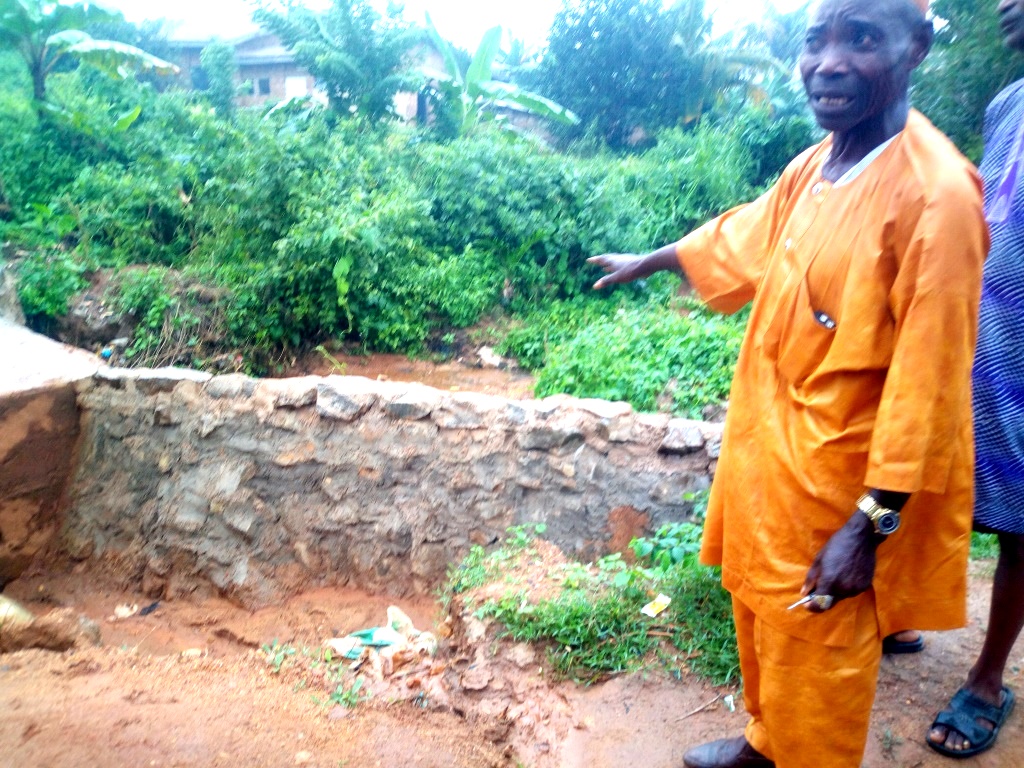
Expanding crevasses by the roadside are also reported to have led to the death of road users on multiple occasions, especially during the rainy seasons.
One of several crevasses on the Apete-Awotan road
During visits paid by The ICIR, most of the persons interviewed were afraid to speak freely and started by questioning our reporter’s identity. They sought to know, before providing answers, if our reporter worked for a private or government-owned organisation and whether he belonged to a political party.
Political revenge?
In response to why the road has been abandoned for years, Akinibi, an elderly woman in her seventies, simply observed that Ajimobi “said they didn’t vote for him.” She said he has equally claimed the route to be a federal road. A few metres from Akinibi’s shop stands another retail shop where two middle-aged women were seen chatting. According to them, the bad road stretches further to Akufo, and it is terrible all the way to the federal railway construction site. They also blamed Alao-Akala for not doing an excellent job when he first constructed the road years ago.
Heaps of garbage dumped in the middle of the road to fill up potholes
The ICIR reporter met a young painter, who was in the company of five friends in front of a boutique and declined to be identified. He confirmed that the governor refused to repair the road because the residents supported the opposition. He said the state governor openly made this declaration during a live broadcast on the Broadcasting Corporation of Oyo State (BCOS).
“What you just said you heard is exactly what happened,” he started, “because for the past seven and a half years that Ajimobi has been in power, that is the excuse he’s given.”
It all started in 2011 with a flooding disaster during Ajimobi’s first term, he narrated. The flood swept across town on August 26, and had led to the loss of over 120 lives, triggering a visit from then president Goodluck Jonathan.
According to the young man, what Ajimobi said when he paid a condolence visit to Apete was that the bridge wasn’t executed swiftly because people there did not vote for him. However, after some time when people cried out, he hurriedly completed the project towards the end of his tenure when he was campaigning for a second term.
After a second flooding incident that led to the bridge cracking and another chorus of disapproval, the governor promised to fix the faults. He eventually tarred the road, in early 2018, up till where the Apete Police Station is situated.
The young painter told The ICIR that Apete community is a strong base for opposition parties. Asked why this is so, he said a key factor was how those parties reacted after the flooding disaster of 2011.
“When the flooding first took place,” he related, “there were two parties who formed rescue teams — Accord Party and either of the Social Democratic Party (SDP) or People’s Democratic Party (PDP).”
The parties, he said, brought vehicles with which people travelled through an alternate route after the bridge collapsed. Apart from that, they also erected streetlights, he added, pointing to a collapsed streetlight across this road as one of the many erected.
“This was why the residents loved them so much, and this reflected in the election results. They got majority votes in Apete. That is why Ajimobi abandoned the road. People have appealed and appealed. Still, he has not budged.”
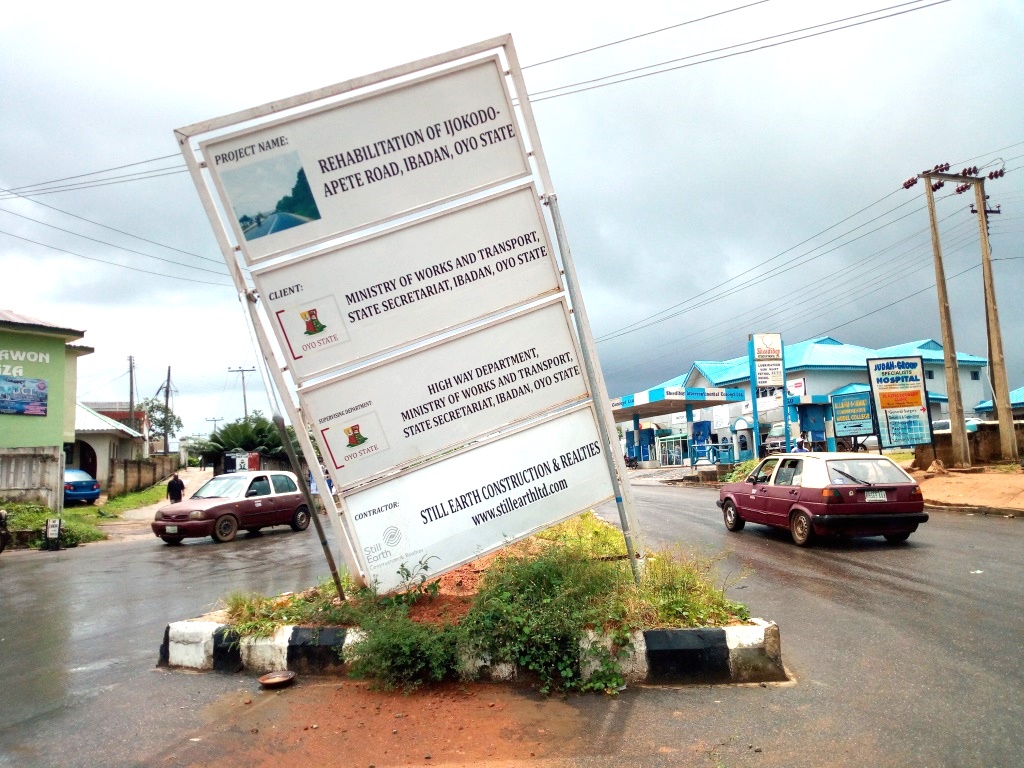
Contract signpost for the rehabilitation of the Ijokodo-Apete road, completed in 2018. Location: WAEC junction, Ijokodo
Road prone to accidents
For a road this bad, located in a community especially prone to flooding, it is not surprising that many casualties have been recorded. Tomiwa Japhet, who has lived in Awotan for close to eight years, confirmed this to The ICIR.
“Lives have been lost due to the condition of the road,” he revealed. “I’ve heard of cases where bikes fell into the gutters. People in the area have witnessed accidents many times just because the road is bad.”
He said just two weeks following constructions done by the Akala-led government, potholes had started appearing on the road. Under Ajimobi, the road was excellently repaired starting from Ijokodo junction up to Apete/Awotan alongside the collapsed bridge. The project was kicked off since the flood happened, but was completed this year because of frequent abandonment, he said. He added that the governor reportedly refused to extend the road construction beyond that point “because people there voted for Ladoja”.
Japhet also revealed that a recent World Bank water project has made the road worse. Holes bored at the road’s edges by contractors in order to fix the underground pipes were not filled up. As a result, there are deep gorges on the road which get even wider whenever it rains. This is unacceptable, he said, especially “on a narrow road”.
Rear view of a truck as it slowly manoeuvres its way through the Apete-Awotan road
‘There are worse communities in Apete’
S.O. Fasina, Chairman of the Toluwalase Landlords and Landladies Association, informed The ICIR that worse roads exist inside Apete town. In those communities, people are unable to take their cars home. They have to park in their friends’ compounds or on streets distant from their residence. He also revealed that, with no help coming from the government, the people often resort to self-help by buying stones and granite used for filling up potholes on the roads.
“In 2011, there was heavy rainfall that led to the collapse of the bridge. So the Federal Government instructed Ajimobi to construct it and then contributed some money to assist. They just tarred it up to this point in 2018, before they abandoned it.
“That is how they punish the masses, but we know God will decide their fate,” he said.
Fasina lamented how residents now using painkillers after a bike ride on the road, and how cars have been seriously damaged and grounded due to wearout. He confirmed that Rashidi Ladoja, a former governor, constructed the road, stopping at Awotan. Akala, he said, continued up till Akufo “even though what he did was basically tar only for the waters to flow”.
S.O. Fasina pointing at one of the projects funded and implemented by the Toluwalase community to curb road erosion
Asked if truly the road was abandoned because the people of Apete did not vote for Ajimobi in mass, he replied that the governor said it publicly himself.
“He said they did not vote for him in Apete; but notwithstanding, God has destined him to win. Besides, a person does not win from a single source. Or are we not part of Oyo State?”
Lifeforte’s offer to help was rejected
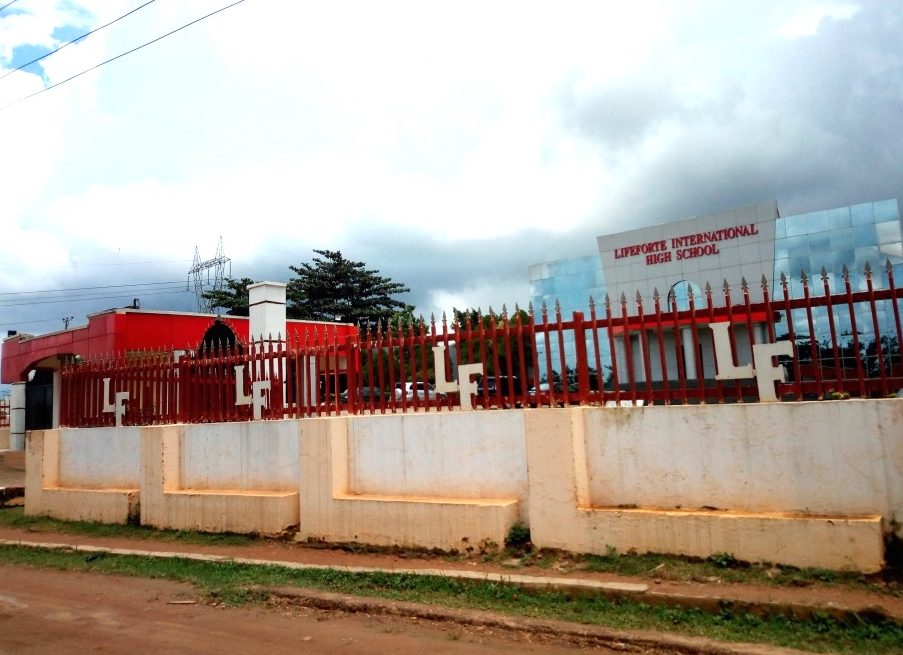
According to a resident of the community who spoke to The ICIR, not only has the government abandoned the road, it has also prevented Lifeforte International School, located along the Awotan road, from putting the road in good shape.
According to a 2016 graduate of Lifeforte International School, the institution was instrumental to the repair of Apete bridge in 2014. The school has also sponsored minimal repair works on the road, she noted, “but not totally, because I’m not sure the government gave total permission to them”.
“I think this is because the government knows it’s an indictment on them that they weren’t able to fix it,” she added.
Members of the academic staff also confirmed that the school caused the road to be partly repaired in 2014, and a female lecturer, who spoke anonymously to The ICIR, said indeed the government had in the past refused the school’s offer to fix the road.
Lifeforte International High School, located at Awotan GRA, Ibadan
Solape Adesiyan, the High School’s Chief Operating Officer, did not answer calls. Texts and reminders sent to confirm the claims were also ignored. Likewise, Tunji Oduntan, an Executive Director and head of the Curriculum and Studies Department, did not respond to enquiries from our correspondent.
Kunle Sokoya, the Executive Director on Mentoring and Child Support, however, told The ICIR he is not aware of such rejection from the Oyo State government. “But that the school has made efforts to do the road is quite clear,” he said. “Not once, not twice.”
‘The people also have a share of the blame’
Speaking to The ICIR, Paul who sells fairly used electronic devices and has been in Apete for six years, said it is not only the government who is to blame, though “the leaders we have are not doing what they are supposed to do”.
“You can see the road is very bad,” he lamented. “Even me, I do things on my own here. I was the one that took the pains to fill the side of the road serving as the entrance to this place. This place was worse before we did some manual work. So the government is not doing anything, and we are suffering here.”
Asked if there is a connection between the condition of the road and previous elections, he replied that it is not the issue and said the governor has apparently outmatched his predecessors in terms of road construction.
“Almost everywhere in Ibadan is bad and we people are not helping ourselves. People are fond of building houses and there is no provision for the gutter. You are expecting the government to build gutter for you in your house. The government cannot do everything and we need to help ourselves. But we are only appealing to them to come and help us.”
“Assuming rain is falling, just take a look at that spot,” he added, pointing to a large pothole by the edge of the road, “you will even cry when you see what comes out from there. That is the problem we are having here. The people fixed it a bit recently, but the more the rain falls the worse it gets.”
‘He would never say that’
When The ICIR placed a call to Bolaji Tunji, the state governor’s Special Adviser on Communication and Strategy, he swore “it is not possible” for his boss to say what has been credited to him.
“The governor will not say that, because a people did not vote for him, he will not repair their road,” he stressed.
“He will never say that. There are a lot of infrastructural developments going on around the state. If there is any problem on that road, there is no way the governor will neglect the area. The governor will never say that. I can swear with anything I hold dear.”
He invited our reporter to his office when he was asked whether the government has any plans for the road. He was however unavailable at the agreed time of visit on Wednesday, August 29, 2018. Toye Arulogun and Oladimeji Dauda, the Commissioners for Information and Works, to whom he referred the reporter were also not in their offices.
Also, email enquiries sent to the official addresses of Arulogun, Dauda, as well as Ajimobi and Ismaila Alli, Secretary to the State Government, have since not been replied.
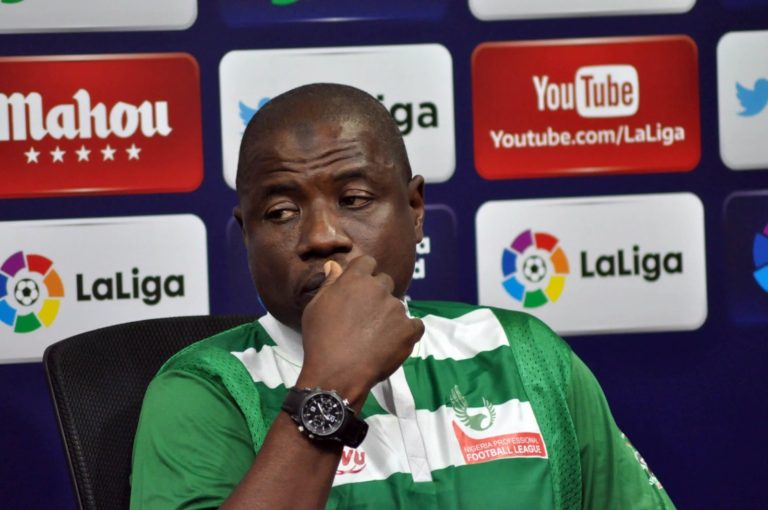
THE Ethics and Fair Play Committee of the Nigeria Football Federation (NFF) has announced a fine of $5000 on Super Eagles’ Head Coach, Salisu Yusuf, following investigations into allegations of bribery against him. He was also banned from all football-related activities for one year.
Yusuf had been caught on camera collecting $1000 “cash gift” from an undercover reporter who posed as a football agent. The decoy football agent had approached Yusuf asking him to ensure that two particular players were selected into the squad for the 2017 African Nations Championship (CHAN). Yusuf was promised that if he selected the players and they got foreign contracts, he would be given 15 per cent of the contract sum.
Though Yusuf was heard in the video telling the undercover reporter that team selection was based solely on fitness and performance, the two players made it to the final squad. Besides, according to the FIFA and NFF code of ethics, football officials are not allowed to receive any cash gift from anyone.
The undercover report, which was done by a Ghanaian investigative reporter, Anas Aremeyaw, was published by the BBC in July this year.
Spokesperson of the NFF, Demola Olajire, announced the decision of the ethics committee, which stated that “it was not an error of judgment on the part of Coach Salisu Yusuf but a conscious and deliberate decision to have accepted the cash gift of $1,000 from the decoy player agent/undercover reporter”.
The report of the committee, however, stated that “the two players could have made the team to 2018 CHAN Competition in Morocco on the basis of their talent and performance”, and also “that Coach Salisu Yusuf did not accept the offer of 15 per cent of the anticipated transfer fees of the said players”.
Nevertheless, the NFF ethics committee agreed that “the act of the Coach, which was widely published on the British Broadcasting Corporation, has a damaging effect on the reputation and integrity of Nigerian Football, as he ought to have conducted himself more professionally in line with the Code of Conduct signed alongside his Contract with the Nigeria Football Federation, as his conduct in public and in secret should be exemplary, since coaches are role models”.
Consequently, Salisu was fined $5,000 dollars, to be paid within three months, and also banned from all football-related activities for one year. He was, however, given an option to appeal to the NFF Appeals Committee.
Two other top African football officials had also received sanctions after being caught on camera by Anas’ undercover reporters, collecting bribes.
They include former Ghana’s Football Association President, Kwesi Nyantakyi, who resigned from office after he was caught on camera collecting $65,000 bribe, and Kenyan referee, Adel Range Marwa, who was caught collecting $600.
Nyantakyi had been shortlisted for the 2018 FIFA World Cup, but following the report, he was banned for life from all football activities.
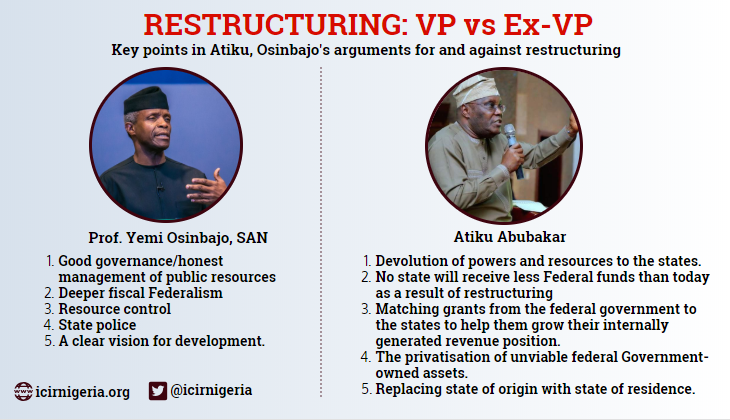
VICE President Yemi Osinbajo and his predecessor, Abubakar Atiku, exchanged letters on Tuesday on the issue of restructuring, which has been a thorny issue in the Nigerian polity over the years.
Osinbajo believes that “the problem with our country is not a matter of restructuring”, but Atiku thinks otherwise, positing that “Nigeria needs to be restructured and restructured soon”.
Key points of Osinbajo’s arguments against restructuring
Osinbajo said what Nigeria truly needs is not restructuring but the following
Good governance/honest management of public resources
Deeper fiscal Federalism
Resource control
State police, and
A clear vision for development
Overall, the Vice President insisted that “restructuring in whatever shape or form, will not mean much if our political leaders see public resources as an extension of their bank accounts. This, I believe, is the real issue”.
Key points of Atiku’s arguments in favour of restructuring
Atiku, for his part, said Nigeria is long overdue for restructuring. He stated seven points which he believed need to be followed in restructuring the country.
Devolution of powers and resources to the states.
No state will receive less Federal funds than today as a result of restructuring
Matching grants from the federal government to the states to help them grow their internally generated revenue position.
The privatisation of unviable federal Government-owned assets.
A truly free market economy driven by the laws of demand and supply.
Replacing state of origin with state of residence, and
Passing the PIGD so that our oil and gas sector will run as a business with minimal governmental interference.
“This continuous prevarication, this approbation and reprobation, helps no one, least of all true progressives who know that Nigeria needs to be restructured and restructured soon,” Atiku stated.
As campaigns for the 2019 general election gradually kicks in, many expect that the issue of restructuring will once again take the front burner.
Every Nigerian owes China about N15,000 at the moment in goodwill and in debt, considering the quantum of Chinese aid for development, welfare and loans in the last few years.
As of 2014, Nigeria was the sixth country on the list of third world countries that had received aid from China. It received the sum of $3.1 billion. This amounts to N1.1 trillion. In the last three years, the country had received $6 billion for infrastructure, which amounts to N2 trillion. The combined figures are put at about N3 trillion, and when divided by 198 million, considered to be the country’s population at the moment, every Nigerian owes China about N15,000.00.
The above figure does not include the loan agreement signed this week between Nigeria and China at the Forum on China-Africa 2018 in Beijing where China pledged to give $60 billion facilities to African countries, a quarter of which would be interest-free.
Government officials defend this indebtedness to China as a good strategy to have an edge over the United States and the United Kingdom in Africa trade.
‘China is being smart’
For instance, Dr. Ibe Kachikwu, minister of state for petroleum resources, speaking at the meeting in Beijing, praised China’s strategy, claiming that: “They are active in Liberia, Ghana, Angola. They are throwing money where their mouth is and in very much respect is one area where they have beaten both the US, European and British in things like this,” he told Bloomberg. “Africa requires a lot of development funds; China is able to provide it. Not just provide in terms of money but provide with adequate technology.”
However, the implication of this grant is that Africa may not be able to resist China in terms of trade and even in international politics.
‘It’s a bargaining chip in corrupt Africa ‘
A United States lawmaker, Rep Chris Smith, Chairman of the Foreign Affairs Subcommittee on Africa said in a recent opinion article that “China also uses foreign aid as a bargaining chip in corrupt African countries with plenty of natural resources for them to exploit. AidData, a research laboratory at the College of William and Mary, argued in written testimony submitted to my committee that China effectively buys the votes of African governments at the United Nations; they concluded that if African countries voted with China at the UN an extra 10 per cent of the time, they would receive an 86 per cent bump in assistance.”
Nigeria has reserves in Yaun
Nigeria has accepted the Chinese Yaun as a reserve currency, which will begin to compete with the US dollar.
The US lawmaker lamented that the Chinese in-road into Africa could be dangerous, arguing that “All of these trends—rising levels of debt, shoddy infrastructure projects, and investment that permits human rights abusers to consolidate their influence and power point to serious risks for the future of the African continent.”





 In 2014, governorship aspirants on the APC platform paid N5.5 million to purchase a nomination form, Senatorial aspirants paid N3.3 million, House of Representative’s aspirants paid N2.2 million, while State Assembly aspirants paid N550,000.