Home Blog Page 2527

The Nigerian Federation vs MTN

0

By Simon Kolawole

DOES the federal government want to chase foreign investors away from Nigeria? This is one of most frequently asked questions since the Central Bank of Nigeria (CBN) asked MTN to refund the $8.1 billion it repatriated as profits out of Nigeria from 2007 to 2015 based on “irregular certificates of capital importation”. CBN also fined four banks N5.8 billion over the certificates. We had barely finished reading the story when Mallam Abubakar Malami, the attorney-general of the federation and minister of justice, fired another letter to MTN demanding “back taxes” of $1.28 billion and N242 billion, both of which we can safely round up to $2 billion. You again, MTN? Only you?!

Coming three years after Nigeria’s biggest telephone operator was fined N1.04 trillion by the Nigerian Communications Commission (NCC) for failing to disconnect 5.2 million unregistered subscribers, the latest sledge hammer blows could kill any company — except it is in the Apple-Amazon-Shell category. The series of fines and sanctions against MTN would play into the hands of those who think the Nigerian state has an agenda against the telco. I have even heard whispers of “xenophobia” following similar negative attitude towards Multichoice Nigeria Ltd, a Nigerian cable TV company owned mainly by Multichoice Africa of South Africa.

While many Nigerians can understand the issue of “unpaid taxes” as raised by Malami, the matter of “irregular” certificates of capital importation (CCIs) is a little bit technical. This is the sense I can make out of it if I were to explain to the uninitiated. Between 2001, when it got a mobile phone licence to operate in the country, and 2006, MTN brought in $402 million to start business here: $59.4 million as shareholders’ funds and $343.1 million as loan. For bringing money into Nigeria to invest, you get a CCI as confirmation. It will, at the same time, allow you to get forex from CBN if you want to take the money out or collect dividends as an investor. That’s the job of CCI.

The CBN said that in 2007, MTN Nigeria decided to convert $2.9 million of the $402 million to equity and the remaining $399.1 million to shares, or what they call “preference” shares. A preference share, as the name suggests, gives preference to the owner when the goodies are shared. The investor usually gets a fixed sum as dividend. Conversely, the “ordinary” shareholders feed on the leftovers. While ordinary shareholders may not get dividend at times, preference shareholders will always get a fixed sum. MTN applied for, and got CBN’s provisional approval, to convert the $399 million loan to preference shares. So it was no longer a loan.

There were conditions given by the CBN to MTN for the bankers to be able to convert the loan to “redeemable” preference shares for the re-issuance of the CCIs. One, MTN must sign an undertaking that no repatriation would be made either on the principal or interest of the original loan from 2001 till the conversion to preference shares was done. Two, the conversion must receive the final approval of the CBN. There were other conditions — such as listing the preference shareholders and the number of shares issued to each one of them; reflecting same in the documentation at Corporate Affairs Commission (CAC); and other basic housekeeping chores.

Where were we? Between 2007 and 2015 — a period of eight years — MTN bought forex worth $8.1 billion from the CBN to pay dividends to its shareholders abroad. Now, this is where the trouble is. The CBN said it has just investigated and found out, in 2018, that MTN’s CCIs were “irregular”. That is, MTN’s bankers did not get a “final final” approval before re-issuing the CCIs. Therefore, the conversion of loan to preference shares was null and void. CBN is now saying: “You cheeky rascals, you played a fast one on us! Return the $8.1 billion I gave you to pay dividends over eight years and I will return your naira to you at the rates you bought the forex! Thank you.” This is the sense I made out of the press statement issued by the CBN a little over a week ago.

But MTN is seriously disputing CBN’s claims and suggesting that the investigation was shoddy. According to the company, even though the $399 million loan was converted to preference shares and CCIs were re-issued, none of the dividends repatriated between 2007 and 2015 was for the preference shares. Or, to say it another way, preference shareholders have not received any dividends based on the new CCIs. MTN is also maintaining that, in fact, the loan was a tenor-free and interest-free loan. No interests have ever been paid on it. MTN is saying: “Hey guys, do your homework well! We’ve never paid any dividend on those preference shares!”

On the $2 billion tax bill from the AGF, MTN is also disputing the figures. MTN has been contesting some figures with the Federal Inland Revenue Service (FIRS) and Nigeria Customs Service (NCS). FIRS is demanding N84 billion, a matter that is now before the tax tribunal (although MTN has paid while contesting it). Customs is also demanding N52 billion which it says was not “properly captured” in its computations; that one too is still a subject of negotiations. NCC, on its part, is not asking for anything from MTN. Adding N84 billion to N52 billion, in the worst case, will not end up at $2 billion. AGF’s demand is, therefore, being hotly disputed by MTN.

I will now make my comments. I am not among those saying foreign investors will be discouraged by regulatory actions. Actually, genuine investors care about the regulatory environment. They want to be sure that the rules are clear and are meant to be obeyed. If they have fallen foul of the rules, then they know they will pay the penalty, which must have been pre-defined. Big corporations such as Shell, Google and Apple have faced heavy sanctions in foreign countries and they did not run away because of that. If Nigerian regulatory authorities are trying to enforce the rules, we should be happy and commend them and not begin to make them feel like they have just killed somebody.

However, the problem is when the rules are not clear, or are being manipulated, or are being unfairly enforced. That is what should worry us. Nobody should argue against enforcement of regulations — that is why the rule of law is integral to a market economy. But I am really disturbed by MTN’s claims that they were not given fair hearing and all the documents they submitted for scrutiny were not even properly examined before the demands were made on them. Arbitrariness really, really bothers me. If it is true that investigators from the CBN and Office of the AGF ignored the evidences presented to them by MTN, then that would be catastrophic.

I understand that in calculating the “back taxes”, the Office of the AGF applied a flat rate of 10% for all withholding taxes (WHT). It also applied VAT to all items. WHT is usually applied at different rates — 10%, 7.5% and 5% depending on the item. In OAGF’s calculations, though, everything was charged at a flat 10%. Some items that are not VATable were also subjected to VAT by OAGF. These include jobs that did not involve the importation of equipment into Nigeria as well as funds from the International Finance Corporation (IFC) which are tax-free by World Bank treaty. I would think taxation matters of this nature should involve the FIRS since that is their job description.

I am also not among those saying because MTN is so big it should be treated with kid gloves. I’m sorry: the rules must apply to every player, big or small. I know we need all the foreign capital that we can get to breathe life into the economy, but then ground rules are ground rules. What I will not support, nonetheless, is targeting MTN for the enforcement of rules. MTN is the poster boy for foreign investment in Nigeria and we do not need to bully them. In addition to the capital they brought in 2001, they have been investing averagely $1 billion in the economy yearly. We have every reason to be fair to them without condoning infractions. We have to be transparently fair.

I would also appeal to the regulators to be less sensational. Some of these issues are sensitive and could induce negative chain reactions — and the damage might be irreversible. All facts must be on the table and all issues properly examined before actions are taken, not while discussions are still ongoing, in this age of whistle-blowing induced by 5% commission. No agency should create the impression that it is working to an answer. Regulation should be a balancing act; decisions should be arrived at only after carefully considering all sides, as well as immediate and future implications. I want firm regulation, I want sanctions for infractions — but justice should be seen to be done.

In sum, I do not want to believe that the government has an agenda against MTN. While the telco’s failure to disconnect unregistered subscribers in 2015 was indefensible and they are still paying the penalty, I believe the disputes with CBN and OAGF should be carefully looked into to see that justice is truly and genuinely served. Issues like these are most certainly going to end in arbitration if the parties continue to maintain their positions. Whatever the case may be, still, the government has to be civil until there is a final resolution. Our ability to resolve all these regulatory issues with decency will count a lot in attracting more investments. It is not warfare. Maturity.

AND FOUR OTHER THINGS…

THE DISASTERS

I woke up on Friday to the worrying news that some parts of Abuja were experiencing earth tremors. Managing information around the natural phenomenon is as important as managing the event. Things are built around myth and hysteria in Nigeria and if care is not taken, all kinds of fake theories, fake news and knee-jerk reactions would take over. When the Ikeja Cantonment bombs shook Lagos to its foundations in January 2002, 99% of the deaths were from the stampede fuelled by fear and rumours several kilometres from the scene of the explosions. We are already managing the national disaster called Nigeria — we cannot afford to add natural disaster to it. Shivering.

RESTRUCTURING WARS

It was interesting reading the exchanges between Vice-President Yemi Osinbajo and former Vice-President Atiku Abubakar over the burning issue of restructuring. Atiku has hinged his presidential bid on restructuring — a theme that seems to resonate with many southerners and the middle belters — while Osinbajo has tried to refine his understanding of the highly political, or should I say politicised, concept. I am cuddling my popcorn and soda (as Americans call it), holding my remote control firmly, full of expectations of explosive debates ahead of the 2019 elections. I love debates, and I hope there will be plenty this time around. Imperative.

THE PDP CROWD

While it appears no heavyweight will challenge President Buhari for the APC presidential ticket, the real action will be in PDP, where “men of timbre and calibre” (RIP Chief KO Mbadiwe) are all set to do battle. They are so many I have lost count. There are rumours that some of them are playing the role of spoilers and will end up fomenting trouble after the primary, but so did we hear too in 2015 when APC was loaded with heavyweight presidential aspirants. APC did not break up thereafter, forcing Dr. Doyin Okupe to swallow his words. I am for competition — losers can be assured they were beaten in a contest. Democracy itself is nothing but competition. Exciting.

AND FINALLY…

Comrade Omoyele Sowore, publisher of Sahara Reporters and presidential aspirant, raised some dust recently when he spoke about making Nigeria export marijuana for medical purposes. He said: “We have to start taking care of our weed… Some of the best weeds in the world are grown in Ekiti state. Our NDLEA should get the memo in advance that Nigeria will be exporting weed to cure cancer in other parts of the world.” He seems to be making a case for medical marijuana. My major worry, though, is that if the containers carrying weed “Catch a Fire” at the seaports and the Nigerian customs officers start feeling “irie”, the “Rastaman Vibration” will have no part two. Thunder!
Simon Kolawolw is the founder and CEO of TheCable. He tweets @simonkolawole.

Nigeria Army still in control of Gudumbali community, no life lost in recent BH attack, say authorities

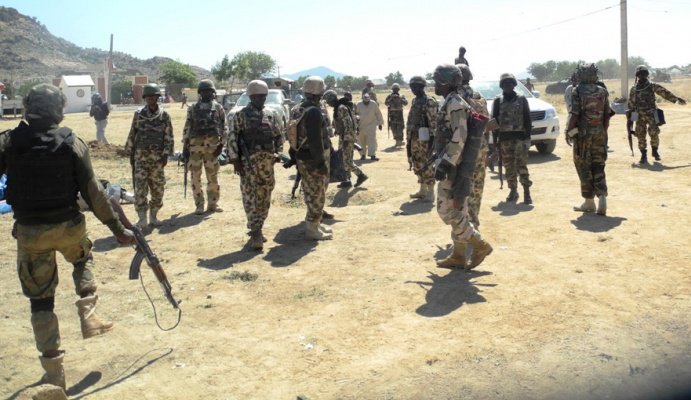
THE Nigeria Army authorities say troops are still in control of Gudumbali town, headquarters of Guzamala Local Government Area of Borno State, and that no life was lost following a recent attack by Boko Haram insurgents between Friday night and Saturday morning.

Director of Army Public Relations, Texas Chukwu, made this known in a statement on Sunday, urging residents of Gudumbali town to remain calm and resilient but also maintain a high level of vigilance to prevent fleeing Boko Haram terrorists from infiltrating and hibernating in their communities.

“Combined troops of 82 Division Task Force Brigade and 158 Task Force Battalion conducting Counter Insurgency Operations in North Eastern Nigeria, on Friday 7 September 2018 had an encounter with Boko Haram insurgents in Gudumbali in Guzamala Local Government Area of Borno state,” Chukwu stated.

“The encounter took place when the insurgents attacked the community, set some buildings ablaze and quickly withdrew from the community.

“However, no human casualty was recorded in the encounter. The troops have regrouped and normalcy has been restored. The troops have also been reinforced with additional troops to dominate the general area.”

On Saturday, the Deputy Governor of Borno State, Usman Durkwa, confirmed to journalists that Gudumbali had come under attack.

“It is unfortunate to confirm to you that there was an attack by Boko Haram extremists on a military base and other communities of Gudumbali,” Daily Trust quoted Durkwa as saying.

The paper also reported that residents of the town, many of whom had just relocated to their homes from various Internally Displaced Persons’ camps, fled into the bush or to nearby villages.

“As I am speaking with you, insurgents are moving about freely at the headquarters of Guzamala LGA, they have reclaimed the town,” Daily Trust quoted a source who witnessed the attack as saying.

“The attacks started last night and the insurgents burnt down the houses recently reconstructed; I believe many people may have been killed. Hundreds of civilians are now in Gubio town, many are in the bushes.”

On Twitter, Ahmad Salkida, a journalist who vast knowledge of the Boko Haram insurgency, said that the Nigerian military has lost more personnel to the terrorists in 2018 than it had in any other year since the insurgency began.

Another journalist, Mngusuul Uji, who also covers the military and the insurgency, recalled how enthusiastic the people of Gudunbali were when they returned to their homes earlier in the year. She added that all the enthusiasm and high hopes might have just been dashed.

Presidency describes allegations of fraud against Abba Kyari as fiction

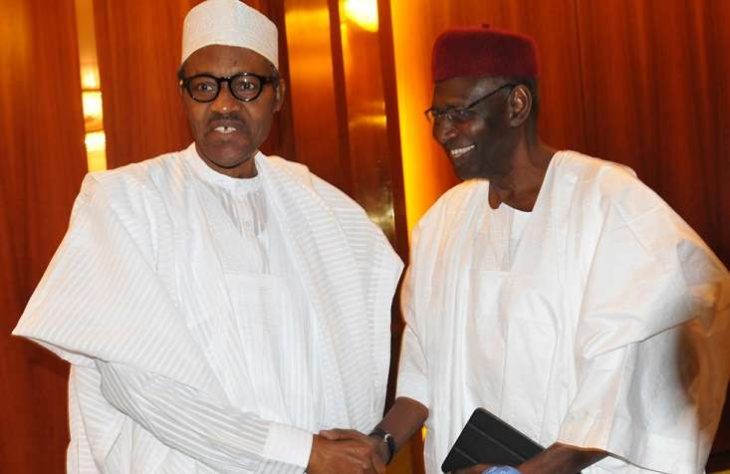
THE office of the Nigerian President has described allegations of procurement fraud against the Chief of Staff to President Muhammdau Buhari, Abba Kyari, as “fiction”.

This was contained in a statement issued by the Presidency on Saturday night.

Abba Kyari had been accused by one Ado Waziri, who claimed to be his cousin, of defrauding him to the tune of over N29 million, but the presidency said it took offence at the allegations as the said complainant have never had any meeting with the COS.

“We wish to state with full authority that the allegation is false and the Chief of Staff did not have any private meetings with the person making those allegations,” the statement read in part.

It also stated that the Bureau of Public Procurement (BPP) has denied a source who was quoted as allegedly being used as a front to defraud the complainant.

Furthermore, the statement added that “the supply of 15 Hilux vehicles for the Presidency was an unlikely contract to have been awarded, as it did not exist anywhere in the 2016 and 2017 budgets. How then could COS Abba Kyari have asked for money to award a contract that did not exist anywhere at all?”

“With a slew of crucial elections ahead, some politicians and their media agents appear to be working together to build pressure on the Buhari administration by wielding non-existent scandals against it,” the statement read.

The full gist

The allegation of contract fraud was made against Abba Kyari by one Ado Waziri, who told a radio station in Abuja – Human Rights Radio 101.FM, – that the COS offered him a contract in December 2015. The contract was for the supply of 15 Toyota Hilux trucks to the state house, and the total contract sum was N300, 725,000. But after Waziri completed the contract and payment were made, the COS refused to pay him.

According to Waziri, who spoke on the radio station’s popular programme “Brekete family”, he sold all his property, including his family house, as well as borrowed money from friends and relatives, in order to be able to raise an initial sum of N29 million to enable him to execute the contract.

Waziri said that after he had supplied the vehicles, the payment was made into the account of one Sani Ado, an official of the Bureau of Public Procurement (BPP), whom Kyari had introduced him to as one of his boys. It was Sani Ado that confirmed that the Money had been paid.

Waziri said Kyari had promised to give him 30 per cent of the entire contract sum of N300,725,000, but till date, he is yet to be paid the agreed sum, or even his initial capital of N29 million.

Magu, IGP Idris, Daura all complicit

Waziri also narrated how Abba Kyari used the Economic and Financial Crimes Commission (EFCC), the Department of State Services (DSS), and the Nigerian Police to frustrate all his efforts at getting justice.

At the EFCC, Waziri said all the petitions he wrote amounted to nothing because once the officials see Abba Kyari’s name, they became jittery. One female senior officer at the EFCC, who was in charge of the commission’s cybersecurity unit, was removed from her post when she insisted on going ahead with the case, according to Waziri.

When the case eventually got to Ibrahim Magu, acting Chairman of the EFCC, he said it was a family issue and asked Waziri to go to Abba Kyari and settle it since they were blood relatives.

At the Police Headquarters, a Deputy Superintendent of Police, Tijani Bulama, who had tried to investigate the case, was whisked away by a team of heavily armed DSS operatives and was detained for over a month at the DSS headquarters at the orders of the former Director General, Lawal Daura.

When Bulama was released by the DSS, he reported at the Force Headquarters only to be accused of plotting to kidnap Abba Kyari. The Inspector General of Police (IGP) Ibrahim Idris ordered that he should be detained for another one month. After he was released, he was transferred to Delta State.

Ahmad Isah, the anchor of the radio programme “Brekete family”, said he had tried all he could to get the COS to respond to the allegations, to no effect. Even the people who had promised to mediate on the issue, according to Isah, did not get back to him.

Isah said he had written a petition to the office of the Vice President, asking for the matter to be investigated.

Below is a youtube video of the radio programme during which Waziri made the allegations:

Nigerians on Twitter expressed diverse opinions about the issue, with many calling for Kyari’s removal from office, and subsequent prosecution. Others noted that the Buhari administration, which prides itself as transparent and not corrupt, is fast gaining notoriety for several scandals.

Read some of the reactions below:

https://twitter.com/effalixumab/status/1038321785459171328

https://twitter.com/Sam_Debayo/status/1038342213539901440

https://twitter.com/AMADICHIMA/status/1037824728893931521

On Friday, the EFCC said it had started investigations into the issue. Wilson Uwajuren, spokesman of the commission made this known via a text message he sent to ThePunch.

“The petition by Bako Waziri is being investigated by the commission. Any serious investigation takes time and it is presumptuous to conclude that the EFCC is non-committal simply because you did not receive an instant result. This is how investigations are done,” Uwajurent stated.

The commission did not say that it has concluded its investigations before the presidency released the statement exonerating Abba Kyari on Saturday night.

PUZZLE: Did US VP, Mike Pence write an anonymous editorial criticising Trump?

IF there is one puzzle the President of the United States of America, Donald Trump, would give anything to unravel, it is who is behind an anonymous editorial published by New York Times, roundly criticising the Trump administration.

The editorial was authored by a “senior official” within the Trump administration, who said that there are many of them within the administration who are working to frustrate many of Trump’s agenda.

“Many of the senior officials in his (Trump’s) own administration are working diligently from within to frustrate parts of his agenda and his worst inclinations,” the author writes.

“I would know. I am one of them.

“To be clear, ours is not the popular ‘resistance’ of the left. We want the administration to succeed and think that many of its policies have already made America safer and more prosperous.”

The author, who said that he/she is not a liberal operative, noted that he agrees with many of the policy goals of the Trump administration, but added, however, that those goals are being achieved in spite of – and not because of – the president.

The author further added that some senior officials of in the administration have thought about invoking the 25th Amendment, a constitutional provision that allows the vice-president and a majority of the Cabinet secretaries to vote to remove a president who is “unable to discharge the powers and duties of his office”.

President Trump, in a Tweeter post, described the article as “treason”, saying that NYT “must, for National Security purposes, turn him/her over to government at once!”

Since the editorial was published, there have been several denials by many of Trump’s senior officials with regards to who wrote it, but speculations are rife that Vice President Mike Pence may have authored the editorial.

Pence denies the allegation, with his spokesman saying that the NYT, as well as the author of such “false, illogical, and gutless” article, should be ashamed of themselves. “Our office is above such amateur acts,” wrote Jarrod Agen, Pence’s communications director.

Did pence author the article?

The BBC ran both manual and computerised analyses of the article and concluded that, to a large extent, the writing style, technique and usage of words of whoever wrote the NYT editorial, was consistent with several articles authored by Mike Pence in the past.

“For a start, the average length of the sentences in the column is very low compared with government statements: only 19.3 words per sentence…. There is one Trump administration official whose statements and speeches are always shorter than the others – sometimes significantly. His name is Michael Richard Pence, the vice-president of the United States of America,” the BBC wrote.

Before arriving at this conclusion, analysts studied Pence’s recent statements and speeches, as well as his works in the 1990s when he was a radio broadcaster.

Also, the anonymous author used one unusual word – “lodestar” – which the Vice President has been known to use.

Similarly, the analysts pointed out that government statements tend to prefer using the active voice than the passive voice, and this has been consistent with almost all government officials except for all of Pence’s statements. The anonymous editorial was written in the passive voice.

The analysts say they are still comparing more statements with the anonymous NYT editorial to see if there are more clues as to whom the author could be.

Sambo Dasuki being kept in a cell without toilet, says Jones Abiri

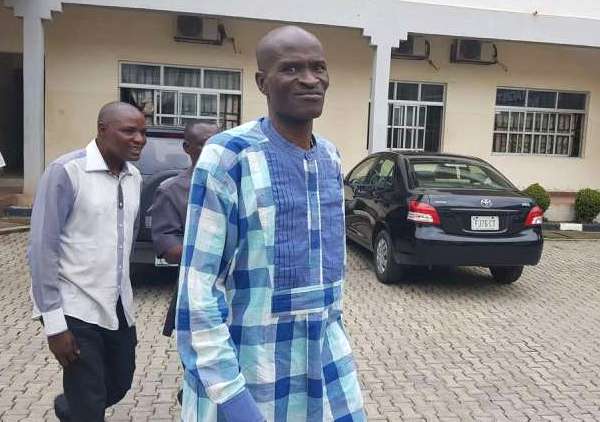
SAMBO Dasuki, former National Security Adviser (NSA) is being kept in a cell without a toilet facility, according to Jones Abiri, the Bayelsa State-based journalist that was arrested by the State Security Service (SSS) in 2016 and kept in custody until 2018.

Abiri revealed this during an interview with Premium Times in which he narrated what he passed through during his over two-year detention. Abiri said he and his co-detainees at the time only saw Dasuki when he is being led out to ease himself, as his cell had no toilet.

He said Dasuki’s cell was much more spacious than the cell in which he was being held alongside 25 others because he is “a big fish”.

“I met Dasuki in there but not in the same cell. You know he is a big fish but where he is now; there is no toilet, so anytime he is pressed, they take him outside; so through that process we were able to see him,” Abiri said.

“There was a time I physically met him and shook hands, he was coming to ease himself, by then I was at the room up.”

Dasuki has been in detention since 2015 after he was arrested by the DSS for allegedly misappropriating $2.1 billion meant for the purchase of arms for the Nigeria Armed Forces. The DSS has consistently refused to honour several court orders for Dasuki to be released.

Abiri, however, said that his own cell, though smaller, had a toilet. He described the cell as an underground facility that had no proper ventilation. Their source of air was a small standing fan that was in the room.

“We were about 26 of us that were in the facility and the room is about 12 by 12 which is not up to some prominent Nigerian’s parlour,” he said.

“That was where we were being kept and though the ground was tiled, nothing was on top of the tiles for us to have a conducive environment. We demanded for cartons before they could even bring in the carton for us to use part of it to lay our heads.

“There was no proper ventilation since the facility was underground, there was no natural breeze coming into the room for you to have air to breathe but one standing fan was kept for the 26 suspects.”

Abiri also said he was tortured when he was first brought into the cell.

Jones Abiri at the Magistrate Court Premises in Wuse Zone 2, Abuja.

He narrated: “When I was arrested on the 21st of July and brought to their office, a state command in Yenagoa; my eyes were blindfolded and they asked me to stay glued to the wall. So I did that but did not know what was happening.

“The next thing I heard was something that struck on my back and I fell down. That is why my spinal cord, (pointing at his waist) this my waist; I cannot stand for a very long time. That is why I want to hurriedly go home to ensure that proper medication is administered before the next date of my trial.

“So I was tortured and through that torturing, they were able to achieve their aim. I told them that I am not a militant because of a story that I wrote.

“I was against the governor, most especially Bayelsa governor and the federal government. Some of the stories that were published in my newspaper were ‘antagonistic’ and many of them were investigated before it was published and some were gotten online.”

Abiri corroborated what former Chairman of the National Human Rights Commission, Chidi Odinkalu, told the ICIR on Thursday, that several hundreds of people are still being held in DSS custody, many of them have spent two years and above without being charged to court, and without their family members knowing their whereabouts.

“There are people with ordeals that have been there for the past 2, 3, 4, 5, 6, 7 years without trial,” Abiri said.

“The whole story has been made public, if the DSS is denying what I am saying, they should allow human right bodies and other NGOs, the media to visit their facility, and personally interview and find out one or two things about those suspects that they have arrested. They would narrate their ordeals.”

Abiri said he saw his wife and children for the first time since July 2016 when some journalists brought them to see him in Kuje prison in August this year after the DSS eventually charged him to court and he was remanded.

World remembers Leah Sharibu as Nigerian government feigns ignorance

It’s been 200 days since Leah Sharibu was kidnapped by Boko Haram fighters, alongside one hundred and nine other girls from their school in Dapchi, Yobe State, North East, Nigeria, on February 19, 2018. One month later, 104 of the girls were released, five had died, but only Leah remains in captivity because she refused to convert to Islam.

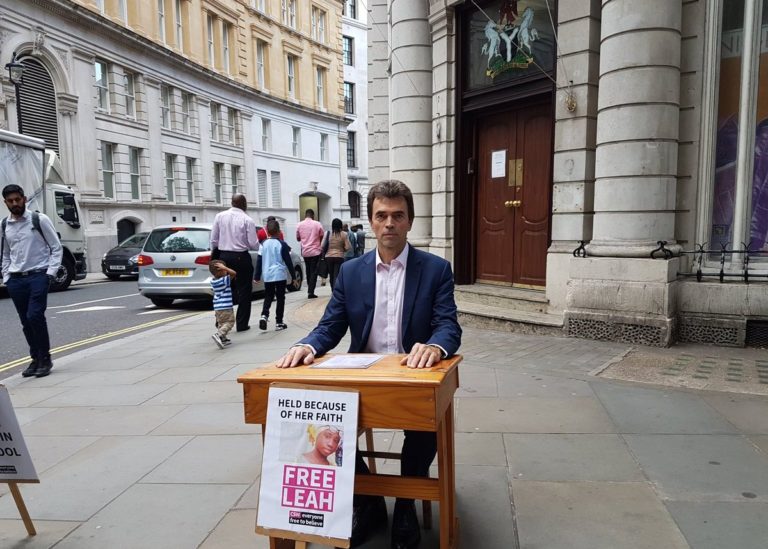
On Thursday, in faraway London, United Kingdom, there were protests at the Nigerian Embassy, organised largely by non-Nigerians  – an advocacy group called Church World Service (CWS) – to put pressure on the Nigerian government to intensify actions to get the kidnapped girl out. However, while the protest was all over the social media (Leah Sharibu trended on Twitter all Thursday), no mention of the development was made by officials of the Muhammadu Buhari-led federal government.

The Buhari administration maintains a robust presence on the social media. Asides having an active Twitter account, Buhari has a personal assistant and a special assistant on the “new media” –  Bashir Ahmad and Tolu Ogunlesi respectively – both of whom have verified handles on various social media platforms. There is also a Twitter handle for the office of the President. Similarly, Vice President Yemi Osinbajo also operates a personal Twitter handle; both of Buhari’s aides on media and publicity, Femi Adesina and Garba Shehu, as well as Osinbajo’s spokesperson, Laolu Akande also have verified social media handles, yet all of them feigned ignorance of the worldwide protest for Leah Sharibu’s release.

The protesters in London on Thursday included a sitting member of the UK Parliament, Tom Brake; a British missionary (according to TheGuardian Nigeria) who worked in Northern Nigeria years ago, Graham Weeks; and former aide to ex-President Goodluck Jonathan, Reno Omokri. They will take turns – for 200 hours from Thursday signifying Leah Sharibu’s 200 in captivity –  to sit on a school desk in front of the Embassy, demanding that the Nigerian government must free her as it freed her classmates.

When the Dapchi girls were released in March this year, the Minister of Information and Culture, Lai Mohammed, told journalists that no ransom was paid to the terrorists, but it turned out to be a lie according to a United Nations Security Council report, which stated that the girls were released after the FG made “large ransom payments” to Boko Haram.

Graham Weeks, a former missionary in Northern Nigeria, also took part in the protest.

“There cannot be a clearer example of someone whose human rights are being ignored than that of Leah who is being detained just because she has maintained her Christian faith,” the UK MP, Brake told CNN in an interview.

Also speaking with CNN, Leah’s father, Nathan Sharibu, expressed his gratitude to the people all over the world who, even having met his daughter, are agitating for her release.

“I am very happy the way Christians around the world have been standing by Leah,” he said. “This man (Thomas Brake) has not met my daughter or her family before, and he is calling for her release. We are so grateful.”

The protest is also taking place in the Nigerian Embassy in Madrid, Spain, on Friday.

President Buhari had on several occasions said that his administration was doing its best to secure Leah Sharibu’s release, but many Nigerians have expressed doubt over the President’s comments. Many wonder why it is taking longer to free one individual when over one hundred were released within one month.

Leah marked her 15th birthday on May 14, in Boko Haram captivity. The insurgents are yet to release over one hundred of the schoolgirls kidnapped from their school in Chibok, Borno State, in April 2014.

A former aide to ex-President Goodluck Jonathan also took part in the protest.

On August 27, Boko Haram released Leah’s recent photograph and an audio clip in which she was heard appealing to President Buhari to take pity on her and rescue her.

Below are other twitter posts from all over the world pleading for Leah Sharibu’s release:


It takes four hours to see a doctor at Wuse District Hospital, Abuja

NOT less than four hours is what it takes a patient to see a doctor at Wuse District Hospital, Abuja. For three days, The ICIR observed patients spend several hours in the waiting area.

Being her first time in the hospital, Aisha Aminu (real name withheld) was instructed to pay N700 to the account section to open a medical file for her sick baby.

With the baby on her back and a bag at hand, Aminu joined a queue of about 30 persons around 10 am. The cashier, a woman who appeared to be in her fifties, kept adjusting her eyeglasses as she collected monies, input data on the system and printed out receipts.

Those on the line started complaining because the queue moved slowly.

“The hospital should bring young persons, at least three, to do this job,” said a person who was behind Aminu.

Around 11:05 am  Aminu was able to make the payment to open a file in the hospital.  On getting to the medical record section with her receipt, the man in charge of the section was leaving his seat. When he came back after about 15 minutes later, and the people in the long queue that has been formed asked him why he had wasted their time.  He shouted: “I’m not a computer, I went to the toilet.”

Eventually, she was attended to around 11:37 am and a file was handed to her.

She proceeded to the paediatrics clinic to submit her file. Here, she joined a long line of patients waiting to see a doctor. She was only able to see a doctor around 2:30 pm. But her child’s problem was not yet attended to.

“I have to come again tomorrow,” Aminu told The ICIR, adding that the doctor she was referred to was not in the office.

If Gwarinpa General Hospital had a paediatrician, she would not have come to Wuse where patients were not given prompt attention, she said.

Other mothers had similar complaints.

Another mother at the paediatric ward said to no one in particular: “I have been in this hospital with my baby since 7 am, up till now(1:00 pm), I’ve not seen any doctor. What if the child is about to die? You people should pity us now.”

In the paediatric ward on Tuesday, there were only two doctors attending to patients. People lamented that the number of doctors is low compared to the huge number of patients that troop into the hospital everyday.

“They should request for more doctors because we are suffering here,” a nursing mother complained. “If you talk, they will shout at you. Since 11 am, I have done the vital signs, I am  yet to see a doctor at 2:03 pm.”

The ICIR observed that at a certain time, there were no more seats for patients, so every new arrival were standing up in the waiting area.

A senior staff of the hospital who spoke with The ICIR said the facilities which have been in Wuse General Hospital for years have not expanded while the population of the patients keeps increasing.

She said the hospital tends to be more patronised because it is a public hospital at the hub of Abuja, and it is close to the Wuse market. And with the increasing population, the hospital cannot provide adequate service for patients, she said.

Another staff of the hospital said the e-health system that was recently adopted by the hospital has been challenging, therefore,  has not quickened the hospital processes as expected.  She said the computers used for keeping medical records sometimes fail to respond, or the network fails to connect.

UniAbuja suspends SUG election over cult violence

0

By Adedamola Akinleye

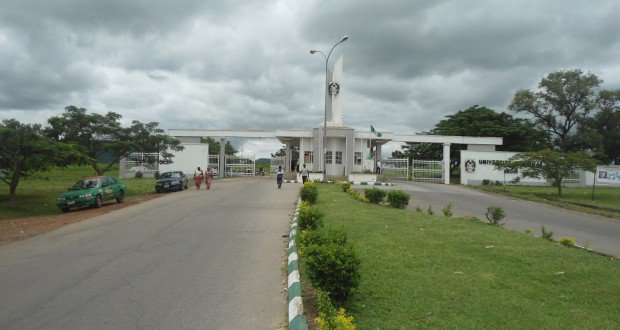
THE University of Abuja has suspended indefinitely the election for the Students Union Government (SUG) over escalating violence on campus.

A circular signed by Alanana Otaki, the Dean of Students Affairs, did not specify how long the suspension will last.

“The University of Abuja management in its emergency meeting held on August 30, 2018 reviewed the security situation in and around the students’ hostels in the mini campus Gwagwalada and directed that the 2018 student union government (SUG) election be suspended till further notice,” the circular read.

“The suspension of the election activities is as a result of the security challenges within the university and its environs.  The university management is assiduously working round the clock to restore normalcy in the overall interest of the students and the entire university community

“As soon as normalcy is fully restored, the suspension will be lifted for full blown election activities.”

Students were advised to focus on their forthcoming second semester examination and to report any security threat to the appropriate authority for necessary action.

Recently, cultists killed a student and critically injured another student at the university.

The incidence occurred about two weeks ago at the Old FCDA boys hostel in the university’s mini campus in Gwagwalada, Abuja.

Students said the killing was sparked by student artist who allegedly made disparaging statements in his lyrics against a particular cult at an event organised by Economics students at the Gwagwalada mini campus open air theatre. Thereafter, the event was disrupted by the rival cult and fighting broke out.

Days later, the fighting degenerated into a shootout by the warring cultists, resulting in the killing of a 200 level Sociology student who was shot in the male hostel but died while being taking to the university’s teaching hospital. Another student in the hostel had a machete cut and he is currently receiving treatment in the hospital

The Dean of Students Affairs told The ICIR that the management of the university was aware of the attack by identified cultists, adding that the university had taken necessary actions to apprehend the culprits and prevent future occurrence.

Otaki said about a week after he was appointed to his current position, the school environment started experiencing violence which culminated in the killing of a student.

“The student was shot in broad daylight. In fact, when the police saw the corpse, they called it summary execution,” Otaki said.

He said the school had met some students to help in identifying the perpetrators, adding that the students were not helping with useful information that could lead to the apprehension of the cultists.

“These suspected cultists are not spirits.  They are students. They live together. They know who is who among themselves, but they are not willing to talk, and so, there is only little we can do,” he said.

Otaki pointed out that that the forth-coming students’ union government election could be responsible for creating unnecessary tension on campus.

“The election was supposed to hold in a couple of weeks from now, but the rivals and oppositions could come up with anything to get to power. We will not allow that in the University of Abuja,” he said.

“Those things their fathers are doing out there will not be allowed here and for this, the school authorities have decided to suspend the election till further notice.”

He said the university had constituted a security panel, headed by the Deputy Vice-Chancellor (Academics) of the school.

Otaki said the security panel comprised of the Department of State Security (DSS), Department of Military Intelligence (DMI), the Nigerian Police Force, Nigeria Security and Civil Defence Corps (NSCDC) and the National Drug Law Enforcement Agency (NDLEA).

He said the investigation into the security breaches is still ongoing, stressing that anybody involved in the violence will be handed over to the police for further prosecution.

Bashir Obasanjo, the SUG president, told The ICIR that the school authority had been unable to curb the rising cases of cult violence on the campus.

“The federal government should please help the school by providing maximum security in and around the institution vicinity because the school authority said they will shut down the school for a while

“I told them that, what is the essence of telling students to go home while the situation has not been dealt with and they resume back and such bad act still continue. But necessary measures have been taken but not saying them now because they are confidential.”


Remain calm, FCT authorities urge residents after earth tremor in parts of Abuja

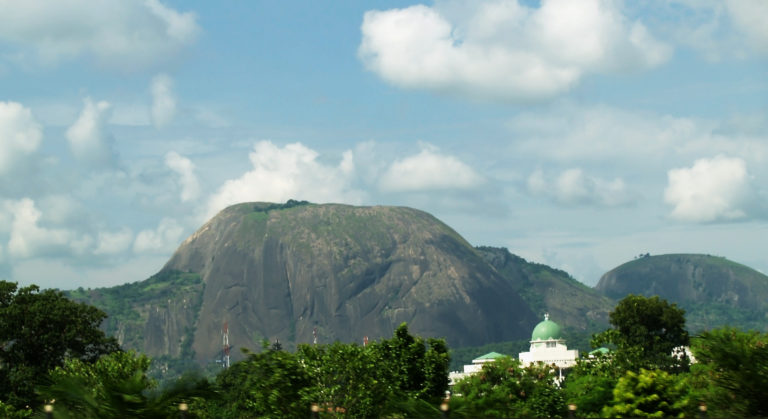
THE Federal Capital Territory Emergency Management Agency (FCT EMA) has told residents of Abuja and environs to remain calm after an earth tremor was felt in some parts of the capital city.

Residents in several parts of Abuja, including Jabi, Maitama, Mpape, Katampe, and Gwarimpa had taken to the social media to say that they felt their houses shake on Wednesday and Thursday, while some called the FCT EMA to register their concerns.

Former Chairman of the Bureau of Public Service Reforms, Joe Abah, said the vibration in his house in Jabi felt like the day the United Nations building in Abuja was bombed in 2011.

“I felt my house in Jabi, Abuja, vibrate around 9 pm last night. It didn’t feel like an earth tremor. It was more like an explosion that pushed air, rattled the windows and shook chandeliers. Almost exactly like when the This Day Office in Utako was bombed some years ago,” Abah tweeted.

In a statement on Friday, the FCT vibrations felt across the city could be as a result of an earth tremor, which it described as “a sign of seismic movement within the earth”, usually caused by “sudden breaks along a fault line which results in sudden release of energy that makes the ground to shake”.

An earth tremor can also be caused by “stress in underground rocks and may be due to rock blasting and mining activities”.

The Director General of the FCT EMA, Abbas Idris, who signed the statement, urged citizens not to panic or think that an earthquake was imminent. “There is no likelihood of any earthquake disaster in Nigeria as we are not in earthquake zone,” Idris stated.

He urged residents to calm down as the abnormal situation will soon stop. In any case, Idris gave tips on what people are to do during earth tremors.

“If you stay in a building, locate a safe room, drop down and take cover under desks and tables and hold on tight to it. You should stay away from windows and objects that may fall.

“If you are outdoors, find a clear spot away from trees buildings and power lines.

“If you are in the car, slow down and drive to a clear place, stay in the car until the shaking stops,” Idris advised.

Osun needs a surgical operation to come out of coma, says Omisore

THE governorship candidate of the Social Democratic Party (SDP), Iyiola Omisore says Osun state needs a surgical operation to come out of the state of coma.

Omisore said this at the party’s mega rally held at the Freedom Park in Oshogbo, the state capital, on Thursday.

At the rally, he asked the citizens of Osun to vote for him comes September 22, 2018 – the date set for the Osun governorship election—  assuring to resolve all the crisis the ruling All Progressive Party led by Rauf Aregbesola had caused in the state.

He said his governments will bring sanity to the economy of Osun State. “We are going to partner with people not to wound them,” Omisore said.

Omisore asked residents of the state to vote for the party and ensure that their votes are not bought or rigged.

He warned the Independent National Electoral Commission (INEC) not to compromise on the election. “Until Omisore is declared as the Governor of this state, our votes will be monitored,” says Omisore.

He promised to provide drugs to hospitals, to promote education, to pay workers and pensioners arrears accordingly.

National Chairman of the SDP, Olu Falae, at the rally, officially handed over the party’s flag to Omisore and his running mate, Azeez Yemi Lawal.

Falae in his remarks described Omisore as the best man to govern Osun State.  He added that Omisore experience as a one-time deputy governor of the state, and chairman of the appropriation committee in the Senate made him the most experienced of all the candidates.

Candidates contesting for the governorship office in the state are 48 individuals from various political parties, according to the INEC.