Home Blog Page 255

Farming activities crippled as gas flaring takes toll on Edo community

RESIDENTS of Gelegele, a coastal community in Edo State, blame persistent gas flaring for crippling their primary sources of livelihood— fishing & farming—and for exposing them to serious health risks. This report highlights how years of pollution from gas flaring, according to locals, have continued to devastate the environment and endanger lives, despite their outcry.


It was a sweltering Friday in Gelegele, a quiet local community in Edo State. A group of topless kids splashed water on one another with ecstasy, their laughter cutting through the thick afternoon heat. Some rested in an old canoe by the shore, tired yet reluctant to leave the bank. A group of women loaded bags of Garri (made from cassava) into canoes headed for neighbouring villages. Not far from them, under a small patch of shade, sat Serah Awowu, a native of Gelegele, who had spent her entire life in this riverside community.

“As you can see, life here is no longer what it used to be. The kids have taken over the water since there are no longer fishes because of the fire (gas flare),” Awowu lamented. She sat on the wooden bench placed under the makeshift tent, wiping sweat from her forehead as the midday sun beat down on the Gelegele riverbank.

Serah Awowu’s fishing business suffered due to gas flaring. Photo: Nurudeen Akewushola/The ICIR

She told The ICIR that they have had problems fishing in the community, largely due to environmental concerns occasioned by gas flaring activities in the heart of the community by an oil firm. Her friend, who sat quietly beside her, Susan, said her own family has had to endure severe heat because their house is located very close to where the flaring occurs.

Gelegele is a riverside community in the Ovia North-East Local Government Area of Edo State, Nigeria. Traditionally, the community’s economy has been anchored on fishing and agriculture (mainly cassava), leveraging its proximity to the Ovia River and fertile lands. However, the discovery and subsequent exploration of oil resources have altered this dynamic.

The firm called Dubri Oil Company Limited (DOCL), which took over operations from the American Phillips Oil Company, owned the flare stack in the heart of Gelegele. Residents blamed the continuous gas flaring from the flare stack for severe environmental degradation and socio-economic challenges.

Gas flaring is the wasteful burning of natural gas from industrial oil extraction and production. The extraction process releases various environmental pollutants, including greenhouse gases, carbon dioxide, methane, and black carbon. The World Bank has said that Nigeria and nine other countries account for 75 per cent of global gas flaring.

The nine other countries include Russia, Iraq, Iran, the United States, Venezuela, Algeria, Mexico, Libya, and China.

Gas flaring negatively impacts the climate and environment. It releases CO2, contributing to global warming. It also causes acid rain, which affects the productivity of the soil for agriculture.

A field assessment showed that the distance of the Dubri Oil Company flare stack to the farthest residential building in Gegelele is less than 600m, and the closest residential building at Gelegele to the flare stack is about 20m.

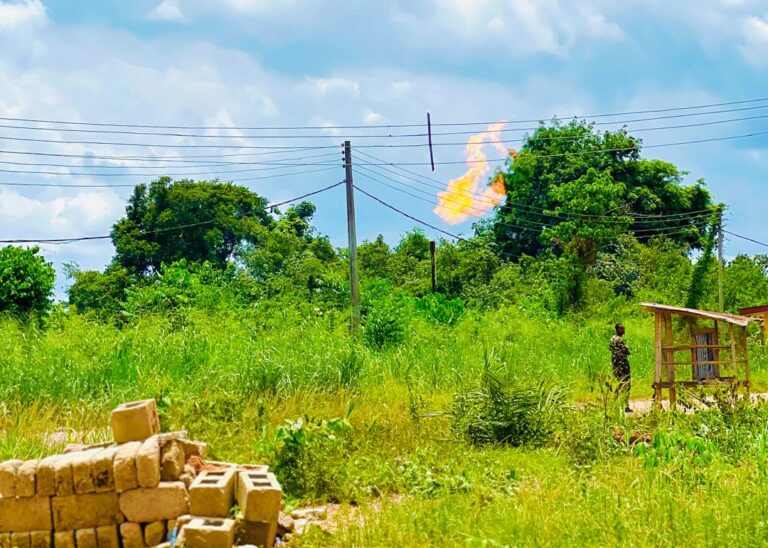
During a visit to the company on April 25, fire was seen gushing from the flare stack situated within the community. Residents who spoke with The ICIR confirmed that this was a daily occurrence.

Gas flares coming out from the flare stack situated at Gelegele community by Dubril Oil Company/ Picture taken on April 25, 2025 by Nurudeen Akewushola/ ICIR.

They said the situation has had detrimental effects on their health and livelihoods. They report experiencing excessive heat, skin diseases, and eye problems, which they attribute to toxic emissions from gas flaring activities.

According to them, the situation has also caused a decline in aquatic life, further affecting fishing activities. They added that agricultural productivity has dropped due to soil degradation, leading to food insecurity and economic hardship. Despite these challenges, residents say they have received minimal support or compensation, prompting renewed calls for an end to oil and gas exploration in the area, as well as demands for environmental remediation and restitution.

Gas flaring robs women of their livelihood 

Both Awowu and Susan complained that there has been a gradual decline in their income over the years due to the gas flaring activities, and they have had to make do with other menial jobs to survive and feed their families.

“This gas flare is killing everything. When I was small, we used to take our fish to markets in other communities to sell,” she recalled, adding, “Now, there’s nothing left to sell.”

“The fishes have disappeared. Before, we used to catch big fish. We would go to the market and sell to make a lot of money. Many of our people are now hopeless, and it all began when these oil and gas people came around,” Awowu said.

Other families like Awowu’s told The ICIR that they have received no tangible benefits from the companies operating in their backyard. She said not even when hope briefly flickered for her daughter, who was shortlisted for a scholarship under the company’s scholarship programme.

Despite the promise, the scholarship never came through. Timi, her daughter, is now a student at Delta State University, and Awowu, with limited means, is left to shoulder her education costs, amounting to over N300,000 a year.

Vero Abagi, 81, who has been fishing in the community for two decades, is also forced to contend with the negative impact of gas flaring. She recalled that the situation continues to worsen over the years due to the flare on the river, which makes it hard for fish to survive.

Vero Abegi used to fish in the Gelegele river but can no longer do that due to environmental issues. Photo: Nurudeen Akewushola/The ICIR

“We can’t fish like we used to before because the water is polluted. If you went to the river before, your rubber would be full, but now there are no fishes again,” Abegi said, her eyes sunken and tired.

Abegi recalled, “Catching fish used to be easy, but now it’s very difficult. Over ten years ago, we could catch up to one board of catfish at a time. It’s the fire (gas flare) that’s affecting the water; not that the water is drying up. The fish now swims far away from the community. If you go farther away from here, you might still be able to catch some.”

Studies have shown that gas flaring releases air pollutants such as nitrogen oxides, carbon oxides, and sulfur oxides. These pollutants increase the acidity of the soil, making it difficult for vegetation to grow around flare sites. They also damage mangrove swamps and salt marshes, reduce plant growth, degrade soil quality, and lower agricultural productivity.

In some areas near gas flares, there is no vegetation at all due to the combined effects of intense heat and acidic soil. Similarly, a study on the impact of gas flaring on crop farming in the Niger Delta found that it significantly slows down crop growth.

Patience Gijere, a 42-year-old farmer in the community, is one of the victims. She explained that farming has not been easy for her due to the impact of the gas flares on her farmland located a few kilometres from the company.

Patience’s crops no longer yield faster due to the impact of gas flaring. Photo: Nurudeen Akewushola/The ICIR

“Our crops used to grow well, but that’s no longer the case. I just came back from the farm. When it’s time to harvest cassava, you will notice the stems are dying and the leaves look yellow instead of green. This is because of the gas flaring. It’s what is spoiling our crops.

“I used to make up to one million naira to two million naira if I farmed one acre of land and got up to 50 bags of garri, but now I get only ten bags at most. It hasn’t been easy,” she said.

Residents live under excessive heat, battle ailments 

Doris Obi, another resident of the community, told The ICIR that residents battle rashes, severe headaches, dim vision, weak legs, and excessive heat due to the environmental crisis in the community.

“The heat in this community is terrible,” she lamented. If a fair-skinned person stays for just a month or two, their skin darkens completely,” she lamented.

Obi has lived most of her life in the Gelegele community. After completing her primary and secondary education, she left for some years but returned about seven years ago and has watched her community and health deteriorate under the impact of environmental pollution.

Doris Obi developed a vision problem after moving to Gelegele community. Photo: Nurudeen Akewushola/The ICIR

According to Obi, the pollution has also affected her eyesight. She explained that before moving back from Lagos in 2017, she had no vision problems. However, after a few years of living near constant gas flaring, her sight began to deteriorate, and she now relies on eyeglasses provided by a non-governmental organisation.

“I wasn’t using glasses before. But after coming back here, my eyes got worse. An NGO brought people from Benin who tested us and gave me these glasses. They said the environmental pollution is affecting our eyes.”

Obi said the gas flaring from oil operations has affected people’s health and their source of livelihood, as the particles released into the air have contaminated their environment, including the rivers and farmlands that once supported fishing and farming.

“The gas flare releases particles that spread everywhere, causing different kinds of diseases. Even our drinking water is not properly treated, and the contamination affects our health, making us age faster and grow grey hair early.”

She lamented the lack of basic infrastructure in the community, saying the community health centre lacks essential drugs and qualified doctors, while the roads are in terrible condition.

“When my husband was sick, there was no drip at the health centre. We had to buy 7Up and mix it with salt as a substitute. We badly need drugs, doctors, and proper healthcare services,” she said.

Godsey Kororo, a community elder and 60-year-old retiree, spent 25 years working with the company. He joined the company in 1995 and retired in 2020. He said,  “The flare is not good with my skin. It is giving me heat in my body. Sometimes in the night, my body feels hot. The environment in this place is very hot. Do you know that this place is polluted everywhere? If you buy a zinc roof for your house, within one month, the zinc will rust.”

Godsey Kororo. Photo: Nurudeen Akewushola/The ICIR

He added that the heat and the pollutants in the air have caused various health issues for the people, including skin problems and respiratory difficulties.

“People cannot even kill fish in the river. There is no fish. When I was young, people went to the river to catch fish. But now, no fish. I am telling you,” he said, highlighting how the pollution has destroyed the environment and made it impossible for the community to rely on traditional sources of food.

“We are not enjoying anything as if there is no oil company here. Do you know how much they pay to the community? Just meagre amounts as gas flaring compensation,” he said.

Godsey expressed frustration with the lack of benefits for the residents. He said that while the company pays compensation to the government for the gas flaring, the funds are not being properly distributed to the community, leaving many without the promised support.

The situation of Gelegele residents mirrors the dire conditions in Nigeria’s Delta region, which constitutes the majority of the 2 million people living within 4 kilometres away from flare sites across the country and are exposed to the black fumes and toxins emitted.

They face the risk of respiratory issues, including asthma, cough, and breathing difficulties, as well as eye and skin irritations, and prolonged exposure to gas flaring activities compared to communities without such exposure.

“The impact is minimal,” says company’s supervisor

Dubri Oil Company Limited (DOCL) is a Nigerian-owned oil company, created in 1987. They took over the oil field after an American company, Phillips Oil, left. Since then, Dubri has been running oil exploration activities in the community.

Speaking with The ICIR, the supervisor of the company, Banigo Da-Onamata insisted that the company is adhering to environmental guidelines in its operation and giving back to the community.

“If you go round the Niger Delta, it’s a common thing. Although things are changing, and with time, we also have plans ongoing. Within the shortest period, gas flaring will be a thing of the past, meaning that as you are seeing today, you might not see it tomorrow.”

Dubril Oil Company. Photo: Nurudeen Akewushola/The ICIR

He said the company has tried to reduce the volume of the gas being flared and also engaged contractors who come to the community to analyse the impact and advise the company.

“They go to the water and take the samples. They also check community members. It’s a procedure in the oil system,” he said. “With the data that we have over time, the impact has been minimal. I don’t think we have ever had issues in Gelegele and that’s why we always engage the service of professionals.”

“The impact is even like zero. It’s not something that causes harm.  For instance, you won’t feel it until you get close to it for some metres. Even if you go to other parts of Benin when there are no flares, there’s heat.”

He said the company has impacted the community in terms of healthcare and education.

“There’s a hospital built by the company for the members of the community. We have also offered scholarships to indigenous members of the community.”

However, a visit to the clinic shows that it lacks manpower, a laboratory and adequate drugs. The ICIR gathered that the hospital has four personnel.

The officer in charge of the hospital, Raphael Ekano, explained that many residents complain of heat rashes, arthritis, cough and Tuberculosis due to inhaling flames from the gas flare.

Health worker in charge of the Gelegele community confirms that residents report illnesses associated with gas flaring. Photo: Nurudeen Akewushola/The ICIR

He explained that due to the lack of a laboratory, there are issues that the healthcare centre may not be able to detect. He bemoaned the inadequate supply of drugs and the shortage of manpower in the hospital.

“This is a primary healthcare centre in which we handle so many cases. It’s only when we get cases that we cannot handle that we refer them. The problem with this health centre is that we don’t have a Laboratory, and because of this, there are some cases that we cannot handle, such as Anaemia. We need to refer them. Like last week (at the time of interview), we had some cases of diarrhoea. In three days, I didn’t sleep at all. Both day and night, I treated like eight people for diarrhoea. We thank God that everything is under control.

“Tuberculosis is one of the issues we have in this community, and this is aggravated by inhaling the gas flames. We also have many people complaining of arthritis, joint pains and so on and we do treat them.”

He said that gas flaring has intensified the heat in the community, which sometimes causes residents to develop health issues such as skin rashes.

One of the ‘expired’ drugs recently supplied to the hospital

“The heat is too high in the community,” he lamented. “People are also developing coughs due to constant exposure to fumes from gas flaring. It doesn’t stop there — gas flaring can severely affect the lungs and even contribute to illnesses like tuberculosis. For individuals with pre-existing lung conditions, inhaling these toxic substances can worsen their health drastically.”

What has government done?

Although Nigeria has pledged to end gas flaring and introduced fines for oil companies that violate this policy, gas flaring continues. As a result, the health of people in the Niger Delta like the Gelegele remains at risk.

A study published in the International Journal of Scientific Reports shows that gas flaring poses damage to human health and the environment, making experts call for the need to implement measures to reduce or end gas flaring to protect the communities living near flaring sites.

The study stated that the level of ambient air pollutants in the Niger Delta region like Edo relative to Lagos State revealed that pollutants levels are uppermost in the former where the majority of flare sites are. The author maintains that some of the greenhouse gases emitted at flare sites contribute to global warming. The environmental consequences include food insecurity, a higher risk of disease, acid rain, corrosion of buildings from polluted rainfall, and increased costs from extreme weather events due to airborne toxins such as benzene.

Nigeria enacted the Petroleum Industry Act in 2021, with some of its sections designed to decrease gas flares and address the environmental and social problems caused by excessive flaring. Its goal is to safeguard the local environment, conserve resources, and ensure human safety by enforcing emergency shutdown procedures.

It states that unauthorised flaring is an offence and requires companies that flare to pay a fee, which would be used for environmental remediation and to provide relief to the affected communities. However, experts have said this approach is ineffective because the penalties are not weighty enough to be a deterrent as it enables giant companies like to continue to flare despite the impacts on the environment.

In December 2024, the House of Representatives, passed for second reading, a bill for an act to prohibit gas flaring, encourage commodity utilisation and provide for penalties and remedies for gas flaring violations.

The bill sponsored by Babajimi Benson, seeks to prohibit the flaring and venting of natural gas, except in strictly regulated circumstances, while encouraging the utilisation of gas resources to foster economic growth and energy generation.

River in Gelegele community. Photo: Nurudeen Akewushola/The ICIR

The proposed legislation aims to mitigate the environmental, health, and economic impacts of gas flaring, aligning Nigeria’s oil and gas operations with international climate change commitments.

Whoever violates the proposed law would face stringent penalties, including fines of $5 per 1,000 standard cubic feet of gas flared and potential suspension of operations for repeat violations.

The current penalties for gas flaring in Nigeria officially stand at $2 per 1,000 scf. Currently, companies producing more than 10,000 barrels per day (bpd) pay a fine of $2 per 1,000 scf of gas flared, while companies producing less than 10,000bpd pay a fine of $0.5.

Efforts to reach the Edo State Ministry of Environment proved abortive at the time of filing this report. The ministry’s Public Relations Officer, Joy Efekwe, said the director in charge of the matter was not on seat.

In August 2024, the state government told Dubril Oil Company to stop gas flaring in the community and do more to alleviate the suffering of the people by focusing on Corporate Social Responsibility.

The government urged the company to capture and liquefy the gas being flared in the centre of the community with modern technology to prevent the women from health hazards. However, checks by The ICIR show that the company continues to flare gas within the community despite the order.

Expert calls for stricter penalties

Analysts have emphasised the need for more stringent enforcement of existing policies and laws to curb gas flaring further and increase penalty collection.

“Overall, Nigeria’s gas flaring activities have considerably reduced over the years, as a result of certain government policies that have been put in place to incentivise the reduction of flaring,” Joshua Olorunmaiye, an oil and gas lawyer had told Business Day.

“However, it would seem that not enough is being done to enforce policy direction and laws that are meant to stifle incessant gas flaring.”

An Environmentalist and Executive Director of Gbolekekro Women Empowerment and Development Organisation (GWEDO), Cynthia Bright, urged the government to enforce stricter penalties for gas flaring and ensure that oil companies are held accountable for the social and environmental damage they cause.

She explained that years of oil exploration and gas flaring have left women and children in the Gelegele community battling health and environmental challenges.

She pointed out that the companies only require to trap the gas and channel it for other uses, such as electricity, rather than flaring it, which is detrimental to the environment.

Cynthia, who began her advocacy journey in 2017, explained that when she first arrived in the community, residents were unaware of the dangers of gas flaring.

“When I got to Gelegele, I met women using gas flares to dry pepper and the children were using it to dry clothes because they saw it as normal fire,” she said, adding, “We had to educate them that it was not a good practice because they didn’t know the risks.”

She also highlighted several health conditions prevalent among residents, such as arthritis, frequent fever because of heat, skin rashes, miscarriages, and partial blindness due to the gas flaring.

According to the Petroleum Industry Act (PIA) 2021, particularly Chapter 3, Sections 234 to 257, oil companies operating in host communities like Dubril Oil are required to establish a Host Communities Development Trust, funded with 3 per cent of their annual operating expenditure. This Trust is designed to finance projects that promote the socioeconomic development of host communities, including the provision of healthcare, education, and infrastructure.

However, despite this legal obligation, Cynthia described the Trust intervention as inadequate. She said they once received nearly expired children’s syrups and a few packs of paracetamol without providing medical personnel or proper healthcare support. 

“The community rejected the expired drugs after we educated them about the dangers,” she said.

Despite continuous extraction activities, Cynthia said the Trust has failed to provide basic amenities like clean water or functional healthcare facilities. She criticised the government’s handling of gas flaring, citing a conversation with a principal engineer in the company who denied polluting the environment.

“He now said they are working towards zero emissions, and I asked, “what are you emitting that you are working towards zero emissions? You can see that it is a very critical issue. Is it that they are aware, and they are pretending like they are not aware, or they don’t even know?” she asked.

“These companies do not care. Even the government does not care. Whatever happens in Niger Delta or Gelegele community is none of their business as far as money (fine) is being channelled to their treasury.

“Don’t forget that these community people were so impoverished, but they were enjoying their impoverished life because when they went to the river, they would see fish, and some of them would take them to another community to sell those fish.

“My late mother-in-law built her house through fish trading, but today, that is no longer possible,” she said.

Cynthia urged the Federal Government to prioritise the well-being of the citizens over profit and look into the policies and framework around gas flaring in Nigeria.

“The government should look at the frameworks and policies and see how they can rephrase them. If you say gas flaring is prohibited, let it remain like that. What is the essence of putting a fine? Putting a fine means it is just a joke because these companies will continue to pay the fine.”

Tinubu honours Army Colonel who opposed Babangida for annulling June 12 presidential poll

0

PRESIDENT Bola Tinubu has awarded the national honour of Commander of the Order of the Federal Republic (CFR) to Abubakar Dangiwa Umar, a retired colonel, in recognition of his contribution to the fight for democracy during the June 12, 1993, movement.

Tinubu made the announcement on Thursday, June 19, in Kaduna while commissioning projects in the state.

He apologised to Umar, widely regarded as a “soldier of democracy”, for omitting his name from the list of those he awarded the national honours on June 12, this year.

The ICIR reports that Umar had challenged the former military President Ibrahim Babangida for annulling the 1993 presidential election, which businessman, Moshood Abiola, popularly known as MKO, won.

Dissatisfied with Babangida’s explanation for the cancellation, Umar resigned from the Nigerian Army and went on to become an advocate for democratic government.

Tinubu spoke glowingly of him on Thursday while announcing his honour: “A man who stood firm on the side of justice and democratic ideals when it mattered most.

“Today, let me use this opportunity to correct an omission. One of the people that I missed during the June 12 broadcast in the National Assembly is Colonel Abubakar Dangiwa Umar. Today, let me correct that by honouring him with National recognition of CFR,” President Tinubu said.

The ICIR reported that Tinubu conferred national honours on eminent Nigerians who fought for Nigeria’s democracy, as part of events marking this year’s Democracy Day.

Among the honorees are the former Chief of Staff and politician, late Shehu Musa Yar’Adua, who received Grand Commander of the Order of the Federal Republic (GCFR); Abiola’s wife, late Kudirat, who was conferred with a posthumous Commander of the Federal Republic (CFR); and Wole Soyinka, a professor and Nobel laureate who got the Grand Commander of the Order of the Niger (GCON).

What to know about the new honoree, Umar

The ICIR reports that Umar was born on September 21, 1949, to a school teacher and administrator.

He joined the Nigerian Army in 1967 and was commissioned as Second Lieutenant in March 1972. He held various positions, including Aide-de-camp to Hassan Usman Katsina, a Major General and Deputy Chief of Staff, Supreme Headquarters.

He became the military governor of Kaduna State from August 1985 to June 1988 after backing the coup that brought Babangida into power. He was thereafter promoted to lieutenant colonel.

He is celebrated for his bold stance against the annulment of the 1993 presidential election and his unwavering support for democratic governance in Nigeria.

After retiring from the Army in 1993, he became a social critic and the founder of the Movement for Unity and Progress, a political party.

Alleged defamation: Court grants Natasha ₦50m bail

0

THE Federal Capital Territory (FCT) High Court on Thursday, June 19, granted the lawmaker representing Kogi Central Senatorial District, Natasha Akpoti-Uduaghan, a ₦50 bail in a case involving her and the Nigerian government. 

The bail came after she pleaded not guilty to an alleged defamation charge preferred against her.

In the ruling, the judge, Chizoba Orji, granted Akpoti-Uduaghan bail with one surety, who must be a ‘responsible resident’ of the FCT and have landed property in the nation’s capital.

The judge adjourned the case to September 23, 2025, for continuation of the trial.

The court was filled with the lawmaker’s supporters, including her husband, former Minister of Education, Oby Ezekwesili, and activist Aisha Yesufu.

The ICIR reported that Akpoti-Uduaghan was arraigned by the Federal Government on three counts bordering on alleged defamation of the Senate President, Godswill Akpabio, and former Governor of Kogi State, Yahaya Bello.

The government accused the Akpoti-Uduaghan of “making imputation knowing or having reason to believe that such imputation will harm the reputation of a person”, citing Section 391 of the penal code, CAP 89, Laws of the Federation, 1990.

The alleged offence is punishable under Section 392 of the same law.

Among the witnesses lined up to testify against the lawmaker in court are Akpabio and Bello.

One of the charges linked to Akpoti-Uduaghan was that she allegedly accused Akpabio and the former Kogi governor of plotting to assassinate her.

The government accused the senator of having, in a television interview, made an imputation concerning Akpabio, saying that, “It was part of the meeting, the discussions that Akpabio had with Yahaya Bello that night to eliminate me.

“Let’s ask the Senate President, why in the first instance did he withdraw my security, if not to make me vulnerable to attacks. He then emphasised that I should be killed, but I should be killed in Kogi.”

In count two, Akpoti-Uduaghan was accused of “making an accusation knowing or having reason to believe that such imputation will harm the reputation of a person, contrary to Section 391 of the Penal Code Law, Cap. 89, Laws of the Federation, 1990, and punishable under Section 392 of the same Law.

The female lawmaker was also accused of having, on or about March 27, 2025, during a two-way telephone conversation with one Sandra C. Duru in Abuja, made certain allegations concerning Akpabio. She pleaded not guilty to all the charges.

The ICIR reported on Thursday that the family home of Akpoti-Uduaghan was attacked again by gunmen for the second time this year.

The house in Ihima, Okehi Local Government Area, reportedly came under attack late on Tuesday night.

Spokesperson of the Kogi State police command, William Ovye Aya, confirmed the attack to The ICIR. He also confirmed that one suspect was arrested at the scene.

This attack followed a similar one on the lawmaker’s family home on April 15.

Akpoti-Uduaghan had raised the alarm in April that gunmen attacked her family’s house in Kogi, believing that she was there.

Akpoti-Uduaghan, currently suspended by the Senate, had urged Nigerians to hold Akpabio, Kogi State Governor Ahmed Ododo and his predecessor, Yahaya Bello, responsible if she and her supporters were attacked.

The ICIR reported that the ongoing case comes amid mixed feelings surrounding Akpoti-Uduaghan, who was suspended from the Senate earlier this year. Her suspension sparked widespread criticisms and allegations of political persecution by Akpabio.

She had accused Akpabio of targeting her after she rejected his alleged sexual advances, claiming that her suspension was orchestrated to silence her. 

She made the allegations after she refused to accept a new seating arrangement in the Senate Chamber, which led to Akpabio ordering the sergeant-at-arms to eject her from the chamber.

Day for the Elimination of Sexual Violence: Voices from Nigeria conflict zones

AS the world marks the International Day for the Elimination of Sexual Violence in Conflict, The ICIR examines the issue from the perspectives of some survivors. 

Niri sat on a low wooden stool outside her modest mud brick house, her hands resting idly in her lap.

 “They raped me after all they did” she forced the words out.”

Niri said she had just managed to calm her young twins, who had been crying unusually around 10 p.m. that night in 2012, when her village in Riyom Local Government Area of Plateau State was suddenly plunged into chaos.

“My husband hid in the ceiling immediately, while my two sons tried to escape but they were shot dead the moment they opened the door,” Niri recounted, letting out a long, sorrowful sigh.

At that moment, Niri said she lay flat on the ground, pressing her twins tightly against both sides of her waist to keep them silent.

 “The room was dark and silent when the strange men speaking Fulfulde entered but I couldn’t hold back my tears,” she said, adding that it was tears of fear and the unbearable pain of watching her two sons die.

Unfortunately, just seconds into the silence, a sudden noise came from the ceiling. The men opened fire, and she said she was drenched in the blood that poured down from above.

Niri case reflects the cases of at least 32 women who have experienced sexual violence in conflict situation across Riyom,  Barakin Ladi and Bokkos LGAs according to a local data curated from community leaders in 2024.

Her experience represents countless cases of rape amid the ongoing conflict that go unreported in official spaces, suggesting the actual number may be significantly alarming.

Amnesty International reports numerous incidents where women who were raped during attacks, often face stigma and a lack of access to healthcare and justice thereafter.

Horror of conflict in Nigerian States 

Persistent violent conflicts in some states in Nigeria have not only displaced tens of thousands of people from their homes in recent years but left a trail of traumatic experiences.

Christened “‘Home of Peace and Tourism’, Plateau State turned into a scene of mass killing and destruction in 2001 after a political disagreement that led to the killing of at least 1,000 people, leaving approximately 220,000 displaced persons in less than one week. 

By 2004, the death toll had risen to over 5,000 people. In November 2008, approximately 700 people died.

Another gruesome incident occurred in 2010 when over 800 people died; including 150 children and 80 women who were murdered in Dogo-Nahawa, 10 kilometres south of Jos, the capital city. 

The attacks reached a horrifying new level on Christmas Eve in 2023, when Bokkos, Barakin Ladi, and Mangu were plunged into tragedy, with over 2,000 residents, predominantly women and children, killed. More than 18,000 people were also displaced. 

In early January 2018, Benue State, Nigeria, held a mass burial for over 70 people killed in an intensified conflict centred around land disputes and grazing rights. 

The ICIR reports that killings in the state have spanned several years, and more than 200 residents have reportedly died in the onslaughts since the beginning of this month.

Médecins Sans Frontières (MSF) said it provided survivors with medical and psychological care after receiving reports of alarming levels of sexual violence against women and girls in Internally Displaced camps.

Similarly, 2021, Amnesty International research revealed that Boko Haram fighters targeted women and girls with rape and other sexual violence, amounting to war crimes, during raids in northeast Nigeria that year.

Survivors and witnesses reported that Boko Haram fighters carried out sexual violence during attacks on at least five villages in Magumeri Local Government Area of Borno State. The assaults, often occurring during nighttime raids, involved the rape of women and girls who were found in their homes or attempting to escape.

A traditional healer reportedly said she treated several women who had been raped in the aftermath of the attack.

The healer said she had previously treated two survivors, including one who was under 18 years old, after a Boko Haram attack on another village.

“I could see the pain on their faces. The first survivor told me what happened. I saw her private parts. They were very swollen. So I understood it was more than one or two people who had raped her. She was suffering,” the traditional healer said.

Call for action

According to the Amnesty International, the conflict in northeast Nigeria has created a humanitarian crisis, with more than 2,000,000 people now displaced. Boko Haram has also frequently targeted aid workers trying to respond to the crisis.

The organisation said that the Nigerian authorities have not taken any genuine steps towards investigating and prosecuting crimes by Boko Haram or the Nigerian security forces, including crimes of sexual violence.

However, in December 2020, the chief prosecutor of the ICC announced that her office had concluded a decade-long preliminary examination into the situation in Nigeria after a series of war crimes documented by Amnesty International, saying that it had found sufficient evidence of crimes to open a full investigation. No formal investigation has yet been opened.

The Director of Amnesty International Nigeria, Osai Ojigho, called on the International Criminal Court to immediately launch a full investigation into the atrocities, emphasising that this form of violence constitutes a war crime.

“As Boko Haram continue their relentless cycle of killings, abductions and looting, they are also subjecting women and girls to rape and other sexual violence during their attacks.

“The International Criminal Court must immediately open a full investigation into the atrocities committed by all sides, and ensure those responsible are held accountable, including for crimes against women and girls.” Ojigho said.

For survivors like Niri, her attackers did not only leave her with a lasting physical scar that still causes her to limp to this day, but a deep and painful traumatic scar.

“They shot me in the leg before leaving, but they didn’t harm my twins,” she said.

Niri said one of the twins died a few years after the attack.

“I was only 26 years old, left with only one of my surviving twins and a deep, painful trauma. I still have nightmares.”

US resumes student visas, demands access to applicants’ social media accounts

THE United States (US) Department announced on Wednesday, 18 June, that it was resuming the processing of student visa applications after a temporary suspension.

However, the processing now comes with a new requirement: all applicants must make their social media accounts publicly accessible for review.

According to a notice released by the Department, consular officers will examine applicants’ social media activity for any content that could be viewed as hostile toward the US, its government, institutions, culture, or founding values.

Applicants who decline to make their social media profiles public risk being denied a visa, as such refusals may be interpreted as an attempt to conceal potentially problematic online behaviour.

Students from countries including China, India, Mexico, and the Philippines have shared their frustration on social media, where they have been tracking State Department updates and scanning visa appointment platforms in hopes of booking interviews in time for fall enrollment.

“I’m really relieved,” said Chen, a 27-year-old Ph.D. student from China currently studying in Toronto, who secured a visa interview appointment for next week. “I’ve been refreshing the website a couple of times every day.” 

The ICIR reported in May that the President Donald Trump administration halted the scheduling of new visa interviews for foreign students while officials worked to enhance screening protocols.

The change stirred concern among prospective international students, many of whom have been awaiting updates with growing anxiety to secure travel and housing ahead of the academic year.

Iran leader, official differ on Trump’s planned talks to avert war

IRAN’s Supreme Leader, Ayatollah Ali Khamenei, has reportedly rejected a meeting proposed by the United States Government to discuss Iran’s ongoing conflict with Israel and avert US participation in what could become a full-blown war.

The New York Times reported that Khamenei warned that if President Donald Trump attacks Iran, the US “without doubt will face irreparable harm.”

However, a senior official in Iran’s Foreign Ministry, who pleaded anonymity because he was not authorised to speak on the matter, said his country welcomed the proposal.

The newspaper added that Iranian Foreign Minister Abbas Araghchi would accept such a meeting to discuss a cease-fire with Israel.

The ICIR reported that Trump had demanded Iran’s “unconditional surrender” and warned that he could no longer wait for the country to concede defeat.

Trump made his stance on the Israel-Iran conflict known on Tuesday, noting that there were no plans to target Iran’s leader, Ali Hosseini Khamenei.

“We know exactly where the so-called ‘Supreme Leader’ is hiding,” he wrote on Truth Social. “We are not going to take him out (kill!), at least not for now…Our patience is wearing thin,” he added.

However, Iran’s supreme leader on Wednesday defiantly rejected Trump’s demand for an “unconditional surrender,” and warned against any American military intervention in Israel’s escalating war with Iran.

Trump, who has indicated that he wanted talks to focus on the Iranian nuclear programme, said on Monday that he might send US Middle East Envoy Steve Witkoff or Vice President JD Vance to meet Iranian officials.

“I may do it, I may not do it. I mean, nobody knows what I’m going to do,” Trump said.

Also on Wednesday, ABC News reported that US officials believed a high-level meeting with Iranian representatives could take place as early as this week, led by Trump’s special envoy Steve Witkoff or Vice President JD Vance, provided Iran agrees to halt its uranium enrichment programme.

The ICIR reported that Trump urged Iranians to evacuate Tehran, citing the Iranian government’s refusal to accept a deal aimed at limiting its nuclear weapons programme.

Earlier, thousands of Tehran residents were said to be fleeing their homes and stockpiling essential supplies for fear that Israel’s airstrike campaign would escalate.

The Israeli military had warned Iranian civilians in a series of messages to leave some areas for their safety, raising the prospect of a widening barrage of aerial attacks.

However, Iran’s supreme leader on Wednesday defiantly rejected Trump’s demand for an “unconditional surrender,” and warned against any American military intervention in Israel’s escalating war with Iran.

Police nab kidnap suspects allegedly behind high-profile abductions in Abuja

0

THE Federal Capital Territory (FCT) Police Command has arrested three kidnap suspects wanted for a series of high-profile abductions and murders within the FCT and its environs.

This was disclosed in a statement by the command’s spokesperson, Josephine Adeh, on Thursday, June 19.

According to the police, on June 13, 17, and 18, 2025, operatives of the command’s
Scorpion Squad, led by Victor Godfrey, an Assistant Commissioner of Police (ACP), acting on credible intelligence, successfully tracked and apprehended the suspects in coordinated operations across Kaduna, Niger, and Nasarawa states.

The suspects are Ya’u Shittu (27), of Kafanchan Local Government Area, Kaduna State; Sale Usman (30), from Niger State; and Ibrahim Abdullahi (28), of Mpape, Abuja.

The police said they had long been on the command’s wanted list and belonged to a ruthless kidnapping syndicate responsible for multiple violent crimes across the nation’s capital.

“Upon interrogation, the suspects voluntarily confessed to their involvement in several heinous acts, including the kidnapping of four men in the Katampe and Shishipe I communities, as well as the abduction and murder of a pastor in Mpape in 2024,” the police said.

Further investigation also linked them to the kidnapping of three children from Ruga Shishipe in Mpape, during which the victim’s father was killed while resisting the attackers.

According to the police, the suspects also admitted to the recent abduction of a woman for whom a ransom of ₦10 million was paid, with each gang member receiving ₦500 thousand.

It was further revealed that Abdullahi served as the gang’s arms supplier.

He also led operatives to the syndicate’s hideout in Bukuru, Nasarawa State, on June 18.

The police said that upon sighting the police team, other gang members opened fire, but the police officers engaged with superior firepower, during which Abdullahi attempted to flee but was shot, injured, and arrested.

“The remaining suspects escaped and are currently being pursued,” the police added.

Exhibits recovered from the hideout include a long knife and assorted charms.

The police added that the suspects were in custody, and efforts were underway to apprehend those at large.

The FCT Commissioner of Police, Adewale Ajao, commended the operatives for their bravery and professionalism.

He also appealed to the public, including residents of the FCT, to remain vigilant, be security-conscious, and cooperate fully with law enforcement agencies.

He emphasised the importance of timely reporting of suspicious movements or activities within communities, stressing that security is a shared responsibility.

In another development, Ajao has ordered a thorough and discreet investigation into the death of a young lady in a hotel room in Gwarimpa.

This, according to a statement by the FCT command’s spokesperson on Wednesday, June 18, was to unravel the circumstances of the death.

The police said preliminary investigation revealed that the victim, identified as Aladi Offikwu Johnson, also known as Tessy, who hailed from Benue State, reportedly checked into a hotel located at 3rd Avenue, Gwarinpa, on June 16, in the company of an unidentified male, who was later observed to have exited the premises without her.

“The victim was discovered unconscious by hotel staff during routine service rounds, prompting immediate notification to the police. She was confirmed dead upon medical evaluation.”

The Commissioner of Police appealed to young ladies to exercise caution in their interactions, especially with unfamiliar people, and to always share their whereabouts with trusted friends or family members for their safety.

Ajao, while commiserating with the deceased’s family, assured them that every effort was being made to bring her killer to justice.

The CP also called on hotel operators to strengthen internal security protocols, including mandatory identity verification for guests and the installation of functional surveillance systems to aid deterrence and investigation.

Police confirm fresh attack on Natasha’s family home in Kogi

0

THE family home of the lawmaker representing Kogi Central in the Senate, Natasha Akpoti-Uduaghan, has been attacked again by gunmen.

The house in Ihima, Okehi Local Government Area, reportedly came under attack late on Tuesday night.

Spokesperson of the Kogi State police command, William Ovye Aya, confirmed the attack to The ICIR.

“Yes, her family’s house was attacked on Tuesday through the early morning of Wednesday,Aya stated.

He also confirmed that one suspect was arrested at the scene.

This attack followed a similar one on the lawmaker’s family home on April 15.

The ICIR reported in April that the Kogi State Police Command promised to probe the attack.

The State Commissioner of Police (CP), Miller Dantawaye, confirmed on Thursday, April 17, that gunmen attacked Akpoti-Uduaghan’s family residence in Okehi Local Government Area.

“Investigation into the incident has begun, and we shall get to the root of it. We will deal with those criminal elements that carried out the attack,the CP said.

Akpoti-Uduaghan had raised the alarm in April that gunmen attacked her family’s house in Kogi, believing that she was there.

According to her, during the attack, security operatives and community members responded promptly and chased the attackers away.

“No one was hurt. A report on the incident was quickly made at the police area command of the LGA,she stated.

Akpoti-Uduaghan had earlier urged Nigerians to hold Senate President Godswill Akpabio, Kogi State Governor Ahmed Ododo and his predecessor, Yahaya Bello, responsible if she and her supporters were attacked.

She raised the alarm in a post via her official Facebook page.

She reiterated the call, even though Akpabio, Bello, and Ododo distanced themselves from her claims and petitioned the Inspector-General of Police (IGP), Kayode Egbetokun, to summon or arrest her for questioning over the allegations.

The issue has since been in court as the Nigerian government dragged the lawmaker to court over the matter. The ICIR reported on Monday, June 16, that the Federal High Court rejected an application by the Federal Government (FG) to issue a bench warrant against the female lawmaker.

The ICIR reported that the case comes amid mixed feelings surrounding Akpoti-Uduaghan, who was suspended from the Senate earlier this year. Her suspension sparked widespread criticisms and allegations of political persecution by Akpabio.

She had accused Akpabio of targeting her after she rejected his alleged sexual advances, claiming that her suspension was orchestrated to silence her. 

She made the allegations after she refused to accept a new seating arrangement in the Senate Chamber, which led to Akpabio ordering the sergeant-at-arms to eject her from the chamber.

Senate raises alarm over  N200trn ‘unaccounted funds’ by NNPCL

0

THE Senate Committee on Public Accounts has raised a serious concern over N200 trillion unaccounted funds in the audited financial statements of the Nigerian National Petroleum Company Limited (NNPCL), which is more than Nigeria’s 10-year budget put together.

The committee, chaired by Aliyu Wadada, raised the alarm during the investigative session on Wednesday, June 18, when Dapo Segun, the NNPCL chief financial officer, appeared before the committee.

It highlighted discrepancies in the absence of detailed records to justify massive legal and auditing fees, as well as contradictions in receivables claimed to be worth approximately N210 trillion between 2017 and 2023.

“Legal fees were accrued without any explanation or documentation regarding the legal services rendered. The auditors’ fees raise similar questions. There are no clear justifications. Everything we’ve seen and heard from the audited financial statements is troubling,” Wadada said.

The chairman further pointed out that the main concern was with the receivables.

“Trillions of naira are in question, and the new document they presented this afternoon doesn’t match what’s already in their audited report. It’s completely independent and contradictory,” Wadada remarked.

According to the committee, the discrepancies stem directly from the analysis of NNPCL’s audited financial statements spanning 2017 to 2023, and not from speculation.

To seek clarity of these audited accounts, the committee then handed over a list of 11 queries to NNPCL’s finance team to respond to within one week.

The chaired was quoted as assuring that the matter would not be swept under the rug, especially as the President Bola Tinubu-led administration, under its Renewed Hope agenda, seeks transparency and accountability in public finance.

Over the years, there have been concerns about the transparency and accountability in the operations of the NNPCL.

In April 2023, The ICIR reported about an investigation the National Assembly carried out against the NNPCL over allegations of N20 billion payment to a ghost consultant.

In September 2024, an ICIR analysis flagged discrepancies in crude oil sales declared by the NNPCL in its audited account from what was captured by the Extractive Industries Transparency Initiative (NEITI).

The report attracted the attention of the executive secretary of NEITI, Orji Ogbonnaya Orji, who admitted to the discrepancies and commented that the organisation observed a huge gap in data harmony.

He said NEITI recommends that the NNPCL should invest more in data management processes and establish technology-driven controls to prevent future discrepancies.

Are Israel’s actions in Iran illegal? Could it be called self-defence? An international law expert explains

0

By Shannon Bosch, Edith Cowan University

Israel’s major military operation against Iran has targeted its nuclear programme, including its facilities and scientists, as well as its military leadership.

In response, the United Nations Security Council has quickly convened an emergency sitting. There, the Israeli ambassador to the UN Danny Danon defended Israel’s actions as a “preventative strike” carried out with “precision, purpose, and the most advanced intelligence”. It aimed, he said, to: “dismantle Iran’s nuclear programme, eliminate the architects of its terror and aggression and neutralise the regime’s ability to follow through on its repeated public promise to destroy the state of Israel.”

So, what does international law say about self-defence? And were Israel’s actions illegal under international law?

When is self-defence allowed?

Article 2.4 of the UN charter states:

All members shall refrain in their international relations from the threat or use of force against the territorial integrity or political independence of any state, or in any other manner inconsistent with the Purposes of the United Nations.

There are only two exceptions:

  1. when the UN Security Council authorises force, and
  2. when a state acts in self-defence.

This “inherent right of individual or collective self-defence”, as article 51 of the UN charter puts it, persists until the Security Council acts to restore international peace and security.

So what’s ‘self-defence’ actually mean?

The International Court of Justice (ICJ) has consistently interpreted self-defence narrowly.

In many cases, it has rejected arguments from states such as the United States, Uganda and Israel that have sought to promote a more expansive interpretation of self-defence.

The 9/11 attacks marked a turning point. The UN Security Council affirmed in resolutions 1368 and 1373 that the right to self-defence extends to defending against attacks by non-state actors, such as terrorist groups. The US, invoking this right, launched its military action in Afghanistan.

The classic understanding of self-defence – that it’s justified when a state responds reactively to an actual, armed attack – was regarded as being too restrictive in the age of missiles, cyberattacks and terrorism.

This helped give rise to the idea of using force before an imminent attack, in anticipatory self-defence.

The threshold for anticipatory self-defence is widely seen by scholars as high. It requires what’s known as “imminence”. In other words, this is the “last possible window of opportunity” to act to stop an unavoidable attack.

As set out by then-UN Secretary-General Kofi Annan in 2005: “as long as the threatened attack is imminent, no other means would deflect it and the action is proportionate, this would meet the accepted interpretation of self defence under article 51.”

As international law expert Donald Rothwell points out, the legitimacy of anticipatory self-defence hinges on factual scrutiny and strict criteria, balancing urgency, legality and accountability.

However, the lines quickly blurred

In 2002, the US introduced a “pre-emptive doctrine” in its national security strategy.

This argued new threats – such as terrorism and weapons of mass destruction – justified using force to forestall attacks before they occurred.

Critics, including Annan, warned that if the notion of preventive self-defence was widely accepted, it would undermine the prohibition on the use of force. It would basically allow states to act unilaterally on speculative intelligence.

Annan acknowledged: “if there are good arguments for preventive military action, with good evidence to support them, they should be put to the Security Council, which can authorise such action if it chooses to.”

If it does not so choose, there will be, by definition, time to pursue other strategies, including persuasion, negotiation, deterrence and containment – and to visit again the military option.

This is exactly what Israel has failed to do before attacking Iran.

Lessons from history

Israel’s stated goal was to damage Iran’s nuclear program and prevent it from developing a nuclear weapon that could be used against it.

This is explicitly about preventing an alleged, threatened, future attack by Iran with a nuclear weapon that, according to all publicly available information, Iran does not currently possess.

This is not the first time Israel has advanced a broad interpretation of self-defence.

In 1981, Israel bombed Iraq’s Osirak nuclear reactor, which was under construction on the outskirts of Baghdad. It claimed a nuclear-armed Iraq would pose an unacceptable threat. The UN Security Council condemned the attack.

As international law stands, unless an armed attack is imminent and unavoidable, such strikes are likely to be considered unlawful uses of force.

While there is still time and opportunity to use non-forcible means to prevent the threatened attack, there’s no necessity to act now in self defence.

Diplomatic engagement, sanction, and international monitoring of Iran’s nuclear program – such as through the International Atomic Energy Agency – remain the lawful means of addressing the emerging threat posed by Tehran.

Preserving the rule of law

The right to self-defence is not a blank cheque.

Anticipatory self-defence remains legally unsettled and highly contested.

So were Israel’s attacks on Iran a legitimate use of “self-defence”? I would argue no.

I concur with international law expert Marko Milanovic that Israel’s claim to be acting in preventive self-defence must be rejected on the facts available to us.

In a volatile world, preserving these legal limits is essential to avoiding unchecked aggression and preserving the rule of law.The Conversation

Shannon Bosch, Associate Professor (Law), Edith Cowan University

This article is republished from The Conversation under a Creative Commons license. Read the original article.