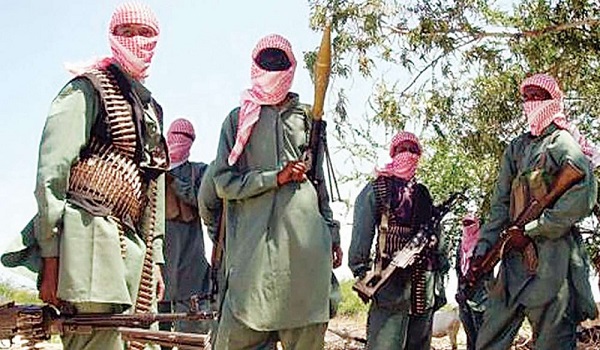
TENSION is mounting in BENUE State amid rising killings and insecurity.
On Sunday June 15, angry youths gathered at the popular Wurukum Food Basket Roundabout in Makurdi from where they moved to the streets, blocking the Abuja-Makurdi highway and Wurukum Roundabout in Makurdi, causing gridlock and panic among commuters.
The protesting youths, who are in the hundreds, are demanding justice for the victims of the attacks and stronger security measures to prevent future attacks.
According to Channels TV, the protesters rejected Deputy Governor Sam Ode’s attempt to address them, demanding that Governor Hyacinth Alia come in person instead.
The situation almost escalated when armed policemen and soldiers confronted the protesters, attempting to disperse them with tear gas.
The protesters were thereafter met with a heavy police and military presence, which led to a tense standoff and the deployment of teargas to disperse the crowd.
Despite police attempts to disperse them, the protesters remained resolute, calling on President Bola Tinubu and Governor Alia to intervene and address the ongoing violence and killings in the state.
Meanwhile, Governor Alia on Sunday condemned the attack and killing of innocent citizens at Yelewata by suspected criminal herders, saying that nothing should warrant the taking of life.
Alia, represented by his deputy Ode, vowed to work tirelessly to bring peace to Benue State after visiting the scene of the recent attack.
He assured the residents that more tactical teams had started arriving in Benue from the federal government, and additional security deployments were being arranged for vulnerable areas.
The ICIR reported on Saturday, June 14, that freshattacks on two local government areas of Benue State have resulted in the death of 26 persons.
The victims were killed in overnight attacks on communities in the Makurdi and Katsina-Ala local government areas of the State.
No fewer than 25 of them were struck to death in the Mtswenem and Akondotyough Bawa communities in the North Bank area of Makurdi Local Government Area, while one person was killed in a different attack on Agbami and Kenvanger villages in the Mbatyula ward of Katsina-Ala Local Government.
Residents said armed men attacked the communities between midnight on Thursday with guns and machetes. A resident reported that the gunmen invaded homes, killing people while they slept. Iorpuu, a witness, told Daily Trust that the victims included women and children, while many others were still missing.
When contacted, the police public relations officer of the Benue Police Command, Udeme Edet, reportedly said operatives from the command had been deployed to the affected areas in Makurdi and promised that further details would be made available to newsmen.
She, however, said the police hadn’t been informed about the Katsina-Ala incident at the time of reporting.
The ICIR reported that gunmen launched attacks on Apa and Agatu LGAs in the troubled state, reportedly leaving scores of people dead.
These attacks came shortly after top military leaders, including the Chief of Army Staff (COAS), Olufemi Oluyede, visited the state and promised to restore peace.
The ICIR reports that following earlier deadly attacks on Gwer West and Apa LGAs, the COAS, Oluyede, moved to the state in a strategic push to curb the escalating violence.
According to the News Agency of Nigeria (NAN), the COAS was accompanied by Principal Staff Officers (PSOs) and other senior army officials for an on-the-ground security assessment.
Oluyede ordered additional deployment of troops and logistics to the state to pursue and dismantle criminal groups operating in the state.
Despite all the efforts by the COAS and his team, the killings in Benue have continued.
According to Daily Trust, at least 270 people have been killed in the state in the last two months.
The ICIR, in a recent report highlighted how many villages in Benue have been caught in a deadly cycle of violence, with families torn apart, homes reduced to rubble, and communities forced to flee.
RESIDENTS of Doka Avong in the Kufana District of Kajuru Local Government Area, Kaduna State, have been gripped by fear following a violent attack by bandits in the early hours of Saturday.
According to a formal report submitted to the Agom of Kufana Chiefdom, the incident occurred around 1:00 a.m. when a group of heavily armed men invaded the home of the Village Head.
During the attack, the gunmen abducted the village head’s wife, 38-year-old Deborah Jonah, and their 14-year-old son, Maxwell Jonah.
The incident was confirmed in a letter signed by Stephen Maikori, Overseer of Kufana District.
“This unfortunate event has caused widespread fear and anxiety within the community,” Maikori stated, adding:“In light of the above, I respectfully call for the urgent intervention of relevant security agencies to enhance surveillance and fortify security in and around Doka Avong and the entire Kufana District.”
He emphasised the need for “prompt and decisive action” to prevent further loss of lives and property and to restore confidence among the people.
The abduction has heightened insecurity concerns in Kajuru, a local government that has witnessed repeated attacks by criminal elements in recent years.
THE Chairman of the Christian Association of Nigeria (CAN) in Plateau State, Polycarp Lubo, has passed away.
He reportedly died in the early hours of Sunday at a hospital in Jos after an accident he was involved in last week.
The Catholic Archdiocese of Jos confirmed his passing in a condolence statement signed by its Archdiocesan Chancellor, Daniel Gyang.
The statement expressed condolences to Lubo’s immediate family, CAN Plateau State chapter, and the religious community, Catholic priests and other religious leaders.
The statement reads, “On a sad note but with total submission to the will of God, we hereby announce the passing unto eternal glory of Very Rev. Fr. Polycarp Lubo, who passed on to eternal glory in the wee hours of the morning of Sunday 15th June, 2025.
“The Archbishop condoles with his immediate family, CAN Plateau State Chapter, the presbyterium of Jos, the parishioners of St. William’s Parish, Zawan where he was Parish Priest and Dean of Deanery, and indeed all the Religious and lay faithful of the Archdiocese.
“May his soul and the souls of all the faithful departed, through the mercy of God, rest in peace.”
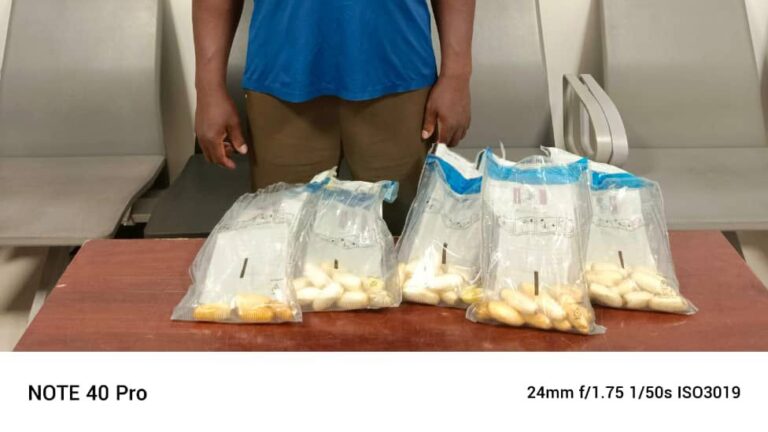
THE National Drug Enforcement Agency (NDLEA) says it has arrested a 44-year-old businessman, Ezemokwe Chukwuebuka Christian, for ingesting 53 wraps of cocaine.
According to a statement by the NDLEA on Sunday June 15 signed by its spokesperson Femi Babafemi, the suspect Ezemokwe was on his way to Tehran Khomeini, Islamic Republic of Iran when he was appended at the Port Harcourt International Airport.
The agency said Ezemokwe was arrested on Saturday June 7 while trying to board aQatar Airways flight QR1434 to Tehran.
“After a body scan proved positive to ingestion of illicit drug, he was placed on excretion observation during which he expelled 53 wraps of cocaine in six excretions with a total weight of 1.172kg.
“The suspect claimed to have gone into the criminal trade two years ago, moving between the West African sub-region and Iran, “the agency stated.
Similarly, NDLEA operatives at the Murtala Muhammed International Airport (MMIA) Ikeja Lagos in the early hours of Saturday June 14 intercepted an Italy bound passenger Edobor Ambrose Ali on an Air France flight.
The NDLEA said its officers in collaboration with the Aviation Security of the Federal Airports Authority of Nigeria (FAAN), discovered drug consignments hidden in the luggage of the suspect during baggage scanning at the tarmac.
The suspect was thereafter brought down from the aircraft for baggage identification after which a thorough search of the bag led to the discovery of 14, 410 pills of tramadol 225mg and 200mg concealed in winter jackets.
In his statement, Ebodor said he lives in Italy where he was hired and sent on the all-expense paid trip to Nigeria to courier the drug consignments to Milan, Italy for a fee of 2000 Euros,the NDLEA said.
THE role of the judiciary in Nigerian politics assumed a heated debate at a webinar held in honour of prominent human rights lawyer and former Chairman of the National Human Rights Commission (NHRC), Chidi Odinkalu, a professor, on Thursday, June 12.
Experts who spoke at the event with the theme, “The Selectorate: When Judges Topple the People”, argued that the judiciary has become an active participant in shaping the country’s political landscape, often to the detriment of democracy.
One of them, Inibehe Effiong, a human rights lawyer, said the judiciary has been instrumental in determining who occupies political offices, rather than the electorate. He cited the example of lawmakers in Plateau State, who were put in office by the courts despite not winning elections.
“The Supreme Court took an opposite decision, but on the basis of the decision of our courts, we now have lawmakers in Plateau, both at the National and the State Assembly, who never won an election. But they have been put in those positions by the courts based on a dispute in the political party,” the lawyer stated.
On his part, a founding executive director at the African Centre for Leadership, Strategy & Development (LSD), Otive Igbuzor, attributed this trend to the judiciary’s colonial roots and the English system of law, which he said is amenable to manipulation. He called for value reorientation, mobilisation of citizens, and a redefinition of democracy.
“I am not a lawyer, but the English system of law, based on evidence and all of those kinds of things, is amenable to manipulation,” he stated.
Accordig to him, Nigeria’s judiciary has lost public trust due to corruption and the degeneration of values.
He said the “judicialization of politics” allows the judiciary to determine election outcomes, rather than the electorate, noting that the judiciary has become an active participant in a flawed system.
Dayo Olaide, an international development professional, highlighted the dangers of civilian takeovers, citing examples from Senegal and other countries.
He emphasised the need to understand the judicialization of elections as part of a larger problem of democratic erosion.
“The big picture for me is the fact that what we are seeing and now categorising as electorate is part of a bigger crisis of democracy in the continent and that is the civilian takeovers that we are seeing across the continent,” Olaide stated.
Olaide warns of an imminent collapse of democracy in Nigeria and across the continent due to the judicialization of elections and civilian takeovers.
He argued that the judiciary’s role in determining election outcomes undermines democracy and leads to unaccountable governments.
To address this, he proposed stripping the political class of the power to appoint judges, judicial reforms, and independent reviews of election petition outcomes. He also suggested “naming and shaming” judges who compromise democracy.
The experts warned of an imminent collapse of democracy in Nigeria and the continent at large. They pointed to the dangers of an unaccountable government disconnected from citizens and the weaponisation of the judiciary.
The webinar highlighted the need for a holistic approach to addressing the crisis of democracy in Nigeria and beyond, as the experts noted that the judiciary’s role in shaping politics has far-reaching implications for the country’s future.
In a nation grappling with persistent insecurity, particularly across the Middle Belt, Redzie Jugo, founder of the Srarina Initiative for Peace, Justice and Development, stands out as an advocate for justice, accountability, and community resilience.
Drawing on his years as coordinator of the National Day of Mourning in Plateau State, Jugo highlights the need for a reimagined security architecture—one that empowers vulnerable communities within the bounds of the law to defend themselves against armed attacks in this interview with The ICIR.
The ICIR: What are some of the works you’ve done recently about insecurity, particularly with the Middle Belt?
Redzie Jugo: I have been the coordinator for the National Day of Mourning in Plateau State for the last five or six years, approximately. And it has largely been to bring attention to the pogrom, the genocide that is going on, but not taken very seriously by the authorities, both individuals and associations of like minds, whether in-country or overseas.
Now we have tried to ensure that we document ways and means of also getting this to stop. In time past, it has largely been about calling attention to the government, holding government accountable, and setting up memory plaques or walls that look and celebrate the lives of people who were killed needlessly by terrorists in our villages, in our localities. We decided that in recent times we needed to move further than the place we have been. To ask our questions, what kind of solutions can we give beyond getting the rebuttals? Because every time we get rebuttals from the government. Rebuttals, for instance, that speak to the police are overstretched, and that the military formations can only do so much.
And we have said, we understand that you’re overstretched and on demand, why don’t you look at getting a security architecture that leans into the already existing security protocols in those vulnerable villages that get pillaged every time and time again. Why don’t you look at the Firearms Act again and take cognisance of the fact that the IG of Police and the President have been given the sole right of making sure that people, the victims of vulnerable communities can have access to those firearms so that they can safeguard themselves and so that they can see another day. Ten years ago, we started having this conversation, but it wasn’t politically correct, and a lot of people shied away from it.
I spoke to a couple of members of the National Assembly, and it was not something they wanted to speak about. In 2025-2024, we have the DSS chief speaking about it in a public forum, talking about the first line charges or the first line of defence. Now you have the conversations that are slowly coming up.
Redzie Jugo, founder of the Srarina Initiative for Peace, Justice and Development.
Why is that? Because as we speak today, you may not find one military or one police individual right now in a Kemapa community in a village of Basa LGA in Plateau State. So the question ultimately is, do we keep allowing people to die off, or do we get ourselves up and think, because we understand also that there are questions about the proliferation of arms and ammunition, and what happens to the individuals who are allowed to safeguard themselves today? What will they be tomorrow?
Our organisation has said, let us come together and think through it, and be able to get protocols to expand the security architecture as it stands today. We’re not asking for a different thing. No, we’re asking for an expansion.
The ICIR: How will this work?
Say you set up a directorate under the army or the police that will do a mapping of vulnerable communities and be able to figure out who their vigilantes are in those communities. They are subjected to all the rigorous testing from psychological and otherwise. They are subjected to weeks of training, and then they are subjected to training on the use of arms and ammunition.
And that is because some of the times we have seen that except those terrorists know that you can match their military-grade weaponry, you cannot stop them from walking into any village at any time and killing four-year-old children who just wanted to sleep, wake up in the morning and go to the public schools in their communities.
We understand that we cannot get the personnel who can go to Benue LGAs, or can be in Lantang, or can be in Mangu at every point in time, but you can use the locals. You can engage the locals to be able to operate under the auspices of the law.
The ICIR: Some communities have reportedly repelled bandits/ insurgents attacks without formal access to firearms. How do you explain this, and what might have made it possible?
Redzie Jugo: Well, one of the things that Srarina would not do is to advocate for any illegalities. One thing we can always do, and we have always done, is to put a lot of our energies into saying that the laws should be a fortress to vulnerable people and not be their albatross.
As it stands, the Firearms Act is a major albatross around the neck of communities. Why do I say that? The terrorists come into these villages with military-grade weaponry, and they assail and pillage and kill innocent women, children, and men. And soon thereafter, when the community vigilantes gather themselves and they want to repel, because that is all that they can do, repel – even the communities that you are referring to, let us face it, it can only be said that they repelled them.
There are thousands of terrorists with military-grade weapons who are running amok in villages and forests around the place. So imagine that kind of situation. And we are saying that we must do the right thing, and that is to put pressure on the authorities to be able to amend certain policies, certain laws, to be able to allow vulnerable communities to just see another day [have access to arms legally to defend themselves].
So, most of what you have heard so far has been what you would term illegal. Why do I say that? Because, as we speak, the laws do not allow for the purchase and ownership of military-grade weapons. You cannot legally own an AK-47 or a Beretta pistol except you have been permitted by the President of the Federal Republic of Nigeria. The only weapons that are allowed by civilians to own are muzzle weapons, one-shot, six-shot pump-action arms.
Now imagine standing next to 10, 15 individuals with AK-47s and other military-grade weapons. You know that that fight was doomed from the beginning. And we’re saying, how else are you going to safeguard these communities that have been pillaged and killed? Just in the Irigwe community alone, from 2001 till date, we are talking about deaths recorded of not less than 1,145 people.
That is just in the Irigwe community. Don’t go to Mangu yet because the conversations and the figures are going to continue to mount. Don’t go to Riyom, don’t go to Bokkos, don’t go to all of those places because you then have to count the number of houses that have been burnt, the number of communities that, as of the last count, it is 145 communities that have been displaced. And some of these communities have been taken over. In some instances, even renamed by the assailant.
I say that because I also happen to be a board of trustees member of one of the communities. And we heard very painfully how some of those communities, the Jol community in Riyom local government, had their names changed.
A week or two after an attack, a man went back to his house. There was somebody living in his house, and there was a woman there. And when he looked flabbergasted at the situation, she quickly advised him to leave the house before her husband comes back.
These things are happening in Nigeria; this is not Afghanistan. It is happening here in Nigeria, just five hours away from Abuja.
The ICIR: Given that amending laws takes time, are there provisions in the current Firearms Act that can be immediately leveraged to improve the security situation?
Redzie Jugo: There are two licensing authorities under the Firearms Act 2004. You have the IG of Police, and then you have the President. Now, my take is, first of all, there is a need for, unification of all vulnerable states and communities.
In recent times, there have been discordant tunes coming out from the Middle Belt. Governor Alia of Benue State seems to be saying something slightly different from what Governor Mutfwang of Plateau State is saying. But assuming we’re able to get states like that to unify and speak with one voice, they should go to Aso Rock and have conversations with our President. Because he is empowered under the law to give permission. Because he is also the chief of the armed forces. He has been given the right to be able to give permission.
And we are saying it has to be systematic. We don’t think that things should be done haphazardly and to give room for abuse. It can be systematically done. He can call his CDS and have an interface with his security chief, the NSA. With the governors of these vulnerable states. And they can agree on the format to be able to ensure that all vulnerable communities are able to bring out their fit young men who are able to be able to form what may be called civilian JTF or by any other nomenclature.
Like I said, a directory can be set up in the army, especially for that. Our military is well-trained, and they can also train these individuals. And then reports can be given on a weekly basis, on a monthly basis, on all of the weaponry that has been deployed to those vulnerable communities.
I believe that if you do that, even the knowledge that these communities are not as vulnerable as they were will stave off these individuals (assailants).
Redzie Jugo, founder of the Srarina Initiative for Peace, Justice and Development.
The ICIR: Won’t this bring up criticism that it will lead to the proliferation of firearms?
Redzie Jugo: In response to such criticism that comes up that saying it will lead to a proliferation of weapons in those communities, that is why I say the process has to be formalised. These suggestions wouldn’t have come up if we didn’t get the excuses that we’ve been getting about the lack of manpower to be able to cater to every village. This time, we are saying we have men and women in those villages who can do what needs to be done.
The ICIR: And when peace has returned to the communities, what happened to these young persons trained for combat?
Redzie Jugo: To the question of what then happens to them if and when the issues have been sorted out? It’s to find a way to absorb them free of charge. You have already trained them. Absorb them into the police. Absorb them into the army and all the other security agencies.
The ICIR: What is your assessment of Operation Rainbow?
Redzie Jugo: Operation Rainbow is one of the initial attempts at state police. Successful because it is an entity. It is a legal entity today, before a lot of other states came up with theirs. However, like I said to you, if you see an Operation Rainbow vehicle today, it will have the police and the military behind it. Which means that, .in an actual sense, there is still a condiment that is lacking.
That has a lot to do with these limitations that come with the Firearms Act and everything. If you want things to happen properly, there is a need for the expansion of the security architecture in a formalised manner.
So, my assessment for now is that it can do so much with the way that it was set up and what it can be, but where it is today, it can do nothing to stave off the violence that is happening in the Middle Belt.
The ICIR: What are the misinformation or disinformation narratives emanating from the insecurity in Plateau State and the Middle Belt?
Redzie Jugo: The one I dislike the most is ‘Farmer-Herder clash’. There is a four-year-old with a big machete cut. Who did she clash with? I saw a video of a dead mother with a baby still suckling on her breast just the other day. What clash did that baby engage in, or that mother?
There was no clash. There has never been a clash. What we have is a genocide going on. There is a pogrom going on. And except we call it for what it is, it will continue unabated. One thing that the terrorists have that most of these local communities do not have is a well-oiled media machinery.
We believe that even before the attacks, they already had a press release that listed them as victims prepared. A day or two after the massacre in Kimapa, in Kwal Village, somebody was in Kaduna State reading a press release and talking about the death of cows. Yes, one of the other misconceptions people need to understand is that there is a machinery for misinformation that has been running for decades.
When you see terrorists who boldly take responsibility and blame communities and use the death of cows as a reason for attacks, then you need to ask yourself why they are still walking freely around the place. In law, you call it a prima facie case.
The was an allegation that cows were poisoned. The cows were not on a ranch, and someone took a poisoned bag of food to the ranch and poisoned them. No, the cows went into a farm and ate food that had pesticides, herbicides, and they died. This allegation is even unfounded because when the cows were found, they were already slaughtered. The conversation was that they were slaughtered so that they would not die prematurely, if there is any such thing. The same cows were taken and sold in the markets by their owners.
There is a lot of twisting of truths, half-truths, and outright malicious lies being told so that assailants get some level of sympathy that they do not deserve.
There is a war going on to take over the Nigerian state, and except we see it for what it is, this war will reach every locality. And Nigeria, as we know it today, will become the Central African Republic tomorrow, or Libya, or Afghanistan, name them.
The ICIR: In the line of your work, what have been the peculiarities of these attacks over the years in Middle-belt, mostly in Plateau State?
You know, I mentioned Gashish, in Barkin Ladi, the local government of Plateau State. You only need to go to Gashish. Gashish is a lush land. You remember, in speaking to the reasons why these attacks are happening?
I’ll refer you to something I mentioned earlier, about the killing of over 200 people in one night. In Gashish, in Barkin Ladi, the local government of Plateau State. You only need to go to Gashish to see how beautiful that place looks.
Lush greens, water bodies, and waterfalls. That is the price. People also forget that Mafarkin Mota is in a part of Jos North local government.
Mafarkin mota has also been overrun. It is a beautiful place. Greeneries, mineral deposits.
I’ve had one or two people who were killed in those places. There was a young man who was doing some work for me. We even saw in the evening that he went to harvest sand for sale.
There is a community not too far from there where he was shot at. And he died. All of the places where these attacks and killings have happened, check them.
They have great land, great potential for vegetation. They have multiple mineral deposits under the ground.
And even the style of banditry, as it is called in Wase local government. Wase local government is one of the most mineralised local governments in Plateau State. The style of banditry in Zamfara State is what is inching in there.
And I say this also because I have done some work in the mineral sector. So these are things that I’m very aware of. These are things I’m well-versed in.
As students, we paid our school fees by working in that sector. So some of these places I’m talking about, and that is how I’ve been able to traverse some of these places in Plateau State, Bauchi State, Gombe State, Taraba State, Zamfara State and Abakaliki. I’ve been to all of these places and I know firsthand what it looks like.
And I know how lucrative those places are. And that is why you see conversations being had about gold for guns. So these are the reasons.
It is not a senseless drivel of gunshots and testing of armaments. No, it is a land grab on the move. It is a programme to take over people’s land without paying for it, without an exchange of money or whatever it is, even by barter, nothing. There’s a story about someone with whom they had disagreements, about land.
And then he came to confront the people. They came back and looked for him. They didn’t find him, but they killed people in his community, and his family.
They’ll take it by force. That’s what is going on, and let us call it by its name.
When he opened the All-Nigerian Judges Conference in February 2003, then Chief Justice of Nigeria, Mohammed Lawal Uwais, who died on 6 June 2025, six days short of his 89th birthday, lamented the fact that State Chief Judges in Nigeria “go begging for funds from their governors”: a practice pioneered by the military. It was part of a wider complaint about the historical legacies of judicial corrosion inherited from military rule. It also reflected the values of a man for whom judicial integrity was a way of life and an independent judiciary was a constitutional mandate of the highest salience.
In 1976, Mohammed Lawal Uwais secured a loan from the Nigerian Building Society to enable him to build a modest home in Kaduna for his mother, Hajiya Hajara. At that point, Uwais had worked as a judge of the High Court for over four years, including a stint as Acting Chief Justice of the North Central (later Kaduna) State. Yet he had only one bank account with Union Bank.
Nearly thirty years later, entering his tenth year as Chief Justice of Nigeria (CJN), Uwais’ office as CJN suffered what looked like a mysterious burglary. The Chambers of the Chief Justice is a sanctuary inside the Supreme Court of Nigeria from where the CJN presides over the judicial shrine. It is one of the most protected spaces in the country. The idea of a burglary on that office is so ordinarily implausible as to make the provenance of such an act easily predicted.
The burglary coincided rather conveniently with a period of intense judicialization of the political antipathy between then vice-president, Atiku Abubakar, and his principal, Olusegun Obasanjo, over the latter’s attempt to succeed himself by lifting constitutional term limits that he had sworn to preserve and protect. That political conflict spawned a succession of high profile cases which ended up at the Supreme Court, resulting in decisions that constrained the caprice of the president. Entirely characteristic of CJN Uwais, the court in case after case handed President Obasanjo a judicial shellacking with neither flash nor flourish.
It later turned out that the convenient burglar appeared to have been desperate to find non-existent material with which to dent the record of an uncompromising CJN and probably afflict him with indelible ignominy. Instead, all that they could find were records indicating that the man had maintained the same bank account for over four decades and with impeccable integrity.
Few would have predicted this turn of events in the relationship between Uwais and the man who preferred him to the Supreme Court as a sprightly 43-year-old in August 1979. On August 11, 1979, the country had voted in a contentious presidential ballot in preparation for return to civil rule after 13 years and nine months of bloody military rule. Five days later, on August 11, the Federal Electoral Commission (FEDECO) announced Shehu Shagari of the National Party of Nigeria (NPN) the winner.
The previous day, on August 15, army general and departing military ruler, Olusegun Obasanjo, appointed two new Justices of the Supreme Court. One was Pharmacist-turned-lawyer and Attorney-General of the Federation, Augustine Nnamani. The other was something of a judicial prodigy, Mohammed Uwais. The following week, Obasanjo also appointed a new CJN in Atanda Fatayi Williams, who was to oversee the adjudication of the dispute over the 1979 election.
As Attorney-General of the Federation, Nnamani had authored the Electoral Act at the centre of the presidential election dispute. That precluded him from sitting on the dispute and catapulted Uwais onto the bench that would ultimately decide the destination of the presidency in 1979.
For Uwais, this guaranteed that his Supreme Court career would begin at the very deep end. It was a new high in a career that was destined for the very top. He had the good fortune of being born in Zaria, home to some of the most elite schools in the country.
The son of a railway worker from Zaria, Abdullahi Uwaisu and his wife, Hajara, Mohammed Lawal Uwais was bereaved of his biological father at the age of six in December 1942. When his mother remarried two years later to headteacher, Mohammed Jumare, Uwais acquired a stepfather who inspired his educational pursuits under the watchful eyes of a doting mother. His high school education was at the elite Barewa College where he was junior to Yakubu Gowon and in the same class and good friends with Gowon’s nemesis, Murtala Mohammed.
A graduate of the Institute of Administration at the Ahmadu Bello University in Zaria, Uwais did his vocational legal training at the Inns of Court in London before becoming part of the pioneer set of lawyers graduated by the Nigerian Law School in 1963.
After his admission to the Nigerian Bar, he returned to his civil service career, this time in the Ministry of Justice, first of the Northern Region; and then of the North Central (later Kaduna) State. Mohammed Bello, the Director of Public Prosecutions (DPP) under whom he worked as State Counsel, became his colleague at the Supreme Court and immediate predecessor in the office of CJN. In the Ministry of Justice of the North Central State, he became Solicitor General and Permanent Secretary in 1971.
The following year, under the government of his high school senior, Yakubu Gowon, Uwais was appointed Acting Judge of the High Court of the Northeastern State. He was only 36.
In 1975, when his high school mate, Murtala Mohammed, emerged as military ruler after overthrowing Gowon, Uwais was offered the office of Chief Justice of the North Central State but turned it down in favour of a more senior serving expatriate judge, A.W.E. Wheeler. When the military established the Court of Appeal the following year, Wheeler preferred him from Kaduna State to the bench of the new court at 40. When he got to the Supreme Court three years later, Uwais was only 43. He went on to serve as Justice of the Supreme Court for 27 years, setting a record of apex court durability that is unlikely to be threatened.
When Nigeria returned to civil rule in 1999 after another 15 unbroken years of military rule, Uwais had already been in office as the eighth indigenous CJN for four years. He was well-placed to stabilise the judiciary through the teething years of institutional adaptation.
Uwais spent 11 of his 27 Supreme Court years as CJN, making him the second longest in that office after Adetokunbo Ademola, the first indigenous Chief Justice, who logged a record 14 years in that office until 1972. He instituted and oversaw rigorous standards of judicial discipline and performance. A mere four years into civil rule, by the beginning of 2004, over 20 judicial officers had been relieved of their positions for judicial malfeasance. Under him, the Nigerian judiciary was voted “Man of the Year” in 2005.
Two years after his retirement as CJN, Uwais came out of retirement to head a blue-ribbon panel on electoral reform in Nigeria. His characteristically thoughtful report continues to suffer neglect to the detriment of democratic sustainability in the country.
Uwais was quietly uncompromising on judicial integrity. In a profound set of interviews with Princeton University in 2009, CJN Uwais underscored the need to eliminate bribery, corruption, nepotism and political interference within the judicial systems. A committed institutionalist with a peerless recall on the evolution of Nigeria’s judiciary, Uwais declined to write any memoirs.
The father of a very senior lawyer and husband to a wife both capable and experienced as a lawyer, Uwais did not nominate any members of his family to the bench. Many of his successors in the office of CJN – who served for less than a fraction of his tenure – were compulsive nepotists in favour of family members with less than marginal qualification or ability.
Current CJN, Kudirat Kekere-Ekun paid tribute at his death to the capacity of Mohammed Uwais to “lead without pretence, and to mentor without fanfare.” He made his earthly exit on Friday 6 June 2025, entirely in keeping with how he lived his life – without fanfare.
ALARMED by an intelligence assessment that Iran will be able to produce nuclear weapons within months if not weeks, Israel has launched a massive air campaign aiming to destroy the country’s nuclear programme.
Israel’s air strikes hit Iran’s main nuclear enrichment facility at Natanz, as well as its air defences and long-range missile facilities.
Among the dead are Hossein Salami, the chief of Iran’s powerful Revolutionary Guards Corps; Mohammad Bagheri, the commander-in-chief of the military; and two prominent nuclear scientists.
Iranian Supreme Leader Ayatollah Ali Khamenei has promised “severe punishment” in response. Iran could potentially target Israel’s own nuclear sites and US bases across the Persian Gulf. Israel claimed Iran launched 100 drones towards it just hours after the attack.
The Middle East is yet again on the precipice of a potentially devastating war with serious regional and global implications.
Stalled nuclear talks
The Israeli operations come against the backdrop of a series of inconclusive nuclear talks between the United States and Iran. These negotiations began in mid-April at President Donald Trump’s request and aimed to reach a deal within months.
Israeli Prime Minister Benjamin Netanyahu opposed the talks, pressing for military action instead as the best option to halt Iran’s nuclear program.
The diplomatic efforts had stalled in recent weeks over Trump’s demand that Iran agree to a zero-uranium enrichment posture and destroy its stockpile of some 400 kilograms of enriched uranium at a 60% purity level. This could be rapidly enriched further to weapons-grade level.
Tehran refused to oblige, calling it a “non-negotiable”.
Netanyahu has long pledged to eliminate what he has called the Iranian “octopus” – the regime’s vast network of regional affiliates, including Hamas in Gaza, Hezbollah in Lebanon, the regime of former Syrian leader Bashar al-Assad, and the Houthi militants in Yemen.
Following Hamas’ attack on Israel on October 7 2023, Israel’s military has considerably degraded these Iranian affiliates, one by one. Now, Netanyahu has now gone for beheading the octopus.
𝗗𝗘𝗖𝗟𝗔𝗦𝗦𝗜𝗙𝗜𝗘𝗗: 𝗜𝗿𝗮𝗻’𝘀 𝗡𝘂𝗰𝗹𝗲𝗮𝗿 𝗣𝗹𝗮𝗻𝘀
Recent intelligence shows Iran is nearing the point of no return in its race toward a nuclear weapon. The regime is producing thousands of kilograms of enriched uranium, alongside decentralized and fortified… pic.twitter.com/my6mVB7rOI
Netanyahu has in the past urged Washington to join him in a military operation against Iran. However, successive US leaders have not found it desirable to ignite or be involved in another Middle East war, especially after the debacle in Iraq and its failed Afghanistan intervention.
Despite his strong commitment to Israel’s security and regional supremacy, Trump has been keen to follow this US posture, for two important reasons.
He has not forgotten Netanyahu’s warm congratulations to Joe Biden when he defeated Trump in the 2020 US presidential election.
Nor has Trump been keen to be too closely aligned with Netanyahu at the expense of his lucrative relations with oil-rich Arab states. He recently visited Saudi Arabia, Qatar and the United Arab Emirates on a trip to the Middle East, while bypassing Israel.
Indeed, this week, Trump had warned Netanyahu not to do anything that could undermine the US nuclear talks with Iran. He has been keen to secure a deal to boost his self-declared reputation as a peace broker, despite not having done very well so far on this front.
But as the nuclear talks seemed to be reaching a dead end, Netanyahu decided now was the moment to act.
The Trump administration has distanced itself from the attack, saying it had no involvement. It remains to be seen whether the US will now get involved to defend Israel if and when Iran retaliates.
What a wider war could mean
Israel has shown it has the capacity to unleash overwhelming firepower, causing serious damage to Iran’s nuclear and military facilities and infrastructure. But the Iranian Islamic regime also has the capability to retaliate, with all the means at its disposal.
Despite the fact the Iranian leadership faces serious domestic issues on political, social and economic fronts, it still has the ability to target Israeli and US assets in the region with advanced missiles and drones.
It also has the capability to close the Strait of Hormuz, through which 20–25% of global oil and liquefied natural gas shipments flow. Importantly, Iran has strategic partnerships with both Russia and China, as well.
Depending on the nature and scope of the Iranian response, the current conflict could easily develop into an uncontrollable regional war, with none of the parties emerging as victor. A major conflict could not only further destabilise what is already a volatile Middle East, but also upend the fragile global geopolitical and economic landscape.
The Middle East cannot afford another war. Trump had good reasons to restrain Netanyahu’s government while the nuclear negotiations were taking place to see if he could hammer out a deal.
Whether this deal can be salvaged amid the chaos is unclear. The next round of negotiations was due to be held on Sunday in Oman, but Iran said it would not attend and all talks were off until further notice.
Iran and the US, under Barack Obama, had agreed a nuclear deal before – the Joint Comprehensive Plan of Action. Although Netanyahu branded it “the worst deal of the century”, it appeared to be holding until Trump, urged by Netanyahu, unilaterally withdrew from it in 2018.
Now, Netanyahu has taken the military approach to thwart Iran’s nuclear program. And the region – and rest of the world – will have to wait and see if another war can be averted before it’s too late.
Amin Saikal, Emeritus Professor of Middle Eastern and Central Asian Studies, Australian National University; and Vice Chancellor’s Strategic Fellow, Victoria University
THE Nigeria Police Force has extended the enforcement deadline for the tinted glass permit requirement to August 12, 2025.
Inspector-General of Police, Kayode Egbetokun, announced the extension in a statement released on Saturday by Force Public Relations Officer, Olumuyiwa Adejobi. He said the move aims to ensure a more user-friendly and accessible application process.
The statement noted that the extension is part of commitment to “transparent, inclusive, and citizen-focused policing,” and comes as the permit system undergoes ongoing technical and policy reviews.
The police added that the extra time will allow for “enhancements and refinements” to both the physical and digital application processes, including better verification systems and reduced delays.
“The Force has not ignored the voices of Nigerians. Rather, these voices have been instrumental in guiding ongoing reviews of the process to ensure it remains user-friendly, secure, and accessible to all,” the statement said.
The force advised Nigerians to apply or renew their permits exclusively via the official portal, and report any incidents of extortion or unauthorised charges encountered during the process.
In June 2021, former IGP Usman Baba ordered the suspension of the issuance of permits for tinted glasses and SPY number plates.
The police, however, announced in 2024 that they would restart issuing the tinted glass permits for vehicles.
The force had earlier granted a 30-day grace period to all motorists to regularise their tinted glass permits as it reactivated the digital tinted glass permit platform. The grace period began on May 1, 2025.
The digital permit system, according to the Force, is aimed at improving transparency, addressing longstanding public concerns, and bolstering national security.
The Nigerian Senate is reviewing a bill seeking to raise the number of Supreme Court Justices from 21 to 30 to address the growing backlog of cases and enhance efficiency.
The bill, sponsored by the Senator representing Imo West, Osita Izunaso, was unveiled during a press briefing in Abuja on Friday to mark his two years in the 10th National Assembly.
Izunaso argued that the current number of justices remains insufficient, even after the appointment of 11 new justices in 2023 — the first time Nigeria has met the constitutional limit of 21.
“Even with the full complement of 21 justices, the Supreme Court is overwhelmed. The volume of cases reaching the court daily is alarming. Some litigants are being given hearing dates as far ahead as 2027 and 2028,” he said.
He explained that the proposed legislation would allow the Supreme Court to set up more panels, thereby speeding up the adjudication process.
“Justices of the Supreme Court usually sit in panels of five, or seven in constitutional matters. With 30 justices, the court can operate at least five panels at the same time, enabling faster resolution of more cases,” Izunaso said.
He also stressed that the apex court should not be burdened with minor cases, such as village land disputes, which he said ought to be resolved at lower courts.
He stated that the proposed law would empower the Supreme Court to create more panels, accelerating the delivery of justice.
“Supreme Court justices typically sit in panels of five, or seven for constitutional matters. If we have 30 justices, it allows the formation of at least five panels simultaneously. That way, more cases can be handled at a faster pace,” he said.
He added that the apex court should not be reduced to “settling village land disputes,” urging that such cases be handled by lower courts.
He stated that the proposed law would empower the Supreme Court to create more panels, accelerating the delivery of justice.
“Supreme Court justices typically sit in panels of five, or seven for constitutional matters. If we have 30 justices, it allows the formation of at least five panels simultaneously. That way, more cases can be handled at a faster pace,” he said.