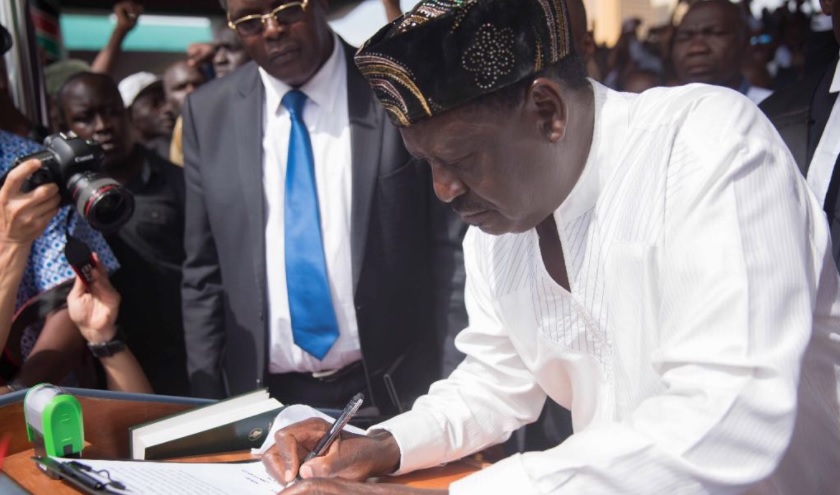
Femi Falana, lawyer and human rights activist, has described former President Olusegun Obasanjo and President Muhammadu as birds of a feather, following the former’s open letter advising the latter against seeking re-election in 2019.
He said apart from nepotism and clannishness, every other allegation that Obasanjo levelled against Buhari started during his 1999-2007 regime, therefore he should “desist from insulting the collective intelligence and the collective memories of Nigerians”.
“But I do not want to join issues with Obasanjo for now on his letter so that one is not seeing as endorsing impunity in our country but other than the allegations of nepotism and clannishness which the presidency is notoriously noted for, I think they are birds of a feather,” Falana said in Benin City, Edo State capital on Friday.
Falana accused the former President of institutionalizing the culture of impunity in the country, noting that he failed to take Nigeria to the El Dorado when he had the opportunity.
“In other words, all the other allegations took place under President Obasanjo and in fact, he institutionalised the culture of impunity under the democratic dispensation in Nigeria,” he said.
“If President Obasanjo who ruled this country for 11 and half years has institutionalised democracy, rule of law and respect for human rights, we will not be in this mess and the control of Nigeria by the Nigerian people, we will be having an El Dorado by now.
“So, please, let Obasanjo and others be honest to admit that they brought us to this shameful episode. So, nobody should grandstand when it comes to the misgovernance of Nigerians.
“Nobody has apologised. The fact that from 1999 to 2007, this country, made close to hundred billion dollars from the sale of one commodity, oil. What is there to show for it rather than permanent darkness?
“The more you spend on energy, the more darkness you get. So what is there to celebrate? What we have were mass unemployment and sale of national assets to few boys who were close to the presidency and rigging of elections.
“You have all forgotten that the results from Delta, Ondo and others were announced in Abuja and not in those states in order to rig those elections. What is there to celebrate?
“President Obasanjo is entitled to form his own political party or his own movement but he should please desist from insulting the collective intelligence and the collective memories of Nigerians.
“When Sharia started, the federal government did not challenge the constitutionality. Under that era, we had ethnic and religious violence that claimed lives of over 20,000 Nigerians.
“With great respect to former President Olusegun Obasanjo, apart from the allegations of nepotism and clannishness, which cannot be disputed, every other allegation made, there is nothing to write home about. In other words, all the other allegations took place under Obasanjo and in fact, he institutionalised the culture of impunity under the democratic dispensation in Nigeria.
“Many of us have forgotten the abduction of Governor Chris Ngige, many of us have forgotten the fact that the national assembly and the house of representatives displayed bales of naira with which it was alleged that the presidency wanted to bribe the legislators.
“Many of us have forgotten about the third term agenda or the fact that many people who were also closed to the seats of power were treated like sacred cows even in the fight against corruption.”
More than 72,000 people die of cancer in Nigeria and 102,000 cases of cancer are recorded in the country every year, according to health activists.
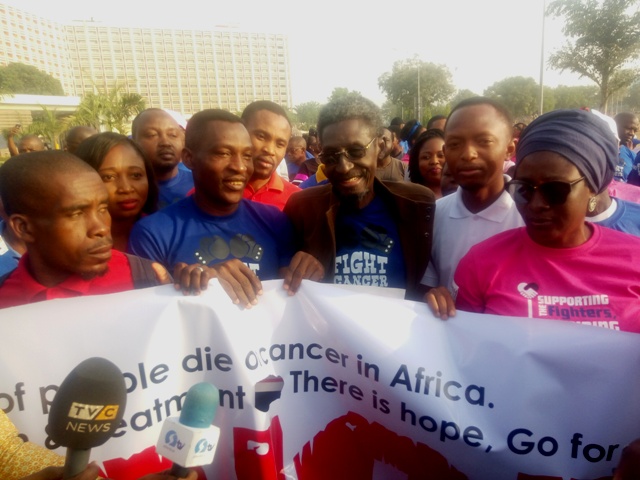
This was made known during a multi-sporting event (jogging, cycling, skating and a walk) organised in Abuja by civil society groups to mark the 2018 World Cancer Day.
“Most of these deaths are preventable, but this is happening because we don’t have sufficient medical infrastructure in Nigeria and the quality of cancer treatment and care is also poor, said Runcie Chidebe, Executive Director of Project PinkBlue, a non-governmental organisation working to eradicate or at least minimise incidents of cancer in Nigeria.
“The World Cancer Day is commemorated all over the world to discuss what has been achieved in cancer care and what still needs to be done.
“So today we are bringing many cancer survivors to let everyone know that you don’t have to wait till you’re down before going to the hospital. We need to ensure that we screen ourselves. We need to ensure that we make screening part of our life style, so we can really save more lives from cancer.”
Also speaking at the event, Adenike Oyetunde, a lawyer and cancer survivor, said government needs to vote more funds into cancer researches and also not leave cancer patients to their fate.
“For 12 years now I have lived cancer-free, though I lost my right leg. I just believe that we need to have a lot more events like this to put out the word about cancer and the need for us to fund cancer research, most importantly,” she said.
“It gives a sense of belonging to people who have been diagnosed with cancer, people who are still suffering the battle of funding their cancer treatment.
“The fact that a lot of us are out here, survivors, family and friends, it can also make the government understand that though we want them to provide free treatment for cancer, they can start by subsidising the treatment and ensuring that persons like me, who lost limbs, can get better environment, building structures and making it an inclusive and adaptive environment for every single person.”
The ‘Walk Against Cancer’ exercise, was also attended by Zainab Bagudu, a consultant pediatrician, cancer advocate and wife of Abubakar Bagudu, Governor of Kebbi State.
She noted that the campaign against cancer in Nigeria has so far yielded several positive results, although more needs to be done in terms of government support.
Bagudu explained that walk against cancer was to let the public know how living a healthy life helps to reduce the risk of cancer.
“By healthy lifestyle we mean the walk, the exercise, the kind of food you eat and of course things like avoiding alcohol and smoking.
“When you see a group of people moving about in the morning together, the first thing you will ask is ‘what are they up to?’ And for people who have never heard about cancer or the relationship with exercise and lifestyle, it’s an eyeopener.
“There’s been a lot of support, we are grateful for it but it is never enough. Cancer is a very poorly understood disease process; it’s also very expensive, so all the support that we can get is welcome. We are a developing country with very weak healthcare system and limited resources, so all these things make it a big fight to really target cancer as we should.
“And then, of course, the poor awareness, people don’t know about cancer, so it’s not detected early enough, which makes the treatment even more complicated and expensive. So we hope that by creating awareness, particularly in areas where we have very low education, if we can get them to see that this cancer is not some spiritual disease, it’s not something that is caused by witches and wizards, it’s a disease process and if you go to hospital in time, you will stand a fighting chance.”
World Cancer Day is commemorated on every February 4. It aims to save millions of preventable deaths each year by raising awareness and education about the disease, as well as pressing governments and individuals across the world to take action.
Sadiq Daba, ace broadcaster and actor, says “Nigerian doctors are magicians, to be honest” but government needs to empower them and give them the enabling environment to prolong the lives of the public
Speaking on Saturday during a ‘Walk Against Cancer’, organised by some health activists, notably Project PinkBlue, to raise awareness on the dangers of cancer and how to stay cancer-free. Daba expressed gratitude to all Nigerians for coming to his aid and donating generously to enable him travel abroad for his cancer treatment.
Popularly known as Uncle Sadiq, the former presenter of AM Express on the Nigerian Television Authority (NTA), however, noted that the Nigerian health sector “is in a shambles”.
“My brother, if I tell you say I no like this cancer walk, na lie I lie o,” the ever cheerful ‘Uncle Sadiq’ told journalists in pidgin.
“This na one of the best things wey dem don do, because most people no know wetin dey happen. There are so many forms of cancer wey people no know. You get breast cancer, you get leukemia, you get prostate cancer.
“And it’s like whether our people wey suppose to dey in charge to correct this thing, them dey sleep ni o; I no know. But with this kind of thing wey dem do this morning, if somebody dey sleep, e go wake by force. Because it’s a killer something and you don’t know until the thing happen to you.
“Thank God for people wey come around (to help me). I will forever be grateful to Nigerians. I never ever know say people like me until now. Millions and millions of Nigerians were praying for me.
“I’m also grateful to the people wey put all these things together: Dr Joe Odumakin, Soni Irabor, and one or two other people. This is fantastic.“
He stressed that more needed to be done to improve the Nigerian health system and government needs to wake up.
“We should do more for ourselves. It’s not just to pay lip service. Our health service is in shambles. Our doctors are fantastic but our government should give them that enabling environment, empower them to do the best. Our doctors are magicians, to be honest,” he said.
“So this, for me, na to appeal, abeg if una get ears make una hear o. At least wetin this young man wey do this walk for cancer don do… it is just the beginning. We can do more.”
Daba was flown to the United Kingdom for cancer treatment in 2017 after his friends raised money for him through crowdfunding.
Nigeria’s national education policy states that children in preschool and lower primary school should be taught in their mother tongue or the local language where they live. But in practice, most children are taught in English all across the country. The failure to teach pupils in their home language is a major reason for poor literacy and comprehension among school children. Research has consistently shown that children do better if they are taught in their home language in their early years of schooling.
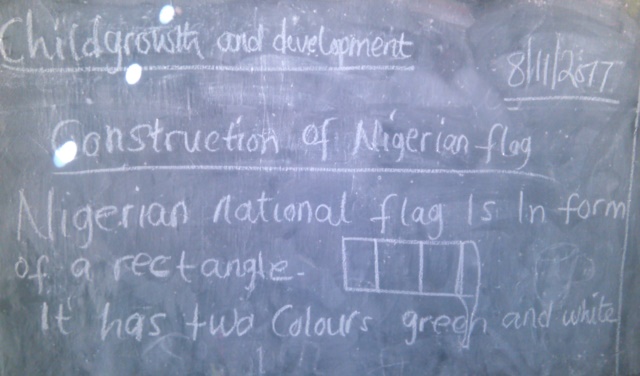
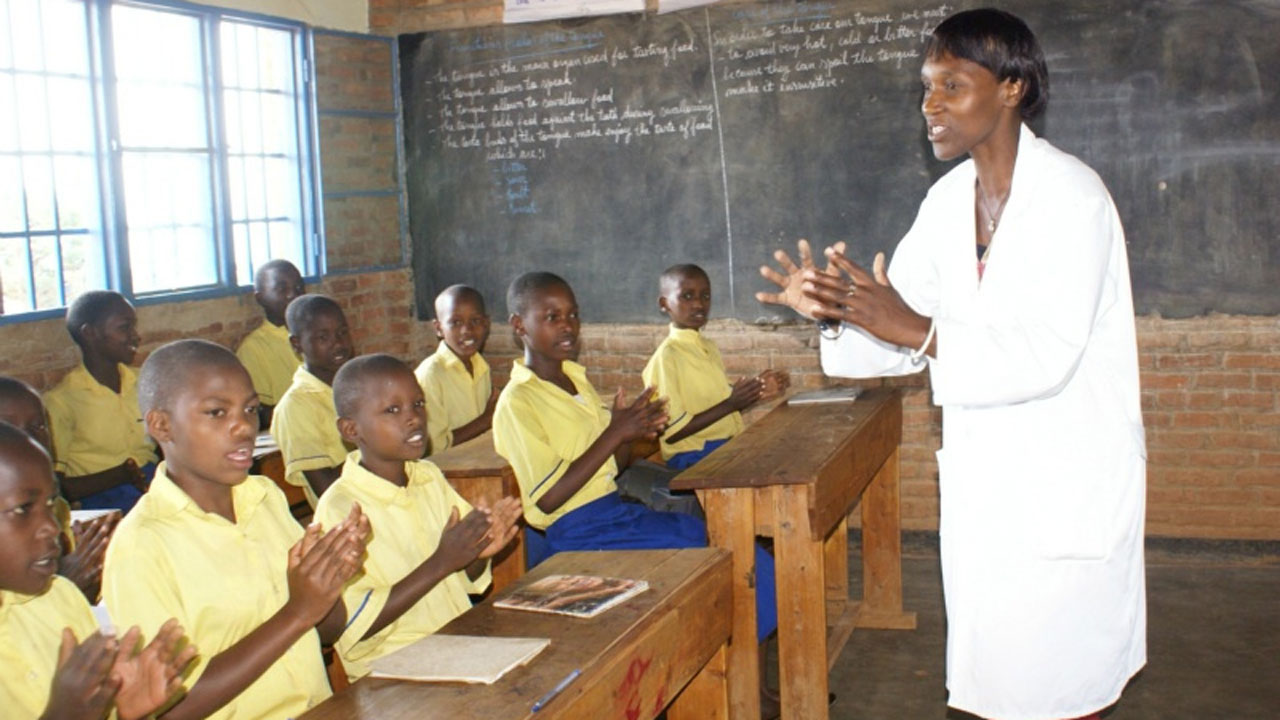
On the blackboard facing the class, Sadika Mohammed Abdullahi writes: “Nigeria’s national flag is in the form of a rectangle.” She draws a shape of the flag and adds: “It has two colours – green and white.” After writing in English, she speaks in Hausa to her pupils who are sitting on mats laid on the cement floor.
Mohammed says she combines English and Hausa to teach her 24 pupils in the nursery class at Kofa/Nassarawa Special Primary School in Kano because the children, who are between three and five years, do not understand English.
“We don’t have instructional materials in Hausa,” she says. “We are mixing the two so that they will understand better.” Not only are the pupils’ textbooks written in English, but the charts, posters and all the learning materials in the class are, too.
This pattern is repeated all over the country. Although the government, since 1981, has officially called on schools to teach young children in their native languages, pupils are still taught entirely or at least partly in English, a language many of them do not understand. The decision reflects both practical considerations – textbooks and teaching materials almost always are written in English – and the fact that many Nigerians want their children to be taught in English because they believe it is the language of upward mobility in today’s world.
That may be misguided, according to many experts. Suddenly expecting pupils to learn a new language actually slows down learning at a crucial time. Forced to learn a new language from scratch instead of building on vocabulary they already have from home, pupils learn by rote, mechanically repeating the names of objects their teachers mention in English rather than build new mental skills.
Policy implementer like Fatima Ibrahim, desk officer for early childhood education in the Kano State’s Universal Basic Education Board, does not see any problem with the bilingual methodology of teaching simultaneously in English and Hausa. “We even use Arabic because children can learn more than five languages at this age,” argues Ibrahim. “We are using this period to introduce them to different languages.”
Nursery class at Kofa/Nassarawa Special Primary School, Kano
However, research suggests that the approach can put children at a disadvantage. Evidence shows that children who first learn to read and write in their native language learn all subjects faster. They even learn English faster than children who are forced to shift to English the moment their formal education begins.
National policy-makers have long recognised this, specifying that the mother tongue or language of a child’s immediate environment should be the medium of instruction in preschool and lower primary school years. According to the policy, English should only be taught as a subject at this stage, and should not be the medium of instruction in all subjects. The official policy holds that English should only become the medium of instruction from Primary 4.
Contrary to the policy, most schools teach preschool and lower primary school children mainly in English, offering instruction in local languages only in classes dedicated to those languages. The practice is not particularly disruptive in cosmopolitan settings where English is now the home language of a growing number of children. But that is less true in rural areas where it is more common for schools to use a combination of English and local language because the pupils enter school with only their mother tongue.
“We teach in English, but we also explain to them in Igbo because that is the language they understand,” says Elizabeth Okpara, Headmistress of Central School, Amucha, Njaba in Imo State.
Theresa Eze, Headmistress of Government Primary School, Afikpo in Ebonyi State, also told the ICIR that the pupils are taught mainly in English.
Primary 1 class at Government Primary School, Afikpo, Ebonyi State
Abba Haladu, Executive Secretary of National Commission for Mass Literacy, Adult Education, and Non-Formal Education talks about the ignorance of the teachers. “It is wrong to teach in English,” he says “The policy is clear that children should be taught in their local languages in the early years of their education.”
Haladu says the relevant quality control agencies in the federal and state governments should step in to ensure that the policy on the medium of instruction is fully adhered to by the schools.
“A lot of teachers don’t even understand the policy, and they feel that teaching in local language does not have as many benefits as English,” says Swadchet Sankey, Unicef’s early childhood education specialist.
Sankey says the ideal approach is to teach children in their home language in the early years and introduce a second language when they have become literate in their first language. “Code-switching is not bad,” says Sankey “But the ideal practice is to focus on one language and immerse them in that early years – and that language should be their first language.”
Although the national policy was formulated more than three decades ago, Nigeria has not developed appropriate structures and systems to implement it. The major challenges are the failure to produce teaching materials in local languages and train specialised teachers for mother tongue instruction.
To be fair, there are serious obstacles to achieving the goal of native-language instruction for all children. Nigeria has about 400 languages, and some education experts have argued that mother tongue instruction would be difficult to achieve since the orthography (standardised spelling) of most of the minority languages are not developed. But instructional materials are not even available for preschool and lower primary school children in the three dominant native languages – Hausa, Igbo, and Yoruba – which are recognised as national languages by the constitution.
The failure to use mother tongue to teach pupils in the early years of their education has contributed to the high number of children who can read neither in English nor their local language when they finish primary school.
According to 2015 Nigeria Education Data Survey, only 44 per cent of public primary school students can read in English or of the three national languages. In private schools, the percentage of those who can read is 74. Comprehension is also abysmally low in public primary schools at 22 per cent while it is 47 per cent in private schools.
Emem Opashi, Director of the Sage School, Abuja, early childhood education specialist, argues for a flexible policy. Children, she says, should be taught in whatever language they understand.
“If you think the children have a good command of English, you can use that; otherwise, you can use their mother tongue and then gradually introduce English,” Opashi says.
“I think the policy should be dynamic, considering the fact that we have many indigenous languages. I think we should have a mixture of both the mother tongue and English,” she adds. “But one major hindrance is that we don’t have adequate materials to teach in the local languages.”
STRONG EVIDENCE BACKS MOTHER TONGUE INSTRUCTION
Credit: The Guardian
Research findings have consistently shown that for children to learn a second language, it is crucial for them to have a solid foundation in their first language. Starting instruction in English in the early years when it is not their home language does not give the children a head start in education.
The famous ‘Ife Six-Year Primary Project’, a research in the 1970s led by Babatunde Fafunwa, former Minister of Education, demonstrated the effectiveness of using mother tongue as a medium of instruction.
Researchers designed a primary school curriculum for children in their native tongue, Yoruba, and taught them English as a separate subject. Then they tracked these students’ performance compared to other Yoruba-speaking children who were taught all subjects in English throughout the six years of primary school. As part of the research, primary school teachers were specially trained in the use of mother tongue for instruction.
The research showed that the pupils who were taught in Yoruba were performing better in all subjects, including English, at the end of primary school education than pupils who were taught in English from the outset.
Following the research, educational experts recommended adopting the mother tongue or language of the immediate environment as the medium of instruction throughout the six years of primary education.
Nigeria eventually adopted the policy that children in preschool and lower primary school should be taught in their mother tongue or the language of the immediate environment and switch to English from Primary 4.
Most African countries where English is the official language have similar policies. But, like Nigeria, they also lack both instructional materials in local languages and teachers who are proficient in mother-tongue instruction.
In Uganda, a reading programme, funded by USAID and implemented by RTI International, has led to the development of instructional materials in 12 languages and facilitated a dramatic increase in literacy among children in lower primary school. Early assessment of the reading programme showed that more Primary 4 learners in programme schools were reading more than 40 words per minute in the local language and more than 60 words per minute in English than in control schools.
“We know that children who read better in local language also read better in English,” Rachel Jordan, a staff of RTI International, told the ICIR in Kampala. “We have seen it as a result of progress in our intervention.”
Pupils play in the field at early childhood education centre, Birambo, Kabale, Uganda
A study in 2013 by Stellenbosch University in South Africa showed that children who were taught in their home language during the first three years of primary school performed better in the English test in Grades 4, 5 and 6 than children who were exposed to English as the language of instruction in Grades 1, 2 and 3. The research controlled for quality of the school and students’ background.
Angelina Kioko, a Professor of English and Linguistics at United States International University, Nairobi, Kenya, argues in an article that using the mother tongue in early education leads to a better understanding of the curriculum content and to a more positive attitude towards school.
“When learners start school in a language that is still new to them, it leads to a teacher-centered approach and reinforces passiveness and silence in classrooms,” says Kioko. “This in turn suppresses young learners’ potential and liberty to express them freely. It dulls the enthusiasm of young minds, inhibits their creativity, and makes the learning experience unpleasant. All this is bound to have a negative effect on learning outcomes.”
Teaching students in their home languages promotes a smooth transition between home and school, Kioko continues.
“It means learners get more involved in the learning process, and speeds up the development of basic literacy skills. It also enables more flexibility, innovation and creativity in teacher preparation,” she says.
“Using learners’ home language is also more likely to get the support of the general community in the teaching/learning process and creates an emotional stability that translates to cognitive stability. In short, it leads to a better educational outcome.”
Ironically, despite these advantages to using mother tongue as the medium of instruction in the early years of children’s education, some parents want their children to be taught in English. They see it as the language of business and heightened opportunities.
The ability to speak good English is seen in Nigeria as a sign that a person is educated, and parents erroneously believe that their children will benefit more academically and socially if they are taught in English. To meet parents’ expectations, schools commonly ban students from speaking their local language in classes.
“Some parents will even tell you that they send their children to school to learn English, not the language they are speaking at home,” says Ikenna Ugwu, Lagos-based teacher.
Despite its failure to implement the policy on using local languages as medium of instruction in the early years, the Federal Government continues to promote that as an ideal.
Last year, the ministers of science and technology and education inaugurated an inter-ministerial committee on the teaching of mathematics and science in local languages. The government argues that teaching mathematics and science subjects in indigenous languages at primary and secondary school levels will help students better understand and appreciate the subjects.
But it seems far from certain that the Federal Government, which has not been able to develop instructional materials in local languages for preschool and lower primary school pupils, where they are considered especially important, can get secondary schools to teach mathematics and science in local languages. Hence, the disconnect between policy and practice appears likely to continue.
For eight years, the National Iron Ore Mining Company (NIOCOM) and Ajaokuta Steel Complex were under lock and keys. No mining and steel production took place, as the two parties — Nigerian Government and an Indian steel firm, Global Steel Holding Limited (GSHL) — were engaged in legal battle over a terminated concession agreement. But the signing of a modified agreement in August 2016 brought fresh hopes that trouble was over. Over a year after, not much has been done, YEKEEN AKINWALE reports.
Each time Raju Pandih (not real name) passes through the main gate of the decrepit National Iron Ore Mining Company (NIOCOM), Itakpe, he sees the ruins of the Nigeria’s multibillion-naira project and he feels sorry for the ‘Giant of Africa’.
Nigeria is believed to possess the 12th largest iron ore deposit in the world and the second largest in Africa. But this is yet to be put into best use — the country has recorded more losses than gains from the natural resources.
In nine years, N23 trillion worth of steel products were imported into Nigeria, according to Isah Onobere, a former Sole Administrator of Ajaokuta Steel Plant.
Pandih, an Indian who worked in the iron ore mining company that has been in limbo all these nine years after a concession agreement went awry, is bemused by the level of damage and wastage at the plant.
“Nothing is running in this country. Government is simply paying people; the work is not moving. People just collect salary and go home,” he said.
“There is no discipline here. It is so sad to think about it. With my experience, if you kill the steel plant, you kill employment, you kill GDP; you kill everything. You kill the intellectuality of the country,” says Pandih, who has more than 27 years’ experience in steel production and has worked for about 10 steel companies in India and Nigeria, including Global Steel Holding Limited (GSHL).
An intractable legal battle between the Government of Nigeria and GSHL has inflicted untold damage on the iron ore mining company, established in 1993 to supply raw material — iron ore — to Ajaokuta and Delta steel companies.
In 2008, late Musa Umar Yar’Adua, former President, terminated a concession agreement between the government and the steel firm that saw the Indian company run the country’s three steel plants: NIOMCO, Ajaokuta Steel Company and Delta Steel Company Limited.
Yar’Adua’s predecessor, Olusegun Obasanjo, signed the concession agreement, which was believed to be shrouded in secrecy and skewed in favour of the concessionaire.
But his decision to terminate the deal was thought to be hasty by some stakeholders in the steel sector who felt government could have waited to review the agreement.
Among other reasons, government accused Global Infrastructure Holding Limited of assets stripping and cannibalism. The botched agreement allowed the company to manage Itakpe iron ore mining plant and Ajaokuta for 10 years, but it had only done so for just three years when the deal was terminated.
So, between 2008 and 2016, Nigeria and the GSHL were in and out of International Court of Justice at The Hague and the International Arbitration Court in London. This is the real reason Itakpe and Ajaokuta have been grounded for those years.
In August 2016, Kayode Fayemi, Minister of Mines and Steel Development, said Nigeria and the company had agreed on an out-of-court settlement of the matter. This, he explained, allowed the two parties to sign a modified agreement.
“Ajaokuta was concessioned out to private investor, but that didn’t work out well.” he was quoted as saying.
“A government came and revoked the concession, which landed government of Nigeria in London Court of International Arbitration. We have now resolved that mediation.”
The modified agreement, the Minister said, allows the concessionaire to take back the National Iron Ore Mining Company, Itakpe, and manage it for the next seven years as the balance of the 10 years initially contained in the terminated contract.
This looks like a new lease of life for the iron ore mining company, but it is nonetheless wishful thinking to believe that the plant is still intact, as it was in 2005 when it was stopped from working after the termination of the concession agreement.
The Indian company is already preparing to take over the plant to commence operations, although the plant is in need of some rehabilitation.
A DILAPIDATED IRON ORE MINING COMPANY AND BRAIN DRAINED WORKERS
Workers at Itakpe plant servicing a cyclone ahead of full blown operation by the concessionaire
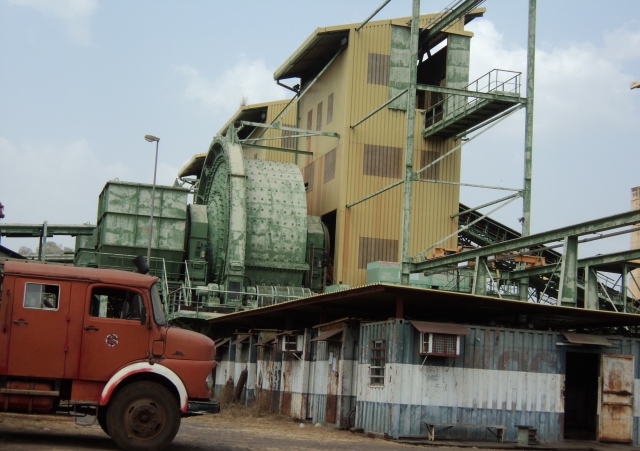
The sight of the wreckage of the plant with webs of machines and other equipment overgrown by bushes means that Nigeria’s dream of joining the league of manufacturing countries such as India, USA, China and Japan has remained a mirage for years.
Each day, a handful of the staff come around, sign their attendance register and sit in clusters for some idle chat, while some simply take a nap under trees or inside the broke- down units within the plant. They close for work when workers at other government ministries and agencies close for the day.
Between 2010 and 2017, the Federal Government, according to the Budget Office of the Federation, budgeted N13.1billion for the company, out of which N12.4billion was paid as salary.
“That’s a ritual we have been doing since this place stopped working,” says one of the workers, who declines to be identified because he is not allowed to talk to press.
The extent of damage done to the company by years of neglect occasioned by the nine years of litigation is beyond description. Its staff strength has dropped from over 3,000 to less than a thousand — some have retired, some have died, others have sought greener pasture elsewhere. Only a few of them still come around to carry out maintenance work. The workers, according to one of them, are “experiencing brain drain now”.
“All of us here are losing technically. We have experts here but now the brain is draining”, says a Metallurgical Institute of Nigeria, Onitsha-trained technical staff.
“If this plant must work, there must be an overhaul of its major components”, says another mechanical staff at the plant who has worked there since inception in 1992 but does not want to be named for fear of a sanction.
Sweating profusely under the intense temperature of Itakpe while carrying out a repair work on a section of the plant known as cyclone alongside three of his colleagues, the elderly staff exudes confidence that the plant can still work.
“It has worked before and it can still work. We stopped all the engines from working when the crisis started,” he says, trying to unlock a bolt in one of the valves.
“Every aspect of this plant needs to be repaired; the automation, that is the automatic part of the plant, is vandalized; the primary crusher, which is the heart of the plant, is grounded. It needs replacement. If you are going to put it (iron ore plant) back in shape, we need a lot of spare parts. Screens and reclaimers, which are other important aspects of the plants, are also damaged.”
Ebhaleme Pius, a staff of GSHL who is supervising the servicing and maintenance work at the plant, confirms that the extent of damage at the ore mining company is deep. “But if the spare parts are available they can be replaced,” he adds.
According to him, it will take up to two months or more to fix the moribund plant once the Indian firm takes charge fully.
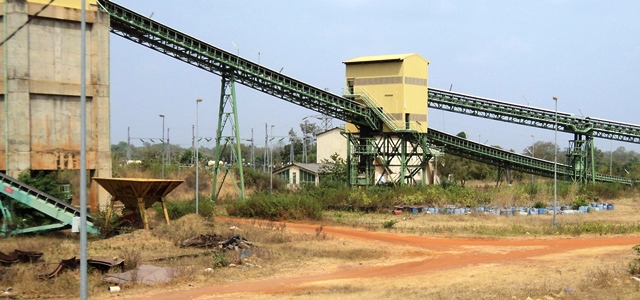
The conveyor belt that runs through the large expanse of land across the plant like a rat track, Pius says, is obsolete and has to be replaced. The vandalized electrical cable will have to be replaced, too.
This is besides the rail track that ought to connect the plant to Delta Steel Company. which is still uncompleted. Across the plant are abandoned loads of concentrate (iron ore) on the rail track. “They have been there since 2008,” the mechanical staff says.
The magnitude of the damage and rot at NIOCOM is probably not known to Nigerians, key stakeholders and perhaps President Muhammadu Buhari — nobody wants to talk about it.
Both the Federal Government and the concessionaire have taken independent audits of the plant. The results of the audit are still being kept to their chests.
The public relies largely on the information provided by the Minister of Steel Development and Mines that the litigation had been finally and amicably settled.
ITAKPE AND AJAOKUTA …STILL HAUNTED BY SPIRIT OF UNFULFILLED AGREEMENT
Obsolete conveyor belts at Itakpe
On the surface, the Nigerian government and the concessionaire seem to have no have qualms about the provision of the modified concession agreement, believed to be vastly superior to the original NIOMCO concession agreement of 2005.
By this modified agreement, the government has agreed to allow GSHL run the iron ore mining plant for another seven years.
Some components of the agreement, ICIR gathered, have been fulfilled — the concessionaire as requested by the document has taken stock of the iron ore mining plant; it has conducted an audit and also has submitted a business plan for the plant to the Federal Government for consideration and approval. The Federal Government has equally audited the Itakpe plant and is contracting an independent audit firm to compare the two audit reports.
Yinka Oyebode, Special Assistant to the Minister of Mine and Steel Development, says the government is working on the implementation of the agreement, though it is over a year that it was signed.
While he wouldn’t agree that the takeoff of NIOCOM by GSHL is being delayed unnecessarily since August 2, 2016 when the two parties put pen to paper, he says “administrative procedure” is being followed by the government to ensure that the right things are done.
Oyebode believes it is wrong to say nothing is happening.
“There are so many things that are supposed to be put in place by both parties,” he says. “These are things that you cannot rush. When people say nothing has happened there, it is not something that you can just rush into; there are procedures.”
However, checks by ICIR reveal that there are still grey areas slowing down the implementation of the modified agreement.
This is the reason the investor is yet to take over NIOMCO for operation. The rehabilitation work that is expected to be undertaken by the Indian firm was yet to commence as of the time of this visit in December 2017.
The contentious issues seem to be three: In the new deal, the railway concession agreement, which is also for the Indian firm was supposed to be revalidated. The company also demands a port for operation between Itakpe, Ajaokuta, which the Federal Government insists must be bid for openly. And above all, GSHL wants the Government to return the Delta Steel Company to it.
Delta Steel Company Limited, Aladja, Delta is already concessioned to Premium Mines and Steel Company, another Indian firm. So, to grant this request, particularly returning Delta Steel Company, is a Herculean task for the Federal Government, as Oyebode says “you cannot give out what you don’t have”.
Delta Steel is not in the hands of Federal Government any longer. “I don’t know how government is going to reconcile the issue of Aladja, because you cannot give what you don’t have,” he says.
“Aladja Steel Company, as we talk today, is not in government’s hand. If someone is asking for it, maybe he has to negotiate with the owner. Construction of the railway is not part of the agreement; it’s the task of Ministry of Transportation. The original agreement does not incorporate that; it is the government that will do that.”
When asked if that will not impede the implementation of the modified agreement, he says: “I don’t think it has anything to do with it because if you are asking for what is not mine, you cannot get it. For instance, this is my laptop, if you are asking for my neighbour’s laptop, how am I going to give it to you? Is it not appropriate that you approach my neighbour?
“As I’m talking to you, technically and factually, Aladja Steel Company is not one of the assets of the Federal Government and so if they are asking for it, I don’t know about it. I don’t work for Global Steel, then I don’t know what government is going to do about it because you are asking for what government cannot do.”
On whether the Federal Government is aware that Global Steel is demanding for Delta Steel Company, he says: “I know there are fresh demands from Global Steel and I’m equally aware there are series of meetings going on. But as regards Aladja, it does not belong to government. That’s how much I know.”
ICIR gathered that the Federal Government, though foot-dragging on the Delta Steel Company being handed back to GSHL, which managed it for five years before it was sacked, has asked the latter to carry out an inter-company indebtedness review.
The review of inter-company indebtedness is being redone by Price Water House Cooper (PWC), creating the impression that the implementation of the modified agreement is on course.
Sam Nwanbuokei, a Director with Global Steel Holding, told the ICIR that the out-of-court settlement between the Federal Government and the company incorporates the renewal agreement of the concession for the National Iron Ore Mining Company, Itakpe.
He explains why there has been stagnation in the implementation of the agreement: other aspects of the signed agreement, like the rail, the port and Delta Steel are yet to be fully resolved.
“The settlement agreement incorporates the renewal agreement of the concession agreement for Itakpe, which has been done; we signed it on August 2, 2016.
“That is how we came to be based there. In addition to that, the railway concession agreement was supposed to be revalidated.
“Thirdly, you needed a port so they were supposed to use their best endeavor if a port is available to lease it or concession it to Global. A port is available, but they asked us to bid and we are doing that. Then, the Delta Steel, they were supposed to use their best endeavour to ensure that Global gets Delta Steel back.
“They said we should review inter-company indebtedness, which was done and now it is being redone by Price Water House Cooper (PWC). All these things are already in the settlement agreement; my main concern is that we are wasting so much time and resources. The Federal Government is losing resources too; manpower is there. Nobody is doing anything.”
Between August 2, 2016 when that agreement was signed and now, not much has been done to implement it.
After the signing of the agreement, Kayode Fayemi, Minister Mines and Steel Development, said the “signing of a modified agreement between Nigeria and Global Infrastructure Nigeria Limited effectively resolved the protracted litigations surrounding the ownership of Ajaokuta Steel”.
The implication of the signing, he explains, “is that Ajaokuta steel has now reverted to the Federal Government and we can now proceed to engage a new core investor with financial and technical capacity to run the complex.”
This means that the company will renounce any claims on Ajaokuta Steel Company.
He seems not to be telling the whole story and probably because of the Delta Steel Company and the railway concession. But Nwanbuokei disagrees with the claim of such settlement and readiness to allow new core investor to Ajaokuta, arguing that although GSHL expected to be party to the resolution referenced by the Minister, he was neither aware of the resolution nor any settlement reached over the matter.
The GSHL Director says he is aware that GSHL is not responsible for the delay in resolving the matter, pointing out that the company had always been open and ready to cooperate with all terms required to arrive at an amicable resolution.”
“We put in all our efforts to conclude the due diligence process in the NIOMCO Itakpe with the conviction that the next phases of compliance with the terms of the International Court of Arbitration would be speedily determined. We regret that this has not been the case”, he stated.
“We are afraid that a message of a similar incorrect formulation may grossly mislead stakeholders both in Nigeria and abroad. We, therefore, request the statement to be removed from the official website address of the Ministry of Steel.”
Nwanbuokei stresses that GSHL and the Nigerian government are still mediating on claims on assets that remained binding on all parties, warning against any investor until the matter has been determined.
In a statement by Mohammed Abbas, Permanent Secretary, the Ministry of Mines and Steel Development said there was no contention about the fact that the company belonged to the Federal Government.
“The Federal Government does not need any mediation to determine its ownership of Ajaokuta Steel Complex, as the integrated steel complex has always been the property of FGN,” Abbas says.
He argues that concessioning of the steel complex and NIOMCO does not make the Federal Government lose the ownership of these assets.
For Ajaokuta, he says despite the concessioning, the Federal Government still remains its actual owner, pointing out that nothing has changed since the entire exercise crumbled.
“The position of government is that having ceded the National Iron Ore Mining Company (NIOMCO), Itakpe to GSHL, for the remaining concession period, as part of the agreement reached during the mediation, the government would, at the appropriate time, take a decision on how best to put Ajaokuta Steel Complex to profitable use”, he notes.
ICIR’s findings reveal that talks are still going on between the Federal Government and the company on how to find a common ground.
Workers at the two plants are worried that their aspirations to start active steel production soon after the signing of the agreement may have hit another brickwall due to the inability of the two parties to agree on some terms.
“We want the steel sector to move forward, let the Federal Government and GSHL resolve the matter,” says Pius, a Vice President of Iron and Steel Senior Staff Association of Nigeria (ISSSAN).
“If we are talking of unemployment and job creation, these two plants will employ more than 75,000 Nigerians and also service about 100 other industries.”
98 PERCENT COMPLETE…WHAT IS HOLDING AJAOKUTA FROM WORKING?
The blast furnace- heart of Ajaokuta Steel Complex, that is not completed yet
Over the years, Nigerians have been told by government and other stakeholders in the steel sector that Ajaokuta Steel Complex has attained 98 percent completion.
In an examination, 98 percent is excellent mark, and this explains why many Nigerians believe that the integrated steel plant ought to be working with its level of completion.
But that is not true; the plant has remained moribund. The two percent, as insignificant as it appears, is much more crucial that it has held the steel complex to ransom for these years.
So, what constitute the two percent?
Ajaokuta has 43 units, out of which 40 have been completed since it was constructed. But the remaining three components — the blast furnace, which is the heart of any steel plant, the coke oven and the steel making shop, — are what constitute the two percent, Bello Itopa, a staff of Ajaokuta and President of ISSSAN reveals.
These three components, according to him, are major. Without them, the plant cannot operate.
Repeatedly, the government has kept allocating budget to pay workers’ salaries at Ajaokuta. In seven years, N29.9billion was spent paying workers out of the total N30.9billion budgeted for both personnel and overhead for the plant. Yet the plant wasn’t functioning.
In 2010 and 2011, personnel cost for the steel plant was the same as the total budget for the plant: N2.3billion and N4.5billion respectively.
Pandih, a steel expert, says years of neglect means that many of the units at the steel complex might be old and obsolete, but he adds that the main stumbling block to its operation is the oxygen plant that is not in place.
“If you want to run that plant, you have to put all the systems in order. Everything to me is spoilt, but the main issue is the oxygen plant, which is not completed. Blast furnace needs oxygen to run.”
But that’s not the only reason the steel complex has not functioned. Its blast furnace — the main equipment used for smelting of iron ore to produce pig irons, one of the best in the world, according to steel workers at Ajapkuta — also failed to work when it was tested.
What constitutes the significant and critical two percent, according to experts, are the blast furnace and the coke oven, which are said to be the heart of the steel plant.
“If you want to talk about the body system — the head, legs and others — and you refuse to put the heart, will the body work?” asks Okeshola Tajudeen, a steel worker and unionist in the steel sector.
The blast furnace is referred to as the primary unit of the plant.
As a unionist, he also believes that there is a conspiracy theory and or international politics behind the non-completion of the plant’s blast furnace.
He explains thus: “The first test that was carried out on the iron ore here, the percentage was low. But through beneficiation, that is improving the quality, there was great improvement and that made it better than that of the foreigners.
“When the Western power saw this, they worked against it. This is how we labour feel about it those are the invisible factors. But as labour, we want the steel plant to work.”
Another worker also corroborates Okeshola’s conspiracy theory, saying the failure of the steel plant to operate about 40 years after it was constructed is due to international politics.
Nigeria, he says, was thought would be too powerful as a nation to have oil deposit and at the same time producing steel. Therefore, superpowers like USA and FRussia were the forces behind the dysfunctional state of the multibillion-naira steel complex.
“Foreigners don’t want Nigeria to have oil and iron at the same time; it is international politics,” he says. “The furnace we have here is what they have in Russia and India and they are working.”
The conspiracy theory does not hold water, according to Nwanbuokei, who has vast knowledge of steel engineering. “There is no inter-play of anything — those are lazy men’s ideas.”
The 98 percent in this case, he argues, is not such that you can start operation. The two percent is the blast furnace and other auxiliary plants that are not ready.
Some of the workers claim that the Russians who built the furnace could not rectify it when iron ore concentrates supplied by Itakpe got stocked in it several years back. Some of the workers at the complex say there could be a problem with the design of the furnace.
“The first product Itakpe we sent there got stocked inside it and they (the Russians) could not rectify it,” says a former worker at the complex who was there in 1985 but now works at NIOCOM.
AJAOKUTA IS GOING FOR PRIVATISATION
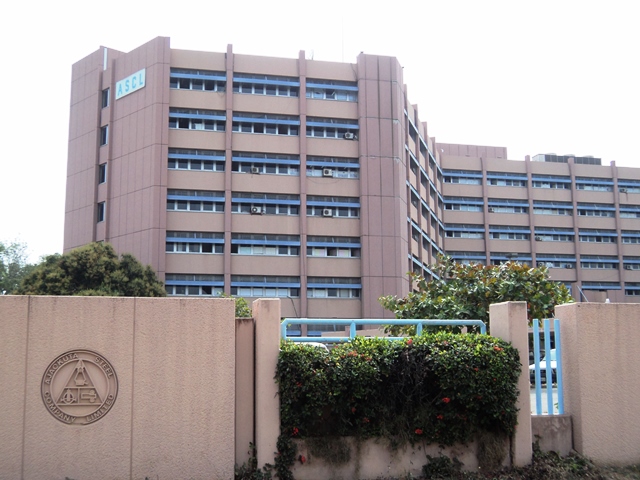
Administrative block of Ajaokuta Steel Company Limited
The Nigerian government has no plan to spend any money on its “half dead humongous steel complex”. It has not estimated how much it would cost to make it operational. The only option that the government is considering after a number of failed concessions is selling the plant.
The Federal Government has expended close to $5billion on the plant and it is said to require another $1.21billion to start production. This new amount to revitalize it is $813million higher than what was needed to complete the complex 17 years ago when Olusegun Obasanjo ordered its audit.
Out of this new fund, $513million is needed to complete the construction of the steel plant and $700million for the construction of external infrastructure.
Government is not interested in running the steel plant again, Yinka Oyebode, spokesperson for the Minister of Mines and Steel Development reveals. Rather, it is available for privatization to any private firm with proven financial and technical capacity to operate it to the optimal level.
He says government does not have the capacity to run Ajaokuta Steel Plant and is not contemplating completing it. The government believes that the new investor should complete the project and run it for profit motives.
“Some will tell you that government will spend $400million to complete it. The question the government is asking is, ‘why do I want to complete it, why can’t I sell it?’
“The new owner should be the one to complete it. Government considers a more convenient option, to sell it as it is, because people will say it is 98 percent, but when you start to quantify it officially you may discover it is more than that.
“Even that two percent, in today’s market value, how much is it? Does the government have that budget? If the government has the budget, then what will it do with it? Can government run that place again? The fact is that government does not have the capacity to run that place again.”
But for a plant that was constructed in 1979, some of its components are old while others by now are obsolete. For 26 years, there were no new inputs to the plant.
Nwanbuokei, who was among the first set of Nigerian graduates deployed to work at the plant, says some modifications are needed at the plant if and when it is ready to operate.
“You need to revitalize them, modify them, modernize some or replace them definitely. The controls now are not the controls when Ajaokuta was built in 1979, so the controls you need to revive them and modernize them,” he explains.
To him, this must be carried out in earnest, as the Nigerian government keeps recording losses while the plant is left unattended to.
“But most importantly, the earlier you start, the better for the system to produce and ensure that you get some money out of it.
“The main thing is that, at the rate you are going, you probably are not expected to produce at the installed capacity. That’s at the rated capacity but you can level up as the production moves on.”
Absence of external infrastructures is also identified as one of the factors that have substantially stopped the plant from being commissioned. Roads, railway and supply are the key infrastructures that are said to be lacking for the plant to commence operation, though it has a power plant that if operational can generate power for four other states in addition to powering Ajaokuta community.
Onobere, a former Sole Administrator of the plant, attests to this, saying: “In fact, the non-completion of the external infrastructure is what has substantially accounted for Ajaokuta Steel Plant not to be commissioned till date, having reached 98 percent completion as of 1994.”
When completed and operational, the plant is expected to generate 75,000 direct jobs and one million indirect jobs.
Disguised, for two weeks, as a desperate customer in need of a prepaid meter, TAIWO ADEBULU investigates racketeering rings among officials of Ibadan Electricity Distribution Company (IBEDC). In this report, he details how the officials source prepaid meters from local producers, vend them in the black market to extort customers who can part with a huge sum for the scarce commodity and other sharp practices.
Unsympathetically, the scorching sun barked without any sign of respite as this reporter hurriedly made his way to the Capital Building headquarters of Ibadan Electricity Distribution Company (IBEDC) at MKO Abiola way in Ibadan on October 12, 2017. With just a few customers waiting to be attended to by the two good-looking female customer care agents, it didn’t take long before he was jolted out of the comforting waves the air conditioner was puffing into his face as he was beckoned to take a seat to be heard.
“Excuse me ma, I’m tired of the estimated billing I’m made to cough up every month. It is too much. I need a prepaid meter and I have come to apply for one,” he said.
“We are very sorry for that sir. But at the moment, we have stopped issuing meters to customers. We have a backlog of applicants who have not yet been provided with the product. Until that is done, we cannot say when we will start supplying out meters,” the rotund lady with a dazzling hair extension audibly whispered.
However, findings revealed that, IBEDC, the largest electricity distribution company in Nigeria with its franchise area made up of Oyo, Ogun, Osun, Kwara and parts of Niger, Ekiti and Kogi states, stopped supplying prepaid meters in mid-2017 after the credited advance payment for metering initiative (CAPMI) intervention programme where customers were made to self-finance meter acquisition was stopped by Babatunde Fashola, Minister of Power, Works and Housing.
WELCOME TO THE BLACK MARKET WHERE PREPAID METER IS GOLD
Prepaid meter procured at the black market
Unlike every other market where items are peddled and sold in the open at certain prices, the black market where electricity prepaid meters are sold and huge sums exchange different hands is not a totally visible one. It is shrouded in open secret. Right inside the main offices, business hubs and service units, officials in connivance with the top officers trade with desperate customers who part with huge sum of money, while the meter is provided in less than two weeks and programmed into the database of the company.
Pretending to be an estate agent in need of units of prepaid meters, this reporter visited Monatan business unit where he met with some officials at the entrance who directed him to another official, a slender and tall man specialised in procuring meters. His countenance lighted in excitement hearing the mouth-watering deal of a huge supply. Without wasting much time, phone numbers were exchanged for further discussions. That evening, the business deal was negotiated as he insisted on N110, 000 (one hundred and ten thousand naira) for a three-phase unit and N60,000 (sixty-thousand naira) for a single phase.
Monatan business unit
“Sir, since we need a lot of it, can you beat down the price for us?” the reported pleaded.
“The process of acquiring the meters is not that easy. We want to work it out for you and it requires a lot of procedures,” he said. When this reporter asked if the meters were genuine since they were not from an official channel, he assured, “Forget it! When it comes to quality, we deal with companies that supply the product directly from Lagos. We will now work it into IBEDC platform.”
When asked if he could handle the deal alone or he would need more hands, he exclaimed that he could do it alone but would need extra hands from his colleagues for installations and that will cost the reporter extra charges. He said the whole process will take less than a week to complete and demanded his First Bank account be credited as soon as possible before work could commence.
He quickly added, “The only problem is that you are not going to get a receipt. As at the time we were supplying meters officially, customers used to pay to Fidelity Bank while the teller served as the receipt.”
RELICS FROM THE PAST: PHCN CONNECTION
The one-storey building housing the IBEDC service unit at Fasfas junction, Old Ife road was a beehive of activities. No one seemed to notice the presence of the reporter in the vacuum the station prides as an office until he approached one of the officials making haste to mount the service truck filled with wires downstairs. Having stated his mission, the official took the reporter upstairs and handed him over to a junior colleague – short, with a bleached skin. After much deliberations, he insisted on N70,000 (seventy-thousand naira only) for a three-phase meter unit and N47,000 (forty-seven thousand naira only) for a single-phase unit. Phone numbers were exchanged for further transactional discussions.
Gbagi service unit
When asked about the authenticity of the products he intended to supply, his mandible dropped with mouth agape. “The meter we are going to give you is original. There are two types. One is Unistar, which is not available at present, while the other is Mojec and it is available. If I know the house you want to install the meter, after installation, tell anyone who challenges you that you obtained the meter since the time of PHCN (the defunct Power Holding Company of Nigeria). It was Mojec that used to supply PHCN and they are reliable.”
When he was asked if he was going to issue a receipt of payment, he said, “Don’t worry about receipt. I’ll just need your passport photograph and your evidence of payment will be done. All I need is just a month to clear the meter and you will see that everything is new and intact.”
A POROUS DATABASE
IBEDC Headquarters
At the multi-storied The Rock Plaza location of the Akobo Service Unit, an official was approached at the first office by the entrance where his colleagues were engaged in series of consumer complaint arguments. As this reporter was explaining his quest to procure units of prepaid meters for a housing project, the official, a young man apparently in his early 30s, pulled him out of the room to a location near the mechanic workshop.
For a single-phase unit, he demanded N65,000 (sixty-five thousand naira only) and N105, 000 (One hundred and five thousand naira only) for a three-phase unit. As phone numbers were exchanged to end the current discussion for further talks, the official swiftly noted, “If you pay today, you will get it within two weeks and it may not be up to that. The only thing that can extend it to two weeks is the programming.”
IBEDC customer care agents
On the authenticity of the product and how he intends to process it considering the fact that it’s not an official channel, he declared convincingly, “It is original and standard. They just brought it from Lagos; it’s that scarce. But that money I told you does not include installation but programming. You will give us your name and address and your card will be programmed with that name such that when you recharge, your name and address will be on the receipt. You will pay differently for installation because I won’t be the one to do it. Some of our officials are specialised in that.
“I’m sorry that we cannot give you a receipt because what we are doing is backdoor. Yet, it is genuine. Were are not supplying meters officially at present and customers are not allowed to pay in because those customers who paid about two or three years ago have not been cleared.”
On December 15, 2017, a sum of N65, 000 was transferred electronically to the Skye Bank account of the official to ascertain if the deal was genuine. At December 27, the product was available and ready for programming into the database of the company. On December 31, N6,500 was transferred to him for installation. On January 2, 2018, the programming was completed and the product with meter serial number 10621423684 was delivered with a purchase credit voucher in this reporter’s name.
However, information on the company’s website showed that IBEDC has metered 300,000 customers across its coverage – a huge decline from its 404,207 strategic metering plan from 2014-2017 – and has enjoined his customers not to pay for meter procurement or installation as it free of charge.
IBEDC MD DISAGREES WITH FASHOLA
John Donnachie, MD, IBEDC
In an interview with John Donnachie, managing director, Ibadan Electricity Distribution Company (IBEDC), he said the management decided to stop supplying prepaid meters because the minister of power, works and housing cancelled the credited advance payment for metering initiative (CAPMI) scheme which was consumer-funded and there was no attempt to review the price of the meter after the exchange rate increased.
“When the exchange rate went from N155 to about N365, they refused to pay the price for the meter. So, we were unable to execute the programme under those conditions. Our limitation is the non-availability of fund to roll out the plan,” he said.
“I’ve lost 3 billion naira on the bill. Then, I must pay salaries. I lose money. If I give you a meter, there’s no payback. However, it’s our responsibility to meter everybody. At present, our preferred meter roll-out plan is post-paid because our money will go further in metering more people quicker, effectively and controlled because I want to make sure meters are not bypassed.”
As this reporter reminded him of a statement credited to the minister a few weeks ago while inspecting the National Meter Test Station in Oshodi, Lagos state, that the core business of distribution companies (DISCOs) is to transport energy and not to supply meters, John quipped, “It is wrong to say that it is not the responsibility of DISCOs to provide electricity. How do I control the power I give you? You can control electricity through meters. I think issues are being politicised.”
While commenting on the corruption and other sharp practices being carried out by officials of the company, he said, “It’s a huge problem. We are investigating everyone and we found our staff selling prepaid meters to people and vending. We change our vending system every day. We are working to enumerate customers. We have 1.5 million registered customers but we believe it should be about 3 million.”
The IBEDC enumeration exercise, according to a news item on the company’s website, is aimed at enhancing the efficiency of the distribution system in terms of quality of power and having a comprehensive database of all electricity customers in its franchise area using Geographic Information System (GIS) technology.
A SECTOR IN CRISIS
Before the privatisation of the power sector in November 2013, the federal government had introduced different interventional schemes to save the stormy sector. The National Prepaid Metering Programme (NPPMP) adopted the prepaid metering technology but failed due to corrupt practices of the Revenue Circle Management (RCMs) and government’s lackadaisical approach in funding the huge cost of meters.
When the federal government privatised the sector, some of the objectives for such reform were to ensure constant electricity supply and to address the metering gap. Hence, investors in the distribution companies were mandated to commit to a solid meter rollout plan over a five-year period under the Performance Agreements (PAs) with the Bureau of Public Enterprise, as it is also the responsibility of DISCOs to provide meters to customers in line with the Electric Power Sector Reform (EPSR) Act.
The EPSR Act of 2005 birthed the Nigerian Electricity Regulatory Commission (NERC) in October that year as an independent watchdog and regulatory body for the power industry. In 2012, NERC launched a new meter scheme to fill the huge metering gap and resolve the funding challenges that plagued the NPPMP/RCM model. It was tagged credited advance payment for metering initiative (CAPMI) plan for customers to quickly get a meter. Customers pay for the meter and the cost is refunded in form of credit units over a period of 36 months with interest. Even with the plan of the Nigerian Electricity Supply Industry (NESI) in 2013 to roll out meters to existing six million consumers across the eleven discos, the CAPMI scheme still became impotent from foreign exchange scarcity and irregularities by DISCOs and was eventually phased out.
METER OWNERSHIP AND FINANCING
Babatunde Fashola, Minister of Power, Works and Housing, inspecting of the NEMSA National Meter Test Station in Oshodi, Lagos
While inspecting the National Meter Test Station in Oshodi, Fashola reportedly said the federal government had concluded plans to involve more Nigerians in meter manufacturing.
“The core business of DISCOs is to transport energy; their business is not to supply meters. The government will address metering more vigorously this year with regulations which will open up business in metering to more investors,” he reportedly said.
However, under existing regulations, it is the obligation of distribution companies to meter customers notwithstanding the party who financed the meters.
This move is an attempt to put a lasting solution to the metering crisis as recent data provided by NERC indicated that 3.39 million out of the 7.74 million customers nationwide have electricity meters. This is coming at a time when customers feel that DISCOs deliberately dilly-dally on providing prepaid meters as a sly approach to continually milk them through bloated bills as the amount they are compelled to pay is not a true reflection of the amount of energy they possibly could have consumed within the billing period. And so, they cannot effectively manage their electricity utilisation. Hence, those who have access to the black market patronise the racketeers among the electricity officials and those who cannot find their way around gnash their teeth to cough up money and settle the crazy bills in order to stay connected.
CUSTOMERS GROAN UNDER WEIGHT OF CRAZY BILLS
Olajumoke’s electricity bill for December
Sixty-two-year-old Maria Olajumoke lives with only her aged mother at a gated duplex at Arulogun road, opposite Adekunle Fajuyi Cantonment, Ojoo, Ibadan. For more than three years, she has been battling to acquire a prepaid meter due to the ridiculous bills officials of IBEDC gives her every month, even though she uses only the fan in her room and the sitting room and occasionally watches television. Yet, she has been told that she cannot pay in for prepaid meters because the company is not supplying the product at the moment.
Olajumoke recounted, “Sometimes, they bring N5, 000 and some other time N3, 000 in a month. My mother and I cannot consume up to that amount; but when they bring the bills, there’s nothing you can do. The electricity supply is not even regular here. They bring it twice or three times in a week.
“They will embarrass you and threaten to disconnect your lines if you do not pay, yet they said we can’t pay for prepaid meters. With a prepaid meter, I can pay anytime and manage my consumption without embarrassment. I don’t have a fridge; the pumping machine is faulty and I don’t iron clothes. So, how do they calculate my bills? Before my last daughter got married, there was a month they brought a bill of eight thousand naira and we kept asking how they derived it but we were shunned.”
When Abiodun Olojede, the 60-year old pastor of Power Pentecostal Church, Podo, Ibadan was getting drained from the yoke of the estimated billing he was paying with no service to show for it, he approached an IBEDC official at Alakia Service station in February 2016 and paid the sum of N30, 000 to acquire a unit of single phase prepaid meter.
“I still spoke with him last week and he said the contractor that gets it for them said it’s still not available,” he said
“I just have to be hopeful because there’s nothing I can do about it. They just bring abnormal bills without reading the meter. We don’t get electricity regularly, yet they come to harass us that they will remove the wire if we do not pay. I haven’t used my refrigerator for the past 10 years. I know I didn’t pass through the appropriate channel, but it will take a very long time, even though the product is not available in their offices. Those officials hoard it and only make it available in the black market where they can make more money. So, we have no choice but to turn to the black market in the face of crazy bills.”
In an interview, Anjuwon Akinwande, a professor of Mass Communication at Babcock University, Ilishan-Remo, expressed dissatisfaction with the unbecoming attitude of IBEDC officials who had come to his house to advise him not to replace his faulty prepaid meter because he would pay more, instead he should accept a bill where he’ll pay a designated amount every month.
He said: “I told them that I wouldn’t pay a bill of what I didn’t use, but with a prepaid meter, I pay for what I use. We were discouraged. The former prepaid meter is not accepting payments. My tenants and I have complained and they made an arrangement with my tenants that they should pay certain amount to them every month.
“The distributors are expected to have their meters and I don’t know why we should pay for it because it’s their tool to make money. We installed the poles and transformers in my area; then, I was at the United Nations. These people cannot do business and you sold our property to them. They are not qualified to handle the electricity business. They are meant to provide everything. We’ve lived in Britain, France, America and we know how things are done. Once they are not capable of handling it, the privatisation deal should be renegotiated because the current system is not working.
“I know there are prepaid meters out there. Someone got one recently and he said it’s N40,000 for a single phase. Really, I do not like the black market. But if I cannot get one through the official channel, I have to buy it elsewhere because they have tampered with my meter and I’m not cool with the current arrangement. I can’t be paying for what is not calculated. I even thought you were coming to solve my problem when you mentioned prepaid meters over the phone.”
One can’t but imagine how electricity consumers are at the receiving end across the country. The government needs to rise to the occasion by sanitising the power sector.
This report is facilitated by the Wole Soyinka Centre For Investigative Journalism, WSCIJ, as part of its Regulators Monitoring Programme, REMOP, on electricity project.
Darius Ishiaku, Governor of Taraba State, says unknown persons use helicopters to drop arms and ammunition at night for hoodlums in the state, yet the police and other security agencies are doing nothing about it.
Ishiaku also lamented the impact of killings by herdsmen on development in the state, saying “God gave us good land, but we lack common sense”.
He made the claims when a delegation of the leadership of the Peoples Democratic Party (PDP) led by Uche Secondus, the National Chairman, paid him a courtesy visit in Jalingo.
Ishiaku said the security apparatus of the country needs to be urgently reviewed to ensure better protection of citizens’ life and property. He decried a situation where a state police command needs to get clearance from the Police Headquarters in Abuja before responding to a potential security threat.
According to Ishiaku, the tensed security situation in Benue State is no different from what presently obtains in Taraba.
“We buried 63 people at Lau, the same day that Benue State buried 73 of its people. We are in trouble in this country,” Ishiaku said.
“When I assumed office, I asked my people to give me peace and that I would give development in return. Peace is elusive in Taraba, but we have development. Here I am as a Governor with a crown, but without a sword.
“You call police and security agencies for help, they will tell you they need to clear from Abuja before acting. Before you know it, you have lost 100 people.
“When you call for help, the help takes ages to come. We need to restructure the security architecture of this country. You take one step forward as the Governor, the almighty Federal Government takes you back 10 miles.
“The police we have can’t help themselves. In 10 days’ time, we will be attacked. Helicopters dropped arms here at night for hoodlums.
“We will talk because if the Federal Government cannot help us, let those who can help us come to our aid.
“Our farmers cannot travel at night with their goods to neighbouring states to sell again. God gave us good land, but we lack common sense.
“I’m talking now since writing has not produced the desired results. Some of these things are not meant to be said, but we will henceforth be talking.
“If our voices are not heard in Abuja, they can be heard in Kano, Niger Republic, United States of America and other places.”
When contacted, David Akinremi, Taraba State Commissioner of Police, said the command has not received any letter from the State Governor.
“As far as I am concerned, I have not received any letter from the Governor. I am not aware that the Governor informed us about any impending attack,” Akinremi told journalists.
A total of 168 Nigerians were killed in clashes between herdsmen and farmers in Adamawa, Benue, Taraba, Ondo and Kaduna states in January 2018 alone, according to a reportby Amnesty International. But many say the number could be higher, as a lot more cases of violent killings were unrecorded and unreported.
Ex-President Olusegun Obasanjo formally registered as a member of the newly-formed Coalition for Nigeria Movement (CNM) on Thursday but said he would pull out should the movement decide to venture into partisan politics.
CNM is the alternative proposed by Obasanjo in his special press statement last week as the platform that would move Nigeria towards path of growth and development since the two major political parties in the country – the PDP and APC – have failed.
Obasanjo urged all Nigerians, “especially youth who have hitherto been feeling marginalised and helpless to go all out and bring friends and families into the CNM fold”.
“The CNM will remain a popular socio-economic Movement open to all Nigerians who believe in the greatness of Nigeria and are ready to contribute to it,” he wrote in another press statement he issued on Thursday.
“I am happy to be a member of the Coalition for Nigeria Movement. The movement is a pressure point towards good governance. This is the commencement for our popular and grassroots association.
“Of course, the membership will be free to collectively decide on whether CNM becomes a political party. If the Movement decides to transform itself and go into partisan politics, I will cease to be a member.
“Nigeria belongs to all Nigerians to be made right and the Coalition with others of the same view and like minds will leave no stone unturned to actualise God-given potentials of our country.
“The Movement will spearhead process, programme, policies and priorities to make Nigeria a great country playing its expected roles within West Africa, Africa and the world.”
Obasanjo added that through the CNM, “Nigerian youth will be emboldened, empowered, have employment, and play meaningful and responsible roles in the leadership and governance of the country in all ramifications. Nigerian women will have dignity, responsibility and equal consideration with men in the affairs of Nigeria”.
“The Movement is a means to an end. The end is Nigeria, unshackled, united, dynamic, strong, secure, cohesive, stable, and prosperous at home and respected outside, and as result, able to play decisive roles assertively within the comity of nations,” he said.
“A Nigeria of hope, aspiration and assurances which belongs to all with no sacred cow nor sacrificial lamb is what we want. My Nigeria, your Nigeria and our Nigeria with enchanting present and secure and glorious future.”
Sadiq Daba, a veteran broadcaster and actor, will join other Nigerians to lead the Abuja Cancer Awareness Walk this weekend as part of the activities to commemorate the 2018 World Cancer Day.
Daba recently returned to the country after undergoing treatment for leukaemia and prostate cancer.
The walk, which will also include, race, cycle, ride, skate and marathon against cancer at the Transcorp Hilton Abuja on Saturday, is being organised by Project PINK BLUE, a non-governmental organization.
Later on February 9, a World Cancer Day Symposium and Panel of Discussion will be held at Transcorp Hilton.
A statement by Runcie Chidebe, Executive Director of Project PINK BLUE, said Adenike Oyetunde, a lawyer and on-air personality who was diagnosed of Osteogenic Sarcoma (bone cancer) in 2016, will also be part of the walk.
Joe Okei-Odumakin, a women’s right activist and President of Women Arise who has been involved in raising funds for cancer patients, including Daba, will also be in Abuja to lead the walk.
Celebrities and high-profile Nigerians expected at the event include Bryan Okwara, Recheal Okonkwo, Kemen of Big Brother Naija, Peace Emezue, Bassey of the Big Brother Naija and Dr. Joe Abah (former DG Bureau of Public Service Reforms).
Others are Chido Onumah, Dapo Olorunyomi, Ghana Must Go, Koboko, CP Sadiq Bello and Commissioner of Police FCT.
According to the statement, over 2,000 Nigerians are expected at the awareness walk, billed to kick off at Transcorp Hilton by 7 am on Saturday.
“This year, we are more interested in matching talks with action,” Chidebe said, listing the actions that must be taken to combat cancer in the country.
“We have been talking a lot. We need to see progress. We need Federal Government to set up one stop comprehensive cancer care. We need National Health Insurance Scheme (NHIS) to cover cancer.
“We want Nigeria’s National Cancer Control Plan to be budgeted for and implemented. We need Nigerians to engage in regular screenings. We need everyone to learn about cancer.”
Chidebe said free cancer screenings would be available for people at the walk, and he urged Nigerians to make donations to support cancer patients.
Isaac Adewole, Minister of Health, is expected to launch Nigeria’s National Cancer Control Plan (2018 to 2022) on Friday February 9 at the World Cancer Day 2018 Symposium & Panel.
World Cancer Day is commemorated globally on February 4.
President Uhuru Kenyatta of Kenya has clamped down on independent television stations that covered the swearing-in of Raila Odinga as the parallel President of the country on Tuesday.
The Kenyan government on Tuesday shut down three private stations for live coverage of Odinga’s swearing-in ceremony.
According to Reuters, three Kenyan journalists said on Thursday they spent the night in their newsroom in fear of arrest, watching plainclothes policemen camped outside, and that their lawyers would file court petitions in the morning seeking to ensure their freedom.
“We were doing our job, we had the right to do this, and if I was to do it again, I’d do it the same way,” Ken Mijungu, NTV senior anchor and reporter, told Reuters after an anxious night spent conferring with lawyers and wondering if police would appear with arrest warrants.
He said his colleagues, Larry Madowo and Linus Kaikai, had all been independently warned by security sources on Wednesday that their arrest was imminent.
In the early evening, when men they believed were plainclothes police appeared outside their office building, they were advised by the station’s management to stay inside.
By morning, the men were still in their newsroom.
“Our head of security said he has reason to believe they had gone for reinforcements,” said Madowo, 30, who was producing coverage on Tuesday before authorities took NTV off air.
But the shutdown of TV stations has been condemned by Kenyan journalists, who had been used to operating freely.
“This is clearly a slide to dictatorship. It’s a return to a repressive period we had forgotten about,” said Madowo. “We are becoming another African country with these kinds of issues.”
Kaikai, who is also Chairman of the Kenya Editors’ Guild, said editors had been warned by authorities that they could be shut down if they covered the event.
The stations would stay off air indefinitely, the government said on Wednesday, as it investigates the symbolic oath by Odinga directly challenging Kenyatta.
Fred Matiang’i, Kenyan Interior Minister, accused media organisations of facilitating the “illegal act”, which he said put the lives of thousands of Kenyans at risk.
“This is a gross abuse of the law and complete disregard for the constitution,” said Mijungu.
Also on Wednesday, police arrested Tom Kajwang, an opposition lawmaker who administered Odinga’s “oath”. He was expected to be charged on Thursday with administering an unlawful oath, a security source told Reuters.