Home Blog Page 2641

Kidnappers kill two policemen, abduct American, Canadian in Kaduna


Kidnappers have killed two policemen and abducted two foreigners — an American and a Canadian — in Kaduna State.

Mukhtar Aliyu, spokesperson of the Kaduna State Police Command, confirmed the attack, saying the two policemen accompanied the foreigners.

Aliyu said the American and Canadian were ambushed by unknown gunmen on their way to Abuja after visiting Kafanchan, Kaduna.

He said the attack occurred around Kagarko, along Kaduna-Abuja Road on Tuesday night.

“The two police escorts attached to them engaged the kidnappers in a fierce gun battle, which resulted to the unfortunate death of the two police officers,” the police spokesperson said.

Buhari can end herdsmen attacks if he really wants to, says SERAP


Socio-Economic Rights and Accountability Project (SERAP), a civil society organisation, believes that President Muahammadu Buhari “is in a powerful position to end the unlawful killings and destruction of property apparently by herdsmen across the country if he really wants to do so”.

The organisation the President to establish a trust fund for victims of attacks by herdsmen as a way of seeking justice for them.

“Establishing a trust fund for victims of attacks by herdsmen will be an important first step towards justice for victims and their families,” Timothy Adewale, its Deputy Director, said in a statement on Wednesday.

He said that “any effort by President Buhari’s government to prevent and combat attacks by herdsmen across the country is grounded in the rights of victims of unlawful killings and their families”.

Adewale lamented that the plights of the victims and their families have been overlooked by government’s attempt to address the persistent attacks by herdsmen in Benue, Taraba and Adamawa states.

THE STATEMENT

So far attempts by the government to address the persistent attacks by herdsmen in Benue, Taraba, Adamawa states and other parts of the country have overlooked the plight of the victims and their families.

But it has to be made clear that victims of attacks apparently by herdsmen are entitled to effective remedies regardless of whether they bring their claims against the government in an individual or collective capacity.

 It is an imperative demand of justice that the responsibility of the perpetrators of the unlawful killings and destruction of property be clearly established and the rights of the victims and their families sustained to the fullest possible extent.

 Victims’ right to an effective remedy and reparation is a legally enforceable human right and not a matter of charity.

It is no coincidence that the Nigerian Constitution of 1999 (as amended) and human rights instruments such as the International Covenant on Civil and Political Rights and the African Charter on Human and Peoples’ Rights to which Nigeria is a state party refer to victims’ right to effective remedies, including access to justice, reparation and guarantee of non-repetition.

As the President of the Republic and Commander-in-Chief of the Armed Forces, SERAP believes that Buhari is in a powerful position to end the unlawful killings and destruction of property apparently by herdsmen across the country if he really wants to do so. Buhari needs to speak directly to Nigerians and particularly to the countless victims and their families.

Continuing refusal of Buhari to speak directly to Nigerians on the matter and visit the states such as Benue, Taraba and Adamawa, that have been most affected by these attacks by herdsmen is feeding into the propaganda that this government may be shielding suspected perpetrators from justice and, more importantly, undermines the rule of law and facilitates continuing attacks.

Under international law, a victim is defined as anyone who suffers individual or collective harm (or pain) such as physical or mental injury, emotional suffering, economic loss, or generally any impairment of human rights as a result of acts or omissions that constitute gross violations of human rights, or serious violations of humanitarian law norms.

A victim does not necessarily have to be the person that has suffered the harm, as a dependent or a member of the immediate family or household of the person that has directly suffered harm can indirectly be characterised as a victim.

Indeed, the Basic Principles of Justice for Victims of Crime and Abuse of Power provides some guarantees for victims (including family members of direct victims), such as those that suffer ‘substantial impairment of their fundamental rights’ through acts or omissions of governments.

12 feared dead as two male bombers strike in Maiduguri


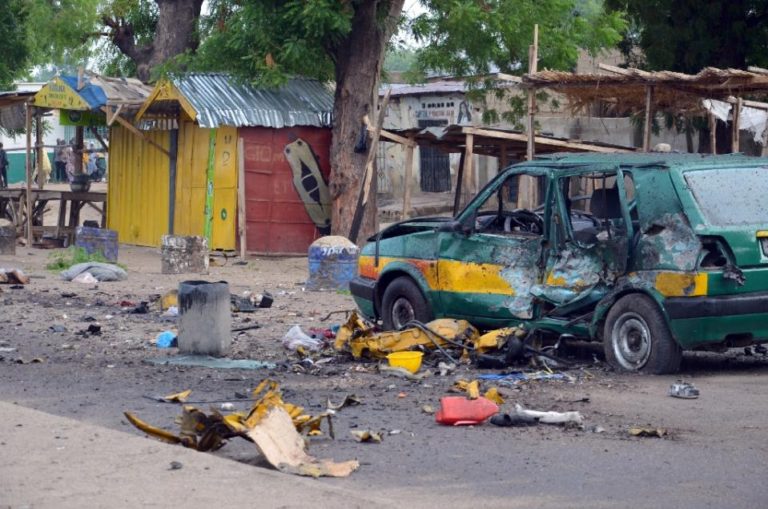
Twelve people are feared dead in a twin suicide bomb attack that occurred at the Muna Garage area of Maiduguri, the Borno State capital, on Wednesday.

Forty-eight others were also injured in the attacks, which members of the Civilian Joint Task Force (CJTF) operating in the area said were carried out by two male bombers.

According to Channels Television, the Borno State Commissioner of Police is said to be on his way to the scene.

Details soon…

Misau says ‘this attorney-general’, Malami, is becoming a ‘nuisance’


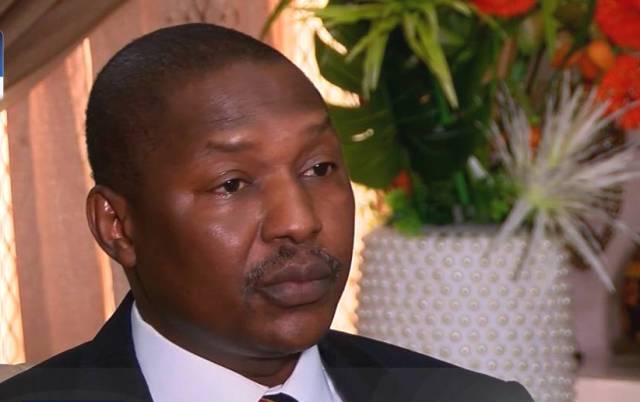
Isah Misau, the senator representing Bauchi Central at the National Assembly, says Abubakar Malami, Attorney-General of the Federation (AGF), is “becoming a nuisance”.

Speaking during the plenary on Wednesday, Misau condemned Malami’s role in the recall of Abdulrasheed Maina, former Chairman of the Pension Reform Task Team, and his legal moves to stop the Senate from investigating the matter

He also asked to know why Babachir Lawal, former Secretary to the Government of the Federation, has not been charged to court months after his indictment by a committee headed by Vice President Yemi Osinbajo.

He said it was time the legislative arm of government started doing more than adopting resolutions, as that alone would not solve the country’s problems.

Misau said many appointments by the executive were not on merit, adding that President Muhammadu Buhari appears not to be in total control of his government.

“It is high time for us to do. If it’s about talking here or holding conferences, it would not solve this problem. We should look at security, who and who are holding offices, are they appointed by merit?” he queried.

“So many appointments in this government are not on merit. Some people have taken over the government as if they are even above the President.

“We say we are fighting corruption. Babachir Lawal that the Vice-President’s committee indicted… why can’t they take him to court and all of us are here keeping quiet. People who have not done anything are always in court.

“This attorney-general (Abubakar Malami) is becoming a nuisance, going to court to stop Maina’s and we are still here.”

Misau also said that a minister had been leading a scheme seeking to oust Bukola Saraki as President of the Senate, on the suspicion that he (Saraki) was planning to leave the All Progressives Congress (APC)

“When we were on holiday, so many people were going behind that they should try and remove the Senate President. During this holiday, a minister was spearheading that thing,” Misau said.

“What is the reason? They said that the Senate President would leave APC, that they should create problems for him. What kind of country is this? Everything is about religion, about tribe.”

Misau, a retired police officer, is currently facing libel charges before a High Court of the Federal Capital Territory following allegations he made against Ibrahim Idris, Inspector General of Police.

He had alleged that Idris pockets billions of naira in bribe money from big companies and wealthy Nigerians to provide them with police security.

Misau also said that Idris grants special promotions to mainly officers from his Nupe ethnic group.

Theresa May appoints UK’s first minister for loneliness

0


Tracey Crouch, former British Minister for Sport and Civil Society, has been named the country’s new Minister for Loneliness, partly in honour of Jo Cox, a member of the British parliament who was murdered by a far-right extremist just before the BREXIT vote in 2016.

The appointment, announced by Prime Minister Theresa May on Wednesday, is aimed at tackling “the sad reality of modern life” affecting millions of people.

“For far too many people, loneliness is the sad reality of modern life,” May said.

“I want to confront this challenge for our society and for all of us to take action to address the loneliness endured by the elderly, by carers, by those who have lost loved ones — people who have no one to talk to or share their thoughts and experiences with.

“Jo Cox recognized the scale of loneliness across the country and dedicated herself to doing all she could to help those affected.”

This was corroborated by the Jo Cox foundation, which tweeted: “Jo experienced and witnessed loneliness throughout her life, especially as a new student at Cambridge University and separated from her sister Kim for (the) first time.

“She would be delighted by Tracey Crouch’s new job as minister for loneliness and would be saying ‘let’s get to work!’”

The loneliness initiative is expected to come up with a strategy published later this year, with representatives from the national and local government, public services, the voluntary sector and private businesses, expected to make inputs.

According to the British Red Cross, over nine million people, out of the 65.6 million British population, are often lonely, a development it described as a “hidden epidemic” that affects people of all ages at various times in their life.

A research carried out by the organisation found that as many as one in 10 people felt lonely “always or often” and that hundreds of thousands of elderly people hadn’t spoken to a friend or relative in the past month.

In December 2017, Rochas Okorocha, Governor of Imo State, caused quite a stir in the nation when he named his biological sister Commissioner for Happiness and Purpose Fulfillment, which he said was in keeping with the provisions of the Nigerian constitution.

42 per cent of proposed 2018 budget not useful to the people, laments BudgIT


Administrative items such buying of cars, retrofitting of government offices, trainings, consultancies, and purchase of furniture and computers make up at least 42 percent of the capital expenditure in the 2018 budget, BudgIT. a civic organisation, has lamented.

In its analysis of the budget, BudgIT showed that approximately N744.48bn or 42.9% of the N2.65tn capital allocation will go to these administrative items.

“BudgIT decries the masking of several opaque administrative items as capital projects just to shore up the percentage of capital component in the 2018 budget,” the organisation said in a press statement made available to ICIR by Abiola Afolabi, its Communications Lead.

These administrative items, it said, will not have direct impact on the citizens.

“In a pre-election year, we would have expected that capital projects will be solely devoted to projects with direct developmental impact on the larger population. We have seen several items included in the capital budget that should ordinarily have been excluded, given the tight fiscal condition and meagre economic growth.  Most of the administrative capital items, as shown in our research analysis, will benefit less than 1% of the populace — politicians and civil servants.”

BudgIT noted that most line items in capital budgets show a great disconnect from the developmental goals of government, as stated in its Economic Recovery and Growth Plan (ERGP), adding that funds marked for capital expenditure would be largely borrowed as highlighted in the proposed 2018 budget.

“Our scope of developmental capital projects, as urgently needed, should include the acquisition, upgrading, construction and maintaining of physical assets, such as hospital, schools, roads, railways, power plants, street lights, boreholes among others. In contrast, administrative capital items are projects that cannot be easily accessed by the general public and have very little or no developmental impact on the population.”

BudgIT also noted the fragmentation of capital items, as 94.7% of the 9,331 line capital items in the 2018 proposed budget have monetary values below N500m each and are accompanied with vague descriptions that will prove difficult to monitor or track in physical and auditing terms.

“Only 26% of capital allocations to the ministries of Health, Education, Agriculture, Transportation, Niger Delta, Water resources, Science, Works, Power and Housing are trackable, and/or can be directly linked to the written, medium-term aspirations of the government as highlighted in the Economic Recovery and Growth Plan.

“Across the board, a significant amount of capital allocated in the 2018 budget falls under certain generically-named items, which have no detailed description and do not communicate the number of beneficiaries of such items.

“It is common to find the following entries in the budget of every Ministry, Department and Agency of government:  welfare packages, sporting activities, drugs and medical supplies, medical expenses, software acquisition, monitoring and evaluation, budget preparation, access to credit, food and agricultural policies, budget preparation and international training etc.”

Budgit pointed out that this system of budgeting with “one-liners” without details, gives room for financial indiscretion and the potential abuse of funds.

The organisation also observed that the Federal Government is yet to come out plainly on the amounts spent on capital items in the 2016 and 2017 financial years.

It accused the Ministry of Finance for showing disdain for accountability, as the ministry failed to disclose the details of the expenditure despite repeated inquiries.

BudgIT urged lawmakers and members of executive arm to significantly reduce the administrative component of the budget and direct funds towards improving education, health and other critical infrastructure.


Suicide bombing is ‘haraam’, 1,800 Pakistani Islamic clerics declare


One thousand eight hundred Pakistani Muslim clerics have issued an Islamic directive, or fatwa, declaring that suicide bombing is against the teachings of the religion, and is therefore “haraam”.

The directive was contained in a book published by the state-run International Islamic University, which was unveiled on Tuesday.

“This Fatwa provides a strong base for the stability of a moderate Islamic society. We can seek guidance from this Fatwa for building a national narrative in order to curb extremism in keeping with the golden principles of Islam,” Mamnoon Hussain, President of Pakistan, wrote in a book.

Pakistan has witnessed violent attacks by Islamist extremists who say they were fighting a holy war or jihad.

“No individual or group has the authority to declare and wage jihad [holy war],” the clerics declared.

However, some members of the Pakistani parliament say the declaration was the result of pressure from the US government.

Two weeks ago, the White House said that it would continue withholding $255 million in military aid to Pakistan because of what it described as the country’s reluctance to confront terrorist networks.

It is yet to be seen whether the declaration will bring about a reduction in suicide bomb incidents in Pakistan, as similar fatwas seem not to have had the desired results.

CAN asks FG to declare Miyetti Allah terrorists over Benue genocide


The Christian Association of Nigeria (CAN) has asked the Federal Government to declare the Miyetti Allah Cattle Breeders Association of Nigeria (MACBAN) a terrorist organization.

Musa Asake, General Secretary of CAN, who spoke at a press conference in Abuja on Tuesday, said leaders of MACBAN should be arrested and prosecuted for genocide against the Christian minorities in the middle belt.

He argued that while the Federal Government had taken the battle to Boko Haram, the Indigenous People of Biafra, (IPOB), the Badoo boys, the Niger Delta Avengers and other groups, the government had not shown any serious willingness to checkmate the murderous Fulani herdsmen.

This, he said, shows a betrayal of the confidence reposed in the Federal Government by the citizens.

Asake said MACBAN was supposed to be a business group, much like many other businesses and professional groups in the country.

He lamented that the MACBAN differs from any other business group in that it combines bloodshed with enterprise.

He maintained that the Fulani herdsmen are clearly associated with MACBAN, noting that officials of the association were known to making inciteful statements before and after attack on vulnerable communities by Fulani herdsmen.

The CAN General Secretary stressed  that in recent attacks on Benue State, Garus Gololo, President of Benue Branch of Miyetti Allah, said they attacked the communities because 1,000 of their cows were stolen.

“Even if it was true that cows were stolen, who constituted Miyetti Allah into law enforcement agency, judge and jury to commit wholesale murder?” he asked.

He said that there is difference between Islam and Islamism, and called on all lovers of freedom and democracy in Nigeria to rise against the tyranny of the Islamists who “manipulate the religion of Islam for political and cultural domination”.

“President Muhammadu Buhari should overhaul the National Security Council with a view to sharing its membership equally between Christians and Muslims and possibly those who do not belong to either. No religion has a monopoly of competency, commitment and patriotism,” he said.

“Recently, the Federal Government once again dragged Nigeria to interfere in the Israeli/Palestinian conflict by voting against the recognition of Jerusalem as the capital of Israel at the United Nations. The non-aligned status of Nigeria demanded that Nigeria should have abstained from voting, either for or against, when the issue came up at the UN.

“Nigeria is a secular state and the issue of religion is supposed to be an individual conviction. While the choice of a nation’s capital is a political decision, the objection of the Palestinians to Jerusalem as the capital of Israel, in this case, has a lot of religious undertones.”

Akinjide, ex-FCT minister, back in court for ‘collecting N650m bribe’ from Diezani


The Economic and Financial Crimes Commission (EFCC) has re-arraigned Jumoke Akinjide, a former Minister of State of the Federal Capital Territory (FCT), before the Federal High Court, Lagos, over allegations she collected N650 million in bribe from Diezani Alison-Madueke, former Minister of Petroleum Resources.

Akinjide, who was first arraigned at a Federal High Court in Ibadan, was re-arraigned before Justice Muslim Hassan, on Tuesday alongside Alison-Madueke, who was described as “still at large”; Ayo Adeseun, a former senator; and one Olarenwaju Otiti.

They were all accused of conspiring among themselves and taking possession of N650 million, which they reasonably ought to have known was proceeds of an unlawful act.

According to the EFCC, the money was part of the $115 million bribe money that was shared by Alison-Madueke during the 2015 presidential election.

One of the charges reads: “That you, Mrs. Diezani Alison-Madueke (still at large), Oloye Jumoke Akinjide, Senator Ayo Ademola Adeseun and Chief Olarenwaju Otiti on or about the 26th day of March, 2015, in Nigeria within the jurisdiction of this Honourable Court conspired amongst yourselves to directly take possession of the N650 million which sum you reasonably ought to have known forms part of the proceeds of an unlawful act.”

The accused persons pleaded not guilty to the charges, after which Bolaji Ayorinde, Akinjide’s lawyer, urged the court to allow his client to continue enjoying bail earlier granted her by the Ibadan Federal High Court.

Counsels to the second and third defendants made similar pleas.

Justice Hassan granted the request and adjourned the matter till February 5, 2018, for continuation of hearing.

Herders of death

0


By Musa Toyyib Olaniyi

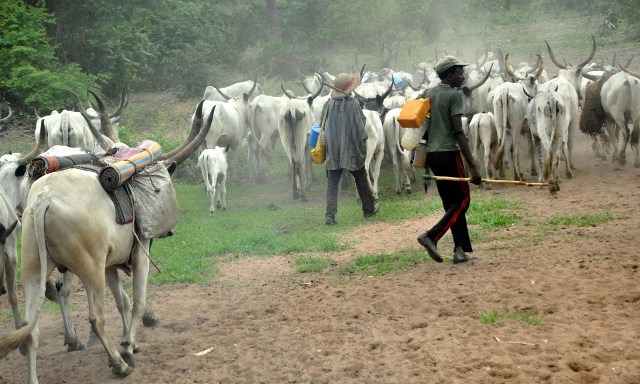
They are herders. But depending on what they herd, they could be goatherd, shepherd or even cowherd. So, there is herdsman, herdswoman or even herdsboy. Rather than herdsmen, people also dignified the job with pastoralism, thus they called them pastoralists.

Pastoralism is not new to human existence. It is as old as man. Modern agriculture will see it as a form of animal husbandry. But because of the peculiarities associated with the job, the herders usually live nomadic or semi nomadic lives.

Before now, we all grew up to recognise the ubiquitous faces of people with lean visages who look like Arabs, controlling herds of cattle with a stick. The other companion could be a transistor radio. People generally like them because of their looks and simplicity. Thus, they were usually welcome in the temperate regions where lush vegetation can be found for most parts of the year.

It is the hospitality of the settlers and the simple and benign nature of the nomads or herders we know before now. But these days, we now hear that there is Miyyeti Allah.

But the relationship between farmers and herders has turned sour because of the propensity of the herdsmen for violence in recent times.  The herders of cattle now herd death and sorrow. Where they step in their peripatetic search for vegetation is usually visited with dirge and mourning occasioned by violence, murder and rape of unimaginable proportions.

In Benue State, 73 corpses were given mass burial on Thursday. The deaths result from the attacks of Fulani herders that took place on 1st and 2nd January, 2018. Seventy-eight souls perished at the hands of the herders!

These souls died not with the sticks we know with the herders. No, the sticks have been replaced with AK-47 and other sophisticated weapons of violence and destruction.

The paramount ruler of Tiv nation, Prof. James Ayatse, in his speech during the funeral, said the last attack was the 47th of its kind perpetrated by Fulani herders. And this is just as  Tiv people residing in Nasarawa and Taraba states were being mauled daily.

The litany of violence is long. In Taraba state, the government enacted the anti-open grazing and ranches establishment law in June 2017, but the law will only become effective from 24th January, 2018. Since the enactment of the law, the state has known no peace. The death toll has risen to 60 in the last weekend.

The herdsmen have become invisible, killing at will, wiping out whole communities and vapourising into thin air. Welcome to Nigeria, the land of the unthinkable.

It would not be painful if the state’s response had not been tepid. The response, in this case, leaves so much to be desired. Because President Buhari appears unmoved by the scale of his kinsmen’s atrocities, people have read complicity or collusion into his famed body language.

In the recent gory attacks, the response of the presidency has been acutely insensitive and unkind. Cataloguing the innumerable attacks by Fulani herders that preceded the Buhari’s administration was a low point for the government. Sometimes, people wonder what crept into the heads of those handling the President’s media team. That the herdsmen killed over 756 in two years under Jonathan was not a particularly brilliant response. So, human statistics now appear meaningless to government as long as the atrocities were perpetrated by favoured groups. Seven hundred and fifty-six souls!

The herdsmen have been classified as a grave security threat only next to that of the Boko Haram. Should we wait until the whole nation falls under the swords of the Fulani herders? In this country, a state governor once publicly highlighted how he made efforts to buy peace from the implacable herders of death. This means the government really knows these marauders. Were Nasir-el Rufai not a governor, he would have flayed such utterances from any governor. Rather than prosecute known criminals, government now appeases them! It is Nigeria, the land of absurdities!

The perennial pastoralists-farmers conflict has its roots in several factors. At the core of it is land scarcity which is environmental in nature. But beyond this, political factor can be implicated. In the North Central, there are states where the Fulani are laying claim to indigeneship. Climate change exacerbating desertification is also a key factor, just as population explosion cannot be ruled out.

But taking a deeper look at this problem, it is easy to figure out why Nigeria seems to have enduring romance with stagnation. Why should the government be obsessed with creating cattle routes all over the country when the modern means of raising cattle is through ranching. In the civilised world, there used to be cowboys but cowboys are now ranchers. That is civilisation and we must continue to think like people eager to catch up with the rest of the civilised world.

Even the establishment of cattle colonies being broached by the government will not likely work. When people are complaining of ulterior agenda of modern colonisation or expansion by the Fulani ethnic group, why should the government think about creating  cattle colonies? On whose land? And what form of administration which such colonies be subjected to?

The Fulani herders cannot suddenly become the invisible purveyors of death while the Miyyeti Allah will only come out to rub salt on the nation’s injury by talking as if the Fulani are above the law. If IPOB could be proscribed as a terrorist organisation, Miyyeti Allah should also be declared a local terrorist group. Human beings cannot become fodder just because Miyyeti Allah is beyond restraint in providing insensitive justification for the atrocities of its members. When the cows are destroying farmlands, the herders are mauling humans! What a catastrophe!

Dealing with the menace of the Fulani herdsmen will require sincerity from government by boosting security, prosecuting criminal herders and rustlers, enforcing legislations on open grazing, dealing with the political element of the perennial feud and implementing policies aimed at mitigating climate change while ultimately embracing ranching as the acceptable means of rearing cattle in Nigeria.

And President Muhamadu Buhari must do more to convince us that he is truly the President of the whole country — not just that of his ethnic group.