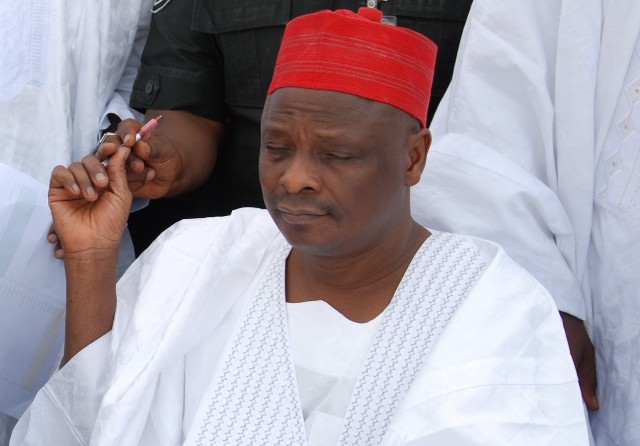
Iliyasu Musa Kwankwaso, younger brother of Rabiu Musa Kwankwaso, immediate past Governor of Kano State, says his brother should forget his presidential ambition in 2019, as he is no match for President Muhammadu Buhari.
The younger Kwankwaso, who is also the Kano State Commissioner for Rural and Community Development, said his elder brother, now a serving senator, has nothing to show for the two years he has spent so far in the National Assembly.
He lambasted Kwankwaso for shunning Buhari during his recent visit to the state, instead fixing his own visit for Saturday, December 30.
“Out of the three Kano senators, only Kwankwaso deliberately shunned Buhari’s visit,” Ilyasu said.
“Senator Barau Jibrin of Kano North and his colleague of Kano South, Kabiru Gaya did not only attend the gathering, they played their roles in ensuring the successful hosting of the President.
“We want to remind him (Kwankwaso) of how Buhari defeated him in APC primary in Lagos; even Kano delegates who were his, then, voted for Buhari. Nothing has changed since then.
“Kwankwaso’s outing can never match that of Buhari because come sun, come rain, Kano remains that of Buhari.”
Ilyasu advised Kwankwaso to not only shelve his 2019 ambition, but to rather beg Umar Ganduje, the Kano State Governor, if he wants to retain his senatorial seat come.
“Vibrant people are eyeing Kano central senatorial seat because of Kwankwaso’s abysmal performance at the Upper Chamber,” Ilyasu said.
“How many times has he spoken on the floor of the Senate? How many bills has he sponsored since 2015 when the Senate was inaugurated? And how many projects has he attracted to Kano from federal level? The answer is zero.”
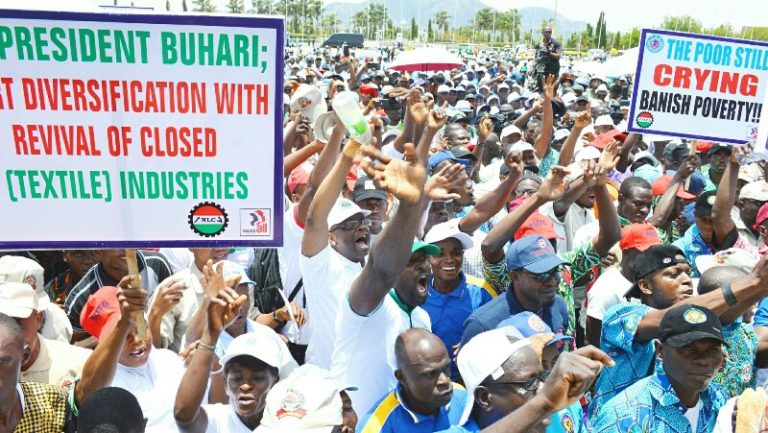
Between January 2016 and September 30, 2017, a total of 7.956 million Nigerians lost their jobs, the National Bureau of Statistics (NBS) has said.
“The unemployment rate increased from 14.2 per cent in Q4 2016 to 16.2 per cent in Q2 2017 and 18.8 per cent in Q3 2017,” NBS said in an unemployment report survey for the third quarter of 2017 released on Friday.
“Total unemployment and underemployment combined increased from 37.2 per cent in the previous quarter to 40 per cent in Q3 2017.
The figure is more than the 8,036 million in stood in 2015 Q4.
The NBS report stated that the number of Nigerians that became unemployed rose from 8,036 million in 2015 fourth quarter to 15.998 million in third quarter of 2017.
It also revealed that between the second quarter and third quarter of 2017, the number of economically active or working age population (15 – 64 years of age) increased from 110.3 million to 111.1 million.
The number of people within the labour force who are unemployed or underemployed increased from 13.6 million and 17.7 million respectively in Q2 2017, to 15.9 million and 18.0 million in Q3 2017.
“The labour force population increased from 83.9 million in Q2 2017 to 85.1 million in Q3 2017. The total number of people in full-time employment (at least 40 hours a week) declined from 52.7 million in Q2 2017 to 51.1 million in Q3 2017.”
NBS blamed the increasing unemployment and underemployment rates on Nigeria’s fragile economy despite the exit from recession.
The report explained that domestic labour market is still fragile and economic growths in the past two quarters in 2017 have not been strong enough to provide employment in Nigeria’s domestic labour market.
“An economic recession is consistent with an increase in unemployment as jobs are lost and new jobs creation is stalled,” the report said.
“A return to economic growth provides an impetus to employment. However, employment growth may lag, and unemployment rates worsen especially at the end of a recession and for many months after.”
During the third quarter of 2017, 21.2 percent of women within the labour force (aged 15-64 and willing, able, and actively seeking work) were unemployed, compared to 16.5 percent of men within the same period.
The report also noted that underemployment was predominant in the rural areas as 26.9 percent of rural residents within the labour force were underemployed, compared to 9 percent of urban residents within the same period.
Martin Obono, a Nigerian Facebook user, has blasted Usani Uguru, Minister of Niger Delta Affairs, for using his official letterhead to invite Nigerians to a service in his church.
Obono noted that Uguru’s action is quite insensitive, especially given the ongoing hardship of citizens as a result of the crippling fuel scarcity.
Uguru, who, according to Wikipedia, is also a pastor, wrote the letter of invitation using the letterhead of the Ministry of Niger Delta Affairs, not his personal letter head or that of his church.
The letter, which has already gone viral on the social media, has elicited strong-worded criticisms by Nigerians, many describing the situation as unfortunate.
“I just saw a post from you, the Minister of Niger Delta Affairs, representing Cross River State at the Federal Executive Council, inviting people to a religious programme on the letterhead of the Federal Republic of Nigeria,” Obono wrote on Saturday.
“This madness has got to STOP! Nigeria is not a religious State. It does appear that we use religion to cover incompetence in this country.
“To the best of my knowledge, Mr. Minister, you have not engaged young people in one single job creation empowerment programme for the teeming population of unemployed youth in your immediate constituency, Yakurr local government, talk less of the rest of the state.
“You have never done a letter like this inviting people to a town hall meeting or skill acquisition training. Despite being aware of the level of hunger and poverty in the state, you are telling people to come and worship God.
“Is that what the Bible teaches you? Haven’t you read what the Bible says in James 2: 15-16? Or you pick and choose to obey the scriptures that suits your clandestine and impious agenda?
“My advise to you Mr. Minister, is that, you design a letterhead in your name for purposes like this. The letterhead of the Federal Republic of Nigeria was printed with tax payers money.
“There are Muslims, Traditional worshippers, atheists among those tax payers and even Buddhists. How do you think they will feel when they see these?
On a final note, Mr. Minister, please be reminded that you are a Minister of the Federal Republic of Nigeria and not Minister of Christian worshippers alone.”
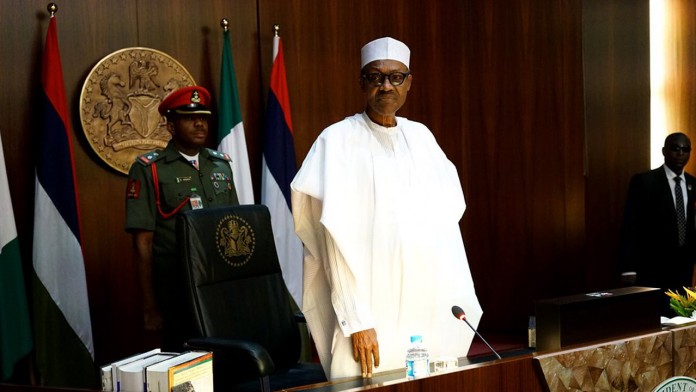
President Muhammadu Buhari says his administration is correcting the many wrongs of the past that crippled the economy, and has ushered in an era of responsibility and accountability.
The President also said it is a wonder how Nigeria survived the monumental corruption that he met when he took over office in 2015.
Buhari said it was only by “an act of God” that the country did not go under.
According to a statement by Femi Adesina, Special Assistant to the President on Media and Publicity, Buhari made the comments when a group of supporters, under the aegis of Governance Support Group, paid him a solidarity visit at the Presidential Villa on Friday.
“Some of the things I saw here were unbelievable. I still shudder and wonder how a country can survive under such abuses. It is only by an act of God that we survived,” Adesina quoted Buhari as saying.
However, Buhari noted that his administration “had ushered in a new era of accountability and responsibility by auditing and correcting the many wrongs of the past that crippled the economy”.
He thanked the delegation and all who believed in him and vigorously supported him during the 2015 presidential campaign.
“I can never forget your sacrifices and I am grateful for all. You never gave up when things were bleak, and we needed to survive. I can’t express my gratitude enough,” he said.
“In spite of the environment you found yourselves [in], you kept believing and pushing. Some of you were really exposed to risks. My consolation is that you voluntarily threw in your lot with me.
“Some of you exposed yourself so much, and I knew it. I urge you to still stick to your principled ways of doing things and our country will be the better for it.
“I want you to maintain your steadfastness. We have gone through the worst of the times. We lost elections three times and I learnt a lot along the way.”
In his response, Chukwuemeka Nwajiuba, leader of the delegation, praised Buhari for his “bold initiatives in restoring security, tackling corruption, and setting the economy on a more predictable path”.
Nick Vujicic, an Australian Christian evangelist and motivational speaker, and his wife Kanae, have become proud parents of identical female twins.
Vujicic, who was born with tetra-amelia syndrome, a rare disorder characterized by the absence of arms and legs, made the announcement through his verified Facebook account.
According to the post, his wife put to bed on Wednesday, and both mother and babies are in good health.
“Our Identical Double Blessing from Our Gracious and Almighty God! Born Dec 20th – Olivia Mei Vujicic (red bow, 5lbs2oz @ 7:54am) and Ellie Laurel Vujicic (yellow bow, 5lbs14oz @ 7:56am) !!! Mommy (Kanae Vujicic) and Girls doing wonderful,” Vujicic wrote.
“Thank you all for your love and prayers! Babies Olivia and Ellie were born on Mommy’s Birthday, 5 pounds 2 oz and 5 pounds 14 oz. Mommy is well and so are the girls. Thank You God!” he had written in an earlier post.
Vujicic got married to his wife, Kanae, in February 2012. They have four children, including the newly born twins.
Edetaen Ojo, Chairman of the African Freedom of Expression Exchange (AFEX), says leaders of African countries must show greater commitment to the fight against violence and impunity on journalists.
Ojo made this known during a one-day stakeholders’ dialogue on Journalists’ Safety held in Juba, South Sudan, as part of activities to mark this year’s International Day to End Impunity for Crimes Against Journalists (IDEI).
Ojo, who is also the Executive Director of Media Rights Agenda (MRA), a Nigerian-based non-governmental organization, expressed sadness that journalists in Africa continue to face numerous challenges, sometimes life-threatening, in the course of carrying out their responsibilities.
“As we all know, the media community is under relentless attack. Not just in South Sudan or in Africa, but globally,” said Ojo, who was represented at the event by Felicia Anthonio, Coordinator of the AFEX network.
“Such attacks include killing, torture, enforced disappearance, arbitrary arrest and arbitrary detention, expulsions, intimidation, harassment, threats and other forms of violence.
“These issues remain a central part of international discussions due to the unending crimes and impunities against journalists.”
Although Ojo was expressed delight that the ugly situation is being tackled by the international community, he noted that leaders of African countries ought to be in the lead of such measures.
Therefore, he urged African States to abide by the terms of the several resolutions they are signatories to, especially those that require them “to ensure that measures to combat terrorism and preserve national security or public order are in compliance with their obligations under international law and do not arbitrarily or unduly hinder the work and safety of journalists, including through arbitrary arrest or detention or the threat thereof”.
“These are some of the responsibilities which South Sudan and other countries on the African continent and, indeed, around the world now have with respect to ensuring the safety of journalists and combating the problem of impunity in this regard,” he said.
The African Freedom of Expression Exchange (AFEX) is a continental network of some prominent freedom of expression and media rights organisations in Africa.
The network is currently made up of 12 organisations spread across West, East, Central, and Southern Africa.
The Nigeria Customs Service (NCS) says it has generated more than N1 trillion in 2017, the highest amount ever since its coming into being in 1891, for revenue collection and accounting, and curtailing anti-smuggling activities.
Joseph Attah, Public Relations Officer of the Customs, made this known at a media briefing in Abuja.
According to Attah, the sum is N241.68 billion higher than the N770.57 billion target the NCS set for itself for 2017, adding that the feat was achieved with about five working days remaining before the end of the year.
The NC generated a total amount of N898.67 billion in 2016 .
“With dogged implementation of the presidential mandate to restructure, reform and raise revenue, Nigeria Customs Service has recorded the highest revenue collection ever of N1,012,259,006,779.94 with five more working days to the end of 2017,” Attah said.
“It is imperative to state that the service would have performed better if not for the paucity of funds.
“Despite this difficult situation, NCS strives to deliver, sometimes even at the risk of sustaining serious injuries and even death.”
Attah added that “in the process of enforcing the laws, six officers fell in the line of duty this year”.
He described the performance of the NCS in terms of revenue generation as remarkable, given the economic recession witnessed in the country and the low volume of imports due to some import restrictions.
Attah also said that illegally-imported goods worth over N11 billion were seized by the Service, including 2,671 pump action rifles, dangerous drugs, rice and vehicles among others.
He reserved special praise for Hameed Ali, the Comptroller-General of Customs, “whose leadership qualities made the record possible”.
Rochas Okorocha, Governor of Imo State, says civil servants who are yet to receive their payments for November and December should direct their complaints to the Ministry of Happiness and Purpose Fulfillment.
This was contained in a statement issued by Nnamdi Obiaraeri, the State Commissioner for Information, who further added that the move was a demonstration of Okorocha’s resolve to ensure that workers in the state have a stress-free Christmas celebration.
“This is to announce that the Governor of Imo State, Rochas Okorocha, has approved the immediate payment of the November and December 2017 salaries of Imo workers,” the statement read.
“This is to enable our esteemed Imo workers to celebrate seamless Christmas. Payments have duly commenced.
“Any worker encountering any difficulties with the approved payments should not hesitate to contact the Ministry of Happiness and Purpose Fulfillment for immediate intervention.”
The newly-created ministry of happiness and purpose fulfillment in Imo State, headed by Ogechi Ololo, Okorocha’s biological sister, has generated heated controversy among Nigerians, as many believe the ministry is not necessary.
Nasir el-Rufai, Governor of Kaduna State, says Abubakar Atiku could not have won the presidential ticket of the All Progressives Congress (APC) even if President Muhammadu Buhari was not seeking re-election.
El-Rufai made these comments on Thursday during an interview on Voice of America (VOA) Hausa station.
He said that Atiku came third during the 2015 APC presidential primary election, behind Rabiu Kwankwanso of Kano State, and as such, even if Buhari was not in the race, he would still have lost out on the ticket.
El-Rufai further said that Atiku’s claims that he funded the Buhari presidential campaign in 2015 was false, as he (el-Rufai) was part of the leadership of the campaign organisation and knows who brought what.
“Atiku had seen that we in the APC, especially the APC governors, had made up our mind to support President Muhammadu Buhari to run again in 2019. That is why he left APC since he was only looking for where to contest for president,” el-Rufai said.
“Even in the 2015 APC primary election, Atiku didn’t come second; he was floored by Kwankwaso. So, even if President Buhari decides not to contest, Atiku knows that the APC ticket is not sure for him.
“Majority of the APC governors have endorsed President Buhari as our candidate for 2019, and God has continued to improve the health condition of the President. Each time I see him, I thank God and I still pray that God continues to give him sound health.
“So, by 2019, we are waiting to see Atiku contest; we are waiting to contest against him and see what happens. I cannot lose sleep because Atiku wants to contest because, by God’s grace, this is the reign of President Muhammadu Buhari.”
El-Rufai also said he never heard Atiku’s name as having donated “a dime” to Buhari’s election campaign in 2015.
“It is agreed that in politics if you lose even only one person, it should worry you, but the utterances of the former Vice President that APC used his money… who did he give the money to?” el-Rufai queried.
“For me, I know those that supported us with their money and property that we used during election, and I never heard the name of Atiku that he brought a dime. If Atiku said he brought money, who did he give it to? Let him come and say it and how much did he give and what was it used for?
“And, in fact, if Atiku brought money, I ought to know, because I was part of the leadership of the party and during campaign, along with former Governor Rotimi Amaechi. We were at the centre of the presidential campaign. Therefore, we are supposed to know. So, let him mention whom he gave the money and how much?”
El-Rufai agreed that some “greedy people” could follow Atiku, “but if people will consider how we can work for the progress of our country, everybody knows that you cannot compare Atiku with President Muhammadu Buhari”.
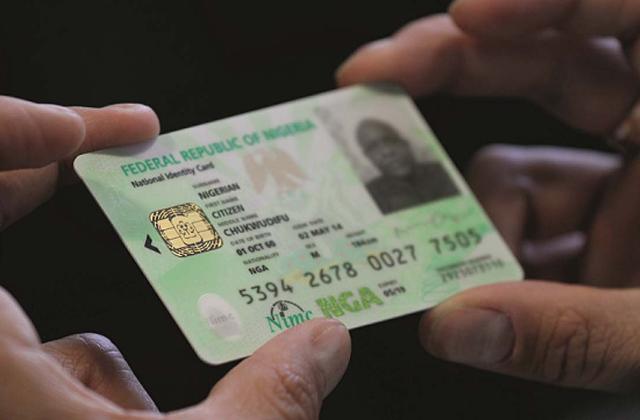
Seven years after its inception and with a huge amount of money already allocated to it by the federal government, the National Identity Management Commission (NIMC) is yet to meet its mandate of capturing all Nigerians on its database and issuing them with valid identity cards, clearly setting the stage for an unending journey to the national identity card programme, as was the case with its predecessor, the Directorate of National Civic Registration.
Although it was officially set up in 2010 and empowered to capture all Nigerians into a database and issue them with permanent national identity cards, the National Identity Management Commission( NIMC) has only been able to scratch the surface of the assignment so far.
As a clear sign of its inability to carry out the task of identifying all Nigerians and issuing them with national identity cards for the purpose of planning and development and improving national security, NIMC has largely been making more noise than taking concrete actions to deliver on its mandate.
For instance, while it has within seven years received a whopping N80.2 billion from the federal government, the commission has only been able to capture about 25 percent of Nigeria’s 180 million population into its database while not more than five percent of those captured have been issued with the National Identification Number (NIN), which is soon to become a compulsory document for all Nigerians residing in the country.
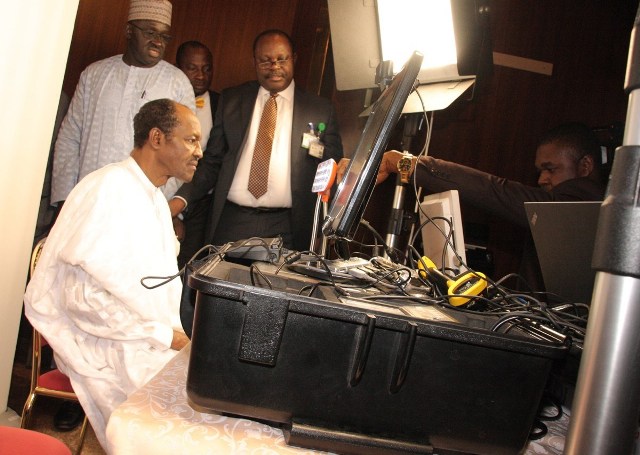
President Buhari registering for his National Identity Card
The commission got an initial N30 billion in 2010, three years after the enactment of the NIMC Act No. 23 in 2007, which conferred on it the mandate to assign a unique National Identification Number known as NIN, issue a General Multi-Purpose Card and produce an all-encompassing National Identity card for every Nigerian.
The commission got N17.9 billion in 2011, N12.35 billion in 2012, and N7.19 billion in 2014, while it received N6.276 billion in 2015 and N6.535 billion in 2017.
The amount received does not translate to concrete achievement in terms of card production and distribution, leaving eager Nigerians in search of the vital document with a sour taste in their mouths. As it is, while it takes raw grit for Nigerians to be registered by NIMC, being able to collect the NIN card from the commission comes with even greater stress.
So far, only a handful of powerful and sometimes lucky Nigerians have been given the cards with majority of Nigerians still waiting anxiously for the precious document. NIMC records show that between 2010 and 2017 less than one million Nigerians have been issued with the NIN. As a result, the various offices of the commission are more of ‘centres of complaints’ than production centres capable of meeting the national expectations in the production and delivery of cards to Nigerians.
In most of the centres, there are no basic materials to work with while erratic power supply and poor cash backing for the necessary assignments have become recurrent. Overall, there are more Nigerians in all the centres across the country than the number of capturing machines, which do not normally work due to power failure.
But while the NIMC has been very slow in capturing all Nigerians into its database and producing NIN cards for them, it has been very fast in expending cash made available to it by the federal government without accomplishing any tangible results to appease the financiers.
This recklessness in spending public funds without proper accountability and transparency and achieving little or no result has irked the Auditor-General of the Federation, who has questioned such opaque expenditure and asked for immediate answers yet to be given by NIMC.
For instance, in 2015 alone, NIMC was queried by the AuGF for mismanaging a whopping N3.5 billion on questionable procurements and project execution. The report from the AuGF said the expenditure violated all known procurement rules and extant financial regulations of Nigeria.
Giving a breakdown of the contracts which failed due process and accounting principles, the auditor general asked NIMC to urgently reply to the query. The report pointed out that the NIMC awarded a N16.5 million contract to a company in 2014 for the deployment of VSAT to local government areas on the 1st August 2014 and 100% down payment (contrary to extant regulations) made to the company five months before the award.
All the money was paid to the contractor on 31 March 2014. A contractor was engaged by NIMC to supply, install and maintain 19 No. Garret PD65001 walk-through metal detector at a total sum of N48.944 million via a letter referenced NIMC/LS/VGSNL/12/12 and dated 28th November 2012, which translates to N2.5 million per detector and the contractor, was paid in full without any completion date stated in the contract paper.
There was also no Advanced Payment Guaranty, APG, given by the contractor as demanded for such contracts. The shipment order and performance bond were not also attached as required by extant rules. An examination of the metal detectors showed that they were low quality materials bought at the cost of N750,000 each as against the N2.5 million per unit.
It was then established that the contract of N48.9 million had been inflated by N30.4 million. As if that was not enough, NIMC also awarded a contract for the supply of 600 units of HP Flatbed scanners to a company at a price of N12.1 million through a letter referenced NIMC/LS/MLS/1/13/3 and dated 9th April, 2013 with no completion period.
Examination of payment vouchers showed that the total contract sum was paid to the contractor in instalments of 15% and 85%. The APG backing the initial 15% was not sighted in all the documents produced for audit verification.
President Buhari being issued his National ID card. Millions of Nigerians are not that lucky.
The second payment of 85% amounting to N10.2 million was made without any covering bond or evidence of execution in form of Stores Receipt Voucher (SRV). The payment of 85% was made on a mere memo written by an officer to the DG/CEO stating that shipment order was placed by the vendor as detailed in the inspection report.
“This payment procedure is contrary to the Procurement Act 2007 which states that ‘No further payment after Advance payment shall be made to contractor without evidence of work done/supply,” it read.
Next, the agency engaged consultant to conduct market study on the smart card industry in Nigeria at a price of N22.6 through a letter referenced NIMC/LS/A&CO/1/13/1 and dated 7th June 2013 with no completion period. An examination of payment vouchers revealed that the total contract sum was paid to the consultant beginning with the initial 15% payment at inception report; while the 2nd and 3rd payments were made on an alleged 2nd draft report.
However, copies of all these reports were not produced for verification, raising suspicion that the job was never done. Following on the heels of that, the commission engaged and paid a media vendor as an agent on the strength of a mere memo written by an aide to the DG/CEO on 10th June 2014 to provide it with newspaper/magazine campaign at a price of N21.9 million per annum.
This job was neither advertised nor approved by the Tenders Board and Procurement Planning Committee of the commission. The same memo that initiated the award of the job was the same that sought for the initial payment of 25% or N5.4 million as mobilization.
The DG/CEO’s minutes approved it without recourse to the Tenders Board. In the end, there was no evidence of publication in the Newspaper on the activities of the commission, as this could not be seen in the entire document sighted or written evidence of the various dates when the publication was made.
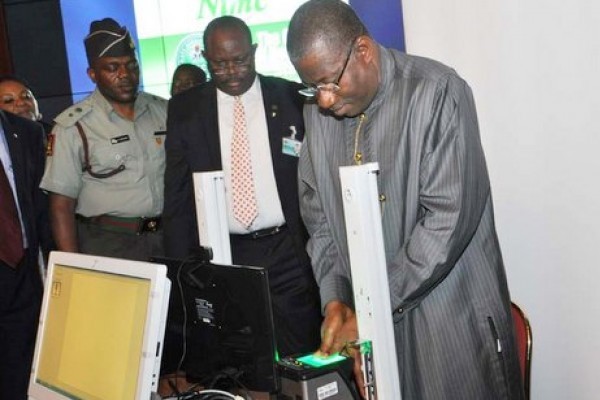
Former President Goodluck Jonathan registering for his National ID card
The vital evidence of publication as the basis for this contract payment was not made available to the audit team. Next on the line of looting spree, a contractor was engaged by the NIMC to provide Affina Enterprise Smartcard Life Cycle Management System (a software) at a contract price of $1.4 million at the exchange rate of N170/Dollar. But the contract award letter was not provided for auditing.
Examination of payment vouchers showed that 80% of the contract sum amounting to N191.5 million was paid upfront without the mandatory APG. There was also no evidence of receipt of the software and delivery before the last payment of 20% which was the yardstick for the payment. There was no detail of the software volume, date of issuance, validity period and serial number. The IT department could not produce record of usage of the software despite repeated demands.
A consultant was engaged by the NIMC to provide 8 modules licenses for the NIMC Enterprise Monitoring System through a letter referenced NIMC/LS/SWSE/1/14 and dated 7th April, 2014 at a price of $104,895 equivalent to N16.9 million.
A memo from a staff to the DG/CEO on the same day of award of contract (7th April 2014) sought for a 100% payment of the contract sum and the DG/CEO minutes approved the memo without asking for evidence of performance or a covering bond. The total contract sum was paid to the consultant vide PV. No. NIMC/236/CA/14.
There was no evidence of performance of this job in the entire documents sighted as there was no evidence of receipt of the license certificate showing date of issuance, volume, and validity period in the Commission. The record at the Data Center did not show the entrance of this contractor to execute this task in the entire system of the Commission. Based on the above therefore, the job was adjudged not executed.
Next, a vendor was engaged by the NIMC to provide tripwire via security information and event monitoring tools (SIEM) and SCM License fees, implementation training, first year support and maintenance. The award letter for the job was not provided for audit verification. Two different memos were written by a member of staff to the DG/CEO on 6th and 7th March 2014 seeking for payment of 15% and 65% of the contract sum amounting to N23.5 million.
In similar manner, the DG/CEO in his minutes approved this payment without evidence of performance or Advance Payment Guarantee (APG) to safe guard public funds. “This negates the provisions of Public Procurement Act 2007. Examination of payment vouchers showed that the contractor”.
Similarly, five contractors were paid the total sum of N90.2 million for awareness campaign on the need for national identification enrolment across the six geo political zone of the federation on behalf of the commission.
But an examination of the documents presented for audit showed no evidence of contract execution like placement of advertisement in any print or electronic media on behalf of the commission or receipts indicating that slots for airtime were booked.
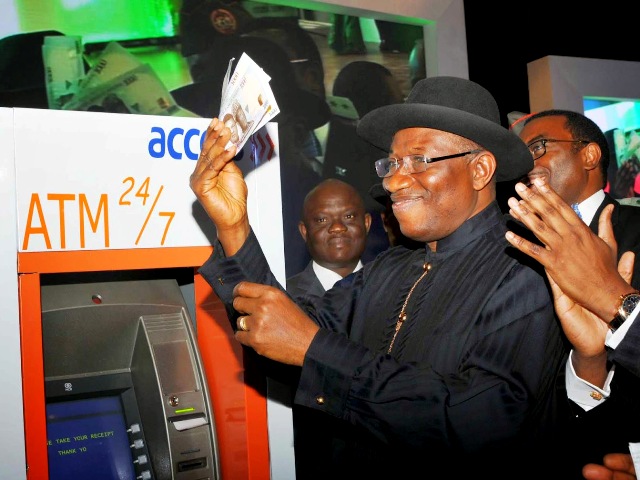
Few weeks after registering, Jonathan celebrates as he was able to withdraw money from an ATM using his national ID card; on the contrary, it’s been tales of woes for ordinary Nigerians.
While the commission has been very active in spending approved funds, it has remained comatose in delivering on the issuance of NIN to Nigerians, causing a serious altercation between its officials and aggrieved Nigerians. The trouble rings all over Nigeria.
A survey of its offices in the six geo-political zones, taking Abuja, Lagos, Port Harcourt, Kano and Enugu reveal common problems and failure exhibited by NIMC. Findings show that the acclaimed offices and operations of the agency in the states and local government areas across the country rarely exist. In fact most of the rural dwellers were surprised to hear about the ‘existence of such offices and the operations claimed by NIMC. They wondered where the offices are located and who actually runs them and what type of services they render to the public when told that the NIMC offices and registration centres are everywhere and easily accessible.
As a result of the rules that guide the civil service, officials of NIMC, declined to comment on their operations, referring our correspondent to Abuja where they said, ‘our bosses are’. Where they agreed to speak at all, they deliberately avoided any direct answer to the issues raised and the malfeasance noticed in their areas.
In Lagos which is the West Regional Headquarters of NIMC, not much activity was going on the day our team visited, while many were seen struggling to get service from the officials. As a result, a long queue of people with a chaotic scene formed around the Lagos office throughout the day and not much could be accomplished for that day.
Bolaji Adesanya, a Lagos resident, who had been registered and captured since 2014, said he had given up on the identity card matter since the commission continued to dribble him over the production of his card till date. He kept waiting for the text message or call from the commission.
Bolaji is not alone on this as hundreds of Nigerians have the same story to tell. The disappointment being experienced daily by Nigerians in the hands of NIMC was adequately captured by Bola Ogunseye, a Development Economist, who spoke of his frustration on Channels television programme, ‘Sunrise Daily’.
“It is really sad that the commission cannot still get things done right many years after it was set up and a lot of money spent by the government of Nigeria,” Ogunseye said.
“I registered since 2014 and have been to their office severally trying to get the card because what I have is just a slip. Just recently I was there; they still asked me to go and hold on that as soon as my card was ready they would notify me through a text message”.
But the Head of Administration at the Lagos office of the NIMC, Mr. Kayode Adegoke, declined to answer any question on the state of affairs there, saying that the State Coordinator of NIMC was barely a month old on the beat and would therefore need more time to familiarise himself with the vital information relating to the office before being able to offer any explanation on the way things were going.
In essence, the Lagos office was unwilling to disclose anything concerning their activities during the investigation as some persons were also spotted sitting unattended to for hours. The story of disappointment, failure and outright attempt by the officials of the agency in Lagos to dribble disgruntled Nigerians, who are fed up with their antics and ineptitude, is the same in the Enugu office, Kano, Port Harcourt and the FCT, the nation’s capital which serves as the South-East Zonal headquarters and is being thronged daily by Nigerians in search of their vital cards.
As in other zones, many residents of towns and communities hardly come in contact with registration officials of NIMC for the purpose of being captured not to talk of receiving their completed identity cards.
At the Obunofia-Ndiuno community in Ezeagu Local Government Area in Enugu state, a member of the community, Chinwe Okpara, said she was unaware of any registration centre there, having never sighted any of their officials. “I don’t think they have any form of exercise going on here,” Okpara said.
Similarly, Chigbo Anyanwu, who was at the Enugu office to collect his card having been registered and captured since 2015, was asked to return home until the card was ready. He fumed in frustration. Meanwhile, in the few available centres in the state, thousands of Nigerians were struggling to be registered, a sign that no serious arrangement had been put in place for a seamless exercise.
But the Zonal Coordinator in the South East, Chizoba Ogboko, would not want to speak on any matter related to the NIMC when confronted by this reporter.
However, the story is slightly positive at the Port Harcourt Office of the agency. Things seem to move faster there and Nigerians were happy with the rate of registration and production of their cards.
Perhaps, as a sign of improvement in service delivery, hundreds of people were seen here struggling to ascertain if their cards were ready for collection while others were making effort to be captured with the few available machines.
Others, whose cards were ready for collection, also queued to be attended to by the few officials on hand. As a sign of the serious work done already in registering, capturing and producing cards for Nigerians in the zone, the Port Harcourt office of NIMC was virtually flooded with cartons of printed cards ready to be distributed to those who had registered.
The state coordinator’s office was a beehive of activities, as Nigerians came to pick their cards, returning with some smiles on their lips as if they won a jackpot. The Rivers State Government was also known to be assisting with publicity and enlightenment, asking its citizens to register for the vital cards.
Apart from the state government, traditional rulers also mobilised their natives to take advantage of the exercise to be registered. The Rivers State Coordinator of NIMC, Amonia Oghenekaro, explained that 16 out of the 23 LGAs in the state had been covered by the commission while efforts were being made to extend the same level of coverage to the remaining areas so as to make the cards readily available to all Nigerians in those places. She said she had to personally visit and enlighten people on the importance of the exercise in the hinterland parts of the state on a weekly basis and that the people were responding positively.
But the good work notwithstanding, there were still pockets of complaints from those who were yet to receive their cards, many years after being registered and issued with temporary ID cards in the form of a printed paper.
One of them, Fortune Tamuno, complained to our correspondent that since she was told in 2014 to await an sms after being captured in 2014, she had not received a notification for the card, a development that bothered her.
Tamuno, said, “I started getting worried about it last year after I graduated from the university and had no other means of identification. Since then, I have been coming here to check if mine was ready but I was always welcomed with the same story”.
In Kano and Abuja, the Federal Capital Territory, the story is the same: complaints everywhere you turn. The citizens appear to have lost faith in the commission and its officials going by the way the registration and production of their cards is being handled.
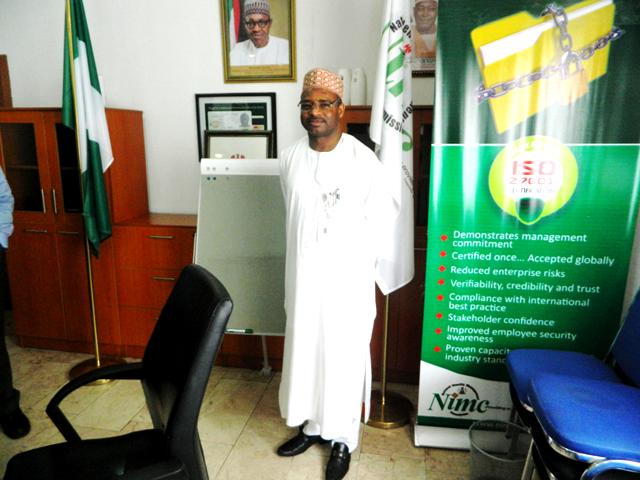
Aliyu Aziz, NIMC Director General
A resident of Kano, Adamu Zango, told our reporter than since he registered with NIMC in 2014, and was issued with a temporary paper as an evidence of his registration, his name was wrongly spelt in the paper and he has been battling with the officials to get it corrected but to no avail.
Zango said he had to give up because since it took him many years to get his name corrected, he did not know how long it would take him to get the card printed for him.
“I am here to correct my name, which was misspelt in 2014 when I registered but that has not been done till date and I am discouraged,” Zango lamented.
Jane Idoko, a resident in the FCT, also narrated her experience: “I am tired of waiting for my card, I do not even need it anymore. I have left it with them and as it is whenever they are ready they should let me know so that I can pick it up. I can assure them that I won’t make any personal effort anymore.”
But Mohammed Jalal, Head of Administration in the Kano Office of NIMC, explained that each of the 44 LGAs was well staffed and had what he called ‘strategic and specialized centres’ in markets and tertiary institutions.
However, when contacted, the Director General of NIMC, Aliyu Aziz, declined to speak on why the commission had not been able to produce identify cards for Nigerians seven years after the inception of NIMC.
Azis however admitted that he received a query from the Auditor-General on the mismanagement of funds and said that he had replied the query and copied the two chambers of the National Assembly.
It must however be pointed out that Aziz, who has just been appointed as the head of NIMC, was not on the saddle when the fraudulent contracts, for which the Auditor-General of the Federation raised the queries, were awarded. He merely inherited the big mess from his predecessor.
But NIMC’s Head of Public Affairs, NIMC, Loveday Chika Ogbonna, noted that the agency had made progress in its assignment by registering 21.9 million Nigerians and legal residents on the National Identity Database (NIDB). Ogbonna boasted that the commission had also produced above one million cards while a sizeable number of Nigerians had collected their cards.
Clearly, with the outright mismanagement of the resources so far allocated to the agency and the evidence that it is yet to get its acts right despite the passage of time, Nigeria and Nigerians have become the major losers in terms of cash, security, national planning and development while a few powerful persons, who drive the process, have made a fortune out of the place and buried the vision of the founding fathers of a seamless identity management agency.
The national identity card system was initially conceived in 1977 but the project did not see the light of the day.
In 2003, a new scheme managed by the Directorate of National Civic Registration (DNCR) was initiated and about 54 million Nigerians were registered, however, the scheme failed to meet official expectations and was also hampered by allegations of corruption and embezzlement of funds.
This Investigation was carried out with support from the John D. and Catherine T. MacArthur Foundation and the International Centre for Investigative Reporting, ICIR