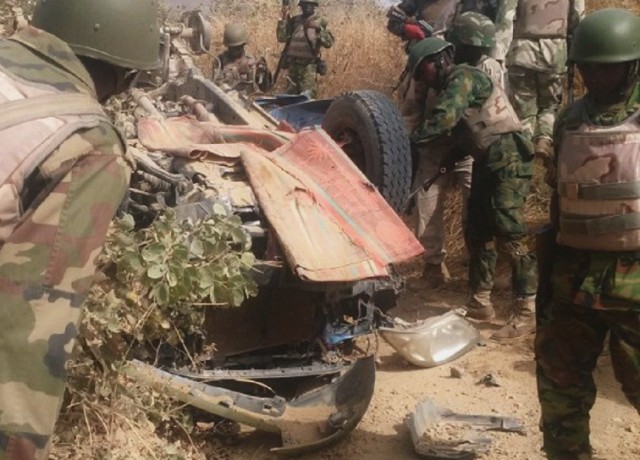
It is now clear that some Boko Haram terrorists ambushed team members of the World Food Programme (WFP) who were conveying relief materials — mainly food items — to an Internally Displaced Persons (IDPs) camp in a remote village in Borno State.
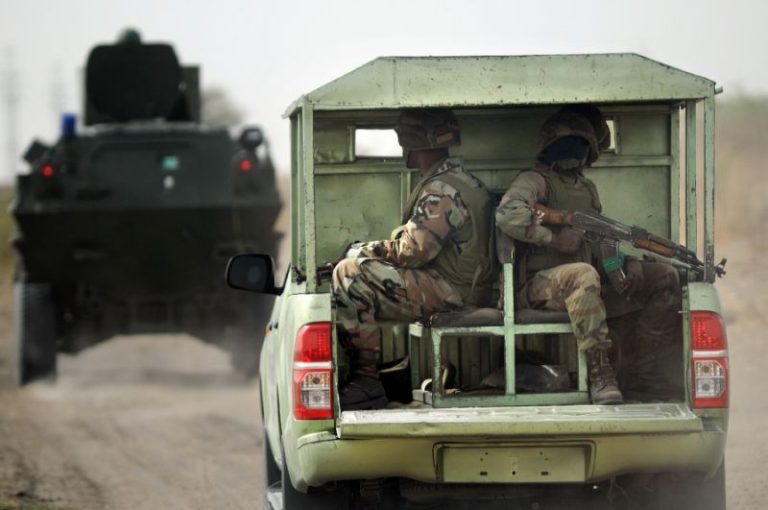
The team was accompanied by a convoy of security operatives, made up mostly of soldiers, to provide protection for the aid workers along the dangerous roads.
What is not clear, however, is the casualty toll of the unfortunate attack, whether on the side of the attackers, the soldiers or the civilian members of the WFP team.
WFP’S ACCOUNT
According to Adedeji Ademigbuji, WFP’s Communication Officer, Maiduguri area office, four persons were killed in the attack, including a driver of one of the food trucks and his assistant.
“WFP can confirm that a convoy escorted by the Nigerian military, including WFP hired trucks, was the subject of an attack by armed groups 35km southwest of Ngala in Borno State on Saturday (16 December),” Ademigbuji said in a statement.
“Four people, including the driver of a WFP-hired truck and a driver’s assistant, were killed in the incident. WFP extends its condolences to the bereaved families.
“WFP is working with the authorities to determine the whereabouts of the trucks.”
ARMY’S ACCOUNT
The Nigerian Army, however, provided an entirely different account from that of the WFP.
Rogers Nicholas, Theatre Commander of Operation Lafiya Dole, said no civilian was killed in the attack, adding that on the contrary, it was the soldiers that killed six of the insurgents and recovered several weapons.
“There was an ambush but the soldiers killed six Boko Haram insurgents and recovered weapons. No civilian was killed. I was in Dikwa that Saturday and this happened while I was within,” Nicholas said.
WHO ARE NIGERIANS TO BELIEVE?
It’s hard to tell at once which party to believe. But history hardly lies, does it?
Few hours after the kidnap of almost 300 Chibok schoolgirls, Chris Olukolade, then Director of Defence Information, told newsmen that all but eight of the girls had been rescued.
In his statement titled ‘More Students Of Government Girls’ Secondary School Chibok Freed; Normalcy Returns To Wukari’, Olukolade said: “More of the abducted students of Government Girls’ Secondary School, Chibok in Borno State have this afternoon been freed as troops pursuing the terrorists close in on the den of those believed to have carried out the attack.
“With this development, the Principal of the school has confirmed that only eight of the students are still missing. One of the terrorists who carried out the attack on the school has also been captured.”
Well… it turned out that none of the Chibok girls had been rescued or freed. It took the persistent cries of the parents of the abducted students, amplified by the ‘Bring Back Our Girls’ campaign, led by Oby Ezekwesili, for the military to recant their earlier position.
Today, three and a half years after the abduction. the number of girls still in captivity are more than the eight originally claimed by Olukolade. More than 100 of the girls are still with insurgents.
JUST SIX MONTHS AGO…
More recently, precisely in July, Boko Haram insurgents ambushed a team of oil explorers commissioned by the NNPC to search for crude oil in the Lake Chad Basin. Almost 50 persons, including soldiers, were killed in the ambush, and several others abducted.
But Sani Usman, the Army Spokesman, told Nigerians that all the kidnapped NNPC personnel had been rescued, and that only 10 persons — an army officer, eight soldiers and one civilian — were killed in the ambush.
“On receipt of the information, the Brigade mobilized and sent reinforcement, search and rescue party that include the Armed Forces Special Forces and guides that worked and pursued the terrorists throughout the night,” Usman stated.
“So far, they have rescued all the NNPC staff and recovered the corpses of the Officer, 8 soldiers and a civilian who have been evacuated to 7 Division Medical Services and Hospital.”
Hardly had Usman released his statement than Boko Haram released an online video showing three abducted NNPC staff pleading for their lives. They are still being held by the insurgents up till now.
On the evidence of these two examples, can we actually believe the Army rather than WFP?
Yahaya Bello, Governor of Kogi State, says he did not engage in double voter registration as alleged by the Independent National Electoral Commission (INEC).
Bello, who spoke on AIT’s Focus Nigeria, said he was not even in the country at the time he was said to have registered a second time at the Kogi State Government House in Lokoja.
The allegation that Bello engaged in double registration was first raised in May by a group called ‘Kogi for Change’, who also threatened to take legal action against the Governor.
Few days later, INEC, through Solomon Soyebi, its National Commissioner and Chairman Voter Education Committee, confirmed that Bello indeed registered twice — contrary to electoral regulations.
“The Governor’s double registration and doing so outside INEC’s designated centres are both illegal,” Soyebi had said in a statement at the time.
He clarified that Bello was first registered at Wuse Zone 4, Abuja, on January 30, 2011, but illegally did so again on May 23, during the ongoing continuous voter registration exercise in Lokoja.
He said the commission would “take disciplinary action against the INEC staff involved”, but “as for the State Governor, Section 308(1) (a) of the 1999 Constitution (as amended) precludes INEC from prosecuting him while in office”.
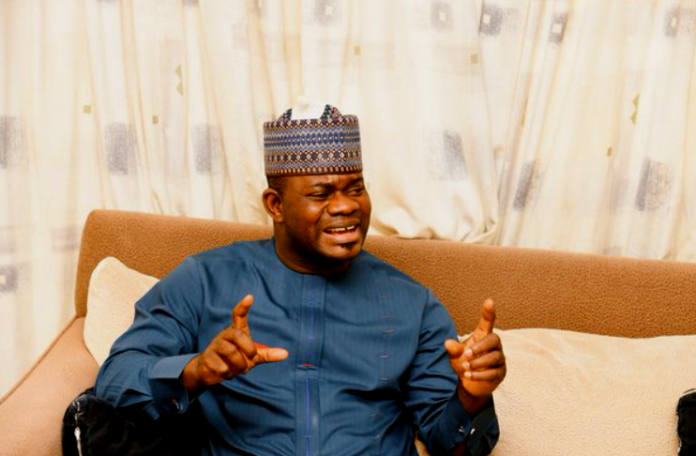
This picture appears to be showing Yahaya Bello, Governor of Kogi State Governor, being registered by an INEC official in his office in Lokoja, but he insists this never took place. Photo Credit: Kogireports
However, Bello said he never registered a second time as INEC wants the world to believe.
“I am urging INEC to further investigate this and tell the world that what they are alleging is false, else, I think more action will be taken about this. I will direct my lawyers to write INEC to prove this,” Bello said.
“INEC needs a lot to prove; they need to prove this beyond reasonable doubt, because it’s not a matter I’m going to let go. They really need to prove to the world that I engaged in double registration.
“Of course the first one exists, the purported second one, they should bring it out, display it to the world, all the processes and the documents that I gave when I was carrying out this second registration.
“I’ve come out very clearly that that particular period, I was not even in the country and I’ve proven it with verifiable document. Now they need to equally prove that I carried out a second registration in government house in Lokoja there.
“And if they are alluding that somebody is tampering or has tampered with their data bank, that is very dangerous, because INEC is telling us that it’s possible for anybody to compromise its system.
“That is why Nigerians should not allow this to lie low and I’m not going to allow this, because it means our data is not safe in their hands. What then is going to be the integrity of subsequent elections.
“And if what they are alleging (against me) is false, which I know it is, then those who came out to malign me and say certain things that are not correct need to be punished in order to serve as a deterrent to others.”
Bello said nobody from INEC ever contacted him to ascertain the authenticity of the allegations.
“If they so claimed that I am enjoying immunity, at least I am not above investigation, you can investigate me but you cannot prosecute me because of immunity.
“You should have reached out to this particular person that you are claiming has engaged in double registration. No written letter (from INEC) no verbal communication, nothing whatsoever.”
Last week, INEC said it had disciplined three of its personnel who allegedly played various roles in Bello’s second registration.
Two of them were summarily dismissed while the other was recommended for “immediate and compulsory retirement” for “acts of gross misconduct”.
However details of the investigation that led to the sack of the INEC officials were not made public, and the identity of the disciplined INEC staff were were not revealed.
“If they (INEC) can come out in public to say that Yahaya Bello, the Governor of Kogi State, has engaged in double registration, and they have investigated their staff and are sacking them and retiring one, then they should make public the details of that investigation,” Bello said.
He said that any such investigation would be one-sided since nobody contacted him to get his own side of the story, “and the whole world needs to really see what was investigated, the process and how the conclusion was reached”.
ActionAid International, a non-governmental organisation, wants Libya suspended from the African Union (AU) until all captive and bonded persons within its soils are released.
This was contained in a letter by the organisation to Moussa Faki Mahamat, Chairman of the AU, on Monday.
ActionAid also requested each African government to immediately begin to identify, register and track their citizens in and across Libya and Europe as a first step to releasing them from physical or economic captivity and bondage, and bringing them home as free citizens.
According to ActionAid, this slave trade has a particular impact on young people, as they are the ones making the perilous journeys to Europe in search of better opportunities.
“It is a real irony that while governments often claim they prioritize youth, the continent is faced with Libyan slavery and slave trade challenges,” Jemal Ahmed, Regional Director for East and Southern Africa at ActionAid, said.
The NGO urged governments to develop a clear strategy to reach more young men and women with programmes that protect all their human rights and guarantee them safety and security.
It pointed out the need for various African governments to provide appropriate information and an open process for migration to their citizens who want to migrate.
Funmilayo Oyefusi, Interim Country Director, ActionAid Nigeria, urged the Nigerian government to take urgent, practical steps to restore the confidence of youth in the Nigerian state through sustainable empowerment programmes.
“The increasing number of graduates competing for scarce employment opportunities coupled with the continuous brain drain of the nation’s best human capital has continuously widened the poverty gap and makes one wonder what the future holds,” Onyefusi said
She called on the Nigerian government to prioritise rehabilitation and reintegration of the returnees, and devise clear strategies that will protect the human rights of Nigerian migrants and fast-track response to similar infringements should it occur.
Contracts worth over N300 million awarded to briefcase companies by the Universal Basic Education Commission (UBEC) for the construction and renovation of classrooms in Ebonyi and Imo states were either not done to specifications or never done at all, reports CHIKEZIE OMEJE who visited the locations.
On Monday, September 25, 2017, Girls Model Comprehensive Secondary School, Ugwuachara, Ebonyi State, welcomed its new students. In their first class, ‘Understanding Technology’, the teacher told them to buy textbooks to complement what they would learn in his class. He, however, said if they could not afford the books, they should cultivate the habit of going to the library to read the books.
“Where is the library?” a young girl in the front row of the class asked the teacher. The teacher hesitated and pointed to the direction of a building opposite the class, but added that they would not be able to use the library until the renovation of the building had been completed.
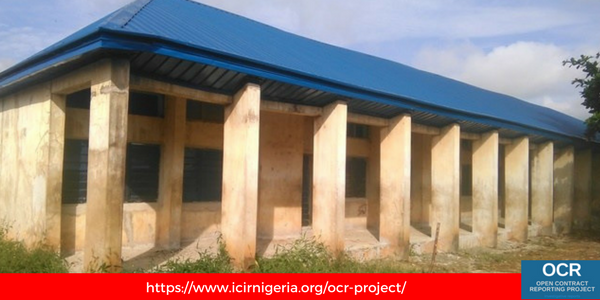
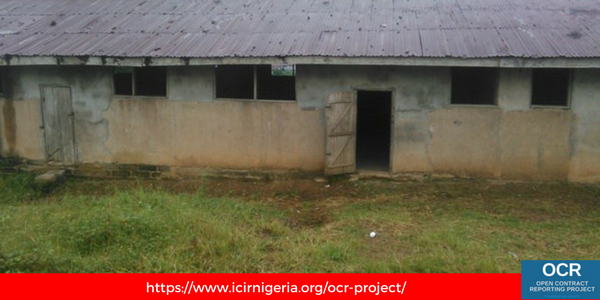
The building the teacher showed the students has a new blue aluminum roof. It is not painted. New iron doors and windows have been installed in a part of the block. The interior of the building is undone with cracks on some of the inner walls. There is no ceiling yet.
Before the rehabilitation started in April, the block contained the library and two classrooms. The books in the library were removed and packed into a store. Students vacated the classrooms for the renovation.
The block under renovation
Chioma Amuta, the principal of the junior section of the school, told the ICIR that she thought the renovation of the building would have been completed by the reopening of the new academic year after the long holiday.
The school has two principals for the junior and senior divisions.
When a contractor came earlier in the year, he told Amuta that he had been given contract by UBEC to renovate a building in the school and chosen this particular block.
The contractor asked Amuta to remove what was in the building to enable him start the renovation. But the principal protested that instead of asking them to vacate the block which they were still using as library and classrooms, he should rather renovate the dilapidated and abandoned school laboratory whose roof had caved in or the hostel where the windows and ceilings were in terrible conditions.
Amuta said the response of the contractor was that he had chosen the building and he was going ahead with the rehabilitation.
“They came and said they were doing UBEC project,” Amuta said. “We don’t know anything about it. I don’t know the arrangement they had with UBEC. They just came, looked around and picked the one they felt was okay for them.
“We were hoping that they would pick the lab that is very bad but they picked this one. The machines in the lab are gone. Rain damaged everything.”
Regina Anuta, the principal of the senior section, said she did not discuss with the contractor about the renovation. She said the man met her in the office and told her that he had chosen a building to renovate.
“This one was manageable,” Anuta said, pointing to the block that is still under rehabilitation. “We used to have two classrooms here. But in others, nobody stays there and everything is damaged.
“He chose the one he liked. I was begging him to do the lab that’s really bad but he said he came in my absence and chose this one.”
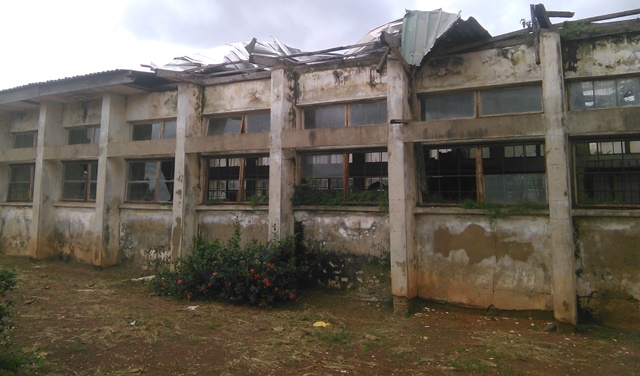
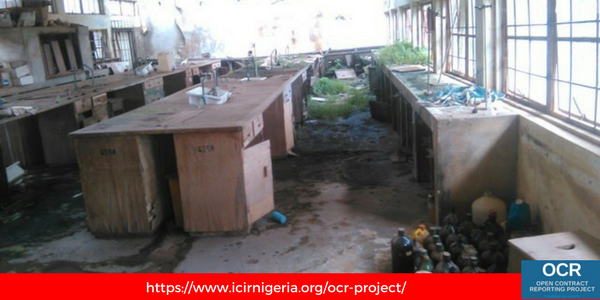
The laboratory’s roof had collapsed. The students had not been making use of the laboratory for their science practical for the past three years. The science equipment and laboratory furniture were damaged by rain. Grass has grown around the dark and stagnant water inside the laboratory building.
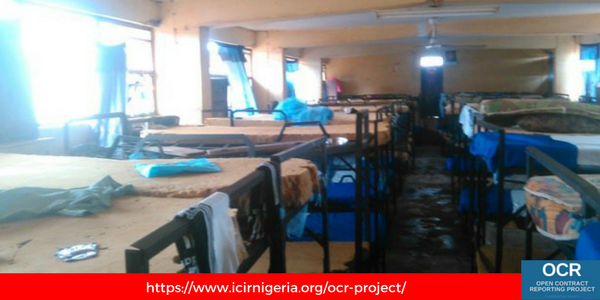
The student hostel is in a terrible condition. Many of the windows of the hostel are missing. The staircase on the one-storeyed hostel has no rail. Portions of the ceilings in the hostel have caved in and faeces from bats drop on the students from the damaged ceilings. A teacher told the ICIR that many bats live inside the ceiling and she had tried to use chemicals to chase them away without success.
The roof of the hostel leaks. When it rains, the students use their buckets to collect the rain from the leaky roof to avoid soaking their tattered mattresses. But violent wind during rain, according to the students, blows water inside the hostel from the missing widows despite their effort in covering the openings with wrappers and cottons.
Rachel Umahi, the first lady of Ebonyi state graduated from the school. It is a boarding school and it is one of the seven comprehensive model secondary schools in the state. Ebonyi is adjudged educationally disadvantaged and has the lowest proportion of school enrolment in the south-eastern part of the country.
The principals and the teachers faulted the claim that the contract for the renovation cost N20 million. They wondered why the contractor refused to renovate the laboratory or the hostel which require urgent intervention but instead opted for the building they were using for library and classroom.
Inside the laboratory building
While the Ugwuachara Girls project has partially been done with the changing of the roof, doors and windows, the project for the rehabilitation of the Urban Junior Secondary School, Abakaliki was yet to start.
Philip Egwu, the principal of the Urban Junior Secondary School, told the ICIR that nobody had come to carry out renovation in the school. The last renovation in the school was done by the Ebonyi State Universal Basic Education Board more than a year ago.
He said he had no idea of a contract being awarded for any renovation in the school. He, however, said he had never been consulted for any past projects in the school.
Another project awarded for the rehabilitation of Government Primary School, Afikpo in Ebonyi State in 2016 has not been executed.
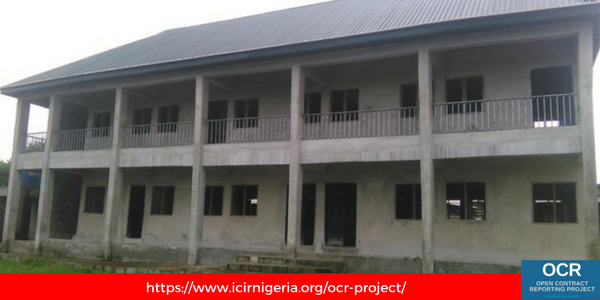
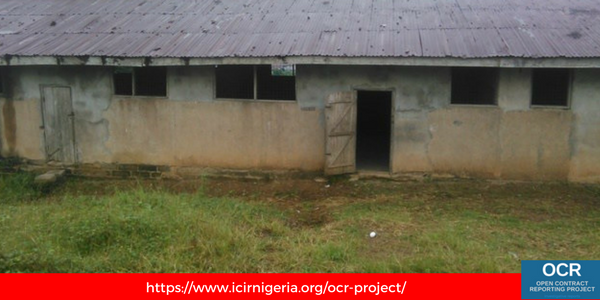
Theresa Eze, the headmistress of the school, told the ICIR that she has not seen any contractor and was not aware of the renovation project. Two classroom blocks for Primary 4 and 6 have been abandoned because they were in bad condition.
Eze said the pupils in the dilapidated buildings have been moved to the other two buildings that contain the rest of the classes. She said the school established in 1924 can also be fenced to provide them with a measure of security.
BRIEFCASE COMPANIES
Hostel, Girls Model Comprehensive Secondary School, Ugwuachara, Ebonyi State
The two companies awarded the contracts for the rehabilitation of the secondary schools are Centre Energy Services Limited and Wellness Energy Result Limited. Both companies were registered on the same day with the same address as a law firm that has occupied the same office at Willand Plaza, Zone 4 in Abuja long before the registration of the companies.They were registered on July 7, 2011, by the Corporate Affairs Commission (CAC).
Centre Energy Services Limited got the contract for the rehabilitation of Girls Model Comprehensive Secondary, Ugwuachara while Wellness Energy Result Limited secured the contract for the renovation of Urban Junior Secondary School, Abakaliki.
Vision Global Synergy Limited got the contract of N20, 094,000 for the rehabilitation of Government Primary School, Afikpo. The company has an obscure address at Anafara Plaza in Gwarimpa, Abuja.The amounts of the contracts were almost at the same price respectively based on information obtained from the Public and Private Development Centre (PPDC), an organisation that is advocating for open contracting in Nigeria.
UBEC was established in 2004 to eradicate illiteracy, ignorance, and poverty in Nigeria through a nine-year basic education. UBEC, which is funded by 2 percent of Consolidated Revenue Fund, is meant to support states and local governments in financing the basic education in the country.
THE BIG SCAM?
N184 million Almajiri school in Ebonyi State
In 2014, UBEC awarded a contract of N184 million for the construction of Almajiri school in Ebonyi State. The contract was awarded during the time that Goodluck Jonathan, the former president, approved the construction of hundreds of Almajiri School, mostly in the northern part of the country.
Almajiri system is prevalent in the northern part of the country where children are sent to Islamic teachers to learn the Koran. In the process of this informal arrangement of religious education under “Malams”, the children roam the streets, begging for alms. To curtail the menace of Almajiri, the schools were constructed to integrate them into Western education.
John Nweze, the focal person for Islamic education in the Ebonyi State Universal Basic Education Board (ESUBEB), told the ICIR that the state does not have Almajiri children, adding that there was no such project in the state.
The only Islamic centre in the state is a private school in Afikpo.
Nweze, however, said UBEC awarded a project for the construction of a block of two classrooms at an Islamic centre in Afikpo.
He said they only got to know about the project when UBEC officials wrote a letter to ESUBEB that they were coming to supervise the project and needed someone to take them to the place.
He said he accompanied the UBEC officials to the school and explained that the project was for the construction of a block of two classrooms, but the school decided to reinforce the building to have a hall on top of the building. The cost of the additional hall was paid by the school.
Eze said the project could not have been awarded at N184 million because it was just a block of two classrooms and the school was paying for the hall. The file containing information about project when the UBEC officials visited the Islamic school in 2015 showed that the first tranche of money released to the contractor was just N2.6 million.
The School of Arabic and Islamic Studies Centre, Enohia, Afikpo was founded in 1963 by Ibrahim N’ass Nwagui and is funded by Muslim World League Makkah AlMukarraawah in Saudi Arabia.
Yakubu Ibrahim, a teacher in the Islamic Centre, corroborated what Eze said that the UBEC only awarded the contract for the construction of a block of two classrooms but the school management decided to add an exam hall on top of the building.
The building has been roofed but it has no doors and windows. No furniture has been provided and it is yet to be painted. The private secondary school was still on holiday when our reporter visited in September.
The project was awarded to Papacy Ventures Limited, a company whose address is located at a private residence in EFAB Estate, Mbora, Abuja.
ESUBEB NOT AWARE OF THE PROJECTS
Dilapidated classrooms block at Government Primary School, Afikpo, Ebonyi State
Hyacinth Ikpo, the chairman of ESUBEB told the ICIR that he was not aware of the projects awarded by UBEC and could not monitor or provide any information about them.
“He said he is a journalist from Abuja,” Ikpo complained to the visitors who were in the waiting room in his office. “And he is coming to ask me about the project given by UBEC in Abuja. Am I the one to tell them how to do their job?
“I can’t tell you what I don’t know. We don’t supervise their projects. The one that involves me they bring money and we bring money that is the one I know. I’m not going to ask them. They are my bosses. They award a contract, they supervise the contact and they pay the contractors.”
When Ikpo was reminded that primary and secondary education is the responsibility of the state, not the federal government, he said UBEC could decide to have interventions in the schools without consulting the state.
“Yes, we own the basic education to the extent that we are given projects and we do it. They do their own projects. They can decide to intervene in each state. They decide to build a block of the classroom. They send their contractor. The contractor will do the job and they will supervise and pay the contractor.”
Ikpo said the last time UBEC officials came to his office, they told him to supervise their projects but he replied them that he could not supervise a project without the bill of quantity.
Chukwu Nwazunku, the UBEC focal person in Ebonyi State, also said he was not aware of the four projects by UBEC in the state.
He explained that execution of projects in schools by UBEC is done through direct intervention or counterpart funding with the state, adding that the direct interventions were usually new construction, not renovation.
Nwazunku insisted that he had no idea of the four projects but pointed out that UBEC usually sent officials from Abuja to monitor projects.
NO PROJECTS DONE IN IMO STATE
Ekubga Home Primary School, Egbema, Imo State
Last year, UBEC awarded two contracts for the construction of classrooms at Ekubga Home Primary School, Egbema and Central School, Amucha, Njaba, Imo State. The contracts included the provision of desks and tables to both schools.
Both projects for the two schools have not been carried out when ICIR visited.
Chinyere Oji, a teacher at Ekugba Home Primary School told the ICIR that a contractor came to the school last year to inquire where he could construct classrooms. It was agreed that the classrooms should be constructed on a space behind the old structure but the man never came back.
The school has just one hall where all the pupils are taught. The hall is not plastered. Teachers interchange two blackboards to teach different classes.
“Sometimes, we ask some teachers to stop teaching to allow others to teach because of the noise when we are all teaching at the same time,” Oji said.
The school, located at the oil producing community, has only five teachers but three have stopped coming because they have not been paid three months’ salary.
Oji said the headmaster had been sick for almost two years. She has been the only teacher coming to school since it reopened four days earlier for the new academic session. She said she had to go to the villages to ask the pupils to start coming to school.
According to her, the school used to have up to 300 pupils but the majority of them have stopped coming because there are no classrooms. She said the pupils reduced to 105 last term, but she was not sure if up to 50 of them would return for the new term.
At Central School, Amucha, Njaba, the contractor has not shown up and the school management was not aware of the contact.
Elizabeth Okpara, the headmistress of the school, said she paid with her money to renovate some parts of the buildings to make it comfortable for the pupils.
“You can see how bad the buildings are,” Okpara said. “The steps you see here, I used my personal money to do it. Nothing is new here”
“The teachers don’t even have tables and chairs. There is nothing in this school. I have been praying to God to do something for this school.”
She said she has more than 200 pupils in the school.
Okpara invited Donatus Agukwe, the chief of the community to inquire if he has heard of any project for the school.
“We haven’t seen anything,” Agukwe told the ICIR. “The only modern building was done by an individual from the community. Since civilian regime, nothing has come to this school. Ask the people in Abuja to show where they did the project.”
ABUJA DID NOT SHOW THE PROJECT
The ICIR first approached Osom Osom, the public relations officer of UBEC to get the commission to provide the status of payment for these projects in Ebonyi and Imo states. He asked our reporter to write the name of the projects and he would get the appropriate department of the commission to provide the information.
Osom later said they would not respond without a letter addressed to UBEC. Subsequently, the ICIR wrote a Freedom of Information (FOI) request to the executive secretary of UBEC on October 9, 2017, to provide the details of payment for the projects. UBEC did not respond to the request.
The FOI provides that all information relating to the receipt or expenditure of public or other funds of public institutions to be widely disseminated and more readily available. The Act also requires public institution to provide the requested information within seven days that the request is received.
However, a source said the companies that got the contracts could mostly have been owned by UBEC officials, their relatives or friends. According to the source, UBEC will be reluctant in releasing the details of the projects because its staff will be indicted.
This investigation is supported by the John D. and Catherine T. MacArthur Foundation and the International Center for Investigative Reporting, ICIR.
Anytime Nigeria is portrayed negatively by the western media, some of us — die-hard pro-Nigeria citizens who are unrepentant Nigerians by birth and blood — feel our pride has been injured.
We don’t always want to hear or read about the ills of our country being told or spread by foreigners, not because we support those ills — not at all, far from condoning bad behavior or indiscipline — but we know the effects of such negative portrayal on all of us.
But one is always constraint by the limit to which Nigeria can be defended and many times promoted when the indices are pointing the other way.
When in November 2017 Portharcourt and Murtala Mohammed airports were rated among the 20 worst airports in the world, some of us felt our image was being unduly maligned by the Sleep in Airport website that carried out the survey. Those who know what obtains at these airports and others could not be bothered by such rating – the airports never measured up to the international standards.
In that survey, Lagos was ranked the fifth worst airport in the world while Port Harcourt was placed the third worst globally. The two are within the world’s worst five.
The website explained that the airports that appeared on the list of worst airports in the world were those that had the capacity to truly offend travelers.
“Within these terminals, there appears to be a general disinterest in a positive traveller experience. In some cases, passengers are made to stand or sit on the floor as they await their flights. In others, the bathrooms don’t have water, toilet paper, or any semblance of cleanliness,” sleepinairpport.net, which is recognized globally, said.
“In some cases, the physical structure of the airport is fine, but the personnel are the problem. Got a problem? Don’t expect much in terms of customer service at these airports.
“If you find yourself travelling through one of these 20 terminals, brace yourself. You’ll want to give yourself just enough time to get in and get out. A minute more and you’ll be unhappy and uncomfortable – a minute less and you risk missing your flight,”
The indices are clear and our airports can be judged through this lens view, even by Nigerians.
NO MEDICAL UNIT AT MMA…AN INFANT CONVULSED?
This happened just exactly one month after MMA was rated fifth worst airport in the world — nothing has changed and is not likely going to change, although there are ministers who oversee the sector and billions of tax payers’ money has been spent to upgrade the airports.
It was a Thursday morning, December 14, 2017. I was rushing to catch an 8 O’clock flight to Abuja from a hotel in Ikeja GRA, Lagos, after attending a three-day training.
Lulu Bangkok of ITV, Ruth Olurounbi, Tola Bademosi both of the Nigerian Tribune plus two other colleagues and I entered the departure lounge of Terminal 1 of MMA.
Despite all the millions claimed to have been spent to renovate the airport, the departure lounge, in terms of space and other accessories, is still below standard. A true reflection of what was considered in the ranking.
But that’s not my real headache. As soon as I passed my stuff through the scanner and I was cleared to enter the departure lounge, a scene caught my attention immediately — a terribly scary experience. There, to the left corner of the scanner, was an Indian couple struggling to revive their baby who was having convulsion. The baby was jerking on the floor, his eyes were dilating.
While a woman I first thought was the mother but later turned out to be a good ‘Samaritan’ was massaging the boy’s hands, the father was doing same to his legs, the real mother was just as confused as the rest of us. Other passengers minded their own business – I don’t blame them, though.
Where are the medics here? I asked almost out of reflex when it looked the boy wouldn’t come back despite efforts by this ‘good lady’ and the father, and ironically, his twin brother was playing around quite unaware of the fate befalling his brother.
At this point, I had expected some level of emergency response from the airport officials. There was none, except for what was a casual call by one of the Airforce personnel who said “please call the medicals”. She left her duty post briefly to where the boy was lying and almost immediately she returned without any real concern for the little boy.
More than 10 minutes after she made this call, there was neither a first aid box in sight nor any medical personnel. In fact, no airport official came close to this dying boy.
Someone among us standing said facing the father, “please take this boy to a hospital”. There and then, the boy, having been stabilized a bit, was lifted by his father on his shoulder. The man exited the departure lounge.
Though I didn’t know where he went and what happened thereafter because it was almost the boarding time for me and others. I hoped the boy survived.
But this is not a good image for Nigeria despite the huge money the government claimed to have spent on the airport. In 2015, Aviation budget was N12.2billion, N36.07billion in 2016 and N70.4billion still running for 2017.
That was not all that happened at the airport just within 30 minutes. Like one of the songs of late Fela Anikulapo Kuti, the Abami Eda himself, ‘e no finishing, no finishing, no finishing’. When the announcement was made for the boarding of Arik plane W3722 to Abuja, Ruth Olurounbi, Business Correspondent with the Nigerian Tribune, couldn’t find her hand luggage.
She was sitting at the lounge just adjacent my seat with her colleague from the same office, Tola Bademosi with her bag under the seat. “Who picked it, where did you keep it,” were the questions we asked a visibly troubled Ruth. No answer and the bag was nowhere. Thus, she boarded the Abuja bound airplane without suitcase which she said contained her clothes and other personal items.
This was also almost a month that Fisayo Soyombo, Editor of the International Centre for Investigative Reporting (ICIR) lost his Nikkon Camera to checked-luggage thieves at Nnamdi Azikwe International Aiport, Abuja while returning from Johannesburg via Addis Ababa aboard Ethiopia Airline.
“Theft of travellers’ belongings is common at Nigerian airports; the airlines know about it, and NAHCO officials are a big part of it,” one airport official had told Fisayo after he discovered that his camera was missing. “Once they see it in the scanner that there are valuables in your checked-in luggage, they find a way to pilfer it. However, if you mount serious pressure on them, they will bring out your property.”
So could it be that someone saw what was inside Ruth’s bag among those manning the scanner? Could it be that one of them had come for the bag later? But she would be told that ‘she was on her own’ by an official she complained to. Grudgingly and very upset too, Ruth boarded the plane to Abuja without her bag.
One thing is clear, Nigerian airports are increasingly becoming unsafe and embarrassing to all of us. Despite the huge amount – N707billion spent to renovate and expand MMA in 2016, it is doubtful if the airport is equipped with Closed Circuit Cameras (CCTV). If there are CCTVs, they are definitely not working like what you have within and around Abuja.
One wonders if the ‘thieving culture’ at Nigerian airports is spreading; Olose Michael, Retail Sales Executive with one of the companies in Nigeria’s downstream sector, had to create a scene early this week at the Abuja airport when his mobile phone disappeared under the scanner.
“I had missed the fly and I was passing my stuff through the scanner,” he said. “I just observed my phone was missing just after I passed it through the scanner,” said Michael who by now had started making trouble before an official said he was the one who picked it when he didn’t see or know who the owner was.
According to him, a senior airport personnel apologized on behalf of the kleptomaniac officer, claiming he was new on the job. What’s obvious; this nauseating thieving by Nigerians at the airports is perpetrated by the so-called airport workers. So there are no CCTV cameras at the airports?
With touting by same officials at the airport, poor state of facilities and pilfering of passengers’ luggage, many Nigerian airports will, for a long time to come, be source of embarrassment to us while the Federal Government keeps budgeting huge sums for airports without corresponding effects.
Officials of the World Food Programme (WFP), the food-assistance branch of the United Nations, have confirmed that four members of its team in Borno State were killed when they ran into a Boko Haram ambush on Saturday.
The deceased were part of a convoy going to deliver food items at an Internally Displaced Persons’ camp in a remote area of the state.
The insurgents drove away with the food supplies, while, according to other sources, some members of the UN team were also abducted.
Adedeji Ademigbuji, WFP’s Communication Officer, Maiduguri area office, confirmed the incident, adding that two of the four persons killed were the truck driver and his assistant.
He however did not say whether any member of the team was kidnapped.
“WFP can confirm that a convoy escorted by the Nigerian military, including WFP hired trucks, was the subject of an attack by armed groups 35km southwest of Ngala in Borno State on Saturday (16 December)”, Ademigbuji stated.
“Four people, including the driver of a WFP-hired truck and a driver’s assistant, were killed in the incident. WFP extends its condolences to the bereaved families.
“WFP is working with the authorities to determine the whereabouts of the trucks.”
It is not clear whether the other two people killed in the attack were civilians or soldiers that were escorting the team.
Unconfirmed sources say three other persons were abducted by the insurgents, who also set one of the trucks ablaze.
The Nigerian military is yet to issue a statement on the attack.
There is something inherently unsettling about the 12 to 18 months preceding an election year, particularly when a sitting president is seeking re-election. It is a period of sure governance missteps. It is the period when even the strongest leaders slacken their political will, and allow politics rather than governance dominate their decision-making. It is the period when elective office holders — not just presidents — are desperate for campaign funds. Usually, executive office holders look no further than security; it’s a trick from the old book. With security, there is no explaining to do. There is a ready escape route because spending on security, being sensitive, are shrouded in secrecy.
Goodluck Jonathan did it before. In July 2014, a little under a year to the 2015 presidential election, he asked the National Assembly for approval to borrow $1billion for the “upgrade of security equipment and training and logistics of the military and other security officers.” To his credit, Jonathan, after securing the loan, trained, in Belarus, more than 700 soldiers dubbed the Armed Forces Special Force (AFSF) — a well-drilled group reputed to instill fear into the most rugged of insurgents. At the point of travel, they were paid $7,700, which was 30% of their Duty Travel Allowance (DTA). But till date, since returning to the country in December 2015, the outstanding 70% has not been paid.
Until his death in December 2016, Lieutenant-Colonel Muhammed Abu Ali was leading the Army’s takeover of lost territory with the T-72, a Soviet-made second-generation main battle tank that entered production in 1971. There have been at least three upgrades to the tank, the most popular being in 1988 and 1995, but they cannot be found anywhere in the northeast or the rest of Nigeria.
Jonathan himself would be shocked if he knew the number of soldiers who died in Borno from stepping on land mines. In this age, no soldier should be killed by mines. A simple mine sweeper is all that is needed. Sweepers detect mines from as far as 25metres away, and detonate them well ahead of advancing troops. Some climb on the mines and detonate them without consequences, the sweepers being very heavy. However, soldiers have always been left with a metal detector, the type available at fast-food joints and hotel entrances.
Even the basic needs of soldiers were not met. The Army found it extremely difficult to supply water, for example, to soldiers in the trenches. Once a group of soldiers waiting to advance to the enemy’s territory asked the Army for water; and when it got an aerial delivery of weapons instead of bottled water, it refused to move. A soldier once told of how in Damasak, Gubio area of Borno State, dehydrated soldiers urinated into their bottles and drank the contents to keep themselves alive. It also happened in Kareto, in April 2016.
These are the memories from Jonathan’s $1bn Boko Haram project, and they are enough to trigger concerns about last week’s approval of state governors for President Muhammadu Buhari to withdraw $1bn from the Excess Crude Account (ECA) to fight the insurgents. The similarity of both circumstances is worrisome. Jonathan’s came eight months before the election, Buhari’s comes 14 months before. With intense election campaigns kicking off in a few months, there are no guarantees for judicious utilization of the funds. Interestingly, when Jonathan made the move in 20014, APC kicked, saying he sought the money “to buy the election and pay for the intimidation of the opposition and electorate” and ultimately “to build a casket for democracy”. Therefore, the APC cannot expect its own government’s move to be perceived in different light.
The source of the funding is another concern, a further indictment of the country’s already-poor savings culture. Before last week’s withdrawal, ECA had a balance of $2.3bn. In the 0.5% Stabilisation Fund was a paltry $29m. And in the Sovereign Wealth Fund (SWF) was another paltry $1.5bn. That is a combined savings of $3.9bn, put away from approximately $1.09 trillion earned from 35 years of crude-oil exportation between 1980 and 2015. The mathematics of it all is that we’ve only ever saved 0.4% of all we earned from oil in 35 years. This means that were all of the country’s crude oil savings be evenly distributed to Nigerians, everyone would get $8 — some N2,888 at the black market.
Despite promising us change, Buhari joins all his predecessors in forgetting that oil is a finite resource, that our buyers are either discovering oil themselves or finding alternatives to the resource, and that our oil reserves have the shortest lifespan of any OPEC nation. By 2051 when our oil reserves are projected to have been depleted, our empty savings will come back to haunt us.
It would be forgivable if the latest ECA depletion would boost the war against insurgency in the same proportion as the amount involved. But to nurse that expectation is to overlook the scale of corruption in the Army. A very simple procedure as paying the operational allowance of soldiers has been abused for years, and continues to thrive under Buhari’s watch. Only last month, a soldier wrote an open letter to the President on “corruption in the Army” and its role in the “needless death of soldiers”. How is it possible that the Army that cannot spare soldiers’ allowances will handle billions of naira without siphoning some?
Finally, the $1bn counter-insurgency project is a contravention of repeated claims by this government that Boko Haram has been “technically degraded” or “really defeated”. Just last month, Buhari — speaking through Lai Mohammed, Minister of Information and Culture — said Boko Haram had been “massively degraded” and its surviving members “put on the run”. “What we are witnessing now are the last kicks of a dying horse,” he added.
Not exactly, Mr. Minister. What we are witnessing now is an enforced revelation of the real truth. It is either Boko Haram was never degraded, or the ECA deduction was never needed. Whichever it is, we will know in the fullness of time.
Officials of the Economic and Financial Crimes Commission (EFCC) have arrested Adeyemi Edun, a real estate agent who allegedly helped Diezani Alison-Madueke, former Minister of Petroleum Resources, to acquire properties worth millions of pounds in the United Kingdom.
Edun was arrested on Wednesday, shortly after he arrived in Nigeria, and is currently being held at the Ikoyi, Lagos office of the EFCC.
“He is being held as part of investigations into Diezani’s multiple corrupt schemes,” Wilson Uwajuren, EFCC spokesperson, told journalists when contacted.
“I can confirm the arrest but I am not able to give details at this stage,” he added.
According to court papers filed in the United States of America and obtained by journalists in Nigeria, Edun “assisted” various Nigerian businessmen with the purchase of £8.3 million of prime London real estate intended “for the use and benefit” of Mrs. Alison-Madueke in March 2011.
He, however, denied the allegations. In an interview he granted to The Mail, a UK-based newspaper, he insisted that “everything is done within the ambit of regulation”.
Alison-Madueke herself has been accused of a series of corrupt practices worth billions of doallars.
Many of her assets in Nigeria have been confiscated and forfeited to the Federal Government, but she remains adamant that she is innocent.
Several court cases are currently ongoing in various courts, involving her or some of her associates.
‘Out of service’ read the network signal on the Journalists’ phone at exactly 6:35 p.m. on Tuesday evening just as the driver, a young dark boy presumably 18 years of age swerved into the mud filled road.
After several twists and turns, the vehicle came to what seemed the end of the road. A river? That’s the first thing that comes to mind. Stretched at a distance of more than 70 meters, almost twice an Olympic-size swimming pool, the drench of the day’s rain formed a pool of flood water ahead. This is where the water is rushing to as there was no gutter on both sides of the road.
To the wonderment of the journalist-passenger, the youthful driver accelerated into the pool. The vehicle began to soak and abruptly stopped almost midway into the pool. It took the combined effort of the passengers who had alighted and some locals to push the vehicle over to the other side of dry land.
This is the only route in and out of Adikwu-Icho community in Apa Local Government Area of Benue State. A night’s rainfall means the flood pool will get as deep as 4 feet. However, if it rains more than a day, movement is completely grounded because you will need a boat to cross which is not handy.
Luckily, the car ignited again after some touches and the driver eventually pulled over by a structure “This is the place you are looking for”, a passenger pointed to an old building, “That’s the Primary Health centre.”
It could be hardly seen because it was already dark and it was still raining.
Though the journalist was given a warm welcome and a place to spend the night, there was a sense of urgency in the facility. Two women were in labour…
A look around the facility, however, showed the labour room is quite scanty with very few equipment at least to cover emergency obstetric care services. It also had no functional ambulance to aid referrals. Relatives of patients have to provide their own transport in the event of an emergency.
Incomplete PHC at Ubbe/Ogba, Akwanga LGA Nasarawa state filled with thick bushes.
A husband to one of the expectant mothers who identified himself simply as Basil recounted their ordeal in bringing his pregnant wife to the health centre.
“It was not easy, me and my brother had to carry my wife who is already in pains because of the pregnancy on our shoulders to cross that flood and get to this side. There was no car or motorcycle that can cross that place because of the water and it’s already night, I just hope and pray she delivers safely,” Basil narrated.
Clad in white apparel and gloves, a nurse, Grace Diashe was busy trying to start the standby small generator which powers the facility during deliveries or emergency at night as there was no electricity in the community.
Adikwu-Icho, a partial island is home to about 2500 people who are predominantly farmers with more than 200 small houses, a typical rural setting.
The silence of the morning was punctured by cries from the new born babies. Buckets were arranged under the roof edges of the building to collect rainwater. This is a tell-tale sign of no borehole and insufficient water supply.
About 30 feet away was another health centre some. This one a beautiful bungalow painted in lively yellow and ox-blood. It is a N22 million project contracted to Ogason Construction LTD in 2014 by the National Primary Health Care Development Agency, NPHCDA. But since it was roofed about a year ago, it has been under lock and key and filled with bushes.
Such health facilities are meant to be the bedrock of public health services in the country. In 1978, Nigeria, along with other World Health Organisation, WHO, member countries adopted the declaration instituting the primary health centres as the basic structural and functional unit of public health delivery system.
There has being three major attempts at achieving people oriented PHC in Nigeria. The first attempt occurred between 1975 and 1980. A second attempt which was led by late Professor Olukoye Ransome-Kuti occurred between 1986 and 1992.
NPHCDA was established in 1992 and it heralded the third attempt.
Completed but abandoned health centre built by NPHCDA in Edikwu Icho community, Benue state.
Despite these attempts, Nigeria’s primary health care could not be mentioned without being associated with an array of challenges.
The health centre in Adikwu-Icho where Mrs. Diashe works is built but not yet accessible. There was no equipment and infrastructure inside.
Locals blame government and contractors for not involving locals in the project as well as not taking due consideration of the access road before starting the project.
Paul Adama, the community’s general secretary, said though the community provided land for the project, it was not carried along.
“We don’t even have the number of the contractor and I don’t think the work he did so far is commensurate with the contract amount,” Mr. Adama said.
“This our road has been like this since I was born. During dry season it can be manageable and motor-able but becomes waterlogged in raining seasons because there is no channel for the water to flow out or gutter. The community has been cut off because of this flood.
“We have complained severally but nothing has been done. We have two polling units here, the government only come during elections period. After their campaign promises, we vote them but they will not do anything.
“With this road, tell me how many qualified health workers will be willing to work here. We don’t have light, good school and other basic amenities,” he added.
The functional health centre, where Mrs. Diashe works, services the health needs of the community. It is a Millennium Development Goals, MDG project of the Goodluck Jonathan administration. This is where the reporter spent the night.
Here, one qualified nurse and three health workers struggle with the challenge of attending to thousands of residents with limited drug supply and no standard equipment.
Worse still, child delivery, pre and post-natal care remain the biggest challenge, health workers say.
Giving a rough mental statistics, Mrs. Diashe estimates deliveries taken in a month to be up to 25, although she was careful not to reveal fatalities.
“We don’t have a lot of things in our labour room which makes delivery difficult. We don’t have more qualified staff, we need a doctor.
PHC, Asata, Enugu State
“If am carrying out delivery and meet an issue I cannot handle, we normally refer the person to Aliade but it’s always a challenge because of this road. If we have a doctor here, he will handle all these and will save the life of the mother and child.
“Pregnant and nursing mothers in the community normally resort to traditional means due to these challenges,” Mrs. Diashe lamented.
LIKE BENUE, LIKE NIGER
Far away in Niger State, it took a combined effort of three men to open the rusted door of a PHC in Gbaye village in Shiroro LGA of the state only to be welcomed by a host of bats that have occupied the entire roof of the building. This comes after struggling to pass through tall bushes that have occupied the entire compound.
Adorned with blue paint on the outside and yellow on the inside, each room was well spaced to meet up the standard of a typical health centre; but it was left in the care of bats who seemed unhappy at the sight of unwelcome strangers at their humble abode.
In some rooms, the PVC ceilings fell apart giving way for the bats to have a clear access to every corner of the building.
Yakubu Soma, the gate keeper who is confident that nobody is coming to say ‘hi’ turned the entrance of the building to where he spreads seeds and food.
He complained of not being paid despite his efforts in trying to rid the place of bushes. “I was brought about two years ago by an Alhaji (contractor) and he gave me N40,000 to stay and take care of the place but since then, he has not come here or even paid me.
“I remove the bushes that fill this place up without being paid. I am tired of staying here. I don’t have money to buy chemical to remove these bushes again,” Mr. Soma said through an interpreter.
A member of the community, Ittah Dahiru, however, said the place was locked up by the contractor who told him he is being owed by the government despite completing almost 90 per cent of the project.
A 33minutes phone conversation with Musa Gwadebe, the contractor, gave a new perspective to the controversy.
Though the data on Budeshi, a public procurement data platform showed that the contract amount for the project is N37 million, Mr. Gwadebe said he only received N7.5 million.
PREMIUM TIMES further learnt that the contract was awarded by NPHCDA and sponsored by Abdullahi Rikko who was representing Shiroro constituency in the House of Representatives. The contract was awarded to one Ibrahim Abah.
It was further learnt that Mr. Abah who doesn’t have a construction company used his brother’s company’s name, Abamatu resources, to get the contract. Abamatu resources in turn contracted Mr. Gwadebe who did the job.
The laws guiding procurement however states that a contractor must own a company and show evidence of works done within the area of the project before he can be considered.
“We got the contract in November 2014 and we only received N7.5 million through Abamatu resources account. As the work progressed to 65 per cent we requested for more money and evaluation of work done but we were told by the person in charge to finish the job as quickly as possible so they can pay us the full balance (N30m).
“I then got a loan from the bank and used my house as collateral so I can complete the project on time. We completed the work in March 2015 before the general elections and since then we have been making requests for our money and up till now (more than 2 years) it’s yet to be paid.
“We have traced our file to the audit department of NPHCDA but all we were told is there is no money.
“The certificate of my house is in court and I’m about to lose it to the people I borrowed money to complete this project. We locked the building up,” Mr. Gwadebe said.
The head of audit department at NPHCDA who simply identified himself as Yemi said the board couldn’t pay because the money was returned to federal government’s account.
“At the end of every financial year, all the money for contracts that was not used will bounce back to FG’s till another budget is released and that is why we couldn’t pay the contractor, his money returned to the government.
“We have written to the government to release liabilities to us but they have not responded and that is the issue,” Yemi said.
In the midst of all these, however, the well-built PHC in Gbaye village keeps decaying while the people it was meant for are in dire need of its services.
A NATIONAL PROBLEM
The Gbaye case mirrors what is obtained in several Primary Health Centres, PHCs, built in the last three years across the country by the federal government. Incomplete or completed, many remain unused, in spite of huge need for them.
In most cases, this is because money was appropriated, contracts awarded and construction commenced without a laid out plan to track the project, its sustainability, due consideration of road network and its accessibility to the people as well as proper liaison and linkages with state and local governments where they are sited.
According to the data from Budeshi, the NPHCDA awarded 91 contracts for the construction of PHCs in 2014 and 2015.
The Budeshi data showed that the new PHCs were awarded mostly at the uniform sum of N21, 986.893.00 to different contractors in many states raising the red flag on whether NPHCDA carried out competitive bidding on the projects.
Adikwu-Icho PHC built during Jonathan administration.
WHO IS TO BLAME?
According to Utache Johnson, an official of NPHCDA, it is expected that the local government authorities periodically inform the board on the progress and challenges of PHC’s within their jurisdiction.
“We are working with contractors and House of Rep members representing each local government. The House members are the ones that normally initiate PHC projects in their various locations. Our job is to execute PHC projects, we now expect the local government authorities to inform us what is needed in these facilities in terms of drugs, staff and equipment so we can come in,” Mr. Johnson said.
On abandoned and incomplete projects, he said the agency has field monitors and project supervisors who go into the field to monitor and evaluate the work done on the sites and “if the work is abandoned, incomplete or not commensurate with the money released, then we now involve the EFCC and other anti-graft agencies to investigate the people responsible and they will be charged to court and made to pay.”
Henry Ewunonu, a pathology specialist and member of the Nigeria Medical Association however believes it is the responsibility of the health ministry and the state health commissioners to tackle the challenges bedevilling health centres across the nation.
Shattered roofs of Gbaye PHC already occupied by bats
“It is the duty of the honourable minister of health in conjunction with the commissioners of health to plan for human resources for health, distribution of equipment, drugs and consumables as well as maintenance of the facility. It is not just about building a PHC but making plans for its sustainability. In Gambia, some PHCs are mud houses but they are well equipped and functional.
“NPHCDA speaks through the ministry of health and the minister would not want to rock the boat with House of Representative members because he’s going to face them at the next budget defence. So it’s complex.”
The Commissioner for Health in Benue State, Cecelia Ojabo, in attempt to address the issue, blamed previous administrations for abandoned, incomplete and non-functional PHCs across the country.
“This is what we inherited from previous administrations, as soon as we bring PHC under one board we will take over those premises. We can’t leave them abandoned and habited by snakes and other reptile. We will take ownership of them and staff them.
“We will complete the uncompleted ones and opened the locked ones for public use. This government doesn’t believe in uncompleted projects,” Ms. Ojabo said.
NPHCDA Speaks
Faisal Shuaib, the Director-General of the National Primary Health Care Development Agency, NPHCDA in an exclusive interview with PREMIUM TIMES described the state of PHCs across the nation as sub optimal.
“As of today, there is no single person in Nigeria who would tell you he is happy with the status of primary healthcare in Nigeria, unless that person is not in touch with reality.
“Our primary healthcare services are sub optimal in most places and that is why we still have high maternal and child mortality indices globally”, Mr. Shuaib said.
Reacting to the first part of PREMIUM TIMES investigation which mirrored the terrible state of Primary Health Centres across the nation, Mr. Faisal said his agency is already taking stock of PHCs in bad condition across the nation.
“From the people we sent out to carry out a detailed assessment of all of these facilities across the nation.
To say, which are the poorly renovated health facilities, which are the dilapidated health facilities, which are the facilities started and completed and those started and not completed? So that we don’t keep having people year in year out, saying they want to start a health facility that will not be completed. Such unfinished projects are littered everywhere in the country.
“So we are taking stock of them all and prioritise each of them. If a National Assembly member comes to us to say, ‘I want to build a PHC’, we will tell them that next to your village is an uncompleted one, ‘can you complete that and probably share credit with your predecessor for ensuring that the health care facility becomes functional?’
“We also want to be able to sit here at NPHCDA with all the photos of the PHCs to be able to show people who want to see the state of health facilities in their villages. To tell them the number of staff there, the last time it was renovated, if it is a 9 a.m. to 5 p.m. PHC, or is it a five-star PHC? Such rankings will be available to them. That is the kind of assessment we are doing, so that we move away from a situation whereby we have PHCs that have not been taken over and equipped.
“We are like 50 percent of the way in terms of getting all the data that we need to know their locations and status,” he said.
In January, the federal government flagged-off of a scheme to revitalise about 10,000 healthcare centres across Nigeria, starting with 109, one in each senatorial district. But about 10 months later, all the eight primary health care centres PREMIUM TIMES visited in Niger, Benue and Nasarawa states in North Central Nigeria had no doctors, drugs or equipment.
Shattered roofs of a PHC in Maito village, Wushishi LGA where bats dwell.
On how far the government have gone in the implementation of the revitalisation of 10,000 PHCs, the NPHCDA director said his agency could not renovate 10,000 PHCs within one year. “What we did is in every senatorial district, we get one PHC and this brought us 109 PHCs so far.”
WOMEN, CHILDREN SUFFER FROM NON-FUNCTIONAL PHCS
A visit to a PHC in Ambana village in Lafia, Nasarawa State perhaps provides even a clearer picture of the rot in the primary healthcare system.
The PHC is occupied by mentally unstable people as their belongings are littered all over the abandoned building.
Contracted to Bright steel structures & co Ltd at N21,986,983.95, the PHC, which was meant to be the bedrock of health services in the community as there was no other, is in ruins. This has led to continued death of children and women especially during child bearing.
Two children died of unknown diseases in the morning of the visit, locals said.
According to the emir of the community, Abubakar Ambana, two women and four under-5 children died in the past week.
“We can only go to general hospital in Lafia which is not close and we cannot beat emergency situation, that is why we lose people,” Mr. Ambana said.
Though Ambana is just not far from Lafia, the state capital, its people still lack access to modern healthcare. Child delivery is often done the traditional way.
Aisha Mohammed, a mother of three, said all her children were delivered at home by ‘Ungozoma’ a traditional midwife. She said she doesn’t have any problem delivering in a hospital, only that none is in the community.
Musa Kabiru, an elder in the community, said efforts have been made to reach out to Meyan Ma, the House of Reps member representing the community who the contract was handed over to. But it was unyielding, he said.
“When we try to meet oga (Meyan Ma) they say he is in Abuja. We want the government to help us. Our children, mothers and elders are dying,” Mr. Kabiru said.
Nobody was found in Meyan Ma’s house in Lafia and his phone was unreachable.
According to a survey conducted by Civil Society Legislative Advocacy Centre (CISLAC), in Nigeria one in 13 women dies during pregnancy or childbirth. Although many of these deaths are preventable, the coverage and quality of health care services in Nigeria continue to fail women and children. At present, less than 20 per cent of health facilities offer emergency obstetric care and only 35 per cent of deliveries are attended by skilled birth attendants.
Apart from poverty and cultural practices, shortage of primary healthcare services are forcing women in Nigeria to seek the help of untrained traditional birth attendants, despite the serious risks involved.
Some 30 minutes’ drive from Ambana is another PHC in Ubbe/Ogba, Akwanga LGA of Nasarawa. It was like a recap of what obtained from the last PHC in Ambana, only that the building did not even get to roof stage.
The alternative health centre servicing the community is just some meters away. There are 11 health workers including nurses here, who are forced to use the old, small facility because the new one under construction has been abandoned. Contract for the abandoned PHC was given to Swaleys Nigeria LTD at N18,420,948.
“If they completed that clinic we would have moved in there because this one no longer contains us,” Grace Edero, the head nurse said.
She, however, complained that equipment and drugs brought for the abandoned project had been in the custody of the chief of the town who refused to hand it over to the health workers.
“When we approached him to give to us so we can use them to treat people, he said he don’t know us and can’t release them.
“They are there rusting away while many people are in need of those drugs and equipment,” Ms. Edero said.
It is even worse at Maito village, Wushishi Local Government Area of Niger State. The stench oozing out from the nearly dilapidated health centre there can make a healthy person develop serious health challenges. Bats have taken over the roof of the building, though there are more dead bats on it than the ones alive, hence the offensive smell.
Directly opposite the almost decomposed centre stood forlorn two incomplete blocks of building adjacent to each other. The buildings are NPHCDA projects of PHC for Maito village which has been long abandoned. It has been fully occupied by goats, hence the use of an old dilapidated building as a health centre.
“What you are perceiving is coming from dead bats all over the roof,” Mariam Mohammed, the only health attendant at the facility explained covering her nose with a veil.
“It’s not proper to treat a sick person here, some people will come here and see the environment and go back and that is a challenge. The ceiling of our injection room fell down. As you can see, it’s wide open.
“I have to cover my nose almost throughout the day because of the smell. I don’t want to contact disease while treating people. We have complained about this condition and if nothing is done, I will leave.”
Apparently, residents shun the facility not wanting to add to their health challenges. Surprisingly, child delivery is done there according to the nurse.
‘STANDARD PHC’
About N96 million was awarded to rehabilitate a PHC in Muye, Lapai LGA of Niger State. It was quite well built with a large open ward, labour room, children and female wards, doctor’s office and staff quarters, an ambulance, solar power with a well-built gate post.
Of all the PHCs visited, this was the only one that could be rated as standard and open to the public to render health services.
The reporter who arrived at 3:30 p.m. met the centre wide open with no one in all the wards and rooms in the facility. It took further probe inside the village to meet the two health workers, a male semi-qualified nurse and an assistant manning such huge facility.
The facility does not have doctors, qualified midwives, pharmacists, nurses, security or labourers to keep the place clean or even a driver to drive the referral vehicle, Ibrahim Abdullahi, a local health attendant, said.
“We treat at least 15 people daily and we don’t have shifts that’s why we leave the place and go home and attend to certain needs because we cannot afford to be here every hour, it’s just two of us.
“We have meeting every month at the Lapai secretariat, we complain of the staff situation but nothing has been done,” Mr. Abdullahi said.
This begs the question why such well-built facility was not well staffed when N96 million was awarded for just rehabilitation.
This paper further learnt that the rehabilitation of the centre was awarded when a member of the community was the director of NPHCDA. However since the contract was completed, it has not been commissioned.
Meanwhile, locals faulted the state of the road leading to the community as part of the reasons why the facility lacked quality staff.
A storeroom of a Nigerian PHC
Muye is at the far end of Niger State and has a boundary with Kogi State. It will take a commuter N1000 to get to the Muye village from Lapai, the nearest town. Not because it’s far but due to the terrible state of the road.
“Most of the staff brought down here always leave, we have not being able to sustain a worker for long due to these challenges, the impact is that people with serious ailment can’t be treated here,” Mr. Abdullahi said.
HOPE?
There is a glimmer of hope for the country’s decaying primary health care. The federal government has initiated a N28 billion health fund that will target the revitalisation of at least one primary health Centre in each of the 774 local government areas.
The Minister of Health, Isaac Adewole, inaugurated the special intervention which he said would be formally rolled out in 2018.
Patients and health workers in PHCs like Mrs. Diashe in the Adikwu-Icho health centre hope the government keeps its promise this time around
This investigation is supported by the John D. and Catherine T. MacArthur Foundation and the International Center for Investigative Reporting, ICIR.
Ayodele Fayose, Governor of Ekiti State, has penned a birthday message to President Muhammadu Buhari, who turned 75 on Sunday, but his message came with a rather unsolicited advice for the celebrant.
Fayose’s message for Buhari is that, at 75, he is too old to run again for the presidency, as the country needs a more vibrant, agile person to coordinate its affairs.
“This is to congratulate Mr President as he clocks 75. I want to thank God for his life and pray for good health in the service of our nation and that he continues to age with grace. I wish him the best,” read a statement signed by Idowu Adelusi, Fayose’s Chief Press Secretary.
“He represents us all and we owe him prayers and cooperation where necessary, just as we also need to criticise him where necessary.
“I am not a fan of an old man and this is not personal and peculiar to President Buhari. We need an agile president come 2019.
“We need somebody that is experienced and agile. He shouldn’t contest and the decision is his and his party. But that is not going to stop me and my party from taking over from him and his party come 2019.”
Though Buhari has not explicitly stated his intention to seek re-election, several factors suggest he may have another go at the presidency.
A team of staunch loyalists, known as ‘Buharists’, led by Nasir El-Rufai, Governor of Kaduna State, has already declared that he must run again or in the contrary point out an anointed candidate to them.
But the clearest indication of his plans came during his visit to Kano last week, where he said that his reception by a mammoth crowd proved that if elections were held again right then, he would have won by a landslide.