Home Blog Page 2664

After ‘consulting with God’, Atiku dumps APC a day before 71st birthday


Abubakar Atiku, former Vice President of Nigeria and one of the leaders of the ruling All Progressives Congress (APC), has resigned from the party, saying it has failed Nigerians.

Atiku, who will be 71 on Saturday, said he took the decision “after due consultation with my God, my family, my supporters and the Nigerian people whom I meet in all walks of life”.

According to a statement with which he announced the move, APC’s “neglect” for the youths of the country and disregard for other prominent politicians invited to join the party, are some of the reasons for his resignation.

He also cited the 2016 memo written to President Muhammadu Buhari by Nasir El-Rufai, the Governor of Kaduna State, in which the latter told the former that the APC had disappointed Nigerians.

FULL STATEMENT

On the 19th of December, 2013, I received members of the All Progressives Congress at my house in Abuja. They had come to appeal to me to join their party after my party, the Peoples Democratic Party, had become factionalized as a result of the special convention of August 31, 2013.

The fractionalization of the Peoples Democratic Party on August 31, 2013 had left me in a situation where I was, with several other loyal party members, in limbo, not knowing which of the parallel executives of the party was the legitimate leadership.

It was under this cloud that members of the APC made the appeal to me to join their party, with the promise that the injustices and failure to abide by its own constitution which had dogged the then PDP, would not be replicated in the APC and with the assurance that the vision other founding fathers and I had for the PDP could be actualized through the All Progressives Congress.

It was on the basis of this invitation and the assurances made to me that I, being party-less at that time, due to the fractionalization of my party, accepted on February 2, 2014, the hand of fellowship given to me by the All Progressives Congress.

On that day, I said “it is the struggle for democracy and constitutionalism and service to my country and my people that are driving my choice and my decision” to accept the invitation to join the All Progressives Congress.

Like you, I said that because I believed that we had finally seen the beginnings of the rebirth of the new Nigeria of our dreams which would work for all of us, old and young.

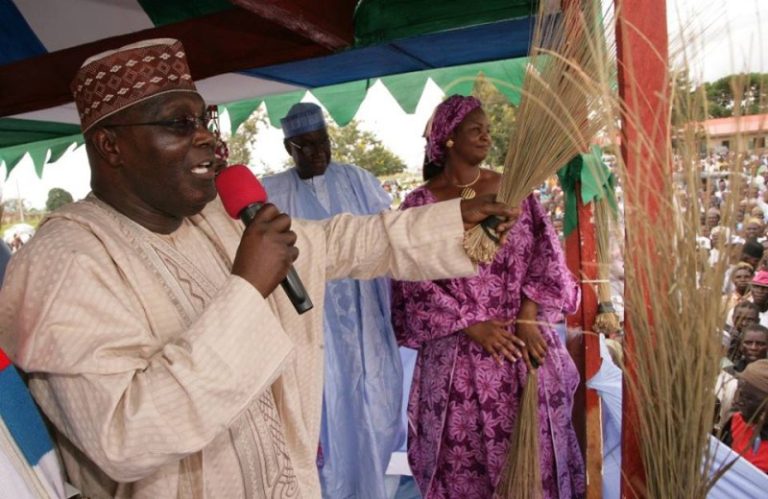
Atiku with President Muhammadu Buhari and other APC leaders during the 2015 electioneering

However, events of the intervening years have shown that like any other human and like many other Nigerians, I was fallible.

While other parties have purged themselves of the arbitrariness and unconstitutionality that led to fractionalization, the All Progressives Congress has adopted those same practices and even gone beyond them to institute a regime of a draconian clampdown on all forms of democracy within the party and the government it produced.

Only last year, a governor produced by the party wrote a secret memorandum to the president which ended up being leaked. In that memo, he admitted that the All Progressives Congress had “not only failed to manage expectations of a populace that expected overnight ‘change’ but has failed to deliver even mundane matters of governance”.

Of the party itself, that same governor said “Mr. President, Sir Your relationship with the national leadership of the party, both the formal (NWC) and informal (Asiwaju Bola Tinubu, Atiku Abubakar, Rabiu Musa Kwankwaso), and former Governors of ANPP, PDP (that joined us) and ACN, is perceived by most observers to be at best frosty. Many of them are aggrieved due to what they consider total absence of consultations with them on your part and those you have assigned such duties.”

Since that memorandum was written up until today, nothing has been done to reverse the treatment meted out to those of us invited to join the All Progressives Congress on the strength of a promise that has proven to be false. If anything, those behaviours have actually worsened.

But more importantly, the party we put in place has failed and continues to fail our people, especially our young people. How can we have a federal cabinet without even one single youth.

A party that does not take the youth into account is a dying party. The future belongs to young people.

I admit that I and others who accepted the invitation to join the APC were eager to make positive changes for our country that we fell for a mirage. Can you blame us for wanting to put a speedy end to the sufferings of the masses of our people?

Be that as it may be, after due consultation with my God, my family, my supporters and the Nigerian people whom I meet in all walks of life, I, Atiku Abubakar, Waziri Adamawa, hereby tender my resignation from the All Progressives Congress while I take time to ponder my future.

May God bless you and may God bless Nigeria.

Senate committee says EFCC ‘shared out’ 222 houses, hotels recovered by Maina

About 222 houses, hotels and other properties recovered by the Pension Reforms Task Team headed by Abdulrasheed Maina, were shared between officials of the EFCC, ICPC and DSS.

This is according to Emmanuel Paulker, Chairman of the Senate’s ad hoc committee investigating Maina’s controversial recall and promotion in the civil service.

Paulker made this known during Thursday’s senate plenary, saying that the revelation came up in the course of the committee’s investigation.

“The Senate notes that the Presidential Task Force on Pension Reforms headed by Maina, in the course of discharging its mandate, recovered about 222 houses, hotels, investment portfolios and properties from pension fund suspects in Abuja and other major cities across the country,” Paulker said.

“The Senate equally notes that before Maina left, the pension reform task team recovered assets from alleged pension looters, working with the EFCC, ICPC, DSS, police and paramilitary agencies who executed the recoveries and thereafter, the EFCC took over custody of the recovered assets.

“The Senate further observed that the EFCC, as a member of the Maina-led pension tax force team, had the statutory powers to impound and take custody of assets.

“The Senate is alarmed that the total recovered assets from alleged pension thieves are reported to be allegedly shared by some interest groups.

“The Senate further notes that this revelation emerged during the current investigation by the ad hoc committee on the reinstatement of Maina and the committee equally received a petition on the recovered properties by the task force.”

Paulker said that the scope of the investigation should be expanded to accommodate the properties that were recovered by Maina’s committee.

He also wants the committee to be given more time to execute a more thorough investigation.

Adamu worried by Nigeria’s world-highest population of out-of-school children


Adamu Adamu, Minister of Education, says the high population of out-of-school children is the strongest evidence yet that Nigeria has failed to achieve one of the Education For All (EFA) goals and Millennium Development Goal of universalizing access to primary education for all school age children.

“Nigeria has the highest number of out-of-school children in the world, accounting for 10.5 million out of the 20 million worldwide,” Adamu said on Thursday at the opening of the Nigeria Annual Education conference with the theme: ‘Achieving Inclusive Education Through Innovative Strategies’.

“These include the almajiri girls of school age who constitute 60 percent, children of nomadic pastoralists and migrant fishermen and the one million children displaced by the Boko Haram insurgency.

“The continued existence of the phenomenon of out-of-school children is the strongest evidence that Nigeria has failed to achieve one of the Education For All (EFA) goals and Millennium Development Goal of universalizing access to primary education for all school age children irrespective of social class, religion or ethnicity.”

Adamu who was represented by Sunny Echono, Permanent Secretary at the Federal Ministry of Education, lamented that many socioeconomic and cultural factors were impeding the eradication of the problem.

He argued that any realistic attempt to provide educational opportunities to Nigeria’s 10 million out-of-school children must review existing practices in order to determine where the country is and the obstacles that are on the way.

“More worrisome is that females account for nearly 60 percent of the country’s illiterate population,” he said.

“The most expedient approach is through selective, intensive and nationwide ongoing campaign against illiteracy, targeting states and groups that have the highest levels of illiteracy, with girls and women as the main target.

“If a minimum of 10 literacy centres could be established in each of the 9,572 wards with each centres enrolling a maximum of 30 learners in two sessions per annum,5.7 million adults would be made literate at the end of each year under the national literacy campaign. Thus, about 23 million people would be literate.”

Adamu also confessed that the percentage of Nigeria’s budget committed to education is very low, lamenting that over 90 percent of the federal and state government annual appropriations for the sector are committed to payment of staff salaries.

REVEALED: Maina continued receiving salaries after dismissal from civil service


Abdulrasheed Maina, former Chairman of the Presidential Pension Reform Task Team, continued to work and earn salary even after he was dismissed from the civil service.

This was made known by Mohammed Katu, Maina’s lawyer, during a hearing into the circumstances that led to Maina’s recent reinstatement and promotion in October.

The hearing, which is being conducted by the House of Representatives, was attended by Abdulrahman Dambazzau, Minister of Interior; Winifred Oyo-Ita, Head of Service of the Federation; and Abubakar Malami, Minister of Justice and Attorney General of the Federation.

Katu told the hearing that Maina had to flee due to serious threats to his life, but continued working from exile and that his salary was never stopped.

“If you want a categorical answer, I will tell you Yes. I will advance documents to you to show (that Maina continued to work even after his dismissal),” Katu said.

“I could go further to let you know that files were sent to Maina even as at last month, for him to treat, while he was absent.

“We’ll mention to you that 23 numbers of files were sent to him to minute in his capacity as acting director.

“We have annex document here to show that even after the letter purporting to have dismissed Maina, dated 12th February (2013) was issued, Maina still worked for the federal government and he sent letters to the various agencies.

“This letters were dated March 13, to the then President, another letter was to the honourable minister of finance dated 13th June 2013, after he was purported to have been dismissed.

“Another letter was addressed to the Attorney General on the 11th of March 2013.

“So it is not true for anybody from anywhere to state that Maina was dismissed. By implication, he is and remain a civil servant, because he has sent in documents and they were all acknowledged and the federal government of Nigeria worked on these documents.”

Maina was a Deputy Director in the Ministry of Interior before being appointed by Steve Oronsanye, then Head of Service, to head the Pension Reforms Task Team (PRTT), in 2010.

He was sacked in 2013 following allegations of gross corruption running into billions of naira purportedly recovered from pension thieves.

However, in October, he was surreptitiously reinstalled into the civil service and promoted to the post of Director.

Following a media uproar over the clandestine reinstatement, President Muhammadu Buhari ordered Maina’s immediate removal, and ordered the Head of the Civil Service to explain what led to his recall.

Similarly, the House of Representatives formed an ad hoc panel to look into the matter.

The panel, headed by Madaki Ali, commenced hearing on Thursday.

15 institutions get TETFund’s N75m research grant but only four are universities

The Tertiary Education Trust Fund (TETFund) says it has released the sum of N75,206,387.13 as research grant to 15 public tertiary institutions across the country to support 135 research proposals.

According to Abdullahi Baffa, Executive Secretary of TETFund, the disbursement, made in July, was under the Institution Based Research (IBR) – an aspect of mandate of the agency supporting academic staff with quality research proposal.

They are also expected to publish outcomes of the research activity

But out of 152 universities in the country, comprising of 40 federal universities, 44 state universities and 68 private universities, only four universities were among the beneficiaries of the research grant, which awards a maximum of N2million to academic staff with research proposal.

Private universities are not entitled to interventions from the agency.

According to a monthly digest of TETFund unveiled in Abuja on Thursday by Baffa, Enugu State University of Science and Technology, Ladoke Akintola University, Oyo State, Abubakar Tafawa University, Bauchi and Federal University, Oye-Ekiti were the universities with 31 research proposals that got N25,004,523.88 of the N75million.

Federal Polytechnic Mubi, Adamawa State and Institute of Management and Technology, Enugu were also the only polytechnics on the list of beneficiaries with 22 research proposals, taking N10,429,824.00 of the total grant, while 9 colleges of education with 82 research proposals took N39,732,039.00.

Among the Colleges of Education were; Kaduna State College of Education, Gidan Waya, Federal College of Education, Osiele, Ogun State, Federal College (Technical) Potiskum, Adeyemi College of Education, Ondo State and Federal College of Education, Katsina. Others were FCT College of Education, Zuba, College of Education, Gindiri I Plateau State, College of Education, Ikwo, Ebonyi State and Federal College of Education, Okene, Kogi State.

In August, the ICIR had reported how TETFund complained that 90 percent of lecturers’ research proposals were very poor and unfundable.

Femi Bamiro, former Vice Chancellor of University of Ibadan and member of one of TETFund’s committees, had said: “The burden of research lies on the shoulder of tertiary institutions. Funding research started around 2009 but we must also not forget that prior to then research was probably nothing to think about in tertiary institutions.

“Only three institutions were lucky to attract foreign grants. I’m speaking for the University of Ibadan, you found out that most of the grants for meaningful research in the system were from WHO and so on. We used to have senate research grant in the university but when the Vice Chancellor cannot even pay salary, how can he get money for allocation of research until TETFund came with that N3billion.

“But when we started calling for proposals, initially we got less than 100 from out of the system; whether universities, polytechnics or colleges of education, and out of the 100 we found less than 10 fundable.”

GIJN 2017: When the world’s biggest gathering of troublemakers held in Jo’burg


For five days – between November 15 and 20, 2017 – 1,200 investigative journalists from 130 countries gathered in Johannesburg to discuss their business: investigative journalism; successes, challenges, ways forward and of course, networking and partnership. It was a conference like no one. YEKEEN AKINWALE, who was a delegate to the conference, brings back memories from the explosive assembly of Investigative Journalists.

The journey was tiring, but our spirits were high; like students going on excursion for the first time, the world’s troublemakers were going for their annual fraternal meeting. Ten hours in the sky, Johannesburg was on everyone’s mind. The University of Witwatersand was the centre of attraction; the 2017 Global Investigative Journalism Network (GIJN) was the event. That was the first time in Africa.

AND THE FRATERNITY BEGINS

When  the conference kicked off on Wednesday November 15, a workshop  — Psychological Safety for Investigative Reporting where Bruce Shapiro, Gavin Rees, Patricia Evangelista, Amantha Perera, Ismail Einashe and Elana Newman  — was just the impetus to prepare delegates psychologically for the remaining days of lectures, knowledge sharing, mentoring, networking, peer group review and future aspirations.

The workshop dissected the complex facets of trauma faced by investigative journalists around the globe. Cait McMahon, psychologist at Dart Centre Asia South Pacific, offered the so-called BDA approach, which provides practical tips that working journalists can implement before, during and after reporting on trauma.

Psychological Safety for Investigative Reporting workshop at #GIJC17

But this was nothing compared to the welcome reception at the Wits Alumni Club House. There, delegates wined and dined, and it was a night you wouldn’t want to end or miss, as it offered a lifetime opportunity of meeting colleagues and accomplished investigative journalists whose works often form inspirations and guides for many of their colleagues across the world.

The Great Hall on Witwatersrand campus on Thursday  November 16 was filled to capacity during the plenary. While panelists David Cay Johnson, Ritu Sarin, Patricia Evangelista, Ewald Scharfenberg, Elena Milashina, Mzilikazi wa Afrika discussed ‘The New Autocrats” moderated by Ferial Haffajee, Muckrakers, as they are called, were already well-seated; the stage was set for an engaging and enthralling conference. Moments before the plenary, the magnificent frontage of The Great Hall provided the ambience and perfect ground for delegates to enter into one another,exchanging greetings, pleasantries, ideas and contacts.

Antorn Harber, Caxton Professor of Journalism at Wits, described this as “the world’s most troublesome journalists under one room”. This is, of course, the truth, because as David Cay Johnson puts it, “investigative journalists are the only ones in the occupation paid to tell the truth and unearth wrongdoings.” This is why we are troublemakers; we uncover what they try to cover, unearth the lies, corruption, documents and the underhand deals they are burying. “I’ve never seen so many troublemakers and the world’s worst nightmares gathered under a single roof,” Haffajee said.

So when these troublemakers meet, relegating biases  — religion, gender, status, race and other forms of divisive perceptions  — to the background, the fraternity was outside of this world. Laughter, banters, jaw-jaw defined the moment.

THE NIGHT OF HONOUR FOR NIGERIA

Musikilu Mojeed, Editor-in-Chief, Premium Times and Emmanuel Mayah, Reporter, after winning the overall Global Shining Light Award at the GIJN 2017

Before that glorious evening for Nigeria, African Muckraking, a collection of 41 investigative journalism stories written by Africans about Africa and edited by Anya Schiffrin and George Lugalambi, was all doubting Thomases needed about the exploits of African investigative journalists.

But an icing on the cake for the African race was the Global Shinning Light Award won by Emmanuel Mayah, a freelance journalist with Premium Times. Nigeria was well-represented at the conference, with about 100 delegates. Therefore, when the winner was announced, the Great Hall erupted in jubilation and it was indeed a night of honour for Nigeria.

The prize honours investigative journalism conducted in a developing or transitioning country, done under threat, duress, or in the direst of conditions. Mayah won first place for a two-part story on the extrajudicial killings of IPOB protesters: ‘Inside the Massive Extrajudicial Killings in Nigeria’s South-East‘‎ and ‎’How the Onitsha Massacre of Pro-Biafra Supporters was Coordinated.’‎

The two-month long investigation uncovered multiple mass graves, lending support to allegations that police and military forces targeted innocent and defenceless civilians for abuse and extrajudicial killings.

Following reports that included photo evidence, human rights groups called for an independent probe and the army announced another investigation.

KNOWLEDGE-BASED CONFERENCE

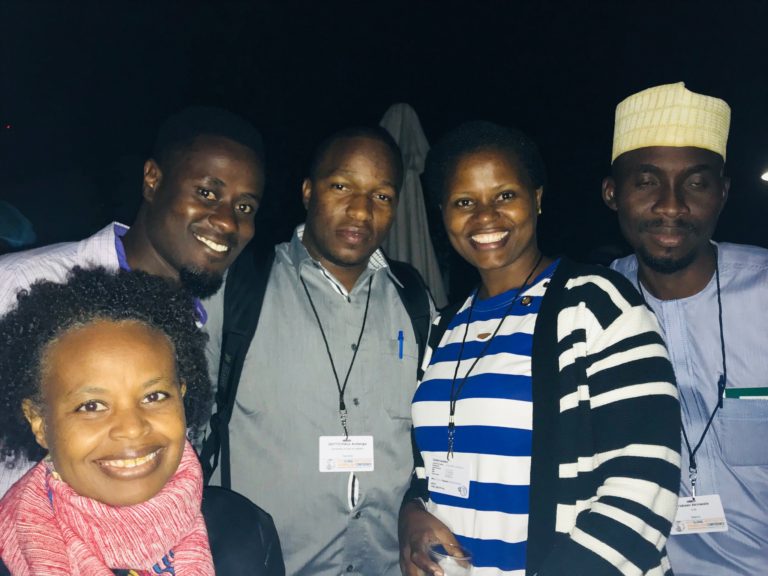
When the curtain was drawn on the conference on Sunday, November 19, GIJN 2017 had offered immeasurable knowledge to participants, the type that can only be acquired at the gathering of 1,200 journalists. Many participants had testimonies to share. Ebenezer Wikina, a Nigerian and NDlink Project Analyst, said the conference expanded his media horizon.

“The Global Investigative Journalism Conference 2017 expanded my media horizon. The workshops and accomplished media professionals I met in Johannesburg were exactly what I needed to move my career to the next level,” said Wikina.

“As journalists, our stories can change the world, and seeing the impact various journos who attended GIJC 17 are making around the world, I’ve been inspired to dig deeper, speak louder, and work together with other journalists to uphold truth and bring proffer solutions to societal problems via my stories.”

One of such exciting new tools given out during the conference was data journalism tips and tools presented by some of the best data journalists in the world.

You know the power of data journalism; it helps to contextualize your reports and take its meaning to the audience as intended. Again, from subjects such as ‘ABC of Investigative Journalism’ taught by Cheryl Thompson to ‘Editing the Investigative Story’ handled by Marina Walker Guevara, Musikilu Mojeed and Mark Schoofs, as well as ‘Multimedia Storytelling: Science Journalism and Data Visualisation’, there were many takeaways for participants. Also, in ‘The Art of Interviewing’, the best way to handle sources was given out. Then, Undercover Reporting was handled by Lkhagva Erdene, Rana Ayub of India and ‘Fisayo Soyombo, a Nigerian and multiple award-winning journalist known for his daring undercover reporting skills.

For Salome Kitomari, Senior Reporter at The Guardian of Tanzania, learning undercover reporting skills was a great takeaway from the conference. “What I gained from the conference was getting experience from investigative journalists worldwide on how to report undercover.”

But that was not all from Kitomari. She added, “I now know how to have a good investigative report under hard regimes like what is happening in Tanzania now, how to engage with hard regime. I also learnt about mobile journalism and online investigative reporting.

“But most important is to hear from western journalists that they are facing challenges as we have in East Africa, for instance, the issue of freedom of expression.”

There is need to emphasize the new synergies between journalists that were formed during the five-day conference. Journalists see opportunities in working together across borders and making more impact in sharing stories. Sources for funding, perhaps, one of the major challenges hindering Investigative Journalism formed substantial parts of discourse.

Die Burger, a South African and a reporter at Malherbe Nienaber, urged Nigerian and South African journalists to strike partnership in reporting issues affecting the well-being of their respective countries.


HAMBURG 2019: HERE WE COME

After five days of intensive discussions, ideas exchange, networking and mentoring, GIJN members decided by vote on the next city to host the 2019 edition of the conference. And Hamburg, Germany, won the hosting rights!

Police to detain Maimuna Aliyu’s daughter, who ‘stabbed’ her husband to death, for two weeks

The Federal Capital Territory (FCT) Police Command has filed criminal charges against Maryam Sanda for allegedly stabbing her husband, Bilyamin Bello, to death last Saturday.

Sanda is the daughter of Maimuna Aliyu, the former Executive Director of Aso Savings and Loans Limited, whose nomination to the Board of ICPC was withdrawn by Vice President Yemi Osinbajo following corruption allegations exposed by the ICIR.

The deceased Bello was the son of Haliru Bello, former National Chairman of the Peoples Democratic Party (PDP).

Anjuguri Manzah, spokesman of the FCT police command, issued a statement revealing that the command had secured a court order to remand Sanda for two weeks.

He said that it would be difficult for the suspect to be remanded in prison custody because she is a nursing mother whose baby is just six months old.

“It should also be noted that this present charge is as a result of preliminary findings; at the end of investigations, additional findings will determine whether the current charge will be amended or whether other persons will be charged along with the suspect,” Manza said.

“To assist the police with their ongoing investigations, some persons have been invited for questioning on the matter.”

Manzah said the case was assigned to FCT High Court in the Jabi district of Abuja, adding that the suspect was charged with culpable homicide punishable under section 224 of the Penal Code.

A source told newsmen that some security guards who were picked up by the police for questioning had been released after they also promised to testify in court.

“The security guards were released after telling the police what they knew about the incident. They subsequently agreed to serve as prosecution witnesses, meaning that they would appear in court to give evidence on the matter,” a source explained.

Sanda allegedly stabbed her husband in the neck, chest and genitals on Saturday while he slept at their home in Maitama, Abuja.

She was said to have rushed him to a hospital where he gave up the ghost.

The deceased was reported to have divorced his first wife before marrying Sanda and the couple had a daughter together.

‘It’s an international embarrassment’, Melaye says on DSS-EFCC face-off


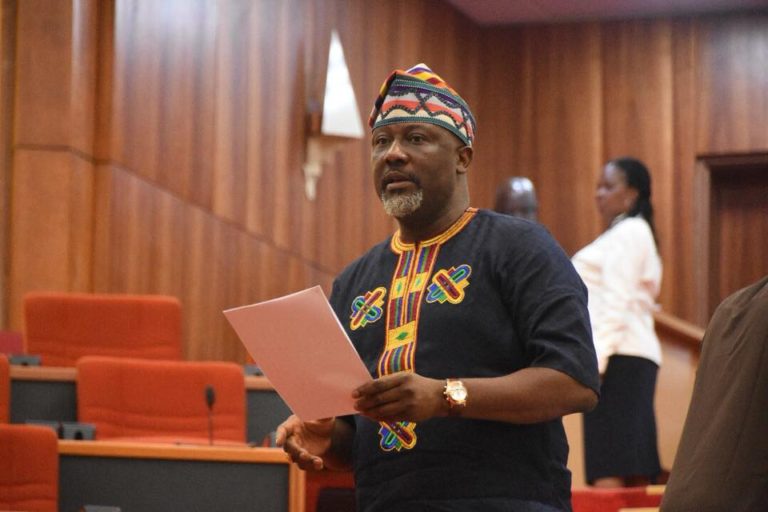
Dino Melaye, senator representing Kogi West in the National Assembly, says the ongoing face-off between the Economic and Financial Crimes Commission (EFCC) and the Department of State Services (DSS) has embarrassed the country in the international community.

Melaye expressed this opinion on Wednesday during the plenary of the Senate, saying that the altercation between the two law enforcement agencies has caused innocent Nigerians undue inconvenience.

On Tuesday, the EFCC went to the Maitama district of Abuja to arrest Ita Ekpenyong, former Director-General of the DSS and Ayodele Oke, former Director-General of the National Intelligence Agency (NIA), over allegations of corruption.

However, DSS operatives at the residences refused to grant the EFCC personnel entry into the separate premises to effect the arrests.

This led to a confrontation between the operatives of the two agencies, and the cordoning of the road leading to the street.

Melaye wondered why innocent Nigerians would be denied access into their homes, adding that the development is a recipe for national disaster.

“Mr. President, the media and the social media, print and electronics have been awash with a disaster that took place yesterday,” Melaye said.

“The EFCC went to the residence of the former Director-General of the SSS, Ita Ekpeyong, to effect an arrest and the Directorate of State Security stopped the EFCC from arresting him.

“That created environmental brouhaha. The whole environment and neighbours were stopped from lawfully gaining entrance into their homes because of this confusion.

“Same yesterday, the EFCC wanted to arrest the former DG NIA, Mr. Oke. Also, the officers of the Nigeria Intelligence Agency stopped that arrest.

“We are not here to say who is at blame. We have been embarrassed before the international community that two sister agencies will engage in fisticuffs, arrest and stoppage of arrests. Mr. President, this is a recipe for national disaster.”

Reacting to the motion, Biodun Olujimi, a lawmaker from Ekiti State, said it appears Buhari has lost control of his administration.

She wondered how two agencies under the presidency could be having a disagreement, with the President doing nothing.

“Right now, we have a situation whereby nobody is in charge of anything and we cannot honestly blame anyone for what is happening,” Olujimi said.

“The truth is that you cannot go to the house of a security agent, a man who had kept the secrets of Nigeria for so long, and just try to arrest him like chicken.

“Mr. President, there has to be someone that we can hold responsible when two brothers are fighting. The person that is supposed to be held responsible has not done anything; he is not doing his work.

“This is the first time we’ll see gross irresponsibility in government whereby there is no arbiter, no one to come in between two agencies that belong to only one person.

“The two agencies report to one person, the presidency, and now we find them fighting on the pages of the newspapers; it’s a shame.

“We are calling on the President; he has to sit up. He should be up and doing. Call these people to order.”

Olujimi reminded the legislators that Magu had been twice rejected by the Senate “and up till today nothing has been said about it”.

“After all, there are 170 million Nigerians, all of a sudden, we are saying only one person can do this job. Mr. President, something has to be done, the presidency has to be called to order,” she said

“Nobody is in charge of this government. Nobody is in charge and somebody needs to be in charge.”

However, Ibrahim Lawan, Senate Majority Leader, said it was wrong for Olujimi to have insinuated that Buhari was not totally in charge of the administration.

President Buhari is in “full control of the government of the Federal Republic of Nigeria,” he said.

“Even when Mr. President was away to attend to his health, the Acting President, Yemi Osinbajo, was in full control.

“The statement by our colleague is unacceptable. It’s not right, it is wrong.

“My opinion about what happened is that, could it be that EFCC did not get the right kind of document to arrest those people? “If they did, then the security agencies are wrong. Only the investigation would reveal this.”

It was eventually resolved that an ad hoc committee should be set up to investigate the incident and report its findings in two weeks.

Buhari inaugurates three-man panel to audit recovered loot

President Muhammadu Buhari has inaugurated a committee to audit all the assets that have been recovered so far in the ongoing anti-corruption campaign.

The three-man panel comprises Olufemi Lijadu, Chinyere Bibiogha and Mohammad Nami.

They were sworn in on Wednesday during the Federal Executive Council meeting, which held inside the conference room in the office of the wife of the pPresident at the Presidential Villa, Abuja.

Buhari said he had earlier directed each of the ministries, departments and agencies of government to submit to him a detailed report of all recoveries up to March 2017.

He said the committee’s primary assignment would be to audit all accounts in which the recovered assets were lodged, in order to ascertain the accuracy of the reports already submitted to him.

Buhari urged all the affected MDAs, as well as financial institutions to cooperate with members of the committee so that they would be able to submit their report promptly.

The committee has four weeks within which to complete the audit exercise and file its report to the President.

Some of the ministries, departments and agencies (MDAs) that have announced recovery of loot are the EFCC, office of the Attorney General of the Federation and the Ministry of Finance.

Army approves extra allowance for soldiers who can speak Igbo, Hausa, Yoruba

The Nigerian Army says it will commence payment of special “language allowance” to its personnel who can speak the three major languages in Nigeria: Igbo, Hausa and Yoruba.

This is contained in a new policy directive released by Sani Usman, Director of Army Public Relations.

Usman explained that the new Language Policy is in keeping with the standard that obtains all over the world, where officers and soldiers are encouraged to be multi-lingual.

He said: “The policy will foster espirit de corps and better communication with the populace to enhance information gathering, civil-military relations, increase understanding between militaries when operating abroad and assist officers and soldiers to perform their duties professionally.”

“It is to be noted that English remains the official language in the Nigerian Army. Yoruba, Igbo and Hausa languages could be used during Civil Military Cooperation (CIMIC) activities or interrogation.

“Therefore all Nigerian Army personnel have been given one year to learn the three major Nigerian languages. Invariably, by December 2018, all Nigerian Army personnel are expected to learn the three major Nigerian languages.

“The standard of proficiency to be attained is the basic level. Certificated proficiency level will attract Language Allowance.

“The ability to speak the three major Nigerian languages will be an added advantage to those applying for recruitment or commissioning into the Nigerian Army.

“Therefore, prospective candidates are encouraged to learn Nigerian languages other than their mother tongues.”

Usman added that the Nigerian Army usually encourages its personnel to learn international languages such as French, Arabic, Spanish, Portuguese and Swahili.

He said that “French language is an assessed subject in some career courses and examinations for Nigerian Army personnel”.