A coalition of organised civil society organisations has demanded an end to the spate of killings in Benue State and other states of the Middle-Belt region.
This was stated in a “joint civil society communique on the crisis in the middle belt” released following a meeting on Monday at the Global Rights Secretariat, Maitama, Abuja.
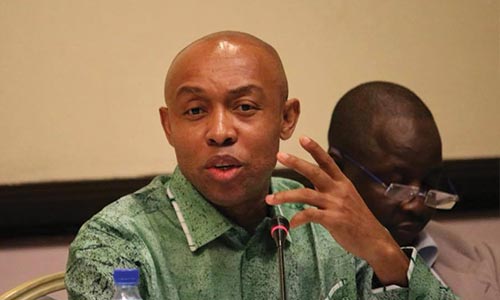
The meeting was convened by the Global Rights and had in attendance Chidi Odinkalu, former Chairman of the National Human Rights Commission (NHRC); Otive Igbuzor, Executive Director of the African Centre for Leadership, Strategy & Development (Centre LSD); among others.
The communique lamented the huge death toll, mass displacement, destruction, and humanitarian crises associated with the “spiraling crisis of violence and mass killings” in the region.
The coalition warned that the crisis threaten peaceful co-existence of Nigeria.
It also decried impunity from the government, citing a provision of the 1999 constitution that encourages humaneness.
“In the 17 years since 2001, the African Centre for Strategic Studies estimates that over 60,000 have been killed in this rising violence in the Middle Belt, representing a yearly average of over 3,500 killed.
“Nigeria’s 1999 constitution makes clear that the primary purpose of government is the safety, security and welfare of all who live within its territory. Section 17(2)(c) of the same constitution commands that ‘government actions shall be humane.
“The government has shown it self unwilling or unable to confront these killings and to put end to them. By so doing, it has abdicated its constitutional duty to guarantee the safety, security and well-being of all who live in Nigeria.”
The groups also called on the Federal Government to live up to its responsibility of protecting lives and promoting welfare.
They demanded an end to the impunity “that has led to the spiral of the conflict in the Middle Belt by immediate ordering of a full investigation”.
They enjoined the government to also ensure adequate provision of humanitarian aid and assistance to displaced communities, ensure an urgent accounting of the missing and dead as well as an estimation of the loss incurred, and mobilise resources to give room to other well-meaning individuals to contribute their bit in bringing the crises to an end.
The communique stated that the coalition will be establishing a “Nigerian CSO Crisis Action on the Middle Belt to explore collaborative and complementary options for constructive action on the crisis of mass killings in the region.
“At this time, [we] stand in solidarity with our fellow citizens in Benue and Zamfara States across the (other) states of the Middle Belt region of Nigeria. To them, we reiterate that you are not alone and that the injustice you suffer you suffer is our collective shame and pain.
“We call on all concerned Nigerians to join us as we organise towards a national day of mourning and remembrance later in May to memorailise all whom we have lost and demand for government that has the capacity to re-discover ― if it can ― the reason for its existence.”
President Muhmmadu Buhari has again blamed the incessant killings by herdsmen on the infiltration of militias who had been dislodged from Libya after the overthrow of Muammar Gaddafi, former Libyan President.
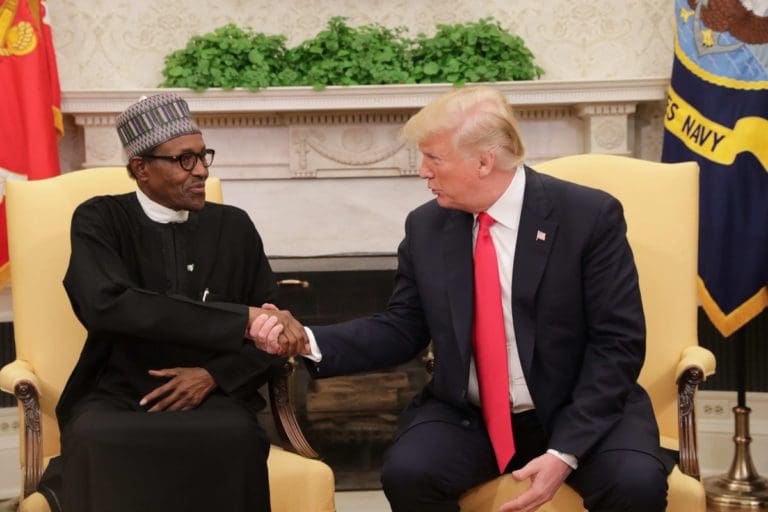
Buhari made the accusation during a brief chat with US President, Donald Trump on Monday.
The usual herdsmen in Nigeria “never carried anything more than a stick, and occasionally a machete to cut down foliage and feed their animals. These ones are carrying AK47”, Buhari said.
“So I don’t think people should underrate what happened in Libya. 43 years of Gaddafi, people are recruited from the Sahel, they were taught nothing other than shoot and kill.
“With the demise of Gaddafi, they moved to their countries and to their regions and they carried away with them the only experience that they had, trained using weapons, and this is what is aggravating the situation.
“We are doing our best to make sure we stop the cross borders and so on, and to get the proliferation of small arms and light weapons in the region checked. But it’s going to take time and the action by the United States in trying to see the end of ISIS has helped us a lot.
“Because the Boko Haram in Nigeria, at one time, made a statement that they were loyal to ISIS. And now that ISIS have virtually gone, with the help of the United States, we are very grateful for that. We are stabilising the security situation in Nigeria.”
Asked how his administration was dealing with the issue of the girls kidnapped by Boko Haram, Buhari assured Trump that many of the Chibok girls, who were kidnapped during the last administration, had been released, as well as the recently abducted Dapchi girls, even though some had died in captivity and one is yet to be released.
“We are very grateful to the United Nations’ organisation that is acting as in-between, between us and the kidnappers. We haven’t given up, we are trying to get everybody back to their families and their schools.”
This is the second time President Buhari is blaming the incessant killings by herdsmen on the influx of arms from Libya. He expressed the same opinion during a char with Justin Welby, Archbishop of Canterbury, in London a fortnight ago.
“The problem (of herdsmen/farmers clashes) is even older than us. It has always been there, but now made worse by the influx of armed gunmen from the Sahel region into different parts of the West African sub-region,” Buhari said at the time.
“These gunmen were trained and armed by Muammar Gaddafi of Libya. When he was killed, the gunmen escaped with their arms. We encountered some of them fighting with Boko Haram.”
A Federal High Court in Abuja has given the Economic and Financial Crimes Commission (EFCC) 45 days to conclude its investigation and charge Patience Jonathan, former First Lady, to court.
The court’s decision followed an ex-parte application by the EFCC seeking the forfeiture of Jonathan’s properties pending the determination of investigations relating to the said assets, according to Premium Times.
The court granted the EFCC’s application and ordered the forfeiture of two properties belonging to the former First Lady.
Nnamdi Dimgba, the judge, gave the EFCC 45 days to conclude its investigation and charge Jonathan to court.
The Judge also ruled that the EFCC could approach the court to seek extension of the forfeiture order before the expiration of the 45 day period.
The EFCC accused the former first lady of using the properties for the running of a non-governmental organisation which the commission found to be fraudulent.
The anti-graft agency also asked the court to stop Jonathan from making any attempt at selling the properties.
A request by Jonathan’s lawyer for the court to refuse the ex-parte application was turned down.
“Having dismissed the motion challenging the ex parte originating summons, I have gone ahead to carefully consider the application along with all the materials placed before the court to support the request for same, which materials have already been listed at the commencement of this ruling.
“In so far as the essence of this application is to preserve an asset pending the completion of an investigation, I am convinced that those materials placed before me, justify a favourable exercise of the court’s discretion to grant the relief sought in the application.
“I hereby accordingly grant relief 1 and relief 2 sought. Relief 3 is refused because it is not supported by the grounds of the application and thus unnecessary in the circumstances of the application.
“The order of court granting the relief shall last only for a period of 45 days within which the applicant must conclude their investigation and file necessary criminal charges where investigation reveals the commission of a crime.”
The court ruled that a valid application for extension of time can only be brought prior to the expiration of the 45 day ultimatum.
“The applicant is at liberty to apply for a renewal of the order on cause, provided that such an application to be valid is made before the expiry of the 45 days validity period granted by the court.
The properties ordered to be forfeited are located at Plot No. 1960, Cadastral Zone A05, Maitama District, and Plot No. 1350, Cadastral Zone A00. Both properties are located in Abuja.
Ben Murray Bruce, senator representing Bayelsa East senatorial district at the National Assembly, says Dino Melaye would have died if he did not force his way out of the police vehicle conveying him to a court in Lokoja, Kogi State, on Tuesday.
Bruce said Melaye was asthmatic, yet the police gassed him twice while in the vehicle, prompting him to force his way out.
Melaye, who had been declared wanted for alleged criminal conspiracy, was arrested on Wednesday, April 25, after he surrendered himself to the police. Two days earlier, Melaye was held briefly at the Abuja International Airport, on his way to Morocco for an official assignment, Immigration officials saying he had been placed on a ‘no flight’ list.
Following his arrest on Wednesday, Melaye was being taken to Lokoja, the Kogi State capital, purportedly to be arraigned in court, when he jumped out of the window of a moving police vehicle and escaped, according to Jimoh Moshood, PRO of the Nigerian Police Force.
Moshood said Melaye was later traced to a hospital in Abuja where he was rearrested, adding that he will be arraigned in court “without further delay”.
But Bruce, popularly referred to as ‘the common sense senator’, said Moshood’s account of the incident was far from the truth. According to him, Melaye literally escaped death.
“Just met with Dino Melaye. Very sad to hear what transpired. Dino is asthmatic, yet while in transit, the police gassed him & he could barely breathe. Second time they gassed him, he had to force his way out of the vehicle. Dino literally escaped death. SAD!” Bruce tweeted on Monday.
Just met with @dino_melaye. Very sad to hear what transpired. Dino is asthmatic, yet while in transit, the police gassed him & he could barely breathe. Second time they gassed him, he had to force his way out of the vehicle. Dino literally escaped death. SAD!
Bruce’s account of the incident appear to differ slightly from that of Gideon Ayodele, Melaye’s media aide, who issued a statement on Wednesday saying that the scene created on Tuesday was “a last resort by Senator Dino Melaye in order to foil attempt to kidnap him and kill him by agents of Kogi State governor in connivance with the police.”
Ayodele wondered why the police wanted to ferry Melaye back to Lokoja, despite a court order approving that his trial be held at the federal high court in Abuja.
“The Senator believes they (the police) are doing the Kogi Governor’s (Yahaya Bello) bidding in order to assassinate him,” Ayodele wrote.
Though belonging to the same All Progress Congress (APC) Melaye and Bello can best be described as political foes.
Melaye is currently admitted at the National Hospital, Abuja, where he is being treated for injuries he sustained while trying to force his way out of police custody on Tuesday.
Nigerians have taken to the social media to bare their minds regarding President Muhammadu Buhari’s ongoing four-day working visit to Washington DC, following an invitation from President Donald Trump of the United States.
Buhari’s presidential aircraft touched ground on Sunday at about 4.20pm Nigerian time, and he is scheduled to meet Trump at the White House on Monday. He is the first leader from sub-Saharan Africa to be so invited, the only other African leader being Abdel Fattah el-Sisi of Egypt, who was hosted in April 2017.
According to Femi Adesina, the president’s Special Adviser on Media and Publicity, “the meeting will further deepen the US-Nigeria relationship as the United States considers Nigeria’s economic growth, security and leadership in Africa to be critical aspects of their strategic partnership.”
Many Nigerians are, however, not very upbeat about the visit. Taking into account past records of overseas gaffes, they have suggested that more than just talks on strategic partnership and bilateral relations is likely to take place. They also used the social media to appeal to the United States president to prevail upon Buhari on matters such as insecurity and unemployment.
Here are some of the comments:
This one that President Buhari is going to meet President Trump tomorrow, they should write a speech for him so that he won't go and say Nigerian youths are lazy again.
I hope there wont be a Joint Press Conference by Trump and Buhari on Monday as is the custom after a foreign Leader visits an American President. Buhari in front of the Washington Press Corp??? Disaster waiting to happen
I can't wait for this Hilarious moment between their President @MBuhari and the US President @realDonaldTrump. What to expect is beyond rhetorics. I trust Trump. He will not let us down. I Trust Buhari. He will definitely let us down. 😑 pic.twitter.com/Px2sw3cmj9
Dear President @realDonaldTrump, please help us ask why the #CluelessNigerianPresident Buhari jailed an American lady for 95 years in 1983 without any evidence. He has embarked on same thing, sending dissenting voices to prison without evidence. Dasuki, Elzakzaky and e.t.c.
Most of the questions will be directed to Trump – focusing on;
1. Iran 2. EU Tariff wars 3. China Tariff wars 4. Mueller investigation 5. North Korea
I doubt many questions will be directed to Buhari, and that is good, because I fear for Nigeria when he opens his mouth abroad. https://t.co/RlfOs7ld1r
The West African Examination Council (WAEC) has claimed that secondary school principals and invigilators collaborate to help candidates cheat during exams.
This was contained in a statement issued by WAEC on Monday, in response to media reports that question papers of the ongoing 2018 exams had been leaked to candidates prior to their exam dates.
WAEC explained that what happened was not the leaking of question papers but rather an active collaboration between heads of some secondary schools and the invigilators that were sent to conduct the exams.
“Our monitoring and investigations of the ongoing examination have established the fact that certain school Principals, invigilators, supervisors and candidates who had succeeded in smuggling mobile phones and other electronic devices into the examination hall, snap the question papers after the examination must have commenced and forward to their criminal collaborators who in turn provide solutions to the questions and send to their subscribers via rogue websites, sms, WhatsApp and other social media,” the statement read.
“The question papers for the ongoing WASSCE for school candidates 2018 did not leak as has been erroneously portrayed in the media.
“Leakage can be said to have occurred when the question papers get into hands of individuals who are not supposed to have them before the time scheduled on the timetable.
“Without any iota of doubt, the Council wishes to state that no case of leakage has been established since the beginning of the examination.”
Reports say four persons were arrested by the police after the alleged selling of WAEC question papers went viral on social media.
WAEC maintained that the integrity of the ongoing WASSCE (West African Senior Secondary Certificate Examination) has not been compromised, explaining that what happened were cases of fraudsters who do ‘photoshop’ of question papers of previous examinations and sell them to gullible candidates.
“In addition, in several cases during our monitoring and investigations, it was discovered that question papers of previous examinations were photoshopped by this despicable elements to scam gullible candidates who patronize their rogue websites and WhatsApp platforms.” It said
The Council said it has the capability and capacity to detect and punish candidates who must have benefited from the fraudulent activities of the operators of rogue websites and WhatsApp platforms.
It commended the efforts of the security agencies, particularly, the Nigeria Police which have been collaborating with it in the fight against examination malpractice.
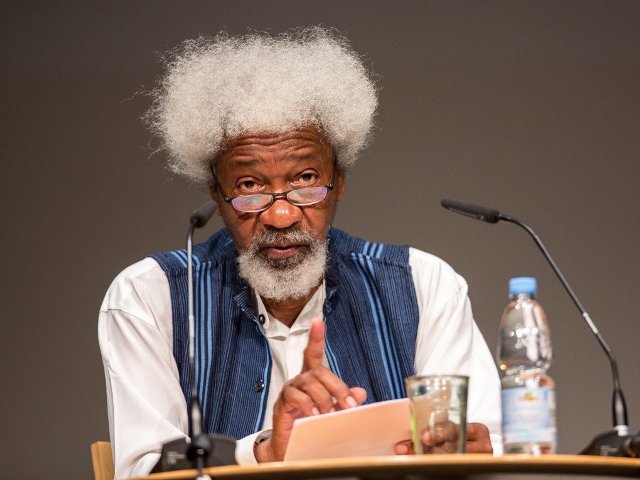
Wole Soyinka, Africa’s first Nobel Laureate in Literature, says the incessant killings by suspected Fulani herdsmen across Nigeria could be likened to the genocide that took place in Rwanda in 1994.
In a statement he issued to mark the 2018 May Day celebration, Soyinka called on President Muhammdu Buhari to provide the nation with maximum protection by ordering the Nigerian armed forces to treat all those carrying out the killings as “terrorists”.
Soyinka stressed that the best way to describe the carnage playing out in several states across the nation is “ethnic cleansing, and we must not beat about the bush. The shade of Rwanda hangs over the nation”.
President Buhari must “issue orders to the military and police that, wherever illegal occupiers are found, they should be meted the same treatment as are accorded terrorists”, Soyinka stated.
“Instruct all agencies that, once cleared of usurpers, the rightful occupants should be escorted back to their farmsteads and villages and provided maximum protection.
“All available forces should be deployed to right a hideous, unprecedented wrong that has left the nation drowning in blood – we simply cannot continue one day longer to endure this forceful feeding of human blood.
“The plain expression is ‘ethnic cleansing’ and we must not beat around the bush. The shade of Rwanda hangs over the nation.”
Soyinka also said that questions should be asked of the federal government’s sincerity in tackling the menace of herdsmen killings. One of the questions is: “What is a Minister of Defence, who openly justified the homicidal rampage of nomadic herdsmen, still doing in government?”
Most importantly, Soyinka said the government must focus on “restitution to the displaced, the maimed, the traumatised survivors and the nation’s suppurating psyche”.
“The torrent of Internally Displaced Persons is a national shame, and the growing number of the kidnapped, an embarrassment,” he said.
Soyinka described the situation in Nigeria as the ill-fated Aeroflot Flight 593 that crashed on September 28, 1994, due to the obvious carelessness of the pilot who left the plane in autopilot, with his family members in the cockpit, and was conversing with passengers in the cabin.
“Aeroflot Flight 593 of Sept. 28, 1994 was such an event, a flight in which all occupants of that plane perished,” Soyinka said.
“The captain was not even in the pilot’s seat – others were! They were the pilot’s family – mostly his children. The pilot’s seat had been turned into a family game of musical chairs.
“Where was the Captain? Somewhere along the aisle, saluting the passengers – all quite proper, and indeed encouraged by regulations. He had placed the plane on auto-pilot – just as this nation has been for some time.
“The ‘black box’ – or flight recorder – indicates that the pilot never even got round to shouting ‘May Day’ over the radio – he was too busy struggling to restore the plane’s technical functions, shout instructions, pull the plane out of a nose-dive, and attempt to right the craft – too late!”
Connecting the story to the Buhari administration, Soyinka opined that “Strangers are in control in the cockpit. Put simply, the captain is missing.”
Despite having a coastline of 853 kilometres bordering the Atlantic Ocean, as well as fresh and mangrove swamps, creeks, coastal rivers, estuaries, bays, and near and offshore waters, it is ironic that Nigeria still depends on fish importation to meet most of her fish demands. Eight out of the 36 Nigerian states, with 25% of Nigeria’s total population, share the Atlantic Ocean coastline – a major fishing resource. Yet, national supply cannot meet national demand.
According to the2016 Nigeria Fisheries Statistics report, our annual fish demand is estimated at 3.32 million metric tonnes —an unsurprisingly high number considering Nigeria’s teeming population of about 186 million people — but domestic production produces only about 1.12 million metric tonnes. This leaves a deficit of 2.2 million metric tonnes, which is largely supplied through fish importation.
Nigeria is the fourth largest importer of fish in the world, following China, Japan and the United States. Frozen fish varieties include mackerel (locally called titus or alaran), herrings (locally called shawa), horse mackerel (locally called kote), blue whiting (locally called panla), Argentina silus (locally called ojuyobo) and the popular croaker fish. The country’s top suppliers are the United States and Chile, but fish is also sourced from Europe, Asia, and a few African countries, including Mauritania, Algeria, and Mauritius.
“In an ideal situation, importing these fish should not be happening in Nigeria since we already have the resources and potential for a fish industry that can meet our consumption demands and even provide exports” says Dr. Flora Olaifa, an Associate Professor of the Department of Fisheries and Aquaculture, Faculty of Agriculture in the University of Ibadan, Nigeria. She attributes the gap in local supply to the fact that Nigeria has not given enough support to its own industries, and it is only due to the recent government calls for industry diversifications that people are beginning to see the agricultural sector – fisheries inclusive – as a profitable industry.
Exports of fish, when they do happen, are comparably far lower than imports. According to Dr. Olajide Ayinla, President of the Fisheries Society of Nigeria and former Executive Director of the Nigerian Institute of Oceanography and Marine Research (NIOMR), Nigeria hardly exports pelagic fish, but some companies do export shrimps and smoked catfish derived from aquaculture.
The issue of imports exceeding exports in Africa is not confined to Nigeria alone; however, other African countries like Ghana and Côte d’Ivoire are supplied by fellow African countries- Morocco and Namibia. In fact, two-thirds of Ghana’s fish supply is from these exporting African countries. A report from the Food and Agriculture Organization indicates that these fish imports are largely “composed of low value small pelagic fish (horse mackerel, mackerel and sardinellas)”. These are highly ubiquitous in both urban and rural food markets in Nigeria and are the most common types of fish consumed by the average Nigerian.
So why does Nigeria, like other African countries, still depend largely on foreign importation to meet local fish demand?
Ocean resources, when exploited sustainably, have the potential to provide wide ranging benefits, however, Nigeria has been unable to realize these potential gains especially in the case of fish and seafood production. Commercial or industrial fishing takes place far off-shore, in the high seas, and is primarily conducted using fish trawlers—fishing net equipment that is actively dragged through water using one or more trawlers attached to a fishing vessel.
Both Dr. Ayinla and Dr. Ngozi Oguguah, a Principal Researcher at NIOMR raised valid concerns about fish trawling because it negatively impacts the ocean ecosystem, destroys the ocean floor, and prematurely kills young marine life. Instead, they suggested, if trawling must be done at all, regulations must be enforced to ensure that nets have larger selective mesh size with appropriate shapes to target only the needed fish.
Despite these concerns, industrial fishing contributes very little to domestic fish production. Instead, fish production primarily comes via artisanal fishing practices and aquaculture. According to the 2017 report on Nigeria’s fish productionby the National Bureau of Statistics, out of 5.79 million tonnes of fish produced between 2010 and 2015 in Nigeria, industrial production of fish and shrimp is summed up to 204,403 metric tonnes. As seen in the graph below, when compared with fish production from the other sectors – artisanal and aquaculture, industrial fishing contributes only 4%.
When asked about the low output from industrial fishing, Dr. Ayinla said industrial fishing is not as productive as expected because most people in the business cannot afford the vessels and equipment required for intense commercial fishing on the high seas. “Most current fishing vessels in Nigeria are old and are only capable of fishing at 0 to 50 meters below sea level,” he said, “and this range is only considered suitable for artisanal fishing, thereby limiting capability of resource exploitation on the high seas”.
The 2017 Country brief update on Nigeriaby the FAO echoes this opinion, stating that the industrial fisheries sector in Nigeria previously made some progress but now they consist of mainly ageing fleet and infrastructure.
Dr. Ayinla also mentioned that because of extensive importation of fish and poor government regulations, investment in industrial fishing in Nigeria has long dwindled. Therefore, the high seas are now mostly explored by foreign vessels who own larger and more suitable fishing vessels, but most of whom operate illegally. It’s a similar problemfaced by many coastal countries in sub-Saharan Africa: foreign industrial fleets operate in deep waters, while most Africa-based marine fishing fleets are artisanal.
Sea robbery and piracy remains another big obstacle to industrial fishing on the high seas. Dr. Oguguah cited a personal experience of sea piracy while she was aboard a fishing vessel conducting research and states that this issue has discouraged many people from exploring expansion opportunities in the industry.
Another pertinent issue limiting industrial fishing in Nigerian oceans is pollution, especially oil spillage and biological waste. Oil spillage is particularly prevalent in the Niger Delta region, which is reputed to be the second largest delta in the world with a 450km coastline and is characterized by rivers, creeks, and the Atlantic Ocean. According to Dr. Olaifa, who has conducted vast research on the effects of oil spillage in the Niger Delta, crude oil spills cause a fast and direct kill of fish and other aquatic life. Some by-effects of the oil spill may occur over a longer period, causing changes in the ocean environment which may in turn lead to gradual damage and change to the biology and organs of fish and aquatic life in the ocean. Dr. Olaifa further explains that it is a frequent occurrence to see captured fish exhibiting symptoms such as mucous, slime, oily sheen, or discolored skin and gills in this region. The polluted ocean and water environments of the Niger Delta, which have been so poorly conserved, have become unproductive and unable to sustain aquatic life.
THE IMPACT OF FISH IMPORTATION IN NIGERIA
HEALTH IMPACT
Of all flesh foods, fish is the most susceptible to tissue decomposition and microbial spoilage because they begin to deteriorate as soon as they leave the water. Therefore, a lot of imported fish are preserved by freezing and applying preservatives such as sodium tripolyphosphate (also known as Pentasodium Triphosphate or STPP) and sodium benzoate. These make fish and other seafood appear firmer, glossier, and smoother.
Although it is generally regarded as a safe product if used according to Good Manufacturing Practice (GMP), research by Ritz et al (2012)has revealed that STPP is a health risk as it may harm normal renal function in the body and worsen incidence of kidney diseases in humans. Since the release of this report, various health and food safety agencies have made calls for a careful consideration and public education of the health impacts of these preservatives.
Furthermore, in Nigeria, it has been reported severally that smugglers without an import license flood the market with contraband and compromised frozen fish through Nigeria’s porous land borders. An officer of the Nigeria Customs Service who spoke on the condition of anonymity stated that fish smuggling into Nigeria is quite common due to oversight, importers avoiding import duty fees and corruption of some custom officers. The Officer went on to say that most times, the smuggled fish may have been compromised such that they do not meet quality control standards in terms of production, storage, and quality. It may be that the fish were improperly stored, have passed storage time limits, or were stored with a counterfeit preservative like formalin. Drs. Ayinla, Olaifa and Oguguah all claimed knowledge of these smuggling practices affirming that a lot of imported fish being sold in the market were smuggled. Selling such unhealthy fish for public consumption exposes Nigerian consumers to potential health problems.
SOCIOECONOMIC IMPACT
As mentioned earlier, most of the fish consumed in Nigeria is imported from foreign countries, reaching more than 2 million tonnes annually. The FAO’s 2017 Country Brief on Nigeria stated that in 2013 total fish imports amounted to 1.2 billion dollars, a figure that Dr. Olaifa says increased to 1.4 billion dollars the following year. By importing such a massive amount of fish annually, Nigeria loses foreign exchange and continues to harm her economy. These losses also stunt the growth and development of trade in local fish industries.
“On the other hand,” continued Dr. Olaifa, “if this remarkable amount of money spent on importation could be channeled for internal trade within our local fish industry, it would bolster the industry’s efforts and generally boost our economy”.
So, can Nigeria still develop and maintain a vibrant fish production industry that will meet consumer demand?
Experts are hopeful, but only if the country endeavors to holistically develop all areas of fish production, including aquaculture, artisanal, and industrial (ocean) fisheries. Currently, said Dr. Ayinla, all efforts are being made to improve the fish industry, especially in aquaculture. He is optimistic that aquaculture will create the sustainability and food security needed for the fish industry while conserving ocean and other water resources.
“We have been promoting aquaculture – focusing on catfish and tilapia production for now – and we are making good progress and seeing the positive results already with improved food security, better nutrition, and creating jobs.” he said. “The ocean, rivers and other fishing mediums would also be able to recover from excess fishing and be conserved”. He also emphasized the need for enforcement of regulations and policies that would favor domestic fish production.
According to Dr. Olaifa, Nigeria has a huge potential to meet local fish demand through increased domestic fish production especially with the kind of resources we have on ground. “If these resources are well managed,” she said, “it will promote entrepreneurship, create employment opportunities, improve our economy and foreign exchange through contribution to GDP and ultimately reduce the need for fish importation”.
Around 9am on Friday, April 20, 2018, I grabbed my phone to check my messages. My wife and I had taken an early morning walk and I had been separated from my phone for over an hour. It was inevitable that there would be many missed calls and messages patiently waiting for my attention. The first message I saw was from Imam Imam, spokesman of Governor Aminu Waziri Tambuwal of Sokoto state and my former colleague at THISDAY. It came in at 8:23am. He wrote: “Oga good morning. Are you available for a chat? Or are you busy?” Although I always prefer WhatsApp chats and SMS to phone calls so that I can multi-task, I chose to call him immediately. It was always fun talking with him.
“Alhaji Imam Dalhatu Imam! So good the Imam named him twice!” I hailed him in my usual salutation.
He laughed, trying to cage a cough.
“Oga, this title is too long for me o,” he said and laughed again. On other occasions, he would joke that when he was born, there were no more names to give to children so they decided to be repeating names, hence “Imam Imam”.
As we spoke, he sniffed in a tone that made me suspect he had a cold. It was a minor thing and he would be fine, he promised me. We spoke for a long time as he poured out his heart to me on his political future. He had earlier told me he wanted to contest for the house of representatives from his Bali Gassol constituency, Taraba state. He often sought my counsel on key career decisions. On this occasion he said he wanted to keep me up to date on his ambition. In confidence, he told me of the developments that meant he would no longer contest “based on principles”. I told him: “Imam, I respect you even more for this decision. It shows you are not desperate, you are not an opportunist and you are loyal.”
Our discussion shifted to Sokoto, his base, and I teased him about his multiple identities. He was born in Tivland – Gboko, Benue state, to be specific – in July 1977 to Fulani parents from Taraba state, and now he was a political appointee in Sokoto state. I asked after his mum who still lives in Gboko, and he told me that for the first time, the old woman was thinking of relocating because of the tension between Fulani herdsmen and farmers in the state. She was afraid of being caught in the crossfire, he said.
I began to lament. “Can you imagine that your mum has lived in a place peacefully for over 40 years but it doesn’t feel like home anymore?” I said, using the opportunity to once again pitch my petty theory about the impediments to the “peace and unity” of Nigeria which I perennially attribute to the poor political management of Nigeria’s diversity. The key to Nigeria’s political stability, I usually propose, is deft management. I often say “diversity is no cancer, balkanisation is no magic cure”. Even if we break up Nigeria today, there will always be cause for conflict in the new entities. Without competent and patriotic leadership, balkanised entities will also be conflict-prone.
Imam told me something that, somewhat, strengthened my theory: he said he was having problems in Sokoto state because some people saw him as a “foreigner” from Taraba appointed by Tambuwal when there were many “indigenes” who could have done the job. The governor was stubbornly standing by him, he said, despite all the intrigues. I quickly capitalised on that to preach my “gospel” again.
“You see what we have always been discussing over the years? You are Fulani. You are Muslim. You are serving in Sokoto where almost everybody around you is Muslim and Fulani. Yet you are seen as a foreigner. That is exactly the point I have been making about those seeking to balkanise Nigeria. They tend to think that the moment we are fractured along ethnic and religious lines, our problems will be solved and we will live together happily ever after. It doesn’t work that way. There will always be something to fight over, even if we are from the same village and speak the same dialect and go to the same church or mosque,” I sermonised. I was preaching to the choir, by the way.
The Nigeria of our daydream, the Nigeria of our fantasy, is a country that once we break into two entities – “Muslim north” and “Christian south”, as the popular fallacy goes – there would automatically be unity, peace and progress. Or if we break into three. Or six. Or 250. We often fantasise about an El Dorado where water would suddenly start flowing, all the lights would be shining 24/7, all the hospitals would have doctors and drugs, all the schools would have teachers, all the roads would be tarred, the lazy youth will disappear and poverty would be rooted out. Just break Nigeria into pieces and we would become Japan and Germany rolled into one! Magic!
I often contend that at best, the chances of success for a balkanised Nigeria would be 50:50. I am not saying Nigeria should not break up if the people so choose, but I insist that nobody can say for sure what we are going to benefit from that. It may turn out to be a success story – or an absolute disaster. Experience across Africa, though, does not paint a glorious picture. Our Southern Sudanese neighbours cannot claim they are better off today than they were before breaking away from Sudan. Yet they fought for independence for decades. Eritrea left Ethiopia after decades of friction, but its own internal conflicts are yet to be resolved as militant groups continue to campaign for more balkanisation.
The most embarrassing example has to be Somalia – a country where they share the same language, the same religion and even the same looks. The country could not break up on the basis of religious and ethnic differences, so they dissolved into clans and have known nothing but conflict for over two decades. Imagine a Republic of Ekiti breaking into Ado-Ekiti, Iyin-Ekiti, Ode-Ekiti, Oye-Ekiti and so on – and still not knowing peace. There is even an argument out there that for a multi-ethnic country to develop, there must be a dominant ethnic group taking charge of the levers of power. Again, the experience of dozens of African countries does not support this position.
There are ironies to deal with. Rwanda, so bitterly divided between the Hutu and the Tutsi, so much so millions of people were killed in the genocide of 1994, is one of the few African countries making real progress. Check their development journey – every single index puts Nigeria to shame. A multi-ethnic country is making tremendous progress on the things that matter to the person on the streets – healthcare, water, sanitation, infrastructure, gender rights and education – in spite of their glaring ethnic differences. They are not into “true federalism” or “resource control”. All they boast of is good leadership. Leadership. Leadership. Leadership.
Imam Imam always supported my research work on Nigeria’s ethnic and religious challenges. When the Berom and Fulani were at each other’s throat in Jos north, I asked him to help me gather some information. I said even though the conflict was framed as Muslims vs Christians (the Fulani are Muslims and the Berom are Christians), I would like to know if there were Berom Muslims and on whose side they were. I was working with the hypothesis that in northern Nigeria, under normal circumstances, religion is the primary form of identity; ethnicity and hometowns are secondary. That is, you are first a Muslim or Christian before anything else.
Imam promised to help with the Berom case. Luckily, he went for hajj in 2010 or 2011 during which he met some Berom Muslims. He helped me to interview them. His finding was not far from my hypothesis – those he interviewed aligned with the Fulani in the conflict. My next question then was: if you break up Nigeria, where would Berom Muslims be? Republic of Northern Nigeria or Republic of Middle Belt? Anyhow it ends up, there would still be Muslims and Christians in both republics. In the end, there would still be ethnic and religious differences to be managed in any new country you create out of Nigeria. There is no neat way of balkanising Nigeria. You can never create a “pure” country.
As Imam Imam and I ended our conversation, he promised to share his Sokoto experience with me to enrich my research work on Nigeria. The following day, he was taken to the hospital as the cold did not subside. It turned out he had viral pneumonia which had similar symptoms with common flu: cough, fever and chills. Exactly a week after our conversation, he passed away. What a loss. I am thoroughly devastated. Imam was a huge asset to me, both as a friend and a professional colleague. From the day our paths crossed at THISDAY, we started relating like blood brothers. He was appointed group politics editor in 2010 while I was editor of the newspaper.
I loved his work ethic. Imam made my job easy – he could squeeze out news from the tightest of sources. He was full of humour and humility. Above all, he was the kind of Nigerian I love to associate with – someone who would not allow religious and ethnic sentiments to damage his brain. I have encountered so many jaundiced Nigerians in my life, those who think and breathe ethnic and religious sentiments every minute of the day. Imam was different. He was a free spirit. Many people told me about his generosity and kindness. As devastating as the news of his death is to me, my mourning is tempered by the realisation that he only went ahead of us. Someday, it will be our turn. Sure.
AND FOUR OTHER THINGS…
KILLING FIELDS
There are times I pity the president and his spokesmen. Under President Goodluck Jonathan when Boko Haram was bombing and killing with glee, it was obligatory for him to say something after each incident. It was a familiar line – the act “is callous”, the security agencies “will not relent” and all that. It was almost a template. President Muhammadu Buhari has entered into the blind alley himself. If Boko Haram is not murdering people in the north-east, gunmen are killing villagers or bishops in Benue state and bandits are massacring people in Kaduna and Zamfara. The president must say something even when it does not make sense anymore. Awkward.
THE PROXY WAR
On paper, it is Governor Yahaya Bello vs Senator Dino Melaye. In real life, it is President Muhammadu Buhari vs Senator Bukola Saraki. It is 2019. So far, I would say Bello is having the upper hand, although the recall move appears to have failed. Melaye has bitten more than he can chew and this is ironic because his hit song, “Ajekun Iya”, literally means if you enter into the ring with a clearly stronger opponent, you will suffer severe knock-out and humiliation. Nigeria will always defeat you. The police have proved once again that even if they cannot arrest the gunmen in Benue and Zamfara, they have enough resources to play politics. Games.
GENDER EXTREMISM
Chimamanda Adichie’s slating of Hillary Clinton for describing herself as “wife” in her Twitter bio is, in my opinion, in bad taste. To start with, Twitter bio is not only about listing your achievements – it is also to describe yourself. Mine starts with “writer” – which is not an achievement. I doubt if Ms Adichie can lecture Mrs Clinton on feminism – she twice vied to be US president, for crying out loud! Feminism is about choice, so a feminist scheming to impose her choice on other women is self-contradiction. Clinton appreciates and celebrates family values and relationships. I oppose all overt and covert attempts to bully women into jettisoning family values under the guise of feminism. Extremism.
AND FINALLY…
Did you see the viral video of a young runner in a relay race? The little boy, who was apparently the anchor, turned the world upside down when he received the baton: he, innocently, started running in the opposite direction with every energy and determination he could muster. A man was seen desperately running after him to stop the reversal of fortune, but the boy would not budge. I cannot but laugh each time I watch it. But does that not remind us of the leadership crisis Nigeria has been facing since Independence? Anytime we seem to be making some progress, some people will just come and collect the baton and start running backwards at full speed! Vicious.
Simon Kolawole is the founder and CEO of TheCable.ng. He tweets @simonkolawole
Several miners were killed and others sustained injuries after an attack by unknown gunmen at a mining site in Mahanga, Birni Gwari council area of Kaduna State on Saturday.
The miners were said to be conducting their business in a forest in Birni Gwari when the attackers came and opened fire on them.
Some reports put the number of dead miners at eight while others said nine of them were killed, out of the 11 that reported for work Saturday morning.
Austin Iwar, Kaduna State Commissioner of Police, confirmed the incident, describing it as very unfortunate.
“Of course, there was an incident there (in Birni Gwari) and some people were killed. It’s very unfortunate,” Iwar told journalists over the phone.
He, however, said investigations were on to ascertain the exact number of people that were killed in the attack.
But a source who spoke to Premium Times but pleaded to remain anonymous, confirmed that his in-law, who is a miner in Birni Gwari, was one of the people that were killed, his body set ablaze.
“My in-Law, Magaji Danjuma, was among the miners killed. They were doing their mining business in the forest near old Birnin Gwari town when the bandits attacked them,” the source said.
“My in-law’s body was set ablaze by his killers while their remains was brought to Birnin Gwari town for burial,” he added.
The deceased Danjuma, was said to be a retired police inspector. What remained of his burnt body has since been buried.
Another anonymous source quoted by Daily Trust, a resident of Birni Gwari, confirmed that two of the miners who survived the attack and were receiving treatment for their injuries, told them that the bodies of two of the deceased miners were burnt by the attackers.
“They told us that the whole thing happened in a flash as the gunmen appeared and started shooting at them,” the source said.
Birnin Gwari is said to be rich in solid minerals, especially gold, which is the major interest of the local miners who carry out their laborious activities using crude implements such as diggers and shovels.
The gold deposits in the area has also led to several attacks by armed bandits, resulting in the loss of several lives including policemen and soldiers.