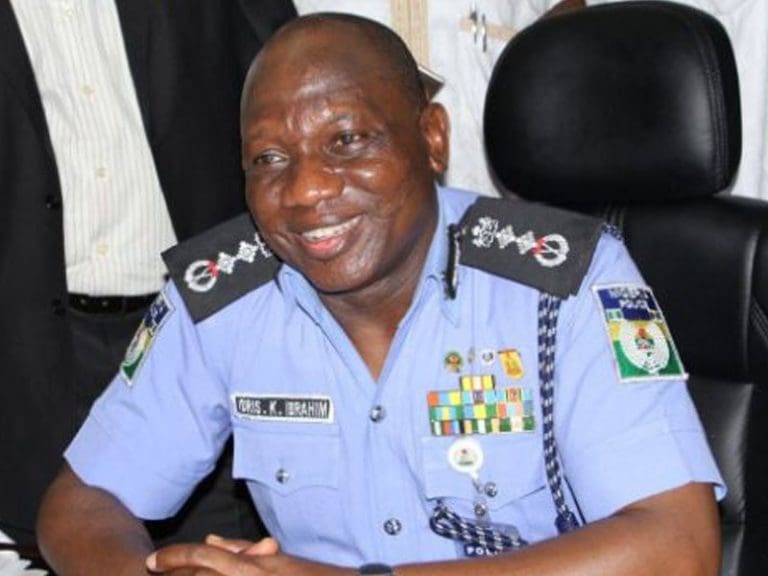
For the second time in a week, Ibrahim Idris, the Inspector General of Police (IGP), has failed to appear before the senate, after he was summoned over arrest and detention of Dino Melaye, senator representing Kogi west.
He was also summoned to address the chamber on the spate of killings recorded in different parts of the country, especially Benue, Zamfara and Taraba states. Instead, the IGP sent Joshak Habilah, his deputy, to represent him.
Idris was similarly summoned to appear before the lawmakers on Thursday, but he had delegated to Habilah, whom the senate rejected, while he accompanied President Muhammadu Buhari on an official visit to Bauchi State.
Ahmed Lawan, senate leader, and Abu Ibrahim, chairman of the senate committee on police affairs, were instructed to communicate the red chamber’s displeasure to him.
The lawmakers also demanded that he appear unfailingly on Wednesday but Idris again sent his deputy to represent him, with the excuse that he was on an official assignment in Birnin Gwari, Kaduna state.
Senate President Bukola Saraki condemned the action of the IGP and described it as a threat to democracy.
The Senate also directed Lawan and Ibrahim to liaise with the Executive regarding the development and report back to it.
An average of 12 Nigerian medical doctors get registered in the United Kingdom every week, according to a report by Africa Check, a fact check website.
The report showed that as at April 25, 2018, the number of Nigerian medical doctors practising in the UK stood at 5,250.
The names of the over 280,000 doctors working in the UK are listed on the website of the General Medical Council, the body empowered by law to register and set professional standards for doctors in the country.
According to the survey, as at 2006, when the GMC first published the list of all the doctors in the UK, Nigerian doctors in the country were only 2,692.
Another 998 Nigerian doctors were added to the register between 2010 and 2015, an average of almost 200 doctors annually. In 2016, the number rose to 245 doctors, and in 2017, the number almost doubled as 439 Nigerian doctors received their UK licenses, making it a total of 5,060 Nigerian doctors in the country.
So far in 2018, 190 Nigerians have received their UK licenses, bringing the number to 5,250, or an average of 12 every week.
“The increase in Nigerian doctors migrating reflects the poor working conditions and low remuneration in the country, John Onyebueze, former president of the National Association of Resident Doctors (NARD), told Africa Check.
“The last three years have been particularly bad for the health sector. There has been poor funding and general neglect. Doctors in Nigeria are frustrated because hospitals lack equipment.”
A recent survey carried out by the Nigeria Health Watch in collaboration with NOI Polls, showed that nine out of every 10 doctors in Nigeria are seeking to leave the country.
20 percent of the 705 doctors that took part in the survey said they know between 16 to 30 of their colleagues who have already left the shores of Nigeria. The reasons they cited for wanting to emigrate include: better facilities and work environment, higher pay and career progression.
Another 2017 survey by NOI Polls revealed that approximately 2,500 Nigerian doctors would leave the country for greener pastures abroad, and that out of the 72,000 registered doctors in Nigeria, about 35,000 were practicing abroad.
“Many Nigerian doctors are currently registered to write foreign medical exams such as PLAB for the UK (30 percent), USMLE for the United States (30 percent), MCCE for Canada (15 percent), AMC for Australia (15 percent) and DHA for Dubai (10 percent),” the survey further revealed.
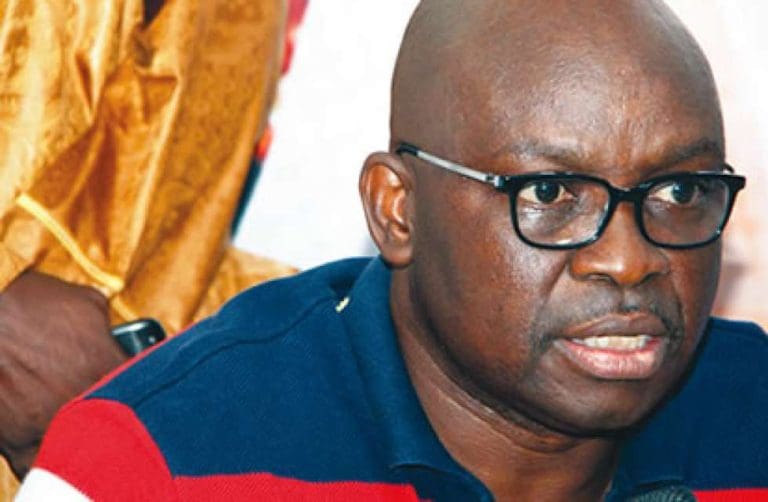
Ayodele Fayose, Governor of Ekiti State says it is better to owe workers and be making efforts to pay them than to sack them.
In a series of tweets on his verified Twitter account on Wednesday, Fayose said he would rather owe workers their salaries than sacking them as being done by some All Progressives Congress (APC) states.
“To me, it is still better to owe salaries and be making efforts to pay as we have been doing than to sack workers as being witnessed in some APC States. We are owing salaries no doubt, but we have been paying and hopefully, we will clear the arrears,” he writes
To me, it is still better to owe salaries and be making efforts to pay as we have been doung than to sack workers as being witnessed in some APC States.
— Peter Ayodele Fayose (@GovAyoFayose) May 2, 2018
He urged labour leaders to put the Federal Government on its toes, by asking questions on how Nigeria’s funds are spent.
“I call on labour leaders to put the FG on its toes, by asking questions on how funds belonging to the country are being spent. Without doing that, states may continue to find it difficult to meet their expectations.
I call on labour leaders to put the FG on its toes, by asking questions on how funds belonging to the country are being spent. Without doing that, states may continue to find it difficult to meet their expectations.
— Peter Ayodele Fayose (@GovAyoFayose) May 2, 2018
“For instance, this year’s benchmark for FG budget is $42 but oil now goes for over $70 per barrel and instead of paying all the revenues to the Federation Account, FG still operates an Excess Crude Account contrary to the judgment of the Supreme Court.”
Fayose, on May 1, announced the promotion of 37,100 workers covering promotion arrears in the civil service between 2015 and 2017.
“Yesterday, during the Workers Day celebration, I approved the promotion of 37,152 govt workers. The promoted workers will be paid all their entitlements.
“The workers made me a man of history in Ekiti state. I had no trade name, a family name that is recognised, but with their support, I was able to defeat two incumbents and become the first Ekiti person to be elected governor twice.
“I appreciate the support that I have enjoyed from workers, even when the battle was fierce. I will never forget their role in bringing me back to office, particularly the teachers. My legacy was already rubbished when I left office but God and the workers made me come back.”
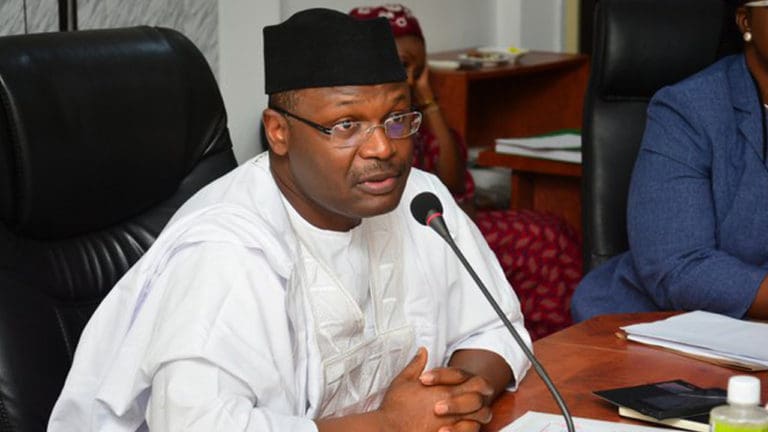
Mahmood Yakubu, Chairman, Independent National Electoral Commission (INEC) says the Commission is determined that the 2019 elections will be free, fair, credible and peaceful.
“We are so determined that the 2019 elections will be free, fair, credible and peaceful. A badly conducted election could be a disaster for any nation,” Yakubu said on Wednesday while speaking at the 69th General Assembly of Broadcasting Organisation of Nigeria (BON).
Speaking on the role of the media in ensuring a free, fair and peaceful conduct of 2019 elections, the INEC Chairman cautioned against the use of media to incite crisis and violence reminding media practitioners of the Rwanda and Burundi Genocide in 2014.
“Without the media, safeguarding the credibility and transparency of the election will be a very herculean task
“The role of the media in information dissemination and public enlightenment, through the provision of platforms for electoral campaigns, public debate, and voter education is often a precondition for free and fair elections.
“The media is not only the cornerstone of democracy, but also play an indispensable role in the proper functioning of any democratic system.” He said
In his remarks, John Momoh, Chairman of Channels Television, emphasized that “greater transparency and accountability are much needed in the current climate of misinformation, political lies and widespread distrust.”
He noted that careful thought should be given to how “we create content, because without that, we could create reasons for discrimination, lack of understanding, misinformation, intolerance and conflict.”
“In the social and political circumstance that we live in, the broadcaster should strive to be a medium of moderation, in such a way as to relay information with decorum, with logic of perspective, and to be dispassionate in news reporting.
“With the growing influence of social media, and its likely role in the elections, we cannot undermine the occurrence of hate speech. It is therefore important for the broadcaster to be cautious.
“BON is progressing steadily, albeit with measured steps. And our role in the shaping of public opinion continues to be very significant.” He added
The Osun State government has shut down Obafemi Awolowo University (OAU), Ile-Ife, over the university’s inability to clear the N1.8 billion tax debt it owes the state.
Channels Television reports that officials of the Osun Internal Revenue Service (OIRS) arrived OAU at about 7 am on Wednesday, led by one Oladipo Babatunde, and locked up the school’s Senate Chamber, the administrative building and the main gate. Only the pedestrian gate was left unlocked.
This follows the expiration of a seven-day ultimatum given by the Osun State government for government-owned institutions in the state to clear their backlog of tax defaults or risk being shut down.
Babatunde said OAU had failed to remit its Pay as You Earn (PAYE) tax, withholding taxes and developments levy between 2015 and 2016, adding that the total amount owed the State government by the University is N1,844,770,939.45.
When contacted, Abiodun Olanrewaju, OAU’s Public Relations Officer, confirmed that the University is indebted to the government as a result of tax default, but added that the “little problem” will soon be resolved.
He explained that OAU has met its tax requirements since the present Vice Chancellor, Eyitope Ogunbodede, took office in 2017.
“I must add this that the present university administration since 2017 has been paying consistently but the backlog of debt inherited from the past administration is what is causing this little problem,” Olanrewaju said.
“Everything will be resolved by the grace of God. The school management is assuring the public that it will soon be resolved,” Olanrewaju said.
At least 24 persons have been confirmed killed in a twin suicide bomb attack at a mosque in Mubi, Adamawa State, on Tuesday. Witnesses say number of casualties could rise.
Witnesses say a boy of about 18 or 19 years had infiltrated the mosque, disguised as a worshiper, only to detonate explosives strapped to his body as soon as the prayer was over.
Another explosion went off after people had gathered to help the people affected by the first explosion, residents say.
Othman Abubakar, a superintendent of police, told Premium Times that the first explosion went off at about 1:00 in the afternoon.
“While people were evacuating the victims of the first blast, another explosion occurred,” he said. “As I am talking to you now, 24 persons are confirmed dead. The scene has been cordoned-off by the Anti-bomb squad and other security personnel.”
Garba Habu, a resident of Mubi, said that “a boy of about 18-19 -years wearing a suicide vest was said to have entered the mosque along with other worshippers. Immediately after the prayers, he detonated the bomb”.
Others who spoke to journalists say many more may have died, given the sound of the explosion and the destruction it caused on the mosque and surrounding buildings.
“Many people died on the spot and several others were taken to hospital with severe injuries,” said Isa Danladi, another resident.
“The mosque’s roof was blown off. The prayer was mid-way when the bomber detonated the explosives. This is obviously the work of Boko Haram,” he added.
However, Haruna HammanFuro, leader of the Adamawa State Emergency Management Agency, did not give a specific number of casualties, but said the number was high.
“It was a twin blast and the detail is sketchy but we are in touch with our partners at Red Cross and others that are helping now. For now dead bodies are being evacuated and those injured have been taken to hospitals,’’ he said.
Tuesday’s attack came five months after a similar attack in a mosque Mubi left about 50 persons dead with several others injured, in November 2017.
Isaac Adewole, Minister of Health, has announced a ban on all pharmaceutical products containing codeine as an active ingredient.
This is following an undercover report by the BBC detailing the devastating effects of addiction to cough syrups, especially in Northern Nigeria.
Codeine is one of the active ingredients in cough syrups, but many youths are hooked to it because of its addictive nature.
According t o a statement issued by the health ministry on Tuesday, Adewole directed the National Agency for Food and Drug Administration and Control (NAFDAC) to quit issuing permits for the importation of codeine.
Instead, Adewole said cough syrups containing Dextromethorphan, a less addictive substance, could be used in treating coughs and related ailments.
He also directed the Pharmaceutical Council of Nigeria, (PCN) and NAFDAC to ensure that all codeine containing cough syrups were recalled. “The Pharmacists Council of Nigeria (PCN) has been directed to continue enforcement activities on Pharmacies, Patent and Proprietary Medicine Vendor’s Shops and outlets throughout the country,” the statement read.
Other agencies that were mandated to join in ensuring the implementation of the directive include, the National Drug Law Enforcement Agency (NDLEA) and the Nursing and Midwifery Council of Nigeria (NMCN).
“These agencies shall work together to increase pharmacovigilance around codeine, tramadol and other related substances of abuse,” Adewole stated.
“The FMOH shall ensure that drug treatment intervention for victims of substances abuse shall be undertaken across the spectrum of health care delivery system in the country.”
Adewole said the federal government is committed to the full implementation of the National Drug Distribution Guideline (NDDG) as from January 1, 2019.
The menace of drug abuse among the youths, including women, in Northern Nigeria is not a new development.
ICIR had carried out detailed undercover investigation in 2016, revealing how addiction to cough syrups is ravaging women in several Northern States including Sokoto, Kaduna, Katsina and Kano.
The two part report also revealed that many shop owners operating in several military barracks deal on cough syrup without fear of being arrested by the NDLEA, because the agency cannot come into the barracks to make arrests.
The investigation led to the closure of patent medicine stalls in some barracks in the North, but nothing else was done by the authorities.
The Nigerian Labour Congress (NLC) says Nigeria may soon overtake India as the poverty capital of the world if the rate of poverty in the country continues unchecked.
Ayuba Wabba, President of NLC stated this on Tuesday while addressing Nigerian workers during the celebration of this year Workers’ Day, held at the Eagle Square, Abuja.
“More than 70% of our population lives below the poverty line. In fact, a number of international economic reports forecast that despite the significant difference in our population size, Nigeria may soon overtake India as the poverty capital of the world.
“The reasons for endemic poverty in Nigeria are not far-fetched. Our economic structure does not provide the enabling space for mass industrialization imbued with the capacity for sustainable jobs. Our public policies and consumption pattern still encourage the export of jobs and the import of poverty.” He said
Wabba said the President Muhammadu Buhari administration has performed below expectation in the areas of job creation, industrialization, power supply and other economic index.
“The crisis of widening unemployment in Nigeria has been exacerbated by indiscriminate sack and retrenchment of workers by some public and private employers.
“Unfortunately, the different levels of government that should be more concerned about protecting our people are the ones leading the campaign to push more Nigerians into the unemployment market.” Wabba said
Speaking on the failure of the government to industrialise the country, the NLC President said Nigeria must copy China’s industrialization drive.
“We must industrialize!We must copy China’s industrialization drive which has within 20 years moved over 250 million people out of poverty through manufacturing and industrialization.
“We must stop exporting raw cottons, crude oil, mineral resources only to be importing finished textile, petroleum products from China, Europe and America.Nigeria must make what it consumes, otherwise it will be consumed by the rest of the world.”
Similarly, Bobboi Kaigama, President of the Trade Union Congress (TUC), said it was regrettable that politics and corruption have become intertwined to the detriment of the masses.
“Politics and corruption are like Siamese twins in our country. Politics is the highest paying job today and you do not really need all the degrees in the world to earn your millions. It has become a do-or-die affair and a lot of corruption embedded,” he said
He noted that the continued neglect of the health sector has opened a floodgate of brain drain in the health sector and medical tourism among others just as he took on state governors some of whom he alleged are still owing workers’ salaries because they diverted part of the bailouts given to them.
“Despite the enormous contribution of Nigerian workers and the labour movement to national development, the issue of improved conditions of service, standard of living and welfare has always been through demand and struggle.
“Our economy remains largely import driven and dependent, though described as mixed, our economy is essentially rent seeking and suffers from systemic distortions.”
Speaking at the event, Vice President Yemi Osinbajo disclosed that states have shared N1.9 trillion Paris Club refund. In spite of this, Fiscal Responsibility Commission (FRC) declared that some states’ debts have exceeded their revenue by over 480%,” he said
Osinbajo, who represented President Muhammadu Buhari at the event, said no reasonable person can ignore the relevance of workers in nation building, but that previous administrations cannot be exonerated from the dire situation which the country has found itself.
He said from the inception of Buhari administration about N1.91 trillion went into providing bailouts for states to pay workers as a result of the badly beaten economy.
Asiya Abubakar’s dream took her beyond her little village in Dawakin Kudu , in one of the 44 local government areas that make up Kano State. She loved western education and always wanted to speak the English language and one day become a teacher or some other professional. But her parents had their own dreams too. They wanted to see their favourite daughter get married and bear children and live a responsible life in her husband’s house. But neither Asiya nor her parents are living their dreams today.
Asiya was given out in marriage immediately after her first menstruation at the age of 14. She had just completed primary two when she was married off by her parents to a man who sells firewood at the village market. She had her first pregnancy at 15 and never went for any antenatal care.
When the labour pangs started, her mother became the midwife that was to oversee her delivery. But for two days, the poor girl was in painful labour and the baby refused to come out. On the third day, she was rushed to the Murtala Mohammed Specialist Hospital in Kano,a driving distance of about one hour. By the time she was delivered of the baby, she had developed Vesicovaginal fistula (VVF) and had started leaking urine. Of course, she had a still birth.
When ICIR met her at the specialists’ hospital on April 10, Asiya, now 20 years, was in the hospital for her second delivery, and another fistula surgery. She had gone back home after her first surgery five years ago, but took in again last year. This time she went for ante natal care in the Primary Healthcare Centre in Dawakin Kudu up till her due date.
“But my parents and husband asked me to deliver at home and hired a traditional birth attendant in the community,” she explained while sitting on the hospital bed, with a rubber tube(catheter) extending from her virginal area into a urine bag tucked inside a bowl under the bed.
Asiya Abubakar
As with the first pregnancy, she went through a prolonged labour for more than 24 hours before she was brought to the hospital where doctors again found she had developed another fistula and had a still birth too. She had a successful operation and was awaiting discharge when ICIR met her.
Amiru Imam, the Surgeon who operated on her, told the reporter that Asiya could have been saved from another VVF if she had been brought to the hospital earlier. “She could have been delivered through a caesarean section and mother and child could have been ok,” he lamented.
Murja Mohammed, 35, presents a different but locally familiar face of VVF. A Kano based NGO known as Voice of Widows Association of Nigeria (VOWAN) had arranged the meeting with her in an office on Maiduguri Road Kano. She travelled from her village at Rehaza in Tudun Wada Local Government Area of Kano. As she stepped into the office, flies swarmed around her and the nose could perceive a stench. She seemed accustomed to the company of flies as she settles down for the interview without a bother.
“What are these flies doing here,” the reporter asked innocently in Hausa. “It’s because of my sickness,” she explains with a little dry smile on her face. She had a VVF operation at 15, also a year after marriage due to prolonged labour at home. Since then she has been in and out of hospital for the past 20 years.
Murja Mohammed
She suffered several complications during delivery which led to both VVF and RVF (Recto virginal Fistula} – an abnormal connection between the lower portion of the large intestine and the vagina. The RVF allows bowel contents to leak, allowing gas or stool to pass through the vagina.
For the past 20 years she has had to wear a small folded towel before putting on an underwear, because she can’t afford pampers to soak the urine and little drops of faeces. Every few hours, she has to remove the towel, wash and dry it before wearing it again. That takes its toll on her, financially as she has to find money to buy soap and other hygiene items every day.
Her husband left her after her first surgery due to the local myth that women who had a VVF operation would no longer be able to get pregnant. She has not been married again since then and has to take care of her health by herself. She is a tailor in the village but said nothing much comes in as revenue. So she has to rely on begging for alms. Sometimes on her “lucky” day, she gets a male admirer willing to part with some cash.
“I want to get married, but I want to take care of my health first,” she said with little conviction.
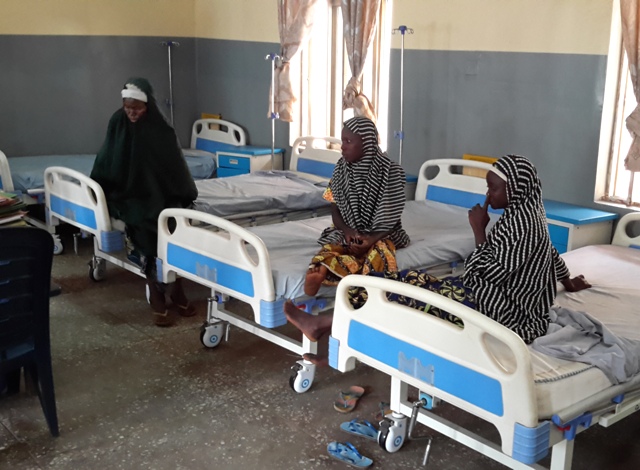
In Sokoto, at the Maryam Abacha Women and Children Hospital, four women were waiting for VVF surgery when the reporter visited on April 13. Maryam Baba, 20, had her own surgery three days earlier and was waiting to be discharged after being certified ‘dry’ enough to go back home.
She was married at 15 and had her first child without any problem. But the second pregnancy came with some challenges. She lived in a village without any primary healthcare facility. The nearest health facility to her village is located in Salame, Gwadabawa Local Government, which is a distance of about seven kilometres. So, going to the hospital was not an option for her and her family, and for many other families in the village.
“I was in painful labour at home for two days and the baby refused to come,” she recounted in her Hausa dialect. “After two days everybody attending to me gave up and someone suggested they should bring me here.”
She was delivered at the hospital but the obstructed labour had damaged her bladder and she had developed VVF.
These women are part of the estimated 400,000 to 800,000 women and girls living with VVF in Nigeria. The World Health Organisation, WHO, and the United Nations Children Fund, UNICEF, rank Nigeria as the country with the highest prevalence of Obstetric Fistula in the world with over 20,000 new cases reported annually.
In recent years, the Nigerian Government has awakened to the reality that VVF has become an embarrassing condition, not only for those living with it and those that would develop it, but also for the government which is confronted with these damning statistics
That is why under previous administrations there were attempts to address the problem. There was a National Strategic Framework for the Elimination of Obstetric Fistula in Nigeria 2011- 2015. It was the first real coordinated attempt to tackle the problem. But it turned out there was nothing strategic about it as new cases continue to emerge.
The current administration under President Muhammadu Buhari appeared to have set a 10-year target for the elimination of the VVF. Isaac Adewole, Minister of Health, said the federal government was determined to eradicate obstetric fistula from Nigeria in the next 10 years. But this target, as ICIR investigations revealed, is unrealistic and unattainable as things stand now in the country’s health sector.
The government has focused more on building fistula centres and offering free surgeries to victims than attacking the factors responsible for this condition for majority of girls and women in the country.
MORE FITSULA CENTRES, MORE VVF
By 1987 when the Kano Chapter of the National Council of Women Societies (NCWS) built and donated the VVF Centre at the Murtala Muhammed Specialists Hospital, there were less than three fistula centres in the country, and only one foreign fistula surgeon, Dr Kees Waaldijik.
But nearly three decades after, the country now has more than 12 surgical repair centres across the states, including three zonal centres. The zonal centres owned by the Federal Government are located in Katsina, Ningi, Bauchi State and Abakaliki in Ebonyi State.
There are also not less than 24 Nigerian fistula surgeons, all working in different centres across the country. There is also a government funded Nigeria National Fistula Programme to support free surgeries, surgeon training, and equipment upgrades since 2011.
In the last 16 years, many states have all also declared free maternity services which reduces the burden of ceasarian section and other delivery costs.
But in spite of these interventions, more cases of obstetric fistula continue to come up.There are said to be 20,000 new cases every year while the existing centres can only handle less than 4,000 cases annually.
Relatives of VVF patients wait outside the ward at the Maryam Abacha Wome and Children Hospital, Sokoto
Lawal Bello, the Chief Medical Director of the Sokoto centre, who spoke to ICIR said it would be wrong for anyone to claim that VVF cases are on the decline. Relying on his record, he said when he resumed at the hospital some five years ago, the centre was registering about 100 cases per year.But that number had now gone to not less than 200.
“By the population census, the number of young women is rising and that means number of women that would carry pregnancy will increase.As more women get pregnant, possibilities of VVF are high because it is associated with prolonged labour,” he stated. The 1991 Census puts Nigeria’s female population at 44,462,612. But the number had risen to 69,086,302 by 2006.
Between October 2016 and September 2017, the Sokoto centre operated 227 patients but only 186 was successful. Bello revealed some of the cases were so bad that they were deemed inoperatable. These are patients with severe conditions due to the extent of damage they suffered during labour. Some of the patients had completely damaged bladder while in some it is the private part. Such women require advanced reconstruction surgery to become normal again. In 2016 four women benefited from this surgery at the hospital and six in 2017.
At the National Obstetric Fistula Centre, Abakaliki, Ebonyi State, the trend has remained the same in the last 10 years. Daniyan Babafemi, the Acting Medical Director of the centre was unavailable when ICIR visited the hospital. But a senior doctor at the centre who did not want to be quoted because he’s not authorised to speak to the Press, disclosed that the hospital has continued to record nearly similar figures since it became a zonal centre for the South East 10 years ago.
The centre still does two to three surgeries per day and all within the age range of 20-35. He also revealed that most of the patients come from the rural areas, but a few come from big cities such as Portharcourt, Owerri, Lagos, Abuja and outside the country from Cameroon.
This website learnt that the Abakaliki centre sees more complicated cases of VVF because most of the patients developed it after the third or fourth birth. The reason for this, according to the doctor, is that babies expand with each pregnancy and most mothers do not eat right in preparation for delivery. The result of unhealthy eating habits is that the babies become too big for the mother to push during labour.
The problem is complicated because most of the women would insist on delivering their babies through the natural way because of the belief that a real woman must be able to deliver her baby herself. “Thus, by the time the patients get here, she has suffered severe damages,” he explained.
The Kano centre still does an average of 10-15 surgeries in a week and about 300 every year. Amiru Imam, a surgeon and head of the VVF theatre at the Murtala Muhammed Specialist Hospital Kano, said the only reduction in the cases of VVF is “not in terms of real reduction, but reduction in the suffering, stigmatisation, divorce and so on”. And this is due to the establishment of more fistula centres and creation of more awareness by the government.
EARLY MARRIAGE SYNDROME
A visit to any VVF centre in the country would show that most patients of the disease are victims of child marriage who developed it in the process of childbirth (obstetric fistula).Most of the patients interviewed had their first VVF surgery at 14 or 15 years of age, following their first pregnancy. Health experts say early child bearing makes the adolescent girls particularly susceptible to obstructed labour because their pelvises are not fully developed. The girl may also develop other complications such as eclampsia, anaemia, heavy bleeding and infection.
According to the document: National Strategic Framework for the Elimination of Obstetric Fistula in Nigeria: 2011-2015, Nigeria alone accounts for a staggering 40% of global obstetric fistula prevalence. It also accounts for 40% of child marriages with two in every five girls getting married before the age of 18.
According to the Demographic and Health Surveys (DHS) 2008, child marriage is highest in the North West with 76% of adolescent girls in marriages. It is followed by the North East with 68% and the North
Central with 35%. Prevalence of child marriage in the South-South was put at 18%, in the South West 17% and in the South East, 10%.
This is why some concerned leaders, especially in the North, are spearheading the campaign against early marriage among adolescent girls. The Emir of Kano, Lamido Sanusi, has been unrelenting in his campaign against child marriage in his domain, using the media, especially radio to propagate his messages. He has also recruited the district heads in the Kano Emirate and religious leaders to reach out to the rural populace. But the practice has endured for long and it may take more than elite persuasion to stem the tide.
FAILURE OF PRIMARY HEALTHCARE
Deserted PHC at Tambagarka community, Gwadabawa LGA, Sokoto State. The security guard is seen sleeping on a wooden bench
On a Wednesday morning at about 10.00 am, a man was in deep slumber, lying on a bench at the entrance of the Primary Health Centre at Tambagarka, in Gwadabawa Local Government Area of Sokoto State. There seemed to be no other person within the premises orinside the centre. The reporter feigned a cough and the sleeping man gently pulled himself up, wiping his face and the saliva dropping from a corner of his mouth. He was the “gateman” of the centre.
The reporter introduced himself and asked if there was no one else at the centre. Then he pointed at a house beside the centre and said the head of the clinic lived there. He went in to inform him there was a visitor. It took him nearly 12 minutes to come out. Obviously he too was also asleep.
He told the reporter there was no patient at the clinic and that the other staff had gone out. He confirmed that patients do come to the centre once in a while and that they also go on medical outreaches to the village and surrounding communities. But the reporter found no evidence of any of these.
There were cobwebs at the entrance of the centre and inside the ward. The chairs, tables and some of the beds in the ward were dusty and showed signs no one has used them in a while. Outside the centre in a corner is an ambulance that still looked new but has been parked probably for weeks or months. No driver, nurse or community health worker was in sight. It’s either the centre had no staff or the staff had gone on their own business.
The centre is one of the evidence of the failure of primary health care in the country. Facilities without staff or equipment cannot encourage reluctant rural dwellers to come to the hospital. In many cases where facilities have some level of equipment and minimal staffing, they are located either too far away from the people they are meant to serve or inaccessible due to lack of motorable roads.
Dr Amiru Imam
Dr Imam is of the view that lack of functional and accessible primary healthcare facilities, especially for rural dwellers, is a major reason for the prevalence of VVF.
“Poor and inaccessible primary healthcare facilities and lack of education are the foundational bedrock for VVF prevalence,” he told this reporter in his office a few minutes after coming out of the theatre room.
In Sokoto, where 350 women were operated and treated successfully in the last one year, a register of VVF and RVF patients seen at the Maryam Abacha Women and Children Hospital show that out of the 103 cases treated in 2016, only five were from Sokoto metropolis, three from Sokoto North and two from Sokoto South Local Government Areas. The remaining 98 came from the rural areas, with Wammako LGA leading with 14 cases, followed by Denge Shuni with 10. Others with high numbers include Kware 10, Silame 7, Shagari 4 and Tambuwal 4.
The centre also treated 16 patients from Zamfara, 13 from Kebbi and 8 from Niger States – all from the rural areas.
In 2017, the number of those treated from Sokoto State increased to 119, with Bingi Local Government recording 17 patients-the highest-followed by Wammako 10 and Kware 9. In the same year, 15 came from Zamfara, 12 from Kebbi and 10 from Niger States Out of the 15 from Zamfara only one came from Gusau, the state capital. In Kebbi and Niger States, none came from the capital-all from remote villages.
Majority of those admitted for fistula repairs in Kano, according to Imam, come from the rural areas of the state where there is still poor health education and strong reluctance to visit the hospital. Primary healthcare facilities meant to serve them are in most cases not functional, and at best, mere dispensaries.
The distance of health facilities to several communities they are meant to serve is also a hindrance. Besides many who are willing to take advantage of the centres may find them too far away from their communities.
Fago is a rural community in Minjibir Local Government of Kano State. It’s about five kilometres to Minjibir, the local government headquarters where the nearest health facility is located. There are not less than five other communities surrounding Fago and all would have to depend on the facility at Minjibir. The centre had only one nurse and one community health officer.
According to 2006 Census figures, Minjibir has a population of 213,794, but has only 28 primary healthcare centres and one general hospital. But only three of the PHCs are equipped to deliver pregnant women. The three are located in Kunya, Gandirwawa and Zabainarwa. That means any woman who falls into labour would have to be referred to one of those three facilities, aside the general hospital. And if the labour is obstructed, she has to be referred to The Murtala Mohammed Specialist Hospital in Kano, about 40 kilometres away.
But there are other challenges too. Minjibir got 12 ambulances from the state government in 2015 to help convey pregnant women to the nearest health facility to avoid prolonged labour, which is the major cause of VVF. Less than three years after, not one of the ambulances is on the road. A staff of the local government told this reporter some of the vehicles were parked due to engine problem; some tyre issues, and some because the LG can’t fuel them.
Ambulances procured for easy transportation of pregnant women to hospitals been grounded
According to Aliyu Lawan, the Primary Healthcare Coordinator for Minjibir, the local government now relied on tricycle ambulances in all the 12 wards to transport pregnant women from their homes to a health facility nearest to them. But even this intervention could not be sustained. Many of the tricycles have packed up and are rusting at the LG secretariat. The women are left to their own devices in the absence of any feasible and convenience means of transportation.
Ige Hashim is the Maternal and Child Health Coordinator at the Kware LG Secretariat in Sokoto State. She told ICIR that the state primary healthcare facilities were short of skilled workers. “When you have just one person in a facility, once she’s tired, she’ll leave the place and there won’t be anyone to attend to patients,” she lamented.
From the statistics seen by ICIR, Kware is one of the LGs with the highest incidence of VVF, and the reasons became obvious when the reporter visited on Wednesday April 11 at about 10; 30 am. There was no single official at the secretariat and most of the offices were under lock. Only Hashim and a handful of female community health workers receiving training on a project supported by PLAN International were around.
Asked where all the local government staff had gone, one of the health workers said: “It’s middle of the month and there’s no money, so they don’t come to the office.” The reporter was told that a similar scenario plays out in other remote local governments of the state.
MORE WOMEN STILL DELIVER AT HOME
More grounded ambulances
Majority of women in the rural areas of the country are still at the mercy of unskilled traditional birth attendants who deliver them of their babies at home. Because of the challenges associated with health facilities in the rural areas, poverty and general ignorance about healthcare, many pregnant women do not attend ante natal care and still deliver at home.
According to statistics from the World Bank and the WHO, 49.8 percent of Nigerians live in rural areas and 70 percent of the population live in poverty.
In Salame, a rural community of about 2,000 people in Sokoto-mostly farmers, only a dispensary built since 1984 is still in use. The dispensary also serves surrounding villages. It has a nurse and one community health worker. Tuesday of every week is the antenatal day but only few pregnant women attend, mostly from Salame town.
Talatu Haruna, the community health worker who takes the ante natal lessons, told ICIR that majority of the women do not come to the clinic for ante natal and delivery. “Most of them still deliver at home and it is when they have obstructed labour that they come to us and we refer them to Sokoto,” she disclosed, while showing the reporter around the labour room of the dispensary which looked more like a scrap store that had not been opened for a while.
Although antenatal care and delivery have been declared free in government hospitals in the state, Haruna said the dispensary had no supply of medical items needed for delivery so women who come for delivery have to buy them. She admitted this could also be a turnoff for many poor rural women.
Haruna was recruited along with others under the Midwives’ Service Scheme two years ago and posted to serve in Salame. She and the others received salaries until December 2017. “We have not received any salary this year,” she told ICIR, adding that she depended on whatever patients give her after treatment.
Dalhatu Buhari, the traditional ruler of Salame, said the community required a general hospital, and urged the state government to complete the general hospital that had been abandoned for eight years. The hospital was started by the Aliyu Magatakarda administration and taken up to the roof level, but was since abandoned.
According to Dr Imam, 90 percent of fistula cases are as a result of obstructed and prolonged labour. He said labour time for a woman carrying her first pregnancy should not exceed 12-18 hours, while for a woman carrying third or fourth pregnancy should not exceed six hours.
But many women, especially in the rural areas are not aware of this. And because they deliver at home, the women usually suffer severe damages before they get to the hospital, leading to either VVF or RFV or both.
“Those living in the cities and are educated know how and when to go to the hospital. But those in the rural areas have so many hindrances, obstacles like decision, right from the family unit. The decision to go to the hospital, decision to deliver in the hospital, who gives the permission? Who decides on what to do and not to do? And when they come out of the house, then the transportation to the hospital, how do they transport themselves? For how long would they transport themselves? The cost of transportation is also an issue,” Imam explained.
HARMFUL CULTURAL PRACTICES THAT CAUSE VVF
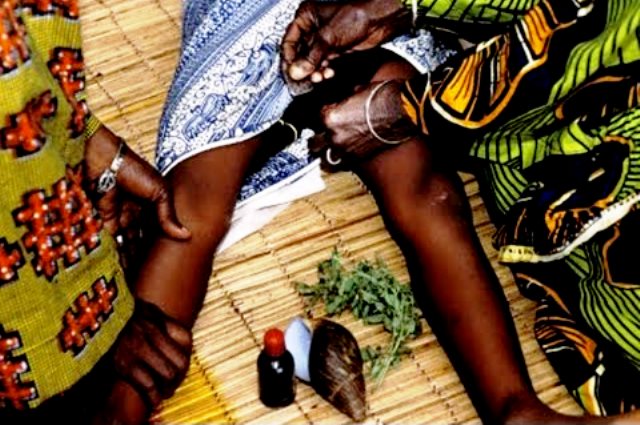
In all parts of the country, some traditional practices have endured till today. One of these is female genital mutilation (FGM) also known as female circumcision. It is common in most parts of the country, especially in the South East and South West. And they are done, especially in the rural areas by unskilled local people who cut in so deep sometimes that the urethral wall is damaged. Fistula surgeons say a woman who suffers this condition is likely to develop VVF.
In the Northern part of the country, especially the North West where local barbers still engage in what is called “Yanka Gishiri.” It refers to the cutting of a growth around the female vagina (Guria) that prevents women from having sex. In the process of cutting it, they cut other vital organs of the woman. Some of the cases of VVF seen in the North West zone were as a result of this practice.
To get around some of these challenges, some states with support from international partners such as UNICEF, USAID and PLAN International are investing in training of traditional birth attendants and providing them delivery kits. In some states, there are also Volunteer Community Mobilizers to track pregnant women in rural areas and bring them to the hospital.
But as health experts have stated, nothing else can take the place of a fully functional primary healthcare system and sustained effort to discourage girl-child marriage and promote health education .
On every school day, for the past two years, fourteen-year-old Patience Mbaze walks through Olusegun Obasanjo Way in order to get to Junior Secondary School, Wuse Zone 2, where she studies. But her unavoidable journey is equally an unusual one, filled with trepidation. Twice, in the morning and two hours after midday, she has to cross a short bridge that abuts Michael Okpara Street.
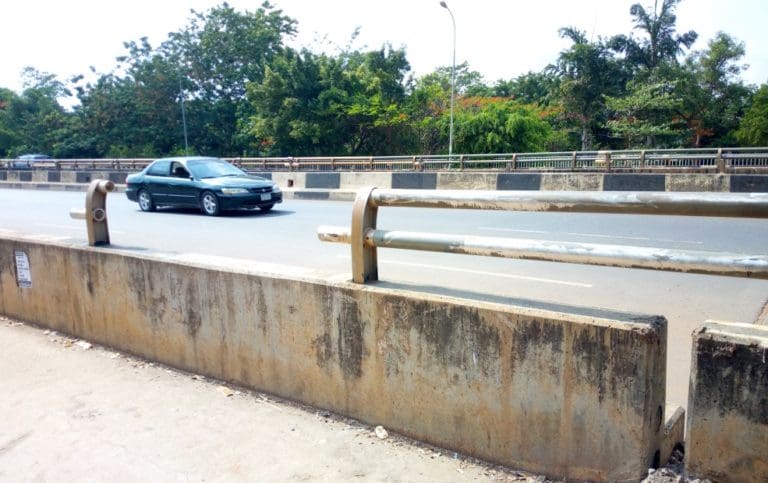
Though strong, this particular bridge would instill fear into the hearts of anyone walking over it, and the reason is not far-fetched. Only fragments are left of the rails on both sides, meant to prevent pedestrians from tipping over and falling into the raging stream below. The other parts? They were forcefully sawed off and carted away the previous year, leaving the bridge disfigured and the people at risk of falling 30 feet into death’s cold embrace.
“When you are passing, it will be as if you want to fall inside,” Patience tells the ICIR. “But I don’t walk on the side where you’ll fall, I walk by the other side”. If they are walking in groups, she says, they will file into a line and cross individually.
“For me, I always feel afraid because I am someone who is always afraid of heights,” says Fatimah Danjuma, a J.S.S. 3 student of the same school. “So when I am walking around that side, I always walk close to the left side of it because there is a rail there. When I see somebody else going, I tell them to shift. You know, students, they can be playing and you never can tell what might happen.”
Missing bridge rails at Olusegun Obasanjo Way, Wuse, Zone 2Missing bridge rails at Olusegun Obasanjo Way, Wuse, Zone 2
Disturbing as their narrations are, the bridge is not the only one in Abuja that has been amputated. There are many like it ― including also places that used to have manholes ― scattered across the city, waiting for government to restore what is lost or, maybe, even the criminals to demand, like Oliver Twist, for what is left.
This is the story of armless bridges, heartless thieves, and life-threatening vandalism in the Federal Capital Territory (FCT).
‘LIKE A THIEF IN THE NIGHT’
Paul Oniloku, a young car detailer who operates a car wash adjacent the bridge on Olusegun Obasanjo Way, discloses to the ICIR that the vandals usually show up only at night and doing the damage in the early hours of the morning. But during the last operation, which occurred late 2017, law enforcement officers fortunately intervened before the thieves could do their damage.
“Normally, it is the Road Safety that pursues them along with SARS operatives,” he says. “If not they would have cut everything here. When SARS came, they arrested some of them and others escaped. Early one morning, we saw stains of blood on the floor and could tell they were shot at. We also asked people around and they said there were gunshots the previous day.”
Also, according to Micheal Ojobo, who works as a vulcaniser at the tail-end of the bridge, “they used to do that thing towards night time.”
Vandalised steel barrier on Olusegun Obasanjo Way, Wuse Zone 1
THE HANDIWORK OF BABAN BOLA?
There have been conflicting assertions on who exactly these criminals are and what background they have. Some think it is the Hausa metal scrap scavengers, locally referred to as baban bola, who are to blame. There are, however, others who seem to have proof to the contrary.
Godfrey, a horticulturist whose workplace stands at the opposite end of the bridge, adjacent Paul’s car wash, holds no one but the baban bola responsible for the damages.
“It is their handiwork, these set of people,” he says, pointing at one young scavenger as he pushes his cart at the other end of the road. “They are the people that normally do it. Many times we report to the police, and they have arrested some and locked them up.”
“They even killed two of my dogs that I have to secure here around May, April last year,” he laments. “They come and steal my things, the scavengers. They have stolen two of my pumping machines. At a stage, they carried my wheelbarrow and shovel. And I have reported to the police many times. They are very very dangerous.”
Paul, however, disagrees. He thinks they are too sophisticated to be part of baban bola. “I don’t think they are baban bola,” he opines. “Because those people always use their personal cars. And they use saw and machine in cutting the metal. I normally get here early in the morning around 5 or 6. At a time, we picked some saws, which they left while running.”
Likewise, Ifeanyi, a tailor who specialises in tent rental, says the thieves are different from the scavengers. “They are not baban bola,” he states confidently. Ifeanyi’s workshop is located at another section of Olusegun Obasanjo Way, close to the famous GSM Village at Wuse Zone 1. In December 2016, security guards working opposite his shop caught three of the thieves red-handed and handed them over to the police.
“They parked their car somewhere close. We couldn’t trace it but we saw them with car key,” his assistant chips in.
Replaced bridge rails on Michael Okpara Way, Wuse, Zone 2
SOME REPLACED, OTHERS LEFT DISPLACED
Perhaps, the government has grown weary of fixing the damages, while thinking they will only be stolen again ― but this is certainly no excuse when lives are at risk. Some damaged bridges have been fixed half-way, and some have been abandoned to their fate for over a year.
Micheal Ojobo observes that the government, in 2017, replaced the rails damaged along the Michael Okpara Street, but has left the ones on Obasanjo Way the way they are.
“But they came with some oyinbo people to survey the damage, also last year,” he adds. Ever since, no repair has been made to the bridge in the area.
Resting on the Herbert Macaulay Way, close to Wuse Market bus stop, is yet another unlawfully amputated bridge. While the side rails were replaced in the previous year, the steel barrier have, till today, been left in ruins.
“They cut the rails in 2015,” narrates a passport photographer working close-by. “But they fixed the rails last year, and left the other side. It’s only this one they fixed.” Asked why this happened, he says he has no idea.
The same story goes for the bridge located close to the GSM Village at Wuse Zone 1. Since the damage in 2016, only the side rails have been fixed. The steel barriers are still a very ugly sight.
‘WE HAVE MADE A LOT OF ARRESTS’
Though their work hours fall within the heart of the night when most are asleep and they possess modern instruments for efficient operations, Anjuguri Manzah, Police Public Relations Officer (PPRO) for the FCT Command says many of the vandals have been arrested and made to dance to the tunes of justice.
“We have filed a lot of arrests and recoveries of hoodlums who are involved in vandalising critical infrastructure, like those who specialise in vandalising manholes,” he informs the ICIR. “In some of our divisions, you will see some of the exhibits we’ve recovered meant to serve the interest of the entire populace.”
“We’ve also had many of them prosecuted. So, it is something the command holds dear to itself. We see no reason why they vandalise these things. And we have realised that by the time they vandalise, they just go and sell them at a giveaway price. They melt and use them for other purposes.”
Recovered steel barriers, rails, solar panels and manholes at Police Divisional Headquarters, Wuse 3Recovered metal pillars and a car used by the vandals at Police Divisional Headquarters, Wuse 3
Asked who it is they sell to, he says investigations are still ongoing but no companies have yet been linked to the menace, only individual receivers and buyers. He says also that the vandals make use of cars to perpetrate their crime. He also implored the public to cooperate and feed the police with needed information.
“We have had cause to arrest them with cars, which they use in vandalising, in the late hours of the night. What they do is they cut the items into size; once they are ready, they bring their cars to convey them.
“We call on members of the public to cooperate with us. Information is key. When you see someone at any point where he ought not to be, alert the police. We assure you that the information given to us will be used to its utmost. It is our duty to follow up and know why the person is there at that particular moment. By doing this, you are only helping the society and also yourself.”
THE NIGHTS DO NOT HAVE TO BE THIS DARK
With streetlights and closed-circuit television cameras (CCTV), night in Abuja will not offer so much cover and safety to men of the underworld during their illicit operations. Day or night ― there would hardly be any difference, since faces on the streets will be taped and movements illuminated. Sadly, bridge rails are not the only victims of vandalism in Abuja. These too have been affected ― and are still affected.
CCTV cameras and poles on Olusegun Obasanjo Road in disrepair
The ICIR reported in September 2017 that CCTV cameras planted on major roads in Abuja have never worked since their installation and failed to detect criminal activities. This is despite the fact that a huge sum of N76 billion was spent on the project. Many of them have been vandalised and one, it was observed, even serves as shelter to the homeless. It is of course unthinkable that devices that have not succeeded in protecting themselves will be able to protect other assets.
Indeed, with cameras in place 24/7 and streetlights shining cheerfully upon the streets when the sun goes down, nights in the Federal Capital Territory will not be this dark ― enough to give safety to those who do not desire it for others.
The ICIR was informed by the Head of PR, Abuja Metropolitan Management Council (AMMC), that the agency in charge of maintaining and repairing bridges and manholes is the Facilities Maintenance and Management Department.
This reporter therefore proceeded to the department to ask what challenges are faced and why there is delay in fixing certain rails. After meetings with the Department’s Public Relations Officer, Head of Civil Engineering and Director, however, he was told they do not grant interviews “like that”, and was encouraged to write first for authorisation to Muhammad Bello, Minister of the FCT.
According to uploads by the National Assembly on its website, the Department was allocated N2.8 billion for capital expenditure according to the 2016 FCT Appropriation Bill, and in 2017 it received a similar allocation of N2.2 billion. This year’s budget has, however, not been passed yet ― as the one before it, which did not pass second reading until mid-October.