Home Blog Page 2696

Former Kebbi SSG, commissioner in court over N664 million Fraud

The Independent Corrupt Practices and Other Related Offences Commission, ICPC, has arraigned Garba Kamba, former Secretary to the Kebbi State Government, and Mohammed Tunga, the State’s former Commissioner of Finance for allegedly misappropriating the sum of N664, 000,000.

The accused persons, who served under Saidu Dakingari, former Kebbi State Governor, were docked before Justice Umar Abubakar of the Kebbi State High Court, on a four-count charge of criminal conspiracy, theft, conferring corrupt advantage on themselves and using their positions for gratification.

Both men were alleged to have diverted the sum of N349,475,000 meant for the provision of power generators and “other logistics” for all polling units in Kebbi State during the 2015 general elections.

They were also accused of using their offices as SSG and Commissioner of Finance to defraud the State of N315,000,000 which was meant for a religious sensitization programme in the 21 Local Government Areas of Kebbi State during the 2015 general elections.

However, investigations by the ICPC revealed that though the amounts were released, no generating set was purchased and no Imam or Mallam benefitted from the sensitization money.

Both men pleaded not guilty to the charges.

According to the ICPC, The offences were contrary to and punishable under sections 19 and 26 (1) (c) of the Corrupt Practices and Other Related Offences Act, 2000, and if found guilty, the defendants could be sentenced to 5 years imprisonment without an option of fine.

Following the pleas, counsel to the accused persons, Ahmad Fingilla and Lagalo Lagalo respectively, filed a bail application on behalf of their clients.

Bail was granted to each of them in the sum of N10 million and one surety in like sum who must be resident and possess property worth N10 million within the court’s jurisdiction.

The case was subsequently adjourned to 26th October 2017 for the commencement of hearing.


READ ALSO:

How Cameroon assaulted, abused and forcefully deported 100,000 Nigerian refugees

Human Rights Watch, an international rights organisation says Cameroonian soldiers assaulted and sexually exploited Nigerian refugees fleeing from Boko Haram.

In a report released on Wednesday, HRW said about 100,000 refugees have so far been illegally deported from Cameroun from 2015 to date, in violation of local and international laws.

The deportations defy the UN refugee agency’s plea in 2016 that no refugee should be forced to return to northeast Nigeria “until the security and human rights situation has improved considerably.”

“Since early 2015, the Cameroonian authorities have summarily deported at least 100,000 Nigerians living in remote border areas back to war, displacement, and destitution in Nigeria’s Borno State,” the report read.

“At least 4,402 are known to have been deported in the first seven and a half months of 2017.

“In carrying out these deportations, Cameroonian soldiers have frequently used extreme physical violence.

“Some, including children, weakened after living for months or years without adequate food and medical care in border areas, have died during or just after the deportations, and children have been separated from their parents.”

According to Gerry Simpson, the associate refugee director of HRW, said the torture and abuse suffered by Nigerian refugees at the hands of Cameroonian soldiers “seems to be driven by an arbitrary decision to punish them for Boko Haram attacks in Cameroon and to discourage Nigerians from seeking asylum.”

“Cameroon should heed the UN’s call on all countries to protect refugees fleeing the carnage in northeast Nigeria, not return them there,” he added.

Many of the refugees interviewed by HRW said they were accused of belonging to Boko Haram. One of them who hails from Mora described how Cameroonian soldiers rounded up 40 of them without warning and forced them onto a bus.

“They beat some of the men so badly, they were heavily bleeding. When we got to the Nigerian border they shouted ‘Go and die in Nigeria,’” the source said.

Refugees who were lucky to make it to Cameroon’s only designated camp for Nigerian refugees, in Minawao, did not fare any better.

“While they have some protection as refugees, the approximately 70,000 people there have had limited access to food and water and abusive restrictions on their movement,” the HRW report read.

“In April and May, 13,000 returned from Minawao to a displacement camp in Banki, just across the border in Nigeria. Some were killed in early September when Boko Haram attacked the camp.

“In late June, the Nigerian authorities responded to Cameroonian pressure by sending military vehicles over the border to help Cameroon deport almost 1,000 asylum seekers.

“That made Nigeria complicit in the unlawful forced return of its own citizens.”

The Cameroonian authorities deny any forced return or abuse of Nigerian asylum seekers and have not replied to a Human Rights Watch request for a response to the report’s findings.

The country has a reputation as a generous country toward refugees since the early 1970s and it has hosted tens and then hundreds of thousands of refugees since then.

“But returning tens of thousands of Nigerians to harm and destitution will only further shred its well-deserved reputation as a generous refugee-hosting country,” the HRW said.

Reps unanimously vote to revisit devolution of powers

Members of the House of Representatives have unanimously voted to revisit the devolution of powers in the ongoing constitution amendment.

The lower legislative chamber had earlier voted against power devolution during a clause-by-clause consideration of the report submitted by its constitutional amendment committee just before the lawmakers embarked on recess.

But at the resumption of plenary on Tuesday, Femi Gbajabiamila, House Majority Leader, moved a motion on the necessity to take a second look at the clause on devolution of power following the overwhelming agitations across the country.

In his response, Yakubu Dogara, Speaker of the House of Representatives, agreed that there was a need to revisit the issue, saying: “Make no mistake, as representatives of the people we have a duty to champion the protection and preservation of the rights of our constituents and peoples.

“Anyone or group who assaults our constitution will not find a partner here because our oath of office repels same.

“But those who stand for justice, fairness and equity will have partners in us because our oath of office compels same. All the arguments about restructuring are, at the end of the day, legislative issues.”

Dogara then put the motion to a voice vote and the lawmakers unanimously voted in the affirmative. A special committee will now be set up by the leadership of the House to liaise with Nigerians at the various geo-political zones to determine the next step to be taken.

Reacting to the development, Epiphany Azinge, former Director-General of the Nigerian Institute of Advanced Legal Studies (NIALS), said that it was a good thing that the lawmakers decided to revisit the issue, otherwise the country’s unity would have be in serious jeopardy.

“We are happy that the National Assembly is alive to its responsibility, both the Senate and the House of Representatives, and they are prepared to do the needful by taking on board those issues that ordinarily many would imagine that they are not prepared to take on board,” Azinge said on Channels Television.

“Devolution, restructuring or whatever you think you want to be achieved, can still be achieved through (constitution) amendment, so it is up to the lawmakers at this point in time to make it their cardinal responsibility, coming fresh from a seven-week vacation, to see how they can go about this.”

Azinge said the allegations of marginalisation against the federal government by various regions of the country cannot and should not be swept under the carpet but should be addressed adequately.

“Also, the fact that we have not really related so strongly in a way and manner that the entire people of this country will come to terms with the fact that the whole primordial sentiments of tribalism should be a thing of the past in this country at this moment,” he said.

“What have we done to achieve the integration that we are talking about? Have we tried as much as possible also to address the issue of residence rights? Why should we still be talking about State of origin? There are so many issues that we need to change and in the process we also ought to change our mindset.”

Whether or not you read this, you still owe ₦102,000

0
Credit: Nairametrics.com

By Saatah Nubari

It was Fela Kuti who said “Trouble sleep, Yanga go wake am.” Wise words from a decent man I must add, but the point here is that you owe 102,000.

Your wife gave birth yesterday to your first child? Congratulations man; you, your wife and your baby now owe ₦102,000 each. Here is a consolation, those your village people, those firmly against your progress, they all owe ₦102,000 each too. “Kpatakpata na draw”, Fela didn’t say this, but those are wise words.

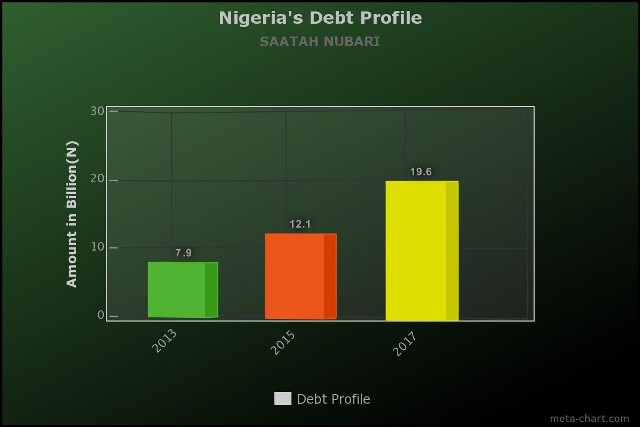
According to the Debt Management Office, Nigeria’s Public Debt Stock as at 30th June 2017 is ₦19.6 trillion. In June of 2015, that amount was ₦12.1 trillion. Prior to that, in 2013, it stood at ₦7.9 trillion. Going by this, our collective debt rose by approximately 50% in 2015 and by 2017, it had increased by 100%.

When these figures get in contact with some mathematical symbols, the entire dynamics does change. You are probably awaiting the explanation regarding how you and every other Nigerian is indebted up to the tune of ₦102,000 as at this year. Not to worry, that is what we will be calculating next.

As at 2013, Nigeria’s population estimate by the World Bank was put at 171,000,000 while our total debt stock was approximately 7,900,000,000,000. That amount split equally amongst the estimated population gives us an Individual Debt Share—I call it IDS—of approximately ₦46,000.

On the other hand, in 2015, according to same source, our population grew by 10,000,000, taking us to 181,000,000, while our debt stock took a “giant leap of faith” and perched at ₦12,100,000,000,000. Dividing a ₦12,100,000,000,000 debt amongst Nigerians in 2015 would have amounted to approximately ₦66,000 for each living Nigerian.

In 2017, the Nigerian population has been estimated to be approximately 191,000,000, and with our total debt at 19,600,000,000,000, you owe approximately ₦102,000. You remember that your friend, Udeme, the great man? Yup, he owes ₦102,000 too.

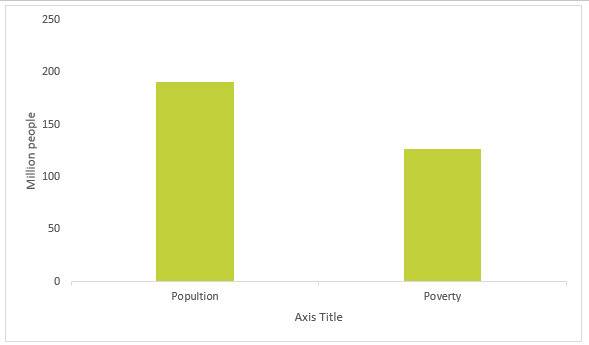
According to the Nigeria Bureau of Statistics’ 2016 Poverty Report, 67.1% of our population live below the poverty line. That 67.1 percent of the populations translates to approximately 112,000,000.

To be “designated” as poor, you should be earning at least $2 a day. At ₦350 to $1, that is ₦750 a day and ₦22,500 a month, and 127,000,000 Nigerians are poor and cannot boast of that amount as total income monthly. We have not included those on the income level above ₦22,500 a month, who still cannot pay ₦102,000 even if you put a gun to their head.

It doesn’t matter to the government of President Buhari that having arguably out-borrowed almost every government in Nigeria’s very short history, he has nothing to show for it, and yet, the very poor Nigerian populace, from Sokoto to Rivers State, have to bear the brunt of his misadventure.

Another point I want you to take note of is that, despite borrowing in excess of ₦7,500,000,000,000 within the last two years, the present Federal Government under President Buhari  has not commissioned a major project it started. Still, it wants to borrow more without being able to account, by any means, how it has spent trillions of Naira or billions of Dollars on the Nigerian economy with nothing to show for it. Mr Patrick will call this something like “criminal criminalness” but it doesn’t fit. I’ll instead say it is as a result of our own “foolish foolishness.”

The 2019 elections will soon be upon us, and these same people  who have mismanaged the economy and our resources and sent us deep into this blackhole of debt have begun strategising, but we, the people, are not strategising. Voter registration is still very low. It is easier to say something like “wetin concern me” than go out to cast a vote for the right persons and defend that vote. This thing isn’t magic, Nigerians need to be more involved in the political process, but until then, “wetin concern me,” every Nigerian owes ₦102,000, and “I no gree, I no gree” will not change it.

This article was completed in the wee hours of the morning, and although it was thororughly edited,  there might be some typographical, graphical, numerical and/or statistical errors. Bear in mind that, if unfortunately those errors exist, they were innocently made. I’m on Twitter @Saatah or you can email me Saatahnubari@gmail.com

IN CIRCULATION: ‘Sweets and candies’ for harming unsuspecting children

The University of Medical Sciences, Ondo State, says a certain “psychotropic drug” is currently in circulation in the country disguised as sweets and candies.

This was contained in an internal memo dated September 20 and signed by O.V Olagbande, the university’s Chief Security Officer.

According to the statement, the new drug, known as “Straw-berry Quick”, is in circulation in schools across the country and “its effects can be very scary”.

“We want to share this with parents and urge them to take urgent action now that children are resuming school,” the statement read.

“There is also a type of Crystal meth going around that looks like Strawberry Pop Rocks (the candy that sizzles and pops in the mouth).

“It smells like strawberry and is being handed out to kids in schools yards. They are calling it “strawberry meth or strawberry quick.

“Kids readily accept these ‘gifts’ thinking that it is a candy and being rushed off to hospital in dire-condition. It also comes in chocolate peanut butter, cola cherry, grape and orange.

“Please instruct your children not to accept candy from strangers and even not to accept a candy that looks like we just described from any friend or persons.”

Odinkalu insists: Everything about the proposed NGO bill is flawed

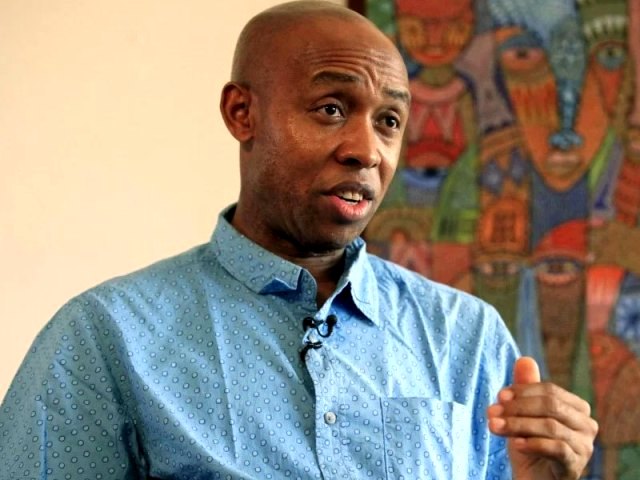
Chidi Odinkalu, former Chairman of the National Human Rights Commission (NHRC), says the proposed Non-Governmental Organisations Regulation Bill currently being considered by the National Assembly is flawed right from the first section.

Odinkalu made the comments on Tuesday during AIT’s Focus Nigeria, insisting that churches, mosques and even social clubs such as the Ikoyi Sports Club, Lagos, are all part of organisations captured in the proposed bill.

He wondered why the legislators want to establish another commission to regulate NGOs and place more debt burden on the government.

“The bill is flawed from section one sub-section one,” Odinkalu said. “You are proposing to create a new NGO board and voluntary council, all of them as charges on the public purse. We can’t pay our workers and we are creating more boards. Are we okay?

“We are in a situation in which people in our essential services cannot draw salaries. We have states that are owing people over 10 months of salaries, 12 months of salaries and we are proposing to create another public body that will be a charge on a country that cannot pay its bills — you want me to keep quiet? Are we serious people?

“I chair the governing council of the National Human Rights Commission, we did not have staff to do our programming, we did not have money.

“We get a budget of N1.3 billion, N1.25 billion was for overheads and salaries, the rest was to service things related to overheads and salaries, not a dime to do the programming that mattered. Why do we do this to ourselves? So it begins from there.”

Odinkalu also pointed out that according to the proposed bill, the NGO regulatory commission would be made up largely of people whose appointments will be approved by the President, with only three representatives from NGOs, an arrangement he said is not balanced.

“This body will be made up of 20 people, including the Executive Secretary, appointed by the President, the Chair appointed by the President,” he said.

“You will have nine people representing different ministers, who are appointees of the President, on this board, so there is an in-built presidential majority.

“And of course, six persons of proven integrity to be appointed from the six geo-political zone will be appointed by the President. So this thing is a governmental entity owned by the President.

“If you noticed, the Chair (of the commission) is not required to be a person of proven integrity, the Executive Secretary is not required to be a person of proven integrity, the nine people representing the ministers are not required to be persons of proven integrity.

“It is only the people from the six geo-political zones that will be persons of proven integrity but the people representing the ministers, where is the requirement of proven integrity for them? So we presume that if you are representing a minister, you are already of proven integrity?

“These people can determine what happens to you [as an NGO], give you licence and all that.”

Odinkalu pointed out that Section 11 (1) of the proposed bill provides that all NGOs must be registered, but sub-section four of the same section empowers the commission to “exempt such NGO from registration as it may determine”.

He said that the clause would empower the commission to “target some people”.

Proponents of the NGO regulatory bill have often referred to a similar bill, which was signed into law recently by the Kenyan Government, saying that Nigeria’s case is not an isolated one. But Odinkalu said South Africa’s version of the law is different and better than Kenya’s, which Nigerian lawmakers copied almost verbatim.

“There is a different model (of the NGO regulatory bill) which is the South African Not-for-profit Organisations Act, which deals with a whole body of issues,” Odinkalu said.

“That model addresses governance of fiscal regimes and taxation, making sure that there’s sufficient governance and transparency in trusts to make sure that they are not used to evade tax or used to fund politics unlawfully. That is different model. That’s closer to the UK charities’ commission.

“The Kenyan and Angolan models is what these guys have tried to introduce and that is why I am saying that it is very dangerous.

“I was there at the beginning of the Kenyan model, I have seen it in different African countries, I have represented people who have been proscribed or sought to be proscribed under these laws in different African countries and I am saying that I’ve got to give my country the benefit of that expertise and experience. I have a duty to, because knowledge comes with responsibility.”

Redeemer’s University begs FG to ‘refund the $375,000 we spent on Ebola’

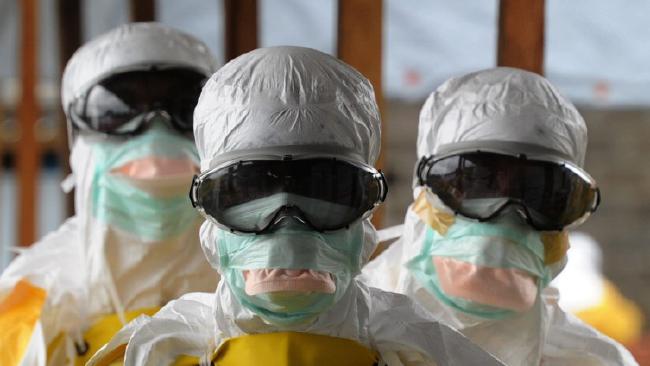
Zacheus Adeyewa, Vice-Chancellor of the Redeemer’s University, Ede, Osun State, says the federal government is still owing the university $375,000, which it spent on researches to prevent the spread of the deadly Ebola virus in 2014.

Adeyewa said this during a press conference to announce the ninth convocation ceremony of the university.

He lamented that despite the contributions of private tertiary institution to the country, they are not part of beneficiaries of the Tertiary Education Trust Fund (TETFund).

“We spent $375,000 during the Ebola crisis and the government has not returned the money to us,” he said.

“They say we are a private university, but they have not answered the question whether Ebola, Yellow fever and other infectious diseases are private.

“Why did they cheat us with this public, private dichotomy? Please help us to tell them to refund our money.”

Adeyewa said that the university has one of the best infectious diseases research centres in Africa, certified by the World Health Organisation.

“Our African Centre of Excellence for Genomics of Infectious Diseases has become the best rated among its peers in Africa through its profound research outputs, innovation and manpower development for the continent,” he said.

“We have become a continental powerhouse in the prevention, control and elimination of infectious diseases, such as Ebola and Lassa fever.

“Our team is not only the toast, but also the pacesetter for the other African Centres of Excellence. In this regard and to the glory of God, the World Bank has rated us as the university with the best research facilities in Sub-Saharan Africa.

“We have developed Rapid Test Kits that could detect Ebola and Lassa fever viruses within 10 minutes. Our Ebola Rapid Diagnostic test kit has been approved for use by the United States Food and Drug Administration and World Health Organisation.”

Ebola was first introduced into Nigeria by Patrick Sawyer, a Liberian-American, who came to Nigeria for a meeting. The disease, however, was largely contained and Nigeria was declared Ebola-free after 93 days.

‘But APC promised us light’ — Twitter bashes Ambode for donating generators to police

The Lagos State government thought it was announcing another achievement by Akinwumi Ambode, Governor of the state, when it took to Twitter on Monday to announce the donation of 120 units of 5KVA generators to the state police.

But instead of praise and commendation, Nigerians bashed the All Progressives Congress, APC-led state and federal government for going public with such gesture instead of working towards regular power supply.

Here are a few of the reactions:

During a meeting of the National Council on Power in Jos, Plateau State, last week, Babatunde Fashola, former Governor of Lagos State and current Minister of Power, Works and Housing, had said the country’s power generation rose to 7001 megawatts in September.

According to Fashola, power transmission also rose to 6,700 megawatts, while power distribution rose to 4,600 megawatts.

But Nigerians want more, as power supply is arguably the biggest challenge militating against economic growth.

During the campaigns for the 2015 general election, the APC had promised that there would be massive improvement in the energy sector, but that promise, like many others by the party, has remained unfulfilled more than two years into the Muhammadu Buhari administration.

Tambuwal grants state pardon to five officials indicted for N15bn fraud by EFCC

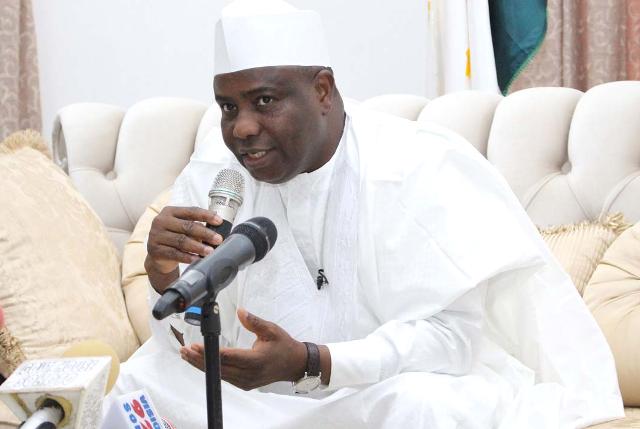
Aminu Tamubuwal, the Governor of Sokoto State has granted state pardon to five officials of the state who are facing trial for allegedly defrauding the state to the tune of N15 billion.

Following the pardon, Justice Bello Abbas of the Sokoto High Court, who is presiding over the corruption case, discharged the affected persons.

The Economic and Financial Crimes Commission (EFCC) made this known on its Facebook page late on Monday, adding that the commission had appealed the judgement.

According to the EFCC, the accused persons were charged alongside Attahiru Bafarawa, the immediate past Sokoto State Governor, and others, but curiously, only five of them, who are currently serving in the Tambuwal administration were pardoned, while the others, including Bafarawa, were left to their fate.

They are: Tukur Alkali, Commissioner for Animal Health and Fisheries Development; Isa Achida, Commissioner for Home Affairs; Maigari Dingyadi, Chairman, Governing Board, National Commission for Colleges of Education; Habibu Modachi, member representing Isa constituency in the state House of Assembly; and Isah Bello, a Permanent Secretary.

The accused persons were first arraigned in 2009, having also served under Bafarawa between 2002 and 2007.

“The EFCC, on September 25, 2017 filed an appeal at the Court of Appeal, Sokoto Division, challenging the judgment delivered by the Sokoto State High in respect of pardon granted by the Governor of Sokoto, Aminu Waziri Tambuwal, to five accused persons who were charged alongside former governor Attahiru Bafarawa,” the EFCC stated.

“It would be recalled that on June 29, 2017, the Sokoto State High Court presided over by Justice Bello Abbas delivered a judgment discharging five accused persons, Alhaji Tukur Alkali, Bello Isah, Alhaji Isah Sadiq, Alhaji Habibu Modachi and Alhaji Muhammadu Dingyadi.

“The ruling was sequel to a motion filed by the respondents seeking to be discharged from further criminal proceedings based on a pardon granted to them by the Sokoto State Government.”

Reacting to the development, Itse Sagay, a Senior Advocate of Nigeria and Chairman of the Presidential Advisory Committee Against Corruption (PACAC) said that Tambuwal’s action is illegal and against the anti-corruption campaign of President Muhammadu Bhari.

“It is only the Attorney General of the Federation that can ask for a case that is being prosecuted by the Federal Government to be withdrawn, so what Tambuwal did by pardoning is illegal,” Sagay said.

“Secondly, the money that was allegedly stolen belonged to the people of Sokoto and not Tambuwal.”

North Korea threatens to ‘shoot US bombers’, says Trump was first to declare a war

0

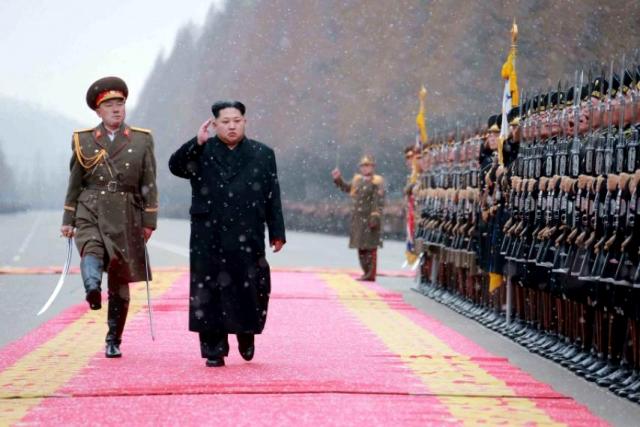
Ri Yong-ho, North Korea’s Foreign Minister, has accused President Donald Trump of the United States of declaring war on his country.

Yong-ho told reporters in New York that henceforth, North Korea has the right to shoot down US bombers even when they are not in North Korean airspace.

“Last weekend Trump claimed that our leadership wouldn’t be around much longer and declared a war on our country,” Yong-ho said, according to an official translation of his remarks to reporters in New York.

“Since the United States declared war on our country, we will have every right to make all self-defensive counter measures, including the right to shoot down the United States strategic bombers at any time even when they are not yet inside the aerospace border of our country.

“The world should clearly remember it was the US that first declared war.”

However, Katina Adams, spokesperson of the US State Department told CNN that “the United States has not ‘declared war’ on North Korea.”

“We continue to seek a peaceful denuclearization of the Korean Peninsula,” Adams said.

But Rob Manning, spokesman of the Pentagon said: “Our job as the Department of Defense is to make sure that the President is provided military options, we’ll continue to do that, and we have a deep arsenal of military options to provide the President so then he can decide how he wants to deal with North Korea and the regime.”

“We are postured and we are ready to fight tonight,” he added.

On Monday afternoon, Trump had tweeted that North Korea “won’t be around any longer”.

During the United Nations General Assembly in New York last week, Trump had threatened that the United States will be left with no choice than to completely “destroy North Korea” if it were forced to defend itself.

In reply, Yong-ho said Trump’s comments were nothing more than the sound of a “barking dog”.

Robert Mugabe, the Zimbabwean President, however urged Trump to quit behaving like the “biblical Goliath”, but to rather blow his trumpet to the sounds of peace and unity.