Home Blog Page 2697

Pregnant woman ‘dies’ at National Hospital due to health workers’ strike

0


The strike embarked upon by health workers under the umbrella of Joint Health Sector Unions (JOHESU) and Assembly of Healthcare Professionals has taken shine off the National Hospital Abuja, resulting in the “death of a pregnant woman” as workers and patients have deserted the hospital.

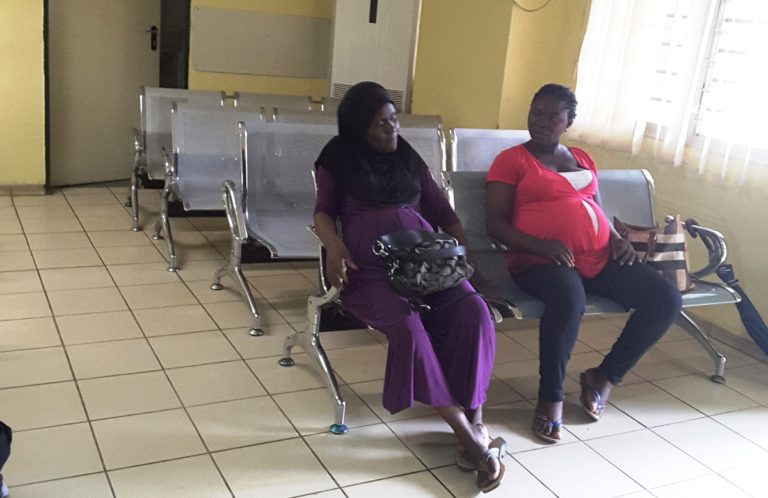
When the ICIR visited the hospital complex on Monday, the general outpatient ward, which used to be a hub of activities, was empty. Two pregnant women who were sighted at one of the wards declined comments, one of them saying her husband works in the hospital.

This was as other wards in the hospital were equally empty, with just a few doctors and cleaners around.

Though they declined comments, the ICIR gathered from a source at the hospital, who asked not to be named, that the four-day-old strike had already resulted in the death of a pregnant woman who did not have the attention of the relevant health workers when she went into labour on Sunday night.

This, however, could not be officially confirmed as of the time of filing this report, as Tayo Hastrup, General Manager, Public Relations of the hospital, said there was no such incident at the hospital.

“Not National Hospital; not here at all,” he said

Empty outpatient ward at the National Hospital

Speaking with ICIR on telephone, Hastrup disclosed that the hospital management had plans to reduce the effects of the strike.

“The Minister of Labour and others are still meeting with the leaders of the health workers and besides that, we have put in place contingency plans to make sure that our patients have access to services” he said

Explaining contingency, he said: “Other workers are not on strike. Doctors are not on strike and corps members are here. Other officers are here.”

Meanwhile, Chris Ngige, Minister of Labour and Employment, has expressed “deep regret” about the strike by the health workers.

In a statement by Samuel Olowokere, Deputy Director of Press at the Ministry, Ngige appealed to the health workers to call off action and return to their different beats in the hospitals and institutions to avoid unnecessary hardship and death of patients.

The statement reads: “I wish to place on record that JOHESU had wrongly issued a seven-day strike ultimatum on 14th September, 2017 instead of the mandatory fifteen-day notice the law requires of those on essential duties.

“The body took another wrong step by routing its notice of action to the Secretary to the Government of the Federation (SGF) instead of the Labour and Employment Minister whom JOHESU is fully aware is empowered by the Section 5(6) of the Trade Dispute Act 2004 to apprehend such dispute within the time frame of notice and effect conciliation thereafter.

“Further, it is regrettable that the invitation extended to JOHESU by the Hon. Minister of Labour and Employment under the provision of this law for a meeting on Thursday, 21st September, 2017 was not honoured because JOHESU wanted to call out the member unions on strike, thereby disrupting services in these health institutions.

“For the avoidance of doubt however, the Ministry of Labour and Employment, working in concert with the Ministry of Health, has fixed another conciliatory meeting for tomorrow Tuesday, 26th September, 2017 by 2 p.m.

“Therefore, the Hon. Minister requests members of JOHESU to resume work as serious efforts are being made to meet their grievances most of which like the payment of shortfalls of salaries, promotion arrears, repatriation allowances among others have already been addressed by Government through various negotiations with other unions representing the interest of workers, that is, the Nigeria Labour Congress (NLC) and the Trade Union Congress (TUC) in the last three weeks.”

Malami, Magu and the blues of anti-corruption war

0

By Godwin Onyeacholem

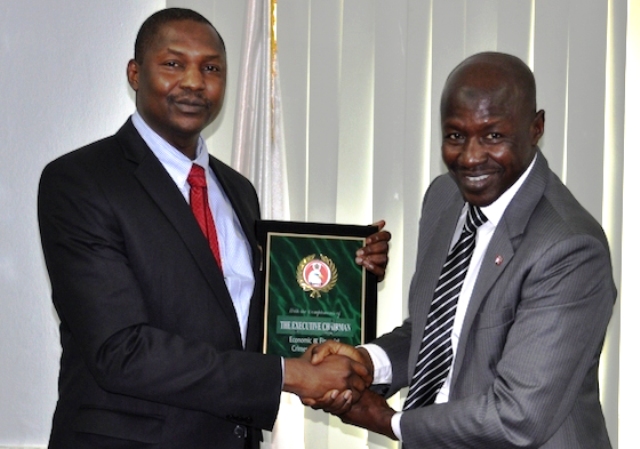
Much as both labour to put up gestures suggesting cordiality, the truth is there is no love lost between them. And interestingly, the one thing that came between them is corruption, which is also supposed to be the only thing that should see them basking in a harmonious relationship in this dispensation. What a paradox!

How to engage this terrible plague is the cause of the simmering discord in their affairs. Yet, between Abubakar Malami, Nigeria’s all-knowing Honourable Attorney General of the Federation and Minister of Justice, the one who never gives an inch in making the point that in all matters legal he is in charge, and Ibrahim Magu, the subordinate, less-obtrusive head of the Economic and Financial Crimes Commission (EFCC), it is not difficult to know who is more minded to waging a more concerted, frontal war against corruption which the administration they both serve promised to fight to a standstill.

First, a slice of these gentlemen’s background. As far as most Nigerians can remember, one enjoyed a brief spell in a fuzzy limelight as junior to Dipo Opeseyi as attorneys for Muhammadu Buhari, then presidential candidate of the defunct Congress for Progressive Change (CPC) battling in court to upturn the declaration of Goodluck Jonathan as winner of the 2011 presidential election.

The other earned glittering epaulettes as a tested, uncompromising anti-corruption warrior from the days of Nuhu Ribadu as Chairman of EFCC. Also, while one, with no antecedent whatsoever of vigorous combat with societal wrong merely thrived in the shadows of redoubtable defenders of the law, the other was, and still is, enmeshed in bruising battles with highly placed fraudsters and economic saboteurs operating in and out of the shores of Nigeria.

But for Magu’s exploits, bolstered, of course, by President Buhari’s rhetoric and body language, there is no way this administration would today beat its chest and announce progress, no matter how minimal, in the war against corruption. Only Magu, and his principal, it seems, are the ones really focused on slaying the dragon of corruption in the country.

Of course, the belief out there is that under Buhari’s watch, corruption is thriving despite his well-known anti-corruption stance. He owes it a duty to wipe off this belief. But the real cause for worry in this administration’s anti-corruption campaign chain is Malami, the country’s chief law officer who is holding an office that is supposed to be seen in the forefront of the charge against a monstrous vice that his government has sworn to do everything to permanently tame.

Instead, it is this same AGF that appears to be confronting corruption with kid gloves, when he should be slugging with it in the mud with bare knuckles. In the face of the overwhelming decadence corruption has inflicted on the country, and given the unusual decisiveness with which the ruling All Progressives Congress pledged to curb it, it ought to be Malami, not Magu, that should be talking of seeing the task at hand as a matter of life and death, or a “do or die” affair, to use the language compatriots would easily understand – if not for anything but to save Buhari’s face.

You expect Malami to be the one donning his wig and gown and pounding the courtrooms as the leader of government lawyers prosecuting the big cases of corruption. No, he would rather ensconce himself in the cushion of ego trip. There he throws his weight around and drums it into as many ears as care to listen that he has all the powers under the law to define the law.

Not a surprise though. Like all the Attorneys General of the Federation, especially since the founding of EFCC, this one too is a fortune-hunter, a deal-maker whose primary interest is not to combat corruption but to snuff out the country’s foremost anti-graft agency to enable him have a field day to bargain with looters for a share of the loot.

To offer a snippet of how these AGFs not only compromise the integrity of their office but also work very hard to render the EFCC ineffective, Michael Aondoakaa as AGF and Minister of Justice in 2008, connived with then EFCC Chairman, Farida Waziri, to scuttle the arrest and trial of Liyel Imoke who no longer enjoyed immunity, as his election as Governor of Cross River State had then been annulled by the election petition tribunal. Tunde Ogunsakin, then Director of Operations at EFCC, ordered the arrest. Rather than end up in EFCC interrogation room, Imoke ended up at Aondoakaa’s house. And that was the end of the matter.

Malami has sermonized on the poor prosecution of financial crimes and criticized the whistle-blower policy for focusing on reward instead of the safety and protection of whistle-blowers. But what has he done about it? What does it say of his office if an AGF whose government at inception swore to fight corruption with all its powers is only just waking up, after almost two years in office, to announce “plans” to create a central body to coordinate all criminal prosecutions in the country?

And on the protection of whistle-blowers, pray, what has Malami done? At the moment, there are reports of persecutions of whistle-blowers in many government offices, but not a whimper of disgust ever issued from his office. But for the civil society and the media which took up the fight, Ntia Thompson, a deputy director in the Directorate of Technical Cooperation in Africa (DTCA), an agency of the Ministry of Foreign Affairs, who was sacked for reporting fraud in his office might not have been reinstated.

At the moment, there is Murtala Ibrahim of the audit department of the Federal Mortgage Bank of Nigeria (FMBN), a victim of similar unconscionable high-handedness, who was sacked by the management of the bank since May 8 for refusing to help cover fraud in the bank. This is one of a whole slew of cases Malami should promptly wade into not only to show that he really cares about whistle-blowers’ safety, but also that he is serious about strengthening the anti-corruption war.

Godwin Onyeacholem is a journalist. He can be reached through Email: gonyeacholem@gmail.com

ABOUT-TURN: From pleading innocence, two admit guilt of illegal arms importation

Two of the five suspects currently on trial for alleged illegal importation of firearms into the country have pleaded guilty to the offence but have opted for plea-bargain.

The five suspects undergoing trial are Mahmud Hassan, Oscar Okafor, Donatus Achinulo Salihu Danjuma, and Matthew Okoye, who is said to still be at large.

All of them pleaded not guilty when they were first arraigned before Justice Ayokunle Faji of the federal high court, Lagos, on an eight-count charge on June 14, but they were all refused bail due to the gravity of the offence they were accused of; and the case was adjourned to September 25.

However, when the trial resumed on Monday, two of the accused persons, Okafor and Achinulo, made an oral application through their counsels Rotimi Jacobs and Paul Ananaba, respectively, to change their pleas from ‘not guilty’ to ‘guilty’.

In his ruling on the new application, Faji, the presiding Judge, directed the defendants to notify the AGF of their intention to change their pleas. He subsequently adjourned the sitting until September 26.

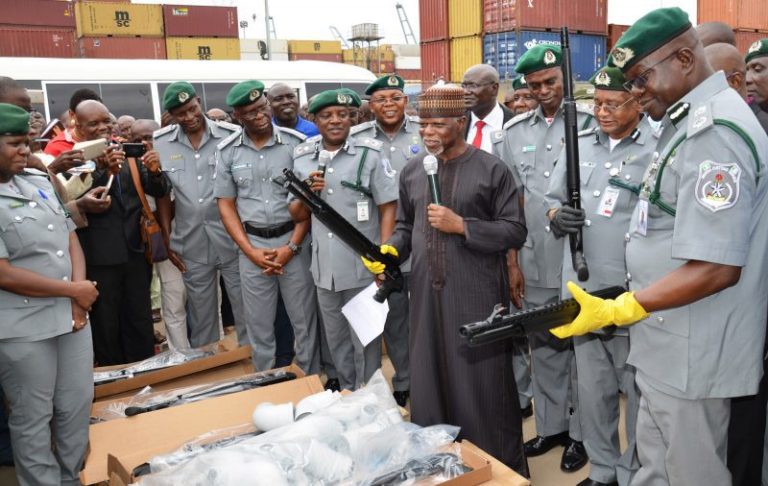
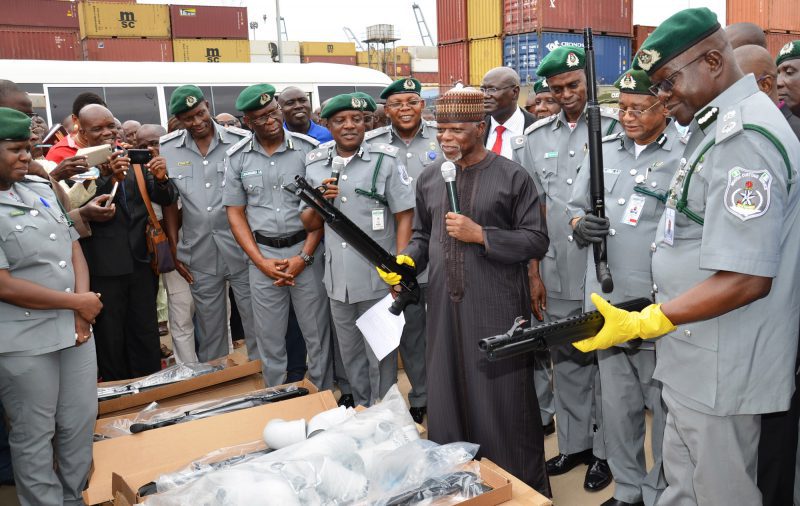
The men on trial were some of the suspects arrested in connection to the 661 units of pump action rifles that were confiscated by officials of the Nigeria Customs Service in January.

There have been three of such seizures by the Customs since then. In May, 440 of pump action rifles were seized; and two weeks ago, another container was intercepted with a total of 1100 units of pump action rifles imported without due approval by the authorities.

Exactly one week ago, another discovery of over 400 pump action rifles was made in another container belonging to the same unnamed person who imported the weapons seized the upper week.

Hameed Ali, the Comptroller General of Customs, said investigations were on to get to the root of the matter.

APC to Sagay: Buhari dug you out of oblivion but now you’re behaving like a rogue

0

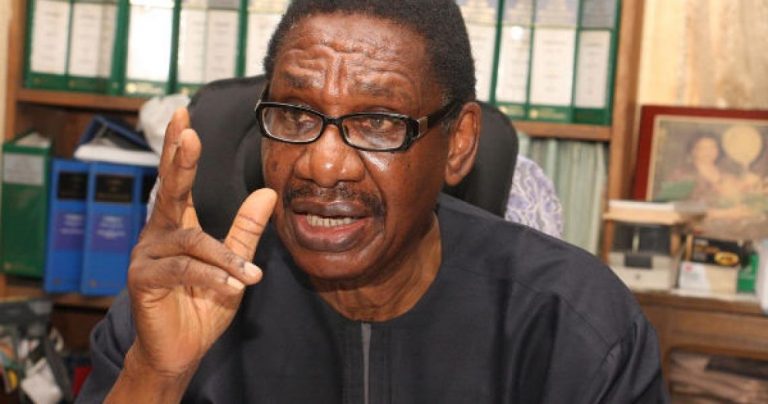
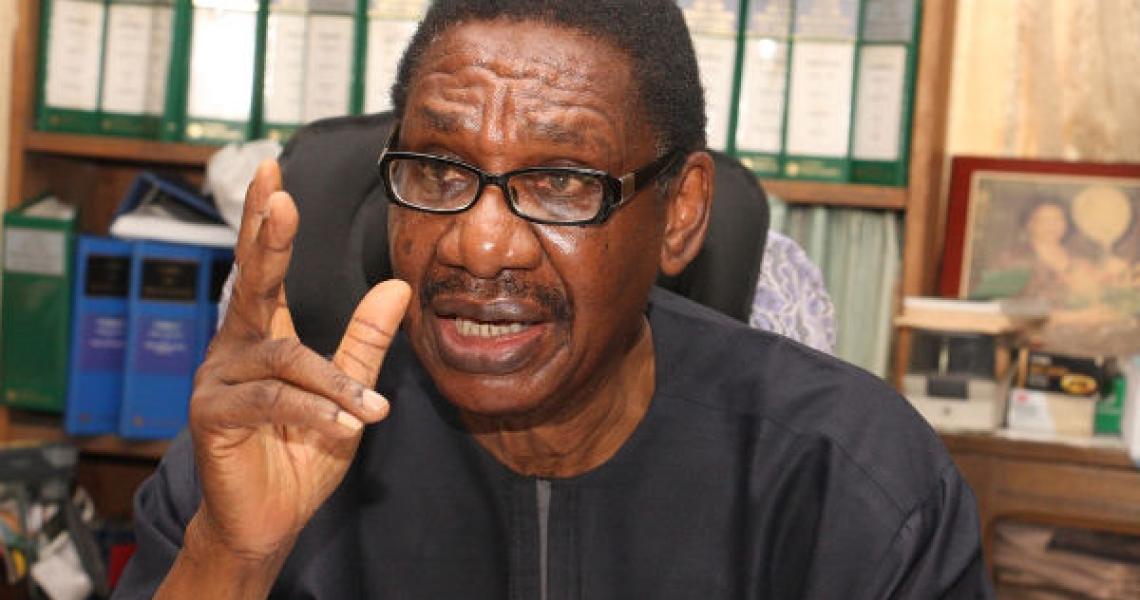
The all Progressives Congress (APC) has penned some strong words for Itse Sagay, a professor and Chairman of the Presidential Advisory Committee on Anti-corruption (PACAC), over his most recent interview.

In an interview with TheNation Newspaper, Sagay criticised the leadership of the ruling party, describing it as an unprincipled group of group.

He had also expressed unwillingness to refrain from continuing with his recent series of media interviews even if President Muhammadu Buhari intervened.

The party has now responded to Sagay, stopping just short of calling him an ingrate, as he would not have been given his current position had APC not won and Buhari not picked him.

“Our attention has been brought to an interview published on pages 46-47 of The Nation Newspaper of Sunday, September 24, 2017, granted by the Chairman of the Presidential Advisory Committee on Anti-corruption (PACAC), Professor Itse Sagay (SAN),” the party said in a statement signed by Bolaji Abdullahi, its National Publicity Secretary.

“In the said interview, Sagay described the leadership of the All Progressives Congress (APC) as ‘the most unprincipled group of people’ who are ‘encouraging and accepting rogues’ in the party. He said: ‘When I say ‘rogues’, I don’t mean stealing. In literature, when you say someone is a rogue elephant, it means people who are running riot and destroying the party’.

“The Webster dictionary defines ‘rogue elephant’ as ‘one whose behaviour resembles that of a rogue elephant in being aberrant or independent’. Clearly if we have today, anyone in our government or, by extension, the party who feels accountable only to his own ego; who does not feel the need to bridle his tongue for the sake of anything that is higher than himself; who feels independent of everyone and every institution; that person is Professor Sagay.

“Asked by the interviewer if he would stop speaking if the President asks him to stop speaking, he said: ‘Yes, he is my employer. If he tells me to stop talking, I’ll stop talking. But I have certain rights too that I can exercise in addition to that, because I’m not going to be in a position where I am impotent. So, I must obey him, but I can go beyond that and obey myself too. That’s it.’

“Framed in another way, what Sagay is saying here is that, no matter what is at stake, he would rather resign than obey the President if the President tries to restrain him. This is the quintessential rogue elephant behaviour.

“In his sheer arrogance, he forgets that it is impossible for him to call out the leadership of the party as ‘weak’ and ‘unprincipled’ without indicting the President, who is the leader of the party and has the fundamental responsibility to build the party.

“If Sagay had any iota of respect for the man who dug him back from inevitable oblivion and puts him in a position in which he now feels superior to everyone, he would channel his opinions and advice to the President on how to make the party stronger and more principled. It appears however that Sagay does not have anything constructive to say about anything. He only knows how to tear down and assault everyone and everything.

“We want to remind Sagay and all other appointees of our government that the only reason they occupy their current position today is because the APC won the election. There is, therefore, a matter of honour to show decorum and respect for the party and its leadership. You cannot love the fruit and hate the tree that produced it.”

Sagay was recently at the heart of some unpalatable exchange with the National Assembly over his claims on the jumbo earnings of legislators

Want to become a lecturer? NUC says you don’t need a PGDE

0

The National Universities Commission (NUC) has said that the acquisition of Postgraduate Diploma in Education (PGDE) is not a sine qua non of the attainment of teaching excellence in the university system.

According to Abubakar Abdurasheed, Executive Secretary of NUC, there is a general consensus that lecturers require regular updating of their pedagogical knowledge and skills in order to facilitate achievement of the anticipated learning outcomes and by extension, the desired over-arching objectives of university education.

Abubakar was speaking in Abuja on Monday at the opening of a five-day transformative higher education pedagogy and practice, organised by the NUC and University of Sussex, London.

He said while pedagogical skill and competences are necessary to ensure continuous improvement in teaching-learning and the attainment of desired learning outcomes, the NUC believes in a systematic approach to pedagogical training on the basis of regular professional development, which will not elicit resistance from or offend the sensibilities of members of the academia, should be pursed.

“There is a lack of consensus on the pathway for achieving the desirable outcome of enhanced pedagogical skills among the academia,” said Abubakar, who was represented by Rahman Yusuf, Director of Research, Innovation and Technology, at NUC.

“On one hand are those who canvass the position that all academic staff need to acquire a PGDE before they could be considered to be qualified and effective professors or lecturers. On the other hand are those — including many university academics — who strongly believe that the PGDE is not the way to go.

“On our part at the National Universities Commission, we believe that the acquisition of a PGDE is not a sine qua non of the attainment of teaching excellence in the Nigerian University system.”

He disclosed that NUC has opted for a modular approach to the pedagogical training of academic staff, which may lead to some sort of certification such as a certificate of competence, after series of well-designed and delivered pedagogical training modules and will facilitate the achievement of the ultimate objective of improving the knowledge, competence and skills of professors and lecturers of Nigerian university system.

This, he added, would not cause undue agitation among members of the academic community, many of whom he noted have expressed their abhorrence for any attempt to foist a mandatory acquisition of the PGDE on them.


READ ALSO:

Only lazy people are afraid of restructuring, says Atiku

Abubakar Atiku, former Vice-President of Nigeria, says those who are afraid of the restructuring the country are lazy people.

Speaking to a group of youth in Abuja on Monday, Atiku maintained that every region of the country has adequate natural and human resources to thrive without having to rely on monthly allocations from the Federal Government.

He recalled that his education from primary to university was bankrolled by the government at a time when oil had not been discovered.

“I would not have gone to school if I were born today. My parents were so poor they couldn’t afford to send me to school. I was born during the era education was free, food was free for me, I was sponsored from primary school to the university,” he said.

“There was even a job waiting for me before I graduated. Yet, there was no oil boom then. I am certainly not a product of oil boom Nigeria. So, I don’t know what those who are against restructuring are afraid of. Those afraid must be lazy.

“We fought the civil war with the Igbo. Today, the Igbo have been completely rebuilt, but we still find mud houses in the north. Is it the fault of the easterners that the north is like that?”

Atiku suggested that the Federal Government should only be in charge of sectors such as “defence, foreign affairs, immigration”, while states or regions should be left to manage their resources. He stressed that this would further boost transparency and accountability.

“It should not be complicated to start with all the recurrent items in the constitution,” he said.

“The President can dialogue with the governors or the National Assembly for states to take charge of the roads, hospitals, schools and such other items in the concurrent List while the federal government will continue with items on the exclusive list.

“I think that what is most important is the devolution of powers and resources with the various governments, whether states or regions. How do the people hold those in power accountable for the resources handed over to them?”

Avengers and herdsmen are saints but IPOB and the rest of us are terrorists

0

These are interesting times. We’re entering an interesting, new journalism era when newspaper editors will cast simple headlines but the public will nevertheless be confused. “Troops kill 14 terrorists in Plateau,” a headline could read. And readers would wonder: What kind of terrorists? Were they Biafra terrorists or Boko Haram terrorists? It could soon happen that we find our ourselves using the word ‘terrorism’ with the same ordinariness with which we do ‘armed robbery’. For that, we have ‘almighty’ President Muhammadu Buhari to thank.

Buhari’s crush-or-kill disposition to agitation was what the Defence Headquarters banked on when it hastily designated the Indigenous People of Biafra (IPOB) a terrorist group, before proceeding on a confusing and embarrassing volte-face, forcing Tukur Buratai, the Chief of Army Staff, to claim that the Army’s “pronouncement” was misinterpreted.

“You have to get it very clear,” Buratai said in that bizarre about-face. “First of all, what the Defence Headquarters did was to make pronouncement. It wasn’t a declaration per se. But this has given room for the right step to be taken.”

It also gave out the administration as one whose well-documented disregard for the law is not accidental. The initial uproar about the DHQ’s declaration was that it was illegal but the illegality has now been corrected with the proscription of IPOB by an Abuja Federal High Court. Therefore, the contentiousness of that declaration is no longer about legality but now about propriety. Are IPOB members indeed terrorists?

THE 14 ACTS OF TERRORISM

Section 2 of the Terrorism (Prevention) Act 2011 as amended is very clear in its definitions of what constitutes terrorism: “act of terrorism” means an act which is deliberately done with malice, aforethought and which:

 (a) may seriously harm or damage a country or an international organization;

 (b) is intended or can reasonably be regarded as having been intended to—

 (i) unduly compel a government or international organization to perform or abstain from performing any act;

 (ii) seriously intimidate a population;

 (iii) seriously destabilize or destroy the fundamental political, constitutional, economic or social structures of a country or an international organization; or

 (iv) otherwise influence such government or international organization by intimidation or coercion; and

 (c) involves or causes, as the case may be—

 (i) an attack upon a person’s life which may cause serious bodily harm or death;

 (ii) kidnapping of a person;

 (iii) destruction to a Government or public facility, a transport system, an infrastructure facility, including an information system, a fixed platform located on the continental shelf, a public place or private property, likely to endanger human life or result in major economic loss;

 (iv)the seizure of an aircraft, ship or other means of public or goods transport and diversion or the use of such means of transportation for any of the purposes in paragraph (b)(iv) of this subsection; *

 (v) the manufacture, possession, acquisition, transport, supply or use of weapons, explosives or of nuclear, biological or chemical weapons, as well as research into, and development of biological and chemical weapons without lawful authority;

(vi) the release of dangerous substance or causing of fire, explosions or floods, the effect of which is to endanger human life;

 (vii) interference with or disruption of the supply of water, power or any other fundamental natural resource, the effect of which is to endanger human life;

 (d) an act or omission in or outside Nigeria which constitutes an office within the scope of a counter terrorism protocols and conventions duly ratified by Nigeria.

 (3) An act which disrupts a service but is committed in pursuance of a protest. However, demonstration or stoppage of work is not a terrorist act within the meaning of this definition provided that the act Is not intended to result in any harm referred to in subsection (2) (b)(i), (ii) or (iv) of this section.

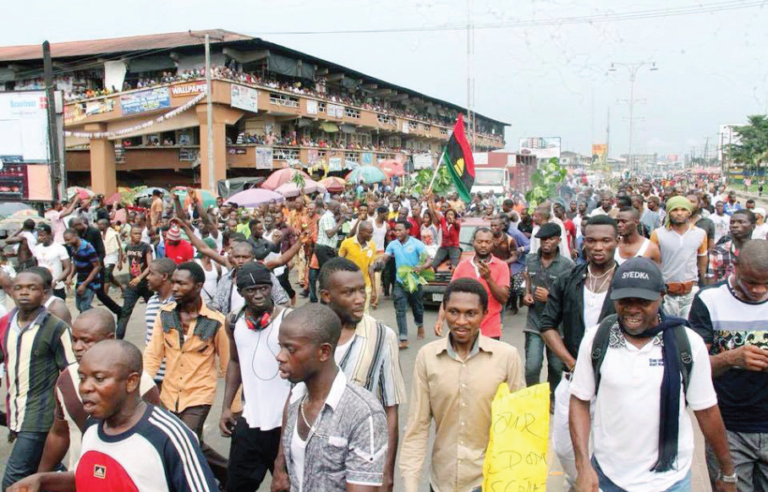
Of these 14 infractions that constitute terrorism, IPOB, as a group, violated only three: C(iii), C(iv) and 3. Importantly, all violations did not come until the army released pythons to the south-east. Of these 14, Nnamdi Kanu breached at least 10. Had the court, on FG’s prompting, declared Kanu a terrorist, it would have been hard to fault the move, judging by the scale of hate preached by the IPOB leader, his call for the boycott of next month’s Anambra governorship election, and the way he continuously incited his followers to shed blood for the actualisation of Biafra. But any declaration of IPOB itself as a group of terrorists is an overkill, especially when this government has turned a blind eye to more dangerous groups.

THE REAL TERRORISTS

How on earth can IPOB members be terrorists when notorious killers, the herdsmen, have no such designation? We are talking about a group that was named in 2015 by the Global Terrorism Index as the fourth deadliest terror group in world. Only Boko Haram, ISIS, and al-Shabab were deemed deadlier than this nomadic group of militants. In 2013, they killed around 80 people in total, but by 2014 the group had killed 1,229 and 847 in 2015.

“The little-known group, formed of individuals from the semi-nomadic, pastoral ethnic group Fula people existing across several West African nations…  operates in Nigeria and parts of the Central African Republic,” The Independent wrote at the time. “As much as 92 per cent of their attacks target private citizens, reflecting the group’s primary concern over the ownership of farmland. Each attack claims an average of 11 lives, with the largest known in April 2014 killing as many as 200 people after a group of the militants targeted community leaders and residents during a meeting in central province Zamfara.”

This group is, in fact, guiltier of terrorism than Nnamdi Kanu. But, sadly, all Buhari thinks of them is that they are a “criminal gang”, as evinced by Garba Shehu, one of his spokesmen, who said last week: “There is a difference between a criminal activity and a terrorist activity. Yes, some Fulani herdsmen are a criminal gang and they are being dealt with according to the law. But IPOB, like Boko Haram, has a territory they have carved out to themselves.”

If IPOB members are terrorists, what do we say of militants in the delta, particularly the Niger Delta Avengers, who actually did terrorise Nigeria by freely bombing oil installations, consequently plummeting oil production capacity, which in turn lowered the country’s crude oil earnings. The Avengers made Buhari’s opening months in office hell, costing Nigeria $7 billion (N2.1 trillion) between January and October 2016, according to the Nigerian National Petroleum Corporation (NNPC). Although they ticked at least 10 of the 14 offence boxes listed in the Terrorism act, the Avengers were not designated as terrorists. After realising the futility of military crackdown on the bombers, he resorted to peace talks between representatives of the government and the militants, followed by the payment of outstanding monthly stipends to militants. Since then, the Avengers have left vengeance to God!

From the Avengers, Buhari must have learnt that force will always be trumped by dialogue; the surprise is why he won’t handle IPOB in a similar manner. By overseeing the proscription of IPOB and its declaration as a terrorist group, Buhari has managed to trivialise terrorism — a truly serious offence — to the realms of thuggery and armed robbery. Tomorrow, should the rest of us hit the streets in protest of an unfavourable policy, we could easily be marked down as terrorists. In case anyone is in doubt, the amended Terrorism Act prescribes up to death as punishment for terrorists. The makers of that law must be holding their heads in their hands, knowing this wasn’t the original plan.

Shehu Sani: Nobody should deceive anybody, there’ll be no restructuring before 2019 elections

Shehu Sani, the outspoken lawmaker representing Kaduna Central at the National Assembly, says there will be no restructuring before the 2019 elections.

Sani, who made the comments via his Twitter handle on Sunday evening, said the leaders of the country should rather implement the reports of the several conferences that were held in the past.

“We either implement reports of previous conferences and committees or we keep producing duplicitous reports and wait for godot,” he said.

“Nobody should deceive anybody and nobody should deceive himself or herself; there will be no restructuring before 2019 elections.”

The All Progressives Congress (APC) promised Nigerians during the campaign for the 2015 general election that it would ensure that the issue of restructuring is looked into once it assumes power.

However, more than two years after the party won the election, it has reneged on that promise.

Femi Adesina, Special Assistant to the on Media and Publicity, told journalists after the President returned from a 103-day medical leave from London, that restructuring was not the priority of the federal government for now.

“The National Chairman (of the APC) has said that restructuring is one of the things the party will do, but it’s not in the order of priority for now,” Adesina had said.

“The priorities are: securing the country, reviving the economy and fighting corruption. Later, restructuring will come up.”

Police ‘torture’ 23-year-old to death over ‘stolen motorcycle’

The family of Hassan Abdullahi, a 23-year old man from Zamfara State, has said that their son was tortured to death by the police for allegedly stealing a motorcycle.

Nura Abdullahi, brother of the deceased, told the media that the family would take all necessary steps to ensure that the policemen involved are brought to justice.

“What happened was that last year, Hassan’s friend, Saidu, stole a motorbike and rode it to Argungu in the neighbouring Kebbi State,” Nura explained.

“When he arrived he met Hassan there. He told my brother that he wanted to sell the bike and my brother brought a buyer, unknown to him that the bike was stolen.

“The bike was then sold off, unknown to Saidu that he was seen by a resident when he was riding the bike out of Gummi town. So when he came back he was arrested and detained by the police alongside my brother.

“The case was then resolved after the stolen motorbike was retrieved and a certain amount of money was paid by the buyer of the motor bike and they were set free.

“But a year later, just two weeks ago, Hassan was re-arrested and beaten by the police. When the case was resolved earlier, Hassan left town and didn’t come back until a year later. When he arrived Gummi, one of his friends informed the police that he was back and had paid a visit to the local government secretariat.

“Hassan’s friend connived with the police and he was re-arrested at Gummi Local Government Area secretariat premises where he had gone for a transaction.

“They started beating him right from there. They handcuffed him, bundled him into a waiting vehicle and moved to the police station where he was continuously beaten.

“When the police realised the magnitude and consequence of their action, they decided to rush him to a hospital after they noticed a white fume gushing out from his nostrils and mouth.

“He died and a day after, his corpse was deposited at the medical facility in Gummi. And preliminary investigation revealed that he had some internal injuries as a result of the beating.”

Voice of the Masses, a non-governmental organisation, said it would support the Abdullahi family not only to get justice for the deceased but also to bring an end to the use of torture by security operatives.

Garba Bala, Chairman of the NGO, said the group was documenting all available evidence that would help them secure a successful prosecution.

“I was at the station when the victim was brought by the police. His hands were held back, tied and handcuffed. They gave him a serious beating and within 24 hours he died,” Bala said.

“Police have been subjecting civilians here to torture. We have a case of one person here who was asked to chew paper as bread and many more others.

“The family of the deceased is under intense pressure to withdraw the case. The father of the victim is being intensively lobbied to give in. But even if he drops the case, we will continue with our process to ensure that justice is done on the matter.”

When contacted, Bello Galadi, Chairman of the Nigerian Bar Association (NBA), in Zamfara State, said he was aware of the matter but has not received any formal report on it.

“We can’t comment on the matter until we receive a formal petition on the case from the family,” he said. “This would give us a true picture of the case and then prepare on how to go about it.”

However, Muhammadu Shehu, the spokesman of the Zamfara State Police Command, denied that the police tortured the deceased to death. Instead, he said that Hassan was arrested because he was a wanted criminal, but when it was discovered that he was illl, the police took him to the hospital, where he died.

“We don’t torture civilians; it is not our tradition and it is against our rules of engagement,” he added.

Falana: Buhari was flown to the UK because his life was in danger here

0


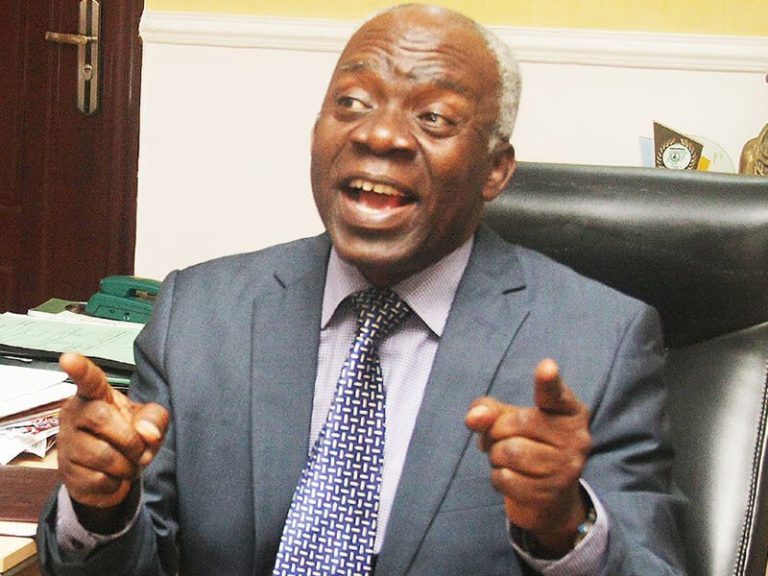
Femi Falana, lawyer and human rights activist, says President Muhammadu Buhari received medical treatment in the UK because he knew his life was in danger here.

Falana said this while responding to questions about the safety of Nnamdi Kanu, leader of the Indigenous People of Biafra (IPOB).

Asked whether Kanu’s life was in danger due to the invasion of his home in Abia State by soldiers, Falana said “nobody is safe in Nigeria”.

“When armed soldiers invaded Odi in Bayelsa State or Zaki Biam in Benue State, they killed scores of people. Everybody’s life in Nigeria is in danger,” he told Punch.

“Nigerians are shot dead in their homes by armed robbers or on the roads by soldiers or policemen or by armed herdsmen on their farms. So, it is a risky business to survive in Nigeria. Even President Muhammadu Buhari had to be flown to Britain for medical attention because his life was in danger here. So, nobody is safe in our country.”

Falana questioned the Kanu’s loyalty to the Biafra cause, saying it is an irony that Kanu holds British citizenship while campaigning for Biafra, just like Shettima Yerima, President of Arewa Youth Forum, who lives in Lagos but asked the Igbo to vacate the north.

“Mind you, the fellow [Kanu] and his wife and children are British citizens. He may have left the country to join his family in the United Kingdom,” he said.

“While campaigning for Biafra, he never threw away his British passport. I hope he has not run away so that he does not jeopardise the liberty of his sureties.

“It is an irony that Kanu, who is leading the struggle for the Balkanization of Nigeria, has dual citizenship, while Mr. Shettima Yerima, who gave the notice to quit to Igbo people in the North lives in Lagos.”


He noted that the Federal Government had always believed that Nigeria’s unity is not negotiable,meaning anyone who threatens the nation’s unity has to be crushed or jailed.

He said: “In the corridors of power, it is generally believed that the unity of Nigeria is not negotiable. Therefore, anyone who threatens the unity of Nigeria has to be crushed or jailed.

“That was what led President Olusegun Obasanjo to charge Mujahid Asari Dokubo, Dr. Fredrick Faseun, Otunba Gani Adams, and Ralph Uwazurike and put them away in Kuje prison. (Former) President (Umaru) Yar’Adua charged Henry Okah with treason and detained him.

“President Jonathan charged Charles Okah with terrorism and put him away in Kuje prison. The regime ensured that his brother, Henry, was jailed in South Africa for threatening the corporate existence of Nigeria;”

Falana also blamed the National Assembly for failing to perform its constitutional role of preventing the deployment of military to Abia State, noting that the constitution allows the President to deploy troops in aid of civil authority on the prescription of the National Assembly.

“Since 1999, I have consistently called for the demilitarisation of the society. Hence, I condemned the military invasion of Abia State. I also criticised the proscription of IPOB by the Nigerian Army,” he said .

“The Senate President, Dr. Bukola Saraki, spoke after I had made my comments. All the same, let the National Assembly, chaired by him, carry out its duty under section 217 of the constitution by enacting a law on military deployment by the President and Commander-in-Chief of the Armed Forces.

“That constitutional duty has not been carried out by the National Assembly since 1999. The constitution states that the President shall deploy troops in aid of civil authority as may be prescribed by the National Assembly. Beyond the issuance of a press statement, the senate president should sponsor a bill to actualise the requirement of the constitution.”