Home Blog Page 2706

INVESTIGATION: Abuja residents are dying in their hundreds — and faulty traffic lights are responsible

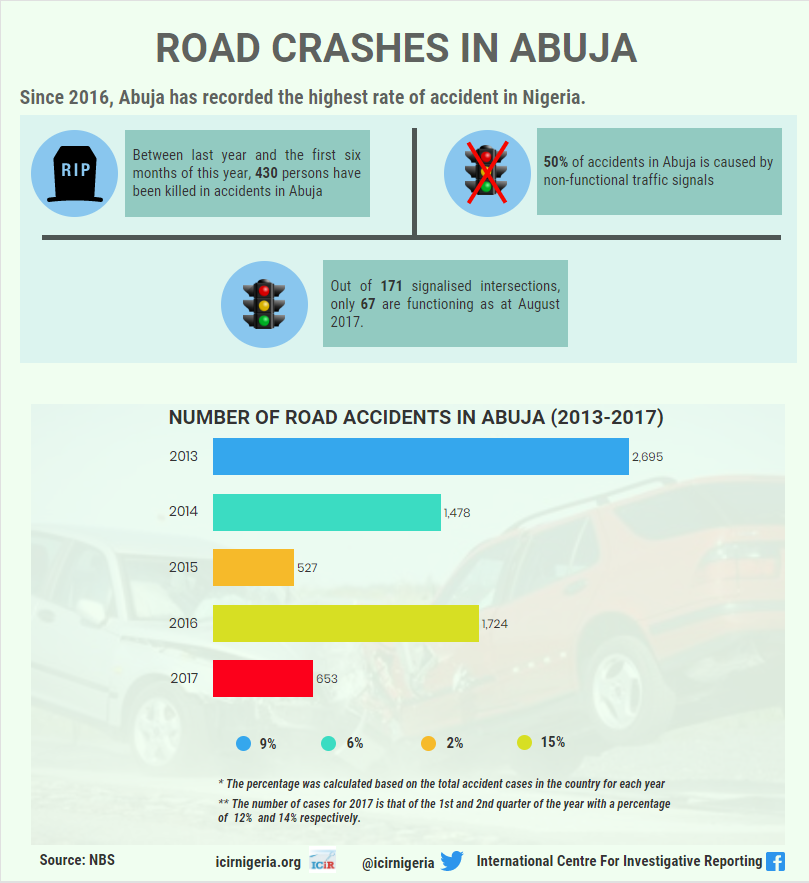
In 18 months, between January 2016 and June 2017, 430 persons have been killed in road accidents in Abuja, the nation’s capital. Investigation by the ICIR, however, reveals that at least 50 percent of the crashes were caused by non-functional traffic signals.

Abuja has 171 signalised intersections but only 67 are functioning after checks by the ICIR. Although 50 traffic signals in the City Centre, nine in Kubwa and eight in Gwarimpa are working as of the last week of August, official record obtained by the ICIR indicates that 74 are still operating.

An official document obtained by ICIR shows that 98 strategic intersections are yet to be signalised, while many of those that have been signalised are not functioning.

For the first time since accident records started to be kept, Abuja had the highest rate of accidents in 2016, beating Lagos, Kano and other states with higher populations.

This year, Abuja has maintained this lead as the accident-prone city.  In the first three months of 2017, Abuja recorded 307 cases of road crashes, representing 12 percent of the total crashes that occurred across the country within this period. From April to June this year, Abuja also had 346 cases of accident, representing 14 percent of the total accidents in the country during the period.

This rate of accidents is odd in an administrative city like Abuja, where the President, members of the National Assembly, top civil servants and diplomats live.

While examining the road accident data published by the National Bureau of Statistics (NBS), the ICIR discovered unusual spikes in the rate of accidents in the city.

In 2013, Abuja recorded 2,695 cases of road accident, the second highest in the country, representing 9 percent of the total accidents in the country that year. By 2014, Abuja had an improvement on the previous year, registering 1,478 accidents, representing 6 percent of the total road crashes. The city also gained positively, placing third in number of accidents after Lagos and Ogun states.

But something unusual happened in 2015: road accidents reduced drastically to 527 cases. Abuja accounted for only 2 percent of total accident cases in the country in 2015, and rose from the usual first three to 26th position among the 36 states of the federation.

However, in 2016, Abuja recorded very unusual figures. From 26th position in the country in 2015, it declined to the worst position. There were 1,724 cases of accident in 2016, representing 15 percent of the total accidents in the country that year.

The city has since maintained this lead in the cases of accident till date.

WHAT HAPPENED IN 2015?
The only plausible factor that led to the magical improvement in the rate of accidents in Abuja in 2015 was the functional traffic signals.

A bilateral assistance from the Chinese government facilitated the installation of 76 new solar-powered traffic signals in 2015 at the cost of about N830 million. In March 2015, Poly Solar Technologies Beijing Limited began to install the new traffic lights in parts of the city. The other moribund traffic lights were also revived.

By the end of May 2015 when there was a change of government, about 168 signalised intersections in Abuja were functioning. The rate of accidents nosedived as all the signalised intersections were working.

About 10 months later when most of the traffic signals stopped indicating any light, accidents returned at the extremely high rate.

DEADLY INTERSECTIONS

Junction by the Church Gate, along Olusegun Obasanjo Way

The Herbert Macaulay Way has 14 signalised intersections but none of them is working. The road runs from the Julius Berger Roundabout through Wuse Market, NNPC Towers to end at the International Conference Centre and Radio House where it intercepts with Tafawa Balewa Way.

Similarly, only two out of nine traffic signals along the Tafawa Balewa Way are working. The two signals are situated by the Nicon Luxury Hotel. The road begins from Area 3 junction through the Defence Headquarters, Central Bank of Nigeria, and Ceddi Plaza to the Central Mosque area.

The Ahmadu Bello Way has the most signalised intersections in the city, with 22 traffic signals, but only three are working. Starting from the Bannex Junction in Wuse 2 through the Federal Secretariat, Area 11 to Apo, the only functional traffic signals are the interception with Capital Street by the Federal Capital Territory Administration headquarters and the two at Apo by the Legislative Quarters.

All around the city, traffic signals in the busiest crossroads in Abuja do not function. Coming to the Central Business District from the airport, the first signalised interception is the junction at Olusegun Obasanjo Way by the Church Gate and the World Trade Centre that is still under construction. The traffic signal is not working.

Only one signalised intersection out of the seven in Olusegun Obasanjo Way is working. The functional one is situated at the Bolingo Hotel Junction close to the Ministry of Defence.

Also coming from Keffi-Nyanya axis towards the Central Area after the A.Y.A junction, the first signalised intersection is moribund at the very busy junction between Nnamdi Azikiwe Way and Yakubu Gowon Crescent. Moreover, coming from this axis into the Central Area, the first functional traffic signal is situated after the police headquarters, towards the Federal Secretariat.

Driving through other busy roads, such as Shehu Shagari, Muhammadu Ribadu and Obafemi Awolowo, show moribund traffic signals.

WHEN HUMANS BECOME TRAFFIC SIGNALS
Junction by the Central Bank of Nigeria

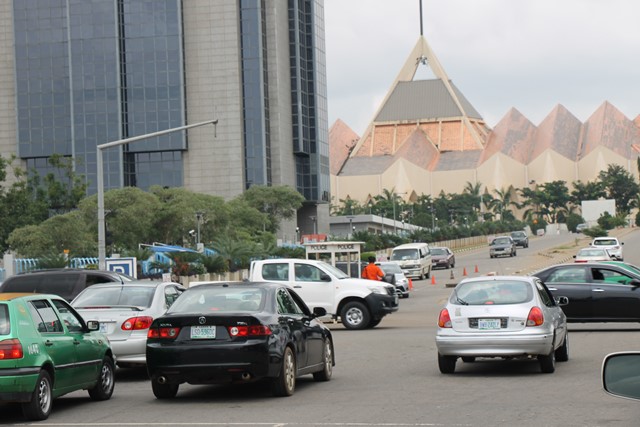
A man in a yellow shirt and black trousers stands in the middle of the junction by the CBN edifice. He puts up a high five with his left hand to cars coming from the Defence College, while waving on a stream of heavy traffic from the Nicon Luxury Hotel axis. When the traffic from this axis empties, he waves to the traffic coming from the Ceddi Plaza to pass.

This man, who is directing traffic in the middle of this strategic junction, is one of the traffic wardens to have replaced the dead traffic signals.

A police post is erected in the middle of the junction to provide him with a little shade from sun and rain but he is standing outside the shade, under the blazing sun. While the electronic signals indicate red, yellow and green light to control traffic, the warden uses his two bare hands to wave at traffic for stop and pass.

As most of the traffic signals are not working, traffic wardens are posted to the busiest junctions to control traffic. But unlike the traffic signals, the wardens do not work for 24 hours a day or seven days a week. They resume in the morning and close in the evening. And on weekends, a very few of them are at their duty post.

The ICIR observes that when the wardens desert their posts at the junctions, accident picks up in the evening and on weekends.

YOUR ASSUMPTIONS MAY NOT BE AUTHENTIC– FRSC

In a chat with the ICIR, Gora Wobin, FCT Sector Commander of Federal Road Safety Corps (FRSC), admits that accidents in Abuja happen more on weekends and evenings, but says it may not be authentic to conclude that most of the accidents are caused by non-functional traffic signals.

“The main causes of the accident in Abuja are impatience and lack of concentration,” Wobin says. “Even where the traffic lights are working, you see drivers beating traffic lights.”

He adds that over-speeding because of the good network of roads in the city is also a major factor why Abuja has a high level of road accidents.

Wobin points out that the location of Abuja also makes it prone to accident. “Abuja is a thoroughfare between the north and south. By the time they get to Abuja, they are tired.  Fatigue is one of the major causes of the accidents in Abuja.”

He also suggests that using the rate of the accidents to compare Abuja with other states may not be a good measure, adding that the comparison should rather look at the fatality figures.

He says FRSC has put in place adequate measures to collect accident data, including minor contacts that contribute to making Abuja’s accident rate appear so high above that of other states.

But contrary to Wobin’s claim that the fatality figure of road accidents in Abuja may not be as high as other states, examination of the data shows that Abuja is second to Kaduna State in the number of people that have been killed in road accidents since last year.

WHERE DO ACCIDENTS OCCUR MOSTLY?

In a Twitter poll conducted by the ICIR, 64 percent of the respondents said accidents occur mostly at the junctions in Abuja while 36 percent said accidents happen more on the straight roads.

When motorists were asked where they had witnessed accident mostly in Abuja – junctions or straight roads – most of them agreed that most accidents in the city occur at the intersections. Some drivers, however, said that accidents also occur frequently at the U-turns along the expressways, especially the Murtala Mohammed Way.

Ibrahim Mohammed, a taxi driver, told the ICIR that accidents usually happen at the intersections where the traffic signals are not functioning or do not exist.

“You see, when you get to junctions, some drivers don’t look. They are kings of the road. They don’t stop. They will just hit you when you put head,” Mohammed says.

“If the traffic light is working, the kings of the road will be forced to stop.  The lights are not working. They keep hitting at the junctions. People wound themselves and die like that”.

Simon Odey (popularly known as ‘Ogoja Pikin’), presenter of a 30-minute daily programme, ‘Oga Driver’, on Aso Radio, says accidents happen mostly at the junctions.

“Some motorists forget that there is a junction, especially where the traffic light is not working or there is no traffic light,” Odey says.

“The problem is that a driver will be thinking another driver will give way but the other is also thinking the other will give way and this often results in collision that is very fatal”

Odey recalls that in 2007, there used to be speed bumps at the junctions to make motorists slow down but these bumps were eventually removed.

He suggests that if the traffic light cannot work, the speed bumps should be reconstructed to reduce the level of accidents in the city.

IT IS VANDALISM – FCDA
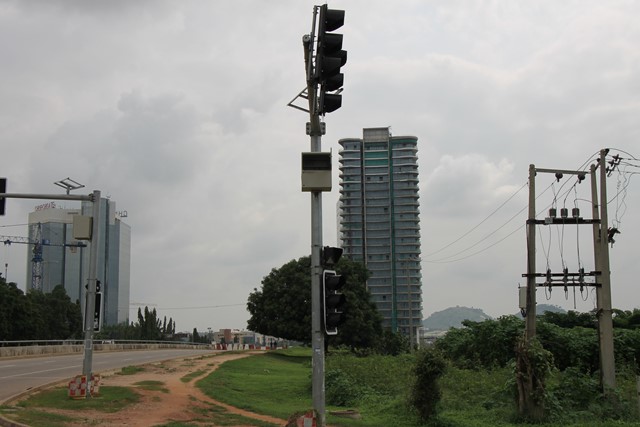
Vandalised traffic light by Church Gate, along Olusegun Obasanjo Way

Vincent Igberase, Director, Department of Traffic Management in the Transportation Secretariat of Federal Capital Territory Administration, told the ICIR that all the non-functional traffic signals were vandalised by hoodlums.

He says the vandals removed the vital components of the traffic signals, leaving only the carcass. He listed the removed parts to include the batteries, slim controllers and the solar panels.

“We have done all that is humanly possible,” Igberase says, referring to the effort to stop the vandalism. “We have written to the Police. We have contacted the Civil Defence, even to the SSS. They have been on it, trying to apprehend those behind it. But no serious arrest has been made.”

He says the traffic signals that are still functioning were part of the 76 installed by the Chinese firm in 2015, adding that the older ones have all been vandalised. The older traffic signals have the locks and the batteries close to the ground but the new ones donated by the Chinese government have the vital components fixed above on the poles, beyond the reach of anyone without a lift.

Despite this improvement to prevent vandalism, Igberase says, the new ones are now being vandalised by still-unidentified hoodlums.

“We are surprised that recently after they have vandalised all the old ones, they are attacking the new ones. We don’t know how they do it,” he laments.

The ICIR observes that the signalised intersection at Olusegun Obasanjo Way by the Church Gate is actually vandalised. The traffic light is among the ones brought by the Chinese but the lock, which is suspended above, is open with nothing inside. The battery and the controller device have been removed.

Despite the moribund traffic signals, Igberase believes that the accidents in Abuja are caused by impatience of the motorists.

“We are not patient,” Igberase says. “Even when the traffic light is working, people still beat the traffic lights. I have gone to places even where there are no traffic lights in the four-way junction. You know what they do. First come first serve. You must give way to the person that comes first. If we follow this, where will the accident occur? The problem is impatience.”

IMPATIENCE OR NON-FUNCTIONAL TRAFFIC SIGNALS
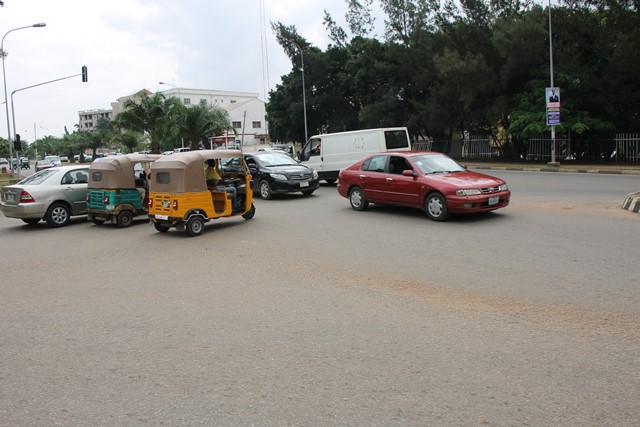
One of the junctions along Tafawa Balewa Way without a warden to control traffic

The dominant narrative is that the high rate of accidents in Abuja is caused by impatience. FRSC officials, traffic light managers and most of the motorists interviewed say the accidents occur because the drivers are impatient when they get to junctions.

However, findings by the ICIR show that the accidents are caused mainly by non-functional traffic signals. In 2015 when the traffic lights were all working, the rate of accident reduced drastically by 64 percent. But in 2016 when most of the traffic signals stopped working, the rate rose by 69 percent.

Again in the evening when the traffic wardens are no longer at the junctions to control traffic, accident increases. Likewise on weekends when most of the traffic wardens do not work at the junctions, accident rate rises.

Contrary to the belief that accidents occur mostly in the evenings and weekends, because that is when the drivers get drunk, the reason major is that the traffic wardens do not work at night and most of them do not work during weekends.

By the ICIR’s checks, only two out of the 76 fixed by the Chinese in 2015 have been vandalised. This means that the new technology can withstand vandalism. If the old technology of the traffic signals is replaced by the new technology where the vital components are suspended at the uppermost part of the poles, beyond the reach of the vandals, the problem of vandalism will be solved to a reasonable extent.

When the signalised intersections start blinking green, yellow, and red again, the rate of accidents will be reduced drastically just as it happened in 2015.

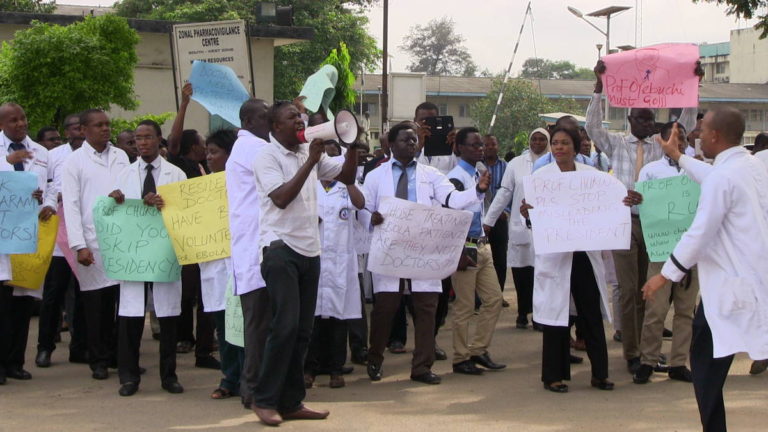
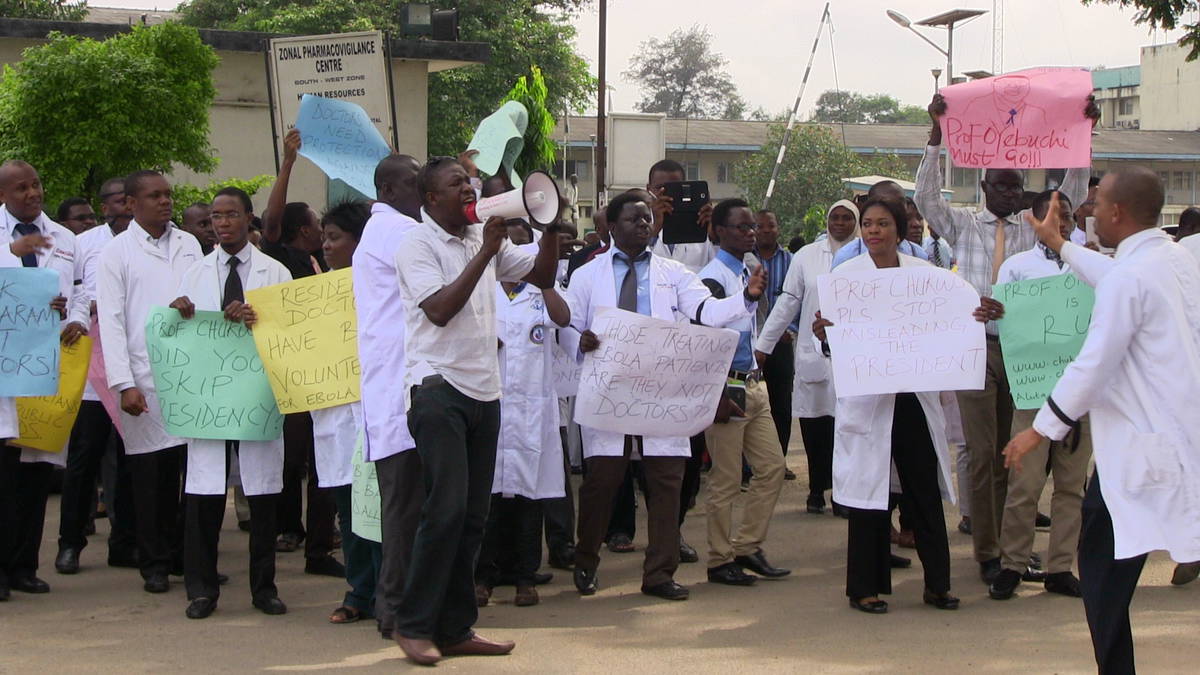
Resident doctors temporarily suspend strike — just for two weeks

The Nigerian Association of Resident Doctors (NARD) has temporarily suspended its indefinite strike for two weeks, in order to hold further discussions with the federal government.

The decision was taken at the National Executive Council (NEC) meeting of the association, which held on Wednesday night.

The strike will resume if, at the expiration of two weeks, the government has still not acceded to the doctors’ demands.

Segun Olaopa, Chairman of University College Hospital, UCH, Ibadan, chapter of NARD, explained that the suspension was influenced by outcry from the public and pleas that they should give the government more time.

Some of the demands being made by the striking doctors include: recalling of some of their sacked colleagues, payment of ‘skipping’ entitlements, inclusion in the Integrated Payroll and Personnel Information System (IPPIS) and payment of outstanding salary arrears.

So far, the federal government has agreed to pay the salary arrears and also begin the process of including resident doctors on the IPPIS platform.

According to Arikawe Adeolu, a member of the national executive council of NARD, members of the association are yet to receive their arrears.

DEADLINE EXTENDED: Essay contest for undergraduates to debate restructuring

0
Adekunle Adebajo, winner of the last edition of the contest (2nd L)

The Union of Campus Journalists (UCJ), University of Ibadan, has announced a one-month extension to the deadline for submitting entries for the 2017 edition of its annual inter-university essay contest.

Samuel Arowosafe, 30th President of the organisation, made the confirmation in a press statement emailed to the ICIR on Thursday.

Now in its third year, the contest requires participants to answer the question: ‘Is It Time To restructure Nigeria’?

The topic was arrived at in view of calls that have been mounting since the beginning of the year for the country to be restructured.

Entrants have the liberty to put forward all arguments possible, including whether restructuring is needed or not, or exactly what type of restructuring is needed — whether the needed alteration is in the country’s form of government or in the system.

Bearing in mind that even the ruling All Progressives Congress (APC) is itself unsure of what the restructuring debate represents, and recently constituted a Committee on Restructuring, participants will have no limits to which they can advance their ideas.

“The new deadline for submission is Wednesday October 10, 2017,” Arowosafe said.

“We’re not at all short of entries at this point; in fact, we have already received the record application since this contest began three years ago.

“However, we’re making this extension so that more students outside the south-west can participate, because this contest is not a UI affair but a national one.”

The inter-university essay contest is endowed by ‘Fisayo Soyombo, Editor of the ICIR, who led an executive council to stage the organisation’s first essay contest when he was UCJ President in 2007.

The winner of the contest will receive a cash prize of N100,000, while one runner-up will receive N50,000.

UCJ is the umbrella body of press organisations in halls of residence, departments, faculties and religious institutions in UI and the University College Hospital (UCH).

Founded in 1987, it has a history of producing top-class journalists, including Laolu Akande, its second President, who is now spokesman to Vice President Yemi Osinbajo.

Full details of the guidelines for the contest are available here.

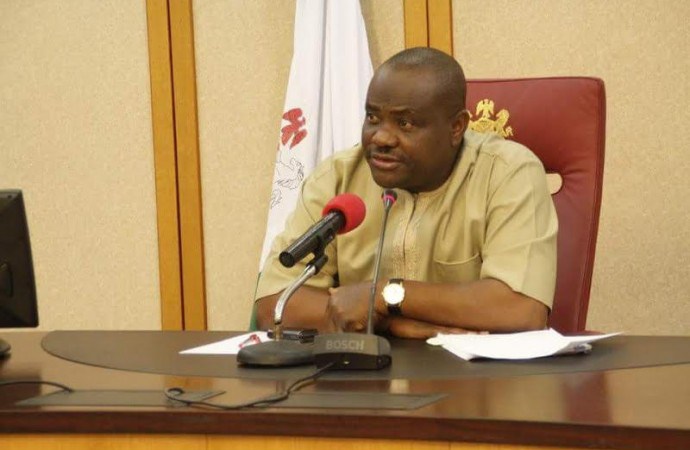
Wike: SARS policemen are the armed robbers, kidnappers in Rivers

Nyesom Wike, the Rivers State Governor, says most of the crimes committed in the state, especially armed robbery and kidnapping, are by men of the Special Anti-Robbery Squad of the Nigeria Police Force.

Wike said that an official police signal had indicted Akin Fakorede, the Rivers State SARS Commander, and his operatives, as having a hand in many of the crimes committed in the state.

Speaking with journalists in Port Harcourt, the State Capital, on Wednesday, Wike alleged that Fakorede was planted in the state to create an atmosphere of insecurity and fear.

“Most of the kidnappings and armed robbery taking place in this state are done by men of SARS,” Wike said.

“They use exhibit vehicles to operate. As the Chief Security Officer of the state, you complain, but they choose to play politics with crime.

“They fight crime in some state, but they refuse to fight crime in Rivers State. We are done with the elections, but they are using SARS to create insecurity in the state. As I speak with you, they will deny.

“But the SARS operative who was killed was amongst those who raided the Rivers East Senatorial District collation centre. This man can be identified in the video as one of those who invaded the collation centre with Fakorede.

“I have never seen a country where they politicise crime. It is very obvious that they want to give the impression that Rivers State is unsafe.

“They want to instill fear, preparatory to declaring during the elections that there are so much killings.

“Authorities deliberately trying to destroy a whole state and you want the people to be happy. I will no longer write. Now is the time to take my case to the public for the whole world to know what is happening.”

Wike said that his administration has invested heavily in security, more than any other state in the country but that the Police was working against the state.

FEC orders probe of ‘grand-scale looting’ at JAMB, NIMASA

0


After Wednesday’s weekly meeting, the Federal Executive Council (FEC) ordered the investigation of past heads of the Nigeria Maritime Administration and Safety Agency (NIMASA) and the Joint Admissions and Matriculating Board (JAMB) over massive fraud.

The council stressed that the grand scale looting that have taken place in the agencies in the past must be looked into.

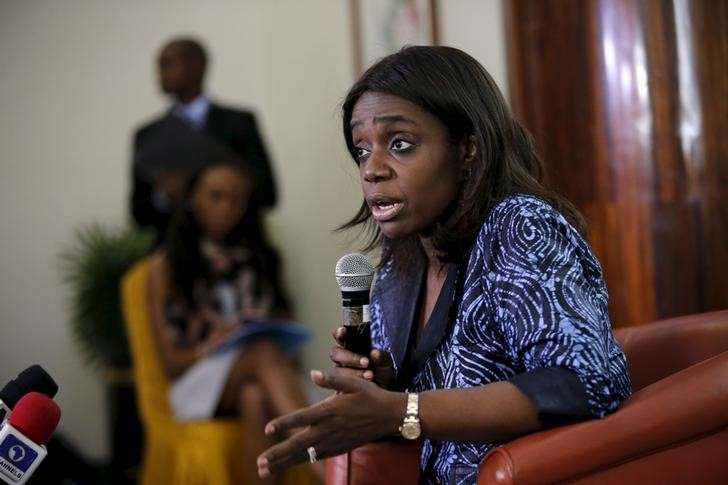
“Council felt this is unacceptable. They want to know where the monies have been going in the past,” said Kemi Adeosun, Minister of Finance while addressing State House correspondents.

“It is not that their revenue drive is different from what they have now. So council wants to know what has been happening to the monies they have been generating. It is in line with this that council has directed that we look into the books of these agencies.”

She noted that the investigation of the agencies is in furtherance of the government’s new realities of accountability and transparency.

Adeosun said the decision to probe the agencies became evident when JAMB remitted a paltry N3 million to the Federal Government’s coffers in 2015 and that in 2017 alone, the agency, without prompting, remitted a staggering N5 billion with a pledge to remit an additional N3 billion.

She maintained that the “grand scale looting in the past in these agencies” must be looked into, adding that following the fraudulent discoveries, the council has also mandated the investigation of other revenue generating agencies in the country to ascertain their level of transparency and accountability.

UN initiative bans tobacco companies from rendering help on SDGs

0

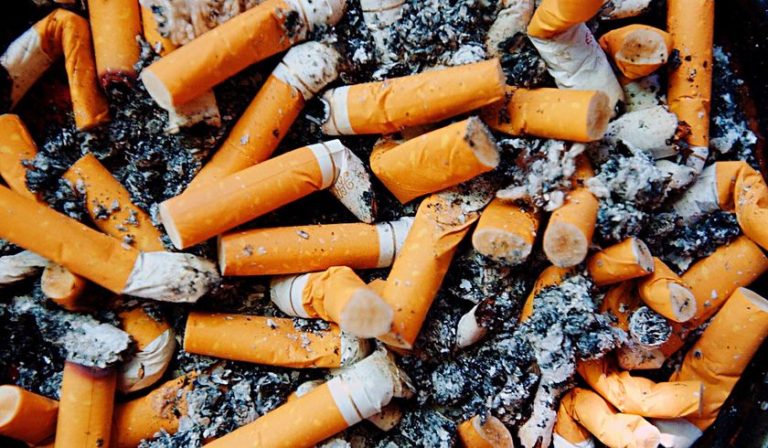
The United Nations Global Compact (UNGC) has delisted tobacco companies from participating in its initiative of involving corporate leadership to achieving the UN development goals.

UNGC, which involves the participation of over 8,000 companies and 4,000 non-business participants, disclosed in a statement on Tuesday that the exclusion of cigarette companies is to align with the policies of the broader UN system.

The statement announced that companies in certain high-risk sectors, such as the production and manufacture of tobacco products, nuclear, chemical, or biological weapons will be excluded from the initiative.

Part of the statement reads: “Participating companies whose business involves manufacturing or producing tobacco products will be delisted effective 15 October 2017.

“Likewise, companies involved in the sale, production, manufacturing, possession, distribution and/or transport of nuclear, chemical or biological weapons will be delisted.”

Companies involved in the production of landmines and cluster bombs were previously excluded.

Some of the affected tobacco companies are Philip Morris International and British America Tobacco.

Reacting to this development, Matthew Myers, President of the Campaign for Tobacco-Free Kids, said: “The announcement from the UNGC is a positive step for global public health because it prevents tobacco companies from burnishing their public image through association with credible organizations like the United Nations.”

Myers, who applauded the new measures, said the tobacco companies should be ashamed for undermining public health.

“The announcement properly places the tobacco industry in shameful company,” he said. “The only businesses in the world now banned from UNGC participation are those associated with the production of landmines, chemical, nuclear and biological weapons.”

He pointed out that Tobacco use is the world’s leading cause of preventable death and is projected to claim one billion lives this century unless countries take strong action to prevent it.

Myers urged UNGC to take any necessary additional steps to remove all associations or organizations representing the tobacco industry from the initiative – including from its board of directors.

“Along with the UNGC, institutions throughout the United Nations system should adopt policies to insulate themselves from the influence of the tobacco industry,” he added.

“Such policies would be in line with the World Health Organization Framework Convention on Tobacco Control, a public health treaty that obligates its 181 parties to implement strong tobacco control measures and ensure that public health policies are free from the interference of tobacco companies.

He said the UNGC announcement should serve as an example to governments, other businesses, and public-private partnerships currently engaged with tobacco companies as tobacco companies deceptively use a wide range of tactics to legitimize themselves to build goodwill to sell their deadly products.

“Unless more organisations act to isolate tobacco companies by refusing their membership or participation, the tobacco industry will continue to wield enormous influence around the world, undermine life-saving public health policies and recruit new smokers into a lifetime of addiction,” Myers said.


‘Proceeds of crime’…EFCC asks court to strip Patience Jonathan of N8bn property


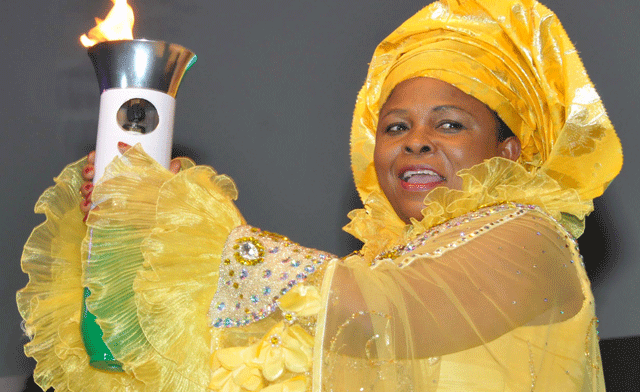
The Economic and Financial Crimes Commission (EFCC) has filed a court application asking for the interim forfeiture of two property allegedly belonging to Patience Jonathan, wife of Goodluck Jonathan, former President.

One of the property, which the EFCC described as a “magnificent architectural edifice”, is an uncompleted eight-storeyed building located at the central business district in the heart of Abuja.

Though the commission said it hadn’t obtained the appropriate value of the property, it is estimated that the amount should be in the neighbourhood of N6billion.

According to court documents, the building was acquired by Patience through Aribawa Aurera Reach-Out Foundation, a non-governmental organisation that she allegedly owns.

The EFCC said chances are high that the building was constructed using proceeds of crime, as the suspected owner, Patience, was a mere Permanent Secretary and could not have afforded such a building.

“Inference may be drawn from investigation that the suspect’s (Patience) last known official position was Permanent Secretary in Bayelsa State. Hence, there is no way such magnificent architectural edifices could have been built within a short space of time,” the documents read.

“There is a high probability that it could have been built with the proceeds of crime. It is evidently clear that it is a case of money laundering but there is a need to do more investigation.”

The EFCC said it had written to the Corporate Affairs Commission (CAC), asking for the identities of the directors of the foundation. Another letter was written to the Abuja Geographical Information System to ascertain how and when the property was bought.

Yet another letter was written to eight banks: Skye Bank, Fidelity Bank, First Bank, Union Bank, Guaranty Trust Bank, Zenith Bank, United Bank for Africa and Unity Bank to provide relevant information on the investigation.

The second property, which the EFCC wants forfeited to the Federal Government, is a luxury hotel located at the Mabushi area of Abuja.

Valued at about N2bn, the property was once marked for investigation by the EFCC, but the inscription was wiped off.

“In view of the foregoing, I request for an interim forfeiture order on the two properties amongst others linked to the suspect and believed to have been acquired from the proceeds of crime,” the EFCC stated.

“This is particularly very important because attempts to mark the property were resisted and even the portion that was successfully marked was later cleaned off by the agents of the suspect.”

The EFCC also said it had traced three other property in the Karsana, Wasa and Idogwari areas of the Federal Capital Territory, Abuja, to Patience.

Documents from the Abuja Geographical Information System (AGIS) show that the property were bought in the names Finchley Top Homes Ltd. and AM-PM Network Limited.

Already, the bank accounts of Finchley Top Homes Limited, a company that was also traced to Patience, had been frozen by the EFCC months ago.

However, Ifedayo Adedipe, a Senior Advocate of Nigeria and counsel to Patience, said he was unaware of the fresh application filed by the EFCC, adding that his client was being witch-hunted.

He said that if the reports were true, then the EFCC was violating court processes as it has a pending case at the Court Appeal challenging the interim forfeiture of Patience’s assets.

“I am not aware of any of these but we are in court over the freezing of her accounts and that case is at the Court of Appeal level and we have a fundamental human rights’ charge against them in court,” Adedipe said.

“My thinking is that the EFCC, which says nobody is above the law, should have waited for the judiciary to finish its process. In my humble opinion, it appears they are abusing judicial powers.

“When you file something today, tomorrow you file another. Why not put everything in one pot? That is why they lose cases.

“Why are they focusing on Mrs. Jonathan who was neither a minister nor a government official? I’m not saying people should steal but it may seem she is being persecuted for her active role in the last election.”

In April this year, a Federal High Court in Lagos ordered a temporal forfeiture of $5.8 million also belonging to Patience Jonathan, after the EFCC said the money was suspected to proceeds of crime.

The case is now at the Court of Appeal.

Health workers declare strike action ‘worse than Operation Python Dance’

0


As the Federal Government struggles to negotiate with members of National Association Resident Doctors (NARD) who are currently on strike, the Joint Health Sector Unions (JOHESU) has directed its members to commence their own industrial action from Wednesday September 20.

The union said its members would embark on ‘Operation Alligator Bite’ if the Federal Government fails to attend to their grievances.

It said the strike would be more dangerous than the Python Dance declared by the army in the south-east.

Meanwhile, Chris Ngige, Minister of Labour and Employment, and the Association of Senior Servants of Nigeria have agreed to temporarily put off their strike notice until next Wednesday.

In a statement issued Tuesday night by Samuel Olowokere, Deputy Director (Press), Ministry of Labour and Employment,  Ngige said the action is to enable the government commence the payment of pending promotion arrears.

He said: “Among others, the meeting agreed that 30 Ministries, Departments and Agencies (MDA) that the office of the Accountant General of the Federation reported having cleared their allowances, amounting to N1.165 billion should start to receive credit of payment to their account by September 20, 2017.

“It also agreed the office of the Accountant General of the Federation should also provide the list of the 30 MDAs in reference to the office of the Minister of Labour and Employment by September 13, 2017.”

Ngige said the conciliation meeting further set up a seven-man committee to be chaired by the Permanent Secretary of the Federal Ministry of Labour, with three members each drawn from the government negotiating team and the labour association respectively to oversee the implementation of the decisions.


Trees, animals dying, as spill from Shell’s oil field devastates Bayelsa community

Residents of Tambiri I and II in Tein community, Yenagoa Local Government Area of Bayelsa State, are demanding that Shell should clean up their community after a leak from one of the oil fields operated by the company.

Large volumes of crude were discharged into the environment from the Shell-operated oil field on August 11, and the community alleged that the oil spill and subsequent pollution of the surrounding area was caused by equipment failure.

But Precious Okolobo, Shell’s Media Relations Manager, released a brief statement claiming that the said well “has not been producing oil”.

However, the Environmental Rights Action/Friends of the Earth Nigeria (ERA/FoEN), a Non-Governmental Organisation, said it conducted an impact analysis on the oil field and released a report that confirmed Shell’s culpability.

Alagoa Morris, Head of Field Operation of the organisation, advised the oil company to first pay a visit to the oil site rather than dismiss the report.

“The shrubs and immediate environment of the wellhead (about 10 meters away) tells the tale that a toxic substance sprayed into the air and they bear testimony,” Morris stated in his report.

“No aquatic life, including other animals, would remain in such a heavily-polluted environment,.

“They will die or migrate to other places. A visit to this environment in three months may present an environment with dead trees and shrubs.”

The ERA/FoEN also condemned a “purported” joint investigation that was said to have been carried out on the sight by without any representative from the community.

It called on the Bayelsa State Ministry of Environment, National Oil Spills Detection and Response Agency (NOSDRA) and other oil and gas industry regulators to ensure a transparent resolution of the oil spillage issues.

The group also recommended that Shell should carry out recovery of spilled crude, clean up the impacted site “in the interest of the environment”.

It also advised residents of the community to remain peaceful while they take all necessary steps to get the oil spillage resolved.

I inherited an ICPC without identity, says Nta as he bows out

0

Ekpo Nta, immediate past Chairman of Independent Corrupt Practices and Other Related Offences Commission (ICPC), says he took over the reins of the anti-corruption commission when it had a crisis of identity.

He said the ICPC was floating between being a law enforcement and civil service organisation, which was worsened by the commission’s dilapidated physical structure.

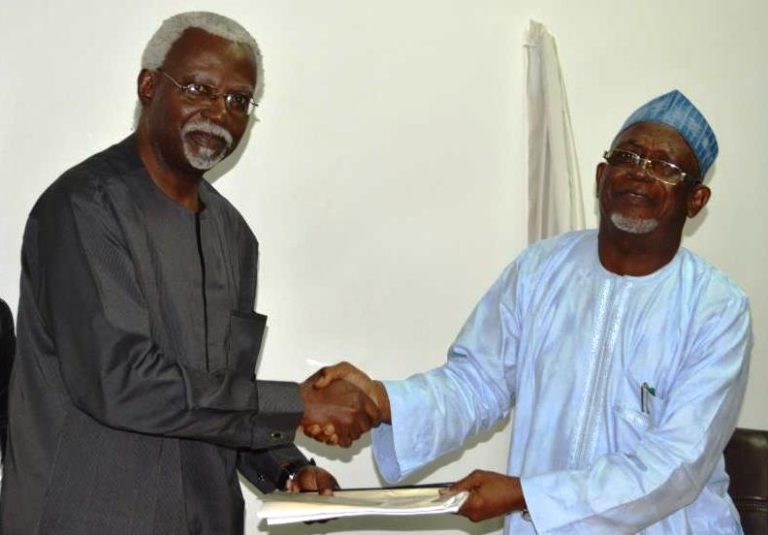
Nta stated this during his handover ceremony after serving six years as ICPC Chairman.

He handed over to Abdullahi Bako, a board member of the commission, who would be acting pending Bolaji Owasanoye’s assumption of duty subject to confirmation by the Senate.

While noting that the situation dampened his enthusiasm, he added that it spurred him into picking up the challenge of not leaving the commission the way he met it.

He disclosed that the first task before him and his board members was to rightfully place ICPC where it belonged, based on the commission’s enabling law,

He highlighted his achievements to include a high rate of investigation and prosecution of corruption cases, the introduction of preventive measures to check corruption in Ministries, Departments and Agencies (MDAs), and the spike in publicity for the commission’s activities on its website and in the media.

Other achievements were listed as publishing of three volumes of ICPC law reports, improving the staff clinic to cater to the health of suspects in the commission’s custody, as well as the intervention and support by UNODC for the Commission’s work.

He commended the management committee and staff of the commission for “a wonderful working period”, stating that the commission’s staff were intellectuals who usually stood out at trainings and workshops featuring participants from other organisations.

Abdullahi Bako, the Acting Chairman, acknowledged that Nta had done a lot to project a positive image for the Commission.

He noted that the achievements made Nta, as ICPC Chairman, to be the first African to be appointed a board member of the International Anti-Corruption Academy (IACA), Vienna, Austria.

Bako pleaded for the support of the management within the period he would act as Chairman while urging all staff to continue to be disciplined, and build on what they had learnt from the out-gone Chairman by striving for excellence.

Ekpo Nta was appointed Acting Chairman of ICPC by former President Goodluck Jonathan at the swearing-in ceremony of the Commission’s Board Members in November 2011, before he became the substantive Chairman in 2012 for a period of five years.

Bako, the Acting Chairman, is a current two-term member of the ICPC Board.

He is a lawyer, Notary Public and Fellow of Charted Institute of Arbitration, who represents the north-east geopolitical zone and was first appointed an ICPC board member in 2009.