Home Blog Page 2715

ASUU, the Academic Strike Union of Universities!

0

ASUU 2

BY ‘FISAYO SOYOMBO

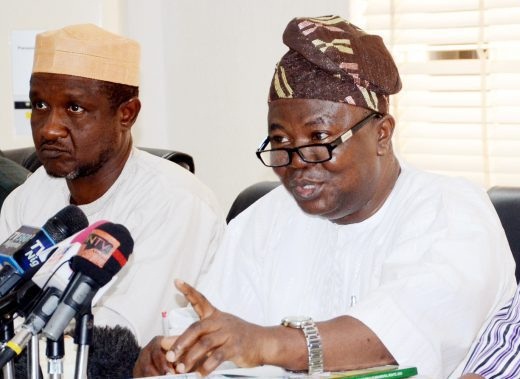
Whenever the Academic Staff Union of Universities (ASUU) convenes a press conference, journalists can already reel off the top three agendas. One, strike. Two industrial action. Three, the downing of tools. Of course, the agendas are never written out this way, but whatever is up for discussion is all semantics. ASUU has become so boringly predictable in its method of agitation that the students for whom it claims to be fighting could someday rebel against it, and the government it seeks to embarrass could someday call its bluff. This is not an exaggeration.

In July, after the killing and abduction of some University of Maiduguri UNIMAID lecturers as part of a wider oil exploration team attacked in Borno State by Boko Haram, ASUU threatened to go on strike.

“Our union is no doubt saddened by the UNIMAID incident,” Biodun Ogunyemi, President of the union and Professor at the Department of Curriculum Studies and Instructional Technology, Olabisi Onabanjo University (OOU), told the media. “We have told the government to take the necessary steps and get our members in captivity released or else, we may be forced to call out our members.”

Never mind that on August 14, when the ASUU addressed a press conference to officially commence its latest industrial action, no single mention was made of the abducted UNIMAID lecturers. Instead ASUU listed five issues: funding for revitalisation of public universities, Earned Academic Allowances (EAA), pension, university staff schools, and unpaid salaries.

OPPORTUNISTIC ASUU

Truly, the Nigerian public tertiary education system is in a mess. In many universities, learning facilities are inadequate and obsolete, lecturers are overworked and the best of them continue seeking greener pastures abroad, hostel accommodation for students are shabby. Generally, universities are operating beyond their carrying capacities, consequently breeding systems where frustrated lecturers are dealing with disenchanted students. The end result, as expected, is a chaotic society as ours, where competence and integrity are usually mutually exclusive.

At the start of the latest industrial action, Ogunyemi declared: “To have public universities that will be pride of all, to secure the future of our children and their own children’s future, and to lay the foundation for a university system capable of producing a country of our dream, we must make the federal and state governments implement the provision of the 2009 Agreement, the MoU of 2013 and the understanding reached in November 2016.”

However, the content of this 2009 agreement and the conduct of university managers in recent years are in dissonance with ASUU’s much vaunted slogans of creating “universities that will be pride for all”, “securing the future of our children” and establishing universities “capable of producing a country of our dream”. Let’s travel back a decade to ASUU’s demands from the federal government.

REVISITING THE 2009 AGREEMENT

In January 2007 when the federal government team led by Gamaliel Onosode and that of ASUU led by then President Abdullahi Sule-Kano began meeting to renegotiate the 2001 agreement, the terms of reference for the resultant committee were to: (i) reverse the decay in the university system, in order to reposition it for greater responsibilities in national development; (ii) reverse the brain drain, not only by enhancing the remuneration of academic staff, but also by disengaging them from the encumbrances of a unified civil service wage structure; (iii) restore Nigerian universities, through immediate, massive and sustained financial intervention; and (iv) ensure genuine university autonomy and academic freedom.

However, when ASUU listed the issues for negotiation, they were: (i) conditions of service, (ii) funding, (iii) university autonomy and academic freedom, and (iv) other matters.

First observation, “condition of service” — candidly put, “salary upgrade” — cannot constitute the most important step in “reversing the decay in the university system”. It is worrisome that ASUU treasured condition of service over infrastructure upgrade.

ASUU and FG agreed to have a “separate salary structure for university academic staff” which would see a lecturer earn as much as N7.5m per annum. They reached an agreement on Earned Academic Allowances (EAA), with assistant lecturers to receive N15,000 per student per annum, senior lecturers N20,000, and readers and professors N25,000 as postgraduate supervision allowance; the lecturers can receive the payments for up to five students. Added with other allowances — for teaching practice/industrial supervision/field trip, honoraria for internal/external examiner (postgraduate thesis), and honoraria for external moderation of undergraduate and postgraduate examinations — a lecturer can make up to N580,000 per annum in earned allowances.

There is N200,000 for external assessors of candidates for the position of Reader or Professor, plus a Responsibility Allowance that sees Hall Wardens receive N150,000 per annum and Vice Chancellors/Deputy Vice Chancellors/Librarians receive N750,000. A list of other non-salary benefits includes improved proposals for vehicle loan/car refurbishing loan, housing loan, research leave, sabbatical leave, annual leave, sick leave, maternity leave and injury pension.

To be clear, I do not support arguments in some quarters that ASUU’s remunerative demands are unreasonable. ASUU — and indeed any other labour union — reserves the rights to propose whatever conditions it considers most effective for motivating its members for optimum job performance.  But there is a problem: while ASUU agrees to be disengaged from the encumbrances of a unified civil service wage structure, it goes on to demand that whenever there is a general increase in public sector salaries and allowances, the remuneration of academic staff shall be correspondingly increased. Simply put, ASUU wants to eat its cake and have it.

In the 2009 agreement, ASUU ensures that the renegotiation team agrees to its salary demands but as soon as discussion shifts to other matters, the team only recommends. And so, on matters involving the Education Tax Fund, Joint Admissions and Matriculation Board (JAMB), amendment of the National Universities Commission Act (2004), and funding of universities, which are major institutional channels for reforming education, what ASUU does is to recommend, agree to recommend or project.

ASUU COMPLICIT IN THE ROT

Make no mistake about this: the number-one reason ASUU is currently on strike is that it wants N825bn from the government, being the accumulation of yearly release of funds to universities as contained in the 2009 agreement. Based on the 2013 MoU, FG was to release N200bn to universities in 2013, and N220bn every year till 2018. By now, N1.3trn should have been released in all but so far only N475bn has. Blame the government! An agreement is sacrosanct regardless of which government signed it.

But there is a question ASUU has failed to answer. What happened to the N475bn released so far? The best-kept secret on university campuses is that vice chancellors saw so much money between 2013 and 2015 that they were scared; the bulk of it was mismanaged and embezzled. White-elephant projects sprang up all over, and at costs that were not commensurate with the result. When Kunle Adebajo, a student of the university wrote about such needless projects last year, UI authorities threatened the young man with rustication. The period also marked the rise in the recruitment of ghost workers and under-declaration of internally-generated revenue. This kind of corruption among university administrators is nationwide, yet ASUU, despite its preponderant influence, has done nothing to restrain errant VCs.

Also, who are the people frustrating the FG’s efforts to audit previous release of funds to universities? ASUU should be interested. The government released N23bn EAA to universities in December and has insisted further release must be preceded by an audit of that tranche, but it’s a conversation that ASUU is uninterested in.

ASUU is a part of a growing university culture of gagging student unionism. ASUU was vociferous in its criticism of Governor Yahaya Bello’s recent ban of the academic union in Kogi State, but the same ASUU has been mum since May, when VC Idowu Olayinka proscribed student unionism in UI. It’s just hypocritical for ASUU to continue holding government accountable to education yet subscribe to Olayinka’s view that management cannot be held to account by students.

‘ACADEMIC’ UNIONISM SHOULD BE MORE THAN STRIKES

ASUU’s mode of agitation is blighted by a number of fallacies: that all the problems with university education will be solved by funding, and all the funding must come in the form of government handouts; that lecturers are more important than other professionals and so should operate at a level beyond their society.

The last, for example, is responsible for ASUU’s demand for exemption from the FG’s TSA policy. TSA is not an angelic policy. While it no doubts help to reduce profligacy in public offices, it can also slow down the pace of governance. It is far nobler for ASUU to present arguments against the general implementation of the policy than to obstinately demand the exclusion of universities. In any case, TSA has handicapped universities to spend money at will and without gauge; at the moment, this looks like ASU’s grouse.

ASUU claims that TSA has hampered research in universities. But Abdullahi Baffa, Executive Seretary of TETFUND, said earlier in the month that since the establishment of TETFUND in 2009 with the seed fund of N3bn plus an additional N1bn in 2016 to beef up the intervention, only N1.72bn had so far been disbursed to finance researches in different thematic areas due to the low quality of research proposals. That’s at least N2.28bn still unexplored by, and ASUU doesn’t seem to be noticing.

If ASUU is truly interested in the emergence of “the country of our dreams”, it must stop using students as cannon fodders while fighting for the pockets of its members. It must lead the students by example — by being a bastion of probity, accountability, tolerance for dissent, and proffering robust, intellectually-driven and empirically-backed solutions to Nigeria’s tertiary education woes. Other than that, ASUU risks being seen by all, including undergraduates, as a union of strikers rather than a union of academics.
In six months, governors received N760.18bn Paris Club refund ‘to pay workers’ salaries’

Governors

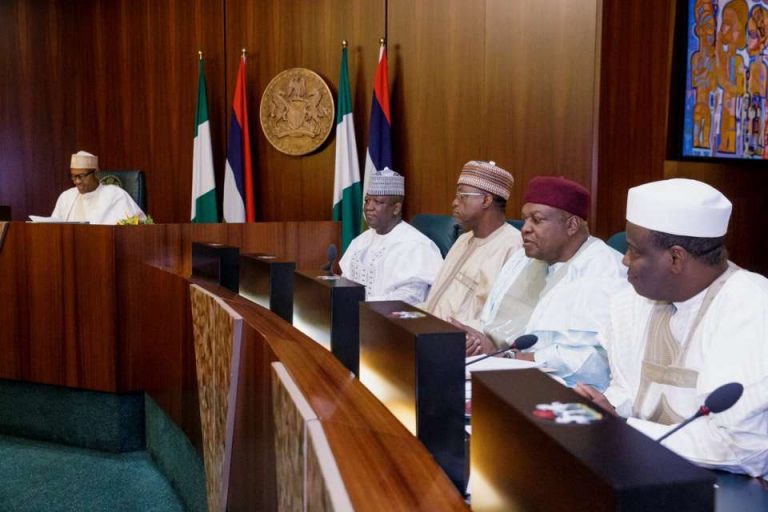
The federal government released N760.18bn Paris Club debt refund to 36 states and the Federal Capital Territory (FCT) in the first six months of the year, it has been revealed.

According to the latest Quarterly Review NEITI Quarterly Review of the Nigeria Extractive Industries Transparency Initiative (NEITI), which focuses on disbursement from the Federation Accounts and Allocation Committee (FAAC), the money, paid in two tranches, represents refunds of over-deductions from FAAC allocations to states and local governments used for quick payment of debt relief granted to Nigeria by the Paris Club between 1995 and 2002.

The report disclosed that Rivers State received the highest amount of N44.93bn, followed by Delta with N37.61bn and Akwa Ibom N35.98bn. Bayelsa got N34.9bn while Kano received  N31.74bn. The FCT received the lowest amount, N2.05bn.

“The Federal Ministry of Finance stressed that the Paris Club releases should be used largely by the states for the payment of workers’ salaries, welfare, and pensions which may have been pending since 2014,” NEITI said in the publication.

The publication also revealed that within the first three months of the year, Nigeria spent a total of N513bn billion on debt servicing — a figure that represents 40.27 percent of all the allocations shared by federal, state and local governments within the same period.

It noted that the nation’s debt in relation to revenues appears to have reached critical levels, as domestic debt servicing constituted 90 per cent of total debt servicing.

“Domestic debt servicing consistently outstrips external debt servicing,” it said. “In the first quarter of 2015, domestic debt servicing made up over 93 per cent of total debt servicing. This figure did not change much by the first quarter of 2017 as domestic debt servicing was over 92 per cent of total debt servicing.”

The report suggested that subsequent debt servicing may not be as much higher as the first quarter of this year.

“The figure reveals that debt servicing as proportion of total FAAC allocations is generally higher in the first quarter of the year, after which it falls to lower levels,” it said.

“Based on this, the figure of 40.27 per cent observed in the first quarter of 2017 might be an upper threshold and it would thus be expected that this figure will be lower for the remaining quarters of the year.”

THREAT TO BUDGET IMPLEMENTATION

While 40.27 per cent of the Federal Account Allocation Committee (FAAC) disbursement has been spent in debt servicing within the first quarter, the three tiers of government have faced a 40.67 per cent shortfall in revenue.

According to the report, the expected FAAC disbursement for the three tiers of government was N4.7 trillion while the actual FAAC disbursement to them was N2.788trillion, representing a shortfall of over 40.67 per cent.

The report notes that the poor revenue generation will derail the implementation of the 2017 budget.

“The volatility nature of disbursements to all tiers of government in the first half of 2017 would suggest difficulty in implementing budgets at Federal, State and Local government levels,” the report said.

“The volatility in revenue inflows will adversely affect planning and expenditure of government and thus likely hamper efforts at stimulating growth and development.”

The report explained that the revenue shortfall was triggered by low crude oil prices and the country’s inability to meet its production benchmark.

“Coupled with the low price of oil is the country’s difficulty in meeting the targeted/budgeted production rate of 2.2 million barrels per day,” it said. “Production has consistently fallen below two million barrels per day since March 2016. Thus the double ‘whammy’ of low oil prices and lower production that hit the country since 2014 has remained.”

According to the report, the three tiers of government shared N2.788 trillion between January and June this year, a 38% increase on the N2.019trn shared in the first half of 2016.

“Out of N2.788 trillion disbursed in the first half of 2017, the Federal Government received N1.09 trillion, 36 state governments received N923 billion while N549.8 billion went to 774 local governments in the country.

“A further  breakdown  shows that total releases to the three tiers of government was N430.16 billion in January, N514 billion in February, N496.40 billion in March, N418.82 billion in April, N418.82 billion in May and N462.36 billion  in  June.”


READ ALSO:

‘Brave heart’, ‘stellar till the end’… Twitter remembers Stella Adadevoh three years on

Ameyo-Stella-Adadevoh

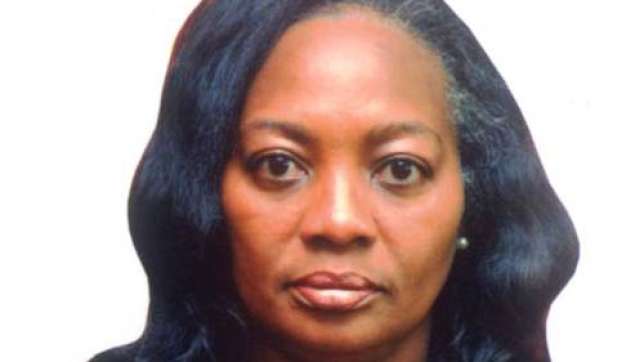
The arrival of President Muhammadu Buhari on Saturday almost quietened what some Nigerians believe should have been be a national celebration. Three years ago, on August 19, was the death of Stella Adadevoh, the medical doctor to whom the entire nation should be grateful for not being destroyed by Ebola Virus Disease (EVD).

Adadevoh contracted the virus herself after preventing Patrick Sawyer, the Liberian man who had brought it into the country, from leaving the hospital facility.

Sawyer pushed all he could to be quickly discharged so he could attend an ECOWAS convention in Calabar, but Adadevoh vehemently refused. Instead, she triggered an incident committee that continued to study his symptoms, conducted tests and eventually detected it was Ebola.

Had Adadevoh released Sawyer, Lagos and the rest of Nigeria would have been in trouble, but she and at least two other staff of First Consultants Medical Centre who came in contact with Sawyer paid the ultimate price so the rest of us will live.

However, despite the “bigger” news of Buhari’s return from London, many Nigerians, including top serving and former government officials, took to the social media to celebrate the “stellar” Stella Adadevoh.

Here are some of the posts:

Falana’s law on socioeconomic rights: Rethinking hierarchies of human rights in Nigeria

0

Femi-Falana

By Kolawole Olaniyan

It’s frequently claimed that human rights — civil, political, economic, social and cultural rights — are indivisible, and the international community has declared the indivisibility, inter-dependency, and inter-relatedness of these rights to be beyond dispute. Yet in practice socioeconomic rights remain largely neglected and ‘marginalized.’ Violations of civil and political rights attract much more attention than violations of their socioeconomic and cultural counterparts.

In this comprehensive and incisive book, Femi Falana SAN sets out to examine the legal treatment of socioeconomic rights in Nigeria, and the broader context in which the rights are defined, understood, interpreted and implemented. As the book makes clear, the lack of constitutional recognition of socioeconomic rights has continued to rob Nigerians of “one major instrument for monitoring and controlling the conduct of those making public decisions on their behalf.” Indeed, the framers of Nigeria’s constitutions have historically failed to take human dignity seriously.

The 320-page book also highlights the contemporary challenges obstructing the legal protection and enjoyment of these rights in the country. The book challenges the notion that socioeconomic rights are not legally enforceable human rights, and sets out the trends in the justiciability of the fundamental objectives and directive principles of state policy enshrined in Chapter II of the 1999 Nigerian Constitution (as amended).

Human rights discourse in Africa, its preface explained, has been “exploited by different groups at different historical epochs to advance their class interests.” The author makes clear that “the British government during colonial era failed to embrace the notion of universality and indivisibility of human rights”, to the point that the human rights of the people were observed more in the breach than in their observance.

Although the British government subsequently ensured that fundamental rights became a central feature of the Independence Constitution of 1960, the move was merely to “secure the liberty of aliens and protect the economic interests of foreign governments and companies operating in Nigeria.” Nonetheless, Falana traces the progress that has since been made through constitutional development stages, starting with the recommendations in 1975 of the Constitutional Drafting Committee to include “Fundamental Objectives and Directive Principles of State Policy” in the 1979 Constitution and subsequent constitutions.

However, the ‘marginalization’ of socioeconomic rights continued because “the ruling class ensured that only civil and political rights were included in chapter 4 of the Constitution as justiciable”, thus leaving the victims of violations of socioeconomic rights without access to effective remedies.

To map and mirror this gradual evolution of laws and progressive judicial decisions on socioeconomic rights in Nigeria, the book offers a comprehensive and nuanced account of specific socioeconomic rights, their legal and jurisprudential context and how they have been and might be deployed.

Following the Introduction, there are twelve chapters, arranged thematically and addressing topical socioeconomic rights issues such as the right to health; to education, and to work. Each chapter cleverly analyses the contents of specific socioeconomic rights and corresponding obligations of Nigeria to protect, respect, promote and fulfil the rights. Each chapter is very thorough in its approach to the topic under discussion, analysing and unpacking several applicable laws, treaties, and buttressing them with decided cases and opinions of scholars.

Issues relating to the legal protection of the human rights of women, children and people living with disability are also thoroughly examined. In a bravura display of scholarship, he demolishes the notion of ‘hierarchies of human rights’ and the arguments that socioeconomic rights are not justiciable, convincingly making the case for the universality and indivisibility of all human rights.

The book’s outstanding contribution lies in its detailed examination of several legislation and case-law (that are not easily found) relevant to the legal enforcement of socioeconomic rights in Nigeria. Falana’s range is impressively wide. He takes us from the analysis of largely non-justiciable constitutional provisions on socioeconomic rights, through the commendable array of legislation in the field, to Nigeria’s acceptance and ratification of international and regional standards such as the International Covenant on Economic, Social and Cultural Rights and the African Charter on Human and Peoples’ Rights.

Along the way he shows how judicial attitudes slowly evolved from ambivalence and rejection of socioeconomic rights as human rights, to acceptance of the rights, and progressive pronouncements by local and regional courts. The key argument of the book is that despite these shifts and positive changes, much more must be done to “enhance the development of the contents of economic, social and cultural rights by the courts and regional and international human rights bodies”, if only to overcome “prejudices against these rights.”

Furthermore, Falana points to the need for Nigeria to ratify the Optional Protocol to the International Covenant on Economic, Social and Cultural Rights, which allows individuals and groups whose socioeconomic rights are violated to access international accountability mechanism in the form of the Committee on Economic, Social and Cultural Rights, and advocates consistent use of public interest litigation to promote legal reforms and “grant victims access to effective remedies and make Chapter II of the 1999 Constitution [as amended] and applicable treaties a living and daily reality for the disadvantaged and vulnerable sector of the population.”

But these will count for nothing unless the government plays its own part “by making sure that decisions and judgments of courts relating to economic and social rights are fully and effectively implemented.” This recommendation is important, especially given the rather depressingly low record of the government’s compliance with judgments of local and regional courts and decisions of international human rights bodies.

The book includes five appendices: a snapshot of the socioeconomic rights guaranteed by the African Charter on Human and Peoples’ Rights (Ratification and Enforcement) Act and Chapter II of the Nigerian Constitution; a plethora of applicable national legislation that are not easily found, as well as international human rights and labour treaties to which Nigeria is a state party. A comprehensive list of bibliography and an excellent index round out this first-class work.

Overall, the book undoubtedly makes a profound contribution to the jurisprudence on the justiciability and legal enforcement of socioeconomic rights in the country. The breadth and depth of Falana’s work contributes substantially to answering the myriad of questions raised and left unanswered by the absence of constitutional recognition of socioeconomic rights in Nigeria.

Falana performs a formidable service by providing such an insightful synthesis of the most important elements of the emerging jurisprudence — both national and international — on socioeconomic rights, and highlighting the need for the application of constitutional and legal principles to achieve the full enjoyment of these human rights, particularly by the most vulnerable and marginalized sectors of the population.

The book’s lasting value will, no doubt, be attributed to its analysis of topical human rights issues such as the right to a safe environment; to residency and movement of persons; to control of natural resources; to an accountable government; to security and welfare.

This book is timely, as there’s increasing interest among Nigerians (as there’s elsewhere) in the stronger protection of socioeconomic rights, which are vital to the survival, dignity, and prosperity of everyone. The enjoyment of such rights is indeed necessary to eliminate the causes of poverty and other threats to national peace and security.

Falana’s work provides a welcome break from the orthodox literature on human rights. The book is well-researched and well-written, thus making it easily accessible to legal practitioners, scholars, human rights defenders, and law students for whom it should become an essential companion.

It’s no exaggeration to say that the book will change the way socioeconomic rights are understood in Nigeria.

Olaniyan, PhD is the author of ‘Corruption and Human Rights Law in Africa’

VIDEO: Buhari back in Aso Rock after returning from London

0

IMG_20170819_181129

President Muhammadu Buhari has arrived the Aso Rock presidential villa, after returning to the country from London on Saturday.

He was received Yemi Osinbajo, Acting President, and other key officials of his government.

Watch the video below:

UPDATED: Buhari arrives in Nigeria after 103 days in the UK

0


Yemi Osinbajo Muhammadu Buhari

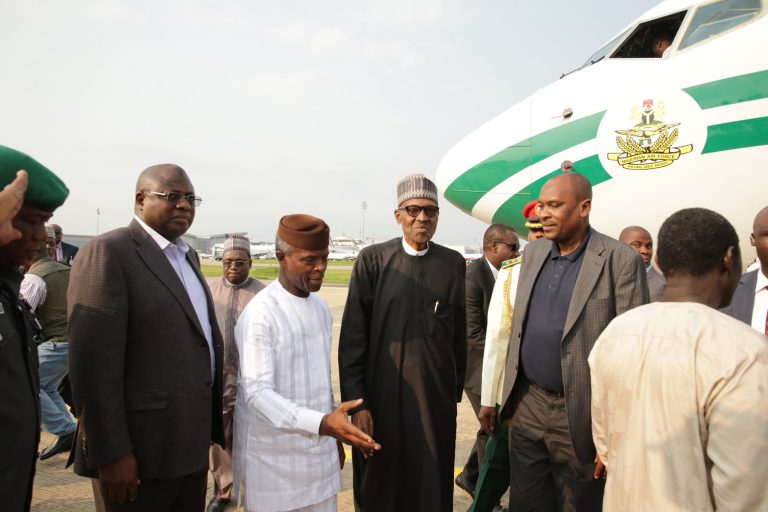
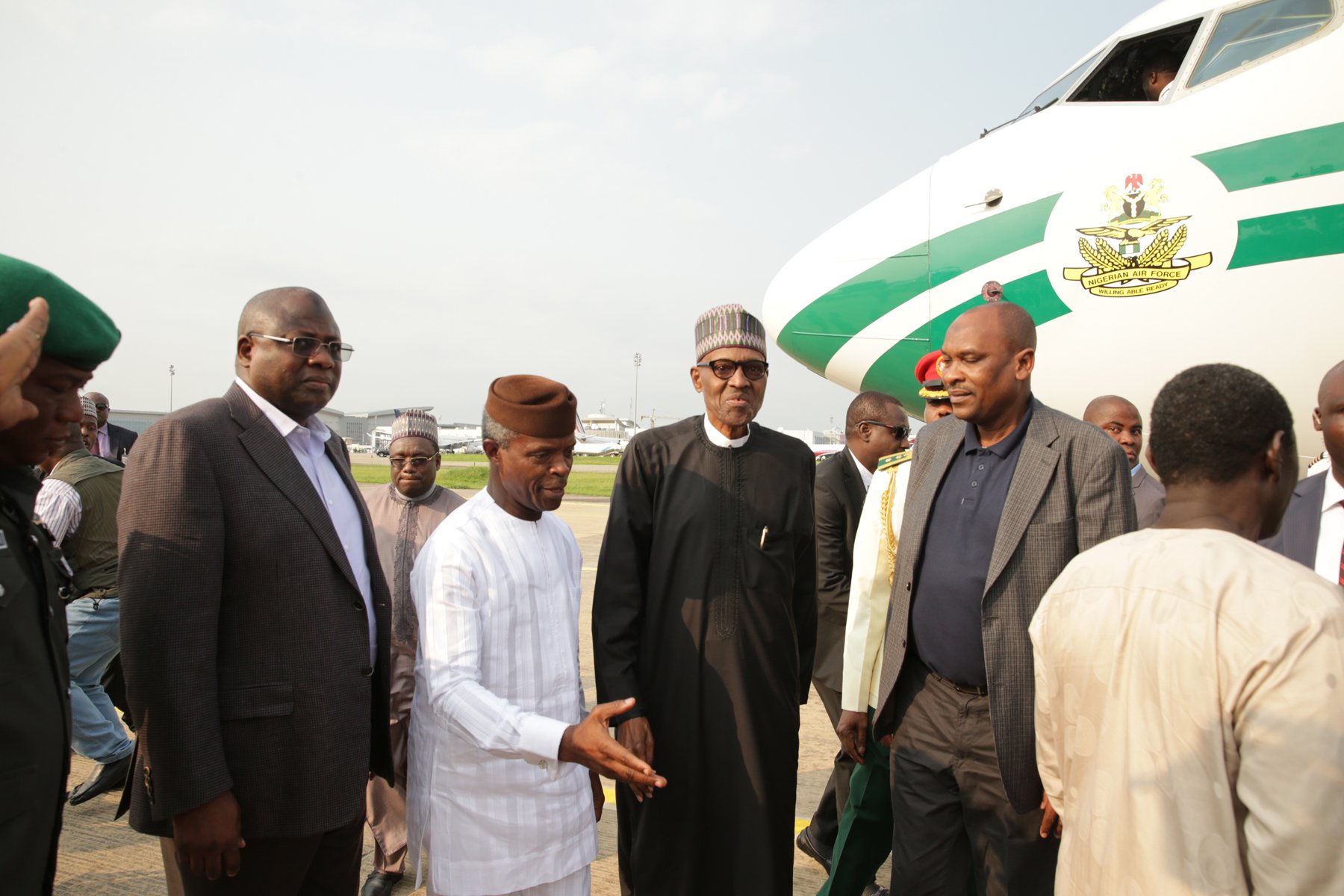
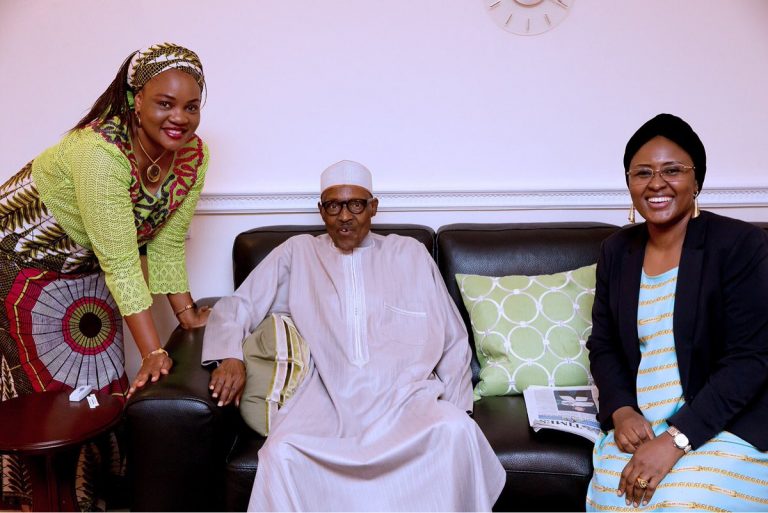
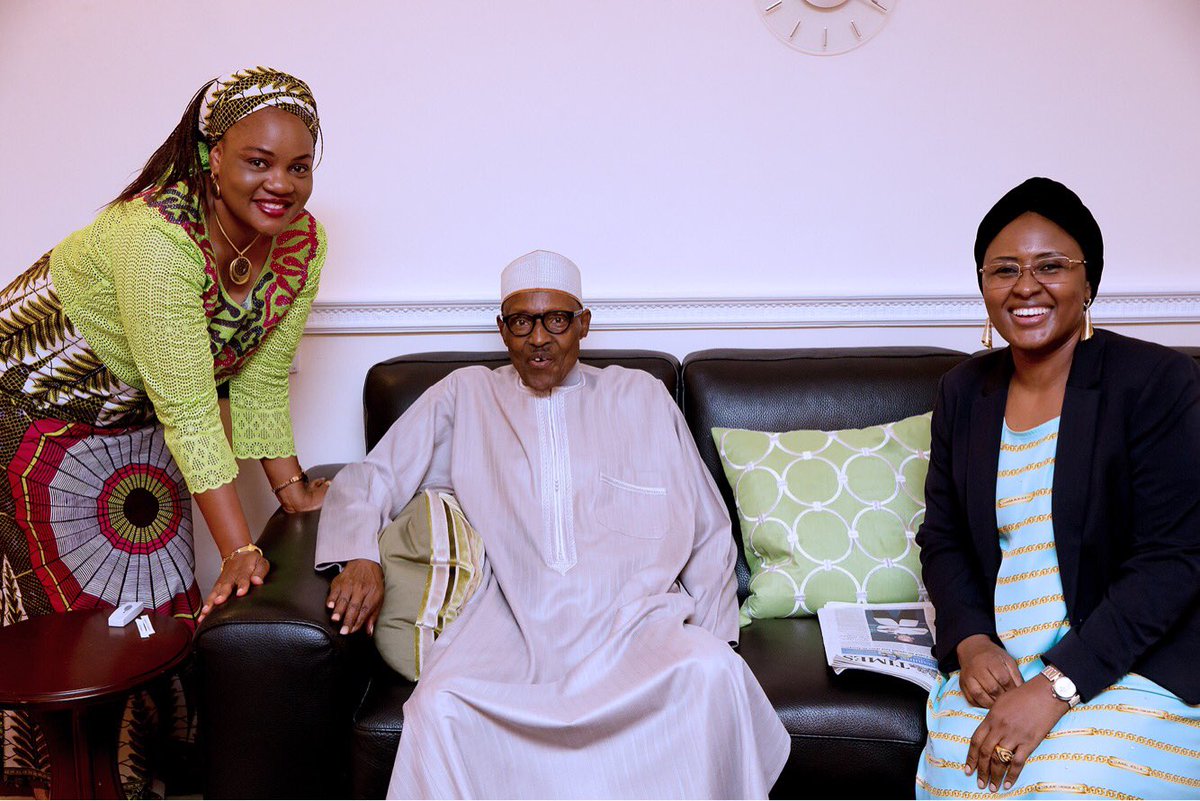
President Muhammadu Buhari has returned  to the country, ending a 103-day medical vacation in the United Kingdom.

The plane conveying the President touched down at the presidential wing of the Nnamdi Azikiwe International Airport, Abuja, at exactly 4:36pm.

Buhari was received by virtually everyone who matters in his government, led by Yemi Osinbajo, his deputy, who then proceeded ahead of him to the presidential residence.

Preparations begin at Abuja airport, villa for Buhari’s return

0

PRES BUHARI 4

Activities at the Nnamdi Azikiwe International Airport, Abuja, and the presidential villa, have gone up a notch following the announcement of President Muhammadu Buhari’s imminent return to the country.

According to NAN, the villa is agog with activities, as staff and security personnel are making last-minute preparations to receive the President.

Other itinerary members of staff in the presidency are also on standby, while security vehicles and personnel attached to the President’s convoy have since left for the airport to receive the him.

NAN also observed that members of the Presidential Guards Brigade were seen moving towards the airport after conducting rehearsal at the Arcade in Abuja.

Buhari’s prolonged absence sparked protests both in Nigeria and London, with demonstrators asking for his resumption or resignation.

He left Nigeria on May 7 for the second round of his medical treatment in London after receiving 82 Chibok school girls freed from among the almost 300 abducted by Boko Haram in 2014.

While in London, Buhari received a number of visitors, including Yemi Osinbajo, the Vice President; leaders of the All Progressives Congress (APC), state governors; Justin Welby, Archbishop of Canterbury, Bukola Saraki, Senate President; and Yakubu Dogara, Speaker of the House of representatives.

Enoch Adeboye, General Overseer of the Redeemed Christian Church of God, was the last to visit the President, on Friday.

Buhari is expected to arrive the Nnandi Azikiwe International Airport Abuja at 3pm on Saturday, and he will make a national broadcast to Nigerians at 7am on Monday.

INVESTIGATION: Corruption, extortion reign at Nigeria Immigration passport office (I)

1

INVESTIGATION - Corruption, extortion reign at Nigeria Immigration passport office (Part 1)

Pretending to be an applicant, Kemi Busari of PREMIUM TIMES investigates Lagos passport offices where Nigerians pay as much as double the approved fees to obtain an international passport.


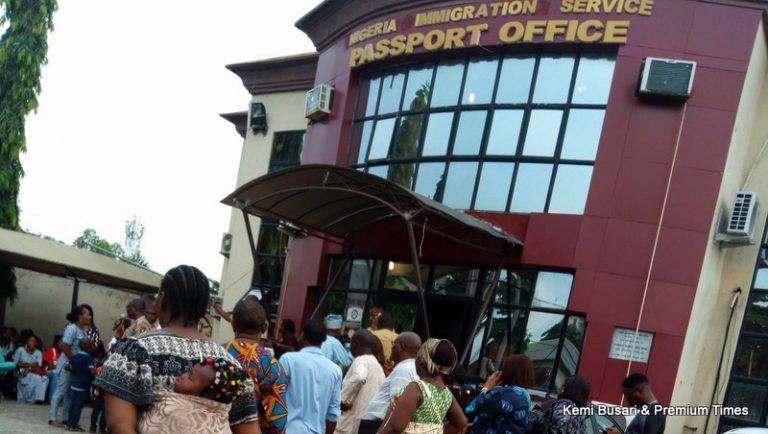
I arrived at the Alausa, Ikeja passport office of the Nigerian Immigration Service, NIS, at 6:50 a.m. on Friday June 23 in heeding to the advice of a friend who initially kicked against my mission.

‘You have to get there early, people start to queue as early as 5:30 a.m.,” my friend had said.

The cloud was pregnant on this day, thus creating a gloomy picture of the sky; a picture which largely mirrored my seemingly impossible mission – fact-finding on the dichotomy in the amount quoted online against the real amount of acquiring an international passport; and uncovering other acts of corruption in the passport offices.

Almost every time I informed a colleague or relative of my intention to acquire an international passport, I was usually greeted with an all-too-familiar reaction: “Can you pay this amount? I got mine in just one day through so, so, so and so person.’’

Other times, the conversation took the form of “Okay, I know one immigration officer who helped my friend facilitate his and he was issued the next day, here’s his number – ring him up or brace yourself up for a long, long wait at their office.”

The day’s business was yet to commence as the door of the main building remained shut when I arrived at the office. However, there was a security guard, a middle-aged man wearied by the pressure of age, checking prospective applicants in, giving them numbers. The numbers made them eligible to a tag which determined how early they would be attended to.

It was now 7:20 a.m. and photographers who also operate as touts in the surrounding buildings had started arriving.

THE IDEAL

According to the Act establishing it, the Nigeria Immigration Service has as its core mandate: control of persons entering or leaving Nigeria; issuance of travel documents to bonafide Nigerians in and outside Nigeria; issuance of residence permits to foreigners in Nigeria; and border surveillance and patrol.

However, the second mandate, which includes the issuance of international passport – a traveling document required by Nigerians to gain access to and cross other country’s borders – has reportedly been fraught with barefaced racketeering over the years.

According to the information posted on NIS website, a 32-page passport for ages 0-17 and 60 years and above goes for ₦10,750 (₦8,750 for Passport Booklet, ₦2,000 for Address Verification Fee) while that of citizens between ages 18-60 is issued at ₦17,000 (₦15,000 for Passport Booklet, ₦2,000 for Address Verification Fee).

The 64-page booklet passport, on the other hand, goes for ₦10,750 and ₦22,000 for persons between ages 0-17 and 60 years and above and 18-60 respectively.

This is the paragon, but the reality which stared me in the face on this early Friday morning transcended the imaginable.

THE MORE YOU LOOK, THE LESS YOU SEE

I approach one of the photographers on ground called Sunday and told him I needed a passport. Sunday, who combines photography with ‘touting,’ explained how he would ‘help’ me, from registering online to filing and capturing, all to be supervised by an ‘officer’ who would get me the passport in little or no time.

“We have the 32-page passport and the 64-page, but I advise you go for the 64-page if you want it quick. For the 32-page, I can do it for N28, 000 but the 64-page is not less than N35, 000,’’ Sunday explained, smartly prodding his first customer for the day to paying the maximum.

THE 64-PAGE ‘ABOVE’ 32-PAGE?

“There is a scarcity of the 32-page booklet in Nigeria, and it’s not as if they didn’t produce from the country where it is being imported. They are producing it but the dollar rate has prevented Immigration from buying more, and the price we charge here is still the same.’’

To get more out of Sunday, I assumed the role of an agent.

I informed him that my customers were four but that he had to give me some level of assurance before we finalised the deal.

“I want to do more than one but the only problem I have with you now is the price and I will like to meet the officer who works for you so that I will be assured that I’m in safe hands,” I said.

Sunday was quick to answer, switching between English and Pidgin with seamless ease: “I want you to do it with me not because of the money but because of customers you’ll bring for me after today. Believe me ‘bros’, I can do this thing better and faster than officers,” he said, referring to immigration officers.

“A photographer processes a passport better and faster than civil servants paid to do the job?”
But how? I wondered in silence.

“Most of them can’t finish the bulk of work they have at hand,’’ he offers what seems like an escape from the reality. “They won’t tell you when you approach them of course. If they say one week, expect your passport in two weeks. Some are even afraid of adding up to what they have at hand. But for me, I will handle it well.

You’ll even see everything from the beginning till end.’’

Some minutes of insistence to speak with Sunday’s “officer” proved futile and so, I decided to end the conversation.

“Here is my number, save it with Sunday passport and ring me up whenever you are ready,” he concluded.
Armed with this information, I headed for the entrance of the passport office. The time now was 7:40 a.m.

POWERFUL TOUTS

“Good morning sir!” I said.

“What can I do for you,’’ the stern voice of a man in mufti greeted me as I got to the gate.

The middle-aged man whom I took for a security guard who was holding the forth for the immigration officers, had been wearied by the task of checking people in.

He asked me to follow him to the registration point after I explained that I needed a passport for myself.

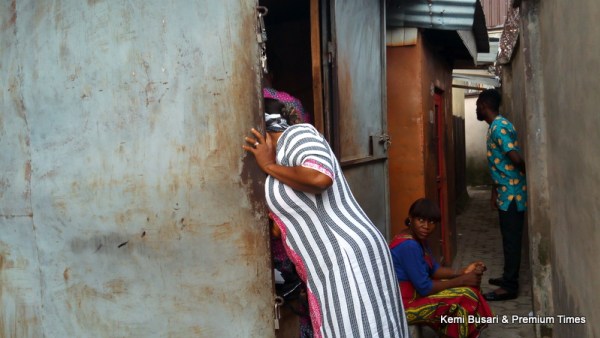
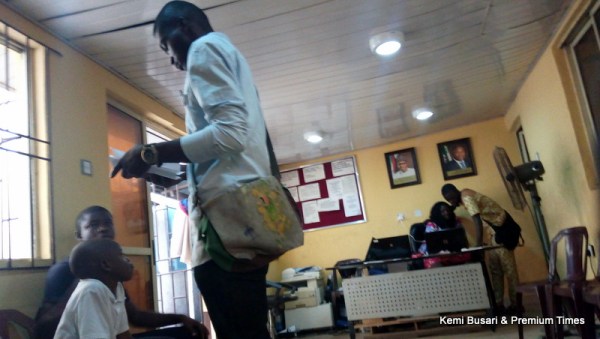
The Alausa Ikeja NIS office is a one-storey building with adjoining makeshift structures built with planks and iron linings on the space between the main building and the fence.

Registration shops at the Alausa passport office

Each of the shops had similar gadgets, including a computer system, a photocopying machine, a bench that can take as much as three people at once, and some folders.

We stopped at the first shop where we met a lady. The security man explained my intention to acquire an international passport to the lady and went back to his duty post.

“Take this form and fill. We do 32-page for N28, 000 and 64-page for 35, 000,’’ said the lady whose identity, either as a shop owner or attendant, could not be ascertained immediately.

She was obviously not willing to attend to a customer who would ask so many questions and when she realised that I was one, she told me to ‘just fill the form and ask questions later.’

By her explanation, the form after it was filled would be used to register for applicants online before handing it over to immigration officers.

In essence, the shops as shanty as they appeared perform the crucial functions of registration and bank transactions for applicants on behalf of NIS. And without passing through these shops or that of other touts around, one may not be registered for an international passport.

Registration point used by touts as Ikoyi office

After scanning through the form, I informed her that I didn’t have the required documents at that moment and that four other people whom she would register were on their way if only she would reduce the price and at least introduce me to an immigration officer who would handle the processing.

She declined.

“32-page is N28, 000 and you’ll get it after six weeks,’’ she replied with no further explanation.

“What’s your name so that I can ask when I come,’’ I asked in a final attempt to get her attention.

“Just ask for Bola passport,” she replied, not taking a second off the keyboard from which she was typing on the computer.

“Just make sure you tell that person who brought you here that you haven’t registered so he won’t think I’m working ‘behind’ him,’’ she added quickly.

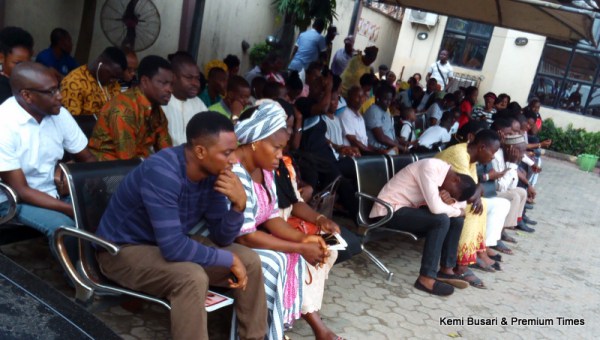
I left Bola’s shop and was jolted by the crowd of applicants in the premises, which was now more than double what I left just over 20 minutes ago.

By 8 a.m., the seats are filled up already

In the last attempt to speak with an officer who worked with the touts, I decide to join the crowd. I made my way to the side of the tent – a structure constructed by NIS to shield the waiting applicants from the sun or rain – where I found an abandoned tyre obviously unoccupied due to its level of dirt. This would serve as my seat for the next hour.

FINALLY, I GET TO SPEAK WITH AN OFFICER

As the clock ticked, more applicants trooped in. This time, the number of people in standing position had comfortably doubled the ones seated.

By 8:58 a.m., a female officer emerged from the main building. Speaking through the microphone erected under the tent, she opened the business of the day.

“Good morning all. On behalf of the management of the Alausa passport office, you are most highly welcome. My name is Grace, I’m the Public Relations Officer, PRO, of this passport office and I’m here to familiarise you with our activities for today.”

In the next 10 minutes, she would explain the process of fresh application, renewal, capturing, the collection of passport and other intricacies.

She explained that applicants billed for the collection of their passports were the ones the office would attend to while those who were around for other purposes were to come back in the next five hours. She added that names would be called in batches of 50 people at once.

As she reeled out the names of those to be attended to, I observed some immigration officers come out of the main building, hand over passport booklets to applicants amid the final exchange of naira notes, without questioning.

She came back for the second round of announcement by 10:50 a.m. This time, her announcements, mostly repetitions, had become of little interest to me but her last sentences finally gave me access to an officer.

‘’We do not condone backdoor processing of passport here in Alausa office,” she said.

“If you meet any of our officers to do this for you, you’ll be embarrassed and you’ll still not get your passport. In case you have any question, you are free to meet me or any other officer.”
After the second round of name calling, I had my first experience with an officer.

TOUTS AS ‘AUTHORISED’ AGENTS

passport story3
Applicants in standing positions in Alausa office

Corruption in Alausa passport office does not only exist with the officers but in the structure and administration of the office.

The office has no inquiry or customer service desk, the sort you have in banks, where one could learn the procedures for applying or renewing an expired passport. If there was any such desk, they did a masterful job of hiding it.

The best and alternative way of transacting with touts is to meet immigration officers who offer ‘official help’ at a cost, mostly determined by the size of an applicant’s pocket.

Also, the actual registration has a lot of complications as I would be tutored by Mr. Halliday, my first officer contact.

“Follow me,” he said after telling him that I was a fresh applicant.

Mr. Halliday, a good-looking officer, perhaps in his 40s, led the way to the shops where I was first directed to by the security guard.

Once I realised he was leading me to one of the touts, I protested and demanded a direct transaction with NIS.

The three-minute tutorial that followed confirmed the impossibility of my request.

“Young man, let me explain to you how we work here. You see these people here, they are our authorised agents. They work hand in hand with the immigration. They collect the money on our behalf, get you registered and after that hand you over to us for other processing,” he said.

“You don’t need to be scared of them, they can’t dupe you. I will take you to someone now and after your payment, I will help you to do everything without stress.’’

Mr. Halliday led me to a shop, just beside the one I visited earlier. The attendant, a female, informed me that I had to pay N28, 000 for 32-page passport and must first apply for mine, even if I was expecting ‘100 people.’

“Take my number and call me when you are through,’’ Mr. Halliday, now “Halliday passport” on my phone contact list, said as he left the shop for his duty post to hunt for more applicants.

I took the form and as I filled it I saw two other officers heading for the next shops with intending applicants. With their movement, the corruption intricacies at the registration stage become clearer to me.

HOW IT WORKS

Each officer with the NIS has one or more touts whom they work with.

The touts receive cash on their behalf, do online registration and hand over the applicant to the officer he or she works with.

In this kind of arrangement, the applicant is asked to pay more, say about N12, 000, above the approved price and this excess payment ends up in the hands of the tout, his or her affiliated officer and others who help in facilitating the deal.

But who gets what? How? In the next hour, I arrive at another passport office for a more revealing bout.

This strike was needless… we were forced into it, says ASUU chairman

Government didn’t mean well for Education, says ASUU

The Academic Staff Union of Universities (ASUU) says the industrial action it embarked upon on Sunday was needless, but it was forced into it by the federal government.

It said the government had shown that it does not mean well for the country’s education sector, hence the necessity of the strike action it commenced on Sunday.

Biodun Ogunyemi, President of the union, reiterated that the strike would not be called of unless its demands are met.

He said ASUU would call off the strike only “when the government is ready to do the right thing as we spelt out during our engagement with the government at the National Assembly in November last year”.

“In November last year, when we went to the National Assembly, the issues were itemised, seven, eight of them. The government was expected to have followed that pathway, to follow what I would call the action plan for resolving the matter.

“But for deviating from the action plan, the government exposed itself to the suspicion that it didn’t mean well. If it meant well, it must go back to that plan and from there, we address the issues.

“It is because it didn’t act on the understanding, that is why we are back to where we are.

“This action was needless; it is like we were forced into it. Implementation must commence and the implementation we are talking about is not the issue of renegotiation.”

Ogunyemi further explained that in 2013, the federal government had agreed to put in N1.3 trillion over a period of six years in order to revitalise Nigerian universities.

“The first year, the government was to release N200bn, which it did, but it took a long time for us to access it. But since that release in 2013, no single kobo has been released thereafter,” he said.

“For 2014, N220bn was not released. Again 2015 and 2016, nothing was released up to the third quarter of 2017.

“In all, we can estimate the outstanding amount to be about N825bn for revitalisation of our universities.

“In the last two years, what has been allocated to education in the budget is between six and seven per cent. Even in countries where they had wars like Rwanda and Sudan, they are still allocating well above 20 per cent to education.

“Our citizens are rushing to Ghana, most universities there are public universities.”

Noting that Nigeria loses N500 million to education tourism annually within Africa, Ogunyemi  blamed the development on the ruling class whom he accused of killing the country’s education system so that their children, who were given quality education abroad, could return to dominate the poor.

A meeting between the federal government and ASUU held on Thursday but it was deadlocked.

God keeping Obasanjo alive ‘because he hasn’t fulfilled his promise to Bakassi people’

God is keeping Obasanjo alive so he can keep his promise to my people – Bakassi Monarch
File: President Paul Biya (left) of Cameroon and President Olusegun Obasanjo of Nigeria (right), and former United Nations Secretary-General Kofi Annan (centre), during mediation talks over the issue of Bakassi Peninsula. Photo credit: unmultimedia.org/allafrica.com 

Etinyin Etim Okon Edet, Paramount Ruler of Bakassi and Chairman of the Cross River State Traditional Rulers’ Council, says former President Olusegun Obasanjo failed to fulfill his promise to the people of Bakassi after the area was ceded to Cameroon in 2008.

Speaking during an interview with the Punch, the monarch said Obasanjo would still be very useful in solving the problem, adding: “I am sure that is why God is still keeping him alive.”

Okon Edet stressed that he still has respect for Obasanjo “as a father, brother and friend”, but added that the former President was hasty in accepting the judgement of the International Court of Justice (ICJ) despite the availability of room for appeal.

“There are other countries of the world, even America and Britain, that have had similar experiences and they did not cede their territories,” he said.

“Why was our own so hasty? The rush in which Bakassi was ceded and the rush in which the people were asked to leave, if we had that corresponding rush in resettlement, nobody will hear about the issue of Bakassi again.

“We had expected that same rush in resettling the displaced people but it was not there. We have wasted all these time and many people have died in the process. He (Obasanjo) will be very useful in helping us solve this problem.”

Okon Edet recalled that he held several meetings with Obasanjo at the time and the latter promised him that there was nothing to worry about.

“I visited the Aso Rock Villa within that period up to five times to have interaction with the President; he showed us so much love and assured that all was going to be well.

“Even when the guys took up arms and declared a republic, he called me again to tell my boys to calm down that the latter days shall be better than the former.

“He said this in the presence of some electronic journalists who recorded our conversations. As the President of the country, I had no doubt about what he said.

“But unfortunately, he did not keep to his promise. He is still alive and I intend to visit him soon. He is a man I personally have respect for as a father, brother and friend.

“I will visit him to tell him that ‘oga we still dey, we nor dey kampe, but we still dey. So sir, you have influence all over the world and within Nigeria, can you use your influence to resettle my people? I think he had good intentions just like he resettled the people in the Lake Chad Basin area.”

He lamented that his people have not been treated fairly as they are now scattered all over the place.

“We are citizens of the world, we should be treated fairly. We are all scattered now. Some are within Cross River State while others are in Akwa Ibom State and they want to come back together to live in the same community,” he said.

“At the moment, it is only God’s grace that is upon my people and me. When you are psychologically tortured, it is worse than the physical torture.

“Several things I would have done for my people with the ideas I have, I can no longer display my full potential as a traditional ruler because of the impediments. Where do I go to now? Do I go to Ogoja or Ikom or Adamawa to begin to build a new palace? I need to be given a place so that I do the things I would have loved to do.

“I do not want to waste my energy and resources on something that will not last. Let them resettle us properly and tell us this is it. Nobody will want his place to be ceded or given out to any other person. Obasanjo will be helpful in solving this problem that he created.”

In August 2016, President Muhammadu Buhari reiterated that Nigeria will abide by the ICJ ruling on the Nigeria/Cameroon border dispute.

“We will abide by the law,” Buhari told visiting Mohammed Ibn Chambers, Special Representative of the Secretary-General, at the Presidential Villa, Abuja.

“Having accepted the judgment of the ICJ, we are ready to support the security and logistics requirements of the Cameroon-Nigeria Mixed Commission to carry out the border demarcation.”