Two patients have died as a result of Lassa Fever at the Lagos University Teaching Hospital (LUTH) in the past one week.
A resident doctor in the hospital is currently infected with the disease, while 100 hospital workers who were exposed to the affected patients have been placed under watch.
This was contained in a statement signed by.Chris Bode, Chief Medical Director of LUTH.
Bode said each of the deceased patients were brought to the hospital “very late and died in spite of efforts to salvage them”.
“The first was a 32-year-old pregnant lady with bleeding disorder who died after a stillbirth. Post-mortem examination had been conducted before her Lassa Fever status was eventually suspected and confirmed,” Bode said.
“No less than 100 different hospital workers exposed to this index case are currently being monitored. A resident doctor from the Department of Anatomic and Molecular Pathology who took part in the autopsy was later confirmed with the disease and is currently on admission and responding well to treatment at the Isolation Ward of LUTH.”
Bode visited the isolation centre on Monday in company of his top management staff, and spoke with the doctor and staff to boost morale and assure them of the hospital’s full support.
He enjoined all LUTH workers to maintain a heightened level of alert in the wake of this new outbreak, and observe universal precautions in handling all suspected cases of this viral hemorrhagic fever.
The outbreak of Lasser Fever in Lagos State is following reports of an outbreak of diarrhea, which killed some students of the Queen’s College, Lagos.
LUTH worked closely with officials of the Lagos State Ministry of Health to contain the outbreak at the time
“Both the Lagos State Ministry of Health and the Federal Ministry of Health have responded swiftly to contain this present Lassa fever outbreak by mobilising human and material resources to trace the sources and extent of the disease, follow up on potential contacts, identify early and test suspected cases,” he added.
“There are adequate materials for containment of the disease while drugs have been made available to treat anyone confirmed with the disease.
“The Centre for Disease Control (CDC) in Nigeria has also been contacted. Two other suspected cases from Lagos state are also presently admitted and quarantined while undergoing confirmatory laboratory tests.”
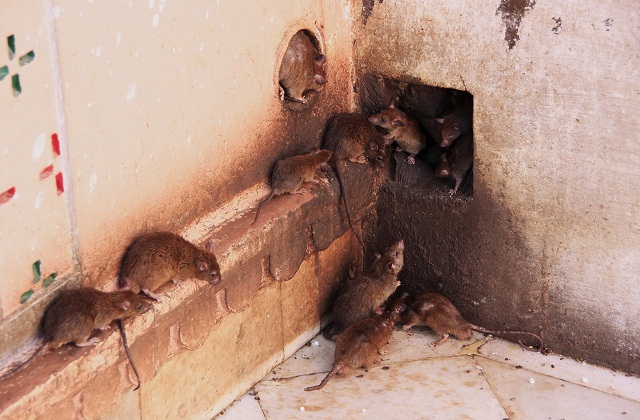
Lassa fever is an acute febrile illness, caused by the Lassa fever virus mostly transmitted by rats. The disease, which has an incubation period of six to 21 days, was first identified in Nigeria in 1969.
The virus is shed in the urine and droppings of the rats hence can be transmitted through direct contact, touching objects or eating food contaminated with these materials or through cuts or sores.
Transmission also occurs in health facilities where infection prevention and control practices are not observed. Person to person transmission also occurs most especially when a person comes in contact with the virus in the blood, tissue, secretions or excrements of an infected individual.
Symptoms of the disease include fever, general weakness, muscle and joint pains, prostration and malaise and after some days, headache, sore throat, muscle pain, chest pain, nausea, vomiting, diarrhoea, cough, and abdominal pain may follow.
In severe cases facial swelling, fluid in the lung cavity, bleeding from the mouth, nose, vagina or gastrointestinal tract and low blood pressure may develop.
Prevention of Lassa fever mainly involves good community and personal hygiene to discourage rodents from entering homes. Other effective measures include storing grain and other foodstuffs in rodent-proof containers, disposing of garbage far from the home, maintaining clean households.
In case of any suspected case of Lassa fever, the response team in LUTH can be notified on 08058019466, 08058744780, 07035521015 and 08023299445.
N47.2 Billion and $487.5 Million in cash and properties have so far been traced to the former Minister of Petroleum Resources in the Ex-President Goodluck Jonathan’s administration, Mrs. Diezani Alison-Madueke. This followed painstaking investigations by operatives of Nigeria’s Economic and Financial Crimes Commission, EFCC.
From time immemorial, precious metals – gold, silver and sparkling stones such as diamonds have delighted women. Relationships have been built and destroyed, wars fought for and reconciliations cemented with gold and precious stones. Not too far back in history, Liberia was the theatre of war over Blood Diamonds.
Unlike Liberia however, the Nigerian nation is not at war. But, it seems Mrs Diezani Alison-Madueke, until recently, Minister of Petroleum Resources, going by the sheer amount of her acquisition of gold and diamonds, may have been fighting a spirited war against millions of compatriots who are heavily and unevenly yoked by crass poverty. To boot, the former minister is accused of having stolen – in broad daylight – the money that funded her acquisitive binge.
A search of one of Alison-Madueke’s palatial residences in Abuja, by the Economic and Financial Crimes Commission, EFCC, turned up boxes of gold, silver and diamond jewellery, worth several million pounds sterling.
Apart from the jewellery, the EFCC, Nigeria’s foremost anticorruption agency, has traced N47.2 Billion and $487.5 Million in cash and properties to the former Minister of Petroleum Resources in Ex-President Goodluck Jonathan’s administration.
The former minister who has been in London since the birth of President Muhammadu Buhari’s administration, has however continued to deny any financial misdeed. She insists she is being severely maligned and persecuted by the EFCC. But, on the strength of weighty evidences placed before Nigerian courts, there are a string of judicial pronouncements ordering the forfeiture of all allegedly ill-gotten wealth to Alison-Madueke’s former employers, the Federal Government of Nigeria.
One of the constitutional requirements to be appointed to public office in Nigeria, is the total declaration of all personal assets. It does seem like that provision was observed more in the breach by Alison-Madueke.
The EFCC, in the course of investigation, traced another property valued at $37.5m to the former minister in Banana Island, Lagos. She was said to have purchased the 15-storey building, which comprises 18 flats and six penthouses, between 2011 and 2012from the developers, YF Construction and Real Estate. The property was allegedly acquired in the name of a shell company, Rusimpex Limited, which is managed by one Afamefuna Nwokedim, Principal Partner, Stillwaters Law Firm, Lagos.
On August 7, 2017, Justice Chuka Obiozor, a vacation judge sitting at the Federal High Court in Ikoyi, Lagos, ordered the final forfeiture of a $37.5m (N11.75bn) (Eleven Billion, Seven Hundred and Fifty Million Naira) property on Banana Island, Ikoyi, Lagos allegedly belonging to Diezani Alison-Madueke. The order followed an exparte application filed on July 17, 2017 by the EFCC.
At the last adjourned sitting on July 19, 2017, counsel to the EFCC, A.B.C. Ozioko, while moving the ex-parte application, had urged the court to order the forfeiture of the total sum of US$2, 740,197.96 and N84, 537,840.70 respectively found by the Commission in Rusimpex USD account No. 1013612486 domiciled in Zenith Bank Plc suspected to be proceeds of unlawful activities. Ozioko had also urged the court to order an interim forfeiture of the assets and property. Ruling on the applications, Justice Obiozor had ordered the respondents- Deziani, Afamefuna Nwokedi and Rusimpex Limited- to show cause within 14 days why the properties should not be forfeited to the Federal Government.
The judge had further ordered the publication of the interim order in any national newspaper for the respondents or anyone who is interested in the property to appear before the court to show cause within 14 days why the final order of the property should not be made in favour of the Federal Government.
At the resumed hearing on August 7, counsel to the EFCC argued that the failure of the second and third respondent, Nwokedi and Rusimex meant that “they are not willing to contest the application”.
In his ruling, Justice Obiozor ordered the final forfeiture of the property to the Federal government, in view of the failure of any interested parties or persons to contest the interim forfeiture order as published in a national newspaper by the Commission. The court also ordered the permanent forfeiture of the sums of US$2, 740,197.96 and N84, 537,840.70 respectively realized as rent on the property.
But, by far the most numbing, record-shattering acquisitions of Alison-Madueke, is to be found inthe ritzy,nouveaux richesplayground of Banana Island, Lagos. It consists of two apartments at the Bella Vista Court. The apartments which are Penthouses, are located on Block C-5, Flat 21, Plot 1, Zone N. For them, a $350 Million(Three Hundred and Fifty Million US Dollar) hole was allegedly dug in the Nigerian treasury on November 22, 2011, by Alison-Madueke.
Also in Lagos, Alison-Madueke allegedly bought a block of six units serviced apartmentsat number 135, Awolowo Road, Ikoyi, just a few hundred metres away from the EFCC zonal operations hub. The apartment has a standby power generating set, sporting facilities, playground and a water treatment plant. The property was bought at the rate of N800 Million(Eight Hundred Million Naira) on January 6, 2012.
Other properties in Yaba, Lagos, also discovered by the eagle eyes of the Commission’s operatives, are located at number 7, Thurnburn Street and 5, Raymond Street. The Thurnburn Street propertyconsists of 21 mixed housing units of eight 4-bedroom apartments, two penthouse apartments of 3-bedrooms each and six 3-bedroom (all en-suite) terrace apartments.
The Raymond Street property is made up of two en-suite 2-bedroom apartments and one 4-bedroom apartment.
The Yaba, Lagos properties, which dug a deep hole of an eye-popping N1 Billion(One Billion Naira), were paid for on May 30, 2012. The same dayAlison-Madueke splashed N900 million for the Port Harcourt estate.
In Lekki Phase one, an upscale neighbourhood of Lagos, operatives found a twin four-bedroom duplex. The duplex is located on Plot 33, Block 112, Lekki Peninsula Residential Scheme Phase 1, Lekki, Lagos, with an estimated value of over N200 Million(Two Hundred Million Naira).
Also in Lagos, a large expanse of land at Oniru, Victoria Island, Lagos has also been traced to the former Petroleum Resources Minister. The land, which is located in Oniru Chieftaincy Family Private Estate, Lekki peninsular, Lagos and currently being utilized as a dumping site, was bought on February 16, 2012, for N135 Million (One Hundred and Thirty- Five Million Naira).
Plot 8, Gerard Road Ikoyi, Lagos, another property traced to Alison-Madueke, is a penthouse on the 11th Floor in the Block B Wing of the building. It was bought for N12 Million(Twelve Million Naira) on December 20, 2011.
On plot 10, Frederick Chiluba Close, in the serene, upscale Asokoro district of Abuja, lies a tastefully built and finished duplex. In the compound, there are also a Guest Chalet, Boy’s Quarters, an elegant swimming pool, fully equipped sports gym and a host of other amenities. Investigators have discovered that the property acquired by the ex-minister in December, 2009, at the cost of N400 Million (Four Hundred Million Naira) was never declared in any of the asset declaration forms filed by Alison-Madueke.
Also linked to the former Minister in Abuja is a mini estate at Mabushi, Abuja. The estate located on Plot 1205, Cadastral Zone B06, Mabushi Gardens Estate, houses 13 three-bedroom terrace houses, each with one bedroom en-suite maid’s quarters. It was purchased on April 2, 2012 at the princely sum of N650 Million (Six Hundred and Fifty Million Naira).
In Aso Drive, Maitama, Abuja, Alison-Madueke reportedly acquired a 6-bedroom en-suite apartment made up of three large living rooms, two-bedroom Guest Chalets, two bedroom Boys Quarters, two lock up garages and a car park. It was bought on July 20, 2011 for N80 Million (Eighty Million Naira).
Down South in Nigeria’s oil city of Port Harcourt, the former minister’s acquisitive appetite took her to Heritage Court Estate, located on Plot 2C, Omerelu Street, Diobu Government Residential Area, Phase 1 Extension, Port Harcourt. The Estate which is made up of 16 four-bedroom terrace duplexes is equipped with among other facilities, a massive standby power generating set. Alison-Madueke did not blink as she shelled out N900 Million (Nine Hundred Million Naira) for it onMay 30, 2012.
In neighbouring Bayelsa State, an apartment with two blocks of flats, all en-suite, and with a Maid’s Quarters were also traced to her. The house located on Goodluck Jonathan Road, Yenagoa is sitting on a large expanse of land. Realtors spoken to by EFCC investigators have placed estimated values running into hundreds of millions of Naira on the property. The apartments have four living rooms, eight bedrooms and gold-plated furniture.
Aside from jewelry and property, Alison-Madueke, EFCC operatives charge, has N23,446,300,000 and $5milion (about N1.5billion) in various Nigerian banks.
Based on evidence presented by the Commission before the court, Justice Muslim Suleiman Hassan on January 6 2017, ordered the funds’ temporary forfeiture to the federal government.
The EFCC again, on January 24, 2017, urged the Federal High Court in Lagos to order the forfeiture of yet another N9 billion allegedly laundered by some bank officials for Alison-Madueke.
A month later, on February 16, 2017, Justice Hassan ordered the final forfeiture to the federal government, of a whooping sum of N34 Billion naira which has been traced to the former minister.
Earlier in May 2016, the sum of over $100 Million (One Hundred Million US dollars) were traced to the accounts of several Independent National Electoral Commission (INEC) staffers, who were allegedly bribed by Alison-Madueke to compromise Nigeria’s 2015 general elections.
Justice Mohammed B. Idris of the Federal High Court, sitting in Ikoyi, Lagos, on April 27, 2017, ordered the final forfeiture of the bribe money traced to one staff of INEC, Christian Nwosu, who was arraigned on April 5, 2017.
In the course of the trial, Nwosu pleaded guilty to receiving the sum of N30 Million (Thirty Million Naira) from Alison-Madueke. Upon his confession, the court ordered the final forfeiture of his landed property situated at Okpanam, Oshimili North Local Government Area of Delta State. Also forfeited by Nwosu to the federal government was the cash sum of N5 Million (Five Million Naira).
Going by the continued unearthing of hard-to-ignore evidences of unexplained acquisitions, coupled with Justice Chuka Obiozor’s ruling on the final forfeiture of a $37.5m (N11.75bn) (Eleven Billion, Seven Hundred and Fifty Million Naira) to the federal government, ex-minister Alison-Madueke’s evidence-free counter-charge, that she is a victim of EFCC persecution, may be ringing hollower and hollower.
Orilade and Gambari are officers of the Public Affairs Directorate of the Economic and Financial Crimes Commission, EFCC.
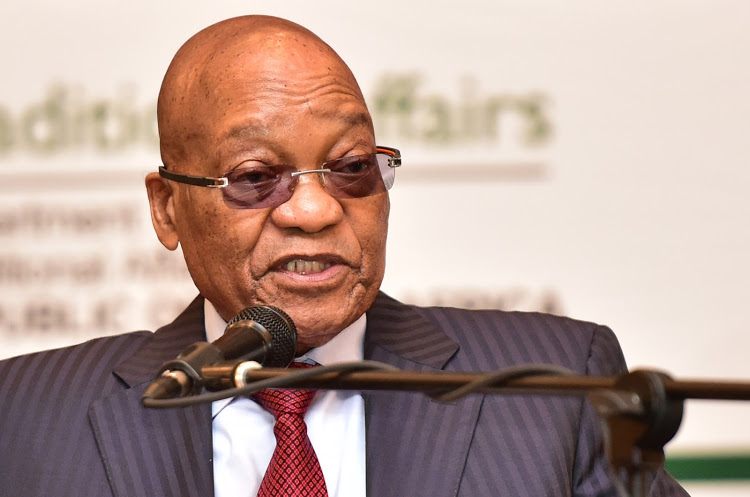
Jacob Zuma, South African President, has survived another no-confidence vote, the eighth time he has faced such political test in his eight-year presidency.
However, this was the first vote held through secret balloting, and the opposition parties had expected that the secret vote would enable MPs from the governing African National Congress (ANC) to vote against the president.
The motion, which was called amid repeated allegations of corruption, was defeated by 198 votes to 177.
The voting recorded nine abstentions in the secret ballot.
BBC reports that in order for the no-confidence motion to pass, at least 50 out of the ANC’s 249 MPs would voted against the president — leading to opposition parties pleading with ANC MPs to “vote with their conscience”.
The news of his triumph was welcomed with cheers and singing by ANC MPs
“Today our choice is between right and wrong; between good and evil,” the Democratic Alliance’s Mmusi Maimane was quoted as saying before the voting, while Andries Tlouamma, deputy president of the Agang party, warned if Mr Zuma survived then South Africa was “on a highway to hell”.
Zuma is expeceted to step down as head of the ANC in December, ahead of the 2019 general election.
The 75-year-old has been power since 2009 but his tenure has been tainted with accusations of monumental corruption and ruining of the economy.
Criticism of Zuma increased this year after he fired Pravin Gordhan, his widely-respected finance minister, in March.
This came amid accusations that the president had become too close to the wealthy Gupta family, who are accused of trying to influence politician decisions — including the sacking of Gordhan.
There is commotion online over a picture of the 2017 Best Graduating Medical Student of the University of Nigeria (UNN) being presented with a GTBank cheque of N10,000.
THE ASSUMPTION
The picture went viral on Tuesday — simply because the presence of the GTB logo on the cheque gave the impression that the award was sponsored by the bank.
Nigerians roundly criticised the sight, saying such paltry prize money was not commensurate with the toil that must have yielded the award.
Many compared the award to the prize money for various TV reality shows, including the recently concluded Big Brother Nigeria (BBN), which gifted Efe Ejeba, the winner, a cash prize of N25 million and a brand new SUV.
₦10,000 was the prize given to the UNN best graduating medical student.
Hey @gtbank, are you guys not ashamed of having your logo on this?? pic.twitter.com/C7xb6GD8MQ
Gtbank gave the best graduating medical student in UNN 10,000 naira while Heritage Bank gave Big Brother Naija winner 25million.
Aca…what? https://t.co/BQUxhqyDtH
But it has now emerged that all the angst at GTB was misplaced. When contacted by the ICIR, the bank denied sponsoring the award.
“Hello. Thank you for contacting us,” the bank said.
“Please note that this donation was not made by GTBank, but by the University of Nigeria Medical Students Association, who made use of their cheque leaflet to create a dummy cheque. We congratulate the young woman on her remarkable achievement and wish her the best in all.”
Hello. Thank you for contacting us. Please note that this donation was not made by GTBank, but by the University of Nigeria Medical… 1/3
Similarly, a student of the university said the award was sponsored by the Medical Students Association of the university.
“No, the award wasn’t sponsored by GTBank,” the student told the ICIR, asking not to be named.
“It was courtesy of the Nigeria Medical Students Association UNN chapter. Though the university management promised to reward the girl with N200,000, that has not been redeemed.”
Anger misplaced, cased closed. Shall the people behind the torrent of anti-GTB abuse now render an ‘unreserved apology’ to the bank?
Contrary to her claims that she was being persecuted for exposing corruption in the past, police documents show that Maimuna Aliyu, one of two people whose appointments to the Independent Corrupt Practices and Other Related Offences Commission (ICPC) board, cornered a sum of N58million belonging to Aso Savings and Loan.
Aliyu and Sa’ad Alanamu were part of a 14-member board of ICPC appointed last week by Acting President, Yemi Osinbajo but after the ICIR exclusively reported that two of them were being investigated by the ICPC for corruption, Osinbajo withdrew their nomination from the board.
Responding to the withdrawal of her nomination, Aliyu had said in a statement that “the news report pointing to a report in May 2017 indicting me is a mere fluke”.
She said the “highly-placed business men who have been variously found culpable by the investigations and also angry with me for exposing them have colluded to stop my appointment” because they were afraid that they would be further exposed”.
“That is the simple reason why they have resorted to media maligning of my person,” she added.
However, as proven by documents from the police, Aliyu, who was Executive Director, Marketing, at Aso Savings and Loans Plc until 2013, had been indicted many times by the bank for series of financial misappropriations, which led to her investigation by the Police, in May.
According to one of the documents, the bank lodged a complaint with the police that Aliyu was entrusted with three landed properties at Jahi District Abuja with title documents for sell.
The three lands, the bank said, were sold for N40million each, totaling N120million, but the proceeds were converted to her personal use without recourse to the bank that entrusted her with the authority to sell the land.
While Aliyu didn’t remit the proceeds from the sales of the land to the coffer of her employee, the bank said there were other transactions that she carried out on its behalf but she didn’t return the money, which amounted to N568 million.
Aliyu, Ibrahim Gaga, Bilikisu Rimi and Hassan Musa, all staff of Aso Savings and Loans, were invited by the police as witnesses while the duo of Babagana Basher and Vincient Mishelia, agent and purported buyer of the three plots of land, were also interrogated by the police.
The three staff all corroborated the claim that the three land documents were entrusted to Aliyu for sale for N19million each.
“Both the agent Babagana Basher and the buyer, Vincient Mishelia gave account on how they paid her in dollar equivalent of N58million which was $385,000 in her office,” the police said.
While quizzed by the police, Aliyu confessed that she received the money as claimed by the buyer, but she said she handed the proceeds over to Bilikisu Rimi, the Company Secretary — a claim denied by the latter.
According to police sources, she was recommended to be charged to court by the police for “fraud and abuse of office having fraudulently converted the money totaling N58million to her personal use”.
As also reported by the ICIR, the federal government failed to run a background check on the appointees before making a public announcement.
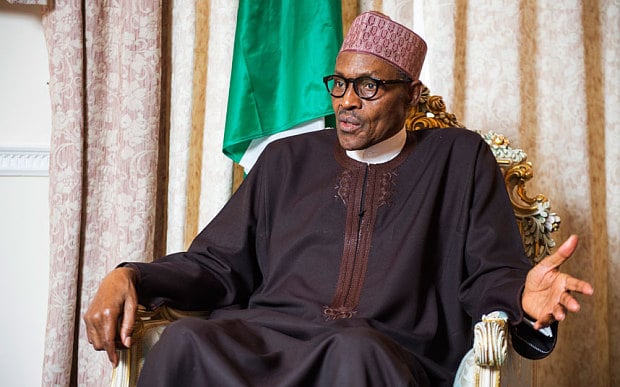
For how long can Muhammadu Buhari, Nigeria’s ailing President, stay in London for medical treatment? Is the answer indefinite, until the expiration of his first term in 2019?
After a 49-day medical vacation in London early this year, Buhari travelled to London again for an indefinite medical examination in May 7.
Buhari has so far spent 56 days in his second medical journey, with no definite return date.
This indefinite stay abroad has led to speculations that the president will be removed from office if he spends more than 60 days outside the country.
However, the duration his foreign stay is not specified in the 1999 Constitution as amended.
As long as he has duly transmitted power to the Vice-President, he can stay in London as much as he wants, unless he is impeached by the National Assembly.
PROCEDURE FOR REMOVING THE PRESIDENT
For the president to be removed from office on the ground of ill-health as specified in Section 144 of the Constitution, two-thirds majority of all members of the Federal Executive Council (FEC) must pass a resolution declaring that he is incapable of discharging the functions of his office.
This declaration by FEC will be verified by a five-man medical panel appointed by the Senate President.
The five members of the panel must be medical practitioners, including the personal physician to the president. The four others must be medical practitioners who have attained a high degree of eminence in the field of medicine related to whatever illness the president is suffering from.
This medical panel will then examine the president in accordance with international standards.
Should the medical panel certify that the president is incapable of discharging the functions of his office due to the illness, a notice signed by the Senate President and the Speaker of the House of Representatives shall be published in the Official Gazette of the Government of the Federation.
Immediately this notice is published, Buhari will cease to be the President of Nigeria and Yemi Osinbajo, the Acting President, will now assume the role of substantive President while a new Vice-President will be appointed.
HOW THE CONSTITUTION PRECISELY STATES IT
Chapter VI, Section 144
(1) The President or Vice-President shall cease to hold office, if –
(a) by a resolution passed by two-thirds majority of all the members of the executive council of the Federation it is declared that the President or Vice-President is incapable of discharging the functions of his office; and
(b) the declaration is verified, after such medical examination as may be necessary, by a medical panel established under subsection (4) of this section in its report to the President of the Senate and the Speaker of the House of Representatives.
(2) Where the medical panel certifies in the report that in its opinion the President or Vice-President is suffering from such infirmity of body or mind as renders him permanently incapable of discharging the functions of his office, a notice thereof signed by the President of the Senate and the Speaker of the House of Representatives shall be published in the Official Gazette of the Government of the Federation.
(3) The President or Vice-President shall cease to hold office as from the date of publication of the notice of the medical report pursuant to subsection (2) of this section.
(4) The medical panel to which this section relates shall be appointed by the President of the Senate, and shall comprise five medical practitioners in Nigeria:-
(a) one of whom shall be the personal physician of the holder of the office concerned; and
(b) four other medical practitioners who have, in the opinion of the President of the Senate, attained a high degree of eminence in the field of medicine relative to the nature of the examination to be conducted in accordance with the foregoing provisions.
(5) In this section, the reference to “executive council of the Federation” is a reference to the body of Ministers of the Government of the Federation, howsoever called, established by the President and charged with such responsibilities for the functions of government as the President may direct.
ANY OTHER MEANS?
Members of the National Assembly may decide to rely on Section 143 of the Constitution to remove the president if two-thirds of the members present signed a written allegation of gross misconduct against the president.
According to the Constitution, “gross misconduct” means a grave violation or breach of the provisions of this Constitution or a misconduct of such nature as amounts in the opinion of the National Assembly to gross misconduct.
Upon receiving the notice of this allegation, the Senate President shall within seven days serve a copy to the president and give each member of the National Assembly another.
The president is expected to reply to the allegation and a copy of his reply will be made available to every member of the National Assembly.
Within 14 days of the presentation of the allegation, members of the National Assembly will resolve by motion without any debate whether or not the allegation shall be investigated.
If up to two-thirds of members of National Assembly agree that the allegation will be investigated, the Senate President shall within seven days request the Chief Justice of Nigeria to appoint a seven member panel to investigate the allegation.
Members of the panel must be persons with unquestionable integrity and not being members of any public service, legislative house or political party.
The panel will submit its reports within three months to the National Assembly.
If the report by the panel concludes that the allegation has not been proved, then the president cannot be impeached and the National Assembly shall suspend all proceedings in respect to the impeachment.
But if the report proves the allegation, then the National Assembly shall consider the report within 14 days after receiving it from the panel.
And if up to two-thirds members of the National Assembly support the resolution, the report will be adopted and the President will cease to hold his office.
This process of removing shall not be challenged in a court of law.
ANSWER
Having handed over power to Osinbajo in acting capacity, President Muhammadu Buhari can stay in London or anywhere else for as long as he wants — so long two-thirds of the national executive council do not have a problem with it.
EDITOR’S NOTE: This piece was originally published on July 4. It has been republished in the light of the ongoing return-or-resign protests against President Muhammadu Buhari.
Of all the vote-catching strategies laid out by the ruling All Progressives Congress in the lead-up to the 2015 general election, its promise to prosecute an all-out war against corruption was unquestionably the most compelling and believable. This is because its presidential candidate, Muhammadu Buhari, is widely known as a man of integrity with very strong aversion for corrupt practices.
And so, due largely to its promise to fight corruption to a standstill and the credibility of the personality behind the pledge, APC was able to seize the mantle from the old guards of corruption and form a new government. Therefore, to refer to Buhari’s government as one of anti-corruption – one hoping to hinge its success in governance on how well it performs in this specific assignment – would not be out of place.
To this administration’s credit, the last two years, or at least since one doughty, no-nonsense police officer named Ibrahim Magu became Acting Chairman of the Economic and Financial Crimes Commission (EFCC), the anti-corruption war has been waged in a manner that has never been seen in the history of Nigeria.
Amazing loads upon loads of stolen public funds in various currencies are being recovered and returned to government coffers. Thanks to the whistleblower initiative, more and more disclosures about the hidden loots are being made to the relevant agencies. And unlike what obtained in the past, the big guns of society, hitherto untouchable, are regularly being hauled to the law courts on account of fraudulent activities. But as yet, no conviction of note has been recorded.
As can be seen, it’s not been an easy fight. Corruption is refusing to be subdued. Government has lost some high-profile cases, while some others are stalemated. Cynics contend that failure to secure notable convictions is proof that government is shoddy in the way it is prosecuting the war; government officials counter that corruption is fighting back in a virulent manner.
In a way, both are correct. While those who have made corruption a lifetime occupation won’t give up easily, it is also true that this administration routinely shoots itself in the foot as far as the anti-corruption campaign is concerned. Take for example, the unhealthy relationship between the Attorney General of the Federation and Minister of Justice, Abubakar Malami, a Senior Advocate of Nigeria, and anti-corruption agencies like the EFCC and the Independent Corrupt Practices and Other Related Offences Commission (ICPC).
Sensing that it is being overshadowed by the two agencies, the AGF is angling to show its muscle as the pre-eminent government department in all matters legal, and especially as far as prosecuting corruption cases is concerned. Okoi Obono-Obla, Special Assistant to the President on Prosecutions, man Friday and agent provocateur, is the arrowhead in this needless exercise of power that is clearly aimed at meeting some self-serving political ends.
At every given opportunity, Obono-Obla does not fail to reiterate the fable that the anti-corruption agencies are not co-operating with the office of the AGF. But the more likely position, in the assessment of many observers, is that these agencies are not willing to compromise in some high-profile cases in which the AGF might be interested.
That is why it is widely believed that other than crude, selfish politics, there can be no legitimate reason for the AGF’s latest threat, as conveyed by Obono-Obla, to report the heads of EFCC and ICPC to the presidency for refusing to hand over the case files of more than 35 former governors and senators. It is important to ask why the AGF wants these files. Why won’t he simply invite these agencies to a meeting to update him on the cases, and then explore ways of assisting in achieving diligent prosecution?
No one is disputing the AGF’s status as the numero uno in the circumstance, but he should refrain from bearing down on these agencies as though they don’t have a statutory mandate to perform certain roles corresponding with his. To paraphrase a local proverb, the sky is wide enough for every bird to flap its wings.
Instead of requesting cases started by other agencies, the AGF should initiate his own high-profile cases too to show that it not only barks but bites as well. Obono-Obla has accused the agencies of slowing down the anti-corruption war. Well, he has to show concrete proof of how this is happening before the charge can hold water, not by merely pointing to a refusal of the agencies to turn in files of the corruption cases they initiated.
In any case the last time anyone heard of one group of government official publicly expressing misgivings about the other, it was one prominent member of the Presidential Advisory Committee Against Corruption (PACAC), also a senior Advocate of Nigeria, berating Obono-Obla’s boss for openly disagreeing with Acting President Yemi Osinbajo on the retention of Magu as the chair of EFCC.
This individual stopped short of calling for the AGF’s sack. Before then, this same member and another articulate colleague at a forum on corruption organized in Abuja by the Pyrates Confraternity, separately pronounced doubts about the commitment of the AGF to the anti-corruption efforts of the government on account of serial embarrassing defeats handed the government in key cases prosecuted by his office.
In fact, there are speculations – indeed strong belief – that the AGF is working with some equally highly-placed corrupt persons to scuttle the anti-corruption fight. He should rather strive to allay the fears of the public and restore confidence in his office, not perpetually bicker with other agencies over cases he didn’t originate.
Godwin Onyeacholem is a journalist. He can be reached on gonyeacholem@gmail.com
Police on Tuesday in Abuja fired tear-gas canisters and high-velocity stream of water at protesters asking for President Muhammadu Buhari to either return to the country or resign.
Armed policemen who also used dogs to scare away the protesters manhandled some of them, leaving one injured and many others scampering to safety. Journalists went early to the Unity Fountain to cover the protest, but they were also not spared from the effect of the teargas.
The protesters, led by Charly Boy, a popular and lone entertainer, gathered at the fountain for the second day of what was planned to be a one-week protest under the OurMumuDonDo campaign to demand the return or resignation of the President who has spent 90 days in London for medical treatment.
As early as 7am, policemen took over the fountain, a development that forced the protesters to relocate to the Millennium Park ground.
However, the security operatives, who were said to be acting on directives from the federal government to disrupt the rally because the protest on Monday went viral and embarrassed the government, went ahead to also disperse the protesters after their relocation to the Millennium Park.
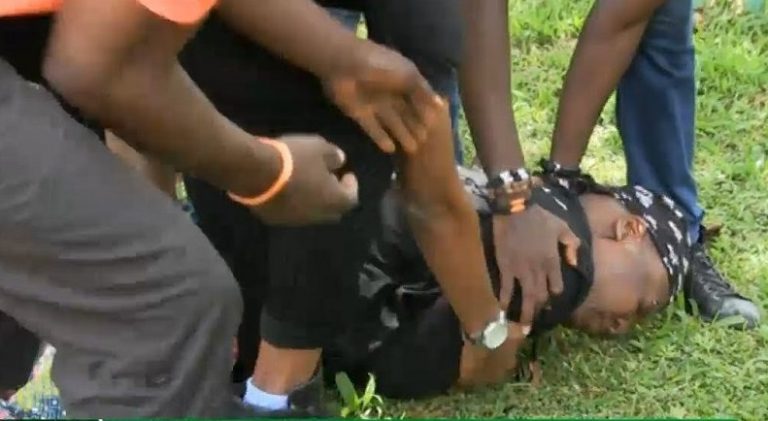
According to a witness, Charly Boy, wept profusely after he and others were teargassed by the police, and later collapsed as he mustered strength to explain what happened when asked by journalists.
It took quick the intervention of other protesters who poured water on him before he could be revived.
“When we saw Charly Boy inside the Millennium Park, he was just crying and we tried to calm him down and ask questions. He just collapsed and fainted as one of his boys was about to explain to us,” said a reporter with WAZOBIA FM.
“His eyes were red and his legs were injured. We had to quickly pour water on him to revive him. We were there when the police again fired another tear-gas canister. Even now, my eyes are aching.”
The wounded protester was taken to a clinic at the Federal Secretariat complex, a few kilometres from the scene of the incident. But the extent of his injuries could not be immediately ascertained.
The participants, however, braved the assault and continued with their meeting for about an hour.
Ondo is popularly known by the slogan ‘The Sunshine State’. But for between three and eight years, four local governments — Okitipupa, Ode-Irele, Ese-Odo and Ilaje — all in Ondo South Senatorial District, have lived in darkness, cut off the power grid for alleged indebtedness to the Benin Electricity Distribution Company (BEDC). Ever since, life in the region has been defined by frustration, hunger, anger, poverty and joblessness, writes YEKEEN AKINWALE, who was in the state to document the pains of the people.
“This is frustrating,” he soliloquizes, simultaneously using a cardboard to blow air into a charcoal-powered pressing iron.
Fanning the iron with one hand and looking away to avoid the choking smoke gushing out of the iron, Oluwashina Omoyeni cannot not hide his frustration as a fashion designer whose most important resource, electricity, is lacking.
With pieces of clothes — newly sewn and freshly cut — lying on his table waiting to be ironed, he struggles to stoke the fire in the iron but the charcoal wouldn’t just burn immediately. This drudgery is what makes him continue lamenting the suffering of everyone in the area.
His experience sums up the frustration of residents of Ondo South Senatorial District, who have been without electricity for years; it is three years for people of Okitipupa, and five for those resident in Ilaje, Irele and Ese-Odo.
THE BONDAGE OF POWER OUTAGE
To power his iron, despondent Omoyeni looks to charcoal
A tour of the district reveals that the people have resigned to living without electricity. Igbotako, Ile-Tuntun, Ikoya, Aye, Atijere and Erinje, among others, have not experienced electricity for about eight years, and there is no hope it will be restored soon; it’s mission near-impossible.
Darkness is a lifestyle in the district, it seems. An envelope of darkness at night at Igbekebo town creates an ominous scene for a newcomer, summarizes the bondage of power outage afflicting the community. Except for flashes of lights from headlamps of motorcycles and a few vehicles coming from Irele, the entire environment looks like a town of the dead.
The headquarters of Ese-Odo local government in Igbekebo, not far from Omoyeni’s shop, is powered daily by an industrial generator. Civil servants at the local government come to office with rechargeable lamps, some even sneaking their clothes into the secretariat for ironing.
DASHED HOPES
In March 2016, Omoyeni relocated from Lagos to Ese-Odo, his place of birth, to explore opportunities as a fashion designer and stylist. He made the move with huge hopes for his business. But one year after his return, he is full of regrets for leaving the hustling and bustling life of Lagos. For him, social and economic life in the whole of Ondo South Senatorial District is “dead without electricity”.
“Since March 7, 2016, when I returned from Lagos where I was based, I never enjoyed electricity here,” he says.
“I have not seen electricity. You know the kind of work I do, we use electricity to power our machines, iron clothes and all that.
“Even after work, you cannot relax at home to watch news or any other programme on the television. In fact, this power outage is affecting us in all ramifications. I use the generator only when I need to work overnight, otherwise it is not profitable to use generator because the population in this area is unworthy of that kind of investment.
“We don’t have customers. It seems to me that people here are used to darkness, they don’t know the value of electricity because they are not doing anything to even impress it on the government that they need electricity.”
To charge his phone, he has to pay N50 at a generator-powered charging point, and what he gets in return is a recharged phone battery that won’t even last the entire day.
“By the time you take your phone for charging, you can imagine how many businesses you would have missed, and that is if the customers’ phone were also charged!” he continues.
“It is a major problem we’re experiencing here. I live in Okitipupa but I work here. From 7pm onward, this place looks like a graveyard because everywhere will be in darkness.”
Though both Rotimi Akeredolu, Governor of Ondo State, and Agboola Ajayi, his deputy, have their roots in Ese-Odo Local Government, the area is yet to feel their impact. Ajayi was the Chairman of Ese-Odo Local Government between 2004 and 2007.
“Did you know that the Governor’s mother is from this local government and even the Deputy Governor was a Chairman in this council?” Omoyeni asks, disappointment and anger etched on his face.
NEGLECT, RUIN, POVERTY
Vestiges of fallen electricity poles, cables, vandalized transformers and dilapidated electricity installations across Okitipupa and the three other local governments in the area paint a picture of a District in ruins. They welcome a visitor to any of these communities. An overgrown power sub-station along Broad Street in Okitipupa says it all.
Abandoned sub-station on Broad Street, Okitipupa
“All these poles and cables that you see on the ground and those in the bush along all the roads to Igbokoda and Ode-Irele, Ese-Odo and Ore are the result of years of neglect. Many of them were vandalized,” says Solomo Odunwon, a worker at the palace of traditional ruler of Okitipupa.
“If you check, many transformers within the town are empty, what you have there are just boxes, jobless boys have stolen many of their contents. We are not expecting light here again; we are used to it. We run on diesel every day to power the palace.”
The relics of electrical poles and wires speak volume of the extent of the work to be done by the Benin Electricity Distribution Company (BEDC) if power would ever be restored to the area.
The overgrown sub-station on Broad Street in Okitipupa hitherto served the four local governments. It belongs to the old National Electric Power Authority (NEPA) — and the creeping animals that now occupy it.
Residents say the sub-station, which still has all its installations intact though no longer functional, was abandoned by BEDC immediately it cut off the area from the national grid in 2014.
Inside the overgrown compound are three operational vehicles — a bus, two Toyota pickup vans and a Mercedes Benz 230 — parked a distance away from the rest. The vehicles are painted in the brown colour of the defunct NEPA. A big warehouse and an office overlook the installations but they are desolate.
Not far from the sub-station is another edifice in ruins — an abandoned two-storeyed building. Sitting on a plot of land along Ikoya road on the same Broad Street. The dilapidated building, already taken over by bushes and showing signs of imminent collapse, served as NEPA office in Okitipupa.
On the cusp of collapse, an abandoned office complex of BEDC in Okitipupa
ICIR gathered that members of staff of the company who were working there and at the sub-station were transferred to Ondo and Akure, after Okitipupa and its sister local governments were cut off from the main power source.
Across the town are locked shops whose owners have been forced out of business due to the electricity problem. Such is the case of a viewing centre along Akindele Street in Okitipupa, which stopped operation more than two years ago when the owner could no longer cope with huge cost of fueling the centre in the face of dwindling patronage. ICIR learnt that the owner is now a farmer and motorcycle rider.
FROM HERO TO ZERO
Forced out of business… dry cleaner-turned-motorcycle rider
But 30-year-old Oluwafemi Isaac, owner of Mega Solution Laundry and Dry Cleaning Outfit, Okitipupa, has grown resilient. He combined dry cleaning and laundry services with commercial motorcycle riding.
From the length and breadth of Okitipupa and anywhere he went Isaac received greetings; he was popular for his first-rate dry cleaning services. For more than five years, he dominated the laundry services business in the whole town, his popularity even extending to as far as Ese-Odo Local Government.
No thanks to the infamous disconnection of power supply, which crippled his business, his popularity as a dry cleaner has also waned though it has grown as an Okada rider now. What a fate!
Despite having a diesel-powered generating set with which he operates his washing machines and ironing customers’ clothes, Isaac still can’t cope with buying fuel to run the generating set with diesel, which until recently sold for N250 per litre. Aside spending N97,500 every month to power the generator, he has three workers whom he pays N7,000 monthly.
Now, he augments the business with commercial motorcycling in order to be able to raise money to eat and also to buy fuel to service few of his customers who still patronise him.
“This problem of electricity has crippled my business because we need electricity to power the washing machine and to iron clothes,” Isaac says.
“Sometimes I get discouraged from working because of the cost of buying fuel alone. I use 13 litres of diesel every day to wash and to iron clothes. This has made our prices to go up and we have to remain in the business.
“When we had electricity, we charged N100 for a complete piece of clothing but it is now N200 and customers can’t afford that, so it is affecting us now. We have clothes to iron now but customers have not paid and we cannot buy diesel to power the generator.
“If I have to use petrol, at the rate of N150 per litre, I will spend over N54,000 monthly on fuel alone. Sometimes I ride bike to augment my earnings when we don’t have fuel or work to do because people no longer bring clothes like before and you cannot blame them.”
EXTREME SUFFERING AT 80
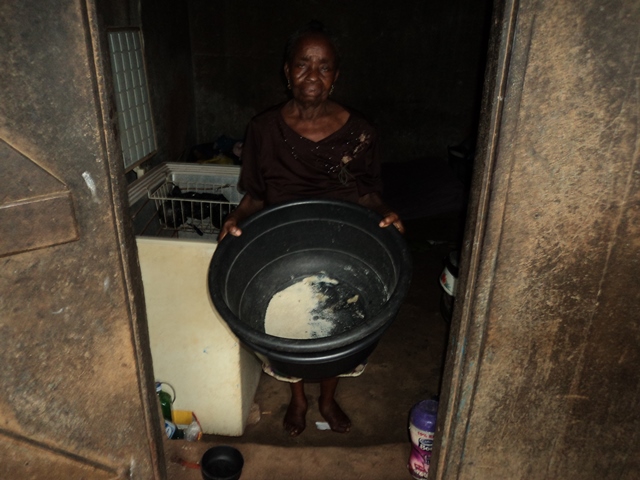
To survive, ‘Mama Eleko’ has converted her deep freezer to a cupboard
But more pitiable is Olasemojo Ulawo, an Octogenarian who was famous for selling beer and soft drinks in her area before the almighty BEDC struck in 2014.
To survive, Mama Eleko, as she is fondly addressed by everyone in the neighbourhood, now sells water to residents from a borehole drilled by her late husband. A bowl of water that she uses a generator to pump in front of her house is just N10. Her daily earnings depend on the water needs of the neighbourhood.
Pointing to her deep freezer that has now been converted to a cupboard where food items such as bread and garri are kept, MamaEleko tells the ICIR that she could not afford to use generator to power the deep freezer to continue with her cold drinks business.
Still having the pile of beer and soft drinks crates in a corner of what used to be her shop but now converted to her room at the basement of a one-storeyed building, she also augments the water business with petty trading.
Her combined earning from the sale of water and odds and ends cannot sustain her at such advanced age as a widow whose children are far away. “Let government give us light,” she moans. “The suffering is too much, hunger is killing us. This is the fifth year that we have been without light.”
ECONOMIC AND SOCIAL DEATH
For Oke Akinbuwa, a driver in his 60s, the district is economically and socially dead. Making particular reference to Okitipupa’s Oil Palm Mill and Oluwa Glass Industry — the two companies that popularised the area in the 70s, 80s and of course 90s — Akinbuwa says there is nothing left to attract young people to the area. While Oluwa Glass situated, along Igbokoda road, is completely dead and deserted as a company, Okitipupa is moribund.
“Many people have not switched on their televisions and radio for the past three years. Radio and TV repairers here have turned to farming and motorcycle riding. No ice water to drink, beer parlours now open only in the evening. No hotel puts on the generator for 24 hours; what they do is just to switch it on between 6pm and 12am,” he says dejectedly.
“We live in the darkness; sometimes it looks like the town is empty because there is no light. There is no headway about the electricity. They are asking us to bring money and that’s the only condition for us to have light. We are old, we have nowhere to go. It is only our children who can go elsewhere.
“There is nothing in this town. If I were a young man, I would have left since. For example, when there is no light, someone who has N200 will use it to buy kerosene to power his lantern. How can you have light without food?”
Olasemojo Omotola, a civil servant, couldn’t lament less, exclaiming: “We don’t derive any satisfaction from blackout!
“Our industries are all dead; Oluwatoyin Sawmill is comatose due to this power problem. Look at welders in this town now, only a few of them are operating and they are using diesel generators. Imagine the amount of environmental pollution we are experiencing now due to smokes from small and big generators.”
Fayemi Joshua, a trained photographer-turned-motorcycle rider, lives in Ilumeje, one of the settlements under the Ilaje clan. He plies his trade in Okitipupa, but his town has not had electricity since 2003.
“We have complained everywhere but nothing has been done. The last time we had light was when late Segun Agagu was campaigning for his governorship election. We are just spending money on fuel; we don’t have money to feed,” Joshua says, straddling his Bajaj-branded bike.
“Our televisions and radios have become homes to rodents due to this problem of electricity. There is no job here and as you can see, I’m riding okada to survive because there is no light to print pictures even if I decide to work as a photographer. The people of Ondo South Senatorial District have been abandoned by their elected representatives.”
DESERTED BY THEIR LEADERS
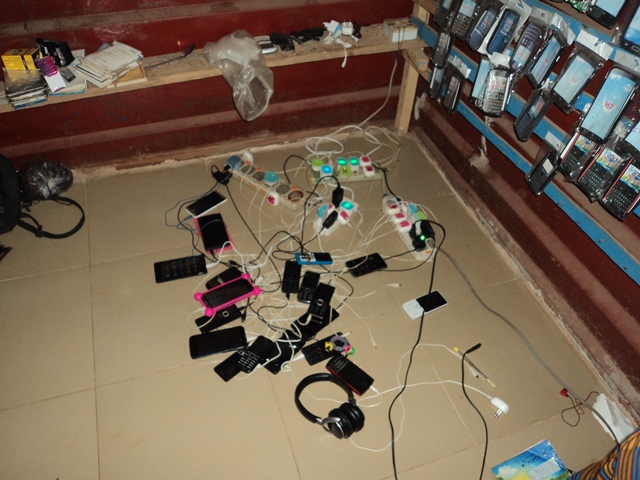
‘Communal’ phone charging
The lamentation by Emmanuel Olohunwa, a phone repairer, captures their mood. According to Olohunwa, the state government has shown no concern about their plight.
“Our elected leaders are not helping us, Senators and members of House of Representatives and even the Speaker are not responding to our problem,” he says. “The immediate former governor, Segun Mimiko, was indifferent to our case but we want the new governor to help us.”
Olohunwa reveals that he spends N1,500 daily on fuel “because I switch on my generator as early as 7am and it will be on till 9pm when I close”.
“All the money that I realise from sales, repair and charging are taken away from me by fuel,” he adds. “People pay N50 to charge their phones and recharge their lamps.”
For possessing three portable generators, colloquially known as “I better pass my neighbour’, Olohunwa is one of the more respected fellows in the community. With these generators, he is able to charge customers’ phones and batteries. In a day, he charges “more than 25 batteries”.
OFF AIR: NTA OKITIPUPA
Adaba FM is located in Akure but it has taken the shine off NTA Okitipupa, no thanks to the power outage. Not only is the radio station now the preferred channel of information for the people of the area, it has also replaced the seven-year-old NTA in terms of commercials and advertisements.
Residents of all the local governments that make up Ondo South Senatorial District have forgotten about the television station. Their sentiment is understandable; the station has been off air for some time. “It no longer transmits,” says a staff of the station who did not want his name mentioned.
So as households’ television sets in Okitipupa and environs are on indefinite break, so also is NTA Channel 26, situated at Idepe in Okitipupa. The coastal station, as it is known, has been off air for about three years due to the power outage and outrageous cost of fueling the station. When the ICIRvisited it, the station still managed some skeletal operation because of its terrestrial paid station, Star Times.
The two industrial generating sets powering the operation room and the transmitting masts were the only reasons some part of the stations were electrified.
But Inumisan Olayemi, Marketing Manager of the station, who was himself listening to Adaba FM on his mobile phone in his car when the ICIR visited, says the station was still transmitting.
“We are transmitting but all the little money we realise from commercials goes into diesel. It is a big problem for us and you know Start Times is here, they run on diesel 24/7,” says Olayemi.
“The problem has badly affected the marketing department because people prefer to take their adverts to radio stations in Akure to bringing it here; at least they can hear it on radio. When there was electricity, when people were planning burials, they planned with NTA adverts in mind. But now, if you go to them for advert, they will tell you that there is no light.”
He explains that the power problem confronting Ondo South has led to about 80 percent reduction in revenue generation of the television station. “We hardly get a commercial a month now,” he says.
NIGERIA’S $15,529/DAY LOSS
Nigeria is the world’s fifth biggest producer of palm oil (Malaysia and Indonesia occupy the top two positions), but it is currently losing $15,529 daily due to the death of Okitipupa Oil Mill. This is approximately a loss of $465,860 a month for a country battling recession and with one of highest unemployment rate in the world: an increase to 14.2 percent in the last quarter of 2016 from 10.4 percent a year earlier. It is the highest joblessness rate since 2009, as the number of unemployed went up by 3.5 million to 11.549 million. Many of the workers at the mill have left after being owed several months of salary.
Employing more than 3,000 workers, the mill produces 25metric tons of palm oil per day when it worked at optimum capacity. According to Index Mundi, an online platform that focuses on importation and exportation of commodities, the current export price per metric ton of palm oil is $621 dollar (as of June 2017).
Okitipupa Oil mill was run aground by bad management on the one hand, and problem of electricity on the other. The carcass of the main mill at the entrance of its Marine Road Headquarters in Okitipupa says it all. What remains of Okitipupa Oil Mill is its name, which has already travelled beyond the shores of the country. The real oil mill of 1968 and early 80s is now a sorry edifice.
The elderly retired soldier manning the place denies the journalist the chance to enter the mill or take a snapshot of its relics by, but what is obvious is a mill in a state of disrepair. With collapsed roofs and fallen parts, the main mill is long dead.
“We used to have over 3,000 workers here but many left for motorcycle riding when the management could not pay their salaries,” he says.
A senior engineer with the oil palm mill adds “this place is moribund” but doesn’t wait to offer details when approached for further comments.
In the past, Okitipupa Oil Palm Plc produced palm oil and kernel. The company that once offered crude palm oil, technical oil, pharmaceutical sterin, palm wine, brooms, seedlings, ashes, and brown soaps now engages in what its staff called “cut and sell”.
Local palm oil makers now buy palm kernels from the mill while the management also runs local mills in place of the giant mill that is now out of operation. What a loss for Ondo state!
Adegbohun Ade, an Electrical Superintendent at the oil mill, says that although the mill has an industrial generator that used to supply power, it cannot run on the generator due to high cost of fueling. Though Ade declines to discuss the details of the problems confronting the once quoted company, he says power is a major factor.
The local palm oil mill has replaced the Okitipupa Oil Mill
The mill, it was gathered, has its dedicated power lines from the old NEPA but they have now broken down or destroyed due to power outage.
“Even if there is light, it can never get here because since 2014 so many of our power lines have either broken down or vandalized,” he says.
“In fact, we used to have a NEPA staff occupying one of our quarters, to show the level of relationship between the mill and NEPA. But today, all that is no more.”
He says machines in the mill are also obsolete and should be replaced rather than repaired if it must bounce back to its past glories. But the mill has become a campaign tool for successive administrations in Ondo State. Every governorship candidate in recent elections has promised to resuscitate it, but the eventual winners never fulfilled their promises. No one knows yet if Rotimi Akeredolu, the new Governor, will revive the mill.
FRUSTRATED ROYAL FATHERS
Igbokoda town has not seen electricity for eight years
Andrew Ikuesan, the Olubo of Obenla Kingdom, Igbokoda in Ilaje Local Government Area, is not in the mood for any chat. He has just lost his sister and is being consoled by his chiefs and subjects. But the moment he is told the electricity situation has brought a journalist to the community, he rises from his seat.
“What do you want to know about the electricity?” he asks, his massive frame and heavily bearded face almost overshadowing his grief.
“The last time I set my eyes on light here was eight years ago. We don’t know where to go. I spend N75, 000 every month to power this palace. I don’t know what crime we committed here.”
In 2015, on the eve of the general election, Ilaje students who gathered to protest against years of blackout were dispersed by armed security men.
Up till now, many coastal villages in Ilaje Local Government, the only area with crude oil deposit, which qualifies Ondo State as an oil-producing state, have been without electricity for more than eight years.
Despite having a Nigerian Navy Forward Operating Base and one of the biggest fish markets in the South West, it is one house, one generator in Igbokoda. Even when Olusegun Mimiko, the former Governor, inaugurated a set of street lights on the only main road in the town, they were powered on the day of commissioning with a generator in 2015.
But the Ilaje king is not the only one who is angry. Oba Olanrewaju Lebi, the Olofun of Irele, is also unhappy about the darkness that has enveloped the district over the years.
With the king old and sick, his queen Ibiduni Lebi speaks on his behalf. Lebi laments the indifferent attitude of the Mimiko administration to the problem of blackout in the district. She explains that the kingdom has witnessed a surge in crime rate, especially kidnapping, since the place was cut off.
“There was supposed to be a demonstration but our people were stopped from doing that demonstration by Mimiko, saying he would look into it. But nothing has happened since then. We are still in the darkness,” she says.
“Our elected representatives in the state house of Assembly and those in Abuja are not doing anything. We expect them to do more on our behalf on this problem but it appears they are not doing anything.
“We believe that our representatives should have been able to solve this problem for us. I learnt that during the privatization of power assets, all the outstanding debt was cleared. Before they completely cut us off, what we were getting in terms of electricity supply was like once in a week. It was not regular.
“To power this palace, we spend N3000 daily on petrol and N21, 000 every week. Eighty percent of the king’s salary goes into buying fuel.”
DEARTH OF RESEARCH AT OSUSTECH
Ogunduyile: there can’t be any serious research work without electricity.
With electricity cables and poles well-connected, a visitor to the Ondo State University of Science and Technology (OSUSTECH) will get the impression that the ivory tower is well-serviced by the national power grid. That is far from the reality.
Located on Kilometre 6, Okitipupa-Igbokoda road, OSUSTECH, with just a faculty — Faculty of Science — and 2000 students, is just recuperating from what Sunday Ogunduyile, the Vice Chancellor, describes as ‘years of neglect’. It is also struggling to fulfil its motto: “For society and development.”
In actual sense, the university has been fully run on generators since 2010/2011 when it commenced academic activities, consequently incurring a huge bill running into millions of naira for powering the university.
“The university spends as much as N9million in three months which amounts to N18million in a session to fuel its generator” says Ogunduyile.
“And we cannot put it on beyond 6pm otherwise we would have been using double and a university of this nature is expected to have students working throughout the night, lecturers doing their researches. If we are to be using it the way we should be using electricity, it means we will be using electricity close to N20million in three months.
“It has affected the university’s finances in other areas; you know a university that is just recovering from long neglect requires every kobo to bring about infrastructural development and so on. For example, the N9million that we spend on power, if we divert that to our library to buy journals, the shelves will be filled. It’s affecting us immensely.”
As a science and technology university, OSUSTECH is expected to churn out cutting-edge researches, but absent of constant power supply means the university can only hope to achieve the feat one day when it is connected to the power grid.
According to him, the university has yet to engage in robust practical experimentation of researches conducted by its lecturers because there is no electricity to work with.
He explains: “The researches we are doing are now being re-intensified. We have been doing them and papers have been published all over the place but when it comes to practical experimentation we need light and we have not been doing well in that area.
“We have written, pleading that we should be connected to the national grid and so on and so forth. But we have not heard any positive response. Where I came from, I normally remain in my office till 10 pm or sometimes I remained there till morning because there was light. If you are to do any serious research work, you need that privacy even after closing hour. But here, we cannot do that. Come here when it is 6pm, and you’ll see the place will look like a ghost village.”
THE REAL REASON BEHIND THE DARKNESS
In the beginning, people of Okitipupa and environs were told that the power outage was caused by a technical fault.
In fact, on October 14, 2014, Benin Electricity Distribution Company (BEDC) informed the people of Odigbo, Okitipupa, Ilaje, Ode-Irele and Ese-Odo local governments that some timber fellers destroyed the high-tension cable that supplies electricity to the district while carrying out their felling activities along Benin-Ore express road. The distribution company serves Edo, Delta and Ekiti States in addition to Ondo State.
But BEDC would later surprise them with a bill of N1billion as the district’s accumulated debt before and after the unbundling of Power Holding Company of Nigeria (PHCN).
At a forum organised by the BEDC to sensitise customers and provide information on the company’s proposed tariff review on August 26, 2015, Edgar Ernest, Chief State Head of BEDC, was quoted as saying that the blackout was because the communities owed over N1billion. He said the communities refused to pay the debt since BEDC took control of the power sector.
“We divided the debt to two: pre-privatisation and post-privatisation and asked the communities to pay, even if it is only the post-privatization they could afford,” Earnest said back then.
“But they did not pay. And we decided to cut their supply until they pay their debt. If you don’t pay your bill, how do you want the company to survive? We will not restore their light until they pay us. Any company that makes N1billion monthly is a big company, let alone losing such amount.”
Expectedly, it was greeted by outcry from the people of the communities. Sayo Onukun, leader of National Revolutionary Vanguard (NRV), Okitipupa, who has been deeply involved in the community’s struggle for restoration of power, tells the ICIR about the “crazy bill” brought by the BEDC.
“If they said our district owes that much, what about other districts in the state?” he asks. “This is a social injustice to our people because our people cannot be an exemption. Why is our own a senatorial billing? It has always been a house-to-house billing anywhere in the world”, he adds
Findings by the ICIR during a tour of the four local governments revealed that the indebtedness to the company is not up to half a billion naira. While bills from communities outside Ondo State were part of accumulated debts BEDC is asking the people of Ondo South Senatorial District to pay, residents allege that BEDC only gave them estimated bills without reading their metres.
“In my house, I was given a metre, but they didn’t bother to read the meter, they were billing on estimation, which is also criminal,” said Omoyele Oke, a driver. “We stay in darkness. There is no headway about the electricity and they are asking us to bring money. They said that is the only condition for us to have light.”
It was gathered that several coastal communities that have not had electricity for more than eight years were also billed up to 2015, forming part of the N1billion debt.
According to Solomon Bitire, a former Chairman of Okitipupa Local Government and current Chairman, Planning, Strategy and Implementation of Operation BringbackOurLight in the district, the actual indebtedness to the company is less than 20 percent of N1billion —N174billion.
“The state governor called a meeting between BEDC and stakeholders. At the meeting, BEDC said we owe N1billlion,” said Bitire, who was the Chairman in 2015 when Mimiko convened a meeting between the management of BEDC and people of the affected local governments.
“They said Okitipupa Local Government owes them N598million out of the N1billion. I told them that they have to convince us about how they arrived at that figure; the Governor asked them if they could do that and they said yes. After two weeks, they brought to my local government about 15 ‘Ghana Must Go bags’ of bills and billing history with a covering note. They said this is the money we owe.”
But the report of a committee set up by the local government, under the chairmanship of S. Aderehinwo, a former Marketing Director of the defunct NEPA, revealed that Okitipupa owed N113million rather than the N598million quoted by the company. Ese-Odo and Ode-Irele Local Governments owed N12 and N9million respectively, while Ilaje owed N40million.
Despite a meeting of stakeholders, which held at the headquarters of Nigerian Electricity Regulation Commission (NERC) in early July 2017, there is yet no respite for the District.
The outcome of the daylong meeting has not been made public, but the ICIR was told by one of the attendees that the commission had directed BEDC to reconnect the district to the power grid. The commission, it was learnt, gave the distribution company a two-week ultimatum to start the repair of all the damaged poles and other installations.
Vandalised transformers like this litter the district
“The management of NERC was very angry and directed that within two weeks of the meeting, BEDC should start repairing all the damaged poles and properties in our area. They also said within a month, they should reconnect us,” said a party to the meeting who did not want to be mentioned.
“They said they should go to Ondo and reconnect us. The third one is that the technical partners from NERC, BEDC and TCN would meet to discuss the technical issues affecting Omotosho Power Plant. They also asked TCN to fix a 133KVA in Omotosho whose only problem is circuit breaker.”
At the meeting, the BEDC was also said to be uncomfortable with the N174million that the people of Ondo South Senatorial District reduced the N1billion debt to. But NERC had directed the two parties to meet and discuss about the reconciliation of the debt.
When contacted for response, an official at the Media Department of the Commission confirmed that “there was an all-day meeting between the management of the Commission and BEDC and representatives of Ondo South Senatorial District”.
She however declined to speak on the details of the meeting and its outcome, insisting that “consultation on the matter” was still ongoing. “Besides, when we are ready to brief the media on the matter, we will invite the media,” she added.
Vivian Mbonu, Head of Media Department of NERC, who just returned from a break, said she had not been briefed on the matter.
Efforts to confirm from the management of BEDC were also unfruitful. Calls and SMS sent to the telephone number of the Ondo Branch Manager of the company, who led representatives of the company to the meeting, were not answered.
When she was called, the BEDC official whose name was simply given as Kunbi told the journalist to send his e-mail address with a promise to respond with steps taken by the company to resolve the problem. But as of the time of filing this report, she was yet to send the mail.
When someone intending to start a hotel business in Okitipupa called the Customer Care Unit of the company requesting for the possible date of restoration of electricity to the area, he was simply told that there is no time frame for his wish.
“We are working to resolve the matter but I cannot tell you the time frame when it will be finally resolved” a female voice said from the other end.
Protesters fired up by anti-establishment songs of Afrobeat musician Fela Anikulapo-Kuti on Monday demanded the resumption to duty or resignation of President Muhammadu Buhari.
Coincidentally, Fela was a vocal opponent of Muhammadu Buhari’s military government, which arrested him in 1984 over trumped-up charges.
“International Thief Thief!” Fela’s voice blared over the loud speakers mounted on open van while the protesters chorused “oppression, inflation, corruption,” as they marched energetically in the rain towards the presidential villa from the Unity Fountain, Abuja.
The protesters drew inspiration from Fela’s anti-establishment songs, which still represent the situation in the country after more than three decades after they were sung.
The protesters displayed a wide banner with the inscription “Resume or resign, Nigeria’s say enough is enough.”
Other placards had inscriptions such as “Our mumu don do,” “Buhari called for impeachment when Yar’ Adua was sick, now we are calling for the same” and “Buhari! Where are you? We are tired of being enslaved in our country.”
Visibly unhappy with the conduct of the affairs of the country, they said they had commenced a daily sit-out to demand the return or resignation of Buhari.
Monday made it exactly three months since Buhari embarked on a medical trip to London for treatment of an undisclosed illness.
The protest is led by Charles Oputa, AKA Charlie Boy. Other prominent faces of the action include Deji Adeyanju, former Director, New Media to the People’s Democratic Party (PDP); Adebayo Raphael, Publicity Secretary, OurMumuDonDo Movement; Ariyo-Dare Atoye, Convener, Coalition in Defence of Nigerian Democracy and Constitution; and John Danfulani of Concerned Nigerians.
They were stopped at the entrance of Presidential Villa by a team of police officers who used vehicles to block the road.