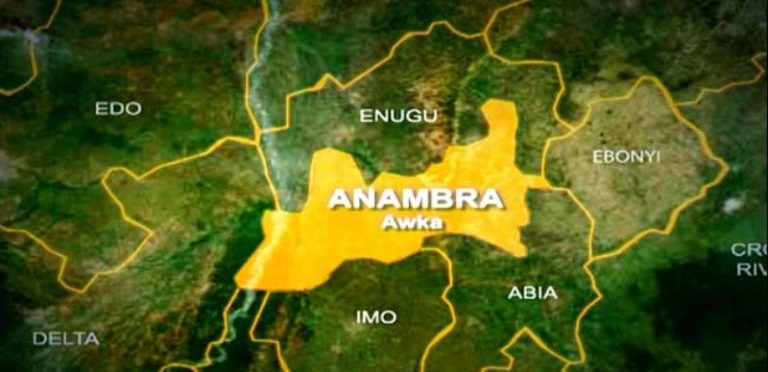
THE Independent National Electoral Commission (INEC) has released the details of candidates for the 2025 Anambra State governorship election.
The electoral umpire made this known in a statement on Saturday, May 17, signed by its National Commissioner and Chairman, Information and Voter Education Committee, Sam Olumekun.
The publication followed the conclusion of party primaries conducted by 16 political parties.
It called for public assessment of the candidates through their details..
“Following the conclusion of party primaries, 16 political parties have uploaded their candidates’ nomination forms for the Anambra State Governorship Election by the deadline of 6 pm on Monday, May 12, 2025, when the dedicated portal automatically shuts down.
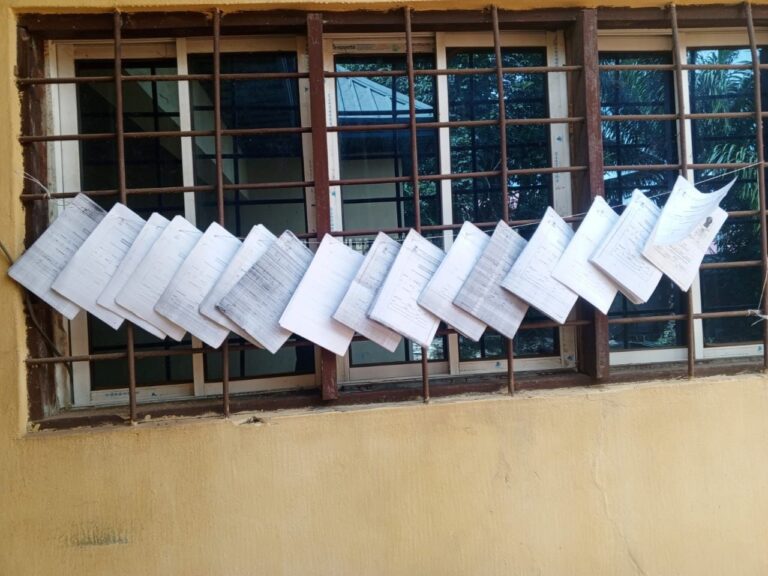
“As provided in Section 29(3) of the Electoral Act 2022 and listed as item 4 on the Timetable and Schedule of Activities for the election, the Commission has published the personal particulars of each candidate and his running mate by displaying copies of the Form EC9, along with all the accompanying academic credentials and other documents submitted by them, at our state headquarters and the 21 local government offices across Anambra State,” INEC stated.
It urged Nigerians to assess the candidates’ documents, which it ‘titled ‘Publication of Personal Particulars of Candidates for the 2025 Anambra State Governorship Election.’
It also urged aspirants with reasonable grounds to believe that a candidate provided false information to challenge the nomination of the candidate in court.
The electoral umpire hinted that the final list of candidates would be published on June 9, which is at least 150 days before the election, in line with the provision of Section 32(1) of the Electoral Act 2022.
“We appeal to Nigerians to scrutinise the documents. Any aspirant who participated in his/her party primaries with reasonable grounds to believe that the information provided by a candidate is false can challenge the nomination in a Federal High Court as provided in Section 29(5) of the Electoral Act 2022.
“The final list of candidates will be published on June 9, 2025, which is at least 150 days before the day of the election, in line with the provision of Section 32(1) of the Electoral Act 2022 and listed as item 7 on our Timetable and Schedule of Activities for the election,” INEC added.
The Anambra state governorship election will be held on Saturday, November 8, this year.
The ICIR had reported that the incumbent governor, Chukwuma Soludo, won as the All Progressives Grand Alliance’s (APGA) flag bearer.
He emerged unopposed, securing 3,168 votes from the delegates of the party during the primary, which was held on Saturday, April 5.
Soludo will be slugging it out in the governorship election to be held on Saturday, November 8, with a former member of the House of Representatives, Nicholas Ukachukwu, who clinched the All Progressives Congress (APC) ticket.
Also in the picture is a former managing director of the National Inland Waterways Authority (NIWA), George Muoghalu, who won the Labour Party’s governorship ticket.
THE Anambra Police Command has recovered a dead body found hanging on a tree in a bush at Amichi, Nnewi South Local Government Area of the state.
The police confirmed the incident in a statement on Saturday, May 17, stating that the body was found following a call made to the deceased’s phone by an unidentified person.
According to the statement released by the Police Public Relations Officer (PPRO), Tochukwu Ikenga, officers from the Onitsha Head Bridge Divisional Headquarters moved the corpse to a morgue.
He noted that efforts are ongoing to contact the deceased’s family for necessary actions.
“Information revealed that an unidentified person called through the deceased’s phone to report the discovery of the body hanging on a mango tree in a bush.
“Meanwhile, the body has been identified and deposited in the morgue, and efforts are ongoing to contact the deceased’s family for necessary action,” the statement read.
Ikenga noted that the Commissioner has mandated a thorough investigation to determine whether foul play was involved.
The police have also called on the public to come forward with any information that might aid in solving the case.
However, the incident came shortly after another incident earlier this month, when the body of a pregnant woman was found hanging from a cashew tree along Uke/Ideani road in Idemili North Local Government Area of the state.
The police spokesman, who confirmed the incident on May 6, noted that the state Commissioner of Police appealed to stakeholders and community leaders of the LGA to assist with information to help identify the perpetrators.
“The CP described the incident as unfortunate and a stark example of ‘man’s inhumanity to man’, and he ordered a thorough investigation to identify and prosecute the perpetrators,” he said.
A gas cylinder explosion at the plumbing market along Uga Street, near Onitsha Bridge Head Market in Anambra State, has left one person dead and six others injured.
The incident occurred on Friday, May 16, while a welder was working on a metal with carbide, causing the gas cylinder to explode due to excessive heat.
Confirming the incident in a statement on Saturday, May 17, the Police Public Relations Officer (PPRO) of the Anambra State Police Command, SP Tochukwu Ikenga, stated that the blast was triggered by excessive heat applied to the gas cylinder.
He stated that police officers from the Onitsha Head Bridge Divisional Headquarters, assisted by community members, quickly responded to the scene and rescued six victims who were rushed to the hospital for treatment.
“Police Operatives attached to the Onitsha Head Bridge Divisional Police Headquarters on the 16th of May 2025 complemented the rescue efforts by good-spirited individuals on the six victims of a gas cylinder explosion at a plumbing market, along Uga Street, which regrettably recorded one death.
“Preliminary information revealed that the welding gas cylinder exploded as the welder was working on a metal due to exposure to excess heat,” the statement added.
According to him, the deceased has been deposited in a morgue.
The police further stated that their operatives have taken steps to secure the area and prevent criminal-minded persons from taking advantage of the situation to commit crimes.
“To this end, the Police Operatives have taken steps to secure the area and prevent criminal-minded persons from taking advantage of the situation to commit crimes,” the statement added.
The statement added that the Commissioner of Police in the state, Ikioye Orutugu, is concerned about the unfortunate incident and has provided some safety tips to prevent such from reoccurring.
This tragedy adds to a series of recent related incidents in Nigeria.
The ICIR reported on Wednesday, March 19, that an explosion from a tanker crash rocked the Abuja-Keffi expressway near Karu Bridge. The incident occurred during rush hour as commuters returned from work along the ever-busy highway.
In January 2025, a fuel tanker explosion near Suleja, Niger State, claimed over 80 lives and injured many others.
The explosion occurred when locals attempted to collect spilled fuel from an overturned tanker, which ignited upon contact with a generator.
Earlier in October 2024, a similar incident occurred in Majiya, Jigawa State. A fuel tanker overturned, and as residents rushed to fetch the spilling fuel—a practice driven by economic desperation—the tanker exploded, resulting in over 150 deaths. Many victims were burned beyond recognition, while about 100 others were injured. The victims were buried together in a mass funeral organised by the authorities.
In September of the same year, another 59 people were killed in Niger State after a fuel tanker collided with a truck carrying passengers and cattle.
ISRAEL has initiated a large-scale military offensive in Gaza following a series of airstrikes that killed over 200 people.
The Israel Defense Forces (IDF) announced the operation as part of an intensified campaign aimed at seizing strategic areas to pressure Hamas into releasing hostages.
In a statement Friday evening, the IDF revealed that the offensive, named Operation Gideon’s Chariots, was targeted at occupying key territories in Gaza as a means to fulfil the broader objectives of the war.
The IDF said it “launched extensive attacks and mobilised forces to seize strategic areas in the Gaza Strip, as part of the opening moves of Operation Gideon’s Chariots and the expansion of the campaign in Gaza, to achieve all the goals of the war in Gaza”.
The ICIR reports that Israeli strikes on Gaza have killed over 250 people since Thursday morning, according to local health authorities. This marks one of the deadliest rounds of bombardment since a truce broke down in March, with a new ground offensive anticipated soon.
However, while justifying the attack, the IDF stated that it carried out airstrikes on over 150 ‘terror targets’ in the Gaza Strip over the past day.
The Israeli forces stated that the strikes targeted anti-tank missile launch sites, operational cells, and buildings used by militant groups to coordinate attacks on forces.
During the ground operations, the IDF reported that the 252nd Division neutralised several operatives positioned at an observation post in northern Gaza.
It noted that the Gaza Division eliminated several tunnel shafts, destroyed related infrastructure, and killed operatives in Rafah.
It added that the 36th Division dismantled more Hamas infrastructure and killed militants attempting to plant a bomb in the Morag Corridor area.
Reports, however, suggested that many civilians were casualties of the airstrikes by the IDF.
The announcement followed Donald Trump’s visit to the Middle East, during which he acknowledged the severe humanitarian crisis in Gaza.
The US president, while addressing reporters in Abu Dhabi on Friday, said, “We’re looking at Gaza. And we’re going to get that taken care of. A lot of people are starving.”
Backstory
The ICIR reported that a two-month ceasefire between Israel and Hamas ended in March, shortly after Israel reinstated a full blockade on Gaza, which aid agencies said had caused severe food shortages.
On March 2, Israel halted aid to Gaza, a move it described as a strategy to pressure Hamas, which continues to hold dozens of Israeli hostages captured in October 2023.
Prime Minister Benjamin Netanyahu announced that Israel was preparing for an expanded and intensified offensive against Hamas, following his security cabinet’s approval of plans that could include taking full control of the Gaza Strip and overseeing the distribution of aid.
Hamas insisted on Thursday that the resumption of humanitarian aid to the war-torn territory was “the minimum requirement” for any negotiations to proceed.
Israel has stated that its objective in Gaza was to eliminate Hamas, the group responsible for attacking Israeli communities on October 7, 2023, killing approximately 1,200 people and taking around 250 hostages.
Gaza’s health ministry reported that 2,876 people have been killed since Israel resumed airstrikes on March 18, bringing the total death toll from the war to 53,010.
The military stated that its operations were ongoing, and that in the past 24 hours, it had “targeted over 150 terror sites across the Gaza Strip, including anti-tank missile launchers, militant groups, military facilities, and operational centres.
The United Nations estimates that 70 per cent of Gaza is currently either designated as a no-go zone by Israel or under an evacuation order.
TRAGEDY struck the family of Tabitha Manasseh Mohammed on a Friday in 2015 after the pit she was mining gold from caved in, and a heap of sand fell on her back. The incident damaged her spinal cord, leaving her unable to stand on her feet.
All efforts by hospitals in Minna, Abuja, Zaria and Sokoto, where she was taken for treatment, failed to help restore her. She is not the only victim of the tragedy; as the ripple effect affected her mother who collapsed and fainted upon hearing the news of what happened to her daughter. The elderly woman spent three days at the hospital before she was resuscitated, she eventually became incapacitated and has since been unable to stand and walk for nine years, like her daughter.
The ICIR saw Tabitha’s father struggling to walk with a stick. He has a challenge with one of his legs. Despite his predicament, he plays a significant role in the care of his disabled wife and daughter.
Tabitha Manasseh Mohammed lies in her room with her wares
Dark Friday
Tabitha had left her two-month-old twins and two older children with her mother at home in Kampani community that fateful Friday, with the hope of going to mine some gold in neighbouring Pmapi community, in Bosso Local Government Area of Niger State. She engaged in this activity to support her family.
“I left the house with whitlow and was in great pain that morning, just to fend for my children,” she recounted. She entered a big pit with other miners but was unlucky as a heap of sand fell on her during a landslide.
She was taken to several hospitals, including traditional bone setters in different towns in Nigeria, without any success after the accident, she said.
“Since the hospitals could not treat my condition, I have since returned to my father’s house. My husband said he could not care for the four children and me. That’s why I have been in my parents’ house,” she said.
Part of the Pmapi land degraded because of illegal mining. Photo: Marcus Fatunmole/The ICIR.
The woman always lies on a small bed in her room, where she keeps bowls of foodstuffs that she sells. The foodstuffs, including rice, beans, and onions, are not more than what her children can consume in a week.
“My first daughter is 20 years old now. My sister takes care of her, paying her school fees at the College of Education. Then the second one is with me. She attends Junior Secondary School in Suleja. My father and siblings pay his school fees. The twins, the last born, were two years old when I had the accident. They could not proceed with their education after their primary education.”
But for her siblings and father, life would have been worse for her, she said. While soliciting support from the public, she expressed hope that a miracle could make her stand again on her feet.
How miners flock Pmapi for gold
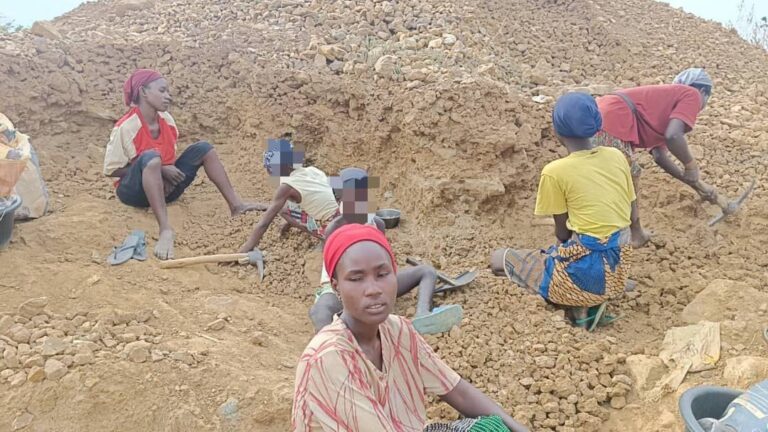
Unlicensed artisanal miners, including women and children of school age, mine gold in Pmapi daily. They come from different communities in the state and beyond. Some of them are violent and could attack the villagers, who also participate in the mining.
Mining pits dot the community. They cave in during the rainy season, injuring and killing miners. At least three people die from mining in the village yearly, in addition to several others who are injured during such incidents, according to several miners interviewed and Pmapi residents.
Another degraded portion of Pmapi community (The houses in the pictures are in Minna.) Photo: Marcus Fatunmole/The ICIR.
Resident said, the business witnesses a boom during the rainy season because there is more water to sieve the gold from sand, and the mineral could be more easily located during this period, according to miners who were interviewed.
Pmapi has been badly degraded, despite being very close to Minna, the state capital. Residents said the situation could deny the area of development. The community lacks most basic amenities, including electricity, hospitals, potable water and a good road. It could only boast of a primary school and a bridge currently under construction.
The community leader, Mohammadu Suleiman, gave an insight into the mining crisis in the village. He said, “Miners have destroyed my community, and we don’t get a dime from the miners. I don’t know if the government is aware of this. We have tried our best to stop the miners, but they often prove stubborn. If you go to your farms during the rainy season, in the process of mining, the miners will uproot our crops. If we talk, they will bring out machetes and other weapons to attack us. Because of this, many of our people have been afraid of them.
#SPECIALREPORT: Residents of a community in Niger State, Nigeria, are grappling with the devastating effects of illegal gold mining activities. The uncontrolled mining has led to significant environmental degradation, loss of livelihoods, and increased insecurity in the area.… pic.twitter.com/JEQASos8BJ
Pmapi community leader, Mohammadu Suleiman. Photo: Marcus Fatunmole/The ICIR.
“If we have the means to talk to the government, we would have spoken. We have been crying. If there is any way the government can stop the miners, we will be happy. If you ask me who the miners are, I don’t know them, and I don’t know who sends them.”
He, however, said that youth and children in his community participate in the mining.
“My people are not known with mining but farming. Whenever I talk to my people who do this thing, they tell me it’s because of hardship. Even if you enrol some of them in school, they won’t stay but will prefer to mine,” he said.
‘Chinese mining firm gave out N2m to community’
Illegal mining has taken place in the village and its environs for several decades, according to residents. However, the practice became worse when the younger brother of the community leader, Suleiman, leased his land to a Chinese firm some years back.
The man, whom the village head and other residents concealed his identity despite several efforts by The ICIR to obtain his name and phone number, was said to have leased his land to the Chinese to mine gold. The company moved into the community in 2021 and quit after 18 months, leaving the land in ruins.
When the firm began mining in the village, The ICIR gathered that it promised to pay the community N2 million annually to support its development. The company operated for 18 months and only released N2 million to the community. It left heaps of sand and gravel, including scores of mining pits in the community. A building by the company for its staff in the village is now being occupied by many illegal artisanal miners.
The building left behind by the Chinese firm. Photo: Marcus Fatunmole/The ICIR.
Some of the pits, which are as deep as wells, cave in during the rainy season, when the business is at its peak. Miners get trapped in them because people keep going into the pits every year to look for gold. There are dozens of other pits dug by the local miners, which have been traps of death.
The village head confirmed that the Chinese firm gave the community N2 million after operating for 18 months. He said his village used the money to build slabs on the river linking them.
No record of Chinese firm at LGA – Chairperson
The ICIR contacted the chairman of the Bosso Local Government, Rakiya Bawa Bosso, who said that there was no record of the Chinese firm at the LGA.
“The coming of the Chinese was before we assumed office, and we didn’t find any MoU signed between the LGA and the Chinese, but they claim that the Federal Government knew about them.”
Similarly, the state Commissioner for Mineral Resources, Garba Yahaya Sabo, said that until he assumed office in 2023, the state did not have records of firms mining in the state.
Commissioner for Mineral Resources, Garba Yahaya Sabo. Photo: Marcus Fatunmole/The ICIR.
“When this government came into office, there was nothing like revenue in the mineral sector. My permanent secretary was posted before me. When I came, we sat together with the directors in the ministry. I said we needed to think outside the box.
This ministry has potential for generating a lot of revenue. We brought the idea of profiling. This idea is that any company that is coming to operate in Niger State must come and profile and you pay some certain amount.
“The essence of the profiling is for security reasons. We have to know your location, number of staff. If possible, we must have details of your operations so that if there is anything, we’ll know who to hold responsible.”
He said the effort paid off, with the state now generating revenue from its mineral resources.
Community received N2m from Chinese out of ignorance – Commissioner
Reacting to the N2 million given to the Pmapi community by the Chinese, the commissioner said, “How much is N2 million? They were supposed to provide social amenities, construct roads, and provide water in that place. Because of a lack of knowledge in that place, the Chinese took advantage of that. This is the problem we have.
“We are enlightening people now. We tell them everywhere that they should not allow any company to start operating without notifying the government, no matter any amount the company gives them.
“You have a lot to lose there, without the government intervention. If we intervene, definitely the company must do the needful.”
Some of the gold mined in Pmapi community kept in an oyster shell. Photo: Marcus Fatunmole/The ICIR.
He vowed that there would be punishment for people who sell or lease their land to mining firms that end up degrading the land or plundering the state’s wealth.
The ICIR reports that Pmapi is entitled to funds accruing from the Community Development Agreement (CDA) as spelt out in Section 116 (1) of the 2007 Nigerian Minerals and Mining Act (NMMA). This portion of the Act establishes the CDA between miners and their host communities.
However, this law only applies to a recognised entities like the Chinese firm. Since mining in Pmapi is largely informal and the artisanal miners are unlicensed, they may not be able to benefit from it.
The ICIR further reports that Niger State has the biggest landmass in Nigeria, covering 76,363 square kilometres. The State boasts of a commercial quantity of large minerals deposits like gold, talc, kaolin, Tantalite, granite, marble, copper and lead. Nigeria losses $9 billion annually to illegal mining, and Niger State contributes to this loss.
However, it has been overwhelmed by bandits who seek to milk its gold and other resources in recent years.
In 2016, former Governor Abubakar Sani Bello said he could not pay workers’ salaries because there was no money in his government’s coffers.
Shortly after assuming office in 2023, the incumbent Governor, Mohammed Umar Bago, borrowed one trillion naira to enable him to deliver infrastructural projects in the state.
He recently regretted taking the loan. Given the huge wealth plundered from the state by illegal miners, the state might have no reason to take such a loan if the government harnessed its resources.
One of the mining pits that dot the Pmapi community. Photo: Marcus Fatunmole/The ICIR.
The ICIR reported how a mining firm’s negligence sent youth to early graves in the state. Some communities are still inaccessible in the state because of the activities of miners who masquerade as terrorists. In 2021, The ICIR reported how the Federal Capital Territory (FCT) lost billions to illegal miners. There were also such reports in Osun, Benue and others.
‘Why we engage in illegal mining’
Several miners shared their views with The ICIR on why they do the business. They said poverty and hardship in the country are among the reasons they went into it.
The miners include nursing mothers, children and youth. They use crude tools such as axes, hoes, diggers and shovels, which make them expend much energy to achieve their aim. Besides, they conduct the business amid the fear of environmental officials who randomly arrest them.
Twenty three-year-old Fatima Abubakar left her children at home in Minna to mine in Pmapi. “I’ve been doing this for one year. The reason I do it is because I’m poor. My husband doesn’t have much. I do this to support my family,” she said.
She makes between N5,000 and N10,000 daily. She, however, said some miners make good money from the business.
Some of the unlicensed artisanal miners in Pmapi community
She said, “I have witnessed three people die in this business,” she said, adding that, “It is always easier to mine during the rainy season because we have enough water to sieve the gold out of the sand.”
Khadijat Alkasim, 17, an SSS 1 student at the Maitunbi Secondary School, said she was into the business because her father had been ill. “I do it to support my parents, especially my father, who has been sick.”
Jemila Mohammed hails from Pmapi and has been doing business for over 20 years. A divorcee and mother of two, her only business is mining. She was recently down with malaria, and in the process of treating herself, she discovered that her legs and hands swelled.
“I just suddenly realised that my hands and legs got swollen. It started with the legs. The hands soon joined. It got worse to the point that people had to carry me to bathe and do other things for me. They used traditional medicines on the hands and legs before the swelling reduced.”
Jemila Mohammed
She could not identify the cause of her predicament, as she continued to walk with the support of a stick. She could no longer mine.
Blessing Mattew, a hair stylist, was also at Pmapi for mining. She said, “I mine gold, it is not my calling; and it is not my future. I’m a hair stylist. I finished secondary school and I’m a mother of four. Without this, at times, there will be no school for my children. Without this, there will also be no food for my children to eat. So, I do this to assist my husband.”
In a week, she could make up to N40,000, and sometimes, she doesn’t make money. She appealed to government to support the less privileged in society and do more to reduce suffering in the country.
Zephaniah Sunday hails from Shiroro LGA, which has faced much insecurity over mining. “Bandits are everywhere sending people away. To get food to eat is a problem. We are here to look for what to eat. We have children and wives. We don’t know what to give our children.”
He said he was not happy with the illegal mining, but fate forced him into it.
Blessing Mattew
Deborah Ayodele is from the South-West. She is among the women who engage in mining. She makes about N30,000 weekly. She also said suffering brought her into mining when her business collapsed.
“I have a daughter in the university and I also have another son graduating this year,” she said, in her bid to justify why she was in the business.
Gold is a lucrative business – Buyer
Audu Adamu hails from Pmapi. He takes the gold to Minna to sell. According to him, there are many gold buyers in Minna, and the business is very lucrative.
Adamu showed The ICIR a small gold of about a tablespoon, which he said would sell for N25,000.
Gold dealer, Audu Adamu
Expert reacts
Responding to The ICIR findings, the Executive Director of Global Rights, Abiodun Baiyewu, said Chinese confidently moved into communities with mineral resources in Nigeria, pretending they did not understand and could not communicate in English to avoid interacting with locals who could challenge them.
She said the Chinese are a menace, not just in Niger State. “If you go to the next door in Nasarawa, if you go to Zamfara, where I first ran into Chinese miners 14 years ago, you will see them.
“The Chinese miners gave a hand-drilling machine to artisanal miners so that they could produce the nuggets faster. Miners took it home. The nugget was already laced with lead. The ensuing tragedy led to almost 700 people in this country dying without us batting an eyelid. That remains a nightmare many years later. If you go to Osun State, you will find these Chinese miners.”
She said the Chinese come to Nigeria with visas to do other work but go into mining illegally, adding that the Chinese do not just mine solid minerals, but red woods. According to her, very little is done by the country to safeguard its mineral assets.
A picture showing how close Pmapi community is to Minna, Niger State capital. The buildings at the other end are in Minna.
“People in communities do not know if miners are licensed. All they know is that miners will say they want to mine. A lot of the communities do not know what’s going on. Miners will say they want to buy or rent the community’s land. They’ll come in and destroy the entire place. Because the communities have been paid, the miners feel there is nothing the communities can do or say; and it goes on like that.”
Baiyewu challenged all tiers of government in the country to invest in mining and protect the nation’s mineral resources.
She called on ministries, including the Ministry of Mines and Steel Development, Water Resources, Environment, and their counterparts in states, to collaborate and ensure the nation enjoys its mineral resources.
She also appealed to the Nigerian government to have the political will to end illegal mining, even as she called for increased local investments in mining.
“Take for example, Niger State has one-tenth of Nigerian landmass. The state used to have four mining officers and one vehicle to cover the size of almost one-tenth of Nigeria. How is that possible?” she queried, stressing that 80 per cent of mining in Nigeria is by artisanal miners.
She also said when the Zamfara crisis happened, the state had just a mining officer, whom she said was not paid by the government for three months.
THE Joint Admissions and Matriculation Board (JAMB) has asked candidates who missed their rescheduled 2025 Unified Tertiary Matriculation Examination (UTME) and have genuine reasons to submit a formal complaint via its support platform.
The examination body issued the directive via its official X handle on Friday, May 16.
JAMB directed affected candidates to raise a ticket on its official support site.
It said that while explaining their reasons for missing the scheduled examination, candidates should indicate a preferred location to retake the exam.
“Did you miss your scheduled examination for a genuine reason? Kindly raise a ticket to that effect on http://support.jamb.gov.ng, stating why you missed the session and where you’d prefer to rewrite the exam,” JAMB stated.
In a related post on Friday, the JAMB unveiled a Candidate Counselling Emergency Support Centre (CCESC) to assist candidates with urgent complaints and queries.
The CCESC is designed to complement its existing ticketing platform to address candidate complaints.
“In addition to our usual and preferred ticketing platform for candidate support, JAMB has now opened a Candidate Counseling Emergency Support Centre (CCESC),” JAMB said.
The examination body urged that members of the public, particularly candidates with genuine concerns, could reach out to its officials.
It reiterated that its digital ticketing platform remains the primary and most effective means of communication with the Board.
“Please note that the ticketing platform is still the primary and most effective method for communicating with the Board as it is fast and easy to use and also guarantees a quick reply,” the statement added.
The ICIRreported that JAMB rescheduled the 2025 UTME for candidates after admitting to having suffered an examination glitch.
The rescheduled examination was to take place on Friday, May 16, Saturday, May 17, and Sunday, May 18, at designated centres across Lagos and the South East.
At a press briefing on Wednesday, May 14, over the matter, the JAMB Registrar, Ishaq Oloyede, said the decision was reached after identifying significant errors in the initial exam process.
He revealed the affected centres to include 65 in Lagos and 92 in the Owerri zone, comprising five states of the South East.
Oloyede then assured that candidates whose timetables clash with other commitments would be accommodated accordingly.
PRESIDENT Bola Tinubu has approved the acquisition of additional air assets to strengthen the fight against terrorism.
The approval came as terrorists have in recent months intensified attacks, particularly in the northern region of the country.
Briefing State House correspondents immediately after a closed-door meeting with the President and defence chiefs at the Aso Rock Villa on Friday, May 16, the Chief of Defence Staff (CDS), Christopher Musa, said the additional equipment has already been procured to strengthen the fight against insurgency.
“Mr President has given a directive as to what to do next for us to intensify all efforts and collaborate with all our sister countries around us, because it is the porous nature from there that is aggravating our issues on the ground.
“And so all our theatres have been enhanced, equipment has been bought, and Mr President has given us much approval for air assets and other aspects of security, and as we said, it is not only the kinetic aspect, the non-kinetic aspect is most important,” Musa said.
Musa hinted that the President was also looking to discuss with state governors to support the cause and ensure the fight against terrorism is extended to communities.
He, however, linked the recent surge in insecurity in Nigeria to a global push by terrorists and jihadists across the Sahel region, asserting that the pressure is largely due to the porous nature of the country’s borders.
Maintaining that the meeting with Tinubu was held to review the overall security situation in the country, Musa added that the security chiefs assured the President of their commitment and efforts to bring the situation under control.
The ICIRreported recently on the rising insecurity in Plateau State, where terrorists took over and occupied about 64 communities.
The attack prompted the state governor, Caleb Mutfwang, to order a census of residents in the communities occupied by the terrorists to ensure proper documentation of those living in the area.
The attack, which began on March 28, 2025, escalated with a series of coordinated invasions of villages across the Bokkos Local Government Area (LGA) of the North-Central state.
By Wednesday, April 2, it escalated in several communities of the LGA, displacing many and leaving a trail of destruction in Ruwi, Hurti, Tadai, Manguna, and Dafo communities.
Not least, 52 people were killed in the attack, the ICIRreported.
As President Bola Tinubu marks two years in office this May, the political landscape is tilting further in favour of the ruling All Progressives Congress (APC), with a steady stream of defections from opposition parties into the president’s camp, a trend that has accelerated in 2025 and may reshape the contest ahead of the 2027 elections.
The APC took over power from the Peoples Democratic Party (PDP) in 2015 and has since maintained its grip on the nation’s leadership.
In this report, The ICIR presents major politicians from the opposition parties who have defected to the APC.
Oborevwori and Okowa
Delta State Governor Sheriff Oborevwori led the entire structure of the Peoples Democratic Party (PDP) to defect to the APC on Wednesday, April 23.
His predecessor, Ifeanyi Okowa, was among the defectors.
Governor Sheriff Oborevwori
Okowa was the running mate to former Vice President Atiku Abubakar, the PDP presidential candidate in the 2023 poll.
Their defection caused a stir among political watchers nationwide.
Kawu Samaila
In April, Kawu Samaila, the senator representing Kano South, confirmed his defection from the New Nigeria People’s Party (NNPP) to the APC.
He wrote, “Yes, it is true — the rumours regarding my defection are accurate. All politics is local, and my primary concern has always been, and remains, the welfare of my immediate constituency.”
Ned Nwoko
In January, the senator representing Delta North, Ned Nwoko, dumped the PDP for the APC.
Nwoko had been a longtime member of the PDP.
Shehu Sani
In February, former Kaduna Senator and activist Shehu Sani dumped the PDP for the APC.
File picture of former senator representing Kaduna Central Senatorial District, Shehu Sani
He said his priority was to help the state governor, Uba Sani, win a second term.
He later revealed his intention to vie for the Kaduna Central Senatorial District on the APC’s platform in the coming election.
Three Kebbi senators
All three PDP senators from Kebbi State, Adamu Aliero, Yahaya Abubakar Abdullahi, and Garba Maidoki, have all joined the APC.
They first announced their intention to join the party after a meeting with President Bola Tinubu on Friday, May 9, at the Presidential Villa.
Three Katsina Reps
On Thursday, May 8, three members of the House of Representatives from Katsina State defected from the PDP to the APC.
The lawmakers are Abubakar Aliyu, Yusuf Majigiri, and Abdullahi Balarabe.
Their notices of defection were read by the Speaker of the House, Tajudeen Abbas, during plenary.
The lawmakers who defected in the presence of the Katsina State governor, Diko Radda, claimed their defection was due to the internal crisis in the PDP.
Another three members of the opposition in the House of Representatives joined the APC on Thursday, May 15.
The lawmakers are Kabiru Hassan Rumrum from NNPP (Kano State), Oluwole Oke from PDP (Osun State), and Sani Abdullahi from NNPP (Kano State).
No problem with Nigeria becoming one-party state – APC chairman
Speaking on the gale of defection to his party and concerns that the nation was transforming into a one-party state, the National Chairman of the APC, Abdullahi Ganduje, said there was nothing wrong with Nigeria evolving into a one-party state, provided it reflected the will of the people.
Ganduje made the remarks at the Presidential Villa in Abuja, shortly after leading the three senators from Kebbi State to meet Tinubu.
APC chairman and former governor of Kano state, Abdullahi Umaru Ganduje
“One party’s state is by negotiation, and it is by other political parties seeing the effect of the positive governance of our party. If they decide to come to our party willingly, I think there is nothing wrong with that.”
The ICIR reports that the defections to the ruling party appear to have slowed down the coalition talks being led by Atiku Abubakar and former governor of Kaduna state, Nasir El-Rufai.
However, Abubakar said the APC and other party members were in the coalition to unseat Tinubu in 2027.
The ICIR reports that as of May 13, 2025, the composition of the Nigerian Senate is as follows:
THE Federal Government, 36 States, and 774 Local Government Areas have shared N1.681 trillion as federation account revenue for April 2025.
The amount represents a 6.5 per cent increase compared to the N1.578 trillion shared for March.
The ICIR reports that the April federation allocation revenue increment was largely as result of VAT revenue which rose to N642.27 billion, compared to N637.62 billion in the previous month.
This was disclosed in a statement on Friday, May 16, by the Director of Press and Public Relations at the Office of the Accountant General of the Federation, Bawa Mokwa.
Mokwa noted in the statement that the amount was shared during the May 2025 Federation Account Allocation Committee (FAAC) meeting held in Abuja.
“The total distributable revenue of N1.681 trillion comprised distributable statutory revenue of N962.88 billion, Value Added Tax (VAT) of N598.08 billion, Electronic Money Transfer Levy (EMTL) of N38.86 billion, and Exchange Difference of N81.41 billion,” the statement read.
FAAC reported that gross revenue for April 2025 stood at N2.848 trillion, out of which N101.05 billion was deducted as cost of collection, while N1.066 trillion was set aside for transfers, refunds, interventions, and savings.
Gross statutory revenue for the month rose to N2.085 trillion, up by N365.60 billion from the N1.719 trillion recorded in March.
From the N1.681 trillion shared, the Federal Government received N565.31 billion, the state governments received N556.74 billion, while local government councils got N406.63 billion.
An additional N152.55 billion was disbursed to oil-producing states as 13 per cent derivation revenue.
A breakdown showed that from the N962.88 billion statutory revenue, the Federal Government received N431.31 billion, states received N218.77billion, local councils got N168.66 billion, and N144.15bn was allocated as derivation revenue.
For the N598.08 billion VAT pool, the Federal Government received N89.71 billion, states got N299.04 billion, and local councils received N209.33 billion.
The EMTL revenue of N38.86bn was shared as follows: N5.83bn to the Federal Government, N19.43 billion to states, and N13.60 billion to local governments.
Also, from the N81.41 billion Exchange Difference, the Federal Government received N38.46 billion, states received N19.51 billion, local governments got N15.04 billion, and N8.40 billion was shared as derivation.
The statement noted that, “In April 2025, Petroleum Profit Tax, Oil and Gas Royalty, Electronic Money Transfer Levy, VAT, Excise Duty, Import Duty and CET Levies increased significantly, while Companies Income Tax decreased considerably.”
The ICIR reports that the rise in revenue suggests improved economic activity in consumption and import-related areas, as well as better compliance with petroleum-related tax obligations.
At the same time, the decline in CIT may indicate continued strain on corporate profitability amid macroeconomic headwinds such as inflation, naira volatility, and elevated input costs.
THE Niger Delta Power Holding Company (NDPHC) has announced a partnership with the National Agency for Science and Engineering Infrastructure (NASENI) and Haier Technologies to deliver a 20-megawatt (MW) embedded solar power facility to the Challawa Industrial Area in Kano State.
The initiative was formally launched during a high-level site assessment visit led by Jennifer Adighije, the Managing Director/Chief Executive Officer of NDPHC, on Friday, May 16.
She was accompanied by key executives, including the Executive Director of Generation, Kassim Abdulahi, Executive Director of Corporate Services, Omoregie Ogbeide-Ihama.
The team first visited the headquarters of Kano Electricity Distribution Company (KEDCO), where they held strategic talks with its Managing Director/CEO, Abu Jimeta.
A statement by the NDPHC’s Head, Corporate Communications and External Relations, Emmanuel Ojor, stated that both organisations reaffirmed their commitment to deepening collaboration for improved electricity access across Kano and its environs.
Also present during the tour were representatives of NASENI and Haier Technologies, who are collaborating with NDPHC to execute the project, targeted at supporting small and medium-sized enterprises (SMEs) and large-scale manufacturers in Challawa.
Adighije, who addressed business owners during the visit, described the exercise as “significant and emotional,” stressing the industrial area’s vital contribution to national revenue and employment.
“This is a very important and emotional visit. I recall that on December 7th last year, the Chairman of our Board and Vice President of Nigeria, Senator Kashim Shettima, visited Challawa. Before returning to Abuja, he directed NDPHC to provide an alternative power source for the area,” she said.
She acknowledged the delay in implementation but clarified that the period was spent mobilising credible development partners to ensure a cost-effective and sustainable solution.
“We didn’t want to rush in with a quick fix. Instead, I engaged NASENI and Haier to design a viable model that ensures affordable and reliable electricity through solar energy,” she explained.
According to her, the initiative is part of a broader national objective to unlock Kano’s solar potential and transform it into a dependable energy source for local industries.
“I saw businesses with the capacity to create jobs and generate wealth being stifled by inadequate electricity. This should not be the case. Solar power offers us a real chance to change this narrative,” she added.
Adighije said the project aligned with President Bola Ahmed Tinubu’s industrialisation and poverty-reduction agenda, describing Kano as “symbolic and strategic” to the administration’s economic vision.
She further assured manufacturers that NDPHC remained committed to delivering embedded generation solutions that bypass the traditional grid system to provide dedicated power to industrial hubs.
“Though NDPHC traditionally supplies electricity to the national grid through gas-fired plants, the evolving electricity market now allows us to sell directly to distribution companies, bulk buyers, or registered consumer groups,” she said.
She encouraged manufacturers and industrial associations in Challawa to explore the option of forming registered trading entities to procure electricity directly from NDPHC under the new bilateral trading regime.
“You will find our tariffs highly competitive and more favourable than the current offerings from the distribution companies,” she assured.
The ICIRreported that NDPHC, as a strategic interventionist agency in the power sector, contributed over 3,400 megawatts (MW) to the national grid in the past six years.
The agency has also expanded its intervention in the power sector with the delivery of 22 substations since 2015.
Through six National Integrated Power Projects (NIPP), thermal power plants and scores of power substations, the company has contributed 45 per cent to the power grid, which currently generates 7,600MW of energy.
The NIPP programme is currently in its second phase and incorporates transmission and distribution projects as well as renewable energy.