Home Blog Page 2755

Before we break Nigeria up

0
IPOB-Massive-crowd-02
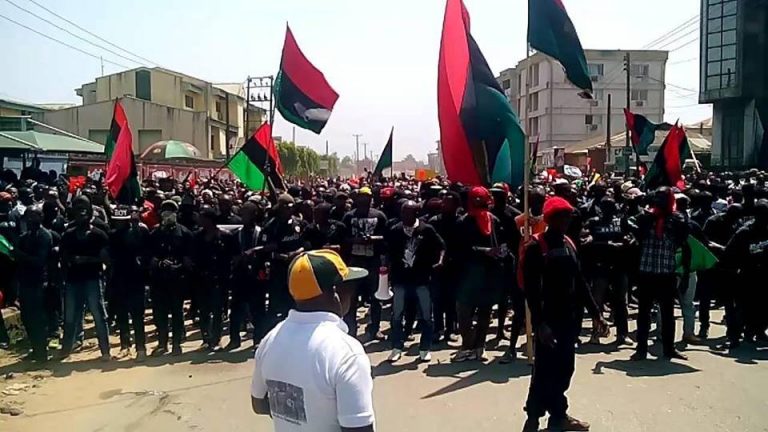
IPOB members in one of their rallies. Picture courtesy Ngyab.com

Many people are warming up for the breakup of Nigeria. Yes, let’s break up the country and go our separate ways; it’s that easy.

That’s what preoccupies their mind now. At the end, we can have Arewa Republic, Biafra, Oduduwa Republic.

And then we stop all these horse trading; there won’t be allegations of manipulation, monopolization and all the distrusts and mutual suspects that beset the present arrangement.

Okechuckwu will leave Aminu’s land and Adebayo will divorce Chizoba and everyone will bid one another farewell, whether they like it or not.

But before we slice the bread and plunge ourselves- infants, women, the weak and the elderly into an unending suffering in the name of secession, can we all pause for a moment. The elderly who witnessed the Nigerian civil war and its aftermath I’m sure are not among those increasing the drumbeat of war in the name of secession. They of course, know better than the younger generation who are possessed by youthful exuberance and fantasies of a country other than Nigeria.

Granted that Nigeria’s unity is a forced marriage, we should still ask if we are really ready for what we are gunning for.

Since the beginning of what has now gained global attention as agitation for Biafra, over 150 people have been reportedly killed between 2015 and 2016. Relatives of those who have so far died since the resurgence of campaign by the Indigenous People of Biafra (IPOP) for secession can explain better. A friend recently showed a picture of her classmate that was killed in one of the recent clashes with security operatives. Life has continued but he is no more to be part of the struggle; his family grieves as ever. To what end?

Perhaps, as the hoopla for the divorce of these entities continues, let the key actors and their sympathizers reflect over the scenario playing out in South Sudan. Then the next question should be: are we really ready for this? Breaking up Nigeria is not as difficult as the attendant fallouts. In the same token, remembering the vestiges of war in Monrovia, Liberia and Sierra Leone would serve as caution.

Today there are 22.5 million refugees worldwide. Syria remains the world’s largest producer of refugees with 5.5 million. South Sudan, the world’s newest country, now ranks third, after Syria and Afghanistan. That’s according to the United Nations High Commissioner for Refugees (UNHCR), also known as the UN Refugee Agency.

South Sudan became an independent state on 9 July 2011, following a referendum that was passed with 98.83% of the vote. It never enjoyed the gains of that independence; it has been in self-inflicted war-civil war since 2013, just two years after independence.

Over 300,000 people are estimated to have been killed in the war, including notable atrocities such as the 2014 Bentiu massacre. About 3 million people have been displaced in a country of 12 million, with about 2 million internally displaced and about 1 million having fled to neighboring countries, especially Kenya, Sudan, and Uganda. As of 2017, it had the highest score on the Fragile States Index (formerly, the Failed States Index), surpassing Somalia. Do you still consider secession an option?

South Sudan is acknowledged to have some of the worst health indicators in the world. The under-five mortality is 92.6 per 1,000, whilst maternal mortality is the highest in Africa at 789 per 100,000 live births (2015 est. CIA World Factbook).

According to Wikipedia, South Sudan was at war with at least seven armed groups in 9 of its 10 states, with tens of thousands displaced. The fighters accuse the government of plotting to stay in power indefinitely, not fairly representing and supporting all tribal groups while neglecting development in rural areas.

If we eventually have Oduduwa Republic, Biafra, Arewa Republic as being proposed by their agitators, these countries and their citizens, I’m not sure are also prepared for  attendant similar disputes and war. Examples abound near and far. The end may not justify the means

As it would later happen here in Nigeria if we ever breakup as being demanded by the IPOB who really want to exit Nigeria and Northern Youths who have issued quit notice to southeasterners resident in the North, there have continued to be disputes between Sudan and South Sudan over sharing formula for their assets.  So are we prepared for the attendant disputes? Are there institutions in place to cater for all the fallouts from any secession, can we actually live without one another?

Nigeria’s common wealth would be major source of disputes as currently is between South Sudan and Sudan- the division of oil revenues has been a major issue. Can we even point at one national issue that has not pitched Nigerians against one another since independence in 1960-petroluem, elections, population, sharing formula, federal character and so on and so on.

Suspicion and mutual distrust have led us to our present situation. Nigerians have not surmounted these problems and yet demanding new countries.

It might interest many Nigerians to know that 75% of all the former Sudan’s oil reserves are in South Sudan. The region of Abyei still remains disputed and a separate referendum will be held in Abyei on whether they want to join Sudan or South Sudan. The South Kordofan conflict broke out in June 2011 between the Army of Sudan and the SPLA over the Nuba Mountains.

Inter-ethnic warfare that in some cases predates the war of independence is still widespread. In December 2011, tribal clashes in Jonglei intensified between the Nuer White Army of the Lou Nuer and the Murle. The White Army warned it would wipe out the Murle and would also fight South Sudanese and UN forces sent to the area around Pibor. Don’t we have inter-ethnic clashes here? Have we addressed them? Ife and Modakeke people are Yoruba and it is fresh in mind how they killed one another in ethnic clash some years ago.

In March 2012, South Sudanese forces seized the Heglig oil fields in lands claimed by both Sudan and South Sudan in the province of South Kordofan after conflict with Sudanese forces in the South Sudanese state of Unity. South Sudan withdrew on 20 March, and the Sudanese Army entered Heglig two days later.

In December 2013, a political power struggle broke out between President Kiir and his former deputy Riek Machar, as the president accused Machar and ten others of attempting a coup d’état.

Fighting broke out, igniting the South Sudanese Civil War. Ugandan troops were deployed to fight alongside South Sudanese government forces against the rebels. The United Nations has peacekeepers in the country as part of the United Nations Mission in South Sudan (UNMISS).

Numerous ceasefires were mediated by the Intergovernmental Authority on Development (IGAD) between the Sudan People’s Liberation Movement (SPLM) and SPLM – in opposition and were subsequently broken. A peace agreement was signed in Ethiopia under threat of United Nations sanctions for both sides in August 2015. All to no avail; South Sudan is still in turmoil. Someone says Nigeria case is different from South Sudan, and I ask, how?

The order to quit the north issued by a coalition of Northern youths to the Igbos has caused more uproar and outcries than was before though it doesn’t seem that the Igbos resident in the north really want to be part of the IPOB agenda.

The Igbos have persistently cried foul and wanting to exit the entity called Nigeria. But besides the IPOB led by Nnamdi Kanu, whose immediate family is tucked in United Kingdom, majority of southeast people have professed quitting Nigeria than actually acting it. They know the consequences without being reminded of the aftermath of the 1966 Biafra war. Most of them don’t trust Nnamdi Kanu and apparently don’t share his vision.

If this is not true, visit Lagos and go to Kano where the ‘Nnas’ formed the nucleus of economic activities.  Ask if they were prepared to relocate to the southeast. Many were born and brought up there and the only place they know as homes are these cities. They have married there, established businesses and courted friendships from different backgrounds over the years.

Rather than inciting more trouble, elder statesman, Ango Abdullahi should toe the line of Emir of Alhaji Abdulmumini Kabir, who said while reacting to the quit notice that Nigeria will continue to remain one in spite of its multi-ethnic diversity and recent calls for breakup.

The quit notice expires October 1, 2017 and Igbo traders, civil servants and of course politicians in the seat of power, Abuja are still going on their normal businesses. Are they not interested in the new Biafra Republic? You already know that who want secession are not living in the country, though some misguided youths have allowed themselves to be used to give voice to their sinister moves. So before we break up Nigeria, let’s think, think and think, then collectively address all our fundamental problems.
 

We don’t want Biafra, Igbo leaders ‘tell’ el-Rufai

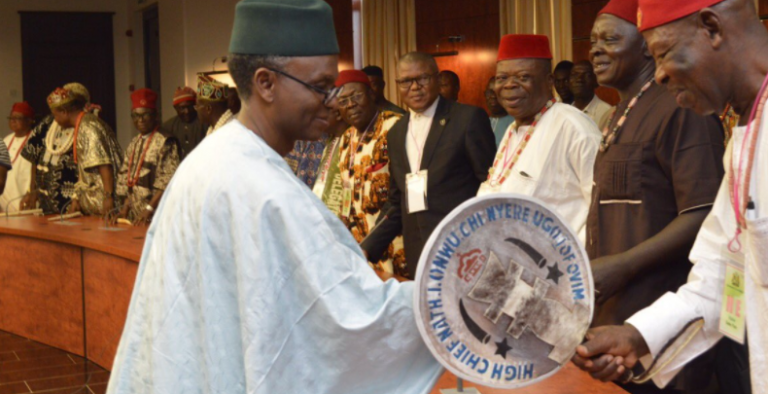
Some Igbo leaders under the aegis of the Igbo Delegate Assembly on Tuesday expressed their opposition to the division of the country, saying Nigeria is “better as one than in pieces”.

Instead, they called for the restructuring of the country and the massive provision of jobs for the disgruntled public.

The leaders also “pledged their loyalty” to Nasir el-Rufai, Governor of Kaduna State.

According to tweets from the verified handle of el-Rufai, the Assembly, comprising of Igbo community leaders from the 19 northern states and the federal capital territory, made the statements during a courtesy visit to the governor.

The meeting held on the back of calls by some northern youth for Igbo to vacate the region, following rising pro-Biafra agitation.

On Tuesday, El-Rufai said the President of the Igbo Delegate Assembly thanked the federal government, the Kaduna State government and the northern governors for calming the situation after a group of northern youth gave an ultimatum for Igbo to leave the north.

Igbo Leaders 2
The leaders addressing el-Rufai

“The President of the Igbo Delegate Association has stated that the Igbo leaders do not support the division of Nigeria,” he tweeted.

“The Igbo leaders have called for restructuring in the country and to look into the level of unemployment in the country.

“The President of the IDA has also said that Nigeria is better as one than in pieces. The Igbo leaders have also commended Gov. @elrufai for his leadership qualities and have pledged their loyalty to Governor el-Rufai.”

Responding to his visitors, El-Rufai branded those calling for war and division in Nigeria as “uneducated, unexposed and are short-sighted”.

He appealed to the Igbo leaders to use their positions to preach unity in the country, and promised to make an example of those who gave the ultimatum for Igbo to leave the North.

“I have the mandate of the Chairman of the Nigerian Governors’ forum to assure you that everyone is safe in the north,” he said.

EXTRA: Saraki prays for Nigeria — in faraway Mecca

0

Bukola Saraki, President of the Senate, is in Mecca, the holiest city of Islam, to perform Umrah — and he didn’t forget to say a word of prayer for Nigeria.

Sarki’s trip to Mecca comes a few days after his victory at the Code of Conduct Tribunal (CCT) where he endured a two-year-trial for alleged false assets declaration.

“Performing Umrah at the Holy Kaaba in Makkah,” he tweeted on Tuesday evening. “May the Almighty answer our supplications and continue to bless our nation.”


N15,000 bribe costs two traffic wardens their job

0

Musa Muktari and Shuaibu Suleman, two traffic wardens attached to Wuse Police Division, Abuja Command, have been dismissed from service with immediate effect for corrupt practice.

The dismissal followed an Orderly Room trial at the Provost Department, Force Headquarters, Abuja, in which both wardens were found guilty of abuse of office, soliciting and receiving a bribe contrary to Paragraph C sub (IV), (VI) and (II) of the 1st Schedule of the Police Act and Regulation CAP 370 of 1990.

A statement issued on Tuesday by Abayomi Shogunle, an Assistant Commissioner of Police at the Public Complaint Rapid Response Unit (PCRRU), revealed that the two wardens landed in trouble when a motorist lodged a complaint against them for extorting the sum of N15,000 from him.

THE STATEMENT

On 30th May, 2017 a motorist Mr. AG (real name withheld) came to the Public Complaint Rapid Response Unit (PCRRU) FHQ Abuja and reported that while driving his vehicle on 29th May, 2017 (12:30pm) along Wuse market road he was accosted by two Traffic Wardens who accused him of “beating traffic light” despite the fact that he did not.

That the wardens started demanding for bribe before they will allow him go and they led him to an Automated Teller Machine (ATM) not far from the scene where he was forced to make a withdrawal of Fifteen Thousand Naira (N15,000) from his account which he gave to the traffic wardens. He also stated that that one of the wardens forgot his mobile phone in his car.

PCRRU immediately launched an investigation (Tracking Number #PCRRU475669), both traffic wardens where identified and apprehended. The sum of N15,000 earlier extorted from the complainant was recovered from both wardens (N7,500 each as money was already shared).

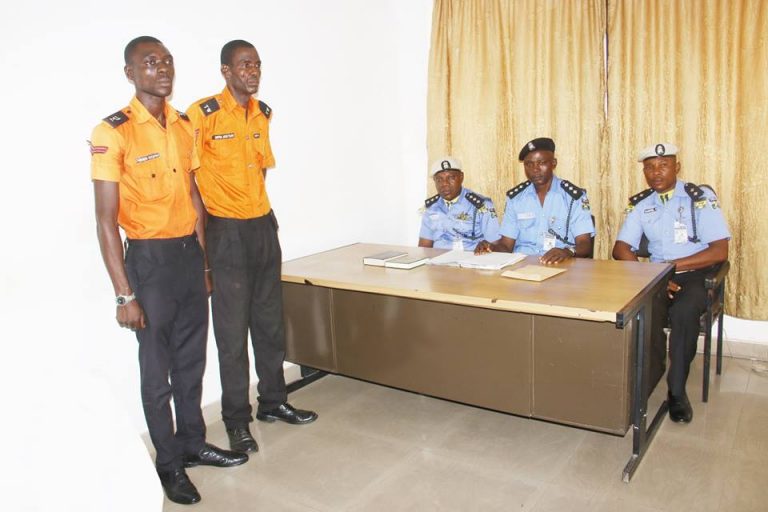
Both wardens were subsequently defaulted and referred to the Force Provost Marshal FHQ Abuja for Orderly Room trial [photo attached] during which all witnesses were called, exhibits were presented and defaulters (both wardens) heard. The Adjudicating officer found both defaulters guilty as charged and recommended punishment of dismissal from service. The orderly room proceeding has been reviewed by the appropriate NPF authority and the punishment approved with immediate effect. Traffic warden uniforms, ID cards and all police accoutrements issued to the men have been retrieved and all other dismissal procedure completed.

The complainant has also been handed back his N15,000 [photo attached] with an apology from the PCRRU. The visibly delighted man while collecting his money said “I never thought this could happen in this country; the officers punished and my money returned to me. God bless the IG, I will go out and spread the news about PCRRU to everyone.

FACT CHECK: Has Buhari removed CRS from secondary school curriculum?

Discussions about the “removal” of Christian Religious Studies (CRS) from Nigeria’s secondary school curriculum have been ongoing since June 14 when a delegation of the Christian Association of Nigeria (CAN) paid a courtesy call on Acting President Yemi Osinbajo at the State House.

During the visit, Samson Ayokunle, the CAN president, pointed out that whereas the new curriculum stipulates that CRS – also referred to as Christian Religious Knowledge (CRK) – will no longer exist as a subject on its own, Islamic/Arabic Studies and French have been introduced.

Ayokunle told Osinbajo that the curriculum had earlier been dropped by the ministry of education after CAN raised objections. He however expressed surprise that the same curriculum had resurfaced.

“This curriculum is the brain-child of Nigerian Educational Research Council, an agency of the Federal Ministry of Education. To us in CAN, its introduction is an ill-wind that blows nobody any good for so many reasons,” he had said.

THE GENESIS

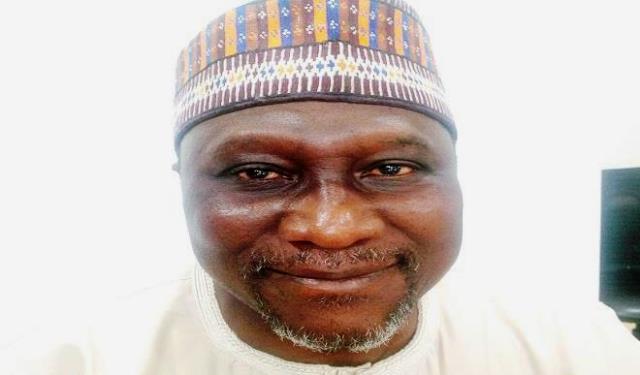
Ismail Junaidu, Executive Secretary, NERDC
Junaidu, Executive Secretary of NERDC

The curriculum, which has now assumed national importance all of a sudden, actually took effect from the beginning of 2015 as announced by Ismail Junaidu, Executive Secretary of the Nigerian Educational Research and Development Council (NERDC), a parastatal of the federal ministry of education.

This means that it was drafted and approved by the Goodluck Jonathan administration.

The education ministry explained that a new curriculum was introduced to prune down the number of subjects offered by primary and secondary school students in accordance with international best practices.

Among other things, a new subject called Religion and National Values (RNV) was introduced in the new curriculum, comprising Christian Religious Studies (CRS) and Islamic Religious Studies (IRS), Civic Education, Social Studies, and Security Education.

All these used to be separate subjects on their own, except Security Education, which was newly introduced as a result of the challenges of the Boko Haram insurgency.

SO, WHAT IS THE MATTER?

Harmless and innovative as the idea may sound, religious leaders from both the Christian and Muslim divides think it is a bad idea to merge CRS and IRS.

They feel both should remain separate entities as they have always been and let children be taught the religion of their parents instead of forcing a Muslim child, for instance, to take CRS lessons or vice versa.

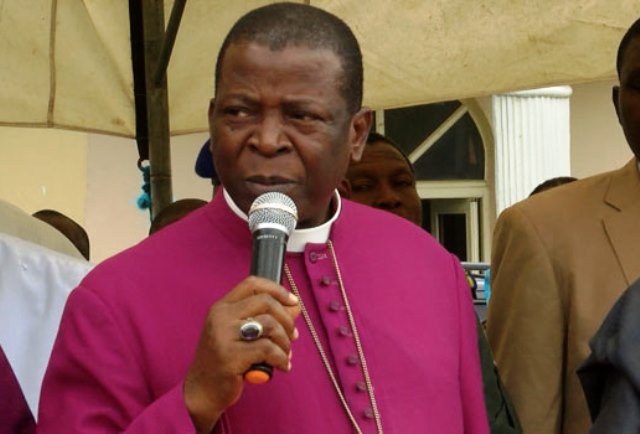
Nicholas Okoh, Primate of the Anglican Church in Nigeria
Okoh, Primate of the Anglican Church

According to Nicholas Okoh, Primate of the Anglican Church in Nigeria, the ministry of education has no right to merge both subjects into one. “We recognize our differences, but we call for unity … Let Muslims be Muslims and Christians be Christians,” the clergy man was quoted as saying in May.

This was strongly supported by Ralph Madura, a priest and the secretary-general of the Catholic Bishops Conference of Nigeria (CBCN), who said that that the so-called merger “would create confusion”.

“Every right-thinking person knows that religion is a very sensitive issue in this country,” he added.

Lakin Akintola of the Muslim Rights Concern (MURIC), the new curriculum reduces the role of religion in national development.

According to him, by merging the study of the two biggest religions in the country, FG is simply telling the kids that religion does not matter.

“If the Federal Government educates Nigerians without a special place for religion,” he warns, “it will only succeed in producing clever devils.”

FACT

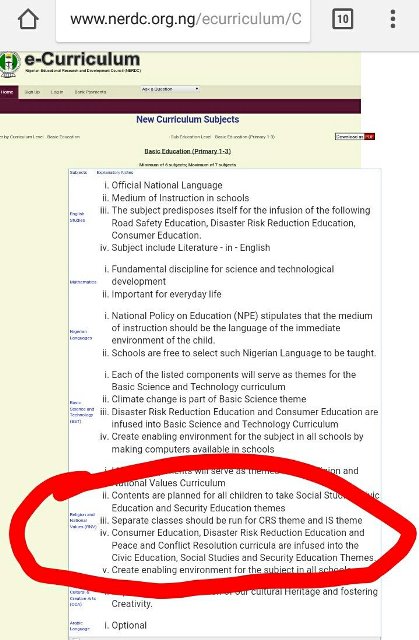
A screen grab from the NERDC website. Courtesy: @jagbros

According to the new curriculum as published on the website of NERDC, the subjects to be offered by students include: English, Mathematics, Nigerian Languages, Basic Science and Technology (BST), Religion and National Values (RNV), Cultural and Creative Arts, CCA, and Arabic.

Under RNV it is stated as follows:

  1. Listed components will serve as themes in the Religion and National Values Curriculum
  2. Contents are planned for all children to take Social Studies, Civic Education and Security Education themes
  3. Separate classes should be run for CRS theme and IS theme
  4. Consumer Education, Disaster Risk Reduction Education and Peace and Conflict Resolution curricula are infused into the Civic Education, Social Studies and Security Education Themes.
  5. Create enabling environment for the subject in all schools

Also in the curriculum, Arabic was marked as “optional”.

Also, Junaidu had explained, on many occasions, the so-called merging of CRS and IRS.

He blamed the unnecessary fuss over the issue on the “ignorant and greedy publishers” of the text books for the subjects.

“In all, we have not changed the contents; the contents are intact,” he said.

“I wouldn’t like to use the word merged, because when you use the word, merging, it would look like you are taking them (both CRS and IRS) as one,

“As far as the listing is concerned, they are standing as distinct courses, but merged under one subject listing.

“In each of these, we made provisions for periods to be set aside for teaching CRS, we have periods set aside for IRS, and we have periods set aside for teaching Social Studies.

“When we developed the curriculum, we also developed the teachers’ guide; and each of these teachers’ guide is separate.”

BOTTOM LINE

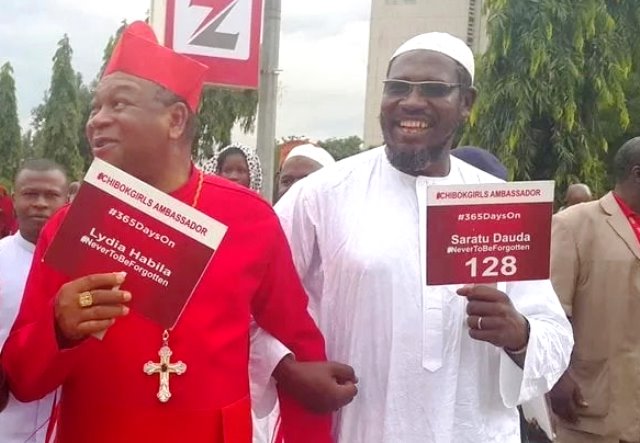
File: John Onaiyekan, Catholic cardinal and Ustaz Muhammad, Muslim Imam, march in solidarity with the Bring back our Girls group in Abuja

Religion is no doubt a very delicate issue in Nigeria, much more delicate than even tribal sentiments, hence caution should be applied when dealing with such issues.

Criticism of the new curriculum by Christian and Muslim leaders suggests that adequate consultation was not carried out during the formulation of the policy.

Nigerians remain divided on whether the new curriculum should be reviewed again to reflect some important subjects – history for instance – that were surreptitiously expunged years ago.

Some say the teaching of core religion should be left for the churches and the mosques but many feel a better approach ought to have been adopted by the government before announcing the new curriculum.

And as the brouhaha continues, the words of Wole Soyinka, the noble laureate, came readily to mind, that “If we do not tame religion in Nigeria, religion will kill us.”

CONCLUSION

Has Buhari removed Christian Religious Studies (CRS) from the curriculum, as currently being bandied about on social media?

The answer is NO. What is in place is a course comprising both Christian and Islamic themes with the teaching of national values.

‘52% of Kogi West voters’ endorse Melaye’s recall — but this is just the beginning

0


Dino Melaye 4

Dino Melaye, senator representing Kogi West at the senate national assembly, is facing a tough time to retain his place in the green chamber, as “more than half” of his constituents have supported his planned recall.

However, this is just one in a long line of constitutional processes required to effect the recall.

Already, about 188,588 voters, representing 52.3 per cent of the total number of registered voters in Kogi West senatorial district, have reportedly approved his recall from the senate.

The document, ICIR gathered, may be submitted soon to the Independent National electoral Commission (INEC) to institute the proper process of his recall.

According to Pius Kolawole, special adviser to the state governor on political affairs, the collation of signatures of voters to that effect was carried out successfully on June 17.

He commended voters in the district for turning out en masse for the exercise, saying Section 69 of the 1999 constitution backed their action.

“In 2015, we voted for Dino and now we are using the same method to return him home,” he said.

Announcing the result of the collation, Adamu Yusuf, collation officer said that 188,588 out of the 360,098 in the senatorial district endorsed Melaye’s recall.

While giving the breakdown of the result per the seven local governments in the district, he said that 18,374 of the total number of 35,331 registered voters in Yagba East approved the recall.

Others are 9,186 out of 18,356 voters in Mopa-Muro local government, 24,703 out of 46,810 voters in Yagba West, 63,736 out of 116,296 in Lokoja Local Government and 24,283 out of 46,819 in Ijumu Local Government.

In Kabba/Bunu Local Government, 28,277 out of 60,520 voters endorsed the recall, while 24,703 out of 46,810 voters in Kogi Local Government voted for move to recall Melaye.

According to Yusuf, with this, the next move is to submit the document to INEC for the next action.


READ ALSO:


Annulment – The last act

0

By Eric Teniola

Of all decisions that General Ibrahim Badamosi Babangida (75) made during his eight year rule in the country, none is graver than the annulment of the Presidential election held on June 12, 1993. It was the last act by General Babangida that did the worst damage.

Twenty-four years after, the issue, as they say in latin “adhuc sub Judice lis est” meaning the case is still before the judge: the controversy is still not settled.

The annulment statement was not signed by anyone but was circulated by my friend, Nduka Irabor on June 23 1993 which would be twenty-four years this Friday. The Attorney-General and Minister of Justice at that time was Chief Clement Obiora Akpamgbo (1935-Nov 16 2006), from Umuakwu in Anambra state. He was President of the Nigerian Bar Association in 1991. The Presidential election was held between Alhaji Bashir Othman Tofa (70) of the National Republican Convention (NRC) and Chief Moshood Kashimawo Olawale Abiola (1937-1998) of the Social Democratic Party (SDP).

Both of them incidentally were members of the Constituent Assembly of 1976-1978. Alhaji Tofa represented Darwankin Tofa constituency in Kano state while Chief Abiola represented Abeokuta constituency in Ogun state. The eventual winner of that election was never announced by the military.

The running mate of Chief Abiola was Alhaji Babagana Kingigbe(71) who later became Minister of Internal Affairs and Secretary to the Government of the Federation. Alhaji Tofa’s running mate was Dr. Sylvester Ugoh, who represented Abah-Mbaise/Ahiazu-Mbaise constituency of the old Imo state in the constituent assembly. Dr. Ugoh, who lost his wife in 2010, now lives in the United States of America with his children.

Below is the full statement of the annulment as circulated by Mr. Nduka Irabor:

“In view of the spirit of litigation pending in various courts, the federal government is compelled to take appropriate steps in order to rescue the judiciary from intra-voyaging. Those steps are taken so as to protect our legal system and the judiciary from being ridiculed and politicized, both nationally and internationally.

In an attempt to end this ridiculous charade which may culminate in judicial anarchy, the Federal Military Government has decide to stop forthwith, all court proceedings pending or to be instituted and appeals thereon in respect of any matter touching, relating or concerning the presidential election held on June 12, 1993.

The Transition to Civil Rule Political Programme (Amendment Number 3), Decree Number 52 of 1992 and the Presidential Election (Basic Constitutional and Transitional Provisions)Decree Number 13 of 1993 are hereby repealed. All acts or omissions done or purported to have been done, or to be done by any person, authority etc, under the above named decree are hereby declared invalid. The National Electoral Commission is hereby suspended. All acts or omissions done or purported to have been done by itself, its officers or agents under the repealed Decree number 13, 1993 are hereby nullified.”

I knew Nduka Irabor in 1979 when we both covered the National Assembly with the likes of Labake Adebiyi, Tony Idigo, Dayo Kusa, Demola Osinubi, Nkem Agetua, Bayo Adewusi, James Bello, Dupe Ajayi Gbadebo,Ruuffy Oladipo, Joke Sanyaolu,CIA Akitomide,Frank Olize,Vera Ifudu,Anene Ugoani, Loius Chike, Yinka Guedon, Idiat Abari, Chris Anyanwun, Nduka Obaigbena, Ronke Akinsete- Thompson, Bolu Oni,Toye Akiyode, Gboyega Amoboye, Jimi Aderinokun, Ola Gbolahan and others.

In March 1984, Nduka Irabor and Tunde Thompson who now works for the Abubakar Atiku Media Campaign Organisation were both jailed under Public Officers Protection Against False Accusation Decree Number 4. The Chairman of the tribunal that jailed both of them then was Justice Joshua Olalere Ayinde from Ibadan Oyo state while Chief Chike Ofodile(SAN)-1924-2014 from Anambra state was then the Attorney-General and Minister of Justice. This was during the twenty months military rule of Major General Muhammadu Buhari(74). Tunde Thompson and myself started our Journalism career in Ibadan in the early 70s. He worked in the defunct DAILY SKETCH while I started with the NIGERIAN TRIBUNE before I pioneered with THE NIGERIAN HERALD.

Nduka Irabor and myself crossed ways in 1985 when he was appointed Editor of the Post Express of THE GUARDIAN family and I was appointed Editor of the EVENING PUNCH. We became competitors looking for news to publish and sell. Both were released by General Ibrahim Babangida when he came to power in 1985. Shortly after, he was appointed as the spokesman to the Chief of General staff, Supreme headquarters, Admiral Augustus Akhabue Aikhomu (1939-2011). It was in that capacity that Chief Irabor circulated the press statement on annulment.

In 1999, Nduka Irabor was elected into the House of Representatives to represent Ika south and Ika North-East in Delta state. He is now the Chairman of the football league management company. A gentleman and devoted husband. Till today he does not talk on the annulment.

The annulment is a cross General Babangida will carry for the rest of his life. For the annulment overshadowed most of his outstanding achievements, like the movement and construction of Abuja to a major National Capital, the creation of eleven new states, liberalisation of the banking sector, the establishment of new universities and polytechniques, the establishment of Oil, Mineral Producing Areas Development Commission(OMPADEC) now NDDC, the construction and commissioning of the 11.8km bridge in Lagos on August 19 1991, now known as the third Mainland Bridge-the last project the Federal Government ever did in Lagos, a major state, now without a Federal Secretariat.

The third Mainland Bridge was the longest bridge in Africa until 1996 when The sixth October Bridge located in Cairo was completed. General Babangida created Akwa-Ibom,Katsina,Osun,Jigawa, Delta,Taraba,Yobe,Kebbi,Kogi,Abia,Enugu states and also established the defunct People’s Bank, then headed by Dr. Augustus Tai Solarin(1922-1994) and the Federal Road Safety Commission.

Till today the nation is yet to know the full story of the annulment.

In his 338 page book on Atiku, by Adinoyi Ojo Onukaba(1960-2017), quoted General Babangida on page 226 as saying “What we did was wrong but we try to rationalize it. Abiola was my friend for 25 years, a very genuine friend. From the day we met there was a rapport. I had my friend there waiting to take over. It would have been a great destiny”.

In continuation, Onukaba offered his own assessment: “The curse of Nigeria has been its fractionless and individualism. Some people began to see the current crisis as an opportunity to settle old scores or to promote their own interest. Public reactions to the annulment began to reflect the political, ethnic, religious and geographical divisions in the country. In the rest of the world, attempts to tamper with the electoral verdict of the people have always been met with mass protests and violent reactions, compelling the anti-democratic forces to concede power or be driven out of office. But the Nigeria political class could not stand together and fight for the de-annulment and compel Babangida to bow to the wishes of the 14 million Nigerians who voted for Abiola on June 12. Seldom do dictators surrender willingly, and Babangida was not going to be an exception.”

As Nigerian writer Wole Soyinka once said, “power, the negative face of power cannot be negotiated. It must be tamed from within, and isolated from without”.

So far, none of those who annulled the election, have spoken on how the annulment came to be. In the words of Chief Olu Akerele, former Personal Assistant to Chief Abiola “there seems to be a mystery and a curse on the annulment”.

But as Cicero wrote in DE FINIBUS, “there is no sorrow which length of time does not diminish and soften”.

Soon, you won’t be able to watch Shekau’s videos on YouTube


As the wave of terrorist attacks sweep across Europe and America in recent times, American multinational technology company, Google says it is stepping up its efforts to identify and remove videos related to terrorism and violent extremist content, particularly on its YouTube platform.

Abubakar Shekau, Boko Haram leader, periodically uses threat-filled videos, many of which end up on YouTube.

But the technology company revealed that it used “video analysis models” to find and assess more than 50 percent of the terrorism-related content that were removed in the past six months.

“While we and others have worked for years to identify and remove content that violates our policies,” Google said, “the uncomfortable truth is that we, as an industry, must acknowledge that more needs to be done now.”

First, the company says it’s increasing its use of technology to identify videos that contain extremist messages.

Google says it will devote more engineering resources to apply “our most advanced machine learning research to train new ‘content classifiers’ to help us more quickly identify and remove extremist and terrorism-related content”.

The company acknowledges that technology can’t fully solve the problem, so it is also adding 50 expert NGO’s to its YouTube Trusted Flagger programme. Flaggers, the company said, can better identify the difference between violent propaganda and news and that they are more than 90 percent accurate. Google says it already works with 63 organisations as part of the programme.

Google said it would also be taking a “tougher stance on videos that do not clearly violate our policies”. It said videos that “contain inflammatory religious or supremacists content” will appear with a warning. People will not be able to make money off them, or to comment on or endorse them.

“That means these videos will have less engagement and be harder to find,” it said. “We think this strikes the right balance between free expression and access to information without promoting extremely offensive viewpoints.”

In a fourth step, Google said it would “expand its role in counter-radicaliwation efforts” through what it calls the “Redirect Method”.

“This promising approach harnesses the power of targeted online advertising to reach potential ISIS recruits and redirects them towards anti-terrorist videos that can change their minds about joining,” Google said..

“In previous deployments of this system, potential recruits have clicked through on the ads at an unusually high rate, and watched over half a million minutes of video content that debunks terrorist recruiting messages.”

The steps were first published in an opinion piece Sunday on the Financial Times website and can now be found on a Google blog.

Google’s steps follow a recent Facebook announcement that the social media giant is using artificial intelligence to combat terrorist content.

Earlier this year, the non-profit Southern Poverty Law Centre issued a report critical of organisations like Google and Facebook. The anti-hate group said the companies “have done little to counter the use of their platforms to spread hateful, false “information”, from conspiracy theories accusing various minority groups of plotting against America to websites promoting Holocaust denial and false “facts” about Islam, LGBT people, women, Mexicans and others.”

Anti-corruption war: Whistleblowers in danger

0

By Godwin Onyeacholem

When the whistleblower policy was unveiled last December by the Muhammadu Buhari administration, it was roundly hailed by the populace as a long-awaited and much desired weapon in the fight against corruption, the single most visible and widely acknowledged reason Nigeria has remained stuck in the groove of under-development. And to the delight of many, especially victims of corruption, the last six months has seen the policy largely living up to its billing, what with the confounding recoveries of tons upon tons of looted funds in various denominations stashed away in the most unimaginable hideaways.

But as it seems, it may be too early for high-fiving or any display of other gestures of celebration. Neither the Federal Government nor Kemi Adeosun, Minister of Finance, who announced the policy on behalf of government and whose Ministry is the manager and implementer of the policy, should rejoice just yet in view of the obvious threat to whistleblowing as result of recurring persecution and victimization of whistleblowers by their employers.

Since the policy kicked off, no fewer than three government employees are known to have been wrongfully fired from their jobs for reporting cases of fraud in their workplaces. This development must be of serious concern to both government and the people who genuinely expect whistleblowing to significantly curb corruption and eventually entrench accountability in both the public sector and the corporate world.

As the Department for Business Innovation and Skills in London pointed out, two main barriers whistleblowers face are (1) fear of reprisal as a result of making a disclosure and (2) that no action will be taken if they do make the decision to “blow the whistle.” Without any iota of doubt, the first barrier is gradually taking its place as the dominant feature of whistleblowing among public sector workers in Nigeria. No notable incident has been recorded in the private sector, to the best of one’s knowledge. Nonetheless, the danger posed to the realization of accountability in the public sector and by extension the anti-corruption campaign due to the persecution of whistleblowers, cannot be over-emphasised.

A recap of three incidents of victimization of whistleblowers will not only expose the extent to which reprisals appear to be gnawing away at the soul of the policy, but also address our minds to how relentless official impunity continues to renew itself in a more virulent manner even in a professed atmosphere of “change.”
Not in the order in which they occurred though, it begins with the story of Ntia Thompson, Assistant Director (Servicom Unit) of the Directorate of Technical Cooperation in Africa (DTCA), an agency of the Ministry of Foreign Affairs. On April 25, 2016, he reported to the Economic and Financial Crime Commission (EFCC) a case of fraud to the tune of $229,000 perpetrated by Mohammed Kachallah, Director-General of DTCA and some officers. The stolen money was meant for the Monitoring and Evaluation of projects executed across Africa and funded from the Nigeria Technical Cooperation Fund (NTCF), as well as for organizing events marking the first ten years of the Trust Fund.

But instead of directing the money towards that end, Kachallah and his co-conspirators diverted it into their pockets. When Thompson reported the fraudulent diversion to the EFCC, he was hounded, threatened, suspended, and eventually compulsorily retired from the services of the DTCA with effect from February 7, 2017. Since then, he has been running around in search of justice.

Although the Acting President, Yemi Osinbajo, a couple of months ago ordered that the EFCC investigate Thompson’s petition, nothing has been heard from Ibrahim Magu and his men up till now. Also, regrettably, not a single word from the administrator of the policy, Ministry of Finance, which is supposed to be in the forefront of ensuring the safety and protection of whistleblowers.

However, in fairness to the Office of Head of the Civil Service of the Federation, they intervened with two separate letters to Sola Enikanolaye, permanent secretary, Ministry of Foreign Affairs, directing the reinstatement of Thompson and stating categorically that the offences allegedly committed by the officer were not punishable by retirement from service. The last letter was sent to Enikaolaye on April 5, 2017. Up till this moment, he has brazenly refused to comply with the order from the Head of Service. And instead of Geoffrey Onyeama, Minister of Foreign Affairs, to weigh in by directing the permanent secretary to immediately comply with the order to return Thompson to office, he too has been disturbingly silent, leaving Thompson to languish in utter hopelessness.
The second case involves Aaron Kaase, Principal Administrative Officer at the Police Service Commission (PSC). On May 22, 2015, he submitted an evidence-based petition to the Independent Corrupt Practices and other Related Offences Commission (ICPC) against the Chairman, Mike Okiro, alleging acts of corruption totaling N275, 525, 000. Following Kaase’s petition against Okiro, the PSC issued a letter backdated to May 21, 2015, suspending him from work indefinitely without pay.

They claimed he was suspended on account of a prima facie case of serious misconduct based on spurious arrest and detention by the police, and arraignment on a fictitious criminal charge. Kaase received no previous query nor was any claim of “serious misconduct” a subject of any investigation which established guilt against him. For more than two years he has remained on suspension without pay while his fundamental rights are continuously violated.

And then there is the case of Murtala Ibrahim, Unit Head/ICT Process Audit and Special Investigation Unit at the Federal Mortgage Bank of Nigeria. He was recently dismissed for exposing contract scams and for refusing to endorse the bank’s manufactured 2016 Half-Year Income Validation Report. The Finance and Accounts Group reported a surplus of income over expenditure of the sum of N423, 653, 187 which the Internal Audit Group found out was actually a loss, and not profit. Ibrahim brought to the attention of Babatunde Fashola, Minister of Power, Works and Housing, the fraudulent manner in which the bank was being managed and also his own persecution by the bank’s management, all to no avail.

Clearly, these are heartbreaking tales that cast a big shadow of doubt on the survival of whistleblowing as a potent tool for the war against corruption in Nigeria. When potential whistleblowers hear or read these unpalatable stories about the plight of those who had made disclosures before them under the policy, the way they are exposed to danger with no protection of any kind from relevant stakeholders in the society, the first reaction would be to obey the law of nature: self-preservation. They will naturally refrain from reporting wrongdoings no matter how grave they are.

Government need not be reminded that whistleblowing is a patriotic act for which those who engage in it deserve to be rewarded and fully protected in all ramifications, even while the whistleblower protection bill is still being processed. To abandon them to their fate is to strengthen the corrupt and their friends, while sounding the death knell at this very stage early days to a productive and persuasive mechanism for fighting corruption.

Onyeacholem is a journalist. He can be reached on gonyeacholem@gmail.com

Bakare on Buhari: The king may be very cold, very old, but he is not yet dead

0

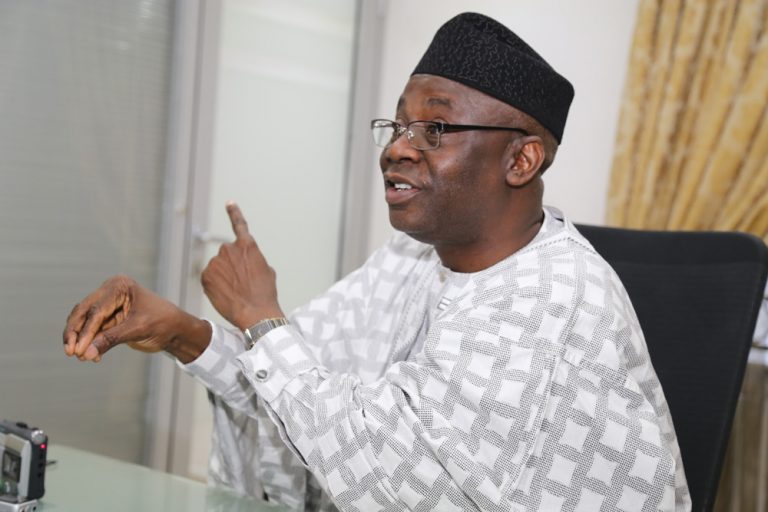
Tunde Bakare, Senior Pastor of The Latter Rain Assembly, says “the king may be very cold, may be very old and in need of warmth, but the king is not yet dead.”

Bakare made the statement — believed to be in reference to ailing President Muhammadu Buhari and directed as those seeking to replace him — on Sunday at his church in Ogba, Lagos, while speaking on ‘The birth pangs of a new Nigeria’.

Reminding the latter group that “the next in line does not translate automatically to the next king”, he cited similar scenarios in the Bible, mentioning the likes of Absalom, who, in a bid to overthrow the king, embraced everyone and warmed his heart into the minds of the simple and gullible; and Adonjah, who confused birthright with leadership rights and assumed that the next in line is automatically the next king whenever the current king is no more”.

“The next in line does not translate automatically to the next king. I kept quiet since, because I knew that the day I will speak, all arrows will begin to fly. But guess what? I’m beyond the enemy’s reach,” said Bakare, who was Buhari’s running mate in the 2011 presidential election.

“What is happening in Nigeria is not new; it’s not strange. But if you don’t have the wherewithal, and your wife is in intense labour, you will panic. What is happening in this nation is not new, it’s not strange. Our nation is going through birth pangs; Nigeria is in intense labour.”

He said he had been “bombarded with requests for interview by the organised press for a very long time now, regarding the situation of the country”, but he had deliberately kept mum.

“I hope the message today will answer their questions and allay all our collective doubts and fears,” he said.

“Our president, who I believe is on the path to sure recovery, has recently been serving the nation he loves with diminishing energy due to his ill health.

“As a result of the president’s present condition, all over the land, Absaloms and Adonijahs are springing up. Again this is not unusual…

“One major fact, the king may be very cold, may be very old and in need of warmth, but the king is not yet dead; the final authority is still in his hands. All the actors in the corridor of power can keep acting, but the residual power is still in the man who is cold.”