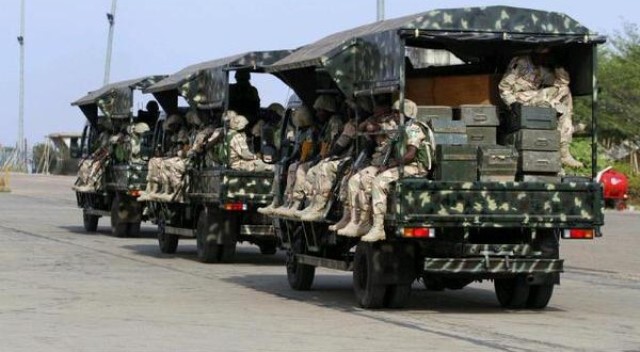
According to sources in the know, families of the affected soldiers have been asked to forward information of their next of kin to the authorities so that their benefits could be paid to them.
The declaration was contained in a notice sent on November 20, by M. Jimoh, the new Commander of the 145 Task Force Battalion of the Nigerian Army in Damasak, Borno State.
According to a report published by an online newspaper, PREMIUM TIMES, “Jimoh, a lieutenant colonel, sent the signal to the 145 Battalion rear base in Ohafia, Abia State, and copied the Army 7 Division Headquarters in Maiduguri and 82 Division Garrison in Enugu.
“Also copied were 5 Battalion in Kano; 20 Battalion in Serti, Taraba State; 103 Battalion in Enugu and 119 Battalion in Malam Fatori, Borno State.
“Also in receipt of the signal were 143 Infantry Battalion for special forces in Borno State; 144 Battalion in Asa, Abia State; and 146 Battalion in Calabar.”
“Each of the battalions copied in the signal had soldiers that were part of the 83 missing.”
The newspaper also reported that Jimoh, the new commander of the 145 Task Force Battalion, was recently appointed to replace K. Yusuf, a lieutenant colonel who is among the missing soldiers.
There had been reports on how 83 Nigerian soldiers went missing after the boko haram terrorists dislodged them from their positions.
The reports at the time had it that several of the troops were feared drowned in the River Yobe while 22 others were rescued by soldiers of neighbouring Niger republic.
The troops were part of ‘Operation Gama Aiki’ which is aimed at clearing out insurgents lurking around the border areas between Nigeria and Niger and Chad aimed at displacing insurgents hibernating around the Nigerian border with Niger and Chad.
Several days after the attack, spokesman for the Army, Sani Usman, insisted that the report was not true.
Ahead of the governorship election scheduled to hold in Ondo State on Saturday, November 26, the Nigerian Police Force has beefed up security in the state with the deployment of more than 28,000 police personnel.
A statement issued on Wednesday by the Force Public Relations Officer, Don Awunah, noted that the Inspector General of Police, IGP, Ibrahim Idris, had directed that a robust and elaborate security arrangement be implemented in Ondo State to ensure peaceful, credible, free and fair elections.
Awunah stated that “a Deputy Inspector General of Police has been deployed to the State and will be assisted by an Assistant Inspector General of Police and three Commissioners of Police (for each Senatorial district) to coordinate the security operations and supervise the deployment of security personnel.
According to the police spokesman, each polling unit in the state will be manned by five conventional policemen, and there are 3009 polling units, 203 wards and 18 Local Government Areas in Ondo State.
The statement noted that “the IGP has graciously approved deployment of additional twenty six thousand conventional Police personnel (5 Policemen per polling unit); two thousand Mobile Police Force (PMF), ten (10) cells of Counter Terrorism Unit, the Special Protection Unit, the Anti-Bomb Squad (EOD), the Marine Police, Conventional Policemen, the Armament Units, personnel from FCIID and FIIB and the Sniffer dogs section and Mounted Troops.”
Similarly, “Twenty (20) Police Gunboats, three (3) Patrol Surveillance Helicopters, twelve (12) additional Armoured Personnel carriers and three hundred (300) Police patrol vehicles are being deployed throughout the State including the riverine areas and difficult terrains.”
Awunah added that other security and safety agencies who are members of Inter Agency Consultative Committee on Election Security, ICCES, in Ondo State have also been deployed to complement the Police during the elections.
He said that security operatives participating in the election are under strict Instructions to be polite and civil but firm in the discharge of their duties and other responsibilities.
He added: “Security details are warned to desist from escorting their Principals and Politicians to polling booths and collation centres during the election.
“Any deviant security detail will be apprehended and dealt with accordingly.
“They are to provide adequate security for the electorates, INEC Staff, election materials, election observers and other individuals and bodies that have statutory roles in the conduct of the elections, at the Polling booths, Collation Centres and INEC Offices throughout the period of the election.”
The Police spokesman called on political, religious and traditional leaders in the state to prevail on their people not to get involved in activities that could threaten the peaceful conduct of the election exercise, warning that the full weight of the law would be meted out on such individuals or groups.
Awunah also assured Ondo electorates, on behalf of the IGP, of adequate security throughout the election.
He enjoined them to cooperate with the Police personnel in the discharge of their duties.
Twenty eight political parties will be taking part in the election.
The Monetary Policy Committee, MPC, of the Central Bank of Nigeria, CBN, has voted to retain interest rates in the country at 14%, despite calls from experts and economic managers, including the Minister of Finance, Kemi Adeosun, for a downward review.
Governor of the CBN, Godwin Emefiele, announced the decision of the committee on Tuesday, at the end of a two-day meeting held at the apex bank’s headquarters in Abuja.
He explained that all the 10 members of the committee present at the meeting agreed to maintain the current monetary policy rates.
Apart from the MPR which was retained at 14 percent, the CBN governor added that the committee also voted to retain the Cash Reserves Ratio at 22.5 percent.
The Liquidity Ratio, was also retained at 30 percent while the Asymmetric Window was left at +200 and -500 basis points around the MPR.
Recall that just before the last MPC meeting in September, the minister of finance urged the committee to consider bringing down the interest rate in order to enable more domestic borrowing by the federal government to boost the Economy.
“We need lower interest rates, because when we are borrowing and interest rates go up, it increases our cost of debt service and it reduces the amount of money that is available to spend on capital projects,” the minister said.
Similarly, former minister of agriculture and the current president of the Africa Development Bank, AfDB, Akinwumi Adesina, complained that Nigeria’s interest rates were “way too high.”
He said the AfDB was willing to assist Nigeria in this difficult period in its economy, but that the country needed to adopt more people-friendly monetary policies.
Adesina said: “The African Development Bank will rally strongly around Nigeria to overcome its recession.
“They (Nigeria) have a liquidity problem. We (AfDB) want to make sure Nigeria gets resilient.”
“(But) in our view it would be better to have gradual (customs) tariffs as opposed to (Forex) restrictions.
“Attracting investment was the only way for the central bank to lower its interest rates. The interest rate is way too high.
“You cannot drag the economy out of recession with those interest rates.”
However, after the September MPC meeting, Emefiele announced that the CBN had decided to retain benchmark interest rate at 14% because “monetary policies alone could not totally save the economy.”
He added that cutting rates without appropriate fiscal plans may not help the economy.
Minister of State for Petroleum Resources, Ibe Kachikwu at a meeting with Chinese investors in June
Minister of State for Petroleum Resources, Ibe Kachikwu, has been summoned by the Senate to explain the details of the deals which the minister claimed was entered into between Nigerian and Chinese governments on the one hand, and the Indian government on the other.
Earlier in June, the petroleum minister announced that the Nigerian National Petroleum Corporation, NNPC, was holding a road show in Beijing China, aimed at attracting Chinese investors into the Nigerian oil and gas sector.
He said that during the road show, Nigeria succeeded in signing Memorandums of Understanding with some Chinese companies worth up to $80 billion.
Kachikwu, told journalists that the MoUs were in the area of “new investments, spanning five years, in the oil and gas industry covering pipelines, refineries, gas and power, facility refurbishments and upstream financing.”
In a related development, a statement issued in October by the Director of Press in the Petroleum Ministry, quoted the petroleum minister as saying that Nigeria was about to sign an agreement with India which would see the country make an advance payment of $15 billion to Nigeria for crude purchases.
However, following a motion moved by Clifford Ordia, the senate agreed that Kachikwu be invited to appear before the senate committees on Petroleum, Gas and Foreign Affairs, to throw more light on the details of the agreements.
Senate President, Bukola Saraki commended the Petroleum minister for his efforts to bring investments into the country, adding, however, that such should be done with utmost transparency.
He said: “It is important that matters like this that have to deal with crude oil processing is brought before National Assembly to ensure transparency.
“We must also appreciate the efforts of the Minister for coming up with it as it will go a long way to boost our economy and technology but again we must ensure that it is transparent by making us understand the roles clearly.”
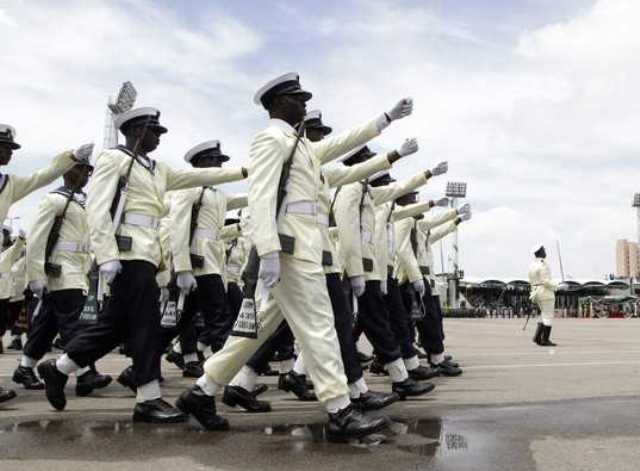
The Nigerian Navy has begun massive crackdown on fake operatives who specialize in using fake naval uniforms and accoutrements to deceive, harass, intimidate and defraud unsuspecting members of the public.
This was revealed by the Director of Naval Information, Cor Ezekobe, in a statement issued on Tuesday, saying that there were many “unauthorized and largely proscribed maritime outfits” who have continued to tarnish the image of the Nigerian Navy.
These outfits according to the Naval spokesman include: “Nigerian Merchant Marine, Nigerian Merchant Navy Corps, Global College of Marine and Technology, Merchant Navy Maritime Academy as well as Nigeria Merchant Navy and Maritime Law Enforcement Agency among others.”
Ezekobe further stated: “In view of the fragile security situation in the country, particularly in the Niger Delta area, the activities of these illegal and proscribed maritime security organisations have posed great danger to the frantic efforts by the Nigerian Navy and sister security services to mitigate the security challenges in the country.
“Consequently, operatives of the Nigerian Navy in conjunction with other security agencies have maintained red alert vigilance to ensure that the naval impostors are promptly apprehended.”
The Naval spokesman said that the efforts to rid the country of fake maritime security agencies paid off on Friday October 18, “when one Mr Allen Benson Edema was arrested dressed in the uniform and accoutrements of a naval commodore, (equivalent to a Brigadier General) within the precinct of the National Assembly Abuja.”
He stated that the fake naval commodore was arrested alongside another suspect also dressed up in naval uniform, and is alleged to be the brain behind a fake maritime security organisation that goes by the name Nigerian Merchant Navy Corps which has also been proscribed.
“In a related development, another 6 persons were arrested by operatives of the Forward Operating Base (FOB) Badagry on 15 November 2016 for impersonating as personnel of the Nigerian Navy,” Ezekobe further stated.
“The suspects who were dressed in naval uniform with rank badges of the Nigerian Navy claimed to be members of another proscribed Maritime security organisation called Nigerian Merchant Marine.
“The suspects were arrested at Dadi Village in Badagry LGA of Lagos State.”
The statement advised the general public to report “any suspicious behaviour of anyone or group of persons who claim to be personnel of the Nigerian Navy or found to be dressed in naval uniform and accoutrement.”
The Naval spokesman reaffirmed the resolve of the Nigerian Navy “to deal decisively with anyone who might be contemplating to test the will of the Service in checkmating activities of criminal gangs and impostors in the maritime domain.”
The Nigerian Police Force has paraded fourteen of its former personnel who were discharged for collaborating with criminals in carrying out their activities.
According to the Force Public Relations Officer, FPRO, Don Awunah, the sting operation that resulted in the arrests of the policemen was in line with the resolve of the Inspector General, Ibrahim Idris, to ensure that the conduct of officers and men of the Force conform to international best practices.
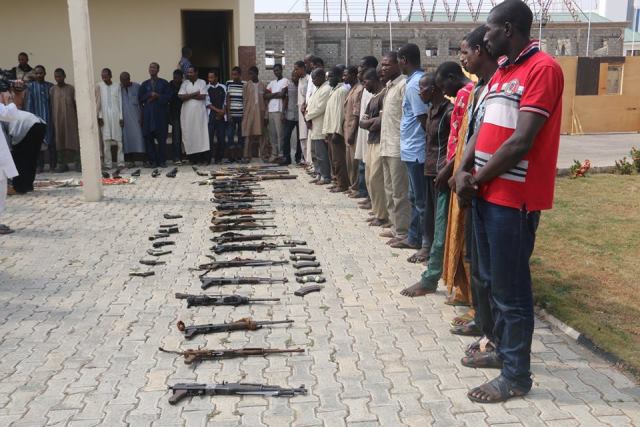
Among the suspects paraded on Tuesday at the Police Headquarters were nine ex-policemen who were arrested for unprofessional conduct, aiding and abetting of serious crimes such as cattle rustling, armed robbery and kidnapping in the North East.
They are: Yuguda Abbah, Habila Sarki, Diphen Nimmyel, Yasan Danda, Abbas Mailalle, Bwanason Tanko, Donan James, Idris Salisu, Zakari Kofi.
According to the FPRO: “In the month of October, 2016, one Alhaji Hodi Adamu, a notorious armed robbery suspect, was arrested by the Police in Adamawa State. The suspect’s confession led to the arrest of two other suspects namely: Rabo Bello ‘M’ and Oliver Honiol ‘M’ whose voluntary confessions led to the arrest of the nine (9) Police personnel mentioned above for various roles they played through their actions and inactions which are considered as disciplinary infractions. The principal suspects and the dismissed police officers will soon be charged to court.”
Awunah added that confessional statements from the arrested police personnel led to the arrest of 19 other suspects from whom assorted weapons were recovered, including: “14 AK 47 rifles with numbers intact; 3 other AK 47 rifles with numbers etched out; 1 Pump Action; 1 locally made pistol; 42 empty magazines; 363 rounds of AK 47 live ammunition; 71 K2 live ammunition and 25 live cartridges.”
Awunah further stated that four police personnel were arrested for “compromising and conspiring with one Zakari Ya’uIsiaka, a notorious armed robber, kidnapper and murderer who has been on the wanted list of the Police in Kogi State.”
They include Musbahu Yahaya; Ugenlo Sylvester; Musa Umar and Omale Edicha.
“5 assorted rifles and different calibers of ammunition were recovered from the suspect and other members of his gang,” the police spokesman said.
Similarly, another Police personnel was arrested for conspiracy to supply explosives to militants in Lagos and Ogun states.
The suspect, “Laibi Opakegba, was intercepted discussing with one Abiodun Amos “alias” SENTI on how to source and supply red dynamite to militants.”
Awunah stated that “the said Abiodun Amos, a 43 year old militant who is a native of Ese-Odo L.G.A of Ondo state was arrested at the bank of Majidun River in Ikorodu area of Lagos State while in possession of two (2) AK-47 rifles.
The FPRO said that the police authority would continue to make sure that its personnel “carry out Police duties and other responsibilities professionally in line with regulations guiding our operations without compromising our integrity and allegiance to the Nation and the Force.”
He assured Nigerians on behalf of the IGP that the Force was working “assiduously to further reduce the rate of crime and criminality across the country, especially kidnap for ransom and other violent crimes.”
Awuna urged Nigerians to always be law abiding and see themselves as stakeholders in making the country safer and secured.
Eyitayo Jegede, Factional Ondo State Governorship Candidate of the PDP
The Supreme Court has given the go ahead for the Appeal Court to deliver Judgement on the cases involving the two warring factions of the Peoples Democratic Party, PDP, in Ondo State-a decision which may change the course of the election should the appeal court rule in favour of the Ahmed Makarfi-led faction of the party.
Acting Chief Justice of Nigeria, Walter Onnoghen, who presided over the matter also struck out ten other motions for stay of execution filed against the Appeal Court after counsel to Biyi Poroye, informed the court that his client wishes to withdraw all the motions.
Taking into consideration the urgency of the case, Justice Onnoghen tasked the Appeal Court panel to expedite action on the case.
Also on the Supreme Court Panel were Justices Tanko Mohammed, Kudirat Kekere-Ekun, Ejembi Eko and Kumai Akaahas.
The Supreme Court also awarded a cost of N250,000 against the initiator of the suit, Poroye, who is also the factional chairman of the PDP in Ondo State.
The Appeal Court is expected to rule on all the fourteen appeals relating to the PDP and the ondo governorship crisis.
A Senior Advocate of Nigeria, Wole Olanipekun led the team for Eyitayo Jegede, while Emmanuel Ukala and James Onoja, both Senior Advocates, represented the Ahmed Markarfi and the Ali Modu-Sheriff factions of PDP respectively; the Independent National Electoral Commission, INEC, was represented by Nelson Anih.
Eyitayo Jegede had approached the Appeal Court to reverse the Judgement of a federal high court which directed INEC to remove his name from the list of Candidates contesting for the Ondo State Governorship position in the election scheduled for November 26.
But Biyi Poroye, Ondo State chairman of the Ali Modu-Sheriff faction of the PDP, filed an interlocutory injunction at the Supreme Court, arguing that the Appeal court had no power to hear the case.
Consequently, the Panel adjourned judgement of the case indefinitely, pending the determination of the injunction filed at the apex court.
The PDP has since called on INEC to postpone the election as a result of the adjournment; a call rejected by both the electoral umpire and the ruling All Progressives Congress, APC.
The decision of the appeal court would ultimately determine who will fly the flag of the PDP in the forthcoming election, which is only four days away.
Over 100 vehicles worth about 450 million have been recovered in the last six months from government officials who made away with them after the present administration wound down the Subsidy Reinvestment and empowerment Programme, SURE – P.
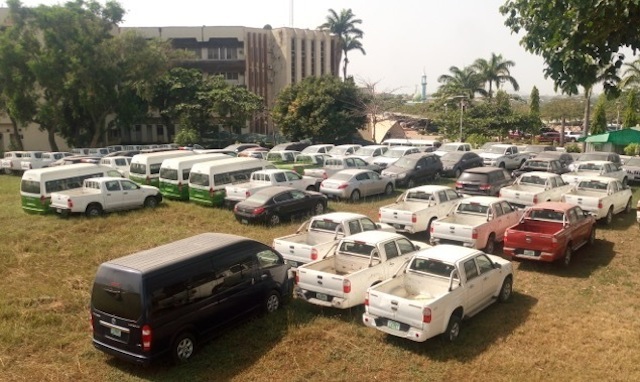
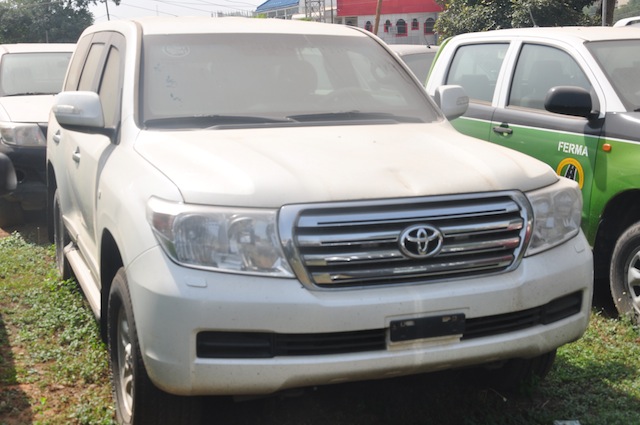
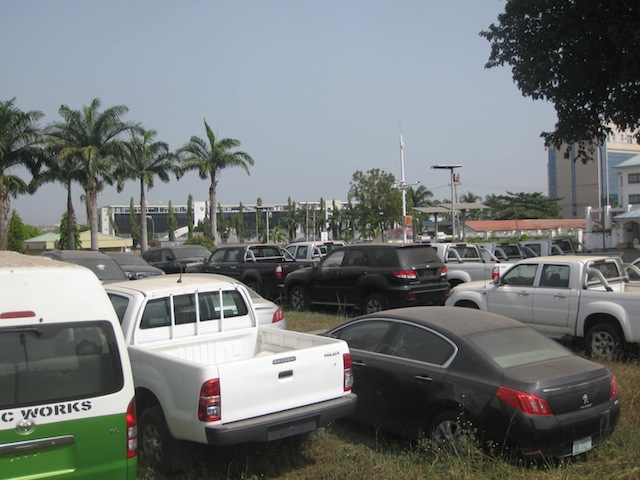
In all, 103 vehicles, including luxury Sports Utility Vehicles, SUVs, were recovered by the Independent Corrupt and other related offences Commission, ICPC, from senior government officials in ministries, departments and agencies, MDAs, which received billions from the SURE – P scheme for infrastructure development and provision of services.
The MDAs include the Federal Ministry of Environment; Federal Ministry of Labour and Productivity, Federal Ministry of Information, the Water Quality Control and Irrigation and Drainage units of the Federal Ministry of Water Resources; Federal Road Maintenance Agency, FERMA, and the Child/Maternal Health department of the Federal Ministry of Health.
The www.icirnigeria.org learnt that most of the vehicles, which included luxury brands like an armoured Land Cruiser, Nissan Armada, Peugeot 508, Audi Q7, Audi A6 and several Prado jeeps, were not registered in government name but in the name of the directors who eventually took them away.
Investigations reveal that when many MDAs received funds from SURE – P during the Goodluck Jonathan administration, they all bought project vehicles, ostensibly to facilitate implementation of projects.
However, because the funds did not come from the MDAs’ allocations, assets such as project vehicles bought with SURE – P resources were never recorded in the MDAs’ Assets Register.
Rather, in most cases, senior officials who coordinated or supervised SURE – P funded projects connived with contractors to purchase such vehicles in their names.
Thus, the vehicles were used as project vehicles for a while, while many of the officials appropriated many of the vehicles to themselves even before the intervention fund was wound down.
When the Buhari administration took over in May 2015 and announced that it would wind down the programme, the remaining vehicles quickly disappeared, taken away by the government officials.
For instance, the former Secretary, SURE – P, Nze Akachukwu Nwankpo, took away a white bulletproof Toyota Land Cruiser jeep worth N36 million which was recovered from him in March 2016.
The amoured Land cruiser SUV recovered from Nze Akachukwu
Curiously, the vehicle was not registered in anybody’s name – not SURE – P or even his own – and carried no plate number. It was also not registered in the assets register of SURE – P, which provided the funds for its purchase.
In another outrageous case, a senior official of the Water Quality Control department of the Federal ministry of Water Resources, Samuel Ome. 0. made away with 13 vehicles including two Prado jeeps, three Toyota Avensis cars, two Rav 4 jeeps and three Toyota Hilux vans. He alone made away with vehicles worth N51.5 million.
But it was not only Ome who benefitted from the bazaar as the SURE P funds were evidently turned into a carnival for ministry officials. In the same water resources ministry, the former director, Irrigation and Drainage, (now retired), Joe Kwanachi, took for himself four vehicles, including a Toyota Land Cruiser, an Audi A6, Nissan Armada and Ford Edge, all SUVs worth N28 million.
The former director of Dams in the department, now retired, Emmanuel Adamu, took home an Audi Q7 and a Hilux van.
Yet another retired director in the Water Quality and Control department, Agada Obioha, took home three vehicles – a Prado jeep, Hilux van and Corolla car.
In all, officials of the Federal Ministry of Water Resources made away with about 40 vehicles, property of the federal government.
A cross section of recovered luxury vehicles
A breakdown shows that 14 vehicles were recovered from officials of FERMA, 13 from officials of the federal health ministry, 15 from the federal labour ministry, a Lincoln Navigator jeep from the National Progressive Movement Party, three vehicles from the federal information ministry and an unspecified number from officials of the defunct SURE – P.
Forty of the vehicles were recovered from officials who had retired from service.
Of the 103 vehicles so far recovered, 95 are parked at the headquarters of the Independent Corrupt Practices and other related offences Commission, ICPC, while eight are in the commission’s offices in Adamawa, Akwa Ibom, Kogi and Rivers states.
It was gathered that there are still many more SURE – P vehicles in the hands of government officials, many of them retired, and the ICPC is still working to recover them.
A source at the ICPC said that apart from vehicles, the commission is also trying to recover other assets and SURE P funds illegally appropriated by government officials and agencies.
The source said so far this effort has led to the recovery of about N108 million from an agency in the health sector.
The SURE P initiative was started in February 2012 by the Jonathan government as an intervention fund following the partial removal of subsidy on petroleum products.
The SURE P committee, headed by Christopher Kolade, was inaugurated on February 13, 2012 to manage and reinvest the federal government’s 41% share of the savings from the removal of the subsidy on petroleum products.
In the three years between 2012 and 2014, SURE P got budgetary provisions of about N628 billion (N180 billion in 2012, N180 billion in 2013 and N268 in 2014).
Another view of the recovered vehicles
Last week, the House of Representatives Committee on Anti – Corruption on a visit to the ICPC headquarters in Abuja inspected 95 of the recovered vehicles parked at the commission’s office.
Chairman of the committee, Akinloye Azeez Babajide, commended the ICPC for its efforts at fighting corruption and for fostering a good image for Nigeria through its preventive initiatives against corruption.
Babajide who expressed satisfaction with the activities of ICPC said that it was important for the achievements of the commission to be made public as a lot of people had the mindset that it was not doing much.
Jide Omokore being escorted to the courtroom by EFCC operatives
Jide Omokore, a billionaire oil magnate and ally of former Minister of Petroleum Resources, Diezani Alison-Madueke, has been re-arraigned by the Economic and Financial Crimes Commission, EFCC, on a nine-count charge of criminal diversion of about $1.6 billion reportedly from the proceeds of petroleum products belonging to the Nigerian government.
Omokore was re-arraigned alongside Victor Briggs, Abiye Membere, and David Mbanefo. before Justice Nnamdi Dimgba of the federal high court, Abuja.
Two of Omokore’s companies, Atlantic Energy Brass Development Limited and Atlantic Energy Drilling Concepts Limited, were also part of the accused persons.
They had been initially arraigned before Justice Binta Nyako on July 4, 2016 but the matter was transferred to Justice Dimgba and so had to begin afresh.
All the accused persons pleaded not guilty when the charges were read to them again on Monday.
The prosecuting counsel, Rotimi Jacobs, SAN, asked the court to allow the defendants to keep enjoying the bail earlier granted them by Justice Nyako, while a date should be fixed for trial to commence
The application was not opposed by the defence team and Justice Dimgba adjourned the case to December 8 for hearing.
Earlier in August, one of Omokore’s counsels, Rabani Lawal, SAN, rejected the claims that his client was an associate of the former petroleum minister, Allison-Madueke.
Lawal said in an interview granted a national daily and published on August 27: “The general impression created every time, all day, is that Jide Omokore is Diezani’s associate but he’s not!
“Jide Omokore is a businessman that has his own companies, bidded for jobs, entered into contracts with NDPC and NNPC to provide some services under the strategic alliance agreement and which has being ongoing, and that has nothing to do with his relationship with Diezani.
And, therefore, it is very worrisome that any time anything about Diezani comes up the next thing is that they will fly Jide Omokore’s name.
So, the EFCC should draw the distinction; if you are investigating Diezani, investigate her and limit your investigation to what has been traced to her either by her conduct, or by her diversion or by her abuse of office, and that is if it has been established. But this should not be extended to independent and third parties whose only offence is that they had a business transaction with the organisation she headed.
The federal government has blamed the incessant destruction of oil facilities by militants in the Niger Delta as being directly responsible for the persistence recession in the Nigerian economy in the third quarter of 2016.
This was made known by the National Economic Management Team, NEMT, headed by Vice President Yemi Osinbajo, in a statement by the Special Adviser to the President on Economic Matters, Adeyemi Dipeolu.
Also identified as a remote cause of the economic crunch is what the economic team referred to as the continued out-sized influence of the oil and gas sector on the rest of the economy.
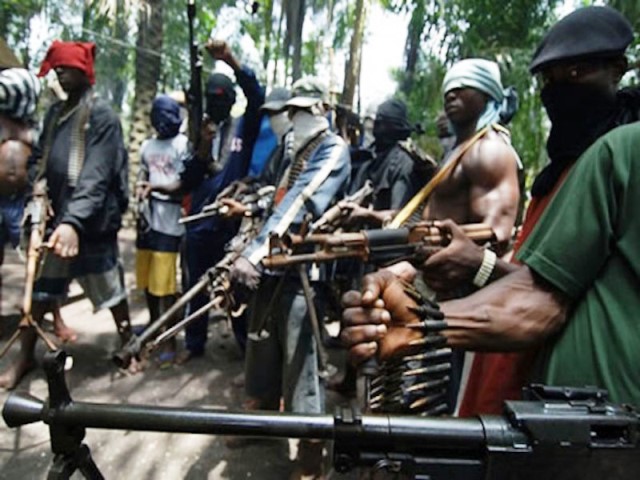
The statement, however, sounded optimistic that the Niger Delta crisis would soon come to an end as the government had opened several channels of communication with all relevant groups in the region.
It also expressed optimism that other measures being put in place by the government, including those targeted at the manufacturing sector, would spur the economy “back to overall positive territory.”
The team assured that urgent fiscal and monetary measures were “certainly in the offing” in lieu of the persistence of the recession in the third quarter.
Though the overall economy of the country was still in recession, the statement pointed out that the third quarter GDP figures released by the National Bureau of Statistics revealed a consistent growth in agriculture and solid mineral sectors.
The statement read: “There are however some green shoots of economic recovery beginning to emerge. To start with, ongoing consultations to bring lasting peace to the Niger Delta have enabled an increase in oil and gas production which, if sustained at current prices, will bring a measure of relief to the economy. Other key sectors of the economy showed encouraging signs of improvement.
“Similarly, while inflation is still high at 18.3% on a year-on-year basis it has begun to level out on a month-on-month basis and should enable the deployment of more policy tools to support growth and employment. Indeed, growth of headline inflation slowed down appreciably from 13.8% in May to as low as 1.70% in September.
“The ratio of investment to GDP also showed a notable improvement rising by 7.6% in the third quarter of 2016 as compared to a contraction of -7.4% in the fourth quarter of 2015.