Home Blog Page 3177

 “No Elections In Michika, Madagali”- INEC

0

The Independent National Electoral Commission, INEC, has said that it will not conduct elections in Madagali and Michika of Adamawa State during the upcoming polls.

According to the INEC spokesman in Adamawa State, Rifkatu Duku, security operatives are yet to give clearance for the electoral umpire to conduct elections in the mentioned areas which were recently recovered from Boko Haram control by the Nigerian military and its allies from Chad, Cameroon and Nigerian.

“We are not going to risk the lives of our staff because we are yet to get the situational report from the security operatives,” Duku stated.

He said that INEC cannot be expected to conduct elections in the areas where security can still not be guaranteed but assured that the commission “had created designated centres here in the state capital for IDPs elections.”

Media reports indicate that residents of the affected communities have expressed reluctance to return or vote in the communities despite successes recorded by the Nigerian military.

INEC statistics also revealed that as much as 148, 375 voters fled Madagali and Michika local governments in a bid to escape death at the hands of insurgents.

The displaced persons who sought refuge in Internally Displaced Persons, IDP, camps in Yola, however, stated that they are not planning to return home yet.

“The military were on ground when Boko Haram came and took over our town. Though the same military has recaptured our land now, but we aren’t sure the insurgents won’t come back,” said an elderly man, Zira Yohanna at the National Youth Service Corp IDP camp in Yola.

“We are not certain about the situation around our area in Garta. I don’t think anybody wishes to return now. Some of the Boko Haram men may have fled to return again,” he further stated.

It would be recalled that the Borno State governor, Kashim Shettima, had described it as “callous and utterly irresponsible” to expect the displaced persons to return to their communities to vote with the existent challenges on ground such as safety, security, and health.

Alleging that “Abuja politicians” were the ones advocating a return of the IDPs to their communities for the purpose of voting at the polls, Shettima stated that dangers awaiting the displaced persons include insurgents on the run, lethal minefields, and health epidemics.

Habu Musa, another survivor of the Boko Haram rampage also said he was afraid of returning to vote in the elections.

“No, we will not return until after the elections. Only last week, we heard that three Boko Haram suspects were nabbed in Michika.

“We are wary of these politicians, we are prepared to vote at the designated centres designed by INEC,” said Musa.

Many displaced persons have expressed fears of reprisal attacks from the insurgents, saying that Boko Haram fighters could spring surprises even after the six-week military operation.


Tuberculosis Is Still A Health Emergency In Nigeria – TB Control Committee Chair

As Nigeria joins other nations to celebrate this year’s World TB Day, Oni Idigbe, a Professor of Microbiology and chairman National Committee on Control of Multi-drug Resistant TB, MDR-TB, speaks to our reporter, Abiose Adelaja Adams, on challenges of combatting disease in the country.

What is this year’s World TB Day all about?

Let’s start by reminding ourselves that the World TB Day stands for the way we mark the anniversary of the discovery of TB bacteria by Robert Koch in 1882. Ever since, the World Health Organization, WHO, has decided to mark that day as a day set aside to carry out advocacy and sensitization on the disease. We are saying that TB is still very much with us and all hands should be on deck to ensure that we control it within our communities.

Every World TB Day in the past years had a theme that WHO wanted to address. But the issue is that in the past two or three years, there has been a burning issue of not getting access to most of the people that are infected with the disease.

Thus, the theme in the past three to four yearshas virtually remained the same. This is because every year, about nine million people globally get infected. And out of these nine million, three million are locked out; they don’t have access to any kind of care. So the thrust is to create awareness for the three million who are elusive; to develop strategies on how to reach these three million, cure them and treat them.

Thus the theme of TB day this year is to reach three million, cure every one. Against this background, we in NIMR (Nigeria Institute of Medical Research) mark the day through symposium where we bring together major stakeholders and international partners, to take stock of what we have been able to do within the last year, what we identify as the gaps and what we think should be the way forward.

Why are these three million people elusive?

These three million people are mostly those who live in the communities with no access  to any form of TB care. TB is a disease of the poor. It is also a disease that could easily be spread through congestion.

Although it is a disease of the poor and could be located at the community where poverty level is high and where people believe the myth that it is caused by a witch in the village, we can also look at cosmopolitan areas, where the population density is high. But most of the care facility for TB is usually focused in cosmopolitan areas.

Most hospitals in the communities are not equipped with TB care and that is where you have most of the cases. That is why WHO has said that emphasis should be on going to these communities. Now some of these communities, not only are they poor, they are hard to reach and healthcare facilities are far away from them.

But whose responsibility is it to provide this care? And why is it not being given?

The services are supposed to be available at the primary health centres, PHCs, at the various local government areas. There are 774 Local government areas in the country. But if you see some of our PHCs, they are not really what you can call a care centre.

There is still a lot of need to reach the communities. I tell you that in 2014 and early 2015, WHO estimated that the world still needs $2billion every year to fill the resource gap of implementing the existing TB programs. Then you can imagine the situation in countries which are very poor. So it is an issue of resource – as well as getting to find the cases where they are and treat them.

How will this be done in the communities?

First is to provide the TB care. And then train community volunteers who will work within the community and train the community dwellers on the signs and symptoms of TB. Most community people don’t know they have TB. If they have that kind of cough, they believe it is some witch.

There are lots of myths around TB that people need to be educated about. There has to be a high level of awareness on the signs and symptoms, where to go to for treatment and let them know that it is absolutely curable.

If globally there is a deficit of funds, what is the situation in Nigeria?

For now, most of the community TB care is sponsored by international partners. I know that there are so many community TB programmes running in Lagos, but they are all sponsored by international partners, foreign NGOs like the Global Fund, USAID, WHO, all putting money into TB. About 90-99per cent (of care programmes) are donor sponsored.

According to Global Tuberculosis Report of 2014, Nigeria’s National TB program budgeted $139million for TB control. It funded only 9 per cent of this. 38 percent was funded by international donors while 53percent of the $139million remains unfunded. That is why we still have the problem of TB we have today.

How big is the TB problem in Nigeria today?

TB is still a health emergency. Nigeria is 11th of 22 high burden TB countries. Most of these countries which account for 95 percent of TB cases in the world are developing countries. Globally we have not really been able to grapple with the detecting and treating it.

TB is 98-99 per cent curable if you use the right combination of drugs and if the patient adheres to treatment, but we don’t always have this kind of result. Somewhere along the line, the correct combination of drugs may not be prescribed or the patient is not adhering to treatment. The result of this is that somewhere along the line the organism (TB bacillus) develops resistance.

Before you go on can you just give us a brief statistics of TB in Nigeria?

TB was almost eradicated in Nigeria and even the world, until it came back in the 90s with the discovery of HIV. It is the major opportunistic infection in people living with HIV. TB progresses faster and causes high morbidity and mortalities in HIV patients because of their compromised immunity.

In 2013, 160,000 people died of TB, while 85,000 people living with TB-HIV co-infection died in 2013. Total prevalence of TB in Nigeria is 570,000 and there are 590,000 new cases as at 2013, according to the 2014 Global Tuberculosis Report.

Currently, the multi-drug resistance TB poses a global challenge and is a major setback in TB treatment.

 So what is this MDR-TB?

Multidrug resistance TB was first observed some years back and, before you knew it, it spread like wild fire. As of 2014, there were about 480,000 cases recorded globally, and most of them are within the developing countries.

It starts like this: there are four major drugs used in treatment of what we call susceptible TB (that is the normal TB). The healthcare personnel ensures that the patient takes the four drugs in his presence for a period of six months. That is why it is called the Directly Observed Treatment (DOTS). Every PHC is supposed to be able to provide these services. Out of these four drugs, there are two most important ones; Isoniazid and Rifampicin. Once a patient develops resistance to any of these two, that patient is classifieds as having multidrug resistant TB.

How serious a threat is MDR-TB?

When people develop MDR-TB, most of the developing countries don’t have the capacities to diagnose it. It was only recently, when we started developing the molecular biology techniques like the Line Assay, the LPI and the Gene extract that the developing countries started detecting it.

TB is spread through droplet of infection, when somebody coughs, it spreads through the sputum and then a susceptible host inhales it. Either of two things can happen. If the person’s immune system is intact, the TB stays in the lungs, rests there, doesn’t cause any harm to the body and remains there as dormant infection. But as soon as there is a drop in the body’s immunity, the aggressive nature of the TB overtakes the body immune, and that organism that was sitting and enjoying himself now starts multiplying and that dormant infection progresses into what we call an active infection.

Once a case of TB not treated, it has the potential of infecting 10-12 people. So imagine the geometric progression.

How can MDR-TB be spread?

If somebody with MDR-TB coughs into the air, he transmits the strain. This then becomes primary drug resistance in another person.

Once a person develops an MDR-TB, they will place him/her on second line drugs, which are more expensive and toxic. They take longer duration of treatment – a minimum of one year to 18 months, and this also includes injectables. You can imagine someone taking drugs for these long periods and some of them are injectable. Also, that is for second line drugs.

What are first line drugs and are they available?

First line drugs are those four combinations I explained earlier and they can be used for a period of six months to achieve results. They are available everywhere and they are free of charge.

But second line drugs are not available everywhere. And they are more expensive, much more toxic, takes you a longer duration of treatment. The second line drugs are available at specialized centres which we call MDR treatment centers.

One needs to obtain approval from the WHO’s Green Light Committee to be able to get these drugs. The country has to obtain permission.

What really causes drug resistance?

Due to the nature of DOTS treatment, where the patient has to come to the clinic every day to collect and use the medicine in the presence of a health worker, there are cases where the patient may miss some days because he does not have transport fare. If this continues, the organism will develop resistance to the drugs and thus a new strain called the MDR-TB sets in. In some other cases, the drug combination may not be always available.

What is the prevalence of MDR-TB in Nigeria?

According to the latest Global TB report of 2014, it Is about 2.9 per cent. There were 10,410 cases tested for MDR-TB in 2013 and 669 laboratory confirmed cases. Out of these, only 426 were started on treatment.

How about the extensive drug resistanceTB?

In treating MDR-TB patients, there are some who have also started developing resistance to the second line drugs. Now when MDR-TB patients start developing resistance to some of the second line drugs, then we go into a more serious situation called extensively drug resistant TB (XDR-TB).

Do we have the capacity from diagnosis to the treatment of these resistant strains?

Initially, we said MDR TB cases should be treated in MDR-TB wards that are dedicated. There is one in Yaba, Calabar, Port Harcourt. They are not many.

The problem again is that because they are not many, you may have an MDR case in Kano and the patient is brought to Lagos. The social component of it is that the patient is separated from the family to a new environment. The stigma also as the family in Kano will be asking where is your brother, or sister’ so because of inadequacy in the number of specialized treatment wards, the country is now trying to adopt what it calls, community MDR care where a patient is identified by a TB control officer to administer the drugs. We are still experimenting on it but that still has its own complication as well.

Now some of the problems we are having is that should the caregiver go to the patients house every day to give injection, community people will start asking questions. The other option is that should the patient go to the health facility. Again, there is the cost of transportation to consider.

The challenges are indeed enormous

Yes but that is not to say that if things are put in place we can’t cure TB. WHO says TB mortality has fallen over 45 percent worldwide since 1990 and incidence is declining. New TB tools such as rapid diagnostics are helping transform response to the disease and new life-saving drugs are being introduced. But the funding gap is still very wide.

 

FALANA BLASTS MEDIA FOR FOCUSING ON NON ISSUES

0

Respected Lagos lawyer, Femi Falana, has berated the media in Nigeria for what he called a diversion of public attention from the nation’s problem of youth unemployment, infrastructural decay, insecurity, corruption, currency devaluation by giving undue coverage to the campaign of calumny and character assassination prevalent amongst Nigerian politicians.

Falana, a Senior Advocate of Nigeria, SAN, who spoke at the Life Theological Seminary, Ikorodu, on Sunday, wondered why the media which is the public’s watchdog would concern and obsess itself with the antics of politicians who are more interested in trading abuses than the art of governance.

“The media have thrown caution to the winds by colluding with certain politicians to divert attention from the crises of youth unemployment, infrastructural decay, insecurity, corruption, currency devaluation etc,” he said.

Falana said also that by giving undue prominence to the campaign of calumny and character assassination embarked upon by politicians, the media had denied the Nigerian people the opportunity to make informed decisions on the candidates of their choice.

The renowned human rights activist also warned that anti-democratic forces are still at work seeking to truncate the re-scheduled elections by way of a military coup which is intended to usher in an interim government.

“There is no indication that the election will hold,” he said, adding that “If the INEC goes ahead with the conduct of the elections there are fears that the exercise may be sabotaged by anti-democratic forces.

“If the election holds the results may be rejected, leading to a post-election violence which may threaten the corporate existence of the nation,” Falana stated.

He warned further:  “In the circumstance, an interim government may be established and be saddled with the task of preparing the country for another political transition. In the alternative, a coup d’etat that may be staged by the top echelon of the armed forces under the pretext of restoring law and order and fighting the menace of insurgency.

Falana, who asked Nigerians to prepare “for a long drawn out battle for the liberation of the country from political and economic predators”, alleged that the special intervention funds designed by the Goodluck Jonathan administration were largely designed for the rich and not the teeming masses.

Such funds, according to Falana, includes Agricultural Credit Guarantee Scheme (N69billion), Commercial Agricultural Credit Guarantee Scheme (N200billion), the Nigerian Incentive-Based Risk Sharing System for Agricultural Lending (N200billion), Small and Medium Enterprises Credit Guarantee Scheme (N200billion), the SMEs Restructuring and Refinancing Scheme (N200billion) and Power and Airlines Intervention Fund (N300billion).

The lawyer, who is regarded by many as a strident critic of anti-masses policies, alleged that all of these intervention funds are yet to have effect on the economy.

“Sequel to the crash in the price of crude oil the federal government announced that austerity measures would be imposed on the hapless Nigerian people. Because of the gross mismanagement of the economy by the government and its allies workers are now owed salaries for months.

“After the elections the people are going to be made to bear the brunt of the looting of the treasury and costs of running the government,” he stated.

Falana also lamented the fact that in spite of the grinding poverty in the land, Nigerian legislators are said to be the highest paid in the world.

“Nigeria’s legislators are said to be the highest paid in the world. The country’s public officers equally receive the highest estacodes in the world. With over 10 aircraft Nigeria has the largest presidential fleet among the developing nations in the world,” he said.

Falana also accused the Central Bank of Nigeria of “dollarization of the economy”.

“In a bid to dollarize the economy and destroys the Nigerian economy, the CBN supplies millions of dollars to the foreign exchange market on a weekly basis,” he said.

“Although Nigeria has become the largest importer of the United States dollars in the world neither the International Monetary Fund, IMF, nor the World Bank has ever questioned the reckless devaluation of the economy.

Even, the National Assembly which is debating the 2015 Appropriation Bill has not deemed it to consider the deleterious effects of the increasing devaluation of the national currency on the implementation of the Budget,” he stated.

SINGAPOREAN LEADER LEE KUAN YEW DIES AT 91

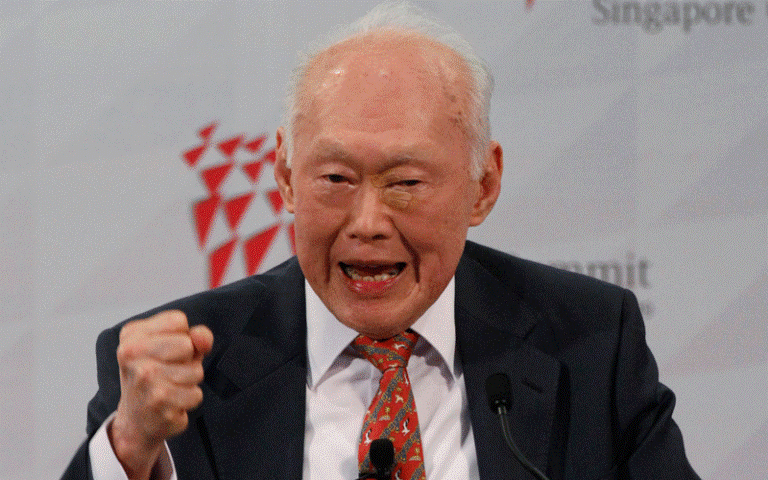
Founding father of modern Singapore, Lee Kuan Yew, who transformed the country from an obscure third-world nation to a first-rate global hub of commercial activities, has died at the age of 91.

His death was announced in Singapore early Monday but he had been in hospital since February 5 with pneumonia and was in critical condition.

“The prime minister is deeply grieved to announce the passing of Mr Lee Kuan Yew, the founding prime minister of Singapore,” the Prime Minister’s office said in a statement.

His oldest son, Lee Hsien Loong, who is prime minister, paid him tribute in an emotional television address saying: “He fought for our independence, built a nation where there was none, and made us proud to be Singaporeans. We won’t see another man like him”.

Thousands of people had been leaving flowers and cards at the hospital over the past three days, praying for his recovery. Many reportedly rushed back there when they awoke to the news of his death.

Lee who co-founded Singapore’s ruling party, People’s Action Party, PAP, in 1959, was the country’s prime minister for 31 years after leading the city-state through a merger with and then separation from Malaysia.

Speaking after the split in 1965, he pledged to build a meritocratic, multi-racial nation and deducing that Singapore, a nation with no natural resources, needed a new economic model, Lee who was determined that his country would succeed set about creating a highly educated work force fluent in English, and reached out to foreign investors to turn the developing nation into a manufacturing hub.

The city-state grew wealthy and later developed into a major financial centre.

However, for Lee, building a nation necessitated instituting tight controls and his reforms included a clampdown on the press and other tight measures, such as corporal punishment, a ban on chewing gum and the government’s foray into matchmaking for Singapore’s brightest – to create smarter babies – led to perceptions of excessive state interference.

Lee remained unapologetic about the repressive measures he used to impose order, and unrepentant about believing his prescriptions alone were the right ones.

“Whoever governs Singapore must have that iron in him. Or give it up. I’ve spent a whole lifetime building this and as long as I’m in charge, nobody is going to knock it down,” he reportedly stated at a rally in 1980.

Lee was popular for his market-friendly policies but was also criticized locally and internationally for his strict controls over the press, public protest and political opponents.

His leadership of Singapore was seen as a model for developing countries across the world, and politicians of all stripes said they took inspiration from his policies.

Though widely respected as the architect of Singapore’s prosperity, Lee receded from public and political life after retirement, even though he was still seen as an influential figure in the government of his son.

U.S. President Barack Obama described Lee as “a true giant of history” whose advice on governance and economic development had been sought by other world leaders down the years.

“Lee’s views and insights on Asian dynamics and economic management were respected by many around the world, and no small number of this and past generations of world leaders have sought his advice on governance and development,” the U.S president said in a statement.
UN Secretary General Ban Ki-moon stated that he was “deeply saddened” by Lee’s death while the Chinese foreign ministry called him “a uniquely influential statesman in Asia”.

The Singaporean government has declared a period of national mourning until his funeral on Sunday while Lee’s family will hold a private wake in the next two days before moving his body to lie in state at parliament from Wednesday to Saturday.


RIVERS DEPUTY GOVERNOR DECAMPS TO PDP

0

The All Progressives Congress, APC, in Rivers State on Sunday suffered a major setback as the deputy governor, Tele Ikuru, dumped the party for the People’s Democratic Party, PDP.

Ikuru, a major ally of Rivers State governor, Rotimi Amaechi, announced his defection in Port Harcourt, the state capital at about 4 p.m on Sunday.

The news of Ikuru’s defection is coming barely six days to the presidential election and the deputy governor, who has worked with the Rivers State governor for about eight years, may be received by President Goodluck Jonathan at a PDP stakeholders’ meeting in Port Harcourt today.

Describing the APC as party of “rebels, insurgents and anarchists clothed in robes of pretense and deceit” in a press statement issued in Port Harcourt, the deputy governor stated that he had joined the APC out of disillusionment but was even further disillusioned within the ranks of the opposition party.

“Recall that in December 2013, out of extreme loyalty to my boss and friend, I   joined the APC, along with other then disillusioned Rivers people.

“Ever since, as the true nature and motives of APC are unveiled, I have continued to twist and turn in extreme mental and emotional agony. The more I struggle to belong, the more the Rivers man in me rejects the APC,” Ikuru stated.

He said that he had done a careful study and analysis of the leadership of the APC and reached the conclusion that it is a party of rebels, insurgents and anarchists, clothed in robes of pretense and deceit.

Feelers within the government house have revealed that since there was no bad blood between the governor and his deputy, this decision to move from APC was probably due to the influence of the deputy national chairman of the PDP, Uche Secondus had on him.

Secondus who is widely regarded as Ikuru’s political godfather, is said to have influenced the deputy governor’s major political appointments since Ikuru’s foray into politics.

Ikuru was first elected deputy governor to Celestine Omehia in 2007, before his removal by the Supreme Court after about six months in office. When Amaechi was sworn in as governor, he retained Ikuru as his deputy and they both fought against the interests and allies of the former governor of the state, Peter Odili.

Ikuru reportedly remained loyal to the governor and fought on the same side when Amaechi fell out with the leadership of the PDP and defected to the APC with majority of his aides.

News of the deputy governor’s defection to the PDP broke on Sunday when a Government House source confirmed his departure from the APC.

Reports indicate that Amaechi had called his deputy on Saturday to ascertain where the deputy governor was, and Ikuru, who at the time was reportedly in his hometown in Andoni Local Government Area of the state concluding his defection to the PDP, reportedly assured the governor that he would see him on his return to Port Harcourt.

However, the deputy governor did not report to Amaechi on his return to the state capital on Saturday.

The news of the defection portends a game-changer in the oil-rich state where a former minister, Nyesom Wike, is contesting for the gubernatorial seat under the aegis of the PDP.

Responding to the news of his deputy’s defection, Ameachi described it as shocking.

A statement by the Rivers State commissioner for Information and Communication, Ibim Semenitari, on Sunday stated that the governor received the news of Ikuru’s resignation from the APC on Sunday with shock.

“He however wishes to note that the reasons adduced by Engineer Ikuru are shocking as Deputy Governor lkuru has consistently been the one driving political activities in his local government area of Andoni. He has also been the second in command driving politics and governance in Rivers State,” the statement said.

The commissioner noted that the governor accorded Ikuru “all the privileges and respect due the office of the Deputy Governor and has treated him with love as a friend and brother.”


READ ALSO:


Semenitari said that the governor had hoped that “the numerous rumours of Engineer Ikuru’s double-faced membership of the APC and open romance with the PDP were not true, but he however appreciates the fact that every individual has a right to pursue his political dreams, as he deems most appropriate.”

She, however, said that governor wished Ikuru the best in his future political endeavours.


FORMER GOV ATTAH, EX MINISTER ETIEBET DUMP PDP FOR APC

0

Former governor of Akwa Ibom State, Victor Attah, and member of the Board of Trustees, BOT, of the People’s Democratic Party, PDP, Don Etiebet, on Saturday dumped the ruling party for the opposition, All Progressives Congress, APC.

The dumping of the ruling party by Attah, a former two-term governor of Akwa Ibom state, and former minister of petroleum Don Etiebet, did not come as a surprise to political watchers of events in the state as the duo was reportedly opposed to what was considered an imposition of the PDP’s gubernatorial candidate by governor Godswill Akpabio.

Akpabio had backed the emergence of Emmanuel Udom, a former executive director of Zenith Bank, as the guber candidate of PDP in the state while the favoured candidate amongst political heavyweights in the state was Umuna Okon Umuna, a close associate of the incumbent governor.

The perceived betrayal on the part of the Akwa Ibom State governor led to the decamping to APC of Umuna Umuna, who clinched the opposition party’s gubernatorial ticket at the primaries thereafter.

Attah and Etiebet, who reportedly joined the APC with more than 50,000 of their supporters declared their support of the APC governorship aspirant.

Both men were sighted at an All Progressives Congress, APC, rally held in Ibibio Park Grounds in Uyo.

Etiebet who is a former minister of petroleum, reportedly commented on the development, stating that “Godswill Akpabio told them we are expired politicians, that we don’t have followers. We have decided to come home to effect change”.

Attah was governor of Akwa Ibom form 1999 to 2007 and is widely believed to be the incumbent governor’s political godfather.


GOV GAIDAM SAYS INSECURITY STALLED BUHARI’S CAMPAIGN IN YOBE

0

By Musdapha Ilo, Maiduguri

The Yobe State governor, Ibrahim Gaidam on Saturday explained that contrary to the rumours being peddled in the media about an alleged frosty relationship existing between him and the presidential candidate of the All Progressives Congress, APC, Muhammadu Buhari, the APC presidential candidate was excused from having a political rally in the state for security reasons.

The governor who spoke at a grand rally of the APC in Damaturu, stated that the APC flagbearer was excused due to the prevalent insecurity of the Maiduguri-Damaturu highway which he would have to pass through to conduct a campaign rally in the state capital.

The governor expressed amusement at reports that Buhari’s absence in the state was because of the sour relationship between him and APC candidate, and accused the PDP in Yobe State of trying to score cheap political points with the rumours.

“Buhari is a straight forward person that Nigerians will benefit under his leadership,” he asserted while calling on all residents to come out en-masse to ensure victory of the APC during the March 28 presidential elections.

The governor also assured the residents of the state that if reelected, he would lift the state to new heights, while affirming that despite challenges posed by the insurgency, he has delivered excellently on his promises.

Gaidam however lamented the constraints placed by the insurgency on developmental strides in the state.


APC ALLEGES PLANS TO ARREST KEY OPPOSITION LEADERS

0

The All Progressives Congress, APC, has raised an alarm about a plot by the presidency and the ruling People’s Democratic Party, PDP, to weaken the opposition by using the Economic and Financial Crimes Commission, EFCC, to execute a series of arrests targeting key chieftains such as the party’s national leader, Bola Tinubu and other financiers of the APC on trumped-up charges.

The party alleged, in a press statement released Saturday by its national publicity secretary, Lai Mohammed, in Lagos that the plot also involves freezing the accounts of companies, individuals and organisations believed to be financing the party, with the ultimate objective of crippling the party so that it would not be able to sustain its activities like paying agents on Election Day.

The party also alleged that the plot is aimed at decapitating the main opposition party and checkmating its impending victory at the polls.

Making reference to the controversial documentary on Bola Tinubu aired on some television stations, the party alleged that this was the first step in the a series of orchestrated actions geared towards effecting the arrest of the APC national leader.

The opposition party stated that the widespread acceptance of the APC is the root cause of the desperation being exhibited by the Jonathan administration which has inspired the PDP to plot the arrest of Tinubu, who is considered to be the arrowhead of the opposition.

The APC also restated its allegation that the six-week postponement of the elections was orchestrated with the objective of slowing down the opposition’s momentum and giving the Jonathan administration time to regain lost ground.

It however asserted that the re-scheduling of the polls failed to achieve that objective, hence the PDP’s resort to new tactics of framing up of opposition leaders.

Also debunking the recent allegations levelled by the PDP in which key leaders in the APC were accused of being behind a certain APC Radio which is allegedly being used to destabilize the polity, the party said that the radio station is the handiwork of the ruling party.

“Their main reason for setting up the station is simple: To use it as another excuse to clamp down on our leaders,” the APC alleged.

“They are the ones who set up the station. They are the ones who announced its establishment to the whole country and now they are the ones who are trying to leverage it to arrest our leaders,” it said further.

According to the party, the increasing resort to dirty tactic fits into the pattern of the presidency’s abuse of federal institutions, including the police, the military and the regulatory agencies, to harass and intimidate the opposition.

The party also stated that the recent events are proof of the desperation of the present administration, which it alleged is determined to make sure that Nigeria is plunged into chaos by sabotaging the elections.

“As we have always said, this President is not interested in a free, fair, credible and violence-free polls. That is why it can even contemplate the arrest of opposition leaders on trumped-up charges, hoping that it will trigger a crisis that will either scuttle the polls or pave the way for anti-democratic forces to short-circuit our country’s democracy.

“We are therefore using this forum to alert Nigerians to the evil machinations of the Jonathan government and the PDP to throw Nigeria into crisis. We also call on our country’s international friends to take note of the desperate tactics of the duo and to do whatever they can to prevail on them not to plunge the country into chaos,” the party further stated.

The opposition party warned that any political crisis arising from the coming election would not augur well for Nigeria and Africa, adding that the country “must not be allowed to be plunged into crisis for whatever reason.”

“This is because the consequences will be dire, not just for our country and her citizens but for the entire West African region and indeed all of Africa,” it stated.

UNICEF GETS N750 MILLION JAPANESE GRANT FOR BOKO HARAM VICTIMS

0

By Musdapha Ilo, Maiduguri

The government of Japan has provided a grant of US$ 3.4 Million (about N750 million) for the “integrated provision of life-saving emergency interventions for vulnerable populations” in the Nigeria’s North east, the international humanitarian organization has reported.

A press statement by UNICEF stated that the grant will be utilized for interventions directed at giving aid to Internally Displaced Persons, IDPs, in conflict affected communities in the region.

The specific areas of coverage include water sanitation and hygiene, health, nutrition, child protection and education.

Recalling that the conflict in the North east, especially in the states of Borno, Yobe and Adamawa, has caused large scale human suffering for the populations in the areas, especially children and women, UNICEF stated that the conflict has triggered major movements and the number of IDPs in the area has almost doubled in less than a year, from an estimated 647,000 in May 2014 to what International Office of Migration reports is now around 1.2 million.

According to UNICEF, children make up about 56 per cent of those who have been internally displaced, with over half of them being five years or younger.

Head of the UNICEF office in Nigeria, Samuel Momanyi, in press statement remarked on the timeliness of the grant received from Japan saying that the it would help the organization to alleviate the suffering of the inhabitants of the conflict-ridden region.

“This grant is timely and will further boost the work UNICEF is doing in the northeast. It will make a significant lifesaving contribution to alleviate the suffering of the affected populations in the northeast especially children and women,” he stated.

Recalling the role played by the government of Japan since 2000 as a major donor to UNICEF, Momanyi said that Japan has aided interventions in child survival, prevention of infectious diseases in children and emergency interventions in Nigeria, through the UNICEF/federal government of Nigeria Programme of Cooperation.

Speaking at the ceremony where the grant was presented, the Chargés d’Affaires ad interim of the Embassy of Japan in Nigeria, Masaya Otsuka expressed hope that the grant would bring succour to people affected by the insurgency..

“I earnestly hope that this grant aid will bring humanitarian assistance to the affected populations, especially children in the northeast of Nigeria,”Otsuka stated.

“The Government of Japan will continue to cooperate with the people and Government of Nigeria and the international community to mitigate the conflict through non-military assistance, and to support Nigerian people affected by the conflict,” he assured.


Nigerian Troops Repel Another Boko Haram Attack On Bama

0

Dare devil members of the Boko Haram group on Saturday made an apparently daring move to retake Bama, the Borno town which was reclaimed from the insurgents only last week, but they were successfully repelled by Nigerian troops.

Scores of the insurgents were believed killed by ground and air operations as soldiers repelled the insurgents who launched attacks on some parts of the town.

A press release issued by the Defence Headquarters and signed by its spokesman, Chris Olukolade, a Major General, said that while calm has returned to Bama, troops were still pursuing the other insurgents who fled after the failed attack.

“An attack by a band of terrorists on parts of Bama was this morning quelled by the Nigerian troops who dealt with them decisively. Over a score of them died while others fled with wounds,” the statement said.

It said further that a Hilux vehicle as well as weapons was recovered from the Boko Haram fighters

The military headquarters also disclosed that a soldier was killed and seven others wounded in the attack and that they had “been evacuated from the combat area by air and are already receiving medical attention.”


READ ALSO:


Nigerian troops finally reclaimed Bama, the second largest local government in Borno State, from Boko Haram fighters on Monday after nearly six months of occupation by the insurgents.

The troops engaged the insurgents for several days before finally dislodging them and Olukolade said that they had to wade through land mines and booby traps set by the terrorists.

Bama was captured by the insurgents in early September, last year.