Equal Measures 2030 (EM2030) offers its Storytelling with Data Fellowship, a six-month programme designed to empower feminist advocates and journalists from Latin America, the Caribbean, Asia and Africa.
The programme aims at transforming gender data into compelling narratives that drive action and policy change.
The fellowship provides mentorship, training, and a $500 stipend to support the creation of diverse storytelling formats, including blogs, videos, podcasts, and infographics.
Participants will engage in hands-on workshops, one-on-one mentorship, and collaborative projects, which will culminate in the dissemination of their work across EM2030’s platforms.
The 2025 fellowship is set to begin on April 1, 2025, with applications due by March 9.
WHILE the current Minister of the Federal Capital Territory (FCT), Nyesom Wike, battles sleepless nights over the rising influx of indigenous beggars into the nation’s capital city, their foreign counterparts have found their way into Abuja and are taking refuge at some satellite locations within the the city.
The federal government on Tuesday, February 11, 2025, announced the setting up of a committee which comprises the Nigerian Police, Nigerian Security and Civil Defence Corps, Department of State Service (DSS), amongst others, to tackle the menace of beggars within the metropolis.
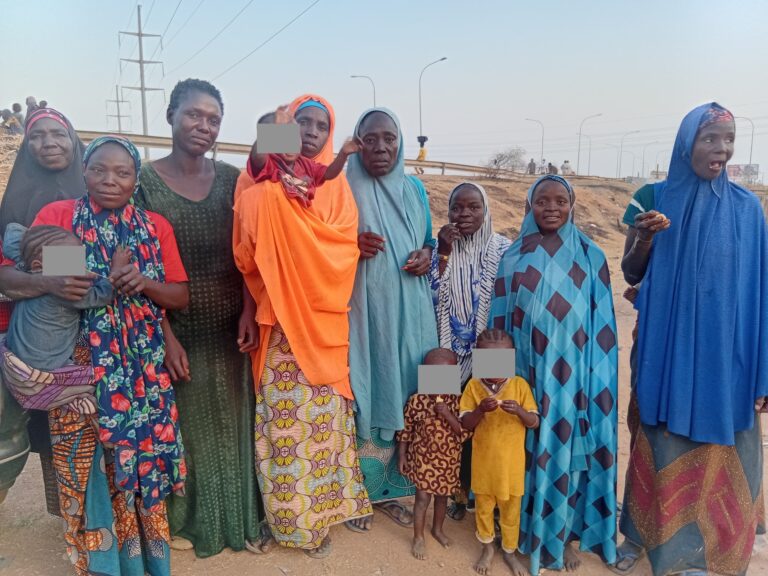
Incidentally, a community of beggars from neighbouring Niger Republic has also found their way into Abuja and are taking refuge in different locations, including the Federal Housing Authority (FHA) flyover bridge at Lugbe.
These beggars comprising of young, aged, and disabled, mount both sides of the bridge from 7:am daily. Some squat on the hard concrete, while others stand, plates stretched out, in silent plea for alms from commuters.
A visit to the location showed mothers cradling crying infants, their weary faces etched with struggles, while barefoot children weaved between the clusters of pedestrians.
‘How we are ‘smuggled’ into Abuja to beg’
On a cool evening in 2022 at Matameye, Niger Republic, a 35-year-old Fatima Ibrahim, was busy with house chores alongside her five children when the deep hum of an approaching truck startled her. It was the same truck that had smuggled her neighbour across the border months earlier. The vehicle rumbled to a stop in front of her neighbour’s door.
“That day, my neighbour and several others, were brought back from Abuja. Another neighbour, who didn’t return, sent money through the driver for the five children she left behind,” Fatima told The ICIR.
According to her, she came to Abuja, Nigeria’s capital city, after her neighbour informed her that the truck would be returning the following week.
Fatima holding her baby Photo credit: Nanji Nandang/The ICIR
“I took three of my children along with my crippled husband and left the rest with their grandparents. Since I arrived, I’ve been sending money to them,” she explained.
Like Fatima, Zaria Ado, the leader of the beggars, who sat hunched on the pavement, her frame thin and weary, said she doesn’t have official papers. However, she revealed that she had been traveling to Niger and back to check on the children she left back home.
\Begging Without Borders: Is Abuja the New destination for foreign beggars?While it is unclear how many of these Nigerien beggars are scattered throughout the capital city, she confirmed that there are over thirty women on her side of the bridge. But she could not say the number of beggars on the other side, which appeared more crowded.
“Everyone here is from Niger. Many of our people are here in Abuja. We are only here to find food to feed our children because the severe hunger in our country is too much to handle,” she said, as she adjusted the tattered, faded hijab, revealing the toll hunger and hardship had taken on her.
Zaria, leader of the beggars, narrating their story. Photo credit: Nanji Nandang/The ICIR
While pointing out that security operatives do not chase or disturb them, Zaria acknowledged that some Nigeriens have been in Abuja longer than she. She said she arrived Lugbe two years before the end of the Presidnet Muhammdu Buhari’s administration.
‘Tragedy led me to begging’
On that fateful day, in 2023 when attackers stormed Mai Adua, Ryahia Dairu’s village without warning, firing their lethal weapons indiscriminately, setting homes on fire, and causing panic among the villagers, Ryahia’s life took a different turn. She said her husband, in an attempt to protect his family, was killed in the crossfire. Her two sons, caught in the brutality of the attack, also lost their lives.
Ryahia narrating her story. Photo credit: Nanji Nandang/The ICIR
Amidst the confusion, Ryahia told The ICIR that her remaining children were forced to flee for their lives, and she was yet to reunite with them.
“The attackers showed no mercy, and many villagers were either killed or abducted. I narrowly escaped as I quickly fled with my surviving child in the direction of a nearby town,” she recalled.
She said the trauma of witnessing such violence and losing so many family members in one brutal assault left her devastated.
“We followed a truck that brought us and other people to Abuja, to beg on the streets as a means of survival,” Ryahia narrated.
‘Our struggles for survival’
“We go without bathing for days. There’s no time, no place, no water. We just sit there, waiting for someone to give us something, anything,” Zaria said.
Another beggar, Mariam Ibrahim, 34, told The ICIR that a truck brings more Nigeriens into the FCT every night.
For Mariam, sitting on the bridge all day was even harder. She said that the lack of movement and the scorching sun made it unbearable.
“I couldn’t bear it. Sometimes, people don’t even move around, but you sit there all day with nothing.”
Instead of staying in one place, Marian started walking around, scavenging empty water bottles and plastic containers, for sale.
Mariam speaking to the ICIR Photo credit: Nanji Nandang/The ICIR
“It wasn’t easy, but it paid off. I make up to N3,000 a day that way,” she said, with a weary smile. “It’s better than sitting on the bridge.
“Not more than five people here are from Katsina State; the rest are all from Niger Republic. Every night, trucks bring more of them into the city. Just yesterday, three trucks arrived with more people. Now, they are scattered across Abuja, begging for alms,” she said.
Mariam said that all the beggars pay a monthly fee of N1,000 to their group leader for permission to beg on the bridge.
“The beggars in the other wing also contribute dues to the leaders, who claim they need the money for bail whenever almajiri children were arrested and detained,” she said.
Leza Ibrahim, a widow, revealed that in 2024, she travelled for two days by road in a truck that brought over twenty Nigeriens to Lugbe. After a brief return home, she came back in January 2025.
The 50-year-old, formerly a petty trader, explained that the severe hunger in her country led her to this begging situation.
“I used to sell beans cakes, also known as akara, but the business collapsed because of debts. With no benefactor to turn to and children to support, I had no choice but to resort to begging for alms to feed them.”
The widow said this was the first time she ever begged in her life. She recounted how she manages to feed her children with less than N1,000, which is the much she sometimes earned in a day.
She explained that after each day’s begging, they head to a nearby truck garage; an abandoned space filled with the sound of idling engines and the smell of oil and rust.
“Some days, I prepare a mixture of Garri with a sprinkle of salt and water for my children because I make less than N1,000,” she said.
Talatua Basiri, who earns at least N1,500 daily, says she sends money and food to her children through the truck driver that regularly checked on them.
Talatua, another beggar from Niger Republic speaking to the ICIR Photo credit: Nanji Nandang/The ICIR
“My husband is in our village with our seven children. We have the truck driver’s phone number, so I call him whenever I need to send money home to my family.”
Nana Baraka, who lost her only son—who had been providing for her and her seven children—in 2024, joined the beggar’s community eleven months ago.
“I have never begged in my life, but the hunger became too much for me to bear. My son had worked at a block industry here in Abuja for several years, sending food and money to us in the village. However, he was diagnosed with lung cancer and passed away in 2024. That is why I came to Abuja to beg for alms, as I no longer have any other benefactor.”
Nana, whose daughter was hit by a bike two weeks ago while begging on the bridge, said the girl hasn’t been able to walk since the accident and has been in the garage without proper medical attention.
“I never knew how to beg for alms in my life; this is my first time. Life has been very difficult.”
Beggars ferried into Nigeria despite border closures
Former President, Muhammadu Buhari, in 2019, ordered the closing of Nigeria’s international land borders against all the country’s neighbours in the Economic Community of West African States (ECOWAS).
He said that the move was to encourage Nigerians to produce food for their consumption. However, in spite of the border closure, Zaria and other Nigeriens not only found their way into the country but made it straight to the capital city, right under the nose of the Nigerian Immigration Service. The Niger–Nigeria border is over 1,600 kilometres, irrespective of which border crossing they used they would have passed an average of two Nigerian states to get to the FCT.
Even though the ECOWAS Protocol on Free Movement stipulates the right of ECOWAS citizens to enter, reside, and establish economic activities in the territory of other member states, it however offers a three-step roadmap to achieve freedom of movement of persons after fifteen years. The protocol allows citizens of ECOWAS countries to move freely and visit any other ECOWAS country without requiring a visa.
For up to 90 days, citizens can stay in any ECOWAS member state without any prior administrative or police formality linked to the stay. The right to reside in an ECOWAS member state is based on the presentation of a residence card or residence permit issued to all citizens who desire one.
President Bola Ahmed Tinubu reinforced the border closure when he assumed office in 2023 as part of the sanctions on the Niger military junta.
This was in accordance with the ECOWAS sanction on Niger Republic after its presidential guards toppled President Mohamed Bazoum.
Despite the reinforcement of this sanction, The ICIR investigation in February 2024, revealed how smugglers and commuters operate at the Nigeria, Niger border, paying between N200 to N500 at each border checkpoint under the watch of the Nigerian security operatives.
It is unclear whether the beggars were smuggled into the country or possibly trafficked by a syndicate that brings them in and exploit them for their own gains.
Not long after assuming office, President Tinubu directed the opening of Nigeria’s land and air borders with the Republic of Niger and the lifting of other sanctions against the country.
He said that the directive was in compliance with the decisions of the ECOWAS Authority of Heads of State and Government at its extraordinary summit in February 2024, to also lift economic sanctions against Mali, Burkina Faso, and Guinea.
Even with the reopening of the border, the ECOWAS Protocol clearly states that the right of entry, residence and establishment are progressively established in the course of a maximum transitional period of fifteen (15) years from the definitive entry into force of this protocol by abolishing all other obstacles to free movement of persons and the right of residence and establishment.
A source in the Nigeria Immigration Service (NIS), who chose to be anonymous, said the provisions of this Protocol allows the repatriation of citizens of the Community whose actions are not in accordance with the laws of the resident state, especially if they exceed the 90 days free movement.Street begging in Nigeria is an offence under sections 249 and 250 of the Criminal Code Act 1986 in the Southern region of the country.Recall that ECOWAS recognised the withdrawal of Niger, Mali, and Burkina Faso, from its bloc in January 2025 after more than a year of diplomatic tensions.Relations between the trio and the regional bloc soured after the July 2023 coup that ousted Niger’s president, Mohamed Bazoum, prompting ECOWAS to demand his reinstatement and threaten military intervention.In response, Niger, Mali, and Burkina Faso announced their exit in January 2024 and accused ECOWAS of failing to safeguard member states and of aligning too closely with foreign powers.They also created a confederation called the Alliance of Sahel States and strengthened alliances with Russia, Turkey, and Iran to address internal security threats such as jihadists and armed gangs, as well as external pressures.Despite maintaining an open border with Nigeria, new immigration measures are being implemented at crossings such as Illela (Nigeria) and Konni (Niger) as at Tuesday, February 19, 2025, as Niger reportedly rejected ECOWAS passports from Nigerians.
FCT’s many battles with beggars
Nasiru El-Rufai, who served as the FCT Minister between 2003 and 2007, under the late Umar Musa Yar Adua administration launched the fight against street begging and repatriated a large number of street beggars to their various states.
Aliyu Umar, who was the FCT minister between 2007 and 2008, returned 395 beggars to their states while 113 were prosecuted.
Adamu Aliero, who was the FCT minister between 2008 and 2010, also banned street begging and raised a 150-member corps to arrest offenders.
Similarly, under Senator Bala Muhammad, in 2014, there was an arrest of 172 beggars.
The Buhari administration launched its fight against street begging in May 2016, and over 200 beggars were arrested and returned to their states.
In October 2024, Wike gave street beggars one week ultimatum to vacate the streets of the capital city while expressing concern over the growing presence of beggars in the city.
He said he launched a sweeping crackdown on 34 beggars, scavengers, and street vendors across various parts of Abuja.
Not long after that, a group of scavengers, beggars, and petty traders, among others, filed a suit against the Wike, the Inspector-General of Police (IGP); Director-General, Department of State Services and Nigeria Security and Civil Defence Corps (NSCDC), demanding N500 million in damages over an alleged breach of their fundamental rights.
A human rights lawyer, Abba Hikima, filed the suit on their behalf before Justice James Omotosho of a Federal High Court in Abuja on 20th November 2024.
Expert raises security concerns
“This highlights the porous nature of the capital city,” said the Managing Director Beacon Security and Intelligence Limited, Kabir Adamu.
He noted that Lagos is the only state in Nigeria that has begun developing an advanced security system spread across its local government areas, adding that the FCT, on the other hand, lacks such a system, making it particularly vulnerable in situations like this.
While maintaining that alms begging reflects the country’s socioeconomic condition, the security expert emphasised that the absence of a coordinated security system allows begging to foster criminal activities, making the city vulnerable to security threats.
“It could be an organised begging network where individuals work for someone who pays them monthly. This suggests that criminals could exploit the situation by strategically placing beggars across the city to coordinate terrorist attacks,” he added.
Adamu further highlighted irregularities with the National Identity Management Commission (NIMC) and negligence in the country’s data and security systems. He urged the government to conduct a scientific sociological investigation into the effectiveness of checkpoints in Nigeria.
“During a recent road trip to a neighbouring state, I encountered 46 security checkpoints where officers were collecting money from trucks and public vehicles. This practice has contributed to the rising cost of food across the country and has also created loopholes that allow criminals to gain entry,” he said.
The ICIR reports that in January 2025, the NIMC identified over 6,000 Nigeriens registered on its database with the National Identification Number (NIN).
FCT Minister, NIS, Police keep mum
On Wednesday, February 12, 2025, this reporter contacted the Chief Press Secretary to the FCT Minister, Tony Ogunleye, to inquire how the ministry deals with local and foreign beggars in curbing street begging. Ogunleye promised to respond on Thursday, February 13, but never did, despite multiple follow-ups.
In the same vein, the Public Relations Officer of the Nigeria Immigration Service, A.S. Akinlabi, was contacted on Wednesday, February 12, 2024 to give clarity on ECOWAS Protocol but had yet to get an official response as at press time.
Also, on Wednesday February 18, a text message was sent to the Public Relations Officer (PPRO) of the FCT command, Josephine Adeh, seeking comments on the matter. The message was not responded to.
NIGERIA’s gross domestic product (GDP) grew by 3.84 per cent year-on-year in real terms in the fourth quarter (Q4) of 2024, driven mainly by the services sector, the National Bureau of Statistics (NBS) said in its latest report.
The report, ‘Nigerian Gross Domestic Product (GDP) Report fourth quarter 2024, was released on Tuesday, February 25.
It shows that Nigeria’s fourth quarter GDP growth of 3.84 per cent was higher than the 3.46 per cent recorded in the fourth quarter of 2023.
The ICIRreports that the growth rate was also higher than the 3.46 per cent reported in the third quarter of 2024.
The service sector recorded a growth of 5.37 per cent and contributed 57.38 per cent to the aggregate GDP, NBS stated.
It said the services sector contributed more to the aggregate GDP in the review quarter compared to the corresponding quarter of 2023 in terms of share of the overall GDP growth rate.
The agriculture sector recorded 1.76 per cent growth compared to 2.10 per cent recorded in fourth quarter 2023.
Similarly, the industry sector settled at 2.00 per cent, declining from 3.86 per cent in the corresponding quarter of 2023.
For the overall year, Nigeria’s GDP grew by 3.40 per cent in 2024 compared to 2.74 per cent in 2023.
Oil sector performance
In the review quarter, NBS said the country recorded an average daily oil production of 1.54 million barrels per day (mbpd).
The figure is lower than the daily average production of 1.56 mbpd recorded in the same quarter of 2023.
It is, however, higher than the oil production volume of 1.47 mbpd recorded for the third quarter of 2024.
The real growth of the oil sector was 1.48 per cent year-on-year) in Q4 2024, NBS stated.
It indicates a decrease of 10.64 per cent points relative to 13.11 per cent recorded in the Q4 of 2023.
When compared to the 5.17 per cent recorded in Q3 2024, it decreased by 3.70 per cent.
On a quarter-on-quarter basis, the oil sector recorded a negative growth rate of -7.19 per cent in Q4 2024.
Its annual growth rate stood at 5.54 per cent, higher than the negative -2.22 per cent recorded in 2023.
The oil sector also contributed 4.60 per cent to the total real GDP in Q4 2024, down from the 4.70 per cent recorded in Q4 2023.
Its contribution was also lower when compared to the 5.57 per cent reported in the third quarter of 2024.
Overall, the oil sector contributed 5.51 per cent for the full year of 2024, higher than 5.40 per cent for the whole year of 2023,
Non-oil sector performance
The non-oil sector grew by 3.96 per cent in real terms during the review quarter.
This rate was higher than the 3.07 per cent reported in Q4 2023.
It was also higher than the 3.37 per cent recorded in the third quarter of 2024.
The NBS stated that the non-oil sector was driven mainly by financial institutions, telecommunications, crop production, road transport, trade, and manufacturing.
The sub-sector growth accounted for the GDP positive growth in the review quarter.
In real terms, the non-oil sector contributed 95.40 per cent to Nigeria’s GDP in Q4 2024, higher than 95.30 per cent recorded in Q4 of 2023.
It was also higher than the 94.43 per cent recorded in the third quarter of 2024.
On the aggregate, 94.49 per cent was contributed by the non-oil sector in the full year of 2024, lower than the 94.60 per cent reported in 2023, the statistics office added.
The ICIR can report that the statistics office had hinted at its plans to unveil a rebased GDP for the country.
This will mean using a new methodology to calculate the GDP.
The revised framework is expected to take effect from the first-quarter GDP report of this year.
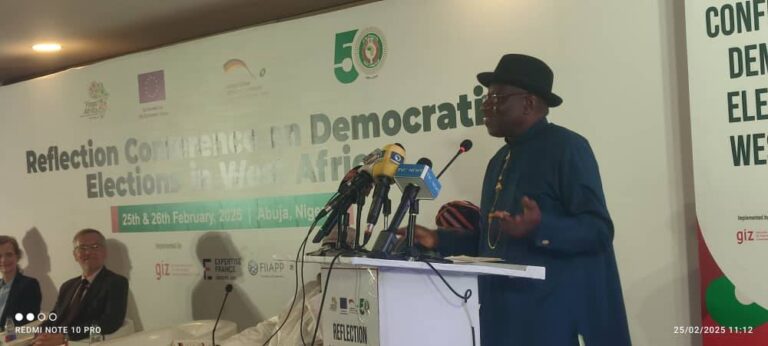
FORMER President Goodluck Jonathan has said his experience as an election observer across Africa and around the world showed that elections in Ghana, Senegal and Liberia are better than those conducted in Nigeria and some other African nations.
Addressing heads of electoral bodies, civil society groups, politicians, representatives of the European Union, Economic Community of West Africa States (ECOWAS), and other election actors across West Africa in Abuja, on Tuesday, February 25, Jonathan emphasised the need for political actors to see people’s will as the ultimate in all democratic settings.
Speaking as a guest of honour at the Reflection Conference on Elections in West Africa, convened by Yiaga Africa, Jonathan said West Africa had made significant progress in its democratic journey.
He argued that though there had been disruptions in Mali, Guinea, Burkina Faso, and Niger, which have experienced military putsches, such should not overshadow the fact that democracy thrives in other countries in the sub-region, adding that that the sub-region had transitioned from the dark days of absolute authoritarian rule.
He listed countries namely Nigeria, Senegal, Togo, Sierra-Leone, Liberia and Ghana which held elections during the 2023 and 2024 election cycles as those making West Africa proud in democratic governance.
While commenting on the Nigerian elections at the two-day conference, which sought to draw lessons from polls conducted in West Africa between 2023 and 2024, Jonathan said, “Despite the introduction of the bimodal voter accreditation system (BIVAS) and the result viewing portal (IReV) to enhance transparency by the Independent National Electoral Commission (INEC), the processes experienced logistical issues (namely) delayed voting in some areas, violence and technical glitches with the BIVAS system, resulting in (an) avalanche of litigations.
“Sierra-Leone also introduced new technology, with the use of biometric voter accreditation ahead of its presidential, parliamentary and local council elections in June 2023. However, there were allegations of irregularities, including voter intimidation, ethnic tension and controversial results, which culminated in the opposition’s boycott of governance institutions…They used technology but the problems were not solved.”
He said in December 2024, Ghana conducted presidential and parliamentary polls, which he adjudged to be very successful despite the application of limited technology.
According to him, Ghana, with the reputation of being one of Africa’s most stable democracies, lived up to this billing by conducting peaceful elections and ensuring a smooth transfer of power.
“The Electoral Commission of Ghana and security authorities played a crucial role in ensuring the elections were free, fair and transparent, demonstrating that Ghana’s democratic institutions and processes have continued to be resilient even with limited technology.
“Two other countries, Liberia and Senegal also conducted elections with the deployment of limited technology. In these countries, the processes were generally peaceful, transparent and credible, with a high voter turnout. In the case of Liberia, the incumbent President George Weah conceded defeat to the opposition candidate, Joseph Boakai after a closely contested runoff, setting a positive example of a democratic transition in the region.
“The pre-election in Senegal was notably marked by protests and arrests of opposition figures, and concerns about the independence of the judiciary. However, it was pleasing to observe that once the election process kicked in, the polling process progressed without issues, resulting in a free and fair outcome. I must commend that the election in Senegal, to me, is one of the best I have observed in Africa and a few I have observed outside Africa.
“It is an election with almost zero technology. So, technology per se, we need it, I’ll emphasise that later, but the human factor is more important than the technology.”
European Union (EU) Ambassador to Nigeria and ECOWAS, Gautier Mignot (L), former President Goodluck Jonathan (m), and former INEC chairman, Attahiru Jega at the Yiaga Africa Conference on Tuesday, February 25, in Abuja.
Jonathan opined that while the deployment of technology could be used to make polls transparent and advance democracy, it could also be used to undermine this system of government when humans manipulate the process.
The former leader recalled that in the past in Nigeria, there were no voter registers or any such documents that could help identify people of voting age. Despite this, he said election results were acceptable and democracy thrived.
He then went on to share his experience when he lost his bid to win re-election in the 2015 presidential election “When Jega was there, he introduced the card reader, but during the election, the card reader rejected me and almost set the country ablaze because the card reader rejected me, my wife and mother. Now, we’ve migrated above the card reader to the BIVAS which is supposed to be more advanced than the card reader but the problems are more than when we used the card reader.
“While we are progressing in terms of technologies, the outcome is retrogressing. This is not what we expect today.”
He challenged electoral bodies in the sub-region to ensure that only real and living humans are on their electoral registers. He also called for an impartial judiciary in adjudicating election disputes.
Some of his recommendations include an independent and impartial electoral commission, non-partisan security institutions and officers, periodic review of electoral laws, tolerance among parties and other stakeholders in the election process, and making national interests outweigh personal and regional interests.
He also questioned the level of independence of electoral bodies across West Africa.
Meanwhile, in his paper titled “Democratic Elections in West Africa: Challenges and Prospects,” the former INEC chairman, Attahiru Jega, who was the keynote speaker at the conference, gave the evolution, disruptions and transitions that democracy has witnessed in West Africa.
He listed such challenges to include desperate politicians, political interference in the appointment (and/or removal) of heads of electoral bodies; intimidation/targeting of electoral officials to ensure desired outcomes; introduction of rules that enable fraud or manipulation of polls; and withholding of funds and other resources from electoral operations.
The Executive Director of Yiaga Africa, Samson Itodo, said the conference was convened to reflect on key lessons from elections observed in the West Africa sub-region by his organisation in the past two years.
He said the discussions at the conference would provide useful information that would support elections scheduled for this year in the sub-region.
He explained that the conference was designed to discuss six key issues namely election administration, the role of technology, disinformation, electoral justice, and implications of elections for governance.
THE Kano State chapter of the Association of Local Government Chairmen (ALGON) has withdrawn its petition seeking to strip the Chairman of the Independent Corrupt Practices and Other Related Offences Commission (ICPC), Musa Aliyu, of his Senior Advocate of Nigeria (SAN) title.
The group requested the Legal Practitioners’ Privileges Committee (LPPC) to discontinue all activities arising from the petition.
In the petition, the council chairmen accused Aliyu of defying a court order and using intimidation tactics under the guise of an anti-corruption probe against them.
The petition, dated September 17, 2024, and filed by a lawyer, Shamsi Jibril, on behalf of the Kano ALGON, and the state government,claimed that despite a Kano State High Court ‘injunction’ restraining the ICPC from harassing or arresting the LG leaders, the agency insisted on probing them.
According to the petitioners, the ICPC, along with the Economic and Financial Crimes Commission (EFCC) and the Nigeria Police Force, has launched parallel investigations into the same allegations, which they argued violate their constitutional rights to personal liberty, dignity, and fair hearing.
The petitioners specifically cited an incident on September 10, 2024, when ICPC officers allegedly attempted to arrest Zangina Galadima Zango, the caretaker chairman of Rimin Gado Local Government, despite the court order.
But in response, the ICPC chairman dismissed the accusations, insisting that the agency’s investigation is lawful and targeted caretaker committees, not elected council chairmen.
Aliyu, in a letter dated February 17, 2024, to the LPPC, stated that the ICPC was acting in line with a Supreme Court ruling in June 2024 (AG Federation v. AG Abia State & others), which declared that local governments must be headed by democratically elected officials.
He emphasised that the investigation focused on caretaker committees unlawfully holding power, as the tenure of the elected LG chairmen in the state had expired on February 12, 2024.
However, in a letter addressed to the Legal Practitioners Privileges Committee (LPPC) at the Supreme Court of Nigeria, legal representatives of the Kano ALGON Chairman confirmed the withdrawal of the petition.
The letter, dated February 25, 2025, was signed by Shamsi Jibril of Baba & Jibril, Attorneys at Law, representing ALGON and other concerned parties in Suit No. K/M1622/24 at the High Court of Justice of Kano State.
The legal team emphasised that the withdrawal of the petition was in line with the discontinuation of the case at the Kano State High Court.
“We humbly write to withdraw our petition dated September 17, 2024, with the above caption, against Dr Musa Adamu Aliyu (SAN), chairman of (the) Independent Corrupt Practices and Other Related Offences Commission (ICPC). We hope that this letter of withdrawal will bring to an end all measures occasioned by the letter under reference; the suit itself, pursuant to which the complaint was made, having been discontinued at the High Court of Justice of Kano State,” the letter read.
THE Federal Government has expressed sadness over the death of Nigerian professional footballer Abubakar Lawal in Uganda.
In a statement released on Tuesday by the Acting Spokesperson for the Ministry of Foreign Affairs, Kimiebi Ebienfa, the government condoled with the deceased family and instructed the Nigerian High Commission in Kampala to collaborate with Ugandan authorities to investigate the circumstances of Lawal’s death.
Lawal, a former Nigerian Under-20 international footballer and a final-year Business Administration student at Cavendish University in Uganda, played for Vipers Football Club until his passing.
He was reportedly found dead after falling from the third floor of Voicemall Shopping Arcade in Kampala Monday morning.
The Nigerian government ordered a thorough investigation, including an autopsy, to determine the cause of his death.
“We are committed to ensuring that a thorough and transparent investigation is conducted, including an autopsy to verify the cause of death. The Ministry has also directed the High Commission in Kampala to provide all necessary consular assistance to support the family and ensure that justice is served,” part of the statement read.
The Nigerian government also expressed confidence in the capacity of the Ugandan authorities to handle the matter with sensitivity and professionalism, given the bilateral relations between the two nations.
While urging Nigerians to remain calm as the investigation unfolds, the Nigerian government pledged to monitor the situation closely.
An AFP report indicates that authorities are currently retrieving CCTV footage and conducting thorough interrogations to determine the cause of the incident.
Lawal’s friend, identified as Omary Naima, told police she had left him alone in the apartment preparing tea while she stepped out to a game centre within the mall. Shortly after, at approximately 8:00 a.m., he was found on the ground, after falling from the third floor.
“Preliminary reports indicate that Lawal arrived at the shopping mall in his vehicle, registration number UBQ 695G, to meet his friend, Omary Naima, a Tanzanian national residing in room 416 since February 20, 2025,” police stated.
The ICIR reports that the Nigerian government assured the public that it would offer necessary support to the deceased’s family.
THE Ekiti State High Court has sentenced two teachers, Gbenga Ajibola and Ayodele Olaofe, to 22 years in prison each for raping minors and abusing their positions of authority.
The defendants were arraigned on March 2, 2022, on three counts bordering on rape and abuse of office.
According to the charge, Ajibola raped a 17-year-old girl, while Olaofe raped a 15-year-old girl in November 2019.
The charge reads, “The first defendant, sometime in November 2019 at Ado Ekiti did rape a 17-year-old girl. Also the second defendant sometime in November 2019 did rape a 15-year-old girl, contrary to Section 31(2) of the Childs Right Law, Cap. C7, Laws of Ekiti State, 2012.
“The defendants sometime in November 2019 at Ado Ekiti did abuse their offices as public servants, contrary to Section 104 of the Criminal Code Law, Cap. C16, Laws of Ekiti State 2012.”
While testifying in court, one of the victims stated that Ajibola, her computer teacher, had instructed her to meet him at a filling station, where he and Olaofe took her and another student to a hotel.
“On that fateful day, he told me to be in mufti, he gave me N200 to go and wait for him in front of a filling station along Bank Road, Ado Ekiti.
“He later came there alongside Mr Olaofe. Before they came, one of my classmates also came there, she told me that Mr Olaofe asked her to wait there for him.
“When they came, we all left for a hotel, around the Oke-Ila area of Ado Ekiti. At the hotel, we were taken to different rooms where Mr Ajibola had sexual intercourse with me. After that day, he continued to disturb me and when I could no longer bear it, I narrated what happened to my mother who later took the matter up,” the pupil said.
The prosecutor, Kunle-Shina Adeyemi, was reported to have presented four witnesses in the court while also tendering statements from the victims and defendants, medical reports, and reports from the panel of inquiry.
According to him, the offence contravened Section 31(2) of the Child Rights Law, Cap. C7, Laws of Ekiti State, 2012.
Although the defendants denied the allegations, the judge, Adeniyi Familoni, found the teachers guilty of the offence.
“The defendants seared their minds and mulled the voice of the conscience as they took advantage of the victims with reckless abandon,” the judge said.
According to him, the teachers deserve severe sanctions for their misdeeds to serve as a warning to others who may want to follow in their footsteps.
“Therefore, Ajibola Gbenga is sentenced to 20 years imprisonment in count one without the option of a fine, and Olaofe Ayodele is sentenced to 20 years imprisonment in count two without the option of a fine. The two defendants are sentenced to two years imprisonment each in count three. The terms are to run concurrently,” he added.
The ICIR reports that Ekiti is among Nigerian states that name-shame sex offenders.
This organisation further reports that several cases of sexual abuse against schoolchildren by teachers and school managers have been recorded in Nigeria over the years.
In 2021, a 14-year-old boarding student of Premier Academy, Lugbe, Keren-Happuch Akpager, died after she was raped and a condom was left in her vagina.
An autopsy report showed that the victim was also sodomised, and her mother, Vivienne Akpager, alleged that the rape occurred within the school premises.
In Nigeria, six out of every 10 children suffer from one or more forms of physical, sexual or emotional violence before clocking 18. More than 70 per cent of children experience this violence repeatedly, according to the United Nations Children’s Fund (UNICEF).
THE International Centre for Investigative Reporting (ICIR) has announced successful fellows for its Countering AI-Enhanced Malign Influence Project.
Supported by the US Embassy, the project is a one-yearinitiative aimed at reducing the dissemination and impact of AI-enhancedmalign influence in Nigeria by promoting media literacy and responsible information sharing among citizens.
Announcing the successful fellows on Tuesday, February 25, The ICIR Programme Officer, Chukwudi Iwuoha, noted that the project would train 120 journalists, influencers, and civic actors from six geopolitical zones in Nigeria through AI literacy workshops in Abuja, Lagos, Enugu, and Kano.
“The project will feature a two-day AI literacy workshop in four locations – Abuja, Lagos, Enugu and Kano, to build necessary skills for participants to identify and counter AI-enhanced malign influences in Nigeria, which will result in quality and responsible information sharing.
The ICIR is an independent, non–profit media organisation that aims to promote good governance in Nigeria through robust investigative, data-driven reporting.
“Our goal is to build a culture of investigative reporting for the media in Nigeria by training journalists to undertake investigative, data-driven reporting, thus strengthening accountability and engendering effective service delivery for the welfare of the citizens.
Click here to see the full list of the selected fellows
THE senator representing Kogi Central, Natasha Akpoti-Uduaghan, has sued Senate President Godswill Akpabio for defamation.
In the suit, marked CV/737/25, Akpoti-Uduaghan, through her lawyer, Victor Giwa, alleged that defamatory statements were made against her by the Senate President and published by his aide on Facebook.
According to her, the post, titled “Is the Local Content Committee of the Senate Natasha’s Birthright?” included a statement suggesting she believed being a lawmaker was only about “pancaking her face and wearing transparent outfits to the chambers.”
Giwa argued that the statement was defamatory, provocative, and disparaging, lowering his client’s dignity in the eyes of her colleagues and the public.
The ICIR reported that Akpoti-Uduaghan raised concerns on February 20, after her seat in the Senate was reassigned due to a reshuffle caused by opposition members joining the majority wing.
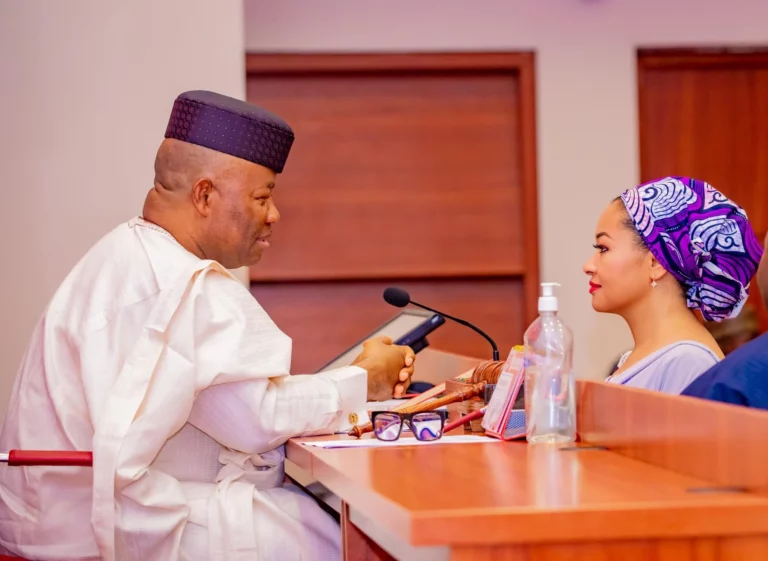
She resisted the relocation, leading to a confrontation between her and the Senate President.
The ICIRreports that the disagreement sparked outrage as Nigerians lambasted Akpabio for the action and described his attitudes towards female senators as not only insulting but a denigration of the female gender and an attempt to stifle female voices.
Among others, Akpoti-Uduaghan is requesting the court to issue, “an order of perpetual injuction restraining the defendants, whether acting by themselves or through their agents, privies, assigns, or associates, from further publishing or causing to be published the said defamatory words or any similar publications about the claimant on social media or in any other manner capable of defaming her.”
Additionally, the lawmaker requested the court to compel the defendants to pay N100 billion in general damages and N300 million to cover litigation costs.
The ICIR reports that Akpabio and the female lawmaker had had confrontations in the Senate at least twice.
In July 2024, Akpoti-Uduaghan commented on a motion without Akpabio’s consent. In his attempt to correct her, he said the Senate was not a nightclub where anybody could talk anyhow.
Akpabio bowed to pressure as he apologised to the lawmaker two days later for comparing her conduct in the Senate to that of a nightclub.
Earlier today, this organisation reported that the Senate referred Akpoti-Uduaghan to its Committee on Ethics, Privileges, and Public Petitions for disciplinary review following the rift between her and Akpabio.
The committee, led by Neda Imaseun, was given two weeks to present its findings.
The decision was made through a voice vote after Yemi Adaramodu raised a motion under Order 1(b) and 10, condemning what he described as Akpoti-Uduaghan’s “extreme intransigence” during the Senate session on February 20.
THE Federal Competition and Consumer Protection Commission (FCCPC) has summoned MultiChoice Nigeria, the parent company of DStv and GOtv, over plans to increase the prices of its packages effective March 1.
The FCCPC, in a statement on Tuesday, February 25, signed by its spokesperson, Ondaje Ijagwu, said the summon was for Multichoice to provide clarification regarding the planned increase in subscription prices.
The FCCPC said that in exercising its power under Sections 32 and 33 of the FCCPA, it had directed the chief executive officer of MultiChoice Nigeria to attend an investigative hearing at the Ccommission’s headquarters on Thursday, February 27.
The regulatory body said this followed MultiChoice’s formal notification of the price adjustment, which raised concerns about recurrent unilateral price hikes, potential market dominance abuse, and perceived anti-competitive practices in the pay-TV industry.
“The FCCPC is deeply concerned that Nigerian consumers continue to face frequent price increases, amid accusations that MultiChoice applies different pricing strategies in other markets, heightening questions about fairness and market abuse,” the FCCPC stated.
It added that should MultiChoice fail to provide satisfactory explanations or be foundin violation of fair market principles, the FCCPC would be left with no other option than to impose penalties or other corrective measures to protect Nigerian consumers.
The FCCPC said it was engaging other relevant agencies to ensure fair competition and consumer protection within Nigeria’s broadcasting and digital subscription landscape.
The ICIR reported that almost a year after its major price preview, Multichoice Nigeria announced plan to increase the prices of its packages effective March 1.
In a message to its customers on Monday, February 24, titled “Price Adjustment on DStv and GOtv Packages,” MultiChoice chief executive officer, John Ugbe, explained the reasons for the hike.
According to the company, its latest price review would hike the DStv compact bouquet from N15,700 to N19,000, the compact plus to N30,000, and the premium subscription to N44,500.
Similarly, GOtv customers who currently pay N3,600 will now pay N3,900, while the tariff on GOtv Plus will rise from N4,850 to N5,800. The GoTV Max package will cost N8,500, while the Supa will jump to 11,400, while Supa Plus rises to 16,800.
The company claimed the price increase was due to the increasing cost of running business in Nigeria. It further pointed to currency depreciation, with the naira’s value dropping significantly and high inflation ballooning its operation expenses.
Meanwhile, there have been growing concerns about the price preview, despite the dwindling economic fortunes of most Nigerian workers.
Nigeria has been grappling with one of its worst inflationary periods in decades, with inflation reaching 24.48 per cent as of January 2025, according to the National Bureau of Statistics (NBS).
In September 2024, MultiChoice Nigeria defended its opposition to a “pay-as-you-watch” model in court, stating that such a system was not commercially or technically feasible in satellite broadcasting due to current technological limitations. This stance was in response to consumer advocacy groups pushing for more flexible payment options.
Additionally, between April and September 2024, the company reported a loss of 243,000 subscribers, attributed to rising subscription costs and a shift towards more affordable streaming alternatives.