Home Blog Page 36

Dangote Refinery’s ₦1,820 Jet A1 price to stabilise market – NMDPRA

THE Nigerian Midstream and Downstream Petroleum Regulatory Authority (NMDPRA) has said the indicative gantry price for Aviation Turbine Kerosene (ATK) recently released by the Dangote Petroleum Refinery would ensure market stability and improve compliance among oil marketers. 

The refinery had fixed its gantry price for ATK, popularly known as Jet A1, at N1,820 per litre – a move expected to bring transparency to a sector where airline operators and passengers have long complained about exploitative pricing.

In an interview with the News Agency of Nigeria (NAN) in Abuja on Saturday, May 2, the NMDPRA’s Director of Public Affairs, George Ene-Ita, noted that the daily publication of prices by the refinery would empower the regulator to conduct more effective surveillance.

“The Dangote Refinery, having released its latest indicative gantry prices, which they promised to publish daily going forward, will enable us to ensure tacit compliance by marketers and operators during our routine surveillance operations nationwide,” Ene-Ita said.

The intervention comes as a relief to the aviation industry, which has seen marketers ignore previous regulatory guidelines.

NMDPRA had issued a directive setting a price cap for end-users, ranging between N1,760 and N1,988 per litre in Lagos, and N1,809 to N2,037 per litre in Abuja. Despite this, oil marketers continued to sell the product to airlines at N2,230 per litre and above, deepening the financial crisis for domestic carriers.

Ene-Ita emphasised that while petroleum product prices are deregulated, the refinery’s decision served as a necessary ‘concession’ to prevent the collapse of aviation operations.

“We are not unmindful of the fact that what the Dangote Refinery is doing is a concession to help ease overhead cost pressures in the aviation sector in order not to truncate its operations. So, we will play our part to see that Nigerians benefit from the gesture,” he added.

The regulator clarified that its current pricing framework was derived from Platts average figures recorded between April 17 and 23, 2026, reflecting prevailing global oil market conditions.

According to the NMDPRA, actual market prices often fluctuate based on external factors. It cited heightened global volatility driven by geopolitical tensions, including the ongoing US-Iran conflict, as a primary contributor to the recent hike in aviation fuel costs across Nigeria.

CAF announces AFCON 2027 dates

THE Confederation of African Football (CAF) has announced that the 2027 Africa Cup of Nations (AFCON) would kick off on June 19 and end on July 17, 2027.

The tournament will be jointly hosted by Kenya, Tanzania and Uganda.

In a statement on Saturday, CAF said, “The opening match will be played on Saturday, 19 June 2027, and the final on Saturday, 17 July 2027.”

It added that the dates were approved by the FIFA Council at its recent meeting in Vancouver, Canada, noting that the host country for both the opening match and final would be announced later.

CAF said the tournament would be the first AFCON to be staged by three countries, describing it as an opportunity to expand the competition’s reach to over 400 million people across the East African region.

On the qualification process, the body said the preliminary round had been concluded, with the draw for the qualifiers scheduled for May 19, 2026.

A total of 48 teams, including the three co-hosts, will take part in the qualifiers, which will be played across three FIFA international windows.

“The qualifiers will be played across the three FIFA International Windows. Matchdays 1 and 2: 21 September to 6 October 2026. Matchdays 3 and 4: 9 to 17 November 2026; Matchdays 5 and 6: 22 to 30 March 2027,” CAF stated.

According to the body, the teams will be drawn into 12 groups of four, with the top two from each group qualifying for the tournament.

The 2027 edition will mark the return of the competition to East Africa for the first time since Ethiopia hosted it in 1976.

CAF added that the tournament would build on the success of recent editions, including Côte d’Ivoire 2023 and Morocco 2025, which recorded growth in sponsorship, commercial revenue and global broadcast audiences.

The ICIR reported that Senegal emerged the last AFCON champions after defeating Morocco in the final at the Prince Moulay Abdellah Stadium, in Rabat, marking one of the most significant eras in African football history.

Papa Gueye secured the first position of the tournament for the West African nation in a most dramatic of circumstances at 94th minute of extra time with a goal, after Brahim Diaz missed the controversial penalty awarded to Morocco, which delayed the match by about 20 minutes.

Meanwhile, CAF’s appeals board stripped the country of the title and awarded it to Morocco, ruling that Senegal had forfeited the final by walking off the pitch in protest at a contentious late penalty.

Meanwhile, the Senegalese Football Federation vowed to challenge the controversial decision.

In a communiqué on Tuesday night, March 17, the Senegalese Football Federation confirmed it had received CAF’s March 17, 2026, ruling concerning the disputed final between Senegal and Morocco.

The ICIR reports that the Appeals Board of CAF ruled in favour of the Fédération Royale Marocaine de Football (FRMF), declaring their appeal admissible and setting aside an earlier decision by CAF’s Disciplinary Board.


The travails of Nestoil and the travesties of courts

0

By Chidi Anselm Odinkalu

IN a week in which the Nigerian judiciary at all levels has been the focus of considerable civic and party-political energy, it may seem odd to expend bandwidth on the travails of an investor or businessman, but Ernest Azudialu-Obiejesi is no ordinary businessman.

The story of the ongoing ordeal in the Nigerian court system involving him, his wife, Nnenna – an entrepreneur in her own right – and various companies in which they cross-invested, will for long be studied as an example of how disreputable dispute resolution constrains development and can blight even the ablest.

These cases involve the control of assets running into billions of dollars and claims concerning the structure and enforcement of secured credit transactions whose value is equally mouthwatering. The issues and sums involved are consequential for the fate of Nigeria’s economy. The performance of the courts has been just as consequential but for mostly the wrong reasons.

These cases have worked their way with dutiful relentlessness through every nook and cranny of the Nigerian court system. In the past six months alone, they have traveled through multiple judges of the Federal High Court; up to the Court of Appeal; and then to the Supreme Court from where they have returned to the Federal High Court. These cases have also generated tens of thousands of pages of court filings and records and thousands of billable hours for the most expensive lawyers in Nigeria.

As with many such cases involving commercial transactions at the sharp end, these cases can seem interminable, and their narrative can appear complex. Amidst the fog of legal attrition, however, the plot is discernible. What they reveal about how courts can dissipate a country and its wellbeing bears close attention.

Better known as “Obijackson”, the name of the trading company under which he first made his foray into the Piranha-infested waters of Nigerian enterprise in 1983, Ernest Azudialu-Obiejesi is one of Nigeria’s richest. In 1991, during the heady days of military rule, he ventured beyond trading and founded Nestoil, an engineering, procurement, construction, and commissioning company active in the provision of services to the hydrocarbons and adjacent sectors in the country.

Neconde Energy, another company founded by Obijackson, is a leading indigenous operator in hydrocarbons exploration and production in Nigeria. Among other holdings, Neconde Energy owns 45% of Oil Mining Lease (OML) 42. The remaining 55% is owned by the Nigeria National Petroleum Company (NNPC) Exploration and Production Limited (NEPL).

These companies are part of the Obijackson Group, which employs over 3,000 Nigerians directly. Up to 15,000 indirect jobs depend on their operations too.

As with many operators in the hydrocarbons and adjacent sectors, it is not unusual for such companies to require lines of credit from financial institutions. Indeed, this can itself be proof of the value and profitability.

In December 2022, the First Bank Group led a syndicate of financial institutions, including 16 Nigerian banks, in restructuring and consolidating the long-term indebtedness of Nestoil into a pool designated as “Global Facilities” and under a document known as Common Terms of Agreement (CTA). The consortium also included some lenders who were non-Nigerian, such as the Africa Export-Import (Afrexim) Bank, headquartered in Cairo.

The CTA contained provisions governing applicable law as well as dispute resolution forum. It appears that the parties agreed that the applicable law will be English law and the forum for resolution of disputes will be England. How or why they made this choice is not in issue at this moment.

Neconde Energy – together with Obijackson and Nnenna Obiejesi – guaranteed this transaction.

Around 22 October 2025, the second anniversary of the onset of his judicial career, Deinde Isaac Dipeolu, a judge of the Federal High Court in Lagos, issued an order at the instance of the FBNQuest Limited, a Merchant Bank, and First Trustees Limited, both members of the First Bank Group, authorising a receiver/manager appointed by them to take control of the assets of Nestoil and Neconde Energy. The basis was a claim that there had been a default in the debt which crystallised enforcement against the assets on which the debt was secured. Importantly, the order declined to extend judicial protection to the receiver/manager.

The understanding of the creditors appeared to be that those assets included a mini-skyscraper known as Nestoil Tower, located in a choice part of Victoria Island in Nigeria’s commercial capital in Lagos. The occupants of this building include staff of Nestoil and of Neconde Energy. However, the building is owned by another company called Drawcock Estates Limited, which was not party to the Global Facilities or the CTA.

One year earlier, on 8 October 2024, another judge of the Federal High Court, Ambrose Lewis-Allagoa, had apparently issued an order restraining “any persons whatsoever”, from taking such adverse enforcement action against the building. This order was not challenged.

Similarly, prior to the CTA, in 2019, another judge of the same court, Muslim Sule Hassan, had made another order requiring the parties – in a formulation that has now become familiar to Nigerians – to preserve the status quo ante bellum.

It appeared that Deinde Dipeolu had set out to anchor a young judicial career on a distinguished track-record of controversial ex parte orders involving both hydrocarbons interests and bankers. On the last working day of 2024, December 30, again at the instance of the First Bank Group, he dutifully issued an order freezing the accounts of General Hydrocarbons Ltd in a dispute concerning credit facilities to the operators of OML 120. However, three weeks earlier, his colleague, Ambrose Lewis-Allagoa appeared to have issued an order restraining such action.

Deinde Dipeolu’s order of October 2025 threatened to ransack the life of Nestoil and the Obijackson Group as a going concern. To enforce the order, the Nigeria Police Force deployed to seal Nestoil Tower. Following a petition by Obijackson alleging judicial malpractice, the Chief Judge of the Federal High Court transferred the case to another judge of the court, Daniel Osiagor who, on 20 November, vacated Deinde Dipeolu’s ex parte orders. This enabled the company to – temporarily at least – return to its headquarters building.

The First Bank Group filed a notice of appeal on 21 November 2025 against Daniel Osiagor’s decision. On 26 November, unknown to anyone, they followed this up with an application ex parte asking the Court of Appeal to issue a “restorative injunction” returning them to the building and affording judicial protection to the manager/receiver.

At this time and on this day, however, no records of appeal had been prepared or transmitted records to the Court of Appeal. So, there was no appeal before the Court. Mind you, the lower court had declined judicial protection to the receiver/manager. So, there was nothing about that to “restore” either.

Yet, the following day, 27 November, a three-judge panel of the Court of Appeal sat promptly and, in the absence of an underlying appeal, granted the application for “restorative injunction” without hearing the other side. If anything qualifies as judicial miracle, this was it.

But this Court of Appeal had only just begun its career in judicial miracles.

In the third week of January 2026, they disqualified lawyers instructed by Obijackson and Nnenna Obiejesi, his wife, as well as Neconde Energy, from participating in the proceedings. According to the Court of Appeal, only the receiver/manager (the validity of whose appointment was disputed) could exercise that right. The audacity of this reasoning did not pass the smell test.

On 10 April 2026, the Supreme Court agreed, accusing the Court of Appeal in this case of having “abdicated its judicial responsibility and enabled blatant abuse of process of court when it granted the application.” Stronger judicial condemnation is difficult to imagine.

Now that the Supreme Court has settled the matter of legal representation, the parties must return to the high court for the underlying dispute. How long this will take or how many more twists of judicial malefaction could accompany the journey to a resolution of the mouthwatering sums involved is anyone’s guess. Investors elsewhere desiring to make Nigeria a destination and looking at this will be forgiven if they were to decide to sit it out or find a more sensible destination.

A lawyer and a teacher, Odinkalu can be reached at chidi.odinkalu@tufts.edu

Army arrests activist over video of soldiers alleging poor feeding, accuses him of subversion

0

THE Nigerian Army has confirmed the arrest of activist and blogger, Justice Mark Chidiebere, popularly known as Justice Crack, following his viral posts regarding the welfare and feeding conditions of Nigerian soldiers.

The confirmation followed growing concerns over the whereabouts of the Abuja-based activist, who was reported missing by family and associates after he posted a video on social media highlighting complaints from personnel within the service.

His post showed how the soldiers claimed they were poorly fed by the authorities, among other allegations of mistreatment.

In a statement released by the Army Acting Director of Public Relations, Appolonia Anele, a colonel, the military stated that the activist was being investigated for a potential breach of the Armed Forces’ Social Media Policy.

The military authorities alleged that Chidiebere’s interactions with the soldiers went beyond reporting welfare issues, claiming he actively incited personnel toward acts of subversion.

The Army explained that a preliminary report suggested the activist’s actions were aimed at creating internal discontent, which it viewed as a threat to national security.

“Preliminary report reveals that the soldiers discussed wide range of issues with Justice Chidiebere who seemed to be inciting soldiers to create discontent within the system. An example was a chat bothering on subversion which Chidiebere had with the soldiers,” she stated.

It further emphasised the danger of such interactions, stating, “A situation where civilians cultivate vulnerable personnel towards acts of subversion has far-reaching implications on discipline and national security.”

While the soldiers involved in the viral video remain in military custody for internal disciplinary action, the Army disclosed that Chidiebere had been handed over to civilian law enforcement for further investigation and possible prosecution.

“Justice Chidiebere was picked by the Nigerian Army alongside the soldiers for investigation. While the soldiers remain in own custody, Chidiebere has been handed over to the relevant civil authorities for further investigation and possible prosecution,” the statement added.

The Army reaffirmed its commitment to the rule of law, maintaining that it would continue to act within legal boundaries while safeguarding national sovereignty.

Bauchi governor defects to APM after Supreme Court ruling

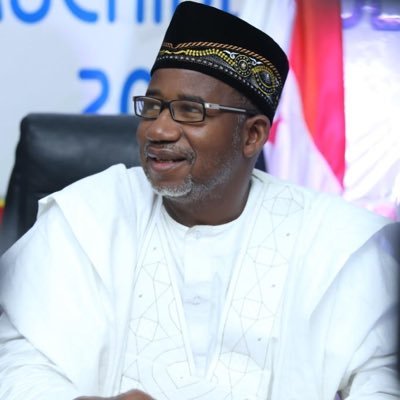
BAUCHI State Governor, Bala Mohammed, has defected from the Peoples’ Democratic Party (PDP) to the Allied Peoples Movement (APM) following the Supreme Court judgment on the PDP leadership crisis.

Mohammed, who was the Chairman of the PDP Governors’ Forum, announced his defection on Saturday, May 2, after a stakeholders meeting convened to review the implications of the court’s ruling and determine a way forward.

The development leaves Oyo State Governor, Seyi Makinde, as the only remaining PDP governor, marking a significant shift in the party’s political strength.

The Bauchi governor said he had spent the past eight days in Abuja consulting with key stakeholders in efforts to resolve the crisis but noted that the situation worsened after the apex court nullified parallel conventions conducted by rival factions within the party.

According to him, the judgment stripped both factions of legal standing, leaving the party’s Board of Trustees to temporarily oversee its affairs, a development he said had deepened uncertainty.

“After careful consideration and wide consultations with leaders and stakeholders across the country, it has become clear that our efforts to restore stability have not yielded the desired results,” he said.

While appreciating the PDP for providing a platform for his political rise, Mohammed said the decision to leave became necessary to ensure continuity in governance.

“However, as responsible leaders, we cannot allow our people to be left without a credible and effective political platform,” he added.

He described his move to the APM as strategic, noting that the party offered a viable platform free from legal encumbrances.

“We remain PDP at heart. We are leaving not out of bitterness, but out of necessity – to continue the struggle for good governance,” the governor said.

Announcing his new political platform, he declared, “Consequently, after extensive consultations, we have taken a firm and strategic decision to join the Allied Peoples Movement.”

Mohammed also disclosed that members of the State Executive Council seeking elective offices had resigned in line with the law.

He outlined measures to ensure a smooth transition, including the establishment of a compliance committee, commencement of membership registration, engagement with APM leadership, and the constitution of a team to interface with the Independent National Electoral Commission.

He urged his supporters to remain calm and united, describing the move as a deliberate political repositioning.

Meanwhile, the National Chairman of the APM, Yusuf Dantalle, formally received the governor and his supporters, describing the party as a “clean, democratic party” guided by the motto “Nigeria First.”

The ICIR reported that there appeared to be no end in sight to the crises rocking the PDP as it joins its contemporaries to prepare for the 2027 elections.

The conflicts took another turn on Thursday, April 30, shortly after the Supreme Court nullified the Ibadan Convention of a faction of the party, backed by Oyo State Governor Seyi Makinde and other stalwarts, in November 2025.

The convention produced the Kabiru Turaki-led National  Working Committee of the faction.

In its ruling, the court lampooned the faction and voided the convention over what it described as deliberate disobedience of subsisting court orders.

Consequently, the Turaki-led group’s Board of Trustees announced its readiness to assume the party’s leadership.

However, the rival faction belonging to the Minister of the Federal Capital Territory (FCT), Nyesom Wike said the apex court’s ruling simply affirmed its control of the PDP.

Yahaya Bello picks APC senatorial form amid EFCC corruption case

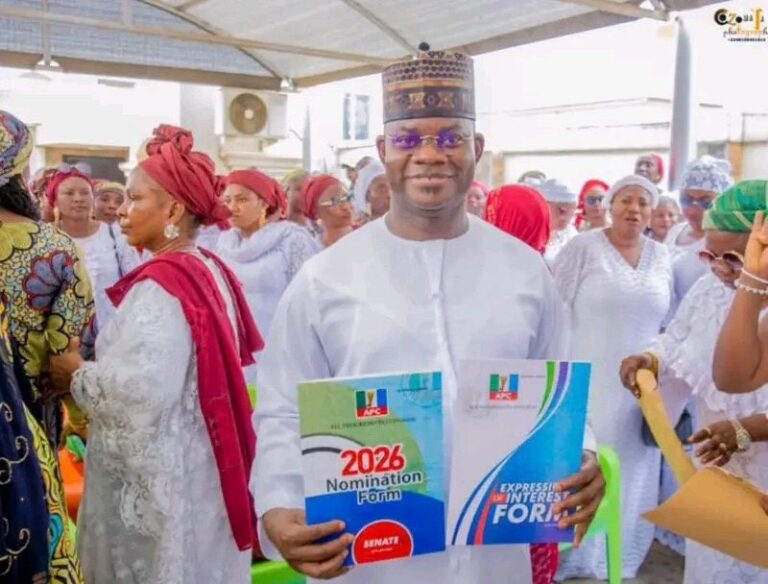
A FORMER Governor of Kogi State, Yahaya Bello, has picked the All Progressives Congress (APC) nomination form for the state’s central senatorial seat ahead of the 2027 general elections.

Bello reportedly received the form on Saturday and is said to have emerged as the party’s consensus candidate for the race.

He is expected to face the incumbent lawmaker, Natasha Akpoti-Uduaghan of the Peoples’ Democratic Party (PDP) and other contestants.

The former governor, who served two terms between 2016 and 2024, handed over to his successor, Usman Ododo, in January 2024.

Bello’s senatorial ambition comes amid an ongoing corruption case involving the Economic and Financial Crimes Commission (EFCC).

The ICIR reports that the EFCC is prosecuting Bello on 19 counts of alleged money laundering amounting to N80.2 billion.

The anti-graft agency had in April 2024 declared him wanted over alleged financial crimes, including misappropriation of public funds during his tenure as governor.

The EFCC later filed charges against him at the Federal High Court in Abuja, accusing him of laundering large sums through multiple bank accounts and shell companies. The commission alleged that some of the funds were used to acquire high-value properties in Abuja and other locations.

Bello, through his lawyers, has consistently denied the allegations, describing them as politically motivated and lacking merit.

Following months of legal back-and-forth, he eventually appeared before the court after earlier controversies surrounding his arrest, including a standoff involving security operatives at the Kogi State Government Lodge in Abuja.

The case is ongoing, with the court yet to reach a final determination on the charges.

NAF pummels terrorist hideouts in North-East

THE Nigerian Air Force (NAF) has intensified its air campaign in the North-East, using precision strikes to dismantle terrorist networks in Sambisa Forest and the Tumbuns around Lake Chad.

Under the Air Component of Operation HADIN KAI, the Nigerian Air Force said it carried out heavy attacks that destroyed hideouts, crippled logistics, and neutralised scores of fighters between April 30 and May 1.

In a statement on Friday, the NAF’s Director of Public Relations and Information, Ehimen Ejodame, an air commodore, stated that the NAF used credible intelligence to hit insurgent enclaves.

“NAF aircraft struck decisively at insurgent enclaves, obliterating hideouts, crippling logistics hubs, and neutralising scores of fighters in relentless, coordinated attack runs,” Ejodame said, adding that the offensive followed a major strike on April 27, 2026, targeting the Guduf axis within the Mandara Mountains.

The Air Component executed a coordinated operation that identified multiple terrorist structures and logistics hubs actively supporting insurgent activities within the area. The NAF spokesperson explained further that building on that success, the mission continued in Alafa, within the Sambisa axis, where air assets wiped out confirmed terrorist infrastructure and supply lines.

He said the NAF followed up the operation with a raid on a fortified island in Metele, located in the Tumbuns, after surveillance spotted fighters hiding in trenches.

According to Ejodame, the Intelligence and surveillance exposed a fortified island stronghold with entrenched fighters, storage facilities, and defensive trench systems. “With scores of insurgents confirmed within the target area, NAF aircraft delivered precise and overwhelming firepower, striking and decimating the location.”

The Chief of Air Staff, Sunday Kelvin Aneke, an air marshal, praised the troops and vowed that the military would continue the onslaught until the threat is completely eliminated.

“The Service’s unyielding resolve is to dominate the battlespace, stressing that operations will persist with increased intensity until all terrorist capabilities are dismantled and threats to national security fully neutralised,” Aneke was quoted as saying.

Nigeria faces tough start at World Relays as Tinubu urges athletes to deliver

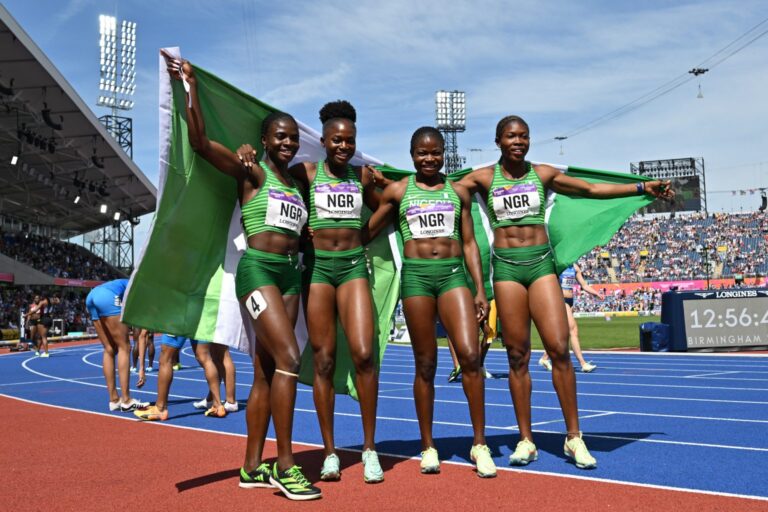
NIGERIA’S relay teams will face stiff competition at the 8th World Athletics Relays Championship, which kicks off today at the National Stadium in Gaborone, Botswana, with qualification spots for major global events at stake.

The competition features 743 athletes from 40 countries, with Nigeria competing in all six relay events as it seeks to improve on its modest record of two medals — a bronze in 2014 and gold in 2015.

Team Nigeria has been drawn in highly competitive heats, starting with the mixed 4x400m, where it will battle the Netherlands, Jamaica, Poland, China, Japan and Canada in one of the most decisive opening races. Only the top two teams in each heat, alongside the two fastest losers, will qualify for the final and secure World Championship spots.

The Netherlands head into the race as favourites with a personal best of 3:07.43 set at the Paris 2024 Olympics, while Poland (3:09.43) and Jamaica (3:11.06) underline the depth of competition. Nigeria, with a personal best of 3:11.99 and a season’s best of 3:16.13, will rely on a mix of experience and youth.

The squad is expected to feature Chidi Okezie alongside Ezekiel Asuquo, Gafari Badmus, Victor Ime, Samson Nathaniel and Emmanuel Ojeli on the men’s side, while Patience Okon-George leads the women’s team with support from Anita Enaruna, Toheebat Jimoh, Taiwo Kudoro, Jecinta Lawrence and Esther Okon.

In the men’s 4x100m, Nigeria faces another difficult draw in heat three alongside Great Britain, South Africa, Brazil, Ghana, China, India and Northern Ireland. The race is widely regarded as one of the most competitive of the opening round.

Great Britain and Northern Ireland lead with a time of 37.36s, followed by South Africa (37.57s) and Brazil (37.72s), while Nigeria’s best of 37.94s keeps it in contention for qualification.

The Nigerian team is expected to feature Enoch Adegoke, Favour Ashe, James Emmanuel, Chidera Ezeakor and Tejire Godwin. Adegoke, an Olympic finalist with a personal best of 9.98s, brings experience, while Ashe’s 9.94s adds pace to the squad.

Beyond the heats, the United States are expected to set the global standard, with strong competition also coming from Canada and Jamaica, as teams battle for slots at both the 2027 World Championships and the inaugural World Athletics Ultimate Championship.

Despite the tough draws, the Federal Government has expressed confidence in the team’s chances.

President Bola Tinubu, through the Director General of the National Sports Commission, Bukola Olopade, urged the athletes to rise to the occasion.

“I want to appeal to you athletes to do this for yourselves, for the country, for your various states, and above all, do this for President Bola Ahmed Tinubu, GCFR. The president’s words are always very clear, do well and come back to a grateful nation,” Olopade said after the team’s final training session.

He also stressed the importance of the relays to Nigeria’s sporting success.

“The relays are a big deal because Nigeria at every major multi-sport competition always looks forward to the relays. As you know, this is not just about this relay because it is a qualifier for the World Championship,” he added.

Reno Omokri makes false claim about Nigeria’s debt reduction under Tinubu

Nigeria’s ambassador-designate to Mexico, Reno Omokri, has claimed that Nigeria’s total public debt has significantly dropped under President Bola Ahmed Tinubu’s administration.

Omokri said this during an interview with the News Central at the induction course for ambassadors and high commissioners designate at the Ministry of Foreign Affairs on April 27, 2026.

He further alleged that while the debt stood at $113 billion in June 2023, it dropped to $103 billion in April 2026.

He argued that critics like former governor Peter Obi misled the public by calculating the debt profile in naira rather than dollars.

“When this administration came into being on May 29, 2023, Nigeria owed $113 billion. So, if you go to DMO, the Debt Management Office, and go to their website, which is dmo.gov.ng, on March 31, 2023, Nigeria’s total debt was $108 billion. And then, because the DMO gives those figures every quarter, the next quarter, which was June 31, 2023, our debts had ballooned to $113 billion. Right now, as I speak to you, April 27, 2026, our debt is $103 billion.

“So, you can see that our debt under President Tinubu has reduced by 10 billion dollars. What people like Peter Obi tend to do is they calculate our debt in naira.”

As of April 28, the post has garnered over 90,000 views, 100 likes, and 70 quotes, causing lots of ruckus as financial debates erupted.

CLAIM

Nigeria’s total public debt has been reduced by $10 billion under President Tinubu, moving from $113 billion in June 2023 to $103 billion in April 2026.

Screenshot of the viral post on x.

THE FINDINGS

Findings by The FactCheckHub show that the claim is FALSE.

To verify the claim, The FactCheckHub analysed data from the Debt Management Office (DMO).

Established on December 4, 2000, the Debt Management Office (DMO) of the Federal Government of Nigeria is responsible for managing and storing information regarding the country’s local and international debts.

Nigeria’s debt profile, also known as total public debt, is calculated by summing the total domestic and external debts of the federal government of Nigeria, the thirty-six states and the Federal Capital Territory.

Data from the DMO shows that as of June 30, 2023, the total public debt was indeed $113.42 billion.

A Detailed Breakdown

On March 31, 2023: Two months before Tinubu took office, the debt stood at $108.30 billion. In naira terms, this was N49.85 trillion, calculated at an exchange rate of N460.35/$1.

By the end of the first month of the new administration, on June 30, 2023, the USD figure rose to $113.42 billion. However, the naira value saw a jump to N87.38 trillion. This was primarily due to two factors: the unification of the foreign exchange windows (shifting the rate to N770.38/$1) and the securitisation of “Ways and Means” (Central Bank loans) which were moved into the official public debt record.

As of the end of September 2025, the debt dropped to $103.94 billion. At this point, the exchange rate had shifted further to N1,474.83/$1, bringing the naira debt to N153.29 trillion.

According to the DMO report released on April 13, 2026, the debt surged again in the final quarter of 2025, that is, by the end of December 2025, reaching $110.97 billion (N159.28 trillion), and not $103 billion quoted by Omokri.

December public debt portfolio. credit: DMO

Reno Omokri’s assertion of a $10 billion reduction is based on a comparison between the June 2023 figure ($113.42 billion) and the September 2025 figure ($103.94 billion). This data cannot be used to assess the current economy in Nigeria.

At the end of 2025, the debt had climbed back up to $110.97 billion. This means that between June 2023 and the latest reported period, the actual reduction is only $2.45 billion, not $10 billion.

While Omokri argued that the debt should be viewed in USD to avoid misleading naira calculations, the naira perspective is critical for domestic economic assessment.

Since June 2023, the debt in naira terms has increased by 82.3 per cent from N87.38 trillion to N159.28 trillion.

VERDICT

The claim by Reno Omokri that Nigeria’s debt has reduced by $10 billion between June 2023 and April 2026 is FALSE. He used an outdated data point from September 2025 to frame a narrative of significant debt reduction. The latest official DMO data, released in April 2026, shows that the debt has since surged to $110.97 billion, making the actual reduction since June 2023 only $2.45 billion.

This report is republished from FactCheckHub. The original story can be read here.

PDP’s cracks widen after Supreme Court ruling

THERE appears to be no end in sight to the crises rocking the Peoples’ Democratic Party (PDP) as the party joins its contemporaries to prepare for the 2027 elections.

The conflicts took another turn on Thursday, April 30, shortly after the Supreme Court nullified the Ibadan Convention of a faction of the party, backed by Oyo State Governor Seyi Makinde and other stalwarts, in November 2025.

The convention produced the Kabiru Turaki-led National  Working Committee of the faction.

In its ruling, the court lampooned the faction and voided the convention over what it described as deliberate disobedience of subsisting court orders.

Consequently, the Turaki-led group’s Board of Trustees announced its readiness to assume the party’s leadership.

However, the rival faction belonging to the Minister of the Federal Capital Territory (FCT), Nyesom Wike said the apex court’s ruling simply affirmed its control of the PDP.

The Turaki-led BoT, through a statement by its charman, Adolphus Wabara, a former senator, said it would assume the PDP’s leadership to avoid a vacuum, and “pursuant to the empowering provisions of the constitution of the PDP (As amended in 2017)”

It posited that the Supreme Court verdict nullified both the Ibadan Convention and the Wike-backed convention in Abuja.
“While the Supreme Court invalidated the Ibadan Convention, it also in a unanimous decision of the five justices on the panel, upheld the suspension of Senator Samuel Anyanwu, Hon. Umar Bature, Kamaldeen Ajibade as National Secretary, National Organising Secretary and National Legal Adviser respectively from the party.
“The implication of today’s judgment by the Supreme Court is that all actions taken by Senator Samuel Anyanwu, Hon. Umar Bature and Barr. Kamaldeen Ajibade including the appointment of Abdulrahman Mohammed as Acting National Chairman, the composition of the National Caretaker Working Committee and the conduct and outcome of the March 29, 2026 Convention in Abuja are illegal, null and ab initio void.
“The consequential invalidation of both the Abdulrahman Mohammed-led as well as the Kabiru Tanimu Turaki-led Working Committees directly places the statutory onus of leadership of our great party on the shoulders of the Board of Trustees (BoT) as the Second Highest Organ of the Party, pursuant to the express and unambiguous provision of Section 32 (5) of the PDP Constitution (as amended in 2017),” the Turaki faction’s BoT said.
The BoT noted that it was convening an emergency meeting to appoint an Interim National Working Committee to take charge of the National Secretariat of the PDP and pilot its affairs.
Late Thursday night, the Turaki-led faction held an emergency stakeholders’ meeting, which further ratified the decision for its BoT to step in and lead the party pending the appointment of a caretaker committee.
Some of the faction’s organs at the meeting are its BoT members, Governors’ Forum, members of the National Assembly Caucus, the National Executive Committee (NEC), the National Caucus, State Chairmen, and Ex-Officio members.
 Meanwhile, shortly after the Supreme Court verdict, Wike addressed a press conference where he claimed that the ruling had resolved all disputes surrounding the party’s leadership structure.

“Today, the Supreme Court has brought to an end the so-called factions of the PDP. There is no more faction in the party. There is only one PDP. The Supreme Court has validated our (Abuja) Convention and set aside all claims to any parallel structure. What this means is that the PDP has come to stay as one united party,” he said.

Wike added that the PDP remained Nigeria’s leading opposition party and a “credible alternative” to the All-Progressives Congress (APC) – the party he is currently serving in.

The ICIR reports that Abdulrahman Mohammed emerged as National Chairman, and Samuel Anyanwu as National Secretary of the Wike-backed PDP.

Whereas, nother statement signed by Wike’s faction BoT members on Thursday evening affirmed Mohammed and Anyanwu as the party’s leader following the apex court verdict.

The statement, signed by its chairman, Mao Ohuabunwa, a former senator, averred that the Ibadan Convention was annulled as ruled by the court.

According to him, the verdict also validated the convention held in Abuja by Wike’s block.

“The leadership structure of the party under Alhaji Abdulrahman Mohammed – National Chairman, Senator Samuel Nnaemeka Anyanwu, FCIPA – National Secretary remains the valid and stabilising authority to guide the affairs of the party at the national level.
“The party remains fully functional and will continue to operate through its recognised organs in line with the constitution of our party (as amended in 2017) Necessary constitutional steps will be taken, as appropriate, to further strengthen the party’s unity, stability, and preparedness for upcoming electoral engagements,” part of the statement said.
.