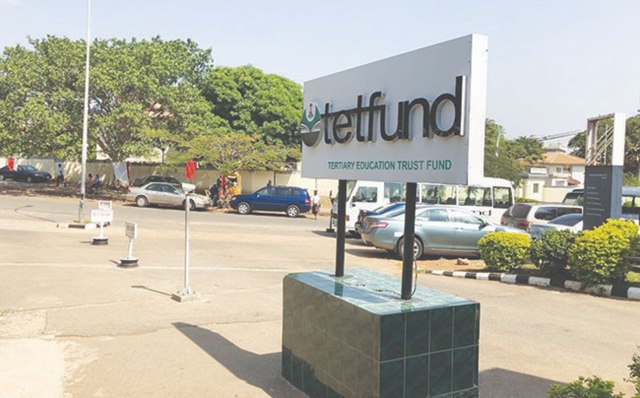
THE Independent Corrupt Practices and Other Related Offences Commission (ICPC) has charged two Tertiary Education Trust Fund (TETFund) contractors and their companies with money laundering, accusing them of fraudulent diversion of funds meant for the execution of multibillion-naira training contracts awarded by the agency.
In separate cases filed in September last year at the Federal High Court in Abuja, the ICPC accused the individuals and their companies of failing to deliver on the contracts and diverting funds meant for their execution, court documents newly obtained by PREMIUM TIMES show.
The contractors are Paul Chukwuma, the Managing Director and Chief Executive Officer (CEO) of the Fides Et Ratio Academy Ltd, and Adedeji Ladipo, the Managing Director and CEO of Pole Global Marketing Limited.
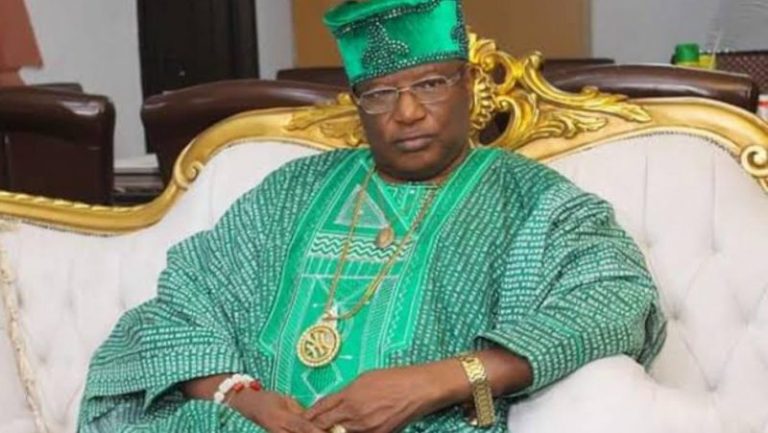
Managing Director/CEO, Fides Et Ratio Academy, Paul Chukwuma
ICPC accused them of concealing the origin of the funds, withdrawing parts of the money and converting some of it to foreign currencies, in a money laundering scheme that allegedly robbed TEFTFund of over N2.2 billion.
In the indictment, the ICPC said the defendants’ actions violated the provisions of section 18 of the Money Laundering Prevention and Prohibition Act (2022).
While Chukwuma of Fides Et Ratio is charged with nine counts, Ladipo is charged with four.
TETFund, an intervention agency for Nigerian tertiary institutions, statutorily receives three per cent of company income tax in Nigeria to fund infrastructure and training of staff in the institutions. It is the major funder of capital projects in Nigerian tertiary institutions.
A PREMIUM TIMES investigation had revealed how TETFund deducted the funds for training from the tertiary institutions’ 2023 annual disbursement against the wishes of the beneficiary institutions.
The report revealed that though Fides Et Ratio Academy was paid N2.9 billion out of the N3.8 billion in four instalments between June and November 2023, there was no evidence that the training had been conducted as of April 2024.
After PREMIUM TIMES story in April, the ICPC interrogated senior officials of the Fund, including the Director of Finance and Accounts, Gloria Olotu, the Director of Human Resources and General Administration at TETFUND, Kolapo Okunola, and the agency’s Director of Information Communication Technology (ICT), Joseph Odo.
The ICPC also interrogated Chukwuma, two months later in June.
Charges against Chukwuma of Fides Et Ratio
In the first to sixth charges filed on 11 September 2024 against Chukwuma, the ICPC accused him of diverting over N669 million meant for the training of students from various tertiary institutions.
The intended beneficiaries of the training that ICPC alleged never took place were:
7,042 students from the Federal University Gusau, Zamfara State
7,042 students from the Federal College of Education, Gidan Madi, Sokoto State
6,329 students from the Federal Polytechnic, Bali, Taraba State
6,329 students from the Umaru Ali Shinkafi Polytechnic, Sokoto, Sokoto State
6,329 students from Ignatius Agwu University of Education, Port Harcourt, Rivers State
6,329 students from Alvan Ikoku Federal University of Education, Owerri, Imo State
In the seventh to ninth charges, the ICPC accused him of using the funds for the training to purchase a N300 million Mercedes Benz GLS 600 Maybach and converted over N450 million to US dollars.
Adedeji Ladipo, the Managing Director/ CEO of Pole Global Marketing Limited
Charges against Ladipo of Pole Global Marketing Limited
In the second case filed by ICPC on 23 September 2024, the ICPC charged Ladipo with diverting over N808 million for the training of 2,239 persons paid for by TETFund.
The ICPC also accused him of converting the funds into US dollars and dissipating it without fulfilling the terms of contract with TETFund.
FORMER Governor of Niger State, Mu’azu Babangida Aliyu, has raised concerns over the quality of education in northern Nigeria, saying that no state in the region has up to 50 per cent of qualified teachers.
Aliyu stated this while speaking at the 22nd Daily Trust Dialogue, themed “Food Security: Availability or Affordability,” held on Thursday at the NAF Conference Centre in Abuja.
The former governor highlighted the need to improve teacher training and enhance educational standards in northern Nigeria.
He stressed the role of education in driving passion and progress, urging federal universities of agriculture and education to collaborate with farmers and other stakeholders to improve skills and knowledge.
“The second thing I am pursuing is education. In the northern states, there is no state with 50 per cent qualified teachers. Even those who are attending the schools now, let alone those who are not able to attend,” he said.
In December 2024, The ICIRreported how primary and secondary schools across Bauchi State lacked adequate and qualified teachers, with findings exposing the dire conditions in the schools and how the state government was looking the other way.
The report noted that the situation significantly impacted both the teachers, who experience burnout and diminished job satisfaction, and the students, whose educational foundation was compromised.
According to the report, schools with class sizes far exceeding recommended ratios are often managed by just one or two teachers, with many of them forced to merge classrooms or rotate lessons due to inadequate teachers.
Many schools relied on teachers without relevant qualifications to teach core subjects like Mathematics and English.
Speaking further at the Daily Trust event on Thursday, the former governor criticised the closure of Nigeria’s borders.
He pointed out that despite the restrictions, Nigerian goods still dominated markets in neighbouring ECOWAS countries.
“What is the importance of closing borders? What is the importance of that while the population of Nigeria is almost the population of other ECOWAS members? And every market you go to in ECOWAS countries you will discover that more than half of the things in that market are from Nigeria.
“For example, in Niger, the cow is still cheaper than in Nigeria. Apart from the inflation, it has always been like that because we used to send people there on good days to get these cows either for slaughter or Sallah. Why is this so? Please, do what you have to do. Do also the education,” he said.
THE Nigerian National Petroleum Company Limited (NNPCL) said it uncovered 179 incidents of crude oil theft in the past week.
The last incidents were revealed in a recent video shared by the NNPCL on its official X handle, stating that the incidents occurred between January 11 and 17 across the Niger Delta region.
Crude oil theft and vandalism have continued to hamper the state-owned energy firm’s production targets and destroyed its decade infrastructure, thereby leading to revenue loss for the country.
In the video, NNPCL reported that 29 illegal pipeline connections and 55 illegal refineries were uncovered within one week.
“Between the 11th and 17th of January 2025, a total of 179 incidents were recorded across the Niger Delta region, thanks to the coordinated efforts of NNPC Limited’s Command and Control Centre, Tantita Security Agency, Pipeline Infrastructure Nigeria Limited, Maton Engineering Nigeria Limited, Shell Petroleum Development Company Limited Nigeria, Liquefied Natural Gas, Oando PLC, and government security agencies,” NNPCL reported.
It said security forces in Bayelsa and Abia States uncovered the illegal pipeline connections and conducted repairs on the pipelines.
Vowing to continue to crack down on oil theft, NNPCL said security operatives dismantled illegal refineries producing black-market petroleum products in Rivers and Abia States.
It reported further that the week also revealed hidden storage sites used for illegal activities in Rivers and other locations in Abia.
“Security forces exposed and destroyed these sites. Unfortunately, acts of sabotage led to several oil spills during the week, including a vandalised condensate pipeline and damaged wellheads in Rivers,” it maintained.
Source: NNPCL
It also said security teams on the roads intercepted and seized vehicles loaded with stolen crude oil in Rivers, Bayelsa, and Abia, while wooden fibre boats packed with stolen crude oil were confiscated on the waterways.
The incidents spanned various corridors: 90 in the Central Corridor, 70 in the Eastern Corridor, five in the Western Corridor, and 14 in Deep Blue Water.
A total of 30 suspects were reportedly arrested and handed over to government security agencies for further investigation, NNPCL revealed.
Oil theft has repeatedly been blamed for Nigeria’s inability to meet oil production targets and earn more revenue.
In July last year, the NNPCL boss, Mele Kyari, announced that the company had declared a state of emergency on crude oil production.
According to him, the state-owned oil firm had decided to stop the debate and declared war on the challenges affecting its crude oil production and promised to improve the situation.
However, crude oil production has yet to significantly improve as industry experts are worried over Nigeria’s inability to meet its Organisation of Petroleum Exporting Countries quota of 1.5 million barrels per day production.
In a recent analysis, The ICIR reported that Nigeria’s crude oil production has not improved in the last four years despite the Nigerian Upstream Petroleum Regulatory Commission (NUPRC) doubling the country’s oil rig count to 32 in 2024.
According to the NUPRC chief executive, Gbenga Komolafe, the increase in rig count reflected ongoing efforts to boost upstream activities and enhance the country’s crude oil production capacity.
In its Monthly Oil Market Report, released on Wednesday, January 15, OPEC revealed that Nigeria’s crude oil production, based on direct communication, fell to 1,485 in December 2024 from 1,486 in November.
In June last year, The ICIRanalysed how the Nigerian government was losing over N16 billion in revenue daily from crude oil production owing to a shortfall in oil production volume.
THE Petroleum Products Retail Outlets Owners Association of Nigeria (PETROAN) has said that as Nigeria President Bola Tinubu eyes the resumption of oil production in Ogoniland, the welfare of the people should also be prioritised.
PETROAN pointed this out in a statement by its national public relations officer, Joseph Obele, on Thursday, January 23.
The association’s call came following President Tinubu’s meeting with Ogoni delegates in Abuja on Tuesday, January 21.
“The resumption of oil production is sacrosanct, but the concerns should be participation, equity, empowerment, employment, environmental protection, and compensations for damages,” PETROAN expressed.
It urged Ogoni youths to support the resumption of oil production in their land.
It stressed that the concerns of all stakeholders should be addressed, suggesting that the Ogoni delegates organise town hall meetings in all four local governments in Ogoniland.
“These meetings will provide platforms for wider consultations and gather thoughts from various groups, including scholars, farmers, elders, women, and youths.
“The submissions from the town hall meetings will constitute the people’s position for development as oil production commences. This will form a position paper for the oil production company handling the oil production,” PETROAN stated.
It pointed out that it would be necessary to hear from the Ogoni community to affirm the position of the delegates who met with the President.
“It is not sufficient to adopt the opinion of 50 persons over a community of two million people, the body maintained,” PETROAN added.
President Tinubu had on Tuesday directed the National Security Adviser (NSA), Nuhu Ribadu, to coordinate negotiations with various parties within Ogoniland in the oil-rich Niger Delta area to resume oil production in the area.
He gave the directive when while receiving Ogoni leaders, including Governor Siminalayi Fubara, at the Aso Villa in Abuja.
He said his administration would prioritise peace, justice, and sustainable development in the area, calling for unity and reconciliation and urging the Ogoni people to set aside historical grievances and work together to achieve peace, development, and a clean environment.
“We cannot in any way rewrite history, but we can correct some anomalies of the past going forward. We cannot heal the wounds if we continue to be angry,
“We must work together with mutual trust. Go back home, do more consultations, and embrace others. We must make this trip worthwhile by bringing peace, development, and a clean environment back to Ogoniland,” Tinubu said.
THE Police have rescued the wife of a retired assistant inspector-general of police (AIG), Hakeem Odumosu, from kidnappers.
Odumosu’s wife was abducted outside her residence in Ogun State on Friday. January 17.
The police in a statement on Thursday, January 23, said it neutralised the kidnappers in the process and recovered the ransom paid.
The police in the statement signed by its spokesperson, Muyiwa Adejobi, said the Ogun State Police Command commenced a thorough investigation and targeted the kidnappers with the support of the Force Headquarters technical intelligence platforms.
He said command operatives engaged in extensive surveillance of the creeks surrounding Arepo, gathering crucial information to track down the assailants.
“Their efforts culminated in a raid on January 23, 2025, at around 06:45 am. The intelligence-led operation took the police to a creek in the swampy area of Ikorodu where the kidnappers were reportedly planning their next attack.
“Upon arrival, the operatives encountered the kidnappers, who opened fire. In the ensuing confrontation, two of the gunmen were neutralised, while four others fled the scene, abandoning their operational weapons,” Adejobi stated.
According to him, the victim was rescued within the swampy creeks during the operation, unharmed.
He said she was undergoing medical evaluation and had since been reunited with her family.
He added that the police also recovered four Ak-47 rifles, three locally made single barrel rifles, ammunition of various calibres, and N10,000,000 ransom previously demanded by the kidnappers.
Adejobi said the inspector-general of police, (IGP) Kayode Egbetokun commended the Ogun State commissioner of police, Lanre Ogunlowo, and his operatives for their display of gallantry in the successful operation.
The ICIR reports that the victim’s husband served in the Force for 32 years.
THE Court of Appeal in Akure, Ondo State, has affirmed the death sentence of an industrialist Rahmon Adedoyin for his involvement in the murder of Timothy Adegoke, an MBA student at Obafemi Awolowo University (OAU).
The appellate court ruled that Adedoyin’s conviction and sentencing by the High Court in Osogbo, Osun State, were valid.
Recall that Adedoyin, dissatisfied with the lower court ruling, had approached the Appeal Court to challenge the verdict.
The latest ruling upheld the court’s decision to condemn the prince to death.
Background
In November 2021, Adegoke, a post-graduate student of Obafemi Awolowo University (OAU), Ile-Ife, was declared missing after lodging in the Hilton Honours Hotel.
But his body was later found in a shallow grave along Old Ede Road in the town by the police, and it was later discovered that he was killed at the hotel.
Adegoke’s murder attracted widespread criticism from civil rights groups, including the National Association of Nigerian Students(NANS), who demanded that justice be served on his killers.
An autopsy report had linked his death to intense haemorrhage (bleeding) due to ‘severe traumatic injuries’.
Although the autopsy could not pin down the actual cause of his death because of his body’s ‘advanced decomposition’ before the inquest was done, the pathologist said there was no natural disease in the deceased’s body to cause or accelerate death or to cause him to collapse (and die).
During the last proceedings of the court on April 27, 2023, where all parties in the suit adopted their written addresses, the prosecuting counsel, Femi Falana, a senior advocate, had insisted before the court that the deceased was killed and his body dumped in the bush.
He added that those involved in the incident attempted to obliterate the act and took an oath of secrecy to conceal the crime.
However, counsel to Adedoyin, Yusuf Alli, also a senior advocate, asked the court to discharge and acquit the accused, saying no evidence linked him to the murder.
He said the only connection Adedoyin had with the matter was simply because he owned the hotel where the said death occurred.
Also, counsel to the 2nd, 4th and 5th defendants accused alongside Adedoyin, Abdulrasheed Muritala, (SAN), said there was no direct evidence linking his clients to the murder.
According to him, the entire case was based on suspicion. Hence, he urged the court to discharge his clients of the charges against them.
In her judgment, the trial judge, Ojo, held that the circumstantial evidence available to the court pointed to the killing of Adegoke while he was a guest at the hotel owned by Adedoyin.
She stated that Adedoyin’s decision not to enter the witness box did not help him, as the circumstantial evidence had shifted the burden of proof on him.
The judge added that Adedoyin’s refusal to testify meant he agreed to the murder charge brought against him by the prosecution, dismissing the alibi pleaded on his behalf by his counsel, who stated that the hotel owner was in Abuja for several days around the time of the late Adegoke’s death.
In addition to Adedoyin, Adeniyi Aderogba, and Oyetunde Kazeem, two other employees working at the hotel were also condemned to death for the murder.
SECURITY agencies in Kuwait have nabbed two Nigerians for allegedly robbing an exchange office in Mahboula.
The Kuwaiti Ministry of Interior said in a statement that the Criminal Security Sector, represented by the General Department of Criminal Investigations in the Ahmadi Governorate, apprehended the suspects within 24 hours after the robbery.
The gang allegedly stole foreign currencies valued at approximately 4,600 Kuwaiti dinars before they were captured.
According to the Kuwaiti Ministry of Interior, investigations showed the gang carefully planned the crime, watching exchange offices from rooftops and using stolen plates to hide their vehicles.
They were accused of monitoring the offices to identify busy times and avoid detection.
Authorities said one of the suspects was caught in Mahboula and confessed to surveilling the area and informing his accomplice when the coast was clear.
The other suspect was found in Al-Qurain Markets, where stolen money and a bag of “crystal meth” were recovered from his home.
“Efforts of the detectives resulted in the arrest of one of the accused in the Mahboula area, where he admitted to monitoring the locations and informing his colleague that they were empty of customers in order to carry out the robbery. The other accused was also arrested in the Al-Qurain Markets area, and the stolen money and a small bag containing the narcotic substance Shabu were found in his home,” the Interior Ministry said.
The authorities noted that the suspects and seized items had been referred to the Public Prosecution Office for further action.
However, the Kuwait authorities did not name the suspects.
Nigerians had been accused of crimes in Kuwait. In 2021, a Nigerian was arrested for hacking and perpetrating a bank fraud that affected Bahrain and Kuwait, resulting in a loss of huge funds.
The suspect, Michael Chibuzi Okonko,29,was accused of cybercrime.
He allegedly hacked into the banking systems of the Bank of Bahrain and Kuwait and transferred a whopping Rs 5.43 crore from three clients’ accounts to 78 other accounts across different Indian states.
The police tracked the funds and found that they were routed to accounts in Delhi, Madhya Pradesh, and Assam.
When arrested, the police said Okonko seized a bunch of devices, including 11 mobile phones, two hard drives, three laptops, and a SIM card.
NIGERIA’s public debt profile rose to N142.32 trillion as of September 30, 2024, compared to N134.3 trillion as of June that same year, the Debt Management Office (DMO) has revealed.
This latest figure means each Nigerian could be owing about N656,514 debt stock per capita when N142.32 trillion is divided by the country’s estimated population of 216.78 million.
However, the DMO stated the debt stock comprises external and domestic borrowings, hinting that it used the Central Bank Nigeria’s (CBN) official exchange rate of N1,601.028/$1 as of September 30, 2024 to convert the external debt to Naira, relative to N1,470.19/$1 it used in June 30, 2024.
In dollar terms, Nigeria’s public debt stood at $88.89 billion in September 2024 compared to $91.35 billion in June 2024, reflecting a higher debt profile due to the impact of naira depreciation against the dollar.
External debt rose to N68.89 trillion from N63.07 trillion while domestic debt rose to N73.43 trillion from N71.22 trillion. It is likely to rise further by the fourth quarter with the federal government’s $2.2 billion Eurobond issuance in December last year.
The DMO’s data indicates that the 36 states and Federal Capital Territory (FCT) owe N4.21 trillion of the domestic debt stock, and the Federal Government of Nigeria (FGN) owes N69.22 trillion.
A cursory look at the debt stock indicates the FGN domestic debt stock increased from N66.96 trillion in June 2024 to N69.22 trillion in September 2024, which might likely have been driven by increased issuance of FGN bonds and other fixed-income securities.
However, states and FCT debt stock declined to N4.21 trillion from N4.27 trillion in the review period.
A further breakdown of the DMO’s data shows domestic debt carrying a weight of 51.60 per cent higher than external debt’s 48.40 per cent.
According to the DMO, only the domestic debt stock for Cross Rivers State was as of June 30, 2024, while all other states and FCT were as of September 2024.
The surging debt profile has been of concern over Nigeria’s debt sustainability, especially with the exchange rate volatility driving up the local currency cost of external obligations.
The overall increase in domestic debt highlights the federal government’s growing dependence on local markets to finance budget deficits amid constrained foreign exchange reserves.
Economic watchers are worried over the risk exposure of Nigerians by the debts with government proposing N15.81 trillion for debt servicing in 2024 budgets estimates.
“Borrowing is not criminal as the country faces serious infrastructural challenge but borrowing to pay interest on outstanding debts is wrong,” said the chief executive officer of Economy Associates, Ayo Teriba.
Most notably, Nigerians are critical of Tinubu-led administration’s appetite for taking more loans while struggling to pay the country’s debts with dilapidated infrastructure littered all over the country.
Despite these huge debts, politicians still live flamboyance lifestyle with long convoys among others priortised at the expense of basic infrastructure such as access to good and affordable primary health centre, good road infrastructure and affordable housing.
Repeatedly, financial analysts have raised concerns about the sustainability of the rising debt levels, particularly as interest payments consume a significant portion of government revenue.
The ICIRreported last year, the World Bank raised the alarm that Nigeria used over 96 per cent of its revenue generated in 2022 to service debt, adding that the constant fiscal deficit has aggravated the country’s public debt stock.
Apart from the World Bank, Economic watchers insist Nigeria appetite for Eurobond is exposing it to higher currency risks triggered by volatile exchange rate.
“We need to be worried about the interest rate we pay on the Eurobond because it is commercial debt and we need to be worried about even the current interest rate on Treasury bills and Federal Government bonds, they are too high. These things impose a lot of pressure on government finances, on the point of view of debt servicing,” former director-general of the Lagos Chamber of Commerce and Industry (LCCI) and the chief executive officer of Centre for the Promotion of Private Enterprise (CPPE), Muda Yusuf told The ICIR.
Yusuf also noted that Nigeria’s exposure to Eurobonds should be considerably reduced going forward, noting that it is extremely very critical.
“I think we need to be more cautious at the rate at which we accumulate these debts because increasing debt will create challenges of rising debt service commitments,” he stressed.
Between June to September 2024, the naira depreciated from N1,470.19/$ to N1,601.03/$, exacerbating the burden of external debt in local currency.
President Bola Tinubu has proposed a N13.08 trillion deficit and N15.81 trillion in debt servicing in the 2025 budget currently being interrogated at the National Assembly.
In December 2024, the President submitted the 2025 budget size of N47.90 trillion to the National Assembly for review and approval, The ICIRreported.
The proposed budget has a revenue projection of N34.82 trillion, a crude oil production assumption at 2.06 million barrels per day (mbpd), an inflation rate of 15 per cent and a naira-dollar exchange rate of N1,500.
AS flood and windstorm increasingly impact Plateau State, many affected families desperately need assistance.However, the Plateau State Emergency Management Agency (PLASEMA) and the Environmental Protection and Sanitation Agency (PEPSA) often fail to deliver timely relief and execute effective ecological projects.
Thirteen years have passed since Zakariyahu Kabiru’s wife, Hawau and six children drowned in a devastating flood that submerged the densely-populated neighbouring Rikkos and Gangare communities in Jos North local government area of Plateau state.
Kabiru, 55, and his daughter Aisha, were the only survivors from their family at the time. The flood, which eyewitnesses said killed more than fifty persons and displaced over two thousand others, not only robbed him of his loved ones but also shattered his faith in the Plateau state government’s ability to help victims recover from ecological disasters.
Kabiru recalls how displaced persons, like himself, were temporarily sheltered in a local school that was used as an internally displaced persons (IDP) camp. However, the camp was closed after a few weeks, leaving victims without shelter. For ten years, Kabiru says he didn’t have a place to call home.
Zakariyahu Kabiru lost his wife and six children in the 2012 flooding disaster that occured in Jos North, Plateau state. Credit: Sinafi Omanga/The ICIR
“I cry each time I remember what happened to us because that day, I lost seven people. I lost my property and everything I had gathered in this life. I have nothing left,” he grieved.
In 2022, Kabiru resettled on his property in Gangare, now an uncompleted building, despite recurrences of flood. The Gangare narrow waterway, a primary cause of flooding in the area, has not been dredged, worsening the risk of overflow during heavy rains.
In July, 2024, another flood, although considered a minor one in Gangare, killed a ten-year-old boy, Umar Umar, about one kilometre away from Kabiru’s residence. “My son was swallowed by water and his body was not found,” says his father, Umar Sarkin Pawa.
“We are scared whenever it rains. I am calling on the government to dredge the waterways to save our lives and properties,” Umar pleads.
As ecological disasters like floods and windstorms increasingly impact Plateau communities, the Plateau State Emergency Management Agency (PLASEMA) and The Plateau Environmental Protection and Sanitation Agency (PEPSA) often fall short in delivering timely relief and executing effective ecological projects, leaving vulnerable communities reeling from perennial losses.
“Climate disasters politicised in Plateau state,” community leader
In June 2024, some officials of PLASEMA paid Miango community a visit after windstorms destroyed over 400 houses that displaced thousands of residents. Miango, a community in Bassa local government area of the state faces a growing vulnerability to windstorms due factors which includes to a lack of windbreaker trees.
The public relations officer of the community’s association Nuhu Bitrus, who was on the tour with PLASEMA officials said the disaster left thousands of residents, including women and children displaced, and others injured.
After assessing the damage, the officials of the state emergency agency promised affected persons urgent relief materials. More than four months later when The ICIR visited in October last year, that promise has not been fulfilled, dashing hopes of members of the community.
During the visit to the community last year, on October 9, The ICIR confirmed that a 70-year-old woman, Gbata Gula, who sustained head injuries from a block that fell on her head as a result of the windstorm had died three months earlier in the hospital.
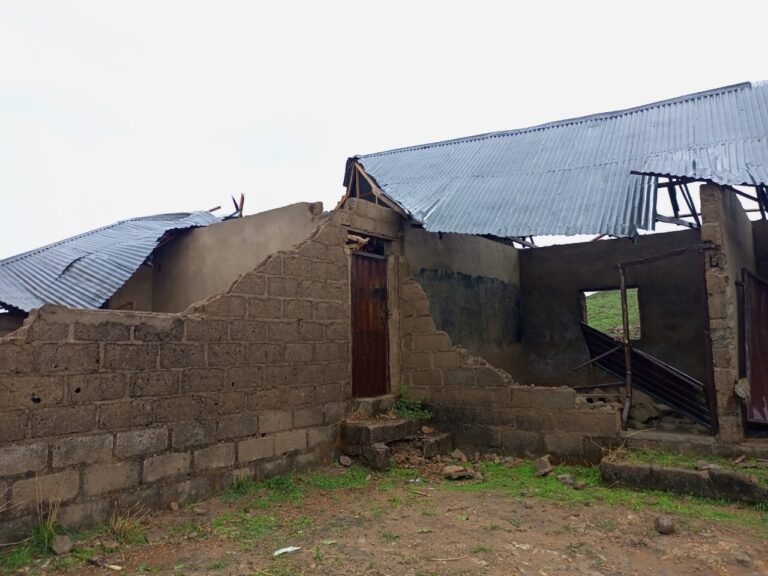
A damaged school building. Credit: Nuhu Bitrus, Miango resident
A community leader, Daniel Geh, says climate issues have been “politicised” in Plateau state.
“All we got was an impression that they care and would do something about our plight. But they never came back with any support till today,” Geh says.
He says for the past seven years, the people of Miango have faced a relentless cycle of environmental challenges, particularly devastating flooding of farmlands and destructive windstorms that level homes.
Without an intervention from PLASEMA, several residents affected by the ecological challenges are left to grapple with the consequences largely on their own.
Some displaced persons have sought refuge in the homes of family and friends. In Geh’s house lives Elizabeth Bitrus, a 20 year old lady, her younger sister and mother. Their house was destroyed by a windstorm in 2022.
Elizabeth Bitrus and Daniel Geh Credit: Sinafi Omanga/The ICIR
“We are grateful to our host, but we can’t wait to return home,” Bitrus tells The ICIR. To support her mother as they plan to rebuild their home, she recently began selling goat meat in a local market.
In 2012, the Plateau state government passed into law the bill establishing PLASEMA with the primary responsibility of coordinating resources towards efficient and effective disaster prevention preparedness, mitigation, response and community resilience to disaster in the state.
It is also responsible for collaborating with the National Emergency Management Agency (NEMA) when damages and need assessment are considered beyond the capacity of the state.
A group of children on the bank of Gangare waterway Credit: Sinafi Omanga/ The ICIR
The ICIR submitted a letter requesting an interview with Sunday Abdul, the executive secretary of PLASEMA. During a visit on October 11, Abdu was not on seat. After several calls, he picked but declined to comment on the story.
“I have already spoken to some journalists on this issue, and I don’t want to speak further on it,” he says. When the reporter pressed further, Abdul gave the number of the deputy director of search and rescue, simply identified as Ashomz, who neither picked calls nor returned them.
200 pupils saved from flood, windstorm but forced out-of-school
Having lived in a flood-prone area for more than 35 years, Munir Abdulrasheed, the founder of Hiltop International Schools located in the Rikkos area of Jos North says he was conscious of rain patterns. This skill proved invaluable in June 2020 when, sensing an impending flood, he quickly dismissed over two hundred pupils. That decision saved the children from the flooding disaster that levelled down the classroom blocks on that fateful afternoon.
Abdulrasheed says he feels a sense of relief for saving the lives of the children but “helpless for many children who never returned to school.”
Taking a tour of the cramped makeshift tents, he now uses as classrooms, The ICIR saw many children loitering and begging on the waterlogged streets. Abdulrasheed says some of the children were his pupils before the flood destroyed the classroom blocks.
Munir Abdulrasheed taking a tour of the cramped makeshift tents he now uses as classrooms Credit: Sinafi Omanga/The ICIR
“I founded the school not to make profit but to fill the gap. It is meant for the less privileged children and the school fee is N1,000 only. But since that incident, I have not been able to get another space to accommodate all of them. Only 50 pupils resumed here,” says Abdulrasheed.
In Bassa LGA, the Atinga Dekki Memorial Secondary School was also not spared by a windstorm that struck in May 2024. The proprietor, Abel Atinga, says the students were on vacation when the incident occurred. Counting his losses, he says the “wreck” forced some children out of school.
“The challenge is that we are still struggling to rebuild and unless the government intervenes by supporting school owners, the problem of out-of-school children will continue. It is the future of our children we are talking about.”
A UNICEF report says 10 million children of primary school age and eight million of secondary school age in Nigeria are out-of-school.
The National Mass Education Programme Initiative (NMPI) 2022 data puts Plateau among states with top aged six to 15 children that are out of school across the country with 23.2 per cent.
The UNICEF’s Children’s Climate Risk Index (CCRI) further says children “living in Nigeria are among those most at risk of the impacts of climate change, threatening their health, education and protection.”
The CCRI, which uses data to generate new global evidence on how children are exposed to climate and environmental hazards, further notes that “investments in social services, particularly child health, nutrition and education, can make a significant difference in our ability to safeguard their futures from the impacts of climate change.”
Over 1.4 billion ecological funds received in 13 months
Since assuming office, the administration of Governor Caleb Mutfwang, has received over N1.4 billion, (1,455,149,134.12815) for the state government and its 17 local government areas. This is according to an analysis of the Federation Account Allocation Committee (FAAC) from June 2023 to July 2024.
The breakdown shows that while the state government received over N839.9 million, the 17 local governments received over N615.17 million.
Established in 1981, the ecological fund is a federal revenue allocation, specifically designated to address various environmental challenges nationwide, including flooding, erosion, desertification, oil spills, and drought. The fund is drawn from the Federation Account at a rate of two per cent.
Meanwhile, Plateau is one of the 27 states under probe by the Public Complaints Commission (PCC) over alleged mismanagement of ecological funds. The panel named ‘Case Conference on Ecological Funding’ is chaired by the Federal Commissioner representing Ekiti, Olukayode Bamisile.
“The investigation is not a witch-hunting exercise but a fact-finding mission on the utilisation of the ecological funds by state governments following the plethora of complaints received by the commission from members of the public facing numerous ecological challenges like deforestation, desertification, erosion, flooding, etc,” Bamisile says as reported by Daily Trust.
The committee notes that while the citizens were complaining of low or no impact of the ecological funds in communities, “state governors appeared to be operating in their comfort zones as no such agitation had been raised by them concerning the fund.”
No bailouts for victims – PEPSA
Hopes for government support among climate-stricken communities to rebuild their houses or relocate to safe areas may have been dashed.
Samuel Dapiya, the director general of PEPSA says the agency is currently focusing more on advocacy rather than direct assistance.
The Director General of PEPSA Samuel Dapiya Credit: Sinafi Omanga/The ICIR
During separate interviews with the ICIR, some victims of ecological disasters said since assistance was not forthcoming from government, they bear consequences on their own.
“The (Plateau) State government does not give bailout for constructions and there is no land set aside anywhere to construct houses or make-shifts for these people (internally displaced persons) to reside,” Dapiya says.
Reacting, Deborah Gana, a resident in Miango and the executive director of Claire Aid Foundation says “the blame game rises and stops on the table of the government.” Claire Aid is a non-governmental agency that provides shelter and education for internally displaced children in the state.
“Climate disasters are real. There are people who cannot rebuild their houses without some form of intervention. We cannot overemphasise the fact that the government needs to step up and provide relief for victims of disasters that are beyond their control,” she says.
Deborah Gana, executive director, Claire Aid Foundation Credit: Sinafi Omanga/The ICIR
She adds that PLASEMA and other agencies, “were created for a reason.
“All we are asking is that they do their job. Let the policies be implemented.”
Ex-Plateau governor served jail term for diverting ecological fund
In 2018, a federal high court in Abuja found former Plateau State governor, Joshua Dariye, guilty of diverting N1.162 billion state ecological funds.
Dariye, who governed between 1999 and 2007 and as senator representing Plateau central at the time, was sentenced to 14 years imprisonment by Justice Adebukola Banjoko.
However, in 2022, he, along with other convicts were released from the correctional facility in Kuje council area, Federal Capital Territory (FCT), a few months after the Council of State meeting presided over by former President Buhari approved a pardon.
“Our problem in Nigeria,” Kabiru (a resident earlier mentioned) says, “is that when disaster occurs, the relief from the government is not always distributed where it’s most needed. Instead, a few people end up spending the money that was meant for the public good.”
NIGERIAN goalkeeper Maduka Okoye, currently with Serie A club Udinese, is under investigation by Italian authorities for alleged involvement in a betting scandal.
The inquiry centres on suspicious betting patterns related to a yellow card he received during Udinese’s 2-1 victory over Lazio on March 11, 2024, according to reports from Italian media.
If found guilty, Okoye could face a lengthy ban from all football-related activities, as Italian regulations impose severe penalties for athletes directly involved in manipulating match events.
The ICIR reports that football governing bodies, including FIFA and UEFA, maintain a zero-tolerance for betting violations.
Players, coaches, and officials are strictly prohibited from betting on matches or competitions worldwide, regardless of whether they are directly involved in the games.
Violations can result in severe sanctions, including lengthy suspensions, hefty fines, and even lifetime bans.
In countries like Italy, the Intalian Football Federation (FIGC) strictly enforces anti-betting rules under the Codice di Giustizia Sportiva. Players found guilty of betting offenses risk multi-year bans and damage to their professional reputation.
Article 24 of the Code of Sports Justice states that it prohibits “the subjects of the federal system, managers, members, and members of clubs belonging to the professional sector from making or accepting bets, directly or indirectly, even from persons authorised to receive them, which have as their object results relating to official matches organised within the framework of the FIGC, FIFA, and UEFA.”
According to reports, the Udine Public Prosecutor’s Office initiated the investigation following a complaint from betting agency Sisal, whose algorithm detected unusual gambling activities linked to Okoye’s booking for time-wasting in the 90th minute of the match.
Subsequently, investigators conducted a search of Okoye’s residence.
While Udinese has not officially spoken on the allegations, the club has reportedly removed Okoye from their registered players list for the remainder of the Serie A season.
When asked about the incident, the Udinese coach Kosta Runjaic said ahead of their Monday, January 20, clash against Como, that “We haven’t talked about it. We’re focused on Como.
“I’m very present in the locker room; maybe the lads talked about it among themselves, but I can’t know that. I’m the coach and I like to talk about formations, football, tactics. The atmosphere is still very good; the team spirit is there, and we’re working diligently and with intensity,” Punch quoted the coach to have said.
His removal might also be due to a wrist injury, which may sideline him for the rest of the season.
Okoye, joined Udinese in 2023 from English club Watford and has made 37 appearances for the Italian side.
The goalkeeper’s legal representatives have dismissed the allegations as baseless, maintaining that they lack substantial evidence.
Meanwhile, the case has attracted significant attention in Nigeria, as many Nigerians hope he is proven innocent.
Recall that Newcastle United midfielder Sandro Tonali was in October 2023, banned from football for 10 months over breaches of rules on betting on matches in Italy.
The Italy midfielder Tonali, who joined Newcastle from AC Milan in 2023, was ruled out of the remainder of the club season and the Euro 2024 tournament in June and July.
The 23-year-old was discovered to have placed bets on matches involving his former club, AC Milan, prior to his £56 million ($67.7 million) transfer to Saudi-owned Newcastle, a deal that set the record as the most expensive for an Italian player in history.