MEDIA Rights Agenda (MRA) has condemned the incessant harassment and intimidation of journalists by Nigerian security agents, especially the police.
The MRA in a statement by its communications officer, Idowu Adewale, on Monday, August 26, said recent incidents of abductions, arbitrary arrests, detention and other forms of attacks against media professionals by security and law enforcement agents had reached alarming levels and are posing a grave danger to media freedom and democracy in the country.
The MRA cited recent incidents, including cases of Ayomide Eweje, Wisdom Okezie, and Oluwamodupe Akinola summoned recently by the police to report to the assistant inspector-general of the police office in Lagos on August 27, 2024, for an unspecified investigation.
The group said the three journalists received separate letters on August 22, 2024, from the deputy commissioner of police, Martin Nwogoh, acting on behalf of the AIG of Zone 2 Nigeria Police headquarters.
According to MRA, letters issued by the police failed to provide essential details regarding the investigation, including the nature of the matter, the identity of the complainant, and the specific information required from the invitees.
It added that the lack of clarity and transparency hinders their invitees’ ability to prepare effectively for the investigation, raising concerns about the fairness and legitimacy of the process.
The deputy police commissioner asked Eweje, Okezie and Akinola to report to the officer in charge of the Zonal Monitoring Unit, stressing that “this is a fact-finding exercise in the interest of justice and fairness.”
According to the head of the MRA Legal Department, Lagos State, Obioma Okonkwo, the police failure to provide details in the letter of invitation was an ambush, adding that it had identified a pattern in numerous such invitations by the police designed to lure journalists to the police station only to detain them when they report in response to the supposed invitation.
“It was curious that the police had become the weapon of choice for public officials and other rich or powerful individuals seeking to silence and punish journalists who publish negative reports about them.
“It seems that the police now consider journalism a crime such that anybody who is unhappy about any report published by the media can get the police to hunt down any journalist involved with uncommon zeal even as real criminals go about their business unchallenged for the most part,” Okonkwo stated.
Okonkwo pointed out that when the police receive complaints about media reports, they often claim to be investigating the matter as a pretext to summon, detain, or prosecute journalists while in reality, no genuine investigation is conducted to verify the accuracy of the reported stories.
She urged the inspector-general of police, (IGP )Kayode Egbetokun, to take action to prevent the misuse of police powers, noting that the lack of accountability has created a culture of impunity, emboldening officers to harass journalists with no fear of consequences, leading to a surge in unjustifiable attacks on the media.
THE Federal Government (FG) has set a minimum age limit of 18 years for candidates to be eligible to take the National Examination Council (NECO) and West Africa Examination Council (WAEC) examinations.
The Minister of Education TahirMamman revealed this while speaking on Channels Television’s “Sunday Politics” programme on August 25.
According to Mamman, the FG has instructed WAEC and NECO to implement an existing policy requiring candidates to be at least 18 years old to take the West African Senior School Certificate Examination (WASSCE) and Senior School Certificate Examination (SSCE), respectively.
Mamman clarified that this age requirement was not new. He noted that the Joint Admissions and Matriculation Board’s (JAMB) Unified Tertiary Matriculation Examination also maintains an 18-year age limit for candidates.
Mamman explained that the minimum age requirement for university admission in Nigeria must be 18 years.
He argued that during a meeting with JAMB in July, it was agreed that students under 18 would be admitted this year, but starting next year, JAMB would strictly enforce the 18-year age requirement.
“Even basically if you compute the number of years pupils, and learners are supposed to be in school, the number you will end up with is 17 and a half – from early child care to primary school to junior secondary school and then senior secondary school. You will end up with 17 and a half by the time they are ready for admission.
“So, we are not coming up with new policy contrary to what some people are saying; we are just simply reminding people of what is existing. In any case, NECO and WAEC, henceforth will not be allowing underage children to write their examinations. In other words, if somebody has not spent the requisite number of years in that particular level of study, WAEC and NECO will not allow them to write the examination,” he stated.
The ICIR reported that in July, Mamman, a professor, made a U-turn on his earlier directive mandating JAMB and Nigerian tertiary institutions not to admit candidates below 18 years.
This decision came after objections and appeals from stakeholders, including rectors, registrars, vice chancellor and other principal officers, present at the 2024 admission policy meeting organised by JAMB, in Abuja on Thursday, July 18.
The ICIR reports that Mamman directed JAMB and tertiary institutions to stop admitting under-18-year-old candidates into higher education programmes.
He issued the order at the 2024 admission policy meeting, decrying the activities of some parents, whom he said pressured their underage wards to get admission into tertiary institutions.
His announcement sparked mixed reactions among vice-chancellors, rectors and registrars present at the meeting, with some stakeholdersprotesting against his declaration.
THE Nigerian Association of Resident Doctors (NARD) has begun a seven-day warning strike over the December 2023 abduction of their colleague, Ganiyat Popoola, who has since remained with her captors.
According to Punch, the NARD President, Dele Abdullahi, on Sunday, August 25, said the decision was made during the group’s emergency national executive council meeting.
According to him, the strike, which begins at midnight on Monday, August 26, will ensure that NARD members suspend all services in hospitals, including emergency care.
He said, “The strike is commencing by midnight today. It’s for seven days, it’s a warning strike, and it’s total.
“During the strike, there will be no concessions, and there will be no emergency care.”
This latest development came after NARD protested in all tertiary hospitals to demand Popoola’s release.
The ICIR reports that NARD members, Osun State University Teaching Hospital chapter, staged a peaceful protest to demand Popoola’s unconditional release.
The doctors who trooped out in their numbers on Friday, August 16, said if their demand for the release of their colleague was not met, they would have no option but to down tools.
Popoola was abducted with her husband and nephew, Folaranmi Abdul-Mugniy, a student at the Airforce Technology Institute. However, her husband was released after paying a ransom.
Since the incident, according to NARD, the abductors have called severally and occasionally allowed some family members to speak to them.
A PAIR in the ongoing BBNaija season 9 reality show, Zinwe, has been evicted from the show.
The host, Ebuka Uchendu, announced the eviction during the live show on Sunday, August 25.
The Zinwe pair comprises Zion and Chinwe who entered the show as lovers.
During the last eviction show, the host announced that there would no longer be any custodian challenge, as housemates would start nominating each other for eviction as in previous seasons.
Five pairs, Zinwe, Chekas, Double Kay, Beta, and WanniXHandi were up for eviction of which the Zinwe pair did not make the cut to remain in the house.
The Head of House (HOH) challenge also resumed with Nelita (Nelly and Anita) emerging the HOH for the second time in a row. They also got the automatic immunity of not being up for eviction, one of the benefits of being the HOH.
Zinwe is the 5th pair to be evicted from the show, leaving 9 pairs battling for the coveted prize of N100 million and a brand-new SUV, among other prizes.
The ICIRreports that for this season, the contestants are paired into teams of two and are expected to compete together. They will complete every task and challenge together, as well as being nominated for eviction together, making teamwork key to their stay in the house.
The 10-week show, now going into its fourth will end with its finale on Sunday, October 6, 2024.
DESPITE the Kano State and Local Government Revenue Administration (Consolidation & Codification Law, 2021) which seeks to harmonise all revenue laws, including local government taxes, investigation reveals that multiple taxations remains the order of the day in some markets across the state.
Auwal Salisu, in his mid-thirties, shares his frustration over the numerous taxes he has to pay for his textile business at the popular Kantin Kwari textile market in Kano.
“First, the state government gives you a notice period of one to two months, depending on the circumstances. When it’s time to pay, you have two options: pay as a group or as an individual. In either case, you’ll get a receipt,” Salisu said. According to him, they bargain with the revenue collectors and it ranges between N20,000 to N50,000 or more annually.
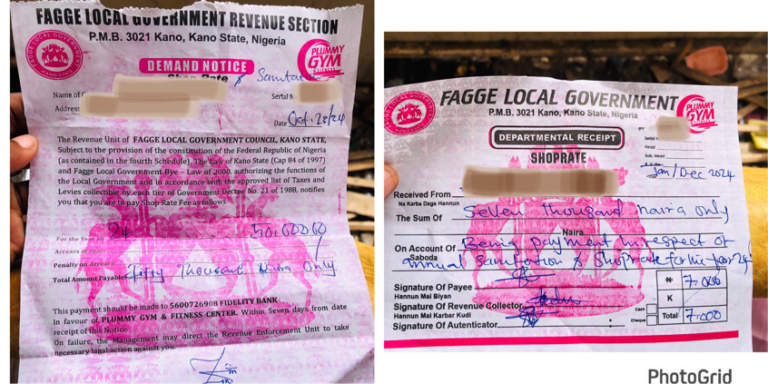
“Secondly, the local government follows the same notice and payment strategy as the state government, with prices varying. The tax paid the local government is referred to sanitation and shop rate, summing up to N50,000 annually.
A notice document and payment receipt
“Then, there’s the market union. Sometimes, unknown individuals come to your shop, claiming to be tax collectors from the market union. They say their office is different from that of the managing director and they present you with another levy to pay.
“Yet, another batch of tax collectors will come, claiming to be from the office of the managing director of Kwari market, asking for additional taxes in the name of security and sanitation,” Salisu said.
He said apart from these, there is a shop ownership fee and if the owner doesn’t pay, they lock up the shop, “despite all the taxes we are paying. If we complain, they tell us to find the shop owner.”
He emphasised that the same security and sanitation fees often appear in local government and market union taxes, and sometimes, no receipt is issued from the MD’s office, leading to conflicts when another batch of tax collectors arrives.
Between tax and multiple taxation
The National Tax Policy has defined tax as the monetary charge imposed by the government on persons, entities, transactions, or properties to yield revenue for government to run its operations.
Multiple taxation is said to occur where these taxes, fees, and rates are levied on the same person in respect of the same liability by more than one tax authority – state, local council, union or other entities. It is also seen in the various unlawful compulsory payments being collected by the local and state governments without appropriate legal backing through intimidation and harassment of the payers.
It is usually characterised by the use of stickers, mounting of roadblocks, use of revenue agents/consultants, including motor park touts. It also refers to situations where a taxpayer is faced with demands from two or more different levels of government either for the same or similar taxes.
This can lead to a significant increase in the overall tax burden, potentially discouraging economic activity and investment.
Kano’s consolidation and codification law, 2021
The Kano State and Local Government Revenue Administration (Consolidation & Codification Law, 2021) was enacted in December 2022 by former governor, Abdullahi Umar Ganduje.
The law seeks to harmonise all revenue laws in the state, including local government tax laws. With the establishment of the Kano Internal Revenue Service (KIRS), the agency has the sole authority for the assessment, collection and accounting of all revenues in the state (tax & non-tax).
Part 6, section 29 (a) and (b) of the law clearly spells out harmonisation of tax administration in the state under the functions of the state and local government joint revenue. It details the responsibilities of the state and local government joint revenue committee, including the important role of educating the public on matters related to state and council revenue. This provision is designed to ensure that tax administration is consistent and transparent across the state.
Non unfortunately, lack of proper implementation of the law has given room for multiple taxation. Also, some taxpayers do not know about the law, they only pay the tax whenever they are approached to pay.
Muhammad Bello, who sells dates from his wheelbarrow at the popular Wudil market which booms every Friday of the week, faces double taxation. He pays N50 weekly to the local government at Wudil market and another N50 to the nearby Kara cattle market.
“Why can’t they harmonise these taxes?” he questions, pointing out that only a mere road divides the two markets.
“We don’t even know who receives our payments; whether local officials, state agents, or market intermediaries, we pay just to keep working,” he said.
Muhammd does not even know who exactly he pays to. According to him, the tax collectors parade themselves as government agents and he pays to anyone that approaches him without asking them of their jurisdiction or affiliation.
This leaves room for non-state actors to exploit the situation and collect unlawful levies and taxes.
A vendor, Abubakar Buyage, who sells woven hats, mats, and hand fans at the Wudil market, said: “At every sales stage, the tax collector collects levy of the buyer and also seller for the same commodity. There’s a levy; N50 here, and N100 there to the local government.”
Receipts of various payments made in the market
When asked about accountability for their contributions, Abubakar said in Hausa language: “Ba mu da wannan hanyar,” which translates to “we don’t have the means,” expressing their inability to monitor tax usage.
“If we question, it invites trouble. They’re powerful; we’re not,” he concluded.
‘We don’t see impact of the multiple taxes we pay‘
Some aggrieved marketers expressed their frustrations over paying multiple taxes without seeing its impact when the need arises in their various markets.
Auwal Salisu, in Kantin Kwari market said, “The painful part is that we don’t see the impact of these fees. I pay a young boy N500 weekly to clean my shop premises. Also, some people claiming to be security men approach us for a security fee, which is N2000.”
He lamented the lack of a government-owned clinic and adequate restrooms in the large market, forcing them to use facilities at the nearby Beirut market.
At Lahadi Makole market in Dawakin Kudu, vendors like Hudu Muhammed, who sell groundnuts, soybeans, and other goods, face a taxing system that starts before they even unload their merchandise. Kudu explained that the tax begins with a fee ranging from N50 to N100 before offloading the goods from the vehicle, especially groundnuts. According to him, the buyer, seller, and retailer pay taxes on the same groundnut, all to the local government.
“The tax starts from N50 to N100 for offloading each vehicle, but we also have to pay between N20 to N30 per bag, as the case may be,” he said.
For shop owners in Lahadi Makole market, the local government collects an annual tax between N3,000 to N5,000 depending on the estimated profit, along with a weekly tax of N200. Hudu expressed frustration that despite these tax payments, there are no visible improvements in the market. He said they face issues like soil erosion, which has affected easy accessibility for vehicles to bring goods to the market.
“If a shop is damaged, there is no intervention from the taxes we pay. We only watch as the roofs and other valuables like doors and windows are taken away by unknown persons if we don’t have the financial power to repair them,” Hudu said.
At Wudil market, Shehu Wudil, who sells flour, salt, and sugar, echoed similar frustrations, noting that each year he faithfully pays taxes to both local and state governments. According to him, the local government levy amounts to N5,000 annually, while state’s tax ranges between N15,000 to N20,000.
“The issue is that despite our prompt tax payments, we see little in return. Especially during the rainy season, when drains clog and refuse piles up, we struggle,” he said.
Pointing toward the market’s infrastructure, where rainwater disrupts open-air vendors and damages government-owned shops, Wudil said:
Images of how rainwater is disrupting activities of open-air vendor
“No assistance comes our way. Even after paying so much in taxes, we’re left to fend for ourselves. Either you fix it or lose your space to someone more influential.”
Abubakar Buyage, who sells woven hats, mats, and hand fans at Wudil market explains that they contribute a total of N20,000, for roadside vendors seeking basic infrastructure like sand-filled grounds to prevent stagnant water.
It was gathered that the traders in the woven hats, mats and hand fans section pay joint tax as Abubakar Buyage, who is the chairman, collects the contributions from his members and submits to revenue officers who in turn send it to the local government.
Significantly, this apparently unorganised and unregulated tax collection system leaves room not only for manipulation but also corruption.
“We’ve pleaded endlessly,” Abubakar recounts, “but our cries seem to fall on deaf ears. The water keeps rising, slowly pushing us out of business,” Buyage complained.
Inusa Saleh, chairman of the cattle wing at Lahadi Makole market, provided insights into the tax system for livestock merchants.
“For every ram brought to the market, there is a tax of N100. Likewise, taking it out incurs a tax of N100, but if you purchase in larger quantities, you won’t be taxed.”
He explained that they generate the tax and pay both the local and state governments, adding: “For the local government, we pay the money on a weekly basis based on what we generate.”
Saleh appealed to the state government to fence the market, noting that previous administrations had not acted on their numerous appeals.
Market authorities react
Garba Labo Gano, speaking on behalf of the market chief at Lahadi Makole market Dawakin Kudu, acknowledged that every week they collect revenue for the local government. However, he noted that issues like soil erosion and other challenges are beyond the capacity of the local government, requiring state government intervention.
“We learned that the state government is ready to intervene on our plight, but you know, administrative bottlenecks slow the process,” he said.
Gano also clarified that they are not mandated to utilise the collected revenue for any tasks without directives from the local government, as they only submit the revenue to the council.
Gano failed to disclose the amount they receive either on weekly or monthly basis. However, a trader in the market named Abbas Tudun-Gusau, who trades in cassava, told this reporter that roadside vendors pay N50 to N100 weekly while shop owners pay N1,000 monthly to the market union.
Yahaya Aliyu who spoke on behalf of a tax collector known as Baba Shugaba, in Wudil market, who operates under the jurisdiction of the market emirate established by the local government, confirmed that all collected funds are remitted to the local government.
Responding to claims by sellers of woven hats, mats, and hand fans that multiple fees were imposed at different stages of goods transactions, mallam Aliyu vehemently denied this allegation.
When asked about the accountability of the collected funds and whether they are effectively utilised to meet community needs, he expressed frustration in that regard. Despite presenting demands to the local government, he claims, little or no action is taken.
On his part, the managing director of Kantin Kwari market, Alh. Hamisu Sa’ad Dogon Nama, refuted claims of multiple taxation there. He claimed that the market does not collect taxes from traders.
“What we collect is a service fee for sanitation and security, amounting to N1,000 monthly each,” he stated.
Dogon Nama emphasised that the market regularly educates traders to verify any tax demands they receive.
“If someone approaches you to pay tax, ask what type of tax it is or request to see their tax documents,” he advised. “Even if you do pay, make sure to get a receipt and follow up with the responsible agency to ensure the payment is properly recorded to avoid multiple taxations.”
He further explained, “Our board clearly outlines the services covered by the fee, which are sanitation and security. If you pay, you will be issued a receipt. If you don’t see the impact of these services, you have every right to complain.
“In Kantin Kwari, we have employees who sweep the market from 7:am to 11:am, easily identifiable by their uniforms. For those concerned about multiple taxation, we encourage you to question anyone who comes to collect money. Throughout Kantin Kwari, only our board has officially recognised sanitation and security officers,” Dogon Nama noted.
KIRS speaks on consolidation policy
Muhammad Abba Aliyu, the executive director of compliance and enforcement at the KIRS explained that the law was established to codify all revenue items collectable by the state government. This, he said, aligns with the 52-digit chart of accounts and aims to consolidate revenue sources by encouraging the harmonisation of taxes collected by both state and local governments.
“We are implementing all sections of the law to ensure efficiency in revenue collection,” Abba Aliyu stated.
Executive director of Compliance and Enforcement at KIRS, Muhammad Abba Aliyu.
When asked about the implementation level of the policy in Kano State, he explained that the state is about 60 per cent along the way.
On the issue of multiple taxation, Abba disclosed that the policy is designed to make tax payments straightforward and that taxpayers will know exactly what they need to pay and can generate their invoices themselves, making payments directly to the state government’s IGR account.
He added, “There are two options: generating an invoice and paying at the bank or paying through transfer, ATM, or Quick Teller.”
Regarding concerns from local traders in Wudil, Lahadi Makole, and Kantin Kwari markets about multiple taxation and reasons why harmonisation policy is yet to reach them, Abba acknowledged that dealing with local business people is the greatest challenge in Kano State.
“Most of our teeming populace are the informal business people and you know dealing with informal tax payers is very difficult
“But we are working hard to educate both the formal and informal sectors on what taxes to pay, when, where, and how to pay them.
“Also, efforts are underway to eradicate cash payments and enhance public engagement to inform, educate, and sensitise taxpayers about the KIRMAS platform” Abba disclosed.
While the Central Billing System (CBS) is not yet fully implemented, Abba assured that once it is, it will streamline the tax payment process. The aim, he said, is to make the payment structure both horizontal (across state MDAs) and vertical (including local government taxes). Once fully implemented, taxpayers will be able to pay all state and local government taxes with a single invoice, splitting payments as necessary.
Regarding penalties for non-compliance, Abba explained that corporate organisations must remit deducted payments by the 10th of the following month or face a penalty of 10% of the prevailing CBN interest rate on the amount. Individuals, he said, are required to file their returns within 90 days (January 1st to March 31st each year), with late filings attracting penalties.
The director, however, appealed to local businessmen concerned about market unions and revenue agents to exercise patience and cooperate with KIRS.
Tax experts speak
Sadiq Muhammad Mustapha, programme lead at the Tax Justice and Governance Platform (TJ&GP), an advocacy group, harped on the financial burden that multiple taxation places on businesses, particularly those in the informal sector.
Sadiq Muhammad Mustapha, Programme Lead at the Tax Justice and Governance Platform (TJ&GP)
“Multiple taxation occurs due to tax laws enforcing collections at different jurisdictional levels, such as state and local governments. This not only creates a heavy financial burden on businesses but also exacerbates difficulties for small and micro-enterprises, many of which are owned by women” Mustapha explained.
Mustapha, pointed out that the Kano State & Local Government Revenue Administration (Consolidation & Codification) Law, 2021 has not achieved it desired goal because of lack of political will, inadequate understanding among tax officers, and coordination challenges among relevant institutions as key obstacles.
“To address these issues, there is a need for deliberate advocacy of the law’s implementation, frequent awareness activities, and clear definitions of roles and responsibilities among coordinating agencies,” he stressed.
Comparing Kano’s tax collection system to that of Kaduna, Mustapha noted that the Kano Internal Revenue Service (KIRS) is mandated to collect taxes on behalf of both state and local governments. However, he highlighted that the law lacks clear instructions on how to effectively coordinate this process, unlike in Kaduna, where tax harmonisation has been more successful.
How it works in Kaduna
Simeon Olatunde, coordinator of the Tax Justice Network Kaduna, provided insights into the success of tax harmonisation efforts in Kaduna State, while highlighting the impact of the State Tax Codification and Consolidated Law 2020.
He clarified that while there is no specific policy document accessible to the public, the Kaduna State Internal Revenue Service (KADIRS) operates with internal policy documents that guide its work. He pointef out that the law itself, rather than a distinct policy, has been central to the state’s efforts in tax reform.
According to Olatunde, the centralisation of tax collection, coupled with the automation and promotion of cashless transactions, has significantly reduced the problem of multiple taxation in Kaduna State.
“These improvements are courtesy to the strategic implementation of the law by KADIRS, which has streamlined tax processes and reduced the burden on taxpayers,” he said.
This report was done with support The International Centre for Investigative Reporting (The ICIR).
A FEDERAL High Court in Abuja has frozen the bank accounts of 32 individuals and companies linked to the 10-day #EndBadGovernance Protest organised across the country pending investigation and prosecution of the case.
Delivering judgement, the justice Emeka Nwite, in a ruling on the ex-parte motion ordered the banks to apprehend the account holders.
The court also ordered the arrest of persons transacting business on the said accounts.
The motion for the suspension of the accounts was moved by counsel for the Inspector-General of Police (IGP), Ibrahim Mohammed.
While granting the request dated August 20, Nwite directed the banks to contact the Nigeria Police Force (NPF) as soon as they were apprehended.
“That the banks are hereby directed by this honourable court to issue details of the account package(s) and to place a Post-No-Debit (PND) on the accounts, disable the ATM while allowing inflow into the said accounts as from the date of this court order,” the judge ruled.
According to the News Agency of Nigeria (NAN) the ruling was issued on Thursday August 22 but the certified true copy of the order was sighted on Sunday August 25 in Abuja.
The IGP Kayode Egbetokun filed the application marked (FHC/ABJ/CS/1219/2024) seeking to freeze the accounts of 11 individuals and organisations suspected of involvement in “unlawful activities”.
The IGP argues that allowing transactions on these accounts could hinder the investigation and render any subsequent court orders ineffective.
The IGP requests that the court grant an order freezing the accounts and authorising the immediate arrest of the suspects to prevent them from accessing or transferring funds, thereby safeguarding the investigation and potential prosecution.
The ICIR reportedthat insecurity, inflation and a hike in the cost of living among others pushed many Nigerians to stage a nationwide protest.
President Bola Tinubu had stopped fuel subsidies and devalued the local currency – the naira – thus causing a spiral hike in food and commodity prices and making life unbearing for citizens.
FORMER Vice President Atiku Abubakar has questioned President Bola Tinubu’s interest in why Oando Plc seemingly got an accelerated approval for the purchase of onshore assets of AGIP and ENI while other transactions such as the Shell/Renaissance deal and the Mobil/Seplat continue to suffer delays.
Atiku’s request was contained in a statement on Sunday, August 25 by his spokesman, Paul Ibe on Sunday, noting that Oando is owned by the incumbent president’s nephew.
He also slammed President Bola Tinubu’s administration for implementing what he described as “a sham subsidy regime”, as revealed in the Nigerian National Petroleum Company Limited’s (NNPCL) 2023 financial statement recently released.
“Tinubu visited the FMDQ in New York, visited Qatar, visited France where he told lies about removing petrol subsidies. This is not a man who is serious about attracting FDI (foreign direct investment).
“More worrisome is that he is not even brave enough to admit that subsidy is being paid. The NNPCL admits that N7.8tn is owed to the national oil company by the Nigerian government,” Atiku said.
According to the former vice president, the International Monetary Fund (IMF) estimates that subsidy payments this year will constitute three per cent of gross domestic product (GDP), amounting to about $7.5 billion.
He said this would be about N11.8 trillion, yet the petrol scarcity continues to linger while the Tinubu administration continues to frustrate the Dangote Refinery and even its own NNPCL facilities.
He asserted that the subsidy regime has become an even wider conduit pipe through which monies for funding the 2027 election will come.
Atiku maintained that Oando was being given undue and preferential treatment in the oil and gas sector to the detriment of more competent investors.
He also knocked the House of Representatives for failing to take proper action on the NNPCL which he said had gone ahead to “mortgage the country’s national oil assets to vested interests.”
“Within just eight months, the Nigerian Upstream Production Regulatory Commission (NUPRC) approved a deal which saw the divestment of ENI/AGIP onshore assets to Oando. Within that same period, Nigeria controversially withdrew all litigation against Shell/ENI in the OPL 245 scandal in what has been described as a quid pro quo.
“However, the attempt by SEPLAT to buy Mobil’s onshore assets has continued to stall for the last three years even as the consent letter remains on Tinubu’s table. The deal between Renaissance and Shell continues to stall. The only deal that has fully scaled through so far is the one involving Oando. We now know why it got accelerated approval,” Atiku said.
He noted that democracy ought to be a government of the people, for the people, and by the people, but in Nigeria, it has become “the government of Tinubu, by Tinubu, and for Tinubu and his family members.”
“In July 2023, the House of Representatives, following the adoption of a motion moved by Miriam Onuoha directed NNPC Ltd to suspend the acquisition of OVH assets pending an investigation by its committee.
“The House ad-hoc committee requested the NNPC Ltd to furnish it with information about registration documents/history from CAC for OVH, Nueoil, and NNPC Retail Limited (NRL), Board Resolution of NNPC Ltd on purchase of OVH, Audited Financial Statement and Management Accounts from 2015 to date of OVH, Nueoil, NRL and NNPC Ltd and the payroll from 2015 to date for NRL and OVH; Board Resolution of NRL/CHQ for movement of head office to Lagos and evidence of Tax Payments for NRL and OVH from 2015 to date,” he recalled.
Atiku said that despite this, the NNPC went ahead to transfer its ownership and properties in its retail arm to OVH, thereby mortgaging the future of Nigerians.
On Thursday, August 22, Oando announced the successful completion of the acquisition of the Nigerian Agip Oil Company (NAOC) from the Italian oil major, Eni, at $783 million.
In September 2023, Oando disclosed that the Italian firm agreed to divest its onshore Nigerian assets to the company.
THE National Drug Law Enforcement Agency (NDLEA) said an Onitsha-based businessman, Ibeanusi Nosike had excreted 68 wraps of cocaine after being observed for 12 days.
The 36-year-old Nosike was arrested while boarding a flight at the Murtala Muhammed International Airport (MMIA) in Lagos on Thursday, August 8 to Abuja.
Nosike was scheduled to join a Qatar Airways flight to Vietnam at the Nnamdi Azikiwe International Airport (NAIA) Abuja at about 10 am the same day.
The NDLEA spokesperson, Femi Babafemi, disclosed this in a statement on Sunday, August 25.
“An Onitsha, Anambra state based-businessman, Ibeanusi Solomon Nosike, has excreted 68 wraps of cocaine after 12 days of excretion observation following his arrest at the local wing of the MMIA Ikeja Lagos by operatives of the National Drug Law Enforcement Agency, NDLEA.
“The 36-year-old Ibeanusi was arrested in the early hours of Thursday 8th August 2024 at the old domestic terminal of the Lagos airport while attempting to board the first flight out of Lagos to Abuja where he was scheduled to join a Qatar Airways flight to Vietnam at the Nnamdi Azikiwe International Airport, NAIA, Abuja at about 10 am the same day,” Babafemi stated.
He said Nosike had been under the agency’s surveillance since his arrival from Anambra state on August 7.
After his interception by NDLEA operatives, Nosike was moved into excretion observation, where he spent the next 12 days excreting the cocaine pellets weighing 1.282 kilograms, Babafemi hinted.
In a related development, the NDLEA spokesman revealed that another Onitsha-based businessman, Aligbo Jacob, the operatives following the seizure of a consignment of 1.20kg cannabis concealed in a package going to Dubai, UAE.
“Operatives at the MMIA Strategic Command of the Agency had intercepted the shipment at the export shed of the Lagos airport while investigations revealed the cargo was sent through a courier company in Onitsha. After a series of follow-up operations, Aligbo was eventually arrested in Onitsha on Saturday, 17th August,” Babafemi said.
He asserted that there is an all-female drug trafficking gang, trafficking drugs outside the country.
He said the leader of the syndicate, 42-year-old Olaribigbe Feyisara, had been under NDLEA radar before being tracked and arrested.
He also revealed that four other members of the gang have been arrested.
“Operatives of a Special Operations Unit in NDLEA have arrested five cross-border female drug traffickers at the Seme border while on their way back to Lagos from Ghana.
“Leader of the syndicate, 42-year-old Olaribigbe Bashirat Feyisara, has been under NDLEA radar before being tracked and arrested on August 21 along with other members of her gang: Abogun Fatimah Ladidi; Osibeluwo Tolulope Oluwaseun; Akanni Balikis Oluwatoyin and Ajetumobi Amudalat,” Babafemi said.
He said 14 packs of Loud, a strong strain of cannabis, weighing a total of 6.97kg, were recovered from hidden parts of their bodies.
The NDLEA disclosed that recently, it had made an interception of cocaine worth N2.2 billion at the Lagos port.
The NDLEA has also made some arrests recently including in Edo, Kogi, and Oyo states, Babafemi added.
A CLASH between the Federal Capital Territory (FCT) Police Command and members of the Islamic Movement of Nigeria, popularly known as the ‘Shi’ite’ group has led to the death of two policemen and left three unconscious.
The FCT police command disclosed this in a statement by its spokesperson, Josephine Adeh on Sunday, August 25.
The police said an unprovoked attack by the ‘Shi’ite’ group, on some personnel of the FCT command at the Wuse Junction traffic light, led to the crisis.
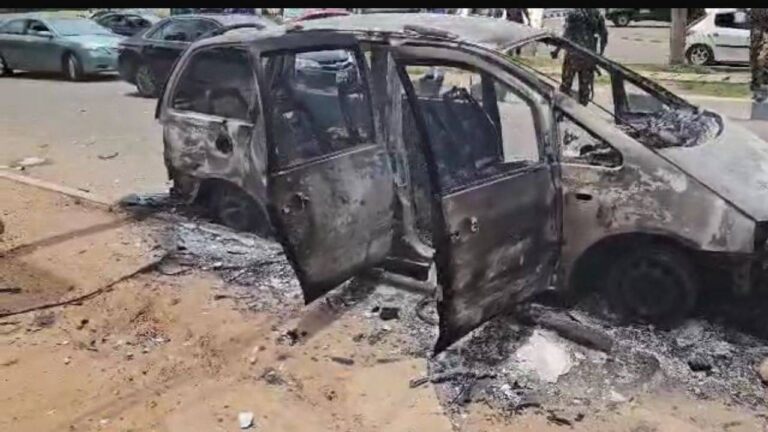
The police said several patrol vehicles were set ablaze in the process.
“The proscribed organisation attacked the police checkpoint unprovoked, wielding machetes, improvised explosive devices (locally made bombs in bottles with kerosene), and knives.
“While several arrests have been effected, the Commissioner of Police FCT, CP Benneth C. Igweh, condemns the unprovoked attack on Police officers.
“He promised to bring those involved to book,” the police said.
The Police further observed that this was not the first time police and Sh’ites would clash in the FCT.
Recall, in July 2019, Nigerian security forces and Shi’ite Muslim demonstrators clashed in Abuja, with gunfire and teargas filling the air as arrests were made.
The protesters demand for the release of their leader despite court order, met with violence, resulting in an unknown number of casualties.
“This incident followed a similar confrontation the previous day, which claimed the lives of at least three individuals, including a journalist and a high-ranking police officer. The Shi’ite group’s spokesman reported that up to 10 additional lives may have been lost in the chaos,” the Police recalled in the statement.
The Command said the situation is presently under control and urged citizens to go about their normal business.
IMNis a prohibited Shia Muslim group that seeks to establish a theocratic government in Nigeria. Founded by Ibrahim Zakzaky, the IMN draws inspiration from Iran’s Islamic Revolution and does not recognize the legitimacy of the Nigerian Government. It was founded by Ibrahim Zakzaky.
THE State Security Service (SSS) has released investigative journalist Adejuwon Soyinka from detention.
Soyinka, the West African editor of ‘The Conversation Africa’ and a former editor of the British Broadcasting Corporation (BBC) pidgin service, was arrested early Sunday morning at the Murtala Muhammed International Lagos.
The journalist was detained by the operatives on arrival at the airport from London.
The SSS agreed to release him on bail, through the efforts of the International Press Institute (IPI) Nigeria, which intervened on his behalf.
As part of his bail conditions, the agency seized his passport and asked him to provide his Nigerian address and reliable phone number through which he can be reached anytime.
Adejuwon himself confirmed his release.
“I have just been released by the DSS in Lagos. They are holding on to my passport, though. I am on an Uber ride ordered for me by the Deputy Director of DSS in Lagos. I will speak better when I get home,”. he stated.
The ICIR reported that a concerned friend of Soyinka said he sent a distress message, stating that he was taken into custody shortly after he arrived from the United Kingdom, without being informed of the reason for his arrest, and has since been held in isolation without access to communication.
The message sent reads “Adejuwon Soyinka has been detained by officers of the Department of State Security at the Muritala Muhammed International Airport in Lagos.
“The incident happened around 5.40 am on Sunday, the 25th of August, 2024, shortly after he arrived in Nigeria via a Virgin Atlantic flight from the United Kingdom.”
At the time of filing this report, no explanation had been provided by the security agency for Soyinka’s detention.
The spokesperson of the SSS, Peter Afunanya in a WhatsApp chat denied knowledge of the arrest.
However, an attempt to get more clarification from Afunanya yielded no result as he did not pick up his call nor respond to messages sent to his phone.
IPI Nigeria condemns Adejuwon’s arrest
Meanwhile, the IPI has condemned the arrest of Adejuwon.
The IPI in a statement on Sunday signed by its secretary, Ahmed Shekarau and legal adviser, Tobi Soniyi said following the intervention of IPI Nigeria, the SSS released Soyinka on bail after detaining him for not less than six hours.
The group said although no reason has been given for his arrest and subsequent detention, they view the action of the SSS as part of a plot to intimidate and harass journalists by the President Bola Tinubu administration.
“Mr Soyinka’s arrest and detention are not isolated cases.
“Since President Tinubu assumed office on May 29, 2023, we have noticed a systematic clampdown on journalists across the country,” IPI said.
The group said the gestapo manner with which Segun Olatunji was arrested and flew from Lagos to Abuja is still fresh in mind.
It added that during the recent #ENDBADGOVERNANCEINNIGERIA protests across the nation, journalists were directly shot at reminiscent of the dark days of the military.
It said the government hiding under the Cybercrime Act, the police have embarked on indiscriminate harassment and arrest of journalists for the flimsiest reason,
“Journalists are being invited or arrested. The plan is to stop journalists from carrying out their legitimate duty.”
The IPI thereby demand the immediate and unconditional release of Mr Soyinka’s international passport.
The group also request a commitment from the federal government to uphold the freedom of the press and stop further harassment and intimidation of journalists.
IPI advise journalists to be vigilant and go about their reportorial duty with the highest commitment to professional ethics.
Attacks and harassment of journalists and other citizens by security operatives especially the police using the NPF-NCCC have remained a great concern in Nigeria.
Recall that on Saturday, August 24 the Nigeria Police Force (NPF) confirmed the arrest of a whistleblower Bristol Tamunobiefiri, also known as PIDOM.
This was disclosed in a statement by the Force’s public relations officer, Olumuyiwa Adejobi.
According to the statement, PIDOM was arrested on August 5, 2024, in his hotel room in Rivers State by operatives of the National Cybercrime Centre (NPF-NCCC).
Adejobi stated that the PIDOM was taken into custody due to accusations of “committing serious offences that undermine the integrity of government operations”.
He further alleged that multiple allegations had been made against the suspect, including unlawful possession, unauthorised disclosure of classified documents, cyber-related offences, and other charges
The ICIR reported in December 2023 how security agents abused their power and flouted the Nigerian Constitution by harassing 39 journalists in the line of duty, nationwide.
Four reporters with The ICIR were harassed by state actors in the line of duty that year.
Meanwhile, in 2024, the NPF-NCCC in Abuja invited and detained The ICIR’s executive director, Dayo Aiyetan, and reporter, Nurudeen Akewushola, over an investigation of sleazes in which its former Inspector-Generals were complicit.
The ICIR reported that a reporter Daniel Ojukwu was abducted by officials of the Intelligence Response Team (IRT) of the Inspector-General of Police (IGP) Kayode Egbetokun on Wednesday, May 1, two days before World Press Freedom Day.
His abduction only became known on Friday, May 3, after spending four days with the police in Lagos State.
On the orders of the IGP, Ojukwu was transferred by the IRT to the Nigeria Police Force National Cybercrime Centre (NPF-NCCC) in Abuja in the early hours of Sunday, May 5.