Home Blog Page 582

UPDATED: ICIR executive director, reporter held by Police Cybercrime Centre

UPDATE:

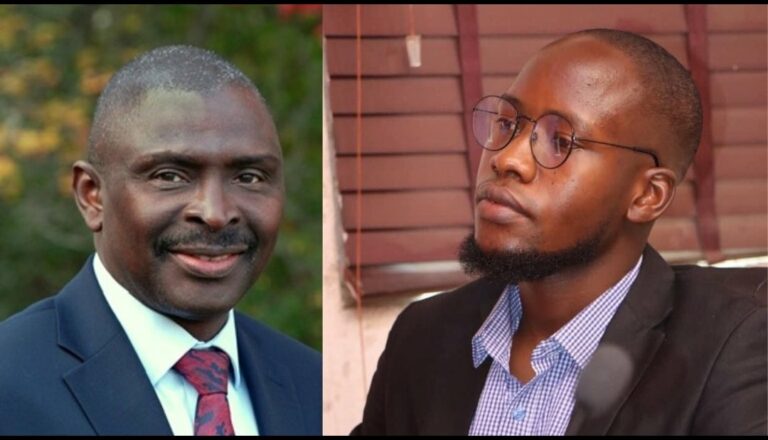
AFTER nine hours at the Nigerian Police Force National Cybercrime Centre (NPF-NCC), the ICIR executive director, Dayo Aiyetan and the reporter, Nurudeen Akewushola, have been released.

Akewushola was however released on bail.


THE Nigerian Police Force National Cybercrime Centre (NPF-NCC) has been holding the Executive Director of the International Centre for Investigative Reporting (ICIR), Dayo Aiyetan, and its reporter, Nurudeen Yahaya Akewushola, hours after they honoured its invitation on Tuesday, May 28.

The ICIR in a statement released Tuesday night raised concerns over their continuous detention, noting that Aiyetan and Akewushola accompanied by the company’s lawyers had been unreachable since 12pm when they arrived at the centre in Abuja.

The organisation said it gathered that there was likely a sinister move by the police to detain both Aiyetan and Akewushola.

The ICIR, earlier on Tuesday reported that both journalists would honour the police invitation having received a letter from the Cybercrime Centre.

In its invitation, the Police claimed it is probing a case of cyberstalking and defamation of character based on a petition received by the office of the Deputy Inspector General of Police, Force Criminal Investigative Department, but provided no details.

Ealier, on May 15, The ICIR received a letter from the Cybercrime Centre inviting its managers and Akewushola to appear before it on April 24. The letter written dated April 16 was not delivered to The ICIR until three weeks later long after it was supposed to have honoured the invitation.

Responding, The ICIR raised some concerns over the invitation, including the disparity in invitation and delivery dates, and the lack of details of the petition which led to investigations for cyberstalking and defamation of character.

The organisation requested that more details of the petition be provided so that it could adequately prepare for the police interview.

In a second letter from the NPF-NCCC dated May 20, 2024, two copies of which were addressed separately to the reporter and the “managing director,” the discrepancy in the dates was adjusted but details of the allegations against the centre and its reporter were not provided.

“The Nigeria Police Force National Cybercrime Centre is investigating a case of cyberstalking and defamation of character reported to the Deputy Inspector General of Police, Force Criminal Investigation Department, Area 10 Abuja, in which your presence is needed.

“In view of the above, you are kindly requested to interview the Director, Nigeria Police Force National Cybercrime Center (NPF-NCC) Plot 625 Mission Road, Diplomatic Zone Central Business District, Abuja, through CSP Omaka Udodinma Chukwu on Monday 27 May, 2024 by 10:00hrs. It is a fact-finding invitation,” the letter read in part.

However, the date and time of the meeting were eventually changed to noon on May 28, following a conversation between The ICIR lawyers and the police.

Despite honouring the invitation, The ICIR’s boss and the reporter, alongside the company’s lawyers, have not been released as of 8:50pm Tuesday when filing this report.

“Today, at the stipulated time, The ICIR staff and lawyers went to the address stated in the NPF-NCC letters and it’s been over seven hours since they’ve been held in custody.

The ICIR expressed concern that its reporter and manager were invited by the police on allegations of cyberstalking in spite of the amendments to the Cybercrime Act in February 2024,” The ICIR said in a statement.

Speaking on the development, the Centre’s Editor, Bamas Victoria, noted that the failure to release the two journalists could be a ploy by the police to detain them, despite the fact that the NPF- NCC stated in its letter that “it is a fact-finding invitation.”

The invitation by the police may not be unconnected from an investigation published by The ICIR, which linked some former police bosses to a shady land deal.

Following the initial invitation of The ICIR reporter and its managers by the NPF-NCCC, human rights lawyer Femi Falana said arresting journalists based on cyberstalking and criminal intimidation charges was unlawful, as the section of the Act (Section 24) often relied on by the police had been amended.

Summary of investigation that exposed the former IGPs, other police chiefs

The report revealed that the former IGPs, Ibrahim Idris and Solomon Arase, currently the chairman of the Police Service Commission (PSC), were accused of receiving N200 million each and a house allocation as incentives for awarding an estate development contract to Corpran International Limited for land originally meant to be used as police barracks.

A former staff member of Corpran International Limited Kalu O. Kalu and a lawyer Francis Mgboh accused both former IGPs of unlawfully approving the contract for the development of the land, which belongs to the Police, without adequate scrutiny, after receiving the bribe.

The allegations currently form a part of ongoing litigation at the Federal High Court in Abuja, and documents obtained by The ICIR, including court affidavits, showed that many other top police officials were also bribed to facilitate the approval of the contract.

Arase, abusing the office he currently occupies, had released a statement through the PSC spokesperson Ikechukwu Ani on Friday, May 17, 2024, saying he had sued three ICIR staff members, including the reporter Akewushola, Executive Director of The ICIR, Dayo Aiyetan, and The ICIR Editor, Victoria Bamas.


Senate recalls Senator Ningi 10 weeks after suspension

0

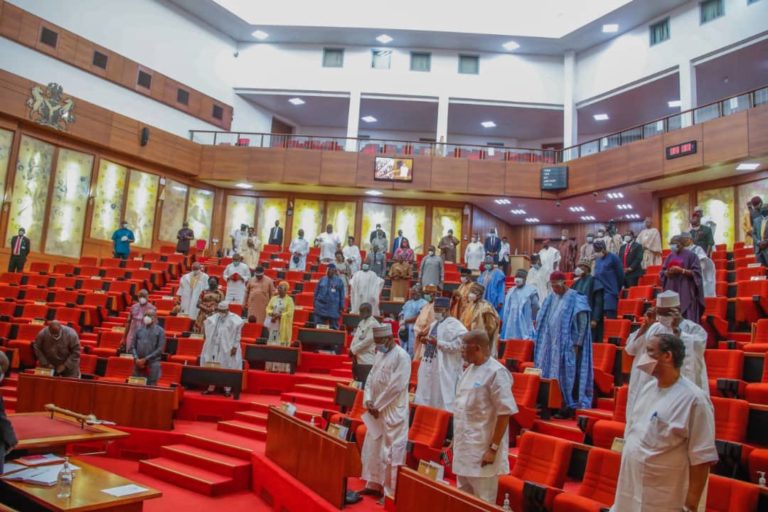
THE Nigerian Senate has recalled its suspended member, Ibrahim Ningi, ten weeks after his suspension. 

The decision, which was announced by the Senate President, Godswill Akpabio, during a plenary session on Tuesday, May 27, followed a motion by Deputy Minority Leader, Abba Moro.

Moro, while apologising on behalf of the suspended senator,  pledged to assume full responsibility for Ningi’s actions.

Granting the lawmaker’s pleas, the Senate President noted that Ningi’s resourcefulness was important to the Senate.

He further described him as a valued member of the Senate, adding that the decision to recall Ningi transcends religious and ethnic divides.

Ningi, a member of the opposition Peoples Democratic Party (PDP), is the Senate Committee on Population chairman.

Backstory

On Tuesday, March 12, the Senate suspended Ningi for three months over his allegation that the National Assembly padded the 2024 budget.

The suspended Senator also alleged that the Red Chamber passed two budget versions.

Ningi, representing Bauchi Central, was suspended under a tense atmosphere at the Senate.

Some senators from the northern part of the country had rejected Ningi’s accusations, claiming he did not speak for them, even as the parties demanded an investigation into the allegation.

Ningi had on Monday indicted the National Assembly for padding the 2024 budget with N3 trillion.

Despite his claims that he was misunderstood, a member of the Senate Appropriations Committee, Jimoh Ibrahim, proposed suspending Ningi for a year due to false information and violations of peace in the National Assembly and, by extension, the nation.

Additionally, Ibrahim, the senator representing Ondo South Senatorial District, moved that the Senate issue a warning to Suleiman Kawu of Kano South on his posting of inflammatory material over the issue on social media and require him to submit an apology. 

Ede Dafinone of the Delta Central Senatorial District promptly seconded Ibrahim’s proposal.

Akpabio announced the motion to suspend Ningi on the Senate floor.

However, his suspension led to a serious concerns among Nigerians, particularly the opposition parties, with both candidates of the Labour Party (LP) and the PDP in the 2023 elections, slamming the Senate for Ningi’s suspension.

Senate passes bill seeking revert to old national anthem

0

THE Nigerian Senate on Tuesday, May 27, passed the National Anthem Bill 2024 seeking to revert the current national anthem ‘Arise, O Compatriots,’ to the old anthem, “Nigeria, we hail thee”.

The lawmakers argued that the old anthem evoked more emotional connections with the Nigerian people.

They also noted that the current anthem is a product of a military junta and does not reflect the aspirations of Nigerians.

The bill, which passed through the first and second readings at the Senate, on Thursday, May 23, now awaits assent into law by President Bola Tinubu.

The ICIR reported how the bill was also passed by the House of Representatives on the same day, scaling through the first, second and third reading.

Providing insight into the reason for the passage of  “A Bill for an Act to Provide for National Anthem, 2024,”  the Senate leader, Bamidele Opeyemi,  who sponsored the bill, said the old anthem aligned with the vision of President Bola Tinubu’s administration and would promote national unity.

The old anthem, “Nigeria, We Hail Thee,” whose lyrics were written by Lilian Jean Williams in 1959, and sung between 1960 and 1978, was replaced with the current “Arise, O Compatriots” in 1978.

While lending support to the motion, the senator representing Enugu North, Okechuukwu  Ezea, explained that the old anthem evoked more emotional connections with the Nigerian people.

Another senator who spoke in favour of the bill, Tahir Monguno, representing Borno North, added that the current anthem is a product of a military junta and does not reflect the aspirations of Nigerians.

On his part, the senator representing Ondo South, Jimoh Ibrahim, said “If Nigeria will get the National  anthem right, we will get Nigeria right.”

Also, speaking on the importance of going back to the anthem the House Leader of the National Assembly, Ihonvbere, emphasised the need for Nigerians to see the anthem as a national symbol and sign of authority, one which does not deny the realities.

While opposing the bill, the Minority Leader, Kingsley Chinda, noted that the old anthem had a colonial tag which was the reason for the new anthem.

Chinda further questioned the importance of the anthem change at a time of more important challenges in the country.

However, the bill was given an expedited hearing and subsequently passed by the lawmakers.

The old anthem, composed to music by Frances Berda, read: 

Nigeria we hail thee

Our own dear native land

Though tribe and tongue may differ

In brotherhood we stand

Nigerians all and proud to serve

Our sovereign motherland

Our flag shall be a symbol

That truth and justice reign

In peace or battle honour

And this we count as gain

To pass unto our children

A banner without stain

O God of all creation

Grant this our one request

Help us to build a nation

Where no man is oppressed

And so with peace and plenty

Nigeria may be blessed.

Tinubu’s first year as president disappointing – Nigerians

SOME Nigerians have expressed disappointment over unmet expectations and unfulfilled promises by President Bola Tinubu whose administration clocks one year in office tomorrow, Wednesday, May 29.

The citizens, drawn from political and civil society organisations, aired their views on the President’s scorecard on Monday, May 27 at an X space organised by The ICIR. This is part of The ICIR series tagged “Tinubu’s one year in office”.

They highlighted how the President’s first tenure has exacerbated the hardship and suffering of numerous Nigerians.

Despite Tinubu’s campaign and his inauguration day pledges to revitalise the economy, the stakeholders said inflation remained a major issue, eroding the purchasing power of ordinary Nigerians.

They further expressed their concerns over the country’s sluggish economic growth, noting that the cost of living had continued to rise, with many citizens struggling to make ends meet.

The 2023 Labour Party’s (LP) governorship candidate in Lagos State, Gbadebo Rhodes-Vivour, said corruption remained a major challenge in the country.

He said Nigeria would continue to grapple with a series of problems if corruption is not addressed.

“No matter what beautiful plan you have – education and agriculture – they will all fail if you do not tackle or fight corruption,” Gbadebo Rhodes-Vivour said.

He said to address hunger and better tackle the economic crises, the nation must make its agricultural and manufacturing sectors productive.

Speaking on widespread demolitions of properties, particularly in Lagos State, Rhodes-Vivour expressed concern over the development, noting that the government is complicit in the ‘illegal’ buildings because it approved them.

He emphasised that regardless of any system flaws leading to developments, the government must respond with compassion and be conscious of the economic hardships faced by Nigerians.

“If the government realises that there are imperfections and compromises in the system that allow the development that they do not intend to have, or goes against their master plan, then government must react to this with sensibility and understanding of the distress, especially in this harsh economic climate that Nigerians are currently dealing with.”

He also noted that “In the event of a building being demolished, the government must approach it with empathy, because people are collapsing and getting admitted to hospital. They need to provide a moving van that will sympathetically help them move their properties”

The ICIR reported how the Lagos State government had marked several buildings for demolition in the Ibeju-Lekki area for lacking approval.

There are several other parts of the state where buildings have been pulled down, either for failing to meet standards or lacking government approval.

One of the demolitions that have attracted the widest criticisms in the state is the Lagos-Calabar Coastal Highway, for which businesses have been destroyed under demolition on the right of way for the project.

In addition to lacking environmental impact assessment, the project raised dust for violating open competitive bidding and the government’s failure to publish bidders at the Infrastructure Concession Regulatory Commission (ICRC) portal before its commencement.

The development led to outrage from concerned Nigerians over the demolition of some buildings and businesses, estimated at over $200 million, around the project take-off point.

At the ICIR X space, the Special Assistant on Digital Media Strategy to former Vice President Atiku Abubakar, Demola Olarewaju, remarked that Tinubu’s first year had been disastrous and disappointing.

“There is a lot the government can do in terms of cutting the cost of governance because everything is happening at a time when we have the biggest cabinet in Nigeria’s history, almost innumerable presidential appointees and the kind of contrast with how the economic figures are going through. The bottom line is that it has been a difficult one year,” he said.

On her part, a gender and research analyst at BudgIT, Oludamilola Onemano, said there had been a lack of consistency in implementing a policy during Tinubu’s first year in office.

She emphasised how Tinubu’s policies and inflation have made life unbearable for Nigerians.


READ ALSO:


According to her, the policies are neither effective enough nor transparent.

“These cushions (palliatives) are not effective enough and have no transparency in the distribution, especially in terms of cash transfers. There has been no revalidation of the social register.

“All of these are done in an opaque system, there is no transparency, and we cannot easily say we are assessing the government in terms of budget because there is no transparency in the releases of the budget document and even the treasury portal,” she added.

Nigerian gov’t blames tomato scarcity on farm infestation

0

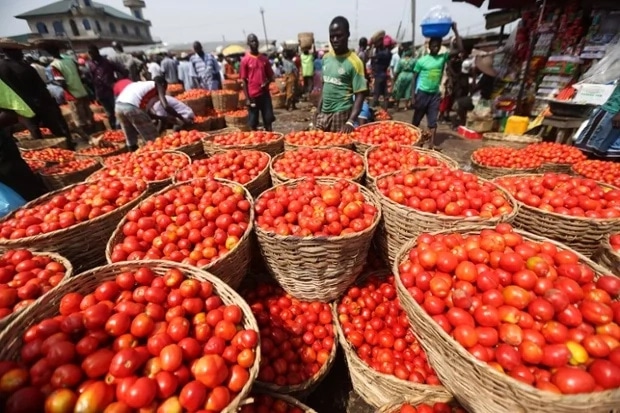
THE Federal Government said it has identified “severe infestation on tomato crops” as the cause for ongoing scarcity and price hikes of tomatoes across the country.

The Minister of Agriculture, Senator Abubakar Kyari, disclosed this in a statement shared on his social media X on Monday, May 27.

He referred to the infestation causing tomato scarcity as tomato ebola or tomato leaf miner.

“A significant number of our tomato farms have been affected by a severe infestation known as tomato ebola or tomato leaf miner.

“This has drastically reduced the availability of tomatoes and contributed to rising costs,” Kyari said.

He, however, said the ministry was taking immediate action to combat the issue.

“We are deploying agricultural experts to affected areas to contain and eliminate the infestation.

“Additionally, we are supporting our farmers with the necessary resources and guidance to recover their crops as quickly as possible, just as we instituted the ginger blight control taskforce.”

The price of tomatoes has hit the rooftop in the past weeks as a basket of tomatoes sells for about N150,000 in some parts of the country.

According to the latest ‘Food Price Watch report for April’ by the National Bureau of Statistics (NBS), there was a significant increase in tomato prices over the past year.

The data showed that the price for 1kg of tomatoes escalated by 131.58 per cent from N485.10 in April 2023 to N1,123.41 in April 2024.

The report highlighted a sharp increase in tomato prices in the short term and stated that between March and April this year, the average price for 1kg of tomatoes rose by 17.06 per cent from N959.68 to N1,123.41.

Last year, a similar infestation caused by an insect called tuta absoluta, ravaged tomato farms, causing consequent loss of about N1.3 billion to farmers, The ICIR reported.

Some of the states currently affected by the tomato ebola were Kano, Kaduna, Katsina and Gombe.

The Federal Ministry of Agriculture and Rural Development (FMARD) feared the scarcity and skyrocketing prices could become worse, with a consequent widening of the country’s tomato needs to three million metric tonnes from about 1.3 million deficit earlier experienced.

Experts have said that the widespread infestation could be enhanced by climate change movement of pests around the field, warm environment and increase in humidity.

A senior advisor with the Tomato and Orchard Producers’ Association of Nigeria (TOPAN),  Ikechi Agbugba, had told The ICIR that the governments at all levels needed to invest considerably in research to effectively tackle the situation.

He also suggested that governments implement policies and promote programmes that would enhance investment in the tomato industry, besides giving out incentives to farmers.

In his statement, the Minister of Agriculture said, “We understand the impact this has on your daily lives and are working tirelessly to resolve the situation and restore the supply of affordable tomatoes. Thank you for your patience and understanding during this challenging time.”

Some Nigerians have taken a swipe on the minister and the President Bola Tinubu-led federal government over the crisis and related prevailing socio-economic challenges in the country.

An X user, Freda, @fredaOnu, said, “The cost of tomatoes is out of control; it’s like they are charging us per seed. Tomatoes should be an affordable staple, please something needs to be done.”

Another X user, Lawal Nojeemdeen, @Enjay_L, stated, “So there was no plan for such occurrences in the first place? No now Mr. Minister. It’s well!”

ICPC, Police Cybercrime Centre invite ICIR over report exposing corruption in Police Force

0

THE Police Cybercrime Centre and the Independent Corrupt Practices and Other Related Offences Commission (ICPC) have invited the International Centre for Investigative Reporting (ICIR) and one of its investigative reporters; these invitations are believed to be connected to a report which exposed abuse of office by two Nigerian former inspector-general of police (IGPs) and other senior officers.

Read the update to this report HERE.

The Centre’s executive director, Dayo Aiyetan, and the reporter, Nurudeen Akewushola, will honour the police invitation at noon today accompanied by a team of lawyers, while Aiyetan will be at the ICPC to provide information to help the agency’s investigation into the allegations of corruption in the Police force.

While the Police invitation, according to an invitation letter from the Cybercrime Centre is related to an investigation relating to “cyberstalking and defamation”, the ICPC invitation is to help the agency’s investigation into the allegations in the ICIR report.

In its invitation, the ICPC said it is investigating “a case that bothers on an alleged violation of provisions of the Corrupt Practices and Other Related OffencesAct 2000 and it has become necessary to have recourse to your organisation.”

It is believed that both investigations relate to an investigative report published by The ICIR titled, “Two former IGPs, senior Police officers accused of bribery in shady land sale of designated Police Barracks.”

In its invitation, the Police claimed it is probing a case of cyberstalking and defamation of character based on a petition received by the office of the Deputy Inspector General of Police, Force Criminal Investigative Department, but provided no details.

Recall that on May 15, the ICIR had received an letter from the Cybercrime Centre inviting its managers and Akewushola to appear before it on April 24. The letter written dated April 16 was not delivered to the ICIR until three weeks later long after it was supposed to have honoured the invitation.

In its response to this first invitation, The ICIR raised some concerns to the police, including the disparity in invitation and delivery dates, and the lack of details of the petition which led to investigations for cyberstalking and defamation of character. The ICIR requested that more details of the petition should be provided so that it could adequately prepare for the police interview.

In a second letter from the NPF-NCCC to The ICIR dated May 20, 2024, two copies of which were addressed separately to the reporter and the “managing director,” the discrepancy in the dates was adjusted but details of the allegations against the centre and its reporter were not provided

“The Nigeria Police Force National Cybercrime Centre is investigating a case of cyberstalking and defamation of character reported to the Deputy Inspector General of Police, Force Criminal Investigation Department, Area 10 Abuja, in which your presence is needed.

“In view of the above, you are kindly requested to interview the Director, Nigeria Police Force National Cybercrime Center (NPF-NCCC) plot 625 Mission Road, Diplomatic Zone Central Business District, Abuja, through CSP Omaka Udodinma Chukwu on Monday 27 May, 2024 by 10:00hrs. It is a fact-finding invitation,” the letter read in part.

The ICIR expressed concern that its reporter and managers were invited by the police on allegations cyberstalking in spite of the amendments to the Cybercrime Act in February 2024.

Before its amendment, some parts of the Act, originally established to prohibit cybercrime in Nigeria, had been weaponised against Nigerians, especially online journalists, regardless of the constitutional mandate of the press to perform watchdog responsibilities.

Section 24 of the Cybercrimes Act made provisions for cyberstalking and found persons who intentionally send false messages “causing annoyance, inconvenience, danger, obstruction, insult, injury, criminal intimidation, enmity, hatred, ill will or needless anxiety,” liable.

However, the Economic Community of West African States (ECOWAS) Court of Justice ruled against this section, stating that it did not conform with Article Nine of the African Charter on Human and Peoples’ Rights (ACHPR) and the International Covenant on Civil and Political Rights (ICCPR).

The Court ordered an amendment of the law which was carried out in 2024.

Following the initial invitation of The ICIR reporter and its managers by the NPF-NCCC, human rights lawyer Femi Falana said arresting journalists based on cyberstalking and criminal intimidation charges was unlawful, as the section of the Act (Section 24) often relied on by the police had been amended.

Summary of investigation that exposed the former IGPs, other police chiefs

The report revealed that the former IGPs, Ibrahim Idris and Solomon Arase, currently the chairman of the Police Service Commission (PSC), were accused of receiving N200 million each and a house allocation as incentives for awarding an estate development contract to Corpran International Limited for land originally meant to be used as police barracks.

A former staff member of Corpran International Limited Kalu O. Kalu and a lawyer Francis Mgboh accused both former IGPs of unlawfully approving the contract for the development of the land, which belongs to the Police, without adequate scrutiny, after receiving the bribe.

The allegations currently form a part of ongoing litigation at the Federal High Court in Abuja, and documents obtained by The ICIR, including court affidavits, showed that many other top police officials were also bribed to facilitate the approval of the contract.

Arase, abusing the office he currently occupies, had released a statement through the PSC spokesperson Ikechukwu Ani on Friday, May 17, 2024, saying he had sued three ICIR staff members, including the reporter Akewushola, Executive Director of The ICIR, Dayo Aiyetan, and The ICIR Editor, Victoria Bamas.

Times Nigerians experienced fuel scarcity since Tinubu took over office

PRESIDENT Bola Ahmed Tinubu took the oath of office on May 29, 2023, and in his inaugural speech made a policy statement, “Fuel subsidy is gone”  which threw the nation in disarray economically.

Almost a year after that statement, Nigerians are still suffering from the after-effects of the statement which triggered the rise in food prices and other commodities caused largely by a spike in Premium motor spirit (fuel) prices referred to as fuel in Nigeria.

President Tinubu at his inauguration said, “Fuel subsidy is gone, as subsidy can no longer justify its ever-increasing costs due to drying resources. We shall instead re-channel the funds into better investment in public infrastructure, education, health care, and jobs that will materially improve the lives of millions”.

This report is part of The ICIR series tagged, “Tinubu’s one year in office”, read here.


Read Also:


The President’s inaugural statement on subsidy removal saw the pump price of a litre of petrol rise from N184 which was the price before the inaugural speech. After the “no more subsidy’ directive of the President, the price rose immediately to N500.

The petrol price rise resulted in an almost 200 per cent hike in the pump price of fuel causing panic buying, fuel scarcity, and an alarming increase in transportation costs and key household items. 

To state the least, Nigerians are yet to recover from the consequences of the statement which has seen over 40 per cent rise in food inflation and core inflation currently at 33.69 per cent triggered mainly by energy prices.

About two months later, the price jumped from N500 to between N617 per litre at Nigerian National Oil Company Limited NNPCL, eliciting criticism from economically stranded citizens.

In response, the group chief executive officer of the Nigerian National Petroleum Company (NNPC) Limited, Mele Kyari, argued that market forces are responsible for the rising pump prices of petrol.

Kyari said the increase in the price per litre of petrol from over N500 to N617 is not a supply issue, assuring Nigerians that the country has “robust supply” of the vital commodity.

Some media outfits reported on another fuel scarcity in September 2023 as marketers shut their retail outlet stations in Lagos and other states.

Energy analysts also said the closure of filling station retail outlets by the NNPCL was to enable licensed major and independent marketers to participate in the importation, following the deregulation of the market.

Media outfits reported that the situation became widespread because of the inability of the marketers to import, mainly due to difficulties associated with sourcing foreign exchange and instability in the domestic market.

With some major marketers involved in the importation, fuel was reportedly sold for between N568 per litre and N590 in some parts of the country. 

In October 2023, the Federal Capital Territory (FCT), Kaduna state, and other major cities across the country experienced a sudden scarcity of fuel. 

Civil society organisations (CSOs) such as the Mega National Movement for Good Governance expressed concerns over the instability of prices of petroleum products resulting from policy somersault of the NNPCL and mounting allegations of monumental corruption within the company.

Several instances showed many petroleum product depots were deserted due to lack of supplies caused by currency volatility, as the landing cost fuel rose to about N720 per litre for independent petroleum marketers.

Petroleum products’ dealers stated that the landing cost was already N720, and the pump price should be around N729/litre in Lagos State if the Federal Government truly stopped subsidising the product.

They went further to state that, they cannot sell at the landing price, Why? NNPC is still subsidising these products, about a subsidy of more than N100/litre.

Due to this increase in petrol landing cost, filling stations were shutting down daily in large numbers, as it was becoming increasingly tough to run the business and compete with the NNPC pump price which was 100 litre lower than the .

A month after in November 2023, another scarcity was experienced in the FCT and others states Nasarawa, and in some South-East and South-South states which persisted for a few weeks. 

Oil marketers stated that the reason behind the long queues at petrol filling stations in those locations was the insufficient supply of fuel by NNPCL.

The NNPCL, the sole importer of the product, refuted the oil marketers’ claim, attributing the queues in the affected areas, particularly Abuja, to a “price war”.

As of May 3, 2024, fuel scarcity was witnessed in Abuja, Lagos, and some parts of the country. This scarcity lasted more than two weeks with harsh effects on the citizens.

Although the major marketers kept mum during the scarcity, a statement released by NNPCL about the scarcity, said the tightness in the supply of premium motor spirit currently being experienced in some areas across the country was due to logistics issues, which have been resolved.

But days later, the fuel scarcity no longer exists although major marketers are now selling at slightly higher prices than the NNPCL with some above N700.

Commenting on the intermittent scarcity, an  oil and gas expert and the former president of Major Marketers Association of Nigeria (MOMMAN)  said the current petrol pricing does not reflect market realities, noting that this is the major cause of the current fuel scarcity.

The chief executive officer of 11 Plc and former president of the Major Marketers Association of Nigeria (MOMAN) Adetunji Oyebanji said told The ICIR, stating that the ongoing fuel crisis in the country is worsened by a mix-up of politics and economics in petrol pricing.

According to him, the price for diesel and petrol are usually similar in the international market, lamenting that the NNPCL pegs the price at N600 per litre in Nigeria, which is not sustainable.

The ICIR has earlier reported how the NNPCL price pegging is creating problems for marketers who struggle to sell at prices not at par with that of NNPCL.

This development creates tension and supply glitches in the petroleum supply business in the country.

Court orders police to evict deposed emir Bayero from palace

0

KANO State High Court has ordered the Commissioner of Police in the state to evict the recently deposed Emir of Kano, Aminu Ado Bayero from the Nasarawa Palace he currently occupies.

The presiding judge, Aisha Adamu Aliyu, also ordered the police to take over the Nasarawa palace where Bayero has been staying since he returned to Kano on Saturday, May 25.

The ruling came in response to a suit filed by the Attorney-General of the state, the Speaker of the House of Assembly, and the Kano State House of Assembly.

The respondents in the matter are the deposed Emir’s of Karaye, Gaya, Bichi, Rano, Kano, Inspector-General of Police (IGP), the State Security Services (DSS), the Nigeria Security and Civil Defence Corps (NSCDC) and the Army.

The ICIR reported how the Kano Police Command, on Saturday , May 25 said it would enforce an order by the Federal High Court in Kano restricting the state government from reinstating Lamido Sanusi as Emir.

The ruling was delivered on Thursday, May 23, restraining the government from enforcing the newly amended Emirate Council Repeal Law of 2024.

The new law approved Sanusi’s reinstatement as Emir.

Meanwhile, Justice Aliyu granted an order “restraining the 1st, 2nd, 3rd 4th & 5th defendants, either by themselves, servants, privies, and or any other persons or officers serving under them or acting in connection with any other person from parading themselves as emirs of Kano, Bichi, Gaya, Rano and Karaye pending the hearing and determination of the motion on notice filed by the applicants.

“That an order is hereby granted to the extent that the Commissioner of Police Kano State should immediately take over the palace of the Emir of Kano situate being and lying at State Road, Kano, and evict the 1st defendant/respondent from the said palace pending the hearing and determination of the motion on notice dated 24th May, 2024.

“That an order of this Hon. Court is hereby granted restraining the 1st, 2nd, 3rd 4th & 5th defendants from parading themselves as emirs of Kano, Bichi, Gaya, Rano and Karaye in the interest of peace in Kano pending the hearing and determination of the motion on notice.

“That an order is hereby made that 15th defendants be served through the office of the Commissioner Police, Kano State who is to ensure immediate implementation of the order of the Hon. Court in the interest of justice.”

The ICIR reported that Ado Bayero was dethroned as Emir of Kano along with four other emirs on Thursday, May 23.

The dethronement followed the amendment of the Emirate Council Law of 2019 by lawmakers in the state.

The Emirate Council Law came into existence under the previous administration led by former Kano governor Abdullahi Ganduje, creating five emirates in the state.

After the five emirates were created, Ganduje deposed the former emir, Lamido Sanusi, a former governor of the Central Bank of Nigeria (CBN), and replaced him with Bayero.

However, the recent abolishment of the five emirates paved the way for the return of the single emirate system in the state, vesting the constitutional powers to appoint emirs in the governor alone.

The current governor immediately reinstated Sanusi as emir and handed him an appointment letter on Friday, May 24, 2024, despite an existing court order restricting him from doing so.

Following his return to the state after his dethronement, Bayero made his way to the palace along Nasarawa in the ancient city of Kano under the protection of security officials believed to be soldiers of the Nigerian Army on Saturday, May 25.

This is despite an order for his arrest by the state Governor, Abba Kabir Yusuf.

LG autonomy: FG sues 36 governors over abuse of office

0

THE Nigeria government has filed a suit at the Supreme Court against the 36 state governors over the nation’s local governments’ autonomy.

In a suit marked SC/CV/343/2024, the federal government, through attorney-general of the federation (AGF) Lateef Fagbemi, urged the apex court to issue an order, prohibiting state governors from arbitrary and unlawful dissolution of democratically elected local government leaders.

The AGF sued the 36 state governors through their respective state attorney generals, with the court fixing Thursday, May 30 for a suit hearing.

The local government is the third tier of government in Nigeria. It caters to the needs of people at the grassroots. 

Council officials head the local governments, and their responsibilities include making laws to address the issues of their locality.

Meanwhile, the suit, hinged on 27 grounds, accused the state governors of gross misconduct and abuse of power.

The federal government sought the court to authorise the direct transfer of funds from the federation account to local governments in line with the provisions of the Constitution against the alleged unlawful joint accounts created by governors.

Fagbemi also requested an injunction to prevent the governors, their agents, and associates from receiving, spending, or interfering with funds disbursed from the federation account meant for the benefit of local governments.

He further sought an order to prohibit governors from establishing caretaker committees to manage local government affairs, noting that the action contradict the constitutionally recognised and guaranteed democratic system.

The summon partly read, “That the governors represent the component states of the federation with executive governors who have also sworn to uphold the Constitution and to at all times give effects to the Constitution and that the Constitution, being the supreme law, has binding force all over the federation of Nigeria.

“That the Constitution of Nigeria recognises federal, states and local governments as three tiers of government and that the three recognised tiers of government draw funds for their operation and functioning from the federation account created by the Constitution.

It added that the governors’ failure to implement a democratically elected local government system is a deliberate undermining of the 1999 Constitution, which they swore to uphold.

“That all efforts to make the governors comply with the dictates of the 1999 Constitution in terms of putting in place, a democratically elected local government system, has not yielded any result and that to continue to disburse funds from the Federation Account to governors for non existing democratically elected local government is to undermine the sanctity of the 1999 Constitution.

“That in the face of the violations of the 1999 Constitution, the federal government is not obligated under section 162 of the Constitution to pay any state, funds standing to the credit of local governments where no democratically elected local government is in place,” the suit read.

The federal government asked the apex court to invoke Sections One, Four, Five, Seven and 14 of the constitution to declare that the governors and state houses of assembly are under obligation to ensure democratically elected systems at the third tier of government.

The ICIR reports that over the years, the state governments have been accused of infringing on local government autonomy, thereby undermining the ability of local councils to function independently. 

Former president Buhari had in May 2020 signed an Executive Order to grant financial autonomy to the judiciary, legislature, and local government councils.

Buhari attributed the stunted development at the third tier of government to the governors’ questionable actions on LGA funds.

Emirship tussle: Kano deputy governor apologises to Ribadu over ‘defamatory’ claim

0

KANO State Deputy Governor Aminu Gwarzo has apologised to the National Security Adviser, Nuhu Ribadu, for fingering him in the ongoing Kano emirship dispute.

Gwarzo said during a press briefing that the government had been misled into believing Ribadu was fueling the dispute in the state.

“The Office of the National Security Adviser has refuted the allegations and distanced themselves (sic) from what we have alleged. I have seen it, he has done it through three media, and today, I have seen the one about going to court.

“We have to acknowledge that we have been misled into believing that the NSA was behind the happenings along this line. We apologise to the National Security Adviser, his person and office for any embarrassment and inconveniences this might have caused him. We are human and can err at any time. On my behalf and the Governor of Kano State, I want to assure the NSA of our continued support and cooperation in discharging his duty as the NSA,” Gwarzo said.

The Kano government dethroned five emirs in the state on Thursday, May 23, abolishing the existing five emirates and reviving the single emirate system in the state.

Following the dethronement, Kano State Governor Abba Yusuf reinstated Lamido Sanusi, who was dethroned under the previous administration led by Abdullahi Ganduje.

The reinstatement occurred despite a court order restricting the governor from reinstating the former emir.

However, one of the five dethroned emirs, Ado Bayero refused to relinquish his position and returned to the city on Saturday, May 25, in the company of security officials.

Gwarzo told journalists upon Bayero’s return that Ribadu supplied him with soldiers to escort him to the palace, thereby, deepening the existing crisis.

Reacting to the allegations, Ribadu threatened to file a defamation suit against the deputy governor. He demanded a retraction of the allegations and a public apology to which the deputy governor complied.