Home Blog Page 623

The hidden truth that led to killing of 17 soldiers in Okuama community

By Isaac MARKSON

A feud between an illegal oil bunker, Endurance Okodeh alias Amangbein and a sophisticated cartel of powerful illegal oil bunkers led to the killing of 17 soldiers in the Okuama community in Ughelli South LGA of Delta, investigations revealed.

Findings unmasked how the leader of the cartel, ex-militant leader Government Ekpemukpolo alias Tompolo who operates a private security company, in a bid for total control of the creeks of Niger Delta, earlier warned Amangbein, who is an ally of a sitting governor in one of the Niger-Delta States, to stay off illegal oil business, a development the latter saw as oppression.

Amangbein, a known ex-militant, hails from the Igbomotoru community in the Southern Ijaw Local Government Area (LGA) of Bayelsa state. He is also a leading voice against Tompolo and the ex- Nigerian Maritime Administration and Safety Agency, (NIMASA) boss, Patrick Akpobolokemi, in both the creek business and the Okuama/Okoloba land dispute.


Read Also:


Investigations revealed that the military authorities zeroed in on Amangbein in search of the leader of the militant group that killed 17 officers and soldiers of the 181 Battalion of the Nigerian Army that went to Okuama community to free one Anthony Aboh, said to be an ally of Akpobolokemi.

The former NIMASA chief allegedly built a mansion in the disputed land between Okuama and Okoloba communities. The building of the house on the disputed land is said to be the genesis of the debacle that led to the killing of the soldiers.

Amangbein’s mother hailed from Okuama, an Urhobo community in Ughelli South LGA, in Delta state. He is now said to have fled to his paternal community in Bayelsa state, apparently informed of the military’s raid of the Igbomotoru community, which left several residents injured and properties destroyed.

A general and the chief of defence staff, Christopher Musa, had earlier said that the 17 military personnel, including four officers and 13 soldiers, were murdered in relation to illegal bunkering business. But Okuama community insisted that the soldiers stormed the community, accusing them of being in possession of one Anthony Aboh, whose lifeless body has since been recovered floating in Forcado River near Ayakoroma community.

Sources said the lifeless body of Anthony Aboh was recovered floating on River Forcados close to the Ayakoromo community in Delta state. One of the sources in Okoloba said, “We found the lifeless body of Mr. Anthony Aboh floating on River Forcados near Ayakoromo community.”

How the illegal oil cartel works

The illegal oil cartel in the Niger Delta comprises influential Nigerians and foreigners, including top military operators, government officials, highly-placed and retired oil industry players, politicians and business persons, and they are the financiers of oil bunkering syndicates, which over the years have plunged the country’s economy in the abyss of decline.

Their oil bunkering cartel, working with insiders, steals crude directly from major crude oil pipelines in the oil-rich region while officials pump crude to the different terminals. They know the time and duration of pumping and the exact pipelines.

The damage inflicted by small oil bunkers who illegally refine crude oil in the Niger Delta region is child’s play compared to the havoc the almighty cartel that owns giant vessels and equipment wreaks on the nation’s economy.

File: A military burial in Nigeria.

There are local oil mafias who also siphon from major pipelines and later sell their product to the big oil players, who use superior tubes and experts to drain off crude oil.

Every security officer involved in the business is well ‘taken care of’ and so, secrecy is maintained. Security operatives who mount sentry on waterways also collect levies from local oil bunkers, and many want to serve in such lucrative beat. They also make returns to superior officers, an insider told this reporter.

This reporter gathered that even with the militarisation of the waterways and the award of security contracts to Tompolo to secure crude oil, the illegal oil business has continued to blossom in Niger Delta. A development the Nigerian National Petroleum Corporation (NNPC) GMD, Mele Kyari ascribed to Nigerian professionals and elites as the brain behind oil theft in the region.

This claim was controverted by Niger Delta elder statesman Edwin Clarke, who fingered the NNPC and the military as the big-time oil thieves.

Crux of the killing

The incident leading to the current crisis is said to have started as unrest in January 2024, following an age-long land dispute between the people of Okoloba and Okuama, leading to a deadly conflict that has brought about loss of lives on both sides. Consequently, the military command unit of the JTF at Bomadi was invited to the scene. It was, however, said that the invitation of the military was at the behest of the ex-NIMASA boss, who had allegedly used his influence to skew the military intervention in favour of his community, Okoloba.

According to Okuama community president-general James Oghoroko, Akpobolokem is an ally of Tompolo, who works closely with the military to secure the creeks. The military’s involvement in the dispute has elicited great suspicion from the people of Okuama, who feel unfairly treated.

Consequently, the attempt by the military personnel to invite the leaders of Okuama was greatly resisted, as it was believed that it was merely an attempt to unduly victimise the people of the community. Until the military authorities can explain the exact nature of the ‘peace mission’ warranting the soldiers’ presence in the community, the street narrative of the military intervention of working under the dictates of Tompolo and Akpobolokem may become attractive and may snowball into a nationwide narrative.

The ICIR  also gathered that Akpobolokem, who is being prosecuted by the Economic and Financial Crimes Commission (EFCC) for a N754 million fraud, built a white mansion on the disputed land, a development that Amangbein and Okuama community elders challenged. It was gathered that an ally of the ex-NIMASA boss, Anthony Aboh, was taken hostage by Okuama people rising from the house built on the disputed land. Residents said that it was this person’s abduction that the military had come to investigate and, perhaps, effect his release, not any peace mission as claimed by the military authorities.

Who killed the 17 soldiers?

Although no group has claimed responsibility for the attack on the soldiers, according to Army sources, 17 military personnel, including a Commanding Officer, two Majors, one Captain and 12 soldiers were murdered by suspected youths of Okuama community. Insiders confided to The ICIR that the soldiers used a speed boat owned by Tantita security outfit, Tompolo’s private security outfit.

The soldiers: Cpl Yahaya Danbaba; Cpl Kabir Bashir; LCpl Bulus Haruna; LCpl Sole Opeyemi; LCpl Bello Anas; LCpl Hamman Peter; LCpl Ibrahim Abdullahi; Pte Alhaji Isah; Pte Clement Francis; Pte Abubakar Ali; Pte Ibrahim Adamu, and Pte Adamu Ibrahim. Others include, Lt. Col. AH Ali (Commanding Officer, 181 Amphibious Battalion); Major SD Shafa; Major DE Obi; Capt. U Zakari and Sgt. Yahaya Saidu were reportedly lured into the creek opposite Okuama community and were all killed but no one has questioned why trained soldiers were killed and those that conveyed them with speed boat survived. The question begging for an answer is, does Tantita security rent their speed boats? Does it mean that the 181 Amphibious Battalion has no speed boat they use for routine patrol?

Tompolo refuses to speak.

Since there were allegations that the speed boat used by the slain soldiers belonged to Tantita security firm, which Tompolo owns, The reporter went to Oporoza on Saturday, March 30, 2024, to obtain comments from the ex-militant leader but was told that all media activities of the ex-militant leader is being handled by his media consultant, Paul Bebenimibo.

The ICIR contacted Paul Bebenimibo on his known MTN cell phone number but he did not take his calls. Short message service (SMS) and WhatsApp messages were sent to him on March 31 and April 1, 2024, asking him to clarify his boss’ stance on the use of the Tantita speed boat by the soldiers and whether the firm rents out its speed boats and whether Tompolo was in cold war with Amangbein.  However, all attempts were unsuccessful, as he did not return calls or respond to the SMS or WhatsApp messages sent to his cell phone.

Who are the oil mafia?

According to a Port Harcourt environment activist, Imabong Cliff, the government has not demonstrated seriousness to fight the oil theft, and “whatever tough measures are said to have been adopted have not put off the cartel.”

An activist with Young Nigerian Rights Organisation based in Asaba, Delta state, Victor Ojei, also criticised government efforts at dealing with the issue of oil theft and illegal bunkering in the Niger Delta.

“The tenacious ascent in oil robbery despite significant interests in securing oil pipelines brings up issues about the adequacy of the public authority’s methodology. It is conceivable that the actions taken to this point by the federal government of Nigeria have not sufficiently tended to the main drivers of the issue or have been inadequate to counter the refined strategies utilised by the oil criminals.

A knowledgeable source said that the cartel, over the years, successfully sold a decoy, making successive governments believe that oil theft was being carried out by small-time oil bunkers and Niger Delta militants bent on destroying the country’s economy, and so they must be eliminated. The Presidency believed that the big-time oil thieves continued their brisk business with protection from security operatives.


How Tompolo was awarded a surveillance contract

But the real challenge is not the small-time oil thieves, it is the influential cartel that is strongly connected and has continued to operate with impunity despite the security measures in place.

A security expert said, “There is no way they can fetch out the illegal oil cartels for possible persecution under the current set-up because those in charge of security are part of the cartel and those saddled with oil pipelines protection contracts.”

Prior to awarding the surveillance contract to Tompolo in 2022, the federal government had understudied the system and came to the understanding that, because of his knowledge of the creeks, ex-militant Tompolo could help the government stop pipeline vandalism and reduce bunkering. It was an idea that top military shots during President Muhammadu Buhari’s regime bought into.

How Tompolo uses military, militants in the creek

Before President Bola Tinubu renewed the Tompolo’s security contract, there were agitations by other ethnic nationalities on the need for them to secure pipelines within their domain instead of giving all the contracts to Tantita Security Company. However, it is alleged that since Tompolo fulfilled his part of the political deal sealed with President when he visited him in his hometown in Oporoza by mobilising for Tinubu Presidency in the region, Tinubu ignored the agitations of other ethnic groups like the Isoko, Urhobo amongst others to give same surveillance contract for them to secure pipelines in their domain and renewed the pipelines surveillance contract to Tompolo through the NNPC GMD

After the re-award of the contract, many expected to get jobs and other benefits, including politicians and security agents, who all have roles to play.

A very reliable source told The ICIR that immediately after the contract was renewed, a former JTF commander, Major-General Sarkin Yarkin-Bello, who tormented Tompolo in 2009 in the oil-rich region, was in Oporoza on one of the weekends, where he assured Tompolo that Operation Delta Safe would work with him.

Tompolo is also said to have invited some militant leaders, including Amangbein, to work with him, saying he would work out modalities to ensure their interest was accommodated. Since then, Tompolo has been said to control both the military and civilian security operators in the creeks. But Amangben turned down Tompolo’s invitation, and the latter allegedly boasted that the former would have himself to be blamed in the creek.

Wike statement on military involvement in Oil theft playing out?

In 2019, former governor of Rivers State, Nyesom Wike, bravely told the nation that top military operators were involved and sponsoring illegal oil bunkering in the Niger Delta region.

He fingered a General Officer Commanding, GOC, a major general, Jamil Sarhem who he alerted, had raised a team of soldiers to steal and sell petroleum products in the region.

Not many believed him because they thought he was playing politics, but Wike spoke from information available to him as the chief security officer of Rivers state.

Wike, however, did not substantiate his allegation. What is known is that the big oil mafias have the support of top military generals, who instruct their subordinate commanders in the area of responsibility, AOR, not to disturb his “friends,” and the benefits go around.

Policemen and operatives of Nigeria Security and Civil Defence Corps (NSCDC) had time without number clashed with the military in the Niger Delta region over the protection of  alleged oil bunkering sites.

Army contradicts self on Okuama killings.

The military contradicted itself with the statement of the chief of defence staff, a general, Christopher Musa, who said that the deceased four military personnel and thirteen soldiers who went to Okuama were killed in relation to illegal oil bunkering while the army acting director defense information, a brigadier general, Tukur Gusau said they were on a peacekeeping mission.

Gusau said, “The troops of 181 Amphibious Battalion, Bomadi Local Government Area of Delta State, while on a peace mission to Okuama community in Ughelli LGA of Delta State, were surrounded by some community youths and killed on Thursday, March 14, 2024.

“The unfortunate incident occurred when the troops responded to a distress call after the communal crisis between the Okuama and Okoloba communities, both in Delta State.”

The reinforcement team led by the commanding officer was also attacked, leading to the deaths of the commanding officer, two majors, one captain, and 12 soldiers.

Finding revealed that the military officers and soldiers who stormed Okuama community were not in any way connected to land issue but a battle of supremacy on who controls the creeks with some members of the illegal oil cartel using the military to achieve their purpose.

Sources within sister security agencies in the area said the military did not inform them neither the Ughelli south Local government chairman, who is the chief security officer of the Local government, nor the Okuama monarch, a development the Ewu monarch confirmed while briefing newsmen before he eventually surrendered himself before the Delta state police command of their peace mission being claimed by the military authority.

We are just poor fishermen—Okuama community

Some Okuama residents have come forward to deny the killing of the soldiers, alleging serious conspiracy against them and insisting that they are poor fishermen and petty farmers and could not have gotten such sophisticated arms to fight or kill 17 soldiers.  They claimed that the attackers are militiamen dressed in army uniforms, invaded the community, resulting in the loss of many lives and properties.

Onajite Idiaphoro, an indigene of Okuama community said; “We were holding our regular community meeting on that fateful day when some men in army uniform, with a gunboat used by this private security company, invaded the meeting demanding to see our community chairman.”

“As soon as our chairman was identified, the men said that they were taking him to Bomadi for questioning, but the community women resisted the approach because Okuama community is under Ughelli South Local Government Area and the chairman did not commit any crime neither the community that demands military invasion.

“The men started shooting, killing two persons instantly and injuring many persons before driving away.”

Further, Idiaphoro said that after the first shooting, residents of the community, especially the men, started moving out, fearing the worst could happen later. “After four hours, the men came back with many gunboats, shooting indiscriminately, killing many persons, including women and children, before burning houses.

“How do our people who are mere fishermen and farmers have guns to fight, talk less of killing a whole 17 army officers as claimed.”

Military continue havoc in Urhobo communities

Soldiers have continued operations against more Urhobo communities in the Ewu-Urhobo Kingdom, apparently in retaliation for the heinous crime of the killing of their officers and men.

This is coming as several riverine communities in Ewu-Urhobo Kingdom raised alarm over military siege and forceful invasions of their community.

It was gathered that several houses have been burnt in Orere, Omosuomo and Olota communities, all neighbouring communities to Okuama community.

Sources told this reporter in Ewo’s main town, Okwagbe, that the youths in the neighbouring communities who have nothing to do with the crisis in Okuama are being assaulted on a daily basis.

Okuama: Military declares 8 wanted over killing of 17 soldiers
The eight persons declared wanted by the DHQ for the killing of 17 soldiers in Okuma, Delta state. Picture courtesy of @DefenceInfoNG

Adjoka Morrison, a local boat operator who narrated his ordeal, said, “On March 21, I was at the riverside preparing for my daily business when I saw the Nigerian Army with five gun boats and four Hilux loaded with soldiers.

“They held and bundled me into one of the gunboats and took me to the other river bank of the community, and as they were taking me into the community, they were shooting sporadically; they messed so many of us up, one the army personnel punched my right eye.”

Orere community chairman, Michael Edameneri, narrated his ordeal and said “We woke up to hear the sound of gunshots at the waterside of our community, and I saw both old and the young running and scampering for safety.

“As the community chairman, when I came out, I saw a multitude of the Nigerian Army entering the community from different directions, and I introduced myself to them, and they took me to the town hall.

“Before we got there, they had assembled almost everyone for interrogation; our former chairman, Mr Ighoteguono, was injured in his head with their gun butt.

“They separated me from others as they started interrogating me, they asked me to take them to where we keep our guns, I told them we don’t have any guns except for our local vigilantes.

They were interrogating me at gun point and they were also having me videoed, and a drone with the threat to kill me if I should lie to them but I insisted that we do not have any gun or refugees in the community.

“One of the army told me point blank that our people have been killing their colleagues at the riverside and they are ready to kill anyone.

“While interrogation was going on, one of the army personnel used a key to open a room store at the town hall in search for what I could not explain. They went to my compound and destroyed doors, bust into many houses in Orere, but they did not find anything.

“They also asked me to agree that the community should be burnt down because we are hiding people from them or they will take me along with them.

“They took me to the entrance of the community, where the shrine is situated; they destroyed and desecrated the entire place in search of guns and people.

The situation was, however, not different in Omosuomo community where soldiers were said to have set three houses ablaze. The soldiers were said to have stormed the community in their numbers as villagers fled for safety.

A top member of the community, who spoke on the condition of anonymity for fear of arrest, noted that no fewer than 15 persons were injured during the military raid on Ewu community, adding that two indigenes namely Diamond Godday Umukoro and Micheal Omeyadonor were arrested.

He said contrary to social media reports, many houses were still untouched in the two communities, stressing that the buildings that were touched were mainly those linked with the suspected killers.

“Contrary to social media reports and analysis on broadcast media, many buildings are still standing in the affected communities. The communities were not razed down as being insinuated. At the appropriate time, the military will open the places for the media to visit and assess what’s on the ground,” he added.

Security expert, Urhobo Union, stakeholder want FG to set up independent panel

Amid the mixed reactions that has trailed the circumstance surrounding the killing of the four officers and thirteen soldiers, Lagos based security expert and security consultant to Ametokun, Hassan Stan Labo, the Urhobo  Progress Union youth wing legal adviser, Princess Omeyoma Eshemitan and former commissioner in Delta state, a professor, Patrick Muboghare who spoke with this reporter has tasked President Bola Tinubu to set up independent panel of inquiry to unearth the root cause that led to the killing of the slain officers and men of the Nigeria military.

They expressed divergent views over the claims of the military authorities saying the slain officers and men of the military were in Okuama community on a peace mission but wondered why the military would not not pre-inform sisters security agencies in the area for collaboration.

For Hassan Labo “it is not out place if the military did not inform sister security agents of their coming if it is on discreet information.”

The trio agreed that the military has no constitutional powers to investigate a case of alleged murder.

Muboghare stated that section 214 of the Nigeria constitution clearly defines who has power to investigate and persecute murder case suspect and not the military.

“The recent events surrounding the handing over of the King of Ewu Kingdom, to the army authority by the Delta State police command calls for concern over the obedience to constitutional duties and proper procedure in law enforcement within the confines of Nigeria law.”

“This incident shows a clear breach of the constitutional duties assigned to the police force as established by the 1999 Constitution of the Federal Republic of Nigeria.

Under the constitutional framework, the police are entrusted with the responsibility to prevent, detect, and prosecute offenses, including murder, within the country, while that of the military primarily revolves around defense against external aggression and the maintenance of territorial integrity.”

“The king already displayed a superior understanding of the law by turning himself up to the police instead of the Nigerian military, which had declared him wanted.”

“However, in the case at hand, the decision to surrender the King to the military instead of conducting an independent investigation or collaborating with the army for assistance raises questions about the proper execution of these constitutional mandates. Section 214 of the Constitution and the Police Act unequivocally designate the police as the primary authority for handling criminal matters, including murder cases.”

“The act confers upon the police the power to prosecute offenses relating to murder in any guise. Therefore, the decision of the Delta State police command to hand over the King to the army authority represents a departure from established legal norms and procedures. The implications of this decision extend far beyond misplaced priorities and irregularities. It is a miscarriage of Justice. By surrendering the King to the army authority, the police have effectively renounce their responsibility and violated the principles of due process and the rule of law.”

Nigeria has lost 10 Nollywood members since January 1

The Nigerian film industry suffered a string of losses in 2024, with not less than ten actors and actresses giving up the ghost between January 1 and April 10.

The ICIR reports that Nollywood covers the different regional and languages in an industry, contributing to the country’s gross domestic product (GDP).

Here are ten actors and actresses who died in the sector during the first four months of 2024:


Read Also:


Olofa Ina

Veteran actor Adedeji Aderemi, often known as Olofa Ina, died in January aged 73 after battling an illness. He was born on May 15, 1950.

In 1972, he formed a theatre group with his friends named “Olofa Ina Theatre Group”.

He started his major acting career in 1980, with his debut film being ‘Ejo Ngboro’ by Tunbosun Odunsi

Jimi Solanke

The veteran actor, poet, and playwright died on February 5 after a prolonged illness. He was 81.

He was often referred to as Uncle Jimi and was well-known for his roles in Kongi’s Harvest, Sango, Shadow Parties, Death and the King’s Horseman, Kurunmi, and The Divorce, among others.

Ethel Ekpe

Ethel Ekpe, a veteran Nollywood actress known for playing the role of ‘Segi’ on the Nigerian Television Authority sitcom, ‘Basi and Company’ died on February 7 after a long battle with cancer.

Sisi Quadri

The actor, whose real name is Tolani Quadri Oyebamiji, died on March 1 at the age of 44 after an undisclosed illness.

He rose to fame in 2004 after his role in Seniyan Seranko and the 2020 film Ebundola.

He also starred in Kunle Afolayan’s Netwlfil original, Anikulapo: The Return of Sceptre, which was scheduled to be released on the day he died, March 1.

Mr Ibu

The death of actor John Okafor, popularly called Mr Ibu, occurred a few hours after Sisi Quadri died.

Mr Ibu died at the age of 62 on March 2 after a prolonged illness that led to a series of surgeries.

He was one of the famous faces in Nollywood and admired for his comic roles in films.

Andy Best

The Nollywood producer, Ikechukwu Nandi, also known as Andy Best, passed away on March 19.

He hailed hailed from Umunkwo, Isiala Mbano Local Government Area, Imo State and was a famous producer and marketer with decades of experience in the industry.

He was the chief executive officer of Andy Best Production.

He produced several movies, including Lion of Africa, White Poison, and My Father’s Cup.

Amaechi Muonagor

Amaechi Muonagor, died on March 24 after suffering from kidney disease.

He was 61.

He was in the industry as an actor and producer for over three decades and was well known for his comic roles in Nollywood films.

Adejumoke Aderounmu

Aderounmu, famous for her role as ‘Esther’ in the popular sitcom Jenifa’s Diary, died on April 6. She started her acting career in 2008, appearing in various Nollywood sitcoms and films, including Jenifa’s Diary, Dazzling Mirage, Alakada 2, and Arugba.

Saratu Gidado

Gidado, often known as Saratu Daso, was a famous Kannywood actress who died on April 9.

She was 56. A successful and prominent figure in the Hausa film industry for over two decades, her death was shocking to many because days and even hours before her death she was active on social media.

Jnr Pope

Actor Junior Pope Odonwodo, mostly known as Jnr Pope, died Wednesday, April 10, after he was involved in a boat mishap on his way back from the location of a movie shoot.

He joined Nollywood in 2006 and rose to fame after starring in the hit movie Secret Adventures, directed by Tchidi Chikere.

W’Bank: Nigeria’s economic growth may determine subregional performance in 2024

THE World Bank projects that the economic activities in Western and Central Africa may increase by 3.7 per cent in 2024, but this will be largely determined by Nigeria’s economic performance in the same year.

The Bank says this will increase by 0.5 per cent from the 3.2 per cent recorded in 2023.

It further notes that the subregion’s performance will be held back if Nigeria’s economic growth is ‘lower-than-average’. 

In its report on the economic outlook of Western and Central Africa, the Washington-based lender says the Western and Central subregion (AFW) is projected to grow by 4.4 per cent in 2024 and 5 per cent in 2025–2026.


Read Also:


It projects Nigeria’s economic growth at 3.3 per cent in 2024 and 3.6 per cent in 2025 to 2026 as macroeconomic and fiscal reforms gradually start to yield results. 

The Bank further notes that, “A more stable macroeconomic environment, as the reforms’ initial shock dissipates, will lead to sustained but still slow growth of the non-oil economy. The oil sector is expected to stabilise with a recovery in production and slightly lower prices. 

“Structural reforms will be needed to foster higher growth. Average inflation will remain elevated at 24.8 per cent in 2024, although it is expected to ease gradually to 15.1 per cent by 2026 on the back of monetary policy tightening and exchange rate stabilisation.”

Also, in Côte d’Ivoire, also located in West Africa, economic activity is set to grow at 6.6 per cent in 2024 and to stay firm at 6.5 per cent in 2025–26. 

The ICIR reported how Nigeria’s gross domestic product (GDP) declined to 3.46 per cent year-on-year in real terms in the fourth quarter (Q4) of 2023. This decline brought the annual GDP to 2.74 per cent in 2023 compared to 3.10 per cent reported in 2022.

Challenges in the subregion 

The World Bank notes that countries in the subregion are suffering from the impacts of multiple overlapping crises like Russia’s invasion of Ukraine, increased violent attacks, and military coups that suspended some economic activities in affected countries. 

The ICIR reported how Burkina Faso, Mali, and Niger juntas threatened to leave the Economic Community of West African States after they were sanctioned by the regional body for overthrowing democratic governments.  

“Persistent conflict and organised violence may disrupt production and access to food staples in several countries (Burkina Faso, Mali, Niger, among others). Food security problems are amplified by climatic shocks. 

“Disruptions of rainfall patterns, along with the black pod disease, are threatening cocoa production and the livelihoods of farmers in Côte d’Ivoire and Ghana. Moreover, factors like soil degradation, pests, and market fluctuations exacerbate the difficulties faced by agricultural communities,” the World Bank says.

However, the World Bank states that in fiscal 2023, it approved $12.0 billion in lending to Western and Central Africa for 73 operations, including $564 million in IBRD commitments and $11.4 billion in IDA commitments.

Abducted Channels TV reporter regains freedom

0

ABDUCTED Channels Television’s reporter, Joshua Rogers, has regained freedom barely 24 hours after he was kidnapped.

He was said to have been released around 10pm on Friday.

Rogers was kidnapped near his residence at Rumuosi in Obio/Akpor Local Government Area of Rivers State on Thursday, April 11.

Rogers, who covers the Rivers State Government House for his organisation, was said to have been trailed after he closed from work to his residence.

The criminals intercepted him and forcefully took him away in a Channels Television-branded vehicle.


Read Also:


After the abduction, the Nigerian Union of Journalists reported that the abductors contacted his wife, demanding a ransom of N30 million for his release

“The NUJ is deeply concerned about the escalating insecurity faced by journalists and media practitioners in the country.
“It is distressing that individuals involved in the vital work of informing the public have become targets of criminal activities.
“The NUJ hereby appeals to the Government of Rivers State and relevant security agencies to prioritise efforts towards securing the safe and immediate release of Rogers,” the NUJ President, Chris Iziguzo, told the News Agency of Nigeria, NAN.

Meanwhile, confirming his release, the management of Channels Television appreciated the support of Nigerians.

“Channels Television reporter Joshua Rogers, who was abducted last night in Port Harcourt, Rivers State, has been freed.

“We thank our viewers and all those who expressed concern over the unfortunate incident,” the organisation said.

The attack on Rogers was not the first on Channel’s TV journalists. It was also an addition to attacks on media practice in Nigeria.

In 2019, a Channel’s TV reporter, Friday Okeregbe, was abducted in Abuja and was later released.

Attacks on journalists come too often in Nigeria. In 2023 alone, at least 39 journalists were harassed by state and non-state actors, with about half of the incidents occurring during the 2023 general elections held between February and March.

One such attack was on the Niger state correspondent of Aljazeera newspapers, Samson Alfa, who raised an alarm over threats to his life following his discovery of a facility suspected to have been used for rigging the Presidential and National Assembly elections.

He said he had been receiving death threats via calls from politicians warning him to stay away from the story.

Also, a freelance photojournalist, Ben Uwalaka, who reports for Daily Trust Newspaper, was attacked by a Police officer in Lagos while covering a protest by aviation workers in April 2023.


READ ALSO:


The officer injured Uwalaka on the hand and broke his camera’s screen, preventing its lens from re-attaching.

In May 2023, Nigeria dropped to 129th place from 120th on the global press freedom ranking index out of 180 countries ranked.

WHO hails Nigeria as world’s first nation to use 5-in-1 meningitis vaccine

0

THE World Health Organisation has disclosed that Nigeria is the first country in the world to roll out a new vaccine called Men5CV, which protects people against five strains of the meningococcus bacteria, otherwise known as meningitis. 

Meningitis is an infection that causes inflammation of the membranes (meninges) surrounding and protecting the brain and spinal cord.

Symptoms include headache, fever, and stiff neck, which are exacerbated by viruses, bacteria, fungi, and other parasites. 

Bacterial meningitis, the most serious form, can kill or disable a person within 24 hours of contacting it. 


Read Also:


According to WHO, Nigeria is one of Africa’s 26 meningitis hyper-endemic countries. In 2023,  WHO said that there was a 50 per cent jump in annual meningitis cases reported across Africa.

In Nigeria, 1,742 suspected meningitis cases, including 101 confirmed cases and 153 deaths, were logged in seven of 36 Nigerian states between 1 October 2023 and 11 March 2024. The seven states are Adamawa, Bauchi, Gombe, Jigawa, Katsina, Yobe, Zamfara.

Meanwhile, the health agency noted that the new vaccine offered a powerful shield against the five major strains of the meningococcal bacteria (A, C, W, Y and X) in a single shot. 

The WHO Director General, Tedros Ghebreyesus, said,  “Meningitis is an old and deadly foe, but this new vaccine holds the potential to change the trajectory of the disease, preventing future outbreaks and saving many lives. Nigeria’s rollout brings us one step closer to our goal to eliminate meningitis by 2030.”

The new vaccine is said to have the potential to significantly reduce meningitis cases and advance progress in defeating meningitis, especially in Nigeria, where multiple serogroups are prevalent. 

The new vaccine uses the same technology as the meningitis A conjugate vaccine (MenAfriVac®), which wiped out meningococcal A epidemics in Nigeria.

Commenting further, Nigeria’s Minister of Health and Social Welfare, Ali Pate, said, “Northern Nigeria, particularly the states of Jigawa, Bauchi, and Yobe, were badly hit by the deadly outbreak of meningitis, and this vaccine provides health workers with a new tool to both stop this outbreak and put the country on a path to elimination.”

Gavi, the Vaccine Alliance, funds the vaccine and emergency vaccination activities. It also funds the global meningitis vaccine stockpile and supports lower-income countries with routine vaccination against meningitis. 

The ICIR, in several reports, has tracked the development of reported cases of meningitis and deaths in Nigeria both in 2022 and 2023.

The Nigeria Centre for Disease Control and Prevention (NCDC) recently said that Nigeria recorded 190 meningitis-related deaths across 140 Local Government Areas between October 2022 and September 2023.

Emefiele released after meeting bail conditions

0

THE embattled former Central Bank of Nigeria Governor, Godwin Emefiele, has regained freedom after meeting his bail conditions.

He was freed on Friday, April 12, hours after the Lagos State High Court granted him N50 million.

The former apex bank governor was standing trial for abuse of office and other infractions.


Read Also: 

Alleged abuse of office: Lagos court grants Emefiele N50m bail

Emefiele: Documents used to pay election observers $6.2m forged, analyst tells court

Unlawful detention: Court fines Nigerian gov’t N100m for infringing on Emefiele’s rights


The judge, Rahmon Oshodi, ruled on the bail application and admitted Emefiele on bail with two sureties in like sum.

Emphasising the bail conditions, the judge said the two sureties must be gainfully employed and have paid three years’ tax to the Lagos State government.

The judge ordered that the addresses of the sureties must be verified.

Emefiele is facing trial on a 26-count charge bordering on abuse of office.

The ICIR reported on Monday that the Lagos court ordered him to be remanded in the custody of the Economic and Financial Crimes Commission (EFCC) over alleged abuse of office and the allocation of $4.5 billion, N2.8 billion.

During its ruling on Monday, April 8, the court adjourned till Thursday, April 11, to give its ruling on the bail application on the fresh 26 counts against the accused.

However, the court could not hear the application because of the Eid-el-Fitr holiday on Thursday.

The judge, Oshodi, also ordered the remand of Emefiele’s co-defendant, Henry Omoile, at the Kirikiri Prison pending the court’s ruling on his bail on April 11.

The court ruled that both accused should be detained after hearing the bail requests submitted by the defendants’ attorney, Abdul Hakeem Labi-Lawal. 

The charge was marked ID/23787c/2024 and dated April 3, 2024.

The EFCC alleged that the former CBN governor committed abuse of office between 2022 and 2023 in Lagos.

The EFCC also claimed that Emefiele made an arbitrary decision in Lagos between 2020 and 2021 by allocating foreign exchange of $291,945,785.59 without calling for bids, which the prosecutor said was an abuse of his office as the CBN governor.

He was also said to have arbitrarily taken another decision in Lagos in 2021 by allocating foreign exchange worth $1,769,254,793.16, which the EFCC said made him violate and abuse his position as the CBN governor.

Emefiele’s co-defendant, Omoile, was accused of accepting gifts of $110,000 for Emefiele from one Raja Punjab through another, Monday Osazuwa, on November 17, 2020, in Lagos while serving as an agent in exchange for the CBN.

The allegation stated that the offences violated Section 73 of the Lagos State Criminal Law 2011.

In November 2023, Emefiele was sent to Kuje Correctional Centre over an alleged N1.6 billion procurement fraud after he was arraigned on a six-count charge at a Federal Capital Territory (FCT) High Court, Abuja, on Friday, November 17.

The ICIR reported on March 7 that a forensic analyst confirmed before a Federal Capital Territory (FCT) High Court in Abuja that the documents used by Emefiele to request the payment of $ 6.2 million to foreign election observers were forged.

The analyst, Bamaiyi Meriga, disclosed while he appeared as a witness to the EFCC at Emefiele’s trial on Thursday, March 7.

Meriga, who appeared before Hamza Adamu, a judge, told the court that following forensic analysis of the documents, he discovered clear evidence of forgery of signature and seal of execution different from the original version.

More lecturers faced sexual harassment charges in 2023

0

MORE lecturers were accused of sexual harassment by students at tertiary institutions in 2023 than any other year in the last five years.

According to a survey by Oga Lecturer, at least 43 lecturers were accused or indicted for sexual harassment between 2018 and 2023.

Based on media reports tracked by Oga Lecturer, at least 15 lecturers were accused in 2023.

They include Cyril Ndifon, former Dean of Law Faculty at the University of Calabar, and Balogun Olaniran, a lecturer at the Tai Solarin University of Education (TASUED), who have been arraigned by the Independent Corrupt Practices and Other Related Offences Commission (ICPC) for sexual harassment.

Following a protest against Ndifon’s behaviour by female students of UNICAL which led to his arrest, other students of the school took to social media to name four other lecturers, alleging that they had also been involved in sexual harassment.

The four lecturers are Frank Enor, Otora Agbor, Elvis Okorn, and Okoi.

In the same year, the Federal College of Forestry, Plateau state, suspended four lecturers, and the University of Lagos (UNILAG) suspended a senior lecturer, Kadiri Akeem Babalola, for sexual harassment.

Two tertiary institutions, Ambrose Ali University in Edo State and Kogi State Polytechnic, also dismissed one lecturer each for sexual harassment and victimisation of female students, while the Nnamdi Azikiwe University (UNIZIK) sanctioned two lecturers over similar allegations.

The spike in reported cases coincides with the setback facing the passage of a bill seeking to criminalise sexual harassment in Nigerian universities, which was first introduced over eight years ago.

Though the bill was passed by lawmakers in 2023, a new Assembly was inaugurated barely a week after.

Presidential assent was not granted in the short period between the passage and the inauguration, and for the current president to assent to the bill, it has to be re-introduced and passed, like all other bills not assented to before the dissolution of a previous Assembly.

In 2022, at least five lecturers were indicted for sexual harassment. Two of them were dismissed by the University of Abuja, while the Elechi Amadi Polytechnic in Rivers State suspended a lecturer, Tamunotonye Solomon.

Obafemi Awolowo University (OAU) probed allegations of sexual harassment against a lecturer Joseph Ayo Opefeyitimi and found him liable, while UNILAG suspended its Principal Assistant Registrar Babatunde Oseni.

There are almost as many cases of sexual harassment in 2021 as in 2023.

Twelve lecturers were dismissed by various schools in 2021, including Adebayo Mosobalaje and two others sacked by OAU, Musa Baba Abubakar and Adebusoye Michael Sunday sacked by Federal Polytechnic Bauchi, Boniface Igbenegbu and Samuel Oladipo, both fired by UNILAG following a documentary by BBC News.

The University of Port Harcourt, Kwara State University, Covenant University and Kaduna State University each dismissed one lecturer for sexual harassment.

The University of Nigeria (UNN) and Federal University Oye-Ekiti (FUOYE) also suspended one lecturer each in 2021, bringing the total number traced by Oga Lecturer to 12.

Imo State University (IMSU), OAU, and Ajuru University of Education suspended five lecturers in 2020, and it was reported that Ambrose Ali University, Edo state, suspended a staff member in 2019 over allegations of sexual harassment.

There were also three reported cases of sexual harassment by lecturers in 2018 involving one lecturer each from OAU, Lagos State University (LASU) and UNILAG.

This report is republished from Oga Lecturer, read the original here.

Did Betty Anyanwu-Akeredolu remarry her late husband’s younger brother?

0

By Blessing Amala MUONWE

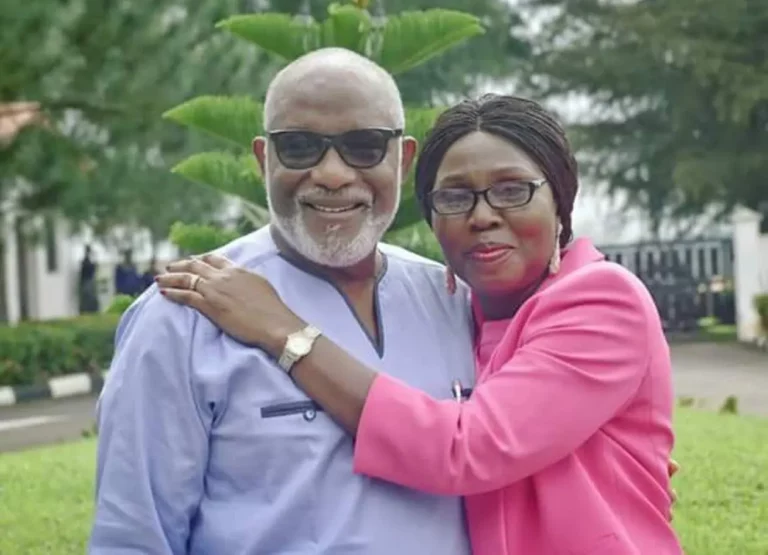
claim that Betty Anyanwu-Akeredolu, the wife of the late Governor of Ondo State, Rotimi Akeredolu, has married his younger brother has been trending online. 

An X account, @instablog9ja, posted the claim on Apr 6, 2024, with a caption:

“Late Ondo’s Gov. Akeredolu’s widow, Betty, ‘remarries’ his younger brother.”

The post was accompanied by screenshots of a post by Betty, the widow of Akeredolu.

The post has garnered over 1.5M views, more than 6.5K likes, over 1.1K comments, and 1.3K reposts as of April 8, 2024.

Other online blogs also shared this claim as can be seen here, and here.

CLAIM

Late Ondo’s Governor Akeredolu’s widow, Betty, remarried his younger brother.

THE FINDINGS

Findings by The FactCheckHub show that the claim is FALSE.

Contrary to the claim, the Late Ondo’s Governor Akeredolu’s widow, Betty in a series of posts on her Instagram handle, which can be found herehere, and here, explained in detail what the ceremony known as “Mgbafu Mkpe” entailed.

Further findings by The FactCheckHub, showed that the “Mgbafu Mkpe” is a traditional Igbo ceremony performed shortly after the demise and burial of a woman’s husband in Igbo land, dominant in the Owerri region of Imo state.

The family of the woman’s husband would indicate interest in still having the widow live with them or not. Upon saying yes, the in-laws would hand the widow back to the husband’s family after performing some rituals.

Should the husband’s family say no, certain rituals are also conducted to free the woman from her husband’s family

Further checks by The FactCheckHub showed that the ceremony was explained in detail in the screenshotted image written by Betty which was also attached in the post made by the claimant.

Also, a national daily,  The Nation newspaper  provided more context about the image and explained in detail the “Mgbafu mkpe” ceremony performed for Betty by her kindred.

THE VERDICT

The claim that the Late Ondo’s Governor Akeredolu’s widow, Betty, remarried his younger brother is FALSE; checks revealed that it was a tradition performed for widows that does not require marrying any member of the family in particular.

Jnr Pope: Police recover 3 more bodies from boat mishap

0

THE Anambra State Police Command said it had recovered three more bodies following a boat mishap that claimed the life of a Nollywood actor, Junior Pope, on Wednesday, April 10.

In a statement on Friday, April 12, the command’s public relations officer, Tochukwu Ikenga, said the bodies were recovered between Thursday and Friday, April 11 and 12.

“The two of the bodies were recovered on Thursday, April 11, 2024, while the last was washed in by the tide this morning. All the bodies have been deposited in the hospital mortuary in Asaba while the President of the Guild of Actors and Actresses has been notified of the recovery.

“The CP (Commissioner of Police) promised an expedited investigation into the sad accident that claimed the lives of five actors. He also commended the command’s Marine Unit and its commander for dedication to duty,” Ikenga said.

On Thursday, April 11, The ICIR reported the president of the Actor’s Guild of Nigeria (AGN), Emeka Rollas, as confirming Pope’s death.

He was returning with four others from a shoot for a movie titled “Another Side of Life”  produced by Adanma Luke when the boat conveying them capsized around Cable Point at the waterside of River Niger in Asaba, the Delta State capital.

Following his death, the (AGN) banned the shooting of movies in riverine areas and suspended the movie producer, Luke.

The AGN also declared April 11 “No Shoot Day” for all actors and producers in the industry and condoled with the deceased’s families.

There were speculations that the actor was still alive hours after the accident on Wednesday. However, he was confirmed dead early on Thursday.

His death sparked public outrage as many Nigerians questioned the absence of live jackets and divers at the scene.