Home Blog Page 639

DHQ confirms rescue of 137 abducted Kaduna schoolchildren in Zamfara

0

CONTRARY to the reported abduction of 287 schoolchildren from the LEA Primary School and its neighbouring Secondary School in Kuriga, Chikun Local Government Area (LEA) of Kaduna State, the Defence Headquarters has given the number of abducted children as 137.

This was as the military confirmed that all the abductees, comprising 76 females and 61 males, within eight and 15 years, had been rescued.

In a statement by the Director of Defence Media Operations, Edward Buba, a major general, said that the children were rescued in Zamfara State in the early hours of Sunday through the joint efforts of the military and local authorities.

The ICIR earlier reported how the state government disclosed that the abducted school children had been rescued but failed to give details of their release and did not clarify whether security operatives rescued the children or if a ransom was paid for their release.

The government also failed to state the number of children rescued.

The rescue came 16 days after they were abducted by bandits, who invaded their school on Thursday, March 7.

One of the schoolteachers, Sani Abdullahi, had claimed that 287 students and a principal, Abubakar Isah, were whisked away from the schools.

He said about 187 students were abducted from the secondary school section and 125 pupils from the primary school section, totalling 312.


Read Also:


Abdullahi, who escaped the abduction along with others, said 25 of the pupils from the primary section had returned, leaving the number of abducted at 287.

The DHQ, however, said only 137 students were abducted. 

“It would be recalled that on 7 March 2024, troops received information that terrorists had invaded LEA School Kuriga in Chikun LG of Kaduna State. During the incident, an unconfirmed number of pupils were abducted. Following the incident, the military committed to leaving no stone unturned until all the hostages were rescued,” the statement read.

It added, “Accordingly, in the early hours of 24 March 2024, the military, working with local authorities and government agencies across the country, in a coordinated search and rescue operation, rescued the hostages. The hostages are the same persons who were abducted from the school at Kuriga in Chikun LGA of Kaduna State.

“The rescued hostages totalled 137 and comprised 76 females and 61 males. They were rescued in Zamfara State and would be conveyed and handed over to the Kaduna State Government for further action.”

Dollar can’t exchange for N400 – Moghalu

A former Deputy Governor of the Central Bank of Nigeria (CBN), Kingsley Moghalu, has rubbished the optimism in some quarters that the US dollar could still be exchanged for N400.

In a series of posts via his X account on Sunday, March 24, the former presidential candidate said, ‘Those who want the naira to be N400 to the $ (US dollar) are living in a dream world. Even discounting for the negative impact of speculative attacks on the value of the naira, the exchange rate will (and should) reflect its market value in reality, not the artificiality that the Emefiele era Central Bank sought to maintain to please economic illiterates in political power at the time.
“That artificiality created room for massive arbitrage by speculators, which bled the economy. Nigeria does not (yet) have a productive export economy. That’s the heart of the matter.’ The post read in part.

Read Also:

He further stated that the country’s foreign reserve was not up to $100 billion, so the forex rate wouldn’t return to normalcy soon as it would take time to regain investors’ confidence in the forex market as in the past.

Moghalu argued that efforts should be made to build a manufacturing export economy that would generate genuine and substantial foreign exchange earnings apart from oil while noting that the stumbling block was the epileptic power supply in the country.

‘The sooner we focus on a painstaking creation of value-added manufacturing export economy that earns forex beyond oil in real and significant terms, the better. Key to this is the electricity conundrum in which we are at less than 4,000 megawatts of generation for a population of 200 million for decades now.
“Take power to even 20,000 megawatts, and you will see what the Nigerian entrepreneurial spirit is capable of. ‘Moghalu stated.
On Thursday, the naira gained N18 to close at 1,382/$ at the official market, continuing its consistent upward trend against the US dollar.
The local currency saw significant gains at the official and unofficial foreign exchange exchanges the day before the naira’s advance. On Wednesday, it closed at N1,400 per dollar on the black market.
Until recently, the naira’s continuous plunge since President Bola Tinubu took over power on May 29, 2023, had seen prices of commodities skyrocket and many citizens unable to afford basic needs of life, including foods.

SERAP urges Tinubu to emulate Otti, stop pensions to ex-govs

0

SOCIO-ECONOMIC Rights and Accountability Project (SERAP) has urged President Bola Tinubu to emulate Governor Alex Otti of Abia State by obeying the court judgment which ordered the Federal Government to recover pensions collected by former governors. 

It also asked the President to challenge the legality of states’ pension laws permitting former governors to collect outrageous pensions.

According to a statement signed by SERAP deputy director, Kolawole Oluwadare, on Sunday, March 24, the court judgment, dated November 26, 2019, was delivered by Oluremi Oguntoyinbo, a judge, following a suit by SERAP.

Reacting to the bill signed into law to repeal Abia state governors and deputy governors pension law No 4 of 2001, which allows former governors and deputy governors in the state to receive lifetime salaries and get houses in the state and Abuja, SERAP asked Tinubu to immediately stop states from paying pension to ex-governors.

The SERAP warned that failure to promptly obey the judgment would allow former governors, their deputies, including those serving as ministers in Tinubu’s administration, and former governors at the National Assembly who receive pensions to escape accountability for their actions.

The letter read in part: “SERAP agrees with former President Olusegun Obasanjo’s conclusion that states’ pension laws are ‘acts of daylight robbery’, and his call for such laws to be abolished by other state governors.

“Immediately obeying the judgment would show the sovereignty of the rule of law in Nigeria and go a long way in protecting the integrity of the country’s legal system.

“Obeying the judgment would also show you as a defender of the Nigerian Constitution of 1999 (as amended), the rule of law, and public interest within government.”

The organisation noted how former President Muhammadu Buhari turned a blind eye to the judgment, adding that governors failed to provide names of former governors and their deputies who have collected and continue to collect pensions from their states and the amount so far spent on these ex-officials.

SERAP further stated that over  N40 billion had reportedly been collected by former governors serving as ministers and members of the National Assembly.

The organisation said it was concerned that while state governors had not paid many Nigerian workers and pensioners for several months and struggled to discharge responsibility, former governors continue to collect double emoluments and enjoy opulent lifestyles.

“According to our information, those who are reportedly receiving double emoluments and large severance benefits from their states include Godswill Akpabio (Akwa Ibom); Rabiu Musa Kwankwaso (Kano); Kabiru Gaya (Kano); Theodore Orji (Abia).

“Others are Abdullahi Adamu (Nasarawa), Sam Egwu (Ebonyi), Shaaba Lafiagi (Kwara), Joshua Dariye (Plateau); and Jonah Jang (Plateau).

“At least 22 states, starting from Lagos State, have reportedly passed life pensions laws for former governors and other ex-public officials. Other states include Akwa Ibom; Edo; Delta; Ekiti; Kano; Gombe; Yobe; Borno; Bauchi; Abia; Imo; Bayelsa; Oyo; Osun; Kwara; Ondo; Ebonyi; Rivers; Niger; Kogi; and Katsina,” the statement added.

Recall that Otti, on Thursday, March 21, signed the Abia State of Nigeria Governors and Deputy Governors Pension Repeal Bill of 2024 into law.

Otti, in his address after assenting to the law, described the new law as part of the efforts to promote good governance and stewardship in the state. 

However, at least two former governors in the state said they did not receive pensions despite the existence of the law.

287 abducted Kaduna schoolchildren freed after 16 days

THE Kaduna State government has confirmed that the 287 abducted schoolchildren in Kuriga, Chikun Local Government Area of the state, have regained freedom after 16 days in captivity.

This was made known in a statement signed by the state governor, Uba Sani, on March 24.

However, the state government failed to provide details of their release. Instead, it lauded President Bola Tinubu and his National Security Adviser, Nuhu Ribadu, for their roles in the children’s release.

The government did not clarify whether security operatives rescued the children or if a ransom was paid for their release. It also failed to confirm if all the children were released.

The ICIR reported that at least 287 students and a principal, Abubakar Isah, were abducted on Thursday, March 7, when bandits invaded the Local Education Authority (LEA) Primary and Junior Secondary School, Kuriga.

One of the schoolteachers, Sani Abdullahi, gave a higher number of abductees. He said about 187 students were abducted from the secondary school section and 125 pupils from the primary school section, totalling 312.

Abdullahi, who escaped the abduction along with others, said 25 of the pupils from the primary section had returned, leaving the number of abducted to 287.

The incident generated public outcry, with several leaders, including Tinubu, calling for their immediate release.

Announcing the children’s freedom in a statement on Sunday morning, the state government said ‘our Kuriga school children have been released.’

“Our special appreciation goes to our dear President, Bola Ahmed Tinubu, GCFR for prioritising the safety and security of Nigerians and particularly ensuring that the abducted Kuriga school children are released unharmed. While the school children were in captivity, I spoke with Mr. President several times. He shared our pains, comforted us and worked round the clock with us to ensure the safe return of the children.

“Special mention must also be made of our dear brother, the National Security Adviser, Mal. Nuhu Ribadu for his exemplary leadership. I spent sleepless nights with Mal. Ribadu finetuning strategies and coordinating the operations of the security agencies eventually resulted in this successful outcome.” Sani said in a statement.

He further applauded the courage and commitment of the Nigerian Army for what he described as showing that “criminal elements can be degraded and security restored in our communities.”

The recent development came after 17 students and a woman abducted from the Qur’anic school located in Gidan Bakuso village of Gada Local Government Area of Sokoto State regained their freedom.

According to the Sokoto State Government on Friday, March 22, the rescue operation was done in collaboration with the Office of the National Security Adviser.

On Sunday, March 10, The ICIR reported that the Sokoto State police command confirmed the abduction of at least 15 Tsangaya students by bandits at the Gidan Bakuso area of Gada Local Government Area of the State.

However, there is growing scepticism among Nigerians regarding the rescue strategy employed for abducted victims in the country, with some alleging that ransom are being paid or deals are being made for the release of the kidnapped individuals.

This was also as many Nigerians reacted to the demand of N40 trillion ransom by another group of bandits to free 16 kidnapped residents of the Gonin Gora area of Kaduna State.

Recall that 16 people were taken hostage on Wednesday, February 28, when bandits raided the Gonin-Gora neighbourhood in the Chikun Local Government Area, a suburb of Kaduna.

The kidnappings are occurring amid the failure of the Federal Government and security operatives to apprehend the criminals by tracking their phone contacts.

The ICIR reported that in 2021 and 2022, the Federal Government earmarked over N50 billion to the National Identity Management Commission (NIMC) for the procurement of various equipment, including biometric capture equipment, backend and frontend systems, and verification equipment crucial for the registration of National Identification Number (NIN), among others.

Despite this investment, coupled with the hardships many Nigerians endured to meet the registration deadline and link their NIN with SIM cards, the former Minister of Communication and Digital Economy, Isa Pantami and the security operatives faced backlash due to the project’s ‘ineffectiveness and inefficiency’ in addressing rampant insurgency and kidnapping cases in the country.

Banditry’s chokehold tightens on child nutrition in Kaduna

By Nonye EKWENU

IN the face of escalating banditry attacks in Nigeria’s Northwest region, the growth and development of children in Madamai and Kajuru communities in Kaduna state, as in many other places, is being severely stunted. This report by NONYE EKWENUGO delves into the dire state of child nutrition in these communities, and the ensuing food insecurity that is most acutely felt by the youngest members of the society.


Tears drop from Victoria Titus’ face onto the cassava flour as she blends the gritty paste. Her three-year-old son, David, whimpers in her arms, his ribs stark against his shrunken frame. Over two years ago, bandits took everything from her – her husband, her village, her livelihood – and now they threaten to steal her son’s life with a weapon far more insidious: hunger.

Bandits attack on Titus’s village, Madamai, in Kaura Local Government Area (LGA) turned her life into a desolate wasteland. Her husband, alongside 34 others, fell to their machetes.

“It is not easy since my husband died. We have been at the mercy of people and the little income that comes from subsistence farming. It is really sad that I can’t provide for my children.”

Titus’s story is not a lone tragedy, but an ugly chorus echoing across Southern Kaduna, where banditry’s bloody grip chokes the lifeblood from communities and steals childhoods and nutrition from innocent eyes.

Malnutrition tales from Madamai and Kajuru communities

Christiana Dauda’s sorrow now extends beyond the loss of her husband over three years ago. This time, malnutrition, not bandits, pose a threat to her two-year-old son’s life. Widowed during the 2021 Madamai attack that claimed 34 lives, she is faced with unimaginable hardship.

“I nearly gave up,” she said. “They took my husband, now my child has started showing signs of not being well fed… I was pregnant when my husband died. People doubted I’d survive, but somehow I did.”

With no breadwinner, Christiana began farming just a month after her breast milk started dwindling due to poor diet.

“I feared losing my son too,” she said, her eyes welling up.


Read Also:

“Leaving her with others while I go to the farm every day terrifies me. What if I returned to find her dead? I think this way because I can barely afford one meal a day,” said Dauda.

A 30-year-old mother from Dogon Noma in Kajuru LGA, Juliana Caleb, shared her plight with four children. She explained that her husband who is a peasant farmer has no additional income-generating skills, and this leaves the family vulnerable.

The family’s precarious situation, coupled with the food insecurity, serve as one of the prominent drivers of acute malnutrition within their household. Juliana lamented the heart-wrenching reality of feeding a sick child while others in the family go hungry.

“Some of my children even cry, and I have nowhere to hide,” she stressed, noting that her son battles severe acute malnutrition (SAM).

A 27-year-old petty trader from Kujeni community in Kajuru, Janeth Mairabo, shared her sadness over her two-year-old daughter’s malnourishment.

Mairabo a petty trader, expressed deep sadness as she described her daughter’s weight, likening it to that of a piece of paper.

“People around here don’t like carrying my baby because they say she is very thin and weak. Many people in the community doubt that she will survive, but we are surviving by the grace of God,” Mairabo said.

She said she feeds her daughter, Endurance, with pap and any other food she can afford at home.

Another resident of Dogo Noma, 32-year-old Lami Hosea recounted her struggles with her nine-month-old malnourished baby. Believing she was providing good nutrition; Lami was devastated when her baby’s health started deteriorating.

“My baby is always falling sick, and she looks thin and weak. A visit to the nearby chemist shop revealed that my child’s weight was very low. I was encouraged to provide her with protein, sometimes sacrificing my own meals and those of my other children to scrape together enough money for baby milk.”

The story of 13-year-old Caleb Gideon whose mother was killed by bandits in 2021 is also pathetic. Caleb who looked visibly malnourished narrated how his father gave him and his siblings salt water to drink at night due to lack of food.

In his words, “Most times my father often put salt in water for us to drink and sleep because there is no food at home. Sometimes I and my siblings go to bed hungry. My father is a peasant farmer, we only eat twice during harvest period but around April to August every year we usually eat once a day. We live at the mercy of others.”

A 35-year-old widow caring for six children, Esther Andrew, revealed the uphill battle she faces in preserving the life of her malnourished 2-year-old daughter. Lamenting the absence of a nearby primary healthcare center and her inability to cover private hospital expenses, she resorts to treating her daughter with herbs. Despite the challenges, Mrs. Andrew remains hopeful that her daughter will recover soon.

“It’s not easy seeing one’s child suffering from malnutrition. Sometimes I regret coming to this world. There is no Primary Healthcare Centre (PHC) in our community. Each time I need any medical attention for my daughter, I make use of herbs to treat her because there is no PHCs here and even the private hospital at Mallagum I can’t afford to pay for the bills,” she explained.

More bitter tales from Madamai residents

Madamai residents find themselves grappling with the devastating aftermath of relentless banditry attacks, resulting in displaced children and shattered families. Situated approximately 10 kilometres from Kaduna town, the community stands as a chilling testament to the glaring absence of government’s intervention.

Investigation into the plight of Madamai residents revealed a litany of challenges, with inadequate infrastructure standing out as a critical issue. Poor road network, unreliable water sources, the absence of a primary healthcare center (PHC), and the lack of educational facilities compound their already dire situation.

Michael Katoh, the youth leader of the community, vividly portrays the painful reality they endure.

“We are a forgotten people,” he said, “Our roads are in such a state that even those with the best intentions are deterred from helping us. This inaccessibility hinders crucial aid, especially from NGOs and good spirited individuals.”

He shared a distressing incident during an attack, where assistance from a neighboring village and the military was hampered by the deplorable road conditions. Expressing frustration at government neglect, the youth leader said “Despite occasional help from NGOs, we have not witnessed any tangible intervention from the government.”

The litany of challenges faced by Madamai residents extends to the most fundamental aspects of their daily lives. Katoh emphasized that, ” No water for our children. The absence of PHCs compounds our woes. With no borehole in our community, both humans and livestock are forced to share water sources, posing significant health risks.”

Attempts to engage in farming, thwarted

Katoh stressed how crops are often destroyed by cows from nomadic livestock herders. “Our survival hinges on God’s mercy as we navigate these challenges with little support,” he said.

Education is also not left out. In a world where education is seen as a lifeline out of poverty, the children of Madamai find themselves adrift. The local school, LEA Primary School, once a bustling centre of learning, has been eerily silent since 2021 due to the relentless banditry activities plaguing the community.

Approximately 300 children in Madamai are deprived of basic education. The youth leader lamented “It has been about three years now that the primary school stopped functioning. We pushed our children down to Mallagum, where some of them trek 10 to 15 kilometres for schooling. We want to bring back our children to continue their primary education here in the community because the distance is too far for small children to trek.

“We have about 50 children whose both parents were killed by bandits. Some of them survive just by the grace of God and it is difficult to supervise 50 children to and from school over a long distance.”

Despite previous government interventions malnutrition persist

Malnutrition remains a pressing issue in Kaduna state despite efforts to combat it. Malnutrition is lack of proper nutrition caused by not having enough to eat, not eating enough of the right things.

Malnutrition refers to eating foods that lack of proper nutrition. This is caused by not having enough to eat and not eating enough of the right things. The World Health Organisation (WHO) refers malnutrition to deficiencies, excesses or imbalance in person’s intake of nutrients and energy. Malnutrition occurs when the body doesn’t get enough nutrients.

The Kaduna State manager of the World Bank-backed Accelerating Nutrition Results in Nigeria (ANRiN) project, Dr Zainab Muhammad-Idris, in an interview with this newspaper disclosed that ANRiN has successfully distributed over 21,000 cartons of ‘ready-to-use therapeutic food’ (RUTF) across the State, preventing malnutrition in children under the age of 5.

However, consistent budgetary allocations for nutrition have fallen short. The allocations for 2020, 2021, and 2022, were N5.94bn, N1.97bn, and N2.56bn respectively.

A non-governmental organisation (NGO) working to achieve food and nutrition security, Civil Society Scaling Up Nutrition in Nigeria (CS-SUNN), highlighted the insufficient funding for nutrition initiatives in specific Ministries, Departments, and Agencies (MDAs) in the state in its 2022 trend analysis report.

Despite governmental efforts, Kaduna contends with elevated rates of malnutrition, necessitating urgent attention to basic amenities in Madamai community and its environs. Over the same period, KADENAP claimed it has provided treatment for more than 82,000 children battling malnutrition and reached 500,000 individuals with crucial nutrition messages, official records by indicate that 1,423 lives were lost due to malnutrition in the state from 2017 to 2022.

According to UNICEF, Nigeria has the second highest burden of stunted children in the world, with a national prevalence rate of 32 percent of children under five. An estimated 2 million children in Nigeria suffer from severe acute malnutrition (SAM), but only two out of every 10 children affected is currently reached with treatment. Seven percent of women of childbearing age also suffer from acute malnutrition.

In Kaduna State, a survey by Nigerian Journal of Nutritional Sciences 2021 estimates that 47 per cent of children under five were stunted, 34% underweight.

A report by Alive&Thrive, an initiative fighting malnutrition in 2022 stated that in Kaduna State 41.7per cent of children under five are severely acutely malnourished and 14.6 per cent are born with low weight.

According to WHO, child stunting refers to a child who is too short for his or her age as a result of chronic or recurrent undernutrition which is usually associated with poor nutrition and maternal health, frequent illness and or inappropriate feeding and care in early life. Stunting prevents children from reaching their physical and cognitive potential.

Stunting is an indication of chronic under-nutrition, which is caused by a prolonged period of hunger or disease. Stunting, which reflects a failure to grow in stature also causes mental growth retardation.

The first 1,000 days of a child’s life, from conception to two years of age, are very critical. It is considered that a baby who lacks essential nourishment during this period that the brain is developing rapidly may have mental retardation that is irreversible.

Scientific evidence shows that stunted children are more likely to have cognitive deficiencies and poor learning outcomes. A report by the Save the Children shows that malnourished children score 7% lower in mathematics tests, are 19% less likely to be able to read at age 8 and are 13% less likely to be in the appropriate grade for their age than those who are well nourished.

Scientists say that stunted children grow into adults with irreversible losses in human capital that also contribute to future losses in economic productivity.

Reacting to why interventions in the sector are not yielding much results, the Permanent Secretary, Kaduna State Ministry of Health,Aisha Abubakar Sadiq, pinpointed poverty, insufficient knowledge on proper food preparation, and the high cost of nutritious food, particularly protein-rich options containing essential vitamins and minerals, as key factors in the state’s malnutrition challenges.

“There is an urgent need for increased availability of crops fortified with essential nutrients. Supporting farmers through subsidies is crucial to ensuring the production of necessary crops, providing our communities with the required nutrients,” she stressed in an interview with this reporter.

Aisha underscored the critical need to strengthen school feeding programmes, recognising the ongoing initiative in the state. However, she highlighted significant challenges, including insufficient funding and mismanagement of food providers.

She acknowledged that the school feeding programme in the state is faced with formidable challenges of inadequate funding and poor management of food providers and would require a more robust strategy to ensure that it addresses malnutrition amongst other objectives.

How Kaduna government can prevent malnutrition

Addressing the prevailing malnutrition crisis, nutrition expert Mohammed Hassan Sani stressed the importance of tackling its root causes. He pinpointed poverty and illiteracy as fundamental contributors to malnutrition in the state, emphasizing that poverty spawns insecurity.

Sani urged both federal and state governments to prioritise food security as their foremost concern. Expressing concern over the removal of subsidies on agriculture, particularly the soaring cost of fertiliser at N30,000 per bag, he called for the establishment of structures ensuring food security. Sani stressed the necessity for interventions in agriculture, subsidy reviews on fertilisers, and the overall safety of lives and property.

Emphasizing the need for increased investment in agriculture to combat malnutrition, Sani urged the government to take decisive action.

“The government must establish structures that will make sure of food security. Put in place intervention on agriculture, review subsidy on fertiliser at the national and state levels and ensure safety of lives and property.”

Another nutrition expert, Bartholomew Jessica, highlighted factors contributing to malnutrition in the state during an interview with this reporter. The immediate causes include inadequate dietary intake and diseases.

“We also have underlining causes at the household or family level which includes insufficient access to food, inadequate maternal and childcare services and poor water, sanitation, and inadequate health services.

“Then the basic causes at the societal level includes inadequate use of potential resources such as environment, technology, people; and lack of quantity and quality of actual resources such as human beings.

She further advised that increased investment in nutrition, timely release and cash backing of nutrition funds will also go a long way in fighting malnutrition.

“Create awareness of the dangers of malnutrition across all communities. The government should as a matter of priority engage skilled health workers to provide services at the community level. The government should also train Traditional Birth Attendants (TBAs) to provide optimum care services to pregnant and lactating mothers. There is also need for community sensitisation to households on the importance of using locally available food during and after pregnancy,” she said.

The Permanent Secretary, Kaduna State Ministry of Health, Hajia Aisha Abubakar Sadiq during an interview with this reporter identified poverty, lack of knowledge and proper way to prepare the right food as the major causes of malnutrition in the State.

She said that the cost of foodstuffs is high all over the world, adding that most people cannot afford to buy the highly nutritious food like proteins that contain the required vitamins and minerals needed in the body.

When asked on how to reduce malnutrition in Kaduna, Hajia Sadiq said that “there is need for greater availability of crops that are fortified with the essential nutrients and subsidy support for farmers so that they can produce necessary crops we need, to provide us with the adequate nutrients.

“There is need to help in school feeding. There is an existing school feeding programme in the state but it is marred by inadequate funding, poor management of the food providers.  There is need to intensify the modification of the food they provide in the school feeding programme. also to provide them with regular payment so that they can do what they are suppose to do”.

“So many children now go to school hungry.  We need to educate people on food groups on how to prepare it and the right amount to give to children, frequency and the signs of malnutrition,” she stated.

*This report republished from Leadership was done with the support of the International Centre for Investigative Reporting, under its Promoting Democratic Governance in Nigeria Project.

Each Nigerian owes N449,000 as debt rises to N97.34 trn

THE latest Debt Management Office (DMO) report has shown that Nigeria’s total public debt rose to N97.34 trillion as of the end of December 2023. 

This represents an increase of N9.43 trillion or 10.73 per cent against N87.91 trillion reported in September 2023.

According to DMO’s report, the federal government has a domestic debt of N53.26 trillion, while the 36 states and the Federal Capital Territory have a domestic debt of N5.86 trillion. 


Read Also:


Debt per capita

The ICIR calculated the debt stock per capita by dividing the total public debts of the country by the country’s population. According to the National Bureau of Statistics, Nigeria has a projected population of 216.78 million. 

Going by this data, each Nigerian now owes N449,022.94. 

This is higher than N405,520 owed in September 2023 and N396,376.19 owed in June 2023. 

On the other hand, the external debts of the federal government stood at $37.89 billion while the subnational state external debt stood at $4.61 billion; totaling $42.50 billion 

The ICIR converted the external debts using the Central Bank of Nigeria’s official rate as of December with  N899.393/ 1$. By this conversion, the external debt would be N38.22 trillion. 

The International Monetary Fund had projected that Nigeria would face more higher percentage of debt to gross domestic product in 2024

Reacting to the marginal increase in public debt, the President, of the Association of Capital Market Academics of Nigeria, ACMAN, Uche Uwaleke, said: “The latest public debt data shows that the pace of public debt accumulation has slowed given the marginal increase recorded as well as the decrease in the external component.

“However, it is worrisome that the outstanding domestic debt stock is more in FGN bonds which are not tied to specific projects accounting for over 80 percent.

“It is important that future domestic borrowings are done using more of infrastructure bonds such as Sukuk and Green Bonds instead of FGN bonds which tend to compound the debt service burden since they are not connected to any self-liquidating project,” he added.

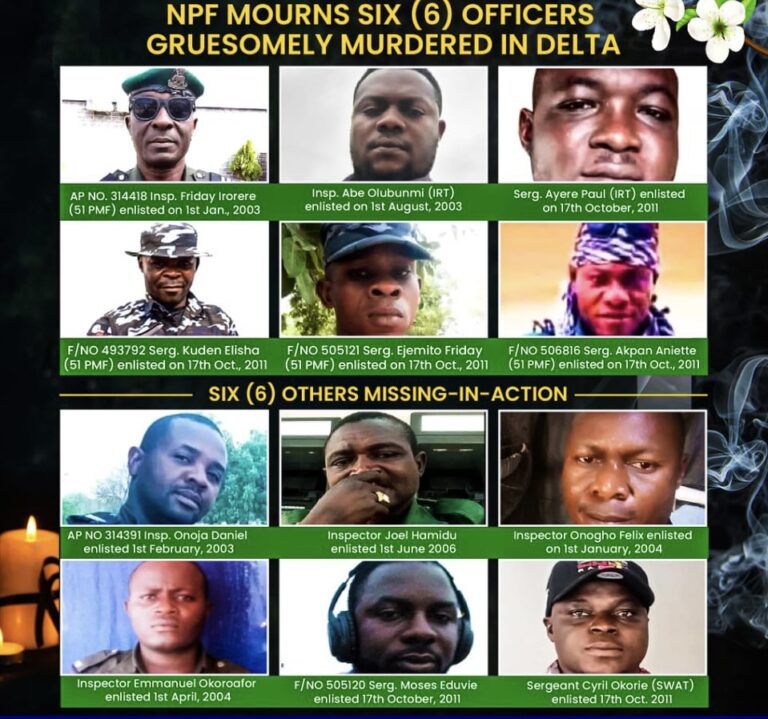
Police mourn 6 officers killed in Delta ambush, confirm 6 others missing

0

THE Nigeria Police Force has expressed sadness over the gruesome murder of six officers while investigating the disappearance of three of their colleagues in the Ohoro Forest, Delta State.

The police confirmed that six other officers who participated in the patrol were missing in action. 

A statement by the force spokesman, Olumuyiwa Adejobi, noted that the “brave officers tragically fell victim to a cowardly ambush by armed assailants while undertaking a mission to investigate the disappearance and rescue of three of their colleagues in the Ohoro Forest, Delta State.”

This was as the Police confirmed that five suspects in connection with the gruesome murder of six policemen had been arrested.

While noting that the force was committed to honouring the memory of the fallen officers for their sacrifice, the police said it would posthumously honour the slain officers at the Nigeria Police Awards Ceremony on April 5th, 2024.

Adejobi also noted that the bodies of six of the slain officers had been recovered after a fierce search conducted by a combined team of police officers and other security outfits, adding that the Force focussed on the search for the other six officers.

He further said the Inspector General of Police, Kayode Egbetokun, had mandated the expedited processing and payment of all entitlements due to the families of the fallen officers, aiming to alleviate any financial burdens they might encounter.

“Similarly, immediate measures have been initiated to ensure that justice is served swiftly and the perpetrators of this abhorrent crime are brought to justice. The Inspector General of Police has mandated the deployment of all necessary resources and personnel to apprehend those responsible for this senseless killing of our officers, and this has led to the arrest of five (5) suspects in connection with the preceding incident and the killing, who are currently volunteering information necessary for the rounding up of all the perpetrators.

“It is paramount to underscore that contrary to perceived notions in some quarters, the Nigeria Police Force is committed to responding decisively to the loss of its officers and men as a result of the many unforeseen hazards associated with our job due to the dynamics of crimes and criminality globally.

“Recent incidents, such as the murder of SP Angbashim in Rivers State, where the perpetrators have been painstakingly traced to their hideout and decimated during the exchange of gunfire with gallant operatives of the Force is a vital pointer,” the statement added.

The police, therefore, strongly condemned any further assaults on officers and other law enforcement personnel who selflessly dedicate themselves to safeguarding the lives and property of all citizens.

The statement added that Egbetokun vowed to pursue justice for all fallen officers and urged public cooperation in apprehending perpetrators.

This recent killings of the policemen in Delta came a week after The ICIR reported how 15 military personnel, consisting of two majors, one captain, and 12 soldiers, were allegedly murdered by some youths in the Okuama community.

The incident, which occurred on Thursday, March 14, happened when the deceased were responding to a crisis between Okuama and Okoloba communities in Bomadi Local Government Area of Delta State.

The attack has since led to an alleged reprisal attack on the community by the military, with many residents said to have deserted their houses.

Senegal set for presidential poll after weeks of violence

0

ELECTORATE in Senegal are heading to the polls on Sunday, March 24, to elect a new president who will succeed the incumbent Macky Sall. 

The election will be held after Sall’s failed attempt to postpone the exercise until the end of the year.

It had been scheduled for February 25 until Sall deferred it, leading to violent protests across the country.

In an interview with the BBC, Sall stated that he acted to protect the integrity of the vote after allegations of corruption and disputes over the eligibility of some presidential candidates.

But his critics accused him of seeking to extend his term in office or buy time to prepare his preferred candidate.

He denied the claims.

Read Also:

Sall has almost exhausted his second term as president of Senegal, one of West Africa’s most stable democracies.

He assumed office on April 2, 2012, and has promised to hand over on April 2, 2024, when his term ends.

He cannot seek re-election under the country’s Constitution for a third term.

Apart from stirring up protests in the country, his decision to delay the election led to political turmoil.

It took the intervention of the Constitutional Court for the President to agree to allow the poll to be held and, consequently, leave office in April.

The impasse resulted in his government conceding to the election date less than a month before his tenure’s end.

Sunday’s election is set to be Senegal’s fourth democratic power transfer since it gained independence from France in 1960.

There are 17 candidates in the race. They include a former Prime Minister, Idrissa Seck, and a former mayor of Dakar, Khalifa Sall.

In recent developments, a top opposition leader, Ousmane Sonko, was released from prison last week, triggering celebrations on the streets of Dakar and renewing excitement about the contest.

Sonko has been barred from contesting, due to the charges against him but has been fully supportive of Bassirou Diomaye Faye, his party’s candidate.

Here are the profiles of the top contenders:

Amadou Ba

Amadou Ba is the nominee of the ruling party, Alliance for the Republic, and Sall’s favoured replacement.

Aged 62, Ba, a former Minister of Foreign Affairs and subsequently of Economy and Finance, runs on an agenda which seeks to sustain the current administration’s economic blueprint. He also pledges to restore peace and unity following months of political unrest.

Amadou Ba, Senegal presidential candidate
Amadou BaBassirou Diomaye Faye

The 44-year-old Bassirou Diomaye Faye is the opposition leader Ousmane Sonko’s replacement. After being freed from prison on March 14 with Sonko, the co-founder of the opposition Pastef party is running a political campaign that seeks to restore Senegal’s ‘sovereignty.’

Bassirou Diomaye Faye
Bassirou Diomaye Faye. Photo Credit; WikidataIdrissa Seck

Idrissa Seck of the Rewmi party,  a former Prime Minister who worked under former president Abdoulaye Wade from 2002 to 2004, is a candidate for president for the fourth time. The 64-year-old former Sall’s rival has attempted several times to use his political background to win the nation’s presidency but has been unsuccessful.

Idrissa Seck
Idrissa Seck. Photo Credit; Facebook

Khalifa Sall

Not to be confused with the departing president, Khalifa Sall is another contender. The Taxawu Senegal alliance leader was disqualified from running for president in 2019 after being found guilty of fraud and theft of public funds in 2018.

He was given a presidential pardon and a statute allowing the restoration of civil rights for those convicted of crimes who were granted amnesty after a nationwide dialogue that the government started in May 2023. Macky Sall’s opponent has subsequently made a comeback to politics.

Khalifa Sall
Khalifa Sall. Photo credit; X

Other candidates in the contest are:

  • Anta Babacar Ngom
  • Boubacar Camara
  • Déthié Fall
  • Daouda Ndiaye
  • Mame Boye Diao
  • Mouhamed Boun Abdallah Dionne
  • Aliou Mamadou Dia
  • Malick Gackou
  • Aly Ngouille Ndiaye
  • Mamadou Lamine Diallo
  • Serigne Mboup
  • Pape Djibril Fall
  • Thierno Allassane Sall

10 things to know about attack on Russia’s Crocus City Hall

0

WITH the recent attack on an entertainment venue in the Russian capital, Moscow, many people, including Nigerians, have expressed concern and demanded a thorough probe into the attack.

The ICIR reported that at least 115 were killed and nearly 200 injured after gunmen opened fire and set off explosives at a concert hall – Crocus City Hallon the western end of Moscow.

The attack was reported to have begun on Friday night, March 22, when the audience was taking their seats for a sold-out show by Picnic, a popular rock band from the Soviet era in the Russian capital.

Read Also:

Nigeria condoles with Russia over deaths of over 100 citizens in Moscow attack

Putin signs agreement on Russia’s annexation of four Ukrainian regions

Wagner boss Prigozhin presumed dead after Russia plane crash

According to the report, about five armed men entered the concert hall,  shooting into the crowd and setting off explosives that started a massive fire.

While the attack has continued to generate public outbursts and more details continue to emerge over it, here are ten major things to know about the incident.

  • Russia’s Investigative Committee has confirmed at least 115 people died in the attack, and over 200 were injured.
  • The targeted Crocus City Hall building is one of the biggest entertainment complexes in Moscow, with over 6,000 capacity.
  • Rescue services have evacuated about 100 people from the basement of the Crocus City Hall.
  • A branch of the Islamic State claimed responsibility for the attack, ISIL
  • The attackers, according to the prosecutor’s office, entered the concert hall, about 20 kilometres (12 miles) from the Kremlin and next to the Moscow Ring Road, and fired on those inside.
  • The assailants used explosives and flammable liquids to set the building ablaze after initially opening fire on people, according to Russian investigators.
  • The authorities have detained at least 11 people, including all four they say were directly involved, but have not identified the assailants or their motives.
  • The United States of America, Spain, Italy and Nigeria have condemned the attack.
  • Ukraine has since denied having a connection with the attack.
  • The attack is one of Russia’s deadliest incidents since the 2004 Beslan school siege, which claimed the lives of over 330 individuals, including many children.                                                                                                                                                  

Nigeria condoles with Russia over deaths of over 100 citizens in Moscow attack

0

The Nigerian Government on Saturday, March 23, commiserated with the Russian Federation on the tragic attack on Crocus City Hall in Moscow that led to the deaths of over 100 citizens. 

The Minister of Foreign Affairs, Yusuf Tuggar, in a statement, condoled with the Russian Federation over the attack that also caused injuries to over 100 others.

The ICIR gathered that at least 115 people were killed and nearly 200 injured after gunmen opened fire and set off explosives at a concert hall on the western end of Moscow.

Read Also:

European Ambassadors blame soaring global food prices on ‘illegal’ Russian invasion of Ukraine

The Wagner Group and the revolt in Russia

Russia will pay heavy price if it attacks Ukraine, NATO warns

The attack was said to have begun on Friday night, March 22, when the audience was taking their seats for a sold-out show by Picnic, a popular rock band from the Soviet era in the Russian capital.

According to the report, about five armed men invaded the concert hall,  shooting into the crowd and setting off explosives that started a massive fire.

Aljazeera quoted the Russian news agency Interfax, stating that the attackers set off explosives that ignited a massive blaze that at one point covered as much as 12,900 square metres (139,000sq ft).

Reacting to the attack, the Nigerian government said, “The Government and people of Nigeria commiserate with the victims of this tragic attack and pray for the repose of their souls. We also pray for the quick recovery of those injured.

“At this challenging time, we stand in brotherhood with the government and Russian Federation and send our deepest sympathy and condolences to the Russian President, His Excellency Vladimir Putin.”

Although Ukraine has strongly denied any connection with the attack, ISIL, an extremist organisation that previously aimed to seize control of Iraq and Syria, took responsibility for the attack on its Telegram channel, stating that the assailants had fled.

However, the spokesperson for Russia’s Investigative Committee, on Saturday morning, said it was too early to say anything about the fate of the attackers, state news agency RIA reported.

The assault marked one of Russia’s deadliest incidents since the 2004 Beslan school siege, which claimed the lives of over 330 individuals, including many children.